EP4079497B1 - Procédé d'enlèvement de couches adhésives de matière des pneus de véhicule - Google Patents
Procédé d'enlèvement de couches adhésives de matière des pneus de véhicule Download PDFInfo
- Publication number
- EP4079497B1 EP4079497B1 EP21209141.7A EP21209141A EP4079497B1 EP 4079497 B1 EP4079497 B1 EP 4079497B1 EP 21209141 A EP21209141 A EP 21209141A EP 4079497 B1 EP4079497 B1 EP 4079497B1
- Authority
- EP
- European Patent Office
- Prior art keywords
- material layer
- adhering material
- vehicle tyre
- vehicle tire
- adhering
- Prior art date
- Legal status (The legal status is an assumption and is not a legal conclusion. Google has not performed a legal analysis and makes no representation as to the accuracy of the status listed.)
- Active
Links
Images
Classifications
-
- B—PERFORMING OPERATIONS; TRANSPORTING
- B29—WORKING OF PLASTICS; WORKING OF SUBSTANCES IN A PLASTIC STATE IN GENERAL
- B29D—PRODUCING PARTICULAR ARTICLES FROM PLASTICS OR FROM SUBSTANCES IN A PLASTIC STATE
- B29D30/00—Producing pneumatic or solid tyres or parts thereof
- B29D30/06—Pneumatic tyres or parts thereof (e.g. produced by casting, moulding, compression moulding, injection moulding, centrifugal casting)
- B29D30/0601—Vulcanising tyres; Vulcanising presses for tyres
- B29D30/0633—After-treatment specially adapted for vulcanising tyres
-
- B—PERFORMING OPERATIONS; TRANSPORTING
- B29—WORKING OF PLASTICS; WORKING OF SUBSTANCES IN A PLASTIC STATE IN GENERAL
- B29B—PREPARATION OR PRETREATMENT OF THE MATERIAL TO BE SHAPED; MAKING GRANULES OR PREFORMS; RECOVERY OF PLASTICS OR OTHER CONSTITUENTS OF WASTE MATERIAL CONTAINING PLASTICS
- B29B17/00—Recovery of plastics or other constituents of waste material containing plastics
- B29B17/02—Separating plastics from other materials
-
- B—PERFORMING OPERATIONS; TRANSPORTING
- B29—WORKING OF PLASTICS; WORKING OF SUBSTANCES IN A PLASTIC STATE IN GENERAL
- B29B—PREPARATION OR PRETREATMENT OF THE MATERIAL TO BE SHAPED; MAKING GRANULES OR PREFORMS; RECOVERY OF PLASTICS OR OTHER CONSTITUENTS OF WASTE MATERIAL CONTAINING PLASTICS
- B29B17/00—Recovery of plastics or other constituents of waste material containing plastics
- B29B17/02—Separating plastics from other materials
- B29B2017/0213—Specific separating techniques
- B29B2017/0217—Mechanical separating techniques; devices therefor
-
- B—PERFORMING OPERATIONS; TRANSPORTING
- B29—WORKING OF PLASTICS; WORKING OF SUBSTANCES IN A PLASTIC STATE IN GENERAL
- B29D—PRODUCING PARTICULAR ARTICLES FROM PLASTICS OR FROM SUBSTANCES IN A PLASTIC STATE
- B29D30/00—Producing pneumatic or solid tyres or parts thereof
- B29D30/06—Pneumatic tyres or parts thereof (e.g. produced by casting, moulding, compression moulding, injection moulding, centrifugal casting)
- B29D30/0601—Vulcanising tyres; Vulcanising presses for tyres
- B29D30/0633—After-treatment specially adapted for vulcanising tyres
- B29D2030/0634—Measuring, calculating, correcting tyre uniformity, e.g. correcting RFV
- B29D2030/0638—Correcting by removing material, e.g. by grinding
-
- B—PERFORMING OPERATIONS; TRANSPORTING
- B29—WORKING OF PLASTICS; WORKING OF SUBSTANCES IN A PLASTIC STATE IN GENERAL
- B29L—INDEXING SCHEME ASSOCIATED WITH SUBCLASS B29C, RELATING TO PARTICULAR ARTICLES
- B29L2030/00—Pneumatic or solid tyres or parts thereof
Definitions
- the invention relates to a method for removing adherent layers of material from the surface of a vehicle tire, a device for removing adherent layers of material from the surface of a vehicle tire and the use of electromagnetic radiation of certain wavelengths for the energy-efficient removal of adherent layers of material from the surface of a vehicle tire.
- a particularly relevant example in which corresponding problems can arise are the so-called self-sealing pneumatic vehicle tires, in which, for example, sealants and composite materials are applied to the inner surface of the tire.
- Pneumatic vehicle tires are, for example, in the EP 0007982 B1 or the EP 2168758 A1 disclosed. However, similar problems can also occur with other manufacturing processes.
- the specialist also faces a similar task when it comes to recycling used vehicle tires and thus recycling them. In this case too, it is regularly necessary to remove at least parts of the adhering material layers from the surface of the vehicle tire before it is sent for final recycling.
- this heating usually takes place by essentially completely heating the tire to be processed, for example in a heating cabinet.
- the adhering layer of material is easier to remove and the tire can be returned to the manufacturing process or recycled.
- the object of the present invention was to eliminate or at least reduce the disadvantages of the prior art and in particular to provide a method for removing adherent layers of material from the surface of a vehicle tire, which can be operated in a more time- and energy-efficient manner than the standard method Procedures known to the art.
- the process to be specified should have a high level of operational safety and, in particular, should do without the use of chemicals that are harmful to health.
- the method according to the invention should be able to be operated in a usual factory hall without complex additional safety precautions.
- the method to be specified should have a high degree of flexibility with regard to the properties of the adhered material layer.
- the method to be specified should be particularly powerful, particularly when dealing with self-sealing pneumatic vehicle tires, and should therefore have a particularly good removal effect for adhering sealants or composite materials.
- the present invention to provide a device for removing adherent layers of material from the surface of a vehicle tire, which should preferably be suitable for carrying out the methods to be specified. It was particularly desirable that the device to be specified should be particularly robust and be able to be operated in an energy-efficient manner.
- the device it was a supplementary object of the present invention to design the device in such a way that it can be used for vehicle tires of different sizes without major adjustments.
- the inventor of the present invention has now recognized that the above-mentioned tasks can surprisingly be achieved if, instead of holistically heating the vehicle tire only the adhering material layers are heated, which can be done by electromagnetic radiation of a suitable wavelength.
- the inventor proposes that, for example, a single radiation source can be introduced into the interior between the beads of a tire in order to direct the radiation there essentially exclusively to a layer of material adhering there, without significantly exposing the tire in its overall structure to heat , whereby by rotating the tire in a suitable device it is even possible to achieve uniform heating of larger areas of the adhering material.
- This not only protects the overall structure of the tire from unnecessary heat stress, but the adhering material layer can also be heated significantly faster and using less energy than in the method known from the prior art.
- a vehicle tire is provided. This can, for example, come from production because a manufacturing defect became apparent during production. Alternatively, it can also be a vehicle tire that is to be recycled.
- an adhesive layer of material is arranged on the surface of the vehicle tire, so that the surface of the vehicle tire is at least partially covered by it.
- adherent material layer expresses that the material layer is connected to the surface of the vehicle tire via adhesive interaction and not, for example, through separate fastening means. Accordingly, a method according to the invention is preferred, wherein the adhering material layer exclusively via adhesive interactions on the Adheres to the surface of the vehicle tire, the adherent material layer preferably being an adhesive layer.
- a sealant for example, for essentially the entire inside of a pneumatic vehicle tire to be covered with a sealant, as is provided, for example, in self-sealing pneumatic vehicle tires.
- only locally adhering material layers can be present, for example an area covered with adhesive on the surface of a vehicle tire.
- the adhering material layer is now exposed to electromagnetic radiation. According to the invention, this is done in such a way that the adhering material layer is heated.
- This is a functional limitation that has an influence on the type of electromagnetic radiation. According to the expert understanding, not all electromagnetic radiation leads to heating of the adhered material layers. This is significantly influenced by the absorption behavior of the adhering material layer.
- the person skilled in the art is able to select the suitable electromagnetic radiation depending on the physico-chemical properties of the adhering material layer or to identify particularly suitable wavelengths in the context of routine experiments.
- Microwaves for example, would be suitable for an adherent material layer that, for example, has larger proportions of water, although the same waves would not lead to heating of the adhered material layer in adherent material layers made exclusively of plastics.
- the inventor of the present invention suggests using radiation in the infrared range if in doubt, since this has proven in our own experiments to be particularly suitable for at least sufficiently heating essentially all of the adherent material layers that occur in tire production.
- heating in the context of the present invention is to be construed by practical experts. In accordance with the expert understanding, the term heating therefore means that there is a noticeable increase in temperature in the process, preferably by at least 10 ° C, particularly preferably at least 15 ° C, very particularly preferably at least 20 ° C, so that a minimal increase in temperature results The smallest interactions are not understood as heating of the adhering material layer.
- the functional feature also shows that the irradiation of the adhering material layer with electromagnetic radiation should be the cause of the heating of the adhering material layer.
- Contacting the adhering material layer, for example with a glowing heating wire does not constitute irradiation for heating in the sense of the present invention, even if the glowing heating wire imitates electromagnetic radiation in the infrared range, since the heating is caused primarily by direct material contact with the hot glow wire he follows.
- Particularly preferred is a method according to the invention, wherein the heating of the adhering material layer in step b) is carried out to more than 80%, preferably more than 90%, particularly preferably essentially exclusively, by the electromagnetic radiation.
- step c) of the method according to the invention the composite is separated mechanically, ie the adhesive interaction between the adhering material layer and the surface of the vehicle tire is dissolved using mechanical forces.
- step b) the adhering material layer is heated, which makes it easier to separate the composite and thereby also remove the adhering material layer.
- the method according to the invention has proven to be particularly effective when the adherent layer of material essentially adheres to smooth surfaces. Even if it is possible to remove adhering material layers from the usually profiled tread of the tire, the method can be carried out particularly efficiently on the inner surface of the tire, in particular of pneumatic vehicle tires.
- a method according to the invention is therefore preferred, wherein the surface of the vehicle tire is the inner surface of the tire, with the inner surface of the tire opposite the tread of the tire preferably being covered by the adhering material layer.
- the method according to the invention has proven to be particularly suitable for removing sealants and composite materials, such as those used in particular in self-sealing pneumatic vehicle tires.
- a method according to the invention is therefore preferred, wherein the vehicle tire is a pneumatic vehicle tire, preferably a self-sealing pneumatic vehicle tire.
- a method according to the invention is also preferred, wherein the adhering material layer is formed by a sealant or composite, preferably by a sealant.
- the method according to the invention can in principle be used for a large number of vehicle tires, it has proven to be particularly efficient for processing vehicle tires that comprise a sulfur-crosslinked rubber mixture, in particular since corresponding vehicle tires have a high load capacity and when the composite is mechanically separated between the surface of the The vehicle tire and the heated, adhering layer of material are usually not damaged.
- a method according to the invention is therefore preferred, wherein the vehicle tire has a includes sulfur-crosslinked rubber mixture.
- Particularly preferred in this respect is a method according to the invention, whereby the vehicle tire has not yet been used in a vehicle before the method or is recycled after the method.
- the adhesive material layer comprises one or more polymers which are selected from the group consisting of polyacrylates, polymethacrylates, polyurethanes, silicones, natural rubber and synthetic rubbers, wherein the adhesive material layer preferably comprises further additives which are selected from the group consisting of fillers, especially carbon black and silica, adhesive resins, crosslinkers, stabilizers and solvents.
- the method according to the invention also makes it easier to remove adhering material layers that are essentially hardened, such as hardened adhesive layers or sulfur-crosslinked rubber compounds. Even if the heating of corresponding layers leads to improved removability, the effect that can be achieved is sometimes perceived as inadequate, so that further measures may be necessary. It has been shown that particularly reliable results can be achieved with the method according to the invention, particularly when the adhering material layer is a pasty material layer which, for example, is not completely hardened in the case of plastics. A method according to the invention is therefore preferred, wherein the Adhering material layer is a pasty material layer. The person skilled in the art can in principle easily identify material layers as pasty material layers.
- a material layer is preferably regarded as a pasty material layer if it has a viscosity of more than 5000 Pa s at 25 ° C, particularly preferably a viscosity in the range from 5000 Pa s to 500,000 Pa s.
- the adhering material layer is designed in such a way that the temperature increase induced in the method according to the invention leads to a reduction in adhesion to the vehicle tire or in viscosity.
- the former is often the case, for example, when the adhering material layer is attached via a hot-melt adhesive, for example, whereas the second case is observed, for example, for thermoplastics.
- a method according to the invention is therefore preferred, wherein the adhering material layer is designed such that the adhesion of the adhering material layer to the vehicle tire and/or the viscosity of the adhering material layer decreases with increasing temperature, preferably by more than 10%, particularly preferably by more than 20 %, most preferably more than 30%.
- a method according to the invention is therefore preferred, wherein the vehicle tire in step a) is provided in a holding element which is designed to rotate the vehicle tire about its tire axis.
- a method according to the invention is also preferred, wherein the vehicle tire in while step b) and/or step c) is rotated about the tire axis, and/or wherein steps b) and c) are carried out simultaneously at different points on the vehicle tire.
- an infrared radiator as the radiation source.
- any radiation sources that show at least a certain intensity of emission at infrared wavelengths.
- the infrared radiator and, as a result, the electromagnetic radiation have the maximum intensity of the emissions or the intensity maximum in the spectrum at a wavelength in the infrared range in order to minimize the energy emitted in other spectral ranges.
- a method according to the invention is therefore preferred, wherein the electromagnetic radiation in step b) is generated by an infrared radiator as a radiation source, the infrared radiator preferably having the maximum intensity of the emission at a wavelength in the range from 780 to 50,000 nm, particularly preferably in the range from 780 to 3000 nm, most preferably in the range from 780 to 1400 nm.
- the electromagnetic radiation in step b) has the intensity maximum at a wavelength in the range from 780 to 50,000 nm, particularly preferably in the range from 780 to 3000 nm, very particularly preferably in the range from 780 to 1400 nm, having.
- the temperature of the adhering material layer should be increased relatively significantly in order to enable good detachment.
- a method according to the invention is preferred, wherein the adhering material layer in step b) is heated at least in sections to a temperature of 60 ° C or more, preferably 80 ° C or more.
- step b) Even if it would in principle be conceivable to heat larger parts of the tire and/or material layers adhering over a large area at the same time, for example by using several radiation sources, with a view to energy-efficient process management, it is clearly preferred that local heating takes place in step b), that is, the adhering material layer is only irradiated in sections and is consequently heated. This is particularly advantageous because the local heating and subsequent removal of the adhering material layer in a stepwise manner Process comparatively little heat is lost through cooling. A method according to the invention is therefore preferred, wherein the heating in step b) is local heating.
- the method according to the invention it would in principle be possible to also heat the vehicle tire, for example through the very wide and unfocused use of several infrared radiators. In light of the task, however, it is clear that a corresponding procedure is less preferred. In fact, it is expedient to carry out the method according to the invention in such a way that essentially only the adhering material layers are heated. This can be expressed by the fact that the average temperature of the vehicle tire in the method according to the invention should be below certain limit values. This is particularly advantageous because it means that unnecessary energy input into the vehicle tires and the resulting premature aging can be avoided.
- a method according to the invention is therefore preferred, wherein the vehicle tire in step b) has an average temperature of 50 ° C or less, preferably of 40 ° C or less, particularly preferably of 30 ° C or less at all times.
- a method according to the invention is preferred, wherein the radiation source in step b) is introduced between the beads of a pneumatic vehicle tire in order to irradiate a layer of material adhering to the inner surface of the tire.
- the method according to the invention is not limited as to how the mechanical separation ultimately has to be carried out.
- a separation tool which can be, for example, a spatula.
- both separation methods are used in combination.
- the mechanical separation of the composite is carried out or supported by a separating tool, preferably by a spatula, and/or where the mechanical separation is carried out or is supported by applying a tensile force to the adhering material layer
- the adhering material layer is preferably contacted with a tool which has a surface to which the adhering material layer has a higher adhesion than to the pneumatic vehicle tire.
- the device according to the invention is particularly suitable for carrying out a method according to the invention.
- the device comprises a holding element, one or more infrared radiators and one or more cutting tools. It can be seen that the device according to the invention can therefore be used to carry out a preferred method according to the invention.
- the holding element for holding a vehicle tire which is still optional for the method according to the invention, has proven to be essential with regard to the design of the device according to the invention in order to enable the method to be carried out in a way that is relevant to industrial practice.
- an infrared radiator as a radiation source has proven useful, as this provides at least sufficient heating power for essentially all adhesive material layers occurring in the tire industry.
- the infrared heater has proven itself particularly with regard to the aspect of the robustness of the device to be maintained and the necessary occupational safety precautions proven to be the most advantageous radiation source when it comes to specifying a device that can be used particularly efficiently in industrial tire production.
- the infrared radiators are arranged so that the electromagnetic radiation generated by them can impinge on the surface of the vehicle tire arranged in the holding element, for example on the profiled tread of the vehicle tire or on the inside of a vehicle tire.
- the one or more cutting tools are designed to be lowered or lifted relative to a vehicle tire arranged in the holding element. This is particularly important since the replacement of vehicle tires in the device according to the invention would be significantly more difficult if the separating tools were fixed in the position in which they can cause a separation of the bond between the adhering material layer and the vehicle tire, which of course occurs essentially immediately is in contact with the surface of the vehicle tire.
- the arrangement according to the invention also makes it possible to attach vehicle tires of different sizes in the same device. In this case, the cutting tools provided are simply lowered to the necessary depth relative to the vehicle tire so that it rests on the surface.
- step c) it is particularly time and energy efficient if the separation of the composite in step c) takes place at those locations that were heated immediately beforehand by irradiation with electromagnetic radiation.
- energy efficiency it is not advisable to use tools to perform the mechanical separation at exactly the point that is currently being irradiated, as this would result in a large part of the electromagnetic radiation only being used to heat the tool and thus for the actual material Purpose would be lost.
- a device wherein the one or more separating tools are arranged so that they are arranged behind the one or more infrared radiators in relation to the direction of rotation of a vehicle tire arranged in the holding element, so that they can act on sections of the vehicle tire that were previously were exposed to electromagnetic radiation.
- the one or more infrared radiators are arranged in such a way that the electromagnetic radiation generated is directed onto the inner tire surface of a vehicle tire arranged in the holding element, the one or more infrared radiators preferably lying during operation between the beads of a vehicle tire arranged in the holding element, and/or wherein the one or more separating tools are arranged so that they can be lowered onto the inner tire surface of a vehicle tire arranged in the holding element, wherein the one or more separating tools are preferably in operation between the beads of a vehicle tire arranged in the holding element.
- the invention also includes the use of electromagnetic radiation which has its maximum intensity at a wavelength in the range from 780 to 50,000 nm, particularly preferably in the range from 780 to 3000 nm, very particularly preferably in the range from 780 to 1400 nm, for the energy-efficient removal of adherent material layers from the surface of a vehicle tire.
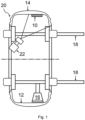
- Fig. 1 shows a simplified, schematic representation of a device 20 according to the invention in a preferred embodiment, from which step b) of the method according to the invention can also be seen in a preferred embodiment.
- Fig. 1 shows a vehicle tire 14, which in the present case is designed as a pneumatic vehicle tire. This is arranged in a device 20 according to the invention and suspended therein in the holding element 18, which is set up to hold vehicle tires 14.
- the device 20 is set up to rotate the vehicle tire 14 arranged in the holding element 18 about the tire axis, which is shown here by a dashed line.
- the surface 12 of the vehicle tire 14 is covered by an adhesive layer of material 10.
- This adherent material layer 10 is in the in Fig. 1
- the work step shown is irradiated with electromagnetic radiation and heated as a result of this irradiation.
- the electromagnetic radiation is generated by a radiation source 22, which in the present example is an infrared radiator, which is arranged so that the generated electromagnetic radiation can impinge on the surface 12 of the vehicle tire 14, in particular in the area in which the adherent material layer 10 is present.
- separating tool 16 arranged, which is designed as a spatula and which can be lowered and raised relative to the vehicle tire 14 arranged in the holding element 18.
- This separating tool 16 serves to mechanically separate the bond between the surface 12 of the vehicle tire 14 and the heated adhesive material layer 10, so that the adhesive material layer 10 can be easily removed.
- the vehicle tire 14 shown may, for example, be a pneumatic vehicle tire with a typical manufacturing defect, such as can occur when applying a sealant or composite that is used in the production of self-sealing pneumatic vehicle tires.
- the vehicle tire 14 itself comprises a sulfur-crosslinked rubber mixture and is connected to the adherent material layer 10 via an adhesive interaction.
- the adhering material layer 10 comprises a rubber mixture which, in addition to natural rubber and the synthetic rubber SSBR, also includes other additives, in particular carbon black.
- the adhering material layer 10, which has not yet hardened, is therefore a pasty material layer.
- the adhering material layer 10 in the example shown is heated to 80 ° C, with exclusively local heating ensuring that the average temperature of the vehicle tire 14 is essentially the room temperature, for example 23 ° C corresponds.
- the radiation source 22 is arranged so that the radiation emitted by it can impinge unhindered on the adhering material layer 10, which in the present case is also caused by the holding element 18 at least partially spreading the beads of the vehicle tire 14.
- the separating tool 16 in the form shown is lowered during operation relative to the surface 12 of the vehicle tire 14 and thereby placed between the beads of the vehicle tire 14 arranged in the holding element 18.
Landscapes
- Engineering & Computer Science (AREA)
- Mechanical Engineering (AREA)
- Environmental & Geological Engineering (AREA)
- Adhesives Or Adhesive Processes (AREA)
- Tyre Moulding (AREA)
Claims (10)
- Procédé pour enlever des couches de matériau adhérentes (10) de la surface (12) d'un pneu de véhicule (14), comprenant les étapes suivantes :a) la fourniture d'un pneu de véhicule (14), la surface (12) du pneu de véhicule (14) étant au moins partiellement recouverte d'une couche de matériau adhérente (10),b) l'exposition de la couche de matériau adhérente (10) à un rayonnement électromagnétique pour chauffer la couche de matériau adhérente (10), etc) la séparation mécanique de la liaison entre la surface (12) du pneu de véhicule (14) et la couche de matériau adhérente chauffée (10) pour enlever la couche de matériau adhérente (10).
- Procédé selon la revendication 1, dans lequel le rayonnement électromagnétique à l'étape b) présente le maximum d'intensité à une longueur d'onde dans la plage de 780 à 50 000 nm, de manière particulièrement préférée dans la plage de 780 à 3 000 nm, de manière tout particulièrement préférée dans la plage de 780 à 1 400 nm.
- Procédé selon l'une quelconque des revendications 1 ou 2, dans lequel, à l'étape b), la couche de matériau adhérente (10) est chauffée au moins par sections à une température de 60 °C ou plus, de préférence de 80 °C ou plus.
- Procédé selon l'une quelconque des revendications 1 à 3, dans lequel, à l'étape b), le pneu de véhicule (14) présente à tout moment une température moyenne de 50 °C ou moins, de préférence de 40 °C ou moins, de manière particulièrement préférée de 30 °C ou moins.
- Procédé selon l'une quelconque des revendications 1 à 4, dans lequel la séparation mécanique de la liaison est effectuée ou assistée par un outil de séparation (16), de préférence par une spatule,
et/ou
dans lequel la séparation mécanique est effectuée ou assistée par sollicitation de la couche de matériau adhérente (10) avec une force de traction, la couche de matériau adhérente (10) étant de préférence mise en contact avec un outil qui présente une surface à laquelle la couche de matériau adhérente (10) présente une adhérence plus élevée qu'au pneu de véhicule (14). - Procédé selon l'une quelconque des revendications 1 à 5, dans lequel la couche de matériau adhérente (10) comprend un ou plusieurs polymères choisis dans le groupe constitué par les polyacrylates, les polyméthacrylates, les polyuréthanes, les silicones, le caoutchouc naturel et les caoutchoucs synthétiques, la couche de matériau adhérente comprenant de préférence d'autres additifs choisis dans le groupe constitué par les charges, notamment le noir de carbone et la silice, les résines adhésives, les agents de réticulation, les stabilisants et les solvants.
- Procédé selon l'une quelconque des revendications 1 à 6, dans lequel la couche de matériau adhérente (10) est configurée de telle sorte que l'adhérence de la couche de matériau adhérente (10) au pneu de véhicule (14) et/ou la viscosité de la couche de matériau adhérente (10) diminuent lorsque la température augmente.
- Procédé selon l'une quelconque des revendications 1 à 7, dans lequel le pneu de véhicule est fourni à l'étape a) dans un élément de support (18) adapté pour faire tourner le pneu de véhicule (14) autour de son axe de pneu,
et/ou
dans lequel le pneu de véhicule (14) est fait tourner autour de l'axe de pneu pendant l'étape b) et/ou l'étape c). - Dispositif (20) pour enlever des couches de matériau adhérentes (10) de la surface (12) d'un pneu de véhicule (14), de préférence dans un procédé selon l'une quelconque des revendications 1 à 8, comprenantx) un élément de support (18) destiné à recevoir un pneu de véhicule (14), notamment un pneumatique de véhicule,y) un ou plusieurs émetteurs infrarouges en tant que source de rayonnement (22), etz) un ou plusieurs outils de séparation (16),le dispositif (20) étant adapté pour qu'un pneu de véhicule (14) agencé dans l'élément de support (18) puisse être fait tourner autour de l'axe de pneu,le ou les émetteurs infrarouges étant agencés de manière à ce que le rayonnement électromagnétique généré soit incident sur la surface (12) d'un pneu de véhicule (14) agencé dans l'élément de support (18),le ou les outils de séparation (16) étant adaptés pour être abaissés ou soulevés par rapport à un pneu de véhicule (14) agencé dans l'élément de support (18).
- Utilisation de rayonnement électromagnétique, qui présente son maximum d'intensité à une longueur d'onde dans la plage de 780 à 50 000 nm, de manière particulièrement préférée dans la plage de 780 à 3 000 nm, de manière tout particulièrement préférée dans la plage de 780 à 1 400 nm, pour le chauffage local, efficace du point de vue énergétique, de couches de matériau adhérentes (10) sur la surface (12) d'un pneu de véhicule (14) et ensuite l'enlèvement progressif de la couche de matériau.
Applications Claiming Priority (1)
| Application Number | Priority Date | Filing Date | Title |
|---|---|---|---|
| DE102021203878.6A DE102021203878A1 (de) | 2021-04-19 | 2021-04-19 | Verfahren zum Entfernen von anhaftenden Materialschichten von Fahrzeugreifen |
Publications (3)
| Publication Number | Publication Date |
|---|---|
| EP4079497A1 EP4079497A1 (fr) | 2022-10-26 |
| EP4079497B1 true EP4079497B1 (fr) | 2024-02-28 |
| EP4079497B8 EP4079497B8 (fr) | 2024-04-03 |
Family
ID=78695643
Family Applications (1)
| Application Number | Title | Priority Date | Filing Date |
|---|---|---|---|
| EP21209141.7A Active EP4079497B8 (fr) | 2021-04-19 | 2021-11-18 | Procédé d'enlèvement de couches adhésives de matière des pneus de véhicule |
Country Status (2)
| Country | Link |
|---|---|
| EP (1) | EP4079497B8 (fr) |
| DE (1) | DE102021203878A1 (fr) |
Cited By (1)
| Publication number | Priority date | Publication date | Assignee | Title |
|---|---|---|---|---|
| WO2025221489A1 (fr) * | 2024-04-17 | 2025-10-23 | Dow Global Technologies Llc | Dispositif et procédé de séparation de l'étanchéité d'un pneu auto-obturant |
Families Citing this family (1)
| Publication number | Priority date | Publication date | Assignee | Title |
|---|---|---|---|---|
| DE102022212440A1 (de) * | 2022-11-22 | 2024-05-23 | Continental Reifen Deutschland Gmbh | Verfahren zum Ablösen einer Reifenschicht |
Family Cites Families (4)
| Publication number | Priority date | Publication date | Assignee | Title |
|---|---|---|---|---|
| US4228839A (en) | 1978-08-03 | 1980-10-21 | The Firestone Tire & Rubber Company | Self-sealing pneumatic tire |
| CN101778715A (zh) | 2007-07-24 | 2010-07-14 | 横滨橡胶株式会社 | 自封式充气轮胎的制造方法和装置 |
| US20200189215A1 (en) * | 2018-12-13 | 2020-06-18 | The Goodyear Tire & Rubber Company | Method for forming a sealant layer in a tire |
| DE202019100947U1 (de) * | 2019-02-19 | 2019-03-04 | 4Jet Technologies Gmbh | Hochgeschwindigkeits-Reifenreinigungsvorrichtung |
-
2021
- 2021-04-19 DE DE102021203878.6A patent/DE102021203878A1/de not_active Withdrawn
- 2021-11-18 EP EP21209141.7A patent/EP4079497B8/fr active Active
Cited By (1)
| Publication number | Priority date | Publication date | Assignee | Title |
|---|---|---|---|---|
| WO2025221489A1 (fr) * | 2024-04-17 | 2025-10-23 | Dow Global Technologies Llc | Dispositif et procédé de séparation de l'étanchéité d'un pneu auto-obturant |
Also Published As
| Publication number | Publication date |
|---|---|
| DE102021203878A1 (de) | 2022-10-20 |
| EP4079497A1 (fr) | 2022-10-26 |
| EP4079497B8 (fr) | 2024-04-03 |
Similar Documents
| Publication | Publication Date | Title |
|---|---|---|
| DE102013112933B4 (de) | Verfahren zum Reparieren von Faser-Kunststoff-Verbünden | |
| DE102021129301B3 (de) | Verfahren und Vorrichtung zum Verarbeiten eines Solarmoduls | |
| WO2008128612A1 (fr) | Procédé de formation de trous débouchants dans des éléments en verre | |
| EP2133923A2 (fr) | Procédé de recyclage pour modules de cellules solaires à couche fine | |
| EP4079497A1 (fr) | Procédé d'enlèvement de couches adhésives de matière des pneus de véhicule | |
| EP3515677A1 (fr) | Procédé et dispositif pour le recyclage d'un matériau composite thermoplastique renforcé par fibres | |
| DE112015002860B4 (de) | Verfahren und Vorrichtung für laserunterstütztes Kraftreinigen | |
| DE10352964B3 (de) | Verfahren zum Entfernern von Matrixharzen aus faserverstärkten Kunststoffbauteilen | |
| DE4213450C1 (de) | Verfahren und Vorrichtung zur Aufbereitung von Verbundglasscheiben und Rückgewinnung der Werkstoffkomponenten | |
| EP3831567B1 (fr) | Procédé de recyclage des pneumatiques de véhicule pourvus de couche intermédiaire d'étanchéité | |
| EP4419320B1 (fr) | Procédé de liaison de composants de pneumatique | |
| EP3548263B1 (fr) | Dispositif et procede de réparation de sites endommagés | |
| EP1478602B1 (fr) | Verre a couche superficielle durcie et procede permettant de le produire | |
| DE102012105730A1 (de) | Verfahren zur Reduzierung der Klebrigkeitseigenschaften eines an einem Reifenrohling angeordneten unvulkanisierten Laufstreifens | |
| DE102011082192B4 (de) | Verfahren und Vorrichtung zum Herstellen von Prepregs aus Wickelverfahren | |
| DE102020203343B4 (de) | Verfahren und Vorrichtung zur Qualitätssicherung industriell beschichteter metallischer Substrate aufweisend eine KTL-Beschichtung, einschließlich Fahrzeug(bremsen)komponente | |
| DE102015014013B3 (de) | Verfahren zur Erstellung von radsegmentförmigen Probestücken aus dem Laufkranz von Schienenfahrzeugrädern im Rahmen der Wärmebehandlung dieser Schienenfahrzeugräder durch Härten und Vorrichtung zur Durchführung des Verfahrens | |
| EP4522409A1 (fr) | Dispositif d'ouverture de soupapes, dispositif de nettoyage laser, ensemble de traitement de moule, segment de moule, procédé et produit de programme informatique | |
| DE102011052531A1 (de) | Verfahren zum Schleifen von Messern und Verschleißplatten eines Messerringzerspaners | |
| DE2844602A1 (de) | Trennen von polykristallinem material | |
| EP4263449A1 (fr) | Procédé de traitement, en particulier de prédivision, d'un substrat bidimensionnel | |
| DE102019128541B4 (de) | Verfahren und Vorrichtung zur Behandlung von Fehlstellen in einer Oberfläche eines Transportbands | |
| DE102012219204A1 (de) | Scheibenwaschdüse | |
| EP4098429B1 (fr) | Procédé de préparation de composants de pneu pour l'utilisation lors du rechapage à froid des pneus | |
| DE102012001864B4 (de) | Verfahren und Vorrichtung zum Herauslösen von metallischen Verstärkungslagen |
Legal Events
| Date | Code | Title | Description |
|---|---|---|---|
| PUAI | Public reference made under article 153(3) epc to a published international application that has entered the european phase |
Free format text: ORIGINAL CODE: 0009012 |
|
| STAA | Information on the status of an ep patent application or granted ep patent |
Free format text: STATUS: THE APPLICATION HAS BEEN PUBLISHED |
|
| AK | Designated contracting states |
Kind code of ref document: A1 Designated state(s): AL AT BE BG CH CY CZ DE DK EE ES FI FR GB GR HR HU IE IS IT LI LT LU LV MC MK MT NL NO PL PT RO RS SE SI SK SM TR |
|
| STAA | Information on the status of an ep patent application or granted ep patent |
Free format text: STATUS: REQUEST FOR EXAMINATION WAS MADE |
|
| 17P | Request for examination filed |
Effective date: 20230426 |
|
| RBV | Designated contracting states (corrected) |
Designated state(s): AL AT BE BG CH CY CZ DE DK EE ES FI FR GB GR HR HU IE IS IT LI LT LU LV MC MK MT NL NO PL PT RO RS SE SI SK SM TR |
|
| GRAP | Despatch of communication of intention to grant a patent |
Free format text: ORIGINAL CODE: EPIDOSNIGR1 |
|
| STAA | Information on the status of an ep patent application or granted ep patent |
Free format text: STATUS: GRANT OF PATENT IS INTENDED |
|
| INTG | Intention to grant announced |
Effective date: 20231012 |
|
| GRAS | Grant fee paid |
Free format text: ORIGINAL CODE: EPIDOSNIGR3 |
|
| GRAA | (expected) grant |
Free format text: ORIGINAL CODE: 0009210 |
|
| STAA | Information on the status of an ep patent application or granted ep patent |
Free format text: STATUS: THE PATENT HAS BEEN GRANTED |
|
| REG | Reference to a national code |
Ref country code: DE Ref legal event code: R081 Ref document number: 502021002820 Country of ref document: DE Owner name: CONTINENTAL REIFEN DEUTSCHLAND GMBH, DE Free format text: FORMER OWNER: CONTINENTAL REIFEN DEUTSCHLAND GMBH, 30173 HANNOVER, DE |
|
| P01 | Opt-out of the competence of the unified patent court (upc) registered |
Effective date: 20240116 |
|
| AK | Designated contracting states |
Kind code of ref document: B1 Designated state(s): AL AT BE BG CH CY CZ DE DK EE ES FI FR GB GR HR HU IE IS IT LI LT LU LV MC MK MT NL NO PL PT RO RS SE SI SK SM TR |
|
| REG | Reference to a national code |
Ref country code: GB Ref legal event code: FG4D Free format text: NOT ENGLISH |
|
| REG | Reference to a national code |
Ref country code: CH Ref legal event code: EP |
|
| RAP4 | Party data changed (patent owner data changed or rights of a patent transferred) |
Owner name: CONTINENTAL REIFEN DEUTSCHLAND GMBH |
|
| REG | Reference to a national code |
Ref country code: DE Ref legal event code: R096 Ref document number: 502021002820 Country of ref document: DE |
|
| REG | Reference to a national code |
Ref country code: CH Ref legal event code: PK Free format text: BERICHTIGUNG B8 |
|
| REG | Reference to a national code |
Ref country code: IE Ref legal event code: FG4D Free format text: LANGUAGE OF EP DOCUMENT: GERMAN |
|
| REG | Reference to a national code |
Ref country code: LT Ref legal event code: MG9D |
|
| PG25 | Lapsed in a contracting state [announced via postgrant information from national office to epo] |
Ref country code: IS Free format text: LAPSE BECAUSE OF FAILURE TO SUBMIT A TRANSLATION OF THE DESCRIPTION OR TO PAY THE FEE WITHIN THE PRESCRIBED TIME-LIMIT Effective date: 20240628 |
|
| REG | Reference to a national code |
Ref country code: NL Ref legal event code: MP Effective date: 20240228 |
|
| PG25 | Lapsed in a contracting state [announced via postgrant information from national office to epo] |
Ref country code: LT Free format text: LAPSE BECAUSE OF FAILURE TO SUBMIT A TRANSLATION OF THE DESCRIPTION OR TO PAY THE FEE WITHIN THE PRESCRIBED TIME-LIMIT Effective date: 20240228 |
|
| PG25 | Lapsed in a contracting state [announced via postgrant information from national office to epo] |
Ref country code: GR Free format text: LAPSE BECAUSE OF FAILURE TO SUBMIT A TRANSLATION OF THE DESCRIPTION OR TO PAY THE FEE WITHIN THE PRESCRIBED TIME-LIMIT Effective date: 20240529 |
|
| PG25 | Lapsed in a contracting state [announced via postgrant information from national office to epo] |
Ref country code: HR Free format text: LAPSE BECAUSE OF FAILURE TO SUBMIT A TRANSLATION OF THE DESCRIPTION OR TO PAY THE FEE WITHIN THE PRESCRIBED TIME-LIMIT Effective date: 20240228 Ref country code: RS Free format text: LAPSE BECAUSE OF FAILURE TO SUBMIT A TRANSLATION OF THE DESCRIPTION OR TO PAY THE FEE WITHIN THE PRESCRIBED TIME-LIMIT Effective date: 20240528 Ref country code: NL Free format text: LAPSE BECAUSE OF FAILURE TO SUBMIT A TRANSLATION OF THE DESCRIPTION OR TO PAY THE FEE WITHIN THE PRESCRIBED TIME-LIMIT Effective date: 20240228 |
|
| PG25 | Lapsed in a contracting state [announced via postgrant information from national office to epo] |
Ref country code: ES Free format text: LAPSE BECAUSE OF FAILURE TO SUBMIT A TRANSLATION OF THE DESCRIPTION OR TO PAY THE FEE WITHIN THE PRESCRIBED TIME-LIMIT Effective date: 20240228 |
|
| PG25 | Lapsed in a contracting state [announced via postgrant information from national office to epo] |
Ref country code: RS Free format text: LAPSE BECAUSE OF FAILURE TO SUBMIT A TRANSLATION OF THE DESCRIPTION OR TO PAY THE FEE WITHIN THE PRESCRIBED TIME-LIMIT Effective date: 20240528 Ref country code: NO Free format text: LAPSE BECAUSE OF FAILURE TO SUBMIT A TRANSLATION OF THE DESCRIPTION OR TO PAY THE FEE WITHIN THE PRESCRIBED TIME-LIMIT Effective date: 20240528 Ref country code: NL Free format text: LAPSE BECAUSE OF FAILURE TO SUBMIT A TRANSLATION OF THE DESCRIPTION OR TO PAY THE FEE WITHIN THE PRESCRIBED TIME-LIMIT Effective date: 20240228 Ref country code: LT Free format text: LAPSE BECAUSE OF FAILURE TO SUBMIT A TRANSLATION OF THE DESCRIPTION OR TO PAY THE FEE WITHIN THE PRESCRIBED TIME-LIMIT Effective date: 20240228 Ref country code: IS Free format text: LAPSE BECAUSE OF FAILURE TO SUBMIT A TRANSLATION OF THE DESCRIPTION OR TO PAY THE FEE WITHIN THE PRESCRIBED TIME-LIMIT Effective date: 20240628 Ref country code: HR Free format text: LAPSE BECAUSE OF FAILURE TO SUBMIT A TRANSLATION OF THE DESCRIPTION OR TO PAY THE FEE WITHIN THE PRESCRIBED TIME-LIMIT Effective date: 20240228 Ref country code: GR Free format text: LAPSE BECAUSE OF FAILURE TO SUBMIT A TRANSLATION OF THE DESCRIPTION OR TO PAY THE FEE WITHIN THE PRESCRIBED TIME-LIMIT Effective date: 20240529 Ref country code: FI Free format text: LAPSE BECAUSE OF FAILURE TO SUBMIT A TRANSLATION OF THE DESCRIPTION OR TO PAY THE FEE WITHIN THE PRESCRIBED TIME-LIMIT Effective date: 20240228 Ref country code: ES Free format text: LAPSE BECAUSE OF FAILURE TO SUBMIT A TRANSLATION OF THE DESCRIPTION OR TO PAY THE FEE WITHIN THE PRESCRIBED TIME-LIMIT Effective date: 20240228 Ref country code: BG Free format text: LAPSE BECAUSE OF FAILURE TO SUBMIT A TRANSLATION OF THE DESCRIPTION OR TO PAY THE FEE WITHIN THE PRESCRIBED TIME-LIMIT Effective date: 20240228 |
|
| PG25 | Lapsed in a contracting state [announced via postgrant information from national office to epo] |
Ref country code: PL Free format text: LAPSE BECAUSE OF FAILURE TO SUBMIT A TRANSLATION OF THE DESCRIPTION OR TO PAY THE FEE WITHIN THE PRESCRIBED TIME-LIMIT Effective date: 20240228 Ref country code: PT Free format text: LAPSE BECAUSE OF FAILURE TO SUBMIT A TRANSLATION OF THE DESCRIPTION OR TO PAY THE FEE WITHIN THE PRESCRIBED TIME-LIMIT Effective date: 20240628 |
|
| PG25 | Lapsed in a contracting state [announced via postgrant information from national office to epo] |
Ref country code: SE Free format text: LAPSE BECAUSE OF FAILURE TO SUBMIT A TRANSLATION OF THE DESCRIPTION OR TO PAY THE FEE WITHIN THE PRESCRIBED TIME-LIMIT Effective date: 20240228 Ref country code: PT Free format text: LAPSE BECAUSE OF FAILURE TO SUBMIT A TRANSLATION OF THE DESCRIPTION OR TO PAY THE FEE WITHIN THE PRESCRIBED TIME-LIMIT Effective date: 20240628 Ref country code: PL Free format text: LAPSE BECAUSE OF FAILURE TO SUBMIT A TRANSLATION OF THE DESCRIPTION OR TO PAY THE FEE WITHIN THE PRESCRIBED TIME-LIMIT Effective date: 20240228 Ref country code: LV Free format text: LAPSE BECAUSE OF FAILURE TO SUBMIT A TRANSLATION OF THE DESCRIPTION OR TO PAY THE FEE WITHIN THE PRESCRIBED TIME-LIMIT Effective date: 20240228 |
|
| PG25 | Lapsed in a contracting state [announced via postgrant information from national office to epo] |
Ref country code: DK Free format text: LAPSE BECAUSE OF FAILURE TO SUBMIT A TRANSLATION OF THE DESCRIPTION OR TO PAY THE FEE WITHIN THE PRESCRIBED TIME-LIMIT Effective date: 20240228 |
|
| PG25 | Lapsed in a contracting state [announced via postgrant information from national office to epo] |
Ref country code: SM Free format text: LAPSE BECAUSE OF FAILURE TO SUBMIT A TRANSLATION OF THE DESCRIPTION OR TO PAY THE FEE WITHIN THE PRESCRIBED TIME-LIMIT Effective date: 20240228 |
|
| PG25 | Lapsed in a contracting state [announced via postgrant information from national office to epo] |
Ref country code: EE Free format text: LAPSE BECAUSE OF FAILURE TO SUBMIT A TRANSLATION OF THE DESCRIPTION OR TO PAY THE FEE WITHIN THE PRESCRIBED TIME-LIMIT Effective date: 20240228 Ref country code: CZ Free format text: LAPSE BECAUSE OF FAILURE TO SUBMIT A TRANSLATION OF THE DESCRIPTION OR TO PAY THE FEE WITHIN THE PRESCRIBED TIME-LIMIT Effective date: 20240228 |
|
| PG25 | Lapsed in a contracting state [announced via postgrant information from national office to epo] |
Ref country code: SK Free format text: LAPSE BECAUSE OF FAILURE TO SUBMIT A TRANSLATION OF THE DESCRIPTION OR TO PAY THE FEE WITHIN THE PRESCRIBED TIME-LIMIT Effective date: 20240228 |
|
| PG25 | Lapsed in a contracting state [announced via postgrant information from national office to epo] |
Ref country code: SM Free format text: LAPSE BECAUSE OF FAILURE TO SUBMIT A TRANSLATION OF THE DESCRIPTION OR TO PAY THE FEE WITHIN THE PRESCRIBED TIME-LIMIT Effective date: 20240228 Ref country code: SK Free format text: LAPSE BECAUSE OF FAILURE TO SUBMIT A TRANSLATION OF THE DESCRIPTION OR TO PAY THE FEE WITHIN THE PRESCRIBED TIME-LIMIT Effective date: 20240228 Ref country code: RO Free format text: LAPSE BECAUSE OF FAILURE TO SUBMIT A TRANSLATION OF THE DESCRIPTION OR TO PAY THE FEE WITHIN THE PRESCRIBED TIME-LIMIT Effective date: 20240228 Ref country code: EE Free format text: LAPSE BECAUSE OF FAILURE TO SUBMIT A TRANSLATION OF THE DESCRIPTION OR TO PAY THE FEE WITHIN THE PRESCRIBED TIME-LIMIT Effective date: 20240228 Ref country code: DK Free format text: LAPSE BECAUSE OF FAILURE TO SUBMIT A TRANSLATION OF THE DESCRIPTION OR TO PAY THE FEE WITHIN THE PRESCRIBED TIME-LIMIT Effective date: 20240228 Ref country code: CZ Free format text: LAPSE BECAUSE OF FAILURE TO SUBMIT A TRANSLATION OF THE DESCRIPTION OR TO PAY THE FEE WITHIN THE PRESCRIBED TIME-LIMIT Effective date: 20240228 |
|
| REG | Reference to a national code |
Ref country code: DE Ref legal event code: R097 Ref document number: 502021002820 Country of ref document: DE |
|
| PG25 | Lapsed in a contracting state [announced via postgrant information from national office to epo] |
Ref country code: IT Free format text: LAPSE BECAUSE OF FAILURE TO SUBMIT A TRANSLATION OF THE DESCRIPTION OR TO PAY THE FEE WITHIN THE PRESCRIBED TIME-LIMIT Effective date: 20240228 |
|
| PG25 | Lapsed in a contracting state [announced via postgrant information from national office to epo] |
Ref country code: IT Free format text: LAPSE BECAUSE OF FAILURE TO SUBMIT A TRANSLATION OF THE DESCRIPTION OR TO PAY THE FEE WITHIN THE PRESCRIBED TIME-LIMIT Effective date: 20240228 |
|
| PLBE | No opposition filed within time limit |
Free format text: ORIGINAL CODE: 0009261 |
|
| STAA | Information on the status of an ep patent application or granted ep patent |
Free format text: STATUS: NO OPPOSITION FILED WITHIN TIME LIMIT |
|
| 26N | No opposition filed |
Effective date: 20241129 |
|
| PG25 | Lapsed in a contracting state [announced via postgrant information from national office to epo] |
Ref country code: SI Free format text: LAPSE BECAUSE OF FAILURE TO SUBMIT A TRANSLATION OF THE DESCRIPTION OR TO PAY THE FEE WITHIN THE PRESCRIBED TIME-LIMIT Effective date: 20240228 |
|
| REG | Reference to a national code |
Ref country code: CH Ref legal event code: PL |
|
| PG25 | Lapsed in a contracting state [announced via postgrant information from national office to epo] |
Ref country code: MC Free format text: LAPSE BECAUSE OF FAILURE TO SUBMIT A TRANSLATION OF THE DESCRIPTION OR TO PAY THE FEE WITHIN THE PRESCRIBED TIME-LIMIT Effective date: 20240228 |
|
| PG25 | Lapsed in a contracting state [announced via postgrant information from national office to epo] |
Ref country code: LU Free format text: LAPSE BECAUSE OF NON-PAYMENT OF DUE FEES Effective date: 20241118 |
|
| REG | Reference to a national code |
Ref country code: CH Ref legal event code: PL |
|
| PG25 | Lapsed in a contracting state [announced via postgrant information from national office to epo] |
Ref country code: CH Free format text: LAPSE BECAUSE OF NON-PAYMENT OF DUE FEES Effective date: 20241130 |
|
| REG | Reference to a national code |
Ref country code: BE Ref legal event code: MM Effective date: 20241130 |
|
| PG25 | Lapsed in a contracting state [announced via postgrant information from national office to epo] |
Ref country code: BE Free format text: LAPSE BECAUSE OF NON-PAYMENT OF DUE FEES Effective date: 20241130 |
|
| PG25 | Lapsed in a contracting state [announced via postgrant information from national office to epo] |
Ref country code: FR Free format text: LAPSE BECAUSE OF NON-PAYMENT OF DUE FEES Effective date: 20241130 |
|
| PG25 | Lapsed in a contracting state [announced via postgrant information from national office to epo] |
Ref country code: IE Free format text: LAPSE BECAUSE OF NON-PAYMENT OF DUE FEES Effective date: 20241118 |
|
| PGFP | Annual fee paid to national office [announced via postgrant information from national office to epo] |
Ref country code: DE Payment date: 20251130 Year of fee payment: 5 |
|
| PGFP | Annual fee paid to national office [announced via postgrant information from national office to epo] |
Ref country code: AT Payment date: 20260113 Year of fee payment: 5 |
|
| PG25 | Lapsed in a contracting state [announced via postgrant information from national office to epo] |
Ref country code: HU Free format text: LAPSE BECAUSE OF FAILURE TO SUBMIT A TRANSLATION OF THE DESCRIPTION OR TO PAY THE FEE WITHIN THE PRESCRIBED TIME-LIMIT; INVALID AB INITIO Effective date: 20211118 |
|
| PG25 | Lapsed in a contracting state [announced via postgrant information from national office to epo] |
Ref country code: CY Free format text: LAPSE BECAUSE OF FAILURE TO SUBMIT A TRANSLATION OF THE DESCRIPTION OR TO PAY THE FEE WITHIN THE PRESCRIBED TIME-LIMIT; INVALID AB INITIO Effective date: 20211118 |