EP4080454B1 - Procédé d'exportation d'un modèle de conception dentaire esthétique tridimensionnel d'une application de réalité augmentée vers une application de conception assistée par ordinateur - Google Patents
Procédé d'exportation d'un modèle de conception dentaire esthétique tridimensionnel d'une application de réalité augmentée vers une application de conception assistée par ordinateur Download PDFInfo
- Publication number
- EP4080454B1 EP4080454B1 EP21170126.3A EP21170126A EP4080454B1 EP 4080454 B1 EP4080454 B1 EP 4080454B1 EP 21170126 A EP21170126 A EP 21170126A EP 4080454 B1 EP4080454 B1 EP 4080454B1
- Authority
- EP
- European Patent Office
- Prior art keywords
- model
- dental
- scan
- design model
- dental design
- Prior art date
- Legal status (The legal status is an assumption and is not a legal conclusion. Google has not performed a legal analysis and makes no representation as to the accuracy of the status listed.)
- Active
Links
Images

Classifications
-
- A—HUMAN NECESSITIES
- A61—MEDICAL OR VETERINARY SCIENCE; HYGIENE
- A61C—DENTISTRY; APPARATUS OR METHODS FOR ORAL OR DENTAL HYGIENE
- A61C13/00—Dental prostheses; Making same
- A61C13/0003—Making bridge-work, inlays, implants or the like
- A61C13/0004—Computer-assisted sizing or machining of dental prostheses
-
- G—PHYSICS
- G06—COMPUTING OR CALCULATING; COUNTING
- G06T—IMAGE DATA PROCESSING OR GENERATION, IN GENERAL
- G06T7/00—Image analysis
- G06T7/30—Determination of transform parameters for the alignment of images, i.e. image registration
-
- G—PHYSICS
- G06—COMPUTING OR CALCULATING; COUNTING
- G06T—IMAGE DATA PROCESSING OR GENERATION, IN GENERAL
- G06T19/00—Manipulating three-dimensional [3D] models or images for computer graphics
- G06T19/006—Mixed reality
-
- A—HUMAN NECESSITIES
- A61—MEDICAL OR VETERINARY SCIENCE; HYGIENE
- A61B—DIAGNOSIS; SURGERY; IDENTIFICATION
- A61B5/00—Measuring for diagnostic purposes; Identification of persons
- A61B5/0059—Measuring for diagnostic purposes; Identification of persons using light, e.g. diagnosis by transillumination, diascopy, fluorescence
- A61B5/0082—Measuring for diagnostic purposes; Identification of persons using light, e.g. diagnosis by transillumination, diascopy, fluorescence adapted for particular medical purposes
- A61B5/0088—Measuring for diagnostic purposes; Identification of persons using light, e.g. diagnosis by transillumination, diascopy, fluorescence adapted for particular medical purposes for oral or dental tissue
-
- A—HUMAN NECESSITIES
- A61—MEDICAL OR VETERINARY SCIENCE; HYGIENE
- A61B—DIAGNOSIS; SURGERY; IDENTIFICATION
- A61B5/00—Measuring for diagnostic purposes; Identification of persons
- A61B5/45—For evaluating or diagnosing the musculoskeletal system or teeth
- A61B5/4538—Evaluating a particular part of the muscoloskeletal system or a particular medical condition
- A61B5/4542—Evaluating the mouth, e.g. the jaw
- A61B5/4547—Evaluating teeth
-
- A—HUMAN NECESSITIES
- A61—MEDICAL OR VETERINARY SCIENCE; HYGIENE
- A61B—DIAGNOSIS; SURGERY; IDENTIFICATION
- A61B90/00—Instruments, implements or accessories specially adapted for surgery or diagnosis and not covered by any of the groups A61B1/00 - A61B50/00, e.g. for luxation treatment or for protecting wound edges
- A61B90/36—Image-producing devices or illumination devices not otherwise provided for
-
- A—HUMAN NECESSITIES
- A61—MEDICAL OR VETERINARY SCIENCE; HYGIENE
- A61C—DENTISTRY; APPARATUS OR METHODS FOR ORAL OR DENTAL HYGIENE
- A61C7/00—Orthodontics, i.e. obtaining or maintaining the desired position of teeth, e.g. by straightening, evening, regulating, separating, or by correcting malocclusions
- A61C7/002—Orthodontic computer assisted systems
-
- A—HUMAN NECESSITIES
- A61—MEDICAL OR VETERINARY SCIENCE; HYGIENE
- A61C—DENTISTRY; APPARATUS OR METHODS FOR ORAL OR DENTAL HYGIENE
- A61C9/00—Impression cups, i.e. impression trays; Impression methods
- A61C9/004—Means or methods for taking digitized impressions
-
- A—HUMAN NECESSITIES
- A61—MEDICAL OR VETERINARY SCIENCE; HYGIENE
- A61C—DENTISTRY; APPARATUS OR METHODS FOR ORAL OR DENTAL HYGIENE
- A61C9/00—Impression cups, i.e. impression trays; Impression methods
- A61C9/004—Means or methods for taking digitized impressions
- A61C9/0046—Data acquisition means or methods
-
- A—HUMAN NECESSITIES
- A61—MEDICAL OR VETERINARY SCIENCE; HYGIENE
- A61C—DENTISTRY; APPARATUS OR METHODS FOR ORAL OR DENTAL HYGIENE
- A61C9/00—Impression cups, i.e. impression trays; Impression methods
- A61C9/004—Means or methods for taking digitized impressions
- A61C9/0046—Data acquisition means or methods
- A61C9/0053—Optical means or methods, e.g. scanning the teeth by a laser or light beam
-
- G—PHYSICS
- G06—COMPUTING OR CALCULATING; COUNTING
- G06F—ELECTRIC DIGITAL DATA PROCESSING
- G06F30/00—Computer-aided design [CAD]
- G06F30/10—Geometric CAD
-
- G—PHYSICS
- G06—COMPUTING OR CALCULATING; COUNTING
- G06T—IMAGE DATA PROCESSING OR GENERATION, IN GENERAL
- G06T19/00—Manipulating three-dimensional [3D] models or images for computer graphics
- G06T19/20—Editing of three-dimensional [3D] images, e.g. changing shapes or colours, aligning objects or positioning parts
-
- G—PHYSICS
- G06—COMPUTING OR CALCULATING; COUNTING
- G06T—IMAGE DATA PROCESSING OR GENERATION, IN GENERAL
- G06T7/00—Image analysis
- G06T7/30—Determination of transform parameters for the alignment of images, i.e. image registration
- G06T7/33—Determination of transform parameters for the alignment of images, i.e. image registration using feature-based methods
- G06T7/344—Determination of transform parameters for the alignment of images, i.e. image registration using feature-based methods involving models
-
- G—PHYSICS
- G06—COMPUTING OR CALCULATING; COUNTING
- G06T—IMAGE DATA PROCESSING OR GENERATION, IN GENERAL
- G06T7/00—Image analysis
- G06T7/70—Determining position or orientation of objects or cameras
-
- G—PHYSICS
- G16—INFORMATION AND COMMUNICATION TECHNOLOGY [ICT] SPECIALLY ADAPTED FOR SPECIFIC APPLICATION FIELDS
- G16H—HEALTHCARE INFORMATICS, i.e. INFORMATION AND COMMUNICATION TECHNOLOGY [ICT] SPECIALLY ADAPTED FOR THE HANDLING OR PROCESSING OF MEDICAL OR HEALTHCARE DATA
- G16H30/00—ICT specially adapted for the handling or processing of medical images
- G16H30/40—ICT specially adapted for the handling or processing of medical images for processing medical images, e.g. editing
-
- G—PHYSICS
- G16—INFORMATION AND COMMUNICATION TECHNOLOGY [ICT] SPECIALLY ADAPTED FOR SPECIFIC APPLICATION FIELDS
- G16H—HEALTHCARE INFORMATICS, i.e. INFORMATION AND COMMUNICATION TECHNOLOGY [ICT] SPECIALLY ADAPTED FOR THE HANDLING OR PROCESSING OF MEDICAL OR HEALTHCARE DATA
- G16H40/00—ICT specially adapted for the management or administration of healthcare resources or facilities; ICT specially adapted for the management or operation of medical equipment or devices
- G16H40/60—ICT specially adapted for the management or administration of healthcare resources or facilities; ICT specially adapted for the management or operation of medical equipment or devices for the operation of medical equipment or devices
- G16H40/63—ICT specially adapted for the management or administration of healthcare resources or facilities; ICT specially adapted for the management or operation of medical equipment or devices for the operation of medical equipment or devices for local operation
-
- G—PHYSICS
- G16—INFORMATION AND COMMUNICATION TECHNOLOGY [ICT] SPECIALLY ADAPTED FOR SPECIFIC APPLICATION FIELDS
- G16H—HEALTHCARE INFORMATICS, i.e. INFORMATION AND COMMUNICATION TECHNOLOGY [ICT] SPECIALLY ADAPTED FOR THE HANDLING OR PROCESSING OF MEDICAL OR HEALTHCARE DATA
- G16H50/00—ICT specially adapted for medical diagnosis, medical simulation or medical data mining; ICT specially adapted for detecting, monitoring or modelling epidemics or pandemics
- G16H50/50—ICT specially adapted for medical diagnosis, medical simulation or medical data mining; ICT specially adapted for detecting, monitoring or modelling epidemics or pandemics for simulation or modelling of medical disorders
-
- A—HUMAN NECESSITIES
- A61—MEDICAL OR VETERINARY SCIENCE; HYGIENE
- A61B—DIAGNOSIS; SURGERY; IDENTIFICATION
- A61B90/00—Instruments, implements or accessories specially adapted for surgery or diagnosis and not covered by any of the groups A61B1/00 - A61B50/00, e.g. for luxation treatment or for protecting wound edges
- A61B90/36—Image-producing devices or illumination devices not otherwise provided for
- A61B2090/364—Correlation of different images or relation of image positions in respect to the body
- A61B2090/365—Correlation of different images or relation of image positions in respect to the body augmented reality, i.e. correlating a live optical image with another image
-
- G—PHYSICS
- G06—COMPUTING OR CALCULATING; COUNTING
- G06F—ELECTRIC DIGITAL DATA PROCESSING
- G06F2111/00—Details relating to CAD techniques
- G06F2111/18—Details relating to CAD techniques using virtual or augmented reality
-
- G—PHYSICS
- G06—COMPUTING OR CALCULATING; COUNTING
- G06F—ELECTRIC DIGITAL DATA PROCESSING
- G06F2111/00—Details relating to CAD techniques
- G06F2111/20—Configuration CAD, e.g. designing by assembling or positioning modules selected from libraries of predesigned modules
-
- G—PHYSICS
- G06—COMPUTING OR CALCULATING; COUNTING
- G06T—IMAGE DATA PROCESSING OR GENERATION, IN GENERAL
- G06T2207/00—Indexing scheme for image analysis or image enhancement
- G06T2207/30—Subject of image; Context of image processing
- G06T2207/30004—Biomedical image processing
- G06T2207/30036—Dental; Teeth
-
- G—PHYSICS
- G06—COMPUTING OR CALCULATING; COUNTING
- G06T—IMAGE DATA PROCESSING OR GENERATION, IN GENERAL
- G06T2210/00—Indexing scheme for image generation or computer graphics
- G06T2210/21—Collision detection, intersection
-
- G—PHYSICS
- G06—COMPUTING OR CALCULATING; COUNTING
- G06T—IMAGE DATA PROCESSING OR GENERATION, IN GENERAL
- G06T2210/00—Indexing scheme for image generation or computer graphics
- G06T2210/41—Medical
-
- G—PHYSICS
- G06—COMPUTING OR CALCULATING; COUNTING
- G06T—IMAGE DATA PROCESSING OR GENERATION, IN GENERAL
- G06T2210/00—Indexing scheme for image generation or computer graphics
- G06T2210/44—Morphing
-
- G—PHYSICS
- G06—COMPUTING OR CALCULATING; COUNTING
- G06T—IMAGE DATA PROCESSING OR GENERATION, IN GENERAL
- G06T2219/00—Indexing scheme for manipulating 3D models or images for computer graphics
- G06T2219/20—Indexing scheme for editing of 3D models
- G06T2219/2004—Aligning objects, relative positioning of parts
-
- G—PHYSICS
- G06—COMPUTING OR CALCULATING; COUNTING
- G06T—IMAGE DATA PROCESSING OR GENERATION, IN GENERAL
- G06T2219/00—Indexing scheme for manipulating 3D models or images for computer graphics
- G06T2219/20—Indexing scheme for editing of 3D models
- G06T2219/2016—Rotation, translation, scaling
-
- G—PHYSICS
- G06—COMPUTING OR CALCULATING; COUNTING
- G06T—IMAGE DATA PROCESSING OR GENERATION, IN GENERAL
- G06T2219/00—Indexing scheme for manipulating 3D models or images for computer graphics
- G06T2219/20—Indexing scheme for editing of 3D models
- G06T2219/2021—Shape modification
Definitions
- the present invention pertains to a method for exporting a three-dimensional dental design model based on a three-dimensional dental library model from an augmented reality application, the augmented reality application being adapted to visualize on a display a rendered image of the dental library model which has been rendered by a virtual camera with a preliminary pose and scale in a photo of a face of a patient taken by a camera under a viewing axis to the face of the patient, the photo including a mouth opening showing at least part of the present situation of the patient's dentition, the method comprising:
- a virtual preview (virtual mockup) of the dentition modified by a dental or orthodontic treatment and/or a preview of the patient wearing the braces/retainers is helpful for the dentist and may also be used in the course of interactively modifying the treatment plan to get the most favorable esthetic results.
- the term “denture” is not necessarily restricted to full dentures but also comprises partial dentures, orthodontic situations or adaptations, or dental restorations such as dental prostheses, including crowns, crown lays, veneers, inlays and onlays, bridges, dental implants, and implant restorations. Accordingly, the term “dental model” includes all models of dental prostheses - such as models of complete and partial dentures - that are used for prosthodontic purposes but also all models of dentitions modified by orthodontic treatments.
- US 2013/0218530 A1 discloses a method of designing a dental restoration for a patient.
- the method comprises an alignment of at least one 2D image, where at least one 2D image comprises at least one facial feature, to a 3D virtual model of at least part of a patient's oral cavity.
- the alignment is performed using for example corresponding or mutual anatomical points or interpolation and/or extrapolation of perspective views.
- EP 3 629 336 A1 discloses a method for exporting a three-dimensional dental design model based on a three-dimensional dental model, which could be especially a dental library model, from an augmented reality application.
- the augmented reality application is adapted to visualize on a display an image of the dental library model rendered by a virtual camera with a preliminary pose and scale in a photo of a face of a patient taken by a camera under a viewing axis to the face of the patient.
- the photo includes a mouth opening showing the present situation of the patient's dentition.
- the described method comprises as a first step placing within the augmented reality application the rendered image of the dental library model on the photo and providing tools to modify the dental library model on the display.
- the method comprises as next steps providing a three-dimensional scan model of the present situation of the patient's dentition, aligning a rendered image of the scan model and the present situation of the patient's dentition in the photo to obtain a pose of the scan model, and calculating, based on the preliminary pose and scale and the pose of the scan model, at least one transformation to bring the desired dental design model and the scan model into a common coordinate system to obtain a positioned dental design model.
- the three-dimensional dental design model obtained by the described method and exported to a computer-aided design application, matches reasonably the situation of the present dentition of the patient in the visible region, e.g. the area of the incisors but usually badly matches the situation of the present dentition of the patient in the less visible molar region.
- the user of the augmented reality application designs the desired dental design model on the display which enables the user to align the teeth at the well visible region much better than the teeth at the less visible or invisible molar region.
- non-rigid deformations are applied to adapt the positioned dental design model to the scan model by minimizing a measure of shape difference between the positioned dental design model and the scan model to obtain a modified dental design model as the dental design model for export.
- a three-dimensional model is the product of the process of developing a mathematical representation of any object in three-dimensions.
- the method used herein is polygonal modelling of the outer surface but other methods as e.g. curve modelling are also thinkable.
- Polygonal modelling is a method for modelling objects by representing their surfaces using polygon meshes.
- Polygon meshes comprise vertices, edges and faces that define the shape of the object. Vertices are points in three-dimensional space. The vertices are connected by line segments that are called edges.
- the polygons formed by the vertices and the edges can be called faces and are usually triangular but also other polygons as e.g. quadrilaterals are thinkable.
- visible and non-visible regions of the positioned dental design model are determined by taking into account the position in respect to the mouth opening and the viewing axis.
- the viewing axis can be assumed as perpendicular to the image plane of the photo. In general, the viewing axis is the axis from the camera, with which the photo was taken, to the face or dentition of the patient. Weighted non-rigid deformations are used to adapt the positioned dental design model to the scan model.
- Movements caused by the non-rigid deformations can be divided into movements along the viewing axis and movements perpendicular to the viewing axis wherein the viewing axis is the viewing axis of the camera that took the photo of the face, and
- movements, that are perpendicular to the viewing axis and caused by the non-rigid deformation are restricted more for the vertices of visible regions than such movements for the vertices of the non-visible regions.
- This non-rigidly deformed model with minimized measure of shape difference to the scan model is the dental design model that can be exported to e.g. a computer-aided design application.
- the visible regions are in particular front regions including incisors and the non-visible regions are in particular rear regions including molars.
- Weighted non-rigid deformations are used to adapt the positioned dental design model to the scan model. By using weighted non-rigid deformations, movements, that are perpendicular to the viewing axis and caused by the non-rigid deformation, are restricted more for the vertices of the front regions including incisors than such movements for the vertices of the rear regions including molars.
- This non-rigidly deformed model with minimized measure of shape difference to the scan model is the dental design model that can be exported to e.g. a computer-aided design application.
- the weights that are used in the weighted non-rigid deformations and are applied to movements perpendicular to the viewing axis of the vertices of the positioned dental design model gradually increase from the visible regions to the non-visible regions.
- the weights that are used in the weighted non-rigid deformations and are applied to movements perpendicular to the viewing axis of the vertices of the positioned dental design model gradually increase from the front regions including the vertices of the incisors to the rear regions including the vertices of the molars. This ensures that the incisors are moved less than the molars.
- the distance between the positioned dental design model and a virtual camera can be adapted. It is assumed that the scan model and the positioned dental design model should be at a similar distance to the virtual camera. Allowing movements along the viewing axis solves a potential problem that might occur when an inexperienced user designs the desired dental design model in an augmented reality application on a display and relates to an apparent size of the model in the augmented reality application. Although the desired dental design model may look correct, it could be too far in the front (and thus be smaller than intended) or too far behind the scan model (and thus be larger than intended). To be able to correct this distance by applying weighted non-rigid deformations, the weights are configured to allow movements along the viewing axis.
- non-rigid deformations comprise shearing, skewing, uniform and/or non-uniform scaling.
- weighted non-uniform deformations allows having significant control over movements of the positioned dental design model.
- the positioned dental design model can be deformed to the scan model while at the same time the desired dental design model the user designed in the augmented reality application can be preserved to a large extent.
- the deformations can be performed by methods that are also known as non-rigid registration or non-rigid alignment, e.g. by computing a surface registration (e.g. as-rigid-as-possible or iterative closest points) or by deforming the space (e.g. by cage deformation or by deformation with radial basis functions) . It is also possible to apply multiple deformations one after another to achieve the desired deformation. In each deformation method weights can be applied to restrict and/or allow movements in different directions for each vertex of the positioned dental design model individually.
- the method comprises exporting the modified dental design model to another application.
- exporting comprises generating an export file comprising the modified dental design model.
- the modified dental design model is exported in a file with a defined coordinate system, or together with the scan model.
- the other application is an external application and is e.g. a computer-aided design application.
- STL is the common file format for the export file.
- the invention also pertains to a computer programme product comprising programme code which is stored on a machine-readable medium, or being embodied as an electromagnetic carrier wave comprising a programme code segment, and having computer-executable instructions for performing the method described above.
- a three-dimensional scan model of the present situation of the patient's dentition is retrieved before using the augmented reality application.
- the next step of the method comprises adapting the three-dimensional dental library model to the scan model with non-rigid deformations by minimizing a measure of shape difference between the three-dimensional dental library model and the scan model to obtain a modified dental library model.
- the deformations are less restricted as in the method described above as there is no already performed design step to be taken into account. However, it may be desirable to keep a symmetry and/or regularity instead of perfectly matching the library model to the scan model.
- the result of this step is a modified dental library model which can already have the correct size.
- the method comprises as a next step placing within the augmented reality application a rendered image of the modified dental library model on the photo and providing tools to modify and/or move the modified dental library model on the display.
- a doctor can in presence of the patient, remotely or without the patient, modify the design of the modified dental library model to obtain a desired dental design model.
- the modified dental library model is already adapted to the scan model of the patient by non-rigid deformations, the visualization of this model on the photo in the augmented reality application is more realistic. Consequently, designing a desired dental design model based on the modified dental library model requires less time compared to designing a desired dental design model based on a dental library model as disclosed in claim 1.
- the method comprises as next steps aligning the scan model and the present situation of the patient's dentition in the photo to obtain a pose of the scan model, and calculating, based on the preliminary pose and scale and the pose of the scan model, at least one transformation to bring the desired dental design model and the scan model into a common coordinate system, in particular wherein the desired dental design model is brought to a coordinate system of the scan model to obtain a positioned dental design model.
- weighted non-rigid deformations are used to adapt the three-dimensional dental library model to the scan model.
- non-rigid deformations comprise shearing, skewing, uniform and/or non-uniform scaling.
- the method comprises exporting the modified dental design model to another application.
- exporting comprises generating an export file comprising the modified dental design model.
- the modified dental design model is exported in a file together with the scan model.
- the other application is an external application and is e.g. a computer-aided design application.
- STL is the preferred file format for the export file.
- the invention also pertains to a computer programme product comprising programme code which is stored on a machine-readable medium, or being embodied by an electromagnetic wave comprising a programme code segment, and having computer-executable instructions for performing methods described above.
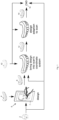
- Figure 1 illustrates an exemplary embodiment of a method for exporting a three-dimensional dental design model based on a three-dimensional dental library model 4 from an augmented reality application 6.
- the augmented reality application 6 is adapted to visualize on a display 7 an image of the dental library model 4 rendered by a virtual camera with a preliminary pose and scale in a photo 2 of a face of a patient taken by a camera under a viewing axis of the face of the patient.
- the photo 2 includes a mouth opening showing the present situation of the patient's dentition.
- the described method comprises as a first step placing within the augmented reality application 6 the rendered image of the dental library model 4 on the photo 2 and providing tools to modify and/or move the dental library model 4 on the display 7.
- the method comprises as next steps providing a three-dimensional scan model 10 of the present situation of the patient's dentition, aligning the scan model 10 and the present situation of the patient's dentition in the photo 2 to obtain a pose of the scan model 10, and calculating, based on the preliminary pose and scale and the pose of the scan model 10, at least one transformation to bring the desired dental design model 8 and the scan model 10 into a common coordinate system, in particular wherein the desired dental design model 8 is brought to a coordinate system of the scan model 10 to obtain a positioned dental design model 12.
- weighted non-rigid deformations are applied to adapt the shape of the positioned dental design model 12 to the scan model 10 by minimizing a measure of shape difference between the positioned dental design model 12 and the scan model 10 to obtain a modified dental design model 14.
- the minimization problem described above belongs to registration problems.
- a large field of registration is image registration in the two-dimensional space. This can be extended to three-dimensions to solve registration problems with three-dimensional models as it is the case herein.
- the aim of registration problems is to find a reasonable transformation such that a transformed version of one model is similar to another model. In the case herein it is therefore the aim to find a reasonable transformation such that a transformed version of the positioned dental design model 12 is similar to the scan model 10.
- Feature-based distance measures can be classified as feature- or intensity-based.
- Feature-based distance measures comprise landmark-based approaches. Feature-based distance measures establish a correspondence between a number of especially distinct points (the so called landmarks) in the two models. Knowing the correspondence between a number of points in the models, a transformation is then determined to map one model to another model, here the positioned dental design model 12 to the scan model 10.
- Intensity-based approaches compare intensity patterns in the models.
- An intensity-based distance measure is e.g. the sum of squared differences (SSD). This distance measure measures the energy contained in the difference model of e.g. the positioned dental design model 12 and the scan model 10.
- Other distance measures are cross-correlation or using mutual information. There are also methods that combine intensity-based and feature-based distance measures which could also be applied in the present minimization problem.
- mapping function a family of functions and the calculation of the parameters of the mapping function must be selected. The simplest case is to use only translation. More parameters have to be calculated by using affine or non-rigid transformations. As disclosed in claim 1 non-rigid deformations shall be used to transform the positioned dental design model 12 to the scan model 10.
- the transformations can be classified as global or local transformations.
- global transformations one set of parameters is calculated for the whole model.
- a global transformation consists of one function which is applied to the whole model.
- local transformations the model is divided into several areas. Parameters are calculated for each area individually. Therefore, each area can be deformed differently.
- a local transformation therefore consists of several functions, each applied to an area.
- the transformations or deformations can be performed by various methods.
- One approach is to use surface deformation methods as e.g. the as-rigid-as-possible deformation of a polygon mesh.
- surface deformation methods e.g. the as-rigid-as-possible deformation of a polygon mesh.
- the overall idea is to preserve certain properties of a given set of control points.
- Another method is the iterative closest points (ICP) algorithm which achieves a deformation in order to match the geometry of the positioned dental design model locally.
- the problem is to estimate a transformation, which will map the polygon mesh of one model, e.g. the positioned dental design model 12 onto a polygon mesh of another model, e.g. the scan model 10.
- the first step of the ICP algorithm is to find for the vertices of the polygon model of the positioned dental design model 12 the closest vertices of the polygon mesh of the scan model 10.
- the second step is to find the transformation that minimizes the distance between the vertices of the transformed polygon mesh of the positioned dental design model 12 and the vertices of the polygon mesh of the scan model 10.
- the estimated transformation is applied to the polygon mesh of the positioned dental design model. If the previously determined desired convergence has not been achieved, the algorithm is executed again from the first step.
- An option for improving speed and smoothness of the deformation is to use a reduced mesh or proxy mesh, perform the deformation on the reduced mesh or proxy mesh, and perform in a last step an interpolation for the original resolution mesh.
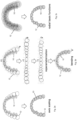
- FIG. 2a-c Another approach to perform non-rigid deformations is to use space deformation methods. Possible space deformation methods that can be applied as non-rigid deformations are illustrated in Figures 2a-c.
- Figure 2a shows scaling along the coordinate axes with potentially different scaling factors for the x, y and z axes. This method can be used to achieve a rough alignment of the scan model 10 to the positioned dental design model 12.
- Radial basis functions can be used to deform the positioned dental design model 12.
- a radial basis function is a real-valued function whose value only depends on the distance to a fixed point, e.g. the origin or a control point. Usually Euclidian distance is used but also other metrics are thinkable.
- An often used form for registration with radial basis functions is using thin-plate splines. Thin-plate splines have an elegant algebra expressing the dependence of the physical bending energy of a thin metal plate on point constraints.
- a set of vectors to describe the deformation e.g. from the positioned dental design model 12 to the scan model 10 is given. For every vertex of the positioned dental design model 12, the resulting deformation is computed by a weighted average of the vectors depending on the respective distance of the vertex to the starting point of the vectors, i.e. the control point.
- Movements of the vertices of the positioned dental design model 12 caused by non-rigid deformations can be controlled by weights as it is illustrated in Figures 3a-d.
- Figure 3a and 3b show a scan model 10 and a positioned dental design model 12 of a jaw in an unaligned state.
- Figure 3a illustrates the two models from the front, and
- Figure 3b illustrates the two models from above.
- the arrows show the directions in which the relevant area of the scan model 12 is allowed to move.
- Cut-out 30 shows an incisor to its vertices only movements along the viewing axis are allowed to apply. Only movements in the direction of the solid arrow are allowed. Movements in other directions, e.g. movements in the direction of the dashed arrow are restricted.
- a molar is illustrated to its vertices movements along the viewing axis and movements in other directions are allowed to apply.
- Figure 3c and 3d show the scan model 10 and the positioned dental design model 12 of the jaw in an aligned state after the appropriately permitted movements for each vertex have been applied.
- Figure 3c illustrates the two aligned models from the front
- Figure 3d illustrates the two aligned models from above.
- Applying weighted non-rigid deformations allows to have significant control over movements of the positioned dental design model 12.
- the positioned dental design model 12 is deformed to better match the shape of the scan model 10 while at the same time the desired dental design model 8 that the user designed in the augmented reality application 6 mainly in the front region of the dentition including the incisors can be preserved.
- the model that is obtained after the deformations have been applied to the positioned dental design model 12 is the dental design model that can be exported to e.g. a computer-aided design application 16.
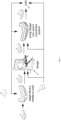
- Figure 4 illustrates another method for exporting a three-dimensional dental design model from an augmented reality application 6 to e.g. a computer-aided design application 16 if a three-dimensional scan model 10 of the present situation of the patient's dentition is available before using the augmented reality application 6. Therefore, the first step of the method comprises adapting a three-dimensional dental library model 4 to the scan model 10 with weighted non-rigid deformations by minimizing a measure of shape difference between the scan model 10 and the three-dimensional dental library model 4. The restrictions for movements caused by the non-rigid deformations controlled by the applied weights are the same as described above. The result of this first step is a modified dental library model 5.
- the method comprises as a next step placing within the augmented reality application 6 the modified dental library model 5 on a photo 2 of a face of a patient including a mouth opening showing at least part of the present situation of the patient's dentition and providing tools to modify and/or move the modified dental library model 5 on the display 7.
- a doctor can in presence of the patient, remotely or without the patient, modify the design of the modified dental library model 5 to obtain a desired dental design model 8. Because the modified dental library model 5 is already adapted to the scan model 10 of the patient by weighted non-rigid deformations, the visualization of this model on the photo 2 in the augmented reality application 6 is more realistic.
- designing a desired dental design model 8 based on the modified dental library model 5 requires less time compared to designing a desired dental design model 8 based on a dental library model 4 as disclosed in claim 1 and illustrated in Fig. 1 .
- the reason for this is that fewer adjustments are needed because the modified dental library model 8 is already adapted to the scan model 10 and therefore already matches reasonably the dentition of the patient and thus the present situation of the patent's dentition in the photo 2.
- the method comprises as next steps aligning the scan model 10 and the present situation of the patient's dentition in the photo 2 to obtain a pose of the scan model 10, and calculating, based on the preliminary pose and scale and the pose of the scan model 10, at least one transformation to bring the desired dental design model 8 and the scan model 10 into a common coordinate system, in particular wherein the desired dental design model 8 is brought to a coordinate system of the scan model 10 to obtain a positioned dental design model 12.
- This model is the dental design model that can be exported to e.g. a computer-aided design application 16.
Landscapes
- Health & Medical Sciences (AREA)
- Engineering & Computer Science (AREA)
- Life Sciences & Earth Sciences (AREA)
- Physics & Mathematics (AREA)
- Public Health (AREA)
- General Health & Medical Sciences (AREA)
- Veterinary Medicine (AREA)
- Animal Behavior & Ethology (AREA)
- Oral & Maxillofacial Surgery (AREA)
- Epidemiology (AREA)
- General Physics & Mathematics (AREA)
- Theoretical Computer Science (AREA)
- Dentistry (AREA)
- Medical Informatics (AREA)
- Biomedical Technology (AREA)
- General Engineering & Computer Science (AREA)
- Surgery (AREA)
- Pathology (AREA)
- Computer Hardware Design (AREA)
- Heart & Thoracic Surgery (AREA)
- Molecular Biology (AREA)
- Software Systems (AREA)
- Computer Graphics (AREA)
- Computer Vision & Pattern Recognition (AREA)
- Primary Health Care (AREA)
- Biophysics (AREA)
- Geometry (AREA)
- Nuclear Medicine, Radiotherapy & Molecular Imaging (AREA)
- Architecture (AREA)
- Mathematical Analysis (AREA)
- Computational Mathematics (AREA)
- Orthopedic Medicine & Surgery (AREA)
- Evolutionary Computation (AREA)
- Mathematical Optimization (AREA)
- Pure & Applied Mathematics (AREA)
- Physical Education & Sports Medicine (AREA)
- Optics & Photonics (AREA)
- Rheumatology (AREA)
- Audiology, Speech & Language Pathology (AREA)
- Data Mining & Analysis (AREA)
Claims (12)
- Procédé pour exporter un modèle de conception dentaire tridimensionnel basé sur un modèle de bibliothèque dentaire (4) tridimensionnel depuis une application de réalité augmentée (6), l'application de réalité augmentée (6) étant adaptée pour visualiser sur un affichage (7) une image du modèle de bibliothèque dentaire (4) restituée par une caméra virtuelle avec un positionnement et une mise à l'échelle préliminaires dans une photo (2) d'un visage d'un patient prise par une caméra sous un axe de vision vers le visage du patient, la photo (2) incluant une ouverture de bouche montrant au moins une partie de la situation présente de la dentition du patient, le procédé comprenant:- de placer dans l'application de réalité augmentée (6) l'image restituée du modèle de bibliothèque dentaire (4) sur la photo (2) et de fournir des outils pour modifier et/ou déplacer le modèle de bibliothèque dentaire (4) sur l'affichage (7) pour obtenir un modèle de conception dentaire souhaité (8),- de fournir un modèle scanné (10) tridimensionnel de la situation présente de la dentition du patient,- d'aligner le modèle scanné (10) et la situation présente de la dentition du patient dans la photo (2) pour obtenir un positionnement du modèle scanné (10),- de calculer, en se basant sur le positionnement et la mise à l'échelle préliminaires et le positionnement du modèle scanné (10), au moins une transformation pour amener le modèle de conception dentaire souhaité (8) et le modèle scanné (10) dans un système de coordonnées commun pour obtenir un modèle de conception dentaire positionné (12),
caractérisé par- adapter le modèle de conception dentaire positionné (12) sur le modèle scanné (10) avec des déformations non rigides en minimisant une mesure de différence de forme entre le modèle de conception dentaire positionné (12) et le modèle scanné (10) pour obtenir un modèle de conception dentaire modifié (14) comme modèle de conception dentaire à exporter. - Procédé selon la revendication 1, caractérisé par déterminer pour le modèle de conception dentaire positionné (12) des régions visibles et non visibles de celui-ci en prenant en compte la position par rapport à l'ouverture de bouche et l'axe de vision, dans lequel des déformations non rigides pondérées sont utilisées pour adapter le modèle de conception dentaire positionné (12) au modèle scanné (10), dans lequel des mouvements provoqués par les déformations non rigides et qui sont perpendiculaires à l'axe de vision sont plus limités pour les régions visibles que de tels mouvements pour les régions non visibles ce qui est obtenu en appliquant des poids faibles à des mouvements perpendiculaires à l'axe de vision des région visibles et des poids supérieurs à des mouvements perpendiculaires à l'axe de vision des régions non visibles.
- Procédé selon la revendication 2, caractérisé en ce que les régions visibles sont en particulier des régions avant incluant des incisives et les régions non visibles sont en particulier des régions arrière incluant des molaires, dans lequel des déformations non rigides pondérées sont utilisées pour adapter le modèle de conception dentaire positionné (12) au modèle scanné (10), des mouvements causés par les déformations non rigides et qui sont perpendiculaires à l'axe de vision sont plus limités pour les régions avant incluant des incisives que de tels mouvements pour les régions arrière incluant des molaires ce qui est obtenu en appliquant de faibles poids à des mouvements perpendiculaires à l'axe de vision des régions avant et des poids supérieurs à des mouvements perpendiculaires à l'axe de vision des régions arrière.
- Procédé selon la revendication 2, caractérisé en ce que les poids utilisés dans les déformations non rigides pondérées et appliqués à des mouvements perpendiculaires à l'axe de vision du modèle de conception dentaire positionné (12), augmentent progressivement des régions visibles vers les régions non visibles.
- Procédé selon la revendication 3, caractérisé en ce que les poids utilisés dans les déformations non rigides pondérées et appliqués à des mouvements perpendiculaires à l'axe de vision du modèle de conception dentaire positionné (12), augmentent progressivement des régions avant incluant des incisives aux régions arrière incluant des molaires.
- Procédé selon l'une quelconque des revendications précédentes, caractérisé en ce que les déformations non rigides comprennent le découpage, l'inclinaison, la mise à l'échelle uniforme et/ou non uniforme.
- Procédé selon l'une quelconque des revendications précédentes, caractérisé par l'exportation du modèle de conception dentaire modifié (14) vers une autre application, particulièrement dans lequel- l'exportation comprend de générer un fichier d'export comprenant le modèle de conception dentaire modifié (14),- le modèle de conception dentaire modifié (14) est exporté dans un fichier conjointement avec le modèle scanné (10),- l'autre application est une application externe,- l'autre application est une application de conception assistée par ordinateur (16), et/ou- le fichier d'export est au format de fichier STL.
- Procédé pour exporter un modèle de conception dentaire tridimensionnel basé sur un modèle de bibliothèque dentaire (4) tridimensionnel depuis une application de réalité augmentée (6), le procédé comprenant:- de récupérer un modèle scanné (10) tridimensionnel de la situation présente d'une dentition de patient,- d'adapter le modèle de bibliothèque dentaire (4) tridimensionnel au modèle scanné (10) avec des déformations non rigides en minimisant une mesure de différence de forme entre le modèle de bibliothèque dentaire (4) et le modèle scanné (10) pour obtenir un modèle de bibliothèque dentaire modifié (5),- de placer dans l'application de réalité augmentée (6) une image du modèle de bibliothèque dentaire modifié (5), restituée par une caméra virtuelle avec un positionnement et une mise à l'échelle préliminaire dans une photo (2) du visage du patient prise par une caméra sous un axe de vision vers le visage du patient, la photo (2) incluant une ouverture de bouche montrant au moins une partie de la situation présente de la dentition du patient, sur la photo (2) et de fournir des outils pour modifier et/ou déplacer le modèle de bibliothèque dentaire modifié (5) sur un affichage (7) pour obtenir un modèle de conception dentaire souhaité (8),- d'aligner le modèle scanné (10) et la situation présente de la dentition du patient sur la photo (2) pour obtenir un positionnement du modèle scanné (10),- de calculer, en se basant sur le positionnement et la mise à l'échelle préliminaire et le positionnement du modèle scanné (10), au moins une transformation pour amener le modèle de conception dentaire souhaité (8) et le modèle scanné (10) dans un système de coordonnées commun, en particulier dans lequel le modèle de conception dentaire souhaité (8) est amené dans un système de coordonnées du modèle scanné (10) pour obtenir un modèle de conception dentaire positionné (12).
- Procédé selon la revendication 8, caractérisé en ce que des déformations non rigides sont utilisées pour adapter le modèle de bibliothèque dentaire tridimensionnel (4) au modèle scanné (10).
- Procédé selon la revendication 9, caractérisé en ce que les déformations non rigides comprennent le découpage, l'inclinaison, la mise à l'échelle uniforme et/ou non uniforme.
- Procédé selon l'une quelconque des revendications 8-10, caractérisé par l'exportation du modèle de conception dentaire positionné (12) vers une autre application, particulièrement dans lequel- l'exportation comprend de générer un fichier d'export comprenant le modèle de conception dentaire positionné (12),- le modèle de conception dentaire positionné (12) est exporté dans un fichier conjointement avec le modèle scanné (10),- l'autre application est une application externe,- l'autre application est une application de conception assistée par ordinateur (16), et/ou
le fichier d'export est au format de fichier STL. - Produit de programme informatique comprenant un code de programme qui est stocké sur un médium lisible par une machine, ou mis en oeuvre comme une onde porteuse électromagnétique comprenant un segment de code de programme, et comportant des instructions exécutables informatiquement pour réaliser le procédé selon l'une quelconque des revendications 1 à 11.
Priority Applications (3)
| Application Number | Priority Date | Filing Date | Title |
|---|---|---|---|
| EP21170126.3A EP4080454B1 (fr) | 2021-04-23 | 2021-04-23 | Procédé d'exportation d'un modèle de conception dentaire esthétique tridimensionnel d'une application de réalité augmentée vers une application de conception assistée par ordinateur |
| CN202210372334.6A CN115239918A (zh) | 2021-04-23 | 2022-04-11 | 用于从增强现实应用导出三维美学牙科设计模型的方法 |
| US17/720,683 US12178672B2 (en) | 2021-04-23 | 2022-04-14 | Method for exporting a three-dimensional esthetic dental design model from an augmented reality application to a computer-aided design application |
Applications Claiming Priority (1)
| Application Number | Priority Date | Filing Date | Title |
|---|---|---|---|
| EP21170126.3A EP4080454B1 (fr) | 2021-04-23 | 2021-04-23 | Procédé d'exportation d'un modèle de conception dentaire esthétique tridimensionnel d'une application de réalité augmentée vers une application de conception assistée par ordinateur |
Publications (2)
| Publication Number | Publication Date |
|---|---|
| EP4080454A1 EP4080454A1 (fr) | 2022-10-26 |
| EP4080454B1 true EP4080454B1 (fr) | 2024-08-07 |
Family
ID=75659895
Family Applications (1)
| Application Number | Title | Priority Date | Filing Date |
|---|---|---|---|
| EP21170126.3A Active EP4080454B1 (fr) | 2021-04-23 | 2021-04-23 | Procédé d'exportation d'un modèle de conception dentaire esthétique tridimensionnel d'une application de réalité augmentée vers une application de conception assistée par ordinateur |
Country Status (3)
| Country | Link |
|---|---|
| US (1) | US12178672B2 (fr) |
| EP (1) | EP4080454B1 (fr) |
| CN (1) | CN115239918A (fr) |
Families Citing this family (5)
| Publication number | Priority date | Publication date | Assignee | Title |
|---|---|---|---|---|
| TWI712396B (zh) * | 2020-01-16 | 2020-12-11 | 中國醫藥大學 | 口腔缺陷模型之修補方法及口腔缺陷模型之修補系統 |
| US12451228B2 (en) * | 2022-04-06 | 2025-10-21 | Intellident Dentaire Inc. | Augmented reality method and system for dental preparations |
| CN116052890B (zh) * | 2022-11-18 | 2023-09-26 | 江苏创英医疗器械有限公司 | 一种基于物联网的牙种植体三维扫描建模系统及方法 |
| CN116543912B (zh) * | 2023-04-26 | 2024-03-15 | 山东山大华天软件有限公司 | 一种基于云平台的齿科协同设计系统 |
| US12232927B2 (en) * | 2023-07-19 | 2025-02-25 | Clevaligner Ltd | Interactive dental treatment planning |
Family Cites Families (10)
| Publication number | Priority date | Publication date | Assignee | Title |
|---|---|---|---|---|
| EP3851069B1 (fr) * | 2010-06-29 | 2023-01-18 | 3Shape A/S | Agencement d'images 2d |
| EP2964139B2 (fr) * | 2013-03-08 | 2025-02-12 | 3Shape A/S | Visualisation d'une restauration dentaire 3d sur une image 2d |
| JP2019506243A (ja) * | 2016-02-24 | 2019-03-07 | 3シェイプ アー/エス | 歯科的状態の進展を検出し且つ監視する方法 |
| US10980613B2 (en) * | 2017-12-29 | 2021-04-20 | Align Technology, Inc. | Augmented reality enhancements for dental practitioners |
| US10779917B2 (en) * | 2018-02-20 | 2020-09-22 | Ivoclar Vivadent Ag | Computer implemented method for modifying a digital three-dimensional model of a dentition |
| EP3629336B1 (fr) | 2018-09-28 | 2025-03-26 | Ivoclar Vivadent AG | Transfert de conception dentaire |
| US11083552B2 (en) | 2018-02-20 | 2021-08-10 | Ivoclar Vivadent Ag | Rendering of dental models |
| US10803675B2 (en) | 2018-02-20 | 2020-10-13 | Ivoclar Vivadent Ag | Dental model attributes transfer |
| US11213374B2 (en) | 2018-02-20 | 2022-01-04 | Ivoclar Vivadent Ag | Rendering a dental model in an image |
| ES2882585T3 (es) * | 2018-02-21 | 2021-12-02 | Ivoclar Vivadent Ag | Procedimiento para alinear un modelo tridimensional de una dentadura de un paciente sobre una imagen del rostro del paciente grabada por una cámara |
-
2021
- 2021-04-23 EP EP21170126.3A patent/EP4080454B1/fr active Active
-
2022
- 2022-04-11 CN CN202210372334.6A patent/CN115239918A/zh active Pending
- 2022-04-14 US US17/720,683 patent/US12178672B2/en active Active
Also Published As
| Publication number | Publication date |
|---|---|
| CN115239918A (zh) | 2022-10-25 |
| EP4080454A1 (fr) | 2022-10-26 |
| US12178672B2 (en) | 2024-12-31 |
| US20220338966A1 (en) | 2022-10-27 |
Similar Documents
| Publication | Publication Date | Title |
|---|---|---|
| EP4080454B1 (fr) | Procédé d'exportation d'un modèle de conception dentaire esthétique tridimensionnel d'une application de réalité augmentée vers une application de conception assistée par ordinateur | |
| US12064311B2 (en) | Visual presentation of gingival line generated based on 3D tooth model | |
| US11666416B2 (en) | Methods for simulating orthodontic treatment | |
| US10980621B2 (en) | Dental design transfer | |
| US11386634B2 (en) | Systems and methods for planning an orthodontic treatment by reconstructing a 3D mesh model of a gingiva associated with an arch form | |
| US12133782B2 (en) | Systems and methods for planning an orthodontic treatment | |
| US11490994B2 (en) | Systems and methods for planning an orthodontic treatment by reconstructing a 3D mesh model of a gingiva assosiated with an arch form | |
| US8026916B2 (en) | Image-based viewing system | |
| AU2011273999B2 (en) | 2D image arrangement | |
| EP3629336B1 (fr) | Transfert de conception dentaire | |
| JP7699849B2 (ja) | 3次元スキャンデータから補綴物を自動で生成する方法、3次元スキャンデータから補綴物を自動で生成するジェネレータ、及びこれをコンピュータで実行させるためのプログラムが記録されたコンピュータ読み取り可能な記録媒体 | |
| CN116543096A (zh) | 产生牙颌三维数字模型的方法 |
Legal Events
| Date | Code | Title | Description |
|---|---|---|---|
| PUAI | Public reference made under article 153(3) epc to a published international application that has entered the european phase |
Free format text: ORIGINAL CODE: 0009012 |
|
| STAA | Information on the status of an ep patent application or granted ep patent |
Free format text: STATUS: REQUEST FOR EXAMINATION WAS MADE |
|
| 17P | Request for examination filed |
Effective date: 20211118 |
|
| AK | Designated contracting states |
Kind code of ref document: A1 Designated state(s): AL AT BE BG CH CY CZ DE DK EE ES FI FR GB GR HR HU IE IS IT LI LT LU LV MC MK MT NL NO PL PT RO RS SE SI SK SM TR |
|
| GRAP | Despatch of communication of intention to grant a patent |
Free format text: ORIGINAL CODE: EPIDOSNIGR1 |
|
| STAA | Information on the status of an ep patent application or granted ep patent |
Free format text: STATUS: GRANT OF PATENT IS INTENDED |
|
| INTG | Intention to grant announced |
Effective date: 20240516 |
|
| GRAS | Grant fee paid |
Free format text: ORIGINAL CODE: EPIDOSNIGR3 |
|
| GRAA | (expected) grant |
Free format text: ORIGINAL CODE: 0009210 |
|
| STAA | Information on the status of an ep patent application or granted ep patent |
Free format text: STATUS: THE PATENT HAS BEEN GRANTED |
|
| P01 | Opt-out of the competence of the unified patent court (upc) registered |
Free format text: CASE NUMBER: APP_34733/2024 Effective date: 20240610 |
|
| AK | Designated contracting states |
Kind code of ref document: B1 Designated state(s): AL AT BE BG CH CY CZ DE DK EE ES FI FR GB GR HR HU IE IS IT LI LT LU LV MC MK MT NL NO PL PT RO RS SE SI SK SM TR |
|
| REG | Reference to a national code |
Ref country code: GB Ref legal event code: FG4D |
|
| REG | Reference to a national code |
Ref country code: CH Ref legal event code: EP |
|
| REG | Reference to a national code |
Ref country code: DE Ref legal event code: R096 Ref document number: 602021016674 Country of ref document: DE |
|
| REG | Reference to a national code |
Ref country code: IE Ref legal event code: FG4D |
|
| REG | Reference to a national code |
Ref country code: LT Ref legal event code: MG9D |
|
| REG | Reference to a national code |
Ref country code: NL Ref legal event code: MP Effective date: 20240807 |
|
| PG25 | Lapsed in a contracting state [announced via postgrant information from national office to epo] |
Ref country code: NO Free format text: LAPSE BECAUSE OF FAILURE TO SUBMIT A TRANSLATION OF THE DESCRIPTION OR TO PAY THE FEE WITHIN THE PRESCRIBED TIME-LIMIT Effective date: 20241107 |
|
| REG | Reference to a national code |
Ref country code: AT Ref legal event code: MK05 Ref document number: 1711807 Country of ref document: AT Kind code of ref document: T Effective date: 20240807 |
|
| PG25 | Lapsed in a contracting state [announced via postgrant information from national office to epo] |
Ref country code: NL Free format text: LAPSE BECAUSE OF FAILURE TO SUBMIT A TRANSLATION OF THE DESCRIPTION OR TO PAY THE FEE WITHIN THE PRESCRIBED TIME-LIMIT Effective date: 20240807 Ref country code: FI Free format text: LAPSE BECAUSE OF FAILURE TO SUBMIT A TRANSLATION OF THE DESCRIPTION OR TO PAY THE FEE WITHIN THE PRESCRIBED TIME-LIMIT Effective date: 20240807 Ref country code: PL Free format text: LAPSE BECAUSE OF FAILURE TO SUBMIT A TRANSLATION OF THE DESCRIPTION OR TO PAY THE FEE WITHIN THE PRESCRIBED TIME-LIMIT Effective date: 20240807 Ref country code: GR Free format text: LAPSE BECAUSE OF FAILURE TO SUBMIT A TRANSLATION OF THE DESCRIPTION OR TO PAY THE FEE WITHIN THE PRESCRIBED TIME-LIMIT Effective date: 20241108 Ref country code: PT Free format text: LAPSE BECAUSE OF FAILURE TO SUBMIT A TRANSLATION OF THE DESCRIPTION OR TO PAY THE FEE WITHIN THE PRESCRIBED TIME-LIMIT Effective date: 20241209 |
|
| PG25 | Lapsed in a contracting state [announced via postgrant information from national office to epo] |
Ref country code: BG Free format text: LAPSE BECAUSE OF FAILURE TO SUBMIT A TRANSLATION OF THE DESCRIPTION OR TO PAY THE FEE WITHIN THE PRESCRIBED TIME-LIMIT Effective date: 20240807 |
|
| PG25 | Lapsed in a contracting state [announced via postgrant information from national office to epo] |
Ref country code: LV Free format text: LAPSE BECAUSE OF FAILURE TO SUBMIT A TRANSLATION OF THE DESCRIPTION OR TO PAY THE FEE WITHIN THE PRESCRIBED TIME-LIMIT Effective date: 20240807 |
|
| PG25 | Lapsed in a contracting state [announced via postgrant information from national office to epo] |
Ref country code: IS Free format text: LAPSE BECAUSE OF FAILURE TO SUBMIT A TRANSLATION OF THE DESCRIPTION OR TO PAY THE FEE WITHIN THE PRESCRIBED TIME-LIMIT Effective date: 20241207 Ref country code: AT Free format text: LAPSE BECAUSE OF FAILURE TO SUBMIT A TRANSLATION OF THE DESCRIPTION OR TO PAY THE FEE WITHIN THE PRESCRIBED TIME-LIMIT Effective date: 20240807 |
|
| PG25 | Lapsed in a contracting state [announced via postgrant information from national office to epo] |
Ref country code: HR Free format text: LAPSE BECAUSE OF FAILURE TO SUBMIT A TRANSLATION OF THE DESCRIPTION OR TO PAY THE FEE WITHIN THE PRESCRIBED TIME-LIMIT Effective date: 20240807 |
|
| PG25 | Lapsed in a contracting state [announced via postgrant information from national office to epo] |
Ref country code: ES Free format text: LAPSE BECAUSE OF FAILURE TO SUBMIT A TRANSLATION OF THE DESCRIPTION OR TO PAY THE FEE WITHIN THE PRESCRIBED TIME-LIMIT Effective date: 20240807 Ref country code: RS Free format text: LAPSE BECAUSE OF FAILURE TO SUBMIT A TRANSLATION OF THE DESCRIPTION OR TO PAY THE FEE WITHIN THE PRESCRIBED TIME-LIMIT Effective date: 20241107 |
|
| PG25 | Lapsed in a contracting state [announced via postgrant information from national office to epo] |
Ref country code: RS Free format text: LAPSE BECAUSE OF FAILURE TO SUBMIT A TRANSLATION OF THE DESCRIPTION OR TO PAY THE FEE WITHIN THE PRESCRIBED TIME-LIMIT Effective date: 20241107 Ref country code: PT Free format text: LAPSE BECAUSE OF FAILURE TO SUBMIT A TRANSLATION OF THE DESCRIPTION OR TO PAY THE FEE WITHIN THE PRESCRIBED TIME-LIMIT Effective date: 20241209 Ref country code: PL Free format text: LAPSE BECAUSE OF FAILURE TO SUBMIT A TRANSLATION OF THE DESCRIPTION OR TO PAY THE FEE WITHIN THE PRESCRIBED TIME-LIMIT Effective date: 20240807 Ref country code: NO Free format text: LAPSE BECAUSE OF FAILURE TO SUBMIT A TRANSLATION OF THE DESCRIPTION OR TO PAY THE FEE WITHIN THE PRESCRIBED TIME-LIMIT Effective date: 20241107 Ref country code: NL Free format text: LAPSE BECAUSE OF FAILURE TO SUBMIT A TRANSLATION OF THE DESCRIPTION OR TO PAY THE FEE WITHIN THE PRESCRIBED TIME-LIMIT Effective date: 20240807 Ref country code: LV Free format text: LAPSE BECAUSE OF FAILURE TO SUBMIT A TRANSLATION OF THE DESCRIPTION OR TO PAY THE FEE WITHIN THE PRESCRIBED TIME-LIMIT Effective date: 20240807 Ref country code: IS Free format text: LAPSE BECAUSE OF FAILURE TO SUBMIT A TRANSLATION OF THE DESCRIPTION OR TO PAY THE FEE WITHIN THE PRESCRIBED TIME-LIMIT Effective date: 20241207 Ref country code: HR Free format text: LAPSE BECAUSE OF FAILURE TO SUBMIT A TRANSLATION OF THE DESCRIPTION OR TO PAY THE FEE WITHIN THE PRESCRIBED TIME-LIMIT Effective date: 20240807 Ref country code: GR Free format text: LAPSE BECAUSE OF FAILURE TO SUBMIT A TRANSLATION OF THE DESCRIPTION OR TO PAY THE FEE WITHIN THE PRESCRIBED TIME-LIMIT Effective date: 20241108 Ref country code: FI Free format text: LAPSE BECAUSE OF FAILURE TO SUBMIT A TRANSLATION OF THE DESCRIPTION OR TO PAY THE FEE WITHIN THE PRESCRIBED TIME-LIMIT Effective date: 20240807 Ref country code: ES Free format text: LAPSE BECAUSE OF FAILURE TO SUBMIT A TRANSLATION OF THE DESCRIPTION OR TO PAY THE FEE WITHIN THE PRESCRIBED TIME-LIMIT Effective date: 20240807 Ref country code: BG Free format text: LAPSE BECAUSE OF FAILURE TO SUBMIT A TRANSLATION OF THE DESCRIPTION OR TO PAY THE FEE WITHIN THE PRESCRIBED TIME-LIMIT Effective date: 20240807 Ref country code: AT Free format text: LAPSE BECAUSE OF FAILURE TO SUBMIT A TRANSLATION OF THE DESCRIPTION OR TO PAY THE FEE WITHIN THE PRESCRIBED TIME-LIMIT Effective date: 20240807 |
|
| PG25 | Lapsed in a contracting state [announced via postgrant information from national office to epo] |
Ref country code: SM Free format text: LAPSE BECAUSE OF FAILURE TO SUBMIT A TRANSLATION OF THE DESCRIPTION OR TO PAY THE FEE WITHIN THE PRESCRIBED TIME-LIMIT Effective date: 20240807 Ref country code: DK Free format text: LAPSE BECAUSE OF FAILURE TO SUBMIT A TRANSLATION OF THE DESCRIPTION OR TO PAY THE FEE WITHIN THE PRESCRIBED TIME-LIMIT Effective date: 20240807 |
|
| PG25 | Lapsed in a contracting state [announced via postgrant information from national office to epo] |
Ref country code: EE Free format text: LAPSE BECAUSE OF FAILURE TO SUBMIT A TRANSLATION OF THE DESCRIPTION OR TO PAY THE FEE WITHIN THE PRESCRIBED TIME-LIMIT Effective date: 20240807 |
|
| PG25 | Lapsed in a contracting state [announced via postgrant information from national office to epo] |
Ref country code: CZ Free format text: LAPSE BECAUSE OF FAILURE TO SUBMIT A TRANSLATION OF THE DESCRIPTION OR TO PAY THE FEE WITHIN THE PRESCRIBED TIME-LIMIT Effective date: 20240807 |
|
| PG25 | Lapsed in a contracting state [announced via postgrant information from national office to epo] |
Ref country code: SK Free format text: LAPSE BECAUSE OF FAILURE TO SUBMIT A TRANSLATION OF THE DESCRIPTION OR TO PAY THE FEE WITHIN THE PRESCRIBED TIME-LIMIT Effective date: 20240807 |
|
| REG | Reference to a national code |
Ref country code: DE Ref legal event code: R097 Ref document number: 602021016674 Country of ref document: DE |
|
| PLBE | No opposition filed within time limit |
Free format text: ORIGINAL CODE: 0009261 |
|
| STAA | Information on the status of an ep patent application or granted ep patent |
Free format text: STATUS: NO OPPOSITION FILED WITHIN TIME LIMIT |
|
| PGFP | Annual fee paid to national office [announced via postgrant information from national office to epo] |
Ref country code: DE Payment date: 20250418 Year of fee payment: 5 |
|
| 26N | No opposition filed |
Effective date: 20250508 |
|
| PGFP | Annual fee paid to national office [announced via postgrant information from national office to epo] |
Ref country code: FR Payment date: 20250425 Year of fee payment: 5 |
|
| PG25 | Lapsed in a contracting state [announced via postgrant information from national office to epo] |
Ref country code: SE Free format text: LAPSE BECAUSE OF FAILURE TO SUBMIT A TRANSLATION OF THE DESCRIPTION OR TO PAY THE FEE WITHIN THE PRESCRIBED TIME-LIMIT Effective date: 20240807 |
|
| REG | Reference to a national code |
Ref country code: CH Ref legal event code: H13 Free format text: ST27 STATUS EVENT CODE: U-0-0-H10-H13 (AS PROVIDED BY THE NATIONAL OFFICE) Effective date: 20251125 |
|
| PG25 | Lapsed in a contracting state [announced via postgrant information from national office to epo] |
Ref country code: LU Free format text: LAPSE BECAUSE OF NON-PAYMENT OF DUE FEES Effective date: 20250423 |
|
| PG25 | Lapsed in a contracting state [announced via postgrant information from national office to epo] |
Ref country code: MC Free format text: LAPSE BECAUSE OF FAILURE TO SUBMIT A TRANSLATION OF THE DESCRIPTION OR TO PAY THE FEE WITHIN THE PRESCRIBED TIME-LIMIT Effective date: 20240807 |
|
| REG | Reference to a national code |
Ref country code: BE Ref legal event code: MM Effective date: 20250430 |
|
| PG25 | Lapsed in a contracting state [announced via postgrant information from national office to epo] |
Ref country code: BE Free format text: LAPSE BECAUSE OF NON-PAYMENT OF DUE FEES Effective date: 20250430 |
|
| PG25 | Lapsed in a contracting state [announced via postgrant information from national office to epo] |
Ref country code: CH Free format text: LAPSE BECAUSE OF NON-PAYMENT OF DUE FEES Effective date: 20250430 |
|
| PG25 | Lapsed in a contracting state [announced via postgrant information from national office to epo] |
Ref country code: IT Free format text: LAPSE BECAUSE OF FAILURE TO SUBMIT A TRANSLATION OF THE DESCRIPTION OR TO PAY THE FEE WITHIN THE PRESCRIBED TIME-LIMIT Effective date: 20240807 |
|
| PGFP | Annual fee paid to national office [announced via postgrant information from national office to epo] |
Ref country code: GB Payment date: 20260327 Year of fee payment: 6 |
|
| PG25 | Lapsed in a contracting state [announced via postgrant information from national office to epo] |
Ref country code: IE Free format text: LAPSE BECAUSE OF NON-PAYMENT OF DUE FEES Effective date: 20250423 |
|
| PG25 | Lapsed in a contracting state [announced via postgrant information from national office to epo] |
Ref country code: RO Free format text: LAPSE BECAUSE OF FAILURE TO SUBMIT A TRANSLATION OF THE DESCRIPTION OR TO PAY THE FEE WITHIN THE PRESCRIBED TIME-LIMIT Effective date: 20240807 |