EP4080608A2 - Positivelektrodenaktivmaterial, verfahren zur herstellung davon und lithiumsekundärbatterie damit - Google Patents
Positivelektrodenaktivmaterial, verfahren zur herstellung davon und lithiumsekundärbatterie damit Download PDFInfo
- Publication number
- EP4080608A2 EP4080608A2 EP20901645.0A EP20901645A EP4080608A2 EP 4080608 A2 EP4080608 A2 EP 4080608A2 EP 20901645 A EP20901645 A EP 20901645A EP 4080608 A2 EP4080608 A2 EP 4080608A2
- Authority
- EP
- European Patent Office
- Prior art keywords
- ppm
- positive electrode
- electrode active
- active material
- coating layer
- Prior art date
- Legal status (The legal status is an assumption and is not a legal conclusion. Google has not performed a legal analysis and makes no representation as to the accuracy of the status listed.)
- Pending
Links
Images

Classifications
-
- H—ELECTRICITY
- H01—ELECTRIC ELEMENTS
- H01M—PROCESSES OR MEANS, e.g. BATTERIES, FOR THE DIRECT CONVERSION OF CHEMICAL ENERGY INTO ELECTRICAL ENERGY
- H01M4/00—Electrodes
- H01M4/02—Electrodes composed of, or comprising, active material
- H01M4/36—Selection of substances as active materials, active masses, active liquids
- H01M4/362—Composites
- H01M4/366—Composites as layered products
-
- C—CHEMISTRY; METALLURGY
- C01—INORGANIC CHEMISTRY
- C01G—COMPOUNDS CONTAINING METALS NOT COVERED BY SUBCLASSES C01D OR C01F
- C01G53/00—Compounds of nickel
- C01G53/04—Oxides
-
- C—CHEMISTRY; METALLURGY
- C01—INORGANIC CHEMISTRY
- C01G—COMPOUNDS CONTAINING METALS NOT COVERED BY SUBCLASSES C01D OR C01F
- C01G53/00—Compounds of nickel
- C01G53/40—Complex oxides containing nickel and at least one other metal element
- C01G53/42—Complex oxides containing nickel and at least one other metal element containing alkali metals, e.g. LiNiO2
-
- H—ELECTRICITY
- H01—ELECTRIC ELEMENTS
- H01M—PROCESSES OR MEANS, e.g. BATTERIES, FOR THE DIRECT CONVERSION OF CHEMICAL ENERGY INTO ELECTRICAL ENERGY
- H01M10/00—Secondary cells; Manufacture thereof
- H01M10/05—Accumulators with non-aqueous electrolyte
- H01M10/052—Li-accumulators
-
- H—ELECTRICITY
- H01—ELECTRIC ELEMENTS
- H01M—PROCESSES OR MEANS, e.g. BATTERIES, FOR THE DIRECT CONVERSION OF CHEMICAL ENERGY INTO ELECTRICAL ENERGY
- H01M10/00—Secondary cells; Manufacture thereof
- H01M10/05—Accumulators with non-aqueous electrolyte
- H01M10/052—Li-accumulators
- H01M10/0525—Rocking-chair batteries, i.e. batteries with lithium insertion or intercalation in both electrodes; Lithium-ion batteries
-
- H—ELECTRICITY
- H01—ELECTRIC ELEMENTS
- H01M—PROCESSES OR MEANS, e.g. BATTERIES, FOR THE DIRECT CONVERSION OF CHEMICAL ENERGY INTO ELECTRICAL ENERGY
- H01M4/00—Electrodes
- H01M4/02—Electrodes composed of, or comprising, active material
- H01M4/36—Selection of substances as active materials, active masses, active liquids
-
- H—ELECTRICITY
- H01—ELECTRIC ELEMENTS
- H01M—PROCESSES OR MEANS, e.g. BATTERIES, FOR THE DIRECT CONVERSION OF CHEMICAL ENERGY INTO ELECTRICAL ENERGY
- H01M4/00—Electrodes
- H01M4/02—Electrodes composed of, or comprising, active material
- H01M4/36—Selection of substances as active materials, active masses, active liquids
- H01M4/48—Selection of substances as active materials, active masses, active liquids of inorganic oxides or hydroxides
- H01M4/52—Selection of substances as active materials, active masses, active liquids of inorganic oxides or hydroxides of nickel, cobalt or iron
- H01M4/525—Selection of substances as active materials, active masses, active liquids of inorganic oxides or hydroxides of nickel, cobalt or iron of mixed oxides or hydroxides containing iron, cobalt or nickel for inserting or intercalating light metals, e.g. LiNiO2, LiCoO2 or LiCoOxFy
-
- C—CHEMISTRY; METALLURGY
- C01—INORGANIC CHEMISTRY
- C01P—INDEXING SCHEME RELATING TO STRUCTURAL AND PHYSICAL ASPECTS OF SOLID INORGANIC COMPOUNDS
- C01P2002/00—Crystal-structural characteristics
- C01P2002/50—Solid solutions
- C01P2002/52—Solid solutions containing elements as dopants
-
- C—CHEMISTRY; METALLURGY
- C01—INORGANIC CHEMISTRY
- C01P—INDEXING SCHEME RELATING TO STRUCTURAL AND PHYSICAL ASPECTS OF SOLID INORGANIC COMPOUNDS
- C01P2002/00—Crystal-structural characteristics
- C01P2002/50—Solid solutions
- C01P2002/52—Solid solutions containing elements as dopants
- C01P2002/54—Solid solutions containing elements as dopants one element only
-
- C—CHEMISTRY; METALLURGY
- C01—INORGANIC CHEMISTRY
- C01P—INDEXING SCHEME RELATING TO STRUCTURAL AND PHYSICAL ASPECTS OF SOLID INORGANIC COMPOUNDS
- C01P2004/00—Particle morphology
- C01P2004/01—Particle morphology depicted by an image
- C01P2004/03—Particle morphology depicted by an image obtained by SEM
-
- C—CHEMISTRY; METALLURGY
- C01—INORGANIC CHEMISTRY
- C01P—INDEXING SCHEME RELATING TO STRUCTURAL AND PHYSICAL ASPECTS OF SOLID INORGANIC COMPOUNDS
- C01P2004/00—Particle morphology
- C01P2004/60—Particles characterised by their size
- C01P2004/61—Micrometer sized, i.e. from 1-100 micrometer
-
- C—CHEMISTRY; METALLURGY
- C01—INORGANIC CHEMISTRY
- C01P—INDEXING SCHEME RELATING TO STRUCTURAL AND PHYSICAL ASPECTS OF SOLID INORGANIC COMPOUNDS
- C01P2004/00—Particle morphology
- C01P2004/80—Particles consisting of a mixture of two or more inorganic phases
-
- C—CHEMISTRY; METALLURGY
- C01—INORGANIC CHEMISTRY
- C01P—INDEXING SCHEME RELATING TO STRUCTURAL AND PHYSICAL ASPECTS OF SOLID INORGANIC COMPOUNDS
- C01P2006/00—Physical properties of inorganic compounds
- C01P2006/40—Electric properties
-
- H—ELECTRICITY
- H01—ELECTRIC ELEMENTS
- H01M—PROCESSES OR MEANS, e.g. BATTERIES, FOR THE DIRECT CONVERSION OF CHEMICAL ENERGY INTO ELECTRICAL ENERGY
- H01M4/00—Electrodes
- H01M4/02—Electrodes composed of, or comprising, active material
- H01M2004/026—Electrodes composed of, or comprising, active material characterised by the polarity
- H01M2004/028—Positive electrodes
-
- H—ELECTRICITY
- H01—ELECTRIC ELEMENTS
- H01M—PROCESSES OR MEANS, e.g. BATTERIES, FOR THE DIRECT CONVERSION OF CHEMICAL ENERGY INTO ELECTRICAL ENERGY
- H01M4/00—Electrodes
- H01M4/02—Electrodes composed of, or comprising, active material
- H01M4/13—Electrodes for accumulators with non-aqueous electrolyte, e.g. for lithium-accumulators; Processes of manufacture thereof
- H01M4/131—Electrodes based on mixed oxides or hydroxides, or on mixtures of oxides or hydroxides, e.g. LiCoOx
-
- H—ELECTRICITY
- H01—ELECTRIC ELEMENTS
- H01M—PROCESSES OR MEANS, e.g. BATTERIES, FOR THE DIRECT CONVERSION OF CHEMICAL ENERGY INTO ELECTRICAL ENERGY
- H01M4/00—Electrodes
- H01M4/02—Electrodes composed of, or comprising, active material
- H01M4/13—Electrodes for accumulators with non-aqueous electrolyte, e.g. for lithium-accumulators; Processes of manufacture thereof
- H01M4/139—Processes of manufacture
- H01M4/1391—Processes of manufacture of electrodes based on mixed oxides or hydroxides, or on mixtures of oxides or hydroxides, e.g. LiCoOx
-
- H—ELECTRICITY
- H01—ELECTRIC ELEMENTS
- H01M—PROCESSES OR MEANS, e.g. BATTERIES, FOR THE DIRECT CONVERSION OF CHEMICAL ENERGY INTO ELECTRICAL ENERGY
- H01M4/00—Electrodes
- H01M4/02—Electrodes composed of, or comprising, active material
- H01M4/36—Selection of substances as active materials, active masses, active liquids
- H01M4/48—Selection of substances as active materials, active masses, active liquids of inorganic oxides or hydroxides
- H01M4/50—Selection of substances as active materials, active masses, active liquids of inorganic oxides or hydroxides of manganese
- H01M4/505—Selection of substances as active materials, active masses, active liquids of inorganic oxides or hydroxides of manganese of mixed oxides or hydroxides containing manganese for inserting or intercalating light metals, e.g. LiMn2O4 or LiMn2OxFy
-
- H—ELECTRICITY
- H01—ELECTRIC ELEMENTS
- H01M—PROCESSES OR MEANS, e.g. BATTERIES, FOR THE DIRECT CONVERSION OF CHEMICAL ENERGY INTO ELECTRICAL ENERGY
- H01M4/00—Electrodes
- H01M4/02—Electrodes composed of, or comprising, active material
- H01M4/62—Selection of inactive substances as ingredients for active masses, e.g. binders, fillers
-
- Y—GENERAL TAGGING OF NEW TECHNOLOGICAL DEVELOPMENTS; GENERAL TAGGING OF CROSS-SECTIONAL TECHNOLOGIES SPANNING OVER SEVERAL SECTIONS OF THE IPC; TECHNICAL SUBJECTS COVERED BY FORMER USPC CROSS-REFERENCE ART COLLECTIONS [XRACs] AND DIGESTS
- Y02—TECHNOLOGIES OR APPLICATIONS FOR MITIGATION OR ADAPTATION AGAINST CLIMATE CHANGE
- Y02E—REDUCTION OF GREENHOUSE GAS [GHG] EMISSIONS, RELATED TO ENERGY GENERATION, TRANSMISSION OR DISTRIBUTION
- Y02E60/00—Enabling technologies; Technologies with a potential or indirect contribution to GHG emissions mitigation
- Y02E60/10—Energy storage using batteries
Definitions
- the present invention relates to a positive electrode active material, a method of preparing the same, and a lithium secondary battery including the same.
- a high-capacity positive electrode active material In order to manufacture a high-capacity battery as such, a high-capacity positive electrode active material should be used.
- a material having the highest capacity among existing layered positive electrode active materials is LiNiO 2 (275 mAh/g), but since it easily undergoes structural collapse during charging and discharging and has low thermal stability due to an oxidation number problem, it is difficult to commercialize the material.
- NCM-based positive electrode active material in which a heterogeneous transition metal (such as Co and Mn) is substituted on a Ni site to improve electrochemical stability has been developed.
- a heterogeneous transition metal such as Co and Mn
- the present invention has been made in an effort to provide a positive electrode active material including B, LiOH, Li 2 CO 3 , and Li 2 SO 4 in a coating layer placed on a surface of a lithium metal oxide particle. Accordingly, a positive electrode active material, which may secure a high capacity, have excellent high-temperature life characteristics, and have decreased initial resistance and a resistance increase rate, may be provided.
- An exemplary embodiment of the present invention provides a positive electrode active material for a lithium secondary battery including: lithium metal oxide particles, and a coating layer placed on at least a part of a surface of the lithium metal oxide particles, wherein the coating layer may include B, LiOH, Li 2 CO 3 , and Li 2 SO 4 .
- a content of the B may be in a range of 10 ppm to 5000 ppm, based on the entire positive electrode active material.
- a content of the LiOH may be in a range of 100 ppm to 10000 ppm, based on the entire positive electrode active material.
- a content of the Li 2 CO 3 may be in a range of 1000 ppm to 5000 ppm, based on the entire positive electrode active material.
- a content of the Li 2 SO 4 may be in a range of 10 ppm to 3000 ppm, based on the entire positive electrode active material.
- the Li 2 CO 3 may come from an internal reaction, without introducing a lithium raw material separately.
- a content of nickel of metals in the lithium metal oxide particles may be 85 mol% or more.
- Another embodiment of the present invention provides a method of preparing a positive electrode active material for a lithium secondary including: introducing an aqueous metal salt solution into a co-precipitation reactor to obtain a metal precursor; mixing the metal precursor, a lithium raw material, and a doping raw material to prepare a mixture; subjecting the mixture to a first heat treatment and cooling the mixture; and washing a product from the cooling with water, drying the product, mixing the product with a coating layer forming material, and subjecting the mixture to a second heat treatment, wherein the coating layer forming material includes a boron compound, LiOH, and Li 2 SO 4 .
- the second heat treatment may be performed in a temperature range of 200 to 450°C.
- obtaining a positive electrode active material having a coating layer formed thereon may be included, wherein the coating layer incudes B, LiOH, Li 2 CO 3 , and Li 2 SO 4 .
- the Li 2 CO 3 may come from an internal reaction.
- a content of the boron compound included in the coating layer forming material may be in a range of 10 ppm to 5000 ppm, based on the entire coating layer forming material.
- a content of LiOH included in the coating layer forming material may be in a range of 100 ppm to 10,000 ppm, based on the entire coating layer forming material.
- a content of Li 2 SO 4 included the coating layer forming material may be in a range of 10 ppm to 3000 ppm, based on the entire coating layer forming material.
- Yet another embodiment of the present invention provides a lithium secondary battery including a positive electrode including the positive electrode active material according to an exemplary embodiment, a negative electrode, and a non-aqueous electrolyte.
- the positive electrode active material according to an exemplary embodiment includes all of B, LiOH, Li 2 CO 3 , and Li 2 SO 4 in a coating layer, it may secure a high capacity of a positive electrode active material, have excellent life characteristics at a high temperature, and have significantly decreased initial resistance and resistance increase rate.
- first, second, and third are used for describing various parts, components, areas, layers, and/or sections, but are not limited thereto. These terms are used only for distinguishing one part, component, area, layer, or section from other parts, components, areas, layers, or sections. Therefore, a first part, component, area, layer, or section described below may be mentioned as a second part, component, area, layer, or section without departing from the scope of the present invention.
- the part When it is mentioned that a part is present "on” the other part, the part may be present directly on the other part, or another part may be involved between them. In contrast, when it is mentioned that a part is present "directly on” the other part, there is no part interposed between them.
- % means wt%, and 1 ppm is 0.0001 wt%.
- the positive electrode active material for a lithium secondary battery is characterized by including: lithium metal oxide particle, and a coating layer placed on at least a part of a surface of the lithium metal oxide particles, wherein the coating layer includes B, LiOH, Li 2 CO 3 and Li 2 SO 4 .
- the lithium metal oxide particles may have a layered structure, and since the coating layer including all of B, LiOH, Li 2 CO 3 , and Li 2 SO 4 is placed on the surface of the particles, resistance of the surface portion of the positive electrode active material may be decreased. Accordingly, a capacity may be increased, and also life characteristics at a high temperature may be improved. In addition, an initial resistance and a resistance increase rate at a high temperature may be significantly decreased.
- the positive electrode active material of the present exemplary embodiment includes at least four elements or compounds together in the coating layer, as described above, a synergistic effect may be shown.
- the content of the B may be in a range of 50 ppm to 2000 ppm, more specifically, in a range of 100 ppm to 1000 ppm, based on the entire positive electrode active material.
- an average crystal grain size in firing of the positive electrode active material may be decreased, the initial resistance and the resistance increase rate at a high temperature may be significantly decreased.
- the content of the LiOH may be in a range of 1200 ppm to 4000 ppm, more specifically, in a range of 1500 ppm to 3500 ppm, based on the entire positive electrode active material.
- a high capacity may be secured, and also life characteristics may be improved.
- the content of the Li 2 CO 3 may be in a range of 1000 ppm to 5000 ppm, more specifically, in a range of 1500 ppm to 4000 ppm or 2000 ppm to 3500 ppm, based on the entire positive electrode active material.
- life characteristics at room temperature and at a high temperature may be improved excellently, and a resistance increase rate and an average leakage current value may be decreased.
- the Li 2 CO 3 is a compound coming from a reaction of metal raw materials forming lithium metal oxides and other coating layer forming raw materials, without introducing a coating layer forming raw material separately.
- the content of the Li 2 SO 4 may be in a range of 5 ppm to 1000 ppm, more specifically, in a range of 10 ppm to 700 ppm or 10 ppm to 500 ppm, based on the entire positive electrode active material.
- excellent capacity properties may be secured, and also life characteristics may be improved and an initial resistance value may be decreased.
- the positive electrode active material of the present exemplary embodiment includes all of B, LiOH, Li 2 CO 3 , and Li 2 SO 4 in a coating layer, a lithium secondary battery to which the positive electrode active material is applied shows an excellent discharge capacity, while also showing improved initial efficiency and excellent life characteristics at room temperature and a high temperature. In addition, initial resistance and a resistance increase rate may be significantly decreased.
- the content of nickel of metals in the lithium metal oxide may be 85 mol% or more, more specifically 88 mol% or more, or 90 mol% or more.
- a positive electrode active material having high power characteristics may be implemented. Since the positive electrode active material of the present exemplary embodiment having the composition as such has an increased energy density per volume, the capacity of a battery to which the positive electrode active material is applied may be improved, and the battery may be suitable for use for an electric vehicle.
- the method of preparing a positive electrode active material includes: introducing an aqueous metal salt solution into a co-precipitation reactor to obtain a metal precursor; mixing the metal precursor, a lithium raw material, and a doping raw material to prepare a mixture; subjecting the mixture to a first heat treatment and cooling the mixture; and washing a product from the cooling with water, drying the product, mixing the product with a coating layer forming material, and subjecting the mixture to a second heat treatment, wherein the coating layer forming material includes a boron compound, LiOH, and Li 2 SO 4 .
- a step of introducing an aqueous metal salt solution into a co-precipitation reactor to obtain a metal precursor is performed.
- a metal raw material forming a lithium metal oxide for example, a nickel raw material, a cobalt raw material, a manganese raw material, and the like are mixed with distilled water to prepare an aqueous metal salt solution, which is then introduced to a reactor and subjected to a co-precipitation process, thereby obtaining a metal precursor.
- a step of mixing the metal precursor, a lithium raw material, and a doping raw material to prepare a mixture is performed.
- the lithium metal oxide of the present exemplary embodiment may be doped with an element such as Al.
- the doping element is introduced so that for example, 3000 ppm to 4000 ppm of Zr and 200 ppm to 350 ppm of Al are included based on the entire lithium metal oxide, thereby preparing the lithium metal oxide.
- Zr acts as a kind of pillar and relieves contraction of a lithium ion path during a charging and discharging process to cause stabilization of a layered structure.
- Al may stabilize the layered structure of the positive electrode active material. Therefore, the life characteristics of a lithium secondary battery may be further improved. Therefore, by including the doping element, the life characteristics of a lithium secondary battery to which the positive electrode active material of the present exemplary embodiment may be further improved.
- the first heat treatment may be performed, for example, in a temperature range of 700°C to 850°C.
- a first heat treatment time may be in a range of 3 hours to 40 hours.
- first heat treatment conditions satisfy the range, the sum of LiOH and Li 2 CO 3 which are residual lithium on the surface of a positive electrode is less than 10000 ppm and a crystal grain size is in a range of 80 nm to 210 nm, and thus, a battery having excellent life and resistance characteristics and excellent thermal stability may be implemented.
- a step of cooling a fired body is performed.
- the cooling step may be performed by a common method.
- the washing and the drying are for removing residual lithium on the surface and removing moisture on the surface of the washed positive electrode active material surface.
- the washing and the drying may be performed by a common method.
- the second heat treatment may be performed in a temperature range of 200 to 450°C, and a heat treatment time may be 1 hr to 12 hr. These are appropriate temperature and time ranges as long as these do not impair the life characteristics at a high temperature.
- a coating layer including all of B, LiOH, Li 2 CO 3 , and Li 2 SO 4 is formed.
- each content range of B, LiOH, Li 2 CO 3 , and Li 2 SO 4 is as described above for an exemplary embodiment, and thus, will be omitted herein.
- the coating layer forming material includes a boron compound, LiOH, and Li 2 SO 4 . That is, Li 2 CO 3 included in the coating layer of the finally obtained positive electrode active material is formed by an internal reaction of other raw materials introduced in the preparing process, and a separate raw material is not introduced.
- the content of the boron compound may be 500 ppm to 2000 ppm, based on the entire coating layer forming material.
- a crystal grain size of the positive electrode active material is in a range of 80 nm to 210 nm, and thus, excellent thermal stability is shown.
- the boron compound includes, for example, H 3 BO 3 , boron oxide, boron compounds containing Li, BN, B 4 C, B 2 H 6 , B 2 F 4 , B 2 Cl 4 , B 2 Br 4 , B 2 I 4 , and the like.
- the content of the LiOH included in the coating layer forming material may be 500 ppm to 3500 ppm, based on the entire coating layer forming material.
- the content of LiOH introduced to the coating layer forming material satisfies the range, gelation of a slurry by residual lithium is suppressed, so that a slurry in a state of being applied to an electrode may be prepared in the manufacture of a positive electrode.
- the content of Li 2 SO 4 included in the coating layer forming material may be 10 ppm to 1000 ppm, based on the entire coating layer forming material.
- a Li-B-C-SO 4 -based ion conductor is formed on the surface, and thus, mobility of a lithium ion on the surface of the positive electrode active material may be improved to implement a lithium secondary battery having excellent life characteristics.
- the amount of LiOH and Li 2 SO 4 introduced is less than the amount of LiOH and Li 2 SO 4 present in the coating layer of the finally obtained positive electrode active material. This is expected to be due to a reaction of lithium and a metal raw material present in the lithium metal oxide in a second heat treatment process after introducing the coating layer forming material.
- a lithium secondary battery including: a positive electrode including the positive electrode active material according to an exemplary embodiment of the present invention described above, a negative electrode including a negative electrode active material, and an electrolyte disposed between the positive electrode and the negative electrode, is provided.
- the positive electrode active material layer may include a binder and a conductive material.
- the binder servs to attach the positive electrode active material particles to each other well, and also, serves to attach the positive electrode active material to a current collector well.
- the conductive material is used for imparting conductivity to an electrode, and any conductive material is used as long as it is an electroconductive material which does not cause a chemical change, in a battery configured.
- the negative electrode includes a current collector and a negative electrode active material layer formed on the current collector, and the negative electrode active material layer includes a negative electrode active material.
- the negative electrode active material includes a material capable of reversibly intercalating/deintercalating a lithium ion, a lithium metal, an alloy of lithium metal, a material capable of doping/dedoping lithium, or a transition metal oxide.
- the material reversibly intercalating/deintercalating a lithium ion is a carbon material, and any carbonaceous negative electrode active material commonly used in a lithium ion secondary battery may be used, and a representative example thereof may be crystalline carbon, amorphous carbon, or a combination thereof.
- An alloy of the lithium metal may be an alloy of a metal selected from the group consisting of Na, K, Rb, Cs, Fr, Be, Mg, Ca, Sr, Si, Sb, Pb, In, Zn, Ba, Ra, Ge, Al, and Sn.
- the material capable of doping/dedoping lithium may include Si, SiO x (0 ⁇ x ⁇ 2), a Si-Y alloy (Y is an element selected from the group consisting of alkali metals, alkaline earth metals, Group 13 elements, Group 14 elements, transition metals, rare earth elements, and combinations thereof, but is not Si), Sn, SnO 2 , Sn-Y (Y is an element selected from the group consisting of alkali metals, alkaline earth metals, Group 13 elements, Group 14 elements, transition metals, rare earth elements, and combinations thereof, but is not Sn), and the like.
- the transition metal oxide may include vanadium oxides, lithium vanadium oxides, and the like
- the negative electrode active material layer may further include a binder, and optionally, a conductive material.
- the binder serves to attach the negative active material particles to each other well, and also, to attach the negative electrode active material to a current collector well.
- the conductive material is used for imparting conductivity to an electrode, and any conductive material may be used as long as it is an electroconductive material which does not cause a chemical change in a battery to be configured.
- the current collector may be a material selected from the group consisting of a copper foil, a nickel foil, a stainless steel foil, a titanium foil, a nickel foam, a copper foam, a polymer substrate coated with a conductive material, and a combination thereof.
- the negative electrode and the positive electrode are manufactured by mixing an active material, a conductive material, and a binder in a solvent to prepare an active material composition, and applying the composition on a current collector. Since the method of manufacturing an electrode as such is well known in the art, the detailed description thereof will be omitted in the present specification.
- the solvent N-methylpyrrolidone and the like may be used, but the present invention is not limited thereto.
- the electrolyte includes a non-aqueous organic solvent and a lithium salt.
- the non-aqueous organic solvent serves as a medium to allow ions participating in the electrochemical reaction of a battery to move.
- the lithium salt is dissolved in an organic solvent and acts as a source of a lithium ion in a battery to allow operation of a basic lithium secondary battery and promote movement of a lithium ion between a positive electrode and a negative electrode.
- a separator may be present between a positive electrode and a negative electrode.
- a separator a multilayer film of polyethylene, polypropylene, polyvinylidene fluoride, or two layers thereof may be used, and a mixed multilayer such as a polyethylene/polypropylene two-layer separator, a polyethylene/polypropylene/polyethylene three-layer separator, and a polypropylene/polyethylene/polypropylene three-layer separator may be used, of course.
- the lithium secondary battery may be classified into a lithium ion battery, a lithium ion polymer battery, and a lithium polymer battery depending on the kinds of separator and electrolyte, may be classified into a cylindrical type, a prismatic type, a coin type, a pouch type, and the like depending on the shape, and may be classified into a bulk type and a thin film type depending on its size. Since the structure and the manufacturing method of these batteries are well known in the art, the detailed description thereof will be omitted.
- a precursor having a composition (Ni 0.92 Co 0.04 Mn 0.04 , OH) 2 was prepared by a common co-precipitation method.
- NiSO 4 ⁇ 6H 2 O was used as a nickel raw material
- CoSO 4 ⁇ 7H 2 O was used as a cobalt raw material
- MnSO 4 ⁇ H 2 O was used as a manganese raw material.
- a co-precipitation reactor was prepared, N 2 was purged for preventing oxidation of a metal ion during the co-precipitation reaction, and the temperature of the reactor was maintained at 50°C.
- NH 4 (OH) was introduced to the co-precipitation reactor as a chelating agent, and NaOH was used for adjusting the pH.
- Precipitates obtained by the co-precipitation process were filtered, washed with distilled water, and dried in an oven at 100°C for 24 hours to prepare a positive electrode active material precursor having an average particle diameter of 14.8 ⁇ m.
- LiOH ⁇ H 2 O LiOH ⁇ H 2 O
- LiOH ⁇ H 2 O LiOH ⁇ H 2 O
- a doping raw material based on 1 mol of the positive electrode active material precursor prepared in Preparation Example 1 and a doping raw material were uniformly mixed to prepare a mixture.
- ZrO 2 Aldrich, 3 N
- Al(OH) 3 Aldrich, 4 N
- the mixture was charged into a tube furnace and fired while oxygen flowed thereinto at 200 ml/min.
- a first heat treatment was performed at 480°C for 5 hours, heating was performed to 760°C at a heating rate of 5°C/min, the temperature was maintained for 16 hours, and a product from the firing process was naturally cooled to 25°C, thereby preparing a positive electrode active material.
- Comparative Example 2 Ni 90% positive electrode active material including 500 ppm of boron
- LiOH ⁇ H 2 O LiOH ⁇ H 2 O
- LiOH ⁇ H 2 O LiOH ⁇ H 2 O
- a doping raw material based on 1 mol of the positive electrode active material precursor prepared in Preparation Example 1 and a doping raw material were uniformly mixed to prepare a mixture.
- ZrO 2 Aldrich, 3 N
- Al(OH) 3 Aldrich, 4 N
- the mixture was charged into a tube furnace and fired while oxygen flowed thereinto at 200 ml/min.
- a first heat treatment was performed at 480°C for 5 hours, heating was performed to 760°C at a heating rate of 5°C/min, the temperature was maintained for 16 hours, and a product from the firing process was naturally cooled to 25°C.
- the cooled product was washed with distilled water, filtered, and dried, and then was dry mixed with 500 ppm of H 3 BO 3 (Aldrich). The mixture was subjected to a second heat treatment at 280°C for 5 hours to prepare a positive electrode active material coated with boron (B) on the surface.
- Comparative Example 3 - Ni 90% positive electrode active material including 1700 ppm of LiOH and 3000 ppm of Li 2 CO 3
- a positive electrode active material having a coating layer including 1700 ppm of LiOH and 3000 ppm of Li 2 CO 3 formed on the surface was prepared in the same manner as in Comparative Example 2, except that the cooled product was dry mixed with 250 ppm of LiOH based on Li and then was subjected to the second heat treatment.
- Comparative Example 4 - Ni 90% positive electrode active material including 1700 ppm of LiOH, 3000 ppm of Li 2 CO 3 , and 30 ppm of Li 2 SO 4
- a positive electrode active material having a coating layer including 1700 ppm of LiOH, 3000 ppm of Li 2 CO 3 , and 30 ppm of Li 2 SO 4 formed on the surface was prepared in the same manner as in Comparative Example 2, except that the cooled product was dry mixed with 250 ppm of LiOH and 30 ppm of Li 2 SO 4 based on Li and S, and then was subjected to the second heat treatment.
- Example 1 - Ni 90% positive electrode active material including 500 ppm of B, 1700 ppm of LiOH, 3000 ppm of Li 2 CO 3 , and 10 ppm of Li 2 SO 4
- a positive electrode active material having a coating layer including 500 ppm of B, 1700 ppm of LiOH, 3000 ppm of Li 2 CO 3 , and 10 ppm of Li 2 SO 4 formed on the surface was prepared in the same manner as in Comparative Example 2, except that the cooled product was washed with distilled water, filtered, and dried, was dry mixed with 500 ppm of H 3 BO 3 , 250 ppm of LiOH, and 10 ppm of Li 2 SO 4 , and then was subjected to the second heat treatment.
- Example 2 Preparation of Ni 90% positive electrode active material including 500 ppm of B, 1700 ppm of LiOH, 3000 ppm of Li 2 CO 3 , and 100 ppm of Li 2 SO 4
- a positive electrode active material having a coating layer including 500 ppm of B, 1700 ppm of LiOH, 3000 ppm of Li 2 CO 3 , and 100 ppm of Li 2 SO 4 formed on the surface was prepared in the same manner as in Example 1, except that the cooled product was washed with distilled water, filtered, and dried, was dry mixed with 500 ppm of H 3 BO 3 , 250 ppm of LiOH, and 20 ppm of Li 2 SO 4 , and was subjected to the second heat treatment.
- Example 3 Preparation of Ni 90% positive electrode active material including 500 ppm of B, 1700 ppm of LiOH, 3000 ppm of Li 2 CO 3 , and 150 ppm of Li 2 SO 4
- a positive electrode active material having a coating layer including 500 ppm of B, 1700 ppm of LiOH, 3000 ppm of Li 2 CO 3 , and 150 ppm of Li 2 SO 4 formed on the surface was prepared in the same manner as in Example 1, except that the cooled product was washed with distilled water, filtered, and dried, was dry mixed with 500 ppm of H 3 BO 3 , 250 ppm of LiOH, and 30 ppm of Li 2 SO 4 , and was subjected to the second heat treatment.
- Example 4 Preparation of Ni 90% positive electrode active material including 500 ppm of B, 1700 ppm of LiOH, 3000 ppm of Li 2 CO 3 , and 200 ppm of Li 2 SO 4
- a positive electrode active material having a coating layer including 500 ppm of B, 1700 ppm of LiOH, 3000 ppm of Li 2 CO 3 , and 200 ppm of Li 2 SO 4 formed on the surface was prepared in the same manner as Example 1, except that the cooled product was washed with distilled water, filtered, and dried, was dry mixed with 500 ppm of H 3 BO 3 , 250 ppm of LiOH, and 60 ppm of Li 2 SO 4 , and was subjected to the second heat treatment.
- Example 5 Preparation of Ni 90% positive electrode active material including 500 ppm of B, 1700 ppm of LiOH, 3000 ppm of Li 2 CO 3 , and 300 ppm of Li 2 SO 4
- a positive electrode active material having a coating layer including 500 ppm of B, 1700 ppm of LiOH, 3000 ppm of Li 2 CO 3 , and 300 ppm of Li 2 SO 4 formed on the surface was prepared in the same manner as in Example 1, except that the cooled product was washed with distilled water, filtered, and dried, was dry mixed with 500 ppm of H 3 BO 3 , 250 ppm of LiOH, and 120 ppm of Li 2 SO 4 , and was subjected to the second heat treatment.
- Example 6 Preparation of Ni 90% positive electrode active material including 500 ppm of B, 1500 ppm of LiOH, 3000 ppm of Li 2 CO 3 , and 200 ppm of Li 2 SO 4
- a positive electrode active material having a coating layer including 500 ppm of B, 1500 ppm of LiOH, 3000 ppm of Li 2 CO 3 , and 500 ppm of Li 2 SO 4 formed on the surface was prepared in the same manner as in Example 3, except that the cooled product was washed with distilled water, filtered, and dried, was dry mixed with 500 ppm of H 3 BO 3 , 50 ppm of LiOH, and 60 ppm of Li 2 SO 4 , and was subjected to the second heat treatment.
- Example 7 Preparation of Ni 90% positive electrode material including 500 ppm of B, 1600 ppm of LiOH, 3000 ppm of Li 2 CO 3 , and 200 ppm of Li 2 SO 4
- a positive electrode active material having a coating layer including 500 ppm of B, 1600 ppm of LiOH, 3000 ppm of Li 2 CO 3 , and 200 ppm of Li 2 SO 4 formed on the surface was prepared in the same manner as in Example 3, except that the cooled product was washed with distilled water, filtered, and dried, was dry mixed with 500 ppm of H 3 BO 3 , 100 ppm of LiOH, and 60 ppm of Li 2 SO 4 , and was subjected to the second heat treatment.
- Example 8 Preparation of Ni 90% positive electrode material including 500 ppm of B, 1700 ppm of LiOH, 3000 ppm of Li 2 CO 3 , and 200 ppm of Li 2 SO 4
- a positive electrode active material having a coating layer including 500 ppm of B, 1700 ppm of LiOH, 3000 ppm of Li 2 CO 3 , and 200 ppm of Li 2 SO 4 formed on the surface was prepared in the same manner as in Example 3, except that the cooled product was washed with distilled water, filtered, and dried, was dry mixed with 500 ppm of H 3 BO 3 , 250 ppm of LiOH, and 60 ppm of Li 2 SO 4 , and was subjected to the second heat treatment.
- Example 9 Preparation of Ni 90% positive electrode active material including 500 ppm of B, 2000 ppm of LiOH, 3000 ppm of Li 2 CO 3 , and 200 ppm of Li 2 SO 4
- a positive electrode active material having a coating layer including 500 ppm of B, 2000 ppm of LiOH, 3000 ppm of Li 2 CO 3 , and 200 ppm of Li 2 SO 4 formed on the surface was prepared in the same manner as in Example 3, except that the cooled product was washed with distilled water, filtered, and dried, was dry mixed with 500 ppm of H 3 BO 3 , 500 ppm of LiOH, and 60 ppm of Li 2 SO 4 , and was subjected to the second heat treatment.
- Example 10 Preparation of Ni 90% positive electrode active material including 500 ppm of B, 2500 ppm of LiOH, 3000 ppm of Li 2 CO 3 , and 200 ppm of Li 2 SO 4
- a positive electrode active material having a coating layer including 500 ppm of B, 2500 ppm of LiOH, 3000 ppm of Li 2 CO 3 , and 200 ppm of Li 2 SO 4 formed on the surface was prepared in the same manner as in Example 3, except that the cooled product was washed with distilled water, filtered, and dried, was dry mixed with 500 ppm of H 3 BO 3 , 1000 ppm of LiOH, and 60 ppm of Li 2 SO 4 , and was subjected to the second heat treatment.
- Example 11 Preparation of Ni 90% positive electrode active material including 500 ppm of B, 3500 ppm of LiOH, 3000 ppm of Li 2 CO 3 , and 200 ppm of Li 2 SO 4
- a positive electrode active material having a coating layer including 500 ppm of B, 3500 ppm of LiOH, 3000 ppm of Li 2 CO 3 , and 200 ppm of Li 2 SO 4 formed on the surface was prepared in the same manner as in Example 3, except that the cooled product was washed with distilled water, filtered, and dried, was dry mixed with 500 ppm of H 3 BO 3 , 2000 ppm of LiOH, and 60 ppm of Li 2 SO 4 , and was subjected to the second heat treatment.
- Example 12 Preparation of Ni 90% positive electrode material including 500 ppm of B, 1700 ppm of LiOH, 3000 ppm of Li 2 CO 3 , and 150 ppm of Li 2 SO 4
- a positive electrode active material having a coating layer including 500 ppm of B, 1700 ppm of LiOH, 3000 ppm of Li 2 CO 3 , and 150 ppm of Li 2 SO 4 formed on the surface was prepared in the same manner as in Example 3, except that the second heat treatment was performed at 200°C.
- Example 13 Preparation of Ni 90% positive electrode material including 500 ppm of B, 1700 ppm of LiOH, 3000 ppm of Li 2 CO 3 , and 150 ppm of Li 2 SO 4
- a positive electrode active material having a coating layer including 500 ppm of B, 1700 ppm of LiOH, 3000 ppm of Li 2 CO 3 , and 150 ppm of Li 2 SO 4 formed on the surface was prepared in the same manner as in Example 3, except that the second heat treatment was performed at 220°C.
- Example 14 Preparation of Ni 90% positive electrode material including 500 ppm of B, 1700 ppm of LiOH, 3000 ppm of Li 2 CO 3 , and 150 ppm of Li 2 SO 4
- a positive electrode active material having a coating layer including 500 ppm of B, 1700 ppm of LiOH, 3000 ppm of Li 2 CO 3 , and 150 ppm of Li 2 SO 4 formed on the surface was prepared in the same manner as in Example 3, except that the second heat treatment was performed at 240°C.
- Example 15 Preparation of Ni 90% positive electrode material including 500 ppm of B, 1700 ppm of LiOH, 3000 ppm of Li 2 CO 3 , and 150 ppm of Li 2 SO 4
- a positive electrode active material having a coating layer including 500 ppm of B, 1700 ppm of LiOH, 3000 ppm of Li 2 CO 3 , and 150 ppm of Li 2 SO 4 formed on the surface was prepared in the same manner as in Example 3, except that the second heat treatment was performed at 260°C.
- Example 16 Preparation of Ni 90% positive electrode active material including 500 ppm of B, 1700 ppm of LiOH, 3000 ppm of Li 2 CO 3 , and 150 ppm of Li 2 SO 4
- a positive electrode active material having a coating layer including 500 ppm of B, 1700 ppm of LiOH, 3000 ppm of Li 2 CO 3 , and 150 ppm of Li 2 SO 4 formed on the surface was prepared in the same manner as in Example 3, except that the second heat treatment was performed at 300°C.
- Example 17 Preparation of Ni 90% positive electrode active material including 500 ppm of B, 1700 ppm of LiOH, 3000 ppm of Li 2 CO 3 , and 150 ppm of Li 2 SO 4
- a positive electrode active material having a coating layer including 500 ppm of B, 1700 ppm of LiOH, 3000 ppm of Li 2 CO 3 , and 150 ppm of Li 2 SO 4 formed on the surface was prepared in the same manner as in Example 3, except that the second heat treatment was performed at 450°C.
- Example 18 Preparation of Ni 90% positive electrode active material including 1000 ppm of B, 1700 ppm of LiOH, 3000 ppm of Li 2 CO 3 , and 150 ppm of Li 2 SO 4
- a positive electrode active material having a coating layer including 1000 ppm of B, 1700 ppm of LiOH, 3000 ppm of Li 2 CO 3 , and 150 ppm of Li 2 SO 4 formed on the surface was prepared in the same manner as in Example 3, except that 1000 ppm of H 3 BO 3 was dry mixed therewith.
- Example 19 Preparation of Ni 90% positive electrode active material including 300 ppm of B, 2000 ppm of LiOH, 3000 ppm of Li 2 CO 3 , and 150 ppm of Li 2 SO 4
- a positive electrode active material having a coating layer including 300 ppm of B, 2000 ppm of LiOH, 3000 ppm of Li 2 CO 3 , and 150 ppm of Li 2 SO 4 formed on the surface was prepared in the same manner as in Example 3, except that 300 ppm of H 3 BO 3 was dry mixed therewith.
- Example 20 Preparation of Ni 90% positive electrode active material including 100 ppm of B, 2000 ppm of LiOH, 3000 ppm of Li 2 CO 3 , and 150 ppm of Li 2 SO 4
- a positive electrode active material having a coating layer including 100 ppm of B, 2000 ppm of LiOH, 3000 ppm of Li 2 CO 3 , and 150 ppm of Li 2 SO 4 formed on the surface was prepared in the same manner as in Example 3, except that 100 ppm of H 3 BO 3 was dry mixed therewith.
- Example 21 - Ni 90% positive electrode active material including 500 ppm of B, 1700 ppm of LiOH, 3000 ppm of Li 2 CO 3 , and 1 ppm of Li 2 SO 4
- a positive electrode active material having a coating layer including 500 ppm of B, 1700 ppm of LiOH, 3000 ppm of Li 2 CO 3 , and 10 ppm of Li 2 SO 4 formed on the surface was prepared in the same manner as in Example 1, except that the cooled product was washed with distilled water, filtered, and dried, was dry mixed with 500 ppm of H 3 BO 3 , 250 ppm of LiOH, and 10 ppm of Li 2 SO 4 , and was subjected to a second heat treatment.
- Example 22 - Ni 90% positive electrode active material including 500 ppm of B, 1700 ppm of LiOH, 3000 ppm of Li 2 CO 3 , and 5 ppm of Li 2 SO 4
- a positive electrode active material having a coating layer including 500 ppm of B, 1700 ppm of LiOH, 3000 ppm of Li 2 CO 3 , and 10 ppm of Li 2 SO 4 formed on the surface was prepared in the same manner as in Example 1, except that the cooled product was washed with distilled water, filtered, and dried, was dry mixed with 500 ppm of H 3 BO 3 , 250 ppm of LiOH, and 10 ppm of Li 2 SO 4 , and was subjected to a second heat treatment.
- Example 23 Ni 90% positive electrode active material including 500 ppm of B, 1700 ppm of LiOH, 3000 ppm of Li 2 CO 3 , and 1000 ppm of Li 2 SO 4
- a positive electrode active material having a coating layer including 500 ppm of B, 1700 ppm of LiOH, 3000 ppm of Li 2 CO 3 , and 10 ppm of Li 2 SO 4 formed on the surface was prepared in the same manner as in Example 1, except that the cooled product was washed with distilled water, filtered, and dried, was dry mixed with 500 ppm of H 3 BO 3 , 250 ppm of LiOH, and 10 ppm of Li 2 SO 4 , and was subjected to a second heat treatment.
- Example 24 Preparation of Ni 90% positive electrode active material including 500 ppm of B, 100 ppm of LiOH, 3000 ppm of Li 2 CO 3 , and 200 ppm of Li 2 SO 4
- a positive electrode active material having a coating layer including 500 ppm of B, 100 ppm of LiOH, 3000 ppm of Li 2 CO 3 , and 500 ppm of Li 2 SO 4 formed on the surface was prepared in the same manner as in Example 3, except that the cooled product was washed with distilled water, filtered, and dried, was dry mixed with 500 ppm of H 3 BO 3 and 60 ppm of Li 2 SO 4 , and was subjected to a second heat treatment.
- Example 25 Preparation of Ni 90% positive electrode active material including 500 ppm of B, 7000 ppm of LiOH, 3000 ppm of Li 2 CO 3 , and 200 ppm of Li 2 SO 4
- a positive electrode active material having a coating layer including 500 ppm of B, 7000 ppm of LiOH, 3000 ppm of Li 2 CO 3 , and 500 ppm of Li 2 SO 4 formed on the surface was prepared in the same manner as in Example 3, except that the cooled product was washed with distilled water, filtered, and dried, was dry mixed with 500 ppm of H 3 BO 3 , 4000 ppm of LiOH, and 60 ppm of Li 2 SO 4 , and was subjected to a second heat treatment.
- Example 26 Preparation of Ni 90% positive electrode active material including 10 ppm of B, 1700 ppm of LiOH, 3000 ppm of Li 2 CO 3 , and 150 ppm of Li 2 SO 4
- a positive electrode active material having a coating layer including 10 ppm of B, 1700 ppm of LiOH, 3000 ppm of Li 2 CO 3 , and 150 ppm of Li 2 SO 4 formed on the surface was prepared in the same manner as in Example 3, except that 10 ppm of H 3 BO 3 was dry mixed therewith.
- Example 27 Preparation of Ni 90% positive electrode active material including 5000 ppm of B, 1700 ppm of LiOH, 3000 ppm of Li 2 CO 3 , and 150 ppm of Li 2 SO 4
- a positive electrode active material having a coating layer including 5000 ppm of B, 1700 ppm of LiOH, 3000 ppm of Li 2 CO 3 , and 150 ppm of Li 2 SO 4 formed on the surface was prepared in the same manner as in Example 3, except that 5000 ppm of H 3 BO 3 was dry mixed therewith.
- the positive electrode active materials prepared according to Examples 1 to 27 and Comparative Examples 1 to 4 were used to manufacture coin-type half batteries.
- a positive electrode active material a Denka Black conductive material, and a polyvinylidene fluoride binder (product name: KF1100) were mixed at a weight ratio of 92.5:3.5:4, and the mixture was added to a N-methyl-2-pyrrolidone solvent so that the solid content is about 30 wt%, thereby preparing a positive electrode active material slurry.
- the slurry was applied on an aluminum foil (Al foil, thickness: 15 ⁇ m) which was a positive electrode current collector using a Doctor blade, dried, and rolled, thereby manufacturing a positive electrode.
- a loading amount of the positive electrode was about 14.6 mg/cm 2 , and a rolling density was about 3.2 g/cm 3 .
- the positive electrode, a lithium metal negative electrode (200 ⁇ m, Honzo metal), an electrolyte solution, and a polypropylene separator were used to manufacture a 2032 coin-type half battery by a common method.
- the coin-type half battery manufactured in (1) was aged at room temperature (25°C) for 10 hours, and then a charge/discharge test was performed.
- Capacity evaluation was performed using 215 mAh/g as a reference capacity and applying CC/CV 2.5-4.25V and 1/20C cut-off as charge and discharge conditions. An initial capacity was performed under 0.1 C charge/0.1 C discharge conditions.
- Cycle life characteristics at a high temperature were calculated by measuring a ratio of a 30th capacity to a first capacity after 30 measurements under the conditions of 0.3 C charge/0.3 C discharge at a high temperature (45°C), and resistance was calculated by measuring a voltage fluctuation for 60 seconds after applying a discharge current at 100% charge at 4.25 V.
- a resistance increase rate was calculated by measuring a resistance in the same manner as in the measurement of the initial resistance after 30 measurements of the cycle life to the initially measured resistance at a high temperature (45°C) (initial resistance at a high temperature) and converting the increase rate into a percentage (%).
- the measurement results are shown in the following Table 2.
- Table 1 shows the results of measuring the initial efficiency and the initial resistance at room temperature for the positive electrode active materials manufactured according to Examples 1 to 27 and Comparative Examples 1 to 4.
- Table 2 shows the results of measuring the life at a high temperature and the resistance increase rate for the positive electrode active materials manufactured according to Examples 1 to 27 and Comparative Examples 1 to 4.
- the positive electrode active materials according to Examples 1 to 23, which included B, LiOH, Li 2 CO 3 , and Li 2 SO 4 in the coating layer had improved initial capacity and life characteristics at a high temperature overall, and both decreased initial and high temperature resistance and the resistance increase rate, as compared with the positive electrode active materials according to Comparative Examples 1 to 4, on which no coating layer was formed or a coating layer not including all of B, LiOH, Li 2 CO 3 , and Li 2 SO 4 was formed.
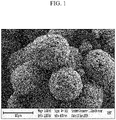
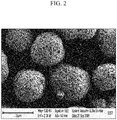
- Example 3 The surfaces of the positive electrode active materials manufactured in Example 3 and Comparative Example 1 were analyzed by a scanning electron microscope (SEM, JEOL JSM-6610) and the results are shown in FIGS. 1 and 2 , respectively.
- SEM scanning electron microscope
- the positive electrode active material of Example 3 had a coating layer formed thereon which was uniform so that no primary particle was seen on the surface, as compared with the positive electrode active material of Comparative Example 1.
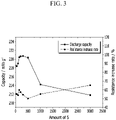
- FIG. 3 shows the initial discharge capacity at room temperature and the resistance increase rate at a high temperature depending on the content of Li 2 SO 4 included in the coating layer as in Examples 1 to 5.
- the 0.1 C discharge capacity was the highest at 300 ppm of S, and the resistance increase rate was the lowest at 500 ppm of S.
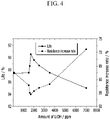
- FIG. 4 shows the life characteristics at a high temperature and the resistance increase rate depending on the content of LiOH included in the coating layer as in Examples 6 to 11.
- the 0.1 C discharge capacity was the highest and the resistance increase rate was the lowest, at 1700 ppm of a LiOH content.
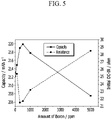
- FIG. 5 shows the 0.1 C initial capacity and the initial resistance depending on the content of B included in the coating layer, as in Examples 18 to 20.
- the 0.1 C discharge capacity was the highest at 500 ppm of B, and the initial resistance was the lowest at 300 ppm of B.
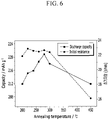
- FIG. 6 shows the 0.1 C charge/discharge capacity and the initial resistance value at 25°C, and the life and the resistance increase rate at 45°C, by adjusting the second heat treatment temperature as in Examples 12 to 17.
- the 0.1 C discharge capacity was the highest, the life characteristics were excellent, and the resistance increase rate was the lowest, at a second heat treatment temperature of 280°C.
- FIG. 7 shows the results of evaluating the life characteristics at a high temperature for the positive electrode active materials of Comparative Example 1 and Example 3. Referring to FIG. 7 , the life at a high temperature was about 71% in Comparative Example 1, but the life was about 91% in Example 3, and thus, it is confirmed that the life of Example 3 was significantly improved.
- the present invention is not limited to the exemplary embodiments, but may be produced in various forms different from each other.
- a person with ordinary skill in the art to which the present invention pertains will understand that the present invention may be carried out in other specific forms without changing the technical idea or the essential feature of the present invention. Therefore, the exemplary embodiments described above should be understood to be illustrative in all respects, and not to be restrictive.
Landscapes
- Chemical & Material Sciences (AREA)
- Chemical Kinetics & Catalysis (AREA)
- Electrochemistry (AREA)
- General Chemical & Material Sciences (AREA)
- Inorganic Chemistry (AREA)
- Engineering & Computer Science (AREA)
- Composite Materials (AREA)
- Organic Chemistry (AREA)
- Manufacturing & Machinery (AREA)
- Materials Engineering (AREA)
- Battery Electrode And Active Subsutance (AREA)
Applications Claiming Priority (2)
| Application Number | Priority Date | Filing Date | Title |
|---|---|---|---|
| KR20190172472 | 2019-12-20 | ||
| PCT/KR2020/018665 WO2021125882A2 (ko) | 2019-12-20 | 2020-12-18 | 양극 활물질, 이의 제조방법 및 이를 포함하는 리튬 이차 전지 |
Publications (2)
| Publication Number | Publication Date |
|---|---|
| EP4080608A2 true EP4080608A2 (de) | 2022-10-26 |
| EP4080608A4 EP4080608A4 (de) | 2023-06-28 |
Family
ID=76476626
Family Applications (1)
| Application Number | Title | Priority Date | Filing Date |
|---|---|---|---|
| EP20901645.0A Pending EP4080608A4 (de) | 2019-12-20 | 2020-12-18 | Positivelektrodenaktivmaterial, verfahren zur herstellung davon und lithiumsekundärbatterie damit |
Country Status (6)
| Country | Link |
|---|---|
| US (1) | US12537188B2 (de) |
| EP (1) | EP4080608A4 (de) |
| JP (1) | JP7333477B2 (de) |
| KR (1) | KR102867392B1 (de) |
| CN (1) | CN114846649B (de) |
| WO (1) | WO2021125882A2 (de) |
Families Citing this family (5)
| Publication number | Priority date | Publication date | Assignee | Title |
|---|---|---|---|---|
| CN117751471A (zh) * | 2022-03-31 | 2024-03-22 | 株式会社Lg新能源 | 全固态电池用正极以及包含其的全固态电池 |
| EP4546493A4 (de) * | 2022-08-24 | 2025-11-19 | Lg Energy Solution Ltd | Lithiumsekundärbatterie und verfahren zur herstellung einer lithiumsekundärbatterie |
| CN115394996B (zh) * | 2022-09-21 | 2025-11-07 | 天津巴莫科技有限责任公司 | 正极材料的包覆方法、包覆系统、正极复合材料和用途 |
| KR102683636B1 (ko) * | 2022-12-23 | 2024-07-10 | (주)포스코퓨처엠 | 리튬 이차 전지용 양극 활물질 및 이를 포함하는 리튬 이차 전지 |
| CN120015778A (zh) * | 2023-11-14 | 2025-05-16 | 宁德时代新能源科技股份有限公司 | 正极活性材料及其处理方法、正极极片、电池、用电装置 |
Family Cites Families (15)
| Publication number | Priority date | Publication date | Assignee | Title |
|---|---|---|---|---|
| JP4923397B2 (ja) * | 2004-09-06 | 2012-04-25 | 日産自動車株式会社 | 非水電解質リチウムイオン二次電池用正極材料およびその製造方法 |
| JP2010009960A (ja) * | 2008-06-27 | 2010-01-14 | Sony Corp | 正極活物質の製造方法および正極活物質 |
| KR101219401B1 (ko) * | 2011-05-31 | 2013-01-15 | 전자부품연구원 | 이차전지용 양극재료 및 이의 제조방법 |
| WO2012164760A1 (ja) | 2011-06-01 | 2012-12-06 | トヨタ自動車株式会社 | 電極活物質の製造方法及び電極活物質 |
| CN104781960B (zh) | 2013-10-29 | 2018-03-06 | 株式会社Lg 化学 | 正极活性物质的制备方法及由该方法制备的锂二次电池用正极活性物质 |
| KR101668799B1 (ko) | 2014-03-20 | 2016-10-24 | 주식회사 엘 앤 에프 | 리튬 이차 전지용 양극 활물질, 이의 제조방법 및 이를 포함하는 리튬 이차 전지 |
| KR102217753B1 (ko) * | 2014-03-20 | 2021-02-22 | 주식회사 엘 앤 에프 | 리튬 이차 전지용 양극 활물질, 이의 제조방법 및 이를 포함하는 리튬 이차 전지 |
| JP6312489B2 (ja) * | 2014-03-27 | 2018-04-18 | オートモーティブエナジーサプライ株式会社 | 非水電解質電池及びその製造方法 |
| KR101844110B1 (ko) | 2014-10-31 | 2018-05-14 | 주식회사 엘지화학 | 리튬 이차전지용 양극 활물질, 및 이를 포함하는 양극 및 리튬 이차전지 |
| US10833321B2 (en) * | 2015-03-06 | 2020-11-10 | Uchicago Argonne, Llc | Cathode materials for lithium ion batteries |
| KR20170075596A (ko) | 2015-12-23 | 2017-07-03 | 주식회사 포스코 | 리튬 이차 전지용 양극 활물질, 이의 제조 방법, 및 이를 포함하는 리튬 이차 전지 |
| KR102010929B1 (ko) | 2017-12-26 | 2019-08-16 | 주식회사 포스코 | 리튬 이차 전지용 양극 활물질, 이의 제조 방법, 및 이를 포함하는 리튬 이차 전지 |
| KR102698845B1 (ko) | 2017-12-27 | 2024-08-26 | 주식회사 엘지에너지솔루션 | 리튬 이차 전지용 양극 활물질, 이의 제조 방법, 이를 포함하는 양극 및 리튬 이차 전지 |
| KR102175578B1 (ko) * | 2018-11-14 | 2020-11-06 | 삼성에스디아이 주식회사 | 양극 활물질, 이의 제조방법 및 이를 포함하는 리튬 이차 전지 |
| KR102851622B1 (ko) | 2020-07-13 | 2025-09-01 | 주식회사 엘지에너지솔루션 | 저온 소결공정을 위한 산화물계 고체전해질을 포함하는 전고체전지 및 이의 제조방법 |
-
2020
- 2020-12-18 US US17/786,888 patent/US12537188B2/en active Active
- 2020-12-18 JP JP2022538325A patent/JP7333477B2/ja active Active
- 2020-12-18 EP EP20901645.0A patent/EP4080608A4/de active Pending
- 2020-12-18 KR KR1020227024237A patent/KR102867392B1/ko active Active
- 2020-12-18 WO PCT/KR2020/018665 patent/WO2021125882A2/ko not_active Ceased
- 2020-12-18 CN CN202080088648.2A patent/CN114846649B/zh active Active
Also Published As
| Publication number | Publication date |
|---|---|
| JP7333477B2 (ja) | 2023-08-24 |
| EP4080608A4 (de) | 2023-06-28 |
| WO2021125882A2 (ko) | 2021-06-24 |
| CN114846649B (zh) | 2024-10-11 |
| KR102867392B1 (ko) | 2025-10-01 |
| WO2021125882A3 (ko) | 2021-08-12 |
| CN114846649A (zh) | 2022-08-02 |
| KR20220116241A (ko) | 2022-08-22 |
| JP2023508026A (ja) | 2023-02-28 |
| US20230039543A1 (en) | 2023-02-09 |
| US12537188B2 (en) | 2026-01-27 |
Similar Documents
| Publication | Publication Date | Title |
|---|---|---|
| CN114556633B (zh) | 正极活性材料、其制备方法和包含它的锂二次电池 | |
| US12537188B2 (en) | Positive electrode active material, method of preparing the same, and lithium secondary battery including the same | |
| JP7432732B2 (ja) | 正極活物質、その製造方法、およびこれを含むリチウム二次電池 | |
| KR102341407B1 (ko) | 리튬이차전지용 양극 활물질 및 그 제조방법, 그리고 상기 양극 활물질을 채용한 양극과 리튬이차전지 | |
| JP7629998B2 (ja) | 正極活物質、その製造方法およびそれを含むリチウム二次電池 | |
| US12603278B2 (en) | Cathode active material, method for manufacturing the same, and secondary lithium ion battery including the same | |
| JP7831909B2 (ja) | 正極活物質、その製造方法、およびこれを含むリチウム二次電池 | |
| KR20210080081A (ko) | 양극 활물질, 이의 제조방법 및 이를 포함하는 리튬 이차 전지 | |
| KR20210079128A (ko) | 양극 활물질, 이의 제조 방법, 및 이를 포함하는 리튬 이차 전지 | |
| JP7754963B2 (ja) | 正極活物質、その製造方法、およびこれを含むリチウム二次電池 | |
| KR102683636B1 (ko) | 리튬 이차 전지용 양극 활물질 및 이를 포함하는 리튬 이차 전지 | |
| EP4636865A1 (de) | Positivelektrodenaktivmaterialvorläufer für lithiumsekundärbatterie, positivelektrodenaktivmaterial und lithiumsekundärbatterie damit | |
| KR20240092853A (ko) | 리튬 이차 전지용 양극 활물질, 및 양극 활물질의 제조 방법 | |
| KR20240093225A (ko) | 리튬 이차 전지용 양극 활물질, 이의 제조 방법 및 이를 포함하는 리튬 이차 전지 |
Legal Events
| Date | Code | Title | Description |
|---|---|---|---|
| STAA | Information on the status of an ep patent application or granted ep patent |
Free format text: STATUS: THE INTERNATIONAL PUBLICATION HAS BEEN MADE |
|
| PUAI | Public reference made under article 153(3) epc to a published international application that has entered the european phase |
Free format text: ORIGINAL CODE: 0009012 |
|
| STAA | Information on the status of an ep patent application or granted ep patent |
Free format text: STATUS: REQUEST FOR EXAMINATION WAS MADE |
|
| 17P | Request for examination filed |
Effective date: 20220713 |
|
| AK | Designated contracting states |
Kind code of ref document: A2 Designated state(s): AL AT BE BG CH CY CZ DE DK EE ES FI FR GB GR HR HU IE IS IT LI LT LU LV MC MK MT NL NO PL PT RO RS SE SI SK SM TR |
|
| DAV | Request for validation of the european patent (deleted) | ||
| DAX | Request for extension of the european patent (deleted) | ||
| A4 | Supplementary search report drawn up and despatched |
Effective date: 20230530 |
|
| RIC1 | Information provided on ipc code assigned before grant |
Ipc: C01G 53/04 20060101ALI20230523BHEP Ipc: C01D 15/08 20060101ALI20230523BHEP Ipc: C01D 15/06 20060101ALI20230523BHEP Ipc: C01D 15/02 20060101ALI20230523BHEP Ipc: C01B 35/00 20060101ALI20230523BHEP Ipc: C01G 53/00 20060101ALI20230523BHEP Ipc: H01M 10/052 20100101ALI20230523BHEP Ipc: H01M 4/505 20100101ALI20230523BHEP Ipc: H01M 4/525 20100101ALI20230523BHEP Ipc: H01M 4/62 20060101ALI20230523BHEP Ipc: H01M 4/36 20060101AFI20230523BHEP |
|
| RAP1 | Party data changed (applicant data changed or rights of an application transferred) |
Owner name: POSCO FUTURE M CO., LTD Owner name: RESEARCH INSTITUTE OF INDUSTRIAL SCIENCE & TECHNOLOGY Owner name: POSCO HOLDINGS INC. |