EP4080974A1 - Procédé de planification, procédé d'entraînement d'algorithme de planification et système associé, et support de stockage - Google Patents
Procédé de planification, procédé d'entraînement d'algorithme de planification et système associé, et support de stockage Download PDFInfo
- Publication number
- EP4080974A1 EP4080974A1 EP21757207.2A EP21757207A EP4080974A1 EP 4080974 A1 EP4080974 A1 EP 4080974A1 EP 21757207 A EP21757207 A EP 21757207A EP 4080974 A1 EP4080974 A1 EP 4080974A1
- Authority
- EP
- European Patent Office
- Prior art keywords
- network
- sub
- value
- policy
- area
- Prior art date
- Legal status (The legal status is an assumption and is not a legal conclusion. Google has not performed a legal analysis and makes no representation as to the accuracy of the status listed.)
- Granted
Links
Images



Classifications
-
- H—ELECTRICITY
- H04—ELECTRIC COMMUNICATION TECHNIQUE
- H04W—WIRELESS COMMUNICATION NETWORKS
- H04W72/00—Local resource management
- H04W72/12—Wireless traffic scheduling
- H04W72/1263—Mapping of traffic onto schedule, e.g. scheduled allocation or multiplexing of flows
-
- H—ELECTRICITY
- H04—ELECTRIC COMMUNICATION TECHNIQUE
- H04W—WIRELESS COMMUNICATION NETWORKS
- H04W28/00—Network traffic management; Network resource management
- H04W28/02—Traffic management, e.g. flow control or congestion control
- H04W28/0226—Traffic management, e.g. flow control or congestion control based on location or mobility
-
- H—ELECTRICITY
- H04—ELECTRIC COMMUNICATION TECHNIQUE
- H04W—WIRELESS COMMUNICATION NETWORKS
- H04W72/00—Local resource management
- H04W72/50—Allocation or scheduling criteria for wireless resources
- H04W72/54—Allocation or scheduling criteria for wireless resources based on quality criteria
-
- H—ELECTRICITY
- H04—ELECTRIC COMMUNICATION TECHNIQUE
- H04W—WIRELESS COMMUNICATION NETWORKS
- H04W28/00—Network traffic management; Network resource management
- H04W28/02—Traffic management, e.g. flow control or congestion control
- H04W28/0231—Traffic management, e.g. flow control or congestion control based on communication conditions
-
- H—ELECTRICITY
- H04—ELECTRIC COMMUNICATION TECHNIQUE
- H04W—WIRELESS COMMUNICATION NETWORKS
- H04W28/00—Network traffic management; Network resource management
- H04W28/02—Traffic management, e.g. flow control or congestion control
- H04W28/10—Flow control between communication endpoints
- H04W28/14—Flow control between communication endpoints using intermediate storage
-
- H—ELECTRICITY
- H04—ELECTRIC COMMUNICATION TECHNIQUE
- H04W—WIRELESS COMMUNICATION NETWORKS
- H04W28/00—Network traffic management; Network resource management
- H04W28/16—Central resource management; Negotiation of resources or communication parameters, e.g. negotiating bandwidth or QoS [Quality of Service]
-
- H—ELECTRICITY
- H04—ELECTRIC COMMUNICATION TECHNIQUE
- H04W—WIRELESS COMMUNICATION NETWORKS
- H04W72/00—Local resource management
- H04W72/04—Wireless resource allocation
-
- H—ELECTRICITY
- H04—ELECTRIC COMMUNICATION TECHNIQUE
- H04W—WIRELESS COMMUNICATION NETWORKS
- H04W72/00—Local resource management
- H04W72/20—Control channels or signalling for resource management
-
- Y—GENERAL TAGGING OF NEW TECHNOLOGICAL DEVELOPMENTS; GENERAL TAGGING OF CROSS-SECTIONAL TECHNOLOGIES SPANNING OVER SEVERAL SECTIONS OF THE IPC; TECHNICAL SUBJECTS COVERED BY FORMER USPC CROSS-REFERENCE ART COLLECTIONS [XRACs] AND DIGESTS
- Y02—TECHNOLOGIES OR APPLICATIONS FOR MITIGATION OR ADAPTATION AGAINST CLIMATE CHANGE
- Y02D—CLIMATE CHANGE MITIGATION TECHNOLOGIES IN INFORMATION AND COMMUNICATION TECHNOLOGIES [ICT], I.E. INFORMATION AND COMMUNICATION TECHNOLOGIES AIMING AT THE REDUCTION OF THEIR OWN ENERGY USE
- Y02D30/00—Reducing energy consumption in communication networks
- Y02D30/70—Reducing energy consumption in communication networks in wireless communication networks
Definitions
- This application relates to the field of communication technologies, and in particular, to a scheduling method, a scheduling algorithm training method, a scheduling control system, a scheduling algorithm training system, and a storage medium.
- medium access control (Medium Access Control, MAC) layer scheduling is mainly used to resolve a problem such as time-frequency resource allocation, modulation and coding scheme (Modulation and Coding Scheme, MCS) selection, user pairing, and precoding, and implement a compromise between a throughput and fairness of a system through scheduling.
- MCS Modulation and Coding Scheme
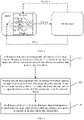
- a Markov decision process is a mathematical model for analyzing a decision problem. As shown in FIG. 1 , it is assumed that an environment has a Markov property (conditional probability distribution of a future state of the environment depends only on a current state). A decision maker periodically observes a state of the environment, makes a decision based on the current state of the environment, and obtains a new state and a reward after interaction with the environment.
- Reinforcement learning is a field in machine learning, and may be used to solve the foregoing Markov decision process.
- reinforcement learning emphasizes that an agent agent obtains a maximum expected reward and learns an optimal behavior manner by using a process of interacting with an environment.
- the agent obtains a current state s by observing the environment, and makes a decision about an action a according to a specified rule ⁇ , to feed back the action to the environment.
- the environment feeds back, to the agent, a reward r or a penalty that is obtained after the action is performed.
- the agent learns to make an optimal decision based on a state of the environment.
- deep reinforcement learning deep reinforcement learning, DRL
- DRL deep reinforcement learning
- a deep reinforcement learning DRL algorithm is used in a conventional technology.
- an agent in the DRL continuously updates a parameter of the agent by interacting with the wireless transmission environment, to obtain a good decision policy.
- the agent first obtains a current state of a communication system, and makes a decision based on the state. After the decision is implemented, the communication system enters a next state, and feeds back a reward.
- the agent adjusts a decision parameter of the agent based on the reward.
- the agent iteratively interacts with the environment, continuously adjusts the parameter of the agent to obtain a larger reward, and may obtain a good scheduling policy after final convergence.
- a centralized scheduling solution is used, and a unique agent is responsible for decision-making of all cells/networks in the entire network.
- a scenario of a multi-cell network or a multi-level heterogeneous network if the conventional technology is used, an action space is excessively large, and a training process of a neural network used by the agent is very slow and has difficulty in converging. Therefore, in an actual system, feasibility of deploying the centralized scheduling solution is extremely low.
- This application discloses a scheduling method, a scheduling algorithm training method, a related system, and a storage medium, to implement distributed scheduling based on a plurality of agents, and improve system performance.
- an embodiment of this application provides a scheduling method, where the method is applied to a scheduling control system, the scheduling control system includes K network devices, K is an integer greater than 1, and the method includes:
- a first network device obtains target state information of a first area, where the first network device is any one of the K network devices, the first area is an area covered by the first network device, and the target state information includes network state information and user data packet cache information;
- the first network device in the K network devices obtains the target state information of the first area, then obtains the scheduling information based on the target state information and the first target sub-policy network corresponding to the first network device, and delivers the scheduling information to the terminal in the first area, so that each terminal in the first area transmits data based on the scheduling information.
- each network device performs scheduling control on a policy network corresponding to the network device, to implement multi-agent scheduling control, and improve performance of the scheduling control system.
- feasibility of a scheduling control solution is improved by deploying policy networks in a distributed manner.
- the method further includes: The first network device performs iterative training on a first initial sub-policy network to obtain the first target sub-policy network; and that first network device performs iterative training on a first initial sub-policy network to obtain the first target sub-policy network includes: the first network device obtains a performance parameter based on target state information Si+i of the first area; and when a value of the performance parameter is not less than a preset value, the first network device determines a first sub-policy network Wi as the first target sub-policy network, where i is a positive integer, the target state information Si+i of the first area is obtained by the terminal in the first area through data transmission based on second scheduling information, the second scheduling information is generated by the first network device based on target state information Si of the first area and the first sub-policy network Wi, the target state information Si is target state information to be used in an
- training is stopped when the value of the performance parameter is not less than the preset value.
- the foregoing condition is not limited in this embodiment of this application.
- training may be stopped when the value of the performance parameter is not greater than the preset value. For example, a new preset value is obtained by inverting the foregoing preset value.
- training may be stopped when a quantity of times of iterative training reaches a preset quantity of times.
- training is stopped when a quantity of times of parameter update reaches a preset quantity of times, or the like.
- training may be stopped when a value of a loss function corresponding to a policy network is less than a preset threshold, or the like.
- the first network device adjusts a parameter of the first sub-policy network W i based on the target state information S i , an output result of the first sub-policy network W i , the target state information S i+1 , and an evaluation value of the first sub-policy network W i , to obtain a first sub-policy network used for next training, where the evaluation value of the first sub-policy network W i is obtained through processing based on a value network Q i , and the value network Q i is obtained based on a value network that is previously trained.
- the evaluation value of the first sub-policy network W i is obtained by inputting, into the value network Qi for processing, target state information of K areas covered by the K network devices, output results of K sub-policy networks corresponding to the K network devices, and feedback rewards corresponding to the K areas, where the feedback rewards corresponding to the K areas are determined by terminals in the K areas through data transmission based on second scheduling information respectively corresponding to the K areas.
- the first network device adjusts a parameter of the first sub-policy network W i based on the target state information S i , an output result of the first sub-policy network W i , the target state information S i+1 , and an evaluation value of the first sub-policy network W i , to obtain a first sub-policy network used for next training, where the evaluation value of the first sub-policy network W i is obtained through processing based on a first sub-value network q i , the first sub-value network q i is obtained based on a first sub-value network that is previously trained, the first sub-value network q i is a sub-value network that is in K sub-value networks and that corresponds to the first network device, and the K sub-value networks are in a one-to-one correspondence with the K network devices.
- the evaluation value of the first sub-policy network W i is obtained by inputting, into the first sub-value network q i for processing, the target state information S i and the target state information S i+1 of the first area covered by the first network device, the output result of the first sub-policy network W i corresponding to the first network device, a feedback reward corresponding to the first area, and information about K-1 sub-value networks other than the first sub-value network q i , where the feedback reward corresponding to the first area is determined by the terminal in the first area through data transmission based on the second scheduling information corresponding to the first area.
- the scheduling control system further includes a centralized network element device, and before the first network device generates the first scheduling information based on the target state information of the first area and the first target sub-policy network, the method further includes:
- the first network device receives a parameter that is of the first target sub-policy network and that is sent by the centralized network element device, where parameters of the K target sub-policy networks are the same, and the centralized network element device is a core network device or a base station centralized unit CU device.
- an embodiment of this application further provides a scheduling algorithm training method, where the method is applied to a scheduling algorithm training system, the scheduling algorithm training system includes K network devices, K is an integer greater than 1, and the method includes:
- the training data includes target state information S i+1 of a first area, the first area is an area covered by the first network device, and that the first network device performs iterative training on a first initial sub-policy network based on the training data, to obtain a first target sub-policy network includes:
- the first network device adjusts a parameter of the first sub-policy network W i based on the target state information S i , an output result of the first sub-policy network W i , the target state information S i+1 , and an evaluation value of the first sub-policy network W i , to obtain a first sub-policy network used for next training, where the evaluation value of the first sub-policy network W i is obtained through processing based on a value network Q i , and the value network Q i is obtained based on a value network that is previously trained.
- the evaluation value of the first sub-policy network W i is obtained by inputting, into the value network Q i for processing, target state information of K areas covered by the K network devices, output results of sub-policy networks respectively corresponding to the K network devices, and feedback rewards corresponding to the K areas, where the feedback rewards corresponding to the K areas are determined by terminals in the K areas through data transmission based on second scheduling information respectively corresponding to the K areas.
- training is performed based on a multi-agent reinforcement learning MARL architecture including a centralized value network and distributed policy networks, to obtain one target value network and a plurality of distributed target policy networks.
- the distributed target policy network may be used by a network device for scheduling, so that fully centralized scheduling in a single-agent DRL is avoided, and solution feasibility is improved.
- the first network device adjusts a parameter of the first sub-policy network W i based on the target state information S i , an output result of the first sub-policy network W i , the target state information S i+1 , and an evaluation value of the first sub-policy network W i , to obtain a first sub-policy network used for next training, where the evaluation value of the first sub-policy network W i is obtained through processing based on a first sub-value network q i , the first sub-value network q i is obtained based on a first sub-value network that is previously trained, the first sub-value network q i is a sub-value network that is in K sub-value networks and that corresponds to the first network device, and the K sub-value networks are in a one-to-one correspondence with the K network devices.
- the evaluation value of the first sub-policy network Wi is obtained by inputting, into the first sub-value network q i for processing, the target state information Si and the target state information S i+1 of the first area covered by the first network device, the output result of the first sub-policy network Wi corresponding to the first network device, a feedback reward corresponding to the first area, and information about K-1 sub-value networks other than the first sub-value network q i , where the feedback reward corresponding to the first area is determined by the terminal in the first area through data transmission based on the second scheduling information corresponding to the first area.
- training is performed based on a multi-agent MARL architecture including distributed value networks and distributed policy networks, to obtain a plurality of target value networks and a plurality of distributed target policy networks.
- the distributed target policy network may be used by a network device for scheduling, so that fully centralized scheduling in a single-agent DRL is avoided, and solution feasibility is improved.
- the method further includes: The first network device determines a first sub-value network q i as a first target sub-value network, where the first sub-value network q i is obtained based on a first sub-value network that is previously trained, the first sub-value network q i is a sub-value network that is in K sub-value networks and that corresponds to the first network device, and the K sub-value networks are in a one-to-one correspondence with the K network devices.
- the first network device When the value of the performance parameter is less than the preset value, the first network device inputs, into the first sub-value network q i for processing, the target state information Si and the target state information S i+1 of the first area, an output result of the first sub-policy network W i corresponding to the first network device, a feedback reward corresponding to the first area, and information about K-1 sub-value networks other than the first sub-value network q i , to obtain an evaluation value of the first sub-policy network W i , where the feedback reward corresponding to the first area is determined by the terminal in the first area through data transmission based on the second scheduling information corresponding to the first area; and the first network device adjusts a parameter of the first sub-value network q i to obtain a first sub-value network used for next training.
- the scheduling algorithm training system further includes a centralized network element device, and when the value of the performance parameter is not less than the preset value, the method further includes: The centralized network element device determines a value network Q i as a target value network, where the value network Q i is obtained based on a value network that is previously trained.
- the centralized network element device When the value of the performance parameter is less than the preset value, the centralized network element device inputs, into the value network Q i for processing, target state information of K areas covered by the K network devices, output results of K sub-policy networks corresponding to the K network devices, and feedback rewards corresponding to the K areas, to obtain K evaluation values, where the K evaluation values are in a one-to-one correspondence with the K sub-policy networks;
- the scheduling algorithm training system further includes a centralized network element device, and when the value of the performance parameter is not less than the preset value, the method further includes:
- the centralized network element device determines a first sub-value network q i as a first target sub-value network, where the first sub-value network q i is obtained based on a first sub-value network that is previously trained, the first sub-value network q i is a sub-value network that is in K sub-value networks and that corresponds to the first network device, and the K sub-value networks are in a one-to-one correspondence with the K network devices.
- the centralized network element device When the value of the performance parameter is less than the preset value, the centralized network element device inputs, into the first sub-value network q i for processing, the target state information S i and the target state information S i+1 of the first area, an output result of the first sub-policy network W i corresponding to the first network device, a feedback reward corresponding to the first area, and information about K-1 sub-value networks other than the first sub-value network q i , to obtain an evaluation value of the first sub-policy network Wi, where the feedback reward corresponding to the first area is determined by the terminal in the first area through data transmission based on the second scheduling information corresponding to the first area; and the centralized network element device adjusts a parameter of the first sub-value network q i to obtain a first sub-value network used for next training.
- an embodiment of this application further provides a scheduling control system, where the scheduling control system includes K network devices, K is an integer greater than 1, a first network device is any one of the K network devices, and the first network device is configured to:
- the first network device Before generating the first scheduling information based on the target state information of the first area and the first target sub-policy network, the first network device is further configured to:
- the first network device is configured to: adjust a parameter of the first sub-policy network W i based on the target state information S i , an output result of the first sub-policy network W i , the target state information S i+1 , and an evaluation value of the first sub-policy network W i , to obtain a first sub-policy network used for next training, where the evaluation value of the first sub-policy network W i is obtained through processing based on a value network Q i , and the value network Q i is obtained based on a value network that is previously trained.
- the evaluation value of the first sub-policy network W i is obtained by inputting, into the value network Qi for processing, target state information of K areas covered by the K network devices, output results of K sub-policy networks corresponding to the K network devices, and feedback rewards corresponding to the K areas, where the feedback rewards corresponding to the K areas are determined by terminals in the K areas through data transmission based on second scheduling information respectively corresponding to the K areas.
- the first network device is configured to: adjust a parameter of the first sub-policy network W i based on the target state information S i , an output result of the first sub-policy network W i , the target state information S i+1 , and an evaluation value of the first sub-policy network W i , to obtain a first sub-policy network used for next training, where the evaluation value of the first sub-policy network W i is obtained through processing based on a first sub-value network q i , the first sub-value network q i is obtained based on a first sub-value network that is previously trained, the first sub-value network q i is a sub-value network that is in K sub-value networks and that corresponds to the first network device, and the K sub-value networks are in a one-to-one correspondence with the K network devices.
- the evaluation value of the first sub-policy network W i is obtained by inputting, into the first sub-value network q i for processing, the target state information S i and the target state information S i+1 of the first area covered by the first network device, the output result of the first sub-policy network W i corresponding to the first network device, a feedback reward corresponding to the first area, and information about K-1 sub-value networks other than the first sub-value network q i , where the feedback reward corresponding to the first area is determined by the terminal in the first area through data transmission based on the second scheduling information corresponding to the first area.
- the scheduling control system further includes a centralized network element device, and before generating the first scheduling information based on the target state information of the first area and the first target sub-policy network, the first network device is further configured to: receive a parameter that is of the first target sub-policy network and that is sent by the centralized network element device, where parameters of the K target sub-policy networks are the same, and the centralized network element device is a core network device or a base station centralized unit CU device.
- an embodiment of this application further provides a scheduling algorithm training system, where the scheduling algorithm training system includes K network devices, K is an integer greater than 1, a first network device is any one of the K network devices, and the first network device is configured to:
- the first network device is configured to: adjust a parameter of the first sub-policy network W i based on the target state information S i , an output result of the first sub-policy network Wi, the target state information S i+1 , and an evaluation value of the first sub-policy network W i , to obtain a first sub-policy network used for next training, where the evaluation value of the first sub-policy network W i is obtained through processing based on a value network Q i , and the value network Q i is obtained based on a value network that is previously trained.
- the evaluation value of the first sub-policy network W i is obtained by inputting, into the value network Qi for processing, target state information of K areas covered by the K network devices, output results of sub-policy networks respectively corresponding to the K network devices, and feedback rewards corresponding to the K areas, where the feedback rewards corresponding to the K areas are determined by terminals in the K areas through data transmission based on second scheduling information respectively corresponding to the K areas.
- the first network device is configured to: adjust a parameter of the first sub-policy network W i based on the target state information S i , an output result of the first sub-policy network W i , the target state information S i+1 , and an evaluation value of the first sub-policy network W i , to obtain a first sub-policy network used for next training, where the evaluation value of the first sub-policy network W i is obtained through processing based on a first sub-value network q i , the first sub-value network q i is obtained based on a first sub-value network that is previously trained, the first sub-value network q i is a sub-value network that is in K sub-value networks and that corresponds to the first network device, and the K sub-value networks are in a one-to-one correspondence with the K network devices.
- the evaluation value of the first sub-policy network W i is obtained by inputting, into the first sub-value network q i for processing, the target state information S i and the target state information S i+1 of the first area covered by the first network device, the output result of the first sub-policy network W i corresponding to the first network device, a feedback reward corresponding to the first area, and information about K-1 sub-value networks other than the first sub-value network q i , where the feedback reward corresponding to the first area is determined by the terminal in the first area through data transmission based on the second scheduling information corresponding to the first area.
- the first network device is further configured to: determine a first sub-value network q i as a first target sub-value network, where the first sub-value network q i is obtained based on a first sub-value network that is previously trained, the first sub-value network q i is a sub-value network that is in K sub-value networks and that corresponds to the first network device, and the K sub-value networks are in a one-to-one correspondence with the K network devices.
- the first network device is further configured to: input, into the first sub-value network q i for processing, the target state information S i and the target state information S i+1 of the first area, an output result of the first sub-policy network W i corresponding to the first network device, a feedback reward corresponding to the first area, and information about K-1 sub-value networks other than the first sub-value network q i , to obtain an evaluation value of the first sub-policy network W i , where the feedback reward corresponding to the first area is determined by the terminal in the first area through data transmission based on the second scheduling information corresponding to the first area; and adjust, by the first network device, a parameter of the first sub-value network q i to obtain a first sub-value network used for next training.
- the scheduling algorithm training system further includes a centralized network element device, and when the value of the performance parameter is not less than the preset value, the centralized network element device is configured to: determine a value network Q i as a target value network, where the value network Q i is obtained based on a value network that is previously trained.
- the centralized network element device is configured to:
- the scheduling algorithm training system further includes a centralized network element device, and when the value of the performance parameter is not less than the preset value, the centralized network element device is configured to: determine a first sub-value network q i as a first target sub-value network, where the first sub-value network q i is obtained based on a first sub-value network that is previously trained, the first sub-value network q i is a sub-value network that is in K sub-value networks and that corresponds to the first network device, and the K sub-value networks are in a one-to-one correspondence with the K network devices.
- the centralized network element device is configured to:
- this application provides a computer storage medium, including computer instructions, where when the computer instructions are run on an electronic device, the electronic device is enabled to perform the method provided in any one of the possible implementations of the first aspect and/or any one of the possible implementations of the second aspect.
- an embodiment of this application provides a computer program product, where when the computer program product runs on a computer, the computer is enabled to perform the method provided in any one of the possible implementations of the first aspect and/or any one of the possible implementations of the second aspect.
- the apparatus according to the third aspect, the apparatus according to the fourth aspect, the computer storage medium according to the fifth aspect, or the computer program product according to the sixth aspect that is provided above is configured to perform the method provided in any one of the possible implementations of the first aspect and the method provided in any one of the possible implementations of the second aspect. Therefore, for beneficial effects that can be achieved, refer to beneficial effects in a corresponding method, and details are not described herein again.
- FIG. 4 is a schematic flowchart of a scheduling method according to an embodiment of this application.
- the scheduling method is applied to a scheduling control system, the scheduling control system includes K network devices, and K is an integer greater than 1.
- the method includes steps 401 to 403 that are specifically as follows: 401.
- a first network device obtains target state information of a first area, where the first network device is any one of the K network devices, the first area is an area covered by the first network device, and the target state information includes network state information and user data packet cache information.
- the K network devices may be K base stations.
- the base station may be an apparatus that is deployed in a radio access network to provide a wireless communication function for a mobile station (Mobile Station, MS).
- the base station may be macro base stations, micro base stations (also referred to as small cells), relay nodes, access points, and the like in various forms.
- a device with a base station function may have different names in systems that use different radio access technologies. For example, in an LTE system, the device is referred to as an evolved NodeB (evolved NodeB, eNB or eNodeB); and in a 3rd Generation (3rd Generation, 3G) system, the device is referred to as a NodeB (NodeB).
- eNB evolved NodeB
- 3rd Generation 3rd Generation
- the MS may include various handheld devices, vehicle-mounted devices, wearable devices, and computing devices that have a wireless communication function, or another processing device connected to a wireless modem.
- the MS may also be referred to as a terminal (terminal), or may be a subscriber unit (subscriber unit), a cellular phone (cellular phone), a smartphone (smartphone), a wireless data card, a personal digital assistant (Personal Digital Assistant, PDA) computer, a tablet computer, a wireless modem (modem), a handset (handset), a laptop computer (laptop computer), a machine type communication (Machine Type Communication, MTC) terminal, or the like.
- a terminal may be a subscriber unit (subscriber unit), a cellular phone (cellular phone), a smartphone (smartphone), a wireless data card, a personal digital assistant (Personal Digital Assistant, PDA) computer, a tablet computer, a wireless modem (modem), a handset (handset), a laptop computer (laptop computer), a machine type communication (Machine Type Communication, MTC) terminal, or the like.
- PDA Personal Digital Assistant
- modem modem
- handset handset
- laptop computer
- the first network device may be any one of the K network devices.
- the first network device may be a base station A, and the first area is an area covered by the base station A.
- the target state information may be state information of each terminal user in a cell covered by the first network device.
- the target state information may be state information of registered user in a coverage area of any base station in the macro base stations, the picocell base stations, or the femto base stations.
- the target state information includes network state information, user data packet cache information, and the like.
- the network state information includes channel state information, throughput information, hybrid automatic repeat request (Hybrid Automatic Repeat request, HARQ) information, and the like.
- the user data packet cache information includes a quantity of data packets in a cache, a size of the data packet in the cache, a delay of the data packet in the cache, and the like.
- the first network device generates first scheduling information based on the target state information of the first area and a first target sub-policy network, where the first target sub-policy network is a target sub-policy network that is in K target sub-policy networks and that corresponds to the first network device, and the K target sub-policy networks are in a one-to-one correspondence with the K network devices.
- the first scheduling information may be information indicating a data sending manner of a first terminal in the first area.
- the data sending manner is a specific configuration such as a radio resource, a modulation and coding scheme, or a precoding policy that is used during data sending.
- the first scheduling information is generated by the first network device based on the target state information of the first area and the first target sub-policy network.
- the first network device may input the target state information of the first area into the first target sub-policy network for processing, and processes an output result of the first target sub-policy network to obtain the first scheduling information.
- An actor-critic (actor-critic) algorithm is a commonly used reinforcement learning algorithm.
- an agent includes two parts: an actor and a critic.
- the actor is responsible for making a decision based on a state of an environment and an output of the critic, and the critic is responsible for evaluating, based on the state of the environment and a reward, the decision made by the actor.
- both the actor and the critic may be implemented by using a deep neural network.
- the actor neural network is responsible for making a decision, and therefore is also referred to as a policy network.
- the critic neural network outputs an evaluation, and is also referred to as a value network.
- the scheduling control system includes K network devices. Each network device corresponds to one target sub-policy network.
- the first network device corresponds to the first target sub-policy network. For example, one target sub-policy network is deployed on each network device. The first target sub-policy network is deployed on the first network device.
- the first target sub-policy network may be obtained through training based on a target value network.
- the first network device performs iterative training on a first initial sub-policy network to obtain the first target sub-policy network includes:
- the first sub-policy network Wi is the first initial sub-policy network.
- the foregoing is described by using an example in which current training is an i th time of training.
- the previous training is an (i-1) th time of training.
- the next training is an (i+1) th time of training.
- training is stopped when the value of the performance parameter is not less than the preset value.
- the foregoing condition is not limited in this embodiment of this application.
- training may be stopped when the value of the performance parameter is not greater than the preset value. For example, a new preset value is obtained by inverting the foregoing preset value.
- that the first network device performs iterative training on a first initial sub-policy network to obtain the first target sub-policy network includes: The first network device performs M times of iterative training on the first initial sub-policy network to obtain the first target sub-policy network, where M is a positive integer.
- the first network device When performing an i th time of iterative training, the first network device obtains the target state information Si of the first area, where i is a positive integer.
- the first network device inputs the target state information Si into the first sub-policy network W i for processing, and processes an output result of the sub-policy network W i to obtain the second scheduling information.
- the first network device delivers the second scheduling information to the terminal in the first area, where the second scheduling information is used by the terminal in the first area for data transmission.
- the first network device obtains the target state information S i+1 of the first area, where the target state information S i+1 is obtained by the terminal in the first area through data transmission based on the second scheduling information.
- the first network device adjusts a parameter of the first sub-policy network W i based on the target state information Si, the output result of the first sub-policy network Wi, the target state information S i+1 , and an evaluation value of the first sub-policy network W i , to obtain a first sub-policy network W i+1 used for next training, where the evaluation value of the first sub-policy network W i is obtained through processing based on a value network Qi, and the value network Q i is obtained based on a value network Q i-1 that is previously trained.
- the first sub-policy network W i+1 is the first target sub-policy network.
- the first sub-policy network Wi is the first initial sub-policy network.
- training is stopped when a quantity of times of iterative training reaches a preset quantity of times.
- training may be stopped when a quantity of times of parameter update reaches a preset quantity of times, or the like. This is not specifically limited herein.
- that the first network device performs iterative training on a first initial sub-policy network to obtain the first target sub-policy network includes:
- the first sub-policy network W i is the first initial sub-policy network.
- training is stopped when a value of a loss function corresponding to a policy network is less than a preset threshold.
- training may be stopped when a value of a loss function corresponding to a policy network is greater than a preset threshold, or the like. This is not specifically limited herein.
- the evaluation value of the first sub-policy network Wi is obtained by inputting, into the value network Q i for processing, target state information (including target state information S i and target state information S i+1 ) of K areas covered by the K network devices, output results of K sub-policy networks corresponding to the K network devices, and feedback rewards corresponding to the K areas.
- the feedback rewards corresponding to the K areas are determined by terminals in the K areas through data transmission based on second scheduling information respectively corresponding to the K areas.
- the method further includes: The first network device performs iterative training on a first initial sub-policy network to obtain the first target sub-policy network.
- the first target sub-policy network may be obtained through training based on a first target sub-value network.
- the K network devices correspond to K target sub-value networks.
- the first network device corresponds to the first target sub-value network.
- That the first network device performs iterative training on a first initial sub-policy network to obtain the first target sub-policy network includes:
- the first network device performs iterative training on a first initial sub-policy network to obtain the first target sub-policy network includes:
- the first sub-policy network W i is the first initial sub-policy network.
- the foregoing is described by using an example in which current training is an i th time of training.
- the previous training is an (i-1) th time of training.
- the next training is an (i+1) th time of training.
- training is stopped when the value of the performance parameter is not less than the preset value.
- the foregoing condition is not limited in this embodiment of this application.
- training may be stopped when the value of the performance parameter is not greater than the preset value. For example, a new preset value is obtained by inverting the foregoing preset value.
- that the first network device performs iterative training on a first initial sub-policy network to obtain the first target sub-policy network includes: The first network device performs M times of iterative training on the first initial sub-policy network to obtain the first target sub-policy network, where M is a positive integer.
- the first network device When performing an i th time of iterative training, the first network device obtains the target state information S i of the first area, where i is a positive integer.
- the first network device inputs the target state information S i into the first sub-policy network W i for processing, and processes an output result of the sub-policy network W i to obtain the second scheduling information.
- the first network device delivers the second scheduling information to the terminal in the first area, where the second scheduling information is used by the terminal in the first area for data transmission.
- the first network device obtains the target state information S i+1 of the first area, where the target state information S i+1 is obtained by the terminal in the first area through data transmission based on the second scheduling information.
- the first network device adjusts a parameter of the first sub-policy network W i based on the target state information S i , the output result of the first sub-policy network W i , the target state information S i+1 , and an evaluation value of the first sub-policy network W i , to obtain a first sub-policy network W i+1 used for next training, where the evaluation value of the first sub-policy network W i is obtained through processing based on a first sub-value network q i , the first sub-value network q i is obtained based on a first sub-value network that is previously trained, the first sub-value network q i is a sub-value network that is in K sub-value networks and that corresponds to the first network device, and the K sub-value networks are in a one-to-one correspondence with the K network devices.
- the first sub-policy network W i+1 is the first target sub-policy network.
- the first sub-policy network W i is the first initial sub-policy network.
- training is stopped when a quantity of times of iterative training reaches a preset quantity of times.
- training may be stopped when a quantity of times of parameter update reaches a preset quantity of times, or the like. This is not specifically limited herein.
- that the first network device performs iterative training on a first initial sub-policy network to obtain the first target sub-policy network includes:
- the first sub-policy network W i is the first initial sub-policy network.
- training is stopped when a value of a loss function corresponding to a policy network is less than a preset threshold.
- training may be stopped when a value of a loss function corresponding to a policy network is greater than a preset threshold, or the like. This is not specifically limited herein.
- the evaluation value of the first sub-policy network Wi is obtained by inputting, into the first sub-value network q i for processing, the target state information S i and the target state information S i+1 of the first area covered by the first network device, the output result of the first sub-policy network W i corresponding to the first network device, a feedback reward corresponding to the first area, and information about K-1 sub-value networks other than the first sub-value network q i .
- the feedback reward corresponding to the first area is determined by the terminal in the first area through data transmission based on the second scheduling information corresponding to the first area.
- the method further includes: The first network device receives a parameter that is of the first target sub-policy network and that is sent by a centralized network element device, where parameters of the K target sub-policy networks are the same.
- the scheduling control system further includes the centralized network element device.
- the first network device may receive the parameter that is of the first target sub-policy network and that is sent by the centralized network element device, so that the first network device inputs the target state information of the first area into the first target sub-policy network for processing, and processes the output result of the first target sub-policy network to obtain the first scheduling information.
- the centralized network element device is a core network device or a base station centralized unit CU device.
- the core network device may be a core network device in 4G communication or 5G communication, or may be a core network device in a future communication network.
- a generation of a communication technology or an application field of the core network device or the base station that implements the technical solution is not limited in this application.
- the base station centralized unit CU device may be a base station centralized unit CU device in 5G communication.
- the first network device delivers the first scheduling information to the terminal in the first area, where the first scheduling information is used by the terminal in the first area for data transmission.
- the scheduling method may be applied to the following scenario. For example, for a multi-cell scheduling problem in a cellular network, each cell needs to make a scheduling decision for a user in the cell. For another example, in a heterogeneous network, there are a plurality of base stations of different levels and coverage areas, for example, a macro base station macrocell, a picocell base station picocell, and a femto base station femtocell. The base station needs to make a scheduling decision for a user, in a coverage area of the base station, who is registered with the base station, and the like.
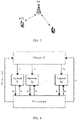
- a base station 4001 may obtain, from an area covered by the base station 4001, target state information of each terminal including a terminal 4002.
- the target state information includes network state information, user data packet cache information, and the like.
- Each terminal may be each terminal in a cell covered by the base station 4001. Alternatively, each terminal may be a registered terminal in a coverage area of a macro base station, a picocell base station, or a femto base station in a cell covered by a base station, or the like.
- the base station 4001 obtains scheduling information based on the target state information of each terminal in the area covered by the base station 4001, and the base station 4001 delivers the scheduling information to each terminal including the terminal 4002, so that each terminal transmits data based on the scheduling information.
- the first network device in the K network devices obtains the target state information of the first area, then obtains the scheduling information based on the target state information and the first target sub-policy network corresponding to the first network device, and delivers the scheduling information to the terminal in the first area, so that each terminal in the first area transmits data based on the scheduling information.
- each network device performs scheduling control on a policy network corresponding to the network device, to implement multi-agent scheduling control, and improve performance of the scheduling control system.
- feasibility of a scheduling control solution is improved by deploying policy networks in a distributed manner.
- FIG. 6 shows a scheduling algorithm training method according to an embodiment of this application.
- the method is applied to a scheduling algorithm training system.
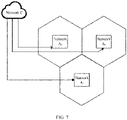
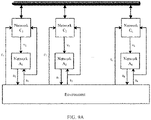
- the scheduling algorithm training system provides a multi-agent reinforcement learning MARL architecture including a centralized value network (network C) and distributed policy networks (networks A).
- One target value network and K target sub-policy networks may be obtained through training by using the architecture.
- the K target sub-policy networks are in a one-to-one correspondence with K network devices.
- the K network devices may implement the foregoing scheduling based on the obtained corresponding target sub-policy networks.
- the centralized value network may be deployed on a centralized network element device.
- the centralized network element device may be a core network device or a base station centralized unit (Centralized Unit, CU) device.
- the distributed sub-policy network may be deployed on a base station distributed unit (Distributed Unit, DU) device.
- this embodiment of this application provides a scheduling algorithm training method.
- the method includes steps 601 and 602 that are specifically as follows:
- the foregoing method may include at least three implementations.
- the training data includes target state information Si of each of K areas covered by the K network devices, the K areas are in a one-to-one correspondence with the K network devices, K is an integer greater than 1, i is a positive integer, and that the centralized network element device performs iterative training on an initial value network based on the training data, to obtain a target value network includes:
- the value network Q i is the initial value network.
- a system performance parameter when a system performance parameter reaches a specified threshold, iterative training is stopped, to obtain the target value network.
- the foregoing system performance parameter may include a throughput, fairness, a packet loss rate, a delay, and the like.
- Target state information may be processed to obtain the performance parameter.
- the system performance parameter such as a throughput, fairness, a packet loss rate, and a delay is calculated based on network state information and user data packet cache information in the target state information.
- the training data includes target state information Si of each of K areas covered by the K network devices, the K areas are in a one-to-one correspondence with the K network devices, i is a positive integer, and that the centralized network element device performs iterative training on an initial value network based on the training data, to obtain a target value network includes: The centralized network element device performs N times of iterative training on the initial value network to obtain the target value network, where N is a positive integer.
- the centralized network element device When performing an i th time of iterative training, the centralized network element device obtains state information S i+1 of each of the K areas covered by the K network devices, where the K pieces of state information S i+1 of the K areas are obtained by terminals in the K areas through data transmission based on second scheduling information respectively corresponding to the K areas, the second scheduling information respectively corresponding to the K areas is obtained by respectively inputting the K pieces of target state information S i of the K areas into K sub-policy networks W i for processing and then respectively processing output results of the K sub-policy networks Wi, the sub-policy network W i is obtained based on a sub-policy network W i-1 , and the K sub-policy networks are in a one-to-one correspondence with the K network devices.
- the centralized network element device inputs, into a value network Q i for processing, the state information S i of each of the K areas covered by the K network devices, the output results of the K sub-policy networks W i , the target state information S i+1 of each of the K areas covered by the K base stations, and feedback rewards corresponding to the K areas, to obtain evaluation values of the K sub-policy networks W i , where the feedback rewards corresponding to the K areas are obtained by the terminals in the K areas through data transmission based on the second scheduling information respectively corresponding to the K areas.
- the centralized network element device adjusts a parameter of the value network Q i to obtain a value network Q i+1 .
- the value network Q i+1 is the target value network.
- the value network Q i is the initial value network.
- the training data includes target state information S i of each of K areas covered by the K network devices, the K areas are in a one-to-one correspondence with the K network devices, i is a positive integer, and that the centralized network element device performs iterative training on an initial value network based on the training data, to obtain a target value network includes:
- the value network Q i is the initial value network.
- the scheduling algorithm training method is described by using an example in which the centralized value network is deployed on the centralized network element device.
- the distributed sub-policy network is deployed on the base station distributed unit (Distributed Unit, DU) device
- an embodiment of this application further provides a scheduling algorithm training method.
- the method is applied to a scheduling algorithm training system, the scheduling algorithm training system includes K network devices, K is an integer greater than 1, and the method includes steps 603 and 604 that are specifically as follows:
- the foregoing method may include at least three implementations.
- the base station may implement scheduling.
- training is performed based on a multi-agent MARL architecture including a centralized value network and distributed policy networks, to obtain one target value network and a plurality of distributed target policy networks.
- the distributed target policy network may be used by a network device for scheduling, so that fully centralized scheduling in a single-agent DRL is avoided, and solution feasibility is improved.
- each network A may obtain, from an environment corresponding to a communication system, target state information s of an area corresponding to the network A.
- Each network A may obtain a decision action a based on the target state information s.
- the environment feeds back a reward r to the network C.
- the network C obtains total target state information of the environment and a next-moment global state, and determines, based on the feedback reward r and each decision action a, an evaluation value v corresponding to each network A.
- a policy network A k corresponding to a base station K obtains, from the environment, target state information s k corresponding to an area covered by the base station K, and the value network C obtains a current global state from the environment, namely, (s 1 , s 2 , ..., s k ).
- the policy network A k makes a decision a k .
- the environment feeds back a reward r to the value network.
- the value network outputs an evaluation value v of each policy network based on the current global state s, the action a of each policy network, the feedback reward r, and the next-moment global state s', and updates a parameter of the value network.
- the next-moment global state s' is global state information obtained after the environment implements the decisions made by all the policy networks.
- the policy network A k updates a network parameter of the policy network A k based on the current state s k , the action a k , a next-moment state s k ', and an evaluation value v k output by the value network.
- Parameters of the policy network and the value network may be updated synchronously or asynchronously. In other words, the parameters may be updated simultaneously, or only the value network or the policy network may be updated in some scheduling periods. This is not specifically limited herein.
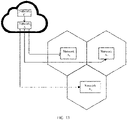
- the foregoing MARL architecture may be deployed in a scenario of a multi-cell cellular network shown in FIG. 7 .
- Joint scheduling of three cells is used as an example.
- a quantity of cells participating in joint scheduling may be set based on an inter-cell interference status, for example, a plurality of cells with severe mutual interference perform joint scheduling.
- the centralized value network may be deployed on a core network device or a base station centralized unit (Centralized Unit, CU).
- the distributed policy network may be deployed on a base station distributed unit (Distributed Unit, DU).
- Each base station may implement scheduling control based on a corresponding target policy network.
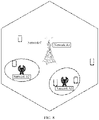
- the foregoing MARL framework may be alternatively deployed in a multi-level heterogeneous network.
- the value network may be deployed on the macro base station
- the policy network may be deployed on the macro base station, the picocell base station, and the femto base station.
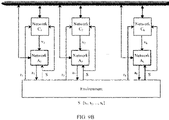
- an embodiment of this application further provides a multi-agent reinforcement learning MARL architecture including distributed value networks and distributed policy networks.
- the distributed value network may be deployed on a centralized network element device, and the centralized network element device may be a core network device or a base station centralized unit (Centralized Unit, CU) device.
- the distributed policy network may be deployed on a base station distributed unit (Distributed Unit, DU) device.
- K target sub-value networks and K target sub-policy networks may be obtained through training by using the architecture.
- the K target sub-value networks and the K target sub-policy networks are respectively in a one-to-one correspondence with K network devices.
- the K network devices may implement the foregoing scheduling based on the obtained corresponding target sub-policy networks.
- this embodiment of this application provides a scheduling algorithm training method.
- the method includes steps 901 and 902 that are specifically as follows:
- the first initial sub-value network is an initial sub-value network that is in K initial sub-value networks and that corresponds to a first network device
- the first target sub-value network is a target sub-value network that is in K target sub-value networks and that corresponds to the first network device
- the first network device is any one of the K network devices
- the K initial sub-value networks and the K target sub-value networks are respectively in a one-to-one correspondence with the K network devices.
- the foregoing method may include at least three implementations.
- the training data includes target state information Si of a first area covered by the first network device, i is a positive integer, and that the centralized network element device performs iterative training on a first initial sub-value network based on the training data, to obtain a first target sub-value network includes:
- the first sub-value network q i is the first initial sub-value network.
- the training data includes state information S i of a first area covered by the first network device, i is a positive integer, and that the centralized network element device performs iterative training on a first initial sub-value network based on the training data, to obtain a first target sub-value network includes: The centralized network element device performs N times of iterative training on the first initial sub-value network to obtain the first target sub-value network, where N is a positive integer.
- the centralized network element device When performing an i th time of iterative training, the centralized network element device obtains target state information S i+1 of the first area, where the target state information S i+1 of the first area is obtained by a terminal in the first area through data transmission based on second scheduling information corresponding to the first area, the second scheduling information corresponding to the first area is obtained by inputting the target state information S i of the first area into a first sub-policy network W i for processing and then processing an output result of the first sub-policy network W i , and the first sub-policy network W i is obtained based on a first sub-policy network W i-1 that is previously trained.
- the centralized network element device inputs, into a first sub-value network q i for processing, the target state information Si of the first area covered by the first network device, the output result of the first sub-policy network Wi, the target state information S i+1 , a feedback reward corresponding to the first area, and information about sub-value networks that respectively correspond to K-1 network devices and that are other than the first sub-value network qi corresponding to the first network device, to obtain an evaluation value of the first sub-policy network W i , where the feedback reward corresponding to the first area is obtained by the terminal in the first area through data transmission based on the second scheduling information.
- the centralized network element device adjusts a parameter of the first sub-value network q i to obtain a first sub-value network q i+1 used for next training.
- the first sub-value network q i+1 is the first target sub-value network.
- the first sub-value network q i is the first initial sub-value network.
- a third optional implementation when an obtained loss function of a first sub-value network is less than a preset threshold, iterative training is stopped, to obtain the first target sub-value network.
- the K target sub-value networks are obtained by performing iterative training on the K initial sub-value networks respectively.
- the training data includes target state information Si of a first area covered by the first network device A, i is a positive integer, and that the centralized network element device performs iterative training on an initial sub-value network based on the training data, to obtain a target sub-value network includes:
- the first sub-value network q i is the first initial sub-value network.
- the scheduling algorithm training method is described by using an example in which the distributed value network is deployed on the centralized network element device.
- the distributed sub-policy network is deployed on the base station distributed unit (Distributed Unit, DU) device
- an embodiment of this application further provides a scheduling algorithm training method.
- the method is applied to a scheduling algorithm training system, the scheduling algorithm training system includes K network devices, K is an integer greater than 1, and the method includes steps 903 and 904 that are specifically as follows:
- the foregoing method may include at least three implementations.
- the training data includes target state information Si of a first area, i is a positive integer, and the first area is an area covered by the first network device.
- the first network device performs iterative training on the first initial sub-policy network based on the training data, to obtain the first target sub-policy network
- the first network device performs iterative training on the first initial sub-policy network based on the training data, to obtain the first target sub-policy network
- the base station may implement scheduling.
- An embodiment of this application further provides a scheduling algorithm training method.
- the method is applied to a scheduling algorithm training system, the scheduling algorithm training system includes K network devices, K is an integer greater than 1, and the method includes steps 905 and 906 that are specifically as follows:
- the training data includes state information of a first area, the first area is an area covered by the first network device, and that the first network device separately performs iterative training on a first initial sub-value network and a first initial sub-policy network based on the training data, to obtain a first target sub-value network and a first target sub-policy network includes:
- the first sub-value network q i is the first initial sub-value network
- the first sub-policy network W i is the first initial sub-policy network
- each value network individually provides an evaluation value for a corresponding policy network.
- the plurality of value networks are connected to each other by using a communication bus, to exchange information.
- a policy network A k obtains, from an environment, a state s k corresponding to the policy network A k
- a value network C k obtains, from the environment, a state s k corresponding to the value network C k .
- the environment implements decisions made by all policy networks, and feeds back a reward r k to the value network C k .
- the value network outputs an evaluation value v k of the policy network A k based on the current state s k , the action a k of the policy network, the reward r k , a next-moment state s k ', and information that is about another value network and that is obtained by using the communication bus, and updates a network parameter of the value network.
- the policy network A k updates a network parameter of the policy network A k based on the current state s k , the action a k , the next-moment state s k ', and the evaluation value v k output by the value network.
- the next-moment state s k ' is a state obtained after the corresponding environment implements the decision made by the policy network.
- the information exchanged between the plurality of value networks by using the communication bus may be a state s k , an action a k , or a reward r k that corresponds to each value network, or may be an output result of another value network, a parameter of the another value network, an updated gradient value of the another value network, or the like.
- parameters of the policy network and the value network may be updated synchronously or asynchronously.
- Information about another policy network may be obtained by using the communication bus.
- the information about the another policy network may include an output result of the another policy network, a parameter of the another policy network, an updated gradient value of the another policy network, or the like.
- the policy network A k may update a network parameter of the policy network A k based on the current state s k , the action a k , the next-moment state s k ', the evaluation value v k output by the value network, and the information about the another policy network.
- the foregoing MARL framework is deployed in a scenario of a multi-cell cellular network.
- a quantity of cells participating in joint scheduling may be set based on an inter-cell interference status, for example, a plurality of cells with severe mutual interference perform joint scheduling.
- Joint scheduling of three cells is used as an example.
- both the distributed value network and the distributed policy network are deployed on a base station distributed unit (Distributed Unit, DU).
- the distributed value network may be deployed on a core network device or a base station CU. When the distributed value network is deployed on a core network device or a base station CU, this helps reduce overheads of communication between value networks.
- the foregoing MARL framework corresponding to the distributed value network and the distributed policy network may be used for scheduling in a system that has a multi-level network, for example, a heterogeneous network and a cognitive radio network.
- the heterogeneous network is used as an example.
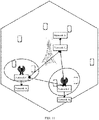
- FIG. 11 there is one macro base station, a plurality of picocell base stations, and a plurality of femto base stations in a cell in a coverage area of a macro base station.
- the value network and the policy network may be deployed on the macro base station, the picocell base station, and the femto base station.
- the plurality of distributed value networks may be deployed on the macro base station, to reduce overheads of communication between the value networks.
- training is performed based on a multi-agent MARL architecture including distributed value networks and distributed policy networks, to obtain a plurality of target value networks and a plurality of distributed target policy networks.
- the distributed target policy network may be used by a network device for scheduling, so that fully centralized scheduling in a single-agent DRL is avoided, and solution feasibility is improved.
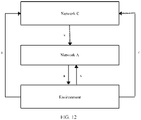
- An embodiment of this application further provides a multi-agent reinforcement learning MARL architecture including a centralized value network and a centralized policy network.
- the architecture includes a centralized value network and a centralized policy network.
- a target value network and a target policy network may be obtained through training by using the architecture. After training ends, the target policy network is delivered to each base station, to complete scheduling in a distributed manner.
- Both the centralized value network and the centralized policy network may be deployed on a centralized network element device such as a core network device or a base station centralized unit (Centralized Unit, CU). Therefore, this embodiment of this application provides a scheduling algorithm training method.
- the method is applied to a scheduling algorithm training system, the scheduling algorithm training system includes a centralized network element device, and the method includes steps 1201 to 1203 that are specifically as follows:
- the centralized network element device obtains training data.
- the centralized network element device separately performs iterative training on an initial value network and an initial policy network based on the training data, to obtain a target value network and a target policy network.
- the training data includes target state information Si of K areas covered by K network devices, i is a positive integer, and that the centralized network element device separately performs iterative training on an initial value network and an initial policy network based on the training data, to obtain a target value network and a target policy network includes:
- the value network Q i is the initial value network
- the policy network w i is the initial policy network
- the centralized network element device sends a parameter of the target policy network to the K network devices.
- the centralized network element device may deliver the obtained target policy network to each network device, so that distributed scheduling can be implemented, fully centralized scheduling in a single-agent DRL is avoided, and solution feasibility is improved.
- both a centralized network A and a centralized network C obtain global target state information s. Then, the centralized network A makes a decision about an action a k for each cell in a cellular network or each level of base station in a heterogeneous network. After the action a k is performed, a system state is updated, and a reward r is fed back to the centralized network C. The centralized network C network calculates an evaluation value v for the centralized network A based on the reward r, the action a k , the target state information s, and a next-moment global state s', and updates a network parameter of the centralized network C. The centralized network A and the centralized network C update respective network parameters.
- a training termination condition is not met, the foregoing step is repeatedly performed.
- the centralized network A is delivered to each cell base station in the cellular network or each level of base station in the heterogeneous network.
- the foregoing termination condition includes: A quantity of update times of a neural network reaches a specified threshold, system performance (a throughput/fairness/a packet loss rate/a delay) reaches a specified threshold, a loss function of a neural network is less than a specified threshold, or the like.
- the centralized value network and the centralized policy network may be deployed on a core network device or a CU in a multi-cell cellular network. After the foregoing training, the centralized policy network may be copied or delivered to each cell base station for scheduling. The centralized value network and the centralized policy network may be deployed on a macro base station in a multi-level heterogeneous network. As shown in FIG. 14 , after the foregoing training, the centralized policy network may be copied or delivered to each level of base station for scheduling.
- an embodiment of this application further provides a scheduling control system, where the scheduling control system includes K network devices, K is an integer greater than 1, a first network device is any one of the K network devices, and the first network device is configured to:
- the first network device Before generating the first scheduling information based on the target state information of the first area and the first target sub-policy network, the first network device is further configured to:
- the first network device is configured to: adjust a parameter of the first sub-policy network W i based on the target state information S i , an output result of the first sub-policy network W i , the target state information S i+1 , and an evaluation value of the first sub-policy network W i , to obtain a first sub-policy network used for next training, where the evaluation value of the first sub-policy network W i is obtained through processing based on a value network Q i , and the value network Q i is obtained based on a value network that is previously trained.
- the evaluation value of the first sub-policy network W i is obtained by inputting, into the value network Q i for processing, target state information of K areas covered by the K network devices, output results of K sub-policy networks corresponding to the K network devices, and feedback rewards corresponding to the K areas, where the feedback rewards corresponding to the K areas are determined by terminals in the K areas through data transmission based on second scheduling information respectively corresponding to the K areas.
- the first network device is configured to: adjust a parameter of the first sub-policy network W i based on the target state information S i , an output result of the first sub-policy network W i , the target state information S i+1 , and an evaluation value of the first sub-policy network W i , to obtain a first sub-policy network used for next training, where the evaluation value of the first sub-policy network W i is obtained through processing based on a first sub-value network q i , the first sub-value network q i is obtained based on a first sub-value network that is previously trained, the first sub-value network q i is a sub-value network that is in K sub-value networks and that corresponds to the first network device, and the K sub-value networks are in a one-to-one correspondence with the K network devices.
- the evaluation value of the first sub-policy network W i is obtained by inputting, into the first sub-value network q i for processing, the target state information S i and the target state information S i+1 of the first area covered by the first network device, the output result of the first sub-policy network W i corresponding to the first network device, a feedback reward corresponding to the first area, and information about K-1 sub-value networks other than the first sub-value network q i , where the feedback reward corresponding to the first area is determined by the terminal in the first area through data transmission based on the second scheduling information corresponding to the first area.
- the scheduling control system further includes a centralized network element device, and before generating the first scheduling information based on the target state information of the first area and the first target sub-policy network, the first network device is further configured to: receive a parameter that is of the first target sub-policy network and that is sent by the centralized network element device, where parameters of the K target sub-policy networks are the same, and the centralized network element device is a core network device or a base station centralized unit CU device.
- an embodiment of this application further provides a scheduling algorithm training system, where the scheduling algorithm training system includes K network devices, K is an integer greater than 1, a first network device is any one of the K network devices, and the first network device is configured to:
- the first network device is configured to: adjust a parameter of the first sub-policy network W i based on the target state information S i , an output result of the first sub-policy network W i , the target state information S i+1 , and an evaluation value of the first sub-policy network W i , to obtain a first sub-policy network used for next training, where the evaluation value of the first sub-policy network W i is obtained through processing based on a value network Q i , and the value network Q i is obtained based on a value network that is previously trained.
- the evaluation value of the first sub-policy network W i is obtained by inputting, into the value network Q i for processing, target state information of K areas covered by the K network devices, output results of sub-policy networks respectively corresponding to the K network devices, and feedback rewards corresponding to the K areas, where the feedback rewards corresponding to the K areas are determined by terminals in the K areas through data transmission based on second scheduling information respectively corresponding to the K areas.
- the first network device is configured to: adjust a parameter of the first sub-policy network W i based on the target state information S i , an output result of the first sub-policy network W i , the target state information S i+1 , and an evaluation value of the first sub-policy network W i , to obtain a first sub-policy network used for next training, where the evaluation value of the first sub-policy network W i is obtained through processing based on a first sub-value network q i , the first sub-value network q i is obtained based on a first sub-value network that is previously trained, the first sub-value network q i is a sub-value network that is in K sub-value networks and that corresponds to the first network device, and the K sub-value networks are in a one-to-one correspondence with the K network devices.
- the evaluation value of the first sub-policy network W i is obtained by inputting, into the first sub-value network q i for processing, the target state information S i and the target state information S i+1 of the first area covered by the first network device, the output result of the first sub-policy network W i corresponding to the first network device, a feedback reward corresponding to the first area, and information about K-1 sub-value networks other than the first sub-value network q i , where the feedback reward corresponding to the first area is determined by the terminal in the first area through data transmission based on the second scheduling information corresponding to the first area.
- the first network device is further configured to: determine a first sub-value network q i as a first target sub-value network, where the first sub-value network q i is obtained based on a first sub-value network that is previously trained, the first sub-value network q i is a sub-value network that is in K sub-value networks and that corresponds to the first network device, and the K sub-value networks are in a one-to-one correspondence with the K network devices.
- the first network device is further configured to: input, into the first sub-value network q i for processing, the target state information S i and the target state information S i+1 of the first area, an output result of the first sub-policy network W i corresponding to the first network device, a feedback reward corresponding to the first area, and information about K-1 sub-value networks other than the first sub-value network q i , to obtain an evaluation value of the first sub-policy network W i , where the feedback reward corresponding to the first area is determined by the terminal in the first area through data transmission based on the second scheduling information corresponding to the first area; and adjust, by the first network device, a parameter of the first sub-value network q i to obtain a first sub-value network used for next training.
- the scheduling algorithm training system further includes a centralized network element device, and when the value of the performance parameter is not less than the preset value, the centralized network element device is configured to: determine a value network Q i as a target value network, where the value network Q i is obtained based on a value network that is previously trained.
- the centralized network element device is configured to:
- the scheduling algorithm training system further includes a centralized network element device, and when the value of the performance parameter is not less than the preset value, the centralized network element device is configured to: determine a first sub-value network q i as a first target sub-value network, where the first sub-value network qi is obtained based on a first sub-value network that is previously trained, the first sub-value network q i is a sub-value network that is in K sub-value networks and that corresponds to the first network device, and the K sub-value networks are in a one-to-one correspondence with the K network devices.
- the centralized network element device is configured to:
- the first network device in the K network devices obtains the target state information of the first area, then obtains the scheduling information based on the target state information and the first target sub-policy network corresponding to the first network device, and delivers the scheduling information to the terminal in the first area, so that each terminal in the first area transmits data based on the scheduling information.
- each network device performs scheduling control on a policy network corresponding to the network device, to implement multi-agent scheduling control, and improve performance of the scheduling control system.
- feasibility of a scheduling control solution is improved by deploying policy networks in a distributed manner.
- An embodiment of this application further provides a computer-readable storage medium.
- the computer-readable storage medium stores instructions. When the instructions are run on a computer or a processor, the computer or the processor is enabled to perform one or more steps in any one of the foregoing methods.
- An embodiment of this application further provides a computer program product including instructions.
- the computer program product runs on a computer or a processor, the computer or the processor is enabled to perform one or more steps in any one of the foregoing methods.
- All or some of the foregoing embodiments may be implemented by using software, hardware, firmware, or any combination thereof.
- software is used to implement the embodiments, all or some of the embodiments may be implemented in a form of a computer program product.
- the computer program product includes one or more computer instructions.
- the computer may be a general-purpose computer, a dedicated computer, a computer network, or another programmable apparatus.
- the computer instructions may be stored in a computer-readable storage medium, or may be transmitted by using the computer-readable storage medium.
- the computer instructions may be transmitted from a website, computer, server, or data center to another website, computer, server, or data center in a wired (for example, a coaxial cable, an optical fiber, or a digital subscriber line) or wireless (for example, infrared, radio, or microwave) manner.
- the computer-readable storage medium may be any usable medium accessible by a computer, or a data storage device, such as a server or a data center, integrating one or more usable media.
- the usable medium may be a magnetic medium (for example, a floppy disk, a hard disk, or a magnetic tape), an optical medium (for example, a DVD), a semiconductor medium (for example, a solid-state disk (solid-state disk, SSD)), or the like.
- the program may be stored in a computer-readable storage medium.
- the storage medium includes any medium that can store program code, for example, a ROM, a random access memory RAM, a magnetic disk, or an optical disc.
Landscapes
- Engineering & Computer Science (AREA)
- Computer Networks & Wireless Communication (AREA)
- Signal Processing (AREA)
- Quality & Reliability (AREA)
- Mobile Radio Communication Systems (AREA)
- Data Exchanges In Wide-Area Networks (AREA)
- Small-Scale Networks (AREA)
Applications Claiming Priority (2)
| Application Number | Priority Date | Filing Date | Title |
|---|---|---|---|
| CN202010106750.2A CN113286374B (zh) | 2020-02-19 | 2020-02-19 | 调度方法、调度算法的训练方法及相关系统、存储介质 |
| PCT/CN2021/073764 WO2021164507A1 (fr) | 2020-02-19 | 2021-01-26 | Procédé de planification, procédé d'entraînement d'algorithme de planification et système associé, et support de stockage |
Publications (3)
| Publication Number | Publication Date |
|---|---|
| EP4080974A1 true EP4080974A1 (fr) | 2022-10-26 |
| EP4080974A4 EP4080974A4 (fr) | 2023-06-28 |
| EP4080974B1 EP4080974B1 (fr) | 2025-10-22 |
Family
ID=77275336
Family Applications (1)
| Application Number | Title | Priority Date | Filing Date |
|---|---|---|---|
| EP21757207.2A Active EP4080974B1 (fr) | 2020-02-19 | 2021-01-26 | Procédé de planification, procédé d'entraînement d'algorithme de planification et système associé, et support de stockage |
Country Status (4)
| Country | Link |
|---|---|
| US (1) | US12262400B2 (fr) |
| EP (1) | EP4080974B1 (fr) |
| CN (1) | CN113286374B (fr) |
| WO (1) | WO2021164507A1 (fr) |
Families Citing this family (4)
| Publication number | Priority date | Publication date | Assignee | Title |
|---|---|---|---|---|
| US12127059B2 (en) * | 2020-11-25 | 2024-10-22 | Northeastern University | Intelligence and learning in O-RAN for 5G and 6G cellular networks |
| CN114006827B (zh) * | 2021-09-27 | 2023-01-24 | 清华大学 | 时间触发调度模型的训练、时间触发调度方法及装置 |
| CN115379583B (zh) * | 2022-08-29 | 2024-10-22 | 北京七山创智科技有限公司 | 一种分布式调度方法、系统、计算机设备和存储介质 |
| CN117062155A (zh) * | 2023-07-25 | 2023-11-14 | 南京工业大学 | Mcs系统中基于tdds算法的复杂任务在线分配方法 |
Family Cites Families (43)
| Publication number | Priority date | Publication date | Assignee | Title |
|---|---|---|---|---|
| US3538024A (en) * | 1969-06-30 | 1970-11-03 | Dow Chemical Co | Acrylic-modified polyalkylenimine or polyalkylenepolyamine |
| US4085624A (en) * | 1976-03-24 | 1978-04-25 | Kitazawa Shoji Kabushiki Kaisha | Electrically driven actuator |
| ATE515864T1 (de) * | 2005-12-23 | 2011-07-15 | Ericsson Telefon Ab L M | Verfahren und vorrichtung zum auflösen von datenpaket-verkehrsstau |
| US7972024B2 (en) * | 2007-11-09 | 2011-07-05 | Deleeuw Bronson | Illuminating device |
| WO2011096856A1 (fr) * | 2010-02-02 | 2011-08-11 | Telefonaktiebolaget L M Ericsson (Publ) | Facteur de correction d'attribution de capacité en régulation de flux basé sur la politique de planification, la mobilité, la charge ou le type de canal radio |
| WO2012130076A1 (fr) * | 2011-03-25 | 2012-10-04 | 北京新岸线无线技术有限公司 | Système de programmation, dispositif réseau, et dispositif terminal |
| CN102346460B (zh) * | 2011-05-27 | 2013-11-13 | 运软网络科技(上海)有限公司 | 一种基于事务的服务控制系统及其控制方法 |
| US11195057B2 (en) * | 2014-03-18 | 2021-12-07 | Z Advanced Computing, Inc. | System and method for extremely efficient image and pattern recognition and artificial intelligence platform |
| CN103179656B (zh) * | 2011-12-20 | 2017-11-17 | 中兴通讯股份有限公司 | 一种异构网络中业务流的同步传输方法及系统 |
| US9973966B2 (en) * | 2013-01-11 | 2018-05-15 | Interdigital Patent Holdings, Inc. | User-plane congestion management |
| US9548927B2 (en) * | 2014-06-17 | 2017-01-17 | Comcast Cable Communications, Llc | Flow-based load balancing |
| CN107229518B (zh) * | 2016-03-26 | 2020-06-30 | 阿里巴巴集团控股有限公司 | 一种分布式集群训练方法和装置 |
| CN110100491B (zh) * | 2017-01-04 | 2023-03-14 | Oppo广东移动通信有限公司 | 信息传输的方法、终端设备和网络设备 |
| EP3583797B1 (fr) * | 2017-02-16 | 2021-10-20 | Alcatel-Lucent Ireland Ltd | Procédés et systèmes d'auto-optimisation de réseau à l'aide d'un apprentissage approfondi |
| DE112018003399T5 (de) * | 2017-07-01 | 2020-03-12 | Intel Corporation | Verfahren und vorrichtungen für fahrzeugfunkkommunikationen |
| CN110770761B (zh) * | 2017-07-06 | 2022-07-22 | 华为技术有限公司 | 深度学习系统和方法以及使用深度学习的无线网络优化 |
| EP4657194A3 (fr) * | 2017-08-02 | 2026-03-04 | Strong Force Iot Portfolio 2016, LLC | Procédés et systèmes de détection dans un environnement de collecte de données de l'internet des objets industriel avec de grands ensembles de données |
| WO2019051802A1 (fr) * | 2017-09-15 | 2019-03-21 | Oppo广东移动通信有限公司 | Procédé de transmission de données, dispositif de réseau, et dispositif terminal |
| WO2019071459A1 (fr) * | 2017-10-11 | 2019-04-18 | Oppo广东移动通信有限公司 | Procédé d'indication de puissance, dispositif de réseau, dispositif de terminal et support de stockage informatique |
| US11368924B2 (en) * | 2017-10-14 | 2022-06-21 | Guangdong Oppo Mobile Telecommunications Corp., Ltd. | Data transmission method, terminal device, and network device |
| US11017107B2 (en) * | 2018-03-06 | 2021-05-25 | Amazon Technologies, Inc. | Pre-deployment security analyzer service for virtual computing resources |
| CN110381598B (zh) * | 2018-04-12 | 2021-11-23 | 维沃移动通信有限公司 | 资源调度方法、信息传输方法、网络设备及终端 |
| CN108966352B (zh) * | 2018-07-06 | 2019-09-27 | 北京邮电大学 | 基于深度增强学习的动态波束调度方法 |
| US11244242B2 (en) * | 2018-09-07 | 2022-02-08 | Intel Corporation | Technologies for distributing gradient descent computation in a heterogeneous multi-access edge computing (MEC) networks |
| US10940863B2 (en) * | 2018-11-01 | 2021-03-09 | GM Global Technology Operations LLC | Spatial and temporal attention-based deep reinforcement learning of hierarchical lane-change policies for controlling an autonomous vehicle |
| CN113261016B (zh) * | 2018-11-05 | 2024-08-23 | 诺基亚通信公司 | 使用基于强化学习的深度q网络(dqn)的单发多用户多输入多输出(mu-mimo)资源配对 |
| CN109471712B (zh) * | 2018-11-21 | 2023-03-10 | 腾讯科技(深圳)有限公司 | 虚拟环境中的虚拟对象的调度方法、装置及设备 |
| CN109688597B (zh) | 2018-12-18 | 2020-09-01 | 北京邮电大学 | 一种基于人工智能的雾无线接入网络组网方法及装置 |
| CN110012547B (zh) * | 2019-04-12 | 2021-04-02 | 电子科技大学 | 一种共生网络中用户关联的方法 |
| WO2020248223A1 (fr) * | 2019-06-14 | 2020-12-17 | Beijing Didi Infinity Technology And Development Co., Ltd. | Procédé d'apprentissage par renforcement pour motivation de conducteurs : réseau antagoniste génératif pour interactions conducteurs-système |
| US11212155B2 (en) * | 2019-06-19 | 2021-12-28 | Altiostar Networks, Inc. | System and method for enhancing reception in wireless communication systems |
| CN110278149B (zh) * | 2019-06-20 | 2022-10-18 | 南京大学 | 基于深度强化学习的多路径传输控制协议数据包调度方法 |
| WO2021026701A1 (fr) * | 2019-08-09 | 2021-02-18 | Oppo广东移动通信有限公司 | Procédé de transmission de données, dispositif de réseau et équipement utilisateur |
| CN110580196B (zh) | 2019-09-12 | 2021-04-06 | 北京邮电大学 | 一种实现并行任务调度的多任务强化学习方法 |
| CN110708259B (zh) * | 2019-09-25 | 2023-07-07 | 江苏省未来网络创新研究院 | 自动调整队列阈值的信息无感知Coflow调度系统及其调度方法 |
| US11916929B1 (en) * | 2019-10-18 | 2024-02-27 | Splunk Inc. | Automatic assignment of incidents in an information technology (IT) and security operations application |
| CN110662238B (zh) * | 2019-10-24 | 2020-08-25 | 南京大学 | 一种针对边缘网络下突发请求的强化学习调度方法及设备 |
| CN111628855B (zh) * | 2020-05-09 | 2021-06-15 | 中国科学院沈阳自动化研究所 | 基于深度强化学习的工业5g动态多优先级多接入方法 |
| US11356329B2 (en) * | 2020-06-10 | 2022-06-07 | At&T Intellectual Property I, L.P. | Network intent synthesis |
| KR20220049421A (ko) * | 2020-10-14 | 2022-04-21 | 삼성에스디에스 주식회사 | 데이터 증강 기법 스케줄링 장치 및 방법 |
| US12127059B2 (en) * | 2020-11-25 | 2024-10-22 | Northeastern University | Intelligence and learning in O-RAN for 5G and 6G cellular networks |
| US11386367B1 (en) * | 2021-05-27 | 2022-07-12 | Recentive Analytics, Inc. | Systems and methods for determining event schedules |
| CN113254178B (zh) * | 2021-06-01 | 2021-10-29 | 苏州浪潮智能科技有限公司 | 一种任务调度方法、装置、电子设备及可读存储介质 |
-
2020
- 2020-02-19 CN CN202010106750.2A patent/CN113286374B/zh active Active
-
2021
- 2021-01-26 WO PCT/CN2021/073764 patent/WO2021164507A1/fr not_active Ceased
- 2021-01-26 EP EP21757207.2A patent/EP4080974B1/fr active Active
-
2022
- 2022-08-17 US US17/889,499 patent/US12262400B2/en active Active
Also Published As
| Publication number | Publication date |
|---|---|
| CN113286374A (zh) | 2021-08-20 |
| US12262400B2 (en) | 2025-03-25 |
| CN113286374B (zh) | 2023-05-09 |
| US20220394727A1 (en) | 2022-12-08 |
| EP4080974B1 (fr) | 2025-10-22 |
| EP4080974A4 (fr) | 2023-06-28 |
| WO2021164507A1 (fr) | 2021-08-26 |
Similar Documents
| Publication | Publication Date | Title |
|---|---|---|
| US12262400B2 (en) | Scheduling method, scheduling algorithm training method, related system, and storage medium | |
| EP3977783B1 (fr) | Contrôle de puissance uplink à l'aide de deep q-learning | |
| Zhao et al. | Joint content caching, service placement, and task offloading in UAV-enabled mobile edge computing networks | |
| US20230010095A1 (en) | Methods for cascade federated learning for telecommunications network performance and related apparatus | |
| Chen et al. | User association with unequal user priorities in heterogeneous cellular networks | |
| US20230262683A1 (en) | Method and system for deep reinforcement learning (drl) based scheduling in a wireless system | |
| WO2023039905A1 (fr) | Procédé et appareil de transmission de données ai, dispositif, et support de stockage | |
| Wen et al. | Time-division cellular networks with full-duplex base stations | |
| US20230319662A1 (en) | Method and apparatus for programmable and customized intelligence for traffic steering in 5g networks using open ran architectures | |
| CN118075823A (zh) | 服务质量参数调整方法、装置及存储介质 | |
| CN114727394A (zh) | 一种信息传输方法、装置及通信设备 | |
| Sapountzis et al. | User association in HetNets: Impact of traffic differentiation and backhaul limitations | |
| Bao et al. | Rate maximization through structured spectrum allocation and user association in heterogeneous cellular networks | |
| EP4616668A1 (fr) | Apprentissage distribué conjoint de signalisation et de politiques pour une attribution de ressources radio | |
| US11284405B2 (en) | Method of reducing uplink inter-cell interference in a cellular communications network | |
| CN114828193A (zh) | 一种无线网络上下行多业务并发功率分配方法及存储介质 | |
| EP4258730B1 (fr) | Procédé d'intelligence programmable et personnalisée pour orientation de trafic dans des réseaux 5g à l'aide d'architectures de ran ouvertes | |
| Shao et al. | Locally cooperative traffic‐offloading in multi‐mode small cell networks via potential games | |
| Wang et al. | Dynamic uplink/downlink configuration using Q-learning in femtocell networks | |
| Song et al. | Energy efficiency model based on stochastic geometry in dynamic TDD cellular networks | |
| EP3206441B1 (fr) | Procédé et appareil d'estimation de puissance | |
| Yu et al. | Resource allocation in RF energy harvesting‐assisted underlay D2D communication | |
| Sampath et al. | Deep Q Network Based Power Allocation for Uplink 5G Heterogeneous Networks | |
| Sapountzis et al. | User association in over-and under-provisioned backhaul HetNets | |
| Champati et al. | Energy compensated cloud assistance in mobile cloud computing |
Legal Events
| Date | Code | Title | Description |
|---|---|---|---|
| STAA | Information on the status of an ep patent application or granted ep patent |
Free format text: STATUS: THE INTERNATIONAL PUBLICATION HAS BEEN MADE |
|
| PUAI | Public reference made under article 153(3) epc to a published international application that has entered the european phase |
Free format text: ORIGINAL CODE: 0009012 |
|
| STAA | Information on the status of an ep patent application or granted ep patent |
Free format text: STATUS: REQUEST FOR EXAMINATION WAS MADE |
|
| 17P | Request for examination filed |
Effective date: 20220721 |
|
| AK | Designated contracting states |
Kind code of ref document: A1 Designated state(s): AL AT BE BG CH CY CZ DE DK EE ES FI FR GB GR HR HU IE IS IT LI LT LU LV MC MK MT NL NO PL PT RO RS SE SI SK SM TR |
|
| DAV | Request for validation of the european patent (deleted) | ||
| DAX | Request for extension of the european patent (deleted) | ||
| A4 | Supplementary search report drawn up and despatched |
Effective date: 20230530 |
|
| RIC1 | Information provided on ipc code assigned before grant |
Ipc: H04W 72/12 20090101AFI20230523BHEP |
|
| REG | Reference to a national code |
Ref country code: DE Ref legal event code: R079 Free format text: PREVIOUS MAIN CLASS: H04W0072120000 Ipc: H04W0028020000 Ref country code: DE Ref legal event code: R079 Ref document number: 602021040849 Country of ref document: DE Free format text: PREVIOUS MAIN CLASS: H04W0072120000 Ipc: H04W0028020000 |
|
| GRAP | Despatch of communication of intention to grant a patent |
Free format text: ORIGINAL CODE: EPIDOSNIGR1 |
|
| STAA | Information on the status of an ep patent application or granted ep patent |
Free format text: STATUS: GRANT OF PATENT IS INTENDED |
|
| RIC1 | Information provided on ipc code assigned before grant |
Ipc: H04W 28/02 20090101AFI20250605BHEP |
|
| INTG | Intention to grant announced |
Effective date: 20250623 |
|
| GRAS | Grant fee paid |
Free format text: ORIGINAL CODE: EPIDOSNIGR3 |
|
| GRAA | (expected) grant |
Free format text: ORIGINAL CODE: 0009210 |
|
| STAA | Information on the status of an ep patent application or granted ep patent |
Free format text: STATUS: THE PATENT HAS BEEN GRANTED |
|
| AK | Designated contracting states |
Kind code of ref document: B1 Designated state(s): AL AT BE BG CH CY CZ DE DK EE ES FI FR GB GR HR HU IE IS IT LI LT LU LV MC MK MT NL NO PL PT RO RS SE SI SK SM TR |
|
| REG | Reference to a national code |
Ref country code: CH Ref legal event code: F10 Free format text: ST27 STATUS EVENT CODE: U-0-0-F10-F00 (AS PROVIDED BY THE NATIONAL OFFICE) Effective date: 20251022 Ref country code: GB Ref legal event code: FG4D |
|
| REG | Reference to a national code |
Ref country code: DE Ref legal event code: R096 Ref document number: 602021040849 Country of ref document: DE |
|
| REG | Reference to a national code |
Ref country code: IE Ref legal event code: FG4D |
|
| REG | Reference to a national code |
Ref country code: NL Ref legal event code: MP Effective date: 20251022 |
|
| PG25 | Lapsed in a contracting state [announced via postgrant information from national office to epo] |
Ref country code: NL Free format text: LAPSE BECAUSE OF FAILURE TO SUBMIT A TRANSLATION OF THE DESCRIPTION OR TO PAY THE FEE WITHIN THE PRESCRIBED TIME-LIMIT Effective date: 20251022 |
|
| PG25 | Lapsed in a contracting state [announced via postgrant information from national office to epo] |
Ref country code: ES Free format text: LAPSE BECAUSE OF FAILURE TO SUBMIT A TRANSLATION OF THE DESCRIPTION OR TO PAY THE FEE WITHIN THE PRESCRIBED TIME-LIMIT Effective date: 20251022 |
|
| REG | Reference to a national code |
Ref country code: LT Ref legal event code: MG9D |
|
| PG25 | Lapsed in a contracting state [announced via postgrant information from national office to epo] |
Ref country code: NO Free format text: LAPSE BECAUSE OF FAILURE TO SUBMIT A TRANSLATION OF THE DESCRIPTION OR TO PAY THE FEE WITHIN THE PRESCRIBED TIME-LIMIT Effective date: 20260122 |
|
| PGFP | Annual fee paid to national office [announced via postgrant information from national office to epo] |
Ref country code: DE Payment date: 20251203 Year of fee payment: 6 |
|
| PG25 | Lapsed in a contracting state [announced via postgrant information from national office to epo] |
Ref country code: FI Free format text: LAPSE BECAUSE OF FAILURE TO SUBMIT A TRANSLATION OF THE DESCRIPTION OR TO PAY THE FEE WITHIN THE PRESCRIBED TIME-LIMIT Effective date: 20251022 Ref country code: HR Free format text: LAPSE BECAUSE OF FAILURE TO SUBMIT A TRANSLATION OF THE DESCRIPTION OR TO PAY THE FEE WITHIN THE PRESCRIBED TIME-LIMIT Effective date: 20251022 Ref country code: AT Free format text: LAPSE BECAUSE OF FAILURE TO SUBMIT A TRANSLATION OF THE DESCRIPTION OR TO PAY THE FEE WITHIN THE PRESCRIBED TIME-LIMIT Effective date: 20251022 |
|
| REG | Reference to a national code |
Ref country code: AT Ref legal event code: MK05 Ref document number: 1850364 Country of ref document: AT Kind code of ref document: T Effective date: 20251022 |
|
| PG25 | Lapsed in a contracting state [announced via postgrant information from national office to epo] |
Ref country code: RS Free format text: LAPSE BECAUSE OF FAILURE TO SUBMIT A TRANSLATION OF THE DESCRIPTION OR TO PAY THE FEE WITHIN THE PRESCRIBED TIME-LIMIT Effective date: 20260122 |
|
| PG25 | Lapsed in a contracting state [announced via postgrant information from national office to epo] |
Ref country code: IS Free format text: LAPSE BECAUSE OF FAILURE TO SUBMIT A TRANSLATION OF THE DESCRIPTION OR TO PAY THE FEE WITHIN THE PRESCRIBED TIME-LIMIT Effective date: 20260222 |
|
| PG25 | Lapsed in a contracting state [announced via postgrant information from national office to epo] |
Ref country code: PT Free format text: LAPSE BECAUSE OF FAILURE TO SUBMIT A TRANSLATION OF THE DESCRIPTION OR TO PAY THE FEE WITHIN THE PRESCRIBED TIME-LIMIT Effective date: 20260223 |
|
| PG25 | Lapsed in a contracting state [announced via postgrant information from national office to epo] |
Ref country code: PL Free format text: LAPSE BECAUSE OF FAILURE TO SUBMIT A TRANSLATION OF THE DESCRIPTION OR TO PAY THE FEE WITHIN THE PRESCRIBED TIME-LIMIT Effective date: 20251022 |
|
| PG25 | Lapsed in a contracting state [announced via postgrant information from national office to epo] |
Ref country code: LV Free format text: LAPSE BECAUSE OF FAILURE TO SUBMIT A TRANSLATION OF THE DESCRIPTION OR TO PAY THE FEE WITHIN THE PRESCRIBED TIME-LIMIT Effective date: 20251022 |