EP4082414A1 - Distributeur portable pour la désinfection des mains sans contact - Google Patents
Distributeur portable pour la désinfection des mains sans contact Download PDFInfo
- Publication number
- EP4082414A1 EP4082414A1 EP21171160.1A EP21171160A EP4082414A1 EP 4082414 A1 EP4082414 A1 EP 4082414A1 EP 21171160 A EP21171160 A EP 21171160A EP 4082414 A1 EP4082414 A1 EP 4082414A1
- Authority
- EP
- European Patent Office
- Prior art keywords
- disinfectant
- data
- dispenser
- sensor
- microprocessor
- Prior art date
- Legal status (The legal status is an assumption and is not a legal conclusion. Google has not performed a legal analysis and makes no representation as to the accuracy of the status listed.)
- Withdrawn
Links
Images



Classifications
-
- A—HUMAN NECESSITIES
- A47—FURNITURE; DOMESTIC ARTICLES OR APPLIANCES; COFFEE MILLS; SPICE MILLS; SUCTION CLEANERS IN GENERAL
- A47K—SANITARY EQUIPMENT; ACCESSORIES THEREFOR, e.g. TOILET ACCESSORIES
- A47K5/00—Holders or dispensers for soap, toothpaste or the like
- A47K5/06—Dispensers for soap
- A47K5/12—Dispensers for soap for liquid or pasty soap
- A47K5/1217—Electrical control means for the dispensing mechanism
-
- A—HUMAN NECESSITIES
- A47—FURNITURE; DOMESTIC ARTICLES OR APPLIANCES; COFFEE MILLS; SPICE MILLS; SUCTION CLEANERS IN GENERAL
- A47K—SANITARY EQUIPMENT; ACCESSORIES THEREFOR, e.g. TOILET ACCESSORIES
- A47K5/00—Holders or dispensers for soap, toothpaste or the like
- A47K5/06—Dispensers for soap
- A47K5/12—Dispensers for soap for liquid or pasty soap
- A47K5/1201—Dispensers for soap for liquid or pasty soap hand-carried
-
- A—HUMAN NECESSITIES
- A47—FURNITURE; DOMESTIC ARTICLES OR APPLIANCES; COFFEE MILLS; SPICE MILLS; SUCTION CLEANERS IN GENERAL
- A47K—SANITARY EQUIPMENT; ACCESSORIES THEREFOR, e.g. TOILET ACCESSORIES
- A47K5/00—Holders or dispensers for soap, toothpaste or the like
- A47K5/14—Foam or lather making devices
-
- A—HUMAN NECESSITIES
- A61—MEDICAL OR VETERINARY SCIENCE; HYGIENE
- A61L—METHODS OR APPARATUS FOR STERILISING MATERIALS OR OBJECTS IN GENERAL; DISINFECTION, STERILISATION OR DEODORISATION OF AIR; CHEMICAL ASPECTS OF BANDAGES, DRESSINGS, ABSORBENT PADS OR SURGICAL ARTICLES; MATERIALS FOR BANDAGES, DRESSINGS, ABSORBENT PADS OR SURGICAL ARTICLES
- A61L2/00—Disinfection or sterilisation of materials or objects, in general; Accessories therefor
- A61L2/16—Disinfection or sterilisation of materials or objects, in general; Accessories therefor using chemical substances
- A61L2/18—Liquid substances
-
- A—HUMAN NECESSITIES
- A61—MEDICAL OR VETERINARY SCIENCE; HYGIENE
- A61L—METHODS OR APPARATUS FOR STERILISING MATERIALS OR OBJECTS IN GENERAL; DISINFECTION, STERILISATION OR DEODORISATION OF AIR; CHEMICAL ASPECTS OF BANDAGES, DRESSINGS, ABSORBENT PADS OR SURGICAL ARTICLES; MATERIALS FOR BANDAGES, DRESSINGS, ABSORBENT PADS OR SURGICAL ARTICLES
- A61L2/00—Disinfection or sterilisation of materials or objects, in general; Accessories therefor
- A61L2/16—Disinfection or sterilisation of materials or objects, in general; Accessories therefor using chemical substances
- A61L2/22—Phase substances, e.g. smokes or aerosols
-
- A—HUMAN NECESSITIES
- A61—MEDICAL OR VETERINARY SCIENCE; HYGIENE
- A61L—METHODS OR APPARATUS FOR STERILISING MATERIALS OR OBJECTS IN GENERAL; DISINFECTION, STERILISATION OR DEODORISATION OF AIR; CHEMICAL ASPECTS OF BANDAGES, DRESSINGS, ABSORBENT PADS OR SURGICAL ARTICLES; MATERIALS FOR BANDAGES, DRESSINGS, ABSORBENT PADS OR SURGICAL ARTICLES
- A61L2/00—Disinfection or sterilisation of materials or objects, in general; Accessories therefor
- A61L2/24—Apparatus using programmed or automatic operation
-
- B—PERFORMING OPERATIONS; TRANSPORTING
- B05—SPRAYING OR ATOMISING IN GENERAL; APPLYING FLUENT MATERIALS TO SURFACES, IN GENERAL
- B05B—SPRAYING APPARATUS; ATOMISING APPARATUS; NOZZLES
- B05B12/00—Arrangements for controlling delivery; Arrangements for controlling the spray area
- B05B12/08—Arrangements for controlling delivery; Arrangements for controlling the spray area responsive to condition of liquid or other fluent material to be discharged, of ambient medium or of target ; responsive to condition of spray devices or of supply means, e.g. pipes, pumps or their drive means
- B05B12/12—Arrangements for controlling delivery; Arrangements for controlling the spray area responsive to condition of liquid or other fluent material to be discharged, of ambient medium or of target ; responsive to condition of spray devices or of supply means, e.g. pipes, pumps or their drive means responsive to conditions of ambient medium or target, e.g. humidity, temperature position or movement of the target relative to the spray apparatus
- B05B12/122—Arrangements for controlling delivery; Arrangements for controlling the spray area responsive to condition of liquid or other fluent material to be discharged, of ambient medium or of target ; responsive to condition of spray devices or of supply means, e.g. pipes, pumps or their drive means responsive to conditions of ambient medium or target, e.g. humidity, temperature position or movement of the target relative to the spray apparatus responsive to presence or shape of target
-
- A—HUMAN NECESSITIES
- A45—HAND OR TRAVELLING ARTICLES
- A45F—TRAVELLING OR CAMP EQUIPMENT: SACKS OR PACKS CARRIED ON THE BODY
- A45F5/00—Holders or carriers for hand articles; Holders or carriers for use while travelling or camping
- A45F5/02—Fastening articles to the garment
-
- A—HUMAN NECESSITIES
- A47—FURNITURE; DOMESTIC ARTICLES OR APPLIANCES; COFFEE MILLS; SPICE MILLS; SUCTION CLEANERS IN GENERAL
- A47K—SANITARY EQUIPMENT; ACCESSORIES THEREFOR, e.g. TOILET ACCESSORIES
- A47K5/00—Holders or dispensers for soap, toothpaste or the like
- A47K5/06—Dispensers for soap
- A47K5/12—Dispensers for soap for liquid or pasty soap
- A47K5/1202—Dispensers for soap for liquid or pasty soap dispensing dosed volume
-
- A—HUMAN NECESSITIES
- A61—MEDICAL OR VETERINARY SCIENCE; HYGIENE
- A61L—METHODS OR APPARATUS FOR STERILISING MATERIALS OR OBJECTS IN GENERAL; DISINFECTION, STERILISATION OR DEODORISATION OF AIR; CHEMICAL ASPECTS OF BANDAGES, DRESSINGS, ABSORBENT PADS OR SURGICAL ARTICLES; MATERIALS FOR BANDAGES, DRESSINGS, ABSORBENT PADS OR SURGICAL ARTICLES
- A61L2103/00—Materials or objects being the target of disinfection or sterilisation
- A61L2103/05—Living organisms or biological materials
-
- A—HUMAN NECESSITIES
- A61—MEDICAL OR VETERINARY SCIENCE; HYGIENE
- A61L—METHODS OR APPARATUS FOR STERILISING MATERIALS OR OBJECTS IN GENERAL; DISINFECTION, STERILISATION OR DEODORISATION OF AIR; CHEMICAL ASPECTS OF BANDAGES, DRESSINGS, ABSORBENT PADS OR SURGICAL ARTICLES; MATERIALS FOR BANDAGES, DRESSINGS, ABSORBENT PADS OR SURGICAL ARTICLES
- A61L2202/00—Aspects relating to methods or apparatus for disinfecting or sterilising materials or objects
- A61L2202/10—Apparatus features
- A61L2202/14—Means for controlling sterilisation processes, data processing, presentation and storage means, e.g. sensors, controllers, programs
-
- A—HUMAN NECESSITIES
- A61—MEDICAL OR VETERINARY SCIENCE; HYGIENE
- A61L—METHODS OR APPARATUS FOR STERILISING MATERIALS OR OBJECTS IN GENERAL; DISINFECTION, STERILISATION OR DEODORISATION OF AIR; CHEMICAL ASPECTS OF BANDAGES, DRESSINGS, ABSORBENT PADS OR SURGICAL ARTICLES; MATERIALS FOR BANDAGES, DRESSINGS, ABSORBENT PADS OR SURGICAL ARTICLES
- A61L2202/00—Aspects relating to methods or apparatus for disinfecting or sterilising materials or objects
- A61L2202/10—Apparatus features
- A61L2202/15—Biocide distribution means, e.g. nozzles, pumps, manifolds, fans, baffles, sprayers
-
- B—PERFORMING OPERATIONS; TRANSPORTING
- B05—SPRAYING OR ATOMISING IN GENERAL; APPLYING FLUENT MATERIALS TO SURFACES, IN GENERAL
- B05B—SPRAYING APPARATUS; ATOMISING APPARATUS; NOZZLES
- B05B15/00—Details of spraying plant or spraying apparatus not otherwise provided for; Accessories
- B05B15/60—Arrangements for mounting, supporting or holding spraying apparatus
- B05B15/62—Arrangements for supporting spraying apparatus, e.g. suction cups
-
- B—PERFORMING OPERATIONS; TRANSPORTING
- B05—SPRAYING OR ATOMISING IN GENERAL; APPLYING FLUENT MATERIALS TO SURFACES, IN GENERAL
- B05B—SPRAYING APPARATUS; ATOMISING APPARATUS; NOZZLES
- B05B7/00—Spraying apparatus for discharge of liquids or other fluent materials from two or more sources, e.g. of liquid and air, of powder and gas
- B05B7/0018—Spraying apparatus for discharge of liquids or other fluent materials from two or more sources, e.g. of liquid and air, of powder and gas with devices for making foam
-
- B—PERFORMING OPERATIONS; TRANSPORTING
- B05—SPRAYING OR ATOMISING IN GENERAL; APPLYING FLUENT MATERIALS TO SURFACES, IN GENERAL
- B05B—SPRAYING APPARATUS; ATOMISING APPARATUS; NOZZLES
- B05B9/00—Spraying apparatus for discharge of liquids or other fluent material, without essentially mixing with gas or vapour
- B05B9/03—Spraying apparatus for discharge of liquids or other fluent material, without essentially mixing with gas or vapour characterised by means for supplying liquid or other fluent material
- B05B9/04—Spraying apparatus for discharge of liquids or other fluent material, without essentially mixing with gas or vapour characterised by means for supplying liquid or other fluent material with pressurised or compressible container; with pump
- B05B9/08—Apparatus to be carried on or by a person, e.g. of knapsack type
- B05B9/085—Apparatus to be carried on or by a person, e.g. of knapsack type with a liquid pump
- B05B9/0855—Apparatus to be carried on or by a person, e.g. of knapsack type with a liquid pump the pump being motor-driven
- B05B9/0861—Apparatus to be carried on or by a person, e.g. of knapsack type with a liquid pump the pump being motor-driven the motor being electric
-
- G—PHYSICS
- G08—SIGNALLING
- G08B—SIGNALLING SYSTEMS, e.g. PERSONAL CALLING SYSTEMS; ORDER TELEGRAPHS; ALARM SYSTEMS
- G08B21/00—Alarms responsive to a single specified undesired or abnormal condition and not otherwise provided for
- G08B21/18—Status alarms
- G08B21/24—Reminder alarms, e.g. anti-loss alarms
- G08B21/245—Reminder of hygiene compliance policies, e.g. of washing hands
Definitions
- the present invention relates to a dosage dispenser for contactless hand disinfection, and more particularly, to a wearable or portable dosage dispenser for contactless hand disinfection.
- Hygienic hand disinfection is recognized worldwide as the most effective single measure for interrupting infection chains.
- the conventional dispenser for stationary contactless hand disinfection is provided at the entrance of a building or a patient room or office. Furthermore, devices with manual pump mechanisms are available, or only pump bottles are provided, which must be taken into the hands of the user.
- the arm lever If the arm lever is not operated correctly, a user can even become infected by the devices. This is especially true if the dispenser has no fill level control. The user operates the lever, which can already be infectious but will not receive disinfectant.
- the form of the disinfectant is normally liquid. Drops of liquid can drip down from the palm of the hand, or the spray mist can pass the hand if the distance is too great.
- the disinfectant may be wasted if it is applied next to or not completely on the palm before trituration. If the disinfectant is in the form of a spray, the disinfectant could get between the fingers or outside the palm.
- the conventional dispenser also uses a motion sensor/detector. However, it is not suitable for wearable or mobile use, as human movement can lead to the unintentional triggering of the administration of the disinfectant.
- a portable dispenser for hand disinfection can generally only contain a limited amount of disinfectant, so it is still preferable to avoid any waste of disinfectant.
- Permanently installed dispensers create spots, as all persons gather in a very confined place and represent an additional risk of contamination.
- the conventional devices are only suitable for stationary use and are not available for wearable or mobile use.
- the subject of the present invention is to solve the described problems, which is particularly practical and useful in view of the present situation of the current pandemic.
- a wearable dosage dispenser for contactless disinfection, said wearable dosage dispenser comprising: a base module and a top case, configured to house a disinfectant cartridge; an electronic controlling unit; the disinfectant cartridge, configured for containing different types of disinfectant for disinfection; a dosing mechanism, connected with the electronic controlling unit, configured for storing and administrating a required amount of disinfectant; a pump, respectively connected with the electronic controlling unit, the disinfectant cartridge and the dosing mechanism, the pump being configured for supplying disinfectant from the disinfectant cartridge to the dosing mechanism; a nozzle, connected with the dosing mechanism and configured for administrating the disinfectant from the dosing mechanism to the hand; a power supply, configured for supplying a sufficient energy level of the dispenser.
- Said wearable dosage dispenser further comprises an attaching mechanism connected with the base module and configured for attaching the dispenser to the human body.
- Said wearable dosage dispenser further comprises one or more sensor and one or more microprocessor, each of the sensor is connected with the respective microprocessor, the one or more microprocessor respectively is connected with the electronic controlling unit, the sensor is configured for detecting an object, its temperature and its proximity with respect to the dispenser, and outputting a set of first data to the respective microprocessor.
- the microprocessor is configured for analyzing the set of first data from the respective sensor and outputting a set of second data to the electronic controlling unit.
- the electronic controlling unit is configured for determining whether the object detected by the sensor is a human hand; the hand is located within a predefined distance and does not move for a predefined period based on the set of second data.
- the electronic controlling unit is further configured for instructing the dosing mechanism to administrate the required amount of disinfectant to the hand via the nozzle and instructing the pump to supply the disinfectant from the disinfectant cartridge to the dosing mechanism.
- the nozzle is a foam nozzle
- the hand disinfectant is of foam property which prevents liquid from dripping down or spray mist from passing the palm of the human hand, thereby ensuring that a suitable amount of the disinfectant reaches the human hand.
- the number of the sensor is one, and the number of the microprocessor is one.
- the number of the sensor is two
- the number of the microprocessor is one
- both the first sensor and the second sensor are connected with the microprocessor
- the set of first data comprises a first data from the first sensor and a first data from the second sensor.
- the number of the sensor is two
- the number of the microprocessor is two
- the first sensor is connected with the first microprocessor
- the second sensor is connected with the second microprocessor
- the set of first data comprises a first data from the first sensor and a first data from the second sensor
- the set of second data comprises a second data from the first microprocessor and second data from the second microprocessor
- the required amount of disinfectant is 0.5 ml to 3 ml.
- the cartridge is replaceable, sealed, and refillable.
- the battery is rechargeable, USB-C or via wireless energy transfer induction, or via a charging station.
- the dispenser further comprises a slave RFID chip and a master RFID chip, and the slave RFID chip is mounted in the cartridge and configured for containing a set of third data about the disinfectant.
- the master RFID chip is wirelessly connected with the slave RFID chip and configured for receiving the set of third data from the slave RFID chip, the master RFID chip is connected with the controlling unit and configured for sending the set of third data to the controlling unit, and the controlling unit is further configured for determining to accept or reject the cartridge based on the set of third data.
- the dispenser further comprises a docking part consisting of a coupling mechanism with a plug and a socket.
- the present disclosure provides a method for administrating disinfectant via a wearable dispenser for contactless disinfection, said dispenser comprising one or more sensor, one or more microprocessor, an electronic controlling unit, a dosing mechanism, a pump, a nozzle, and a disinfectant cartridge.
- Said method comprises of the following steps: detecting an object, its temperature and its proximity with respect to the dispenser, and outputting a set of first data to the respective microprocessor; analyzing the set of first data, and outputting a set of second data to the electronic controlling unit; determining whether the detected object is a human hand, the hand is located within a predefined distance and does not move for a predefined period based on the set of second data; administrating the disinfectant to the hand via the nozzle; and supplying the disinfectant to the dosing mechanism.
- the non-contact portable disinfectant dispenser has an integrated sensor that is triggered by detecting the human skin and dispenses the correct amount of disinfectant.
- our dispenser is more hygienic and especially suitable for areas where a disinfectant dispenser is otherwise used by a large number of people. This includes, for example, hospitals, municipal medical facilities, doctors' practices, outpatient care services, and government institutions such as schools, kindergartens, and nursing homes, as well as laundries and kitchens used for providing direct supplies to patients.
- hospitals, municipal medical facilities, doctors' practices, outpatient care services, and government institutions such as schools, kindergartens, and nursing homes, as well as laundries and kitchens used for providing direct supplies to patients.
- shopping markets, stores, and other businesses open to the public, as well as jobs in the non-domestic sector in general, are also affected.
- the present dispenser is designed for individual use; therefore, no unnecessary agglomeration of people is created.
- the dispenser detects the human hand at the right distance and at rest and only then triggers a pump impulse.
- the present mechanism binds the disinfectant with an adjustable flow rate and dosing volume, which easily adheres to the palm of the hand and can be distributed correctly according to EN1500.
- the individual use of the dispenser ensures the highest possible compliance with EN1500 when used.
- An audible signal informs the user about the dosage time until the end of the application.
- An audible signal also warns the user when the level of disinfectant is low.
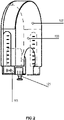
- the portable dosing dispenser for contactless hand disinfection comprises a base module 101 and a top case 100 configured to hold a disinfectant cartridge 102.
- the disinfectant cartridge 102 is configured for containing different types of disinfectant for disinfection.
- the cartridge is replaceable, sealed, and refillable.
- the portable dispenser comprises an electronic controlling unit 110 and a dosing mechanism 131 connected with the electronic controlling unit 110 for storing and administrating a required amount of disinfectant.
- the portable dispenser comprises a pump 130 connected with the electronic controlling unit 110, the disinfectant cartridge 102, and the dosing mechanism 131, respectively.
- the pump 130 is configured for supplying disinfectant from the disinfectant cartridge 102 to the dosing mechanism 131.
- the portable dispenser comprises a nozzle 132, connected with the dosing mechanism 131 and configured for administrating the disinfectant from the dosing mechanism 131 to the hand.
- the dispenser further comprises one or more sensors 111 and one or more microprocessors 112.
- Each of the sensors 111 is connected with the respective microprocessor 112; the microprocessor 112 is respectively connected with the electronic controlling unit 110.
- the sensor 111 is configured for detecting an object, its temperature, and its proximity with respect to the dispenser and outputting a set of first data to the respective microprocessor 112.
- the microprocessor 112 is configured for analyzing the set of first data from the respective sensor 111 and outputting a set of second data to the electronic controlling unit 110.
- the electronic controlling unit 110 is configured for determining whether the object detected by the sensor 111 is a human hand; the hand is located within a predefined distance and does not move for a predefined period based on the set of second data.
- the electronic controlling unit 110 is further configured for instructing the dosing mechanism 131 to administrate the required amount of disinfectant to the hand via the nozzle and instructing the pump 130 to supply the disinfectant from the disinfectant cartridge 102 to the dosing mechanism 131.
- the controlling unit 110 is connected to a speaker 115 to provide an audible signal during the predefined period of time.
- the predefined distance could be 1 cm to 15 cm but is not limited to this.
- the predefined period could be, but is not limited to, 0.5 second to 5 seconds.
- the portable dispenser comprises a power supply 140 for supplying a sufficient energy level of the dispenser.
- the power supply 140 e.g., battery
- the power supply 140 is connected to the sensor 111 and microprocessor 112, and the electronic controlling unit 110 and the dosing mechanism 131 and the pump 130 and is configured to provide sufficient power to the dosing dispenser.
- Battery 140 may be capable of providing sufficient power level to the dispenser for at least one hundred disinfections. If necessary, the battery 140 can also be integrated differently in the disinfection cartridge 102.
- the battery is rechargeable, USB-C or via wireless energy transfer induction, or via a charging station.
- the portable dosing dispenser is connected to a fastening mechanism 104, which is connected with the base module 101 and configured for attaching the dispenser to the human body or clothing.
- the mounting mechanism 104 could be, but is not limited to, a clip or any other component suitable for attaching the dispenser.
- the nozzle is a foam nozzle
- the hand disinfectant is of foam property which prevents liquid from dripping down or spray mist from passing palm of the human hand, thereby ensuring that a suitable amount of the disinfectant reaches the human hand.
- the number of the sensor 111 is one, and the number of the microprocessor 112 is one.
- the number of the sensor 111 is two, the number of the microprocessor 112 is one. Both the first sensor 111 and the second sensor 111' are connected with the microprocessor 112, and the set of first data comprises a first data from the first sensor 111 and a first data from the second sensor 111'.
- the number of the sensor is two
- the number of the microprocessor is two
- the first sensor 111 is connected with the first microprocessor 112
- the second sensor 111' is connected with the second microprocessor 112'.
- the set of first data comprises a first data from the first sensor 111 and a first data from the second sensor 111'.
- the set of second data comprises a second data from the first microprocessor 112 and second data from the second microprocessor 112'.
- the required amount of disinfectant is 0.5 ml to 3 ml.
- the dispenser further comprises a slave RFID chip 113 and a master RFID chip 114.
- the slave RFID chip 113 is mounted in the cartridge 102 and configured for containing a set of third data about the disinfectant.
- the master RFID chip 114 is wirelessly connected with the slave RFID chip 113 and configured for receiving the set of third data from the slave RFID chip 113.
- the master RFID chip 114 is connected with the controlling unit 110 and configured for sending the set of third data to the controlling unit 110. wherein the controlling unit 110 is further configured for determining to accept or reject the cartridge 102 based on the set of third data.
- the dispenser further comprises a docking part consisting of a coupling mechanism with a plug 121 and a socket 122.
- the following embodiment describes the basic operation of the dispenser and how the elements of the embodiment interact, in order to achieve the desired result of dispensing an amount of disinfectant to the hand of the person using the dispenser.
- the detecting mechanism detects that a human hand is held in front of the dispenser within the defined proximity.
- the detecting mechanism comprises the one or more sensors 111 and the one or more microprocessors 112.
- the sensors 111 constantly collect raw data measurement and provides a set of first data to the microprocessors 112 to be analyzed.
- the set of first data consist of data is obtained via the sensor's raw measurement.
- the raw measurement of the object via the detecting mechanism comprises, but not limited to, the temperature, the proximity or the distance with respect to the dispenser, the diameter and the shape.
- the detecting mechanism comprises one sensor 111 and one microprocessor 112.
- the sensor 111 can be the first sensor 111
- the microprocessor 112 can be the first micro-processor 112.
- Step 510 when an object (e.g., human hand) approaches the dispenser and is held in front of the sensor 111, the infrared light from the sensor 111 is reflected by the object and correspondingly detected by a photoresistor of the sensor 111. The luminosity of the reflected light is evaluated by the sensor 111 and then output as a digital voltage signal from the sensor 111.
- an object e.g., human hand
- the temperature of the object is detected and output as a digital voltage signal from the sensor 111.
- the sensor 111 is able to provide the temperature measurement (including thermal images) by a measuring area which is equivalent to 25 - 30 cm in diameter in the predefined distance range of 1 - 15 cm.
- the sensor 111 then provides the set of first data to the microprocessors 112 to be analyzed.
- Step 520 the microprocessor 112 analyzes the set of first data and outputs a set of second data to the controlling unit 110.
- the determining criteria are presented in the following. If the temperature of the object is detected in the range of 35 - 40 °C (degree Celsius), the object is determined as a human part (e.g., hand).
- the predefined proximity or the distance of the object detected with respect to the dispenser is in the range of 1 - 15 cm.
- the proximity is defined as in the range of 1 - 15 cm, preferably the range of 5 - 10 cm, and more preferably the range of 6 - 8 cm.
- the diameter of the object detected is in the range of 25 - 30 cm, while the virtual center of the virtual circle is the projection of the sensor 111 on the plane of the object.
- the shape of the human part is detected as a human hand with a splayed thumb.
- the predefined period during which the object does not move is set in the range of 0.5 - 5 seconds.
- the microprocessor 112 receives sets of first data from the sensor 111 which are used to determine whether the hand is not moving. By comparing the multiple thermal images representing the shape of a human hand with a splayed thumb, the microprocessor 112 can recognize that it does not move for a predefined period.
- the microprocessor 112 output the set of second data which is a confirmation that the object is the human hand stable for the predefined period and located within the predefined proximity.
- the microprocessor 112 can recognize that a) the object is a human hand or not; b) the object is not moving for the predefined period; and c) the object is in the predefined distance or proximity. Via a bus line consisted of three data lines, the microprocessor 112 sends the confirmation for the above three conditions to the controlling unit 110.
- the detecting mechanism sends confirmation to the electronic controlling unit 110 that a human hand is held steady in front of the dispenser within the defined proximity.
- the sensor 111 coupled with the programmable microprocessor 112 may be from different manufactures and therefore should be treated separately.
- the sensor may also be two or more sensors coupled with one or more microprocessor 112. This will be presented in other embodiments.
- Step 530 The electronic controlling unit 110 determines from the set of second data that there is a human hand in the predefined proximity. The electronic controlling unit 110 also determines whether the human hand does not move for a predefined period of time.
- the electronic controlling unit 110 then sends a first instruction to the dosing mechanism 131, in order to administer a quantity of disinfectant or disinfectant fluid.
- the dosing mechanism 131 administer disinfectant or disinfectant fluid which is stored via the nozzle 132 to the hand.
- the controlling unit 110 also sends a second instruction to the pump 130, so as to refill and provide new disinfectant from the pump 130 to the dosing mechanism 131.
- the inventor's trials have shown that the amount (quantity) of disinfectant to be used depends on the disinfectant that will be used for the specific application in a specific country.
- the inventor's trials have shown that generally the foam with its amount between 23 ml and 28 ml (inclusive) is needed dependent on the various hands and the distance. Particularly, 26 ml of foam is a sufficient amount. Hence, the size of the hand is not a key factor.
- the instruction can contain the duration of the flow from the container to the nozzle, so as to determine how much amount of disinfectant will be applied.
- the duration of the flow will be determined by the density, or volumic mass, of the disinfectant used and the ratio of the volumic expansion when turned into foam.
- the duration of the flow is dependent on the pump as well, namely, it takes 1 - 2 seconds for 0.5 - 3 ml of liquid that will expand to 25 - 30 ml of foam.
- the required amount of disinfectant is fixed. That is, the required amount of disinfectant is not variable during administrating or re-filling.
- step 540a1 the dosing mechanism 131 dispenses the quantity of disinfectant at an adjustable flow rate to the nozzle 132, based on the first instruction from the electronic controlling unit 110.
- step 540a2 the nozzle 132 applies the determined amount of disinfectant to the hand.
- step 540b the pump 130 transports the quantity of disinfectant from the cartridge 102 to the dosing mechanism 131, based on the second instruction from the electronic controlling unit 110.
- step 540c an audible signal is triggered by the electronic controlling unit 110 for the duration of the release process, so as to avoid that the hand is removed prematurely.
- the electronic controlling unit 110 is ready to repeat the process form step 510.
- the present second embodiment further includes a sensor.
- the number of the sensor 111 is two, the number of the microprocessor 112 is also one. Both the first sensor 111 and the second sensor 111' are connected with the one single microprocessor 112. Because of the two sensors, the set of first data comprises a first data from the first sensor 111 and a first data from the second sensor 111'.
- the first sensor 111 can be an (infrared) spectro sensor for detecting both the object and the temperature of the object, and then output a first data regarding object.
- the second sensor 111' can be an ultrasonic sensor for detecting the proximity (distance) of the object, and then output a first data regarding distance.
- the sensors 111 and 111' collect raw data, and the microprocessor 112 analyzes the raw data and will determine what is needed, i.e., a) the object is a human hand; b) the object is not moving for the predefined period; and c) the object is in the predefined distance or proximity.
- the inventor's trials have shown that at least two different measurements are needed for determining a) the object is a human hand; and b) the object is in the predefined distance or proximity. That is, a) an infrared sensor is needed for determining the object is a human hand; and b) an ultrasonic sensor is needed for determining whether the human hand is in the predefined distance or proximity.
- the proximity of the object or human hand is detected by another separate sensor, because potentially one sensor cannot precisely measure both distance and light (or temperature).
- the microprocessor 112 then outputs the set of second data which is a confirmation that the object is the human hand stable for the predefined period and within the predefined proximity. It can be understood that other components of the wearable dispenser for hand disinfection are the same as the corresponding components in the first embodiment, and are not repeated herein.
- the present third embodiment further includes a microprocessor.
- the number of the sensor is two, the number of the microprocessor is also two.
- the first sensor 111 is connected with the first microprocessor 112
- the second sensor 111' is connected with the second microprocessor 112'.
- the set of first data comprises a first data from the first sensor 111 and a first data from the second sensor 111'
- the set of second data comprises a second data from the first microprocessor 112 and the second data from the second microprocessor 112'.
- the first microprocessor 112 analyzes the first data from the first sensor 111 and then output a second data regarding object, which is a first confirmation that the object is the human hand stable for the predefined period.
- the second microprocessor 112' analyzes the first data from the second sensor 111', and then output a second data regarding distance, which is which is a second confirmation that the object (human hand) is located within the predefined proximity.
- the dispenser further comprises the master RFID chip 114 and the slave RFID chip 113.
- the slave RFID chip 113 is mounted in the cartridge 102, and as an example, the slave RFID chip 113 is a passive tag or an adhesive chip.
- the slave RFID chip 113 is powered by energy from the master RFID chip 114 interrogating radio waves.
- the slave RFID chip 113 contains information (i.e., being the set of third data) about the disinfectant contained in the cartridge 102.
- This set of third data can comprise, but is not limited to: a country specific accreditation (only use in Switzerland), an environment specific use (for healthcare, for food processing, etc.), the expiry date of the disinfectant, and the filling level at packaging.
- the information can be stored during filling of the cartridge 102.
- the master RFID chip 114 is wirelessly connected with the slave RFID chip 113, and configured for receiving the set of third data from the slave RFID chip 113.
- the master RFID chip 114 will be using the LF Band at 120 to 150 kHz; it generates radio waves to interrogate the slave RFID chip 113 and it also receives the authentication replies from the salve RFID chip 113.
- the authentication reply consists of a 96-bit string of data.
- the slave RFID chip 113 modulates the field produced by the master RFID chip 114 by changing the electrical loading the slave RFID chip 113 represents. By switching between lower and higher relative loads, the slave RFID chip 113 produces a change that the master RFID chip 114 can detect.
- the master RFID chip 114 is connected with the controlling unit 110, and sends the set of third data to the controlling unit 110.
- the master RFID chip 114 wirelessly communicates with the slave RFID chip 113, and sends the set of third data to the controlling unit 110.
- the controlling unit 110 interprets and analyzes the set of third data, and determines to accept or reject (i.e., refuse) the cartridge 102.
- the disinfectant in the cartridge 102 needs to be certified with respect to specific uses, e.g., in certain applications (for healthcare, for food processing, etc.) or for certain countries (only use in Switzerland) If the cartridge 102 is accepted, disinfectant will be supplied. Otherwise, if the cartridge 102 is rejected, no disinfectant will be supplied.
- Step 550 the electronic controlling unit 110 performs a self-test of the dispenser. If the self-test fails and audible error signal is triggered. If the self-test is OK, nothing further happens.
- Step 560 the electronic controlling unit 110 checks if the filling level of the cartridge is above a predetermined minimum. If the minimum is reached, an audible error signal is triggered. If the fill level is OK, nothing further happens.
- Step 560 is periodically triggered at a predetermined interval, in order to avoid running out of disinfectant.
Landscapes
- Health & Medical Sciences (AREA)
- Public Health (AREA)
- Epidemiology (AREA)
- Life Sciences & Earth Sciences (AREA)
- Animal Behavior & Ethology (AREA)
- General Health & Medical Sciences (AREA)
- Veterinary Medicine (AREA)
- Chemical & Material Sciences (AREA)
- Chemical Kinetics & Catalysis (AREA)
- General Chemical & Material Sciences (AREA)
- Apparatus For Disinfection Or Sterilisation (AREA)
Priority Applications (1)
| Application Number | Priority Date | Filing Date | Title |
|---|---|---|---|
| EP21171160.1A EP4082414A1 (fr) | 2021-04-29 | 2021-04-29 | Distributeur portable pour la désinfection des mains sans contact |
Applications Claiming Priority (1)
| Application Number | Priority Date | Filing Date | Title |
|---|---|---|---|
| EP21171160.1A EP4082414A1 (fr) | 2021-04-29 | 2021-04-29 | Distributeur portable pour la désinfection des mains sans contact |
Publications (1)
| Publication Number | Publication Date |
|---|---|
| EP4082414A1 true EP4082414A1 (fr) | 2022-11-02 |
Family
ID=75746230
Family Applications (1)
| Application Number | Title | Priority Date | Filing Date |
|---|---|---|---|
| EP21171160.1A Withdrawn EP4082414A1 (fr) | 2021-04-29 | 2021-04-29 | Distributeur portable pour la désinfection des mains sans contact |
Country Status (1)
| Country | Link |
|---|---|
| EP (1) | EP4082414A1 (fr) |
Citations (3)
| Publication number | Priority date | Publication date | Assignee | Title |
|---|---|---|---|---|
| US6883563B2 (en) * | 2001-07-26 | 2005-04-26 | Judson L. Smith | Apparatus and method to monitor the usage of a network system of personal hand sanitizing dispensers |
| US20120218106A1 (en) * | 2009-07-14 | 2012-08-30 | Harold Zaima | Dispenser Assembly For Dispensing Disinfectant Fluid And Method For Use Thereof And Data Collection And Monitoring System For Monitoring And Reporting Dispensing Events |
| US20120256741A1 (en) * | 2011-04-08 | 2012-10-11 | Gotohti.Com Inc. | Personal compliance dispenser |
-
2021
- 2021-04-29 EP EP21171160.1A patent/EP4082414A1/fr not_active Withdrawn
Patent Citations (3)
| Publication number | Priority date | Publication date | Assignee | Title |
|---|---|---|---|---|
| US6883563B2 (en) * | 2001-07-26 | 2005-04-26 | Judson L. Smith | Apparatus and method to monitor the usage of a network system of personal hand sanitizing dispensers |
| US20120218106A1 (en) * | 2009-07-14 | 2012-08-30 | Harold Zaima | Dispenser Assembly For Dispensing Disinfectant Fluid And Method For Use Thereof And Data Collection And Monitoring System For Monitoring And Reporting Dispensing Events |
| US20120256741A1 (en) * | 2011-04-08 | 2012-10-11 | Gotohti.Com Inc. | Personal compliance dispenser |
Similar Documents
| Publication | Publication Date | Title |
|---|---|---|
| US10660482B2 (en) | Intelligent dispenser of disinfectant gel for connection to disinfection habits monitoring system | |
| US10042984B2 (en) | System and method for monitoring hand hygiene | |
| CN105492058B (zh) | 用于监控消耗品分配器的使用的装置和方法 | |
| US20190139395A1 (en) | Hygiene monitoring system | |
| US7844361B2 (en) | Prescription drug compliance monitoring system | |
| JP2012513052A (ja) | 手の衛生システム | |
| TW201104627A (en) | Touch-free biometric-enabled dispenser | |
| CN101162531A (zh) | 监控手部卫生合格性的方法和系统 | |
| US10028624B1 (en) | Wearable treatment substance dispenser | |
| ES2811765T3 (es) | Dispositivo portátil para mejorar la higiene y procedimiento | |
| Minera et al. | Smart cup for a smart pill dispenser for verification of pill consumption | |
| US20210283293A1 (en) | Systems, devices and methods for disinfecting objects or surfaces in a scene | |
| US11176802B1 (en) | Wearable health and treatment device | |
| EP4082414A1 (fr) | Distributeur portable pour la désinfection des mains sans contact | |
| KR20220095570A (ko) | IoT 복약관리 시스템 및 장치 | |
| US20230121230A1 (en) | Method and system for motivating and monitoring hygiene compliance in a hospital or related environment | |
| Nokerov et al. | Technology Development of Automated Contactless Hand Sanitizer Dispenser System with IR Sensor and Based on A PIC Microcontroller | |
| CA2509279A1 (fr) | Systeme et methode de surveillance integree du bien-etre personnel | |
| US12048399B2 (en) | Devices, systems, and methods for dispensing a fluid | |
| Dandekar et al. | Internet of things based user identification and hand sanitization system with non-contact temperature measurement | |
| US11837071B2 (en) | System and method for monitoring hand hygiene, wellness, and human interactions | |
| KR20120075595A (ko) | 사용자 방문 약 복용 지원 방법 및 이를 실현하는 로봇 장치 | |
| Gupta et al. | Automated Medicine Dispenser Powered by Arduino and Flowmeter With AI Integration | |
| Alić et al. | Ultra-low Power Beacon-based Hand Hygiene Assistance System for Hospitals and Care Facilities | |
| Divya et al. | SmartMeds Hub: Bridging Generations in Healthcare |
Legal Events
| Date | Code | Title | Description |
|---|---|---|---|
| PUAI | Public reference made under article 153(3) epc to a published international application that has entered the european phase |
Free format text: ORIGINAL CODE: 0009012 |
|
| STAA | Information on the status of an ep patent application or granted ep patent |
Free format text: STATUS: THE APPLICATION HAS BEEN PUBLISHED |
|
| AK | Designated contracting states |
Kind code of ref document: A1 Designated state(s): AL AT BE BG CH CY CZ DE DK EE ES FI FR GB GR HR HU IE IS IT LI LT LU LV MC MK MT NL NO PL PT RO RS SE SI SK SM TR |
|
| STAA | Information on the status of an ep patent application or granted ep patent |
Free format text: STATUS: THE APPLICATION IS DEEMED TO BE WITHDRAWN |
|
| 18D | Application deemed to be withdrawn |
Effective date: 20230503 |