EP4082476A1 - Système d'implant dentaire - Google Patents
Système d'implant dentaire Download PDFInfo
- Publication number
- EP4082476A1 EP4082476A1 EP21171453.0A EP21171453A EP4082476A1 EP 4082476 A1 EP4082476 A1 EP 4082476A1 EP 21171453 A EP21171453 A EP 21171453A EP 4082476 A1 EP4082476 A1 EP 4082476A1
- Authority
- EP
- European Patent Office
- Prior art keywords
- dental
- blank
- abutment
- restoration
- implant
- Prior art date
- Legal status (The legal status is an assumption and is not a legal conclusion. Google has not performed a legal analysis and makes no representation as to the accuracy of the status listed.)
- Withdrawn
Links
- 239000004053 dental implant Substances 0.000 title claims abstract description 26
- 239000007943 implant Substances 0.000 claims abstract description 58
- 238000000034 method Methods 0.000 claims abstract description 25
- 238000004519 manufacturing process Methods 0.000 claims abstract description 11
- 239000002131 composite material Substances 0.000 claims description 16
- 239000003479 dental cement Substances 0.000 claims description 11
- 239000000463 material Substances 0.000 claims description 10
- 239000000919 ceramic Substances 0.000 claims description 9
- 238000003754 machining Methods 0.000 claims description 7
- RVTZCBVAJQQJTK-UHFFFAOYSA-N oxygen(2-);zirconium(4+) Chemical compound [O-2].[O-2].[Zr+4] RVTZCBVAJQQJTK-UHFFFAOYSA-N 0.000 claims description 5
- 229910001928 zirconium oxide Inorganic materials 0.000 claims description 5
- 238000005304 joining Methods 0.000 claims description 4
- 238000007669 thermal treatment Methods 0.000 claims description 4
- 238000004873 anchoring Methods 0.000 claims description 3
- 239000010433 feldspar Substances 0.000 claims description 2
- 239000002241 glass-ceramic Substances 0.000 claims description 2
- 239000004033 plastic Substances 0.000 claims description 2
- 229920003023 plastic Polymers 0.000 claims description 2
- 238000004381 surface treatment Methods 0.000 claims description 2
- 239000004568 cement Substances 0.000 description 15
- 208000006389 Peri-Implantitis Diseases 0.000 description 6
- 229910010293 ceramic material Inorganic materials 0.000 description 3
- 238000009826 distribution Methods 0.000 description 3
- 229910052751 metal Inorganic materials 0.000 description 3
- 239000002184 metal Substances 0.000 description 3
- 150000002739 metals Chemical class 0.000 description 3
- 238000012545 processing Methods 0.000 description 3
- 238000011282 treatment Methods 0.000 description 3
- 241000894006 Bacteria Species 0.000 description 2
- 208000034309 Bacterial disease carrier Diseases 0.000 description 2
- 208000010392 Bone Fractures Diseases 0.000 description 2
- 206010017076 Fracture Diseases 0.000 description 2
- 206010061218 Inflammation Diseases 0.000 description 2
- 238000013459 approach Methods 0.000 description 2
- 230000015572 biosynthetic process Effects 0.000 description 2
- 210000000988 bone and bone Anatomy 0.000 description 2
- 230000001055 chewing effect Effects 0.000 description 2
- 230000000694 effects Effects 0.000 description 2
- 238000000227 grinding Methods 0.000 description 2
- 230000004054 inflammatory process Effects 0.000 description 2
- 238000003780 insertion Methods 0.000 description 2
- 230000037431 insertion Effects 0.000 description 2
- 238000003801 milling Methods 0.000 description 2
- 210000000214 mouth Anatomy 0.000 description 2
- 238000005498 polishing Methods 0.000 description 2
- 208000005888 Periodontal Pocket Diseases 0.000 description 1
- RTAQQCXQSZGOHL-UHFFFAOYSA-N Titanium Chemical compound [Ti] RTAQQCXQSZGOHL-UHFFFAOYSA-N 0.000 description 1
- 239000000956 alloy Substances 0.000 description 1
- 229910045601 alloy Inorganic materials 0.000 description 1
- 230000015556 catabolic process Effects 0.000 description 1
- 238000010276 construction Methods 0.000 description 1
- 230000008878 coupling Effects 0.000 description 1
- 238000010168 coupling process Methods 0.000 description 1
- 238000005859 coupling reaction Methods 0.000 description 1
- 238000013016 damping Methods 0.000 description 1
- 238000006731 degradation reaction Methods 0.000 description 1
- 230000001934 delay Effects 0.000 description 1
- 238000005553 drilling Methods 0.000 description 1
- 210000000887 face Anatomy 0.000 description 1
- 210000003128 head Anatomy 0.000 description 1
- 230000035876 healing Effects 0.000 description 1
- 230000001771 impaired effect Effects 0.000 description 1
- 230000010354 integration Effects 0.000 description 1
- 239000000203 mixture Substances 0.000 description 1
- 210000004400 mucous membrane Anatomy 0.000 description 1
- 230000003287 optical effect Effects 0.000 description 1
- SIWVEOZUMHYXCS-UHFFFAOYSA-N oxo(oxoyttriooxy)yttrium Chemical compound O=[Y]O[Y]=O SIWVEOZUMHYXCS-UHFFFAOYSA-N 0.000 description 1
- 238000005245 sintering Methods 0.000 description 1
- 210000001519 tissue Anatomy 0.000 description 1
- 229910052719 titanium Inorganic materials 0.000 description 1
- 239000010936 titanium Substances 0.000 description 1
- 230000007704 transition Effects 0.000 description 1
- 238000013022 venting Methods 0.000 description 1
Images

Classifications
-
- A—HUMAN NECESSITIES
- A61—MEDICAL OR VETERINARY SCIENCE; HYGIENE
- A61C—DENTISTRY; APPARATUS OR METHODS FOR ORAL OR DENTAL HYGIENE
- A61C8/00—Means to be fixed to the jaw-bone for consolidating natural teeth or for fixing dental prostheses thereon; Dental implants; Implanting tools
- A61C8/0048—Connecting the upper structure to the implant, e.g. bridging bars
-
- A—HUMAN NECESSITIES
- A61—MEDICAL OR VETERINARY SCIENCE; HYGIENE
- A61C—DENTISTRY; APPARATUS OR METHODS FOR ORAL OR DENTAL HYGIENE
- A61C13/00—Dental prostheses; Making same
- A61C13/0003—Making bridge-work, inlays, implants or the like
- A61C13/0004—Computer-assisted sizing or machining of dental prostheses
-
- A—HUMAN NECESSITIES
- A61—MEDICAL OR VETERINARY SCIENCE; HYGIENE
- A61C—DENTISTRY; APPARATUS OR METHODS FOR ORAL OR DENTAL HYGIENE
- A61C13/00—Dental prostheses; Making same
- A61C13/0003—Making bridge-work, inlays, implants or the like
- A61C13/0022—Blanks or green, unfinished dental restoration parts
-
- A—HUMAN NECESSITIES
- A61—MEDICAL OR VETERINARY SCIENCE; HYGIENE
- A61C—DENTISTRY; APPARATUS OR METHODS FOR ORAL OR DENTAL HYGIENE
- A61C5/00—Filling or capping teeth
- A61C5/70—Tooth crowns; Making thereof
- A61C5/77—Methods or devices for making crowns
-
- A—HUMAN NECESSITIES
- A61—MEDICAL OR VETERINARY SCIENCE; HYGIENE
- A61C—DENTISTRY; APPARATUS OR METHODS FOR ORAL OR DENTAL HYGIENE
- A61C5/00—Filling or capping teeth
- A61C5/30—Securing inlays, onlays or crowns
-
- A—HUMAN NECESSITIES
- A61—MEDICAL OR VETERINARY SCIENCE; HYGIENE
- A61C—DENTISTRY; APPARATUS OR METHODS FOR ORAL OR DENTAL HYGIENE
- A61C8/00—Means to be fixed to the jaw-bone for consolidating natural teeth or for fixing dental prostheses thereon; Dental implants; Implanting tools
- A61C8/0048—Connecting the upper structure to the implant, e.g. bridging bars
- A61C8/005—Connecting devices for joining an upper structure with an implant member, e.g. spacers
Definitions
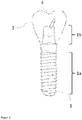
- the present invention relates to a dental implant system comprising an implant and a dental restoration, the dental restoration having a channel introduced by a machine. Furthermore, the present invention relates to a blank for the production of the dental restoration and a method for its production and a method for the production of the dental implant system.
- Implantology as a branch of dentistry deals with the use, or insertion, of dental implants in the jawbone.
- the implants are usually used as part of an implant-dental system and act as an artificial tooth root.
- the implant systems usually include an endosseous part for anchoring the implant in the jawbone and an abutment that protrudes from the jawbone and is used to hold the dental care, for example a crown.
- the implant As part of the restoration of the chewing function and aesthetics, the implant is usually first inserted into the jawbone and after an appropriate healing time, the dental restoration is placed on the abutment and connected to it.
- Various options are available for attaching the dental restoration to the abutment.
- the dental restoration can be screwed on. This has the advantage that in the event of complications or damage, the dental restoration can simply be unscrewed again.
- the disadvantage is that the screw connection creates niches and gaps in the oral cavity into which bacteria can nest, which in turn can lead to inflammation in the tissue surrounding the implant, which leads to bone degradation. This process is commonly referred to as peri-implantitis, which in the worst case can lead to the loss of the implant.
- the dental restoration is fixed on the abutment with the aid of dental fastening means, for example dental cement.
- dental fastening means for example dental cement.
- the gap that occurs between the abutment and the dental restoration can be sealed with dental cement, this has the disadvantage that an excess of cement has to be used in order to guarantee that the gap between the abutment and the dental restoration is completely filled.
- the excess cement spills out of the gap between the abutment and the restoration at the lower end of the dental restoration and must be removed. Since the edge of the dental restoration is usually below the level of the gums, access is limited, if at all, and removing the excess cement is difficult or impossible.
- the excess cement which is forced to remain in the oral cavity, can lead to local inflammation and bacterial colonization, with the risk of peri-implantitis and the resulting loss of the implant.
- DE 10 2007 018 453 relates to a dental implant system consisting of an implant and a superstructure such as a crown or bridge.
- the implant is made of one piece and the superstructure is connected to the transgingival implant head over the entire surface and is also attached to the implant with a prosthetic abutment pin.
- the adapted surface structure of the implant should enable complete ingrowth in the endosseous and transgingival area, which should prevent the formation of periodontal pockets. According to the publication, no micro-movements can occur due to the construction described and an optimal distribution of forces is guaranteed.
- U.S. 2006/0014120 describes a biofunctional dental implant comprising a root region for attachment in the patient's jaw, through which a canal extends longitudinally; a flexible abutment protruding from the top of the root region and having a canal extending longitudinally through the abutment and aligned with the canal in the root region, a crown region surrounding the flexible abutment and a Abutment post which extends through the crown portion into the longitudinal canal of the root portion and flexible abutment and creates an outward force against the flexible abutment which forces the flexible abutment against the crown portion which in turn forces it onto the root portion is held. In this way it should be possible to dispense with conventional screws or the like.
- US2016/0338802 discloses a dental prosthesis with a superstructure and an implant adapted for integration into the bone, which are mutually joined by means of a screw, an insert element, which consists of a damping material and is arranged between the coupling surfaces of the superstructure and the implant, respectively, and a cap , the insert element having an annular base suitable for placement between the faces, a profile engaging the superstructure and a threaded portion for engaging the cap which is also threaded to secure the superstructure to the Block insert, the screw fixes the insert to the implant.
- a dental implant system that reduces the risk of a peri-implantitis caused by excess cement and at the same time achieves a uniform force distribution in the system.
- the implant system according to the invention allows the gap that normally occurs between the abutment and the dental restoration to be sealed with cement, thus preventing the formation of a gap as a prerequisite for bacteria to nest.
- the excess cement can advantageously be drained off through the channel and is therefore no longer available as a source of ignition.
- the mechanical insertion of the canal ensures that the material of the restoration is not pre-damaged and that there is no increased risk of fracture when handling the dental restoration.
- the canal inner wall has a straight and smooth surface, in contrast to manual production, which is free of undercuts caused by processing, which makes it easier for excess cement or other composite materials to flow out.
- the inner contour of the recess is congruent to the outer contour of the abutment.
- the implant used within the scope of the implant system according to the invention can be made in one piece or in two pieces.
- Two-part implants are understood to be those with a detachable connection between the endosseous part and the abutment.
- the abutment can be attached to the endosseous part of the implant with the aid of a screw.
- One-piece implants are those in which the endosseous part and the abutment of the implant are made in one piece and accordingly cannot be separated from one another.
- the use of one-piece implants offers the advantage that they have no further transitions and thus offer fewer points of attack for bacterial colonization. This further reduces the risk of peri-implantitis.
- An embodiment of the implant system according to the invention is therefore preferred in which the implant is designed in one piece.
- the channel in the dental restoration of the implant system according to the invention is intended in particular for draining away excess composite material that is used to attach the dental restoration to the abutment. Accordingly, the channel should have a diameter that is suitable for draining the excess composite material, such as dental cement, without impairing the mechanical stability of the dental restoration.
- An embodiment is therefore preferred in which the channel has a diameter of 0.5 to 2 mm, preferably 0.7 to 1 mm.
- the channel is an internal channel.
- the aesthetic appearance of the dental care is not impaired by this embodiment.
- the latter accordingly has a hole in its surface, which forms the outlet opening of the channel.
- the hole can be closed after the dental care has been attached.
- an embodiment of the implant system according to the invention is preferred in which the outlet of the channel is attached to the dental restoration on the oral side.
- the implant system comprises or consists of a material selected from the group of metals and ceramic materials. Titanium and its alloys are particularly preferred from the group of metals, while zirconium oxide and mixtures containing zirconium oxide are particularly preferred from the group of ceramic materials. Zirconium oxide stabilized with yttrium oxide is used as a particularly preferred material.
- a further object of the present invention is a blank for producing a dental restoration, preferably a dental restoration as used in the implant system according to the invention, the blank having a recess for receiving an abutment of a dental implant and a channel having the recess connects to an outer surface of the blank.
- the outer contour of an abutment follows a standardized form, so that even if the recess in the dental restoration is prefabricated, a high degree of accuracy of fit can be achieved with the abutment.
- An embodiment is therefore preferred in which the inner contour of the recess is congruent to the outer contour of an abutment.
- the blank according to the present invention should preferably consist of a material that can be processed using standard tools and methods, but at the same time has mechanical stability that can withstand the forces occurring during the chewing process.
- the blank therefore consists of or comprises a material selected from the group consisting of feldspar ceramics, glass ceramics, zirconium oxide, plastic-ceramic composite material, plastics and hybrid ceramics.
- the machining of the blank preferably includes the introduction of the recess in such a way that its inner contour is congruent to the outer contour of an implant abutment.
- the patient's oral situation can be recorded analogously, ie with the aid of dental impressions, or else digitally with the aid of cameras.
- the oral situation is determined using traditional dental impressions, it is preferable for this data to be digitized.
- the data determined when recording the oral situation of the patient serves as a template for creating the dental care.
- the method according to the invention in a preferred embodiment also includes digitizing the oral situation of the patient and creating a virtual model, the virtual positioning of the implant, the superimposition of the virtual model of the oral Situation with the CAD data of the abutment of the implant and the virtual positioning of the virtual model of the dental restoration in a virtual blank.
- the virtual model of the dental restoration is preferably positioned in the virtual blank in such a way that the channel provided in the dental restoration connects the recess in the dental restoration with one of its outer surfaces and the outlet opening in the outer surface comes to rest on the oral side.
- the machine processing of the blank takes place on the basis of the CAD data determined in this way.
- the blank is machined using CAD/CAM methods. This ensures that the restoration sits securely on the abutment, that the restoration anatomically forms the passage through the mucous membrane and that the restoration has sufficient wall thickness.
- Another advantage of the method according to the invention is that the patient can be treated directly at the treatment chair in one session, a so-called chair-side treatment, without the time delays that occur when the data has to be transmitted to a dental laboratory , in which the dental restoration is then produced.
- the recess in the dental restoration is designed in such a way that its inner contour is congruent to the outer contour of an implant abutment.
- the method according to the invention further comprises a thermal treatment of the dental restoration, preferably the sintering of the dental restoration.
- the composite material is preferably a dental adhesive or dental cement.
- the joints can be pre-treated accordingly.
- An embodiment of the method according to the invention is therefore preferred in which the joining points of the abutment and the dental restoration are subjected to a surface treatment before they are joined together.
- a further object of the present invention is therefore a kit comprising an implant system according to the invention, or a blank according to the invention, and a composite material, preferably dental adhesive or dental cement.
Landscapes
- Health & Medical Sciences (AREA)
- Oral & Maxillofacial Surgery (AREA)
- Dentistry (AREA)
- Epidemiology (AREA)
- Life Sciences & Earth Sciences (AREA)
- Animal Behavior & Ethology (AREA)
- General Health & Medical Sciences (AREA)
- Public Health (AREA)
- Veterinary Medicine (AREA)
- Orthopedic Medicine & Surgery (AREA)
- Dental Prosthetics (AREA)
Priority Applications (1)
| Application Number | Priority Date | Filing Date | Title |
|---|---|---|---|
| EP21171453.0A EP4082476A1 (fr) | 2021-04-30 | 2021-04-30 | Système d'implant dentaire |
Applications Claiming Priority (1)
| Application Number | Priority Date | Filing Date | Title |
|---|---|---|---|
| EP21171453.0A EP4082476A1 (fr) | 2021-04-30 | 2021-04-30 | Système d'implant dentaire |
Publications (1)
| Publication Number | Publication Date |
|---|---|
| EP4082476A1 true EP4082476A1 (fr) | 2022-11-02 |
Family
ID=75746408
Family Applications (1)
| Application Number | Title | Priority Date | Filing Date |
|---|---|---|---|
| EP21171453.0A Withdrawn EP4082476A1 (fr) | 2021-04-30 | 2021-04-30 | Système d'implant dentaire |
Country Status (1)
| Country | Link |
|---|---|
| EP (1) | EP4082476A1 (fr) |
Citations (6)
| Publication number | Priority date | Publication date | Assignee | Title |
|---|---|---|---|---|
| JP2002153493A (ja) * | 2000-11-18 | 2002-05-28 | Shogo Minaki | 上部構造物撤去用構造を持つ歯科用インプラントと撤去用治具 |
| US20060014120A1 (en) | 2004-07-16 | 2006-01-19 | Sapian Schubert L | Biofunctional dental implant |
| DE102007018453B3 (de) | 2007-04-17 | 2008-10-23 | Dental Service Center Michael Menzel Gmbh | Zahnimplantatsystem |
| WO2014064558A2 (fr) * | 2012-10-22 | 2014-05-01 | Medical Corporation It | Butée, dispositif de fixation, ensemble d'implants dentaires, taraud dentaire, guide dentaire, ensemble de tarauds dentaires et fraise dentaire |
| US20160338802A1 (en) | 2014-02-11 | 2016-11-24 | Heraeus Kulzer Gmbh | Dampening insert for dental implants |
| FR3087643A1 (fr) * | 2018-10-31 | 2020-05-01 | Biotech Dental | Dispositif a coque amelaire, prothese dentaire utilisant le dispositif a coque amelaire et procede de fabrication |
-
2021
- 2021-04-30 EP EP21171453.0A patent/EP4082476A1/fr not_active Withdrawn
Patent Citations (6)
| Publication number | Priority date | Publication date | Assignee | Title |
|---|---|---|---|---|
| JP2002153493A (ja) * | 2000-11-18 | 2002-05-28 | Shogo Minaki | 上部構造物撤去用構造を持つ歯科用インプラントと撤去用治具 |
| US20060014120A1 (en) | 2004-07-16 | 2006-01-19 | Sapian Schubert L | Biofunctional dental implant |
| DE102007018453B3 (de) | 2007-04-17 | 2008-10-23 | Dental Service Center Michael Menzel Gmbh | Zahnimplantatsystem |
| WO2014064558A2 (fr) * | 2012-10-22 | 2014-05-01 | Medical Corporation It | Butée, dispositif de fixation, ensemble d'implants dentaires, taraud dentaire, guide dentaire, ensemble de tarauds dentaires et fraise dentaire |
| US20160338802A1 (en) | 2014-02-11 | 2016-11-24 | Heraeus Kulzer Gmbh | Dampening insert for dental implants |
| FR3087643A1 (fr) * | 2018-10-31 | 2020-05-01 | Biotech Dental | Dispositif a coque amelaire, prothese dentaire utilisant le dispositif a coque amelaire et procede de fabrication |
Non-Patent Citations (2)
| Title |
|---|
| D. PATEL ET AL.: "schlagen in ihrem Artikel An analysis of the effect of a vent hole on excess cement expressed at the crwon-abutment margin for cement-retained implant crowns", JOURNAL OF PROSTHODONTICS, vol. 18, 2009, pages 54 - 59 |
| L.K. ZAUGG ET AL.: "The effect of crown venting orprecementing of CAD/CAM-constructed all-ceramic crowns luted on YTZ implants on moarginal zement excess", CLIN ORAL IMPL RES, vol. 29, 2018, pages 82 - 90 |
Similar Documents
| Publication | Publication Date | Title |
|---|---|---|
| EP1761196B2 (fr) | Implant dentaire a base d'oxyde de zirconium et procede pour produire un implant dentaire | |
| EP1450722B2 (fr) | Implant dentaire c ramique | |
| DE3886366T2 (de) | Abstandsstück für Zahnimplantat. | |
| CH694571A5 (de) | Verfahren zur Herstellung eines Zahnersatzes und eines Zahnersatzteiles, Material für ein Zahnersatzteil und Zahnersatzteil. | |
| WO2008006868A1 (fr) | implant dentaire comprenant une structure façonnable | |
| EP2142136B1 (fr) | Système d'implant dentaire | |
| WO2004060197A1 (fr) | Procede de production automatique d'une superstructure dentaire pour assurer la jonction avec un implant | |
| WO2005016171A1 (fr) | Ébauche et procédé pour réaliser une prothèse dentaire | |
| DE4035576A1 (de) | Orale enossale implantate und ein verfahren zur praeparation und implantation | |
| DE102013014660A1 (de) | Suprakonstruktion für ein Implantatsystem, Rohling zu deren Herstellung und dazugehöriger Schraubendreher | |
| DE102007026325B4 (de) | Künstlicher Zahnersatz | |
| DE102012108153A1 (de) | Rohling und Verfahren zur Herstellung einer Dentalrestauration durch substraktive Bearbeitung | |
| EP2874563B1 (fr) | Système de pilier pour implants immédiats servant à remplacer une prothèse dentaire | |
| DE20023670U1 (de) | Zahnsortiment und System zur Präparation von Zähnen | |
| DE102007018453B3 (de) | Zahnimplantatsystem | |
| EP0904743B1 (fr) | Méthode de fabrication de prothèses dentaires et implants par moyens d'appareils CAD/CAM en utilisant des éléments préfabriqués | |
| WO1997030654A1 (fr) | Prothese dentaire implantable, butees correspondantes et procede de production desdites butees | |
| EP3242625B1 (fr) | Système avec implant dentaire permettant de réduire les pertes d'implants dentaires et de prothèses dentaires | |
| DE102005042091A1 (de) | Keramischer Zahnersatz und Verfahren zu dessen Herstellung | |
| DE202008007189U1 (de) | Abutment für ein Schraubimplantat in einem Kieferknochen | |
| EP0803232B1 (fr) | Elément de retenue pour une prothèse dentaire | |
| DE10331524A1 (de) | Dentalimplantat | |
| EP2845562A1 (fr) | Implant et système de prothèse dentaire | |
| DE29820971U1 (de) | Industriell gefertigte zahnfarbene Vollkeramikringe als transgingivaler Fertigungsbestandteil gängiger Dentalimplantate | |
| DE4039979A1 (de) | Konfektioniertes doppelkronensystem als halteelement bei implantatgetragenem zahnersatz |
Legal Events
| Date | Code | Title | Description |
|---|---|---|---|
| PUAI | Public reference made under article 153(3) epc to a published international application that has entered the european phase |
Free format text: ORIGINAL CODE: 0009012 |
|
| STAA | Information on the status of an ep patent application or granted ep patent |
Free format text: STATUS: THE APPLICATION HAS BEEN PUBLISHED |
|
| AK | Designated contracting states |
Kind code of ref document: A1 Designated state(s): AL AT BE BG CH CY CZ DE DK EE ES FI FR GB GR HR HU IE IS IT LI LT LU LV MC MK MT NL NO PL PT RO RS SE SI SK SM TR |
|
| STAA | Information on the status of an ep patent application or granted ep patent |
Free format text: STATUS: THE APPLICATION IS DEEMED TO BE WITHDRAWN |
|
| 18D | Application deemed to be withdrawn |
Effective date: 20230503 |