EP4083018A1 - Diisocyanates d'origine biologique; et leur procédé de préparation - Google Patents
Diisocyanates d'origine biologique; et leur procédé de préparation Download PDFInfo
- Publication number
- EP4083018A1 EP4083018A1 EP22170655.9A EP22170655A EP4083018A1 EP 4083018 A1 EP4083018 A1 EP 4083018A1 EP 22170655 A EP22170655 A EP 22170655A EP 4083018 A1 EP4083018 A1 EP 4083018A1
- Authority
- EP
- European Patent Office
- Prior art keywords
- biobased
- bis
- pentadecyl
- isocyanato
- diisocyanate
- Prior art date
- Legal status (The legal status is an assumption and is not a legal conclusion. Google has not performed a legal analysis and makes no representation as to the accuracy of the status listed.)
- Pending
Links
Images



Classifications
-
- C—CHEMISTRY; METALLURGY
- C08—ORGANIC MACROMOLECULAR COMPOUNDS; THEIR PREPARATION OR CHEMICAL WORKING-UP; COMPOSITIONS BASED THEREON
- C08G—MACROMOLECULAR COMPOUNDS OBTAINED OTHERWISE THAN BY REACTIONS ONLY INVOLVING UNSATURATED CARBON-TO-CARBON BONDS
- C08G18/00—Polymeric products of isocyanates or isothiocyanates
- C08G18/06—Polymeric products of isocyanates or isothiocyanates with compounds having active hydrogen
- C08G18/70—Polymeric products of isocyanates or isothiocyanates with compounds having active hydrogen characterised by the isocyanates or isothiocyanates used
- C08G18/72—Polyisocyanates or polyisothiocyanates
- C08G18/74—Polyisocyanates or polyisothiocyanates cyclic
- C08G18/76—Polyisocyanates or polyisothiocyanates cyclic aromatic
- C08G18/7614—Polyisocyanates or polyisothiocyanates cyclic aromatic containing only one aromatic ring
- C08G18/7621—Polyisocyanates or polyisothiocyanates cyclic aromatic containing only one aromatic ring being toluene diisocyanate including isomer mixtures
-
- C—CHEMISTRY; METALLURGY
- C07—ORGANIC CHEMISTRY
- C07C—ACYCLIC OR CARBOCYCLIC COMPOUNDS
- C07C263/00—Preparation of derivatives of isocyanic acid
- C07C263/10—Preparation of derivatives of isocyanic acid by reaction of amines with carbonyl halides, e.g. with phosgene
-
- C—CHEMISTRY; METALLURGY
- C07—ORGANIC CHEMISTRY
- C07C—ACYCLIC OR CARBOCYCLIC COMPOUNDS
- C07C265/00—Derivatives of isocyanic acid
- C07C265/14—Derivatives of isocyanic acid containing at least two isocyanate groups bound to the same carbon skeleton
-
- C—CHEMISTRY; METALLURGY
- C08—ORGANIC MACROMOLECULAR COMPOUNDS; THEIR PREPARATION OR CHEMICAL WORKING-UP; COMPOSITIONS BASED THEREON
- C08G—MACROMOLECULAR COMPOUNDS OBTAINED OTHERWISE THAN BY REACTIONS ONLY INVOLVING UNSATURATED CARBON-TO-CARBON BONDS
- C08G18/00—Polymeric products of isocyanates or isothiocyanates
- C08G18/06—Polymeric products of isocyanates or isothiocyanates with compounds having active hydrogen
- C08G18/28—Polymeric products of isocyanates or isothiocyanates with compounds having active hydrogen characterised by the compounds used containing active hydrogen
- C08G18/40—High-molecular-weight compounds
- C08G18/42—Polycondensates having carboxylic or carbonic ester groups in the main chain
-
- C—CHEMISTRY; METALLURGY
- C08—ORGANIC MACROMOLECULAR COMPOUNDS; THEIR PREPARATION OR CHEMICAL WORKING-UP; COMPOSITIONS BASED THEREON
- C08G—MACROMOLECULAR COMPOUNDS OBTAINED OTHERWISE THAN BY REACTIONS ONLY INVOLVING UNSATURATED CARBON-TO-CARBON BONDS
- C08G18/00—Polymeric products of isocyanates or isothiocyanates
- C08G18/06—Polymeric products of isocyanates or isothiocyanates with compounds having active hydrogen
- C08G18/70—Polymeric products of isocyanates or isothiocyanates with compounds having active hydrogen characterised by the isocyanates or isothiocyanates used
- C08G18/72—Polyisocyanates or polyisothiocyanates
- C08G18/74—Polyisocyanates or polyisothiocyanates cyclic
- C08G18/76—Polyisocyanates or polyisothiocyanates cyclic aromatic
- C08G18/7614—Polyisocyanates or polyisothiocyanates cyclic aromatic containing only one aromatic ring
-
- C—CHEMISTRY; METALLURGY
- C08—ORGANIC MACROMOLECULAR COMPOUNDS; THEIR PREPARATION OR CHEMICAL WORKING-UP; COMPOSITIONS BASED THEREON
- C08G—MACROMOLECULAR COMPOUNDS OBTAINED OTHERWISE THAN BY REACTIONS ONLY INVOLVING UNSATURATED CARBON-TO-CARBON BONDS
- C08G18/00—Polymeric products of isocyanates or isothiocyanates
- C08G18/06—Polymeric products of isocyanates or isothiocyanates with compounds having active hydrogen
- C08G18/70—Polymeric products of isocyanates or isothiocyanates with compounds having active hydrogen characterised by the isocyanates or isothiocyanates used
- C08G18/72—Polyisocyanates or polyisothiocyanates
- C08G18/74—Polyisocyanates or polyisothiocyanates cyclic
- C08G18/76—Polyisocyanates or polyisothiocyanates cyclic aromatic
- C08G18/7657—Polyisocyanates or polyisothiocyanates cyclic aromatic containing two or more aromatic rings
-
- C—CHEMISTRY; METALLURGY
- C08—ORGANIC MACROMOLECULAR COMPOUNDS; THEIR PREPARATION OR CHEMICAL WORKING-UP; COMPOSITIONS BASED THEREON
- C08G—MACROMOLECULAR COMPOUNDS OBTAINED OTHERWISE THAN BY REACTIONS ONLY INVOLVING UNSATURATED CARBON-TO-CARBON BONDS
- C08G18/00—Polymeric products of isocyanates or isothiocyanates
- C08G18/06—Polymeric products of isocyanates or isothiocyanates with compounds having active hydrogen
- C08G18/70—Polymeric products of isocyanates or isothiocyanates with compounds having active hydrogen characterised by the isocyanates or isothiocyanates used
- C08G18/72—Polyisocyanates or polyisothiocyanates
- C08G18/74—Polyisocyanates or polyisothiocyanates cyclic
- C08G18/76—Polyisocyanates or polyisothiocyanates cyclic aromatic
- C08G18/7657—Polyisocyanates or polyisothiocyanates cyclic aromatic containing two or more aromatic rings
- C08G18/7664—Polyisocyanates or polyisothiocyanates cyclic aromatic containing two or more aromatic rings containing alkylene polyphenyl groups
-
- C—CHEMISTRY; METALLURGY
- C08—ORGANIC MACROMOLECULAR COMPOUNDS; THEIR PREPARATION OR CHEMICAL WORKING-UP; COMPOSITIONS BASED THEREON
- C08G—MACROMOLECULAR COMPOUNDS OBTAINED OTHERWISE THAN BY REACTIONS ONLY INVOLVING UNSATURATED CARBON-TO-CARBON BONDS
- C08G18/00—Polymeric products of isocyanates or isothiocyanates
- C08G18/06—Polymeric products of isocyanates or isothiocyanates with compounds having active hydrogen
- C08G18/70—Polymeric products of isocyanates or isothiocyanates with compounds having active hydrogen characterised by the isocyanates or isothiocyanates used
- C08G18/72—Polyisocyanates or polyisothiocyanates
- C08G18/77—Polyisocyanates or polyisothiocyanates having heteroatoms in addition to the isocyanate or isothiocyanate nitrogen and oxygen or sulfur
- C08G18/771—Polyisocyanates or polyisothiocyanates having heteroatoms in addition to the isocyanate or isothiocyanate nitrogen and oxygen or sulfur oxygen
Definitions
- This disclosure is generally directed to diisocyanates, and in particular to organic diisocyanates that are bio-derived from natural sources or derived from biomass starting materials such as Cardanol or Hydrogenated Cardanol also known as 3-pentadecylphenol. Specifically, this disclosure further provides biobased diisocyanates of the structures 1 and 2 shown in Figure 1 , and to methods for their preparation.
- Polyurethanes are a large class of polymers used in a wide range of applications, such as construction, automotive, furniture, footwear, insulation, coatings, adhesives, elastomer foams, and consumer goods.
- Polyurethanes are produced from the polymerization reaction between polyols and/or aliphatic diols with diisocyanates.
- the polyols are hydroxyl-terminated oligomers or polymers, such as poly (ethylene oxide), poly (propylene oxide), poly (alkylene glycols) or polyester resin with terminal hydroxyl groups.
- the diisocyanates are usually selected as toluene-diisocyanate, 4,4'-methylene diphenyl diisocyanate, isophorone diisocyanate and hexamethylene diisocyanate.
- the properties of polyurethanes vary depending on the structure of the polymer backbone and can be tailored to have high strength and rigidity, or high flexibility and toughness. When a polyol (and or aliphatic diol) reacts with the diisocyanate, it forms a linear, thermoplastic polymer.
- crosslinking agents such as diethanol amine, polyhydric alcohol or polyols with three or more hydroxyl moieties and/or poly- isocyanates with 3 reactive isocyanate groups
- varying degree of crosslinking in the polyurethane product can be tailored to achieve a rigid, cross-linked, thermosetting polyurethane.
- additives are commonly added during the reaction of the polyurethane to improve certain properties, such as chain-extending agents, blowing agents, surfactants, fillers, plasticizers, pigments and flame retardants. Blowing agents will create a polyurethane foam, and surfactants will control the bubble formation and, therefore, the cell formation of the foam.
- TDI toluene diisocyanate
- MDI 4,4'-methylene diphenyl diisocyanate
- polyurethane compositions useful in specialty applications such as enamel paints and coatings which are resistant to abrasion or degradation by ultraviolet light.
- the main components of the polyurethane namely the polyols and the diisocyanates, are mainly derived from petrochemicals, and their production contributes heavily towards greenhouse gasses that negatively impact the environment.
- polyols and diisocyanates that are based on renewable resource materials derived primarily from a biomass such that there is less dependency on fossil fuels, which accelerate climate change.
- polyols derived from biobased chemicals are known.
- U.S. Patent No. 10,934,384 describes selection of biobased polyester-polyols used for producing polyurethane resins.
- the polyurethanes are obtained from biobased polyols, additives and petrochemically derived diisocyanate such as MDI, to result with an overall biobased content of from about 70 to about 85% by weight of the corresponding polyurethane composition.
- U.S. Patent No. 9,950,996 describes biobased aromatic diisocyanates, wherein the starting materials are namely, bis(4-isocyanato-2-methoxyphenoxy)alkane and bis(4-isocyanato-2, 6-dimethoxyphenoxy) alkanes and are synthesized from vanillic acid/syringic acid which have their origin in bio-resources such Lignin.
- the aromatic biobased diisocyanates are analogous in structure to oil-derived MDI.
- U.S. Patent Nos. 8.044,166 , 9,404,132 and 9,765,369 describe a process for making 1,5-pentylene diisocyanate from bioderived 1,5-pentane diamine obtained from enzymatic decarboxylation of L-lysine.
- the aliphatic biobased diisocyanates are analogous in structure to oil-derived hexamethylene diisocyanates.
- biobased content for example, is from about 95% to about 100% by weight of the polyurethane composition. While the objective is to increase the renewable content of the polyurethane foam, it is also desirable to maintain or improve the performance properties of the polyurethane composition. To achieve high renewable contents of the polyurethane foam, there is a need for biobased polyols, biobased additives, biobased fillers, biobased colorants and biobased diisocyanates.
- biobased diisocyanates that are aromatic and analogous in structure to TDI and MDI. Furthermore, there is a need for biobased diisocyanates that are primarily derived from non-food-based biomass or food-waste biomass.
- biobased aromatic diisocyanates derived form food-waste or non-food biomass with biobased polyols, fillers, additives and colorants for the production of polyurethane composition for many applications, wherein the bio-content is from about 95% to about 100% by weight of the polyurethane composition.
- a biobased diisocyanate that is bio-derived from natural sources or derived from biomass starting materials such as Cardanol or Hydrogenated Cardanol (also known as 3-pentadecylphenol).
- Cardanol is a phenolic material obtained from cashew nutshell as a food-waste by-product of cashew nut processing.
- Cardanol and derivatives are raw materials with wide applications in the form of surface coatings, paints and varnishes, and are inexpensive with over 1-million-ton production in 2021.
- the present invention provides biobased diisocyanates as illustrated in Figure 1 , and wherein structure 1 , is an aromatic diisocyanate which is analogous in structure to TDI; and wherein structure 2, is bis-aromatic diisocyanate which is analogous in structure to MDI.
- the biobased diisocyanates are primarily derived from non-food-based biomass or food-waste biomass, and are from about 70 to about 100% biobased by weight.
- a biobased diisocyanate of the formula 1 or 2, as illustrated in Figure 1 , wherein R is an alkyl chain C 15 H 31 (n-pentadecyl); R 1 CH 3 or COCH 3 ; and R 2 is an alkylene of from about 1 to 18 carbon atoms.
- the biobased diisocyanate of formula 1 may be selected from the group consisting of: 1,5-diisocyanato-2-methoxy-4-pentadecylbenzene, 1,3-diisocyanato-2-methoxy-4-pentadecylbenzene, 2,4-diisocyanato-5-pentadecylphenyl acetate, and 2,6-diisocyanato-3-pentadecylphenyl acetate, and mixtures thereof.
- the biobased diisocyanate of formula 2 may be selected from the group consisting of: 1,2-bis(4-isocyanato-3-pentadecylphenoxy) ethane, 1,2-bis(2-isocyanato-5-pentadecylphenoxy) alkane, 1,2-bis(2-isocyanato-3-pentadecylphenoxy) alkane, 1-isocyanato-2-(2-(4-isocyanato-3-pentadecylphenoxy) alkoxy)-4-pentadecylbenzene , 2-isocyanato-1-(2-(4-isocyanato-3-pentadecylphenoxy) alkoxy)-3-pentadecylbenzene , 2-isocyanato-1-(2-(2-isocyanato-5-pentadecylphenoxy) alkoxy)-3-pentadecylbenzene, and mixtures thereof.
- a process for the preparation of the biobased diisocyanate of formula 1, may comprise the steps of: (i) nitration of 3-n-pentadecylphenol to di-nitro-pentadecyl-phenol; (ii) methylation of di-nitro-pentadecyl-phenol to di-nitro-methoxy-pentadecylbenzene; (iii) reduction of di-nitro-methoxy-pentadecylbenzene to di-amino-methoxy-pentadecylbenzene; and (iv) phosgenation of di-amino-methoxy-pentadecylbenzene to diisocyanato-methoxy-pentadecylbenzene.
- a process for the preparation of the biobased diisocyanate of formula 1, may comprise the steps of: (i) methylation of 3-n-pentadecylphenol to methoxy-pentadecylbenzene; (ii) nitration of methoxy-pentadecylbenzene to di-nitro-methoxy-pentadecylbenzene; (iii) reduction of di-nitro-methoxy-pentadecylbenzene to di-amino-methoxy-pentadecylbenzene; and (iv) phosgenation of di-amino-methoxy-pentadecylbenzene to diisocyanato-methoxy-pentadecylbenzene.
- a process for the preparation of the biobased diisocyanate of formula 1, may comprise the steps of: (i) nitration of 3-n-pentadecylphenol to di-nitro-pentadecyl-phenol; (ii) acetylation of di-nitro-pentadecyl-phenol to dinitro-5-pentadecylphenyl acetate; (iii) reduction of dinitro-5-pentadecylphenyl acetate to diamino-5-pentadecylphenyl acetate; and (iv) phosgenation of diamino-5-pentadecylphenyl acetate to diisocyanato- diamino-5-pentadecylphenyl acetate.
- a process for the preparation of the biobased diisocyanate of formula 1, may comprise the steps of: (i) acetylation of 3-n-pentadecylphenol to 3-pentadecylphenyl acetate; (ii) nitration of 3-pentadecylphenyl acetate to dinitro-5-pentadecylphenyl acetate; (iii) reduction of dinitro-5-pentadecylphenyl acetate to diamino-5-pentadecylphenyl acetate; and (iv) phosgenation of diamino-5-pentadecylphenyl acetate to diisocyanato- diamino-5-pentadecylphenyl acetate.
- a process for the preparation of the biobased diisocyanate of formula 2 may comprise the steps of: (i) nitration of 3-n-pentadecylphenol to nitro-pentadecyl-phenol; (ii) etherification of dihaloalkane with nitro-pentadecyl-phenol to bis-(nitro-pentadecyl-phenoxy)-alkane; (iii) reduction of bis-(nitro-pentadecyl-phenoxy)-alkane to bis-(amino-pentadecyl-phenoxy)-alkane; and (iv) phosgenation of bis-(amino-pentadecyl-phenoxy)-alkane to 1,2-bis(isocyanato--pentadecylphenoxy) alkane.
- a process for the preparation of the biobased diisocyanate of formula 2 may comprise the steps of: (i) etherification of dihaloalkane with pentadecyl-phenol to bis-(pentadecyl-phenoxy)-alkane; (ii) nitration of bis-(pentadecyl-phenoxy)-alkane to bis-(nitro-pentadecyl-phenoxy)-alkane; (iii) reduction of bis-(nitro-pentadecyl-phenoxy)-alkane to bis-(amino-pentadecyl-phenoxy)-alkane; and iv) phosgenation of bis-(amino-pentadecyl-phenoxy)-alkane to 1,2-bis(isocyanato--pentadecylphenoxy) alkane.
- the dihaloalkane may be selected from the group consisting of: 1,2-dichloroethane, 1,2-dibromoethane, 1,2-diiodoethane, 1,3-dichloropropane, 1,3-dibromopropane, 1,4-dichlorobutane, 1,4-dibromobutane, 1,5-dichloropentane, 1,5-dibromopentane, 1,6-dibromohexane, 1,8-dibromooctane, 1,9-dibromononane, 1,10-dibromodecane, 1,12-dibromododecane, 1,18-dibromooctadecane, and mixtures thereof.
- a polyurethane elastomer derived from: the biobased diisocyanate; and a polyester resin.
- the polyester resin may be a biobased polyester resin.
- the biobased diisocyanates 1 and 2 ( Figure 1 ) of the present invention may each be prepared utilizing four distinct process step starting from 3-pentadecyl phenol (Hydrogenated Cardanol), whereby three of the steps are common to established procedures in the art of preparing traditional fossil fuel aromatic based diisocyanates such as toluene diisocyanate (TDI) or 4,4'-methylene diphenyl diisocyanate (MDI).
- TDI toluene diisocyanate
- MDI 4,4'-methylene diphenyl diisocyanate
- the three steps common to established procedures in the art are nitration, reduction (hydrogenation) and phosgenation.
- an additional process step is performed to either protect the phenolic OH group of 3-pentadecyl phenol by either a methylation or an acetylation process, or by etherification with a dihaloalkane to result in the bis (phenoxy) alkane derivative.
- This additional process step can be done directly on the 3-pentadecyl phenol, or with the mono-nitro or dinitro-pentadecyl phenol resulting from the nitration process.
- FIG 2 shows exemplary embodiments of the biobased diisocyanate 1 illustrated in Figure 1 .
- These can be defined as 1,5-diisocyanato-2-methoxy-4-pentadecylbenzene (1a), 1,3-diisocyanato-2-methoxy-4-pentadecylbenzene ( 1b ), 2,4-diisocyanato-5-pentadecylphenyl acetate (1c) and 2,6-diisocyanato-3-pentadecylphenyl acetate (1d). Mixtures thereof are contemplated.
- Figure 3 shows exemplary embodiments of the biobased diisocyanate 2 illustrated in Figure 1 .
- These can be defined as 1,2-bis(4-isocyanato-3-pentadecylphenoxy) alkane (2a), 1,2-bis(2-isocyanato-5-pentadecylphenoxy) alkane (2b), 1,2-bis(2-isocyanato-3-pentadecylphenoxy) alkane (2c), 1-isocyanato-2-(2-(4-isocyanato-3-pentadecylphenoxy) alkoxy)-4-pentadecylbenzene (2d), 2-isocyanato-1-(2-(4-isocyanato-3-pentadecylphenoxy) alkoxy)-3-pentadecylbenzene (2e), 2-isocyanato-1-(2-(2-isocyanato-5-pentadecylphenoxy) alkoxy)-3-pentadecy
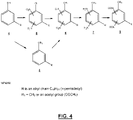
- the preferred process for the preparation of the biobased diisocyanates 1 illustrated in Figure 1 is shown in Figure 4 and comprises the steps of: (i) di-nitration of the 3-pentadecylphenol (4) to the corresponding di-nitro-pentadecylphenol ( 5 ); (ii) methylation or acetylation to the corresponding di-nitro-methoxy-pentadecylbenzene or di-nitro-pentadecylphenyl-acetate ( 6 ); (iii) hydrogenation to the di-amino methoxy-pentadecylbenzene or di-amino-pentadecylphenyl-acetate (7); followed by phosgenation to yield the biobased diisocyanates (1) as illustrated in Figure 5 .
- the process may comprise the steps of: (i) methylation or acetylation of 3-pentadecylphenol (4) to the corresponding 3-pentadecyl methoxy benzene or 3-pendadecyl-phenyl-acetate (8); (ii) di-nitration to the corresponding di-nitro-methoxy-pentadecylbenzene or di-nitro-pentadecylphenyl-acetate ( 6 ); (iii) hydrogenation to the di-amino methoxy-pentadecylbenzene or di-amino-pentadecylphenyl-acetate (7); followed by phosgenation to yield the biobased diisocyanates (1).
- the preferred process for the preparation of the biobased diisocyanates 2 illustrated in Figure 1 wherein R 2 is an alkylene from about 1 to 18 carbon atoms, is shown in Figure 5 and comprises the steps of: (i) mononitration of 3-pentadecylphenol (4) to the corresponding nitro-3-pentadecyl-phenol ( 12 ); (ii) etherification with dihaloalkane to the corresponding bis-(nitro-pentadecyl-phenoxy)-alkane (10); (iii) hydrogenation to the corresponding bis-(amino-pentadecyl-phenoxy)-alkane ( 11 ); followed by phosgenation to the corresponding biobased diisocyanates (2), as illustrated in the process steps of Figure 6.
- the process may comprise the steps of: (i) etherification with dihaloalkane of 3-pentadecylphenol (4) to the corresponding bis (3-pentadecyl-phenoxy) alkane ( 9 ); (ii) mono-nitration to the corresponding bis-(nitro-pentadecyl-phenoxy)-alkane (10); (iii) hydrogenation to the corresponding bis-(amino-pentadecyl-phenoxy)-alkane (11); followed by phosgenation to the corresponding biobased diisocyanates (2).
- the mono-nitration process step of 3-pentadecylphenol (4), to the corresponding nitro-pentadecylphenol 12, or the di-nitration of (4) to the di-nitro-pentadecyl phenol (5) can be achieved utilizing nitric acid in a solvent such as alcohol, or acetonitrile at room temperature as described by Attanasi et al., "Synthesis and reactions of nitro derivatives of hydrogenated cardanol", Tetrahedron 62, p.6113 (2006 ). This procedure can also be utilized in the preparation of the nitration products 6 from 8, or 9 to 10.
- nitric acid can be utilized in concentration of 50% to about 90% or by utilizing fumic nitric acid.
- Acetic acid, acetic anhydride and sulfuric acid can also be utilized in combination with the nitric acid.
- the various nitration products can be isolated by aqueous (basic) extraction of the residual acid followed by solvent evaporation, and optionally recrystallization of the products.
- the reduction of the di-nitro aromatic compounds 6 and 10, to the diamino aromatic compounds 7, and 11 respectively, can be preferably accomplished by hydrogenation with a catalyst with hydrogen under pressure, as described in U.S. Patent Nos. 3,328,465 , 3,356,728 and 3,517,063 , wherein the aromatic dinitro compound is dissolved in a solvent such as methanol and a catalyst such as Raney nickel is employed, at a temperature of from about 100°C to about 150°C with a hydrogen pressure of from about 50 atmosphere to about 250 atmosphere.
- a catalyst such as platinum, palladium or a combination of platinum and palladium deposited on a carbon support which may be porous or non-porous, can also be utilized.
- the diamino aromatic compounds 7 and 11 can be transformed into the biobased aromatic diisocyanates 1 and 2, utilizing phosgene gas, and similarly to the production process of toluene diisocyanate as described in U.S. Patent No. 8,034,972 , and in prior art documents cited therein.
- Other known methods utilizing diphosgene (trichloromethyl chloroformate) or triphosgene also known as bis(trichloromethyl) carbonate, which is in liquid rather than gaseous form, can be utilized for the preparation or aromatic diisocyanates from aromatic diamines.
- solvents can be utilized for this process, including aprotic solvents such as alkanes, dichloromethane, ether, tetrahydrofuran, ethyl acetate, acetonitrile, and the like, at a temperature range of from about 0°C to about 60°C, followed by solvent removal by distillation.
- aprotic solvents such as alkanes, dichloromethane, ether, tetrahydrofuran, ethyl acetate, acetonitrile, and the like
- the resulting diisocyanate products can be optionally fractionally distilled under reduced pressure, recrystallized or utilized without purification.
- Various procedures for the acetylation of phenolic compounds have been reported in the literature, and are accomplished by contacting the aromatic phenolic compound with acetic anhydride in the presence of a catalyst from room temperature to about 140°C.
- Suitable catalysts include, sulfuric acid, p-toluenesulfonic acid ion exchange resins, tetra-alkylammonium halides, and the AMBERLYST 15 catalyst.
- the reaction can be conducted without the presence of solvents, or can be conducted with aprotic solvents such as alkanes, dichloromethane, ether, tetrahydrofuran, ethyl acetate, acetonitrile, and the like.
- aprotic solvents such as alkanes, dichloromethane, ether, tetrahydrofuran, ethyl acetate, acetonitrile, and the like.
- the present invention is not limited to the above acetylation process, and a variety of processes known in the literature can be utilized by those skilled in the art such as with the use of acetic acid or acetyl chloride.
- the preparation of bis (3-pentadecyl-phenoxy) alkane ( 9 ) is obtained from the etherification of a dihaloalkane with the 3-pentadecylphenol (4).
- the bis-(nitro-pentadecyl-phenoxy)-alkane (10) is obtained from the etherification of a dihaloalkane with the nitro-3-pentadecyl-phenol (12).
- the dihaloalkane can be selected from 1,2-dichloroethane, 1,2-dibromoethane, 1,2-diiodoethane, 1,3-dichloropropane, 1,3-dibromopropane, 1,4-dichlorobutane, 1,4-dibromobutane, 1,5-dichloropentane, 1,5-dibromopentane, 1,6-dibromohexane, 1,8-dibromooctane, 1,9-dibromononane, 1,10-dibromodecane, 1,12-dibromododecane, 1,18-dibromooctadecane, mixtures thereof, and the like.
- the reaction is carried out with a base, such as sodium carbonate, potassium carbonate, sodium hydroxide, potassium hydroxide or lithium hydroxide, and is carried out at a temperature of from about 50°C to about 130°C, with or without the use of an aprotic solvent such as dimethylformamide.
- a base such as sodium carbonate, potassium carbonate, sodium hydroxide, potassium hydroxide or lithium hydroxide
- the present invention also contemplates polyurethane elastomers derived primarily from a two-component reaction or curing of the biobased diisocyanate of formula 1 or 2, and a polyol.
- the polyol is a biobased polyol, and more preferably a biobased polyol.
- the polyol is in liquid form during the reaction at a temperature from about 25°C to about 80°C.
- Polyols derived from ethylene oxide and or propylene oxide are typically liquid and of low viscosity under these conditions, although these polyols are generally derived from fossil fuels.
- Polyols comprised of polyester resins with hydroxyl terminated end groups may also be used, and in some instances are derived from biomass or biobased materials such as those disclosed in U.S. Patent No. 10,934,384 to Evoco Ltd., issued March 2, 2021 , the content of which is herein incorporated by reference in its entirety.
- These polyester polyols can be solid or viscous liquids at the temperature range of from about 25°C to about 80°C, and thus require the use of diluents to render them to liquid states.
- biobased plasticizers can be utilized as effective diluents to solubilize the polyester polyol to a liquid of low viscosity state and for providing the plasticization of the resulting polyurethane elastomer.
- the amount of plasticizer should be added in a minimal enough quantity to solubilize the polyester polyol, and to provide a desirable level of plasticization of the resulting polyurethane elastomer.
- biobased plasticizers have been described, for example, in co-pending U.S. Application No. 17/176874 to Evoco Ltd., filed February 16, 2021 , the content of which is herein incorporated by reference in its entirety. From about 85 to about 99% of the weight of the polyurethane elastomer may be derived from biobased content.
- the mixture was then transferred to a 1.5 L separatory funnel, washed with a 1% aqueous solution of sodium carbonate, followed by water and the organic layer was then rotary evaporated to yield a mixture of about 92% di-nitro-pentadecyl-phenol (5).
- the product was then recrystallized from hexane and characterized by NMR spectroscopy.
- the mixture was then transferred to a 1.5 L separatory funnel, washed with a 1% aqueous solution of sodium carbonate, followed by water, and the organic layer was then rotary evaporated to yield a mixture of about 91% of the nitro-pentadecyl-phenol (12).
- the product was characterized by NMR spectroscopy.
- reaction mixture was poured into ice cold water (500 mL), and the product was collected by filtration, dissolved in 200 mL of dichloromethane and washed with water, and the solvent was rotary evaporated to obtain 22 grams of the bis-(nitro-pentadecyl-phenoxy)-ethane (10).
Landscapes
- Chemical & Material Sciences (AREA)
- Organic Chemistry (AREA)
- Chemical Kinetics & Catalysis (AREA)
- Health & Medical Sciences (AREA)
- Medicinal Chemistry (AREA)
- Polymers & Plastics (AREA)
- Emergency Medicine (AREA)
- Organic Low-Molecular-Weight Compounds And Preparation Thereof (AREA)
- Polyurethanes Or Polyureas (AREA)
Applications Claiming Priority (1)
| Application Number | Priority Date | Filing Date | Title |
|---|---|---|---|
| US17/245,807 US20220356150A1 (en) | 2021-04-30 | 2021-04-30 | Biobased diisocyanates, and process for preparation of same |
Publications (1)
| Publication Number | Publication Date |
|---|---|
| EP4083018A1 true EP4083018A1 (fr) | 2022-11-02 |
Family
ID=81392599
Family Applications (1)
| Application Number | Title | Priority Date | Filing Date |
|---|---|---|---|
| EP22170655.9A Pending EP4083018A1 (fr) | 2021-04-30 | 2022-04-28 | Diisocyanates d'origine biologique; et leur procédé de préparation |
Country Status (4)
| Country | Link |
|---|---|
| US (2) | US20220356150A1 (fr) |
| EP (1) | EP4083018A1 (fr) |
| CN (1) | CN115260448A (fr) |
| CA (1) | CA3156515A1 (fr) |
Families Citing this family (1)
| Publication number | Priority date | Publication date | Assignee | Title |
|---|---|---|---|---|
| US20260062511A1 (en) | 2024-09-03 | 2026-03-05 | Evoco Limited | Polyalkylene glycol terminated poly-carbodiimides, and process for forming same |
Citations (13)
| Publication number | Priority date | Publication date | Assignee | Title |
|---|---|---|---|---|
| US3328465A (en) | 1963-03-26 | 1967-06-27 | Du Pont | Process for the hydrogenation of nitro compounds |
| US3356728A (en) | 1964-03-12 | 1967-12-05 | Olin Mathieson | Process of preparing aromatic polyamines by catalytic hydrogenation of aromatic polynitro compounds |
| US3517063A (en) | 1965-09-22 | 1970-06-23 | Mobay Chemical Corp | Hydrogenation of dinitrotoluene to tolylene diamine |
| EP0183115A1 (fr) * | 1984-11-23 | 1986-06-04 | Bayer Ag | Alcanes bis(4-isocyanatophénoxy) éventuellement substitués en position 3 par un groupe méthyl, procédé pour leur préparation et leur utilisation dans la préparation de polyuréthanes |
| EP0270906A1 (fr) * | 1986-12-06 | 1988-06-15 | Bayer Ag | Diisocyanates et mélanges de diisocyanates, un procédé pour leur préparation et leur utilisation pour la préparation de plastiques de polyuréthane |
| US8034972B2 (en) | 2007-06-27 | 2011-10-11 | H R D Corporation | System and process for production of toluene diisocyanate |
| US8044166B2 (en) | 2006-08-01 | 2011-10-25 | Basf Aktiengesellschaft | Process for preparing pentamethylene 1,5-diisocyanate |
| US9404132B2 (en) | 2010-03-01 | 2016-08-02 | Mitsui Chemicals, Inc. | Method for producing 1,5-pentamethylenediamine, 1,5-pentamethylenediamine, 1,5-pentamethylene diisocyanate, method for producing 1,5-pentamethylene diisocyanate, polyisocyanate composition, and polyurethane resin |
| US9428441B2 (en) | 2013-09-05 | 2016-08-30 | Basf Se | Method for removing HCN from crude dinitro toluene |
| US9765369B2 (en) | 2012-01-18 | 2017-09-19 | Mitsui Chemicals, Inc. | Method for producing 1,5-pentamethylenediamine, mutant lysine decarboxylase, method for producing 1,5-pentamethylene diisocyanate and method for producing polyisocyanate composition |
| US9950996B2 (en) | 2014-12-23 | 2018-04-24 | Council Of Scientific & Industrial Research | Bio-based aromatic diisocyanates for preparation of polyurethanes |
| CN110183356A (zh) * | 2019-05-20 | 2019-08-30 | 江苏蓝丰生物化工股份有限公司 | 取代类对苯二异氰酸酯的制备方法及非腈极性有机溶剂在其制备中的应用 |
| US10934384B1 (en) | 2020-09-09 | 2021-03-02 | Evoco Ltd. | Polyurethane elastomer compositions, and processes thereof |
Family Cites Families (18)
| Publication number | Priority date | Publication date | Assignee | Title |
|---|---|---|---|---|
| DE3442689A1 (de) * | 1984-11-23 | 1986-05-28 | Bayer Ag, 5090 Leverkusen | Bis-(4-isocyanatophenoxy)-alkane, ein verfahren zu ihrer herstellung und ihre verwendung bei der herstellung von polyurethankunststoffen |
| DE3628316A1 (de) * | 1986-08-21 | 1988-02-25 | Bayer Ag | Verfahren zur herstellung von diisocyanaten, ausgewaehlte diisocyanate und deren verwendung als aufbaukomponente bei der herstellung von polyurethankunststoffen |
| DE3722499A1 (de) * | 1987-07-08 | 1989-01-19 | Bayer Ag | Aromatische polyisocyanate, verfahren zu ihrer herstellung sowie ihre verwendung als klebstoffkomponente |
| GB9302418D0 (en) * | 1993-02-08 | 1993-03-24 | Ici Plc | Novel di-and polyamino compounds for use in the preparation of polyurethanes |
| US6329344B1 (en) * | 1998-10-22 | 2001-12-11 | Ranbaxy Laboratories Limited | Derivatives of monosaccharides as cell adhesion inhibitors |
| US7828991B2 (en) * | 2006-12-08 | 2010-11-09 | Bayer Materialscience Llc | Polyether polyols based on cashew nutshell liquid and flexible foams |
| EP2072556A1 (fr) * | 2007-12-17 | 2009-06-24 | Sika Technology AG | Procédé de fabrication de polymères hydroxyfonctionnels, produits de polyaddition à terminaison de groupes isocyanates ainsi obtenus et leur utilisation |
| FR2949783B1 (fr) * | 2009-09-10 | 2012-08-17 | Coatex Sas | Polyurethanes associatifs a base de cardanol, epaississants associatifs correspondants et leurs utilisations. |
| JP5935796B2 (ja) * | 2011-04-04 | 2016-06-15 | 日本電気株式会社 | セルロース系樹脂およびその製造方法 |
| US9181351B2 (en) * | 2011-04-04 | 2015-11-10 | Nec Corporation | Cellulose resin and process for producing the same |
| WO2013186957A1 (fr) * | 2012-06-15 | 2013-12-19 | 日本電気株式会社 | Composition de résine à base de cellulose et son utilisation |
| US20160102168A1 (en) * | 2014-09-17 | 2016-04-14 | Trent University | Bio-based diisocyanate and chain extenders in crystalline segmented thermoplastic polyester urethanes |
| US20170145145A1 (en) * | 2015-11-25 | 2017-05-25 | Trent University | Renewably derived thermoplastic polyester-based urethanes and methods of making and using the same |
| CA2949659A1 (fr) * | 2015-11-25 | 2017-05-25 | Trent University | Urethanes a base de polyester thermoplastique derive renouvelable et methodes de fabrication et utilisation associees |
| CN106977694B (zh) * | 2017-03-14 | 2019-09-17 | 中科院广州化学有限公司南雄材料生产基地 | 紫外光固化的聚氨酯丙烯酸酯光敏树脂及其制法和用途 |
| CN111886287B (zh) * | 2018-03-11 | 2022-11-08 | 赢创运营有限公司 | 用于pvc增塑溶胶的腰果酚封闭的异氰酸酯粘附促进剂 |
| CN111909357A (zh) * | 2019-05-08 | 2020-11-10 | 王镇 | 一种水性腰果酚活性乳化剂的制备方法 |
| US11214539B1 (en) * | 2021-07-30 | 2022-01-04 | Evoco Limited | Biobased diisocyanates, and process for preparation of same |
-
2021
- 2021-04-30 US US17/245,807 patent/US20220356150A1/en not_active Abandoned
- 2021-12-02 US US17/540,462 patent/US11358929B1/en active Active
-
2022
- 2022-04-25 CN CN202210439655.3A patent/CN115260448A/zh active Pending
- 2022-04-26 CA CA3156515A patent/CA3156515A1/fr active Pending
- 2022-04-28 EP EP22170655.9A patent/EP4083018A1/fr active Pending
Patent Citations (13)
| Publication number | Priority date | Publication date | Assignee | Title |
|---|---|---|---|---|
| US3328465A (en) | 1963-03-26 | 1967-06-27 | Du Pont | Process for the hydrogenation of nitro compounds |
| US3356728A (en) | 1964-03-12 | 1967-12-05 | Olin Mathieson | Process of preparing aromatic polyamines by catalytic hydrogenation of aromatic polynitro compounds |
| US3517063A (en) | 1965-09-22 | 1970-06-23 | Mobay Chemical Corp | Hydrogenation of dinitrotoluene to tolylene diamine |
| EP0183115A1 (fr) * | 1984-11-23 | 1986-06-04 | Bayer Ag | Alcanes bis(4-isocyanatophénoxy) éventuellement substitués en position 3 par un groupe méthyl, procédé pour leur préparation et leur utilisation dans la préparation de polyuréthanes |
| EP0270906A1 (fr) * | 1986-12-06 | 1988-06-15 | Bayer Ag | Diisocyanates et mélanges de diisocyanates, un procédé pour leur préparation et leur utilisation pour la préparation de plastiques de polyuréthane |
| US8044166B2 (en) | 2006-08-01 | 2011-10-25 | Basf Aktiengesellschaft | Process for preparing pentamethylene 1,5-diisocyanate |
| US8034972B2 (en) | 2007-06-27 | 2011-10-11 | H R D Corporation | System and process for production of toluene diisocyanate |
| US9404132B2 (en) | 2010-03-01 | 2016-08-02 | Mitsui Chemicals, Inc. | Method for producing 1,5-pentamethylenediamine, 1,5-pentamethylenediamine, 1,5-pentamethylene diisocyanate, method for producing 1,5-pentamethylene diisocyanate, polyisocyanate composition, and polyurethane resin |
| US9765369B2 (en) | 2012-01-18 | 2017-09-19 | Mitsui Chemicals, Inc. | Method for producing 1,5-pentamethylenediamine, mutant lysine decarboxylase, method for producing 1,5-pentamethylene diisocyanate and method for producing polyisocyanate composition |
| US9428441B2 (en) | 2013-09-05 | 2016-08-30 | Basf Se | Method for removing HCN from crude dinitro toluene |
| US9950996B2 (en) | 2014-12-23 | 2018-04-24 | Council Of Scientific & Industrial Research | Bio-based aromatic diisocyanates for preparation of polyurethanes |
| CN110183356A (zh) * | 2019-05-20 | 2019-08-30 | 江苏蓝丰生物化工股份有限公司 | 取代类对苯二异氰酸酯的制备方法及非腈极性有机溶剂在其制备中的应用 |
| US10934384B1 (en) | 2020-09-09 | 2021-03-02 | Evoco Ltd. | Polyurethane elastomer compositions, and processes thereof |
Non-Patent Citations (7)
| Title |
|---|
| ATTANASI ET AL.: "Synthesis and reactions of nitro derivatives of hydrogenated cardanol", TETRAHEDRON, vol. 62, 2006, pages 6113, XP025002119, DOI: 10.1016/j.tet.2006.03.105 |
| CAWSE ET AL.: "Polymers from renewable sources", MAKROMOLEKULARE CHEMIE, vol. 185, no. 4, 1984, pages 697 |
| GHATGE N D ET AL: "Studies on the Reactivities of Diisocyanates"", vol. 19, 1 January 1971 (1971-01-01), pages 75 - 81, XP055959549, Retrieved from the Internet <URL:https://onlinelibrary.wiley.com/doi/epdf/10.1002/apmc.1971.050190106> * |
| HAJIPOURRUOHO: "A Fast and Mild Method for Nitration of Aromatic Ring", PHOSPHORUS, SULFUR, AND SILICON, vol. 179, 2004, pages 221 - 226 |
| KUMAR ET AL.: "Simple and chemoselective reduction of aromatic nitro compounds to aromatic amines: reduction with hydriodic acid revisited", TETRAHEDRON LETTERS, vol. 42, 2001, pages 5601, XP004295821, DOI: 10.1016/S0040-4039(01)01083-8 |
| LAUWINER ET AL., APPLIED CATALYSIS A: GENERAL, vol. 177, 1999, pages 9 |
| N.D. GHATGE, S.S. MAHAJAN: "Syntheses of Diisocyanates Based on Cashewnut Shell Liquid", INDIAN JOURNAL OF TECHNOLOGY, vol. 17, no. 2, 1 January 1979 (1979-01-01), pages 55 - 57, XP009539013 * |
Also Published As
| Publication number | Publication date |
|---|---|
| CN115260448A (zh) | 2022-11-01 |
| US11358929B1 (en) | 2022-06-14 |
| CA3156515A1 (fr) | 2022-10-30 |
| US20220356150A1 (en) | 2022-11-10 |
Similar Documents
| Publication | Publication Date | Title |
|---|---|---|
| US9012676B2 (en) | Processes for producing aryl carbamates, isocynates and polyureas using diaryl carbonate | |
| US8822729B2 (en) | Method for providing a secondary or tertiary amine | |
| US20120129963A1 (en) | Synthesis of novel multifunctional cardanol's derivatives and their use as halogen free polyurethanic foams precursors | |
| EP4122597A2 (fr) | Un procédé de production d'un produit diisocyanate, un procédé de production d'un produit isocyanate aromatique et un procédé de production d'un produit polyuréthane | |
| WO2011087793A1 (fr) | Étheramines et leur utilisation comme intermédiaires dans la synthèse de polymères | |
| US4978791A (en) | Substituted P,P'-methylene-bis-aniline | |
| EP4083018A1 (fr) | Diisocyanates d'origine biologique; et leur procédé de préparation | |
| JP2026067965A (ja) | リグニンモノマー由来熱可塑性ポリウレタン | |
| CN107810214A (zh) | 用加入的铯盐合成聚合物碳二亚胺的方法、聚合物碳二亚胺及其用途 | |
| CN115650861A (zh) | 一种木质素基聚氨酯扩链剂在制备聚氨酯材料中的应用 | |
| US11214539B1 (en) | Biobased diisocyanates, and process for preparation of same | |
| TWI443080B (zh) | 利用二芳基碳酸酯製造芳基胺基甲酸酯、異氰酸鹽及聚脲之方法 | |
| WO2015069531A1 (fr) | Étheramines et leur utilisation comme agents de durcissement ou intermédiaires pour la synthèse de polymères | |
| US4820866A (en) | Process for the production of diisocyanates, selected diisocyanates produced thereby and the production of polyurethane plastics therefrom | |
| CN108250406B (zh) | 含软链段的多胺基甲酸酯、多元异氰酸酯、胺甲酸酯预聚物及聚胺甲酸酯弹性体及制备方法 | |
| US3474126A (en) | Process for production of high molecular weight diamines | |
| KR20090019304A (ko) | 무수말레인산 부산물을 이용한 폴리에스테르 폴리올의제조방법 | |
| EP0677542B1 (fr) | Diamines d'allongement de chaíne dans des polyurées-uréthanes et procédé pour leur préparation | |
| US4051166A (en) | Araliphatic diisocyanates | |
| US5719307A (en) | Diamine chain extenders and method of use | |
| US4229576A (en) | Anthranilates of oxyalkylated cyanuric acid | |
| CN101687972A (zh) | 用于聚氨酯泡沫体的反应性胺催化剂 | |
| CN118878798B (zh) | 一种以乙醇酸甲酯为原料催化合成低聚聚酯多元醇的方法 | |
| US4595744A (en) | Low melting point diphenylethane diisocyanate mixtures, method of making the same, and polyurethanes made therefrom | |
| US3313744A (en) | 1, 4-bis(3-dimethylaminopropyl)piperazine catalyst for polyurethane preparation |
Legal Events
| Date | Code | Title | Description |
|---|---|---|---|
| PUAI | Public reference made under article 153(3) epc to a published international application that has entered the european phase |
Free format text: ORIGINAL CODE: 0009012 |
|
| STAA | Information on the status of an ep patent application or granted ep patent |
Free format text: STATUS: THE APPLICATION HAS BEEN PUBLISHED |
|
| AK | Designated contracting states |
Kind code of ref document: A1 Designated state(s): AL AT BE BG CH CY CZ DE DK EE ES FI FR GB GR HR HU IE IS IT LI LT LU LV MC MK MT NL NO PL PT RO RS SE SI SK SM TR |
|
| STAA | Information on the status of an ep patent application or granted ep patent |
Free format text: STATUS: REQUEST FOR EXAMINATION WAS MADE |
|
| 17P | Request for examination filed |
Effective date: 20230502 |
|
| RBV | Designated contracting states (corrected) |
Designated state(s): AL AT BE BG CH CY CZ DE DK EE ES FI FR GB GR HR HU IE IS IT LI LT LU LV MC MK MT NL NO PL PT RO RS SE SI SK SM TR |
|
| STAA | Information on the status of an ep patent application or granted ep patent |
Free format text: STATUS: EXAMINATION IS IN PROGRESS |