EP4083601A1 - Blutentnahmeröhrchen zur messung der blutviskosität, vorrichtung zur messung der viskosität von blut und versiegelte packung eines blutentnahmeröhrchens zur messung der blutviskosität - Google Patents
Blutentnahmeröhrchen zur messung der blutviskosität, vorrichtung zur messung der viskosität von blut und versiegelte packung eines blutentnahmeröhrchens zur messung der blutviskosität Download PDFInfo
- Publication number
- EP4083601A1 EP4083601A1 EP19957871.7A EP19957871A EP4083601A1 EP 4083601 A1 EP4083601 A1 EP 4083601A1 EP 19957871 A EP19957871 A EP 19957871A EP 4083601 A1 EP4083601 A1 EP 4083601A1
- Authority
- EP
- European Patent Office
- Prior art keywords
- blood
- viscosity measurement
- tube
- collection tube
- blood collection
- Prior art date
- Legal status (The legal status is an assumption and is not a legal conclusion. Google has not performed a legal analysis and makes no representation as to the accuracy of the status listed.)
- Pending
Links
Images


Classifications
-
- G—PHYSICS
- G01—MEASURING; TESTING
- G01N—INVESTIGATING OR ANALYSING MATERIALS BY DETERMINING THEIR CHEMICAL OR PHYSICAL PROPERTIES
- G01N11/00—Investigating flow properties of materials, e.g. viscosity, plasticity; Analysing materials by determining flow properties
- G01N11/10—Investigating flow properties of materials, e.g. viscosity, plasticity; Analysing materials by determining flow properties by moving a body within the material
- G01N11/12—Investigating flow properties of materials, e.g. viscosity, plasticity; Analysing materials by determining flow properties by moving a body within the material by measuring rising or falling speed of the body; by measuring penetration of wedged gauges
-
- A—HUMAN NECESSITIES
- A61—MEDICAL OR VETERINARY SCIENCE; HYGIENE
- A61B—DIAGNOSIS; SURGERY; IDENTIFICATION
- A61B5/00—Measuring for diagnostic purposes; Identification of persons
- A61B5/15—Devices for taking samples of blood
- A61B5/150007—Details
- A61B5/150015—Source of blood
- A61B5/15003—Source of blood for venous or arterial blood
-
- A—HUMAN NECESSITIES
- A61—MEDICAL OR VETERINARY SCIENCE; HYGIENE
- A61B—DIAGNOSIS; SURGERY; IDENTIFICATION
- A61B5/00—Measuring for diagnostic purposes; Identification of persons
- A61B5/15—Devices for taking samples of blood
- A61B5/150007—Details
- A61B5/150351—Caps, stoppers or lids for sealing or closing a blood collection vessel or container, e.g. a test-tube or syringe barrel
-
- B—PERFORMING OPERATIONS; TRANSPORTING
- B01—PHYSICAL OR CHEMICAL PROCESSES OR APPARATUS IN GENERAL
- B01L—CHEMICAL OR PHYSICAL LABORATORY APPARATUS FOR GENERAL USE
- B01L3/00—Containers or dishes for laboratory use, e.g. laboratory glassware; Droppers
- B01L3/50—Containers for the purpose of retaining a material to be analysed, e.g. test tubes
- B01L3/508—Rigid containers without fluid transport within
- B01L3/5082—Test tubes per se
- B01L3/50825—Closing or opening means, corks, bungs
-
- G—PHYSICS
- G01—MEASURING; TESTING
- G01N—INVESTIGATING OR ANALYSING MATERIALS BY DETERMINING THEIR CHEMICAL OR PHYSICAL PROPERTIES
- G01N33/00—Investigating or analysing materials by specific methods not covered by groups G01N1/00 - G01N31/00
- G01N33/48—Biological material, e.g. blood, urine; Haemocytometers
- G01N33/483—Physical analysis of biological material
- G01N33/487—Physical analysis of biological material of liquid biological material
- G01N33/49—Blood
-
- A—HUMAN NECESSITIES
- A61—MEDICAL OR VETERINARY SCIENCE; HYGIENE
- A61B—DIAGNOSIS; SURGERY; IDENTIFICATION
- A61B5/00—Measuring for diagnostic purposes; Identification of persons
- A61B5/15—Devices for taking samples of blood
- A61B5/150007—Details
- A61B5/150374—Details of piercing elements or protective means for preventing accidental injuries by such piercing elements
- A61B5/150381—Design of piercing elements
- A61B5/150389—Hollow piercing elements, e.g. canulas, needles, for piercing the skin
-
- A—HUMAN NECESSITIES
- A61—MEDICAL OR VETERINARY SCIENCE; HYGIENE
- A61B—DIAGNOSIS; SURGERY; IDENTIFICATION
- A61B5/00—Measuring for diagnostic purposes; Identification of persons
- A61B5/15—Devices for taking samples of blood
- A61B5/150007—Details
- A61B5/150374—Details of piercing elements or protective means for preventing accidental injuries by such piercing elements
- A61B5/150381—Design of piercing elements
- A61B5/150473—Double-ended needles, e.g. used with pre-evacuated sampling tubes
-
- A—HUMAN NECESSITIES
- A61—MEDICAL OR VETERINARY SCIENCE; HYGIENE
- A61B—DIAGNOSIS; SURGERY; IDENTIFICATION
- A61B5/00—Measuring for diagnostic purposes; Identification of persons
- A61B5/15—Devices for taking samples of blood
- A61B5/153—Devices specially adapted for taking samples of venous or arterial blood, e.g. with syringes
- A61B5/154—Devices using pre-evacuated means
-
- A—HUMAN NECESSITIES
- A61—MEDICAL OR VETERINARY SCIENCE; HYGIENE
- A61B—DIAGNOSIS; SURGERY; IDENTIFICATION
- A61B5/00—Measuring for diagnostic purposes; Identification of persons
- A61B5/15—Devices for taking samples of blood
- A61B5/157—Devices characterised by integrated means for measuring characteristics of blood
-
- B—PERFORMING OPERATIONS; TRANSPORTING
- B01—PHYSICAL OR CHEMICAL PROCESSES OR APPARATUS IN GENERAL
- B01L—CHEMICAL OR PHYSICAL LABORATORY APPARATUS FOR GENERAL USE
- B01L2300/00—Additional constructional details
- B01L2300/04—Closures and closing means
- B01L2300/041—Connecting closures to device or container
-
- B—PERFORMING OPERATIONS; TRANSPORTING
- B01—PHYSICAL OR CHEMICAL PROCESSES OR APPARATUS IN GENERAL
- B01L—CHEMICAL OR PHYSICAL LABORATORY APPARATUS FOR GENERAL USE
- B01L2300/00—Additional constructional details
- B01L2300/04—Closures and closing means
- B01L2300/046—Function or devices integrated in the closure
Definitions
- the present invention relates to a blood collection tube in which a blood collection tube that has collected blood can be used as a blood-viscosity measurement container as it is and can initiate blood-viscosity measurement within a very short time after collecting the blood, and also relates to a blood-viscosity measurement device.
- negative pressure means that the absolute pressure is 50 kPa or less.
- rubber is used in a sense including a thermoplastic elastomer.
- a falling ball type blood-viscosity measurement device is known (see Patent Document 1).
- blood is collected with a syringe in which a steel ball is disposed to measure the blood viscosity, and the steel ball is raised to an upper position in the syringe using a magnetic force. Thereafter, the steel ball is dropped, and the fall terminal velocity of the falling steel ball is measured to determine the blood viscosity.
- a falling body type viscosity measurement device in which fluid viscosity is determined by measuring the fall terminal velocity of a cylindrical falling body that falls in a cylindrical measurement container filled with a fluid (see Patent Document 2).
- the steel ball in the syringe is raised to an upper position in the syringe by a magnetic force from the outside. In this case, it is required to move the steel ball in a viscous blood fluid from a remote location, which requires a very strong magnetic force. Further, when the steel ball drops, the steel ball often comes into contact with the inner wall of the syringe, which prevents highly accurate viscosity measurement.
- an anticoagulant is added to the sampled blood in a normal blood test. Adding this anticoagulant does not significantly impact ingredient analyses, but it significantly impacts viscosity measurement to assess the blood status. Therefore, in order to measure the viscosity of blood, it is desirable to complete the viscosity measurement within three minutes after the blood collection without adding an anticoagulant so that the blood solidification does not start.
- An object of the present invention is to provide a blood-viscosity measurement blood collection tube and a blood-viscosity measurement device in which a blood collection tube that has collected blood can be used as a blood-viscosity measurement container as it is, the blood-viscosity measurement can be quickly initiated without for the measurer coming into contact with the blood, and the blood-viscosity measurement can be performed in a substantially air non-contact manner.
- the present invention provides the following measures.
- the measurer can quickly initiate the blood-viscosity measurement without coming into contact with the blood. It is also capable of measuring the blood viscosity substantially in an air non-contact manner.
- the inside of the blood collection tube is in a negative pressure state, and therefore, it is possible to collect the quantity of blood required for the blood-viscosity measurement at the time of the blood collection. Further, by defining (controlling) the internal pressure of the blood collection tube with high accuracy, the quantity of blood to be collected can be kept constant at all times.
- the viscosity measurement falling body can smoothly drop the inside of the guide tube while discharging the air in the guide tube, which enables further accurate blood-viscosity measurement.
- the blood collection tube that has collected blood as a blood-viscosity measurement container as it is, thereby enabling the measurer to quickly initiate the blood-viscosity measurement without touching the blood. It is also possible to provide a blood-viscosity measurement device capable of measuring the blood-viscosity in a substantial air non-contact manner.
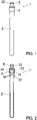
- a blood-viscosity measurement blood collection tube 1 is provided with a bottomed tube 3 and a sealing plug 4 (see FIGS. 1 and 2 ).
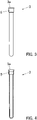
- the bottomed tube 3 is a tube body, as shown in FIGS. 3 and 4 , provided with an opening 3a at one end side (upper side in the drawing) in the length direction and a bottom wall at the other end side (lower side in the drawing) in the length direction.
- the bottomed tube 3 is a cylindrical bottomed tube having a constant diameter over substantially the entire length.
- the bottomed tube 3 has a structure provided at the end side of the opening 3a with an enlarged diameter portion 5 enlarged in diameter. It is desirable that the bottomed tube 3 be transparent.
- the material of the bottomed tube 3 is not particularly limited but may be made of, for example, polyester resin (PET, PEN, PBT), polyolefin resin (PP, PE) or cyclic olefin resin (COP, COC), or the like.
- PET polyester resin
- PP polyolefin resin
- COP cyclic olefin resin
- it is preferably made of polyester resin, and particularly preferably made of polyethylene terephthalate (PET).
- PET polyethylene terephthalate
- PET polyethylene terephthalate
- the sealing plug 4 is provided with a sealing part 31 capable of being fitted into the opening 3a of the bottomed tube in a hermetically sealed state, a cap part 32 capable of being pinched by fingers, and a connecting part 33 connecting the cap part 32 and the sealing part 31.
- the connecting part 33 is a connecting part made of an annular member with a thin thickness (thickness in the horizontal direction).
- the cap part 32 has an outer diameter shape formed in a substantially cylindrical shape. At the upper surface of the cap part 32, a needle insertion hole 32a is provided (see FIG. 6 ).
- the material of the sealing plug 4 is not particularly limited. It may be made of various rubber materials, such as, e.g., natural rubber, butyl rubber, isoprene rubber, butadiene rubber, styrene-butadiene rubber, and silicone rubber, and various thermoplastic elastomers, such as, e.g., polyurethane-based thermoplastic elastomer, polyester-based thermoplastic elastomer, polyamide-based thermoplastic elastomer, olefin-based thermoplastic elastomer, and styrene-based thermoplastic elastomer. Of these, it is particularly preferred to be made of butyl rubber.
- the degree of the hermetical sealing by the sealing plug is high, which enables maintaining the inside of the blood collection tube in a higher negative pressure condition. Therefore, it is possible to collect a sufficient quantity of blood in the blood collection tube when collecting blood, which enables more accurate blood-viscosity measurement.
- the sealing part 31 is provided with a vertically penetrated insertion hole 34.
- a guide tube 37 communicating with the insertion hole 34 is fitted in the insertion hole 34 such that the guide tube 37 extends downward (see FIG. 6 ).
- the planar shape of the insertion hole 34 is circular.
- the guide tube 37 is a cylindrical tube.
- a plurality of apertures (through-holes) 38 is formed in the side surface of the guide tube 37.
- a circular aperture 38 is formed, but the present invention is not particularly limited to such a shape.
- a slit 39 may be formed.
- the material of the guide tube 37 is not particularly limited and may be made of various rubber materials, such as, e.g., polyester resin (PET, PEN, PBT), polyolefin resin (PP, PE), cyclic olefin resins (COP, COC), natural rubber, butyl rubber, isoprene rubber, butadiene rubber, styrene-butadiene rubber, and silicone rubber, and various thermoplastic elastomers, such as, e.g., polyurethane-based thermoplastic elastomer, polyester-based thermoplastic elastomer, polyamide-based thermoplastic elastomer, olefin-based thermoplastic elastomer, and styrene-based thermoplastic elastomer.
- polyester resin particularly preferably made of polyethylene terephthalate (PET).
- the upper end of the insertion hole 34 communicates with the inner space of the annular member constituting the connecting part 33 (see FIG. 6 ).
- the upper side of the insertion hole 34 is closed by the cap part 32 (see FIG. 6 ).
- the outer diameter of the annular member constituting the connecting part 33 is smaller than the outer diameter of the cap part 32 and smaller than the outer diameter of the sealing part 31 (see FIG. 6 ).
- the blood-viscosity measurement blood collection tube 1 is a tube in which the sealing part 31 of the sealing plug 4 is fitted in the opening 3a of the bottomed tube 3 in a hermetically sealed state (see FIGS. 1 and 2 ).
- the sealing plug 4 is fitted in the opening of the bottomed tube 3 such that the notched part formed in the sealing part 31 of the sealing plug 4 extends beyond the opening of the bottomed tube 3 (in a half-sealed state).
- the blood collection tube is brought into a vacuum chamber. Thereafter, the inside of the vacuum chamber is made in a negative pressure state to a specified value, and then the sealing part 31 of the sealing plug 4 is completely fitted to the bottomed tube 3 in the vacuum chamber (in a hermetically sealed state).
- the collection tube is took out of the vacuum chamber. Since the sealing part 31 of the sealing plug 4 is tightly fitted in the opening 3a of the bottomed tube 3 in a hermetically sealed state, the inner space of the bottomed tube 3 can be maintained in the negative pressure state for a long period of time.
- the degree of vacuum (absolute pressure) in the blood collection tube 1 is preferably set to 30 kPa or less, more preferably set to 20 kPa or less.
- the cap part 32 can be removed by applying an external force (a tensile force, a shearing force, a torsional force, etc.) to the cap part 32 to break the connecting part 33.
- the connecting part 33 is formed of an annular member which is thin in thickness (the thickness in the horizontal, i.e., the thickness in the radial direction of the annular member), and therefore, the connecting part 33 can be easily broken by pulling the cap part 32 with the bottomed tube 3 held by a hand.
- one needle 41 is pierced into the skin 40 of a human body.
- the distal end of the other needle 42 is pierced through the cap part 32 by way of the needle insertion hole 32a of the cap part 32 of the blood-viscosity measurement blood collection tube 1 according to the present invention, and the distal end of the other needle 42 is placed in the insertion hole 34 (guide tube 37).
- the inside of the blood collection tube 1 bottomed tube 3
- blood 60 is injected into the inside of the bottomed tube 3 via the one needle 41, the tube 43, and the other needle 42.
- the blood 60 is drawn into the bottomed tube 3 so that the lower end of the guide tube 37 is immersed in the blood 60 (see FIG. 9 ).
- the lower end portion of the guide tube 37 be immersed in the blood 60. In this case, it is possible to measure the blood-viscosity more precisely.
- the connecting part 33 is broken (torn) to remove the cap part 32 by pulling the cap part 32 with fingers.
- the insertion hole 34 is exposed at the upper surface of the sealing part 31 as shown in FIG. 10 .
- the upper end portion of the guide tube 37 has been inserted and fitted.
- This guide tube 37 is extending downward. Accordingly, as will be described in detail, the needle-like falling body 2 is assuredly guided by the guide tube 37 to the measuring position of the blood collection tube 1, which can realize the dropping of the substantially needle-like falling body 2 in the vertically downward direction (straight vertical falling to the bottom wall of the blood collection tube 1). Further, since a plurality of apertures 38 is formed in the side surface of the guide tube 37, the substantially needle-like falling body 2 can smoothly fall in the guide tube 37 while discharging the air in the guide tube 37.
- the blood collection tube 1 from which the cap part 32 has been removed is inserted into the vertically extended insertion hole provided in the measuring device main body 71 from above. That is, the blood collection tube 1 is set to the measuring device main body 71 to constitute a blood-viscosity measurement device 70 (see FIG. 10 ).
- a detection means 74 for detecting a fall terminal velocity of the substantially needle-like falling body 2 falling in the blood-viscosity measurement blood collection tube 1 is attached to the measuring device main body 71.
- a pair of first magnetic sensors 72A and 72A arranged apart from each other in the horizontal direction, a pair of second magnetic sensors 72B and 72B arranged apart from each other in the horizontal direction, and a measurement device 73 are used (see FIG. 10 ).
- the lower first magnetic sensor 72A are spaced apart from the upper second magnetic sensor 72B.
- the measurement device 73 measures the time from when a detection signal was received from the upper second magnetic sensor 72B to when a detection signal was received from the lower first magnetic sensor 72A. With this measurement device 73, it is possible to measure the time required for the falling body 2 to fall from the position of the upper second magnetic sensor 72B to the position of the lower first magnetic sensor 72A.
- the "fall terminal velocity” denotes the velocity when a constant falling motion is being performed in the fluid.
- the substantially needle-like falling body 2 is released into the insertion hole 34 formed in the upper surface of the sealing part 31 (see FIG. 10 ) to drop the falling body in the vertically downward direction through the guide tube 37.
- the substantially needle-like falling body 2 falls in a stabilized state in the vertically downward direction in the blood 60 in the blood collection tube 1 and reaches the bottom surface of the blood collection tube 1.
- the fall terminal velocity Ut of the falling body 2 is calculated from the drop time of the falling body 2 determined by the magnetic sensors 72A and 72B and the measurement device 73 and the distance between the upper magnetic sensor 72B and the lower magnetic sensor 72A.
- the substantially needle-like falling body 2 is a substantially needle-like body 11 made of synthetic resin in which a metal weight 12 is sealed therein. That is, in this embodiment, as shown in FIG. 11 , a substantially needle-like falling body 2 is used in which a metal weight 12 is disposed inside a bottomed cylindrical substantially needle-like body 11 made of synthetic resin, and a lid 13 is fitted to the upper opening end of the substantially needle-like body 11.
- the outer shape of the substantially needle-like falling body 2 is an axially elongated cylindrical shape (see FIGS. 10 and 11 ).
- FIG. 12 is a conceptual diagram showing a state when the falling body 2 is dropping.
- FIG. 13 is a velocity cross-sectional view showing the moving directions of the blood 60 displaced by the dropping falling body 2.
- the reference symbol “L” denotes the length of the substantially needle-like falling body 2
- the reference symbol “kR” denotes the radius of the substantially needle-like falling body 2
- the reference symbol “R” denotes the radius of the bottomed tube 3.
- the reference numeral “50” denotes a minute cylindrical shell as a fluidic element around the falling body, the minute cylindrical shell being displaced by the dropping falling body.
- the reference symbol “r” denotes the inner radius of the minute cylindrical shell.
- the reference symbol “r+dr” denotes the outer radius of the minute cylindrical shell.
- the reference symbol “L” denotes the length of the minute cylindrical shell.
- the fall velocity of the substantially needle-like falling body 2 is as very small as 0.1 mm/sec (0.1 ⁇ 10 -3 m/sec) to 1.827 m/sec, and therefore no slippage occurs between the blood and the falling body and between the blood and the inner wall of the bottomed tube.
- Equation ⁇ 2> is established as a boundary condition relating to the speed.
- Equation ⁇ 4> ⁇ s is the density of the falling body, and ⁇ f is the density of the blood.
- the viscosity of the blood can be analyzed by simultaneously combining the above-described Equation ⁇ 5>, which is a constitutive Equation of the blood (a constitutive equation of Newton fluid), with the above-described Equations ⁇ 1> to ⁇ 4>. That is, since the blood is a Newton fluid in a state prior to solidification, the viscosity of the blood can be analyzed by simultaneously combining the Equation ⁇ 5>, which is the constitutive Equations of Newton fluid, with the Equations ⁇ 1> to ⁇ 4>.
- the blood-viscosity is obtained for each of a plurality of substantially needle-like falling bodies 2 having different densities, and these averages are adopted as a measured value of the blood-viscosity.
- ⁇ ⁇ ⁇
- Equation ⁇ 5> " ⁇ " is the shear stress, “ ⁇ ” (gamma) is the shearing rate, and “ ⁇ ” (mu) is the viscosity of the blood.
- the blood-viscosity measurement device 70 having the above-described configuration, it is possible to use the blood collection tube 1 in which the blood has been collected as a measurement container as it is.
- the measurer can initiate the blood-viscosity measurement very quickly without coming into contact with the blood. Further, it is also possible to measure the blood-viscosity in a substantially non air-contact manner.
- the detection means 74 is composed of the magnetic sensors 72A and 72B and the measurement device 73, but the present invention is not particularly limited to such a structure.
- the detection means 74 may be any means that can detect the fall terminal velocity of the dropping falling body 2.
- the viscosity of the blood is determined by measuring the fall terminal velocity of the falling body 2.
- the viscosity of the blood may be determined by measuring the fall acceleration of the falling body 2.
- a detection means for measuring the fall acceleration of the falling body a configuration composed of three or more magnetic sensors arranged apart from each other in the vertical direction (in the falling direction of the falling body) can be exemplified.
- an inner space of the bottomed tube 3 sealed with the sealing plug 4 be set in a negative pressure state and stored in a vacuum pack made of, for example, aluminum. It is preferable that the vacuum pack be opened to use the blood-viscosity measurement blood collection tube in the manner described above when it is used. In this manner, by encapsulating the blood collection tube in the vacuum pack, the negative pressure condition in the blood collection tube 1 can be maintained for a long period of time.
- the synthetic resin (e.g., a synthetic resin constituting the substantially needle-like body 11) constituting the substantially needle-like falling body 2 is not particularly limited, but olefin resin, such as, e.g., polyethylene and polypropylene, is preferably used. In this case, it is possible to assuredly prevent blood from sticking to the surface of the falling body 2, which in turn enables viscosity measurement of blood with higher accuracy.
- the metal weight 12 may be in any form, such as, e.g., a mass, a granule, a powder, or the like.
- the falling body 2 a falling body made of a synthetic resin in which the metal weight 12 is encapsulated therein is used, but is not particularly limited to such a configuration.
- the outer diameter (m 1 , m 2 ) be set in the range of 0.5 mm 3 mm, and the length L be set in the range of 5 mm to 100 mm.
- the length L be set in the range of 5 mm to 100 mm.
- the density of the falling body 2 denotes the apparent density, which is a value obtained by dividing the mass of the falling body 2 by the volume (volume including voids) of the falling body 2.
- a blood collection device e.g., a needle
- blood of a mammalian animal was collected into the inside of the blood-viscosity measurement blood collection tube shown in FIGS. 1 and 2 (in a high-internal negative pressure condition).
- Blood was collected into the bottomed tube 3 until the lower end of the guide tube 37 was submerged in the blood 60 (see FIG. 9 ).
- the cap part of the sealing plug 4 was pinched with fingers and was torn to expose the insertion hole 34 penetrated vertically at the top surface of the sealing part. Thereafter, the blood collection tube was set to the blood-viscosity measurement device as shown in FIG. 10 .
- the inner diameter of the blood collection tube was about 10 mm, the length was about 140 mm, and the inner volume of the blood collection tube was about 11 mL.
- the length of the substantially needle-like falling body was 20 mm, and the outer diameter (m 1 , m 2 ) was 2 mm.
- the apparent density of the substantially needle-like falling body was 1.486 g/cm 3 .
- the density of the collected blood was 1.048 g/cm 3 .
- the time required for the substantially needle-like falling body 2 to fall from the position of the upper second magnetic sensor 72B to the position of the lower first magnetic sensor 72A was 0.04375 seconds, and the fall terminal velocity Ut of the falling body obtained from this was 33.1 cm/second.
- the viscosities ⁇ of the blood was calculated by simultaneously combining the four equations of Equations (1) to (4) and the constitutive Equation (5) of a Newton fluid.
- the viscosity ⁇ of this blood was found to be 4.508 mPa ⁇ sec.
- the blood-viscosity measurement blood collection tube according to the present invention is used as a blood collection tube for collecting blood subject to viscosity measurement and is used as a measurement container (measuring cell) as it is in the case of blood-viscosity measurement.
- a measurement container measuring cell
- the viscosity measurement of the blood can be initiated in a very short time after collecting the blood. Therefore, the blood viscosity measurement can be performed with high accuracy, and therefore, it can be useful for predicting blood diseases, early detection of diseases, and the like.
Landscapes
- Health & Medical Sciences (AREA)
- Life Sciences & Earth Sciences (AREA)
- Engineering & Computer Science (AREA)
- Physics & Mathematics (AREA)
- Chemical & Material Sciences (AREA)
- Biomedical Technology (AREA)
- Hematology (AREA)
- General Health & Medical Sciences (AREA)
- Pathology (AREA)
- Analytical Chemistry (AREA)
- Immunology (AREA)
- General Physics & Mathematics (AREA)
- Biochemistry (AREA)
- Biophysics (AREA)
- Molecular Biology (AREA)
- Urology & Nephrology (AREA)
- Ecology (AREA)
- Medicinal Chemistry (AREA)
- Food Science & Technology (AREA)
- Medical Informatics (AREA)
- Animal Behavior & Ethology (AREA)
- Public Health (AREA)
- Surgery (AREA)
- Veterinary Medicine (AREA)
- Heart & Thoracic Surgery (AREA)
- Chemical Kinetics & Catalysis (AREA)
- Clinical Laboratory Science (AREA)
- Measurement Of The Respiration, Hearing Ability, Form, And Blood Characteristics Of Living Organisms (AREA)
- Investigating Or Analysing Biological Materials (AREA)
- Sampling And Sample Adjustment (AREA)
Applications Claiming Priority (1)
| Application Number | Priority Date | Filing Date | Title |
|---|---|---|---|
| PCT/JP2019/051533 WO2021131045A1 (ja) | 2019-12-27 | 2019-12-27 | 血液粘度測定用採血管及び血液粘度測定装置及び血液粘度測定用採血管封入パック |
Publications (2)
| Publication Number | Publication Date |
|---|---|
| EP4083601A1 true EP4083601A1 (de) | 2022-11-02 |
| EP4083601A4 EP4083601A4 (de) | 2023-08-09 |
Family
ID=76573816
Family Applications (1)
| Application Number | Title | Priority Date | Filing Date |
|---|---|---|---|
| EP19957871.7A Pending EP4083601A4 (de) | 2019-12-27 | 2019-12-27 | Blutentnahmeröhrchen zur messung der blutviskosität, vorrichtung zur messung der viskosität von blut und versiegelte packung eines blutentnahmeröhrchens zur messung der blutviskosität |
Country Status (4)
| Country | Link |
|---|---|
| US (1) | US12222269B2 (de) |
| EP (1) | EP4083601A4 (de) |
| JP (1) | JP7407430B2 (de) |
| WO (1) | WO2021131045A1 (de) |
Family Cites Families (18)
| Publication number | Priority date | Publication date | Assignee | Title |
|---|---|---|---|---|
| CA611575A (en) | 1960-12-27 | E. Fraatz Robert | Viscometer | |
| US3055367A (en) * | 1955-07-13 | 1962-09-25 | Baxter Laboratories Inc | Container for supplemental medication and method of using the same |
| FR2479468A1 (fr) | 1980-03-26 | 1981-10-02 | Medicatest | Appareil pour mesurer automatiquement la viscosite des liquides |
| US4517830A (en) * | 1982-12-20 | 1985-05-21 | Gunn Damon M | Blood viscosity instrument |
| US5203203A (en) | 1990-10-10 | 1993-04-20 | Bryan William L | Viscometer for in situ monitoring |
| JP3000726U (ja) | 1994-02-03 | 1994-08-16 | 光製薬株式会社 | 輸液容器のプラスチック栓体 |
| JPH08219973A (ja) | 1995-02-09 | 1996-08-30 | Res Inst For Prod Dev | 落体式粘度測定方法及びその装置 |
| US5634474A (en) | 1995-04-28 | 1997-06-03 | Becton, Dickinson And Company | Blood collection assembly including clot-accelerating glass insert |
| JPH09243542A (ja) | 1996-03-05 | 1997-09-19 | Kansai Paint Co Ltd | 液体の粘度測定装置 |
| KR20010049172A (ko) * | 1997-04-08 | 2001-06-15 | 인젝티미드, 인코포레이티드. | 혈액 채취 방법 및 장치 |
| DE19831235C1 (de) | 1998-07-11 | 2000-03-16 | Fresenius Ag | Steriler Konnektor für medizinische Flüssigkeiten enthaltende Behälter |
| JP4343228B2 (ja) | 2003-08-05 | 2009-10-14 | ベクトン・ディキンソン・アンド・カンパニー | 生体液試料の採集および選択された成分の処置のための装置および方法 |
| JP4277805B2 (ja) * | 2005-01-31 | 2009-06-10 | 学校法人 関西大学 | 血液の粘度測定方法及び装置 |
| JP4701442B2 (ja) | 2005-11-02 | 2011-06-15 | 学校法人 関西大学 | 血液粘度測定装置 |
| JP4701441B2 (ja) | 2005-11-02 | 2011-06-15 | 学校法人 関西大学 | 血液粘度測定用採血管 |
| JP2007127469A (ja) | 2005-11-02 | 2007-05-24 | Univ Kansai | 落体式血液粘度測定方法及び落体式血液粘度測定装置 |
| JP4669953B2 (ja) * | 2005-11-02 | 2011-04-13 | 学校法人 関西大学 | 粘度測定用血液採取器及び血液粘度測定装置 |
| JP5397845B2 (ja) | 2007-05-13 | 2014-01-22 | 国立大学法人名古屋大学 | 腹膜透析下での腹膜障害モデル動物及びその利用 |
-
2019
- 2019-12-27 EP EP19957871.7A patent/EP4083601A4/de active Pending
- 2019-12-27 JP JP2021566745A patent/JP7407430B2/ja active Active
- 2019-12-27 US US17/789,078 patent/US12222269B2/en active Active
- 2019-12-27 WO PCT/JP2019/051533 patent/WO2021131045A1/ja not_active Ceased
Also Published As
| Publication number | Publication date |
|---|---|
| WO2021131045A1 (ja) | 2021-07-01 |
| US12222269B2 (en) | 2025-02-11 |
| JP7407430B2 (ja) | 2024-01-04 |
| JPWO2021131045A1 (de) | 2021-07-01 |
| US20230042810A1 (en) | 2023-02-09 |
| EP4083601A4 (de) | 2023-08-09 |
Similar Documents
| Publication | Publication Date | Title |
|---|---|---|
| EP1756565B1 (de) | Anordnung zum sammeln, bearbeiten und analysieren einer probe | |
| EP0493838B1 (de) | Bestandteil-Schicht-Entnahme von einer zentrifugierten Probe in einem Röhrchen | |
| US6497325B1 (en) | Device for separating components of a fluid sample | |
| JP4306902B2 (ja) | 流体サンプルの成分分離用アセンブリおよび方法 | |
| EP1788944B1 (de) | Allergietester | |
| US6280400B1 (en) | Device and method for separating component of a liquid sample | |
| US8460620B2 (en) | Specimen collection container assembly | |
| US20080161769A1 (en) | Capillary fill test device | |
| EP0399151A1 (de) | In einer evaluierten Röhre zentrifugierte Material-Schicht-Messungen | |
| US20020131904A1 (en) | Device and method for separating components of a fluid sample | |
| EP1106253A2 (de) | Vorrichtung und Verfahren zur Trennung von Bestandteilen einer flüssigen Probe | |
| AU763656B2 (en) | Biological sampling method | |
| JPH0557851B2 (de) | ||
| JP2010502994A (ja) | 物理的な充填ライン指標を備える試料容器 | |
| US12569148B2 (en) | Blood-viscosity measurement method | |
| US6465256B1 (en) | Device and method for separating components of a fluid sample | |
| US20100021351A1 (en) | Collection of biological samples | |
| JP2013514874A (ja) | 遠心分離管 | |
| EP3416556B1 (de) | Systeme für eine blutentnahmevorrichtung mit verbessertem volumen durch kapillare techniken | |
| US12222269B2 (en) | Blood collection tube for measuring blood viscosity, blood viscosity measurement device, and sealed pack of blood collection tube for measuring blood viscosity | |
| JP4669953B2 (ja) | 粘度測定用血液採取器及び血液粘度測定装置 | |
| EP0796659A2 (de) | Pipette zur Sammlung und Abgabe von Proben | |
| CN212008612U (zh) | 一种粪便隐血检测装置 | |
| EP2142912B1 (de) | Nachweis von bakterien oder körperzellen in organischen proben mittels lumineszenz auf atp-basis | |
| JP2007127469A (ja) | 落体式血液粘度測定方法及び落体式血液粘度測定装置 |
Legal Events
| Date | Code | Title | Description |
|---|---|---|---|
| STAA | Information on the status of an ep patent application or granted ep patent |
Free format text: STATUS: THE INTERNATIONAL PUBLICATION HAS BEEN MADE |
|
| PUAI | Public reference made under article 153(3) epc to a published international application that has entered the european phase |
Free format text: ORIGINAL CODE: 0009012 |
|
| STAA | Information on the status of an ep patent application or granted ep patent |
Free format text: STATUS: REQUEST FOR EXAMINATION WAS MADE |
|
| 17P | Request for examination filed |
Effective date: 20220628 |
|
| AK | Designated contracting states |
Kind code of ref document: A1 Designated state(s): AL AT BE BG CH CY CZ DE DK EE ES FI FR GB GR HR HU IE IS IT LI LT LU LV MC MK MT NL NO PL PT RO RS SE SI SK SM TR |
|
| DAV | Request for validation of the european patent (deleted) | ||
| DAX | Request for extension of the european patent (deleted) | ||
| A4 | Supplementary search report drawn up and despatched |
Effective date: 20230710 |
|
| RIC1 | Information provided on ipc code assigned before grant |
Ipc: B01L 3/00 20060101ALI20230704BHEP Ipc: G01N 1/10 20060101ALI20230704BHEP Ipc: G01N 11/12 20060101ALI20230704BHEP Ipc: G01N 11/00 20060101AFI20230704BHEP |
|
| STAA | Information on the status of an ep patent application or granted ep patent |
Free format text: STATUS: EXAMINATION IS IN PROGRESS |
|
| 17Q | First examination report despatched |
Effective date: 20240322 |
|
| GRAP | Despatch of communication of intention to grant a patent |
Free format text: ORIGINAL CODE: EPIDOSNIGR1 |
|
| STAA | Information on the status of an ep patent application or granted ep patent |
Free format text: STATUS: GRANT OF PATENT IS INTENDED |
|
| INTG | Intention to grant announced |
Effective date: 20251223 |
|
| GRAS | Grant fee paid |
Free format text: ORIGINAL CODE: EPIDOSNIGR3 |
|
| GRAA | (expected) grant |
Free format text: ORIGINAL CODE: 0009210 |
|
| STAA | Information on the status of an ep patent application or granted ep patent |
Free format text: STATUS: THE PATENT HAS BEEN GRANTED |