EP4084409A1 - Procédé et appareil de réglage de niveau de service, dispositif, système et support d'informations - Google Patents
Procédé et appareil de réglage de niveau de service, dispositif, système et support d'informations Download PDFInfo
- Publication number
- EP4084409A1 EP4084409A1 EP20915290.9A EP20915290A EP4084409A1 EP 4084409 A1 EP4084409 A1 EP 4084409A1 EP 20915290 A EP20915290 A EP 20915290A EP 4084409 A1 EP4084409 A1 EP 4084409A1
- Authority
- EP
- European Patent Office
- Prior art keywords
- service level
- parameter
- target service
- queue
- data flow
- Prior art date
- Legal status (The legal status is an assumption and is not a legal conclusion. Google has not performed a legal analysis and makes no representation as to the accuracy of the status listed.)
- Pending
Links
- 238000000034 method Methods 0.000 title claims abstract description 143
- 230000015654 memory Effects 0.000 claims description 63
- 230000003247 decreasing effect Effects 0.000 claims description 17
- 230000008569 process Effects 0.000 description 51
- 230000006870 function Effects 0.000 description 26
- 238000004364 calculation method Methods 0.000 description 21
- 238000004590 computer program Methods 0.000 description 18
- 238000012545 processing Methods 0.000 description 15
- 230000001960 triggered effect Effects 0.000 description 14
- 238000004891 communication Methods 0.000 description 13
- 238000010586 diagram Methods 0.000 description 13
- 238000012544 monitoring process Methods 0.000 description 11
- 238000004458 analytical method Methods 0.000 description 6
- 238000013468 resource allocation Methods 0.000 description 6
- 238000013459 approach Methods 0.000 description 5
- 230000008859 change Effects 0.000 description 5
- 238000012423 maintenance Methods 0.000 description 4
- 230000001360 synchronised effect Effects 0.000 description 4
- 241001522296 Erithacus rubecula Species 0.000 description 3
- 230000002159 abnormal effect Effects 0.000 description 3
- 230000015556 catabolic process Effects 0.000 description 3
- 238000006731 degradation reaction Methods 0.000 description 3
- 230000001934 delay Effects 0.000 description 3
- 238000005516 engineering process Methods 0.000 description 3
- 230000003068 static effect Effects 0.000 description 3
- 230000003993 interaction Effects 0.000 description 2
- 230000006399 behavior Effects 0.000 description 1
- 230000009286 beneficial effect Effects 0.000 description 1
- 230000005540 biological transmission Effects 0.000 description 1
- 238000004422 calculation algorithm Methods 0.000 description 1
- 238000013523 data management Methods 0.000 description 1
- 238000013500 data storage Methods 0.000 description 1
- 238000013461 design Methods 0.000 description 1
- 230000006872 improvement Effects 0.000 description 1
- 230000007774 longterm Effects 0.000 description 1
- 238000007726 management method Methods 0.000 description 1
- 230000007246 mechanism Effects 0.000 description 1
- 238000012986 modification Methods 0.000 description 1
- 230000004048 modification Effects 0.000 description 1
- 230000003287 optical effect Effects 0.000 description 1
- 239000013307 optical fiber Substances 0.000 description 1
- 238000013139 quantization Methods 0.000 description 1
- 239000004065 semiconductor Substances 0.000 description 1
Images




Classifications
-
- H—ELECTRICITY
- H04—ELECTRIC COMMUNICATION TECHNIQUE
- H04L—TRANSMISSION OF DIGITAL INFORMATION, e.g. TELEGRAPHIC COMMUNICATION
- H04L41/00—Arrangements for maintenance, administration or management of data switching networks, e.g. of packet switching networks
- H04L41/50—Network service management, e.g. ensuring proper service fulfilment according to agreements
- H04L41/5003—Managing SLA; Interaction between SLA and QoS
- H04L41/5019—Ensuring fulfilment of SLA
- H04L41/5025—Ensuring fulfilment of SLA by proactively reacting to service quality change, e.g. by reconfiguration after service quality degradation or upgrade
-
- H—ELECTRICITY
- H04—ELECTRIC COMMUNICATION TECHNIQUE
- H04L—TRANSMISSION OF DIGITAL INFORMATION, e.g. TELEGRAPHIC COMMUNICATION
- H04L41/00—Arrangements for maintenance, administration or management of data switching networks, e.g. of packet switching networks
- H04L41/50—Network service management, e.g. ensuring proper service fulfilment according to agreements
- H04L41/5003—Managing SLA; Interaction between SLA and QoS
-
- H—ELECTRICITY
- H04—ELECTRIC COMMUNICATION TECHNIQUE
- H04L—TRANSMISSION OF DIGITAL INFORMATION, e.g. TELEGRAPHIC COMMUNICATION
- H04L43/00—Arrangements for monitoring or testing data switching networks
- H04L43/08—Monitoring or testing based on specific metrics, e.g. QoS, energy consumption or environmental parameters
- H04L43/0876—Network utilisation, e.g. volume of load or congestion level
-
- H—ELECTRICITY
- H04—ELECTRIC COMMUNICATION TECHNIQUE
- H04L—TRANSMISSION OF DIGITAL INFORMATION, e.g. TELEGRAPHIC COMMUNICATION
- H04L47/00—Traffic control in data switching networks
- H04L47/10—Flow control; Congestion control
- H04L47/24—Traffic characterised by specific attributes, e.g. priority or QoS
- H04L47/2425—Traffic characterised by specific attributes, e.g. priority or QoS for supporting services specification, e.g. SLA
-
- H—ELECTRICITY
- H04—ELECTRIC COMMUNICATION TECHNIQUE
- H04L—TRANSMISSION OF DIGITAL INFORMATION, e.g. TELEGRAPHIC COMMUNICATION
- H04L47/00—Traffic control in data switching networks
- H04L47/10—Flow control; Congestion control
- H04L47/30—Flow control; Congestion control in combination with information about buffer occupancy at either end or at transit nodes
-
- H—ELECTRICITY
- H04—ELECTRIC COMMUNICATION TECHNIQUE
- H04L—TRANSMISSION OF DIGITAL INFORMATION, e.g. TELEGRAPHIC COMMUNICATION
- H04L47/00—Traffic control in data switching networks
- H04L47/50—Queue scheduling
-
- H—ELECTRICITY
- H04—ELECTRIC COMMUNICATION TECHNIQUE
- H04L—TRANSMISSION OF DIGITAL INFORMATION, e.g. TELEGRAPHIC COMMUNICATION
- H04L47/00—Traffic control in data switching networks
- H04L47/50—Queue scheduling
- H04L47/52—Queue scheduling by attributing bandwidth to queues
-
- H—ELECTRICITY
- H04—ELECTRIC COMMUNICATION TECHNIQUE
- H04L—TRANSMISSION OF DIGITAL INFORMATION, e.g. TELEGRAPHIC COMMUNICATION
- H04L47/00—Traffic control in data switching networks
- H04L47/50—Queue scheduling
- H04L47/56—Queue scheduling implementing delay-aware scheduling
-
- H—ELECTRICITY
- H04—ELECTRIC COMMUNICATION TECHNIQUE
- H04L—TRANSMISSION OF DIGITAL INFORMATION, e.g. TELEGRAPHIC COMMUNICATION
- H04L41/00—Arrangements for maintenance, administration or management of data switching networks, e.g. of packet switching networks
- H04L41/08—Configuration management of networks or network elements
- H04L41/0803—Configuration setting
- H04L41/0813—Configuration setting characterised by the conditions triggering a change of settings
- H04L41/082—Configuration setting characterised by the conditions triggering a change of settings the condition being updates or upgrades of network functionality
-
- H—ELECTRICITY
- H04—ELECTRIC COMMUNICATION TECHNIQUE
- H04L—TRANSMISSION OF DIGITAL INFORMATION, e.g. TELEGRAPHIC COMMUNICATION
- H04L43/00—Arrangements for monitoring or testing data switching networks
- H04L43/16—Threshold monitoring
Definitions
- This application relates to the communications field, and in particular, to a service level adjustment method, apparatus, device, and system, and a storage medium.
- An emerging 5th generation (5th generation, 5G) ultra-reliable low-latency communication (Ultra-Reliable Low-Latency Communication, uRLLC) service imposes a new requirement on an internet protocol (internet protocol, IP) network.
- IP internet protocol
- end-to-end delay guarantee and packet loss rate guarantee further need to be provided for a service.
- end-to-end delay of a packet does not exceed a specified maximum delay and a packet loss does not occur.
- a conventional best-effort-based IP network cannot provide a deterministic service forwarding capability, and cannot meet an SLA requirement such as a guaranteed end-to-end delay requirement.
- This application provides a service level adjustment method, apparatus, device, and system, and a storage medium, to improve network resource utilization while ensuring an end-to-end delay requirement of a service.
- a service level adjustment method includes: A control device obtains at least one piece of related information in at least one piece of queue status information, a remaining data flow parameter, a current data flow parameter, and a quantity of reporting times of exception information of a target service level of a first network device. The control device adjusts, when any information in the related information does not meet a threshold corresponding to the any information, a parameter of the target service level based on a maximum delay associated with the target service level.
- the at least one piece of queue status information of the target service level includes one or more pieces of queue status information of the target service level.
- each service level is bound to one or more queues on a port of the first network device, and the plurality of queues are referred to as a group of queues.
- the queue status information of the target service level is queue status information of one or more queues in the group of queues bound to the target service level, or the queue status information of the target service level is overall queue status information of the group of queues bound to the target service level.
- the queue status information includes but is not limited to one or more of local queue buffer occupation, a queuing delay, a packet count, and the like.
- the queue buffer occupation represents a size of a buffer occupied by a packet in a queue bound to the target service level.
- the packet queuing delay represents a queuing delay of the packet in the queue bound to the target service level, and includes a time interval from a time point at which the packet enters a buffer to a time point at which the packet is scheduled.
- the packet count represents a data amount per unit time or a packet quantity per unit time of the packet in the queue bound to the target service level.
- the remaining data flow parameter of the target service level includes remaining allowable traffic that is of a data flow and that is of the target service level of the first network device.
- the exception information of the target service level includes at least one of queue buffer occupation exception information, queuing delay exception information, packet count exception information, and error information.
- the current data flow parameter of the target service level includes a current traffic value that is of a data flow and that is of the target service level of the first network device.
- the error information is error information sent by the network device to the control device when traffic of the target service level exceeds an admission constraint or a resource threshold.
- the parameter of the target service level is adjusted, so that network resource utilization is further improved while an end-to-end delay of a service is ensured.
- the related information includes the at least one piece of queue status information of the target service level.
- the control device adjusts, when any one of the at least one piece of queue status information is less than a threshold lower limit corresponding to the any queue status information, the parameter of the target service level based on the maximum delay associated with the target service level.
- the queue status information includes the local queue buffer occupation, the packet queuing delay, and the packet count.
- the control device is triggered to adjust the target service level based on the maximum delay associated with the target service level.
- the control device adjusts the parameter of the target service level based on the maximum delay associated with the target service level, so that when the queue status information changes, an end-to-end delay of a service can be ensured, and network resource utilization can be improved.
- the related information includes the current data flow parameter of the target service level.
- the control device adjusts, when the current data flow parameter of the target service level is less than a threshold lower limit corresponding to the current data flow parameter, the parameter of the target service level based on the maximum delay associated with the target service level.
- the control device adjusts the parameter of the target service level based on the maximum delay associated with the target service level, so that when a change of current traffic is considered, an end-to-end delay of a service can be ensured, and network resource utilization can be improved.
- the related information includes the remaining data flow parameter of the target service level.
- the control device adjusts, when the remaining data flow parameter of the target service level exceeds a threshold upper limit corresponding to the remaining data flow parameter, the parameter of the target service level based on the maximum delay associated with the target service level.
- the control device adjusts the parameter of the target service level based on the maximum delay associated with the target service level, so that when a change of remaining traffic is considered, an end-to-end delay of a service can be ensured, and network resource utilization can be further improved.
- the parameter of the target service level includes a queue resource parameter and a data flow constraint parameter.
- the control device determines a first update value of the data flow constraint parameter; and determines a first update value of the queue resource parameter based on the first update value of the data flow constraint parameter when the maximum delay remains unchanged;
- the control device adjusts the data flow constraint parameter based on the first update value of the data flow constraint parameter, and adjusts the queue resource parameter based on the first update value of the queue resource parameter.
- the first update value of the queue resource parameter includes a first update value of a queue bandwidth and a first update value of a queue buffer.
- the first update value of the data flow constraint parameter includes a first update value of a threshold of a burst amount of a data flow and a first update value of a threshold of an average rate of the data flow.
- the control device determines a total bandwidth of a port corresponding to the target service level, a first maximum amount of data that can be forwarded at the target service level after the parameter of the target service level is adjusted, a maximum amount of data that can be forwarded at each of a plurality of service levels of the first network device before the parameter of the target service level is adjusted, and a maximum packet length of a queue corresponding to each of the plurality of service levels.
- the control device determines the first update value of the queue bandwidth based on the total bandwidth of the port corresponding to the target service level, the first maximum amount of data that can be forwarded at the target service level after the parameter of the target service level is adjusted, and the maximum amount of data that can be forwarded at each of the plurality of service levels before the parameter of the target service level is adjusted.
- the control device determines the first update value of the queue buffer based on the maximum amount of data that can be forwarded at each of the plurality of service levels before the parameter of the target service level is adjusted, the maximum packet length of the queue corresponding to each of the plurality of service levels, the first update value of the threshold of the burst amount of the data flow, and the first update value of the threshold of the average rate of the data flow.
- C is the bandwidth of the port corresponding to the target service level
- Q i 1 2 is the first maximum amount of data that can be forwarded at the target service level after the parameter of the target service level is adjusted
- Q j is a maximum amount of data that can be forwarded at a j th service level
- Q i 1 is a maximum amount of data that can be forwarded at the target service level before the parameter of the target service level is adjusted
- Q n + 1 1 is a maximum amount of data that can be forwarded in a non-delay-guarantee queue before the parameter of the target service level is adjusted
- L max,L is a maximum packet length of a low-priority queue
- L n+1 is a maximum packet length of the non-delay-guarantee queue
- L j is a maximum packet length of a queue at the j th service level
- b i 1 2 is the first update value of the threshold of the burst amount of the data flow
- b i 1 2 b
- the related information includes the at least one piece of queue status information of the target service level.
- the control device adjusts, when any one of the at least one piece of queue status information exceeds a threshold upper limit corresponding to the any queue status information, the parameter of the target service level based on the maximum delay associated with the target service level.
- the queue status information includes the local queue buffer occupation, the packet queuing delay, and the packet count.
- the control device is triggered to adjust the parameter of the target service level based on the maximum delay associated with the target service level.
- the related information includes the current data flow parameter of the target service level.
- the control device adjusts, when the current data flow parameter of the target service level exceeds a threshold upper limit corresponding to the current data flow parameter, the parameter of the target service level based on the maximum delay associated with the target service level.
- the related information includes the remaining data flow parameter of the target service level.
- the control device adjusts, when the remaining data flow parameter of the target service level is less than a threshold lower limit corresponding to the remaining data flow parameter, the parameter of the target service level based on the maximum delay associated with the target service level.
- the related information includes the quantity of reporting times of the exception information of the target service level.
- the control device adjusts, when the quantity of reporting times of the exception information of the target service level exceeds a threshold upper limit corresponding to the quantity of reporting times of the exception information, the parameter of the target service level based on the maximum delay associated with the target service level.
- the first network device reports the exception information to the control device when a local resource does not meet an update value of the configuration parameter of the target service level when the maximum delay remains unchanged.
- the exception information is abnormal service information of the first network device.
- the abnormal quality of service information includes at least one of queue buffer occupation, a packet queuing delay, packet count information, and error information that exceed a threshold.
- the parameter of the target service level includes a queue resource parameter and a data flow constraint parameter.
- the control device determines a second update value of the data flow constraint parameter.
- the control device determines a second update value of the queue resource parameter based on the second update value of the data flow constraint parameter when the maximum delay remains unchanged.
- the control device adjusts the data flow constraint parameter based on the second update value of the data flow constraint parameter, and adjusts the queue resource parameter based on the second update value of the queue resource parameter.
- the configuration parameter of the target service level includes a queue resource parameter and a data flow constraint parameter.
- the control device determines a second update value of the data flow constraint parameter.
- the control device determines a second update value of the queue resource parameter based on the second update value of the data flow constraint parameter when the maximum delay remains unchanged.
- the control device switches a target data flow corresponding to the target service level to a data flow corresponding to another service level, where the another service level includes another service level of the first network device or a service level of another device.
- the configuration parameter of the target service level includes a queue resource parameter and a data flow constraint parameter.
- the control device determines a second update value of the data flow constraint parameter.
- the control device determines a second update value of the queue resource parameter based on the second update value of the data flow constraint parameter when the maximum delay remains unchanged.
- the control device determines a third update value of the queue resource parameter based on the second update value of the data flow constraint parameter, and determines an update value of a parameter of a service level of a resource that can be preempted.
- the update value of the parameter of the service level of the resource that can be preempted is used to enable the third update value of the queue resource parameter to meet a constraint condition.
- the control device adjusts the data flow constraint parameter based on the second update value of the data flow constraint parameter, adjusts the queue resource parameter based on the third update value of the queue resource parameter, and adjusts, based on the update value of the parameter of the service level of the resource that can be preempted, the parameter of the service level of the resource that can be preempted.
- the second update value of the queue resource parameter includes a second update value of a queue bandwidth and a second update value of a queue buffer
- the second update value of the data flow constraint parameter includes a second update value of a threshold of a burst amount of a data flow and a second update value of a threshold of an average rate of the data flow.
- the determining a second update value of the queue resource parameter based on the second update value of the data flow constraint parameter when the maximum delay remains unchanged includes: when the maximum delay remains unchanged, determining a bandwidth of a port corresponding to the target service level, a second maximum amount of data that can be forwarded at the target service level after the parameter of the target service level is adjusted, a maximum amount of data that can be forwarded at each of a plurality of service levels of the first network device before the parameter of the target service level is adjusted, and a maximum packet length of a queue corresponding to each of the plurality of service levels; determining the second update value of the queue bandwidth based on the bandwidth of the port corresponding to the target service level, the second maximum amount of data that can be forwarded at the target service level after the parameter of the target service level is adjusted, and the maximum amount of data that can be forwarded at each of the plurality of service levels before the parameter of the target service level is adjusted; and determining the second update value of the queue buffer based on the maximum amount of data that can be forwarded
- C is the bandwidth of the port corresponding to the target service level
- Q i 2 2 is the second maximum amount of data that can be forwarded at the target service level after the parameter of the target service level is adjusted
- Q j is a maximum amount of data that can be forwarded at a j th service level
- Q i 1 is a maximum amount of data that can be forwarded at the target service level before the parameter of the target service level is adjusted
- Q n + 1 1 is a maximum amount of data that can be forwarded in a non-delay-guarantee queue before the parameter of the target service level is adjusted
- L max,L is a maximum packet length of a low-priority queue
- L n+1 is a maximum packet length of the non-delay-guarantee queue
- L j is a maximum packet length of a queue at the j th service level
- b i 2 2 is the second update value of the threshold of the burst amount of the data flow
- b i 2 2 b
- the second update value of the data flow constraint parameter includes a second update value of a threshold of a burst amount of a data flow and a second update value of a threshold of an average rate of the data flow.
- the determining a third update value of the queue resource parameter based on the second update value of the data flow constraint parameter includes: determining a bandwidth of a port corresponding to the target service level, a third maximum amount of data that can be forwarded at the target service level after the parameter of the target service level is adjusted, a maximum amount of data that can be forwarded at each of a plurality of service levels of the first network device before the parameter of the target service level is adjusted, and a maximum packet length of a queue corresponding to each of the plurality of service levels; determining a third update value of a queue bandwidth based on the bandwidth of the port corresponding to the target service level, the third maximum amount of data that can be forwarded at the target service level after the parameter of the target service level is adjusted, and the maximum amount of data that can be
- the determining an update value of a parameter of a service level of a resource that can be preempted includes: determining, based on the bandwidth of the port corresponding to the target service level, the maximum amount of data that can be forwarded after the service level of the resource that can be preempted is adjusted, and the maximum amount of data that can be forwarded at each of the plurality of service levels before the parameter of the target service level is adjusted, an update value of a queue bandwidth of the service level of the resource that can be preempted; and determining, based on the maximum amount of data that can be forwarded at each of the plurality of service levels before the parameter of the target service level is adjusted, the maximum packet length of the queue corresponding to each of the plurality of service levels, the maximum amount of data that can be forwarded after the service level of the resource that can be preempted is adjusted, the maximum packet length, an update value of a threshold that is of a burst amount of a data flow and that is of the service level of the resource that can be preempted
- C is the bandwidth of the port corresponding to the target service level
- Q i 2 is the third maximum amount of data that can be forwarded at the target service level after the parameter of the target service level is adjusted
- Q k 2 is a maximum amount of data that can be forwarded after the service level of the resource that can be preempted is adjusted
- Q j is a maximum amount of data that can be forwarded at a j th service level
- Q i 1 is a maximum amount of data that can be forwarded before the parameter of the target service level is adjusted
- Q n + 1 1 is a maximum amount of data that can be forwarded in a non-delay-guarantee queue before the parameter of the target service level is adjusted
- L max,L is a maximum packet length of a low-priority queue
- L n+1 is a maximum packet length of the non-delay-guarantee queue
- L j is a maximum packet length of a queue at the j th service level
- b i 2 2
- the method further includes: The control device sends an update value of the adjusted parameter of the target service level to the first network device, to indicate the first network device to adjust the parameter of the target service level based on the update value of the parameter of the target service level.
- a control device obtains related information of a target service level of a first network device includes: The control device receives, in a preset period, the related information that is of the target service level and that is sent by the first network device.
- a service level adjustment apparatus configured to obtain related information of a target service level of a first network device, where the related information includes at least one piece of information in at least one piece of queue status information, a remaining data flow parameter, a current data flow parameter, and a quantity of reporting times of exception information of the target service level; and an adjustment module, configured to adjust, when any information in the related information does not meet a threshold corresponding to the any information, a parameter of the target service level based on a maximum delay associated with the target service level.
- the related information includes the at least one piece of queue status information of the target service level.
- the adjustment module is configured to adjust, when any one of the at least one piece of queue status information is less than a threshold lower limit corresponding to the any queue status information, the parameter of the target service level based on the maximum delay associated with the target service level.
- the related information includes the current data flow parameter of the target service level.
- the adjustment module is configured to adjust, when the current data flow parameter of the target service level is less than a threshold lower limit corresponding to the current data flow parameter, the parameter of the target service level based on the maximum delay associated with the target service level.
- the related information includes the remaining data flow parameter of the target service level.
- the adjustment module is configured to adjust, when the remaining data flow parameter of the target service level exceeds a threshold upper limit corresponding to the remaining data flow parameter, the parameter of the target service level based on the maximum delay associated with the target service level.
- the parameter of the target service level includes a queue resource parameter and a data flow constraint parameter.
- the adjustment module is configured to: determine a first update value of the data flow constraint parameter; determine a first update value of the queue resource parameter based on the first update value of the data flow constraint parameter when the maximum delay remains unchanged; and adjust the data flow constraint parameter based on the first update value of the data flow constraint parameter, and adjust the queue resource parameter based on the first update value of the queue resource parameter.
- the first update value of the queue resource parameter includes a first update value of a queue bandwidth and a first update value of a queue buffer
- the first update value of the data flow constraint parameter includes a first update value of a threshold of a burst amount of a data flow and a first update value of a threshold of an average rate of the data flow.
- the adjustment module is configured to: when the maximum delay remains unchanged, determine a bandwidth of a port corresponding to the target service level, a first maximum amount of data that can be forwarded at the target service level after the parameter of the target service level is adjusted, a maximum amount of data that can be forwarded at each of a plurality of service levels of the first network device before the parameter of the target service level is adjusted, and a maximum packet length of a queue corresponding to each of the plurality of service levels;
- the related information includes the at least one piece of queue status information of the target service level.
- the adjustment module is configured to adjust, when any one of the at least one piece of queue status information exceeds a threshold upper limit corresponding to the any queue status information, the parameter of the target service level based on the maximum delay associated with the target service level.
- the related information includes the current data flow parameter of the target service level.
- the adjustment module is configured to adjust, when the current data flow parameter of the target service level exceeds a threshold upper limit corresponding to the current data flow parameter, the parameter of the target service level based on the maximum delay associated with the target service level.
- the related information includes the remaining data flow parameter of the target service level.
- the adjustment module is configured to adjust, when the remaining data flow parameter of the target service level is less than a threshold lower limit corresponding to the remaining data flow parameter, the parameter of the target service level based on the maximum delay associated with the target service level.
- the related information includes the quantity of reporting times of the exception information of the target service level.
- the adjustment module is configured to adjust, when the quantity of reporting times of the exception information of the target service level exceeds a threshold upper limit corresponding to the quantity of reporting times of the exception information, the parameter of the target service level based on the maximum delay associated with the target service level.
- the parameter of the target service level includes a queue resource parameter and a data flow constraint parameter.
- the adjustment module is configured to: determine a second update value of the data flow constraint parameter;
- the configuration parameter of the target service level includes a queue resource parameter and a data flow constraint parameter.
- the adjustment module is configured to: determine a second update value of the data flow constraint parameter;
- the configuration parameter of the target service level includes a queue resource parameter and a data flow constraint parameter.
- the adjustment module is configured to: determine a second update value of the data flow constraint parameter; and determine a second update value of the queue resource parameter based on the second update value of the data flow constraint parameter when the maximum delay remains unchanged;
- the second update value of the queue resource parameter includes a second update value of a queue bandwidth and a second update value of a queue buffer
- the second update value of the data flow constraint parameter includes a second update value of a threshold of a burst amount of a data flow and a second update value of a threshold of an average rate of the data flow.
- the adjustment module is configured to: when the maximum delay remains unchanged, determine a bandwidth of a port corresponding to the target service level, a second maximum amount of data that can be forwarded at the target service level after the parameter of the target service level is adjusted, a maximum amount of data that can be forwarded at each of a plurality of service levels of the first network device before the parameter of the target service level is adjusted, and a maximum packet length of a queue corresponding to each of the plurality of service levels;
- the second update value of the data flow constraint parameter includes a second update value of a threshold of a burst amount of a data flow and a second update value of a threshold of an average rate of the data flow.
- the adjustment module is configured to: determine a bandwidth of a port corresponding to the target service level, a third maximum amount of data that can be forwarded at the target service level after the parameter of the target service level is adjusted, a maximum amount of data that can be forwarded at each of a plurality of service levels of the first network device before the parameter of the target service level is adjusted, and a maximum packet length of a queue corresponding to each of the plurality of service levels;
- the adjustment module is configured to: determine, based on the bandwidth of the port corresponding to the target service level, the maximum amount of data that can be forwarded after the service level of the resource that can be preempted is adjusted, and the maximum amount of data that can be forwarded at each of the plurality of service levels before the parameter of the target service level is adjusted, an update value of a queue bandwidth of the service level of the resource that can be preempted; and determine, based on the maximum amount of data that can be forwarded at each of the plurality of service levels before the parameter of the target service level is adjusted, the maximum packet length of the queue corresponding to each of the plurality of service levels, the maximum amount of data that can be forwarded after the service level of the resource that can be preempted is adjusted, the maximum packet length, an update value of a threshold that is of a burst amount of a data flow and that is of the service level of the resource that can be preempted, and an update value of a threshold of an average rate of the data flow, an update value of
- the apparatus further includes: a sending module, configured to send an update value of the adjusted parameter of the target service level to the first network device, to indicate the first network device to adjust the parameter of the target service level based on the update value of the parameter of the target service level.
- a sending module configured to send an update value of the adjusted parameter of the target service level to the first network device, to indicate the first network device to adjust the parameter of the target service level based on the update value of the parameter of the target service level.
- the obtaining module is configured to receive, in a preset period, the related information that is of the target service level and that is sent by the first network device.
- a network device performs the method according to any one of the first aspect or the implementations of the first aspect.
- the network device includes units configured to perform the method according to the implementations of the first aspect.
- a computer-readable storage medium stores a computer program or instructions, and when the computer program or the instructions are executed on a computer, the computer is enabled to perform the method according to any one of the first aspect or the implementations of the first aspect.
- a network device includes a memory and a processor, the memory stores a computer program or at least one instruction, and the computer program or the at least one instruction is loaded and executed by the processor, to implement the method according to any one of the first aspect or the implementations of the first aspect.
- a communications apparatus includes a transceiver, a memory, and a processor.
- the transceiver, the memory, and the processor communicate with each other through an internal connection channel, the memory is configured to store a computer program or instructions, and the processor is configured to execute the computer program or the instructions stored in the memory, to control the transceiver to receive a signal and control the transceiver to send a signal.
- the processor executes the instructions stored in the memory, the processor is enabled to perform the method according to any one of the first aspect or the possible implementations of the first aspect.
- processors there are one or more processors, and there are one or more memories.
- the memory may be integrated with the processor, or the memory is disposed independently of the processor.
- the memory may be a non-transitory (non-transitory) memory, for example, a read-only memory (read-only memory, ROM).
- the memory and the processor may be integrated into a same chip, or may be disposed in different chips.
- a type of the memory and a manner in which the memory and the processor are disposed are not limited in this embodiment of this application.
- a computer program includes computer program code, and when the computer program code is run by a computer, the computer is enabled to perform the method according to any one of the first aspect or the possible implementations of the first aspect.
- a chip includes a processor.
- the processor is configured to: invoke a computer program or instructions stored in a memory from the memory and run the computer program or the instructions, so that a communications device on which the chip is installed performs the method according to any one of the first aspect or the possible implementations of the first aspect.
- another chip includes an input interface, an output interface, a processor, and a memory.
- the input interface, the output interface, the processor, and the memory are connected to each other through an internal connection channel.
- the processor is configured to execute code in the memory. When the code is executed, the processor is configured to perform the method according to any one of the first aspect or the possible implementations of the first aspect.
- a service level adjustment system includes the control device and the first network device according to any one of the second aspect or the possible implementations of the second aspect.
- the first network device is configured to send related information of a target service level to the control device, where the related information of the target service level includes at least one piece of information in at least one piece of queue status information, a remaining data flow parameter, a current data flow parameter, and a quantity of reporting times of exception information of the target service level.
- QoS quality of service
- IntServ integrated service
- DiffServ Differentiated Service
- the IntServ model relies on a network device in a network to perform per-flow status maintenance, resource reservation, and admission control.
- a network device does not need to perform per-flow maintenance on a service data flow. Instead, the network device performs a priority-based per-hop behavior forwarding operation on a packet based on a differentiated service type carried in the packet.
- the IntServ model can ensure end-to-end QoS of a service, but has poor scalability and cannot be deployed in a large scale.
- the DiffServ model has good scalability, the DiffServ model cannot provide a deterministic forwarding capability due to relative characteristics of a priority policy of the network device. As a result, the end-to-end delay requirement of the service data flow cannot be strictly met. Therefore, neither of the two models can ensure the end-to-end delay on a current large-scale IP network.
- a service-level-based technology for dynamically adjusting QoS is not considered when a service requirement, a real-time data flow, a network status, and the like change. Keeping static QoS settings unchanged cannot ensure that the QoS settings are still optimal when related conditions change.
- embodiments of this application provide a service level adjustment method, so that based on changes of a service deployment status (for example, a current data flow parameter and a remaining data flow parameter), queue status information, a quantity of reporting times of exception information, and the like, parameter configurations of a service level such as queue resource allocation and a data flow admission constraint can be dynamically updated, and a service level through which a data flow passes can be dynamically switched, to further improve network resource utilization while ensuring an end-to-end delay requirement of a service.
- a service deployment status for example, a current data flow parameter and a remaining data flow parameter
- queue status information for example, a current data flow parameter and a remaining data flow parameter
- a quantity of reporting times of exception information for example, a service deployment status information, a quantity of reporting times of exception information, and the like.
- the following describes a service level adjustment method by using a schematic diagram of a scenario shown in FIG. 1 as an example.
- the network devices are respectively a first network device and a second network device.
- Egress ports that are of the first network device and the second network device and on which service data flows are sent each maintain one or more service levels, and allocate corresponding resources such as a bandwidth and a buffer to a queue bound to the service level.
- the first network device and the second network device are network devices on a path for transmitting a data flow having a delay requirement.
- the first network device and the second network device each report, to the control device, one or more pieces of information such as a service level of the network device, an associated maximum delay, an associated confidence coefficient, and an associated data flow admission constraint.
- the controller obtains a subscribed committed service parameter of a service data flow, including one or more pieces of information such as a maximum allowable burst amount and a maximum allowable average rate.
- the control device performs service deployment based on the obtained information, including selecting a forwarding path and selecting a service level to be entered by each hop of network device on the path, to ensure that an end-to-end delay requirement of a service data flow is met, and ensure that the selected service level meets a data flow admission constraint of the selected service level.
- the control device delivers information such as the forwarding path and selection of each hop of service level to the network device, so that the service data flow is forwarded based on the specified path and the service level.
- the control device may be an independent physical device shown in FIG. 1 , that is, physically independent of the first network device and the second network device, or may be a functional unit deployed on the first network device or the second network device, provided that the control device has logically corresponding management and control functions.
- An existence form of the control device is not limited in this application.
- the first network device and the second network device may be in a form of hardware or a combination of software and hardware, each are an independent network device, for example, a network device having a forwarding function such as a switch or a router, and are configured to: receive and send a data flow in a network.
- the first network device and the second network device may be in a form of software, each are one functional module or a combination of a plurality of functional modules on another network device in a network, and may be selected and designed based on a specific scenario requirement.
- the network scenario includes a controller 101 and several network devices.
- the several network devices include a first network device 102, a second network device 103, a third network device 104, and the like.
- the first network device 102 is one or more routers or switches that have a packet forwarding function.
- the control device 101 may be in a form of a server, a network device, other software, a combination of software and hardware, or the like that has a function such as path computation or resource allocation. In this embodiment of this application, only an example in which the control device 101 is a controller is used for description.
- one or more service levels are set on a port on which the first network device 102 forwards a data flow, and each service level provides a corresponding service forwarding capability.
- a deterministic service forwarding capability provided by the first network device 102 is defined as a service level of the first network device 102.
- Each service level is bound to one queue or one group of queues in the first network device 102.
- Each service level is associated with one delay threshold, for example, a maximum delay.
- the delay threshold represents a delay allowed in a process of forwarding, by the first network device 102, a data flow that is input into a queue bound to the service level.
- the delay threshold includes one or more of delays such as a queuing delay, a processing delay, and a sending delay of the first network device.
- the queuing delay is a time period required by a packet to enter a queue for queuing.
- the queuing delay is a time period required by a packet to enter a queue of a downlink traffic manager for queuing.
- the sending delay is a time period required by a network device to send a packet, that is, a time period required from sending the first bit of the packet to completing sending of the last bit of the packet.
- the processing delay is a time period required by the network device to perform operations such as packet header parsing, error check, and route search after the network device receives a packet.
- the delay threshold is the queuing delay of the first network device.
- the delay threshold is a sum of the queuing delay, the processing delay, and the sending delay of the first network device.
- each service level may be further associated with a confidence coefficient, which is also referred to as a reliability probability.
- the confidence coefficient indicates a probability that a delay generated when a data flow passes through the service level does not exceed the delay threshold.
- the confidence coefficient may be set to 100% or 1, indicating that the generated delay strictly does not exceed the delay threshold.
- resources including but not limited to a queue bandwidth, a queue buffer, and the like, need to be allocated to a queue bound to the service level.
- the queue bandwidth is a value obtained by multiplying a ratio of a queue weight to a total weight by a bandwidth of an egress port.
- a constraint condition also needs to be set for a data flow that is input into a queue, and includes but is not limited to a threshold of a burst amount of the data flow entering the queue, a threshold of an average rate of the data flow, and the like.
- the threshold of the burst amount of the data flow is represented as a maximum amount of data that is of the data flow and that is allowed in a specified period of time
- the threshold of the average rate of the data flow is represented as a maximum value that is of the average rate of the data flow and that is allowed in a specified period of time.
- a target service level of the first network device 102 For example, for a target service level of the first network device 102, if it is determined that a large quantity of data flows enter the target service level, for example, reach a data flow admission constraint upper limit, resources such as a bandwidth and a buffer that are pre-allocated to the target service level are insufficient. In this case, allocation of queue resources, for example, a bandwidth and a buffer, to the target service level is increased while a maximum delay associated with the target service level remains unchanged.
- the data flow admission constraint may be further adjusted, for example, the threshold of the burst amount of the data flow or the threshold of the average rate of the data flow is increased. In this way, a bottleneck of the target service level can be eliminated, and more data flows can be accommodated, to improve resource utilization.
- a target service level of the first network device 102 For another example, for a target service level of the first network device 102, if a small quantity of data flows pass through the target service level in a period of time, for example, far from reaching a data flow admission constraint upper limit, resources such as a bandwidth and a buffer that are pre-allocated to the target service level are idle. In this case, it may be considered to reduce allocation of resources, for example, a bandwidth and a buffer, to the target service level while a maximum delay associated with the target service level remains unchanged.
- the data flow admission constraint may be further adjusted. When a total quantity of local resources of the first network device is specified, a resource released from the target service level is transferred to another service level of the first network device, to increase resource allocation to the another service level. This helps these service levels accommodate more data flow requirements, to finally improve overall resource utilization.
- a service level of a deployed data flow along a path may be considered to adjust a service level of a deployed data flow along a path, that is, perform intra-device or even inter-device switching on a service level that is entered by the data flow along the path, to improve resource utilization.
- a target service level through which the data flow passes along a path approaches or reaches a data flow admission constraint upper limit, further deployment of more data flows is affected. It may be considered to switch the data flow from the target service level to an idle service level of this device or another device while ensuring that an end-to-end delay requirement of a service can still be met, to release a resource at an original location for deployment of another data flow, so as to improve overall resource utilization.
- FIG. 3 A system architecture in an embodiment of this application is shown in FIG. 3 .
- the system architecture includes unit modules of a control device 101 and a first network device 102.
- a first network device 102 in FIG. 3 is used as an example for description.
- the control device 101 includes but is not limited to a global service deployment unit 111, a global queue monitoring analysis unit 112, a global adjustment trigger unit 113, a global configuration update calculation unit 114, a global service level switching unit 115, and a global service level maintenance unit 116.
- the first network device 102 includes but is not limited to a local queue monitoring unit 121, a local adjustment trigger unit 122, a local configuration update calculation unit 123, a local configuration update execution unit 124, and a local exception information reporting unit 125.
- a local queue monitoring unit 121 For functions of the unit modules of the control device 101 and the first network device 102, refer to related descriptions of a method procedure shown in FIG. 5 .
- the control device 101 and the first network device 102 are deployed in a same network device, and the network device includes functional modules or units shown in the control device 101 and the first network device 102.
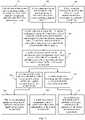
- the method provided in this embodiment of this application includes but is limited to: In a globally triggered QoS adjustment procedure, the controller determines, based on global service data flow admission, global queue monitoring analysis, or local exception information reporting, whether to trigger global QoS adjustment. If the controller determines to trigger QoS adjustment, the controller updates a service level, or switches a service level of a deployed data flow.
- the control device 101 globally triggers a complete adjustment procedure, so that it can be ensured that delay degradation or a packet loss of the data flow in a network is not caused during the configuration update of the service level or the switching of the service level of the data flow.
- the method provided in this embodiment of this application is applicable to an IP network based on packet statistical multiplexing, and helps improve applicability and effectiveness of a service-level-based solution for ensuring an end-to-end delay.
- the procedure of the method includes the following processes. Communication between a control device and a network device is implemented by using NETCONF.
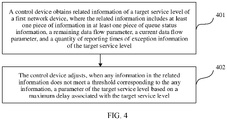
- a control device obtains related information of a target service level of a first network device, where the related information includes at least one piece of information in at least one piece of queue status information, a remaining data flow parameter, a current data flow parameter, and a quantity of reporting times of exception information of the target service level.
- the control device monitors a service level of each network device, and obtains the related information of the target service level of the first network device, where the target service level may be understood as a monitored service level.
- the related information includes the at least one piece of queue status information of the target service level.
- the related information includes the remaining data flow parameter of the target service level.
- the related information includes the current data flow parameter of the target service level.
- the related information includes the quantity of reporting times of the exception information of the target service level.
- the first network device reports queue status information of a service level of the first network device to the control device in a specified period, and the control device obtains the queue status information of the target service level of the first network device.
- the control device locally maintains a remaining data flow parameter and a current data flow parameter of a service level of each network device, to obtain the remaining data flow parameter and the current data flow parameter of the first network device.
- the current data flow parameter includes but is not limited to a current burst amount and a current average rate of a data flow.
- the remaining data flow parameter includes but is not limited to a remaining burst amount and a remaining average rate of a data flow.
- the current data flow parameter may be reported by the network device to the control device, and the remaining data flow parameter is obtained by the control device based on the current data flow parameter.
- the first network device reports the exception information to the control device when a local resource does not meet an update value of a configuration parameter of the target service level when a maximum delay remains unchanged.
- the exception information includes at least one of queue buffer occupation, a packet queuing delay, packet count information, and error information that exceed a threshold. Therefore, the control device obtains, through statistical collection, the quantity of reporting times of the exception information based on the abnormal quality of service information reported by the first network device.
- the control device adjusts, when any information in the related information does not meet a threshold corresponding to the any information, a parameter of the target service level based on a maximum delay associated with the target service level.
- Case 1 The related information of the target service level includes the at least one piece of queue status information of the target service level.
- control device adjusts, when any information in the related information does not meet a threshold corresponding to the any information, a parameter of the target service level based on a maximum delay associated with the target service level includes: Case 1A: The control device adjusts, when any one of the at least one piece of queue status information is less than a threshold lower limit corresponding to the any queue status information, the parameter of the target service level based on the maximum delay associated with the target service level.
- the control device sets one or more service levels on a port of each controlled network device, and the control device monitors a queue status indicator of each service level of each network device in real time, to obtain the at least one piece of queue status information of the target service level of the first network device.
- each service level is bound to one or more queues in the first network device, and the plurality of queues are referred to as a group of queues.
- the queue status information of the target service level is queue status information of one or more queues in the group of queues bound to the target service level, or the queue status information of the target service level is overall queue status information of the group of queues bound to the target service level.
- the queue status information of the target service level includes but is not limited to at least one piece of queue status information such as local queue buffer occupation, a queuing delay, and a packet count.
- the queue buffer occupation represents a size of a buffer occupied by a packet in a queue bound to the target service level.
- the packet queuing delay represents a queuing delay of the packet in the queue bound to the target service level, and includes a time interval from a time point at which the packet enters a buffer to a time point at which the packet is scheduled.
- the packet count represents a data amount per unit time or a packet quantity per unit time of the packet in the queue bound to the target service level.
- the overall queue status information of the target service level is the overall queue status information of the group of queues bound to the target service level
- the overall queue status information refers to a sum of buffer occupation of the group of bound queues, that is, buffer occupation of queues in the group of bound queues is accumulated, and an obtained result is used as the overall queue status information
- the overall queue status information refers to a largest value of packet queuing delays of queues in the group of bound queues, or an average value of packet queuing delays of queues in the group of bound queues
- the overall queue status information refers to a sum of packet counts of the group of bound queues, that is, packet counts of queues in the group of bound queues are accumulated, and an obtained result is used as the overall queue status information.
- the queue status information includes the local queue buffer occupation, the packet queuing delay, and the packet count. If it is detected that the local queue buffer occupation of the target service level is less than a threshold lower limit of the buffer occupation, the packet queuing delay is less than a threshold lower limit of the packet queuing delay, or the packet count is less than a threshold lower limit of the packet count, the control device is triggered to adjust the target service level based on the maximum delay associated with the target service level.
- a threshold lower limit corresponding to each piece of queue status information of the target service level may be set based on a single queue, and threshold lower limits corresponding to queue status information of queues in the group of queues may be the same or different.
- a threshold lower limit corresponding to each piece of queue status information of the target service level may be set based on a quantity of queues in the group of queues.
- another manner may be used.
- a threshold lower limit corresponding to each type of queue status information is not limited in this embodiment of this application.
- the threshold lower limit of the buffer occupation, the threshold lower limit of the packet queuing delay, and the threshold lower limit of the packet count may be set based on experience, or may be set based on an application scenario.
- the control device may be triggered to adjust the target service level.
- control device adjusts, when any one of the at least one piece of queue status information is less than a threshold lower limit corresponding to the any queue status information, the target service level based on the maximum delay associated with the target service level includes: The control device adjusts, when the any one of the at least one piece of queue status information is less than the threshold lower limit corresponding to the any queue status information within a first reference time period, the target service level based on the maximum delay associated with the target service level. Adjusting the target service level based on the maximum delay associated with the target service level is triggered after it is detected, within the first reference time period, that the any queue status information is less than the threshold lower limit corresponding to the any queue status information. This can avoid a case in which the target service level is repeatedly adjusted because the queue status information is repeatedly not less than the threshold lower limit corresponding to the queue status information, to further improve stability and accuracy of use of global resources.
- Case 1B The control device adjusts, when any one of the at least one piece of queue status information exceeds a threshold upper limit corresponding to the any queue status information, the parameter of the target service level based on the maximum delay associated with the target service level.
- each service level of the first network device is bound to one queue or one group of queues in the first network device.
- the queue status information of the target service level is queue status information of each queue in the group of queues bound to the target service level, or the queue status information of the target service level is queue status information of the group of queues bound to the target service level.
- the queue status information of the target service level includes but is not limited to at least one piece of queue status information such as local queue buffer occupation, a packet queuing delay, and a packet count.
- the queue status information includes the local queue buffer occupation, the packet queuing delay, and the packet count. If it is detected that the local queue buffer occupation of the target service level exceeds a threshold upper limit of the buffer occupation, the packet queuing delay exceeds a threshold upper limit of the packet queuing delay, or the packet count exceeds a threshold upper limit of the packet count, the control device is triggered to adjust the parameter of the target service level based on the maximum delay associated with the target service level.
- control device adjusts, when any one of the at least one piece of queue status information exceeds a threshold upper limit corresponding to the any queue status information, the target service level based on the maximum delay associated with the target service level includes: The control device adjusts, when the any one of the at least one piece of queue status information exceeds the threshold upper limit corresponding to the any queue status information within a second reference time period, the parameter of the target service level based on the maximum delay associated with the target service level. Adjusting the target service level based on the maximum delay associated with the target service level is triggered after it is detected, within the second reference time period, that the any queue status information exceeds the threshold upper limit corresponding to the any queue status information. This can avoid a case in which the parameter of the target service level is repeatedly adjusted because the queue status information is repeatedly less than or equal to the threshold lower limit corresponding to the queue status information, to further improve stability and accuracy of use of global resources.
- Case 2 The related information of the target service level includes the current data flow parameter of the target service level.
- That the control device adjusts, when any information in the related information does not meet a threshold corresponding to the any information, a parameter of the target service level based on a maximum delay associated with the target service level includes: Case 2A: The control device adjusts, when the current data flow parameter of the target service level is less than a threshold lower limit corresponding to the current data flow parameter, the parameter of the target service level based on the maximum delay associated with the target service level.
- control device adjusts, when the current data flow parameter of the target service level is less than a threshold lower limit corresponding to the current data flow parameter, the parameter of the target service level based on the maximum delay associated with the target service level includes: The control device adjusts, when the current data flow parameter of the target service level is less than the threshold lower limit corresponding to the current data flow parameter within a third reference time period, the parameter of the target service level based on the maximum delay associated with the target service level. Adjusting the parameter of the target service level based on the maximum delay associated with the target service level is triggered after it is detected, within the third reference time period, that the current data flow parameter of the target service level is less than the threshold lower limit corresponding to the current data flow parameter. This can avoid a case in which the parameter of the target service level is repeatedly adjusted because the current data flow parameter of the target service level is repeatedly not less than the threshold lower limit corresponding to the current data flow parameter, to further improve stability and accuracy of use of resources.
- Case 2B The control device adjusts, when the current data flow parameter of the target service level exceeds a threshold upper limit corresponding to the current data flow parameter, the parameter of the target service level based on the maximum delay associated with the target service level.
- control device adjusts, when the current data flow parameter of the target service level exceeds a threshold upper limit corresponding to the current data flow parameter, the parameter of the target service level based on the maximum delay associated with the target service level includes: The control device adjusts, when the current data flow parameter of the target service level exceeds the threshold upper limit corresponding to the current data flow parameter within a fourth reference time period, the parameter of the target service level based on the maximum delay associated with the target service level. Adjusting the parameter of the target service level based on the maximum delay associated with the target service level is triggered after it is detected, within the fourth reference time period, that the current data flow parameter of the target service level exceeds the threshold upper limit corresponding to the current data flow parameter. This can avoid a case in which the parameter of the target service level is repeatedly adjusted because the current data flow parameter of the target service level is repeatedly less than or equal to the threshold upper limit corresponding to the current data flow parameter, to further improve stability and accuracy of use of resources.
- Case 3 The related information of the target service level includes the remaining data flow parameter of the target service level.
- That the control device adjusts, when any information in the related information does not meet a threshold corresponding to the any information, a parameter of the target service level based on a maximum delay associated with the target service level includes: Case 3A: The control device adjusts, when the remaining data flow parameter of the target service level exceeds a threshold upper limit corresponding to the remaining data flow parameter, the parameter of the target service level based on the maximum delay associated with the target service level.
- control device adjusts, when the remaining data flow parameter of the target service level exceeds a threshold upper limit corresponding to the remaining data flow parameter, the parameter of the target service level based on the maximum delay associated with the target service level includes: The control device adjusts, when the remaining data flow parameter of the target service level exceeds the threshold upper limit corresponding to the remaining data flow parameter within a fifth reference time period, the target service level based on the maximum delay associated with the target service level. Adjusting the target service level based on the maximum delay associated with the target service level is triggered after it is detected, within the fifth reference time period, that the remaining data flow parameter of the target service level exceeds the threshold upper limit corresponding to the remaining data flow parameter of the target service level. This can avoid a case in which the target service level is repeatedly adjusted because the remaining data flow parameter of the target service level is repeatedly less than or equal to the threshold upper limit corresponding to the remaining data flow parameter of the target service level, to further improve stability and accuracy of use of resources.
- Case 3B The control device adjusts, when the remaining data flow parameter of the target service level is less than a threshold lower limit corresponding to the remaining data flow parameter, the parameter of the target service level based on the maximum delay associated with the target service level.
- control device adjusts, when the remaining data flow parameter of the target service level is less than a threshold lower limit corresponding to the remaining data flow parameter, the parameter of the target service level based on the maximum delay associated with the target service level includes: The control device adjusts, when the remaining data flow parameter of the target service level is less than the threshold lower limit corresponding to the remaining data flow parameter within a sixth reference time period, the target service level based on the maximum delay associated with the target service level. Adjusting the parameter of the target service level based on the maximum delay associated with the target service level is triggered after it is detected, within the sixth reference time period, that the remaining data flow parameter of the target service level is less than the threshold lower limit corresponding to the remaining data flow parameter of the target service level. This can avoid a case in which the parameter of the target service level is repeatedly adjusted because the remaining data flow parameter of the target service level is repeatedly not less than the threshold lower limit corresponding to the remaining data flow parameter of the target service level, to further improve stability and accuracy of use of resources.
- Case 4 The related information of the target service level includes the quantity of reporting times of the exception information of the target service level.
- That the control device adjusts, when any information in the related information does not meet a threshold corresponding to the any information, a parameter of the target service level based on a maximum delay associated with the target service level includes: The control device adjusts, when the quantity of reporting times of the exception information of the target service level exceeds a threshold upper limit corresponding to the quantity of reporting times of the exception information, the parameter of the target service level based on the maximum delay associated with the target service level.
- control device adjusts, when the quantity of reporting times of the exception information of the target service level exceeds a threshold upper limit corresponding to the quantity of reporting times of the exception information, the parameter of the target service level based on the maximum delay associated with the target service level includes: The control device adjusts, when the quantity of reporting times of the exception information of the target service level exceeds the threshold upper limit corresponding to the quantity of reporting times of the exception information within a seventh reference time period, the target service level based on the maximum delay adjustment associated with the target service level.
- Adjusting the parameter of the target service level based on the maximum delay associated with the target service level is triggered after it is detected, within the seventh reference time period, that the quantity of reporting times of the exception information of the target service level exceeds the threshold upper limit corresponding to the quantity of reporting times of the exception information. This can avoid a case that occurs due to an excessively long time and in which the parameter of the target service level is adjusted because the quantity of reporting times of the exception information of the target service level exceeds the threshold upper limit corresponding to the quantity of reporting times of the exception information, and consequently an adjustment occasion does not match an actual situation, to further improve stability and accuracy of use of resources.
- the parameter of the target service level includes a queue resource parameter and a data flow constraint parameter.
- the adjusting a parameter of the target service level based on a maximum delay associated with the target service level includes: determining a first update value of the data flow constraint parameter of the target service level; determining a first update value of the queue resource parameter of the target service level based on the first update value of the data flow constraint parameter of the target service level when the maximum delay remains unchanged; and then adjusting the previous data flow constraint parameter based on the first update value of the data flow constraint parameter, and adjusting the previous queue resource parameter based on the first update value of the queue resource parameter.
- the first update value of the queue resource parameter includes a first update value of a queue bandwidth and a first update value of a queue buffer
- the first update value of the data flow constraint parameter includes a first update value of a threshold of a burst amount of a data flow and a first update value of a threshold of an average rate of the data flow.
- the determining a first update value of the queue resource parameter based on the first update value of the data flow constraint parameter when the maximum delay remains unchanged includes: when the maximum delay remains unchanged, determining a bandwidth of a port corresponding to the target service level, a first maximum amount of data that can be forwarded at the target service level after the parameter of the target service level is adjusted, a maximum amount of data that can be forwarded at each of a plurality of service levels of the first network device before the parameter of the target service level is adjusted, and a maximum packet length of a queue corresponding to each of the plurality of service levels; determining the first update value of the queue bandwidth based on the bandwidth of the port corresponding to the target service level, the first maximum amount of data that can be forwarded at the target service level after the parameter of the target service level is adjusted, and the maximum amount of data that can be forwarded at each of the plurality of service levels before the parameter of the target service level is adjusted; and determining the first update value of the queue buffer based on the maximum amount of data that can be forwarded
- C is the bandwidth of the port corresponding to the target service level
- Q i 1 2 is the first maximum amount of data that can be forwarded at the target service level after the parameter of the target service level is adjusted
- Q j is a maximum amount of data that can be forwarded at a j th service level
- Q i 1 is a maximum amount of data that can be forwarded at the target service level before the parameter of the target service level is adjusted
- Q n + 1 1 is a maximum amount of data that can be forwarded in a non-delay-guarantee queue before the parameter of the target service level is adjusted
- n is a positive integer greater than 1.
- Q i 1 and Q n + 1 1 include but are not limited to values obtained based on a configuration of the control device before current adjustment.
- the control device configures, before currently adjusting the parameter of the target service level, the maximum amount of data that can be forwarded at the target service level.
- Q i 1 is the maximum amount of data that can be forwarded at the target service level before the parameter of the target service level is adjusted.
- the control device configures, before currently adjusting the parameter of the target service level, the maximum amount of data that can be forwarded in the non-delay-guarantee queue.
- Q n + 1 1 is the maximum amount of data that can be forwarded in the non-delay-guarantee queue before the parameter of the target service level is adjusted.
- Q i 1 and Q n + 1 1 include but are not limited to values obtained after the parameter of the target service level is previously adjusted.
- the control device stores adjusted Q i 1 and Q n + 1 1 .
- the control device obtains stored Q i 1 and uses Q i 1 as the maximum amount of data that can be forwarded at the target service level before the parameter of the target service level is adjusted, and obtains stored Q n + 1 1 and uses Q n + 1 1 as the maximum amount of data that can be forwarded in the non-delay-guarantee queue before the parameter of the target service level is adjusted.
- the control device For Q j , a change of a parameter of the j th service level is not involved during adjustment of the parameter of the target service level. Therefore, the maximum amount of data that can be forwarded at the j th service level may be obtained based on the configuration of the control device.
- the control device adjusts a parameter of the j th service level, and the control device may also store the adjusted value. In this case, for the current adjustment of the parameter of the target service level, the control device may directly obtain stored Q j and use Q j as the maximum amount of data that can be forwarded at the j th service level and that is used during the adjustment of the parameter of the target service level.
- L max,L is a maximum packet length of a low-priority queue
- C is the bandwidth of the port corresponding to the target service level
- Q i 1 2 is the first maximum amount of data that can be forwarded at the target service level after the parameter of the target service level is adjusted
- Q j is the maximum amount of data that can be forwarded at the j th service level
- L n+1 is a maximum packet length of the non-delay-guarantee queue
- L j is a maximum packet length of a queue at the j th service level
- b i 1 2 is the first update value of the threshold of the burst amount of the data flow
- b i 1 2 b i 1 ⁇ ⁇ b i 1
- b i 1 is the threshold of the burst amount of the data flow that exists before the parameter of the target service level is adjusted
- ⁇ b i1 is a value by which the threshold that is of the burst amount of the data flow and that is of the target
- L n+1 , L j , L i , L max,L , and C may be pre-stored in the control device. For example, after allocating a bandwidth to the port corresponding to the target service level, the control device stores L n+1 , L j , L i , L max,L , and C. In this case, the control device directly obtains stored L n+1 , L j , L i , L max,L , and C.
- the configuration parameter of the target service level includes a queue resource parameter and a data flow constraint parameter.
- the adjusting a parameter of the target service level based on a maximum delay associated with the target service level includes but is not limited to an adjustment manner in a first case in which a second update value of the queue resource parameter is less than or equal to a resource threshold, and an adjustment manner in a second case in which the second update value of the queue resource parameter is greater than the resource threshold.
- the adjustment manners in the two cases are as follows: The adjustment manner in the first case is: determining a second update value of the data flow constraint parameter; determining a second update value of the queue resource parameter based on the second update value of the data flow constraint parameter when the maximum delay remains unchanged; and when the second update value of the queue resource parameter is less than or equal to the resource threshold, adjusting the previous data flow admission constraint parameter based on the second update value of the data flow constraint parameter, and adjusting the previous queue resource parameter based on the second update value of the queue resource parameter.
- the second update value of the queue resource parameter includes a second update value of a queue bandwidth and a second update value of a queue buffer
- the second update value of the data flow constraint parameter includes a second update value of a threshold of a burst amount of a data flow and a second update value of a threshold of an average rate of the data flow.
- the determining a second update value of the queue resource parameter based on the second update value of the data flow constraint parameter when the maximum delay remains unchanged includes: when the maximum delay remains unchanged, determining a bandwidth of a port corresponding to the target service level, a second maximum amount of data that can be forwarded at the target service level after the parameter of the target service level is adjusted, a maximum amount of data that can be forwarded at each of a plurality of service levels of the first network device before the parameter of the target service level is adjusted, and a maximum packet length of a queue corresponding to each of the plurality of service levels; determining the second update value of the queue bandwidth based on the bandwidth of the port corresponding to the target service level, the second maximum amount of data that can be forwarded at the target service level after the parameter of the target service level is adjusted, and the maximum amount of data that can be forwarded at each of the plurality of service levels before the parameter of the target service level is adjusted; and determining the second update value of the queue buffer based on the maximum amount of data that can be forwarded
- C is the bandwidth of the port corresponding to the target service level
- Q i 2 2 is the second maximum amount of data that can be forwarded at the target service level after the parameter of the target service level is adjusted
- Q j is a maximum amount of data that can be forwarded at a service level
- Q i 1 is a maximum amount of data that can be forwarded at the target service level before the parameter of the target service level is adjusted
- Q n + 1 1 is a maximum amount of data that can be forwarded in a non-delay-guarantee queue before the parameter of the target service level is adjusted
- n is a positive integer greater than 1.
- C is the bandwidth of the port corresponding to the target service level
- Q i 2 2 is the second maximum amount of data that can be forwarded at the target service level after the parameter of the target service level is adjusted
- Q j is the maximum amount of data that can be forwarded at the service level
- L max,L is a maximum packet length of a low-priority queue
- L n+1 is a maximum packet length of the non-delay-guarantee queue
- L j is a maximum packet length of a queue at the service level
- b i 2 2 is the second update value of the threshold of the burst amount of the data flow
- b i 2 2 b i 1 + ⁇ b i 2
- b i 1 is the threshold of the burst amount of the data flow that exists before the parameter of the target service level is adjusted
- ⁇ b i2 is a value by which the threshold of the burst amount of the data flow is increased
- r i 2 2 is the second update value of the
- the configuration parameter of the target service level includes a queue resource parameter and a data flow constraint parameter.
- the adjusting a parameter of the target service level based on a maximum delay associated with the target service level includes: determining a second update value of the data flow constraint parameter of the target service level; determining a second update value of the queue resource parameter of the target service level based on the second update value of the data flow constraint parameter of the target service level when the maximum delay remains unchanged; and when the second update value of the queue resource parameter is greater than the resource threshold, switching a target data flow corresponding to the target service level to a data flow corresponding to another service level, where the another service level includes another service level of the first network device or a service level of another device.
- the resource threshold includes but is not limited to a size of a resource that can be preempted by a non-delay-guarantee queue, and the resource includes but is not limited to a bandwidth and a buffer.
- the configuration parameter of the target service level includes a queue resource parameter and a data flow constraint parameter.
- the adjusting a target service level based on a maximum delay associated with the target service level includes: determining a second update value of the data flow constraint parameter; determining a second update value of the queue resource parameter based on the second update value of the data flow constraint parameter when the maximum delay remains unchanged; when the second update value of the queue resource parameter is greater than the resource threshold, determining a third update value of the queue resource parameter based on the second update value of the data flow constraint parameter, and determining an update value of a parameter of a service level of a resource that can be preempted, where the update value of the parameter of the service level of the resource that can be preempted is used to enable the third update value of the queue resource parameter to meet a constraint condition; and adjusting the data flow constraint parameter based on the second update value of the data flow constraint parameter, adjusting the queue resource parameter based on the third update value of the
- the second update value of the data flow constraint parameter includes a second update value of a threshold of a burst amount of a data flow and a second update value of a threshold of an average rate of the data flow.
- the determining a third update value of the queue resource parameter based on the second update value of the data flow constraint parameter includes: determining a bandwidth of a port corresponding to the target service level, a third maximum amount of data that can be forwarded at the target service level after the parameter of the target service level is adjusted, a maximum amount of data that can be forwarded at each of a plurality of service levels of the first network device before the parameter of the target service level is adjusted, and a maximum packet length of a queue corresponding to each of the plurality of service levels; determining a third update value of a queue bandwidth based on the bandwidth of the port corresponding to the target service level, the third maximum amount of data that can be forwarded at the target service level after the parameter of the target service level is adjusted, and the maximum amount of data that can be forwarded at
- the determining an update value of a parameter of a service level of a resource that can be preempted includes: determining, based on the bandwidth of the port corresponding to the target service level, the maximum amount of data that can be forwarded after the service level of the resource that can be preempted is adjusted, and the maximum amount of data that can be forwarded at each of the plurality of service levels before the parameter of the target service level is adjusted, an update value of a queue bandwidth of the service level of the resource that can be preempted; and determining, based on the maximum amount of data that can be forwarded at each of the plurality of service levels before the parameter of the target service level is adjusted, the maximum packet length of the queue corresponding to each of the plurality of service levels, the maximum amount of data that can be forwarded after the service level of the resource that can be preempted is adjusted, the maximum packet length, an update value of a threshold that is of a burst amount of a data flow and that is of the service level of the resource that can be preempted
- C is the bandwidth of the port corresponding to the target service level
- Q i 2 is the third maximum amount of data that can be forwarded at the target service level after the parameter of the target service level is adjusted
- Q k 2 is the maximum amount of data that can be forwarded after the service level of the resource that can be preempted is adjusted
- Q j is a maximum amount of data that can be forwarded at a j th service level
- Q i 1 is a maximum amount of data that can be forwarded before the parameter of the target service level is adjusted
- Q n + 1 1 is a maximum amount of data that can be forwarded in a non-delay-guarantee queue before the parameter of the target service level is adjusted
- n is a positive integer greater than 1.
- C is the bandwidth of the port corresponding to the target service level
- Q i 2 is the third maximum amount of data that can be forwarded at the target service level after the parameter of the target service level is adjusted
- Q j is the maximum amount of data that can be forwarded at the service level
- L max,L is a maximum packet length of a low-priority queue
- L n+1 is a maximum packet length of the non-delay-guarantee queue
- L j is a maximum packet length of a queue at the service level
- b i 2 2 is the second update value of the threshold of the burst amount of the data flow
- b i 2 2 b i 1 + ⁇ b i 2
- b i 1 is the threshold of the burst amount of the data flow that exists before the parameter of the target service level is adjusted
- ⁇ b i2 is a value by which the threshold of the burst amount of the data flow is increased
- r i 2 2 is the second update value of the threshold
- both the adjustment manner 1 and the adjustment manner 2 in the second case are processing manners used when the second update value of the queue resource parameter is greater than the resource threshold.
- whether the adjustment manner 1 or the adjustment manner 2 is used is not limited in this embodiment of this application.
- the adjustment manner 1 may be directly used to switch the target data flow corresponding to the target service level to the data flow corresponding to the another service level, or the adjustment manner 2 may be used to adjust the data flow constraint parameter based on the second update value of the data flow constraint parameter, adjust the queue resource parameter based on the third update value of the queue resource parameter, and adjust, based on the update value of the parameter of the service level of the resource that can be preempted, the parameter of the service level of the resource that can be preempted.
- the adjustment manner 2 may be further used.
- an adjustment manner 3 may be further used.
- the method further includes: The control device sends an update value of the adjusted parameter of the target service level to the first network device, to indicate the first network device to adjust the parameter of the target service level based on the update value of the parameter of the target service level.
- the first network device receives the update value that is of the parameter of the target service level and that is sent by the control device, and adjusts the parameter of the target service level based on the update value of the parameter of the target service level.
- the method further includes: The control device sends an update value of an adjusted parameter of the another service level different from the target service level to the first network device, to indicate the first network device to adjust the corresponding another service level based on the update value of the parameter of the another service level different from the target service level.
- the first network device receives the update value that is of the parameter of the another service level different from the target service level and that is sent by the control device, and adjusts the corresponding another service level based on the update value of the parameter of the another service level.
- the update value of the queue buffer in this embodiment of this application is a required minimum value of the queue buffer.
- another value greater than the update value of the queue buffer may be used. This is not limited in this embodiment of this application.
- a service deployment status for example, a current data flow parameter and a remaining data flow parameter
- queue status information for example, a current data flow parameter and a remaining data flow parameter
- quantity of reporting times of exception information for example, a quantity of reporting times of exception information, and the like
- parameter configurations of a service level such as queue resource allocation and a data flow admission constraint are dynamically updated, and a service level through which a data flow passes is dynamically switched, to further improve network resource utilization while ensuring an end-to-end delay of a service.
- the system architecture shown in FIG. 3 is used as an example to describe, by using a process of interaction between the first network device and the controller, the service level adjustment method provided in this embodiment of this application.
- the method includes the following processes 501 to 511.
- a global service deployment unit 111 of a controller receives a service requirement, computes a path and a service level that needs to be entered along the path for the service, and performs deployment.
- the global service deployment unit 111 maintains current data flow parameters and quantities of remaining allowable data flows of all service levels in a network, including increasing a value of each parameter in the current data flow parameter based on a corresponding parameter (a threshold of a burst amount of a data flow, a threshold of an average rate of the data flow, and the like) of a subscripted committed data flow of a new service, and decreasing a value of each parameter in the current remaining allowable traffic based on the corresponding parameter of the subscripted committed data flow of the new service.
- a local queue monitoring unit 112 of each network device periodically reports local queue status information to a global queue monitoring analysis unit 121, and the global queue monitoring analysis unit 121 maintains global queue status information of all service levels.
- the local queue monitoring unit 111 of the first network device periodically reports local queue status information such as queue buffer occupation, a packet queuing delay, or a packet count to the global queue monitoring analysis unit 121 of the controller.
- a local exception information reporting unit 125 of the network device reports local QoS adjustment exception information to the controller in real time.
- a global adjustment trigger unit 113 Based on 501, 502, and 503, and a current data flow admission status of a service level in an entire network, global queue monitoring information, and a local QoS exception information reporting status, a global adjustment trigger unit 113 triggers configuration update of a global target service level or triggers a service level at which a related deployed data flow is switched.
- Triggering the configuration update of the global target service level or triggering the service level at which the related deployed data flow is switched includes but is not limited to the following seven cases:
- a global adjustment calculation unit 114 calculates an update configuration of a related service level in an entire network, including a new queue resource parameter (a queue bandwidth, a queue buffer, or the like) and a data flow constraint parameter (a threshold of a burst amount of a data flow, a threshold of an average rate of a data flow, or the like); or calculates, for a related deployed data flow in an entire network, a new service level through which each hop along a path needs to pass.
- a new queue resource parameter a queue bandwidth, a queue buffer, or the like
- a data flow constraint parameter a threshold of a burst amount of a data flow, a threshold of an average rate of a data flow, or the like
- an original service level may be selected to be switched to another service level on a same port, or an original service level may be selected to be switched to another service level on a different port of a same device or even of a different device.
- that the global adjustment calculation unit 114 calculates the update configuration of the related service levels in the entire network includes but is not limited to the following two manners.
- the global adjustment calculation unit 114 calculates data flow admission that is of the related service level and that needs to be subtracted (including a threshold that is of a burst amount of a data flow and that needs to be subtracted, a threshold that is of an average rate of a data flow and that needs to be subtracted, or the like), and calculates, when an associated maximum delay remains unchanged, a queue resource that is of the target service level and that needs to be correspondingly subtracted (including a queue bandwidth, a queue buffer, or the like that needs to be subtracted).
- the global adjustment calculation unit 114 calculates an update configuration of a service level according to a network calculus theory
- a principle is shown in a schematic diagram of an egress port queue shown in FIG. 6 . It is considered that a total of n service levels are set on an egress port, and each service level is bound to one queue.
- one virtual queue is used to represent the queues having no delay guarantee requirement, and is referred to as a non-delay-guarantee queue. Queues corresponding to all the service levels and the non-delay guarantee queue are scheduled through round robin.
- the queues corresponding to the service levels and the non-delay-guarantee queue are high-priority queues. At each scheduling opportunity, the high-priority queues can be scheduled first.
- the target service level is an i th service level.
- a maximum amount of data that can be forwarded in one scheduling at the i th service level is Q i
- a maximum amount of data that can be forwarded in one scheduling in a non-delay-guarantee queue is Q n+1 .
- Q n+1 may be directly set to 0 if there is no non-delay-guarantee queue on a current port.
- an arrival curve function of an i th service level is ⁇ i (t)
- an independent variable is t
- an amount of data arriving at the i th service level does not exceed ⁇ i (t 2 - t 1 ).
- an amount of accumulated data in a queue at the i th service level from a moment 0 to a moment t is A i (t).
- ⁇ i (t) If a function ⁇ i (t) exists, A i (t 2 ) - A i (t 1 ) ⁇ ⁇ i (t 2 - t 1 ) is satisfied for the any moments t 1 and t 2 (t 2 ⁇ t 1 ⁇ 0). In this case, it is defined that the function ⁇ i (t) is the arrival curve function of the i th service level.
- a service curve function of the i th service level is ⁇ i (t)
- an independent variable is t
- an amount of data successfully forwarded at the service level is not less than ⁇ i (t 2 - t 1 ).
- an amount of accumulated data sent in the queue at the i th service level from the moment 0 to the moment t is B i (t).
- the target service level is an i th service level.
- a total bandwidth of the port is C
- a maximum delay requirement of the i th service level is D i
- a maximum packet length of a queue corresponding to the i th service level is L i .
- a maximum packet length of a non-delay-guarantee queue is L n+1
- a maximum packet length of a low-priority queue is L max,L .
- a threshold that is of a burst amount of a data flow and that is of the i th service level is b i 1
- an average rate is r i 1 .
- ⁇ i 1 t represents an arrival curve existing before the update of the i th service level.
- T 0 is defined as a sum of the ingress port queuing delay, the processing delay, and the sending delay of the network device.
- T 0 is defined as 0.
- T i 1 L max ,L + ⁇ 1 ⁇ j ⁇ n ,j ⁇ i L j + Q j + L n + 1 + Q n + 1 1 C + L i ⁇ 1 ⁇ j ⁇ n ,j ⁇ i Q j + Q n + 1 1 CQ i 1 + T 0
- R i 1 C Q i 1 Q i 1 + ⁇ 1 ⁇ j ⁇ n ,j ⁇ i Q j + Q n + 1 1 1
- D i T i 1 + b i 1 R i 1
- D i L max ,L + ⁇ 1 ⁇ j ⁇ n ,j ⁇ i L j + Q j + L n + 1 + Q n + 1 1 C + L i ⁇ 1 ⁇ j ⁇ n ,j ⁇ i Q j + Q n + 1 1 CQ i 1 + b i 1 Q i 1 + ⁇ 1 ⁇ j ⁇ n ,j ⁇ i Q j + Q n + 1 1 CQ i 1 + T 0
- a threshold that is of the i th service level, that is of a burst amount of a data flow, and that needs to be subtracted is ⁇ b i
- a threshold that is of an average rate of the data flow and that needs to be subtracted is ⁇ r i
- ⁇ i 2 t represents an updated service curve of the i th service level
- a horizontal coordinate intercept of ⁇ i 2 t is T i 2
- ⁇ i 2 t represents an updated arrival curve of the i th service level
- D i L max , L + ⁇ 1 ⁇ j ⁇ n , j ⁇ i L j + Q j + L n + 1 + Q n + 1 2 C + L i ⁇ 1 ⁇ j ⁇ n , j ⁇ i Q j + Q n + 1 2 CQ i 2 + b i 1 2 Q i 1 2 + ⁇ 1 ⁇ j ⁇ n , j ⁇ i Q j + Q n + 1 2 CQ i 2 + T 0
- Q i1 2 is a newly calculated first maximum amount of data that can be forwarded when the i th service level is scheduled, that is, a first maximum amount of data that can be forwarded at the target service level after the parameter of the target service level is adjusted
- Q n + 1 2 is a newly calculated maximum amount of data that can be forwarded in the non-delay-guarantee queue, that is, a maximum amount of data that can be forwarded in the non-delay-guarantee queue after the parameter of the target service level is adjusted.
- the first maximum amount Q i 1 2 of data that can be forwarded when the i th service level is scheduled after the configuration update may be calculated as follows:
- Q i1 1 Q i 1 2 ⁇ L i + b i 1 ⁇ 1 ⁇ j ⁇ n , j ⁇ i Q j + Q i 1 + Q n + 1 1 2
- Q n + 1 2 Q i 1 + Q n + 1 1 ⁇ Q i 1 2 ⁇ L i + b i 1 ⁇ 1 ⁇ j ⁇ n , j ⁇ i Q j + Q i 1 + Q n + 1 1 2 Q i 1 ⁇ L i + b i 1 ⁇ 1 ⁇ j ⁇ n , j ⁇ i Q j + Q i 1 + Q n + 1 1 2 Q i 1 ⁇ L i + b i 1 ⁇ 1 ⁇ j ⁇ n , j ⁇ i Q j + Q i 1 + Q n + 1 1 ⁇ Q i 1 2 2 4 Q i 1 2 + L i + b i 2 ⁇ 1 ⁇ j ⁇ n , j ⁇ i Q j + Q i 1 + Q n + 1 1 1 1 1 1 1 1 1 1 1 1 ⁇ Q i 1 2 2 4 Q i 1 2 + L
- an updated reserved queue bandwidth of the i th service level that is, a first update value C i 1 2 of a queue bandwidth
- C i 1 2 C Q i 1 2 ⁇ 1 ⁇ j ⁇ n , j ⁇ i Q j + Q i 1 + Q n + 1 1
- Q i 1 2 is the first maximum amount of data that can be forwarded at the target service level after the parameter of the target service level is adjusted
- Q j is a maximum amount of data that can be forwarded at a service level
- Q i 1 is a maximum amount of data that can be forwarded at the target service level before the parameter of the target service level is adjusted
- Q n + 1 1 is a maximum amount of data that can be forwarded in a non-delay-guarantee queue before the parameter of the target service level is adjusted
- n is a positive integer greater than 1.
- L max,L is a maximum packet length of a low-priority queue
- C is a bandwidth of a port corresponding to the target service level
- Q i 1 2 is the first maximum amount of data that can be forwarded at the target service level after the parameter of the target service level is adjusted
- Q j is the maximum amount of data that can be forwarded at the service level
- L n+1 is a maximum packet length of the non-delay-guarantee queue
- L j is a maximum packet length of a queue at the service level
- b i 1 2 is the first update value of the threshold of the burst amount of the data flow
- b i 1 2 b i 1 ⁇ ⁇ b i 1
- b i 1 is the threshold of the burst amount of the data flow that exists before the parameter of the target service level is adjusted
- ⁇ b i1 is a value by which the threshold that is of the burst amount of the data flow and that is of the target service level is decreased
- a local configuration update execution unit 124 preempts a corresponding resource of the non-delay-guarantee queue, transfers the resource to the target service level, and updates the parameter of the target service level based on a new queue bandwidth and buffer requirement.
- the global adjustment calculation unit 114 calculates data flow admission that is of the related service level and that needs to be additionally added (including a threshold that is of a burst amount of a data flow and that needs to be added, a threshold that is of an average rate of a data flow and that needs to be added, or the like), and calculates, when a maximum delay associated with the target service level remains unchanged, a queue resource that is of the target service level and that needs to be correspondingly added (including a reserved queue bandwidth, a queue buffer, or the like that needs to be added).
- a calculation result needs to ensure that the added queue resource of the target service level does not exceed a sum of a resource (including a bandwidth or a buffer) that is of a non-delay-guarantee queue and that can be preempted on a same port and a queue resource that can be released by another service level on the same port without affecting a maximum delay requirement of the another service level.
- a resource including a bandwidth or a buffer
- the global adjustment calculation unit 114 calculates an update configuration of a service level according to a network calculus theory
- a principle is shown in a schematic diagram of a port in FIG. 6 .
- Manner 1 Details are not described herein again.
- a threshold that is of the i th service level and that is of a burst amount of a data flow is b i 1
- an average rate is r i 1 .
- ⁇ i 1 t represents an arrival curve existing before the update of the i th service level.
- T 0 is defined as a sum of the ingress port queuing delay, the processing delay, and the sending delay of the network device.
- T 0 is defined as 0.
- D i L max , L + ⁇ 1 ⁇ j ⁇ n , j ⁇ i L j + Q j + L n + 1 + Q n + 1 1 C + L i ⁇ 1 ⁇ j ⁇ n , j ⁇ i Q j + Q n + 1 1 CQ i 1 + b i 1 Q i 1 + ⁇ 1 ⁇ j ⁇ n , j ⁇ i Q j + Q n + 1 1 CQ i 1 + T 0
- a threshold that is of the i th service level, that is of a burst amount of a data flow, and that needs to be added is ⁇ b i2
- a threshold that is of an average rate of the data flow and that needs to be added is ⁇ r i2
- the resource (the bandwidth or the buffer) that is of the non-delay-guarantee queue and that can be preempted on the same port is preferentially preempted. If the resource that is of the non-delay-guarantee queue and that can be preempted on the same port does not meet a requirement, the queue resource that can be released by the another service level on the same port without affecting the maximum delay requirement of the another service level is further preempted.
- the target service level directly and sequentially preempts queue resources that can be released by other service levels on the same port without affecting a maximum delay requirement of the another service level until an adjustment requirement of the target service level is met.
- Case 1 There is the non-delay-guarantee queue. It is first determined whether the resource that can be preempted by the non-delay-guarantee queue meets the adjustment requirement of the target service level. When the value of the maximum delay D i of the i th service level remains unchanged, it is assumed that to meet updated traffic admission (including a second update value b i 2 2 of a threshold of a burst amount of a data flow, and a second update value r i 2 2 of a threshold of an average rate of the data flow), a maximum amount of data that can be forwarded when the i th service level is scheduled needs to be updated to Q i ass , and correspondingly, a maximum amount of data that can be forwarded when the non-delay-guarantee queue is scheduled needs to be updated to Q n + 1 ass .
- updated traffic admission including a second update value b i 2 2 of a threshold of a burst amount of a data flow, and a second update value
- ⁇ i 2 t represents an updated service curve of the i th service level
- a horizontal coordinate intercept of ⁇ i 2 t is T i 2
- ⁇ i 2 t represents an updated arrival curve of the i th service level
- Q n + 1 ass Q i 1 + Q n + 1 1 ⁇ Q i 1 2 ⁇ L i + b i 1 ⁇ 1 ⁇ j ⁇ n ,j ⁇ i Q j + Q i 1 + Q n + 1 1 2 Q i 1 ⁇ L i + b i 1 ⁇ 1 ⁇ j ⁇ n ,j ⁇ i Q j + Q i 1 + Q n + 1 1 2 Q i 1 ⁇ L i + b i 1 ⁇ 1 ⁇ j ⁇ n ,j ⁇ i Q j + Q i 1 + Q n + 1 1 ⁇ Q i 1 2 2 4 Q i 1 2 + L i + b i 2 ⁇ 1 ⁇ j ⁇ n ,j ⁇ i Q j + Q i 1 + Q n + 1 1 1 1 1 1 1 1 1 1 ⁇ Q i 1 2 2 4 Q i 1 2 + L i + b
- BF i ass L max , L + ⁇ 1 ⁇ j ⁇ n , j ⁇ i L j +Q j + L n + 1 + Q n + 1 ass C + L i ⁇ 1 ⁇ j ⁇ n , j ⁇ i Q j + Q n + 1 ass CQ i 2 a ⁇ r i 2 2 + b i 2 2
- Case 1A It is defined that a maximum bandwidth resource that can be currently preempted by the non-delay-guarantee queue is ⁇ C n + 1 and a maximum buffer resource that can be preempted is ⁇ BF n + 1
- a second update value C i 2 2 of a queue bandwidth of the target service level is equal to C i ass
- a second update value BF i 2 2 of a queue buffer is equal to BF i ass .
- Case 1B If a resource that can be currently preempted by the non-delay-guarantee queue does not meet an adjustment requirement of the target service level, the adjusting the target service level based on a maximum delay associated with the target service level includes: determining a second update value of a data flow constraint parameter; determining a second update value of a queue resource parameter based on the second update value of the data flow constraint parameter when the maximum delay remains unchanged; and when the second update value of the queue resource parameter is greater than a resource threshold, switching a target data flow corresponding to the target service level to a data flow corresponding to another service level, where the another service level includes another service level of the first network device or a service level of another device.
- the target service level first preempts all resources that can be preempted by the non-delay-guarantee queue, and then sequentially preempts queue resources that can be released by other service levels on a same port without affecting a maximum delay requirement of the another service level until an adjustment requirement of the target service level is met.
- C i ass and C n + 1 ass are respectively the foregoing calculated bandwidth resources that are of the target service level and the non-delay-guarantee queue and that need to be obtained through adjustment when the adjustment requirement is met.
- adjustment parameters Q i temp and C i temp of the target service level in this case are only temporary. Therefore, preempting queue resources that can be released by other service levels on a same port without affecting a maximum delay requirement of the another service level further needs to be considered.
- preemption of a corresponding queue resource of a non-delay-guarantee queue or preemption of a corresponding queue resource of another queue on a same port is considered as an iteration process.
- the preemption of the corresponding queue resource of the non-delay-guarantee queue is considered as a first iteration process.
- C i ass , Q i ass , C i temp , and Q i temp are respectively re-represented as C i ass 1 , Q i ass 1 , C i temp 1 , and Q i temp 1 .
- a threshold b i temp 1 that is of a burst amount of a data flow and that is in admission traffic of the target service level needs to satisfy the following:
- Q i temp 1 Q i 1 2 ⁇ L i + b i 1 ⁇ 1 ⁇ j ⁇ n ,j ⁇ i Q j + Q i 1 + Q n + 1 1 2
- current allowable traffic parameters of the k th service level are b _ a k 1 and r _ a k 1 , which are respectively a threshold of a current allowable burst amount and a threshold of a current allowable average rate.
- b _ a k 1 ⁇ b k 1 and r _ a k 1 ⁇ r k 1 are respectively a threshold of a current allowable burst amount and a threshold of a current allowable average rate.
- a maximum amount of data that can be forwarded when the i th service level is scheduled and that needs to be updated when the adjustment requirement is met is defined as Q i ass 2 .
- a maximum amount of data that can be forwarded when the k th service level is scheduled and that needs to be updated when the adjustment requirement is met is defined as Q k ass .
- Q k 1 Q k is a maximum amount of data that can be forwarded when the k th service level is scheduled before the update.
- Q i ass 2 Q i temp 1 2 ⁇ L i + b i temp 1 ⁇ 1 ⁇ j ⁇ n ,j ⁇ i ,j ⁇ k Q j + Q i temp 1 + Q k 1 + Q n + 1 2 2 Q i 1 + L i + b i temp 1 ⁇ 1 ⁇ j ⁇ n ,j ⁇ i ,j ⁇ k Q j + Q i temp 1 + Q k 1 + Q n + 1 2 ⁇ Q i temp 1 2 2 4 Q i temp 1 2 + L i + b i 2 ⁇ 1 ⁇ j ⁇ n ,j ⁇ i , j ⁇ k Q j + Q i temp 1 + Q k
- Q k ass Q i temp 1 + Q k 1 ⁇ Q i temp 1 2 ⁇ L i + b i temp 1 ⁇ 1 ⁇ j ⁇ n ,j ⁇ i Q j + Q i 1 + Q n + 1 1 2 Q i 1 ⁇ L i + b i temp 1 ⁇ 1 ⁇ j ⁇ n ,j ⁇ i Q j + Q i 1 + Q n + 1 1 ⁇ Q i temp 1 2 2 4 Q i temp 1 2 + L i + b i 2 ⁇ 1 ⁇ j ⁇ n ,j ⁇ i Q j + Q i 1 + Q n + 1 1 1 ⁇ Q i temp 1 2 2 4 Q i temp 1 2 + L i + b i 2 ⁇ 1 ⁇ j ⁇ n ,j ⁇ i Q j + Q i 1 + Q n + 1 1 1 1 1 ⁇ Q i temp 1 2 2 4 Q i temp
- a queue resource that can be released by the k th service level without affecting a maximum delay requirement of the k th service level is sufficient to meet the adjustment requirement of the target service level, that is, after the target service level and the k th service level are adjusted based on Q i ass 2 and Q k ass , a maximum delay of current allowable traffic of the k th service level still meets the requirement, that is, the following condition is met: L max ,L + ⁇ 1 ⁇ j ⁇ n ,j ⁇ i ,j ⁇ k L j + Q j + L i + Q i ass 2 + L n + 1 + Q n + 1 2 C + L k ⁇ 1 ⁇ j ⁇ n ,j ⁇ i ,j ⁇ k Q j + Q i ass 2 + Q n + 1 2 CQ k ass + b_a k 1 Q k ass + ⁇ 1 ⁇ j ⁇ n ,j
- C i 2 C Q i ass 2 ⁇ 1 ⁇ j ⁇ n ,j ⁇ i Q j + Q i 1 + Q n + 1 1
- a queue resource that can be released by the k th service level without affecting a maximum delay requirement of the k th service level is insufficient to meet the adjustment requirement of the target service level, that is, after the target service level and the k th service level are adjusted based on Q i ass 2 and Q k ass , a maximum delay of current allowable traffic of the k th service level cannot meet the requirement, that is, the following condition is met: L max , L + ⁇ 1 ⁇ j ⁇ n , j ⁇ i , j ⁇ k L j + Q j + L i + Q i ass 2 + L n + 1 + Q n + 1 2 C + L k ⁇ 1 ⁇ j ⁇ n , j ⁇ i , j ⁇ k Q j + Q i ass 2 + Q n + 1 2 CQ k ass + b _ a k 1 Q k ass + ⁇ 1 ⁇ j
- the maximum amount of data that can be forwarded when the k th service level is scheduled is first adjusted to a maximum value Q k 2 allowed to be obtained through adjustment, and is used as an update value that is of the bandwidth and that is finally determined by the k th service level.
- Q k 2 is calculated as follows: Q k 1 2 ⁇ L k + b k 1 ⁇ 1 ⁇ j ⁇ n , j ⁇ i Q j + Q i 1 + Q n + 1 1 2 Q k 1 + L k + b k 1 ⁇ 1 ⁇ j ⁇ n , j ⁇ i Q j + Q i 1 + Q n + 1 1 ⁇ Q k 1 2 2 4 Q k 1 2 + L k + b _ a k 1 ⁇ 1 ⁇ j ⁇ n , j ⁇ i Q j + Q i 1 + Q n + 1 1 1 1
- a threshold b i temp 2 that is of a burst amount of a data flow and that is in admission traffic of the target service level needs to satisfy the following:
- Q i temp 2 Q i temp 1 2 ⁇ L i + b i temp 1 ⁇ 1 ⁇ j ⁇ n , j ⁇ i Q j + Q i 1 + Q n + 1 1 2 Q i temp 1 + L i + b i temp 1 ⁇ 1 ⁇ j ⁇ n , j ⁇ i Q j + Q i 1 + Q n + 1 1 ⁇ Q i temp 1 2 2 4 Q i temp 1 2 + L i + b i temp 2 ⁇ 1 ⁇ j ⁇ n , j ⁇ i Q j + Q i 1 + Q i 1 + Q n + Q n + Q n + Q n + Q n + Q n + Q n + Q n + Q n + Q n + Q i temp
- the adjustment requirement of the target service level still cannot be met after the second iteration process of preempting the resources that can be released by the non-delay-guarantee queue and the k th service level
- selecting any one of service levels other than the target service level and the k th service level on a same port continues to be considered for preemption, to start a third iteration process.
- a principle of a specific process is the same as that of the second iteration process. Details are not described herein again.
- the iteration process may be performed repeatedly until the adjustment requirement of the service level is met in an iteration process, and the service level adjustment process ends.
- K other service levels j 1 to j K are also adjusted. Specifically, iterative adjustment is performed in a sequence of the (j 1 ) th service level, the (j 2 ) th service level, ..., and the (j K ) th service level.
- C j k 2 C Q j k 2 ⁇ 1 ⁇ j ⁇ n , j ⁇ i Q j + Q i 1 + Q n + 1 1 ⁇ k ⁇ 1,2 , ... , K
- r j k 2 is an update value of a threshold that is of an average rate of a data flow and that is of the (j k ) th service level
- b j k 2 is an update value of a threshold that is of a burst amount of the data flow and that is of the ( j k ) th service level
- r j k 2 r a j k 1 , ⁇ k ⁇ 1,2 , ... , K ⁇ 1
- b j k 2 b a j k 1 , ⁇ k ⁇ 1,2 , ... , K ⁇ 1
- ⁇ is a quantization symbol
- r a j k 1 is a threshold that is of a current allowable average rate and that is of the (j k ) th service level
- b _ a j k 1 is a threshold that is of a current allowable burst amount and that is of the (j k
- Case 2 There is no non-delay-guarantee queue.
- the target service level directly and sequentially preempts queue resources that can be released by other service levels on a same port without affecting a maximum delay requirement of the another service level until an adjustment requirement of the target service level is met.
- the maximum amount Q n + 1 1 of data that can be forwarded when the non-delay-guarantee queue is scheduled may be directly set to 0.
- a basic calculation process is the same as that in Case 1, except that the first iteration process of preempting the resource of the non-delay-guarantee queue is omitted, and the second iteration process of preempting the resource of the another service level on the same port is directly started. Details are not described herein again.
- the global adjustment calculation unit 114 calculates, for these data flows, a new service level through which each hop along a path passes, and ensures that deployment based on the result still meets an end-to-end delay requirement of a service and a data flow admission constraint of each service level. For a target service level that needs to be switched, switching to another idle service level on the same port of the local device is preferentially considered. If there is no feasible calculation result, switching to another idle service level on another port of the local device or even of another network device is further considered.
- the global adjustment calculation unit 114 enables switching of the service level of the data flow to be performed before an update configuration of the service level. If it is calculated that a queue resource (including a queue bandwidth, a queue buffer, or the like) that is of the target service level and that needs to be additionally added exceeds a sum of a resource (including a bandwidth or a buffer) that is of the non-delay-guarantee queue and that can be preempted on the same port and a queue resource that can be released by another service level on the same port, a service level that needs to be switched is further calculated for a related deployed data flow passing through another service level, so that the queue resource that can be released by the another service level is added, to meet an additional queue resource requirement of the related service level. It is stipulated that before configuration update of the service level, switching of the target service level of the deployed data flow is performed in advance.
- the global adjustment calculation unit 114 enables an update configuration of the target service level to be performed before switching of the service level of the data flow. If a path switching result of a related deployed data flow is calculated, but remaining data flow admission of a service level to which a service level is to be-switched is insufficient, the update configuration is further calculated for the service level, so that the target service level can meet a switching requirement of the related data flow. It is stipulated that before switching of the service level of the deployed data flow, configuration update of the target service level is performed in advance.
- the controller Based on 505, the controller delivers an update configuration result that is of the target service level and that is calculated by the global adjustment calculation unit 114 to a local configuration update execution unit 124 of the related device. Particularly, if an update value of a parameter of another service level different from the target service level is also calculated, the controller also delivers the update value of the parameter of the corresponding another service level to the local configuration update execution unit 124 of the related device.
- the update configuration information of the service level includes a new queue resource parameter (including a reserved queue bandwidth, a queue buffer, or the like) and a new data flow constraint parameter (including a threshold of a burst amount of a data flow, a threshold of an average rate of a data flow, or the like).
- the local configuration update execution unit 124 performs corresponding configuration update on the target service level.
- the local configuration update execution unit 124 performs configuration update on the target service level based on the calculation result in Manner 1 in 505, and preferentially considers transferring a bandwidth and a buffer resource that are of the non-delay-guarantee queue and that can be preempted on the same port to the target service level. If a requirement of a queue resource that is of the target service level and that needs to be additionally added is still not met, the local configuration update execution unit 124 continues to consider transferring a queue resource that is of another idle service level on the same port and that can be subtracted without affecting a maximum delay requirement of the another idle service level to the target service level until specified configuration update is implemented.
- the local configuration update execution unit 124 performs configuration update on the target service level based on the calculation result in Manner 2 in 505, and converts a queue resource released from the target service level into a bandwidth and a buffer resource that are of the non-delay-guarantee queue and that can be preempted on the same port.
- a global service level maintenance unit 116 Based on 507, a global service level maintenance unit 116 synchronizes the update value of the parameter of the target service level. Subsequently, the controller performs service deployment based on the update value of the parameter of the target service level.
- a global service level switching unit 115 switches, based on the switching result that is of the service level and that is calculated by the global adjustment calculation unit 114, a service level through which a related data flow needs to pass. Subsequently, a packet in the related data flow is transmitted based on a new service level.
- the global service deployment unit 111 modifies a subscribed committed data flow parameter of a related service based on an actual arrival status and a requirement, including modifying a threshold of a burst amount of a data flow, a threshold of an average rate of the data flow, and the like, and modifies, based on an update configuration of the related service level or a service level switching status of the related service and a requirement, a quantity of current allowable data flows and a quantity of remaining allowable data flows of each service level.
- that the global service deployment unit 111 modifies, in an increasing direction based on an actual arrival status, a parameter of a data flow that exceeds a subscription commitment in the target service level includes: modifying the threshold of the burst amount of the data flow, the threshold of the average rate of the data flow, and the like in an increasing direction; and modifying, in a decreasing direction based on an actual arrival status, a parameter of a data flow that is less than the subscription commitment in a long term such as a target reference time period in the target service level, including modifying the threshold of the burst amount of the data flow, the threshold of the average rate of the data flow, and the like in a decreasing direction.
- An embodiment of this application provides a service level adjustment apparatus.
- the apparatus implements, by using modules shown in FIG. 8 , the service level adjustment methods shown in FIG. 4 and FIG. 5 . Refer to FIG. 8 .
- the apparatus includes an obtaining module 801 and an adjustment module 802.
- the obtaining module 801 is configured to obtain related information of a target service level of a first network device, where the related information includes at least one piece of information in at least one piece of queue status information, a remaining data flow parameter, a current data flow parameter, and a quantity of reporting times of exception information of the target service level.
- the related information includes at least one piece of information in at least one piece of queue status information, a remaining data flow parameter, a current data flow parameter, and a quantity of reporting times of exception information of the target service level.
- the adjustment module 802 is configured to adjust, when any information in the related information does not meet a threshold corresponding to the any information, a parameter of the target service level based on a maximum delay associated with the target service level.
- adjustment module 802 For example, for functions performed by the adjustment module 802, refer to related content in process 402 in FIG. 4 , or refer to related content in processes 504 to 510 shown in FIG. 5 . Details are not described herein again.
- a service deployment status for example, a current data flow parameter and a remaining data flow parameter
- queue status information for example, a current data flow parameter and a remaining data flow parameter
- quantity of reporting times of exception information for example, a quantity of reporting times of exception information, and the like
- parameter configurations of a service level such as queue resource allocation and a data flow admission constraint are dynamically updated, and a service level through which a data flow passes is dynamically switched, to further improve network resource utilization while ensuring an end-to-end delay of a service.
- the apparatus provided in FIG. 8 implements functions of the apparatus
- division into the foregoing functional modules is merely used as an example for description.
- the foregoing functions may be allocated to different functional modules for implementation based on a requirement.
- a device is divided into different functional modules in terms of an inner structure, to implement all or some of the functions described above.
- the apparatus provided in the foregoing embodiment and the method embodiments pertain to a same concept. For a specific implementation process of the apparatus, refer to the method embodiments. Details are not described herein again.
- An embodiment of this application provides a service level adjustment system, so that network resource utilization can be further improved while an end-to-end delay requirement of a service is ensured.
- this embodiment of this application can ensure that delay degradation or a packet loss is not caused by a data flow in a network.
- FIG. 2 shows a service-level-based QoS adjustment system that ensures an end-to-end delay, to improve network resource utilization while ensuring an end-to-end delay of a service.
- An overall architecture of the system includes units on a controller side and a network device side, related functions of the units, and interaction logic between the units.
- An overall working procedure includes steps such as a QoS adjustment procedure globally triggered by the controller, corresponding original information collection, trigger determining adjustment, calculation adjustment, execution adjustment, and information synchronization adjustment, so that based on changes of a service deployment status, an actual arrival status of a data flow, queue status information, and the like, configuration update can be dynamically performed on a parameter of a service level, and a service level through which the data flow passes can be dynamically switched. Therefore, delay degradation or a packet loss of the data flow in a network is not caused during the dynamic configuration update of the service level or the switching of the service level of the data flow.
- the configuration update of the parameter of service level includes one or more of the following parameters: increasing or reducing allocation of queue resources, for example, a queue reservation bandwidth and a buffer; and increasing or decreasing a value of a data flow constraint parameter, for example, a threshold of a burst amount of a data flow and a maximum average rate of the data flow.
- the switching of the service level through which the data flow passes includes: switching to another service level on a same port of a same device; or switching to a service level on another port of a same device or of another device.
- the network device sends related information of a target service level to a control device, where the related information includes at least one piece of information in at least one piece of queue status information, a remaining data flow parameter, a current data flow parameter, and a quantity of reporting times of error information of the target service level.
- the control device obtains the related information of the target service level of the first network device.
- the control device adjusts, when any information in the related information does not meet a threshold corresponding to the any information, a parameter of the target service level based on a maximum delay associated with the target service level.
- related content in process 402 in FIG. 4 or refer to related content in processes 504 to 510 shown in FIG. 5 . Details are not described herein again.
- control device or the network device in the foregoing embodiments may be a router or a switch.
- a hardware structure includes but is not limited to the following two manners.
- control device or the network device includes a transceiver, a processor, and a memory.
- the transceiver of the control device is configured to receive a packet, data information, or the like. For example, refer to related content in process 401 shown in FIG. 4 or in processes 501 to 503 shown in FIG. 5 .
- the transceiver of the control device is configured to receive information such as at least one piece of queue status information, a current data flow parameter, and a quantity of reporting times of exception information that are of a target service level of a first network device and that are reported by the first network device, and may further receive some parameters stored in the processor, for example, a remaining data flow parameter.
- the processor of the control device is configured to adjust, when any information in the related information does not meet a threshold corresponding to the any information, a parameter of the target service level based on a maximum delay associated with the target service level.
- a threshold corresponding to the any information a parameter of the target service level based on a maximum delay associated with the target service level.
- the control device or the network device includes a main control board and an interface board
- the main control board includes a processor and a memory
- the interface board includes a processor, a memory, and an interface card.
- the processor of the interface board is configured to invoke program instructions in the memory of the interface board to receive and send a packet.
- the processor of the main control board is configured to invoke program instructions in the memory of the main control board to perform corresponding processing functions.
- the interface card of the interface board of the control device is configured to receive a packet, data information, or the like. For example, refer to related content in process 401 shown in FIG. 4 or in processes 501 to 503 shown in FIG. 5 .
- the interface card of the interface board of the control device is configured to receive information such as at least one piece of queue status information, a current data flow parameter, and a quantity of reporting times of exception information that are of a target service level of a first network device and that are reported by the first network device, and may further receive some parameters stored in the processor of the interface board, for example, a remaining data flow parameter.
- the processor of the main control board of the control device is configured to adjust, when any information in the related information does not meet a threshold corresponding to the any information, a parameter of the target service level based on a maximum delay associated with the target service level.
- a parameter of the target service level based on a maximum delay associated with the target service level.
- any apparatus embodiment described above is merely an example.
- the units described as separate parts may or may not be physically separate, and parts displayed as units may or may not be physical units, and may be located in one position, or may be distributed on a plurality of network units.
- Some or all of the modules may be selected based on an actual requirement to achieve the objectives of the solutions of embodiments.
- a connection relationship between modules indicates that there is a communication connection between the modules, and the communication connection may be specifically implemented as one or more communications buses or signal cables.
- the software instructions may include corresponding software modules.
- the software module may be stored in a random access memory (random access memory, RAM), a flash memory, a read-only memory (read-only memory, ROM), an erasable programmable read-only memory (erasable programmable ROM, EPROM), an electrically erasable programmable read-only memory (electrically EPROM, EEPROM), a hard disk, a removable hard disk, a compact disc, or any other form of storage medium well-known in the art.
- a storage medium is coupled to the processor, so that the processor can read information from the storage medium and can write information into the storage medium.
- the storage medium may be a component of the processor.
- the processor and the storage medium may be located in an ASIC.
- the ASIC may be located in a core network interface device.
- the processor and the storage medium may exist in the core network interface device as discrete components.
- functions described in this application may be implemented by hardware, software, firmware, or any combination thereof.
- the foregoing functions may be stored in a computer-readable medium or transmitted as one or more instructions or code in a computer-readable medium.
- the computer-readable medium includes a computer storage medium and a communications medium.
- the communications medium includes any medium that facilitates transmission of a computer program from one place to another.
- the storage medium may be any available medium accessible to a general-purpose or dedicated computer.
- FIG. 11 is a schematic diagram of a hardware structure of a service level adjustment device 1100 according to an embodiment of this application.
- the service level adjustment device 1100 shown in FIG. 11 may perform corresponding steps in the configuration data management method provided in the embodiment shown in FIG. 3 .
- the service level adjustment device 1100 includes a processor 1101, a memory 1102, an interface 1103, and a bus 1104.
- the interface 1103 may be implemented in a wireless or wired manner.
- the interface 1103 may be a network adapter.
- the processor 1101, the memory 1102, and the interface 1103 are connected through the bus 1104.
- the interface 1103 may include a transmitter and a receiver, and is configured to communicate with another communications device, to perform process 401 shown in FIG. 4 or related steps shown in FIG. 5 .
- the processor 1101 is configured to perform process 402 in the embodiment shown in FIG. 4 or processing-related steps shown in FIG. 5 , and/or the processor 1101 is configured to perform another process of the technology described in this specification.
- the memory 1102 includes an operating system 11021 and an application program 11022, and is configured to store a program, code, or instructions. When executing the program, the code, or the instructions, the processor or a hardware device may complete the processing process of the service level adjustment device 1100 in the method embodiment.
- the memory 1102 may include a read-only memory (English: Read-only Memory, ROM for short) and a random access memory (English: Random Access Memory, RAM for short).
- the ROM includes a basic input/output system (English: Basic Input/Output System, BIOS for short) or an embedded system.
- the RAM includes an application program and an operating system.
- the service level adjustment device 1100 When the service level adjustment device 1100 needs to run, the service level adjustment device 1100 is started by using the BIOS built into the ROM or a bootloader bootstrap system in the embedded system, to boot the service level adjustment device 1100 to enter a normal running state. After entering the normal running state, the service level adjustment device 1100 runs the application program and the operating system in the RAM, to complete the processing process of the service level adjustment device 1100 in the method embodiment.
- FIG. 11 merely shows a simplified design of the service level adjustment device 1100.
- the service level adjustment device 1100 may include any quantity of interfaces, processors, or memories.
- the processor may be a central processing unit (Central Processing Unit, CPU), or may be another general-purpose processor, a digital signal processor (digital signal processor, DSP), an application-specific integrated circuit (application-specific integrated circuit, ASIC), a field-programmable gate array (field-programmable gate array, FPGA) or another programmable logic device, a discrete gate or a transistor logic device, a discrete hardware component, or the like.
- the general-purpose processor may be a microprocessor, any conventional processor, or the like.
- the processor may be a processor that supports an advanced reduced instruction set computing machines (advanced RISC machines, ARM) architecture.
- the memory may include a read-only memory and a random access memory, and provide instructions and data for the processor.
- the memory may further include a non-volatile random access memory.
- the memory may further store information about a device type.
- the memory may be a volatile memory or a non-volatile memory, or may include both a volatile memory and a non-volatile memory.
- the non-volatile memory may be a read-only memory (read-only memory, ROM), a programmable read-only memory (programmable ROM, PROM), an erasable programmable read-only memory (erasable PROM, EPROM), an electrically erasable programmable read-only memory (electrically EPROM, EEPROM), or a flash memory.
- the volatile memory may be a random access memory (random access memory, RAM) and is used as an external cache.
- RAMs may be used, for example, a static random access memory (static RAM, SRAM), a dynamic random access memory (dynamic random access memory, DRAM), a synchronous dynamic random access memory (synchronous DRAM, SDRAM), a double data rate synchronous dynamic random access memory (double data rate SDRAM, DDR SDRAM), an enhanced synchronous dynamic random access memory (enhanced SDRAM, ESDRAM), a synchlink dynamic random access memory (synchlink DRAM, SLDRAM), and a direct rambus random access memory (direct rambus RAM, DR RAM).
- static random access memory static random access memory
- DRAM dynamic random access memory
- DRAM dynamic random access memory
- SDRAM synchronous dynamic random access memory
- double data rate SDRAM double data rate SDRAM
- DDR SDRAM double data rate SDRAM
- ESDRAM enhanced synchronous dynamic random access memory
- synchlink dynamic random access memory synchlink dynamic random access memory
- direct rambus RAM direct rambus RAM
- This application further provides a computer-readable storage medium.
- the storage medium stores at least one instruction, and the instruction is loaded and executed by a processor to implement any one of the foregoing service level adjustment methods, for example, perform the method in FIG. 4 or FIG. 5 .
- This application provides a computer program.
- a processor or the computer is enabled to perform corresponding steps and/or procedures in the method embodiment in FIG. 4 or FIG. 5 .
- a chip is provided.
- the chip includes a processor, configured to: invoke, from a memory, instructions stored in the memory and run the instructions, so that a communications device on which the chip is installed can perform the method in FIG. 4 or FIG. 5 .
- the chip includes an input interface, an output interface, a processor, and a memory.
- the input interface, the output interface, the processor, and the memory are connected to each other through an internal connection channel.
- the processor is configured to execute code in the memory. When the code is executed, the processor is configured to perform the methods in the foregoing aspects.
- All or some of the foregoing embodiments may be implemented by using software, hardware, firmware, or any combination thereof.
- the embodiments may be implemented completely or partially in a form of a computer program product.
- the computer program product includes one or more computer instructions.
- the computer may be a general-purpose computer, a dedicated computer, a computer network, or another programmable apparatus.
- the computer instructions may be stored in a computer-readable storage medium or may be transmitted from a computer-readable storage medium to another computer-readable storage medium.
- the computer instructions may be transmitted from a website, computer, server, or data center to another website, computer, server, or data center in a wired (for example, a coaxial cable, an optical fiber, or a digital subscriber line) or wireless (for example, infrared, radio, or microwave) manner.
- the computer-readable storage medium may be any usable medium accessible by a computer, or a data storage device, such as a server or a data center, integrating one or more usable media.
- the usable medium may be a magnetic medium (for example, a floppy disk, a hard disk, or a magnetic tape), an optical medium (for example, a DVD), or a semiconductor medium (for example, a solid-state drive (Solid-State Drive)).
Landscapes
- Engineering & Computer Science (AREA)
- Computer Networks & Wireless Communication (AREA)
- Signal Processing (AREA)
- Quality & Reliability (AREA)
- Environmental & Geological Engineering (AREA)
- Data Exchanges In Wide-Area Networks (AREA)
- Devices For Checking Fares Or Tickets At Control Points (AREA)
- Input Circuits Of Receivers And Coupling Of Receivers And Audio Equipment (AREA)
- Networks Using Active Elements (AREA)
- Debugging And Monitoring (AREA)
Applications Claiming Priority (3)
| Application Number | Priority Date | Filing Date | Title |
|---|---|---|---|
| CN202010075494 | 2020-01-22 | ||
| CN202010635155.8A CN113162789B (zh) | 2020-01-22 | 2020-07-03 | 调整服务等级的方法、装置、设备、系统及存储介质 |
| PCT/CN2020/118590 WO2021147368A1 (fr) | 2020-01-22 | 2020-09-28 | Procédé et appareil de réglage de niveau de service, dispositif, système et support d'informations |
Publications (2)
| Publication Number | Publication Date |
|---|---|
| EP4084409A1 true EP4084409A1 (fr) | 2022-11-02 |
| EP4084409A4 EP4084409A4 (fr) | 2023-06-28 |
Family
ID=76882225
Family Applications (2)
| Application Number | Title | Priority Date | Filing Date |
|---|---|---|---|
| EP20915290.9A Pending EP4084409A4 (fr) | 2020-01-22 | 2020-09-28 | Procédé et appareil de réglage de niveau de service, dispositif, système et support d'informations |
| EP21744328.2A Active EP4080829B1 (fr) | 2020-01-22 | 2021-01-22 | Procédé, appareil, dispositif et support d'informations de réglage de classe de service |
Family Applications After (1)
| Application Number | Title | Priority Date | Filing Date |
|---|---|---|---|
| EP21744328.2A Active EP4080829B1 (fr) | 2020-01-22 | 2021-01-22 | Procédé, appareil, dispositif et support d'informations de réglage de classe de service |
Country Status (6)
| Country | Link |
|---|---|
| US (2) | US12184555B2 (fr) |
| EP (2) | EP4084409A4 (fr) |
| JP (2) | JP7531594B2 (fr) |
| KR (2) | KR102693696B1 (fr) |
| CN (2) | CN113162790B (fr) |
| WO (2) | WO2021147368A1 (fr) |
Families Citing this family (12)
| Publication number | Priority date | Publication date | Assignee | Title |
|---|---|---|---|---|
| CN118890319A (zh) * | 2019-11-08 | 2024-11-01 | 华为技术有限公司 | 一种业务流量调整方法及装置 |
| CN113162790B (zh) * | 2020-01-22 | 2023-10-03 | 华为技术有限公司 | 调整服务等级的方法、装置、设备及存储介质 |
| US12184488B2 (en) * | 2020-09-09 | 2024-12-31 | Lenovo (Singapore) Pte. Limited | Method and apparatus including event triggered goal change for control loops |
| CN118104216A (zh) * | 2021-08-31 | 2024-05-28 | 马维尔以色列(M.I.S.L.)有限公司 | 分组在具有先占的特定发送时间的传输 |
| US12314771B2 (en) * | 2021-09-17 | 2025-05-27 | GM Global Technology Operations LLC | Perception processing with multi-level adaptive data processing flow rate control |
| CN114070776B (zh) * | 2021-11-02 | 2023-05-02 | 中国联合网络通信集团有限公司 | 一种改进的时间敏感网络数据传输方法、装置及设备 |
| CN114301817A (zh) * | 2021-12-17 | 2022-04-08 | 中电信数智科技有限公司 | 基于Netconf协议的设备监测阈值设置方法和系统 |
| WO2023164916A1 (fr) * | 2022-03-04 | 2023-09-07 | 新华三技术有限公司 | Procédé, système et appareil de gestion de dispositif de réseau |
| CN114726598B (zh) * | 2022-03-28 | 2024-02-09 | 新华三信息安全技术有限公司 | 一种影响因子调整方法及装置 |
| CN115996195B (zh) * | 2023-03-23 | 2023-05-30 | 腾讯科技(深圳)有限公司 | 一种数据传输方法、装置、设备及介质 |
| US12407618B1 (en) * | 2023-06-30 | 2025-09-02 | Amazon Technologies, Inc. | Service level based routing using visibility thresholds |
| CN120729726A (zh) * | 2024-03-27 | 2025-09-30 | 华为技术有限公司 | 一种报文转发方法及装置 |
Family Cites Families (128)
| Publication number | Priority date | Publication date | Assignee | Title |
|---|---|---|---|---|
| US6081513A (en) * | 1997-02-10 | 2000-06-27 | At&T Corp. | Providing multimedia conferencing services over a wide area network interconnecting nonguaranteed quality of services LANs |
| US6567416B1 (en) | 1997-10-14 | 2003-05-20 | Lucent Technologies Inc. | Method for access control in a multiple access system for communications networks |
| WO1999057858A1 (fr) * | 1998-05-07 | 1999-11-11 | Cabletron Systems, Inc. | Mise en memoire tampon a priorites multiples dans un reseau informatique |
| EP1819108B1 (fr) * | 1999-10-22 | 2013-09-18 | Nomadix, Inc. | Systèmes et procédés de gestion dynamique de la largeur de bande pour chaque abonné dans un réseau de communication |
| US6990529B2 (en) * | 2000-02-24 | 2006-01-24 | Zarlink Semiconductor V.N., Inc. | Unified algorithm for frame scheduling and buffer management in differentiated services networks |
| US6990113B1 (en) | 2000-09-08 | 2006-01-24 | Mitsubishi Electric Research Labs., Inc. | Adaptive-weighted packet scheduler for supporting premium service in a communications network |
| JP2002344509A (ja) | 2001-05-17 | 2002-11-29 | Nippon Telegr & Teleph Corp <Ntt> | ルータとパケットの読み出しレート制御方法およびその処理プログラム |
| JP2003110605A (ja) | 2001-09-28 | 2003-04-11 | Mitsubishi Electric Corp | ポリシー制御システム、ポリシー制御方法およびその方法をコンピュータに実行させるプログラム |
| US7263065B1 (en) | 2002-08-30 | 2007-08-28 | At&T Corp. | Network having multiple QoS levels |
| US7362704B2 (en) | 2003-09-15 | 2008-04-22 | Teknovus, Inc. | Method and apparatus for dynamically allocating upstream bandwidth in passive optical networks |
| US7436765B2 (en) | 2003-09-03 | 2008-10-14 | Teknovus, Inc. | Method and apparatus for dynamically allocating upstream bandwidth in passive optical networks |
| FI115100B (fi) * | 2003-10-14 | 2005-02-28 | Tellabs Oy | Menetelmä ja laitteisto ruuhkanhallinnan sekä siirtoyhteyskapasiteetin vuorottamisen ohjaamiseksi pakettikytkentäisessä tietoliikenteessä |
| US7394780B1 (en) | 2003-11-26 | 2008-07-01 | Idirect Incorporated | Method, apparatus, and system for downstream recovery in a communication network |
| US9065739B2 (en) * | 2004-02-03 | 2015-06-23 | Nokia Technologies Oy | Method and apparatus for providing end-to-end quality of service (QoS) |
| US7680139B1 (en) | 2004-03-25 | 2010-03-16 | Verizon Patent And Licensing Inc. | Systems and methods for queue management in packet-switched networks |
| US7720063B2 (en) | 2004-07-02 | 2010-05-18 | Vt Idirect, Inc. | Method apparatus and system for accelerated communication |
| CN101044721B (zh) * | 2004-09-10 | 2012-05-09 | 意大利电信股份公司 | 移动通信网络中管理无线资源的方法和系统及其相关网络 |
| US8300575B2 (en) * | 2004-12-29 | 2012-10-30 | Telefonaktiebolaget L M Ericsson (Publ) | Priority bearers in a mobile telecommunication network |
| WO2006097899A1 (fr) * | 2005-03-14 | 2006-09-21 | Koninklijke Philips Electronics, N.V. | Mesure et surveillance de la qualite de service dans des reseaux sans fil differenties en service |
| WO2006109131A2 (fr) * | 2005-04-11 | 2006-10-19 | Nokia Corporation, | Procede et dispositif pour faciliter l'ordonnancement de paquets en temps reel dans un systeme de communication sans fil |
| US7636309B2 (en) * | 2005-06-28 | 2009-12-22 | Alcatel-Lucent Usa Inc. | Multi-path routing using intra-flow splitting |
| US20070008986A1 (en) * | 2005-07-07 | 2007-01-11 | Utstarcom, Incorporated | Method and system for configuring a queue profile |
| US7836250B2 (en) | 2005-07-15 | 2010-11-16 | International Business Machines Corporation | Automatic rebalancing of a data storage system |
| US10069737B2 (en) * | 2014-12-29 | 2018-09-04 | Verizon Patent And Licensing Inc. | Applying policies based on unique content identifiers |
| KR100798854B1 (ko) * | 2005-11-18 | 2008-01-29 | 에스케이 텔레콤주식회사 | 광대역 이동 액세스 시스템에서 실시간 및 비실시간 통합서비스를 지원하기 위한 적응적 지연 임계값 기반 패킷스케줄링 방법 |
| US20070116051A1 (en) * | 2005-11-23 | 2007-05-24 | Chen An M | Method and apparatus for transporting IP datagrams over FLO network |
| US8036372B2 (en) * | 2005-11-30 | 2011-10-11 | Avaya Inc. | Methods and apparatus for dynamically reallocating a preferred request to one or more generic queues |
| EP2016800B1 (fr) * | 2006-05-02 | 2015-12-23 | ANT - Advanced Network Technologies OY | Procédé et système de transmission sans fil en temps réel de données audio ou vidéo multicanal |
| US8085775B1 (en) * | 2006-07-31 | 2011-12-27 | Sable Networks, Inc. | Identifying flows based on behavior characteristics and applying user-defined actions |
| US7779142B1 (en) | 2007-01-23 | 2010-08-17 | Juniper Networks, Inc. | Bandwidth allocation to support fast buffering |
| CN101309165B (zh) | 2007-05-14 | 2012-04-04 | 华为技术有限公司 | 信息报告的控制方法、装置和设备 |
| US8688129B2 (en) | 2007-09-17 | 2014-04-01 | Qualcomm Incorporated | Grade of service (GoS) differentiation in a wireless communication network |
| US8139528B2 (en) * | 2008-01-28 | 2012-03-20 | Qualcomm Incorporated | Adaptive transmission of resource utilization messages |
| EP2279626B1 (fr) | 2008-04-22 | 2017-09-13 | Telefonaktiebolaget LM Ericsson (publ) | Procede d'exploitation de passerelle de signalisation et de serveur d'applications, et passerelle de signalisation et serveur d'applications associes |
| US8223641B2 (en) * | 2008-07-28 | 2012-07-17 | Cellco Partnership | Dynamic setting of optimal buffer sizes in IP networks |
| CN101739113B (zh) * | 2008-11-20 | 2013-04-10 | 国际商业机器公司 | 在虚拟化集群系统中进行能效管理的方法及装置 |
| US8031607B2 (en) | 2009-01-29 | 2011-10-04 | Alcatel Lucent | Implementation of internet protocol header compression with traffic management quality of service |
| CN101895403B (zh) * | 2009-05-22 | 2013-08-28 | 华为技术有限公司 | 一种数据传送方法、装置和通信系统 |
| US8780740B2 (en) * | 2010-05-06 | 2014-07-15 | Qualcomm Incorporated | System and method for controlling downlink packet latency |
| KR20120010089A (ko) * | 2010-07-20 | 2012-02-02 | 삼성전자주식회사 | Http 기반의 멀티미디어 스트리밍 서비스의 품질 향상을 위한 방법 및 장치 |
| US20120114112A1 (en) | 2010-10-04 | 2012-05-10 | Jon Rauschenberger | Call center with federated communications |
| CN103201973B (zh) | 2010-11-08 | 2015-11-25 | Lg电子株式会社 | 传输功率报告方法和装置 |
| US8924981B1 (en) * | 2010-11-12 | 2014-12-30 | Teradat US, Inc. | Calculating priority indicators for requests in a queue |
| US10817421B2 (en) * | 2010-12-13 | 2020-10-27 | Sandisk Technologies Llc | Persistent data structures |
| JP5706297B2 (ja) | 2011-02-18 | 2015-04-22 | アラクサラネットワークス株式会社 | パケット転送装置及びQoS制御回路の電力供給制御方法 |
| US20120233315A1 (en) * | 2011-03-11 | 2012-09-13 | Hoffman Jason A | Systems and methods for sizing resources in a cloud-based environment |
| CN102739507B (zh) * | 2011-04-14 | 2015-04-15 | 中国科学院声学研究所 | 一种承载状态感知的路由器及其业务流带宽分配方法 |
| US9521205B1 (en) | 2011-08-01 | 2016-12-13 | Google Inc. | Analyzing changes in web analytics metrics |
| US9571406B2 (en) * | 2011-10-25 | 2017-02-14 | Vmware, Inc. | Network congestion management based on communication delay |
| US8982841B2 (en) * | 2011-10-27 | 2015-03-17 | Spidercloud Wireless, Inc. | Long term evolution architecture and mobility |
| US9014264B1 (en) * | 2011-11-10 | 2015-04-21 | Google Inc. | Dynamic media transmission rate control using congestion window size |
| CN103139104B (zh) | 2011-12-05 | 2017-02-08 | 深圳迈瑞生物医疗电子股份有限公司 | 网络传输服务级别调整方法、数据终端和网络服务器 |
| US9767032B2 (en) * | 2012-01-12 | 2017-09-19 | Sandisk Technologies Llc | Systems and methods for cache endurance |
| US9251052B2 (en) * | 2012-01-12 | 2016-02-02 | Intelligent Intellectual Property Holdings 2 Llc | Systems and methods for profiling a non-volatile cache having a logical-to-physical translation layer |
| US9584385B2 (en) | 2012-01-19 | 2017-02-28 | Comcast Cable Communications, Llc | Adaptive buffer control |
| US9374289B2 (en) * | 2012-02-28 | 2016-06-21 | Verizon Patent And Licensing Inc. | Dynamically provisioning subscribers to manage network traffic |
| US9313766B2 (en) * | 2012-06-01 | 2016-04-12 | Interdigital Patent Holdings, Inc. | Bandwidth management (BWM) operation with opportunistic networks |
| CN103782555A (zh) * | 2012-09-06 | 2014-05-07 | 华为技术有限公司 | 控制网络传输时延的方法、服务质量控制实体和通信设备 |
| EP2728827A1 (fr) * | 2012-10-31 | 2014-05-07 | British Telecommunications public limited company | Réseau de communications utilisant un tunnel pour connecter deux noeuds d'un réseax |
| US9191329B2 (en) | 2013-01-24 | 2015-11-17 | Comcast Cable Communications, Llc | Network latency optimization |
| US9485326B1 (en) | 2013-04-01 | 2016-11-01 | Marvell Israel (M.I.S.L) Ltd. | Scalable multi-client scheduling |
| US9282052B2 (en) | 2013-05-29 | 2016-03-08 | Verizon Patent And Licensing Inc. | End-to-end quality of service optimization and reporting |
| CN103326961B (zh) | 2013-06-14 | 2016-06-29 | 中国人民解放军信息工程大学 | 基于QoS的预留带宽自适应调整方法 |
| US9450881B2 (en) * | 2013-07-09 | 2016-09-20 | Intel Corporation | Method and system for traffic metering to limit a received packet rate |
| US9264934B2 (en) * | 2013-08-15 | 2016-02-16 | Telefonaktiebolaget L M Ericsson (Publ) | Method and apparatus for controlling the transmission of streaming content in a wireless communication network |
| WO2015024240A1 (fr) * | 2013-08-23 | 2015-02-26 | 华为技术有限公司 | Procédé, appareil, et système de contrôle de ressource réseau |
| US9571384B2 (en) | 2013-08-30 | 2017-02-14 | Futurewei Technologies, Inc. | Dynamic priority queue mapping for QoS routing in software defined networks |
| US9882818B2 (en) | 2013-09-30 | 2018-01-30 | Apple Inc. | Adjusting a jitter buffer based on inter arrival jitter |
| US9191282B2 (en) | 2013-11-29 | 2015-11-17 | Verizon Patent And Licensing Inc. | Service level agreement (SLA) based provisioning and management |
| US9641411B1 (en) * | 2013-12-12 | 2017-05-02 | Google Inc. | Estimating latent demand with user prioritization |
| US9686204B2 (en) | 2014-02-05 | 2017-06-20 | Verizon Patent And Licensing Inc. | Capacity management based on backlog information |
| US20150244804A1 (en) | 2014-02-21 | 2015-08-27 | Coho Data, Inc. | Methods, systems and devices for parallel network interface data structures with differential data storage service capabilities |
| US9552550B2 (en) * | 2014-05-13 | 2017-01-24 | Cisco Technology, Inc. | Traffic shaping based on predicted network resources |
| US9454321B1 (en) * | 2014-05-30 | 2016-09-27 | Emc Corporation | Workload-driven storage configuration management |
| EP3119052B1 (fr) | 2014-06-17 | 2018-05-16 | Huawei Technologies Co., Ltd. | Procédé, dispositif et commutateur pour identifier un flux d'attaques dans un réseau défini par logiciel |
| US9841325B2 (en) | 2014-08-29 | 2017-12-12 | Oracle International Corporation | High accuracy, compact on-chip temperature sensor |
| US10123323B2 (en) * | 2014-10-24 | 2018-11-06 | Qualcomm Incorporated | Dynamic uplink/downlink frame structure for enhanced component carriers |
| US9609660B2 (en) * | 2014-12-19 | 2017-03-28 | Wipro Limited | System and method for adaptive downlink scheduler for wireless networks |
| EP3076616B1 (fr) | 2015-03-31 | 2017-04-12 | Mitsubishi Electric R&D Centre Europe B.V. | Procédé de gestion de trafic de données et noeud de réseau pour la mise en oeuvre de ce procédé |
| US10798623B2 (en) | 2015-06-26 | 2020-10-06 | Apple Inc. | Method for processing radio signals and mobile terminal device |
| CN107852374A (zh) | 2015-07-30 | 2018-03-27 | 西门子股份公司 | 用于在中央网络管理实体内管理网络的端到端连接的设备和方法 |
| US10721147B2 (en) | 2015-11-05 | 2020-07-21 | Cecelumen, Llc | Methods and apparatus for associating content with one or more wireless signals and/or controlling access to content associated with such signals |
| WO2017077039A1 (fr) * | 2015-11-06 | 2017-05-11 | Ipcom Gmbh & Co. Kg | Amélioration de services mdt |
| US10009235B2 (en) | 2015-12-07 | 2018-06-26 | Bank Of America Corporation | Messaging queue spinning engine |
| US20170244894A1 (en) * | 2016-02-22 | 2017-08-24 | Seastar Labs, Inc. | Method and Apparatus for Managing Latency of Remote Video Production |
| KR20170100109A (ko) | 2016-02-24 | 2017-09-04 | 한국전자통신연구원 | 이동 통신 시스템에서의 버퍼 상태 보고 방법 및 그 장치 |
| US9935888B2 (en) | 2016-05-02 | 2018-04-03 | Visa International Service Association | System and method for latency-based queuing |
| CN109548090B (zh) * | 2016-05-24 | 2020-07-07 | 华为技术有限公司 | QoS控制方法及设备 |
| US10362507B2 (en) * | 2016-06-10 | 2019-07-23 | Huawei Technologies Co., Ltd. | Systems and method for quality of service monitoring, policy enforcement, and charging in a communications network |
| US11240697B2 (en) | 2016-08-11 | 2022-02-01 | Lg Electronics Inc. | Aperiodic CSI reporting method based on aperiodic CSI-RS in wireless communication system, and device therefor |
| US10972525B2 (en) | 2016-08-15 | 2021-04-06 | Comcast Cable Communications, Llc | Targeted buffer priority management |
| EP3485618B1 (fr) | 2016-08-22 | 2020-07-15 | Siemens Aktiengesellschaft | Dispositif et procédé de gestion de connexions de bout en bout |
| US10237171B2 (en) * | 2016-09-20 | 2019-03-19 | Intel Corporation | Efficient QoS support for software packet processing on general purpose servers |
| US10498612B2 (en) * | 2016-09-27 | 2019-12-03 | Mellanox Technologies Tlv Ltd. | Multi-stage selective mirroring |
| US10382380B1 (en) * | 2016-11-17 | 2019-08-13 | Amazon Technologies, Inc. | Workload management service for first-in first-out queues for network-accessible queuing and messaging services |
| US10148561B2 (en) | 2016-12-06 | 2018-12-04 | At&T Intellectual Property I, L.P. | Enhanced quality of service in software-defined networking-based connectionless mobility architecture |
| US10194446B2 (en) | 2017-02-07 | 2019-01-29 | Qualcomm Incorporated | Techniques and apparatuses for concurrent resource usage for WWAN and WLAN |
| US10531336B2 (en) * | 2017-02-26 | 2020-01-07 | Mariana Goldhamer | Link control in centralized deployments |
| CN108882367B (zh) * | 2017-05-11 | 2020-10-30 | 维沃移动通信有限公司 | 数据传输的控制方法及装置 |
| EP3787323A1 (fr) | 2017-05-17 | 2021-03-03 | Cellwize Wireless Technologies Ltd. | Procédé et système de gestion de la connectivité radio d'un véhicule |
| US20180359172A1 (en) * | 2017-06-12 | 2018-12-13 | Juniper Networks, Inc. | Network path prediction and selection using machine learning |
| JP2020530703A (ja) * | 2017-08-11 | 2020-10-22 | コンヴィーダ ワイヤレス, エルエルシー | 通信ネットワークにおけるネットワークデータ分析 |
| US11695648B2 (en) * | 2017-08-23 | 2023-07-04 | Nec Corporation | Method for supporting service level agreement monitoring in a software defined network and corresponding software defined network |
| US20190089760A1 (en) | 2017-09-20 | 2019-03-21 | Junshan Zhang | Systems and methods for real-time content creation and sharing in a decentralized network |
| JP6828971B2 (ja) | 2017-10-04 | 2021-02-10 | Necソリューションイノベータ株式会社 | 情報処理装置、制御方法、及びプログラム |
| CN109787801B (zh) | 2017-11-15 | 2022-01-21 | 华为技术有限公司 | 一种网络服务管理方法、装置和系统 |
| KR102505060B1 (ko) | 2018-01-12 | 2023-03-02 | 삼성전자주식회사 | 무선 통신 시스템에서 스케줄링을 위한 장치 및 방법 |
| CN112073216B (zh) | 2018-02-05 | 2025-09-02 | 华为技术有限公司 | 获取链路质量的方法和装置 |
| WO2019161782A1 (fr) * | 2018-02-22 | 2019-08-29 | Fg Innovation Ip Company Limited | Procédés et dispositifs de notification de rapport de mesure dans des opérations de faisceau |
| CN110267310B (zh) * | 2018-03-12 | 2022-04-22 | 中兴通讯股份有限公司 | 链路容量调整方法及装置、系统、控制器、网络节点 |
| EP3565218B1 (fr) * | 2018-04-30 | 2023-09-27 | Hewlett Packard Enterprise Development LP | Système et procédé de gestion décentralisée de noeuds multipropriétaires à l'aide de chaîne de blocs |
| EP3791543B1 (fr) | 2018-06-06 | 2023-03-01 | Huawei Technologies Co., Ltd. | Profilage et analyse de télémesure d'un flux programmable de paquets |
| US10764113B2 (en) | 2018-07-05 | 2020-09-01 | At&T Intellectual Property I, L.P. | Self-adjusting control loop |
| CN112690005A (zh) * | 2018-09-14 | 2021-04-20 | 新加坡国立大学 | 用于流传输内容的方法和设备 |
| CN110958704B (zh) | 2018-09-26 | 2022-02-22 | 维沃移动通信有限公司 | 一种资源调度方法和装置 |
| EP3831141B1 (fr) | 2018-09-28 | 2026-03-04 | Sony Group Corporation | Procédé et appareil d'opération de bande passante adaptative |
| US11196678B2 (en) | 2018-10-25 | 2021-12-07 | Tesla, Inc. | QOS manager for system on a chip communications |
| US11349545B2 (en) | 2018-11-02 | 2022-05-31 | Apple Inc. | Beam management without beam correspondence |
| CN109547362A (zh) * | 2019-01-16 | 2019-03-29 | 郑州云海信息技术有限公司 | 一种队列调度方法、系统及电子设备和存储介质 |
| CN113366805A (zh) | 2019-02-03 | 2021-09-07 | 华为技术有限公司 | 报文调度方法、调度器、网络设备和网络系统 |
| US11664959B2 (en) | 2019-03-29 | 2023-05-30 | Nokia Technologies Oy | Dynamic configuration of user equipment duplexing mode |
| US20200334615A1 (en) | 2019-04-22 | 2020-10-22 | Google Llc | Predicting Business-Agnostic Contact Center Expected Wait Times With Deep Neural Networks |
| US11632338B2 (en) | 2019-07-03 | 2023-04-18 | Vmware, Inc. | Multi-tenant resource management in a gateway |
| US11240294B2 (en) | 2019-08-23 | 2022-02-01 | Samsung Electronics Co., Ltd. | Systems and methods for spike detection and load balancing resource management |
| US11729243B2 (en) | 2019-09-20 | 2023-08-15 | Intel Corporation | Dash-based streaming of point cloud content based on recommended viewports |
| US10817424B1 (en) | 2019-12-20 | 2020-10-27 | Cloudflare, Inc. | Using post-cache edge computing to re-populate dynamic content in cached content |
| CN113162790B (zh) * | 2020-01-22 | 2023-10-03 | 华为技术有限公司 | 调整服务等级的方法、装置、设备及存储介质 |
| KR20240124737A (ko) * | 2023-02-09 | 2024-08-19 | 삼성전자주식회사 | 스토리지 컨트롤러, 스토리지 컨트롤러의 동작 방법, 및 스토리지 시스템 |
-
2020
- 2020-07-03 CN CN202010636735.9A patent/CN113162790B/zh active Active
- 2020-07-03 CN CN202010635155.8A patent/CN113162789B/zh active Active
- 2020-09-28 KR KR1020227028085A patent/KR102693696B1/ko active Active
- 2020-09-28 WO PCT/CN2020/118590 patent/WO2021147368A1/fr not_active Ceased
- 2020-09-28 JP JP2022544401A patent/JP7531594B2/ja active Active
- 2020-09-28 EP EP20915290.9A patent/EP4084409A4/fr active Pending
-
2021
- 2021-01-22 KR KR1020227026827A patent/KR102704501B1/ko active Active
- 2021-01-22 WO PCT/CN2021/073420 patent/WO2021148020A1/fr not_active Ceased
- 2021-01-22 EP EP21744328.2A patent/EP4080829B1/fr active Active
- 2021-01-22 JP JP2022544403A patent/JP7467645B2/ja active Active
-
2022
- 2022-07-21 US US17/814,071 patent/US12184555B2/en active Active
- 2022-07-21 US US17/870,435 patent/US12335113B2/en active Active
Also Published As
| Publication number | Publication date |
|---|---|
| US20220407808A1 (en) | 2022-12-22 |
| CN113162789B (zh) | 2025-02-25 |
| WO2021148020A1 (fr) | 2021-07-29 |
| EP4080829B1 (fr) | 2025-07-30 |
| EP4084409A4 (fr) | 2023-06-28 |
| KR102704501B1 (ko) | 2024-09-06 |
| KR20220126295A (ko) | 2022-09-15 |
| US12335113B2 (en) | 2025-06-17 |
| US20220377016A1 (en) | 2022-11-24 |
| WO2021147368A1 (fr) | 2021-07-29 |
| KR102693696B1 (ko) | 2024-08-08 |
| US12184555B2 (en) | 2024-12-31 |
| CN113162790B (zh) | 2023-10-03 |
| EP4080829A4 (fr) | 2023-06-28 |
| EP4080829A1 (fr) | 2022-10-26 |
| KR20220123686A (ko) | 2022-09-08 |
| JP2023511916A (ja) | 2023-03-23 |
| JP7531594B2 (ja) | 2024-08-09 |
| CN113162789A (zh) | 2021-07-23 |
| JP2023511918A (ja) | 2023-03-23 |
| CN113162790A (zh) | 2021-07-23 |
| JP7467645B2 (ja) | 2024-04-15 |
Similar Documents
| Publication | Publication Date | Title |
|---|---|---|
| US12184555B2 (en) | Service level adjustment method, apparatus, device, and system, and storage medium | |
| US11316795B2 (en) | Network flow control method and network device | |
| US10523577B2 (en) | Systems and methods for low latency DOCSIS queueing and scheduling | |
| US11722418B2 (en) | Network configuration method and device | |
| EP4024778B1 (fr) | Procédé de détermination de bande passante requise pour transmission de flux de données, et dispositifs et système | |
| EP4152703A1 (fr) | Procédé et dispositif de commande de réseau | |
| US20130286834A1 (en) | Traffic management apparatus for controlling traffic congestion and method thereof | |
| US11258717B2 (en) | Method for sending service packet, network device, and system | |
| Irazabal et al. | Dynamic buffer sizing and pacing as enablers of 5G low-latency services | |
| US9439106B2 (en) | Mobile backhaul dynamic QoS bandwidth harmonization | |
| EP1851919B1 (fr) | Attribution de bande passante pour réseaux de télécommunications | |
| EP3025544B1 (fr) | Procédé et noeud de réseau pour une gestion d'encombrement dans un réseau de communication sans fil | |
| EP3395023B1 (fr) | File d'attente optimisée de manière dynamique dans un routage de données | |
| WO2021238694A1 (fr) | Procédé de détermination de bande passante en vue d'une transmission de flux de service, dispositif et système | |
| CN119545441B (zh) | 一种配电网通信切片的流量传输控制方法、装置、设备及存储介质 | |
| JP7193787B2 (ja) | 通信システム、ブリッジ装置、通信方法、及びプログラム | |
| US20260067221A1 (en) | Systems and methods for predictive congestion management using application signals | |
| WO2023188398A1 (fr) | Dispositif de commande, procédé de commande et programme de commande |
Legal Events
| Date | Code | Title | Description |
|---|---|---|---|
| STAA | Information on the status of an ep patent application or granted ep patent |
Free format text: STATUS: THE INTERNATIONAL PUBLICATION HAS BEEN MADE |
|
| PUAI | Public reference made under article 153(3) epc to a published international application that has entered the european phase |
Free format text: ORIGINAL CODE: 0009012 |
|
| STAA | Information on the status of an ep patent application or granted ep patent |
Free format text: STATUS: REQUEST FOR EXAMINATION WAS MADE |
|
| 17P | Request for examination filed |
Effective date: 20220728 |
|
| AK | Designated contracting states |
Kind code of ref document: A1 Designated state(s): AL AT BE BG CH CY CZ DE DK EE ES FI FR GB GR HR HU IE IS IT LI LT LU LV MC MK MT NL NO PL PT RO RS SE SI SK SM TR |
|
| DAV | Request for validation of the european patent (deleted) | ||
| DAX | Request for extension of the european patent (deleted) | ||
| REG | Reference to a national code |
Ref country code: DE Ref legal event code: R079 Free format text: PREVIOUS MAIN CLASS: H04L0012240000 Ipc: H04L0041502500 |
|
| A4 | Supplementary search report drawn up and despatched |
Effective date: 20230526 |
|
| RIC1 | Information provided on ipc code assigned before grant |
Ipc: H04L 43/16 20220101ALN20230522BHEP Ipc: H04L 41/082 20220101ALN20230522BHEP Ipc: H04L 47/30 20220101ALI20230522BHEP Ipc: H04L 43/0876 20220101ALI20230522BHEP Ipc: H04L 41/5025 20220101AFI20230522BHEP |
|
| STAA | Information on the status of an ep patent application or granted ep patent |
Free format text: STATUS: EXAMINATION IS IN PROGRESS |
|
| 17Q | First examination report despatched |
Effective date: 20250115 |