EP4084500A1 - Dispositif auditif électronique et procédé - Google Patents
Dispositif auditif électronique et procédé Download PDFInfo
- Publication number
- EP4084500A1 EP4084500A1 EP21170830.0A EP21170830A EP4084500A1 EP 4084500 A1 EP4084500 A1 EP 4084500A1 EP 21170830 A EP21170830 A EP 21170830A EP 4084500 A1 EP4084500 A1 EP 4084500A1
- Authority
- EP
- European Patent Office
- Prior art keywords
- acoustic
- hearing
- signal
- otoacoustic
- input
- Prior art date
- Legal status (The legal status is an assumption and is not a legal conclusion. Google has not performed a legal analysis and makes no representation as to the accuracy of the status listed.)
- Pending
Links
Images



Classifications
-
- H—ELECTRICITY
- H04—ELECTRIC COMMUNICATION TECHNIQUE
- H04R—LOUDSPEAKERS, MICROPHONES, GRAMOPHONE PICK-UPS OR LIKE ACOUSTIC ELECTROMECHANICAL TRANSDUCERS; ELECTRIC HEARING AIDS; PUBLIC ADDRESS SYSTEMS
- H04R25/00—Electric hearing aids
- H04R25/70—Adaptation of deaf aid to hearing loss, e.g. initial electronic fitting
-
- A—HUMAN NECESSITIES
- A61—MEDICAL OR VETERINARY SCIENCE; HYGIENE
- A61B—DIAGNOSIS; SURGERY; IDENTIFICATION
- A61B5/00—Measuring for diagnostic purposes; Identification of persons
- A61B5/0002—Remote monitoring of patients using telemetry, e.g. transmission of vital signals via a communication network
- A61B5/0015—Remote monitoring of patients using telemetry, e.g. transmission of vital signals via a communication network characterised by features of the telemetry system
- A61B5/0022—Monitoring a patient using a global network, e.g. telephone networks, internet
-
- A—HUMAN NECESSITIES
- A61—MEDICAL OR VETERINARY SCIENCE; HYGIENE
- A61B—DIAGNOSIS; SURGERY; IDENTIFICATION
- A61B5/00—Measuring for diagnostic purposes; Identification of persons
- A61B5/12—Audiometering
- A61B5/121—Audiometering evaluating hearing capacity
- A61B5/123—Audiometering evaluating hearing capacity subjective methods
-
- A—HUMAN NECESSITIES
- A61—MEDICAL OR VETERINARY SCIENCE; HYGIENE
- A61B—DIAGNOSIS; SURGERY; IDENTIFICATION
- A61B5/00—Measuring for diagnostic purposes; Identification of persons
- A61B5/12—Audiometering
- A61B5/121—Audiometering evaluating hearing capacity
- A61B5/125—Audiometering evaluating hearing capacity objective methods
-
- A—HUMAN NECESSITIES
- A61—MEDICAL OR VETERINARY SCIENCE; HYGIENE
- A61B—DIAGNOSIS; SURGERY; IDENTIFICATION
- A61B5/00—Measuring for diagnostic purposes; Identification of persons
- A61B5/68—Arrangements of detecting, measuring or recording means, e.g. sensors, in relation to patient
- A61B5/6801—Arrangements of detecting, measuring or recording means, e.g. sensors, in relation to patient specially adapted to be attached to or worn on the body surface
- A61B5/6813—Specially adapted to be attached to a specific body part
- A61B5/6814—Head
- A61B5/6815—Ear
- A61B5/6817—Ear canal
-
- G—PHYSICS
- G16—INFORMATION AND COMMUNICATION TECHNOLOGY [ICT] SPECIALLY ADAPTED FOR SPECIFIC APPLICATION FIELDS
- G16H—HEALTHCARE INFORMATICS, i.e. INFORMATION AND COMMUNICATION TECHNOLOGY [ICT] SPECIALLY ADAPTED FOR THE HANDLING OR PROCESSING OF MEDICAL OR HEALTHCARE DATA
- G16H15/00—ICT specially adapted for medical reports, e.g. generation or transmission thereof
-
- G—PHYSICS
- G16—INFORMATION AND COMMUNICATION TECHNOLOGY [ICT] SPECIALLY ADAPTED FOR SPECIFIC APPLICATION FIELDS
- G16H—HEALTHCARE INFORMATICS, i.e. INFORMATION AND COMMUNICATION TECHNOLOGY [ICT] SPECIALLY ADAPTED FOR THE HANDLING OR PROCESSING OF MEDICAL OR HEALTHCARE DATA
- G16H40/00—ICT specially adapted for the management or administration of healthcare resources or facilities; ICT specially adapted for the management or operation of medical equipment or devices
- G16H40/60—ICT specially adapted for the management or administration of healthcare resources or facilities; ICT specially adapted for the management or operation of medical equipment or devices for the operation of medical equipment or devices
- G16H40/63—ICT specially adapted for the management or administration of healthcare resources or facilities; ICT specially adapted for the management or operation of medical equipment or devices for the operation of medical equipment or devices for local operation
-
- G—PHYSICS
- G16—INFORMATION AND COMMUNICATION TECHNOLOGY [ICT] SPECIALLY ADAPTED FOR SPECIFIC APPLICATION FIELDS
- G16H—HEALTHCARE INFORMATICS, i.e. INFORMATION AND COMMUNICATION TECHNOLOGY [ICT] SPECIALLY ADAPTED FOR THE HANDLING OR PROCESSING OF MEDICAL OR HEALTHCARE DATA
- G16H40/00—ICT specially adapted for the management or administration of healthcare resources or facilities; ICT specially adapted for the management or operation of medical equipment or devices
- G16H40/60—ICT specially adapted for the management or administration of healthcare resources or facilities; ICT specially adapted for the management or operation of medical equipment or devices for the operation of medical equipment or devices
- G16H40/67—ICT specially adapted for the management or administration of healthcare resources or facilities; ICT specially adapted for the management or operation of medical equipment or devices for the operation of medical equipment or devices for remote operation
Definitions
- a method at an electronic hearing device with an earpiece configured to be worn in an ear and including: an acoustic output transducer, a first acoustic input transducer, a second acoustic input transducer; and a processor coupled to the acoustic transducers.
- the method comprises engaging a hearing compensation mode, including emitting a compensated output signal by means of the acoustic output transducer; wherein the compensated output signal is based on a hearing compensation profile.
- the method includes performing a fitting procedure including obtaining hearing compensation data via audiometric measurements requiring the wearer's input to confirm a hearing threshold.
- hearing compensation is performed by the electronic hearing device based on a hearing compensation profile.
- the hearing compensation profile is obtained by performing a fitting procedure including obtaining hearing compensation data via audiometric measurements requiring the wearer's input to confirm a hearing threshold.
- the user of the electronic hearing device the wearer
- consults a human audiologist who conducts the fitting procedure using specialized equipment to perform the audiometric measurements in cooperation with the wearer.
- the hearing device is optimized to provide personalized hearing compensation when the hearing mode is engaged.
- Otoacoustic emissions can be recorded from the external ear canal using sensitive low-noise microphones.
- Otoacoustic emissions are low-level sounds that emanate from the cochlea itself e.g. in response to short stimulus impulses.
- DP-OAEs distortion products of otoacoustic emissions.
- DP-OAEs represent mechanical distortion of outer hair cells within a region of overlap of two primary tones with frequencies f1 and f2 and sound pressure levels L1 and L2.
- otoacoustic emissions can also be evoked at stationary stimulation with two sine tones (primary tones) of the frequency f1 and f2 which are presented at the same time.
- otoacoustic emission signals such as distortion-product otoacoustic emissions
- a sound probe inserted in the external ear of a user for being input into a computer computing an audiogram providing fitting parameters for a hearing aid compensating for the user's hearing loss in accordance with the audiogram.
- US 5,526,819 discloses the recording of distortion product emission (DPE) levels in human beings. At least one microphone and a sound-delivery system is inserted in the external ear canal in a manner similar to that required to position a small hearing aid. Two primary tones Tf1, Tf2 are applied simultaneously to the ear. The cochlea of the inner ear produces a DPE tone which is sensed by the microphone. DPE levels are sensed as a function of input frequencies f1 and f2. Such DPE frequency is equal to 2f1-f2. Such DPE frequencies are collected in 100 Hz steps by adjusting f1 and f2 and maintaining a substantially constant ratio between f1 and f2. Two output forms are created: an DPE audiogram and a DPE input/output function.
- DPE distortion product emission
- US 7,223,245 describes a handheld hearing testing device for automatically assessing loss of hearing sensitivity and compression (recruitment).
- the handheld hearing testing device employs extrapolated distortion product otoacoustic emission input/output functions (DPOAE I/O-functions) and auditory brain stem responses (ABRs).
- DPOAE I/O-functions extrapolated distortion product otoacoustic emission input/output functions
- ABRs auditory brain stem responses
- the hearing testing device has a display screen attached to a handheld device generating and collecting otoacoustic emission signals and/or brain stem response signals into a programmed computer with a clinical audiogram providing fitting parameters for hearing aids calculated on the basis of assessed hearing threshold and compression.
- DPOAEs a sound probe has to be inserted in the ear canal.
- the auditory brain stem responses, ABRs have to be also recorded.
- electrodes have to be fixed on the scalp. Based upon OAE and ABR measurements, hearing thresholds are constructed and displayed in the
- US 9,497,530 discloses an earbud embodiment adapted to be located within the ear canal of one of a user's ears includes two speakers, an internal microphone, and an optional external microphone. Whereas an optional external microphone may be used for noise cancellation, an internal microphone is used for measurement of otoacoustic emissions (OAEs). In particular, two speakers per ear are included to allow measurement of distortion-product otoacoustic emissions. Allegedly, it is possible to increase a user's enjoyment of sound by personalizing an audio signal so that the user perceives the audio signal as if the user had ideal hearing. While the speakers play an audio signal to the user, the sensor records the user's response to the audio signal. The sensor can be a microphone. The user's response can be the audio response inside the user's ear. Based on the measured response, and based on the knowledge of how other people perceive sound, the audio signal is modified to compensate for the difference between the user's hearing and the ideal hearing and/or desired hearing.
- OAEs otoacous
- a method performed by a hearing system at least including an electronic hearing device with an earpiece configured to be worn in an ear and including: an acoustic output transducer, a first acoustic input transducer, a second acoustic input transducer, a first wireless communications unit; and a processor coupled to the acoustic transducers; the method comprising;
- the first notification signal indicative of the deviation from the hearing device is a reliable indicator of a possible hearing loss or a change in hearing.
- the otoacoustic measurements obtained the second time are reliably comparable to the otoacoustic measurements obtained the first time.
- the first notification signal is based on a recurrent and consistently similar type of measurements, namely recurrent otoacoustic measurements.
- the fitting procedure includes the audiometric measurements and the capture of otoacoustic emissions, if any.
- the otoacoustic emissions captured the first time are associated with the generally more reliable audiometric measurements.
- the electronic hearing device enables automatically having tests based on the otoacoustic effect performed recurrently by the electronic hearing device, e.g. when at home, e.g. without an Internet connection, e.g. without scheduling an appointment with an audiologist. This may serve as an objective measure of whether degradation of hearing has occurred e.g. during the course of a treatment e.g. in connection with hospitalization.
- the first notification signal may thus be helpful for the wearer of the hearing device, a caretaker and/or an audiologist.
- the audiometric measurements are distinguished from the otoacoustic measurements in that the otoacoustic measurements are based on an autonomous acoustic response originating from the wearer's cochlear. Audiometric measurements require the wearer's conscious, intentional response. Otoacoustic measurements may be carried out without any intervention from the wearer. Audiometric measurements and otoacoustic measurements are based on acoustic stimulation signals e.g. based on one or more tones at varying signal levels.
- the determining a deviation value is based on comparing the second acoustic signal and the third acoustic signal; and determining whether the deviation value satisfies a first criterion.
- the hearing mode is engaged before the fitting procedure is performed e.g. based on current hearing compensation data, which have default values e.g. representing a flat (neutral) hearing compensation or representing a mild, typical hearing compensation.
- the hearing mode is engaged only after the fitting procedure is completed.
- the hearing mode is disengaged at times when performing the monitoring procedure.
- the hearing mode is disengaged at times when performing the fitting procedure.
- the hearing mode may be engaged at a time before the fitting procedure is run a first time, e.g. using a flat hearing compensation profile.
- the hearing mode may be engaged at a time when the monitoring procedure and/or the fitting procedure is interrupted e.g. interrupted temporarily.
- the method includes exiting the hearing mode in connection with engaging the first monitoring procedure or suspending the hearing mode during the course of emitting a stimulation signal and capturing the otoacoustic emissions.
- a deviation value may be computed at one or more frequencies and/or for one or more frequency bands.
- deviation values are computed for frequency bands or at frequencies corresponding to frequencies at which audiometric measurements are performed.
- the number of frequency bands are in the range of 10 to 50 frequency bands, e.g. 15 or 30 frequency bands.
- a deviation value is computed by aggregating deviations at one or more frequencies or frequency bands. In some examples, a deviation value is based on weighted deviations at one or more frequencies or frequency bands.
- the first criterion may include a threshold value for each of the one or more frequency bins and/or for the aggregate value. The threshold value may be expressed in dB or in another way.
- the first input signal may be a signal received in response to a user input at the electronic hearing device, a timer at the hearing device, or at another device of the hearing system or from a remote server.
- the hearing system further includes an electronic device with a display, first input means, a second wireless communications unit, and a processor.
- the electronic device can be programmed to provide at least improved user interface capabilities of the electronic hearing device.
- the processor is a programmable processor that can execute or run one or more applications (an app, or multiple apps).
- the electronic device is a mobile or wearable electronic device such as mobile phone, a smart phone, a tablet computer, a smart watch or the like e.g. augmented reality glasses.
- the first input means include a touch-sensitive display and one or more physical buttons.
- the first input means are configured to detect and recognize gestures.
- the first and second wireless communication units may operate in accordance with a Bluetooth specification and/or a Wi-Fi specification in a manner enabling communication or interoperability.
- the first wireless communications unit and the second wireless communications unit enable wireless communication between the electronic hearing device and the electronic device.
- the wireless communications units are in accordance with a Bluetooth standard, a Wi-Fi standard or another wireless communications standard.
- the method comprises: in response to receiving the first input signal, at least the second and/or a further time: automatically performing the first monitoring procedure without requiring a user's input.
- An advantage is that otoacoustic measurements can be carried out, e.g. unobtrusively, without requiring the user's input for initiating the otoacoustic measurements automatically.
- the first input signal is a signal from a timer of the hearing device or from another device of the hearing system or from a remote server. In some examples the first input signal is generated at the electronic device. The first input signal triggers performing the first monitoring procedure. In some examples, the method comprises generating the first input signal, to trigger performing the first monitoring procedure at scheduled times or at scheduled intervals. In some aspects, the method comprises generating the first input signal, to trigger performing the first monitoring procedure at scheduled times or at scheduled intervals during a period of time. The method may forgo generating the first input signal at times not falling in the period of time. Thereby, the monitoring procedure can be engaged during times e.g. when the user is subjected to medical treatment and/or exposed to certain ototoxins.
- the first fitting procedure comprises: in accordance with a determination that the second acoustic signal satisfies a second criterion, enabling the first monitoring procedure; wherein the determining a deviation value and the communicating a first notification signal indicative of the deviation from the hearing device, is performed in accordance with a determination that the monitoring procedure is enabled.
- An advantage is that the first monitoring procedure can be enabled only if the wearer has an otoacoustic response. This is the case for almost all people unless they suffer from problems with the inner ear or have excess cerumen in the ear canal. By enabling the first monitoring procedure only if the second criterion is satisfied, it is prevented that possibly misleading first notification signals are communicated.
- the second criterion may represent whether the captured otoacoustic emissions are sufficiently strong and/or sufficiently indicative of a person's hearing.
- the second acoustic signal may be processed for one or more frequency bins.
- second acoustic signal is processed by aggregating signal level values across one or more frequency bins.
- signal level values are based on weighted signal level values across one or more frequency bins.
- the second criterion may include a threshold value for each of the one or more frequency bins and/or for the aggregate value. The threshold value may be expressed in dB or in another way.
- the first monitoring procedure includes: storing data values based on an acoustic signal captured by means of the second acoustic input transducer in response to emitting an otoacoustic stimulation signal via the acoustic output transducer; wherein the data values include or are stored with a date-time value representing the time of capturing the acoustic signal; wherein the data values are communicated to the electronic device and/or to a server computer.
- An advantage is that the data values including the date-time values can be made available to audiologist for analysis of temporal changes in the data values. This may give significant insights into the wearer's hearing loss over time e.g. to determine the current otoacoustic measurement data based on temporal changes such as trends and recurrent variations.
- the data values include or are stored with a date-time value e.g. each time the first monitoring procedure is performed.
- the data values and the date-time values may be stored in a table or database e.g. in a file such as an XML file.
- a second and/or any further fitting procedure may include otoacoustic tests to keep a basis for assessing a hearing loss at a time between fitting sessions e.g. at a time convenient for the wearer.
- the method comprises: at the electronic device: at a time following the first time, displaying a first notification prompting the user to engage the first monitoring procedure or displaying a second notification prompting the user to engage a second monitoring procedure.
- An advantage is that multiple sets of otoacoustic measurements at different times can be statistically processed to improve the determination whether the deviation is significant.
- the notification prompting the user to engage the monitoring mode is displayed in a notification centre of an operating system running on the electronic device. Thereby the notification can reach the user despite the user not explicitly opening the first app.
- the notification includes the first affordance to engage the monitoring mode directly from the notification.
- the displaying a notification prompting the user to engage the first monitoring mode is performed recurrently e.g. at regular times or at regular intervals. In some examples, the displaying a notification prompting the user to engage the first monitoring mode is scheduled to take place more frequently during a predefined time period and less frequently at times following the predefined time period. The scheduling enables more frequent testing e.g. during periods of illness and/or scheduled treatment.
- the fitting procedure includes: in accordance with a determination that the first monitoring procedure is not enabled, and in response to receiving a second input signal at a third time, performing a second monitoring procedure including:
- An advantage is that the wearer can attempt to have otoacoustic tests performed at the third time despite no otoacoustic response was received during the fitting procedure.
- the second input signal is a signal received via a user interface. It is thereby required that the first input signal is a user-initiated request to perform the monitoring procedure.
- the method comprises: at the electronic device:
- An advantage is that the electronic system is enabled to obtain the otoacoustic measurement data at times when it is deemed relevant and/or convenient by the wearer/user. This greatly improves the comfort and convenience for hearing impaired persons.
- displaying a first affordance to engage the monitoring mode is performed in response to a user opening a first app.
- the first app communicates with the electronic hearing device via the wireless communications means.
- hearing compensation can be based on accurate hearing compensation data including electing e.g. firstly the second selectable item, then secondly the first selectable item, and then again the second selectable item.
- the wearer initiates, requests or engages then selected item as current hearing compensation data. This is particularly useful in cases when the wearer's hearing loss has a dynamic or changing character.
- the storing, obtaining and enabling are performed before completing the fitting procedure a first time, a fourth time or another time.
- the first repository is located in memory of the electronic device and/or in memory of the electronic hearing device.
- the method comprises: at the second time or at a third time, in accordance with a determination that the first monitoring procedure is enabled, in accordance with a determination that the deviation values satisfy the first criterion, and in accordance with receiving a fourth input signal: updating the current hearing compensation data based on the third acoustic signal and/or second hearing compensation data obtained by a second fitting procedure performed a fourth time.
- An advantage is that the wearer can activate an update of the current hearing compensation in situations wherein the first monitoring procedure is enabled and wherein the deviation is significant.
- hearing compensation can anyhow be updated. This may greatly improve quality of life for the wearer.
- the fourth signal is communicated from the electronic device to the electronic hearing device in response to a user input at an affordance displayed on a user interface of the electronic device.
- the current hearing compensation data are thus updated based on the second hearing compensation data obtained by the second fitting procedure. The method thereby ensures that current hearing compensation data are based on data from a fitting procedure rather than a monitoring procedure. This improves reliability of the current hearing compensation while the current hearing compensation can be updated when there is a further hearing loss that has degraded hearing following the first fitting procedure.
- the accuracy of hearing loss compensation is determined to be sufficiently high and reliable that the current hearing compensation data can be updated based on the second monitoring procedure or any subsequent monitoring procedure.
- the method comprises: in accordance with a determination that the deviation is significant and in accordance with receiving the fourth input signal, and at least until after updating the current hearing compensation data, one or more times, forgoing performing the fitting procedure the fourth time.
- An advantage is that the fitting procedure is at least postponed, while compensation for a hearing loss can be improved until a fitting procedure can be performed. It is possible to both detect a further hearing loss which develops after the first time, when the fitting procedure was performed, and to update the current hearing compensation data, such that hearing compensation is adapted to the further hearing loss until a fitting procedure based on audiometric measurements requiring the wearer's input to confirm a hearing threshold can be performed.
- highly accurate first hearing compensation data can be recurrently obtained via audiometric measurements based on automatic or semiautomatic hearing impairment assessments without requiring a physical or online consultation with an audiologist. Whereas the wearer's active participation is required during the course of performing the highly accurate audiometric measurements, only the wearer's passive participation is required during the course of performing the otoacoustic test in the first monitoring mode.
- a computer-readable storage medium comprising one or more programs for execution by one or more processors of an electronic hearing device with an earpiece, an acoustic output transducer, a first acoustic input transducer, a second acoustic input transducer, a wireless communications unit, one or more processors, and memory; the one or more programs including instructions for performing the method.
- a computer-readable storage medium may be, for example, a software package, embedded software.
- the computer-readable storage medium may be stored locally and/or remotely.
- an electronic hearing device comprising:
- Fig. 1a shows a block diagram of an electronic hearing device 101, a first electronic device 120, a second electronic device 140 and a server computer 130.
- the electronic hearing device 101 includes wireless communication means such as an antenna 108 and a transceiver 109 for wireless communication with the first electronic device 120 e.g. using a Bluetooth or Wi-Fi protocol or another communications protocol.
- the first electronic device 120 is configured to communicate with the server computer 130, such as a cloud server, at least occasionally, using a wireless connection e.g. based on a public telecommunications network, such as 3G, 4G or 5G network, and/or a private communications network e.g. based on a Wi-Fi protocol.
- the first electronic device 120 may be an electronic device, such as a smartphone, possessed by the wearer of the electronic hearing device 101.
- the first electronic device 120 may be configured with a so-called app (software application) to enhance or add a user interface to the electronic hearing device 101.
- a second electronic device 140 may be possessed by a human audiologist to perform e.g. fitting procedures and/or supervision of the wearer's hearing e.g. based on recurrently obtained otoacoustic data.
- the electronic hearing device 101 comprises an earpiece configured to be worn in the wearer's ear and includes an acoustic output transducer 105, a first acoustic input transducer 102, a second acoustic input transducer 110, a first wireless communications unit 108, such as an antenna; and a processor 150 coupled to the acoustic transducers.
- the acoustic output transducer 105 may include one or more miniature loudspeaker(s).
- the acoustic input transducers may each include one or more microphones.
- the first acoustic input transducer 102 is arranged in the earpiece to capture acoustic waves propagating towards the wearer.
- the second acoustic input transducer 110 and the acoustic output transducer 105 are arranged in the earpiece to emit and capture acoustic waves in a space established between the earpiece and the wearer's ear canal and the middle ear.
- the processor 150 captures the first acoustic signal, from the environment surrounding the wearer, by means of the first input transducer 102.
- a hearing compensation unit 103 of the processor 150 performs hearing compensation using a current hearing compensation profile and outputs a compensated signal to an output unit 104, which outputs the compensated signal to the acoustic output transducer 105 in the hearing mode.
- a signal path is established from the first acoustic input transducer 102 to the acoustic output transducer 105.
- the acoustic output transducer is arranged e.g. in the earpiece to emit acoustic signals towards the wearer's eardrum.
- the first acoustic input transducer 102 includes a directional microphone, or an array of microphones coupled to one or more beamformers.
- a hearing profile may be deployed via a hearing mode controller 106.
- the acoustic output transducer 105 emits an otoacoustic stimulation signal and the second acoustic input transducer 110 captures a second acoustic signal including otoacoustic emissions, if any, emitted from the wearer's ear.
- the second acoustic signal propagates in the wearer's ear canal.
- An otoacoustic control unit 107 generates or forwards the otoacoustic stimulation signal via the output unit 104 and processes the otoacoustic signals received via the second acoustic input transducer 110.
- the hearing mode may be suspended.
- the acoustic output transducer 105 may include one or more miniature loudspeakers.
- the electronic hearing device 101 may be engaged to perform audiometric measurements and generate stimulation signals e.g. in interaction with the first electronic device 120 and/or the second electronic device 140 and/or the cloud server 130.
- the otoacoustic stimulation signals are generated in the first or second electronic device. In some examples, the otoacoustic stimulation signals are generated in the electronic hearing device.
- Fig. 1b shows a first electronic device 120 with a display 121.
- the first electronic device 120 may have similar elements as the second electronic device 140.
- the electronic devices 120, 140 are, in some examples, mobile electronic devices as depicted or wearable electronic devices e.g. including a smart watch, a tablet computer or another type of computer.
- the electronic device 120 includes a touch-sensitive display 121, physical input buttons 122, 123 and 124, a camera lens 126 for a built-in camera (not shown) and a loudspeaker opening 125.
- the electronic device 120 displays a set of icons and/or affordances designated 'M', '12', 'C', 'H', 'C' and 'P'.
- An affordance as known in the art of graphical user interfaces, has a graphical icon and properties that help a user understand that they can interact with it, and the type of interaction that may be involved. For instance, the affordance 'C' may be tapped to activate an application, e.g. an app, that is engaged to perform portions of the method described herein.
- an application e.g. an app
- Fig. 1c shows hardware elements of the electronic device 120;
- the hardware elements comprise a processor 150 that may include a combination of one or more hardware elements.
- the processor 150 may be configured to run one or more a software programs or software components thereof including the application that can be activated via the affordance 'C'.
- the processor 150 is coupled to an audio circuit 151, a radio frequency circuit 152, including one or more antennas 153, a display 154, which may be display 121, a touch input circuit 155 and a memory 156.
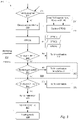
- Fig. 2 shows a first flowchart 200 for a method including a fitting procedure and a first monitoring procedure.
- the hearing mode is engaged in step 230 based on the result of at least the fitting procedure.
- the hearing mode is engaged a first time, before completion of the fitting procedure and the first monitoring procedure, e.g. based on a default hearing profile such as a flat hearing profile.
- the method is performed by an electronic hearing device e.g. as described in connection with figs. 1a-1c and including an earpiece configured to be worn in an ear and including: an acoustic output transducer, a first acoustic input transducer, a second acoustic input transducer, a first wireless communications unit; and a processor coupled to the acoustic transducers.
- an electronic hearing device e.g. as described in connection with figs. 1a-1c and including an earpiece configured to be worn in an ear and including: an acoustic output transducer, a first acoustic input transducer, a second acoustic input transducer, a first wireless communications unit; and a processor coupled to the acoustic transducers.
- the hearing mode includes capturing a first acoustic signal by means of the first acoustic input transducer, generating a compensated output signal based on the acoustic signal and emitting the compensated output signal by means of the first acoustic output transducer.
- the compensated output signal is based on current hearing compensation data.
- the first fitting procedure is started in step 201.
- the first fitting procedure includes both of audiometric fitting performed in step 202 as it is known in the art of hearing aids and otoacoustic monitoring performed in step 210.
- the first fitting procedure thus includes obtaining first hearing compensation data via audiometric measurements requiring the wearer's input to confirm a hearing threshold.
- this includes playing a fitting signal f(n) such as a tone at a predefined amplitude and frequency and in response thereto receiving the wearer's gesture input to confirm or not whether the fitting signal was perceived heard by the wearer.
- the steps 203 and 204 are repeated at various frequencies and at various amplitudes, e.g. several times at each frequency and amplitude such as three times.
- the frequencies may include 125Hz, 250Hz, 500Hz, 1KHz, 2KHz, 4KHz and 8KHz or fewer or more frequencies.
- the amplitudes may be varied in steps of 3dB or more or less.
- the first fitting procedure includes performing otoacoustic monitoring in step 210.
- the otoacoustic test is faster and does not require the wearer to respond orally or by gestures.
- the otoacoustic test can therefore be performed, e.g. automatically. This is useful e.g. when the wearer is a patient under serious medical treatment and is weakened in physically e.g. mentally affected.
- this includes emitting an otoacoustic stimulation signal via the acoustic output transducer and capturing a second acoustic signal including otoacoustic emissions, if any, by means of the second acoustic input transducer.
- the otoacoustic stimulation signal may include one or more tones e.g. two tones at the same time at frequencies f1(m) and f2(m) to stimulate otoacoustic distortion products as it is known.
- an otoacoustic response is measured.
- the stimulation is repeated at different frequency pairs f1, f2, wherein f2 is e.g. a function of f1, e.g. f2 is 2 times f1.
- f2 is e.g. a function of f1, e.g. f2 is 2 times f1.
- the amplitudes of the stimulation signals are each fixed or set at a pre-set value.
- the wearer's ear does not produce an otoacoustic response. This is however mainly due to wax in the ear canal and/or problems with the inner ear.
- the captured signals or data based thereon are stored as data OTO1 in step 212.
- step 213 it is determined whether the captured signals or data based thereon, stored as data OTO1, exceeds a first threshold. This enables testing whether an otoacoustic response was generated, or at least detectable, in the wearer's ear.
- a monitoring procedure is enabled in step 215. It is then possible, at a later time, to verify whether an otoacoustic response was generated and to enable an otoacoustic monitoring procedure at a later time.
- the method forgoes enabling the monitoring procedure or disables the monitoring procedure in step 214.
- a notification e.g. a fourth notification is displayed in step 217 to indicate the absence of an otoacoustic response. Step 217 may be omitted.
- the fitting procedure including the otoacoustic monitoring procedure is completed in step 216 and current hearing compensation data are deployed at the electronic hearing device to enable hearing compensation in accordance with the result of the fitting procedure.
- the hearing mode can then be engaged or re-engaged in step 230.
- Fig. 3 shows a second flowchart 300 including a second monitoring procedure 310.
- the first monitoring procedure is performed in connection with a fitting procedure
- the second monitoring procedure is performed in response to receiving a first input signal.
- the first input signal is a signal received in response to a user's or wearer's input e.g. at an affordance displayed on the first electronic device 120.
- the second monitoring procedure includes performing otoacoustic monitoring in step 210 as described above. Also, as exemplified by steps 211 and 212, this includes emitting an otoacoustic stimulation signal via the acoustic output transducer 105 and capturing, this time, a third acoustic signal including otoacoustic emissions, if any, by means of the second acoustic input transducer 110.
- the captured signals or a data value based thereon are designated OTO(2). Also, in step 213 it is determined whether the captured signals, or a data value based thereon, OTO(2), exceeds the first threshold, TH1.
- a 4 th notification may be transmitted in step 217, e.g. to the first electronic device 120 or the second electronic device 140.
- the 4 th notification may inform the wearer and/or an audiologist that an otoacoustic response is not detectable and/or sufficiently strong.
- step 302 it is tested in step 302 whether the monitoring procedure was enabled based on a previous test, e.g. in connection with the first fitting procedure.
- a 5 th notification may be generated and/or the monitoring procedure may be enabled for subsequent monitoring procedures.
- the method tests in step 304 whether the most recent otoacoustic response e.g. OTO(2) deviates, e.g. significantly, from a previous or preceding otoacoustic response e.g. OTO(1).
- the non-affirmative event (n) of step 304 i.e.
- a 3 rd notification is transmitted, e.g. to the first electronic device, in step 305.
- a 1 st notification is transmitted in step 306 e.g. to the first electronic device and/or to the second electronic device e.g. via a server computer.
- the most recent otoacoustic response e.g. OTO(2) or a set of otoacoustic responses may be transmitted or uploaded to the server computer in step 307.
- the method communicates a first notification signal indicative of the deviation from the hearing device.
- determining whether the deviation is significant is based on the so-called Kullback-Leibler divergence.
- determining whether the deviation is significant is based on a sum of differences e.g. a weighted sum of differences.
- test regarding whether monitoring is enabled is omitted. Then steps 302 and 303 in box 310 are omitted.
- the captured otoacoustic signals or data based thereon are stored with a date-time value, e.g. a time-stamp, each time a monitoring procedure is performed e.g. as data items OTO(1), OTO(2), OTO(k), ...
- the data items are communicated to the first electronic device and/or the second electronic device e.g. via a server computer.
- the data items including the date-time values can be made available to an audiologist for analysis of temporal changes in the data values.
- the data items OTO(1), OTO(2), OTO(k) may be uploaded individually in response to being obtained or at times when an upload connection becomes available.
- the method may proceed to engage the hearing mode in step 230.
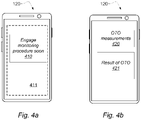
- Figs. 4a and 4b show examples of user interfaces.
- a notification 410 to engage in a monitoring procedure is displayed in a notification centre 411.
- the notification centre 411 may be a part of the operating system of the electronic device.
- a report 421 with results of an otoacoustic monitoring procedure is shown e.g. including a graphical audiogram in response to activation of an affordance 420.
- Fig. 5 shows an illustration of an ear 601 with an electronic hearing device 101 for capturing first acoustic signals 502 from surroundings and capturing second acoustic signals 503 including otoacoustic emissions in response to a stimulation signal.
- audiometric data may be provided by an external source; for example, the results of an audiogram testing process may be provided by an audiologist.
- the audiometric data can be input via a wireless connection into the electronic hearing device.
- Embodiments of the method defined in item 1 above are set out in the present disclosure and in particular in dependent claims 2-12 and in claims 13-14.
Landscapes
- Health & Medical Sciences (AREA)
- Engineering & Computer Science (AREA)
- Life Sciences & Earth Sciences (AREA)
- General Health & Medical Sciences (AREA)
- Biomedical Technology (AREA)
- Public Health (AREA)
- Physics & Mathematics (AREA)
- Medical Informatics (AREA)
- Otolaryngology (AREA)
- Animal Behavior & Ethology (AREA)
- Surgery (AREA)
- Biophysics (AREA)
- Pathology (AREA)
- Audiology, Speech & Language Pathology (AREA)
- Heart & Thoracic Surgery (AREA)
- Veterinary Medicine (AREA)
- Molecular Biology (AREA)
- Acoustics & Sound (AREA)
- Epidemiology (AREA)
- Primary Health Care (AREA)
- Multimedia (AREA)
- Business, Economics & Management (AREA)
- General Business, Economics & Management (AREA)
- Neurosurgery (AREA)
- Signal Processing (AREA)
- Computer Networks & Wireless Communication (AREA)
- Measurement Of The Respiration, Hearing Ability, Form, And Blood Characteristics Of Living Organisms (AREA)
Priority Applications (4)
| Application Number | Priority Date | Filing Date | Title |
|---|---|---|---|
| EP21170830.0A EP4084500A1 (fr) | 2021-04-28 | 2021-04-28 | Dispositif auditif électronique et procédé |
| US17/714,068 US12133051B2 (en) | 2021-04-28 | 2022-04-05 | Electronic hearing device and method |
| CN202210460627.XA CN115348521A (zh) | 2021-04-28 | 2022-04-28 | 电子听力设备和方法 |
| US18/907,454 US20250030992A1 (en) | 2021-04-28 | 2024-10-04 | Electronic hearing device and method |
Applications Claiming Priority (1)
| Application Number | Priority Date | Filing Date | Title |
|---|---|---|---|
| EP21170830.0A EP4084500A1 (fr) | 2021-04-28 | 2021-04-28 | Dispositif auditif électronique et procédé |
Publications (1)
| Publication Number | Publication Date |
|---|---|
| EP4084500A1 true EP4084500A1 (fr) | 2022-11-02 |
Family
ID=75728644
Family Applications (1)
| Application Number | Title | Priority Date | Filing Date |
|---|---|---|---|
| EP21170830.0A Pending EP4084500A1 (fr) | 2021-04-28 | 2021-04-28 | Dispositif auditif électronique et procédé |
Country Status (1)
| Country | Link |
|---|---|
| EP (1) | EP4084500A1 (fr) |
Citations (6)
| Publication number | Priority date | Publication date | Assignee | Title |
|---|---|---|---|---|
| US5526819A (en) | 1990-01-25 | 1996-06-18 | Baylor College Of Medicine | Method and apparatus for distortion product emission testing of heating |
| DE19905743A1 (de) * | 1999-02-11 | 2000-09-14 | Thomas Janssen | Vorrichtung und Verfahren zur objektiven Bestimmung der schwellennahen und überschwelligen Schallverarbeitung des Innenohres |
| US7223245B2 (en) | 2002-01-30 | 2007-05-29 | Natus Medical, Inc. | Method and apparatus for automatic non-cooperative frequency specific assessment of hearing impairment and fitting of hearing aids |
| EP2053877A1 (fr) * | 2007-10-18 | 2009-04-29 | Siemens Medical Instruments Pte. Ltd. | Procédé et dispositif destinés à l'adaptation d'un appareil auditif à l'aide de DPOAE |
| DE102014108663A1 (de) * | 2014-06-20 | 2015-12-24 | Ernst Dalhoff | Verfahren und Vorrichtung zur Untersuchung des Hörvermögens |
| US9497530B1 (en) | 2015-08-31 | 2016-11-15 | Nura Holdings Pty Ltd | Personalization of auditory stimulus |
-
2021
- 2021-04-28 EP EP21170830.0A patent/EP4084500A1/fr active Pending
Patent Citations (6)
| Publication number | Priority date | Publication date | Assignee | Title |
|---|---|---|---|---|
| US5526819A (en) | 1990-01-25 | 1996-06-18 | Baylor College Of Medicine | Method and apparatus for distortion product emission testing of heating |
| DE19905743A1 (de) * | 1999-02-11 | 2000-09-14 | Thomas Janssen | Vorrichtung und Verfahren zur objektiven Bestimmung der schwellennahen und überschwelligen Schallverarbeitung des Innenohres |
| US7223245B2 (en) | 2002-01-30 | 2007-05-29 | Natus Medical, Inc. | Method and apparatus for automatic non-cooperative frequency specific assessment of hearing impairment and fitting of hearing aids |
| EP2053877A1 (fr) * | 2007-10-18 | 2009-04-29 | Siemens Medical Instruments Pte. Ltd. | Procédé et dispositif destinés à l'adaptation d'un appareil auditif à l'aide de DPOAE |
| DE102014108663A1 (de) * | 2014-06-20 | 2015-12-24 | Ernst Dalhoff | Verfahren und Vorrichtung zur Untersuchung des Hörvermögens |
| US9497530B1 (en) | 2015-08-31 | 2016-11-15 | Nura Holdings Pty Ltd | Personalization of auditory stimulus |
Similar Documents
| Publication | Publication Date | Title |
|---|---|---|
| US12574669B2 (en) | Earpiece for audiograms | |
| US11665488B2 (en) | Auditory device assembly | |
| US10341790B2 (en) | Self-fitting of a hearing device | |
| US20200315544A1 (en) | Sound interference assessment in a diagnostic hearing health system and method for use | |
| US12121349B2 (en) | Method to estimate hearing impairment compensation function | |
| US20190090073A1 (en) | Method, apparatus, and computer program for adjusting a hearing aid device | |
| US12273683B2 (en) | Self-fit hearing instruments with self-reported measures of hearing loss and listening | |
| US20080015463A1 (en) | Earguard monitoring system | |
| JP2018528735A5 (fr) | ||
| AU2018315630B2 (en) | Hearing evaluation system | |
| US20190141462A1 (en) | System and method for performing an audiometric test and calibrating a hearing aid | |
| US20250016512A1 (en) | Hearing instrument fitting systems | |
| EP3614695A1 (fr) | Système d'instrument auditif et procédé mis en oeuvre dans un tel système | |
| US20250030992A1 (en) | Electronic hearing device and method | |
| US12627938B2 (en) | Calibration of wearable sound-emitting devices | |
| DK202170193A1 (en) | Electronic hearing device and method | |
| US12490918B2 (en) | Spectro-temporal modulation test unit | |
| US11528566B2 (en) | Battery life estimation for hearing instruments | |
| KR102963488B1 (ko) | 키오스크를 이용한 청각 검사장치 및 청각 검사 방법 | |
| US20250142271A1 (en) | Hearing instrument configured to implement a behavioral diagnostic | |
| EP4425958A1 (fr) | Commande d'interface utilisateur utilisant une suppression de vibrations | |
| WO2024080069A1 (fr) | Dispositif de traitement d'informations, procédé de traitement d'informations et programme | |
| JP2025519755A (ja) | 補聴器を作動する方法 | |
| CN117617932A (zh) | 心率检测方法、装置、音频设备及存储介质 |
Legal Events
| Date | Code | Title | Description |
|---|---|---|---|
| PUAI | Public reference made under article 153(3) epc to a published international application that has entered the european phase |
Free format text: ORIGINAL CODE: 0009012 |
|
| STAA | Information on the status of an ep patent application or granted ep patent |
Free format text: STATUS: THE APPLICATION HAS BEEN PUBLISHED |
|
| AK | Designated contracting states |
Kind code of ref document: A1 Designated state(s): AL AT BE BG CH CY CZ DE DK EE ES FI FR GB GR HR HU IE IS IT LI LT LU LV MC MK MT NL NO PL PT RO RS SE SI SK SM TR |
|
| STAA | Information on the status of an ep patent application or granted ep patent |
Free format text: STATUS: REQUEST FOR EXAMINATION WAS MADE |
|
| 17P | Request for examination filed |
Effective date: 20230424 |
|
| RBV | Designated contracting states (corrected) |
Designated state(s): AL AT BE BG CH CY CZ DE DK EE ES FI FR GB GR HR HU IE IS IT LI LT LU LV MC MK MT NL NO PL PT RO RS SE SI SK SM TR |
|
| STAA | Information on the status of an ep patent application or granted ep patent |
Free format text: STATUS: EXAMINATION IS IN PROGRESS |
|
| GRAP | Despatch of communication of intention to grant a patent |
Free format text: ORIGINAL CODE: EPIDOSNIGR1 |
|
| STAA | Information on the status of an ep patent application or granted ep patent |
Free format text: STATUS: GRANT OF PATENT IS INTENDED |
|
| GRAJ | Information related to disapproval of communication of intention to grant by the applicant or resumption of examination proceedings by the epo deleted |
Free format text: ORIGINAL CODE: EPIDOSDIGR1 |
|
| STAA | Information on the status of an ep patent application or granted ep patent |
Free format text: STATUS: EXAMINATION IS IN PROGRESS |
|
| INTG | Intention to grant announced |
Effective date: 20260205 |
|
| INTC | Intention to grant announced (deleted) | ||
| GRAP | Despatch of communication of intention to grant a patent |
Free format text: ORIGINAL CODE: EPIDOSNIGR1 |
|
| STAA | Information on the status of an ep patent application or granted ep patent |
Free format text: STATUS: GRANT OF PATENT IS INTENDED |
|
| INTG | Intention to grant announced |
Effective date: 20260330 |