EP4084566A1 - Procédé de transmission de données pour extrémité nb-iot et puce nb-iot, dispositif et système de communication - Google Patents
Procédé de transmission de données pour extrémité nb-iot et puce nb-iot, dispositif et système de communication Download PDFInfo
- Publication number
- EP4084566A1 EP4084566A1 EP21218069.9A EP21218069A EP4084566A1 EP 4084566 A1 EP4084566 A1 EP 4084566A1 EP 21218069 A EP21218069 A EP 21218069A EP 4084566 A1 EP4084566 A1 EP 4084566A1
- Authority
- EP
- European Patent Office
- Prior art keywords
- base station
- nrsrp
- iot end
- iot
- threshold
- Prior art date
- Legal status (The legal status is an assumption and is not a legal conclusion. Google has not performed a legal analysis and makes no representation as to the accuracy of the status listed.)
- Granted
Links
Images




Classifications
-
- H—ELECTRICITY
- H04—ELECTRIC COMMUNICATION TECHNIQUE
- H04W—WIRELESS COMMUNICATION NETWORKS
- H04W74/00—Wireless channel access
- H04W74/08—Non-scheduled access, e.g. ALOHA
- H04W74/0833—Random access procedures, e.g. with 4-step access
-
- H—ELECTRICITY
- H04—ELECTRIC COMMUNICATION TECHNIQUE
- H04W—WIRELESS COMMUNICATION NETWORKS
- H04W24/00—Supervisory, monitoring or testing arrangements
- H04W24/08—Testing, supervising or monitoring using real traffic
-
- H—ELECTRICITY
- H04—ELECTRIC COMMUNICATION TECHNIQUE
- H04W—WIRELESS COMMUNICATION NETWORKS
- H04W76/00—Connection management
- H04W76/10—Connection setup
-
- H—ELECTRICITY
- H04—ELECTRIC COMMUNICATION TECHNIQUE
- H04W—WIRELESS COMMUNICATION NETWORKS
- H04W76/00—Connection management
- H04W76/20—Manipulation of established connections
- H04W76/27—Transitions between radio resource control [RRC] states
Definitions
- the present disclosure relates to the communication field, and in particular, to a data transmission method for a Narrowband Internet of Things (NB-IoT) end, an NB-IoT chip, an NB-IoT device, an NB-IoT communication system, and a computer-readable storage medium.
- NB-IoT Narrowband Internet of Things
- the Internet of Things (IoT) technology is a honeycomb-based NB-IoT technology. It supports a cellular data connection, in a wide area network (WAN), of a device with low power consumption, and is mainly used in situations with ultra-low power consumption, weak coverage and access of a large quantity of terminals.
- WAN wide area network
- the 2G logout message released by the ministry of communications, and the implementation, with 5G evolution, of the NB-IoT protocol in the 3rd Generation Partnership Project (3GPP) summit have laid a solid foundation for the sustainable development of the NB-IoT.
- the NB-IoT has a network coverage gain 20 dB greater than an existing network coverage gain, which is equivalent to increasing an area coverage capability by 100 times.
- an enhance coverage level is determined only based on measured narrowband reference signal receiving power (NRSRP). If the measured NRSRP is greater than an NRSRP threshold delivered by the base station, the terminal sends a random access preamble to the base station based on a small ECL. If the measured NRSRP is smaller than the NRSRP threshold delivered by the base station, the terminal sends the random access preamble to the base station based on a greater ECL.
- NRSRP narrowband reference signal receiving power
- the measured NRSRP can roughly reflect a distance between the terminal and the base station. A shorter distance between the terminal and the base station leads to greater NRSRP measured by the terminal and better communication quality.
- SINR signal to interference plus noise ratio
- the terminal sends the random access preamble to the base station in a case of a small ECL configuration, and the base station cannot successfully demodulate the random access preamble or return a random access response (RAR) to the terminal. Even if the terminal receives the RAR, the terminal cannot successfully obtain the RAR through demodulation. As a result, the terminal accesses the base station with more time and larger power consumption.
- the present disclosure provides a data transmission method for an NB-IoT end, an NB-IoT chip, device, and communication system, and a computer-readable storage medium.
- an embodiment of the present disclosure provides a data transmission method for a Narrowband Internet of Things (NB-IoT) end, including: when narrowband reference signal receiving power (NRSRP) measured by the NB-IoT end is greater than or equal to a first NRSRP threshold, and a signal to interference plus noise ratio (SINR) measured by the NB-IoT end is smaller than or equal to a first SINR threshold, sending, by the NB-IoT end, a random access preamble to a base station through a narrowband physical random access channel NPRACH based on a configuration with an enhance coverage level (ECL) being 1 or 2, to set up a connection between the NB-IoT end and the base station.
- NRSRP narrowband reference signal receiving power
- SINR signal to interference plus noise ratio
- the method further includes: when the NRSRP measured by the NB-IoT end is greater than or equal to the first NRSRP threshold, and the SINR measured by the NB-IoT end is greater than the first SINR threshold, sending, by the NB-IoT end, the random access preamble to the base station through the NPRACH based on a configuration with the ECL being 0.
- the method further includes: when the NRSRP measured by the NB-IoT end is smaller than the first NRSRP threshold, sending, by the NB-IoT end, the random access preamble to the base station through the NPRACH based on the configuration with the ECL being 1 or 2.
- a second SINR threshold is smaller than the first SINR threshold; and the data transmission method for an NB-IoT end further includes: when the NRSRP measured by the NB-IoT end is smaller than the first NRSRP threshold, and the SINR measured by the NB-IoT end is smaller than or equal to the second SINR threshold, sending, by the NB-IoT end, the random access preamble to the base station through the NPRACH based on the configuration with the ECL being 2; and/or when the NRSRP measured by the NB-IoT end is smaller than the first NRSRP threshold, and the SINR measured by the NB-IoT end is greater than the second SINR threshold, sending, by the NB-IoT end, the random access preamble to the base station through the NPRACH based on the configuration with the ECL being 1.
- the first NRSRP threshold is greater than a second NRSRP threshold, a second SINR threshold is smaller than the first SINR threshold; and the data transmission method for an NB-IoT end further includes: when the NRSRP measured by the NB-IoT end is smaller than the second NRSRP threshold, sending, by the NB-IoT end, the random access preamble to the base station through the NPRACH based on the configuration with the ECL being 2; when the NRSRP measured by the NB-IoT end is smaller than the first NRSRP threshold and greater than or equal to the second NRSRP threshold, and the SINR measured by the NB-IoT end is smaller than or equal to the second SINR threshold, sending, by the NB-IoT end, the random access preamble to the base station through the NPRACH based on the configuration with the ECL being 2; and/or when the NRSRP measured by the NB-IoT end is smaller than the first NRSRP threshold and
- the method further includes: receiving, by the NB-IoT end, the second NRSRP threshold sent by the base station, such that the NB-IoT end compares the measured SINR with the second SINR threshold and compares the measured NRSRP with the first NRSRP threshold and the second NRSRP threshold, where the second NRSRP threshold is -120 dBm.
- a second SINR threshold is smaller than the first SINR threshold; and the data transmission method for an NB-IoT end further includes: when the NRSRP measured by the NB-IoT end is greater than or equal to the first NRSRP threshold, and the SINR measured by the NB-IoT end is smaller than or equal to the first SINR threshold and greater than the second SINR threshold, sending, by the NB-IoT end, the random access preamble to the base station through the NPRACH based on the configuration with the ECL being 1; and/or when the NRSRP measured by the NB-IoT end is greater than or equal to the first NRSRP threshold, and the SINR measured by the NB-IoT end is smaller than or equal to the second SINR threshold, sending, by the NB-IoT end, the random access preamble to the base station through the NPRACH based on the configuration with the ECL being 2.
- the NRSRP measured by the NB-IoT end when the NRSRP measured by the NB-IoT end is greater than or equal to the first NRSRP threshold, and the SINR measured by the NB-IoT end is smaller than or equal to the first SINR threshold and greater than the second SINR threshold, sending, the NB-IoT end, the random access preamble to the base station through the NPRACH based on the configuration with the ECL being 1; and/or when the NRSRP measured by the NB-IoT end is greater than or equal to the first NRSRP threshold, and the SINR measured by the NB-IoT end is smaller than the second SINR threshold, sending, by the NB-IoT end, the random access preamble to the base station through the NPRACH based on the configuration with the ECL being 2.
- the method further includes: derterming, based on a scheduling parameter of the base station, the first SINR threshold and/or the second SINR threshold.
- the scheduling parameter of the base station includes a data demodulation success rate, and when the data demodulation success rate of the NB-IoT end under a configuration with the ECL being 0 or 1 is smaller than a preset success rate, the second SINR threshold increases, and/or the first SINR threshold increases.
- the measured SINR is the second SINR threshold; and the second SINR threshold is -4 dB.
- the measured SINR is the first SINR threshold; and the first SINR threshold is 5 dB.
- the method further includes: receiving, by the NB-IoT end, a system message broadcast by the base station, to measure the NRSRP and the SINR
- the method further includes: receiving, by the NB-IoT end, the first NRSRP threshold sent by the base station, such that the NB-IoT end compares the measured SINR with the first SINR threshold and compares the measured NRSRP and the first NRSRP threshold, where the first NRSRP threshold is -110 dBm.
- the method further includes: sending, by the NB-IoT end, the random access preamble to the base station through the NPRACH, such that the base station performs scheduling based on radio resource configuration information corresponding to the ECL to send a random access response (RAR) to the NB-IoT end, where the radio resource configuration information includes at least one of a quantity of repetitions of the random access preamble, a maximum quantity of attempts made by the NB-IoT end to access the base station, a time domain resource of the NPRACH, and a frequency domain resource of the NPRACH.
- RAR random access response
- the data transmission method for an NB-IoT end further includes: receiving, by the NB-IoT end, a random access response (RAR) sent by the base station; demodulating, by the NB-IoT end, the RAR; sending, by the NB-IoT end, a radio resource control (RRC) connection request to the base station, such that the base station returns an RRC connect setup message to the NB-IoT end after receiving the RRC connection request; receiving, by the NB-IoT end, the RRC connect setup message sent by the base station; and sending, by the NB-IoT end, an RRC connect setup complete message to the base station.
- RAR random access response
- RRC radio resource control
- said sending, by the NB-IoT end, the random access preamble to the base station through the NPRACH includes: sending, by the NB-IoT end, the random access preamble to the base station through the NPRACH based on the ECL, where a greater ECL leads to a larger quantity of repetitions of the random access preamble corresponding to the ECL.
- the quantity of repetitions of the random access preamble is 2; or when setting a connection between the NB-IoT end and the base station through the NPRACH based on the configuration with the ECL being 1, the quantity of repetitions of the random access preamble is 8; or when setting a connection between the NB-IoT end and the base station through the NPRACH based on the configuration with the ECL being 2, the quantity of repetitions of the random access preamble is 16.
- an embodiment of the present disclosure provides an NB-IoT chip, including a memory storing program instructions; and a processor coupled to the memory and configured to call the program instructions stored in the memory, such that an UE executes the data transmission method for an NB-IoT end in the first aspect.
- an embodiment of the present disclosure provides an NB-IoT device, including an antenna and the NB-IoT chip described in the second aspect, where the antenna is connected to the NB-IoT chip to realize data transmission between the NB-IoT device and a base station.
- an embodiment of the present disclosure provides an NB-IoT communication system, including the NB-IoT device described in the third aspect and the base station, where the NB-IoT device is wirelessly connected to the base station to perform data transmission.
- an embodiment of the present disclosure provides a computer-readable storage medium storing a computer program, where the computer program is executed by a processor to implement any data transmission method for an NB-IoT end in the first aspect.
- the embodiments of the present disclosure provide a data transmission method for an NB-IoT end, an NB-IoT chip, device, and communication system, and a computer-readable storage medium.
- NRSRP measured by an NB-IoT end is greater than or equal to a first NRSRP threshold
- an SINR measured by the NB-IoT end is smaller than or equal to a first SINR threshold
- the NB-IoT end sends a random access preamble to a base station based on a configuration with an ECL being 1 or 2, to set up a connection to the base station.
- An ECL configuration is determined based on the measured NRSRP and SINR, thereby avoiding long data transmission time due to an improper ECL configuration, and improving user experience.
- NPUSCH narrowband physical uplink shared channel
- NPRACH narrowband physical random shared channel
- the NPRACH is an access channel when a terminal starts to initiate a call.
- NPUSCH narrowband physical uplink shared channel
- NPRACH narrowband physical random shared channel
- the NPRACH is an access channel when a terminal starts to initiate a call.
- ECLs different quantities of information repetitions are set for the NPRACH to achieve coverage enhancement.
- a greater ECL leads to a larger quantity of information repetitions that is correspondingly set for the NPRACH.
- SIB2-NB narrowband system information block 2
- the SIB2-NB can also be referred to as SIB2 for short.
- the terminal requests to access the base station, and an access attempt process is as follows: in the NPRACH, the terminal attempts to access the base station every time with a quantity of information repetitions corresponding to the ECL being i; when a quantity of times that the terminal attempts to access the base station is equal to the maximum quantity of access attempts that is set by the base station, if the terminal still has not successfully accessed the base station, the terminal upgrades the current ECL to a greater ECL, and attempts to access the base station according to the same access attempt process described above. After ECL upgrade, the quantity of information repetitions increases correspondingly, which can effectively increase a probability that the terminal successfully accesses the base station.
- FIG. 1 shows a configuration of an existing network.
- the base station delivers a SIB2 to user equipment (UE) of an IoT user.
- the SIB2 includes a cell configuration parameter rrc.rsrp_ThresholdsPrachInfoList_r13.
- the cell configuration parameter is used to indicate a threshold of each parameter for determining an ECL of a current cell.
- NRSRP measured by the UE is [-110 dBm, - 109 dBm]
- the UE attempts to access the base station based on a configuration with the ECL being 0.
- numRepetitionsPerPreambleAttempt-r13:n2(1) indicates that the quantity of repetitions is 2; and for the configuration with the ECL being 1, numRepetitionsPerPreambleAttempt-r13:n8(3) indicates that the quantity of repetitions is 8.
- the quantity of repetitions may be set to 16.
- a larger quantity of times of repeatedly sending an uplink message by the UE leads to a higher success rate of demodulating, by the UE, a message returned by the base station.
- specific data shown in FIG. 1 is merely illustrative.
- the NRSRP is a key parameter that can represent strength of a wireless signal and one of physical layer measurement demands in an NB-IoT network, and is an average value of signal power received on all resource elements (REs) carrying reference signals in a certain symbol.
- REs resource elements
- FIG. 2 is a schematic diagram of the ECL.
- MCS modulation and coding scheme
- NB-IoT cells are classified into different ECLs.
- the UE selects a corresponding configuration of an ECL based on signal strength to perform service transmission. Communication between a UE belonging to a small ECL and the base station has good quality, and a transmission rate thereof is guaranteed first.
- a signal between a UE belonging to a great ECL and the base station is weak, and the UE belonging to the great ECL can appropriately reduce a data transmission rate and give priority to a transmission success rate.
- a greater ECL leads to a larger quantity of repetitions when the UE sends uplink data, such that data returned by the base station is easier to be successfully demodulated by the UE, but more radio resources are occupied and a lower rate is caused. Therefore, selecting an appropriate ECL is very important to performance of the UE. For example, in an area with a strong signal between the base station and the UE, the configuration with the ECL being 0 can be used to efficiently complete service transmission.
- FIG. 3 is a schematic diagram of interference between cells.
- NRSRP measured by a UE in an overlapping area of cells is great, but an SINR measured by the UE may be small due to interference in cells 0, 1 and 2 in a same-frequency networking situation.
- SINRs measured by the UEs may be very small.
- UE3 is used as an example for illustration.
- NRSRP measured by UE3 is great, but a ratio of strength of a useful signal sent by the base station and received by UE3 to a sum of strength of interference and noise is low.
- the strength of interference is strength of an interference signal received by UE3
- the strength of noise is strength of a noise signal received by UE3. If UE3 determines that the ECL is 0 and attempts to access the base station based on the configuration with the ECL being 0, a quantity of times that UE3 repeatedly sends an NPRACH messages is small. In this case, the base station may not receive the NPRACH message, or the base station may not successfully demodulate the received NPRACH message. In this embodiment, the NPRACH message is a message sent through the NPRACH.
- the NPRACH message is a random access preamble. Even if the base station successfully demodulates the NPRACH message, after the base station obtains ECL information carried in the NPRACH message, the base station performs scheduling based on radio resource configuration information corresponding to the ECL being 0, to return an RAR to UE3. After the base station confirms that the ECL is 0, an RAR time window allocated by the base station to UE3 is short, that is, a quantity of times that the bases station repeatedly returns the RAR to UE3 is small. In this case, UE3 may not receive the RAR, or UE3 may receive the RAR returned by the base station but cannot successfully demodulate the RAR.
- UE3 cannot successfully demodulate the RAR delivered by the base station under the configuration with the ECL being 0, the UE can only continue to attempt to access the base station based on the configuration with the ECL being 0, until a maximum quantity of attempts that corresponds to the ECL being 0 is reached, and then the UE increases the ECL for an attempt.
- Specific data is used herein as an example for illustration.
- the NRSRP measured by UE3 is -90 dBm, but the SINR measured by UE3 is -8 dB. Assuming that the NRSRP measured by UE3 is greater than an NRSRP threshold sent by the base station to the UE, UE3 sends the NPRACH message to the base station based on the configuration with the ECL being 0.
- UE3 does not receive the RAR returned by the base station, or UE3 cannot successfully demodulate the RAR returned by the base station. Then, when a quantity of attempts made by UE3 to access the base station under the configuration with the ECL being 0 reaches the maximum quantity of attempts that corresponds to the ECL being 0, UE3 sends the NPRACH message to the base station based on a quantity of repetitions corresponding to the ECL being 1.
- UE3 After a quantity of attempts made by UE3 to access the base station under the configuration with the ECL being 1 reaches a maximum quantity of attempts corresponding to the ECL being 1, if UE3 still does not receive the RAR sent by the base station or cannot demodulate the RAR returned by the base station, UE3 attempts to send the NPRACH message to the base station based on a quantity of repetitions corresponding to the ECL being 2.
- UE3 sends the NPRACH message to the base station based on the configuration with the ECL being 1, 2 or 3 a respective success rate that the UE successfully demodulates the RAR returned by the base station is different. A greater ECL of the UE leads to a higher success rate that the UE successfully demodulates the received RAR.
- UE3 can successfully demodulate the RAR returned by the base station only when UE3 sends the NPRACH message to the base station based on the configuration with the ECL being 1 or even 2.
- an attempt made by UE3 to send the NPRACH message based on the configuration with the ECL being 0 is a kind of waste.
- UE3 is likely to attempt to access the base station for many times under the configuration with the ECL being 0. Therefore, if threshold decision-making is made only based on the NRSRP, as specified in a protocol, data transmission time may be longer due to an improper ECL configuration. As a result, more time and more power are consumed to set up a connection between the base station and the NB-IoT.
- the SINR is a ratio of strength of a useful signal sent by the base station and received by an NB-IoT end to interference plus noise.
- a sufficient SINR is required for basic normal communication between the UE and the base station.
- the SINR can be illustrated as a ratio of reference signal power S in a sounding bandwidth of the UE to interference plus noise power (I+N), namely, S/(I+N).
- the reference signal power is power of a narrowband reference signal (NRS), and (I+N) can be illustrated as a sum of interference of a non-serving cell on the reference signal, interference of an adjacent channel, and thermal noise power in the system.
- the SINR reflects link quality of a current channel and is an important index for measuring performance of the UE.
- the NB-IoT end When the NB-IoT end sends the NPRACH message to the base station under different ECL configurations, the NB-IoT may or may not receive the RAR returned by the base station. When the NB-IoT end does not receive the RAR returned by the base station, the NB-IoT end regards that the base station does not receive the NPRACH message. When the NB-IoT end receives the RAR returned by the base station, a greater ECL configured by the UE leads to a higher success rate that the NB-IoT end demodulates the RAR returned by the base station.
- the SINR is added as one of evaluation parameters to determine the ECL configuration.
- an ECL determined by the NB-IoT end is more suitable for a current communication environment, and the NB-IoT end can successfully demodulate, with less time and power, the RAR delivered by the base station, so as to successfully set up the connection between the NB-IoT end and the base station.
- the NB-IoT end may be a UE or an NB-IoT chip. This embodiment provides description by using an example in which the NB-IoT end is a UE.
- the UE Before determining to access the base station, the UE can obtain a target value list of reference signal receiving power (RSRP) of the base station through cell broadcasting, by comparing its own RSRP with the target value list of the RSRP of the base station, and comparing its measured SINR with an SINR threshold, an ECL of the UE can be determined.
- the target value list of the RSRP of the base station includes at least a first NRSRP threshold.
- the target value list may further include a second NRSRP threshold.
- the NB-IoT end can send the NPRACH message to the base station.
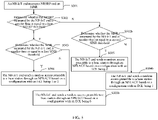
- the random access preamble can be sent with reference to a data transmission method for an NB-IoT end as shown in FIG. 4 , to realize a connection between the UE and the base station.
- the data transmission method for an NB-IoT end in this embodiment includes the following steps:
- the UE may measure many parameters, such as the SINR and the NRSRP. Generally, in some application situations, for example, after the UE is powered off or faulty, the UE may be disconnected from the base station. After the UE is disconnected from the base station, if the UE wants to set up a connection to the base station again, the data transmission method provided in this embodiment of the present disclosure can be adopted. After determining an appropriate ECL, the NB-IoT end sends the random access preamble to the base station based on the ECL, such that the UE accesses the base station with less time and power.
- the NB-IoT end when the NRSRP of the NB-IoT end is greater than or equal to the first NRSRP threshold, and the SINR of the NB-IoT end is smaller than or equal to the first SINR threshold, the NB-IoT end sends the random access preamble to the base station based on the configuration with the ECL being 1 or 2.
- the SINR in addition to the measured NRSRP, the SINR is also introduced as one of judgment criteria, in other words, the ECL is determined based on the NRSRP and the SINR that are measured by the NB-IoT end.
- the ECL is set to 1 or 2. This presents the UE from attempting to access the base station based on the configuration with the ECL being 0 in these situations, such that the UE does not take long time to access the base station.
- the UE in a situation in which the measured NRSRP is greater than or equal to the first NRSRP threshold and the measured SINR is smaller than or equal to the first SINR threshold, after sending the random access preamble to the base station based on the configuration with the ECL being 1 or 2, the UE can receive an RAR returned by the base station and successfully demodulate the RAR, thereby helping the NB-IoT end access the base station quickly with low power consumption.
- the solution provided in this embodiment of the present disclosure is improved compared with an ECL determining solution in an existing protocol. Through actual measurement, it is found that about 30% of positions have same-frequency interference, and a typical business in these 30% of positions wastes more than 60% of time and electric energy due to the same-frequency interference.
- an embodiment of the present disclosure provides a data transmission method for an NB-IoT end.
- the NRSRP measured by the NB-IoT end is greater than or equal to the first NRSRP threshold, and the SINR measured by the NB-IoT end is greater than the first SINR threshold, it indicates that communication between the base station and the NB-IoT end has good quality, and there is no same-frequency interface or weak same-frequency interference between UEs.
- the NB-IoT end can attempt to access the base station based on the configuration with the ECL being 0.
- the UE may send the NPRACH message to the base station based on the configuration with the ECL being 0, to avoid a waste of communication resources due to an increase of a quantity of repetitions of transmission of the NPRACH message because the ECL is set to 1 or 2 for the UE when the communication quality is good.
- a quantity of times of repeatedly sending the NPRACH message by the UE is eight when the ECL is 1
- a quantity of times of repeatedly sending the NPRACH message by the UE is two when the ECL is 0.
- the ECL may be set to 1, in other words, when the quantity of times of repeatedly sending the NRSRP message is eight, the UE can successfully demodulate the RAR returned by the base station.
- the ECL is set to 0 for the UE
- the UE may not receive the RAR sent by the base station, or the UE receives the RAR but cannot successfully demodulate the RAR, then, the UE sends the NPRACH message to the UE based on the configuration with the ECL being 0, the UE may attempt to send the NPRACH message to the UE based on the configuration with the ECL being 0 for many times, and when a maximum quantity of access attempts under the configuration with the ECL being 0 is reached, if the UE does not receive the RAR returned by the base station or the UE fails to demodulate the RAR, the UE performs an access attempt based on the configuration with the ECL being 1, and the UE sends the NPRACH message to the base station, the UE needs to repeatedly send the NPRACH message for eight times to complete one access attempt under the configuration with the ECL being 1, in this case, the base station returns
- the quantity of repetitions of the NPRACH message is set to 2 when the ECL is 0, 8 when the ECL is 1, and 16 when the ECL is 2.
- the quantity of repetitions of the NPRACH message is configured based on the ECL, which can basically meet a communication requirement of an NB-IoT device. Specific data of the quantity of repetitions in this embodiment of the present disclosure is merely illustrative, and a user may adjust a specific value of the quantity of repetitions based on actual requirements.
- an embodiment of the present disclosure provides a data transmission method for an NB-IoT end.
- the NB-IoT end when the NRSRP measured by the NB-IoT end is smaller than the first NRSRP threshold, the NB-IoT end sends the random access preamble to the base station based on the configuration with the ECL being 1 or 2.
- the NRSRP measured by the UE is small, a large quantity of repetituions of transmission is required to ensure that the UE receives and demodulates the RAR returned by the base station, so as to further realize the connection between the NB-IoT end and the base station. Therefore, in this situation, sending the random access preamble to the base station based on the configuration with the ECL being 1 or 2 can enable the UE to access the base station with less time and power.
- an embodiment of the present disclosure provides a data transmission method for an NB-IoT end.
- a second SINR threshold is set, and the second SINR threshold is smaller than a first SINR threshold.
- the data transmission method for an NB-IoT end in this embodiment includes the following steps:
- steps S501, S502, S503, S504, and S503b are the same as or similar to steps S401, S402, S403, S404, and S403b in the foregoing embodiment. Details are not described herein again.
- an embodiment of the present disclosure provides a data transmission method for an NB-IoT end. As shown in FIG. 5 , when the NRSRP measured by the NB-IoT end is smaller than the first NRSRP threshold, and the SINR measured by the NB-IoT end is smaller than or equal to the second SINR threshold, the NB-IoT end sends an NPRACH message to the base station based on the configuration with the ECL being 2.
- the UE sends the NPRACH message to the base station based on the configuration with the ECL being 0 or 1, the UE may not receive an RAR returned by the base station or the UE fails to demodulate the RAR returned by the base station. Therefore, in this situation, the ECL of the UE is set to 2, to avoid a case that more time and power are consumed because the UE sends the NPRACH message under the configuration with the ECL being 0 or 1 and the UE does not receive the RAR returned by the base station or fails to demodulate the RAR.
- an embodiment of the present disclosure provides a data transmission method for an NB-IoT end.
- the NB-IoT end when the NRSRP measured by the NB-IoT end is smaller than the first NRSRP threshold and the SINR measured by the NB-IoT end is greater than the second SINR threshold, the NB-IoT end sends the random access preamble to the base station based on the configuration with the ECL being 1.
- the NRSRP measured by the UE is smaller than the first NRSRP threshold, therefore, in this situation, there is a high probability that the SINR measured by the UE is also smaller than the first SINR threshold.
- the measured SINR can be directly compared with the second SINR threshold to determine whether the ECL should be set to 1 or 2, thereby avoiding comparison between the measured SINR and the first SINR threshold.
- the configuration with the ECL being 1 is selected to transmit data with the base station, which can not only avoid a waste of time and power caused when the UE attempts to access the base station under the configuration with the ECL being 0, but also avoid a waste of communication resources due to an increase of a quantity of repetitions of the NPRACH message under the configuration with the ECL being 2.
- this embodiment avoids comparison between the measured SINR and the first SINR threshold when the measured NRSRP is smaller than the first NRSRP threshold, thereby further reducing power and time consumption.
- an embodiment of the present disclosure provides a data transmission method for an NB-IoT end.
- a second NRSRP threshold is set, and the second NRSRP threshold is smaller than a first NRSRP threshold.
- the data transmission method for an NB-IoT end in this embodiment includes the following steps:
- steps S601, S602, S603, S604, and S603b are the same as or similar to steps S401, S402, S403, S404, and S403b in the foregoing embodiment. Details are not described herein again.
- an embodiment of the present disclosure provides a data transmission method for an NB-IoT end.
- the measured NRSRP is compared with the first NRSRP threshold
- the measured NRSRP is further compared with the second NRSRP threshold. If the measured NRSRP is smaller than the second NRSRP threshold, the UE sends an NPRACH message to the base station based on the configuration with the ECL being 2.
- the ECL is set to 2, to avoid a waste of power and time caused when the UE attempts to access the base station when the UE sets the ECL to 0 or 1.
- the measured SINR is further compared with the second SINR threshold. If the measured SINR is greater than the second SINR threshold, the UE sets the ECL to 1. If the measured SINR is smaller than or equal to the second SINR threshold, the UE sets the ECL to 2. In this embodiment, first the measured NRSRP is compared with the first NRSRP threshold, then the measured NRSRP is compared with the second NRSRP threshold, and finally the measured SINR is compared with the second SINR threshold.
- the ECL of the UE can be accurately configured to reduce power and time consumption.
- an embodiment of the present disclosure provides a data transmission method for an NB-IoT end.
- a second SINR threshold is set, and the second SINR threshold is smaller than a first SINR threshold.
- the data transmission method for an NB-IoT end in this embodiment includes the following steps:
- steps S701, S702, S702b, S703, and S703b are the same as or similar to steps S401, S402, S402b, S403, and S403b in the foregoing embodiment. Details are not described herein again.
- an embodiment of the present disclosure provides a data transmission method for an NB-IoT end.
- the measured SINR is further compared with the second SINR threshold. If the measured SINR is smaller than or equal to the second SINR threshold, the UE may send the random access preamble to the base station based on the configuration with the ECL being 2, to attempt to access the base station.
- the UE may send the random access preamble to the base station based on the configuration with the ECL being 1, to attempt to access the base station.
- the measured SINR is compared with the first SINR threshold and the second SINR threshold to determine an appropriate ECL configuration, thereby avoiding a waste of power and increasing time consumption.
- an embodiment of the present disclosure provides a data transmission method for an NB-IoT end.
- this embodiment further describes step S504 in the embodiment shown in FIG. 5 , to specifically describe a situation in which the ECL is set to 1 and a situation in which the ECL is set to 2.
- the data transmission method for an NB-IoT end in this embodiment includes the following steps:
- steps S801, S802, S802b, S803, S803b, S804b, and S805 are the same as or similar to steps S501, S502, S502b, S503, S503b, S504b, and S505 in the foregoing embodiment. Details are not described herein again.
- an embodiment of the present disclosure provides a data transmission method for an NB-IoT end.
- this embodiment further describes step S604 in the embodiment in FIG. 6 , to specifically describe a situation in which the ECL is set to 1 and a situation in which the ECL is set to 2.
- the data transmission method for an NB-IoT end in this embodiment includes the following steps:
- steps S901, S902, S902b, S903, S903b, S905, S905b, S906, and S906b are the same as or similar to steps S601, S602, S602b, S603, S603b, S605, S605b, S606, and S606b in the foregoing embodiment. Details are not described herein again.
- the second SINR threshold may be determined based on a scheduling parameter of the base station. Specifically, when the NB-IoT end attempts to connect to the base station based on the configuration with the ECL being 0, if a success rate of demodulating an RAR by the UE is smaller than a preset success rate, it indicates that the ECL of the UE should be set to 1 or 2. In this situation, the second SINR threshold may be increased, such that the original ECL can be adjusted from 0 to 1 or 2.
- the NB-IoT end attempts to access the base station based on the configuration with the ECL being 1, if a data demodulation success rate of the UE is smaller than a preset success rate, it indicates that the ECL of the UE should be set to 2. In this situation, the second SINR threshold may be increased, such that the original ECL can be adjusted from 1 to 2.
- the preset success rate may be set to be greater than or equal to 50%.
- the preset success rate may be set to any value of 50% to 70%.
- the preset success rate may be set to 80%.
- the preset success rate When the preset success rate is set to 80%, a basic communication demand can be guaranteed, and the UE performs well in each aspect during actual measurement. In actual situations, since it is impossible to completely avoid interference and noise, if a high preset success rate is set, a SINR threshold may be set excessively great, as a result, many UEs set the ECL to 2. Therefore, considering power consumption, the preset success rate may be set to 70%, which can not only ensure an access success rate, but also reduce the power consumption.
- the second SINR threshold can be adjusted to ensure that the ECL configuration is still accurate when a communication environment changes. In addition, the second SINR threshold may be determined based on a data demodulation success rate corresponding to a specific ECL configuration.
- an SINR measured when the ECL is 1 and the data demodulation success rate is greater than 70% may be set as the second SINR threshold.
- the second SINR threshold may be set to -4 dB.
- the first SINR threshold may be determined based on the scheduling parameter of the base station. Specifically, when the NB-IoT end performs data communication with the base station based on the configuration with the ECL being 0, if the data demodulation success rate of the UE is smaller than the preset success rate, it indicates that the ECL should be set to 1 or 2. In this situation, the first SINR threshold may be increased, such that the original ECL can be adjusted from 0 to 1 or 2. When the NB-IoT end performs data communication with the base station based on the configuration with the ECL being 1, if the data demodulation success rate of the UE is smaller than the preset success rate, it indicates that the ECL should be set to 2.
- the first SINR threshold may be increased, such that the original ECL can be adjusted from 1 to 2.
- the preset success rate may be set to be greater than or equal to 50%, for example, may be set to any value of 50% to 70%.
- the preset success rate may be set to 80%.
- the preset success rate is set to 80%, the basic communication demand can be guaranteed, and the UE performs well in each aspect during actual measurement.
- a SINR threshold may be set excessively great, as a result, many UEs set the ECL to 2. Therefore, considering the power consumption, the preset success rate may be set to 70%.
- the first SINR threshold can be adjusted to ensure that the ECL configuration can be automatically adjusted based on a change of the threshold when the communication environment changes.
- the first SINR threshold may be determined based on a data demodulation success rate corresponding to a specific ECL configuration. For example, for the UE, if the data demodulation success rate is greater than 70% when the ECL is 0, an SINR measured when the ECL is 0 and the data demodulation success rate is greater than 70% may be set as the first SINR threshold.
- the first SINR threshold may be set to 5 dB.
- the first NRSRP threshold is delivered by the base station to the UE.
- the first NRSRP threshold received by the UE may be - 110 dBm.
- the basic communication demand can be met.
- an NPRACH message namely, the random access preamble used to realize the connection between the NB-IoT end and the base station, is transmitted during data transmission between the UE and the base station.
- the base station may return the RAR to the UE based on the random access preamble, and the base station can perform resource configuration based on the ECL when sending the RAR to the UE.
- the NB-IoT end sends the random access preamble to the base station through the NPRACH, such that the base station performs scheduling based on radio resource configuration information corresponding to the ECL to send the RAR to the NB-IoT end.
- the radio resource configuration information may include at least one of a quantity of repetitions of the random access preamble (numRepetitionsPerPreambleAttempt), a time domain resource (including parameters such as a cycle and a start subframe position) of the NPRACH, a frequency domain resource (including parameters such as a subcarrier offset and a quantity of subcarriers) of the NPRACH, a maximum quantity of attempts (maxNumPreambleAttemptCE), and other parameters.
- the quantity of repetitions, corresponding to the ECL, of the random access preamble represents a quantity of times of repeatedly sending the random access preamble when the UE attempts to access the base station under the set ECL. For example, when the ECL is 0, the quantity of times of repeatedly sending the random access preamble is 2, in other words, the UE sends the random access preamble to the base station twice under the configuration with the ECL being 0.
- the maximum quantity of attempts can be illustrated as a maximum quantity of access attempts.
- the maximum quantity of access attempts corresponds to the ECL, in other words, a corresponding maximum quantity of attempts can be set for each ECL. For example, as shown in FIG.
- maxNumPreambleAttemptCE-r13:n10(6) under Item0 represents that the UE can attempt to access the base station for ten times based on the configuration with the ECL being 0.
- the UE may attempt to access the base station again based on the configuration with the ECL being 0, until all the ten access attempts fail. Then, the UE attempts to access the base station based on the configuration with the ECL being 1.
- maxNumPreambleAttemptCE-r13:n6(3) under Item1 represents that the UE can attempt to access the base station for six times based on the configuration with the ECL being 1.
- the UE may attempt to access the base station again based on the configuration with the ECL being 1, until all the six access attempts fail. Then, the UE attempts to access the base station based on the configuration with the ECL being 2.
- a current network configuration can be collected based on big data.
- an SINR measured by the UE when the UE can demodulate, under an NRSRP value, the RAR delivered by the base station can be determined. That is, an NRSRP threshold and an SINR threshold that support successful demodulation by the UE under each ECL configuration can be obtained through analysis based on the big data, and then the ECL configuration can be determined by comparing the thresholds with respective measured values.
- the UE sends the NPRACH message to the base station based on the configuration with the ECL being 0, and an SINR, for example, 5 dB, measured when the demodulation success rate of the NB-IoT end is greater than 70% is the first SINR threshold, in other words, the first SINR threshold is 5 dB, then when the SINR measured by the NB-IoT end is greater than 5 dB, if the UE sends the NPRACH message to the NB-IoT end based on the configuration with the ECL being 0, the NB-IoT end can successfully demodulate the RAR returned by the base station.
- an SINR for example, 5 dB
- the UE sends the NPRACH message to the base station based on the configuration with the ECL being 1, and an SINR, for example, -4 dB, measured when the demodulation success rate of the NB-IoT end is greater than 70% is the second SINR threshold, in other words, the second SINR threshold is -4 dB, then when the SINR measured by the NB-IoT end is greater than -4 dB, if the UE sends the NPRACH message to the base station based on the configuration with the ECL being 1, the UE can successfully demodulate the RAR returned by the base station.
- SINR for example, -4 dB
- the base station can determine NRSRP, for example, -110 dBm, measured by the NB-IoT end when the demodulation success rate of the NB-IoT end is greater than 70%, as the first NRSRP threshold, in other words, the first NRSRP threshold may be -110 dBm, then after determining the first NRSRP threshold, the base station can send the first NRSRP threshold to the NB-IoT end; and when the NRSRP measured by the NB-IoT end is greater than or equal to -110 dBm and the SINR measured by the NB-IoT end is greater than 5 dB, if the UE sends the NPRACH message to the NB-IoT end based on the configuration with the ECL being 0, the UE can successfully demodulate the RAR returned by the base station.
- NRSRP for example, -110 dBm
- the base station can use NRSRP, for example, -120 dBm, measured by the NB-IoT end when the demodulation success rate of the NB-IoT end is greater than 70%, as the second NRSRP threshold, in other words, the second NRSRP threshold may be -120 dBm, then after determining the second NRSRP threshold, the base station can send the second NRSRP threshold to the NB-IoT end.
- NRSRP for example, -120 dBm, measured by the NB-IoT end when the demodulation success rate of the NB-IoT end is greater than 70%
- the second NRSRP threshold in other words, the second NRSRP threshold may be -120 dBm
- the base station can send the second NRSRP threshold to the NB-IoT end.
- this embodiment takes the above specific values as an example to describe the data transmission method for an NB-IoT end in the above embodiments.
- Conditions for that the UE transmits the NPRACH message to the base station based on the configuration with the ECL being 0 are: the NRSRP measured by the UE is greater than or equal to -110 dBm, and the SINR measured by the UE is greater than 5 dB.
- Conditions for that the UE transmits the NPRACH message to the base station based on the configuration with the ECL being 1 are: the measured NRSRP is greater than or equal to -110 dBm, and the measured SINR is greater than -4dB and smaller than or equal to 5 dB; or the measured NRSRP is smaller than -110 dBm and greater than -120 dBm, and the measured SINR is greater than -4dB.
- Conditions for that the UE transmits the NPRACH message to the base station based on the configuration with the ECL being 2 are: the measured NRSRP is smaller than -120 dBm; or the measured NRSRP is greater than or equal to -120 dBm and smaller than -110 dBm, and the measured SINR is smaller than or equal to -4 dB; or the measured NRSRP is greater than or equal to -110 dBm, and the measured SINR is smaller than or equal to -4 dB.
- the ECL is determined as 2 provided that the SINR is smaller than or equal to -4dB, or the NRSRP is smaller than -120 dB.
- a data transmission method for an NB-IoT end in an embodiment includes the following steps:
- This embodiment of the present disclosure provides a transmission strategy of the random access preamble during setup of a connection between the NB-IoT end and the base station, to reduce data transmission time and save power.
- the first NRSRP threshold and the second NRSRP threshold may be delivered by the base station to the NB-IoT end.
- the first NRSRP threshold and the second NRSRP threshold may be adjusted by the base station based on an application situation and are not necessarily limited to the specific values provided in the above embodiments.
- the SINR threshold may also be referred to as an SINR demodulation threshold.
- the first SINR threshold and the second SINR threshold may be determined by using the following three methods:
- a scheduling parameter of the base station can be obtained, a typical conservative scheduling configuration of a current network can be obtained based on analysis of a large quantity of scheduling parameters of the base station.
- the thresholds mentioned in the above embodiments can be determined based on the scheduling parameter, and the scheduling parameter is the data demodulation success rate mentioned in the above embodiments.
- the first SINR threshold and the second SINR threshold can be determined based on a scheduling parameter obtained by simulating a communication model between the base station and the UE.
- the first SINR threshold and the second SINR threshold can be determined based on data statistics of successful or failed demodulation performed by the NB-IoT end under each ECL configuration of a current network.
- the SINR threshold determined through simulation in the second method can be corrected based on the data statistics of successful or failed demodulation performed by the NB-IoT end under each ECL configuration of the current network.
- the first SINR threshold and the second SINR threshold can be updated again through actual measurement.
- updating or adjusting the SINR threshold includes updating or adjusting at least one of the first SINR threshold and the second SINR threshold.
- the base station can determine a coverage level based on a received NPRACH message.
- the ECL can be determined according to the data transmission method provided in this embodiment.
- the base station sends the NPRACH message to the base station through the NPRACH, NPRACH sequences sent by the UE are different for different ECLs. Therefore, the base station receive different NPRACH sequences. Therefore, after receiving the NPRACH message, the base station can obtain an ECL based on an NPRACH sequence. Then, the base station can schedule a resource based on the obtained ECL to realize communication with the UE, for example, send an RAR to the UE based on a quantity of repetitions that corresponds to the ECL.
- the UE can obtain a maximum quantity of access attempts configured by the base station.
- the maximum quantity of access attempts is a quantity of times that the UE attempts to access the base station based on the preamble and a current coverage level, and can be illustrated as a maximum quantity of times that the base station allows the UE to attempt to access the base station under a certain ECL.
- the UE can measure the NRSRP and the SINR based on the system message delivered by the base station to the UE. After measuring the NRSRP and the SINR, the UE can determine, according to the data transmission method provided in this embodiment of the present disclosure, an ECL for sending the random access preamble to the base station. For example, the UE may send the NPRACH message to the base station based on the quantity of repetitions, corresponding to the ECL, of the random access preamble. After receiving the NPRACH message transmitted through the NPRACH, the base station also obtains the ECL, and can also configure a resource based on the ECL to send the RAR to the UE.
- bit rates and quantities of repetitions when the base station sends the RAR are different for different ECLs. For example, a greater ECL leads to a longer time window for the base station to send the RAR, in other words, a larger quantity of times of repeatedly sending the RAR by the base station.
- a data transmission method for an NB-IoT end in FIG. 12 includes the following steps:
- step S1201 is the same as or similar to step S401 in the above steps, and details are not described herein again.
- the NB-IoT end may determine the ECL based on the NRSRP and the SINR, as disclosed in the above embodiments. Specifically, the ECL is determined by comparing the measured NRSRP and SINR with their corresponding thresholds, and details are not described herein again.
- the UE may configure transmit power of a random access preamble before sending the random access preamble to the base station.
- the transmit power of the random access preamble can be understood as transmit power of an NPRACH message.
- y min[Pmax, x- t NRSRP], namely, a minimum value in Pmax and x- t NRSRP, where Pmax is maximum transmit power configured by the base station for the NB-IoT end, and x- t_NRSRP is a value calculated by the UE based on a protocol and the NRSRP measured by the UE.
- x-t_NRSRP represents a difference between x and the measured NRSRP
- t NRSRP represents the NRSRP measured by the NB-IoT end
- x TargetPower+DELTA PREAMBLE+(Preamble_TC-1) ⁇ PR_Step+NRS_power_r13 -Gain
- TargetPower represents target power configured by the base station for the NB-IoT end, and can also be illsustrated as initial target received power of the random access preamble
- TargetPower can also be expressed as preambleInitialReceiverdTargetPower
- DELTA_PREAMBLE represents a power offset of the random access preamble
- Preamble_TC represents a quantity of access times of the NB-IoT end
- PR_Step represents a power increment step
- NRS_power_r13 represents reference signal power of the base station
- Gain represents a gain corresponding to a quantity of repetitions.
- TargetPower configured by the base station for the UE is -96 dBm
- the power offset of the random access preamble is 0 for access performed by the UE for the first time
- PR_Step is 2 dB
- NRS_power_rl3 is 29 dBm
- the NRSRP measured by the NB-IoT end is -80 dBm
- a quantity of repetitions of message RnumRepetitionPerPreambleAttempt-r13 is 8
- Gain is 10 ⁇ lg8
- the transmit power Pmax configured by the base station is determined.
- a value of the measured NRSRP can represent a distance between the NB-IoT end and the base station. When the NRSRP measured by the NB-IoT end is greater, it indicates that the NB-IoT end is closer to the base station and the required transmit power x- t NRSRP is smaller.
- the transmit power of the UE may be set to Pmax.
- a setting of the transmit power of the random access preamble is related to the NRSRP measured by the NB-IoT end. Reference may be made to a method for determining the transmit power of the random access preamble as shown in FIG. 13 .
- the transmit power of the random access preamble can be referred to as transmit power of the NPRACH.
- the transmit power of the NPRACH may be determined not according to a conventional solution, namely, the ECL.
- ECL the transmit power of the UE may further be set to reduce power consumption.
- how to select the ECL is determined.
- the transmit power of the UE is determined according to the conventional solution, namely, a solution in which the transmit power y of the NB-IoT end is [Pmax, x- t NRSRP] when the ECL is set to 0, and Pmax when the ECL is set to 1 or 2, power consumption when the transmit power is Pmax may be high because the measured SINR is small and a selected ECL is great.
- the transmit power of the UE may be adjusted to avoid increasing the power consumption of the UE.
- the transmit power of the NPRACH message of the UE may be determined based on the NRSRP measured by the UE. If the measured NRSRP is greater than or equal to the first NRSRP threshold, the transmit power y of the random access preamble through the NPRACH is min[Pmax, x-t NRSRP]. If the measured NRSRP is smaller than the first NRSRP threshold, the transmit power y of the random access preamble through the NPRACH is Pmax. In this embodiment, the transmit power of the NPRACH is determined without depending on a value of the measured SINR.
- the ECL of the UE can be determined as 1 based on the content disclosed in the above embodiments.
- the transmit power y of the NPRACH message is not Pmax, but min[Pmax, x- t_NRSRP], so as to further reduce the power consumption and avoid increasing the power consumption because large transmit power is set for the NPRACH due to an improvement of the coverage level in this solution.
- Pmax may be equal to 23 dBm.
- the method for determining the transmit power of the NPRACH message in this embodiment can reduce the power consumption, and is used to determine the transmit power of the random access preamble in a process of setting up a connection between the NB-IoT end and the base station. Specifically, as shown in FIG. 13 , the method may include the following steps:
- the step of determining an ECL based on the measured NRSRP and SINR in the above embodiments may be performed concurrently with step S1302, or performed before or after step S1302.
- the NRSRP measured in step S1301 can also be used to determine the ECL, so as to avoid repeatedly comparing the measured NRSRP and the first NRSRP threshold.
- Sending an NPRACH message to the base station by using the transmit power determined in this embodiment can further reduce power consumption.
- the random access preamble sent by the NB-IoT end to the base station through the NPRACH is used to set up a connection between the NB-IoT end and the base station.
- a data transmission method for an NB-IoT end includes the following steps:
- the method provided in this embodiment can realize, with low power consumption, a fast connection between the UE and the base station.
- the UE can determine the ECL based on the content disclosed in the above embodiments, and then sends the random access preamble to the base station based on the ECL to enable the UE to access the base station. Before sending the random access preamble, the UE may further determine transmit power of the random access preamble and a maximum quantity of attempts that corresponds to the ECL.
- the base station After receiving the random access preamble sent by the UE, the base station returns the RAR to the UE. After receiving the RAR, the UE demodulates the RAR.
- the UE After successfully demodulating the RAR, the UE sends the RRC connection request (RRConnectionRequest) to the base station. After receiving the RRC connection request, the base station returns the RRC connect setup (RRConnectSetup) message to the UE. After receiving the RRC connect setup message sent by the base station, the UE returns the RRC connect setup complete (RRConnectSetupComplete) message to the base station. So far, the connection between the UE and the base station is set up.
- An embodiment of the present disclosure further provides an NB-IoT chip.
- the NB-IoT chip 1500 includes a memory 1501 and a processor 1502.
- the memory 1501 is coupled to the processor 1502.
- the memory 1501 is configured to store a program instruction.
- the processor 1502 is configured to call the program instruction stored in the memory, such that the chip executes the data transmission method for an NB-IoT end in any one of the above embodiments.
- An embodiment of the present disclosure further provides an NB-IoT device 1600.
- the NB-IoT device 1600 includes an antenna 1601 and an NB-IoT chip 1602 as described in the above embodiments.
- the antenna 1601 is connected to the NB-IoT chip 1602 to realize data transmission between the NB-IoT device and a base station.
- the UE may be an NB-IoT device, for example, a mobile phone, an ammeter, or a water meter.
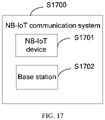
- An embodiment of the present disclosure further provides an NB-IoT communication system 1700.
- the NB-IoT communication system 1700 includes an NB-IoT device 1701 as described in the above embodiments and a base station 1702.
- the NB-IoT device is wirelessly connected to the base station to perform data transmission.
- An embodiment of the present disclosure further provides a computer-readable storage medium storing a computer program, where the computer program is executed by a processor to implement the data transmission method for an NB-IoT end in any one of the above embodiments.
- the processor may be an integrated circuit (IC) chip capable of signal processing. During the implementation, the steps of each method may be performed by using an integrated logic circuit of hardware in a processor or by using instructions in a form of software.
- the processor may be a general-purpose processor, a digital signal processor (DSP), an application-specific integrated circuit (ASIC), a field-programmable gate array (FPGA), another programmable logic device, a discrete gate or transistor logic device, or a discrete hardware component.
- DSP digital signal processor
- ASIC application-specific integrated circuit
- FPGA field-programmable gate array
- the processor can implement or execute the methods, steps and logical block diagrams disclosed in the embodiments of the present disclosure.
- the general-purpose processor may be a microprocessor, any conventional processor, or the like.
- the steps of the methods disclosed with reference to the embodiments of the present disclosure may be directly executed by a hardware decoding processor, or executed by a combination of hardware and software modules in the decoding processor.
- the software module may be located in a mature storage medium in the art, such as a random access memory, a flash memory, a read-only memory, a programmable read-only memory, an electrically erasable programmable memory, or a register.
- the storage medium is located in a memory.
- the processor reads information in the memory, and completes the steps of the foregoing methods in combination with hardware in the processor.
- the memory in the embodiments of the present disclosure may be a volatile memory or a non-volatile memory, or may include both a volatile memory and a non-volatile memory.
- the non-volatile memory may be a read-only memory (ROM), a programmable ROM (PROM), an erasable PROM (EPROM), an electrically EPROM (EEPROM), or a flash memory.
- the volatile memory may be a random access memory (RAM), which is used as an external cache.
- RAMs of many forms are available, for example, a static RAM (SRAM), a dynamic RAM (DRAM), a synchronous DRAM (SDRAM), a double data rate SDRAM (DDR SDRAM), an enhanced SDRAM (ESDRAM), synchlink DRAM (SLDRAM), and a direct rambus RAM (DRRAM).
- SRAM static RAM
- DRAM dynamic RAM
- SDRAM synchronous DRAM
- DDR SDRAM double data rate SDRAM
- ESDRAM enhanced SDRAM
- SLDRAM synchlink DRAM
- DRRAM direct rambus RAM
- B corresponding to A means that B is associated with A, and B can be determined based on A. It should also be understood that determining B based on A means that B not only can be determined only based on A, and but also can be determined based on A and/or other information.
- the disclosed systems, apparatuses, and methods may be implemented in other manners.
- the described apparatus embodiments are merely examples.
- the unit division is merely logical function division and may be other division in actual implementation.
- a plurality of units or components may be combined or integrated into another system, or some features may be ignored or not performed.
- the displayed or discussed mutual couplings or direct couplings or communication connections may be implemented through some interfaces.
- the indirect couplings or communication connections between the apparatuses or units may be implemented in electrical, mechanical, or other forms.
- the units described as separate parts may or may not be physically separate. Parts shown as units may or may not be physical units, which may be located in one position, or may be distributed on a plurality of network units. Some or all of the units may be selected according to actual requirements to achieve the objectives of the solutions in the embodiments.
- functional units in the embodiments of the present disclosure may be integrated into one processing unit, or each of the units may exist alone physically, or two or more units are integrated into one unit.
- the computer software product is stored on a storage medium, and includes several instructions to enable a computer device (which may be a personal computer, a server, a network device, or the like) to execute all or some steps of the methods according to the embodiments of the present disclosure.
- the foregoing storage medium includes any medium that can store program code, such as a USB flash drive, a removable hard disk, a read-only memory (ROM), a random access memory (RAM), a magnetic disk, or an optical disc.
Landscapes
- Engineering & Computer Science (AREA)
- Computer Networks & Wireless Communication (AREA)
- Signal Processing (AREA)
- Mobile Radio Communication Systems (AREA)
- Computer And Data Communications (AREA)
Applications Claiming Priority (1)
| Application Number | Priority Date | Filing Date | Title |
|---|---|---|---|
| CN202110455170.9A CN112996136B (zh) | 2021-04-26 | 2021-04-26 | 一种nb-iot端的数据传输方法、nb-iot芯片、设备及通信系统 |
Publications (2)
| Publication Number | Publication Date |
|---|---|
| EP4084566A1 true EP4084566A1 (fr) | 2022-11-02 |
| EP4084566B1 EP4084566B1 (fr) | 2023-08-09 |
Family
ID=76340287
Family Applications (1)
| Application Number | Title | Priority Date | Filing Date |
|---|---|---|---|
| EP21218069.9A Active EP4084566B1 (fr) | 2021-04-26 | 2021-12-29 | Procédé de transmission de données pour extrémité nb-iot et puce nb-iot, dispositif et système de communication |
Country Status (2)
| Country | Link |
|---|---|
| EP (1) | EP4084566B1 (fr) |
| CN (2) | CN112996136B (fr) |
Families Citing this family (3)
| Publication number | Priority date | Publication date | Assignee | Title |
|---|---|---|---|---|
| CN113556827B (zh) * | 2021-06-22 | 2023-05-26 | 深圳市汇顶科技股份有限公司 | 一种nb-iot端的数据传输方法、nb-iot芯片、设备及通信系统 |
| CN113473643B (zh) * | 2021-07-02 | 2023-07-11 | 深圳市汇顶科技股份有限公司 | 一种nb-iot端的数据传输方法、nb-iot芯片、设备及通信系统 |
| CN113792744B (zh) * | 2021-09-14 | 2023-09-05 | 东北农业大学 | 一种低功耗广域网内农作物生长数据传输系统及方法 |
Citations (4)
| Publication number | Priority date | Publication date | Assignee | Title |
|---|---|---|---|---|
| WO2016190711A1 (fr) * | 2015-05-27 | 2016-12-01 | Samsung Electronics Co., Ltd. | Procédé de gestion d'indication de niveau d'extension de couverture (ce) |
| CN109803302A (zh) * | 2017-11-15 | 2019-05-24 | 中国移动通信有限公司研究院 | 覆盖增强等级的确定方法、设备和计算机可读存储介质 |
| WO2020187386A1 (fr) * | 2019-03-15 | 2020-09-24 | Telefonaktiebolaget Lm Ericsson (Publ) | Technique de communication radio avec différents niveaux de couverture |
| US20200329506A1 (en) * | 2018-01-31 | 2020-10-15 | Zte Corporation | Information transmission method, and base station, terminal and computer-readable storage medium |
Family Cites Families (4)
| Publication number | Priority date | Publication date | Assignee | Title |
|---|---|---|---|---|
| CN110636567B (zh) * | 2018-06-22 | 2022-11-22 | 中兴通讯股份有限公司 | 一种切换评估、报告方法、装置及基站 |
| CN112567701B (zh) * | 2018-08-09 | 2024-04-02 | Lg电子株式会社 | 在无线通信系统中由终端估计信道的方法及其装置 |
| EP3735049A1 (fr) * | 2019-04-30 | 2020-11-04 | Comcast Cable Communications LLC | Communications sans fil pour configuration d'accès à un réseau |
| CN110234151B (zh) * | 2019-05-05 | 2021-03-12 | 中国联合网络通信集团有限公司 | 一种终端接入方法及装置 |
-
2021
- 2021-04-26 CN CN202110455170.9A patent/CN112996136B/zh active Active
- 2021-04-26 CN CN202111038668.1A patent/CN113873673B/zh active Active
- 2021-12-29 EP EP21218069.9A patent/EP4084566B1/fr active Active
Patent Citations (4)
| Publication number | Priority date | Publication date | Assignee | Title |
|---|---|---|---|---|
| WO2016190711A1 (fr) * | 2015-05-27 | 2016-12-01 | Samsung Electronics Co., Ltd. | Procédé de gestion d'indication de niveau d'extension de couverture (ce) |
| CN109803302A (zh) * | 2017-11-15 | 2019-05-24 | 中国移动通信有限公司研究院 | 覆盖增强等级的确定方法、设备和计算机可读存储介质 |
| US20200329506A1 (en) * | 2018-01-31 | 2020-10-15 | Zte Corporation | Information transmission method, and base station, terminal and computer-readable storage medium |
| WO2020187386A1 (fr) * | 2019-03-15 | 2020-09-24 | Telefonaktiebolaget Lm Ericsson (Publ) | Technique de communication radio avec différents niveaux de couverture |
Also Published As
| Publication number | Publication date |
|---|---|
| CN112996136A (zh) | 2021-06-18 |
| CN113873673B (zh) | 2022-09-13 |
| EP4084566B1 (fr) | 2023-08-09 |
| CN112996136B (zh) | 2021-09-28 |
| CN113873673A (zh) | 2021-12-31 |
Similar Documents
| Publication | Publication Date | Title |
|---|---|---|
| US12127146B2 (en) | Enhancing timing advance validity in preconfigured uplink resource for wireless networks | |
| RU2711033C1 (ru) | Способы и устройства обеспечения покрытия лучом устройства связи, работающего в сети беспроводной связи | |
| US20200163074A1 (en) | Beam selection method and device | |
| EP2815604B1 (fr) | Procédés et dispositifs permettant d'adapter des procédures de gestion de ressources dans des réseaux de communication hétérogènes | |
| EP4084566B1 (fr) | Procédé de transmission de données pour extrémité nb-iot et puce nb-iot, dispositif et système de communication | |
| US12574841B2 (en) | Adjusting power consumption in a telecommunications network based on traffic prediction | |
| US10659978B1 (en) | Use of UE type as basis to control whether to use blind addition or rather threshold-based addition when configuring dual connectivity | |
| US12513605B2 (en) | Methods, apparatus and systems for configuring micro service areas in a wireless communication | |
| WO2018232696A1 (fr) | Procédé et dispositif de communication | |
| US20230309134A1 (en) | Resource selection coordination for new radio (nr) sidelink (sl) | |
| EP3753328B1 (fr) | Système et procédé pour effectuer des communications dans un réseau multi-rat | |
| CN104159242A (zh) | 通信方法、基站和用户设备 | |
| CN118157830A (zh) | 补充上行载波配置信息传递的方法及设备 | |
| CN109076411B (zh) | 改进的小区重选过程 | |
| EP2979488B1 (fr) | Méthode de lancement de transfert, dispositif sans fil et station de base | |
| WO2021213136A1 (fr) | Procédé de communication et dispositif terminal | |
| US20240014874A1 (en) | Wireless communication method and apparatus, device, and storage medium | |
| US11265943B1 (en) | Use of fading as basis to control whether to use blind addition or rather threshold-based addition when configuring dual connectivity | |
| CN113473643B (zh) | 一种nb-iot端的数据传输方法、nb-iot芯片、设备及通信系统 | |
| WO2023206272A1 (fr) | Procédé et appareil d'envoi d'informations de faisceau, procédé et appareil de réception d'informations de faisceau et système de communication | |
| US11445436B2 (en) | Cell selection and resource allocation thresholds | |
| CN115604697A (zh) | 通信方法和通信设备 | |
| CN113556827B (zh) | 一种nb-iot端的数据传输方法、nb-iot芯片、设备及通信系统 | |
| WO2022226729A1 (fr) | Procédé de transmission de données pour extrémité nb-ido et puce nb-ido, dispositif nb-ido et système de communication nb-ido | |
| KR20250083375A (ko) | 전송속도 기반의 셀 선택을 위한 방법 및 장치 |
Legal Events
| Date | Code | Title | Description |
|---|---|---|---|
| PUAI | Public reference made under article 153(3) epc to a published international application that has entered the european phase |
Free format text: ORIGINAL CODE: 0009012 |
|
| STAA | Information on the status of an ep patent application or granted ep patent |
Free format text: STATUS: REQUEST FOR EXAMINATION WAS MADE |
|
| 17P | Request for examination filed |
Effective date: 20211230 |
|
| AK | Designated contracting states |
Kind code of ref document: A1 Designated state(s): AL AT BE BG CH CY CZ DE DK EE ES FI FR GB GR HR HU IE IS IT LI LT LU LV MC MK MT NL NO PL PT RO RS SE SI SK SM TR |
|
| GRAP | Despatch of communication of intention to grant a patent |
Free format text: ORIGINAL CODE: EPIDOSNIGR1 |
|
| STAA | Information on the status of an ep patent application or granted ep patent |
Free format text: STATUS: GRANT OF PATENT IS INTENDED |
|
| RIC1 | Information provided on ipc code assigned before grant |
Ipc: H04W 76/10 20180101ALN20230214BHEP Ipc: H04W 24/08 20090101ALI20230214BHEP Ipc: H04W 74/08 20090101AFI20230214BHEP |
|
| INTG | Intention to grant announced |
Effective date: 20230307 |
|
| GRAS | Grant fee paid |
Free format text: ORIGINAL CODE: EPIDOSNIGR3 |
|
| GRAA | (expected) grant |
Free format text: ORIGINAL CODE: 0009210 |
|
| STAA | Information on the status of an ep patent application or granted ep patent |
Free format text: STATUS: THE PATENT HAS BEEN GRANTED |
|
| AK | Designated contracting states |
Kind code of ref document: B1 Designated state(s): AL AT BE BG CH CY CZ DE DK EE ES FI FR GB GR HR HU IE IS IT LI LT LU LV MC MK MT NL NO PL PT RO RS SE SI SK SM TR |
|
| REG | Reference to a national code |
Ref country code: GB Ref legal event code: FG4D |
|
| REG | Reference to a national code |
Ref country code: CH Ref legal event code: EP |
|
| REG | Reference to a national code |
Ref country code: IE Ref legal event code: FG4D |
|
| REG | Reference to a national code |
Ref country code: DE Ref legal event code: R096 Ref document number: 602021004167 Country of ref document: DE |
|
| REG | Reference to a national code |
Ref country code: LT Ref legal event code: MG9D |
|
| REG | Reference to a national code |
Ref country code: NL Ref legal event code: MP Effective date: 20230809 |
|
| REG | Reference to a national code |
Ref country code: AT Ref legal event code: MK05 Ref document number: 1598998 Country of ref document: AT Kind code of ref document: T Effective date: 20230809 |
|
| PG25 | Lapsed in a contracting state [announced via postgrant information from national office to epo] |
Ref country code: GR Free format text: LAPSE BECAUSE OF FAILURE TO SUBMIT A TRANSLATION OF THE DESCRIPTION OR TO PAY THE FEE WITHIN THE PRESCRIBED TIME-LIMIT Effective date: 20231110 |
|
| PG25 | Lapsed in a contracting state [announced via postgrant information from national office to epo] |
Ref country code: IS Free format text: LAPSE BECAUSE OF FAILURE TO SUBMIT A TRANSLATION OF THE DESCRIPTION OR TO PAY THE FEE WITHIN THE PRESCRIBED TIME-LIMIT Effective date: 20231209 |
|
| PG25 | Lapsed in a contracting state [announced via postgrant information from national office to epo] |
Ref country code: SE Free format text: LAPSE BECAUSE OF FAILURE TO SUBMIT A TRANSLATION OF THE DESCRIPTION OR TO PAY THE FEE WITHIN THE PRESCRIBED TIME-LIMIT Effective date: 20230809 Ref country code: RS Free format text: LAPSE BECAUSE OF FAILURE TO SUBMIT A TRANSLATION OF THE DESCRIPTION OR TO PAY THE FEE WITHIN THE PRESCRIBED TIME-LIMIT Effective date: 20230809 Ref country code: PT Free format text: LAPSE BECAUSE OF FAILURE TO SUBMIT A TRANSLATION OF THE DESCRIPTION OR TO PAY THE FEE WITHIN THE PRESCRIBED TIME-LIMIT Effective date: 20231211 Ref country code: NO Free format text: LAPSE BECAUSE OF FAILURE TO SUBMIT A TRANSLATION OF THE DESCRIPTION OR TO PAY THE FEE WITHIN THE PRESCRIBED TIME-LIMIT Effective date: 20231109 Ref country code: NL Free format text: LAPSE BECAUSE OF FAILURE TO SUBMIT A TRANSLATION OF THE DESCRIPTION OR TO PAY THE FEE WITHIN THE PRESCRIBED TIME-LIMIT Effective date: 20230809 Ref country code: LV Free format text: LAPSE BECAUSE OF FAILURE TO SUBMIT A TRANSLATION OF THE DESCRIPTION OR TO PAY THE FEE WITHIN THE PRESCRIBED TIME-LIMIT Effective date: 20230809 Ref country code: LT Free format text: LAPSE BECAUSE OF FAILURE TO SUBMIT A TRANSLATION OF THE DESCRIPTION OR TO PAY THE FEE WITHIN THE PRESCRIBED TIME-LIMIT Effective date: 20230809 Ref country code: IS Free format text: LAPSE BECAUSE OF FAILURE TO SUBMIT A TRANSLATION OF THE DESCRIPTION OR TO PAY THE FEE WITHIN THE PRESCRIBED TIME-LIMIT Effective date: 20231209 Ref country code: HR Free format text: LAPSE BECAUSE OF FAILURE TO SUBMIT A TRANSLATION OF THE DESCRIPTION OR TO PAY THE FEE WITHIN THE PRESCRIBED TIME-LIMIT Effective date: 20230809 Ref country code: GR Free format text: LAPSE BECAUSE OF FAILURE TO SUBMIT A TRANSLATION OF THE DESCRIPTION OR TO PAY THE FEE WITHIN THE PRESCRIBED TIME-LIMIT Effective date: 20231110 Ref country code: FI Free format text: LAPSE BECAUSE OF FAILURE TO SUBMIT A TRANSLATION OF THE DESCRIPTION OR TO PAY THE FEE WITHIN THE PRESCRIBED TIME-LIMIT Effective date: 20230809 Ref country code: AT Free format text: LAPSE BECAUSE OF FAILURE TO SUBMIT A TRANSLATION OF THE DESCRIPTION OR TO PAY THE FEE WITHIN THE PRESCRIBED TIME-LIMIT Effective date: 20230809 |
|
| PG25 | Lapsed in a contracting state [announced via postgrant information from national office to epo] |
Ref country code: PL Free format text: LAPSE BECAUSE OF FAILURE TO SUBMIT A TRANSLATION OF THE DESCRIPTION OR TO PAY THE FEE WITHIN THE PRESCRIBED TIME-LIMIT Effective date: 20230809 |
|
| PG25 | Lapsed in a contracting state [announced via postgrant information from national office to epo] |
Ref country code: ES Free format text: LAPSE BECAUSE OF FAILURE TO SUBMIT A TRANSLATION OF THE DESCRIPTION OR TO PAY THE FEE WITHIN THE PRESCRIBED TIME-LIMIT Effective date: 20230809 |
|
| PG25 | Lapsed in a contracting state [announced via postgrant information from national office to epo] |
Ref country code: SM Free format text: LAPSE BECAUSE OF FAILURE TO SUBMIT A TRANSLATION OF THE DESCRIPTION OR TO PAY THE FEE WITHIN THE PRESCRIBED TIME-LIMIT Effective date: 20230809 Ref country code: RO Free format text: LAPSE BECAUSE OF FAILURE TO SUBMIT A TRANSLATION OF THE DESCRIPTION OR TO PAY THE FEE WITHIN THE PRESCRIBED TIME-LIMIT Effective date: 20230809 Ref country code: ES Free format text: LAPSE BECAUSE OF FAILURE TO SUBMIT A TRANSLATION OF THE DESCRIPTION OR TO PAY THE FEE WITHIN THE PRESCRIBED TIME-LIMIT Effective date: 20230809 Ref country code: EE Free format text: LAPSE BECAUSE OF FAILURE TO SUBMIT A TRANSLATION OF THE DESCRIPTION OR TO PAY THE FEE WITHIN THE PRESCRIBED TIME-LIMIT Effective date: 20230809 Ref country code: DK Free format text: LAPSE BECAUSE OF FAILURE TO SUBMIT A TRANSLATION OF THE DESCRIPTION OR TO PAY THE FEE WITHIN THE PRESCRIBED TIME-LIMIT Effective date: 20230809 Ref country code: CZ Free format text: LAPSE BECAUSE OF FAILURE TO SUBMIT A TRANSLATION OF THE DESCRIPTION OR TO PAY THE FEE WITHIN THE PRESCRIBED TIME-LIMIT Effective date: 20230809 Ref country code: SK Free format text: LAPSE BECAUSE OF FAILURE TO SUBMIT A TRANSLATION OF THE DESCRIPTION OR TO PAY THE FEE WITHIN THE PRESCRIBED TIME-LIMIT Effective date: 20230809 |
|
| REG | Reference to a national code |
Ref country code: DE Ref legal event code: R097 Ref document number: 602021004167 Country of ref document: DE |
|
| PG25 | Lapsed in a contracting state [announced via postgrant information from national office to epo] |
Ref country code: IT Free format text: LAPSE BECAUSE OF FAILURE TO SUBMIT A TRANSLATION OF THE DESCRIPTION OR TO PAY THE FEE WITHIN THE PRESCRIBED TIME-LIMIT Effective date: 20230809 |
|
| PLBE | No opposition filed within time limit |
Free format text: ORIGINAL CODE: 0009261 |
|
| STAA | Information on the status of an ep patent application or granted ep patent |
Free format text: STATUS: NO OPPOSITION FILED WITHIN TIME LIMIT |
|
| 26N | No opposition filed |
Effective date: 20240513 |
|
| PG25 | Lapsed in a contracting state [announced via postgrant information from national office to epo] |
Ref country code: SI Free format text: LAPSE BECAUSE OF FAILURE TO SUBMIT A TRANSLATION OF THE DESCRIPTION OR TO PAY THE FEE WITHIN THE PRESCRIBED TIME-LIMIT Effective date: 20230809 |
|
| PG25 | Lapsed in a contracting state [announced via postgrant information from national office to epo] |
Ref country code: LU Free format text: LAPSE BECAUSE OF NON-PAYMENT OF DUE FEES Effective date: 20231229 |
|
| PG25 | Lapsed in a contracting state [announced via postgrant information from national office to epo] |
Ref country code: MC Free format text: LAPSE BECAUSE OF FAILURE TO SUBMIT A TRANSLATION OF THE DESCRIPTION OR TO PAY THE FEE WITHIN THE PRESCRIBED TIME-LIMIT Effective date: 20230809 |
|
| REG | Reference to a national code |
Ref country code: BE Ref legal event code: MM Effective date: 20231231 |
|
| PG25 | Lapsed in a contracting state [announced via postgrant information from national office to epo] |
Ref country code: MC Free format text: LAPSE BECAUSE OF FAILURE TO SUBMIT A TRANSLATION OF THE DESCRIPTION OR TO PAY THE FEE WITHIN THE PRESCRIBED TIME-LIMIT Effective date: 20230809 Ref country code: LU Free format text: LAPSE BECAUSE OF NON-PAYMENT OF DUE FEES Effective date: 20231229 |
|
| REG | Reference to a national code |
Ref country code: IE Ref legal event code: MM4A |
|
| PG25 | Lapsed in a contracting state [announced via postgrant information from national office to epo] |
Ref country code: IE Free format text: LAPSE BECAUSE OF NON-PAYMENT OF DUE FEES Effective date: 20231229 |
|
| PG25 | Lapsed in a contracting state [announced via postgrant information from national office to epo] |
Ref country code: BE Free format text: LAPSE BECAUSE OF NON-PAYMENT OF DUE FEES Effective date: 20231231 |
|
| PG25 | Lapsed in a contracting state [announced via postgrant information from national office to epo] |
Ref country code: IE Free format text: LAPSE BECAUSE OF NON-PAYMENT OF DUE FEES Effective date: 20231229 Ref country code: BE Free format text: LAPSE BECAUSE OF NON-PAYMENT OF DUE FEES Effective date: 20231231 |
|
| PG25 | Lapsed in a contracting state [announced via postgrant information from national office to epo] |
Ref country code: BG Free format text: LAPSE BECAUSE OF FAILURE TO SUBMIT A TRANSLATION OF THE DESCRIPTION OR TO PAY THE FEE WITHIN THE PRESCRIBED TIME-LIMIT Effective date: 20230809 |
|
| PG25 | Lapsed in a contracting state [announced via postgrant information from national office to epo] |
Ref country code: BG Free format text: LAPSE BECAUSE OF FAILURE TO SUBMIT A TRANSLATION OF THE DESCRIPTION OR TO PAY THE FEE WITHIN THE PRESCRIBED TIME-LIMIT Effective date: 20230809 |
|
| PG25 | Lapsed in a contracting state [announced via postgrant information from national office to epo] |
Ref country code: CY Free format text: LAPSE BECAUSE OF FAILURE TO SUBMIT A TRANSLATION OF THE DESCRIPTION OR TO PAY THE FEE WITHIN THE PRESCRIBED TIME-LIMIT; INVALID AB INITIO Effective date: 20211229 |
|
| REG | Reference to a national code |
Ref country code: CH Ref legal event code: PL |
|
| PG25 | Lapsed in a contracting state [announced via postgrant information from national office to epo] |
Ref country code: CH Free format text: LAPSE BECAUSE OF NON-PAYMENT OF DUE FEES Effective date: 20241231 |
|
| PG25 | Lapsed in a contracting state [announced via postgrant information from national office to epo] |
Ref country code: TR Free format text: LAPSE BECAUSE OF FAILURE TO SUBMIT A TRANSLATION OF THE DESCRIPTION OR TO PAY THE FEE WITHIN THE PRESCRIBED TIME-LIMIT Effective date: 20230809 |
|
| PGFP | Annual fee paid to national office [announced via postgrant information from national office to epo] |
Ref country code: DE Payment date: 20251210 Year of fee payment: 5 |
|
| PGFP | Annual fee paid to national office [announced via postgrant information from national office to epo] |
Ref country code: GB Payment date: 20251211 Year of fee payment: 5 |
|
| PGFP | Annual fee paid to national office [announced via postgrant information from national office to epo] |
Ref country code: FR Payment date: 20251208 Year of fee payment: 5 |