EP4084671B1 - Système permettant de détecter et de classer des segments de signaux à partir d'enregistrements eeg - Google Patents
Système permettant de détecter et de classer des segments de signaux à partir d'enregistrements eeg Download PDFInfo
- Publication number
- EP4084671B1 EP4084671B1 EP20807439.3A EP20807439A EP4084671B1 EP 4084671 B1 EP4084671 B1 EP 4084671B1 EP 20807439 A EP20807439 A EP 20807439A EP 4084671 B1 EP4084671 B1 EP 4084671B1
- Authority
- EP
- European Patent Office
- Prior art keywords
- target
- signal
- target signal
- segment
- segments
- Prior art date
- Legal status (The legal status is an assumption and is not a legal conclusion. Google has not performed a legal analysis and makes no representation as to the accuracy of the status listed.)
- Active
Links
Images
Classifications
-
- A—HUMAN NECESSITIES
- A61—MEDICAL OR VETERINARY SCIENCE; HYGIENE
- A61B—DIAGNOSIS; SURGERY; IDENTIFICATION
- A61B5/00—Measuring for diagnostic purposes; Identification of persons
- A61B5/0002—Remote monitoring of patients using telemetry, e.g. transmission of vital signals via a communication network
- A61B5/0004—Remote monitoring of patients using telemetry, e.g. transmission of vital signals via a communication network characterised by the type of physiological signal transmitted
- A61B5/0006—ECG or EEG signals
-
- A—HUMAN NECESSITIES
- A61—MEDICAL OR VETERINARY SCIENCE; HYGIENE
- A61B—DIAGNOSIS; SURGERY; IDENTIFICATION
- A61B5/00—Measuring for diagnostic purposes; Identification of persons
- A61B5/24—Detecting, measuring or recording bioelectric or biomagnetic signals of the body or parts thereof
- A61B5/316—Modalities, i.e. specific diagnostic methods
- A61B5/369—Electroencephalography [EEG]
-
- A—HUMAN NECESSITIES
- A61—MEDICAL OR VETERINARY SCIENCE; HYGIENE
- A61B—DIAGNOSIS; SURGERY; IDENTIFICATION
- A61B5/00—Measuring for diagnostic purposes; Identification of persons
- A61B5/24—Detecting, measuring or recording bioelectric or biomagnetic signals of the body or parts thereof
- A61B5/316—Modalities, i.e. specific diagnostic methods
- A61B5/369—Electroencephalography [EEG]
- A61B5/372—Analysis of electroencephalograms
-
- A—HUMAN NECESSITIES
- A61—MEDICAL OR VETERINARY SCIENCE; HYGIENE
- A61B—DIAGNOSIS; SURGERY; IDENTIFICATION
- A61B5/00—Measuring for diagnostic purposes; Identification of persons
- A61B5/40—Detecting, measuring or recording for evaluating the nervous system
- A61B5/4058—Detecting, measuring or recording for evaluating the nervous system for evaluating the central nervous system
- A61B5/4064—Evaluating the brain
-
- A—HUMAN NECESSITIES
- A61—MEDICAL OR VETERINARY SCIENCE; HYGIENE
- A61B—DIAGNOSIS; SURGERY; IDENTIFICATION
- A61B5/00—Measuring for diagnostic purposes; Identification of persons
- A61B5/72—Signal processing specially adapted for physiological signals or for diagnostic purposes
- A61B5/7221—Determining signal validity, reliability or quality
-
- A—HUMAN NECESSITIES
- A61—MEDICAL OR VETERINARY SCIENCE; HYGIENE
- A61B—DIAGNOSIS; SURGERY; IDENTIFICATION
- A61B5/00—Measuring for diagnostic purposes; Identification of persons
- A61B5/72—Signal processing specially adapted for physiological signals or for diagnostic purposes
- A61B5/7235—Details of waveform analysis
- A61B5/7253—Details of waveform analysis characterised by using transforms
- A61B5/726—Details of waveform analysis characterised by using transforms using Wavelet transforms
-
- A—HUMAN NECESSITIES
- A61—MEDICAL OR VETERINARY SCIENCE; HYGIENE
- A61B—DIAGNOSIS; SURGERY; IDENTIFICATION
- A61B5/00—Measuring for diagnostic purposes; Identification of persons
- A61B5/72—Signal processing specially adapted for physiological signals or for diagnostic purposes
- A61B5/7235—Details of waveform analysis
- A61B5/7264—Classification of physiological signals or data, e.g. using neural networks, statistical classifiers, expert systems or fuzzy systems
- A61B5/7267—Classification of physiological signals or data, e.g. using neural networks, statistical classifiers, expert systems or fuzzy systems involving training the classification device
-
- A—HUMAN NECESSITIES
- A61—MEDICAL OR VETERINARY SCIENCE; HYGIENE
- A61B—DIAGNOSIS; SURGERY; IDENTIFICATION
- A61B5/00—Measuring for diagnostic purposes; Identification of persons
- A61B5/72—Signal processing specially adapted for physiological signals or for diagnostic purposes
- A61B5/7271—Specific aspects of physiological measurement analysis
- A61B5/7275—Determining trends in physiological measurement data; Predicting development of a medical condition based on physiological measurements, e.g. determining a risk factor
-
- G—PHYSICS
- G16—INFORMATION AND COMMUNICATION TECHNOLOGY [ICT] SPECIALLY ADAPTED FOR SPECIFIC APPLICATION FIELDS
- G16H—HEALTHCARE INFORMATICS, i.e. INFORMATION AND COMMUNICATION TECHNOLOGY [ICT] SPECIALLY ADAPTED FOR THE HANDLING OR PROCESSING OF MEDICAL OR HEALTHCARE DATA
- G16H50/00—ICT specially adapted for medical diagnosis, medical simulation or medical data mining; ICT specially adapted for detecting, monitoring or modelling epidemics or pandemics
- G16H50/70—ICT specially adapted for medical diagnosis, medical simulation or medical data mining; ICT specially adapted for detecting, monitoring or modelling epidemics or pandemics for mining of medical data, e.g. analysing previous cases of other patients
-
- A—HUMAN NECESSITIES
- A61—MEDICAL OR VETERINARY SCIENCE; HYGIENE
- A61B—DIAGNOSIS; SURGERY; IDENTIFICATION
- A61B5/00—Measuring for diagnostic purposes; Identification of persons
- A61B5/72—Signal processing specially adapted for physiological signals or for diagnostic purposes
- A61B5/7203—Signal processing specially adapted for physiological signals or for diagnostic purposes for noise prevention, reduction or removal
-
- A—HUMAN NECESSITIES
- A61—MEDICAL OR VETERINARY SCIENCE; HYGIENE
- A61B—DIAGNOSIS; SURGERY; IDENTIFICATION
- A61B5/00—Measuring for diagnostic purposes; Identification of persons
- A61B5/72—Signal processing specially adapted for physiological signals or for diagnostic purposes
- A61B5/7235—Details of waveform analysis
- A61B5/7253—Details of waveform analysis characterised by using transforms
- A61B5/7257—Details of waveform analysis characterised by using transforms using Fourier transforms
Definitions
- the invention relates to a system that is configured and arranged to perform a method for detecting and classifying a segment of a signal that is obtained from a single-channel EEG-recording as a target signal segment or as a non-target signal segment.
- Delirium is an acute disturbance of consciousness and cognition that usually fluctuates over time. It is a common disorder, with reported incidences of more than 60% during Intensive Care Unit (ICU) stay and over 15% on a geriatric ward or medium care unit. Delirium is associated with higher mortality, longer hospitalization, long-term cognitive impairment and increased costs. There are three different subtypes of delirium based on psychomotor behavior, i.e. hypoactive, hyperactive and mixed-type delirium.
- Various delirium assessment tools have been developed including for example the Confusion Assessment Method for the ICU (CAM-ICU) as well as methods and systems that involve electroencephalography (EEG) using for example single-channel EEG-recordings.
- CAM-ICU Confusion Assessment Method for the ICU
- EEG electroencephalography
- Document WO2020/002519A1 discloses a multi-class classification method for assessing quality of electroencephalographic (EEG) signals, which involves calculating distance between feature value of each channel of EEG signal segment and each feature value of training samples.
- the method involves receiving segments of EEG signal acquired from electrodes.
- the feature value is extracted from each channel of the EEG signal segments.
- a first classification is performed so as to assign each channel of the EEG signal segment to one of at least three quality classes.
- the first classification is performed by a k-nearest neighbours algorithm using a first training set comprising multiples training (reference) samples. Each of the training sample of the first training set is associated to one of the quality classes and to the feature value.
- the quality class which is the most frequent class among the k training samples of the first training set which are nearer to each channel of the EEG signal segment is assigned to each channel of the EEG signal segment.
- the distance is calculated between the feature value of each channel of the EEG signal segment and each feature value of the training samples.
- a disadvantage of known delirium assessment methods and systems that use single-channel EEG-recordings is that they do not provide a reliable distinction between target signal segments and non-target signal segments of a single-channel EEG-recording, in particular when the target signal segments and the non-target signal segments of the single-channel EEG-recording look alike.
- target signal segments of a single-channel EEG-recording are to be construed as signal segments that are, for example, indicative for a patient being delirious or suffering from related encephalopathy
- non-target signal segments of a single-channel EEG-recording are to be construed as signal segments that are indicative for non-target brain signals or artifacts such as for example eye artifacts, artifacts related to muscle activity, or artifacts related to a combination of such artifacts.
- a data processing method for detecting and classifying a segment of a signal that is obtained from a single-channel EEG-recording as a target signal segment or as a non-target signal segment comprising:
- the plurality of reference target signal segments and the plurality of reference non-target signal segments are obtained from signals that are obtained from single-channel EEG-recordings.
- single-channel EEG-recordings can be acquired in various known ways including for example using a differential electrode pair, using a single electrode in combination with a reference (REF) electrode or a ground (GND) electrode, or using a differential electrode pair in combination with a REF electrode or a GND electrode.
- the individual electrodes of the differential electrode pair can be positioned at specific midline frontal, e.g. Fz, midline vertex, e.g. Cz, midline parietal, e.g.
- a single-channel EEG-recording in the context of the present invention can also be a single channel from a standard 10-20 EEG montage or from any other multichannel EEG montage for that matter.
- the plurality of reference target signal segments and the plurality of reference non-target signal segments are obtained exclusively from data of a single channel.
- the single-channel EEG-recordings used to obtain the plurality of reference target signal segments and the plurality of reference non-target signal segments can have a predefined duration of for example 15 minutes.
- a predefined duration for example 15 minutes.
- any suitable predefined duration can be used as long as the acquired single-channel EEG-recordings enable obtaining suitable reference target signal segments and reference non-target signal segments.
- the reference target signal segments of the plurality of reference target signal segments can be mutually different. The same holds for the reference non-target signal segments of the plurality of non-target signal segments.
- the plurality of reference target signal segments can for example comprise more than 1000 reference target signal segments. The same holds for the plurality of non-target signal segments.
- the target parameter set that is indicative for the plurality of reference target signal segments is determined by processing and analyzing the reference target signal segments of the plurality of reference target signal segments.
- the aforementioned processing and analyzing can be done using a training process that involves a machine learning algorithm that can for example use deep neural networks.
- the processing and analyzing can for example be done in the frequency domain.
- the target parameter set can be construed as an aggregate parameter set as it comprises parameters that are indicative for the plurality of reference target signal segments.
- the target parameter set Upon determining the target parameter set, it is used to detect a first signal segment of a single-channel EEG-recording that is acquired in one of the above-mentioned ways and to classify the detected first signal segment as a target signal segment, i.e. a signal segment that is indicative for a patient being delirious or suffering from related encephalopathy. Upon detecting the first signal segment, it is marked by assigning the first time stamp to it.
- a target signal segment i.e. a signal segment that is indicative for a patient being delirious or suffering from related encephalopathy.
- the non-target parameter set that is indicative for the plurality of reference non-target signal segments is determined by processing and analyzing the reference non-target signal segments of the plurality of reference non-target signal segments.
- the aforementioned processing and analyzing can be done using another training process that involves another machine learning algorithm that can for example use deep neural networks.
- the processing and analyzing can for example be done in the frequency domain.
- the non-target parameter set can be construed as an aggregate parameter set as it comprises parameters that are indicative for the plurality of reference non-target signal segments.
- the non-target parameter set Upon determining the non-target parameter set, it is used to detect a second signal segment of the same signal that was obtained from the single-channel EEG-recording that is acquired in one of the above-mentioned ways and to classify the detected second signal segment as a non-target signal segment, i.e. a signal segment that is indicative for artifacts such as for example eye artifacts, artifacts related to muscle activity, or artifacts related to a combination of such artifacts.
- Upon detecting the second signal segment it is marked by assigning the second time stamp to it.
- determining a temporal proximity of the first time stamp and the second time stamp involves determining a time difference between the first time stamp and the second time stamp.
- the determined time difference is compared with a predefined threshold.
- the predefined threshold is chosen such that when the determined time difference between the first time stamp and the second time stamp is smaller than the threshold, it can be not likely or not possible at all that the classification of the detected first signal segment as being a target signal segment and the classification of the detected second signal segment as being a non-target signal segment can both be correct.
- the voting process is required to determine whether classification of the detected first signal segment as a target signal segment or the classification of the detected second signal segment as a non-target signal segment is correct. If the determined time difference is equal to or larger than the threshold then the classification of the detected first signal segment as being a target signal segment and the classification of the detected second signal segment as being a non-target signal segment are most likely both correct.
- any suitable predefined threshold can be chosen as long as it allows to establish whether the classification of the detected first signal segment as being a target signal segment and/or the classification of the detected second signal segment as being a non-target signal segment can be correct.
- Suitable values for the predefined threshold range between 0.25 s and 3 s.
- the threshold is 1 s.
- the voting process eliminates one of the classifications.
- the system according to the present invention can reduce false positive detections or incorrect classifications for that matter.
- an example of the data processing method for use in a system according to the present invention is a method for detecting and classifying a segment of a signal that is obtained from a single-channel EEG-recording as a target signal segment or as a non-target signal segment, the method comprising:
- performing the voting process comprises:
- matching the first signal sample with the plurality of reference target signal segments to determine the best target match can involve for example curve fitting in the time domain of the first signal sample with the plurality of reference target signal segments.
- matching the second signal sample with the plurality of reference non-target signal segments to determine the best non-target match can involve for example curve fitting in the time domain of the second signal sample with the plurality of reference non-target signal segments.
- curve fitting in the time domain may include comparing the signal shape of the first signal sample with the signal shapes of the reference target signal segments of the plurality of reference target signal segments and comparing of the signal shape of the second signal sample with the signal shapes of the reference non-target signal segments of the plurality of reference non-target signal segments.
- the curve fit resulting in for example the smallest residue can be chosen to determine the best target match and the best non-target match, respectively.
- other aspects related to the curve fitting process can of course also be regarded to determine the best target match and the best non-target match, respectively.
- curve fitting in the time domain is just an example of the analysis methods that are available to determine the best target match and the best non-target match, respectively.
- analysis methods include for example Fast Fourier Transform (FFT), linear signal analysis techniques involving determination of coherence, non-linear signal analysis techniques involving determination of phase synchronization and/or generalized synchronization, template matching, and parametric models including the use of wavelets.
- FFT Fast Fourier Transform
- linear signal analysis techniques involving determination of coherence
- non-linear signal analysis techniques involving determination of phase synchronization and/or generalized synchronization
- template matching template matching
- parametric models including the use of wavelets.
- applying metrics to the first signal sample, the best target match, the second signal sample and the best non-target match can be done in several different ways.
- a first way of doing this is by establishing and comparing a correlation in the time domain.
- a second way of doing this is by establishing and comparing a goodness of fit in the wavelet domain.
- the voting process can eliminate one of the two classifications and thereby will determine the final classification as target signal segment or as non-target signal segment. As a result, false positive classifications or incorrect detections for that matter can be reduced.
- performing the voting process comprises:
- the voting process can eliminate one of the two classifications without having to use all reference target signal segments of the plurality of reference target signal segments and all reference non-target signal segments of the plurality of reference non-target signal segments, respectively. As a result, the voting process can be performed faster.
- the method further comprises removing the classification of the detected first signal segment or the classification of the detected second signal segment that based on the voting process is incorrect.
- the voting process used in a system according to the present invention results in a so-called winner, i.e. either the classification of the detected first signal segment as being a target signal segment or the classification of the detected second signal segment as being a non-target signal segment is correct.
- the classification that in accordance with the voting process is to be regarded as incorrect will be removed.
- a predetermined detection boundary which is determined based on the target parameter set and/or the non-target parameter set, is applied that allows classification of detected signal segments as target signal segments or as non-target signal segments.
- the detection boundary can for example be a boundary plane in the feature space of wavelet coefficients that is determined by training on a labeled training set of target signal segments and non-target signal segments. In this way, another way to make a distinction between target signal segments and non-target signal segments of a single-channel EEG-recording can be provided. Hence, false positive detections or incorrect classifications for that matter can be reduced.
- a detection boundary is determined that allows classification of detected signal segments as target signal segments or as non-target signal segments.
- the target parameter set comprises wavelet coefficients that are determined using wavelet decomposition of the plurality of reference target signal segments
- the non-target parameter set comprises wavelet coefficients that are determined using wavelet decomposition of the plurality of reference non-target signal segments.
- the wavelet coefficients are determined by wavelet decomposition of the reference target signal segments of the plurality of reference target signal segments and of the reference non-target signal segments of the plurality of the reference non-target signal segments.
- a training process that involves a machine learning algorithm can be used to identify the wavelet coefficients that are most representative for the reference target signal segments and for the reference non-target signal segments, respectively.
- the machine learning algorithm can for example use deep neural networks.
- the target parameter set preferably comprises the wavelet coefficients that are most representative for the reference target signal segments and that the non-target parameter set preferably comprises the wavelet coefficients that are most representative for the reference non-target signal segments.
- the thus obtained target parameter set and the non-target parameter set can comprise statistical average values of the wavelet coefficients that are most representative for the plurality of reference target signal segments and for the plurality of reference non-target signal segments, respectively.
- the method further comprises determining an optimized target parameter set that comprises wavelet coefficients that are indicative specifically for the plurality of reference target signal segments and/or an optimized non-target parameter set that comprises wavelet coefficients that are indicative specifically for the plurality of reference non-target signal segments.
- Determination of the optimized target parameter set and the optimized non-target parameter set can be achieved in several ways.
- a first way of doing this involves comparing of the wavelet coefficients of the target parameter set and the wavelet coefficients of the non-target parameter set, wherein wavelet coefficients that occur both in the target parameter set and in the non-target parameter set are removed from the target parameter set and/or from the non-target parameter set. In this way, overlap between the target parameter set and the non-target parameter set can be reduced.
- a second way of determining the optimized target parameter set and the optimized non-target parameter set involves using the resulting sensitivity and specificity of a system, e.g. a classifier unit, that is adapted to classify a detected first signal segment as being a target signal segment and a detected second signal segment as being a non-target signal segment.
- a system e.g. a classifier unit
- the thus optimized target parameter set and non-target parameter set enable an improved distinction between target signal segments and non-target signal segments of a single-channel EEG-recording. Hence, false positive detections or incorrect classifications for that matter can be reduced.
- a detection boundary is determined that allows improved classification of detected signal segments as target signal segments or as non-target signal segments. In this way, an improved distinction between target signal segments and non-target signal segments of a single-channel EEG-recording can be achieved. Hence, false positive detections or incorrect classifications for that matter can be reduced.
- a device is provided that is configured and arranged to be used with the system according to the invention that is configured and arranged to detect and classify a segment of a signal that is obtained from a single-channel EEG-recording as a target signal segment or as a non-target signal segment, the device having a database comprising at least one of:
- the device can be construed as a detector that comprises dedicated parameter sets, i.e. the target parameter set that is indicative for the plurality of reference target signal segments and the non-target parameter set that is indicative for the plurality of reference non-target signal segments, wherein the dedicated parameter sets can be obtained via respective training processes as described above that may involve respective machine learning algorithms that may use respective deep neural networks.
- the device enables an improved distinction between target signal segments and non-target signal segments of a signal that is obtained from a single-channel EEG-recording. As a result, false positive detections or incorrect classifications for that matter as discussed above can be reduced.
- a system is provided that is configured and arranged to detect and classify a segment of a signal that is obtained from a single-channel EEG-recording as a target signal segment or as a non-target signal segment, the system comprising a processor that is configured and arranged to perform the method for use in a system according to the present invention on said signal when being operatively connected to the device for use in the system according to the present invention.
- the system and the device when being operatively connected can be used to achieve an improved distinction between target signal segments and non-target signal segments of a signal that is obtained from a single-channel EEG-recording.
- false positive detections or incorrect classifications for that matter as discussed above can be reduced.
- the device and the system can be implemented as separate units. However, the device and the system can also be implemented as an integrated unit.
- a system is provided that is configured and arranged to detect and classify a segment of a signal that is obtained from a single-channel EEG-recording as a target signal segment or as a non-target signal segment, the system comprising a processor that is configured and arranged to perform on said signal when being operatively connected to a device having a database, the process steps of:
- the plurality of reference target signal segments and the plurality of reference non-target signal segments are obtained from signals that are obtained from single-channel EEG-recordings.
- single-channel EEG-recordings can be acquired in various known ways including for example using a differential electrode pair, using a single electrode in combination with a reference (REF) electrode or a ground (GND) electrode, or using a differential electrode pair in combination with a REF electrode or a GND electrode.
- the individual electrodes of the differential electrode pair can be positioned at specific midline frontal, e.g. Fz, midline vertex, e.g. Cz, midline parietal, e.g.
- the single-channel EEG-recordings used to obtain the plurality of reference target signal segments and the plurality of reference non-target signal segments can have a predefined duration of for example 15 minutes. However, the person skilled in the art will appreciate that any suitable predefined duration can be used as long as the acquired single-channel EEG-recordings enable obtaining suitable reference target signal segments and reference non-target signal segments.
- the reference target signal segments of the plurality of reference target signal segments can be mutually different. The same holds for the reference non-target signal segments of the plurality of non-target signal segments.
- the plurality of reference target signal segments can for example comprise more than 1000 reference target signal segments. The same holds for the plurality of non-target signal segments.
- the target parameter set that is indicative for the plurality of reference target signal segments can be determined by processing and analyzing the reference target signal segments of the plurality of reference target signal segments.
- the aforementioned processing and analyzing can be done using a training process that involves a machine learning algorithm that can for example use deep neural networks.
- the processing and analyzing can for example be done in the frequency domain.
- the target parameter set can be construed as an aggregate parameter set as it comprises parameters that are indicative for the plurality of reference target signal segments.
- the target parameter set comprises wavelet coefficients that are determined using wavelet decomposition of the plurality of reference target signal segments.
- the target parameter set Upon determining the target parameter set, it is be used to detect a first signal segment of a single-channel EEG-recording that is acquired in one of the above-mentioned ways and to classify the detected first signal segment as a target signal segment, i.e. a signal segment that is indicative for a patient being delirious or suffering from related encephalopathy. Upon detecting the first signal segment, it is marked by assigning the first time stamp to it.
- the non-target parameter set that is indicative for the plurality of reference non-target signal segments is determined by processing and analyzing the reference non-target signal segments of the plurality of reference non-target signal segments.
- the aforementioned processing and analyzing can be done using another training process that involves another machine learning algorithm that can for example use deep neural networks.
- the processing and analyzing can for example be done in the frequency domain.
- the non-target parameter set can be construed as an aggregate parameter set as it comprises parameters that are indicative for the plurality of reference non-target signal segments.
- the non-target parameter set comprises wavelet coefficients that are determined using wavelet decomposition of the plurality of reference non-target signal segments.
- the wavelet coefficients can be determined by wavelet decomposition of the reference target signal segments of the plurality of reference target signal segments and of the reference non-target signal segments of the plurality of the reference non-target signal segments.
- a training process that involves a machine learning algorithm can be used to identify the wavelet coefficients that are most representative for the reference target signal segments and for the reference non-target signal segments, respectively.
- the machine learning algorithm can for example use deep neural networks.
- the target parameter set preferably comprises the wavelet coefficients that are most representative for the reference target signal segments and that the non-target parameter set preferably comprises the wavelet coefficients that are most representative for the reference non-target signal segments.
- the thus obtained target parameter set and the non-target parameter set can comprise statistical average values of the wavelet coefficients that are most representative for the plurality of reference target signal segments and for the plurality of reference non-target signal segments, respectively.
- the non-target parameter set Upon determining the non-target parameter set, it is used to detect a second signal segment of the same signal that was obtained from the single-channel EEG-recording that is acquired in one of the above-mentioned ways and to classify the detected second signal segment as a non-target signal segment, i.e. a signal segment that is indicative for artifacts such as for example eye artifacts, artifacts related to muscle activity, or artifacts related to a combination of such artifacts.
- a non-target signal segment i.e. a signal segment that is indicative for artifacts such as for example eye artifacts, artifacts related to muscle activity, or artifacts related to a combination of such artifacts.
- determining a temporal proximity of the first time stamp and the second time stamp can be done in several different ways.
- a first exemplary way of doing this involves dividing the obtained first signal in time intervals of a predefined length.
- the time intervals have a predefined equal length. These time intervals can be referred to as bins.
- the time intervals or bins have a predefined equal length.
- the predefined length of the time intervals can be chosen depending on specific requirements such as desired accuracy. Suitable predefined lengths of the time intervals range between 0.25 s and 3 s.
- the time intervals have a predefined length of 1 s. Determining the temporal proximity of the first time stamp and the second time stamp is based on establishing if the first time stamp and the second time stamp fall within the same time interval or not.
- the voting process is required and will be performed to determine whether classification of the detected first signal segment as a target signal segment or classification of the detected second signal segment as a non-target signal segment is correct. If the first time stamp and the second time stamp fall in different time intervals, i.e. the first time stamp and the second time stamp do not fall within the same bin, then the voting process is not required and preferably the voting process is not performed. In this case, the classification of the detected first signal segment as being a target signal segment and the classification of the detected second signal segment as being a non-target signal segment are most likely both correct.
- a second way of determining the temporal proximity of the first time stamp and the second time stamp involves determining a time difference between the first time stamp and the second time stamp.
- the determined time difference is compared with a predefined threshold.
- the predefined threshold is chosen such that when the determined time difference between the first time stamp and the second time stamp is smaller than the threshold, it can be not likely or not possible at all that the classification of the detected first signal segment as being a target signal segment and the classification of the detected second signal segment as being a non-target signal segment can both be correct.
- the voting process is required to determine whether classification of the detected first signal segment as a target signal segment or the classification of the detected second signal segment as a non-target signal segment is correct. If the determined time difference is equal to or larger than the threshold then the classification of the detected first signal segment as being a target signal segment and the classification of the detected second signal segment as being a non-target signal segment are most likely both correct.
- any suitable predefined threshold can be chosen as long as it allows to establish whether the classification of the detected first signal segment as being a target signal segment and/or the classification of the detected second signal segment as being a non-target signal segment can be correct.
- Suitable values for the predefined threshold range between 0.25 s and 3 s.
- the threshold is 1 s.
- the voting process eliminates one of the classifications.
- the system according to the present invention can reduce false positive detections or incorrect classifications for that matter.
- matching the first signal sample with the plurality of reference target signal segments to determine the best target match can involve for example curve fitting in the time domain of the first signal sample with the plurality of reference target signal segments.
- matching the second signal sample with the plurality of reference non-target signal segments to determine the best non-target match can involve for example curve fitting in the time domain of the second signal sample with the plurality of reference non-target signal segments.
- curve fitting in the time domain may include comparing the signal shape of the first signal sample with the signal shapes of the reference target signal segments of the plurality of reference target signal segments and comparing of the signal shape of the second signal sample with the signal shapes of the reference non-target signal segments of the plurality of reference non-target signal segments.
- the curve fit resulting in for example the smallest residue can be chosen to determine the best target match and the best non-target match, respectively.
- other aspects related to the curve fitting process can of course also be regarded to determine the best target match and the best non-target match, respectively.
- curve fitting in the time domain is just an example of the analysis methods that are available to determine the best target match and the best non-target match, respectively.
- analysis methods include for example Fast Fourier Transform (FFT), linear signal analysis techniques involving determination of coherence, non-linear signal analysis techniques involving determination of phase synchronization and/or generalized synchronization, template matching, and parametric models including the use of wavelets.
- FFT Fast Fourier Transform
- linear signal analysis techniques involving determination of coherence
- non-linear signal analysis techniques involving determination of phase synchronization and/or generalized synchronization
- template matching template matching
- parametric models including the use of wavelets.
- applying metrics to the first signal sample, the best target match, the second signal sample and the best non-target match can be done in several different ways.
- a first way of doing this is by establishing and comparing a correlation in the time domain.
- a second way of doing this is by establishing and comparing a goodness of fit in the wavelet domain.
- the voting process can eliminate one of the two classifications and thereby will determine the final classification as target signal segment or as non-target signal segment. As a result, false positive classifications or incorrect detections for that matter can be reduced.
- the processor is configured and arranged to perform the voting process comprising the process steps of:
- the voting process can eliminate one of the two classifications without having to use all reference target signal segments of the plurality of reference target signal segments and all reference non-target signal segments of the plurality of reference non-target signal segments, respectively. As a result, the voting process can be performed faster.
- the processor is configured and arranged to remove the classification of the detected first signal segment or the classification of the detected second signal segment that based on the voting process is incorrect.
- the voting process results in a so-called winner, i.e. either the classification of the detected first signal segment as being a target signal segment or the classification of the detected second signal segment as being a non-target signal segment is correct.
- the classification that in accordance with the voting process is to be regarded as incorrect will be removed.
- the processor is configured and arranged to apply a predetermined detection boundary that is determined based on the target parameter set and/or the non-target parameter set, the detection boundary allowing a classification of detected signal segments as target signal segments or as non-target signal segments.
- the detection boundary can for example be a boundary plane in the feature space of wavelet coefficients that is determined by training on a labeled training set of target signal segments and non-target signal segments. In this way, another way to make a distinction between target signal segments and non-target signal segments of a single-channel EEG-recording can be provided. Hence, false positive detections or incorrect classifications for that matter can be reduced.
- the processor is configured and arranged to determine an optimized target parameter set that comprises wavelet coefficients that are indicative specifically for the plurality of reference target signal segments and/or an optimized non-target parameter set that comprises wavelet coefficients that are indicative specifically for the plurality of reference non-target signal segments. Determination of the optimized target parameter set and the optimized non-target parameter set can be achieved in several ways. A first way of doing this involves comparing of the wavelet coefficients of the target parameter set and the wavelet coefficients of the non-target parameter set, wherein wavelet coefficients that occur both in the target parameter set and in the non-target parameter set are removed from the target parameter set and/or from the non-target parameter set. In this way, overlap between the target parameter set and the non-target parameter set can be reduced.
- a second way of determining the optimized target parameter set and the optimized non-target parameter set involves using the resulting sensitivity and specificity of a system, e.g. a classifier unit, that is adapted to classify a detected first signal segment as being a target signal segment and a detected second signal segment as being a non-target signal segment.
- a system e.g. a classifier unit
- the thus optimized target parameter set and non-target parameter set enable an improved distinction between target signal segments and non-target signal segments of a single-channel EEG-recording. Hence, false positive detections or incorrect classifications for that matter can be reduced.
- the processor is configured and arranged to apply a predetermined detection boundary that is determined based on the optimized target parameter set and/or the optimized non-target parameter set, the detection boundary allowing an improved classification of detected signal segments as target signal segments or as non-target signal segments.
- a predetermined detection boundary that is determined based on the optimized target parameter set and/or the optimized non-target parameter set, the detection boundary allowing an improved classification of detected signal segments as target signal segments or as non-target signal segments.
- the system further comprises a data storage unit that is operatively connected to the processor, wherein the data storage unit is configured and arranged to store at least one of the single-channel EEG-recording, the signal obtained from the single-channel EEG-recording, and a classification of a detected signal segment of said signal as a target signal segment or as a non-target signal segment as a result of the method performed by the processor.
- the system is configured and arranged to be connectable with two electrodes that are arrangeable on a subject's scalp and are configured to record the single-channel EEG-recording and transfer the single-channel EEG-recording to the data storage unit.
- the person skilled in the art will appreciate that a system that is connected with more than two electrodes, for example three or four electrodes or any other suitable number, to record the single-channel EEG-recordings also falls within the scope of the present invention as such system is also connected with two electrodes as defined by this exemplary embodiment of the system according to the invention.
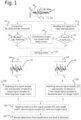
- Figure 1 shows how a target signal segment of a test signal 1 that is obtained from a single-channel EEG-recording can be classified as a target signal segment or as a non-target signal segment using the system according to the invention
- the test signal 1 that is schematically represented in figure 1 , can be obtained from a single-channel EEG-recording.
- the detected test signal 1 can be presented to a device 2 for use in a system according to the disclosure and a system 3 according to the invention.
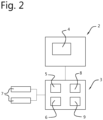
- Figure 2 shows a schematic layout of exemplary, non-limiting embodiments of the device 2 for use in a system according to the disclosure and the system 3 according to the invention.
- the test signal 1 shown in figure 1 is obtained from a single-channel EEG-recording.
- Single-channel EEG-recordings can be acquired in various known ways including for example using a differential electrode pair, using a single electrode in combination with a reference (REF) electrode or a ground (GND) electrode, or using a differential electrode pair in combination with a REF electrode or a GND electrode.
- the individual electrodes of the differential electrode pair can be positioned at specific midline frontal, e.g. Fz, midline vertex, e.g.
- target signal segments of a single-channel EEG-recording are to be construed as signal segments that are indicative for a patient being delirious or suffering from related encephalopathy
- non-target signal segments of a single-channel EEG-recording are to be construed as signal segments that are indicative for artifacts such as for example eye artifacts, artifacts related to muscle activity, or artifacts related to a combination of such artifacts.
- the reference target signal samples of the plurality of reference target signal samples and the reference non-target signal samples of the plurality of reference non-target signal samples can have a predefined duration of for example 15 minutes. However, any suitable predefined duration can be used as long as the acquired single-channel EEG-recordings enable obtaining suitable reference target signal segments and reference non-target signal segments.
- the reference target signal segments of the plurality of reference target signal segments can be mutually different. The same holds for the reference non-target signal segments of the plurality of non-target signal segments.
- the plurality of reference target signal segments can for example comprise more than 1000 reference target signal segments. The same holds for the plurality of non-target signal segments.
- a target parameter set that is indicative for the plurality of reference target signal segments is applied to the test signal 1 to detect a first signal segment and to classify the detected first signal segment as a target signal segment.
- the target parameter set comprises wavelet coefficients that are most representative for the reference target signal segments. The wavelet coefficients have been determined based on the plurality of reference target signal samples using a training process that can involve a machine learning algorithm.
- the machine learning algorithm can for example use neural networks or deep neural networks.
- a first time stamp t1 is assigned to it.
- a non-target parameter set that is indicative for the plurality of reference non-target signal segments is applied to the same test signal 1 to detect a second signal segment and to classify the detected second signal segment as a non-target signal segment.
- the non-target parameter set comprises wavelet coefficients that are most representative for the reference non-target signal segments. The wavelet coefficients have been determined based on the plurality of reference non-target signal samples using another training process that can involve another machine learning algorithm that for example can use neural networks or deep neural networks.
- a second time stamp t2 is assigned to it.
- the wavelet coefficients of the target parameter set and the wavelet coefficients of the non-target parameter set can be compared to optimize the target and non-target parameter sets by removing from either one of them wavelet coefficients that occur in both of them. In this way, overlap between the target parameter set and the non-target parameter set can be reduced.
- an optimized target parameter set that comprises wavelet coefficients that are indicative specifically for the plurality of reference target signal segments, and an optimized non-target parameter set that comprises wavelet coefficients that are indicative specifically for the plurality of reference non-target signal segments can be obtained.
- the optimized target parameter set and the optimized non-target parameter set enable an improved distinction between target signal segments and non-target signal segments of the single-channel EEG-recording. Hence, false positive detections or incorrect classifications for that matter can be reduced.
- a temporal proximity of the first time stamp t1 and the second time stamp t2 is determined.
- the person skilled in the art will appreciate that the temporal proximity of the first time stamp t1 and the second time stamp t2 can be determined in several different ways.
- Figure 1 shows two exemplary ways of doing this.
- a first exemplary way of doing this involves dividing the obtained test signal 1 in time intervals of a predefined length.
- These time intervals can be referred to as bins.
- the time intervals or bins have a predefined equal length.
- the predefined length of the time intervals can be chosen depending on specific requirements such as desired accuracy. Suitable predefined lengths of the time intervals range between 0.25 s and 3 s.
- step 22 is indicated as step 22 in figure 1 .
- the voting process which is indicated as step 23 in figure 1 , is required and will be performed to determine whether classification of the detected first signal segment as a target signal segment or classification of the detected second signal segment as a non-target signal segment is correct. If the first time stamp t1 and the second time stamp t2 fall in different time intervals, i.e. the first time stamp t1 and the second time stamp t2 do not fall within the same bin, then the voting process is not required and preferably the voting process is not performed. In this case, the classification of the detected first signal segment as being a target signal segment and the classification of the detected second signal segment as being a non-target signal segment are most likely both correct. This is indicated as step 24 in figure 1 .
- a second way of determining the temporal proximity of the first time stamp t1 and the second time stamp t2 that is explained in relation to step 25 in figure 1 involves determining a time difference ⁇ t,deter between the first time stamp t1 and the second time stamp t2.
- the determined time difference ⁇ t,deter is compared with a predefined threshold ⁇ t,threshold.
- the threshold ⁇ t,threshold is chosen such that when the determined time difference ⁇ t,deter is smaller than the threshold ⁇ t,threshold, it is not likely or not possible at all that the classification of the detected first signal segment is assigned as being a target signal segment and the classification of the detected second signal segment is assigned as being a non-target signal segment can both be correct.
- step 26 in figure 1 when the determined time difference ⁇ t,deter is smaller than the threshold ⁇ t,threshold, then a voting process, which is indicated as step 23 in figure 1 , will be performed to determine whether classification of the detected first signal segment as a target signal segment or the classification of the detected second signal segment as a non-target signal segment is correct.
- the classification of the detected first signal segment as being a target signal segment and the classification of the detected second signal segment as being a non-target signal segment are most likely both correct. This is indicated as step 24 in figure 1 .
- any suitable threshold ⁇ t,threshold can be chosen as long as it allows to establish whether the classification of the detected first signal segment as being a target signal segment and/or the classification of the detected second signal segment as being a non-target signal segment can be correct.
- Suitable values for the predefined threshold range between 0.25 s and 3 s.
- the threshold is 1 s.
- the voting process of the method for use in a system of the present invention comprises a step 23A of generating a first signal sample 10 that comprises the detected first signal segment to which the first time stamp t1 has been assigned.
- a next step 23B of the voting process the generated first signal sample 10 is matched with the plurality of reference target signal segments to determine a best target match.
- step 23C in the voting process is generating a second signal sample 12 that comprises the detected second signal segment to which the second time stamp t2 has been assigned. Then, in a next step 23D of the voting process, the second signal sample 12 is matched with the plurality of reference non-target signal segments to determine a best non-target match.
- matching the first signal sample 10 with the plurality of reference target signal segments to determine the best target match can involve for example curve fitting in the time domain of the first signal sample 10 with the plurality of reference target signal segments.
- matching the second signal sample 12 with the plurality of reference non-target signal segments to determine the best non-target match can involve for example curve fitting in the time domain of the second signal sample 12 with the plurality of reference non-target signal segments.
- Curve fitting in the time domain may include comparing the signal shape of the first signal sample 10 with the signal shapes of the reference target signal segments of the plurality of reference target signal segments and comparing of the signal shape of the second signal sample 12 with the signal shapes of the reference non-target signal segments of the plurality of reference non-target signal segments.
- the curve fit resulting in for example the smallest residue can be chosen to determine the best target match and the best non-target match, respectively.
- other aspects related to the curve fitting process can of course also be regarded to determine the best target match and the best non-target match, respectively.
- curve fitting in the time domain is just an example of the analysis methods that are available to determine the best target match and the best non-target match, respectively.
- analysis methods include for example Fast Fourier Transform (FFT), linear signal analysis techniques involving determination of coherence, non-linear signal analysis techniques involving determination of phase synchronization and/or generalized synchronization, template matching, and parametric models including the use of wavelets.
- FFT Fast Fourier Transform
- linear signal analysis techniques involving determination of coherence
- non-linear signal analysis techniques involving determination of phase synchronization and/or generalized synchronization
- template matching template matching
- parametric models including the use of wavelets.
- metrics are applied to the first signal sample 10, the best target match, the second signal sample 12 and the best non-target match parameter to determine whether the classification of the detected first signal segment as a target signal segment is correct, or whether the classification of the detected second signal segment as a non-target signal segment is correct.
- applying metrics to the first signal sample 10, the best target match, the second signal sample 12 and the best non-target match can be done in several different ways.
- a first way of doing this is by establishing and comparing a correlation in the time domain.
- a second way of doing this is by establishing and comparing a goodness of fit in the wavelet domain.
- the voting process of the method for use in a system of the present invention will result in a so-called winner, i.e. the voting process eliminates one of the two classifications and thereby will determine the final classification as target signal segment or as non-target signal segment.
- the loser is removed. This is indicated as step 23F in figure 1 .
- Figure 2 shows a schematic layout of exemplary, non-limiting embodiments of a device 2 for use in a system according to the disclosure and a system 3 according to the invention.
- the device 2 can be construed as a detector that is configured and arranged to be used with the system 3 that is configured and arranged to detect and classify a segment of a signal that is obtained from a single-channel EEG-recording as a target signal segment or as a non-target signal segment.
- the device 2 has a database 4 that comprises at least one of a plurality of reference target signal segments that are obtained from signals that are obtained from reference single-channel EEG-recordings, a set of reference target signal segments that is based on the plurality of reference target signal segments, a plurality of reference non-target signal segments that are obtained from signals that are obtained from reference single-channel EEG-recordings, a set of reference non-target signal segments that is based on the plurality of reference non-target signal segments, a target parameter set that is indicative for the plurality of reference target signal segments, and a non-target parameter set that is indicative for a plurality of reference non-target signal segments.
- the target parameter set and the non-target parameter set can be obtained via respective training processes that may involve respective machine learning algorithms that may use respective deep neural networks.
- the device 2 for use in a system according to the invention enables an improved distinction between target signal segments and non-target signal segments of a signal that is obtained from a single-channel EEG-recording. As a result, false positive detections or incorrect classifications for that matter as discussed above can be reduced.
- the system 3 is configured and arranged to detect and classify a segment of a signal that is obtained from a single-channel EEG-recording as a target signal segment or as a non-target signal segment in accordance with the method for use in a system of the present invention (the method itself not being part of the claimed invention).
- the system 3 comprises a processor 5 that is configured and arranged to perform the method for use in a system according to the present invention on said signal when being operatively connected to the device 2 for use in a system according to the present disclosure.
- the system 3 and the device 2 when being operatively connected can be used to achieve an improved distinction between target signal segments and non-target signal segments of a signal that is obtained from a single-channel EEG-recording.
- false positive detections or incorrect classifications for that matter as discussed above can be reduced.
- the device 2 and the system 3 can be implemented as separate units as is schematically shown in figure 2 .
- the device 2 and the system 3 can also be implemented as an integrated unit (not shown).
- the system 3 shown in figure 2 further comprises a data storage unit 6 that is operatively connected to the processor 5.
- the data storage unit 6 can be configured and arranged to store at least one of the single-channel EEG-recording, the signal obtained from the single-channel EEG-recording, and a classification of a detected signal segment of said signal as a target signal segment or as a non-target signal segment as a result of the method performed by the processor 5.
- the system 3 is connected with two electrodes 7 that are arrangeable on a subject's scalp and are configured to record the single-channel EEG-recordings and transfer the single-channel EEG-recordings to the data storage unit 6.
- the system 3 can further be configured to comprise application software 8 and a display unit 9, such as a screen.
- the present invention can be summarized as relating to a system, which system uses a method for detecting and classifying a segment of a signal 1 that is obtained from an EEG-recording as a target signal segment or as a non-target signal segment.
- the method (the method itself not being part of the claimed invention) comprises a voting process to determine whether classification of a first detected segment of the signal as a target signal segment or classification of a second detected segment of the signal as a non-target signal segment is correct.
- the invention relates to a system 3 as defined in the appended claims.
Landscapes
- Health & Medical Sciences (AREA)
- Life Sciences & Earth Sciences (AREA)
- Engineering & Computer Science (AREA)
- Medical Informatics (AREA)
- Public Health (AREA)
- General Health & Medical Sciences (AREA)
- Biomedical Technology (AREA)
- Pathology (AREA)
- Physics & Mathematics (AREA)
- Animal Behavior & Ethology (AREA)
- Molecular Biology (AREA)
- Heart & Thoracic Surgery (AREA)
- Surgery (AREA)
- Biophysics (AREA)
- Veterinary Medicine (AREA)
- Physiology (AREA)
- Psychiatry (AREA)
- Artificial Intelligence (AREA)
- Signal Processing (AREA)
- Computer Vision & Pattern Recognition (AREA)
- Psychology (AREA)
- Neurology (AREA)
- Computer Networks & Wireless Communication (AREA)
- Data Mining & Analysis (AREA)
- Evolutionary Computation (AREA)
- Databases & Information Systems (AREA)
- Epidemiology (AREA)
- Primary Health Care (AREA)
- Fuzzy Systems (AREA)
- Mathematical Physics (AREA)
- Neurosurgery (AREA)
- Measurement Of The Respiration, Hearing Ability, Form, And Blood Characteristics Of Living Organisms (AREA)
- Measurement And Recording Of Electrical Phenomena And Electrical Characteristics Of The Living Body (AREA)
- Debugging And Monitoring (AREA)
- Image Analysis (AREA)
- Signal Processing For Digital Recording And Reproducing (AREA)
Claims (8)
- Système (3) qui est configuré et agencé pour détecter et classifier un segment d'un signal (1) qui est obtenu à partir d'un enregistrement EEG à canal unique en tant que segment de signal cible ou en tant que segment de signal non cible, le système (3) comprenant un processeur (5) qui est configuré et agencé pour réaliser sur ledit signal (1), lorsqu'il est connecté fonctionnellement à un dispositif (2) présentant une base de données (4), les étapes de processus consistant à :• fournir un signal (1) qui est obtenu à partir d'un enregistrement EEG à canal unique ;• appliquer audit signal (1) un ensemble de paramètres cible, qui indique une pluralité de segments de signal cibles de référence qui sont obtenus à partir des enregistrements EEG à canal unique de référence, pour détecter un premier segment de signal dudit signal (1) et pour classifier le premier segment de signal détecté en tant que segment de signal cible, dans lequel l'ensemble de paramètres cible comprend des coefficients d'ondelettes qui sont déterminés à l'aide d'une décomposition en ondelettes de la pluralité de segments de signal cible de référence ;• attribuer un premier horodatage (t1) au premier segment de signal détecté ;• appliquer audit signal (1) un ensemble de paramètres non cible, qui indique une pluralité de segments de signal non cibles de référence qui sont obtenus à partir des enregistrements EEG à canal unique de référence, pour détecter un second segment de signal dudit signal (1) et pour classifier le second segment de signal détecté en tant que segment de signal non cible, dans lequel l'ensemble de paramètres non cible comprend des coefficients d'ondelettes qui sont déterminés à l'aide d'une décomposition en ondelettes de la pluralité de segments de signal non cibles de référence ;• attribuer un second horodatage (t2) au second segment de signal détecté ;• déterminer une différence temporelle entre le premier horodatage (t1) et le second horodatage (t2) ;• lorsque ladite différence temporelle déterminée est inférieure à un seuil prédéterminé, déterminer si un processus de vote est requis pour déterminer si une classification du premier segment de signal détecté en tant que segment de signal cible ou une classification du second segment de signal détecté en tant que segment de signal non cible est correcte ; et• s'il est établi que ledit processus de vote est requis, la réalisation dudit processus de vote ;dans lequel la base de données (4) comprend au moins l'un parmi :• la pluralité de segments de signal cibles de référence qui sont obtenus à partir d'enregistrements d'EEG à canal unique de référence ;• un ensemble de segments de signal cibles de référence qui est basé sur la pluralité de segments de signal cible de référence ;• la pluralité de segments de signal non cibles de référence qui sont obtenus à partir d'enregistrements d'EEG à canal unique de référence ;• un ensemble de segments de signal non cibles de référence qui est basé sur la pluralité de segments de signal non cible de référence ;• l'ensemble de paramètres cible qui indique la pluralité de segments de signal cibles de référence, dans lequel l'ensemble de paramètres cible comprend des coefficients d'ondelettes qui sont déterminés à l'aide d'une décomposition en ondelettes de la pluralité de segments de signal cibles de référence ; et• l'ensemble de paramètres non cible qui indique une pluralité de segments de signal non cibles de référence, dans lequel l'ensemble de paramètres non cible comprend des coefficients d'ondelettes qui sont déterminés à l'aide d'une décomposition en ondelettes de la pluralité de segments de signal non cible de référence.
- Système selon la revendication 1,• dans lequel, lors de l'étape d'application audit signal (1) l'ensemble de paramètres cible, le premier segment de signal détecté est classifié en tant que segment de signal cible lorsque le premier segment de signal détecté indique un patient déflagrant ou souffrant d'une encéphalopathie liée, et• dans lequel, lors de l'étape d'application audit signal (1) de l'ensemble de paramètres non cible, le second segment de signal détecté est classifié comme un segment de signal non cible lorsque le second segment de signal détecté indique des artéfacts.
- Système (3) selon la revendication 1 ou 2, dans lequel le processeur (5) est configuré et agencé pour réaliser le processus de vote comprenant
soit les étapes de processus consistant à :• générer un premier échantillon de signal (10) qui comprend le premier segment de signal détecté ;• mettre en correspondance le premier échantillon de signal (10) avec la pluralité de segments de signal cibles de référence pour déterminer une meilleure correspondance cible ;• générer un second échantillon de signal (12) qui comprend le second segment de signal détecté ;• mettre en correspondance le second échantillon de signal avec la pluralité de segments de signal non cibles de référence pour déterminer une meilleure correspondance non cible ;• appliquer des mesures au premier échantillon de signal (10), à la meilleure correspondance cible, au second échantillon de signal (12) et à la meilleure correspondance non cible pour déterminer :ou les étapes de processus consistant à :- si la classification du premier segment de signal détecté en tant que segment de signal cible est correcte ; ou- si la classification du second segment de signal détecté en tant que segment de signal non cible est correcte ;• générer un premier échantillon de signal (10) qui comprend le premier segment de signal détecté ;• mettre en correspondance le premier échantillon de signal (10) avec un ensemble de segments de signal cibles de référence qui est basé sur la pluralité de segments de signal cibles de référence pour déterminer une meilleure correspondance cible ;• générer un second échantillon de signal (12) qui comprend le second segment de signal détecté ;• mettre en correspondance le second échantillon de signal (12) avec un ensemble de segments de signal non cibles de référence qui est basé sur la pluralité de segments de signal non cibles de référence pour déterminer une meilleure correspondance non cible ;• appliquer des mesures au premier échantillon de signal (10), à la meilleure correspondance cible, au second échantillon de signal (12) et à la meilleure correspondance non cible pour déterminer :- si la classification du premier segment de signal détecté en tant que segment de signal cible est correcte ; ou- si la classification du second segment de signal détecté en tant que segment de signal non cible est correcte. - Système (3) selon l'une quelconque des revendications 1 à 3, dans lequel le processeur (5) est configuré et agencé :• pour supprimer la classification du premier segment de signal détecté ou la classification du second segment de signal détecté qui est incorrecte sur la base du processus de vote ;et/ou
pour appliquer une limite de détection prédéterminée qui est déterminée sur la base de l'ensemble de paramètres cible et/ou de l'ensemble de paramètres non cible, la limite de détection permettant une classification de segments de signal détectés en tant que segments de signal cibles ou en tant que segments de signal non cibles. - Système (3) selon l'une quelconque des revendications 1 à 4, dans lequel le processeur (5) est configuré et agencé pour déterminer un ensemble de paramètres cible optimisé qui comprend des coefficients d'ondelette qui indiquent spécifiquement la pluralité de segments de signal cibles de référence et/ou un ensemble de paramètres non cible optimisé qui comprend des coefficients d'ondelette qui indiquent spécifiquement la pluralité de segments de signal non cible de référence.
- Système (3) selon la revendication 5, dans lequel le processeur (5) est configuré et agencé pour appliquer une limite de détection prédéterminée qui est déterminée sur la base de l'ensemble de paramètres cible optimisé et/ou de l'ensemble de paramètres non cible optimisé, la limite de détection permettant une classification améliorée de segments de signal détectés en tant que segments de signal cibles ou en tant que segments de signal non cibles.
- Système (3) selon l'une quelconque des revendications 1 à 6, comprenant en outre une unité de stockage de données (6) qui est fonctionnellement connectée au processeur (5), dans lequel l'unité de stockage de données (6) est configurée et agencée pour stocker au moins l'un parmi l'enregistrement EEG à canal unique et le signal obtenu à partir de l'enregistrement d'EEG à canal unique, et une classification d'un segment de signal détecté dudit signal en tant que segment de signal cible ou en tant que segment de signal non cible comme résultat du procédé réalisé par le processeur (5).
- Système (3) selon la revendication 7, dans lequel le système (3) est configuré et agencé pour être connectable à deux électrodes (7) qui peuvent être agencées sur le cuir chevelu d'un sujet et sont configurées pour enregistrer l'enregistrement d'EEG à canal unique et transférer l'enregistrement d'EEG à canal unique à l'unité de stockage de données (6).
Applications Claiming Priority (2)
| Application Number | Priority Date | Filing Date | Title |
|---|---|---|---|
| EP20152275 | 2020-01-16 | ||
| PCT/EP2020/082823 WO2021144053A1 (fr) | 2020-01-16 | 2020-11-20 | Procédé et système de détection et de classification de segments de signaux provenant d'enregistrements d'eeg |
Publications (3)
| Publication Number | Publication Date |
|---|---|
| EP4084671A1 EP4084671A1 (fr) | 2022-11-09 |
| EP4084671C0 EP4084671C0 (fr) | 2023-11-08 |
| EP4084671B1 true EP4084671B1 (fr) | 2023-11-08 |
Family
ID=69176983
Family Applications (1)
| Application Number | Title | Priority Date | Filing Date |
|---|---|---|---|
| EP20807439.3A Active EP4084671B1 (fr) | 2020-01-16 | 2020-11-20 | Système permettant de détecter et de classer des segments de signaux à partir d'enregistrements eeg |
Country Status (7)
| Country | Link |
|---|---|
| US (1) | US20230044209A1 (fr) |
| EP (1) | EP4084671B1 (fr) |
| JP (1) | JP2023514675A (fr) |
| CN (1) | CN115279258A (fr) |
| CA (1) | CA3168263A1 (fr) |
| ES (1) | ES2969112T3 (fr) |
| WO (1) | WO2021144053A1 (fr) |
Families Citing this family (1)
| Publication number | Priority date | Publication date | Assignee | Title |
|---|---|---|---|---|
| EP4417126A1 (fr) | 2023-02-16 | 2024-08-21 | Prolira B.V. | Support d'électrode et procédé de réalisation de mesures d'électroencéphalographie (eeg) |
Citations (7)
| Publication number | Priority date | Publication date | Assignee | Title |
|---|---|---|---|---|
| US5999846A (en) * | 1995-11-08 | 1999-12-07 | Oxford Medical Limited | Physiological monitoring |
| US6021346A (en) * | 1997-11-13 | 2000-02-01 | Electronics And Telecommunications Research Institute | Method for determining positive and negative emotional states by electroencephalogram (EEG) |
| US8538705B2 (en) * | 2006-03-31 | 2013-09-17 | Covidien Lp | System and method of assessing analgesic adequacy using biopotential variability |
| WO2013142051A1 (fr) * | 2012-03-19 | 2013-09-26 | University Of Florida Research Foundation, Inc. | Méthodes et systèmes utilisés pour l'analyse de la fonction cérébrale |
| CN108542386A (zh) * | 2018-04-23 | 2018-09-18 | 长沙学院 | 一种基于单通道eeg信号的睡眠状态检测方法和系统 |
| WO2019132768A1 (fr) * | 2017-12-29 | 2019-07-04 | Agency For Science, Technology And Research | Discriminateur alerte contre fatigue |
| CN109994203A (zh) * | 2019-04-15 | 2019-07-09 | 江南大学 | 一种基于eeg信号深度多视角特征学习的癫痫检测方法 |
Family Cites Families (19)
| Publication number | Priority date | Publication date | Assignee | Title |
|---|---|---|---|---|
| EP0828225A1 (fr) * | 1996-09-04 | 1998-03-11 | Siemens Aktiengesellschaft | Procédé et dispositif pour évaluer les données EEG |
| WO2005117693A1 (fr) * | 2004-05-27 | 2005-12-15 | Children's Medical Center Corporation | Detection d'apparition d'une crise propre a un patient |
| US20180146879A9 (en) * | 2004-08-30 | 2018-05-31 | Kalford C. Fadem | Biopotential Waveform Data Fusion Analysis and Classification Method |
| US8684921B2 (en) * | 2010-10-01 | 2014-04-01 | Flint Hills Scientific Llc | Detecting, assessing and managing epilepsy using a multi-variate, metric-based classification analysis |
| US10206591B2 (en) * | 2011-10-14 | 2019-02-19 | Flint Hills Scientific, Llc | Seizure detection methods, apparatus, and systems using an autoregression algorithm |
| US8792974B2 (en) * | 2012-01-18 | 2014-07-29 | Brainscope Company, Inc. | Method and device for multimodal neurological evaluation |
| US10296660B2 (en) * | 2014-02-25 | 2019-05-21 | Intel Corporation | Systems, apparatuses, and methods for feature searching |
| US10332638B2 (en) * | 2015-07-17 | 2019-06-25 | Massachusetts Institute Of Technology | Methods and systems for pre-symptomatic detection of exposure to an agent |
| US10779744B2 (en) * | 2015-10-27 | 2020-09-22 | Cardiologs Technologies Sas | Automatic method to delineate or categorize an electrocardiogram |
| WO2017165500A1 (fr) * | 2016-03-24 | 2017-09-28 | Board Of Regents Of The University Of Nebraska | Dispositifs et procédés de détection et de mesure de vasomotricité sympathique |
| US20180000428A1 (en) * | 2016-05-18 | 2018-01-04 | Massachusetts Institute Of Technology | Methods and Systems for Pre-Symptomatic Detection of Exposure to an Agent |
| CN111107786A (zh) * | 2017-07-31 | 2020-05-05 | 国立大学法人大阪大学 | 实际信号时间变动小波解析的应用 |
| US10694967B2 (en) * | 2017-10-18 | 2020-06-30 | Medtronic, Inc. | State-based atrial event detection |
| EP3698710B1 (fr) * | 2017-10-20 | 2025-07-09 | LIFESCAPES Inc. | Appareil d'analyse d'ondes cérébrales, procédé d'analyse d'ondes cérébrales, programme et support d'enregistrement non transitoire |
| US11864880B2 (en) * | 2017-12-21 | 2024-01-09 | The University Of Queensland | Method for analysis of cough sounds using disease signatures to diagnose respiratory diseases |
| WO2020002519A1 (fr) * | 2018-06-29 | 2020-01-02 | Mybrain Technologies | Procédé de classification multiclasse pour l'estimation de la qualité d'un signal eeg |
| US11514720B2 (en) * | 2019-01-02 | 2022-11-29 | Blink Technologies Inc. | Geometrically constrained, unsupervised training of convolutional autoencoders for extraction of eye landmarks |
| CN110584597A (zh) * | 2019-07-15 | 2019-12-20 | 天津大学 | 基于时空卷积神经网络的多通道脑电信号监测方法及应用 |
| EP4192354A1 (fr) * | 2020-08-10 | 2023-06-14 | Cardiologs Technologies SAS | Système de traitement d'électrocardiogramme pour la détection et/ou la prédiction d'événements cardiaques |
-
2020
- 2020-11-20 EP EP20807439.3A patent/EP4084671B1/fr active Active
- 2020-11-20 ES ES20807439T patent/ES2969112T3/es active Active
- 2020-11-20 US US17/793,108 patent/US20230044209A1/en active Pending
- 2020-11-20 WO PCT/EP2020/082823 patent/WO2021144053A1/fr not_active Ceased
- 2020-11-20 CA CA3168263A patent/CA3168263A1/fr active Pending
- 2020-11-20 CN CN202080098610.3A patent/CN115279258A/zh active Pending
- 2020-11-20 JP JP2022543394A patent/JP2023514675A/ja active Pending
Patent Citations (7)
| Publication number | Priority date | Publication date | Assignee | Title |
|---|---|---|---|---|
| US5999846A (en) * | 1995-11-08 | 1999-12-07 | Oxford Medical Limited | Physiological monitoring |
| US6021346A (en) * | 1997-11-13 | 2000-02-01 | Electronics And Telecommunications Research Institute | Method for determining positive and negative emotional states by electroencephalogram (EEG) |
| US8538705B2 (en) * | 2006-03-31 | 2013-09-17 | Covidien Lp | System and method of assessing analgesic adequacy using biopotential variability |
| WO2013142051A1 (fr) * | 2012-03-19 | 2013-09-26 | University Of Florida Research Foundation, Inc. | Méthodes et systèmes utilisés pour l'analyse de la fonction cérébrale |
| WO2019132768A1 (fr) * | 2017-12-29 | 2019-07-04 | Agency For Science, Technology And Research | Discriminateur alerte contre fatigue |
| CN108542386A (zh) * | 2018-04-23 | 2018-09-18 | 长沙学院 | 一种基于单通道eeg信号的睡眠状态检测方法和系统 |
| CN109994203A (zh) * | 2019-04-15 | 2019-07-09 | 江南大学 | 一种基于eeg信号深度多视角特征学习的癫痫检测方法 |
Non-Patent Citations (4)
| Title |
|---|
| LINA WANG ET AL: "Automatic Epileptic Seizure Detection in EEG Signals Using Multi-Domain Feature Extraction and Nonlinear Analysis", ENTROPY, vol. 19, no. 6, 27 May 2017 (2017-05-27), pages 222, XP055591843, DOI: 10.3390/e19060222 * |
| QI YUAN ET AL: "Epileptic EEG classification based on extreme learning machine and nonlinear features", EPILEPSY RESEARCH, ELSEVIER SCIENCE PUBLISHERS , AMSTERDAM, NL, vol. 96, no. 1, 24 April 2011 (2011-04-24), pages 29 - 38, XP028293041, ISSN: 0920-1211, [retrieved on 20110429], DOI: 10.1016/J.EPLEPSYRES.2011.04.013 * |
| S. VANI ET AL: "EEG Signal Analysis for Automated Epilepsy Seizure Detection Using Wavelet Transform and Artificial Neural Network", JOURNAL OF MEDICAL IMAGING AND HEALTH INFORMATICS, vol. 9, no. 6, 1 August 2019 (2019-08-01), pages 1301 - 1306, XP055772067, ISSN: 2156-7018, DOI: 10.1166/jmihi.2019.2713 * |
| T. NUMAN ET AL: "Delirium detection using relative delta power based on 1-minute single-channel EEG: a multicentre study", BRITISH JOURNAL OF ANAESTHESIA, vol. 122, no. 1, 1 January 2019 (2019-01-01), pages 60 - 68, XP055714483, ISSN: 0007-0912, DOI: 10.1016/j.bja.2018.08.021 * |
Also Published As
| Publication number | Publication date |
|---|---|
| EP4084671C0 (fr) | 2023-11-08 |
| CA3168263A1 (fr) | 2021-07-22 |
| CN115279258A (zh) | 2022-11-01 |
| JP2023514675A (ja) | 2023-04-07 |
| ES2969112T3 (es) | 2024-05-16 |
| EP4084671A1 (fr) | 2022-11-09 |
| WO2021144053A1 (fr) | 2021-07-22 |
| US20230044209A1 (en) | 2023-02-09 |
Similar Documents
| Publication | Publication Date | Title |
|---|---|---|
| Gupta et al. | Automated detection of focal EEG signals using features extracted from flexible analytic wavelet transform | |
| Sharanreddy et al. | EEG signal classification for epilepsy seizure detection using improved approximate entropy | |
| Boubchir et al. | A review of feature extraction for EEG epileptic seizure detection and classification | |
| Song et al. | Automatic recognition of epileptic EEG patterns via extreme learning machine and multiresolution feature extraction | |
| Boashash et al. | A methodology for time-frequency image processing applied to the classification of non-stationary multichannel signals using instantaneous frequency descriptors with application to newborn EEG signals | |
| Siddharth et al. | Discrimination of focal and non-focal seizures from EEG signals using sliding mode singular spectrum analysis | |
| Duque-Muñoz et al. | Identification and monitoring of brain activity based on stochastic relevance analysis of short–time EEG rhythms | |
| Sharanreddy et al. | Detection of primary brain tumor present in EEG signal using wavelet transform and neural network | |
| Bakheet et al. | Linear and nonlinear analysis of intrinsic mode function after facial stimuli presentation in children with autism spectrum disorder | |
| Joy et al. | Detection and Classification of ADHD from EEG Signals Using Tunable Q‐Factor Wavelet Transform | |
| Divya et al. | Classification of low-functioning and high-functioning autism using task-based EEG signals | |
| Xin et al. | Paroxysmal atrial fibrillation recognition based on multi-scale wavelet α-entropy | |
| EP4084671B1 (fr) | Système permettant de détecter et de classer des segments de signaux à partir d'enregistrements eeg | |
| De et al. | Identification of patients with de novo Parkinson's Disease from chemosensory EEG signals using ICEEMDAN domain Entropy Features | |
| Zaylaa et al. | Entropy complexity analysis of electroencephalographic signals during pre-ictal, seizure and post-ictal brain events | |
| Dilber et al. | EEG based detection of epilepsy by a mixed design approach | |
| Zabcikova et al. | EEG-based lie detection using ERP P300 in response to known and unknown faces: An overview | |
| Karabiber Cura et al. | Classification of epileptic and psychogenic nonepileptic seizures via time–frequency features of EEG data | |
| Elmahdy et al. | Epileptic seizure detection using singular values and classical features of EEG signals | |
| Ontivero-Ortega et al. | Comparison of classifiers to detect epileptic seizures via PARAFAC decomposition | |
| Balakrishnan et al. | A multi-channel fusion based new-born seizure detection | |
| Anastasiadou et al. | Automatic detection and removal of muscle artifacts from scalp EEG recordings in patients with epilepsy | |
| Khandelwal et al. | Alcoholism identification by processing the EEG signal using oscillatory modes decomposition and machine learning | |
| Cai et al. | Quantifying instability in neurological disorders EEG based on phase space DTM function | |
| Mole et al. | An efficient Gait Dynamics classification method for Neurodegenerative Diseases using Brain signals |
Legal Events
| Date | Code | Title | Description |
|---|---|---|---|
| STAA | Information on the status of an ep patent application or granted ep patent |
Free format text: STATUS: UNKNOWN |
|
| STAA | Information on the status of an ep patent application or granted ep patent |
Free format text: STATUS: THE INTERNATIONAL PUBLICATION HAS BEEN MADE |
|
| PUAI | Public reference made under article 153(3) epc to a published international application that has entered the european phase |
Free format text: ORIGINAL CODE: 0009012 |
|
| STAA | Information on the status of an ep patent application or granted ep patent |
Free format text: STATUS: REQUEST FOR EXAMINATION WAS MADE |
|
| 17P | Request for examination filed |
Effective date: 20220804 |
|
| AK | Designated contracting states |
Kind code of ref document: A1 Designated state(s): AL AT BE BG CH CY CZ DE DK EE ES FI FR GB GR HR HU IE IS IT LI LT LU LV MC MK MT NL NO PL PT RO RS SE SI SK SM TR |
|
| STAA | Information on the status of an ep patent application or granted ep patent |
Free format text: STATUS: EXAMINATION IS IN PROGRESS |
|
| 17Q | First examination report despatched |
Effective date: 20230125 |
|
| DAV | Request for validation of the european patent (deleted) | ||
| DAX | Request for extension of the european patent (deleted) | ||
| GRAP | Despatch of communication of intention to grant a patent |
Free format text: ORIGINAL CODE: EPIDOSNIGR1 |
|
| STAA | Information on the status of an ep patent application or granted ep patent |
Free format text: STATUS: GRANT OF PATENT IS INTENDED |
|
| INTG | Intention to grant announced |
Effective date: 20230717 |
|
| GRAS | Grant fee paid |
Free format text: ORIGINAL CODE: EPIDOSNIGR3 |
|
| GRAA | (expected) grant |
Free format text: ORIGINAL CODE: 0009210 |
|
| STAA | Information on the status of an ep patent application or granted ep patent |
Free format text: STATUS: THE PATENT HAS BEEN GRANTED |
|
| AK | Designated contracting states |
Kind code of ref document: B1 Designated state(s): AL AT BE BG CH CY CZ DE DK EE ES FI FR GB GR HR HU IE IS IT LI LT LU LV MC MK MT NL NO PL PT RO RS SE SI SK SM TR |
|
| REG | Reference to a national code |
Ref country code: GB Ref legal event code: FG4D |
|
| REG | Reference to a national code |
Ref country code: CH Ref legal event code: EP |
|
| REG | Reference to a national code |
Ref country code: DE Ref legal event code: R096 Ref document number: 602020020824 Country of ref document: DE |
|
| REG | Reference to a national code |
Ref country code: IE Ref legal event code: FG4D |
|
| U01 | Request for unitary effect filed |
Effective date: 20231123 |
|
| U07 | Unitary effect registered |
Designated state(s): AT BE BG DE DK EE FI FR IT LT LU LV MT NL PT SE SI Effective date: 20231129 |
|
| U20 | Renewal fee for the european patent with unitary effect paid |
Year of fee payment: 4 Effective date: 20231129 |
|
| REG | Reference to a national code |
Ref country code: NO Ref legal event code: T2 Effective date: 20231108 |
|
| PGFP | Annual fee paid to national office [announced via postgrant information from national office to epo] |
Ref country code: ES Payment date: 20231228 Year of fee payment: 4 |
|
| PGFP | Annual fee paid to national office [announced via postgrant information from national office to epo] |
Ref country code: NO Payment date: 20231212 Year of fee payment: 4 Ref country code: IE Payment date: 20231211 Year of fee payment: 4 Ref country code: CH Payment date: 20231219 Year of fee payment: 4 |
|
| PG25 | Lapsed in a contracting state [announced via postgrant information from national office to epo] |
Ref country code: GR Free format text: LAPSE BECAUSE OF FAILURE TO SUBMIT A TRANSLATION OF THE DESCRIPTION OR TO PAY THE FEE WITHIN THE PRESCRIBED TIME-LIMIT Effective date: 20240209 |
|
| PG25 | Lapsed in a contracting state [announced via postgrant information from national office to epo] |
Ref country code: IS Free format text: LAPSE BECAUSE OF FAILURE TO SUBMIT A TRANSLATION OF THE DESCRIPTION OR TO PAY THE FEE WITHIN THE PRESCRIBED TIME-LIMIT Effective date: 20240308 |
|
| PG25 | Lapsed in a contracting state [announced via postgrant information from national office to epo] |
Ref country code: IS Free format text: LAPSE BECAUSE OF FAILURE TO SUBMIT A TRANSLATION OF THE DESCRIPTION OR TO PAY THE FEE WITHIN THE PRESCRIBED TIME-LIMIT Effective date: 20240308 Ref country code: GR Free format text: LAPSE BECAUSE OF FAILURE TO SUBMIT A TRANSLATION OF THE DESCRIPTION OR TO PAY THE FEE WITHIN THE PRESCRIBED TIME-LIMIT Effective date: 20240209 |
|
| REG | Reference to a national code |
Ref country code: ES Ref legal event code: FG2A Ref document number: 2969112 Country of ref document: ES Kind code of ref document: T3 Effective date: 20240516 |
|
| PG25 | Lapsed in a contracting state [announced via postgrant information from national office to epo] |
Ref country code: RS Free format text: LAPSE BECAUSE OF FAILURE TO SUBMIT A TRANSLATION OF THE DESCRIPTION OR TO PAY THE FEE WITHIN THE PRESCRIBED TIME-LIMIT Effective date: 20231108 Ref country code: PL Free format text: LAPSE BECAUSE OF FAILURE TO SUBMIT A TRANSLATION OF THE DESCRIPTION OR TO PAY THE FEE WITHIN THE PRESCRIBED TIME-LIMIT Effective date: 20231108 Ref country code: HR Free format text: LAPSE BECAUSE OF FAILURE TO SUBMIT A TRANSLATION OF THE DESCRIPTION OR TO PAY THE FEE WITHIN THE PRESCRIBED TIME-LIMIT Effective date: 20231108 |
|
| PG25 | Lapsed in a contracting state [announced via postgrant information from national office to epo] |
Ref country code: CZ Free format text: LAPSE BECAUSE OF FAILURE TO SUBMIT A TRANSLATION OF THE DESCRIPTION OR TO PAY THE FEE WITHIN THE PRESCRIBED TIME-LIMIT Effective date: 20231108 |
|
| PG25 | Lapsed in a contracting state [announced via postgrant information from national office to epo] |
Ref country code: SK Free format text: LAPSE BECAUSE OF FAILURE TO SUBMIT A TRANSLATION OF THE DESCRIPTION OR TO PAY THE FEE WITHIN THE PRESCRIBED TIME-LIMIT Effective date: 20231108 |
|
| PG25 | Lapsed in a contracting state [announced via postgrant information from national office to epo] |
Ref country code: SM Free format text: LAPSE BECAUSE OF FAILURE TO SUBMIT A TRANSLATION OF THE DESCRIPTION OR TO PAY THE FEE WITHIN THE PRESCRIBED TIME-LIMIT Effective date: 20231108 Ref country code: SK Free format text: LAPSE BECAUSE OF FAILURE TO SUBMIT A TRANSLATION OF THE DESCRIPTION OR TO PAY THE FEE WITHIN THE PRESCRIBED TIME-LIMIT Effective date: 20231108 Ref country code: RO Free format text: LAPSE BECAUSE OF FAILURE TO SUBMIT A TRANSLATION OF THE DESCRIPTION OR TO PAY THE FEE WITHIN THE PRESCRIBED TIME-LIMIT Effective date: 20231108 Ref country code: CZ Free format text: LAPSE BECAUSE OF FAILURE TO SUBMIT A TRANSLATION OF THE DESCRIPTION OR TO PAY THE FEE WITHIN THE PRESCRIBED TIME-LIMIT Effective date: 20231108 |
|
| REG | Reference to a national code |
Ref country code: DE Ref legal event code: R097 Ref document number: 602020020824 Country of ref document: DE |
|
| PG25 | Lapsed in a contracting state [announced via postgrant information from national office to epo] |
Ref country code: MC Free format text: LAPSE BECAUSE OF FAILURE TO SUBMIT A TRANSLATION OF THE DESCRIPTION OR TO PAY THE FEE WITHIN THE PRESCRIBED TIME-LIMIT Effective date: 20231108 |
|
| PG25 | Lapsed in a contracting state [announced via postgrant information from national office to epo] |
Ref country code: MC Free format text: LAPSE BECAUSE OF FAILURE TO SUBMIT A TRANSLATION OF THE DESCRIPTION OR TO PAY THE FEE WITHIN THE PRESCRIBED TIME-LIMIT Effective date: 20231108 |
|
| PLBE | No opposition filed within time limit |
Free format text: ORIGINAL CODE: 0009261 |
|
| STAA | Information on the status of an ep patent application or granted ep patent |
Free format text: STATUS: NO OPPOSITION FILED WITHIN TIME LIMIT |
|
| 26N | No opposition filed |
Effective date: 20240809 |
|
| REG | Reference to a national code |
Ref country code: CH Ref legal event code: PL |
|
| PG25 | Lapsed in a contracting state [announced via postgrant information from national office to epo] |
Ref country code: NO Free format text: LAPSE BECAUSE OF NON-PAYMENT OF DUE FEES Effective date: 20241130 |
|
| REG | Reference to a national code |
Ref country code: CH Ref legal event code: PL |
|
| U90 | Renewal fees not paid: noting of loss of rights |
Free format text: RENEWAL FEE NOT PAID FOR YEAR 05 Effective date: 20250620 |
|
| GBPC | Gb: european patent ceased through non-payment of renewal fee |
Effective date: 20241120 |
|
| PG25 | Lapsed in a contracting state [announced via postgrant information from national office to epo] |
Ref country code: CH Free format text: LAPSE BECAUSE OF NON-PAYMENT OF DUE FEES Effective date: 20241130 |
|
| PG25 | Lapsed in a contracting state [announced via postgrant information from national office to epo] |
Ref country code: CY Free format text: LAPSE BECAUSE OF FAILURE TO SUBMIT A TRANSLATION OF THE DESCRIPTION OR TO PAY THE FEE WITHIN THE PRESCRIBED TIME-LIMIT; INVALID AB INITIO Effective date: 20201120 |
|
| PG25 | Lapsed in a contracting state [announced via postgrant information from national office to epo] |
Ref country code: HU Free format text: LAPSE BECAUSE OF FAILURE TO SUBMIT A TRANSLATION OF THE DESCRIPTION OR TO PAY THE FEE WITHIN THE PRESCRIBED TIME-LIMIT; INVALID AB INITIO Effective date: 20201120 |
|
| U1N | Appointed representative for the unitary patent procedure changed after the registration of the unitary effect |
Representative=s name: EP&C; NL |
|
| U93 | Unitary patent lapsed |
Free format text: RENEWAL FEE NOT PAID Effective date: 20241130 |
|
| PG25 | Lapsed in a contracting state [announced via postgrant information from national office to epo] |
Ref country code: GB Free format text: LAPSE BECAUSE OF NON-PAYMENT OF DUE FEES Effective date: 20241120 |
|
| PG25 | Lapsed in a contracting state [announced via postgrant information from national office to epo] |
Ref country code: IE Free format text: LAPSE BECAUSE OF NON-PAYMENT OF DUE FEES Effective date: 20241120 |
|
| PG25 | Lapsed in a contracting state [announced via postgrant information from national office to epo] |
Ref country code: TR Free format text: LAPSE BECAUSE OF FAILURE TO SUBMIT A TRANSLATION OF THE DESCRIPTION OR TO PAY THE FEE WITHIN THE PRESCRIBED TIME-LIMIT Effective date: 20231108 |
|
| REG | Reference to a national code |
Ref country code: ES Ref legal event code: FD2A Effective date: 20251230 |
|
| PG25 | Lapsed in a contracting state [announced via postgrant information from national office to epo] |
Ref country code: ES Free format text: LAPSE BECAUSE OF NON-PAYMENT OF DUE FEES Effective date: 20241121 |