EP4085782B1 - Chaussure d'escalade - Google Patents
Chaussure d'escalade Download PDFInfo
- Publication number
- EP4085782B1 EP4085782B1 EP22170977.7A EP22170977A EP4085782B1 EP 4085782 B1 EP4085782 B1 EP 4085782B1 EP 22170977 A EP22170977 A EP 22170977A EP 4085782 B1 EP4085782 B1 EP 4085782B1
- Authority
- EP
- European Patent Office
- Prior art keywords
- shoe
- climbing
- tensioning band
- tensioning
- cover
- Prior art date
- Legal status (The legal status is an assumption and is not a legal conclusion. Google has not performed a legal analysis and makes no representation as to the accuracy of the status listed.)
- Active
Links
Images


Classifications
-
- A—HUMAN NECESSITIES
- A43—FOOTWEAR
- A43B—CHARACTERISTIC FEATURES OF FOOTWEAR; PARTS OF FOOTWEAR
- A43B13/00—Soles; Sole-and-heel integral units
- A43B13/14—Soles; Sole-and-heel integral units characterised by the constructive form
- A43B13/16—Pieced soles
-
- A—HUMAN NECESSITIES
- A43—FOOTWEAR
- A43B—CHARACTERISTIC FEATURES OF FOOTWEAR; PARTS OF FOOTWEAR
- A43B13/00—Soles; Sole-and-heel integral units
- A43B13/02—Soles; Sole-and-heel integral units characterised by the material
- A43B13/04—Plastics, rubber or vulcanised fibre
-
- A—HUMAN NECESSITIES
- A43—FOOTWEAR
- A43B—CHARACTERISTIC FEATURES OF FOOTWEAR; PARTS OF FOOTWEAR
- A43B23/00—Uppers; Boot legs; Stiffeners; Other single parts of footwear
- A43B23/02—Uppers; Boot legs
- A43B23/0205—Uppers; Boot legs characterised by the material
- A43B23/0235—Different layers of different material
-
- A—HUMAN NECESSITIES
- A43—FOOTWEAR
- A43B—CHARACTERISTIC FEATURES OF FOOTWEAR; PARTS OF FOOTWEAR
- A43B5/00—Footwear for sporting purposes
- A43B5/002—Mountain boots or shoes
- A43B5/003—Mountain boots or shoes for free climbing
Definitions
- EP3571948 A1 discloses a similar climbing shoe having a front sole-section and a rear sole-section discrete and spaced to one another.
- the bottom 4 of the shoe-upper i.e. the piece of the shoe-upper 2 covering the sole of the user's foot
- the bottom 4 of the shoe-upper is longitudinally divided into a front or tarsus-phalangeal section 4a located immediately underneath the phalangeal region of the sole of the user's foot; a central or metatarsal section 4b located immediately underneath the metatarsal region of the sole of the user's foot, i.e. underneath the plantar arch; and a rear or talus-calcaneal section 4c located immediately underneath the talus-calcaneal region of the sole of the user's foot.
- the sole 3 is preferably shaped/dimensioned so as to substantially cover the entire front or phalangeal section 4a of the bottom 4 of the shoe-upper 2, and optionally also a part of the adjacent central or metatarsal section 4b.
- the sole 3 is preferably shaped/sized so to leave the rear or talus-calcaneal section 4c of the bottom 4 uncovered.
- the sole 3 is further made of a polymeric material having a hardness (UNI 4916) preferably lower than 80 ShoreA and optionally ranging between 50 and 75 ShoreA.
- a hardness UNI 4916
- the front sole 3 is preferably made of a soft and flexible polymeric material, such as for example the XS Edge compound or the GRIP 2 compound manufactured by the Italian company VIBRAM S.P.A..
- the climbing shoe 1 additionally comprises a plurality of elastic tensioning, bands which are made of high-elasticity elastomeric material and are firmly fixed to the shoe-upper 2, or rather on the outer surface of the shoe-upper 2, preferably by gluing, so as to embrace and tighten the shoe-upper 2 on the user's foot.
- the tensioning bands are moreover pre-tensioned.
- the tensioning bands are preferably provided with an elastic modulus 2-10 times lower than that of the sole 3.
- each tensioning band preferably has a hardness (UNI 4916) higher than that of the polymeric material forming the sole 3.
- the front part of shoe-upper 2 is substantially ogival in shape and is provided with a tip and, respectively, with an outer front side and with an inner front side that are arranged on opposite sides of the tip so as to flank the user's forefoot on both sides.
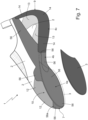
- the climbing shoe 1 is provided with an outer tensioning band 5 and an inner tensioning band 6, both with a monolithic structure.
- the outer tensioning band 5 extends obliquely on the outer side and on the bottom 4 of shoe-upper 2, and is adapted to connect the tip 7 and only the inner front side 8 of the shoe-upper 2 directly with the rear part 9 of the shoe-upper 2, i.e. with the part of shoe-upper 2 that covers and protects the calcaneus of the user's foot, passing over the bottom 4 of shoe-upper 2, under the sole 3.
- the outer tensioning band 5 is adapted to connect the area of the rear part 9 of shoe-upper 2 that is located immediately over the calcaneus of the user's foot, directly to the tip 7 and to the only inner front side 8 of shoe-upper 2, passing under the sole 3.
- outer tensioning band 5 is preferably firmly fixed to the outer surface of shoe-upper 2 substantially without interruptions, preferably by gluing, and is preferably also pre-tensioned.
- the inner tensioning band 6 on the other hand, extends obliquely on the inner lateral side of the shoe-upper 2, and is adapted to connect the rear part 9 of shoe-upper 2 directly to the outer tensioning band 5 roughly at the central or metatarsal section 4b of the bottom 4 of shoe-upper 2.
- the inner tensioning band 6 is adapted to connect the area of the rear part 9 of shoe-upper 2 which is immediately above the calcaneus of the user's foot, directly with the section of outer tensioning band 5 that substantially covers the central or metatarsal section 4b of the bottom 4.
- the inner tensioning band 6 is preferably firmly fixed to the outer surface of shoe-upper 2 substantially without interruptions, preferably by gluing, and is preferably also pre-tensioned.
- the outer tensioning band 5 preferably has the front portion shaped/dimensioned so as to substantially entirely cover the front or phalangeal section 4a of the bottom 4 of shoe-upper 2, and optionally also at least a part of the adjacent central or metatarsal section 4b of the bottom 4.
- the front part of the outer tensioning band 5 is shaped/dimensioned so as to extend on the upper part of the shoe-upper 2 to cover, preferably without interruptions, also the tip 7 and the inner front side 8 of the shoe-upper 2, while instead leaving the outer front side 10 of the shoe-upper 2 uncovered.
- the front part of tensioning band 5 is preferably provided with a curved appendage or end flap 5a, which is bent upwards so as to cover the ogival tip 7 and the inner front side 8 of shoe-upper 2, preferably roughly up to the height of the plantar arch, while instead leaving the outer front side 10 of shoe-upper 2 uncovered.
- the front end of the outer tensioning band 5 is shaped so as to form an oblong pocket that contains and covers the ogival tip 7 and the inner front side 8 of shoe-upper 2, while instead leaving the outer front side of the shoe-upper 2 uncovered.
- the curved appendage or end flap 5a of tensioning band 5 is furthermore fixed directly to the outer surface of shoe-upper 2 preferably by gluing.
- outer tensioning band 5 is preferably firmly fixed to a small pressure-relieving saddle-shaped patch 11, separate and distinct from tensioning bands 5 and 6, which is made of a soft and flexible material and is firmly fixed/ located on the rear part 9 of shoe-upper 2, in the area immediately over the user's calcaneus and substantially astride the footwear midplane.
- the rear end of inner tensioning band 6, on the other hand, is preferably firmly fixed to the saddle-shaped patch 11 on the opposite side with respect to the rear end of the outer tensioning band 5.
- the oblong-shaped front protective patch 12 is preferably helically wound on the front part of shoe-upper 2, so as to cover the front or phalangeal section 4a of the bottom 4, the outer front side 10 of shoe-upper 2, the upper front area of shoe-upper 2, and preferably also a part of the inner front side 8 of shoe-upper 2.
- the protective patch 12 moreover extends on the bottom 4 of shoe-upper 2, partially covering the central or metatarsal section 4b.
- the outer tensioning band 5 moreover overlaps and is firmly fixed to the protective patch 12 preferably by gluing.
- the front protective patch 12 has a monolithic and ribbon-like structure, and is preferably provided with an elastic modulus (Young's modulus) lower than that of the tensioning bands 5 and 6.
- the protective patch 12 is preferably made of a polymeric material having a hardness (UNI 4916) preferably lower than 60 ShoreA and optionally ranging between 45 and 60 ShoreA.
- the climbing shoe 1 is furthermore provided with a pair of lateral protective inserts 13 preferably made of a soft and flexible polymeric material, which are firmly fixed to the rear part 9 of shoe-upper 2 on opposite bands of the footwear midplane, preferably by gluing, and are adapted to cover the areas of the inner and outer lateral sides of shoe-upper 2 flanking the calcaneus of the user's foot.
- a pair of lateral protective inserts 13 preferably made of a soft and flexible polymeric material, which are firmly fixed to the rear part 9 of shoe-upper 2 on opposite bands of the footwear midplane, preferably by gluing, and are adapted to cover the areas of the inner and outer lateral sides of shoe-upper 2 flanking the calcaneus of the user's foot.
- the lateral protective inserts 13 are preferably made up of a single sheet of soft and flexible, elastomeric material that is substantially C-bent, and is firmly fixed to the rear part 9 of shoe-upper 2 preferably by gluing, so as to embrace the calcaneus of the user's foot.
- the sheet of elastomeric material is preferably shaped substantially in the form of a butterfly, and is arranged astride the rear part 9 of shoe-upper 2 so as to extend along the outer and inner lateral sides of shoe-upper 2, in order to embrace and protect the calcaneus of the user's foot.
- the layer of elastomeric material has a surface hardness (UNI 4916) preferably ranging between 90 and 120 ShoreA.
- the climbing shoe 1 is finally also provided with an oblong-shaped, rear protective patch 14, which is made of a soft and flexible polymeric material, and is firmly fixed to the rear part 9 of shoe-upper 2 preferably by gluing, so as to cover and protect the calcaneus of the user's foot.
- an oblong-shaped, rear protective patch 14 which is made of a soft and flexible polymeric material, and is firmly fixed to the rear part 9 of shoe-upper 2 preferably by gluing, so as to cover and protect the calcaneus of the user's foot.
- the protective patch 14 also overlaps the tensioning bands 5 and 6 and, possibly, the lateral protective inserts 13.
- the rear protective patch 14 has a monolithic ribbon-like structure, and is preferably substantially L-bent so as to simultaneously cover the talus-calcaneal section 4c of the bottom 4 and the rear part 9 of shoe-upper 2, while remaining substantially astride the footwear midplane.
- the lower part of the rear protective patch 14 is preferably shaped/dimensioned so as to substantially completely cover the talus-calcaneal section 4c of bottom 4, and optionally also at least part of the adjacent central or metatarsal section 4b of bottom 4, while overlapping the tensioning bands 5 and 6 and possibly the lateral protective inserts 13.
- the upper part of the rear protective patch 14, on the other hand, is preferably shaped/dimensioned so as to rise along the rear part 9 of shoe-upper 2, preferably up to arrive close to the saddle-shaped patch 11.
- the rear protective patch 14 is preferably provided with an elastic modulus (Young's modulus) greater than that of tensioning bands 5 and 6, and moreover has a surface hardness preferably lower than that of tensioning bands 5 and 6 and of the lateral protective inserts 13, and optionally greater than or equal to that of the sole 3 and/or of the front protective patch 12.
- elastic modulus Young's modulus
- the rear protective patch 14 is preferably made of a polymeric material having a hardness (UNI 4916) preferably lower than 70 ShoreA and optionally ranging between 45 and 60 ShoreA.
- the outer tensioning band 5 causes a very marked curvature of the user's forefoot, accompanied by a concurrent torsion of the forefoot towards the inside of the foot.
- the tensioning bands 5 and 6 may be fixed on the shoe-upper 2 with a different degree of pre-tensioning, thus allowing the climbing shoe 1 to bring into tension the inner and outer sides of the user's foot in a differentiated and asymmetric manner.
- the outer tensioning band 5 in fact, helps the wearer's toe to support the weight of the body during the most difficult props.
- the saddle-shaped patch 11 may also be made of leather.
- the climbing shoe 1 lacks the saddle-shaped patch 11, and the tensioning bands 5 and 6 are replaced by a single large oblong tensioning band 56, which is firmly fixed to the shoe-upper 2 so as to extend obliquely along the bottom 4 and the outer lateral side of shoe-upper 2 up to reach the area over the calcaneus of the user's foot, and then to descend obliquely along the inner lateral side of shoe-upper 2 towards the bottom 4, up to reach and stably join, preferably by gluing, an intermediate section of the same tensioning band 56, preferably more or less at the central or metatarsal section 4b of the bottom 4 of the shoe-upper.
- the front end of oblong tensioning band 56 is shaped so as to extend over the upper part of shoe-upper 2, in order to cover, preferably without interruption, the tip 7 and the inner front side 8 of shoe-upper 2, while leaving uncovered the outer front side 10 of shoe-upper 2 .
- the front part of the oblong tensioning band 56 is shaped so as to form an oblong pocket that contains and covers the tip 7 and the inner front side 8 of shoe-upper 2, while leaving uncovered the outer front side of the shoe-upper 2 .
- the front part of oblong tensioning band 56 is preferably provided with a curved appendage or end flap 56a, which is bent upwards so as to cover the ogival tip 7 and the inner front side 8 of shoe-upper 2, preferably roughly up to the height of the plantar arch, while instead leaving the outer front side 10 of the shoe-upper uncovered.
- the protective patch 12 is arranged crosswise the front part of shoe-upper 2, so as to cover the upper front area of shoe-upper 2 and the outer front side 10 of shoe-upper 2, preferably leaving the tip 7 uncovered.
Landscapes
- Chemical & Material Sciences (AREA)
- Engineering & Computer Science (AREA)
- Materials Engineering (AREA)
- Health & Medical Sciences (AREA)
- General Health & Medical Sciences (AREA)
- Physical Education & Sports Medicine (AREA)
- Footwear And Its Accessory, Manufacturing Method And Apparatuses (AREA)
Claims (13)
- Chaussure d'escalade (1) comprenant : une tige (2) formée afin de loger et de recouvrir sensiblement tout le pied de l'utilisateur ; une semelle (3) réalisée avec un matériau polymère, qui est fixée sur le fond (4) de la tige (2) afin de recouvrir au moins la partie avant du fond (4) de ladite tige (2) ; et au moins une première bande de tension (5, 56) qui est réalisée avec un matériau élastomère et s'étend de manière oblique sur le côté latéral externe de la tige (2), à partir de la partie arrière (9) de la tige (2), dans la zone au-dessus du calcanéum du pied de l'utilisateur, jusqu'au fond (4) de la tige (2) ;
la chaussure d'escalade (1) étant caractérisée en ce que ladite première bande de tension (5, 56) s'étend de plus de manière oblique sur le fond (4) de la tige (2) au-dessous de ladite semelle (3), afin de raccorder ladite partie arrière (9) de la tige (2) directement à la pointe (7) et le côté avant interne (8) de la tige (2) et en ce que l'extrémité avant de ladite première bande de tension (5, 56) forme une poche oblongue qui recouvre et contient la pointe (7) et le côté avant interne (8) de la tige (2) et est de plus formée afin de laisser le côté avant externe (10) de la tige (2) découvert. - Chaussure d'escalade selon la revendication 1, dans laquelle l'extrémité avant de ladite première bande de tension (5, 56) est prévue avec un appendice ou un rabat d'extrémité courbé (5a, 56a) qui est plié vers le haut afin de recouvrir la pointe ogivale (7) et le côté avant interne (8) de la tige (2), tout en laissant le côté avant externe (10) de la tige (2) découvert.
- Chaussure d'escalade selon l'une quelconque des revendications précédentes, caractérisée en ce qu'elle comprend de plus une seconde bande de tension (6) qui est réalisée avec un matériau élastomère et s'étend de manière oblique sur le côté latéral interne de la tige (2) afin de raccorder la zone de la partie supérieure (9) de la tige (2) qui est positionnée sur le calcanéum du pied de l'utilisateur, directement avec ladite première bande de tension (5) sensiblement au niveau de la section centrale ou du métatarse (4b) du fond (4) de la tige (2).
- Chaussure d'escalade selon la revendication 3, caractérisée en ce qu'elle comprend de plus un empiècement en forme de selle (11) distinct et séparé desdites première (5) et seconde (6) bandes de tension, qui est réalisé avec un matériau souple et flexible et est placé sur la partie arrière (9) de la tige (2), dans la zone au-dessus du calcanéum de l'utilisateur ; les extrémités arrière desdites première (5) et seconde (6) bandes de tension étant fermement fixées sur ledit empiècement en forme de selle (11).
- Chaussure d'escalade selon la revendication 1 ou 2, dans laquelle ladite première bande de tension (56), après avoir atteint et être passée au-delà de la zone de la tige (2) située au-dessus du calcanéum du pied de l'utilisateur, s'étend de manière oblique également le long du côté latéral interne de la tige (2) jusqu'à atteindre et fermement s'assembler à un segment intermédiaire de la même bande, sensiblement au niveau de la section centrale ou du métatarse (4b) du fond (4) de la tige (2).
- Chaussure d'escalade selon l'une quelconque des revendications précédentes, dans laquelle ladite première bande de tension (5, 56) a la partie avant formée/dimensionnée afin de recouvrir sensiblement toute la section avant ou phalangienne (4a) du fond (4) de la tige (2).
- Chaussure d'escalade selon l'une quelconque des revendications précédentes, caractérisée en ce qu'elle comprend, de plus, un empiècement de protection avant (12) qui est séparé et distinct de ladite première bande de tension (5, 56), est réalisé avec un matériau élastomère souple et flexible, et est fermement fixé sur la tige (2) afin de recouvrir la partie de l'avant-pied non recouverte par ladite première bande de tension (5).
- Chaussure d'escalade selon la revendication 7, dans laquelle l'empiècement de protection avant (12) a une forme oblongue et est agencé de travers sur la partie avant de la tige (2) afin de recouvrir la zone avant supérieure et le côté avant externe (10) de la tige (2), de préférence tout en laissant également la pointe (7) de la tige (2) découverte.
- Chaussure d'escalade selon la revendication 8, dans laquelle l'empiècement de protection avant (12) est enroulé de manière hélicoïdale sur la partie avant de la tige (2), afin de recouvrir la section avant ou phalangienne (4a) du fond (4) de la tige (2), le côté avant externe (10) de la tige (2), la zone avant supérieure de la tige (2), et de préférence également une partie du côté avant interne (8) de la tige (2).
- Chaussure d'escalade selon la revendication 9, dans laquelle l'empiècement de protection avant (12) s'étend, de manière supplémentaire sur le fond (4) de la tige (2), recouvrant partiellement la section centrale ou du métatarse (4b).
- Chaussure d'escalade selon l'une quelconque des revendications 7 à 10, dans laquelle l'empiècement de protection avant (12) est prévu avec un module élastique inférieur à celui de ladite première bande de tension (5, 56).
- Chaussure d'escalade selon l'une quelconque des revendications 7 à 11, dans laquelle l'empiècement de protection avant (12) a une dureté de surface inférieure à celle de ladite semelle (3) et/ou de ladite première bande de tension (5, 56).
- Chaussure d'escalade selon l'une quelconque des revendications précédentes, dans laquelle ladite semelle (3) est formée/dimensionnée afin de recouvrir sensiblement toute la section avant ou phalangienne (4a) du fond (4) de la tige (2) et de préférence également une partie de la section centrale ou du métatarse (4b) adjacente du fond (4).
Applications Claiming Priority (1)
| Application Number | Priority Date | Filing Date | Title |
|---|---|---|---|
| IT202100011207 | 2021-05-03 |
Publications (2)
| Publication Number | Publication Date |
|---|---|
| EP4085782A1 EP4085782A1 (fr) | 2022-11-09 |
| EP4085782B1 true EP4085782B1 (fr) | 2025-02-26 |
Family
ID=76921253
Family Applications (1)
| Application Number | Title | Priority Date | Filing Date |
|---|---|---|---|
| EP22170977.7A Active EP4085782B1 (fr) | 2021-05-03 | 2022-04-29 | Chaussure d'escalade |
Country Status (2)
| Country | Link |
|---|---|
| US (1) | US12150515B2 (fr) |
| EP (1) | EP4085782B1 (fr) |
Families Citing this family (1)
| Publication number | Priority date | Publication date | Assignee | Title |
|---|---|---|---|---|
| USD1076393S1 (en) * | 2023-11-30 | 2025-05-27 | Skechers U.S.A., Inc. Ii | Shoe upper |
Family Cites Families (8)
| Publication number | Priority date | Publication date | Assignee | Title |
|---|---|---|---|---|
| US2562514A (en) * | 1947-11-05 | 1951-07-31 | Sibulkin Morris | Arch-supporting counter for shoes |
| IT1303472B1 (it) | 1998-01-28 | 2000-11-06 | Sportiva Srl Ora La Sportiva S | Scarpetta particolarmente adatta per arrampicata libera. |
| ITTV20060132A1 (it) * | 2006-07-21 | 2008-01-22 | Scarpa Calzaturificio Spa | Scarpa da arrampicata. |
| US20090151198A1 (en) * | 2007-12-13 | 2009-06-18 | Jorge Villegas | Stick patch |
| IT1398425B1 (it) * | 2009-07-15 | 2013-02-22 | Scarpa Calzaturificio Spa | Scarpa da arrampicata |
| WO2015052792A1 (fr) * | 2013-10-09 | 2015-04-16 | 株式会社アシックス | Chaussure de sport |
| IT201800005616A1 (it) * | 2018-05-23 | 2019-11-23 | Scarpa da arrampicata | |
| US12082651B2 (en) * | 2019-09-20 | 2024-09-10 | R. G. Barry Corporation | Footwear article including cushion management system |
-
2022
- 2022-04-29 EP EP22170977.7A patent/EP4085782B1/fr active Active
- 2022-05-02 US US17/734,671 patent/US12150515B2/en active Active
Also Published As
| Publication number | Publication date |
|---|---|
| US20220346496A1 (en) | 2022-11-03 |
| EP4085782A1 (fr) | 2022-11-09 |
| US12150515B2 (en) | 2024-11-26 |
Similar Documents
| Publication | Publication Date | Title |
|---|---|---|
| EP3659455B1 (fr) | Chaussure d'escalade | |
| EP3571949B1 (fr) | Chaussure d'escalade | |
| EP2274994B1 (fr) | Chaussure d'escalade | |
| US20080120871A1 (en) | Upper structure for a shoe | |
| US20020078591A1 (en) | Dance shoe with tri-split | |
| AU2017435644B2 (en) | Shoe sole structure with reinforcement device | |
| JP7476186B2 (ja) | スケートボード用シューズ | |
| EP3571948B1 (fr) | Chaussure d'escalade | |
| EP4157014B1 (fr) | Tige comprenant des supports dynamiques | |
| EP2949232B1 (fr) | Chaussure d'escalade | |
| EP4103008B1 (fr) | Article chaussant à sangle à rabat | |
| EP4085782B1 (fr) | Chaussure d'escalade | |
| EP4085781B1 (fr) | Chaussure d'escalade | |
| EP3415024B1 (fr) | Chaussure d'escalade | |
| EP3811809B1 (fr) | Chaussure d'escalade | |
| EP3387935B1 (fr) | Chaussure d'escalade | |
| EP1430803A2 (fr) | Assemblage de semelle d'usure pour chaussure | |
| CN208724982U (zh) | 攀岩鞋 | |
| JP7481873B2 (ja) | シューズ用アッパー構造および当該アッパー構造を備えたシューズ | |
| KR20230054341A (ko) | 신발 |
Legal Events
| Date | Code | Title | Description |
|---|---|---|---|
| PUAI | Public reference made under article 153(3) epc to a published international application that has entered the european phase |
Free format text: ORIGINAL CODE: 0009012 |
|
| STAA | Information on the status of an ep patent application or granted ep patent |
Free format text: STATUS: THE APPLICATION HAS BEEN PUBLISHED |
|
| AK | Designated contracting states |
Kind code of ref document: A1 Designated state(s): AL AT BE BG CH CY CZ DE DK EE ES FI FR GB GR HR HU IE IS IT LI LT LU LV MC MK MT NL NO PL PT RO RS SE SI SK SM TR |
|
| STAA | Information on the status of an ep patent application or granted ep patent |
Free format text: STATUS: REQUEST FOR EXAMINATION WAS MADE |
|
| 17P | Request for examination filed |
Effective date: 20230503 |
|
| RBV | Designated contracting states (corrected) |
Designated state(s): AL AT BE BG CH CY CZ DE DK EE ES FI FR GB GR HR HU IE IS IT LI LT LU LV MC MK MT NL NO PL PT RO RS SE SI SK SM TR |
|
| STAA | Information on the status of an ep patent application or granted ep patent |
Free format text: STATUS: EXAMINATION IS IN PROGRESS |
|
| 17Q | First examination report despatched |
Effective date: 20240412 |
|
| GRAP | Despatch of communication of intention to grant a patent |
Free format text: ORIGINAL CODE: EPIDOSNIGR1 |
|
| STAA | Information on the status of an ep patent application or granted ep patent |
Free format text: STATUS: GRANT OF PATENT IS INTENDED |
|
| INTG | Intention to grant announced |
Effective date: 20240920 |
|
| GRAS | Grant fee paid |
Free format text: ORIGINAL CODE: EPIDOSNIGR3 |
|
| GRAA | (expected) grant |
Free format text: ORIGINAL CODE: 0009210 |
|
| STAA | Information on the status of an ep patent application or granted ep patent |
Free format text: STATUS: THE PATENT HAS BEEN GRANTED |
|
| P01 | Opt-out of the competence of the unified patent court (upc) registered |
Free format text: CASE NUMBER: APP_2340/2025 Effective date: 20250114 |
|
| AK | Designated contracting states |
Kind code of ref document: B1 Designated state(s): AL AT BE BG CH CY CZ DE DK EE ES FI FR GB GR HR HU IE IS IT LI LT LU LV MC MK MT NL NO PL PT RO RS SE SI SK SM TR |
|
| REG | Reference to a national code |
Ref country code: GB Ref legal event code: FG4D |
|
| REG | Reference to a national code |
Ref country code: CH Ref legal event code: EP |
|
| REG | Reference to a national code |
Ref country code: DE Ref legal event code: R096 Ref document number: 602022010991 Country of ref document: DE |
|
| REG | Reference to a national code |
Ref country code: IE Ref legal event code: FG4D |
|
| REG | Reference to a national code |
Ref country code: NL Ref legal event code: MP Effective date: 20250226 |
|
| PG25 | Lapsed in a contracting state [announced via postgrant information from national office to epo] |
Ref country code: RS Free format text: LAPSE BECAUSE OF FAILURE TO SUBMIT A TRANSLATION OF THE DESCRIPTION OR TO PAY THE FEE WITHIN THE PRESCRIBED TIME-LIMIT Effective date: 20250526 |
|
| PG25 | Lapsed in a contracting state [announced via postgrant information from national office to epo] |
Ref country code: FI Free format text: LAPSE BECAUSE OF FAILURE TO SUBMIT A TRANSLATION OF THE DESCRIPTION OR TO PAY THE FEE WITHIN THE PRESCRIBED TIME-LIMIT Effective date: 20250226 |
|
| PG25 | Lapsed in a contracting state [announced via postgrant information from national office to epo] |
Ref country code: PL Free format text: LAPSE BECAUSE OF FAILURE TO SUBMIT A TRANSLATION OF THE DESCRIPTION OR TO PAY THE FEE WITHIN THE PRESCRIBED TIME-LIMIT Effective date: 20250226 |
|
| PGFP | Annual fee paid to national office [announced via postgrant information from national office to epo] |
Ref country code: DE Payment date: 20250428 Year of fee payment: 4 |
|
| PG25 | Lapsed in a contracting state [announced via postgrant information from national office to epo] |
Ref country code: ES Free format text: LAPSE BECAUSE OF FAILURE TO SUBMIT A TRANSLATION OF THE DESCRIPTION OR TO PAY THE FEE WITHIN THE PRESCRIBED TIME-LIMIT Effective date: 20250226 |
|
| REG | Reference to a national code |
Ref country code: LT Ref legal event code: MG9D |
|
| PG25 | Lapsed in a contracting state [announced via postgrant information from national office to epo] |
Ref country code: NO Free format text: LAPSE BECAUSE OF FAILURE TO SUBMIT A TRANSLATION OF THE DESCRIPTION OR TO PAY THE FEE WITHIN THE PRESCRIBED TIME-LIMIT Effective date: 20250526 Ref country code: IS Free format text: LAPSE BECAUSE OF FAILURE TO SUBMIT A TRANSLATION OF THE DESCRIPTION OR TO PAY THE FEE WITHIN THE PRESCRIBED TIME-LIMIT Effective date: 20250626 |
|
| PG25 | Lapsed in a contracting state [announced via postgrant information from national office to epo] |
Ref country code: NL Free format text: LAPSE BECAUSE OF FAILURE TO SUBMIT A TRANSLATION OF THE DESCRIPTION OR TO PAY THE FEE WITHIN THE PRESCRIBED TIME-LIMIT Effective date: 20250226 |
|
| PG25 | Lapsed in a contracting state [announced via postgrant information from national office to epo] |
Ref country code: HR Free format text: LAPSE BECAUSE OF FAILURE TO SUBMIT A TRANSLATION OF THE DESCRIPTION OR TO PAY THE FEE WITHIN THE PRESCRIBED TIME-LIMIT Effective date: 20250226 |
|
| PG25 | Lapsed in a contracting state [announced via postgrant information from national office to epo] |
Ref country code: PT Free format text: LAPSE BECAUSE OF FAILURE TO SUBMIT A TRANSLATION OF THE DESCRIPTION OR TO PAY THE FEE WITHIN THE PRESCRIBED TIME-LIMIT Effective date: 20250626 Ref country code: LV Free format text: LAPSE BECAUSE OF FAILURE TO SUBMIT A TRANSLATION OF THE DESCRIPTION OR TO PAY THE FEE WITHIN THE PRESCRIBED TIME-LIMIT Effective date: 20250226 |
|
| PGFP | Annual fee paid to national office [announced via postgrant information from national office to epo] |
Ref country code: FR Payment date: 20250424 Year of fee payment: 4 |
|
| PG25 | Lapsed in a contracting state [announced via postgrant information from national office to epo] |
Ref country code: BG Free format text: LAPSE BECAUSE OF FAILURE TO SUBMIT A TRANSLATION OF THE DESCRIPTION OR TO PAY THE FEE WITHIN THE PRESCRIBED TIME-LIMIT Effective date: 20250226 Ref country code: GR Free format text: LAPSE BECAUSE OF FAILURE TO SUBMIT A TRANSLATION OF THE DESCRIPTION OR TO PAY THE FEE WITHIN THE PRESCRIBED TIME-LIMIT Effective date: 20250527 |
|
| REG | Reference to a national code |
Ref country code: AT Ref legal event code: MK05 Ref document number: 1769751 Country of ref document: AT Kind code of ref document: T Effective date: 20250226 |
|
| PG25 | Lapsed in a contracting state [announced via postgrant information from national office to epo] |
Ref country code: SE Free format text: LAPSE BECAUSE OF FAILURE TO SUBMIT A TRANSLATION OF THE DESCRIPTION OR TO PAY THE FEE WITHIN THE PRESCRIBED TIME-LIMIT Effective date: 20250226 |
|
| PG25 | Lapsed in a contracting state [announced via postgrant information from national office to epo] |
Ref country code: SM Free format text: LAPSE BECAUSE OF FAILURE TO SUBMIT A TRANSLATION OF THE DESCRIPTION OR TO PAY THE FEE WITHIN THE PRESCRIBED TIME-LIMIT Effective date: 20250226 |
|
| PG25 | Lapsed in a contracting state [announced via postgrant information from national office to epo] |
Ref country code: DK Free format text: LAPSE BECAUSE OF FAILURE TO SUBMIT A TRANSLATION OF THE DESCRIPTION OR TO PAY THE FEE WITHIN THE PRESCRIBED TIME-LIMIT Effective date: 20250226 |
|
| PG25 | Lapsed in a contracting state [announced via postgrant information from national office to epo] |
Ref country code: IT Free format text: LAPSE BECAUSE OF FAILURE TO SUBMIT A TRANSLATION OF THE DESCRIPTION OR TO PAY THE FEE WITHIN THE PRESCRIBED TIME-LIMIT Effective date: 20250226 |
|
| PG25 | Lapsed in a contracting state [announced via postgrant information from national office to epo] |
Ref country code: AT Free format text: LAPSE BECAUSE OF FAILURE TO SUBMIT A TRANSLATION OF THE DESCRIPTION OR TO PAY THE FEE WITHIN THE PRESCRIBED TIME-LIMIT Effective date: 20250226 |
|
| PG25 | Lapsed in a contracting state [announced via postgrant information from national office to epo] |
Ref country code: EE Free format text: LAPSE BECAUSE OF FAILURE TO SUBMIT A TRANSLATION OF THE DESCRIPTION OR TO PAY THE FEE WITHIN THE PRESCRIBED TIME-LIMIT Effective date: 20250226 Ref country code: CZ Free format text: LAPSE BECAUSE OF FAILURE TO SUBMIT A TRANSLATION OF THE DESCRIPTION OR TO PAY THE FEE WITHIN THE PRESCRIBED TIME-LIMIT Effective date: 20250226 |
|
| PG25 | Lapsed in a contracting state [announced via postgrant information from national office to epo] |
Ref country code: RO Free format text: LAPSE BECAUSE OF FAILURE TO SUBMIT A TRANSLATION OF THE DESCRIPTION OR TO PAY THE FEE WITHIN THE PRESCRIBED TIME-LIMIT Effective date: 20250226 |
|
| PG25 | Lapsed in a contracting state [announced via postgrant information from national office to epo] |
Ref country code: SK Free format text: LAPSE BECAUSE OF FAILURE TO SUBMIT A TRANSLATION OF THE DESCRIPTION OR TO PAY THE FEE WITHIN THE PRESCRIBED TIME-LIMIT Effective date: 20250226 |
|
| REG | Reference to a national code |
Ref country code: CH Ref legal event code: H13 Free format text: ST27 STATUS EVENT CODE: U-0-0-H10-H13 (AS PROVIDED BY THE NATIONAL OFFICE) Effective date: 20251125 |
|
| REG | Reference to a national code |
Ref country code: DE Ref legal event code: R097 Ref document number: 602022010991 Country of ref document: DE |
|
| PG25 | Lapsed in a contracting state [announced via postgrant information from national office to epo] |
Ref country code: LU Free format text: LAPSE BECAUSE OF NON-PAYMENT OF DUE FEES Effective date: 20250429 |
|
| PG25 | Lapsed in a contracting state [announced via postgrant information from national office to epo] |
Ref country code: MC Free format text: LAPSE BECAUSE OF FAILURE TO SUBMIT A TRANSLATION OF THE DESCRIPTION OR TO PAY THE FEE WITHIN THE PRESCRIBED TIME-LIMIT Effective date: 20250226 |
|
| REG | Reference to a national code |
Ref country code: BE Ref legal event code: MM Effective date: 20250430 |
|
| PLBE | No opposition filed within time limit |
Free format text: ORIGINAL CODE: 0009261 |
|
| STAA | Information on the status of an ep patent application or granted ep patent |
Free format text: STATUS: NO OPPOSITION FILED WITHIN TIME LIMIT |
|
| PG25 | Lapsed in a contracting state [announced via postgrant information from national office to epo] |
Ref country code: BE Free format text: LAPSE BECAUSE OF NON-PAYMENT OF DUE FEES Effective date: 20250430 |
|
| PG25 | Lapsed in a contracting state [announced via postgrant information from national office to epo] |
Ref country code: CH Free format text: LAPSE BECAUSE OF NON-PAYMENT OF DUE FEES Effective date: 20250430 |
|
| 26N | No opposition filed |
Effective date: 20251127 |
|
| PGFP | Annual fee paid to national office [announced via postgrant information from national office to epo] |
Ref country code: GB Payment date: 20260323 Year of fee payment: 5 |
|
| PG25 | Lapsed in a contracting state [announced via postgrant information from national office to epo] |
Ref country code: IE Free format text: LAPSE BECAUSE OF NON-PAYMENT OF DUE FEES Effective date: 20250429 |