EP4086800A1 - Module de circuit intégré pour la sécurité d'informations - Google Patents
Module de circuit intégré pour la sécurité d'informations Download PDFInfo
- Publication number
- EP4086800A1 EP4086800A1 EP22171261.5A EP22171261A EP4086800A1 EP 4086800 A1 EP4086800 A1 EP 4086800A1 EP 22171261 A EP22171261 A EP 22171261A EP 4086800 A1 EP4086800 A1 EP 4086800A1
- Authority
- EP
- European Patent Office
- Prior art keywords
- key
- unit
- information security
- secure
- integrated circuit
- Prior art date
- Legal status (The legal status is an assumption and is not a legal conclusion. Google has not performed a legal analysis and makes no representation as to the accuracy of the status listed.)
- Granted
Links
Images


Classifications
-
- G—PHYSICS
- G06—COMPUTING OR CALCULATING; COUNTING
- G06F—ELECTRIC DIGITAL DATA PROCESSING
- G06F21/00—Security arrangements for protecting computers, components thereof, programs or data against unauthorised activity
- G06F21/70—Protecting specific internal or peripheral components, in which the protection of a component leads to protection of the entire computer
- G06F21/71—Protecting specific internal or peripheral components, in which the protection of a component leads to protection of the entire computer to assure secure computing or processing of information
- G06F21/72—Protecting specific internal or peripheral components, in which the protection of a component leads to protection of the entire computer to assure secure computing or processing of information in cryptographic circuits
-
- H—ELECTRICITY
- H04—ELECTRIC COMMUNICATION TECHNIQUE
- H04L—TRANSMISSION OF DIGITAL INFORMATION, e.g. TELEGRAPHIC COMMUNICATION
- H04L9/00—Cryptographic mechanisms or cryptographic arrangements for secret or secure communications; Network security protocols
- H04L9/08—Key distribution or management, e.g. generation, sharing or updating, of cryptographic keys or passwords
- H04L9/0816—Key establishment, i.e. cryptographic processes or cryptographic protocols whereby a shared secret becomes available to two or more parties, for subsequent use
- H04L9/0819—Key transport or distribution, i.e. key establishment techniques where one party creates or otherwise obtains a secret value, and securely transfers it to the other(s)
- H04L9/0825—Key transport or distribution, i.e. key establishment techniques where one party creates or otherwise obtains a secret value, and securely transfers it to the other(s) using asymmetric-key encryption or public key infrastructure [PKI], e.g. key signature or public key certificates
-
- G—PHYSICS
- G06—COMPUTING OR CALCULATING; COUNTING
- G06F—ELECTRIC DIGITAL DATA PROCESSING
- G06F12/00—Accessing, addressing or allocating within memory systems or architectures
- G06F12/14—Protection against unauthorised use of memory or access to memory
-
- G—PHYSICS
- G06—COMPUTING OR CALCULATING; COUNTING
- G06F—ELECTRIC DIGITAL DATA PROCESSING
- G06F21/00—Security arrangements for protecting computers, components thereof, programs or data against unauthorised activity
- G06F21/60—Protecting data
- G06F21/602—Providing cryptographic facilities or services
-
- G—PHYSICS
- G06—COMPUTING OR CALCULATING; COUNTING
- G06F—ELECTRIC DIGITAL DATA PROCESSING
- G06F21/00—Security arrangements for protecting computers, components thereof, programs or data against unauthorised activity
- G06F21/60—Protecting data
- G06F21/606—Protecting data by securing the transmission between two devices or processes
-
- G—PHYSICS
- G06—COMPUTING OR CALCULATING; COUNTING
- G06F—ELECTRIC DIGITAL DATA PROCESSING
- G06F21/00—Security arrangements for protecting computers, components thereof, programs or data against unauthorised activity
- G06F21/70—Protecting specific internal or peripheral components, in which the protection of a component leads to protection of the entire computer
- G06F21/82—Protecting input, output or interconnection devices
- G06F21/85—Protecting input, output or interconnection devices interconnection devices, e.g. bus-connected or in-line devices
-
- H—ELECTRICITY
- H04—ELECTRIC COMMUNICATION TECHNIQUE
- H04L—TRANSMISSION OF DIGITAL INFORMATION, e.g. TELEGRAPHIC COMMUNICATION
- H04L9/00—Cryptographic mechanisms or cryptographic arrangements for secret or secure communications; Network security protocols
- H04L9/08—Key distribution or management, e.g. generation, sharing or updating, of cryptographic keys or passwords
- H04L9/0816—Key establishment, i.e. cryptographic processes or cryptographic protocols whereby a shared secret becomes available to two or more parties, for subsequent use
- H04L9/0838—Key agreement, i.e. key establishment technique in which a shared key is derived by parties as a function of information contributed by, or associated with, each of these
- H04L9/0841—Key agreement, i.e. key establishment technique in which a shared key is derived by parties as a function of information contributed by, or associated with, each of these involving Diffie-Hellman or related key agreement protocols
-
- H—ELECTRICITY
- H04—ELECTRIC COMMUNICATION TECHNIQUE
- H04L—TRANSMISSION OF DIGITAL INFORMATION, e.g. TELEGRAPHIC COMMUNICATION
- H04L9/00—Cryptographic mechanisms or cryptographic arrangements for secret or secure communications; Network security protocols
- H04L9/08—Key distribution or management, e.g. generation, sharing or updating, of cryptographic keys or passwords
- H04L9/0816—Key establishment, i.e. cryptographic processes or cryptographic protocols whereby a shared secret becomes available to two or more parties, for subsequent use
- H04L9/085—Secret sharing or secret splitting, e.g. threshold schemes
-
- H—ELECTRICITY
- H04—ELECTRIC COMMUNICATION TECHNIQUE
- H04L—TRANSMISSION OF DIGITAL INFORMATION, e.g. TELEGRAPHIC COMMUNICATION
- H04L9/00—Cryptographic mechanisms or cryptographic arrangements for secret or secure communications; Network security protocols
- H04L9/08—Key distribution or management, e.g. generation, sharing or updating, of cryptographic keys or passwords
- H04L9/0861—Generation of secret information including derivation or calculation of cryptographic keys or passwords
- H04L9/0869—Generation of secret information including derivation or calculation of cryptographic keys or passwords involving random numbers or seeds
-
- H—ELECTRICITY
- H04—ELECTRIC COMMUNICATION TECHNIQUE
- H04L—TRANSMISSION OF DIGITAL INFORMATION, e.g. TELEGRAPHIC COMMUNICATION
- H04L9/00—Cryptographic mechanisms or cryptographic arrangements for secret or secure communications; Network security protocols
- H04L9/32—Cryptographic mechanisms or cryptographic arrangements for secret or secure communications; Network security protocols including means for verifying the identity or authority of a user of the system or for message authentication, e.g. authorization, entity authentication, data integrity or data verification, non-repudiation, key authentication or verification of credentials
- H04L9/3271—Cryptographic mechanisms or cryptographic arrangements for secret or secure communications; Network security protocols including means for verifying the identity or authority of a user of the system or for message authentication, e.g. authorization, entity authentication, data integrity or data verification, non-repudiation, key authentication or verification of credentials using challenge-response
- H04L9/3278—Cryptographic mechanisms or cryptographic arrangements for secret or secure communications; Network security protocols including means for verifying the identity or authority of a user of the system or for message authentication, e.g. authorization, entity authentication, data integrity or data verification, non-repudiation, key authentication or verification of credentials using challenge-response using physically unclonable functions [PUF]
-
- G—PHYSICS
- G06—COMPUTING OR CALCULATING; COUNTING
- G06F—ELECTRIC DIGITAL DATA PROCESSING
- G06F21/00—Security arrangements for protecting computers, components thereof, programs or data against unauthorised activity
- G06F21/70—Protecting specific internal or peripheral components, in which the protection of a component leads to protection of the entire computer
- G06F21/78—Protecting specific internal or peripheral components, in which the protection of a component leads to protection of the entire computer to assure secure storage of data
Definitions
- the present invention relates to an integrated circuit module for information security, and more particularly to an integrated circuit module for information security in data storage and communication applications.
- the main purpose to develop technical means of the present invention is to solve the problems caused by the conventional means.
- the present invention principally relates to an integrated circuit module for information security, which includes: a secure circuit unit, which has passed a security evaluation as a cryptographic module and stores therein at least one digital key for providing a digital key service; and a controller unit set which is in communication with the secure circuit unit and includes a fast service unit and a trusted zone unit.
- the trusted zone unit and the secure circuit unit respectively use a first channel establishment key and a second channel establishment key dependent on each other to establish a secure signal channel.
- the secure circuit unit transmits a specific data to the fast service unit via the security signal channel to perform a fast service.
- the first channel establishment key and the second channel establishment key are derived from the digital key.
- the trusted zone unit contains a volatile memory.
- the trusted zone unit uses a main key to perform an initialization process with the digital key provided by the secure circuit unit, a set of derived data is obtained from the digital key and the main key and stored back to the secure circuit unit.
- the secure circuit unit sends the set of derived data to the trusted zone unit, and the trusted zone unit uses the main key and the set of derived data to restore the digital key and stores it in a volatile memory.
- the trusted zone unit and the secure circuit unit use the digital key to derive the first channel establishment key and the second channel establishment key respectively.
- the secure signal channel by way of the first channel establishment key and the second channel establishment key, has the specific data transmitted therevia under encryption.
- the specific data obtained by the trusted zone unit is stored into the volatile memory. After the controller unit set is powered off, the digital key stored in the volatile memory will disappear, and the process of establishing the secure signal channel will be restarted once the controller unit is powered on.
- the first channel establishment key and the second channel establishment key are session keys of the same contents.
- the secure signal channel by way of the session keys, has the specific data transmitted therevia under encryption.
- the specific data contains a key for fast service for the fast service unit to perform the fast service.
- the mutual verification includes the following steps.
- the trusted zone unit issues a first challenge to the security circuit unit, which is a generated random number, and sends it to the security circuit unit.
- the security circuit unit sends back a first response to the trusted zone unit, which is the random number encrypted with the digital key.
- the trusted zone unit then decrypts the first response based on the digital key to get back the decrypted random number, thereby determining whether the decrypted random number is the same as the generated random number.
- the security circuit unit issues a second challenge to the trusted zone unit, which is another generated random number, and sends it to the trusted zone unit.
- the trusted zone unit In response to the second challenge, the trusted zone unit sends back a second response to the security circuit unit, which is the another random number encrypted with the digital key.
- the security circuit unit then decrypts the second response according to the digital key to get back the decrypted another random number, thereby determining whether the decrypted another random number is the same as the generated another random number. The mutual verification is then completed.
- the trusted zone unit uses a secure technology of Physically Unclonable Function (PUF) to generate the main key.
- PAF Physically Unclonable Function
- the trusted zone unit obtains a first public key pairing the digital key in the initialization process.
- a second public key of a second public-private key pair in the trusted zone unit is sent to the secure circuit unit, and stored in the secure circuit unit.
- the trusted zone unit uses a PUF secure technology to generate the main key, and uses the main key to conduct encryption protection of the second public-private key pair.
- the trusted zone unit uses a key establishment process to derive a share key from the first public key and a second private key of the second public-private key pair.
- the secure circuit unit uses the key establishment process to derive the share key from the second public key and the digital key.
- the secure circuit unit and the trusted zone unit then use a session key derived from the shared key to serve as the first channel establishment key and the second channel establishment key.
- the secure circuit unit is a secure integrated circuit chip
- the controller unit set is a controller integrated circuit chipset.
- the fast service unit is implemented with an AI chip, a field programmable gate array unit, or an application specific integrated circuit (ASIC) for conducting the fast service, which is a fast service via a changeable interface.
- AI chip an AI chip
- field programmable gate array unit an application specific integrated circuit (ASIC) for conducting the fast service, which is a fast service via a changeable interface.
- ASIC application specific integrated circuit
- Another aspect of the present invention is a memory module exhibiting an information security function, which includes the above described integrated circuit module for information security and the following devices, including a non-volatile memory for storing digital information; and an interface controller in communication with the non-volatile memory, the integrated circuit module for information security, and a host for conducting digital data transmission between the non-volatile memory and the host, and using the fast service provided by the integrated circuit module for information security.
- a further aspect of the present invention is a memory module exhibiting an information security function, which includes the above-described integrated circuit module for information security and a non-volatile memory for storing digital information.
- the integrated circuit module for information security is in communication with the non-volatile memory and a host for conducting digital data transmission between the non-volatile memory and the host, and providing the fast service.
- Still another aspect of the present invention is a hardware module exhibiting an information security function, which includes the above-described integrated circuit module for information security and a communication controller.
- the communication controller is in communication with a host for conducting digital data transmission between the non-volatile memory and the host, and providing the fast service.
- the communication controller is a network interface controller.
- the integrated circuit module for information security is further coupled to a network module.
- the network module is used for communicating with the external internet or mobile network. Data information transmitted between the host and a user device at the other end of the internet or mobile network are encrypted/decrypted by way of the fast service unit in the integrated circuit module for information security.
- the integrated circuit module for information security and the communication controller are integrated in a housing to form the hardware module exhibiting information security and encryption/decryption functions.
- the integrated circuit module for information security conducts digital data transmission with a non-volatile memory in the host via the communication controller.
- the host transmits unencrypted information in the non-volatile memory to the fast service unit in the integrated circuit module for information security to be fast encrypted.
- the encrypted information is then transmitted back to the non-volatile memory in the host via the communication controller to be stored.
- the host transmits the encrypted information to the fast service unit in the integrated circuit module for information security to be fast decrypted.
- the decrypted information is then transmitted back to the non-volatile memory in the host via the communication controller to be stored.
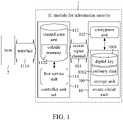
- the IC module 1 for information security mainly includes a security circuit unit 10 and a controller unit set 11.
- the secure circuit unit 10 is a circuit unit that has passed the secure module verification, e.g., the verifying test of Common Criteria Evaluation Assurance Level 5+, or short named "EAL5+"), and a storage unit 100 therein stores at least one digital key 1001 and ordinary digital information 1002.
- the digital key 1001 is used for conducting digital key services.
- the digital key services may be functions of cryptographic services, key management, data storage, and so on.
- the secure circuit unit 10 may further include an encryption unit 102 for providing necessary encryption/decryption services. Its processing speed, however, is not fast enough. Therefore, a fast service unit 111 is additionally developed according to the present invention to make improvement.
- the controller unit set 11 developed according to the present invention mainly includes the fast service unit 111 and a trusted zone unit 112.
- the trusted zone unit 112 and the secure circuit unit 10 respectively use a first channel establishment key and a second channel establishment key, which are dependent on each other, to establish a secure signal channel 101.
- the secure circuit unit 10 uses the secure signal channel 101 to transmit a specific data to the fast service unit 111.
- the fast service unit 111 uses the specific data to conduct, with a host 2, a fast service 1110 via a changeable interface.
- the fast service unit 111 may be implemented with an artificial intelligence (AI) chip, a field programmable gate array (FPGA) unit, or other types of application specific integrated circuit (ASIC) for conduct a fast service 1110 via a changeable interface with the host 2.
- AI artificial intelligence
- FPGA field programmable gate array
- ASIC application specific integrated circuit
- the specific data may include a key for fast service.
- the key for fast service is originally well preserved in the secure circuit unit 10.
- Examples of the key for fast service include an identity key indicating a specific identity, e.g., a client of an online bank, a cryptocurrency account password, or a key for encrypting a confidential document.
- the fast service 1110 may be a fast log-in operation, information encryption/decryption such as AES encryption/decryption, and digital signature production and signature verification, by way of the key for fast service.
- the fast service unit 111 is disposed with a specific hardware circuit for fast information encryption/decryption, e.g., AES encryption/decryption and digital signature production and signature verification, for promoting the encryption/decryption processing speed of the entire IC module 1 for information security. Furthermore, by way of the following technical means, reliability of the information security of the IC module 1 can be extended to the fast service unit 111.
- the dependent first channel establishment key and second channel establishment key have a specific relationship. The simplest one is that both are identical, or there is a function/mapping relationship therebetween.
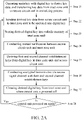
- the trusted zone unit 112 in the controller unit set 11 can use a main key to conduct an initialization process of the digital key provided by the secure circuit unit 10 during a packaging process of the above-described IC module 1 for information security or when the system is reset to factory settings.
- the initialization process mainly aims to obtain a set of derived data, and the trusted zone unit 112 stores the set of derived data back to the secure circuit unit 10 (Step 21).
- the set of derived data may be derived and obtained by operating the main key and the digital key.
- the trusted zone unit 112 stores the set of derived data back to the secure circuit unit 10, it will not store the set of derived data in a complete form, or it will delete the set of derived data.
- the object is that the set of derived data will not be simultaneously stored in the trusted zone unit 112 and the secure circuit unit 10 in a complete form until a secure channel is established.
- the way of generating the main key by the above-described trusted zone unit 112 may be implemented with the secure technology of Physically Unclonable Function, which is hereinafter so called as PUF. Due to the features of being random, unique, and unable to reproduce, the generated main key plays a chip-fingerprint like role. Therefore, the main key can inherently differ with the chip circuit feature of the trusted zone unit 112, and it is not easy to hack away the main key.
- the secure circuit unit 10 sends the set of derived data back to the trusted zone unit 112 again (Step 22). Accordingly, the trusted zone unit 112 gets back the digital key according to the main key and the set of derived data again, and stores it into a volatile memory 1120 (Step 23). Then the trusted zone unit 112 can use the digital key to conduct mutual verification with the secure circuit unit 10 (Step 24).
- the first channel establishment key and the second channel establishment key may be session keys of the same contents (Step 25). Then the secure signal channel 101 can use the session keys to conduct encrypted transmission of the specific data (Step 26).
- the specific data may include the key for fast service.
- the key for fast service is stored in the volatile memory 1120. After the controller unit set 11 is powered off, the digital key stored in the volatile memory 1120 and the key for fast service will disappear (Step 27). In the meantime, the key for fast service is stored only in the better protected secure circuit unit 10. In response to regeneration of the need for another fast service, the process of establishing the secure signal channel 101 can be started again after the controller unit set 11 is powered on again (Step 28).
- a first challenge to the secure circuit unit 10 is issued by the trusted zone unit 112, e.g., the trusted zone unit 112 generates a random number and transmits it to the secure circuit unit 10.
- the secure circuit unit 10 sends a first response, which is the random number encrypted with the digital key, to the trusted zone unit 112.
- the trusted zone unit 112 decrypts the first response according to the digital key to get back the random number. Then, whether the random number is the random number initially issued can be determined, thereby performing verification.
- a second challenge to the trusted zone unit 112 is issued by the secure circuit unit 10, e.g., the secure circuit unit 10 generates another random number and transmits it to the trusted zone unit 112.
- the second challenge for example, is another random number generated by the secure circuit unit 10.
- the trusted zone unit 112 sends a second response to respond to the secure circuit unit 10, which is the another random number encrypted with the digital key, to the secure circuit unit 10.
- the secure circuit unit 10 decrypts the second response with the digital key to get back the another random number. Then, whether the another random number is the random number initially issued can be determined, thereby performing mutual verification.
- the orders of the above-described two challenges may be exchanged.
- the present invention may also use other key establishment mechanism to establish the secure signal channel.
- this embodiment is characterized in that even in the initialization process during manufacturing, the digital key in the secure circuit unit 10 will not be outputted to the external, but only public keys are exchanged.
- the trusted zone unit 112 can obtain a first public key, which pairs the digital key. Meanwhile, a second public key of a second public-private key pair in the trusted zone unit 112 is sent to the secure circuit unit 10, and stored in the secure circuit unit 10. For securing the second public-private key pair from being hacked, the trusted zone unit 112 may use the PUF-based main key to encrypt the second public-private key pair.
- a share key is generated by the trusted zone unit 112 according to a key establishment process.
- the key establishment algorithm for example, can be Elliptic Curve Diffie-Hellman key exchange (ECDH), by which the share key is derived from the first public key and a second private key of the second public-private key pair.
- the secure circuit unit 10 may also use the same key establishment process, e.g., ECDH, and derive the share key from the second public key and the digital key.
- the secure circuit unit 10 and the trusted zone unit 112 then use the share key to derive a session key, which serves as each of the first channel establishment key and the second channel establishment key.
- the first channel establishment key and the second channel establishment key are session keys of the same contents, and the secure signal channel uses the session keys to conduct symmetric-encryption transmission, e.g., AES encryption.
- the session keys will disappear as the controller unit set 11 is powered off. Subsequently, when the controller unit set 11 is powered on, the process of establishing the secure signal channel restarts again.
- the above-described ECDH process may be a type of Elliptic Curve Diffie-Hellman key exchange(2s), which is ECDH(2s) in short. That is, two static keys are used for generating a share key. In other words, the resulting share key will not change, and it is necessary to derive different session keys each time to avoid from cracking.
- ECDH(2s,1e) or ECDH(2s,2e) may also be introduced.
- ECDH(2s,1e) or ECDH(2s,2e) may also be introduced.
- an ephemeral key By introducing an ephemeral key, different share keys can be generated each time without the derivation operation of the session key, and security of the system can be further improved. Since the above-described ECDH(2s,1e) and ECDH(2s,2e) have been developed to be well known algorithms, they are not redundantly described herein.
- the secure circuit unit 10 may be implemented with a commercially available secure element, e.g., SLE 97 produced by Infineon Technologies.
- the controller unit set 11 may be implemented with an integrated chipset consisting of a single chip or composite chips.
- the fast service unit 111 may be implemented with an artificial intelligence (AI) chip, a field programmable gate array (FPGA) unit, or other application specific integrated circuit (ASIC) for conducting the fast service 1110 via a changeable interface with the host.
- AI artificial intelligence
- FPGA field programmable gate array
- ASIC application specific integrated circuit
- FIGS. 3A, 3B and 3C illustrate the use of the IC module 1 for information security according to the present invention in different hardware environments.
- the IC module 1 for information security is in communication with a flash memory 30 via an interface controller 31, which are further integrated into a memory module exhibiting an information security function.
- the flash memory 30 can be used for storing digital information.
- the interface controller 31 is a controller of Secure Digital Memory Card, i.e., SD card controller.
- FIG. 3A will be able to constitute an SD card or a microSD card exhibiting an information security function.
- the SD card or microSD card exhibiting an information security function is inserted into an ordinary card-reader.
- the host 2 as shown is a computer or a smartphone, and a memory card-reader is coupled thereto. It may be transformed into a USB dongle exhibiting an information security function.
- the card-reader inserted with the SD card or microSD card exhibiting an information security function can be transformed into a USB dongle exhibiting an information security function, or a security token.
- the flash memory 30, of course, may be implemented with other types of non-volatile memory, and not to be redundantly described herein.
- the consumer can transform an ordinary card reader into a USB dongle exhibiting an information security function, or a security token, by purchasing the SD card or microSD card exhibiting an information security function, which is developed according to the present invention.
- information encryption/decryption functions can be achieved.
- the interface controller 31 may also be directly implemented with a USB controller. Accordingly, the circuit blocks shown in FIG. 3A may be integrated into one housing to directly form a USB dongle exhibiting an information security function, and communicable with the host 2 via the I/O interface 310, i.e., the USB interface herein.
- a USB token passing the verification executed by the fast identity online (FIDO) appliance can be obtained with the IC module 1 for information security serving as a core and integrated therewith an ordinary USB interface controller.
- the I/O interface 310 e.g., the above-described microSD card interface or a USB interface
- the host 2 can communicate with the IC module 1 for information security and the flash memory 30 by way of a microSD card protocol or a USB protocol.
- the data stored in the flash memory 30 can have the encryption service from the IC module 1 for information security.
- an interface controller 1110 is integrated into the fast service unit 111. Accordingly, the flash memory 30 is in communication with the host 2 via an I/O interface 320 provided by the fast service unit 111 of the IC module for information security. Installation of the interface controller 31 shown in FIG. 3A can thus be omitted.
- the fast service unit 111 may be implemented with an FPGA unit. By way of programming settings to adjust functions so as to accomplish the interface control functions of a USB, a peripheral component interconnect express (PCIe), an integrated drive electronics (IDE), a serial advanced technology attachment (SATA), or a small computer system interface (SCSI).
- PCIe peripheral component interconnect express
- IDE integrated drive electronics
- SATA serial advanced technology attachment
- SCSI small computer system interface
- the flash memory 30 may further be integrated with the IC module 1 for information security in the same housing, thereby directly constituting a portable secure SSD exhibiting an information security function.
- the fast service unit 111 may also be implemented with an ASIC, which is lower in cost and poorer in function.
- FIG. 3C it is a hardware module exhibiting an information security function with the IC module 1 for information security serving as a core.
- the fast service unit 111 in the IC module 1 for information security is communicable with the host 2 via an I/O interface 330 directly provided by a communication controller 33, which is implemented with an ASIC, an FPGA unit or a system on a chip (SoC).
- the communication controller 33 may be a network interface card controller, and the IC module 1 for information security may further be connected to a network module 39 for communication with an external internet (not shown) or mobile network (not shown).
- FIG. 3C can directly constitute a network communication device exhibiting an information security function, e.g., a voice over internet protocol (VoIP) device exhibiting information security and encryption/decryption functions, or a virtual private network (VPN) device exhibiting information security and encryption/decryption functions.
- VoIP voice over internet protocol
- VPN virtual private network
- the communication controller 33 may also be implemented with a PCI-E bus controller, and may also be a USB, IDE, SATA or SCSI interface controller. Accordingly, as shown in FIG. 3C , the integrated IC module 1 for information security and communication controller 33 in one housing (not shown), a hardware security module (HSM) exhibiting information security and encryption/decryption functions can be obtained. Then it is not necessary to install the network module 39 in the HSM.
- HSM hardware security module
- the unencrypted data stored in the non-volatile memory 20 can be transmitted by the host to the fast service unit 111 in the IC module 1 via the communication controller 33 to be encrypted.
- the encrypted data is then transmitted back to the non-volatile memory 20 in the host 2 via the communication controller 33 to be stored.
- the host 2 sends the encrypted data stored in the non-volatile memory 20 to the fast service unit 111 in the IC module 1 for information security via the communication controller 33 to be decrypted.
- the decrypted data is then transmitted back to the non-volatile memory 20 in the host 2 via the communication controller 33 to be stored or for other uses, e.g., shown on a display.
- the host 2 can be transformed into a network attached storage (NAS) exhibiting an information security function.
- NAS network attached storage
- the fast service as described above can be used to conduct fast encryption or decryption of the transmitted or received data by using various session keys derived from the digital key properly stored in the IC module 1 for information security, or to perform fast digital signature production and signature verification.
Landscapes
- Engineering & Computer Science (AREA)
- Computer Security & Cryptography (AREA)
- Theoretical Computer Science (AREA)
- Physics & Mathematics (AREA)
- Computer Hardware Design (AREA)
- Computer Networks & Wireless Communication (AREA)
- Signal Processing (AREA)
- General Physics & Mathematics (AREA)
- General Engineering & Computer Science (AREA)
- Software Systems (AREA)
- General Health & Medical Sciences (AREA)
- Bioethics (AREA)
- Health & Medical Sciences (AREA)
- Mathematical Physics (AREA)
- Storage Device Security (AREA)
- Credit Cards Or The Like (AREA)
Applications Claiming Priority (1)
| Application Number | Priority Date | Filing Date | Title |
|---|---|---|---|
| TW110115954 | 2021-05-03 |
Publications (2)
| Publication Number | Publication Date |
|---|---|
| EP4086800A1 true EP4086800A1 (fr) | 2022-11-09 |
| EP4086800B1 EP4086800B1 (fr) | 2026-04-08 |
Family
ID=81653599
Family Applications (1)
| Application Number | Title | Priority Date | Filing Date |
|---|---|---|---|
| EP22171261.5A Active EP4086800B1 (fr) | 2021-05-03 | 2022-05-03 | Module de circuit intégré pour la sécurité d'informations |
Country Status (5)
| Country | Link |
|---|---|
| US (1) | US12267413B2 (fr) |
| EP (1) | EP4086800B1 (fr) |
| JP (1) | JP7398509B2 (fr) |
| CN (1) | CN114896180A (fr) |
| TW (1) | TWI809852B (fr) |
Families Citing this family (2)
| Publication number | Priority date | Publication date | Assignee | Title |
|---|---|---|---|---|
| US20240265152A1 (en) * | 2023-02-08 | 2024-08-08 | Stmicroelectronics International N.V. | Embedded secure circuit |
| CN118573359A (zh) * | 2023-02-28 | 2024-08-30 | 华为技术有限公司 | 密钥获取方法、装置、系统及计算机可读存储介质 |
Citations (3)
| Publication number | Priority date | Publication date | Assignee | Title |
|---|---|---|---|---|
| US20120054498A1 (en) * | 2010-08-24 | 2012-03-01 | Rickman Gregory M | System and method for managing secure information within a hybrid portable computing device |
| EP3373508A1 (fr) * | 2015-11-05 | 2018-09-12 | Mitsubishi Electric Corporation | Appareil de sécurité et procédé de sécurité |
| US20190188397A1 (en) * | 2017-12-14 | 2019-06-20 | Apple Inc. | Multiple mailbox secure circuit |
Family Cites Families (9)
| Publication number | Priority date | Publication date | Assignee | Title |
|---|---|---|---|---|
| US20030037237A1 (en) * | 2001-04-09 | 2003-02-20 | Jean-Paul Abgrall | Systems and methods for computer device authentication |
| US8027472B2 (en) | 2005-12-30 | 2011-09-27 | Selim Aissi | Using a trusted-platform-based shared-secret derivation and WWAN infrastructure-based enrollment to establish a secure local channel |
| JP2009543211A (ja) * | 2006-07-07 | 2009-12-03 | サンディスク コーポレイション | 汎用管理構造を使用するコンテンツ管理システムおよび方法 |
| SG171730A1 (en) * | 2008-11-24 | 2011-07-28 | Certicom Corp | System and method for hardware based security |
| FR2968799B1 (fr) | 2010-12-09 | 2013-01-11 | Oberthur Technologies | Procede et dispositif de controle d'execution pour des fonctions internes et des applications protegees embarquees dans des cartes a microcircuits pour terminaux mobiles |
| CN104025500B (zh) | 2011-12-29 | 2017-07-25 | 英特尔公司 | 使用在物理上不可克隆的函数的安全密钥存储 |
| TW201633207A (zh) * | 2014-12-12 | 2016-09-16 | 納格維遜股份有限公司 | 裝置金鑰保護 |
| TWI536199B (zh) * | 2015-01-12 | 2016-06-01 | 群聯電子股份有限公司 | 資料保護方法、記憶體控制電路單元及記憶體儲存裝置 |
| US10833858B2 (en) * | 2017-05-11 | 2020-11-10 | Microsoft Technology Licensing, Llc | Secure cryptlet tunnel |
-
2022
- 2022-05-02 US US17/734,139 patent/US12267413B2/en active Active
- 2022-05-03 TW TW111116626A patent/TWI809852B/zh active
- 2022-05-03 EP EP22171261.5A patent/EP4086800B1/fr active Active
- 2022-05-05 CN CN202210494111.7A patent/CN114896180A/zh not_active Withdrawn
- 2022-05-06 JP JP2022076427A patent/JP7398509B2/ja active Active
Patent Citations (3)
| Publication number | Priority date | Publication date | Assignee | Title |
|---|---|---|---|---|
| US20120054498A1 (en) * | 2010-08-24 | 2012-03-01 | Rickman Gregory M | System and method for managing secure information within a hybrid portable computing device |
| EP3373508A1 (fr) * | 2015-11-05 | 2018-09-12 | Mitsubishi Electric Corporation | Appareil de sécurité et procédé de sécurité |
| US20190188397A1 (en) * | 2017-12-14 | 2019-06-20 | Apple Inc. | Multiple mailbox secure circuit |
Also Published As
| Publication number | Publication date |
|---|---|
| US20220353062A1 (en) | 2022-11-03 |
| US12267413B2 (en) | 2025-04-01 |
| EP4086800B1 (fr) | 2026-04-08 |
| TWI809852B (zh) | 2023-07-21 |
| CN114896180A (zh) | 2022-08-12 |
| JP2022172472A (ja) | 2022-11-16 |
| JP7398509B2 (ja) | 2023-12-14 |
| TW202244764A (zh) | 2022-11-16 |
Similar Documents
| Publication | Publication Date | Title |
|---|---|---|
| CN114629639B (zh) | 基于可信执行环境的密钥管理方法、装置和电子设备 | |
| US9735962B1 (en) | Three layer key wrapping for securing encryption keys in a data storage system | |
| EP3598696B1 (fr) | Appareil de fourniture de mots de passe à usage unique de matériel basé sur puf et procédé d'authentification à deux facteurs l'utilisant | |
| CN106575326B (zh) | 利用非对称加密实施一次性密码的系统和方法 | |
| CN103124269B (zh) | 云环境下基于动态口令与生物特征的双向身份认证方法 | |
| CN110868291B (zh) | 一种数据加密传输方法、装置、系统及存储介质 | |
| US11196721B2 (en) | Systems and methods for establishing a secure communication channel between an information handling system and a docking station | |
| CN103237305B (zh) | 面向移动终端上的智能卡密码保护方法 | |
| CN107210914A (zh) | 用于安全凭证供应的方法 | |
| US9313185B1 (en) | Systems and methods for authenticating devices | |
| CN111917710A (zh) | Pci-e密码卡及其密钥保护方法、计算机可读存储介质 | |
| CN102571340A (zh) | 证书认证装置及该装置的访问和证书更新方法 | |
| CN101551784A (zh) | 一种usb接口的ata类存储设备中数据的加密方法及装置 | |
| CN106100850A (zh) | 基于二维码的智能安全芯片签名信息传输方法及系统 | |
| CN102947836A (zh) | 存储设备、主机设备和使用双重加密方案在第一和第二存储设备之间传递密码的方法 | |
| CA2940633A1 (fr) | Dispositif d'authentification universel pour le web et les reseaux mobiles | |
| CN103986717A (zh) | 网络数据安全传输与存储系统及方法 | |
| US12267413B2 (en) | Integrated circuit module functioning for information security | |
| EP2902934B1 (fr) | Dispositif de sécurité portable, procédé pour sécuriser un échange de données et produit de programme informatique | |
| KR20220162609A (ko) | 저장 디바이스와 호스트 디바이스 사이의 데이터 전송을 인증하는 모듈 및 방법 | |
| CN113422832A (zh) | 文件传输方法、装置、设备和存储介质 | |
| US20200380107A1 (en) | Short-distance network electronic authentication | |
| TWI476629B (zh) | Data security and security systems and methods | |
| US11005651B2 (en) | Method and terminal for establishing security infrastructure and device | |
| CN107370598A (zh) | 以智能手机作为个人电脑电子密钥的方法 |
Legal Events
| Date | Code | Title | Description |
|---|---|---|---|
| PUAI | Public reference made under article 153(3) epc to a published international application that has entered the european phase |
Free format text: ORIGINAL CODE: 0009012 |
|
| STAA | Information on the status of an ep patent application or granted ep patent |
Free format text: STATUS: REQUEST FOR EXAMINATION WAS MADE |
|
| 17P | Request for examination filed |
Effective date: 20220519 |
|
| AK | Designated contracting states |
Kind code of ref document: A1 Designated state(s): AL AT BE BG CH CY CZ DE DK EE ES FI FR GB GR HR HU IE IS IT LI LT LU LV MC MK MT NL NO PL PT RO RS SE SI SK SM TR |
|
| RBV | Designated contracting states (corrected) |
Designated state(s): AL AT BE BG CH CY CZ DE DK EE ES FI FR GB GR HR HU IE IS IT LI LT LU LV MC MK MT NL NO PL PT RO RS SE SI SK SM TR |
|
| STAA | Information on the status of an ep patent application or granted ep patent |
Free format text: STATUS: EXAMINATION IS IN PROGRESS |
|
| 17Q | First examination report despatched |
Effective date: 20240913 |
|
| GRAP | Despatch of communication of intention to grant a patent |
Free format text: ORIGINAL CODE: EPIDOSNIGR1 |
|
| STAA | Information on the status of an ep patent application or granted ep patent |
Free format text: STATUS: GRANT OF PATENT IS INTENDED |
|
| RIC1 | Information provided on ipc code assigned before grant |
Ipc: G06F 21/72 20130101AFI20250930BHEP Ipc: G06F 21/60 20130101ALI20250930BHEP Ipc: G06F 21/85 20130101ALI20250930BHEP Ipc: H04L 9/08 20060101ALI20250930BHEP Ipc: H04L 9/32 20060101ALI20250930BHEP Ipc: G06F 21/78 20130101ALN20250930BHEP |
|
| INTG | Intention to grant announced |
Effective date: 20251030 |
|
| GRAS | Grant fee paid |
Free format text: ORIGINAL CODE: EPIDOSNIGR3 |
|
| GRAA | (expected) grant |
Free format text: ORIGINAL CODE: 0009210 |
|
| STAA | Information on the status of an ep patent application or granted ep patent |
Free format text: STATUS: THE PATENT HAS BEEN GRANTED |
|
| AK | Designated contracting states |
Kind code of ref document: B1 Designated state(s): AL AT BE BG CH CY CZ DE DK EE ES FI FR GB GR HR HU IE IS IT LI LT LU LV MC MK MT NL NO PL PT RO RS SE SI SK SM TR |
|
| REG | Reference to a national code |
Ref country code: CH Ref legal event code: F10 Free format text: ST27 STATUS EVENT CODE: U-0-0-F10-F00 (AS PROVIDED BY THE NATIONAL OFFICE) Effective date: 20260408 Ref country code: GB Ref legal event code: FG4D |
|
| REG | Reference to a national code |
Ref country code: DE Ref legal event code: R096 Ref document number: 602022033868 Country of ref document: DE |