EP4087103A1 - Linearantrieb - Google Patents
Linearantrieb Download PDFInfo
- Publication number
- EP4087103A1 EP4087103A1 EP21171873.9A EP21171873A EP4087103A1 EP 4087103 A1 EP4087103 A1 EP 4087103A1 EP 21171873 A EP21171873 A EP 21171873A EP 4087103 A1 EP4087103 A1 EP 4087103A1
- Authority
- EP
- European Patent Office
- Prior art keywords
- magnetic wheel
- linear drive
- magnets
- secondary part
- drive
- Prior art date
- Legal status (The legal status is an assumption and is not a legal conclusion. Google has not performed a legal analysis and makes no representation as to the accuracy of the status listed.)
- Granted
Links
Images


Classifications
-
- H—ELECTRICITY
- H02—GENERATION; CONVERSION OR DISTRIBUTION OF ELECTRIC POWER
- H02K—DYNAMO-ELECTRIC MACHINES
- H02K41/00—Propulsion systems in which a rigid body is moved along a path due to dynamo-electric interaction between the body and a magnetic field travelling along the path
- H02K41/02—Linear motors; Sectional motors
- H02K41/025—Asynchronous motors
-
- H—ELECTRICITY
- H02—GENERATION; CONVERSION OR DISTRIBUTION OF ELECTRIC POWER
- H02K—DYNAMO-ELECTRIC MACHINES
- H02K49/00—Dynamo-electric clutches; Dynamo-electric brakes
- H02K49/02—Dynamo-electric clutches; Dynamo-electric brakes of the asynchronous induction type
- H02K49/04—Dynamo-electric clutches; Dynamo-electric brakes of the asynchronous induction type of the eddy-current hysteresis type
- H02K49/046—Dynamo-electric clutches; Dynamo-electric brakes of the asynchronous induction type of the eddy-current hysteresis type with an axial airgap
-
- B—PERFORMING OPERATIONS; TRANSPORTING
- B60—VEHICLES IN GENERAL
- B60L—PROPULSION OF ELECTRICALLY-PROPELLED VEHICLES; SUPPLYING ELECTRIC POWER FOR AUXILIARY EQUIPMENT OF ELECTRICALLY-PROPELLED VEHICLES; ELECTRODYNAMIC BRAKE SYSTEMS FOR VEHICLES IN GENERAL; MAGNETIC SUSPENSION OR LEVITATION FOR VEHICLES; MONITORING OPERATING VARIABLES OF ELECTRICALLY-PROPELLED VEHICLES; ELECTRIC SAFETY DEVICES FOR ELECTRICALLY-PROPELLED VEHICLES
- B60L13/00—Electric propulsion for monorail vehicles, suspension vehicles or rack railways; Magnetic suspension or levitation for vehicles
- B60L13/03—Electric propulsion by linear motors
-
- B—PERFORMING OPERATIONS; TRANSPORTING
- B60—VEHICLES IN GENERAL
- B60L—PROPULSION OF ELECTRICALLY-PROPELLED VEHICLES; SUPPLYING ELECTRIC POWER FOR AUXILIARY EQUIPMENT OF ELECTRICALLY-PROPELLED VEHICLES; ELECTRODYNAMIC BRAKE SYSTEMS FOR VEHICLES IN GENERAL; MAGNETIC SUSPENSION OR LEVITATION FOR VEHICLES; MONITORING OPERATING VARIABLES OF ELECTRICALLY-PROPELLED VEHICLES; ELECTRIC SAFETY DEVICES FOR ELECTRICALLY-PROPELLED VEHICLES
- B60L2200/00—Type of vehicles
- B60L2200/26—Rail vehicles
Definitions
- the present invention falls within the technical field of electric drives for track-guided means of land transport or rail vehicles; In the present case, it relates to a linear drive for operating a vehicle along a section of a route according to the preamble of claim 1.
- a linear drive or linear motor is an electrical drive machine in which, in contrast to known rotating machines, the driven objects are not set in a rotating motion, but are moved on a straight or curved path. Consequently, in the case of linear drives, one does not speak of a rotational movement, but of a translational movement.
- roller coaster trains are catapulted every two minutes by an electromagnetic linear drive into a ball of rails made of steel tubes, with such a heavy roller coaster train receiving its initial energy on a catapult track about 50 meters long by around 100 pairs of linear induction motors - also known as LIMs.
- LIMs linear induction motors
- Such a LIM was and is a logical further development of a contactless acceleration system with the aim of being largely mechanically maintenance-free.
- LIMs are also used in mechanical drives of door systems - such as in supermarkets, for example - or in passenger conveyor belts and luggage belts at airports.
- roller coasters Other electromagnetic functional principles are also of interest for roller coasters, namely the linear induction motors are being replaced by linear synchronous motors - also called LSM - whose efficiency is comparatively higher than that of the LIM.
- LSM linear synchronous motors
- Leading providers of roller coasters often take action back to powerful LSM acceleration tracks that master top speeds of around 180 kilometers per hour.
- the way the linear induction motor works is derived from the AC motor. The only and most noticeable difference is that a translatory movement is generated instead of a rotational one.
- the stator coils arranged in a circle in the AC motor are placed on a flat, linear path.
- the "rotor” that rotates in the AC motor is moved in a straight line in the linear synchronous motor. If a current is passed through a copper wire, a magnetic field is created around it. Its field strength depends on the applied current.
- the copper wire is wound around an elongated iron core - the ferrite core.
- an ironless embodiment is also conceivable.
- a coil is formed which, when current is applied, has the same properties as a permanent magnet.
- a north and a south pole are formed at the respective ends of the ferrite core.
- motor modules with three-phase coils - the stators - are arranged along a rail over an entire acceleration section or catapult section, which are grouped around a linear air gap about 20 millimeters wide.
- the motor has a length of about one meter.
- a copper or aluminum rail is located on the train as a reaction rail as a so-called runner, which reaction rail is pulled through the gap by the LIM motor without contact.
- the functional principle of the drive follows the law of induction.
- An applied AC voltage generates a moving magnetic field in the coils of the linear motor with a constant change of polarity between north and south.
- the traveling field moves along the catapult track, its speed of travel is determined by the frequency of the applied current.
- the traveling magnetic field applied in the stator induces an electrical voltage in the "rotor medium", which sets the free electrons in the reaction rail in motion. This flow of electrons in turn creates a magnetic field.
- Both magnetic fields interact with each other, unlike poles attract each other, like poles repel each other.
- the interaction of the two magnetic fields creates a force component in the direction of the traveling field, which sets the roller coaster train in motion.
- the translational driving force is in this case dependent on the relative speed ⁇ v between the train and the traveling magnetic field. If both are equally fast, no opposing magnetic field is generated and the acceleration is equal to zero.
- the speed of the train - and thus of the runner - is always lower than that of the driving stator field. So the magnetic field generated in the runners moves across the reaction rail and even jumps from car to car over adjacent reaction rails. If the velocities of the stator field and the train were equal, no voltage would be induced in the rotor and the force driving the train would no longer be sustained. If the speed of the train were even greater than that of the stator field, the direction of the force would change and the train would be decelerated. As is well known, such relationships result from the physical law of induction.
- the publication discloses a known linear drive EP 3 107 195 A1 ; it relates to a linear motor drive system for accelerating a vehicle within an acceleration section of a travel route.
- the linear motor drive system includes a stator with at least two stator elements arranged along the route, the stator elements being combined into stator groups. Furthermore, the linear motor drive system includes a slider which is attached to the vehicle.
- Each stator group is permanently connected to its own energy converter for the energy supply, which energy converter can be controlled individually. At least two of the stator groups are arranged in such a way that the rotor can interact simultaneously with these two stator groups.
- the present linear motor drive system is suitable for accelerating a vehicle for passenger transport in an amusement ride such as a roller coaster.
- a linear drive comprises a primary part and a secondary part that is magnetically operatively connected thereto, the primary part being designed as at least one first reaction rail and the secondary part comprising a number of magnets, the secondary part comprising at least one first magnetic Wheel comprises and the number of magnets are arranged on the at least one first magnetic wheel, and wherein the at least one first magnetic wheel is magnetically operatively connected to the at least one reaction rail and the secondary part is mechanically connected to a rotary drive.
- the magnetic fields which are alternately aligned by the magnets on the circumference of the secondary part, are in motion in relation to the primary part due to the rotation of the rotary drive in such a way that eddy currents I form in the primary part, which is designed as a reaction rail, which in turn are associated with these alternately aligned magnetic fields interact such that a desired mechanical force is consequently provided; the rotatable secondary part thus “simulates a quasi-infinite length expansion of the same” in the primary part.
- one subsystem installation essentially comprises the magnetic wheels with the rotary drive that drives them in a compact unit that can be arranged concentrated in one area of a vehicle and is also available for use over the entire route and at every point on the route, on which the primary part is arranged, interact with it, namely both (positively) accelerating and braking.
- these magnetic wheel systems can also be installed per vehicle, with which the overall system performance can be increased and/or the several drive units can be made smaller for a given overall system performance.
- the amount of the propulsion force can be adjusted by means of a controllable rotational speed of the rotary drive; the direction of rotation—forward or backward in relation to a direction of travel of a vehicle—determines the type of acceleration in terms of an increase in speed or a reduction in speed.
- the primary part designed as a reaction rail is made of an electrically conductive material for the formation of the necessary eddy currents I;
- the reaction rail can be made of copper or aluminum, which is a comparatively poor conductor, which is advantageously significantly lighter and also cheaper; other electrically conductive materials can also be used.
- the invention now provides a linear drive for the first time, the overall system installation of which is significantly easier to implement and during operation the energy consumption no longer has to be concentrated on conventional individual acceleration route sections, but can be distributed over the entire route.
- the secondary part comprises the first magnetic wheel and a second magnetic wheel arranged parallel thereto, with the at least one first reaction rail being arranged between the first magnetic wheel and the second magnetic wheel and being magnetically operatively connected to both wheels is.
- the magnets are arranged on a side of the first magnetic wheel or of the second magnetic wheel that faces the reaction rail, or that the magnets are arranged on a side of the first magnetic wheel and of the second magnetic wheel that faces the reaction rail . It is provided that opposite magnets on the first and second wheel have a different polarity and adjacent magnets on a respective wheel as well.
- the primary part is stationary and the secondary part is movable. Furthermore, in a further embodiment it can be provided that the secondary part is stationary and the primary part is movable.
- the magnets are advantageously designed as permanent magnets, or the magnets are designed as separately excited electromagnets.
- the magnets which are designed as separately excited electromagnets, to have a ferrite core.
- An advantageous embodiment provides that the secondary part and the rotary drive are arranged on a drive platform, as a result of which a unit that is as compact as possible can be provided.
- the linear drive advantageously has a magnetic operative connection between the primary part and the secondary part as an asynchronous coupling, with a number of eddy currents I being able to be induced in the primary part.
- the primary part comprises the at least one reaction rail and at least one second reaction rail parallel thereto, which are magnetically operatively connected to the secondary part, the secondary part comprising the first and the second magnetic wheel and also at least a third magnetic wheel includes; through this parallel arrangement of two—or optionally more—reaction rails, the overall system performance can be increased in a concentrated design.
- the rotary drive in the form of an electric, hydraulic or pneumatic machine, or for the rotary drive to be in the form of a combined drive from the group of electric, hydraulic or pneumatic machines.
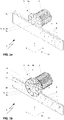
- a linear drive 1 according to the invention is shown in a perspective plan view.
- This linear drive 1 essentially comprises at least one primary part 5, designed as a reaction rail 5a, with a return plate 5c, a secondary part 3, which is designed as at least one first magnetic wheel 3a, and a rotary drive 2, which is mechanically connected to the at least one first magnetic wheel 3a connected is.
- the at least one first magnetic wheel 3a is equipped with magnets 4 in such a way that these magnets 4 generate a magnetic field that penetrates the reaction rail 5a and induce a number of eddy currents I 8 in this reaction rail 5a, which interact with the magnetic field, whereby the magnetic field closes in a known manner via the return plate 5c of the primary part 5.
- the linear drive 1 is equipped with at least one second magnetic wheel 3b of the secondary part 3 in addition to the first magnetic wheel 3a, the first and the second magnetic wheel 3a, 3b being arranged parallel to one another on a common axis 15 of the rotary drive 2 , and wherein the first and the second magnetic wheel 3a, 3b are spaced apart on this axis 15 in such a way that the at least one first reaction rail 5 can be arranged in a magnetically operatively connected manner in between.
- the first and/or the second magnetic wheel 3a, 3b is/are fitted with magnets 4 in such a way that these magnets 4 generate the magnetic field B 6 between this first and this second magnetic wheel 3a, 3b, which magnetic field B 6 also penetrates the reaction rail 5a and thereby with it interacts.
- 1c additionally shows possible arrangements of the magnets 4 on the first and the second magnetic wheel 3a, 3b.
- the secondary part is 3 in 1c shown in a plan view of the first magnetic wheel 3a and the second magnetic wheel 3b, with the magnets 4a being designed as permanent magnets 4a on one of the two and as electromagnets 4b on the other, optionally with a respective ferrite core 4c.
- FIG. 1b respectively adjacent magnets 4 on the respective first or second magnetic wheel 3a, 3b, have a different polarity and also opposing magnets 4 on the one hand on the first magnetic wheel 3a and on the other hand on the second magnetic wheel 3b, provided that both have magnets 4 are equipped as in the Figures 2a to 2c shown as an example.
- the magnetic field B 6 is shown using an example, which magnetic field B 6 is generated between the first and the second wheel 3a, 3b by the two associated magnets 4 with the polarities "N" and "S".
- the rotary drive 2 sets the secondary part 3 in a rotating motion with the direction of rotation 7b, whereby the magnets 4 are periodically moved into the region of the reaction rail 5a screw in and out again.
- the secondary part 3 of the linear drive 1 according to the invention with the rotary drive 2 is arranged on a support frame 11 of a drive platform 10 of a vehicle not shown in detail here, with a power supply 12, 12b of the linear drive 1 being connected via a number of current collectors 16 on busbars 9 the drive platform 10 can take place.
- Further examples of energy supplies 12a or 12c are also symbolically indicated here, a more detailed explanation of which does not appear necessary in view of specialist knowledge.
- the primary part 5 or the secondary part 3 it is optionally possible to design the primary part 5 or the secondary part 3 to be stationary and the other part to be movable.
- Figures 4a and 4b show two further embodiments of the linear drive 1 according to the invention, their difference to those described above Linear actuators 1 can be seen essentially in the horizontal arrangement of the secondary part 3 and the first and second magnetic wheel 3a, 3b.
- one leg of an L-profile support 14a serves as a reaction rail and in Figure 4b a leg of an H-profile beam 14b.
- Fig. 1a discussed functionality for the translatory drive in the direction of force F 7a, see also Fig.
- the Figure 4c showed a further advantageous embodiment of the invention, in which, compared to the embodiment in Figure 4b , a further, parallel to the first reaction rail 5a, second reaction rail 5b is shown, which is operatively connected to a further magnetic wheel 3c.
Landscapes
- Engineering & Computer Science (AREA)
- Power Engineering (AREA)
- Physics & Mathematics (AREA)
- Electromagnetism (AREA)
- Transportation (AREA)
- Mechanical Engineering (AREA)
- Chemical & Material Sciences (AREA)
- Combustion & Propulsion (AREA)
- Linear Motors (AREA)
- Dynamo-Electric Clutches, Dynamo-Electric Brakes (AREA)
Abstract
Description
- Die vorliegende Erfindung fällt in den technischen Bereich von elektrischen Antrieben für spurgeführte Landverkehrsmittel bzw. Schienenfahrzeuge; sie betrifft vorliegend einen Linearantrieb für den Betrieb eines Fahrzeugs entlang eines Streckenabschnitts einer Fahrstrecke gemäss dem Oberbegriff des Anspruchs 1.
- Ein Linearantrieb oder Linearmotor ist eine elektrische Antriebsmaschine, bei der im Gegensatz zu bekannten, rotierenden Maschinen, die angetriebenen Objekte nicht in eine drehende Bewegung versetzt werden, sondern auf einer geradlinigen oder gekurvten Bahn verschoben werden. Konsequenterweise spricht man bei Linearantrieben also nicht von einer Rotationsbewegung, sondern von einer Translationsbewegung.
- Eine bekannte Anwendung solcher Linearantriebe liegt bei Achterbahnen seit Jahrzehnten vor; typischerweise werden dabei Achterbahnzüge im Zwei-Minuten-Takt von einem elektromagnetischen Linearantrieb in ein Schienenknäuel aus Stahlrohren katapultiert, wobei ein solcher tonnenschwere Achterbahnzug seine Initialenergie auf einer rund 50 Meter langen Katapultstrecke mittels etwa 100 paarweise installierten linearen Induktionsmotoren -auch LIM genannt- erhält. Ein solcher LIM war und ist dabei eine konsequente Weiterentwicklung eines kontaktlosen Beschleunigungssystems mit dem Ziel einer weitgehend mechanischen Wartungsfreiheit. Des Weiteren finden LIM auch in mechanischen Antrieben von Türsystemen -wie in Supermärkten beispielsweise- oder bei Personenbeförderungsbänder und Gepäckbändern an Flughäfen Verwendung.
- Auch andere elektromagnetische Funktionsprinzipien sind bei Achterbahnen von Interesse, und zwar werden dabei die linearen Induktionsmotoren abgelöst durch lineare Synchronmotoren -auch LSM genannt- deren Wirkungsgrad vergleichsweise höher ist als bei den LIM. Führende Anbieter von Achterbahnen greifen dabei vielfach auf durchschlagsstarke LSM Beschleunigungsbahnen zurück, die Spitzengeschwindigkeiten von rund 180 Stundenkilometern meistern.
- Der lineare Induktionsmotor entstammt in seiner Funktionsweise dem Wechselstrommotor. Der einzige und auffälligste Unterschied liegt darin, dass statt einer rotatorischen eine translatorische Bewegung erzeugt wird. Die im Wechselstrommotor kreisförmig angeordneten Statorspulen werden dazu auf einer ebenen, linearen Strecke platziert. Der "Läufer", der im Wechselstrommotor rotiert, wird beim linearen Synchronmotor über eine geradlinige Strecke bewegt. Wird durch einen Kupferdraht ein Strom geleitet, so entsteht um diesen ein magnetisches Feld. Dessen Feldstärke ist vom angelegten Strom abhängig. Um das erzeugte Magnetfeld zu maximieren und in seiner Ausbreitungsrichtung geometrisch zu kontrollieren, wird der Kupferdraht um einen länglichen Eisenkern -dem Ferritkern- gewickelt, wobei selbstverständlich auch eine eisenlose Ausführungsform denkbar ist. Es entsteht eine Spule, welche bei angelegtem Strom gleiche Eigenschaften wie ein Permanentmagnet besitzt. An den jeweiligen Enden des Ferritkerns entsteht ein Nord- und ein Südpol. Beim Linearmotor sind viele derartige Spulen in einer Reihe hintereinandergeschaltet. Entlang einer Schiene sind dazu über eine gesamte Beschleunigungsstrecke bzw. Katapultstrecke Motormodule mit dreiphasigen Spulen -den Statoren- angeordnet, die um einen etwa 20 Millimeter breiten linearen Luftspalt gruppiert sind. Der Motor besitzt dabei eine Länge von etwa einem Meter. Am Zug befindet sich eine Kupfer- oder Aluminiumschiene als Reaktionsschiene als sogenannter Läufer, welche Reaktionsschiene vom LIM Motor berührungslos durch den Spalt gezogen wird. Das Funktionsprinzip des Antriebs folgt dabei dem Gesetz der Induktion. Eine angelegte Wechselspannung erzeugt in den Spulen des Linearmotors ein wanderndes Magnetfeld mit ständigem Wechsel der Polarität zwischen Nord und Süd. Das Wanderfeld bewegt sich entlang der Katapultstrecke, seine Fortbewegungsgeschwindigkeit wird durch die Frequenz des angelegten Stroms bestimmt. Das im Stator angelegte magnetische Wanderfeld induziert im "Läufermedium" eine elektrische Spannung, die die freien Elektronen in der Reaktionsschiene in Bewegung versetzt. Dieser Elektronenfluss erzeugt wiederum ein Magnetfeld. Beide Magnetfelder interagieren miteinander, ungleiche Pole ziehen sich an, gleiche Pole stoßen sich ab. Durch die Wechselwirkung der beiden Magnetfelder entsteht eine Kraftkomponente in Richtung des Wanderfeldes, welche den Achterbahnzug in Bewegung setzt. Die translatorische Antriebskraft ist vorliegend abhängig von der Relativgeschwindigkeit Δv zwischen dem Zug und dem Wandermagnetfeld. Sind beide gleich schnell, wird kein Gegenmagnetfeld erzeugt und die Beschleunigung ist gleich null.
- Während der Beschleunigungsphase ist die Geschwindigkeit des Zuges -und damit des Läufer- stets kleiner als die des antreibenden Statorfeldes. Das in den Läufern erzeugte Magnetfeld bewegt sich also über die Reaktionsschiene und springt sogar über benachbarte Reaktionsschienen von Wagen zu Wagen. Würden die Geschwindigkeiten des Statorfeldes und des Zuges gleich sein, so würde im Läufer keine Spannung induziert und die den Zug antreibende Kraft nicht mehr aufrechterhalten. Würde die Geschwindigkeit des Zuges sogar größer als die des Statorfeldes, so würde die Kraftrichtung drehen und der Zug abgebremst werden. Derartige Zusammenhänge resultieren bekanntermassen aus dem physikalischen Induktionsgesetz.
- Einen bekannten Linearantrieb offenbart die Druckschrift
EP 3 107 195 A1 ; sie betrifft ein Linearmotorantriebssystem zur Beschleunigung eines Fahrzeugs innerhalb eines Beschleunigungsabschnitts auf einer Fahrtrasse. Das Linearmotorantriebssystem umfasst einen Stator mit mindestens zwei längs der Fahrtrasse angeordneten Statorelementen, wobei die Statorelemente zu Statorgruppen zusammengefasst sind. Ferner umfasst das Linearmotorantriebssystem einen Läufer, welcher am Fahrzeug befestigt ist. Dabei ist jede Statorgruppe mit einem eigenen Energiewandler zur Energieversorgung permanent verbunden, welcher Energiewandler einzeln angesteuert werden kann. Mindestens zwei der Statorgruppen sind derart angeordnet, dass der Läufer gleichzeitig mit diesen zwei Statorgruppen wechselwirken kann. Das hier vorliegende Linearmotorantriebssystem ist zur Beschleunigung eines Fahrzeugs zum Personentransport in einer Vergnügungsanlage wie beispielsweise einer Achterbahn geeignet. - Es ist Aufgabe der vorliegenden Erfindung, einen Linearantrieb dahingehend weiterzuentwickeln, dass ein einfacherer und effizienterer Systemaufbau dieses Linearantriebs ermöglicht wird, der eine raumsparendere Gesamtsysteminstallation im Vergleich zu herkömmlichen Linearantrieben aufweist.
- Die dieser Erfindung für den Linearantrieb zugrundeliegende Aufgabe wird gelöst durch die Merkmale des Anspruchs 1; die diesen Erfindungsgedanken weiterbildenden Merkmale sind Gegenstand der Unteransprüche 2 bis 12.
- Der Kern der vorliegenden Erfindung ist darin zu sehen, dass ein Linearantrieb ein Primärteil und ein hierzu magnetisch in Wirkverbindung stehendes Sekundärteil umfasst, wobei das Primärteil als mindestens eine erste Reaktionsschiene ausgebildet ist und das Sekundärteil eine Anzahl Magnete umfasst, wobei das Sekundärteil mindestens ein erstes magnetisches Rad umfasst und die Anzahl Magnete an dem mindestens einen ersten magnetischen Rad angeordnet sind, und wobei das mindestens eine erste magnetische Rad mit der mindestens einen Reaktionsschiene magnetisch wirkverbunden ist und das Sekundärteil mit einem Rotationsantrieb mechanisch verbunden ist.
- Zusammenfassend ist festhaltbar, dass die durch die Magnete am Umfang des Sekundärteils wechselweise ausgerichteten Magnetfelder durch die Rotation des Rotationsantriebs gegenüber dem Primärteil derart in Bewegung sind, dass sich in dem als Reaktionsschiene ausgestalteten Primärteil Wirbelströme I ausbilden, die wiederum in Verbindung mit diesen wechselweise ausgerichteten Magnetfeldern derart wechselwirken, dass folglich eine gewünschte, mechanische Kraft bereitgestellt wird; dem Primärteil wird also mittels des rotierbaren Sekundärteils "quasi eine unendliche Längenausdehnung desselben vorgetäuscht". Somit umfasst die eine Teilsysteminstallation hinsichtlich des Sekundärteils im Wesentlichen die Magneträder mit dem sie antreibenden Rotationsantrieb in einer kompakten Einheit, die in einem Bereich eines Fahrzeugs konzentriert angeordnet werden kann und darüber hinaus über die gesamte Fahrstrecke nutzbar zur Verfügung steht und an jeder Stelle der Fahrstrecke, an dem das Primärteil angeordnet ist, mit diesem in Wechselwirkung treten, und zwar sowohl (positiv) beschleunigend als auch bremsend. Selbstverständlich sind pro Fahrzeug auch mehrere dieser Magnetradsysteme installierbar, womit die gesamte Systemleistung erhöht werden kann und/oder die mehreren Antriebseinheiten bei vorgegebener Gesamtsystemleistung kleiner ausgeführt werden können.
- Besonders vorteilhaft ist dabei, dass mit der Erfindung ein massgeblich kürzerer Sekundärteil in Bezug auf die Länge bekannter Fahrzeuge möglich ist als herkömmliche Sekundärteile, die häufig auch annähernd entlang einer gesamten Fahrzeuglänge angeordnet werden.
- Mittels einer steuerbaren Rotationsgeschwindigkeit des Rotationsantriebs, ist der Betrag der Vortriebskraft einstellbar; die Drehrichtung -vorwärts bzw. rückwärts in Bezug auf eine Fahrtrichtung eines Fahrzeugs- bestimmt die Art der Beschleunigung im Sinne einer Geschwindigkeitserhöhung bzw. einer Geschwindigkeitsreduktion.
- Das als Reaktionsschiene ausgebildete Primärteil ist für die Ausbildung der notwendigen Wirbelströme I aus einem elektrisch leitenden Material hergestellt; beispielsweise kann die Reaktionsschiene aus Kupfer oder dem dazu vergleichsweise schlechter leitenden Aluminium hergestellt sein, welches mit Vorteil deutlich leichter und auch preiswerter ist; auch andere elektrisch leitende Materialen können zum Einsatz gelangen.
- Die vorliegend einfache Ausführung der Teilsysteminstallation hinsichtlich des Primärteils, nämlich als einfache Reaktionsschiene, erlaubt nun die Ausstattung einer gesamten Fahrstrecke eines herkömmlichen Fahrgeschäfts mit einer solchen Reaktionsschiene, womit die Fahrzeuggeschwindigkeit permanent steuerbar ist.
- Gegenüber dem Stand der Technik stellt die Erfindung nun erstmalig einen Linearantrieb zur Verfügung, dessen Gesamtsysteminstallation markant einfacher ausführbar ist und bei dessen Betrieb sich der Energieverbrauch nicht mehr nur auf herkömmliche einzelne Beschleunigungsstreckenabschnitte konzentrieren muss, sondern über die gesamte Fahrstrecke verteilbar ist.
- Bei einer vorteilhaften Ausführungsform der Erfindung ist vorgesehen, dass das Sekundärteil das erstes magnetisches Rad und ein parallel dazu angeordnetes zweites magnetisches Rad umfasst, wobei die mindestens eine erste Reaktionsschiene zwischen dem ersten magnetischen Rad und dem zweiten magnetischen Rad angeordnet ist und mit beiden Rädern magnetisch wirkverbunden ist.
- Bei einer Ausführungsform der Erfindung ist vorgesehen, dass die Magnete auf einer der Reaktionsschiene zugewandten Seite des ersten magnetischen Rads oder des zweiten magnetischen Rads angeordnet sind, oder dass die Magnete auf einer der Reaktionsschiene zugewandten Seite des ersten magnetischen Rads und des zweiten magnetischen Rads angeordnet sind. Dabei ist vorgesehen, dass einander gegenüberstehende Magnete am ersten und zweiten Rad eine unterschiedliche Polung aufweisen und benachbarte Magnete auf einem jeweiligen Rad ebenso.
- Bei einer weiteren Ausführungsform der Erfindung ist vorgesehen, dass das Primärteil ortsfest angeordnet ist und das Sekundärteil beweglich. Ferner kann bei einer weiteren Ausführungsform vorgesehen sein, dass das Sekundärteil ortsfest angeordnet ist und das Primärteil beweglich. Mit Vorteil sind die Magnete bei einer weiteren Ausführungsform als Permanentmagnete ausgebildet, oder die Magnete sind als fremderregte Elektromagnete ausgebildet.
- Zecks Erhöhung der magnetischen Wirkung kann ferner vorgesehen sein, dass die als fremderregte Elektromagnete ausgebildeten Magnete einen Ferritkern umfassen.
- Eine vorteilhafte Ausführungsform sieht vor, dass das Sekundärteil und der Rotationsantrieb auf einer Antriebsplattform angeordnet sind, wodurch eine möglichst kompakte Einheit bereitstellbar ist.
- Vorteilhafterweise weist der Linearantrieb in einer Ausführungsform eine magnetische Wirkverbindung zwischen dem Primärteil und dem Sekundärteil als eine asynchrone Kopplung auf, wobei im Primärteil eine Anzahl Wirbelströme I induzierbar sind.
- Bei einer weiteren vorteilhaften Ausführungsform der Erfindung ist vorgesehen, dass das Primärteil die mindestens eine Reaktionsschiene und parallel dazu eine mindestens zweite Reaktionsschiene umfasst, welche mit dem Sekundärteil magnetisch in Wirkverbindung stehen, wobei das Sekundärteil das erste und das zweite magnetische Rad und zudem mindestens ein drittes magnetisches Rad umfasst; durch diese Parallelanordnung zweier -oder gegebenenfalls mehrerer- Reaktionsschienen, kann in einer konzentrierten Bauform die Gesamtsystemleistung erhöht werden.
- Ferner kann bei einer weiteren Ausführungsform des erfindungsgemässen Linearantriebs vorgesehen sein, den Rotationsantrieb als eine elektrische oder als eine hydraulische oder als eine pneumatische Maschine auszubilden oder dass der Rotationsantrieb als ein kombinierter Antrieb aus der Gruppe elektrischer, hydraulischer oder pneumatischer Maschinen ausbildbar ist.
- Weitere Ausführungsformen des erfindungsgemässen Linearantriebs und deren zugehörigen Vorteile sind Gegenstand der detaillierten Beschreibung und der Figuren.
- Im Folgenden wird die Erfindung anhand von Figuren beispielhaft erläutert. Gleiche Gegenstände sind in den Figuren grundsätzlich mit gleichen Bezugszeichen versehen. An dieser Stelle wird darauf hingewiesen, dass die Figuren keine einschränkende Wirkung auf den vorliegenden Erfindungsgegenstand als solches haben, sondern lediglich exemplarische Ausführungsformen des Erfindungsgedankens -wie dieser sich in den Ansprüchen darstellt- zeigen.
- Es zeigen rein schematisch die
-
Fig.1a, 1b und1c einen erfindungsgemässen Linearantrieb mit einem als Reaktionsschiene ausgebildeten Primärteil und ein Sekundärteil, welches ein erstes magnetisches Rad, bzw. ein erstes und ein zweites magnetisches Rad umfasst, die inFig. 1c detaillierter dargestellt sind; -
Fig. 2a bis Fig. 2 Ausführungsformen des erfindungsgemässen Linearantriebs gemässFig. 1a mit unterschiedlich ausgestatteten magnetischen Tragrädern; -
Fig. 3 eine weitere Ausführungsform des Linearantriebs gemässFig. 1a , wobei dieser auf einer Antriebplattform eines -nicht näher dargestellten- Fahrzeugs angeordnet ist, und -
Fig. 4a, 4b, 4c noch weitere Ausführungsformen des Linearantriebs gemässFig. 1a , wobei dessen magnetische Tragräder vorliegend horizontal angeordnet sind. - In
Fig. 1a ist ein Linearantrieb 1 gemäss der Erfindung in einer perspektivischen Draufsicht gezeigt. Dieser Linearantrieb 1 umfasst im Wesentlichen mindestens ein als eine Reaktionsschiene 5a ausgebildetes Primärteil 5 mit einer Rückschlussplatte 5c, ferner ein Sekundärteil 3, welches als mindestens ein erstes magnetisches Rad 3a ausgestaltet ist und ein Rotationsantrieb 2, der mechanisch mit dem mindestens einen ersten magnetischen Rad 3a verbunden ist. Das mindestens eine erste magnetische Rad 3a ist mit Magneten 4 bestückt, und zwar derart, dass diese Magnete 4 ein die Reaktionsschiene 5a durchdringendes magnetisches Feld erzeugen und in dieser Reaktionsschiene 5a eine Anzahl Wirbelströme I 8 induzieren, welche mit dem magnetischen Feld wechselwirken, wobei sich das magnetische Feld in bekannter Weise über die Rückschlussplatte 5c des Primärteils 5 schliesst. - In der
Fig. 1b ist der erfindungsgemässe Linearantrieb 1 in einer Ausführungsform zusätzlich zu dem ersten magnetische Rad 3a mit mindestens einem zweiten magnetischen Rad 3b des Sekundärteils 3 ausgestattet, wobei das erste und das zweite magnetische Rad 3a, 3b auf einer gemeinsamen Achse 15 des Rotationsantriebs 2 parallel zueinander angeordnet sind, und wobei das erste und das zweite magnetische Rad 3a, 3b auf dieser Achse 15 derart voneinander beabstandet sind, dass dazwischen die mindestens eine erste Reaktionsschiene 5 magnetisch wirkverbunden anordenbar ist. - Das erste und/oder das zweite magnetische Rad 3a, 3b ist/sind mit Magneten 4 bestückt, und zwar derart, dass diese Magnete 4 das magnetische Feld B 6 zwischen diesem ersten und diesem zweiten magnetischen Rad 3a, 3b erzeugt, welches magnetische Feld B 6 ebenfalls die Reaktionsschiene 5a durchdringt und dabei mit dieser wechselwirkt.
Fig. 1c zeigt ergänzend hierzu mögliche Anordnungen der Magnete 4 an dem ersten und dem zweiten magnetischen Rad 3a, 3b. Vorliegend ist das Sekundärteil 3 inFig. 1c in einer Draufsicht auf das erste magnetisches Rad 3a und auf das zweite magnetisches Rad 3b gezeigt, wobei an einem der beiden die Magnete 4a als Permanentmagnete 4a ausgebildet sind und am anderen als Elektromagnete 4b, gegebenenfalls mit einem jeweiligen Ferritkern 4c. Bei der Auslegung des erfindungsgemässen Linearantriebs 1 ist zu bestimmen, welche Art von Magneten 4 zum Einsatz gelangen, Permanentmagnete 4a und/oder Elektromagnete 4b mit oder ohne Ferritkern 4c. In diesem Zusammenhang ist ein Blick auf dieFig. 2a bis 2e ergänzend hilfreich: So ist nämlich inFig. 2a das Sekundärteil 3 in einer Seitenansicht vereinfacht dargestellt, wobei hier einander zugewandte Permanentmagnete 4a zum Einsatz gelangen, inFig. 2b einander zugewandte Elektromagnete 4b, inFig. 2c einander zugewandte Permanentmagnete 4a und Elektromagnete 4b und in denFig. 2d und 2e jeweils einseitig lediglich angeordnete Permanentmagnete 4a bzw. Elektromagnete 4b. Hinlänglich bekannt ist, dass zwecks erwartetem magnetischem Feld B 6 inFig. 1b , jeweils benachbarte Magnete 4 auf dem jeweiligen ersten oder zweiten magnetischen Rad 3a, 3b, eine unterschiedliche Polarität aufweisen und ebenso einander gegenüberliegende Magnete 4 zum einen auf dem ersten magnetischen Rad 3a und zum anderen auf dem zweiten magnetischen Rad 3b, sofern denn beide mit Magneten 4 ausgestattet sind wie in denFig. 2a bis 2c beispielhaft gezeigt. InFig. 1b ist das magnetische Feld B 6 anhand eines Beispiels gezeigt, welches magnetische Feld B 6 zwischen dem ersten und dem zweiten Rad 3a, 3b durch die beiden zugehörigen Magnete 4 mit den Polaritäten "N" bzw. "S" erzeugt wird. In Umfangsrichtung des ersten und des zweiten magnetischen Rads 3a, 3b wechselt die Richtung des magnetischen Feldes B 6 zum jeweils benachbarten Magnet 4, wobei dies vorliegend der Einfachheit halber nicht explizit dargestellt ist; allerdings sind solche Magnetanordnungen im technischen Gebiet der elektrischen Maschinen hinreichend bekannt, sodass solche Magnetanordnungen auch ohne detailliertere bildliche Darstellung als aus den vorliegenden Figuren -unmittelbar und eindeutig- bekannt voraussetzbar sind. - Bei Inbetriebnahme des erfindungsgemässen Linearantriebs 1 wird mit dem Rotationsantrieb 2 das Sekundärteil 3 in eine rotierende Bewegung mit der Drehrichtung 7b versetzt, womit die Magnete 4 periodisch in den Bereich der Reaktionsschiene 5a eindrehen und wieder herausdrehen. Dabei entstehen in der Reaktionsschiene 5a Wirbelströme 8, deren Stromrichtungen sich aus den Richtungen des jeweiligen magnetischen Feldes B 6 ergeben; jeder induzierte Wirbelstrom 8 ist dabei so ausgerichtet, dass das hierdurch induzierte Wirbelstrommagnetfeld dem magnetischen Feld B 6 entgegenzuwirken versucht, wobei eine abstossende Kraft mit der Kraftrichtung 7a resultiert und das Sekundärteil 3 gegenüber dem Primärteil 5 translatorisch angetrieben wird. Das Koordinatensystem 17 in
Fig. 1a verdeutlicht hier nochmals die zueinander senkrecht ausgerichtete Stromrichtung der Wirbelströme I 8 zum magnetischen Feld B 6 und die resultierende Kraftrichtung F 7a, die für den translatorischen Antrieb sorgt. Eine notwendige Energieversorgung des Rotationsantriebs 2 ist hier nicht näher gezeigt; für diese Energieversorgung des Rotationsantriebs 2 kann eine elektrische Versorgung vorgesehen sein, eine hydraulische oder eine pneumatische oder gar eine Kombination aus zwei oder drei der genannten Energieversorgungsmöglichkeiten.Fig. 3 zeigt eine Anzahl Beispiele für mögliche Energieversorgungsmöglichkeiten. Gezeigt ist dabei, dass das Sekundärteil 3 des erfindungsgemässen Linearantriebs 1 mit dem Rotationsantrieb 2 an einem Trägerrahmen 11 einer Antriebsplattform 10 eines hier nicht näher gezeigten Fahrzeugs angeordnet ist, wobei über eine Anzahl Stromabnehmer 16 an Stromschienen 9 eine Energieversorgung 12, 12b des Linearantriebs 1 auf der Antriebsplattform 10 erfolgen kann. Weitere Beispiele für Energieversorgungen 12a oder 12c sind hier zusätzlich symbolisch angedeutet, eine nähere Erläuterung derselben erscheint mit Blick auf fachmännisches Wissen nicht notwendig. - Der guten Ordnung halber sei an dieser Stelle angemerkt, dass es -ohne den Erfindungsgedanken zu verlassen- wahlweise möglich ist, das Primärteil 5 oder das Sekundärteil 3 ortsfest auszuführen und das jeweils andere Teil beweglich. Selbstverständlich ist im Fahrbetrieb auch denkbar, durch einen Drehrichtungswechsel des Rotationsantriebs 2 eine Bremsung einzuleiten und -sofern Elektromagnete 4b am Sekundärteil 3 angeordnet sind- auch eine zumindest teilweise Rekuperation der Bremsenergie vorzunehmen.
- Die
Fig. 4a und 4b zeigen zwei weitere Ausführungsformen des erfindungsgemässen Linearantriebs 1, deren Unterschied zu den oben beschrieben Linearantrieben 1 im Wesentlichen in der horizontalen Anordnung des Sekundärteils 3 bzw. des ersten und zweiten magnetischen Rads 3a, 3b zu sehen ist. InFig. 4a dient beispielsweise ein Schenkel eines L-Profil-Trägers 14a als Reaktionsschiene und inFig. 4b ein Schenkel eines H-Profil-Trägers 14b. Abgesehen von der anhand derFig. 1a diskutierten Funktionsweise für den translatorischen Antrieb in Kraftrichtung F 7a, siehe auchFig. 1a , resultiert im Betrieb eine weitere Kraft, namentlich eine Hubkraft mit einer Hubkraftrichtung 13, die -wie hier gezeigt- für das erste und das zweite Rad 3a, 3b eine Anhebung gegenüber dem ortsfesten L-Profil-Träger 14a bzw. gegenüber dem ortsfesten H-Profil-Träger 14b bedeutet. Bei einer entsprechenden Dimensionierung und Ausgestaltung ist somit ein Anheben eines Fahrzeugs denkbar, womit nicht nur der Energiebedarf bei laufendem Betrieb reduzierbar ist, sondern zudem der Verschleiss, insbesondere in Bereichen hoher Fahrzeuggeschwindigkeiten. Rein informatorisch sei angemerkt, dass mit dem erfindungsgemässen Linearantrieb Fahrzeuggeschwindigkeiten erzielbar sind, die deutlich über 200 Stundenkilometern liegen. - Die
Fig. 4c zeigte eine weitere vorteilhaften Ausführungsform der Erfindung, bei welcher im Vergleich zu der Ausführungsform inFig. 4b , eine weitere, parallel zur ersten Reaktionsschiene 5a angeordnete, zweite Reaktionsschiene 5b gezeigt ist, die mit einem weiteren magnetischen Rad 3c in Wirkverbindung steht. -
- 1
- Linearantrieb
- 2
- Rotationsantrieb
- 3, 3a, 3b, 3c
- Sekundärteil; erstes, zweites, drittes magnetisches Rad
- 4, 4a, 4b
- Magnete, Permanentmagnete, Elektromagnete, mit N=Nordpol und S=Südpol
- 4c
- Ferritkern für Elektromagnete
- 5, 5a, 5b, 5c
- Primärteil, erste bzw. zweite Reaktionsschiene, Rückschussplatte
- 6
- magnetisches Feld B, mit N=Nordpol und S=Südpol
- 7a
- Kraftrichtung (F) von 3, translatorisch
- 7b
- Drehrichtung von 3
- 8
- Wirbelströme I in 5
- 9
- Stromschienen zur Speisung von 2
- 10
- Antriebsplattform (für ein Fahrzeug)
- 11
- Trägerrahmen
- 12, 12a, 12b, 12c
- Energieversorgung
- 13
- Hubkraftrichtung (Levitation)
- 14a
- L-Profil-Träger für 5
- 14b
- H-Profil-Träger für 5
- 15
- Achse
- 16
- Stromabnehmer an 9
- 17
- Koordinatensystem
Claims (12)
- Linearantrieb (1), umfassend ein Primärteil (5) und ein hierzu magnetisch in Wirkverbindung stehendes Sekundärteil (3), wobei das Primärteil (5) mindestens eine erste Reaktionsschiene (5a) und das Sekundärteil (3) eine Anzahl Magnete (4) umfasst, dadurch gekennzeichnet, dass das Sekundärteil (3) mindestens ein erstes magnetisches Rad (3a) umfasst und die Anzahl Magnete (4) an dem mindestens einen ersten magnetischen Rad (3a) angeordnet sind, wobei das mindestens eine erste magnetische Rad (3a) mit der mindestens einen Reaktionsschiene (5a) magnetisch wirkverbunden ist und wobei das Sekundärteil (3) mit einem Rotationsantrieb (2) mechanisch verbunden ist.
- Linearantrieb (1) nach Anspruch 1, dadurch gekennzeichnet, dass das Sekundärteil (3) neben dem mindestens einen ersten magnetischen Rad (3a) mindestens ein hierzu parallel angeordnetes, zweites magnetisches Rad (3b) umfasst, wobei die mindestens eine erste Reaktionsschiene (5a) zwischen dem ersten magnetischen Rad (3a) und dem zweiten magnetischen Rad (3b) angeordnet ist und mit letzteren magnetisch wirkverbunden ist.
- Linearantrieb (1) nach Anspruch 2, dadurch gekennzeichnet, dass das Primärteil (5) neben der mindestens einen ersten Reaktionsschiene (5a) parallel dazu mindestens eine zweite Reaktionsschiene (5b) aufweist, und das Sekundärteil (3) neben dem mindestens einen ersten magnetischen Rad (3a) und dem mindestens einen zweiten magnetischen Rad (3b) ein zu beiden parallel angeordnetes, drittes magnetisches Rad (3c) umfasst, wobei die mindestens eine zweite Reaktionsschiene (5b) zwischen dem zweiten magnetischen Rad (3b) und dem dritten magnetischen Rad (3c) angeordnet ist und mit letzteren magnetisch wirkverbunden ist.
- Linearantrieb (1) nach Anspruch 3, dadurch gekennzeichnet, dass an dem mindestens einen zweiten magnetischen Rad (3b) und/oder an dem dritten magnetischen Rad (3c) eine Anzahl Magnete (4) angeordnet sind.
- Linearantrieb (1) nach einem der Ansprüche 1 bis 4, dadurch gekennzeichnet, dass das Primärteil (5) ortsfest angeordnet ist und das Sekundärteil (3) beweglich.
- Linearantrieb (1) nach einem der Ansprüche 1 bis 4, dadurch gekennzeichnet, dass das Sekundärteil (3) ortsfest angeordnet ist und das Primärteil (5) beweglich.
- Linearantrieb (1) nach einem der vorhergehenden Ansprüche, dadurch gekennzeichnet, dass die Magnete (4) als Permanentmagnete ausgebildet sind.
- Linearantrieb (1) nach einem der vorhergehenden Ansprüche 1 bis 6, dadurch gekennzeichnet, dass die Magnete (4) als fremderregte Elektromagnete ausgebildet sind.
- Linearantrieb (1) nach Anspruch 8, dadurch gekennzeichnet, dass die als fremderregte Elektromagnete ausgebildeten Magnete (4) einen Ferritkern (4c) umfassen.
- Linearantrieb (1) nach einem der vorhergehenden Ansprüche, dadurch gekennzeichnet, dass das Sekundärteil (3) und der Rotationsantrieb (2) auf einer Antriebsplattform (10) angeordnet sind.
- Linearantrieb (1) nach einem der vorhergehenden Ansprüche 1 bis 9, dadurch gekennzeichnet, dass die magnetische Wirkverbindung zwischen dem Primärteil (5) und dem Sekundärteil (3a, 3b) als eine asynchrone Kopplung ausgebildet ist, wobei im Primärteil (5) eine Anzahl Wirbelströme I (8) induzierbar sind.
- Linearantrieb (1) nach einem der vorhergehenden Ansprüche, dadurch gekennzeichnet, dass der Rotationsantrieb (2) als eine elektrische oder als eine hydraulische oder als eine pneumatische Maschine ausgebildet ist oder dass der Rotationsantrieb (2) als ein kombinierter Antrieb aus der Gruppe elektrischer, hydraulischer oder pneumatischer Maschinen ausgebildet ist.
Priority Applications (7)
| Application Number | Priority Date | Filing Date | Title |
|---|---|---|---|
| EP21171873.9A EP4087103B1 (de) | 2021-05-03 | 2021-05-03 | Linearantrieb |
| PL21171873.9T PL4087103T3 (pl) | 2021-05-03 | 2021-05-03 | Napęd liniowy |
| ES21171873T ES3024370T3 (en) | 2021-05-03 | 2021-05-03 | Linear drive |
| US18/558,255 US20240223059A1 (en) | 2021-05-03 | 2022-05-03 | Linear drive for track-guided means of land transportation or railway vehicles |
| CN202280032184.2A CN117242683A (zh) | 2021-05-03 | 2022-05-03 | 线性驱动器 |
| CA3215140A CA3215140A1 (en) | 2021-05-03 | 2022-05-03 | Linear drive |
| PCT/EP2022/061769 WO2022233822A1 (en) | 2021-05-03 | 2022-05-03 | Linear drive |
Applications Claiming Priority (1)
| Application Number | Priority Date | Filing Date | Title |
|---|---|---|---|
| EP21171873.9A EP4087103B1 (de) | 2021-05-03 | 2021-05-03 | Linearantrieb |
Publications (2)
| Publication Number | Publication Date |
|---|---|
| EP4087103A1 true EP4087103A1 (de) | 2022-11-09 |
| EP4087103B1 EP4087103B1 (de) | 2025-02-12 |
Family
ID=75787008
Family Applications (1)
| Application Number | Title | Priority Date | Filing Date |
|---|---|---|---|
| EP21171873.9A Active EP4087103B1 (de) | 2021-05-03 | 2021-05-03 | Linearantrieb |
Country Status (7)
| Country | Link |
|---|---|
| US (1) | US20240223059A1 (de) |
| EP (1) | EP4087103B1 (de) |
| CN (1) | CN117242683A (de) |
| CA (1) | CA3215140A1 (de) |
| ES (1) | ES3024370T3 (de) |
| PL (1) | PL4087103T3 (de) |
| WO (1) | WO2022233822A1 (de) |
Citations (6)
| Publication number | Priority date | Publication date | Assignee | Title |
|---|---|---|---|---|
| JPH05336616A (ja) * | 1991-11-22 | 1993-12-17 | Aqueous Res:Kk | 車両用駆動装置及び二元推進式車両 |
| JPH09261805A (ja) * | 1996-03-19 | 1997-10-03 | Yaskawa Electric Corp | 磁気浮上アクチュエータ |
| US20030205163A1 (en) * | 2001-07-02 | 2003-11-06 | Magna Force, Inc. | Apparatus, systems and methods for levitating and moving objects |
| WO2015191935A1 (en) * | 2014-06-11 | 2015-12-17 | Arx Pax, LLC | Propulsion and control for a magnetically lifted vehicle |
| EP3107195A1 (de) | 2015-06-16 | 2016-12-21 | InDriveTec AG | Linearmotorantriebssystem |
| EP2269289B1 (de) * | 2008-04-16 | 2019-11-27 | SEW-EURODRIVE GmbH & Co. KG | Transportvorrichtung |
Family Cites Families (7)
| Publication number | Priority date | Publication date | Assignee | Title |
|---|---|---|---|---|
| US3616762A (en) * | 1968-09-25 | 1971-11-02 | Linerail Manutention Par Moteu | Overhead conveyor system |
| DE3601963A1 (de) * | 1985-01-26 | 1986-07-31 | Kabushiki Kaisha Toshiba, Kawasaki, Kanagawa | Transportanordnung |
| CA2370416C (en) * | 2001-02-07 | 2010-01-26 | Denipro Ag | Conveyor system |
| US7002223B2 (en) * | 2001-07-27 | 2006-02-21 | Samsung Electronics Co., Ltd. | Semiconductor device having elevated source/drain |
| CA2457999A1 (en) * | 2004-02-17 | 2005-08-17 | Michel Paradis | Track belt guide wheels assembly |
| US9126487B2 (en) * | 2013-03-15 | 2015-09-08 | Arx Pax, LLC | Hoverboard which generates magnetic lift to carry a person |
| DE102015226139A1 (de) * | 2015-12-21 | 2017-06-22 | Krones Ag | Lineares Transportsystem mit minimaler Transportteilung |
-
2021
- 2021-05-03 PL PL21171873.9T patent/PL4087103T3/pl unknown
- 2021-05-03 ES ES21171873T patent/ES3024370T3/es active Active
- 2021-05-03 EP EP21171873.9A patent/EP4087103B1/de active Active
-
2022
- 2022-05-03 WO PCT/EP2022/061769 patent/WO2022233822A1/en not_active Ceased
- 2022-05-03 CA CA3215140A patent/CA3215140A1/en active Pending
- 2022-05-03 CN CN202280032184.2A patent/CN117242683A/zh active Pending
- 2022-05-03 US US18/558,255 patent/US20240223059A1/en active Pending
Patent Citations (6)
| Publication number | Priority date | Publication date | Assignee | Title |
|---|---|---|---|---|
| JPH05336616A (ja) * | 1991-11-22 | 1993-12-17 | Aqueous Res:Kk | 車両用駆動装置及び二元推進式車両 |
| JPH09261805A (ja) * | 1996-03-19 | 1997-10-03 | Yaskawa Electric Corp | 磁気浮上アクチュエータ |
| US20030205163A1 (en) * | 2001-07-02 | 2003-11-06 | Magna Force, Inc. | Apparatus, systems and methods for levitating and moving objects |
| EP2269289B1 (de) * | 2008-04-16 | 2019-11-27 | SEW-EURODRIVE GmbH & Co. KG | Transportvorrichtung |
| WO2015191935A1 (en) * | 2014-06-11 | 2015-12-17 | Arx Pax, LLC | Propulsion and control for a magnetically lifted vehicle |
| EP3107195A1 (de) | 2015-06-16 | 2016-12-21 | InDriveTec AG | Linearmotorantriebssystem |
Also Published As
| Publication number | Publication date |
|---|---|
| CA3215140A1 (en) | 2022-11-10 |
| EP4087103B1 (de) | 2025-02-12 |
| PL4087103T3 (pl) | 2025-06-09 |
| US20240223059A1 (en) | 2024-07-04 |
| ES3024370T3 (en) | 2025-06-04 |
| WO2022233822A1 (en) | 2022-11-10 |
| CN117242683A (zh) | 2023-12-15 |
Similar Documents
| Publication | Publication Date | Title |
|---|---|---|
| EP2150434B1 (de) | Fahrzeug mit einer wirbelstrombremse für ein spurgebundenes verkehrssystem und damit betriebenes verkehrssystem, insbesondere magnetschwebebahn | |
| EP2099640B1 (de) | Magnetschwebefahrzeug mit wenigstens einem magnetsystem | |
| EP1851408B1 (de) | Schiebetür mit einem magnetischen antriebssystem mit einem wegmesssystem | |
| EP2219900A2 (de) | Magnetschwebebahn mit nutschrägung | |
| EP3489072B1 (de) | Transportstrecke eines langstatorlinearmotors | |
| DE102004013994A1 (de) | Magnetschwebebahn mit einer Wirbelstrombremse | |
| DE4222167C2 (de) | Magnetschwebebahn mit Supraleitung sowie dafür vorgesehene Stromzuleitungseinrichtung | |
| EP0986490A1 (de) | Fahrsystem für ein magnetschwebefahrzeug | |
| DE2438889A1 (de) | Fahrzeug mit linearsynchronmotor | |
| DE2710156C2 (de) | Magnetbahn | |
| DE2541599A1 (de) | Integrierte magnetfahrtechnik fuer den nahverkehr | |
| DE2140103B1 (de) | Magnetische fuehrung einer schienengebundenen magnetschwebebahn | |
| DE2339060B2 (de) | Magnetische Trag- und Vortriebseinrichtung für ein längs eines Fahrweges bewegbares Fahrzeug | |
| DE1206010B (de) | Anordnung fuer ein Zugsystem | |
| EP4087103B1 (de) | Linearantrieb | |
| DE19718840C1 (de) | Antriebsmittel für eine Linearbewegung, insbesondere kontinuierliche Linearbewegung und Langstator-Linearmotor | |
| DE2329718A1 (de) | Linearmotor fuer hochgeschwindigkeitsbahn | |
| WO2009012743A1 (de) | Fahrzeug mit einer wirbelstrombremse für ein spurgebundenes verkehrssystem und damit betriebenes verkehrssystem, insbesondere magnetschwebebahn | |
| DE102011011810A1 (de) | Elektromagnetische Schwebetechnik mit einfachem Fahrweg | |
| DE3909705A1 (de) | Unterteilte speiseschaltung fuer eine magnetschwebebahn mit supraleitung | |
| DE102009025337B4 (de) | Tragmagnet mit Permanentmagneten und Stromstellung | |
| EP1647655B1 (de) | Schiebetür mit einem Antriebssystem mit einer Magnetreihe | |
| DE2425940C2 (de) | ||
| DE102004050328B3 (de) | Schiebetür mit einem magnetischen Antriebssystem mit einer Magnetreihe | |
| DE29708026U1 (de) | Antriebsmittel für eine Linearbewegung, insbesondere kontinuierliche Linearbewegung und Langstator-Linearmotor |
Legal Events
| Date | Code | Title | Description |
|---|---|---|---|
| STAA | Information on the status of an ep patent application or granted ep patent |
Free format text: STATUS: EXAMINATION IS IN PROGRESS |
|
| PUAI | Public reference made under article 153(3) epc to a published international application that has entered the european phase |
Free format text: ORIGINAL CODE: 0009012 |
|
| 17P | Request for examination filed |
Effective date: 20210503 |
|
| AK | Designated contracting states |
Kind code of ref document: A1 Designated state(s): AL AT BE BG CH CY CZ DE DK EE ES FI FR GB GR HR HU IE IS IT LI LT LU LV MC MK MT NL NO PL PT RO RS SE SI SK SM TR |
|
| RBV | Designated contracting states (corrected) |
Designated state(s): AL AT BE BG CH CY CZ DE DK EE ES FI FR GB GR HR HU IE IS IT LI LT LU LV MC MK MT NL NO PL PT RO RS SE SI SK SM TR |
|
| RIN1 | Information on inventor provided before grant (corrected) |
Inventor name: VINZENS, MARTIN Inventor name: JULEN, ERIC |
|
| RIN1 | Information on inventor provided before grant (corrected) |
Inventor name: VINZENS, MARTIN Inventor name: JULEN, ERIC |
|
| TPAC | Observations filed by third parties |
Free format text: ORIGINAL CODE: EPIDOSNTIPA |
|
| RIC1 | Information provided on ipc code assigned before grant |
Ipc: B60L 13/03 20060101ALI20241004BHEP Ipc: B60L 13/10 20060101ALI20241004BHEP Ipc: B60L 13/00 20060101ALI20241004BHEP Ipc: H02K 49/04 20060101AFI20241004BHEP |
|
| GRAP | Despatch of communication of intention to grant a patent |
Free format text: ORIGINAL CODE: EPIDOSNIGR1 |
|
| STAA | Information on the status of an ep patent application or granted ep patent |
Free format text: STATUS: GRANT OF PATENT IS INTENDED |
|
| INTG | Intention to grant announced |
Effective date: 20241127 |
|
| GRAS | Grant fee paid |
Free format text: ORIGINAL CODE: EPIDOSNIGR3 |
|
| GRAA | (expected) grant |
Free format text: ORIGINAL CODE: 0009210 |
|
| STAA | Information on the status of an ep patent application or granted ep patent |
Free format text: STATUS: THE PATENT HAS BEEN GRANTED |
|
| AK | Designated contracting states |
Kind code of ref document: B1 Designated state(s): AL AT BE BG CH CY CZ DE DK EE ES FI FR GB GR HR HU IE IS IT LI LT LU LV MC MK MT NL NO PL PT RO RS SE SI SK SM TR |
|
| REG | Reference to a national code |
Ref country code: GB Ref legal event code: FG4D Free format text: NOT ENGLISH |
|
| REG | Reference to a national code |
Ref country code: CH Ref legal event code: EP |
|
| REG | Reference to a national code |
Ref country code: DE Ref legal event code: R096 Ref document number: 502021006596 Country of ref document: DE |
|
| REG | Reference to a national code |
Ref country code: IE Ref legal event code: FG4D Free format text: LANGUAGE OF EP DOCUMENT: GERMAN |
|
| REG | Reference to a national code |
Ref country code: NL Ref legal event code: FP |
|
| PGFP | Annual fee paid to national office [announced via postgrant information from national office to epo] |
Ref country code: NL Payment date: 20250404 Year of fee payment: 5 |
|
| REG | Reference to a national code |
Ref country code: ES Ref legal event code: FG2A Ref document number: 3024370 Country of ref document: ES Kind code of ref document: T3 Effective date: 20250604 |
|
| PG25 | Lapsed in a contracting state [announced via postgrant information from national office to epo] |
Ref country code: RS Free format text: LAPSE BECAUSE OF FAILURE TO SUBMIT A TRANSLATION OF THE DESCRIPTION OR TO PAY THE FEE WITHIN THE PRESCRIBED TIME-LIMIT Effective date: 20250512 |
|
| PG25 | Lapsed in a contracting state [announced via postgrant information from national office to epo] |
Ref country code: FI Free format text: LAPSE BECAUSE OF FAILURE TO SUBMIT A TRANSLATION OF THE DESCRIPTION OR TO PAY THE FEE WITHIN THE PRESCRIBED TIME-LIMIT Effective date: 20250212 |
|
| PGFP | Annual fee paid to national office [announced via postgrant information from national office to epo] |
Ref country code: PL Payment date: 20250409 Year of fee payment: 5 Ref country code: DE Payment date: 20250423 Year of fee payment: 5 |
|
| PGFP | Annual fee paid to national office [announced via postgrant information from national office to epo] |
Ref country code: GB Payment date: 20250520 Year of fee payment: 5 Ref country code: ES Payment date: 20250602 Year of fee payment: 5 |
|
| REG | Reference to a national code |
Ref country code: LT Ref legal event code: MG9D |
|
| PG25 | Lapsed in a contracting state [announced via postgrant information from national office to epo] |
Ref country code: NO Free format text: LAPSE BECAUSE OF FAILURE TO SUBMIT A TRANSLATION OF THE DESCRIPTION OR TO PAY THE FEE WITHIN THE PRESCRIBED TIME-LIMIT Effective date: 20250512 Ref country code: IS Free format text: LAPSE BECAUSE OF FAILURE TO SUBMIT A TRANSLATION OF THE DESCRIPTION OR TO PAY THE FEE WITHIN THE PRESCRIBED TIME-LIMIT Effective date: 20250612 |
|
| PGFP | Annual fee paid to national office [announced via postgrant information from national office to epo] |
Ref country code: IT Payment date: 20250509 Year of fee payment: 5 |
|
| PG25 | Lapsed in a contracting state [announced via postgrant information from national office to epo] |
Ref country code: HR Free format text: LAPSE BECAUSE OF FAILURE TO SUBMIT A TRANSLATION OF THE DESCRIPTION OR TO PAY THE FEE WITHIN THE PRESCRIBED TIME-LIMIT Effective date: 20250212 |
|
| PG25 | Lapsed in a contracting state [announced via postgrant information from national office to epo] |
Ref country code: LV Free format text: LAPSE BECAUSE OF FAILURE TO SUBMIT A TRANSLATION OF THE DESCRIPTION OR TO PAY THE FEE WITHIN THE PRESCRIBED TIME-LIMIT Effective date: 20250212 Ref country code: PT Free format text: LAPSE BECAUSE OF FAILURE TO SUBMIT A TRANSLATION OF THE DESCRIPTION OR TO PAY THE FEE WITHIN THE PRESCRIBED TIME-LIMIT Effective date: 20250612 |
|
| PGFP | Annual fee paid to national office [announced via postgrant information from national office to epo] |
Ref country code: FR Payment date: 20250528 Year of fee payment: 5 |
|
| PG25 | Lapsed in a contracting state [announced via postgrant information from national office to epo] |
Ref country code: BG Free format text: LAPSE BECAUSE OF FAILURE TO SUBMIT A TRANSLATION OF THE DESCRIPTION OR TO PAY THE FEE WITHIN THE PRESCRIBED TIME-LIMIT Effective date: 20250212 Ref country code: GR Free format text: LAPSE BECAUSE OF FAILURE TO SUBMIT A TRANSLATION OF THE DESCRIPTION OR TO PAY THE FEE WITHIN THE PRESCRIBED TIME-LIMIT Effective date: 20250513 |
|
| PGFP | Annual fee paid to national office [announced via postgrant information from national office to epo] |
Ref country code: CH Payment date: 20250601 Year of fee payment: 5 |
|
| PGFP | Annual fee paid to national office [announced via postgrant information from national office to epo] |
Ref country code: AT Payment date: 20250721 Year of fee payment: 5 |
|
| PG25 | Lapsed in a contracting state [announced via postgrant information from national office to epo] |
Ref country code: SE Free format text: LAPSE BECAUSE OF FAILURE TO SUBMIT A TRANSLATION OF THE DESCRIPTION OR TO PAY THE FEE WITHIN THE PRESCRIBED TIME-LIMIT Effective date: 20250212 |
|
| PG25 | Lapsed in a contracting state [announced via postgrant information from national office to epo] |
Ref country code: SM Free format text: LAPSE BECAUSE OF FAILURE TO SUBMIT A TRANSLATION OF THE DESCRIPTION OR TO PAY THE FEE WITHIN THE PRESCRIBED TIME-LIMIT Effective date: 20250212 |
|
| PG25 | Lapsed in a contracting state [announced via postgrant information from national office to epo] |
Ref country code: DK Free format text: LAPSE BECAUSE OF FAILURE TO SUBMIT A TRANSLATION OF THE DESCRIPTION OR TO PAY THE FEE WITHIN THE PRESCRIBED TIME-LIMIT Effective date: 20250212 |
|
| PG25 | Lapsed in a contracting state [announced via postgrant information from national office to epo] |
Ref country code: CZ Free format text: LAPSE BECAUSE OF FAILURE TO SUBMIT A TRANSLATION OF THE DESCRIPTION OR TO PAY THE FEE WITHIN THE PRESCRIBED TIME-LIMIT Effective date: 20250212 Ref country code: EE Free format text: LAPSE BECAUSE OF FAILURE TO SUBMIT A TRANSLATION OF THE DESCRIPTION OR TO PAY THE FEE WITHIN THE PRESCRIBED TIME-LIMIT Effective date: 20250212 |
|
| PG25 | Lapsed in a contracting state [announced via postgrant information from national office to epo] |
Ref country code: RO Free format text: LAPSE BECAUSE OF FAILURE TO SUBMIT A TRANSLATION OF THE DESCRIPTION OR TO PAY THE FEE WITHIN THE PRESCRIBED TIME-LIMIT Effective date: 20250212 |
|
| PG25 | Lapsed in a contracting state [announced via postgrant information from national office to epo] |
Ref country code: SK Free format text: LAPSE BECAUSE OF FAILURE TO SUBMIT A TRANSLATION OF THE DESCRIPTION OR TO PAY THE FEE WITHIN THE PRESCRIBED TIME-LIMIT Effective date: 20250212 |
|
| REG | Reference to a national code |
Ref country code: DE Ref legal event code: R097 Ref document number: 502021006596 Country of ref document: DE |
|
| PLBE | No opposition filed within time limit |
Free format text: ORIGINAL CODE: 0009261 |
|
| STAA | Information on the status of an ep patent application or granted ep patent |
Free format text: STATUS: NO OPPOSITION FILED WITHIN TIME LIMIT |
|
| REG | Reference to a national code |
Ref country code: CH Ref legal event code: L10 Free format text: ST27 STATUS EVENT CODE: U-0-0-L10-L00 (AS PROVIDED BY THE NATIONAL OFFICE) Effective date: 20251224 |
|
| PG25 | Lapsed in a contracting state [announced via postgrant information from national office to epo] |
Ref country code: LU Free format text: LAPSE BECAUSE OF NON-PAYMENT OF DUE FEES Effective date: 20250503 |
|
| 26N | No opposition filed |
Effective date: 20251113 |
|
| REG | Reference to a national code |
Ref country code: BE Ref legal event code: MM Effective date: 20250531 |
|
| PG25 | Lapsed in a contracting state [announced via postgrant information from national office to epo] |
Ref country code: MC Free format text: LAPSE BECAUSE OF FAILURE TO SUBMIT A TRANSLATION OF THE DESCRIPTION OR TO PAY THE FEE WITHIN THE PRESCRIBED TIME-LIMIT Effective date: 20250212 |
|
| REG | Reference to a national code |
Ref country code: CH Ref legal event code: R18 Free format text: ST27 STATUS EVENT CODE: U-0-0-R10-R18 (AS PROVIDED BY THE NATIONAL OFFICE) Effective date: 20260211 |
|
| PG25 | Lapsed in a contracting state [announced via postgrant information from national office to epo] |
Ref country code: IE Free format text: LAPSE BECAUSE OF NON-PAYMENT OF DUE FEES Effective date: 20250503 |
|
| PG25 | Lapsed in a contracting state [announced via postgrant information from national office to epo] |
Ref country code: BE Free format text: LAPSE BECAUSE OF NON-PAYMENT OF DUE FEES Effective date: 20250531 |