EP4089178B1 - Procédé de production de nouveaux micro-organismes et d'ergothionéine - Google Patents
Procédé de production de nouveaux micro-organismes et d'ergothionéine Download PDFInfo
- Publication number
- EP4089178B1 EP4089178B1 EP20912348.8A EP20912348A EP4089178B1 EP 4089178 B1 EP4089178 B1 EP 4089178B1 EP 20912348 A EP20912348 A EP 20912348A EP 4089178 B1 EP4089178 B1 EP 4089178B1
- Authority
- EP
- European Patent Office
- Prior art keywords
- ergothioneine
- culture
- microorganism
- strain
- papiliotrema
- Prior art date
- Legal status (The legal status is an assumption and is not a legal conclusion. Google has not performed a legal analysis and makes no representation as to the accuracy of the status listed.)
- Active
Links
Images
Classifications
-
- C—CHEMISTRY; METALLURGY
- C12—BIOCHEMISTRY; BEER; SPIRITS; WINE; VINEGAR; MICROBIOLOGY; ENZYMOLOGY; MUTATION OR GENETIC ENGINEERING
- C12N—MICROORGANISMS OR ENZYMES; COMPOSITIONS THEREOF; PROPAGATING, PRESERVING, OR MAINTAINING MICROORGANISMS; MUTATION OR GENETIC ENGINEERING; CULTURE MEDIA
- C12N1/00—Microorganisms; Compositions thereof; Processes of propagating, maintaining or preserving microorganisms or compositions thereof; Processes of preparing or isolating a composition containing a microorganism; Culture media therefor
- C12N1/14—Fungi; Culture media therefor
- C12N1/145—Fungi isolates
-
- C—CHEMISTRY; METALLURGY
- C12—BIOCHEMISTRY; BEER; SPIRITS; WINE; VINEGAR; MICROBIOLOGY; ENZYMOLOGY; MUTATION OR GENETIC ENGINEERING
- C12N—MICROORGANISMS OR ENZYMES; COMPOSITIONS THEREOF; PROPAGATING, PRESERVING, OR MAINTAINING MICROORGANISMS; MUTATION OR GENETIC ENGINEERING; CULTURE MEDIA
- C12N1/00—Microorganisms; Compositions thereof; Processes of propagating, maintaining or preserving microorganisms or compositions thereof; Processes of preparing or isolating a composition containing a microorganism; Culture media therefor
- C12N1/14—Fungi; Culture media therefor
- C12N1/16—Yeasts; Culture media therefor
- C12N1/165—Yeast isolates
-
- C—CHEMISTRY; METALLURGY
- C12—BIOCHEMISTRY; BEER; SPIRITS; WINE; VINEGAR; MICROBIOLOGY; ENZYMOLOGY; MUTATION OR GENETIC ENGINEERING
- C12P—FERMENTATION OR ENZYME-USING PROCESSES TO SYNTHESISE A DESIRED CHEMICAL COMPOUND OR COMPOSITION OR TO SEPARATE OPTICAL ISOMERS FROM A RACEMIC MIXTURE
- C12P13/00—Preparation of nitrogen-containing organic compounds
- C12P13/04—Alpha- or beta- amino acids
-
- C—CHEMISTRY; METALLURGY
- C12—BIOCHEMISTRY; BEER; SPIRITS; WINE; VINEGAR; MICROBIOLOGY; ENZYMOLOGY; MUTATION OR GENETIC ENGINEERING
- C12P—FERMENTATION OR ENZYME-USING PROCESSES TO SYNTHESISE A DESIRED CHEMICAL COMPOUND OR COMPOSITION OR TO SEPARATE OPTICAL ISOMERS FROM A RACEMIC MIXTURE
- C12P17/00—Preparation of heterocyclic carbon compounds with only O, N, S, Se or Te as ring hetero atoms
- C12P17/10—Nitrogen as only ring hetero atom
-
- C—CHEMISTRY; METALLURGY
- C12—BIOCHEMISTRY; BEER; SPIRITS; WINE; VINEGAR; MICROBIOLOGY; ENZYMOLOGY; MUTATION OR GENETIC ENGINEERING
- C12N—MICROORGANISMS OR ENZYMES; COMPOSITIONS THEREOF; PROPAGATING, PRESERVING, OR MAINTAINING MICROORGANISMS; MUTATION OR GENETIC ENGINEERING; CULTURE MEDIA
- C12N2500/00—Specific components of cell culture medium
- C12N2500/30—Organic components
- C12N2500/34—Sugars
-
- C—CHEMISTRY; METALLURGY
- C12—BIOCHEMISTRY; BEER; SPIRITS; WINE; VINEGAR; MICROBIOLOGY; ENZYMOLOGY; MUTATION OR GENETIC ENGINEERING
- C12R—INDEXING SCHEME ASSOCIATED WITH SUBCLASSES C12C - C12Q, RELATING TO MICROORGANISMS
- C12R2001/00—Microorganisms ; Processes using microorganisms
- C12R2001/645—Fungi ; Processes using fungi
Definitions
- the present invention relates to a novel microorganism and a method for producing ergothioneine by culturing the novel microorganism to obtain ergothioneine.
- Ergothioneine is one of sulfur-containing amino acids. Ergothioneine has a higher antioxidant effect than that of vitamin E, and has been attracted attention as a highly useful compound in the fields of health, beauty and the like.
- Patent Document 1 and Non-Patent Document 1 describe transformed filamentous fungi with enhanced ergothioneine production capability.
- Non-Patent Document 2 describes a transformed microorganism of the genus Methylobacrium with enhanced ergothioneine production capability.
- Non-Patent Document 2 describes that microorganisms of the genera Aureobasidium and Rhodotorula have ergothioneine production capability.
- Non-Patent Document 3 describes that a microorganism of the genus Pleurotus has ergothioneine production capability.
- Patent Document 1 WO 2016/121285
- ergothioneine is not biosynthesized in the human body, but biosynthesized in some microorganisms.
- research and development on microorganisms that produce ergothioneine and modification of microorganisms to enhance the ergothioneine production are in progress, as described in the prior art documents.
- the microorganisms described in the prior art documents have a low ergothioneine production, and search and development on microorganisms having a high ergothioneine production are desired.
- Gene recombination techniques can be used to modify microorganisms to enhance the ergothioneine production.
- the ergothioneine produced by the microorganisms cannot be used in the food industry or the like. Accordingly, there is a strong desire to search for microorganisms with high ergothioneine production, which have not been subjected to gene recombination and are unmodified.
- the present invention has been made in light of the above problem, and an object thereof is to provide a novel microorganism with high ergothioneine production.
- the present inventors have found a novel microorganism that has higher ergothioneine production than that of known microorganisms, and completed the present invention.
- the microorganism according to the present invention is a microorganism belonging to Dirkmeia churashimaensis (NITE BP-03054), a microorganism belonging to Papiliotrema flavescens (NITE BP-03051), a microorganism belonging to Papiliotrema flavescens (NITE BP-03052), or a microorganism belonging to Apiotrichum porosum (NITE BP-03053).
- a microorganism having high ergothioneine production can be provided.
- the microorganism of the present embodiment is a microorganism belonging to the genus Dirkmeia capable of producing ergothioneine, a microorganism belonging to the genus Papiliotrema capable of producing ergothioneine, or a microorganism belonging to the genus Apiotrichum capable of producing ergothioneine.
- the microorganism of the present embodiment has high ergothioneine production.
- Ergothioneine is one of sulfur-containing amino acids and has excellent antioxidant effect.
- the microorganism of the present embodiment has not been modified by the gene recombination technique or the like, and thus can also be used in the food industry.
- Dirkmeia churashimaensis S111 (hereinafter abbreviated as "yeast S111" in some cases) is a microorganism that is first isolated using, as an isolation source, leaves (young leaves) collected in Tsukuba-shi, Ibaraki.
- the base sequences of the ribosomal RNA gene 26S rDNA-D1/D2 and ITS regions were determined. Homology search by BLAST was performed across the TechnoSuruga Laboratory microorganism identification system (TechnoSuruga Laboratory, Japan) database DB-FU10.0 and the International Nucleotide Sequence Databases (DDBJ/ENA (EMBL)/GenBank). As a result, yeast S111 was attributed to Dirkmeia churashimaensis.
- yeast S111 exhibits almost similar physiological/biochemical properties to those of Dirkmeia churashimaensis, except that differences were observed in terms of the assimilation of erythritol and succinates as carbon sources and nitrates as nitrogen sources and the viability at 37°C.
- Yeast S111 was deposited at the NITE Patent Microorganisms Depositary (NPMD), National Institute of Technology and Evaluation (hereinafter abbreviated as "NITE") (#122, 2-5-8 Kazusakamatari, Kisarazu-shi, Chiba, Japan) (date of original deposition: October 25, 2019, Accession No.: NITE BP-03054).
- NPMD NITE Patent Microorganisms Depositary
- NITE National Institute of Technology and Evaluation
- the method for culturing yeast S111 may be performed in accordance with common culture methods for microorganisms of the genus Dirkmeia.
- the culture form is batchwise culture using a liquid medium or fed-batch culture in which a carbon source and/or an organic nitrogen source is continuously added to the culture system, and aeration agitation is desirably performed.
- a medium a medium containing carbon and nitrogen sources that are assimilable by microorganisms belonging to the genus Dirkmeia or a required nutrient source such as an inorganic salt may be used.
- the pH for culture is preferably from 3 to 8
- the culture temperature is preferably 20°C to 37°C
- the incubation time is preferably from 2 to 14 days.
- Papiliotrema flavescens EA071 (hereinafter abbreviated as "yeast EA071" in some cases) is a microorganism that is first isolated using, as an isolation source, leaves of Japanese pampas grass collected around Lake Motosu.
- yeast EA071 was attributed to Papiliotrema flavescens. Also, as illustrated in the Examples, yeast EA071 exhibits almost similar physiological/biochemical properties to those of Papiliotrema flavescens except that differences were observed in terms of inulin and water-soluble starch as carbon sources.
- Yeast EA071 was deposited at the NITE Patent Microorganisms Depositary (NPMD), National Institute of Technology and Evaluation (NITE) (#122, 2-5-8 Kazusakamatari, Kisarazu-shi, Chiba, Japan) (date of original deposition: October 25, 2019, Accession No.: NITE BP-03051).
- the method for culturing yeast EA071 may be performed in accordance with common culture methods for microorganisms of the genus Papiliotrema.
- the culture form is batchwise culture using a liquid medium or fed-batch culture in which a carbon source and/or an organic nitrogen source is continuously added to the culture system, and aeration agitation is desirably performed.
- a medium a medium containing carbon and nitrogen sources that are assimilable by microorganisms belonging to the genus Papiliotrema or a required nutrient source such as an inorganic salt may be used.
- the pH for culture is preferably from 3 to 8
- the culture temperature is preferably 20°C to 30°C
- the incubation time is preferably from 2 to 14 days.
- Papiliotrema flavescens EA361 (hereinafter abbreviated as "yeast EA361" in some cases) is a microorganism that is first isolated using, as an isolation source, the bark collected around Lake Suwa.
- yeast EA361 was attributed to Papiliotrema flavescens. Also, as illustrated in the Examples, yeast EA071 exhibits almost similar physiological/biochemical properties to those of Papiliotrema flavescens except that differences were observed in terms of inulin and water-soluble starch as carbon sources.
- Yeast EA361 was deposited at the NITE Patent Microorganisms Depositary (NPMD), National Institute of Technology and Evaluation (NITE) (#122, 2-5-8 Kazusakamatari, Kisarazu-shi, Chiba, Japan) (date of original deposition: October 25, 2019, Accession No.: NITE BP-03052).
- the method for culturing yeast EA361 may be performed in accordance with common culture methods for microorganisms of the genus Papiliotrema.
- the culture form is batchwise culture using a liquid medium or fed-batch culture in which a carbon source and/or an organic nitrogen source is continuously added to the culture system, and aeration agitation is desirably performed.
- a medium a medium containing carbon and nitrogen sources that are assimilable by microorganisms belonging to the genus Papiliotrema or a required nutrient source such as an inorganic salt may be used.
- the pH for culture is preferably from 3 to 8
- the culture temperature is preferably 20°C to 30°C
- the incubation time is preferably from 2 to 14 days.
- Apiotrichum porosum EA702 (hereafter abbreviated as "yeast EA702" in some cases) is a microorganism that is first isolated using, as an isolation source, from soil collected in Iwaki-shi.
- yeast EA702 was attributed to Apiotrichum porosum. Also, as illustrated in the Examples, yeast EA702 exhibits almost similar physiological/biochemical properties to those of Papiliotrema flavescens except that differences were observed in terms of inulin as a carbon source and 50% D-glucose in the resistance test.
- Yeast EA702 was deposited at the NITE Patent Microorganisms Depositary (NPMD), National Institute of Technology and Evaluation (NITE) (#122, 2-5-8 Kazusakamatari, Kisarazu-shi, Chiba, Japan) (date of original deposition: October 25, 2019, Accession No.: NITE BP-03053).
- NPMD NITE Patent Microorganisms Depositary
- NITE National Institute of Technology and Evaluation
- the method for culturing yeast EA702 may be performed in accordance with common culture methods for microorganisms of the genus Apiotrichum.
- the culture form is batchwise culture using a liquid medium or fed-batch culture in which a carbon source and/or an organic nitrogen source is continuously added to the culture system, and aeration agitation is desirably performed.
- a medium a medium containing carbon and nitrogen sources that are assimilable by microorganisms belonging to the genus Apiotrichum or a required nutrient source such as an inorganic salt may be used.
- the pH for culture is preferably from 3 to 8
- the culture temperature is preferably 20°C to 27°C
- the incubation time is preferably from 2 to 14 days.
- the method for producing ergothioneine of the present embodiment includes culturing the microorganism described above to obtain a culture containing ergothioneine.
- Collection of ergothioneine from the culture containing ergothioneine may be accomplished, for example, by a common method for collecting and purifying ergothioneine from a microorganism culture.
- the culture includes, for example, a culture supernatant, cultured microbial cells, and a crushed product of cultured microbial cells.
- the cultured microbial cells are collected by centrifugation or the like of the culture.
- the collected microbial cells are subjected to hot water extraction or the like to obtain an extract liquid containing ergothioneine.
- Ergothioneine can then be collected by purifying the extract liquid.
- the ergothioneine production of the microorganism can be quantified, for example, by measuring the resulting extract liquid using a high performance liquid chromatography instrument and a mass spectrometer such as LCMS.
- the microorganism according to the present embodiment is a microorganism belonging to Dirkmeia churashimaensis (NITE BP-03054), a microorganism belonging to Papiliotrema flavescens (NITE BP-03051), a microorganism belonging to Papiliotrema flavescens (NITE BP-03052), or a microorganism belonging to Apiotrichum porosum (NITE BP-03053).
- the method for producing ergothioneine according to the present embodiment includes culturing the microorganism described above to obtain a culture containing ergothioneine.
- the samples collected were each immersed in a 15-mL plastic tube containing 2 mL of a screening medium, and cultured at 200 rpm and 25°C for 3 to 5 days.
- the screening medium used was a YM medium containing an antibiotic. Specifically, a medium containing 1% glucose, 0.5% peptone, 0.3% yeast extract, 0.3% malt extract, 0.01% streptomycin sulfate, and 0.005% chloramphenicol was used.
- 111 samples (30 samples for the first stage and 81 samples for the second stage) in which the medium was visually observed to be cloudy (microorganisms proliferated) were selected.
- Culture solutions of the 111 samples selected in (1) above were each diluted 100 or 100000 times in a YM medium.
- the diluted culture solution was applied to a YM agar medium and a YM agar medium added with 3 mM H 2 O 2 (hereinafter abbreviated as H 2 O 2 -containing YM agar medium), and cultured at 25°C for 2 to 5 days.
- H 2 O 2 -containing YM agar medium 3 mM H 2 O 2
- the number of colonies having grown on the YM agar medium and the number of colonies having grown on the H 2 O 2 -containing YM agar medium were counted. Then, 83 samples in which colonies had grown on both the YM agar medium and the H 2 O 2 -containing YM agar medium were selected.
- the 164 colonies selected in (2) above were inoculated into 96 well plates containing 1 mL of a YM medium, and cultured at 1600 rpm and 25°C for 3 to 4 days. After culturing, the collected culture solutions were centrifuged at 2000 rpm and 4°C for 10 minutes. The cell pellets obtained by centrifugation were washed with pure 1 mL and centrifuged again.
- LCMS-2020 available from Shimadzu Corporation, was used for LCMS analysis.
- an Asahipak NH2P-40 2D+ guard column available from SHODEX, was used as the column for LC.
- a mixed solution of 10 mM ammonium formate and acetonitrile (10 mM ammonium formate/acetonitrile 30/70 (v/v)) was used as the mobile phase for LC.
- the flow rate was set to 0.1 mL/min, and analysis was performed at 25°C.
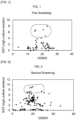
- FIGS. 1 and 2 are graphs showing the amounts of ergothioneine produced by the microorganism samples collected at the first and second stages of microorganism sampling, respectively.
- the horizontal axis in FIGS. 1 and 2 shows the values obtained by measuring the culture solutions obtained after culture in (3) above at OD600.
- the vertical axis shows the amounts of ergothioneine (mg/L (culture solution)) in the culture solutions obtained after culture in (3) above.
- the amount of ergothioneine is a value obtained by LCMS analysis.
- the 14 colonies selected are enclosed in a circle.
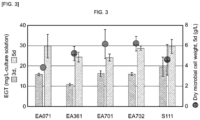
- the resulting extract liquids were analyzed by LCMS in a similar manner as in (4) above to select five strains (S111, EA071, EA361, EA701, and EA702) with high ergothioneine production.
- the left bar graph for each of the strains indicates the ergothioneine production on Day 3 of culture.
- the right bar graph for each of the strains indicates the ergothioneine production on Day 5 of culture.
- the S111 strain belongs to Dirkmeia churashimaensis; that the EA071 and EA361 strains belong to Papiliotrema flavescens, and that the EA701 and EA702 strains belong to Apiotrichum porosum.
- Table 1 shows the ergothioneine (EGT) productions and production rates of the selected five strains.
- Table 2 shows the productions and production rates of known microorganisms.
- the unit for the ergothioneine (EGT) production is mg/L
- the unit for the EGT production rate is mg/L/d (ergothioneine production per day).
- the EGT productions in Table 1 indicate the ergothioneine productions on Day 5 of culture.
- the S111 strain was cultured on a YM agar plate medium at 27°C for 7 days, and the colonies formed were observed.
- the shape of the margin of the colonies was entire, and the raised state thereof was flat and wrinkled.
- the shape of the surface of the colonies was smooth. In addition, the colonies were dull and butter-like, and light orange to cream-colored.
- the S111 strain was cultured on a YM agar plate medium at 27°C for 7 days, and then the cell morphological properties thereof were also observed. It was seen that the nutritive cells were oval to ovoid in shape, and that the strain was proliferated through budding. No formation of sexual reproductive organs was observed in the plate 4 weeks or longer after the start of culture.
- the morphological properties of the S111 strain described above nearly matched the characteristics of Dirkmeia churashimaensis to which it was attributed according to the DNA sequence analysis of the D1/D2 and ITS regions.
- the physiological properties of the S111 strains are shown in Table 3.
- the S111 strain was determined to be a novel microorganism attributed to Dirkmeia churashimaensis.
- the EA071 strain was cultured on a YM agar plate medium at 27°C for 7 days, and the colonies formed were observed.
- the shape of the margin of the colonies was entire, and the raised state thereof was cushion-shaped.
- the shape of the surface of the colonies was smooth.
- the colonies were luminous and viscous, and cream-colored.
- the EA071 strain was cultured on a YM agar plate medium at 27°C for 7 days, and then the cell morphological properties thereof were also observed. It was seen that the nutritive cells were subglobular to oval in shape, and that the strain was proliferated through budding. No formation of sexual reproductive organs was observed in the plate 4 weeks or longer after the start of culture.
- the morphological properties of the EA071 strain described above nearly matched the characteristics of Papiliotrema flavescens to which it was attributed by the DNA sequence analysis of the D1/D2 and ITS regions.
- the physiological properties of the EA071 strains are shown in Table 4.
- the EA071 strain was determined to be a novel microorganism attributed to Papiliotrema flavescens.
- the EA361 strain was cultured on a YM agar plate medium at 27°C for 7 days, and the colonies formed were observed.
- the shape of the margin of the colonies was entire, and the raised state thereof was cushion-shaped.
- the shape of the surface of the colonies was smooth.
- the colonies were luminous and viscous, and cream-colored.
- the EA361 strain was cultured on a YM agar plate medium at 27°C for 7 days, and then the cell morphological properties thereof were also observed. It was seen that the nutritive cells were subglobular to oval in shape, and that the strain was proliferated through budding. No formation of sexual reproductive organs was observed in the plate 4 weeks or longer after the start of culture.
- the morphological properties of the EA361 strain described above nearly matched the characteristics of Papiliotrema flavescens to which it was attributed by the DNA sequence analysis of the D1/D2 and ITS regions.
- the physiological properties of the EA071 strains are shown in Table 5.
- the EA702 strain was cultured on a YM agar plate medium at 27°C for 7 days, and the colonies formed were observed.
- the shape of the margin of the colonies was filamentous.
- the raised state of the colonies was flat at the margin and raised at the center.
- the shape of the surface of the colonies was wrinkled.
- the colonies were dull. Furthermore, the colonies were wet to slightly dry, and white to white cream-colored.
- the EA702 strain was cultured on a YM agar plate medium at 27°C for 7 days, and then the cell morphological properties thereof were also observed. It was seen that the nutritive cells were oval to ovoid in shape, and that the strain was proliferated through budding. In addition, the strain was proliferated through lateral budding, together with the hyphae elongation. No formation of sexual reproductive organs was observed in the plate 4 weeks or longer after the start of culture.
- the morphological properties of the EA702 strain described above nearly matched the characteristics of Apiotrichum porosum to which it was attributed by the DNA sequence analysis of the D1/D2 and ITS regions.
- the physiological properties of the EA702 strains are shown in Table 6.
- the EA702 strain was determined to be a novel microorganism attributed to Papiliotrema flavescens.
- the microorganisms of the present invention have high ergothioneine production and can be used in the fields of health, beauty, and the like.
Landscapes
- Life Sciences & Earth Sciences (AREA)
- Chemical & Material Sciences (AREA)
- Organic Chemistry (AREA)
- Engineering & Computer Science (AREA)
- Wood Science & Technology (AREA)
- Zoology (AREA)
- Health & Medical Sciences (AREA)
- Biotechnology (AREA)
- Genetics & Genomics (AREA)
- Bioinformatics & Cheminformatics (AREA)
- Microbiology (AREA)
- General Engineering & Computer Science (AREA)
- General Health & Medical Sciences (AREA)
- Biochemistry (AREA)
- Mycology (AREA)
- General Chemical & Material Sciences (AREA)
- Chemical Kinetics & Catalysis (AREA)
- Tropical Medicine & Parasitology (AREA)
- Medicinal Chemistry (AREA)
- Botany (AREA)
- Virology (AREA)
- Biomedical Technology (AREA)
- Micro-Organisms Or Cultivation Processes Thereof (AREA)
- Coils Of Transformers For General Uses (AREA)
- Regulation Of General Use Transformers (AREA)
- Immobilizing And Processing Of Enzymes And Microorganisms (AREA)
- Preparation Of Compounds By Using Micro-Organisms (AREA)
Claims (2)
- Micro-organisme appartenant à Dirkmeia churashimaensis NITE BP-03054, micro-organisme appartenant à Papiliotrema flavescens NITE BP-03051, micro-organisme appartenant à Papiliotrema flavescens NITE BP-03052, ou micro-organisme appartenant à Apiotrichum porosum NITE BP-03053.
- Procédé de production d'ergothionéine, comprenant la culture du micro-organisme décrit à la revendication 1 pour obtenir une culture contenant de l'ergothionéine.
Applications Claiming Priority (2)
| Application Number | Priority Date | Filing Date | Title |
|---|---|---|---|
| JP2020002301 | 2020-01-09 | ||
| PCT/JP2020/030145 WO2021140693A1 (fr) | 2020-01-09 | 2020-08-06 | Procédé de production de nouveaux micro-organismes et d'ergothionéine |
Publications (3)
| Publication Number | Publication Date |
|---|---|
| EP4089178A1 EP4089178A1 (fr) | 2022-11-16 |
| EP4089178A4 EP4089178A4 (fr) | 2024-02-28 |
| EP4089178B1 true EP4089178B1 (fr) | 2025-05-28 |
Family
ID=76788596
Family Applications (1)
| Application Number | Title | Priority Date | Filing Date |
|---|---|---|---|
| EP20912348.8A Active EP4089178B1 (fr) | 2020-01-09 | 2020-08-06 | Procédé de production de nouveaux micro-organismes et d'ergothionéine |
Country Status (10)
| Country | Link |
|---|---|
| US (1) | US11732236B2 (fr) |
| EP (1) | EP4089178B1 (fr) |
| JP (1) | JP7120588B2 (fr) |
| KR (1) | KR102492346B1 (fr) |
| CN (4) | CN116240120B (fr) |
| AR (1) | AR120516A1 (fr) |
| AU (1) | AU2020420098B2 (fr) |
| CA (1) | CA3163427C (fr) |
| ES (1) | ES3036445T3 (fr) |
| WO (1) | WO2021140693A1 (fr) |
Families Citing this family (4)
| Publication number | Priority date | Publication date | Assignee | Title |
|---|---|---|---|---|
| JP7378473B2 (ja) * | 2019-07-10 | 2023-11-13 | 株式会社クレハ | 植物生長調整剤および植物の生長促進方法 |
| US20240049723A1 (en) * | 2021-01-08 | 2024-02-15 | Kureha Corporation | Plant growth regulator or method for promoting plant growth |
| JP7756402B2 (ja) | 2022-01-05 | 2025-10-20 | 株式会社クレハ | 新規微生物、新規微生物の培養物または抽出物、およびエルゴチオネインの生産方法 |
| US20260085277A1 (en) | 2022-11-18 | 2026-03-26 | Kureha Corporation | Novel microorganism, novel microorganism culture or extract, and ergothioneine production method |
Family Cites Families (17)
| Publication number | Priority date | Publication date | Assignee | Title |
|---|---|---|---|---|
| JP2009161498A (ja) * | 2008-01-10 | 2009-07-23 | Univ Nagoya | エルゴチオネインの製造方法 |
| JP2009249356A (ja) | 2008-04-08 | 2009-10-29 | Daicel Chem Ind Ltd | エルゴチオネインの製造方法 |
| US20140121156A1 (en) | 2011-06-13 | 2014-05-01 | Entia Biosciences, Inc. | Nutritional approach to the control of anemia, diabetes and other diseases or conditions and prevention of associated comorbid states with the use of ergothioneine |
| JP2013116876A (ja) * | 2011-12-05 | 2013-06-13 | Nippon Rensui Co Ltd | エルゴチオネインの精製方法 |
| CN103734022B (zh) * | 2012-10-16 | 2017-09-05 | 中国科学院天津工业生物技术研究所 | 生产麦角硫因的菌株及制备麦角硫因的方法 |
| EP3137611B1 (fr) * | 2014-04-29 | 2021-02-24 | Conagen Inc. | Bioxynthèse d'ergothionéine microbienne |
| WO2016104437A1 (fr) * | 2014-12-22 | 2016-06-30 | 国立大学法人 岡山大学 | Procédé de production de l'ergothionéïne |
| JP6578100B2 (ja) | 2014-12-25 | 2019-09-18 | 日東シンコー株式会社 | 絶縁紙 |
| WO2016121285A1 (fr) | 2015-01-30 | 2016-08-04 | キッコーマン株式会社 | Champignon transformé présentant une productivité augmentée d'ergothionéine et procédé de production d'ergothionéine |
| JP6263672B1 (ja) * | 2016-02-29 | 2018-01-17 | 長瀬産業株式会社 | エルゴチオネインの発酵生産 |
| JP6758703B2 (ja) * | 2016-06-21 | 2020-09-23 | 国立大学法人 岡山大学 | エルゴチオネインの産生方法 |
| JP2018130091A (ja) * | 2017-02-17 | 2018-08-23 | 国立大学法人 筑波大学 | 植物体、食品、培養物、肥料及び製造方法 |
| JP7070570B2 (ja) | 2017-06-27 | 2022-05-18 | 三菱ケミカル株式会社 | エルゴチオネインの製造方法 |
| JP7185213B2 (ja) * | 2018-03-02 | 2022-12-07 | 国立大学法人 筑波大学 | エルゴチオネイン合成微生物、及びエルゴチオネインの製造方法 |
| CN110317803B (zh) * | 2018-03-29 | 2022-06-14 | 陶志敏 | 麦角硫因的纳米生物学制备方法 |
| CN109439553B (zh) | 2018-12-26 | 2020-08-21 | 华熙生物科技股份有限公司 | 产麦角硫因的菌株及其筛选方法 |
| CN110283856B (zh) * | 2019-04-30 | 2020-06-26 | 弘恒泰(天津)科技发展有限公司 | 耐高温糙皮侧耳菌在生产麦角硫因中的应用 |
-
2020
- 2020-08-06 AU AU2020420098A patent/AU2020420098B2/en active Active
- 2020-08-06 EP EP20912348.8A patent/EP4089178B1/fr active Active
- 2020-08-06 CN CN202310231442.6A patent/CN116240120B/zh active Active
- 2020-08-06 US US17/758,329 patent/US11732236B2/en active Active
- 2020-08-06 CA CA3163427A patent/CA3163427C/fr active Active
- 2020-08-06 KR KR1020227022701A patent/KR102492346B1/ko active Active
- 2020-08-06 CN CN202310231455.3A patent/CN116925936B/zh active Active
- 2020-08-06 ES ES20912348T patent/ES3036445T3/es active Active
- 2020-08-06 JP JP2021569722A patent/JP7120588B2/ja active Active
- 2020-08-06 WO PCT/JP2020/030145 patent/WO2021140693A1/fr not_active Ceased
- 2020-08-06 CN CN202080085536.1A patent/CN114867843B/zh active Active
- 2020-08-06 CN CN202310259414.5A patent/CN116731870B/zh active Active
- 2020-11-19 AR ARP200103218A patent/AR120516A1/es unknown
Also Published As
| Publication number | Publication date |
|---|---|
| AR120516A1 (es) | 2022-02-23 |
| WO2021140693A1 (fr) | 2021-07-15 |
| CN116731870A (zh) | 2023-09-12 |
| CN116925936B (zh) | 2024-01-16 |
| US20230043773A1 (en) | 2023-02-09 |
| CN116925936A (zh) | 2023-10-24 |
| CN116731870B (zh) | 2023-12-01 |
| CA3163427C (fr) | 2023-02-28 |
| JPWO2021140693A1 (fr) | 2021-07-15 |
| CN116240120B (zh) | 2024-03-01 |
| CN114867843A (zh) | 2022-08-05 |
| AU2020420098A1 (en) | 2022-07-21 |
| KR20220106831A (ko) | 2022-07-29 |
| BR112022013285A2 (pt) | 2022-09-06 |
| EP4089178A4 (fr) | 2024-02-28 |
| EP4089178A1 (fr) | 2022-11-16 |
| CN116240120A (zh) | 2023-06-09 |
| JP7120588B2 (ja) | 2022-08-17 |
| CN114867843B (zh) | 2023-06-13 |
| ES3036445T3 (en) | 2025-09-18 |
| AU2020420098B2 (en) | 2022-12-01 |
| CA3163427A1 (fr) | 2021-07-15 |
| KR102492346B1 (ko) | 2023-01-26 |
| US11732236B2 (en) | 2023-08-22 |
Similar Documents
| Publication | Publication Date | Title |
|---|---|---|
| EP4089178B1 (fr) | Procédé de production de nouveaux micro-organismes et d'ergothionéine | |
| Khurshid et al. | Mutation of Aspergillus niger for hyperproduction of citric acid from black strap molasses | |
| CN103820337B (zh) | 一种用于发酵生产核糖核酸的酿酒酵母菌及其应用 | |
| De Aráujo et al. | Production of coconut aroma by fungi cultivation in solid-state fermentation | |
| Gimenez-Jurado et al. | Metschnikowia vanudenii sp. nov. and Metschnikowia lachancei sp. nov., from flowers and associated insects in North America | |
| EP4461804A1 (fr) | Nouveau microorganisme, nouvelle culture ou extrait de microorganismes, et procédé de production d'ergothionéine | |
| Zhang et al. | Starmerella anomalae fa, sp. nov., Starmerella asiatica fa, sp. nov., Starmerella henanensis fa, sp. nov. and Starmerella scarabaei fa, sp. nov., four yeast species isolated from scarab beetles | |
| US8084237B2 (en) | Microorganism and method for producing dodecahydro-3a,6,6,9a-tetramethylnaphtho[2,1-b]furan intermediate using the novel microorganism | |
| Manachini | DNA sequence similarity, cell wall mannans and physiological characteristics in some strains of Candida utilis, Hansenula jadinii and Hansenula petersonii | |
| Hong et al. | Isolation and identification of Aspergillus section Fumigati strains from arable soil in Korea | |
| EA044426B1 (ru) | Новый микроорганизм и способ получения эрготионеина | |
| JP7833152B2 (ja) | 新規微生物、新規微生物の培養物または抽出物、およびエルゴチオネインの生産方法 | |
| KR20010033541A (ko) | 신규 미생물 및 그것을 사용한 폴리올의 제조방법 | |
| US9040257B2 (en) | Basidiomycetous yeast mutant | |
| KR20200107287A (ko) | 신규 사카로마이세스 세레비지에 nw-3 균주 및 그 용도 | |
| Han et al. | Influence of inoculum type, inorganic salt and nitrogen to carbon ratio on sclerotium formation and carotenoid production in surface culture of Penicillium sp. PT95 | |
| Manna et al. | Occurrence of poly-3-hydroxybutyrate in Azospirillum sp. | |
| Geyer et al. | Influence of Flavonoids on the Stability of an (S)-Hydroxynitrile Lyase from Hevea brasiliensis | |
| JP2006067823A (ja) | バッファーを使用しない条件下での微生物を用いたグリコール酸の製造方法 | |
| JP2006067822A (ja) | 微生物を用いたグリコール酸の製造方法 |
Legal Events
| Date | Code | Title | Description |
|---|---|---|---|
| STAA | Information on the status of an ep patent application or granted ep patent |
Free format text: STATUS: THE INTERNATIONAL PUBLICATION HAS BEEN MADE |
|
| PUAI | Public reference made under article 153(3) epc to a published international application that has entered the european phase |
Free format text: ORIGINAL CODE: 0009012 |
|
| STAA | Information on the status of an ep patent application or granted ep patent |
Free format text: STATUS: REQUEST FOR EXAMINATION WAS MADE |
|
| 17P | Request for examination filed |
Effective date: 20220701 |
|
| AK | Designated contracting states |
Kind code of ref document: A1 Designated state(s): AL AT BE BG CH CY CZ DE DK EE ES FI FR GB GR HR HU IE IS IT LI LT LU LV MC MK MT NL NO PL PT RO RS SE SI SK SM TR |
|
| DAV | Request for validation of the european patent (deleted) | ||
| DAX | Request for extension of the european patent (deleted) | ||
| A4 | Supplementary search report drawn up and despatched |
Effective date: 20240129 |
|
| RIC1 | Information provided on ipc code assigned before grant |
Ipc: C12N 1/20 20060101ALI20240123BHEP Ipc: C12P 13/04 20060101AFI20240123BHEP |
|
| GRAP | Despatch of communication of intention to grant a patent |
Free format text: ORIGINAL CODE: EPIDOSNIGR1 |
|
| STAA | Information on the status of an ep patent application or granted ep patent |
Free format text: STATUS: GRANT OF PATENT IS INTENDED |
|
| INTG | Intention to grant announced |
Effective date: 20250103 |
|
| RAP3 | Party data changed (applicant data changed or rights of an application transferred) |
Owner name: NATIONAL INSTITUTE OF ADVANCED INDUSTRIAL SCIENCEAND TECHNOLOGY Owner name: KUREHA CORPORATION |
|
| RIN1 | Information on inventor provided before grant (corrected) |
Inventor name: SAIKA, AZUSA Inventor name: MORITA, TOMOTAKE Inventor name: SATO, SHUN Inventor name: HIGASHIYAMA, YUKIHIRO Inventor name: KANEKO, MUTSUMI Inventor name: KOSHIYAMA, TATSUYUKI |
|
| P01 | Opt-out of the competence of the unified patent court (upc) registered |
Free format text: CASE NUMBER: APP_11749/2025 Effective date: 20250311 |
|
| GRAS | Grant fee paid |
Free format text: ORIGINAL CODE: EPIDOSNIGR3 |
|
| GRAA | (expected) grant |
Free format text: ORIGINAL CODE: 0009210 |
|
| STAA | Information on the status of an ep patent application or granted ep patent |
Free format text: STATUS: THE PATENT HAS BEEN GRANTED |
|
| AK | Designated contracting states |
Kind code of ref document: B1 Designated state(s): AL AT BE BG CH CY CZ DE DK EE ES FI FR GB GR HR HU IE IS IT LI LT LU LV MC MK MT NL NO PL PT RO RS SE SI SK SM TR |
|
| REG | Reference to a national code |
Ref country code: GB Ref legal event code: FG4D |
|
| REG | Reference to a national code |
Ref country code: CH Ref legal event code: EP |
|
| REG | Reference to a national code |
Ref country code: DE Ref legal event code: R096 Ref document number: 602020052125 Country of ref document: DE |
|
| REG | Reference to a national code |
Ref country code: IE Ref legal event code: FG4D |
|
| REG | Reference to a national code |
Ref country code: ES Ref legal event code: FG2A Ref document number: 3036445 Country of ref document: ES Kind code of ref document: T3 Effective date: 20250918 |
|
| REG | Reference to a national code |
Ref country code: NL Ref legal event code: MP Effective date: 20250528 |
|
| PG25 | Lapsed in a contracting state [announced via postgrant information from national office to epo] |
Ref country code: FI Free format text: LAPSE BECAUSE OF FAILURE TO SUBMIT A TRANSLATION OF THE DESCRIPTION OR TO PAY THE FEE WITHIN THE PRESCRIBED TIME-LIMIT Effective date: 20250528 |
|
| PGFP | Annual fee paid to national office [announced via postgrant information from national office to epo] |
Ref country code: ES Payment date: 20250926 Year of fee payment: 6 |
|
| PGFP | Annual fee paid to national office [announced via postgrant information from national office to epo] |
Ref country code: DE Payment date: 20250820 Year of fee payment: 6 |
|
| REG | Reference to a national code |
Ref country code: LT Ref legal event code: MG9D |
|
| PG25 | Lapsed in a contracting state [announced via postgrant information from national office to epo] |
Ref country code: NO Free format text: LAPSE BECAUSE OF FAILURE TO SUBMIT A TRANSLATION OF THE DESCRIPTION OR TO PAY THE FEE WITHIN THE PRESCRIBED TIME-LIMIT Effective date: 20250828 Ref country code: GR Free format text: LAPSE BECAUSE OF FAILURE TO SUBMIT A TRANSLATION OF THE DESCRIPTION OR TO PAY THE FEE WITHIN THE PRESCRIBED TIME-LIMIT Effective date: 20250829 |
|
| PG25 | Lapsed in a contracting state [announced via postgrant information from national office to epo] |
Ref country code: NL Free format text: LAPSE BECAUSE OF FAILURE TO SUBMIT A TRANSLATION OF THE DESCRIPTION OR TO PAY THE FEE WITHIN THE PRESCRIBED TIME-LIMIT Effective date: 20250528 Ref country code: PL Free format text: LAPSE BECAUSE OF FAILURE TO SUBMIT A TRANSLATION OF THE DESCRIPTION OR TO PAY THE FEE WITHIN THE PRESCRIBED TIME-LIMIT Effective date: 20250528 |
|
| PG25 | Lapsed in a contracting state [announced via postgrant information from national office to epo] |
Ref country code: BG Free format text: LAPSE BECAUSE OF FAILURE TO SUBMIT A TRANSLATION OF THE DESCRIPTION OR TO PAY THE FEE WITHIN THE PRESCRIBED TIME-LIMIT Effective date: 20250528 |
|
| PGFP | Annual fee paid to national office [announced via postgrant information from national office to epo] |
Ref country code: GB Payment date: 20250820 Year of fee payment: 6 |
|
| PG25 | Lapsed in a contracting state [announced via postgrant information from national office to epo] |
Ref country code: HR Free format text: LAPSE BECAUSE OF FAILURE TO SUBMIT A TRANSLATION OF THE DESCRIPTION OR TO PAY THE FEE WITHIN THE PRESCRIBED TIME-LIMIT Effective date: 20250528 |
|
| PGFP | Annual fee paid to national office [announced via postgrant information from national office to epo] |
Ref country code: FR Payment date: 20250828 Year of fee payment: 6 |
|
| PG25 | Lapsed in a contracting state [announced via postgrant information from national office to epo] |
Ref country code: RS Free format text: LAPSE BECAUSE OF FAILURE TO SUBMIT A TRANSLATION OF THE DESCRIPTION OR TO PAY THE FEE WITHIN THE PRESCRIBED TIME-LIMIT Effective date: 20250828 |
|
| PG25 | Lapsed in a contracting state [announced via postgrant information from national office to epo] |
Ref country code: IS Free format text: LAPSE BECAUSE OF FAILURE TO SUBMIT A TRANSLATION OF THE DESCRIPTION OR TO PAY THE FEE WITHIN THE PRESCRIBED TIME-LIMIT Effective date: 20250928 |
|
| PG25 | Lapsed in a contracting state [announced via postgrant information from national office to epo] |
Ref country code: LV Free format text: LAPSE BECAUSE OF FAILURE TO SUBMIT A TRANSLATION OF THE DESCRIPTION OR TO PAY THE FEE WITHIN THE PRESCRIBED TIME-LIMIT Effective date: 20250528 |
|
| REG | Reference to a national code |
Ref country code: AT Ref legal event code: MK05 Ref document number: 1798648 Country of ref document: AT Kind code of ref document: T Effective date: 20250528 |
|
| PG25 | Lapsed in a contracting state [announced via postgrant information from national office to epo] |
Ref country code: SM Free format text: LAPSE BECAUSE OF FAILURE TO SUBMIT A TRANSLATION OF THE DESCRIPTION OR TO PAY THE FEE WITHIN THE PRESCRIBED TIME-LIMIT Effective date: 20250528 Ref country code: AT Free format text: LAPSE BECAUSE OF FAILURE TO SUBMIT A TRANSLATION OF THE DESCRIPTION OR TO PAY THE FEE WITHIN THE PRESCRIBED TIME-LIMIT Effective date: 20250528 Ref country code: DK Free format text: LAPSE BECAUSE OF FAILURE TO SUBMIT A TRANSLATION OF THE DESCRIPTION OR TO PAY THE FEE WITHIN THE PRESCRIBED TIME-LIMIT Effective date: 20250528 |
|
| PG25 | Lapsed in a contracting state [announced via postgrant information from national office to epo] |
Ref country code: CZ Free format text: LAPSE BECAUSE OF FAILURE TO SUBMIT A TRANSLATION OF THE DESCRIPTION OR TO PAY THE FEE WITHIN THE PRESCRIBED TIME-LIMIT Effective date: 20250528 |
|
| PG25 | Lapsed in a contracting state [announced via postgrant information from national office to epo] |
Ref country code: EE Free format text: LAPSE BECAUSE OF FAILURE TO SUBMIT A TRANSLATION OF THE DESCRIPTION OR TO PAY THE FEE WITHIN THE PRESCRIBED TIME-LIMIT Effective date: 20250528 |
|
| PG25 | Lapsed in a contracting state [announced via postgrant information from national office to epo] |
Ref country code: SK Free format text: LAPSE BECAUSE OF FAILURE TO SUBMIT A TRANSLATION OF THE DESCRIPTION OR TO PAY THE FEE WITHIN THE PRESCRIBED TIME-LIMIT Effective date: 20250528 |
|
| PG25 | Lapsed in a contracting state [announced via postgrant information from national office to epo] |
Ref country code: IT Free format text: LAPSE BECAUSE OF FAILURE TO SUBMIT A TRANSLATION OF THE DESCRIPTION OR TO PAY THE FEE WITHIN THE PRESCRIBED TIME-LIMIT Effective date: 20250528 |
|
| REG | Reference to a national code |
Ref country code: DE Ref legal event code: R097 Ref document number: 602020052125 Country of ref document: DE |
|
| PG25 | Lapsed in a contracting state [announced via postgrant information from national office to epo] |
Ref country code: RO Free format text: LAPSE BECAUSE OF FAILURE TO SUBMIT A TRANSLATION OF THE DESCRIPTION OR TO PAY THE FEE WITHIN THE PRESCRIBED TIME-LIMIT Effective date: 20250528 |
|
| REG | Reference to a national code |
Ref country code: CH Ref legal event code: H13 Free format text: ST27 STATUS EVENT CODE: U-0-0-H10-H13 (AS PROVIDED BY THE NATIONAL OFFICE) Effective date: 20260324 |
|
| PG25 | Lapsed in a contracting state [announced via postgrant information from national office to epo] |
Ref country code: MC Free format text: LAPSE BECAUSE OF FAILURE TO SUBMIT A TRANSLATION OF THE DESCRIPTION OR TO PAY THE FEE WITHIN THE PRESCRIBED TIME-LIMIT Effective date: 20250528 |
|
| PLBE | No opposition filed within time limit |
Free format text: ORIGINAL CODE: 0009261 |
|
| STAA | Information on the status of an ep patent application or granted ep patent |
Free format text: STATUS: NO OPPOSITION FILED WITHIN TIME LIMIT |
|
| REG | Reference to a national code |
Ref country code: CH Ref legal event code: L10 Free format text: ST27 STATUS EVENT CODE: U-0-0-L10-L00 (AS PROVIDED BY THE NATIONAL OFFICE) Effective date: 20260409 |
|
| PG25 | Lapsed in a contracting state [announced via postgrant information from national office to epo] |
Ref country code: LU Free format text: LAPSE BECAUSE OF NON-PAYMENT OF DUE FEES Effective date: 20250806 |
|
| PG25 | Lapsed in a contracting state [announced via postgrant information from national office to epo] |
Ref country code: CH Free format text: LAPSE BECAUSE OF NON-PAYMENT OF DUE FEES Effective date: 20250831 |