EP4089207A1 - Membrane électrolytique, ensemble électrode à membrane, cellule électrochimique et procédé de fabrication de membrane électrolytique - Google Patents
Membrane électrolytique, ensemble électrode à membrane, cellule électrochimique et procédé de fabrication de membrane électrolytique Download PDFInfo
- Publication number
- EP4089207A1 EP4089207A1 EP20912823.0A EP20912823A EP4089207A1 EP 4089207 A1 EP4089207 A1 EP 4089207A1 EP 20912823 A EP20912823 A EP 20912823A EP 4089207 A1 EP4089207 A1 EP 4089207A1
- Authority
- EP
- European Patent Office
- Prior art keywords
- electrolyte membrane
- crystal
- subdomain
- electrode
- electrolyte
- Prior art date
- Legal status (The legal status is an assumption and is not a legal conclusion. Google has not performed a legal analysis and makes no representation as to the accuracy of the status listed.)
- Pending
Links
Images



Classifications
-
- H—ELECTRICITY
- H01—ELECTRIC ELEMENTS
- H01M—PROCESSES OR MEANS, e.g. BATTERIES, FOR THE DIRECT CONVERSION OF CHEMICAL ENERGY INTO ELECTRICAL ENERGY
- H01M8/00—Fuel cells; Manufacture thereof
- H01M8/10—Fuel cells with solid electrolytes
- H01M8/1004—Fuel cells with solid electrolytes characterised by membrane-electrode assemblies [MEA]
-
- H—ELECTRICITY
- H01—ELECTRIC ELEMENTS
- H01M—PROCESSES OR MEANS, e.g. BATTERIES, FOR THE DIRECT CONVERSION OF CHEMICAL ENERGY INTO ELECTRICAL ENERGY
- H01M8/00—Fuel cells; Manufacture thereof
- H01M8/10—Fuel cells with solid electrolytes
- H01M8/12—Fuel cells with solid electrolytes operating at high temperature, e.g. with stabilised ZrO2 electrolyte
- H01M8/124—Fuel cells with solid electrolytes operating at high temperature, e.g. with stabilised ZrO2 electrolyte characterised by the process of manufacturing or by the material of the electrolyte
- H01M8/1246—Fuel cells with solid electrolytes operating at high temperature, e.g. with stabilised ZrO2 electrolyte characterised by the process of manufacturing or by the material of the electrolyte the electrolyte consisting of oxides
-
- B—PERFORMING OPERATIONS; TRANSPORTING
- B32—LAYERED PRODUCTS
- B32B—LAYERED PRODUCTS, i.e. PRODUCTS BUILT-UP OF STRATA OF FLAT OR NON-FLAT, e.g. CELLULAR OR HONEYCOMB, FORM
- B32B18/00—Layered products essentially comprising ceramics, e.g. refractory products
-
- C—CHEMISTRY; METALLURGY
- C01—INORGANIC CHEMISTRY
- C01G—COMPOUNDS CONTAINING METALS NOT COVERED BY SUBCLASSES C01D OR C01F
- C01G25/00—Compounds of zirconium
- C01G25/006—Compounds containing zirconium, with or without oxygen or hydrogen, and containing two or more other elements
-
- C—CHEMISTRY; METALLURGY
- C04—CEMENTS; CONCRETE; ARTIFICIAL STONE; CERAMICS; REFRACTORIES
- C04B—LIME, MAGNESIA; SLAG; CEMENTS; COMPOSITIONS THEREOF, e.g. MORTARS, CONCRETE OR LIKE BUILDING MATERIALS; ARTIFICIAL STONE; CERAMICS; REFRACTORIES; TREATMENT OF NATURAL STONE
- C04B35/00—Shaped ceramic products characterised by their composition; Ceramics compositions; Processing powders of inorganic compounds preparatory to the manufacturing of ceramic products
- C04B35/01—Shaped ceramic products characterised by their composition; Ceramics compositions; Processing powders of inorganic compounds preparatory to the manufacturing of ceramic products based on oxide ceramics
-
- C—CHEMISTRY; METALLURGY
- C04—CEMENTS; CONCRETE; ARTIFICIAL STONE; CERAMICS; REFRACTORIES
- C04B—LIME, MAGNESIA; SLAG; CEMENTS; COMPOSITIONS THEREOF, e.g. MORTARS, CONCRETE OR LIKE BUILDING MATERIALS; ARTIFICIAL STONE; CERAMICS; REFRACTORIES; TREATMENT OF NATURAL STONE
- C04B35/00—Shaped ceramic products characterised by their composition; Ceramics compositions; Processing powders of inorganic compounds preparatory to the manufacturing of ceramic products
- C04B35/01—Shaped ceramic products characterised by their composition; Ceramics compositions; Processing powders of inorganic compounds preparatory to the manufacturing of ceramic products based on oxide ceramics
- C04B35/48—Shaped ceramic products characterised by their composition; Ceramics compositions; Processing powders of inorganic compounds preparatory to the manufacturing of ceramic products based on oxide ceramics based on zirconium or hafnium oxides, zirconates, zircon or hafnates
- C04B35/486—Fine ceramics
-
- C—CHEMISTRY; METALLURGY
- C04—CEMENTS; CONCRETE; ARTIFICIAL STONE; CERAMICS; REFRACTORIES
- C04B—LIME, MAGNESIA; SLAG; CEMENTS; COMPOSITIONS THEREOF, e.g. MORTARS, CONCRETE OR LIKE BUILDING MATERIALS; ARTIFICIAL STONE; CERAMICS; REFRACTORIES; TREATMENT OF NATURAL STONE
- C04B35/00—Shaped ceramic products characterised by their composition; Ceramics compositions; Processing powders of inorganic compounds preparatory to the manufacturing of ceramic products
- C04B35/01—Shaped ceramic products characterised by their composition; Ceramics compositions; Processing powders of inorganic compounds preparatory to the manufacturing of ceramic products based on oxide ceramics
- C04B35/48—Shaped ceramic products characterised by their composition; Ceramics compositions; Processing powders of inorganic compounds preparatory to the manufacturing of ceramic products based on oxide ceramics based on zirconium or hafnium oxides, zirconates, zircon or hafnates
- C04B35/486—Fine ceramics
- C04B35/488—Composites
-
- C—CHEMISTRY; METALLURGY
- C04—CEMENTS; CONCRETE; ARTIFICIAL STONE; CERAMICS; REFRACTORIES
- C04B—LIME, MAGNESIA; SLAG; CEMENTS; COMPOSITIONS THEREOF, e.g. MORTARS, CONCRETE OR LIKE BUILDING MATERIALS; ARTIFICIAL STONE; CERAMICS; REFRACTORIES; TREATMENT OF NATURAL STONE
- C04B35/00—Shaped ceramic products characterised by their composition; Ceramics compositions; Processing powders of inorganic compounds preparatory to the manufacturing of ceramic products
- C04B35/50—Shaped ceramic products characterised by their composition; Ceramics compositions; Processing powders of inorganic compounds preparatory to the manufacturing of ceramic products based on rare-earth compounds
-
- C—CHEMISTRY; METALLURGY
- C04—CEMENTS; CONCRETE; ARTIFICIAL STONE; CERAMICS; REFRACTORIES
- C04B—LIME, MAGNESIA; SLAG; CEMENTS; COMPOSITIONS THEREOF, e.g. MORTARS, CONCRETE OR LIKE BUILDING MATERIALS; ARTIFICIAL STONE; CERAMICS; REFRACTORIES; TREATMENT OF NATURAL STONE
- C04B35/00—Shaped ceramic products characterised by their composition; Ceramics compositions; Processing powders of inorganic compounds preparatory to the manufacturing of ceramic products
- C04B35/622—Forming processes; Processing powders of inorganic compounds preparatory to the manufacturing of ceramic products
- C04B35/626—Preparing or treating the powders individually or as batches ; preparing or treating macroscopic reinforcing agents for ceramic products, e.g. fibres; mechanical aspects section B
- C04B35/62605—Treating the starting powders individually or as mixtures
- C04B35/62685—Treating the starting powders individually or as mixtures characterised by the order of addition of constituents or additives
-
- C—CHEMISTRY; METALLURGY
- C25—ELECTROLYTIC OR ELECTROPHORETIC PROCESSES; APPARATUS THEREFOR
- C25B—ELECTROLYTIC OR ELECTROPHORETIC PROCESSES FOR THE PRODUCTION OF COMPOUNDS OR NON-METALS; APPARATUS THEREFOR
- C25B1/00—Electrolytic production of inorganic compounds or non-metals
- C25B1/01—Products
- C25B1/02—Hydrogen or oxygen
-
- C—CHEMISTRY; METALLURGY
- C25—ELECTROLYTIC OR ELECTROPHORETIC PROCESSES; APPARATUS THEREFOR
- C25B—ELECTROLYTIC OR ELECTROPHORETIC PROCESSES FOR THE PRODUCTION OF COMPOUNDS OR NON-METALS; APPARATUS THEREFOR
- C25B1/00—Electrolytic production of inorganic compounds or non-metals
- C25B1/01—Products
- C25B1/02—Hydrogen or oxygen
- C25B1/04—Hydrogen or oxygen by electrolysis of water
- C25B1/042—Hydrogen or oxygen by electrolysis of water by electrolysis of steam
-
- C—CHEMISTRY; METALLURGY
- C25—ELECTROLYTIC OR ELECTROPHORETIC PROCESSES; APPARATUS THEREFOR
- C25B—ELECTROLYTIC OR ELECTROPHORETIC PROCESSES FOR THE PRODUCTION OF COMPOUNDS OR NON-METALS; APPARATUS THEREFOR
- C25B13/00—Diaphragms; Spacing elements
- C25B13/04—Diaphragms; Spacing elements characterised by the material
- C25B13/05—Diaphragms; Spacing elements characterised by the material based on inorganic materials
- C25B13/07—Diaphragms; Spacing elements characterised by the material based on inorganic materials based on ceramics
-
- C—CHEMISTRY; METALLURGY
- C25—ELECTROLYTIC OR ELECTROPHORETIC PROCESSES; APPARATUS THEREFOR
- C25B—ELECTROLYTIC OR ELECTROPHORETIC PROCESSES FOR THE PRODUCTION OF COMPOUNDS OR NON-METALS; APPARATUS THEREFOR
- C25B9/00—Cells or assemblies of cells; Constructional parts of cells; Assemblies of constructional parts, e.g. electrode-diaphragm assemblies; Process-related cell features
- C25B9/70—Assemblies comprising two or more cells
- C25B9/73—Assemblies comprising two or more cells of the filter-press type
- C25B9/75—Assemblies comprising two or more cells of the filter-press type having bipolar electrodes
-
- C—CHEMISTRY; METALLURGY
- C25—ELECTROLYTIC OR ELECTROPHORETIC PROCESSES; APPARATUS THEREFOR
- C25B—ELECTROLYTIC OR ELECTROPHORETIC PROCESSES FOR THE PRODUCTION OF COMPOUNDS OR NON-METALS; APPARATUS THEREFOR
- C25B9/00—Cells or assemblies of cells; Constructional parts of cells; Assemblies of constructional parts, e.g. electrode-diaphragm assemblies; Process-related cell features
- C25B9/70—Assemblies comprising two or more cells
- C25B9/73—Assemblies comprising two or more cells of the filter-press type
- C25B9/77—Assemblies comprising two or more cells of the filter-press type having diaphragms
-
- H—ELECTRICITY
- H01—ELECTRIC ELEMENTS
- H01B—CABLES; CONDUCTORS; INSULATORS; SELECTION OF MATERIALS FOR THEIR CONDUCTIVE, INSULATING OR DIELECTRIC PROPERTIES
- H01B1/00—Conductors or conductive bodies characterised by the conductive materials; Selection of materials as conductors
- H01B1/06—Conductors or conductive bodies characterised by the conductive materials; Selection of materials as conductors mainly consisting of other non-metallic substances
-
- H—ELECTRICITY
- H01—ELECTRIC ELEMENTS
- H01B—CABLES; CONDUCTORS; INSULATORS; SELECTION OF MATERIALS FOR THEIR CONDUCTIVE, INSULATING OR DIELECTRIC PROPERTIES
- H01B1/00—Conductors or conductive bodies characterised by the conductive materials; Selection of materials as conductors
- H01B1/06—Conductors or conductive bodies characterised by the conductive materials; Selection of materials as conductors mainly consisting of other non-metallic substances
- H01B1/08—Conductors or conductive bodies characterised by the conductive materials; Selection of materials as conductors mainly consisting of other non-metallic substances oxides
-
- H—ELECTRICITY
- H01—ELECTRIC ELEMENTS
- H01M—PROCESSES OR MEANS, e.g. BATTERIES, FOR THE DIRECT CONVERSION OF CHEMICAL ENERGY INTO ELECTRICAL ENERGY
- H01M8/00—Fuel cells; Manufacture thereof
- H01M8/10—Fuel cells with solid electrolytes
- H01M8/1016—Fuel cells with solid electrolytes characterised by the electrolyte material
-
- H—ELECTRICITY
- H01—ELECTRIC ELEMENTS
- H01M—PROCESSES OR MEANS, e.g. BATTERIES, FOR THE DIRECT CONVERSION OF CHEMICAL ENERGY INTO ELECTRICAL ENERGY
- H01M8/00—Fuel cells; Manufacture thereof
- H01M8/10—Fuel cells with solid electrolytes
- H01M8/12—Fuel cells with solid electrolytes operating at high temperature, e.g. with stabilised ZrO2 electrolyte
-
- H—ELECTRICITY
- H01—ELECTRIC ELEMENTS
- H01M—PROCESSES OR MEANS, e.g. BATTERIES, FOR THE DIRECT CONVERSION OF CHEMICAL ENERGY INTO ELECTRICAL ENERGY
- H01M8/00—Fuel cells; Manufacture thereof
- H01M8/10—Fuel cells with solid electrolytes
- H01M8/12—Fuel cells with solid electrolytes operating at high temperature, e.g. with stabilised ZrO2 electrolyte
- H01M8/124—Fuel cells with solid electrolytes operating at high temperature, e.g. with stabilised ZrO2 electrolyte characterised by the process of manufacturing or by the material of the electrolyte
- H01M8/1246—Fuel cells with solid electrolytes operating at high temperature, e.g. with stabilised ZrO2 electrolyte characterised by the process of manufacturing or by the material of the electrolyte the electrolyte consisting of oxides
- H01M8/1253—Fuel cells with solid electrolytes operating at high temperature, e.g. with stabilised ZrO2 electrolyte characterised by the process of manufacturing or by the material of the electrolyte the electrolyte consisting of oxides the electrolyte containing zirconium oxide
-
- C—CHEMISTRY; METALLURGY
- C01—INORGANIC CHEMISTRY
- C01P—INDEXING SCHEME RELATING TO STRUCTURAL AND PHYSICAL ASPECTS OF SOLID INORGANIC COMPOUNDS
- C01P2002/00—Crystal-structural characteristics
- C01P2002/50—Solid solutions
- C01P2002/52—Solid solutions containing elements as dopants
-
- C—CHEMISTRY; METALLURGY
- C01—INORGANIC CHEMISTRY
- C01P—INDEXING SCHEME RELATING TO STRUCTURAL AND PHYSICAL ASPECTS OF SOLID INORGANIC COMPOUNDS
- C01P2002/00—Crystal-structural characteristics
- C01P2002/80—Crystal-structural characteristics defined by measured data other than those specified in group C01P2002/70
- C01P2002/85—Crystal-structural characteristics defined by measured data other than those specified in group C01P2002/70 by XPS, EDX or EDAX data
-
- C—CHEMISTRY; METALLURGY
- C04—CEMENTS; CONCRETE; ARTIFICIAL STONE; CERAMICS; REFRACTORIES
- C04B—LIME, MAGNESIA; SLAG; CEMENTS; COMPOSITIONS THEREOF, e.g. MORTARS, CONCRETE OR LIKE BUILDING MATERIALS; ARTIFICIAL STONE; CERAMICS; REFRACTORIES; TREATMENT OF NATURAL STONE
- C04B2235/00—Aspects relating to ceramic starting mixtures or sintered ceramic products
- C04B2235/02—Composition of constituents of the starting material or of secondary phases of the final product
- C04B2235/30—Constituents and secondary phases not being of a fibrous nature
- C04B2235/32—Metal oxides, mixed metal oxides, or oxide-forming salts thereof, e.g. carbonates, nitrates, (oxy)hydroxides, chlorides
- C04B2235/3205—Alkaline earth oxides or oxide forming salts thereof, e.g. beryllium oxide
- C04B2235/3215—Barium oxides or oxide-forming salts thereof
-
- C—CHEMISTRY; METALLURGY
- C04—CEMENTS; CONCRETE; ARTIFICIAL STONE; CERAMICS; REFRACTORIES
- C04B—LIME, MAGNESIA; SLAG; CEMENTS; COMPOSITIONS THEREOF, e.g. MORTARS, CONCRETE OR LIKE BUILDING MATERIALS; ARTIFICIAL STONE; CERAMICS; REFRACTORIES; TREATMENT OF NATURAL STONE
- C04B2235/00—Aspects relating to ceramic starting mixtures or sintered ceramic products
- C04B2235/02—Composition of constituents of the starting material or of secondary phases of the final product
- C04B2235/30—Constituents and secondary phases not being of a fibrous nature
- C04B2235/32—Metal oxides, mixed metal oxides, or oxide-forming salts thereof, e.g. carbonates, nitrates, (oxy)hydroxides, chlorides
- C04B2235/3224—Rare earth oxide or oxide forming salts thereof, e.g. scandium oxide
-
- C—CHEMISTRY; METALLURGY
- C04—CEMENTS; CONCRETE; ARTIFICIAL STONE; CERAMICS; REFRACTORIES
- C04B—LIME, MAGNESIA; SLAG; CEMENTS; COMPOSITIONS THEREOF, e.g. MORTARS, CONCRETE OR LIKE BUILDING MATERIALS; ARTIFICIAL STONE; CERAMICS; REFRACTORIES; TREATMENT OF NATURAL STONE
- C04B2235/00—Aspects relating to ceramic starting mixtures or sintered ceramic products
- C04B2235/02—Composition of constituents of the starting material or of secondary phases of the final product
- C04B2235/30—Constituents and secondary phases not being of a fibrous nature
- C04B2235/32—Metal oxides, mixed metal oxides, or oxide-forming salts thereof, e.g. carbonates, nitrates, (oxy)hydroxides, chlorides
- C04B2235/3231—Refractory metal oxides, their mixed metal oxides, or oxide-forming salts thereof
- C04B2235/3244—Zirconium oxides, zirconates, hafnium oxides, hafnates, or oxide-forming salts thereof
-
- C—CHEMISTRY; METALLURGY
- C04—CEMENTS; CONCRETE; ARTIFICIAL STONE; CERAMICS; REFRACTORIES
- C04B—LIME, MAGNESIA; SLAG; CEMENTS; COMPOSITIONS THEREOF, e.g. MORTARS, CONCRETE OR LIKE BUILDING MATERIALS; ARTIFICIAL STONE; CERAMICS; REFRACTORIES; TREATMENT OF NATURAL STONE
- C04B2235/00—Aspects relating to ceramic starting mixtures or sintered ceramic products
- C04B2235/02—Composition of constituents of the starting material or of secondary phases of the final product
- C04B2235/30—Constituents and secondary phases not being of a fibrous nature
- C04B2235/32—Metal oxides, mixed metal oxides, or oxide-forming salts thereof, e.g. carbonates, nitrates, (oxy)hydroxides, chlorides
- C04B2235/3231—Refractory metal oxides, their mixed metal oxides, or oxide-forming salts thereof
- C04B2235/3244—Zirconium oxides, zirconates, hafnium oxides, hafnates, or oxide-forming salts thereof
- C04B2235/3248—Zirconates or hafnates, e.g. zircon
-
- C—CHEMISTRY; METALLURGY
- C04—CEMENTS; CONCRETE; ARTIFICIAL STONE; CERAMICS; REFRACTORIES
- C04B—LIME, MAGNESIA; SLAG; CEMENTS; COMPOSITIONS THEREOF, e.g. MORTARS, CONCRETE OR LIKE BUILDING MATERIALS; ARTIFICIAL STONE; CERAMICS; REFRACTORIES; TREATMENT OF NATURAL STONE
- C04B2235/00—Aspects relating to ceramic starting mixtures or sintered ceramic products
- C04B2235/02—Composition of constituents of the starting material or of secondary phases of the final product
- C04B2235/30—Constituents and secondary phases not being of a fibrous nature
- C04B2235/32—Metal oxides, mixed metal oxides, or oxide-forming salts thereof, e.g. carbonates, nitrates, (oxy)hydroxides, chlorides
- C04B2235/327—Iron group oxides, their mixed metal oxides, or oxide-forming salts thereof
- C04B2235/3279—Nickel oxides, nickalates, or oxide-forming salts thereof
-
- C—CHEMISTRY; METALLURGY
- C04—CEMENTS; CONCRETE; ARTIFICIAL STONE; CERAMICS; REFRACTORIES
- C04B—LIME, MAGNESIA; SLAG; CEMENTS; COMPOSITIONS THEREOF, e.g. MORTARS, CONCRETE OR LIKE BUILDING MATERIALS; ARTIFICIAL STONE; CERAMICS; REFRACTORIES; TREATMENT OF NATURAL STONE
- C04B2235/00—Aspects relating to ceramic starting mixtures or sintered ceramic products
- C04B2235/02—Composition of constituents of the starting material or of secondary phases of the final product
- C04B2235/30—Constituents and secondary phases not being of a fibrous nature
- C04B2235/44—Metal salt constituents or additives chosen for the nature of the anions, e.g. hydrides or acetylacetonate
- C04B2235/443—Nitrates or nitrites
-
- C—CHEMISTRY; METALLURGY
- C04—CEMENTS; CONCRETE; ARTIFICIAL STONE; CERAMICS; REFRACTORIES
- C04B—LIME, MAGNESIA; SLAG; CEMENTS; COMPOSITIONS THEREOF, e.g. MORTARS, CONCRETE OR LIKE BUILDING MATERIALS; ARTIFICIAL STONE; CERAMICS; REFRACTORIES; TREATMENT OF NATURAL STONE
- C04B2235/00—Aspects relating to ceramic starting mixtures or sintered ceramic products
- C04B2235/60—Aspects relating to the preparation, properties or mechanical treatment of green bodies or pre-forms
- C04B2235/604—Pressing at temperatures other than sintering temperatures
-
- C—CHEMISTRY; METALLURGY
- C04—CEMENTS; CONCRETE; ARTIFICIAL STONE; CERAMICS; REFRACTORIES
- C04B—LIME, MAGNESIA; SLAG; CEMENTS; COMPOSITIONS THEREOF, e.g. MORTARS, CONCRETE OR LIKE BUILDING MATERIALS; ARTIFICIAL STONE; CERAMICS; REFRACTORIES; TREATMENT OF NATURAL STONE
- C04B2235/00—Aspects relating to ceramic starting mixtures or sintered ceramic products
- C04B2235/70—Aspects relating to sintered or melt-casted ceramic products
- C04B2235/74—Physical characteristics
- C04B2235/75—Products with a concentration gradient
-
- C—CHEMISTRY; METALLURGY
- C04—CEMENTS; CONCRETE; ARTIFICIAL STONE; CERAMICS; REFRACTORIES
- C04B—LIME, MAGNESIA; SLAG; CEMENTS; COMPOSITIONS THEREOF, e.g. MORTARS, CONCRETE OR LIKE BUILDING MATERIALS; ARTIFICIAL STONE; CERAMICS; REFRACTORIES; TREATMENT OF NATURAL STONE
- C04B2235/00—Aspects relating to ceramic starting mixtures or sintered ceramic products
- C04B2235/70—Aspects relating to sintered or melt-casted ceramic products
- C04B2235/74—Physical characteristics
- C04B2235/76—Crystal structural characteristics, e.g. symmetry
- C04B2235/768—Perovskite structure ABO3
-
- C—CHEMISTRY; METALLURGY
- C04—CEMENTS; CONCRETE; ARTIFICIAL STONE; CERAMICS; REFRACTORIES
- C04B—LIME, MAGNESIA; SLAG; CEMENTS; COMPOSITIONS THEREOF, e.g. MORTARS, CONCRETE OR LIKE BUILDING MATERIALS; ARTIFICIAL STONE; CERAMICS; REFRACTORIES; TREATMENT OF NATURAL STONE
- C04B2235/00—Aspects relating to ceramic starting mixtures or sintered ceramic products
- C04B2235/70—Aspects relating to sintered or melt-casted ceramic products
- C04B2235/80—Phases present in the sintered or melt-cast ceramic products other than the main phase
-
- C—CHEMISTRY; METALLURGY
- C04—CEMENTS; CONCRETE; ARTIFICIAL STONE; CERAMICS; REFRACTORIES
- C04B—LIME, MAGNESIA; SLAG; CEMENTS; COMPOSITIONS THEREOF, e.g. MORTARS, CONCRETE OR LIKE BUILDING MATERIALS; ARTIFICIAL STONE; CERAMICS; REFRACTORIES; TREATMENT OF NATURAL STONE
- C04B2237/00—Aspects relating to ceramic laminates or to joining of ceramic articles with other articles by heating
- C04B2237/30—Composition of layers of ceramic laminates or of ceramic or metallic articles to be joined by heating, e.g. Si substrates
- C04B2237/32—Ceramic
- C04B2237/34—Oxidic
-
- C—CHEMISTRY; METALLURGY
- C04—CEMENTS; CONCRETE; ARTIFICIAL STONE; CERAMICS; REFRACTORIES
- C04B—LIME, MAGNESIA; SLAG; CEMENTS; COMPOSITIONS THEREOF, e.g. MORTARS, CONCRETE OR LIKE BUILDING MATERIALS; ARTIFICIAL STONE; CERAMICS; REFRACTORIES; TREATMENT OF NATURAL STONE
- C04B2237/00—Aspects relating to ceramic laminates or to joining of ceramic articles with other articles by heating
- C04B2237/30—Composition of layers of ceramic laminates or of ceramic or metallic articles to be joined by heating, e.g. Si substrates
- C04B2237/32—Ceramic
- C04B2237/34—Oxidic
- C04B2237/345—Refractory metal oxides
- C04B2237/348—Zirconia, hafnia, zirconates or hafnates
-
- C—CHEMISTRY; METALLURGY
- C04—CEMENTS; CONCRETE; ARTIFICIAL STONE; CERAMICS; REFRACTORIES
- C04B—LIME, MAGNESIA; SLAG; CEMENTS; COMPOSITIONS THEREOF, e.g. MORTARS, CONCRETE OR LIKE BUILDING MATERIALS; ARTIFICIAL STONE; CERAMICS; REFRACTORIES; TREATMENT OF NATURAL STONE
- C04B35/00—Shaped ceramic products characterised by their composition; Ceramics compositions; Processing powders of inorganic compounds preparatory to the manufacturing of ceramic products
- C04B35/622—Forming processes; Processing powders of inorganic compounds preparatory to the manufacturing of ceramic products
- C04B35/626—Preparing or treating the powders individually or as batches ; preparing or treating macroscopic reinforcing agents for ceramic products, e.g. fibres; mechanical aspects section B
- C04B35/63—Preparing or treating the powders individually or as batches ; preparing or treating macroscopic reinforcing agents for ceramic products, e.g. fibres; mechanical aspects section B using additives specially adapted for forming the products, e.g.. binder binders
- C04B35/632—Organic additives
-
- H—ELECTRICITY
- H01—ELECTRIC ELEMENTS
- H01M—PROCESSES OR MEANS, e.g. BATTERIES, FOR THE DIRECT CONVERSION OF CHEMICAL ENERGY INTO ELECTRICAL ENERGY
- H01M2300/00—Electrolytes
- H01M2300/0017—Non-aqueous electrolytes
- H01M2300/0065—Solid electrolytes
- H01M2300/0068—Solid electrolytes inorganic
- H01M2300/0071—Oxides
-
- H—ELECTRICITY
- H01—ELECTRIC ELEMENTS
- H01M—PROCESSES OR MEANS, e.g. BATTERIES, FOR THE DIRECT CONVERSION OF CHEMICAL ENERGY INTO ELECTRICAL ENERGY
- H01M2300/00—Electrolytes
- H01M2300/0017—Non-aqueous electrolytes
- H01M2300/0065—Solid electrolytes
- H01M2300/0068—Solid electrolytes inorganic
- H01M2300/0071—Oxides
- H01M2300/0074—Ion conductive at high temperature
-
- Y—GENERAL TAGGING OF NEW TECHNOLOGICAL DEVELOPMENTS; GENERAL TAGGING OF CROSS-SECTIONAL TECHNOLOGIES SPANNING OVER SEVERAL SECTIONS OF THE IPC; TECHNICAL SUBJECTS COVERED BY FORMER USPC CROSS-REFERENCE ART COLLECTIONS [XRACs] AND DIGESTS
- Y02—TECHNOLOGIES OR APPLICATIONS FOR MITIGATION OR ADAPTATION AGAINST CLIMATE CHANGE
- Y02E—REDUCTION OF GREENHOUSE GAS [GHG] EMISSIONS, RELATED TO ENERGY GENERATION, TRANSMISSION OR DISTRIBUTION
- Y02E60/00—Enabling technologies; Technologies with a potential or indirect contribution to GHG emissions mitigation
- Y02E60/30—Hydrogen technology
- Y02E60/50—Fuel cells
-
- Y—GENERAL TAGGING OF NEW TECHNOLOGICAL DEVELOPMENTS; GENERAL TAGGING OF CROSS-SECTIONAL TECHNOLOGIES SPANNING OVER SEVERAL SECTIONS OF THE IPC; TECHNICAL SUBJECTS COVERED BY FORMER USPC CROSS-REFERENCE ART COLLECTIONS [XRACs] AND DIGESTS
- Y02—TECHNOLOGIES OR APPLICATIONS FOR MITIGATION OR ADAPTATION AGAINST CLIMATE CHANGE
- Y02P—CLIMATE CHANGE MITIGATION TECHNOLOGIES IN THE PRODUCTION OR PROCESSING OF GOODS
- Y02P70/00—Climate change mitigation technologies in the production process for final industrial or consumer products
- Y02P70/50—Manufacturing or production processes characterised by the final manufactured product
Definitions
- the present disclosure relates to an electrolyte membrane, a membrane electrode assembly, and a method for manufacturing an electrochemical cell electrolyte membrane.
- PTL 1 discloses BaZr 1-x M x O 3- ⁇ (M is at least one element selected from Sc, In, Lu, and Yb, and 0 ⁇ x ⁇ 1).
- the electrolyte membrane of the present disclosure is an electrolyte membrane including a plurality of crystal domains.
- at least one crystal domain includes a first crystal subdomain and a second crystal subdomain, each of the first crystal subdomain and the second subdomain includes Ba, Zr, M, and O, where M is a trivalent element, and the concentration of M in the first crystal subdomain is different from the concentration of M in the second crystal subdomain.
- the method for manufacturing an electrolyte membrane of the present disclosure includes mixing a material containing BaZr 1-d M d O 3- ⁇ ' and a material containing BaM 2 O 4 .
- M is a trivalent element, and 0 ⁇ d ⁇ 1 and 0 ⁇ ⁇ ' ⁇ 1 are satisfied.
- the present disclosure provides an electrolyte membrane having high proton conductance.
- STEM scanning transmission electron microscope
- FE-EPMA used in the present specification means an electron probe microanalyzer.
- EDX energy dispersive X-rays
- Fig. 1 schematically illustrates a cross-sectional STEM image of an electrolyte membrane 11 according to an embodiment 1.
- each electrolyte membrane 11 is constituted of a plurality of crystal domains 100.
- the plurality of crystal domains 100 includes a first crystal domain 100a and a second crystal domain 100b.
- each crystal domain 100 is constituted of a first crystal subdomain 101 and a second crystal subdomain 102.
- at least one crystal domain 100 includes a first crystal subdomain 101 and a second crystal subdomain 102 in the inside thereof.
- a grain boundary gb is formed between two adjacent crystal domains 100 (e.g., between a first crystal domain 100a and a second crystal domain 100b).
- the grain boundary gb defines the boundary of two adjacent crystal domains.
- Each crystal domain 100 in the STEM image is surrounded by a plurality of grain boundaries gb. In other words, each crystal domain 100 in the STEM image is defined by a plurality of grain boundaries gb.
- the first crystal subdomain 101 and the second subdomain 102 each include Ba, Zr, M, and O, where M is a trivalent element.
- M may be, for example, at least one element selected from Sc, In, Lu, and Yb.
- the concentration of M in the first crystal subdomain 101 and the concentration of M in the second crystal subdomain 102 are different from each other. In the embodiment 1, for example, the concentration of M in the first crystal subdomain is higher than the concentration of M in the second crystal subdomain, and in addition thereto, the first crystal subdomain 101 is surrounded by the second crystal subdomain 102 in the inside of each crystal domain 100.
- M is, for example, Yb
- the first crystal subdomain and the second crystal subdomain are constituted of oxides represented by BaZr 1-a Yb a O 3- ⁇ and BaZr 1-b Yb b O 3- ⁇ , respectively (here, 0 ⁇ a ⁇ 1, 0 ⁇ b ⁇ 1, 0 ⁇ ⁇ ⁇ 1, and (a - b) ⁇ 0.28).
- the electrolyte membrane 11 according to the embodiment 1 has a high proton conductivity at temperatures of 500 degrees Celsius or more and 700 degrees Celsius or less.
- Examples 1 and 2 show examples of using Yb as the M, even if other elements are used, as long as the concentration of M in the first crystal subdomain 101 and the concentration of M in the second crystal subdomain 102 are different from each other, a high proton conductivity is exhibited at temperatures of 500 degrees Celsius or more and 700 degrees Celsius or less.
- the proton conductivity at temperatures of 500 degrees Celsius or more and 700 degrees Celsius or less is 0.22 (10 -2 s ⁇ cm -1 ) or less.
- the proton conductivity is low when compared at the same temperature condition.
- the phrase “the concentration of M in the first crystal subdomain and the concentration of M in the second crystal subdomain are substantially the same” means that any of the following cases is satisfied:
- the phrase "the concentration of M in the first crystal subdomain and the concentration of M in the second crystal subdomain are different from each other" means the following cases:
- the electrolyte membrane 11 according to the embodiment 1 has a high proton conductivity at temperatures of 500 degrees Celsius or more and 700 degrees Celsius or less.
- an electrolyte membrane having an (a - b) value of 0.28 or more (i.e., the electrolyte membrane according to the embodiment 1) has a proton conductivity higher than that of an electrolyte membrane having an (a - b) value of less than 0.28.
- an electrolyte membrane having an (a - b) value of 0.28 or more at a temperature of 600 degrees Celsius has a high proton conductivity of 0.24 (10 -2 s ⁇ cm -1 ) or more
- an electrolyte membrane having an (a - b) value of less than 0.28 has a proton conductivity of 0.21 (10 -2 s ⁇ cm -1 ).
- the mathematical expression (a - b) ⁇ 0.30 is satisfied. Further desirably, the mathematical expression (a - b) ⁇ 0.35 is satisfied.
- the value of "a” is the amount of Zr deficiency (in other words, the amount of Yb dopant).
- the value of " ⁇ ” is the amount of oxygen deficiency.
- the value of " ⁇ " satisfies 0 ⁇ ⁇ ⁇ 1.
- An electrolyte membrane having an Yb difference of 5% or more at a temperature of 500 degrees Celsius or more and 700 degrees Celsius or less has a proton conductivity higher than that of an electrolyte membrane having an Yb difference of lower than 5%.
- a high proton conductivity of 0.24 (10 -2 s ⁇ cm -1 ) or more is exhibited at a temperature of 600 degrees Celsius.
- the Yb difference is less than 5%, for example, 2.0% or less, as demonstrated in Comparative Example 1, a low proton conductivity of 0.21 (10 -2 s ⁇ cm -1 ) is exhibited at a temperature of 600 degrees Celsius.
- the Yb difference is 6% or more.
- An electrolyte membrane having an Yb difference of 6% or more at temperatures of 500 degrees Celsius or more and 700 degrees Celsius or less has a high proton conductivity of 0.24 (10 -2 s ⁇ cm -1 ) or more.
- a low proton conductivity of 0.19 (10 -2 s ⁇ cm -1 ) or less is exhibited at a temperature of 500 degrees Celsius.
- the electrolyte membrane 11 has a high proton conductivity of 0.24 (10 -2 s ⁇ cm -1 ) or more at a temperature of 600 degrees Celsius. In the unlikely event that the electrolyte membrane does not have a region where the mathematical expression (c + 0.1) ⁇ x is satisfied, as demonstrated in Comparative Example 1, a low proton conductivity of 0.21 (10 -2 s ⁇ cm -1 ) or less is exhibited at a temperature of 600 degrees Celsius.
- the electrolyte material is synthesized by a citric acid complex method, a solid phase sintering method, a coprecipitation method, a nitrate method, or a spray granulation method.
- Fig. 2A shows a cross-section of a membrane electrode assembly 10 according to an embodiment 2.
- the membrane electrode assembly 10 includes an electrolyte membrane 11 and an electrode 12.
- an electrode 12 is arranged on one main surface of an electrolyte membrane 11.
- the electrolyte membrane 11 is described in the embodiment 1.
- the thickness of the electrolyte membrane 11 is, for example, 1 to 50 ⁇ m.
- the electrode 12 mainly includes at least one compound of the followings:
- the electrode 12 has a thickness of, for example, 1 to 1000 ⁇ m.
- the electrode 12 desirably has a thickness of 100 to 500 ⁇ m.
- the electrode 12 desirably has a thickness of 10 to 20 ⁇ m.
- the electrolyte membrane 11 and the electrode 12 are in contact with each other.
- another layer may be provided between the electrolyte membrane 11 and the electrode 12.
- An example of such another layer is a functional layer.
- the functional layer is a layer that promotes the movement of electrons or protons between the electrolyte membrane 11 and the electrode 12.
- the functional layer is, for example, constituted of a composite of a cermet and a complex oxide.
- the electrolyte membrane is produced by a tape casting method, a spin coating method, a dip coating method, sputtering, or PLD (Pulse Laser Deposition).
- the electrolyte membrane is manufactured by mixing a material containing BaZr 1-d M d O 3- ⁇ ' and a material containing BaM 2 O 4 and then, for example, preparing an electrolyte ceramic slurry containing the mixed materials using a doctor blade method.
- 0 ⁇ d ⁇ 1 and 0 ⁇ ⁇ ' ⁇ 1 are satisfied, and M is a trivalent element and may be at least one element selected from Sc, In, Lu, and Yb.
- the manufacturing of the electrolyte membrane may include, for example, addition of a powder of BaM 2 O 4 to a powder of BaZr 1-d M d O 3- ⁇ .
- Fig. 2B shows a cross-section of an electrochemical cell 20 including a membrane electrode assembly 10.
- the electrochemical cell 20 includes an electrode 12, an electrolyte membrane 11, and a counter electrode 13.
- the membrane electrode assembly 10 has been described in the embodiment 2.
- the electrode 12, the electrolyte membrane 11, and the counter electrode 13 are stacked in this order. That is, the electrolyte membrane 11 is sandwiched between the electrode 12 and the counter electrode 13. In other words, the electrolyte membrane 11 is arranged between the electrode 12 and the counter electrode 13.
- the counter electrode 13 When the counter electrode 13 functions as an air electrode, the counter electrode 13 includes a composite compound.
- the counter electrode 13 mainly includes a lanthanum strontium cobalt oxide.
- the counter electrode 13 can be provided in the membrane electrode assembly 10 by a screen printing method.
- the counter electrode 13 and the electrolyte membrane 11 are arranged to be in contact with each other, but the configuration is not limited thereto.
- Another layer may be disposed between the counter electrode 13 and the electrolyte membrane 11.
- An example of such another layer is a functional layer.
- the functional layer has been described in the embodiment 2.
- the electrochemical cell 20 can be used in a fuel cell, an electrochemical hydrogen pump, a hydrogen sensor, or a water electrolyzer.
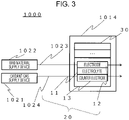
- Fig. 3 schematically illustrates a fuel cell system 1000 including an electrochemical cell.
- the electrochemical cell 20 has been described in the embodiment 3.
- the electrochemical cells 20 are stacked to obtain a stack 30.
- the resulting stack 30 is stored in a housing 1014.
- the housing 1014 may be made of a heat insulation member.
- An oxidant gas is supplied to the counter electrodes 13 of the stacked electrochemical cells 20.
- the oxidant gas is supplied to the counter electrodes 13 (i.e., cathodes) of a plurality of the electrochemical cells 20 from an oxidant gas supply device 1021 through an oxidant gas path 1024.
- the oxidant gas is, for example, air.
- a raw material is supplied to the electrode 12 from a raw material supply device 1022 through a raw material gas path 1023.
- the raw material is, for example, a hydrogen molecule.
- Hydrogen may be generated by a reforming reaction. Alternatively, hydrogen may be generated by water electrolysis.
- the fuel cell system 1000 works. Then, the fuel cell system 1000 generates electricity.
- citric acid monohydrate 0.1 mol, manufactured by Kanto Chemical Co., Inc.
- ethylenediaminetetraacetic acid 0.2 mol, manufactured by Kanto Chemical Co., Inc., hereinafter, "ethylenediaminetetraacetic acid” is referred to as EDTA
- EDTA ethylenediaminetetraacetic acid
- ammonia water 28 wt%, manufactured by Kanto Chemical Co., Inc.
- the pH of the solution mixture was adjusted to 7 at a temperature of 90°C using a pH meter (manufactured by HORIBA, Ltd.).
- the temperature of the solution mixture was raised from 95°C to 240°C using a hot stirrer to evaporate the solvent (i.e., water). The water was thus removed from the solution mixture to obtain a solid.
- solvent i.e., water
- the resulting solid was pulverized in a mortar and was then degreased at a temperature of about 400°C. Thus, a powder was obtained.
- the resulting powder was pressed into a cylindrical form using a hydraulic pump (manufactured by Enerpac Co., Ltd.) and a powder molding die having a diameter of 30 mm. Thus, a cylindrical molded product was obtained.
- the resulting circular molded product was subjected to preliminary heat treatment at 900°C for 10 hours in the atmosphere.
- a preliminarily heat-treated powder was obtained.
- the preliminarily heat-treated powder was pulverized. Subsequently, the pulverized powder was transferred to a plastic container together with zirconia balls.
- ethanol 100 g, manufactured by Kanto Chemical Co., Inc.
- a solution mixture was obtained.
- the solution mixture was pulverized with a ball mill for 4 days.
- the solution mixture was dried using a lamp to remove the ethanol from the solution mixture. Thus, a powder was obtained.
- the resulting powder was subjected to main heat treatment at 1200°C for 5 hours in the atmosphere.
- a material corresponding to BaZr 1-d M d O 3- ⁇ ' (M is Yb) was produced.
- a powder of BaYb 2 O 4 (3 mol% based on the powder subjected to main heat treatment) was further added to the powder subjected to main heat treatment to prepare an electrolyte material of Ba 0.97 Zr 0.80 Yb 0.20 O 3- ⁇ ( ⁇ is the amount of oxygen deficiency, 0 ⁇ ⁇ ⁇ 1.0).
- the solvent mixture was composed of butyl acetate (20 g, manufactured by Kanto Chemical Co., Inc.) and 1-butanol (20 g, manufactured by Kanto Chemical Co., Inc.).
- an electrolyte ceramic slurry was prepared.
- a membrane consisting of the electrolyte ceramic slurry was formed on a support sheet of a polyethylene terephthalate film having a thickness of about 50 ⁇ m by a doctor blade method (see S101).
- the resulting membrane made of the slurry was heated at a temperature of 80°C to evaporate the solvent.
- an electrolyte green sheet was produced (see S102).
- the electrolyte green sheet had a thickness of about 21 ⁇ m.
- An electrode green sheet was produced as in the method for producing the electrolyte green sheet except for the matters detailed below.
- An electrolyte material was prepared as in the method for preparing an electrolyte material of Ba 1.00 Zr 0.85 Yb 0.15 O 3- ⁇ ( ⁇ is the amount of oxygen deficiency, 0 ⁇ ⁇ ⁇ 1.0) except that the following materials were prepared as the starting materials of the electrode instead of the starting raw materials of the electrolyte material.
- An electrode ceramic slurry was prepared by mixing the following materials.
- the solvent mixture was composed of butyl acetate (20 g, manufactured by Kanto Chemical Co., Inc.) and 1-butanol (20 g, manufactured by Kanto Chemical Co., Inc.).
- a membrane consisting of the electrode ceramic slurry was formed on a support sheet of a polyethylene terephthalate film having a thickness of about 50 ⁇ m by a doctor blade method (see S201).
- the membrane made of the slurry had a thickness of about 30 ⁇ m.
- the resulting membrane made of the slurry was heated at a temperature of 80°C. Thus, an electrode green sheet was produced.
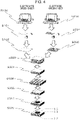
- the electrolyte green sheet was cut to obtain one cut electrolyte green sheet. Subsequently, the polyethylene terephthalate film was peeled off from the electrolyte green sheet. The one cut electrolyte green sheet had a size of 140 mm ⁇ 140 mm. The electrode green sheet was cut to obtain one cut electrode green sheet. The one cut electrode green sheet had a size of 140 mm ⁇ 140 mm.
- a plurality of cut electrode green sheets were stacked to obtain a laminate.
- the resulting laminate had a thickness of about 700 ⁇ m.
- the laminate was hot pressed.
- the hot pressing was performed under conditions of 85°C and 13 MPa. Thus, an electrode was produced.
- one cut electrolyte green sheet was stacked on one main surface of the electrode to obtain a laminate (see S300). Then, the resulting laminate was hot pressed.
- the hot pressing was performed under conditions of 80°C and 13 MPa. Thus, a compact was obtained.
- the resulting compact was further pressed with a pressure of 50 MPa (manufactured by Sansho Industry Co., Ltd.) to obtain a laminate (see S301).
- the thickness was almost unchanged to be about 700 ⁇ m.
- the laminate was cut to a size of 20 mm ⁇ 20 mm (see S302).
- Example 1 a membrane electrode assembly of Example 1 was produced (see S303, the drawing shows one cut laminate).
- the membrane electrode assembly was an assembly of an electrolyte membrane and an electrode.
- the counter electrode was provided as follows. As the starting raw materials of the counter electrode, the following materials were prepared.
- Each of the starting raw materials was placed in a ball mill, and they were mixed. Thus, a mixture was obtained. Then, the resulting mixture was heated up to 150°C using a hot stirrer. Thus, a NiO paste was obtained.
- the NiO paste was applied to one main surface exposing the electrolyte membrane of the membrane electrode assembly by a screen printing method (see S304).
- the applied NiO paste had a diameter of 10 mm.
- a precursor of a cell was obtained.
- Example 1 a cell of Example 1 was produced (see S305).
- the electrolyte membrane of the cell of Example 1 was analyzed with a STEM. Specifically, the resulting membrane electrode assembly was cut, and a cross section of the membrane electrode assembly was analyzed with a STEM.
- analysis with a STEM may be referred to as "STEM analysis”.
- the STEM used for the analysis is JEM-F200 (manufactured by JEOL Ltd.).
- the STEM analysis was performed at an acceleration voltage of 200 kV.
- Fig. 5 is a bright field STEM image of an electrolyte membrane.
- the circles shown in Fig. 5 are positions analyzed with EDX.
- analysis with EDX may be referred to as "EDX analysis”.
- the ratios (i.e., weight ratios) of Zr and Yb elements were calculated from the characteristic X-ray intensity obtained by EDX analysis using the well-known Cliff-Lorimer method. Table 1 shows the ratios of Zr and Yb at all analysis positions.
- the electrolyte membrane of Example 1 was analyzed with an FE-EPMA.
- analysis with an FE-EPMA may be referred to as "FE-EPMA analysis”.
- the FE-EPMA used for the analysis is EPMA-8050G (manufactured by Shimadzu Corporation). The analysis was performed at an acceleration voltage of 15 kV and an illumination current of 100 nA with the FE-EPMA. An area of 40 ⁇ 30 ⁇ m including the electrolyte membrane was analyzed.
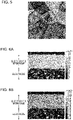
- Figs. 6A and 6B are data output from the FE-EPMA.
- Fig. 6A shows the number of counts of Yb based on the weight of various elements. Incidentally, the resulting number of counts is the absolute value.
- the bar on the right side of Fig. 6A indicates the relationship between the shading on Fig. 6A and the number of counts.
- Fig. 6B is a graph obtained by converting Fig. 6A to relative values (i.e., wt%).
- the average value, the maximum value, and the minimum value of wt% of Yb in a 3 ⁇ 3 ⁇ m square region of the electrolyte membrane were output from EPMA-8050G (manufactured by Shimadzu Corporation).
- Table 2 shows data indicating the average value, the maximum value, and the minimum value of wt% of Yb in a 3 ⁇ 3 ⁇ m square region of the electrolyte membrane.
- the number of counts were converted to concentrations (i.e., wt%) based on the data of Fig. 6A by a calibration curve method.
- the number of analysis points was 15000.
- Yb/(Zr + Yb) i.e., the composition ratio of Yb
- Yb/(Zr + Yb) 0.2
- This average composition of the electrolyte membrane is calculated from the amounts of the charged starting raw materials.
- Fig. 7 is a graph showing the value of Yb/(Zr + Yb) at each analysis point and the proportion of the analysis points having a predetermined Yb/(Zr + Yb) value in the 15000 analysis points.
- the "Yb proportion” shown in Fig. 7 is the value of Yb/(Zr + Yb).
- the "Frequency (%)” shown in Fig. 7 is the proportion of a predetermined value of Yb/(Zr + Yb) in the electrolyte membrane.
- the proton conductivity of an electrolyte membrane was calculated from the resistance of the electrolyte membrane and the thickness of the electrolyte membrane using the cell of Example 1.
- the resistance of the electrolyte membrane is based on an alternating current impedance method.
- the proton conductivity of the electrolyte membrane was determined as follows.
- the proton conductivity (unit: 10 -2 s ⁇ cm -1 ) of the electrolyte membrane of the cell was calculated based on the determined IR resistance and the thickness of the electrolyte membrane.
- the resistance of the electrolyte membrane was also measured at each of the temperatures of 500°C and 700°C.
- Table 3 shows the proton conductivity (unit: 10 -2 s ⁇ cm -1 ) of the electrolyte membrane at each temperature.
- Example 2 an electrolyte membrane of Example 2 and a membrane electrode assembly/cell using it were produced by the same method as in Example 1, except for the following steps. Then, the electrolyte membrane was analyzed. Subsequently, the characteristics of the membrane electrode assembly/cell were evaluated.
- Fig. 9 and Table 1 show the results of STEM analysis and EDX analysis.
- Figs. 10A and 10B and Table 2 show the results of FE-EPMA analysis.
- Table 3 shows the results of calculation of proton conductivity of the cell.
- Comparative Example 1 an electrolyte membrane of Comparative Example 1 and a membrane electrode assembly/cell using it were produced by the same method as in Example 1, except for the following steps. Then, the electrolyte membrane was analyzed. Subsequently, the characteristics of the membrane electrode assembly/cell were evaluated.
- Fig. 12 and Table 1 show the results of STEM analysis and EDX analysis.
- Figs. 13A and 13B and Table 2 show the results of FE-EPMA analysis.
- Table 3 shows the results of calculation of proton conductivity of the cell.
- the electrolyte membranes of Examples 1 and 2 are crystalline.
- the crystalline electrolyte membrane is composed of a plurality of crystal domains.
- Each crystal domain is composed of a first crystal subdomain and a second crystal subdomain.
- the first crystal subdomain is surrounded by the second crystal subdomain.
- the first crystal subdomain is positioned near the center of each crystal domain.
- the second crystal subdomain is positioned near the periphery of each crystal domain.
- the analysis positions 1-1, 1-3, and 1-5 are positions that are visually observed as black. These analysis positions are first crystal subdomains. In analysis of these first crystal subdomains with EDX, as shown in Table 1, the concentration of Yb was higher than the concentration of Zr. On the other hand, as shown in Fig. 5 , the analysis positions 1-2, 1-4, and 1-6 are positions that are visually observed as white. These analysis positions are second crystal subdomains. In analysis of these second crystal subdomains with EDX, as shown in Table 1, the concentration of Zr was higher than that of Yb.
- the analysis positions 2-1 and 2-3 are positions that are visually observed as black. These analysis positions are first crystal subdomains. In analysis of these first crystal subdomains with EDX, as shown in Table 1, the concentration of Yb was higher than the concentration of Zr. On the other hand, as shown in Fig. 9 , the analysis positions 2-2 and 2-4 are positions that are visually observed as white. These analysis positions are second crystal subdomains. In analysis of these second crystal subdomains with EDX, as shown in Table 1, the concentration of Zr was higher than that of Yb. The analysis positions 2-5 and 2-6 are both portions that are visually observed as white. Accordingly, the crystal domains of the analysis positions 2-5 and 2-6 do not have crystal subdomains.
- the crystal domains constituting the electrolyte membrane of Comparative Example 1 did not have crystal subdomains.
- the concentration of Zr was higher than the concentration of Yb at every analysis position.
- the electrolyte membrane of Comparative Example 1 was an electrolyte membrane having a homogeneous concentration of Yb, compared to the electrolyte membranes of Examples 1 and 2.
- the electrolyte membranes of Examples 1 and 2 had positions having uneven distribution of the concentration of Yb, compared to Comparative Example 1.
- the difference in Yb/(Zr + Yb) measured in each crystal domain is 0.28 or more. Specifically, the difference in Yb/(Zr + Yb) was 0.29 or more.
- the electrolyte membranes of Examples 1 and 2 each included a plurality of crystal domains.
- at least one of the crystal domains included a first crystal subdomain and a second crystal subdomain in the inside thereof.
- the concentration of M in the first crystal subdomain and the concentration of M in the second crystal subdomain were different from each other.
- the concentration of M in the first crystal subdomain was higher than the concentration of M in the second crystal subdomain.
- the first crystal subdomain is surrounded by the second crystal subdomain.
- the first crystal subdomain was represented by a chemical formula of BaZr 1-a Yb a O 3- ⁇
- the second crystal subdomain was represented by a chemical formula of BaZr 1-b Yb b O 3- ⁇ .
- the respective chemical formulae satisfied 0 ⁇ a ⁇ 1, 0 ⁇ b ⁇ 1, 0 ⁇ ⁇ ⁇ 1, and a - b ⁇ 0.28.
- Comparative Example 1 when an electrolyte membrane having a homogenous concentration of Yb compared to Examples 1 and 2 was produced, the Yb proportion determined by FE-EPMA analysis was within the range of the average composition value (i.e., 0.2) + 0.1.
- Example 1 and 2 the Yb proportions determined by FE-EPMA analysis were outside the average composition value + 0.1. In other words, in Examples 1 and 2, at least a part of the Yb proportions determined by FE-EPMA analysis had a value larger than the average composition value + 0.1. Accordingly, it was revealed that in the electrolyte membranes of Examples 1 and 2, the distribution of the Yb concentration was not homogeneous compared to Comparative Example 1 (that is, the Yb concentration was unevenly distributed in the electrolyte membrane. In addition, the concentrations of Yb of the first crystal subdomain and the second crystal subdomain were different from each other).
- the electrolyte membranes of Examples 1 and 2 each include a barium zirconate compound doped with ytterbium.
- a 3 ⁇ 3 ⁇ m square region represented by a composition formula of BaZr 1-a Yb a O 3- ⁇ (0 ⁇ c ⁇ 1, c + 0.1 ⁇ x, and 0 ⁇ ⁇ ⁇ 1) is present on the electrolyte membrane.
- the difference in Yb concentration in each of the electrolyte membranes of Examples 1 and 2 was large compared to that in the electrolyte membrane of Comparative Example 1.
- the electrolyte membranes of Examples 1 and 2 each contained a barium zirconate compound doped with ytterbium.
- the concentration of M in the first crystal subdomain and the concentration of M in the second crystal subdomain were substantially the same.
- a 3 ⁇ 3 ⁇ m area of the electrolyte membrane was analyzed with an electron probe microanalyzer, and the data were output.
- the value of "(the maximum value of wt% of Yb) - (the average value of wt% of Yb)" per unit area of the output data was 5% or more.
- the cells of Examples 1 and 2 each had a high proton conductivity at each temperature (i.e., 500°C, 600°C, and 700°C) compared to the cell of Comparative Example 1. Accordingly, it was revealed that an electrolyte membrane having uneven distribution of the concentration of Yb and a cell including the electrolyte membrane were improved in the proton conductivity.
- Example 1 EDX analysis Analysis position Zr/(Zr + Yb) Yb/(Zr + Yb) Difference in measured Yb/(Zr + Yb)
- Example 1 1-1 0.333 0.667 0.291 1-2 0.624 0.376 1-3 0.290 0.710 0.358 1-4 0.648 0.352 1-5 0.292 0.708 0.369 1-6 0.661 0.339
- Example 2 2-1 0.258 0.742 0.407 2-2 0.665 0.335 2-3 0.278 0.722 0.369 2-4 0.647 0.353 2-5 0.650 0.350 0.013 2-6 0.637 0.363
- Comparative Example 1 3-1 0.521 0.479 0.156 3-2 0.677 0.323 3-3 0.518 0.482 0.109 3-4 0.627 0.373 3-5 0.627 0.373 0.004 3-6 0.623 0.377
- Table 2 FE-EPMA analysis Maximum value Minimum value Average value Value of "(maximum value) - (average value
- the electrolyte membrane according to the present disclosure can be suitably used in an electrochemical cell or a fuel cell.
Landscapes
- Chemical & Material Sciences (AREA)
- Engineering & Computer Science (AREA)
- Manufacturing & Machinery (AREA)
- Organic Chemistry (AREA)
- Chemical Kinetics & Catalysis (AREA)
- Electrochemistry (AREA)
- Ceramic Engineering (AREA)
- Materials Engineering (AREA)
- Sustainable Development (AREA)
- Sustainable Energy (AREA)
- Life Sciences & Earth Sciences (AREA)
- General Chemical & Material Sciences (AREA)
- Inorganic Chemistry (AREA)
- Metallurgy (AREA)
- Structural Engineering (AREA)
- Composite Materials (AREA)
- Conductive Materials (AREA)
- Fuel Cell (AREA)
Applications Claiming Priority (2)
| Application Number | Priority Date | Filing Date | Title |
|---|---|---|---|
| JP2020000909 | 2020-01-07 | ||
| PCT/JP2020/045748 WO2021140817A1 (fr) | 2020-01-07 | 2020-12-09 | Membrane électrolytique, ensemble électrode à membrane, cellule électrochimique et procédé de fabrication de membrane électrolytique |
Publications (2)
| Publication Number | Publication Date |
|---|---|
| EP4089207A1 true EP4089207A1 (fr) | 2022-11-16 |
| EP4089207A4 EP4089207A4 (fr) | 2023-06-28 |
Family
ID=76787914
Family Applications (1)
| Application Number | Title | Priority Date | Filing Date |
|---|---|---|---|
| EP20912823.0A Pending EP4089207A4 (fr) | 2020-01-07 | 2020-12-09 | Membrane électrolytique, ensemble électrode à membrane, cellule électrochimique et procédé de fabrication de membrane électrolytique |
Country Status (5)
| Country | Link |
|---|---|
| US (1) | US12401053B2 (fr) |
| EP (1) | EP4089207A4 (fr) |
| JP (1) | JP7624633B2 (fr) |
| CN (1) | CN114902460B (fr) |
| WO (1) | WO2021140817A1 (fr) |
Family Cites Families (13)
| Publication number | Priority date | Publication date | Assignee | Title |
|---|---|---|---|---|
| JP4608047B2 (ja) * | 1999-02-17 | 2011-01-05 | パナソニック株式会社 | 混合イオン伝導体およびこれを用いたデバイス |
| JP2009023883A (ja) * | 2007-07-20 | 2009-02-05 | Shin Imayado | プロトン伝導体 |
| CN107112564B (zh) * | 2014-11-13 | 2020-07-14 | 住友电气工业株式会社 | 电池结构体及其制造方法以及燃料电池 |
| JP2016219406A (ja) * | 2015-05-20 | 2016-12-22 | パナソニックIpマネジメント株式会社 | プロトン伝導体 |
| JP2017188440A (ja) * | 2016-04-04 | 2017-10-12 | パナソニック株式会社 | 膜電極接合体および固体酸化物形燃料電池 |
| US20170288248A1 (en) * | 2016-04-04 | 2017-10-05 | Panasonic Corporation | Membrane electrode assembly and solid oxide fuel cell |
| US10826075B2 (en) | 2016-04-19 | 2020-11-03 | Panasonic Intellectual Property Management Co., Ltd. | Membrane electrode assembly of electrochemical device, membrane electrode assembly of fuel cell, fuel cell, membrane electrode assembly of electrochemical hydrogen pump, electrochemical hydrogen pump, membrane electrode assembly of hydrogen sensor, and hydrogen sensor |
| JP7021787B2 (ja) * | 2017-02-28 | 2022-02-17 | 国立研究開発法人産業技術総合研究所 | プロトン伝導性電解質 |
| EP3641038A1 (fr) * | 2017-06-15 | 2020-04-22 | Sumitomo Electric Industries, Ltd. | Élément d'électrolyte solide, pile à combustible à oxyde solide, dispositif d'électrolyse d'eau, pompe à hydrogène et procédé de production d'élément d'électrolyte solide |
| US11545690B2 (en) | 2017-11-29 | 2023-01-03 | Kyoto University | Proton conductor, proton-conducting cell structure, water vapor electrolysis cell, and method for producing hydrogen electrode-solid electrolyte layer complex |
| JP7113326B2 (ja) * | 2017-12-12 | 2022-08-05 | パナソニックIpマネジメント株式会社 | プロトン伝導体および膜電極接合体 |
| JP7016028B2 (ja) * | 2018-04-03 | 2022-02-04 | パナソニックIpマネジメント株式会社 | 燃料電池 |
| CN112585791A (zh) * | 2018-08-30 | 2021-03-30 | 堺化学工业株式会社 | 固体氧化物型燃料电池用电解质材料及其前体的制备方法 |
-
2020
- 2020-12-09 WO PCT/JP2020/045748 patent/WO2021140817A1/fr not_active Ceased
- 2020-12-09 CN CN202080091635.0A patent/CN114902460B/zh active Active
- 2020-12-09 EP EP20912823.0A patent/EP4089207A4/fr active Pending
- 2020-12-09 JP JP2021569780A patent/JP7624633B2/ja active Active
-
2022
- 2022-06-13 US US17/806,501 patent/US12401053B2/en active Active
Also Published As
| Publication number | Publication date |
|---|---|
| JPWO2021140817A1 (fr) | 2021-07-15 |
| CN114902460B (zh) | 2026-03-27 |
| JP7624633B2 (ja) | 2025-01-31 |
| CN114902460A (zh) | 2022-08-12 |
| US20220311036A1 (en) | 2022-09-29 |
| US12401053B2 (en) | 2025-08-26 |
| WO2021140817A1 (fr) | 2021-07-15 |
| EP4089207A4 (fr) | 2023-06-28 |
Similar Documents
| Publication | Publication Date | Title |
|---|---|---|
| EP2750227B1 (fr) | Matériau d'électrode oxydoréductrice et pile à combustible à oxyde solide | |
| EP3719815B1 (fr) | Conducteur de protons, structure de cellule conductrice de protons, cellule d'électrolyse de vapeur d'eau et procédé de production de complexe de couche d'électrolyte à électrode solide à hydrogène | |
| EP2903067A1 (fr) | Demi-cellule pour piles à combustible à oxyde solide, et piles à combustible à oxyde solide | |
| US20180309148A1 (en) | Ceria electrolyte for low-temperature sintering and solid oxide fuel cell using the same | |
| KR101808387B1 (ko) | 저온 소결용 세리아 전해질 및 이를 이용한 고체산화물연료전지 | |
| EP3641038A1 (fr) | Élément d'électrolyte solide, pile à combustible à oxyde solide, dispositif d'électrolyse d'eau, pompe à hydrogène et procédé de production d'élément d'électrolyte solide | |
| KR20020053787A (ko) | 혼합이온 전도체 및 이것을 이용한 장치 | |
| JP7291031B2 (ja) | 固体電解質接合体 | |
| JP4953152B2 (ja) | 固体酸化物形燃料電池 | |
| JP2020129433A (ja) | 固体電解質部材、固体酸化物型燃料電池、水電解装置、水素ポンプ及び固体電解質部材の製造方法 | |
| CN113260737A (zh) | 膜电极接合体、电化学装置和电化学系统 | |
| EP2936597B1 (fr) | Mélange de poudres pour une couche dans une pile à combustible à oxyde solide | |
| EP3002813B1 (fr) | Piles à combustibles oxyde solides | |
| EP4089207A1 (fr) | Membrane électrolytique, ensemble électrode à membrane, cellule électrochimique et procédé de fabrication de membrane électrolytique | |
| EP1864955A1 (fr) | Conducteur d'ions | |
| EP3002811B1 (fr) | Pile a combustible d'oxyde solide | |
| KR101698210B1 (ko) | 고체산화물 전해질, 이를 포함하는 고체산화물 연료전지 및 이의 제조방법 | |
| EP3960906A1 (fr) | Assemblage membrane-électrode, pile à combustible de type à oxyde solide et dispositif électrochimique | |
| JP2018139183A (ja) | 固体電解質部材、固体酸化物型燃料電池、水電解装置、水素ポンプ及び固体電解質部材の製造方法 | |
| EP4131287B1 (fr) | Conducteur de protons, membrane électrolytique, ensemble membrane-électrode, cellule électrochimique et empilement de piles à combustible | |
| KR101840094B1 (ko) | 저온 소결 특성을 갖는 세리아 전해질 및 이를 이용한 고체산화물연료전지 | |
| US20260128342A1 (en) | Proton conductor, film-electrode joined body, electrochemical cell, and fuel cell stack | |
| KR20240118451A (ko) | 고체산화물 전지용 반응 방지막 및 이를 포함하는 고체산화물 전지 | |
| EP4517887A1 (fr) | Ensemble électrode à membrane, cellule électrochimique et système de pile à combustible | |
| KR20240118453A (ko) | 고체산화물 전지용 반응 방지막 및 이를 포함하는 고체산화물 전지 |
Legal Events
| Date | Code | Title | Description |
|---|---|---|---|
| STAA | Information on the status of an ep patent application or granted ep patent |
Free format text: STATUS: THE INTERNATIONAL PUBLICATION HAS BEEN MADE |
|
| PUAI | Public reference made under article 153(3) epc to a published international application that has entered the european phase |
Free format text: ORIGINAL CODE: 0009012 |
|
| STAA | Information on the status of an ep patent application or granted ep patent |
Free format text: STATUS: REQUEST FOR EXAMINATION WAS MADE |
|
| 17P | Request for examination filed |
Effective date: 20220704 |
|
| AK | Designated contracting states |
Kind code of ref document: A1 Designated state(s): AL AT BE BG CH CY CZ DE DK EE ES FI FR GB GR HR HU IE IS IT LI LT LU LV MC MK MT NL NO PL PT RO RS SE SI SK SM TR |
|
| DAV | Request for validation of the european patent (deleted) | ||
| DAX | Request for extension of the european patent (deleted) | ||
| A4 | Supplementary search report drawn up and despatched |
Effective date: 20230530 |
|
| RIC1 | Information provided on ipc code assigned before grant |
Ipc: C04B 35/486 20060101ALI20230523BHEP Ipc: C25B 13/04 20210101ALI20230523BHEP Ipc: H01M 8/1253 20160101ALI20230523BHEP Ipc: H01M 8/12 20160101ALI20230523BHEP Ipc: H01B 1/08 20060101ALI20230523BHEP Ipc: H01B 1/06 20060101ALI20230523BHEP Ipc: C25B 9/23 20210101AFI20230523BHEP |