EP4095627A1 - Évaluation des paramètres de contrôle alternatifs basée sur un double numérique - Google Patents
Évaluation des paramètres de contrôle alternatifs basée sur un double numérique Download PDFInfo
- Publication number
- EP4095627A1 EP4095627A1 EP21175517.8A EP21175517A EP4095627A1 EP 4095627 A1 EP4095627 A1 EP 4095627A1 EP 21175517 A EP21175517 A EP 21175517A EP 4095627 A1 EP4095627 A1 EP 4095627A1
- Authority
- EP
- European Patent Office
- Prior art keywords
- control parameters
- industrial automation
- automation device
- alternative control
- digital twin
- Prior art date
- Legal status (The legal status is an assumption and is not a legal conclusion. Google has not performed a legal analysis and makes no representation as to the accuracy of the status listed.)
- Granted
Links
Images


Classifications
-
- G—PHYSICS
- G05—CONTROLLING; REGULATING
- G05B—CONTROL OR REGULATING SYSTEMS IN GENERAL; FUNCTIONAL ELEMENTS OF SUCH SYSTEMS; MONITORING OR TESTING ARRANGEMENTS FOR SUCH SYSTEMS OR ELEMENTS
- G05B17/00—Systems involving the use of models or simulators of said systems
- G05B17/02—Systems involving the use of models or simulators of said systems electric
Definitions
- the following exemplary embodiments relate to industrial automation and to industrial communication networks.
- an apparatus comprising at least one processor, and at least one memory including computer program code, wherein the at least one memory and the computer program code are configured, with the at least one processor, to cause the apparatus to: obtain a set of alternative control parameters associated with an industrial automation device; evaluate the set of alternative control parameters by simulating a digital twin associated with the industrial automation device with multiple combinations of inputs, while the digital twin is configured to use the set of alternative control parameters; indicate whether or not the digital twin stays within a safe operating range based on the simulating; and apply the set of alternative control parameters to the industrial automation device.
- an apparatus comprising means for: obtaining a set of alternative control parameters associated with an industrial automation device; evaluating the set of alternative control parameters by simulating a digital twin associated with the industrial automation device with multiple combinations of inputs, while the digital twin is configured to use the set of alternative control parameters; indicating whether or not the digital twin stays within a safe operating range based on the simulating; and applying the set of alternative control parameters to the industrial automation device.
- a method comprising: obtaining a set of alternative control parameters associated with an industrial automation device; evaluating the set of alternative control parameters by simulating a digital twin associated with the industrial automation device with multiple combinations of inputs, while the digital twin is configured to use the set of alternative control parameters; indicating whether or not the digital twin stays within a safe operating range based on the simulating; and applying the set of alternative control parameters to the industrial automation device.
- a computer program comprising instructions for causing an apparatus to perform at least the following: obtain a set of alternative control parameters associated with an industrial automation device; evaluate the set of alternative control parameters by simulating a digital twin associated with the industrial automation device with multiple combinations of inputs, while the digital twin is configured to use the set of alternative control parameters; indicate whether or not the digital twin stays within a safe operating range based on the simulating; and apply the set of alternative control parameters to the industrial automation device.
- a computer readable medium comprising program instructions for causing an apparatus to perform at least the following: obtain a set of alternative control parameters associated with an industrial automation device; evaluate the set of alternative control parameters by simulating a digital twin associated with the industrial automation device with multiple combinations of inputs, while the digital twin is configured to use the set of alternative control parameters; indicate whether or not the digital twin stays within a safe operating range based on the simulating; and apply the set of alternative control parameters to the industrial automation device.
- a non-transitory computer readable medium comprising program instructions for causing an apparatus to perform at least the following: obtain a set of alternative control parameters associated with an industrial automation device; evaluate the set of alternative control parameters by simulating a digital twin associated with the industrial automation device with multiple combinations of inputs, while the digital twin is configured to use the set of alternative control parameters; indicate whether or not the digital twin stays within a safe operating range based on the simulating; and apply the set of alternative control parameters to the industrial automation device.
- a system comprising at least an industrial automation device, a user device, a cloud server, and a remote support device.
- the user device is configured to: transmit, to the cloud server, one or more messages indicative of a service request associated with the industrial automation device.
- the cloud server is configured to: receive, from the user device, the one or more messages indicative of the service request associated with the industrial automation device; transmit, to the remote support device, at least a subset of the one or more messages indicative of the service request associated with the industrial automation device; receive, from the remote support device, a set of alternative control parameters associated with the industrial automation device; evaluate the set of alternative control parameters by simulating a digital twin associated with the industrial automation device with multiple combinations of inputs, while the digital twin is configured to use the set of alternative control parameters; transmit, to the user device and/or to the industrial automation device, the set of alternative control parameters; and transmit, to the user device and/or to the industrial automation device, a first indication indicating whether or not the digital twin stays within a safe operating range based on the simulating.
- the industrial automation device is configured to: receive, from the user device or from the cloud server, the set of alternative control parameters; and apply the set of alternative control parameters.
- a system comprising at least an industrial automation device, a user device, a cloud server, and a remote support device.
- the user device comprises means for: transmitting, to the cloud server, one or more messages indicative of a service request associated with the industrial automation device.
- the cloud server comprises means for: receiving, from the user device, the one or more messages indicative of the service request associated with the industrial automation device; transmitting, to the remote support device, at least a subset of the one or more messages indicative of the service request associated with the industrial automation device; receiving, from the remote support device, a set of alternative control parameters associated with the industrial automation device; evaluating the set of alternative control parameters by simulating a digital twin associated with the industrial automation device with multiple combinations of inputs, while the digital twin is configured to use the set of alternative control parameters; transmitting, to the user device and/or to the industrial automation device, the set of alternative control parameters; and transmitting, to the user device and/or to the industrial automation device, a first indication indicating whether or not the digital twin stays within a safe operating range based on the simulating.
- the industrial automation device comprises means for: receiving, from the user device or from the cloud server, the set of alternative control parameters; and applying the set of alternative control parameters.
- Various exemplary embodiments may be applicable to any process in an industrial plant, including a processing system and/or an industrial manufacturing related process and/or a system for a technical process, which is at least partly automated, providing different measured/sensored values for a plurality of variables on one or more devices (equipment) and/or on one or more processes.
- a non-limiting list of examples includes power plants, pulp and paper plants, manufacturing plants, chemical processing plants, power transmission systems, mining and mineral processing plants, oil and gas systems, data centers, ships, and transportation fleet systems.
- Virtualization may allow a single physical computing device to host one or more instances of virtual machines that appear and operate as independent computing devices, so that a single physical computing device can create, maintain, delete, or otherwise manage virtual machines in a dynamic manner. It is also possible that device operations will be distributed among a plurality of servers, nodes, devices or hosts. In cloud computing network devices, computing devices and/or storage devices provide shared resources. Some other technology advancements, such as Software-Defined Networking (SDN) may cause one or more of the functionalities described below to be migrated to any corresponding abstraction or apparatus or device. Therefore, all words and expressions should be interpreted broadly, and they are intended to illustrate, not to restrict, the exemplary embodiments.
- SDN Software-Defined Networking
- the control parameter configuration and/or firmware of the industrial automation device may need to be updated.
- the technical support staff of the device manufacturer may remotely read the warning and failure logs as well as the existing control parameters of the industrial automation device, and then recommend new parameters to solve the issue.
- the approval of the new parameters may be the responsibility of the customer, i.e. the user of the industrial automation device.
- An industrial automation device such as a variable speed drive may be in remote mode, wherein the start and stop are controlled by external inputs.
- the encoder configuration of a variable speed drive may also be prone to human error.
- the encoder is connected to the reference chain of the drive. For example, changing the encoder pulse count may affect the measured speed.
- An additional check could be done by cross-referencing speed-related control parameters, such as gearing, minimum and maximum limits, etc.
- Some exemplary embodiments may be used to validate the new control parameters by simulating the effects of the changes with a digital twin before applying them to the actual industrial automation device.
- the digital twin is a virtual model that may be used to simulate the operation of the industrial automation device.
- the digital twin may comprise a test bench, which systematically validates all possible combinations of inputs and outputs including rare corner cases.
- the digital twin may comprise a detailed model of the entire automation system that the industrial automation device is part of, or just a subset of the automation system, such as a functional safety system. This validation may ensure that the industrial automation device does not enter an unintentional state (for example that it does not start accidentally).
- FIG. 1 illustrates a communication system to which some exemplary embodiments may be applied.
- some exemplary embodiments may be based on wireless communications, such as 3G (third generation), 4G (fourth generation), LTE (long term evolution), LTE-A (long term evolution advanced), 5G (fifth generation), 5G NR (new radio), UMTS (universal mobile telecommunications system), EDGE (enhanced data rates for GSM evolution), WCDMA (wideband code division multiple access), Bluetooth, WLAN (wireless local area network), Wi-Fi, Li-Fi (light fidelity) or any other mobile or wireless network.
- the communication may also occur between nodes belonging to different but compatible systems, such as LTE and 5G.
- Some exemplary embodiments may also be based on wired networks.
- FIG. 1 illustrates a system according to an exemplary embodiment. It should be noted that FIG. 1 illustrates a simplified system architecture only showing some elements and functional entities, all being logical units whose implementation may differ from what is shown. The connections shown in FIG. 1 are logical connections; the actual physical connections may be different. Data collection may use so-called master protocols, in which a master network node subscribes data from slaves (devices whose data it wants to have), and a slave device/network node sends its data to the receiver/master based on query or automatically based on subscription. It is apparent to a person skilled in the art that the systems also comprise other functions and structures. It should be appreciated that the functions, structures, elements, and protocols used in or for communication are irrelevant to the exemplary embodiments. Therefore, they need not be discussed in more detail here.
- the system comprises an industrial automation device 101.
- the industrial automation device 101 may comprise, for example, a frequency converter, variable frequency drive, variable speed drive, motion drive, motion controller, motor, servomotor, AC/DC module, DC/AC module, DC/DC module, programmable logic controller (PLC), switch, soft starter, robot, or any other device used for industrial automation.
- a variable frequency drive or a variable speed drive may be used to run machinery, such as a motor or a pump, at different speeds.
- the industrial automation device 101 may comprise or be connected to a controller, for example a proportional-integral-derivative (PID) controller.
- the controller may be configured to send control signals to the industrial automation device 101.
- the industrial automation device 101 may control highly dynamic industrial processes, in which for example the speed or torque applied to a motor has to be varied according to the needs of the industrial process.
- the industrial automation device 101 may store, for example in an internal memory of the industrial automation device or in an external memory, information on control parameter settings, for example present values of control parameters such as controller gains, ramp times, motor data, limits, magnetization settings, signal filtering settings, and/or motor control settings.
- the industrial automation device 101 may also store operational information recorded during the operation of the industrial automation device, for example information on key performance indicators, such as load current histogram, torque ripple, torque vs. speed curves, and/or power vs. speed curves, temperature, voltage, current, and/or other information such as resonance frequencies and/or load inertias.
- the industrial automation device 101 is equipped with a short-range communication interface to provide a connection to a user device 102.
- the connection between the industrial automation device 101 and the user device 102 may be provided, for example, by Bluetooth, Bluetooth low energy, ZigBee, wireless local area network (WLAN or WiFi), wireless mesh network, near field communication (NFC), light fidelity (Li-Fi), Ethernet, or any other wireless or wired connection.
- the short-range communication interface may be comprised, for example, in the industrial automation device 101 or in a control panel of the industrial automation device 101.
- the industrial automation device 101 may be configured to exchange information, i.e. to transmit and/or receive data, with the user device 102 via the connection.
- the industrial automation device 101 may be configured to transmit notifications of faults or warnings to the user device 102 via the connection.
- the industrial automation device 101 may be further configured to apply control parameters and/or other configuration changes received from the user device 102.
- the industrial automation device 101 may be connected to the internet via a network interface, such as 3G, 4G, LTE, LTE-A, 5G, 5G NR, UMTS, EDGE, WCDMA, WLAN, Wi-Fi, Li-Fi, or any other mobile, wireless or wired network.
- the network interface may be comprised, for example, in the industrial automation device 101 or in a control panel of the industrial automation device 101.
- the industrial automation device 101 may be configured to exchange information, i.e. to transmit and/or receive data, with a cloud server 103 via the network interface.
- the industrial automation device 101 may be connected to the cloud server 103 directly by cellular link, or via the user device 102, or via a separate gateway device such as an edge gateway.
- the industrial automation device 101 may be configured to transmit warning and failure logs, real-time operational information, and/or the existing control parameter settings of the industrial automation device 101 to the cloud server 103.
- the existing control parameters refer to the control parameters currently applied at the industrial automation device 101.
- the user device 102 may comprise user equipment such as a smartphone, mobile phone, tablet computer, laptop computer, desktop computer, or any other computing device.
- the user device 102 may be a local device located on-site at a close proximity to the industrial automation device 101.
- the user device 102 is equipped with a short-range communication interface to provide the connection to the industrial automation device 101.
- the user device is configured to exchange information, i.e. to transmit and/or receive data, with the industrial automation device 101.
- the user device 102 may be configured to receive the notifications of faults and/or warnings from the industrial automation device 101 via the first connection 111.
- the user device 102 may be further configured to transmit control parameters and/or other configuration changes to the industrial automation device 101 via the connection.
- the user device 102 may be connected to the internet via a network interface, such as 3G, 4G, LTE, LTE-A, 5G, 5G NR, UMTS, EDGE, WCDMA, WLAN, Wi-Fi, Li-Fi, Ethernet, or any other mobile, wireless or wired network.
- the user device 102 may be configured to exchange information, i.e. to transmit and/or receive data, with a cloud server 103 via the network interface.
- the cloud server 103 is configured to exchange information, i.e. to transmit and/or receive data, with the industrial automation device 101 and/or with the user device 102.
- the cloud server 103 may be further configured to store the received data in an internal or external memory.
- the cloud server 103 is further configured to simulate the operation of the industrial automation device 101 by using a digital twin associated with the industrial automation device 101.
- the cloud server 103 comprises a digital twin database 103-1, which comprises the digital twin associated with the industrial automation device 101.
- the digital twin may be a pre-defined model provided by the manufacturer of the industrial automation device 101.
- the digital twin may be a user-defined model.
- the digital twin database 103-1 may also comprise digital twins of other devices and/or systems.
- the system further comprises a remote support device 104 located at a remote service center, for example.
- the remote support device 104 may comprise user equipment such as a smartphone, mobile phone, tablet computer, laptop computer, desktop computer, or any other computing device.
- the remote support device 104 may be connected to the internet via a network interface, such as 3G, 4G, LTE, LTE-A, 5G, 5G NR, UMTS, EDGE, WCDMA, WLAN, Wi-Fi, Li-Fi, Ethernet, or any other mobile, wireless or wired network.
- the remote support device 104 may be configured to exchange information, i.e. to transmit and/or receive data, with the cloud server 103 via the network interface.
- the remote support device 104 may be further configured to enable a remote support technician operating the remote support device 104 to provide remote support to a user of the user device 102 via the internet or via the cloud server 103.
- the remote support may include, for example, commissioning and/or troubleshooting associated with the industrial automation device 101.
- the remote support may be provided, for example, by a video chat application, a voice call application, or a messaging application configured in the remote support device 104 and in the user device 102.
- FIG. 2 illustrates a signaling diagram for a troubleshooting use case according to an exemplary embodiment.
- an industrial automation device transmits 201 a notification to a user device for example for indicating a fault and/or warning associated with the industrial automation device.
- the notification may indicate a need to update control parameters of the industrial automation device in order to improve the performance, functionality or features of the industrial automation device.
- the industrial automation device may have no direct internet connectivity.
- the industrial automation device is connected to the user device via a short-range connection, such as a Bluetooth or Wi-Fi connection, and thus the industrial automation device may use the user device as a gateway to the internet.
- the user device Upon receiving the notification, the user device establishes a connection to a cloud server via the internet.
- the connection to the cloud server may be established automatically upon receiving the notification, or the connection may be established upon receiving a user input for establishing the connection.
- the user device obtains, or downloads, relevant information from the industrial automation device, and transmits 202 one or more messages (or transactions) indicative of a service request associated with the industrial automation device to the cloud server.
- the relevant information may comprise, for example, the existing control parameters, fault and warning logs, firmware variant, firmware version, device type code, and/or an identifier of the industrial automation device.
- the control parameters may comprise the inputs, outputs, limits and/or other settings used for controlling the industrial automation device.
- the control parameters may possibly also comprise some key values of other machinery, such as nameplate values of an electric motor connected to the industrial automation device.
- the one or more messages may comprise, for example, the identifier of the industrial automation device, the existing control parameters of the industrial automation device, the fault and warning logs, one or more fault codes indicated by the industrial automation device in the notification 201, and/or a user-defined problem description.
- the user of the user device may also define a system configuration of the automation system that the industrial automation device is part of.
- the system configuration may be indicated in the one or more messages.
- the system configuration may comprise information about the automation system, including for example mechanical parts, limit switches, sensors, etc.
- the industrial automation device may comprise PLC functions, which enable controlling the automation system with multiple drives and motors based on measured input from fieldbuses, sensors, and/or switches, as an example.
- the user may also define a safe operating range for the industrial automation device and/or an industrial process that the industrial automation device is controlling.
- the safe operating range may be defined by allowed minimum and maximum limits for outputs such as speed, acceleration and/or physical position associated with the industrial automation device and/or the industrial process.
- the physical position may cause safety issues for example with elevators or cranes, and thus it may need to be taken into account.
- the user may also define the intended control inputs, a range and/or sequence of the intended control inputs, and/or a relationship of the control inputs to the outputs, such as speed and/or acceleration associated with the industrial automation device.
- the control inputs may comprise commands for starting, stopping, accelerating (i.e. increasing speed of), and/or decelerating (i.e.
- the sequence of the intended control inputs indicates multiple consecutive control inputs that are entered in a row.
- the safe operating range, the control inputs, and/or the relationship between the control inputs and outputs may be indicated in the one or more messages.
- the cloud server Upon receiving the service request, the cloud server obtains, from its digital twin database, a digital twin of at least a subset of the automation system that the industrial automation device is part of, and runs 203, i.e. executes, the digital twin in order to simulate the industrial automation device by using the existing control parameters.
- simulation results with the existing control parameters are ready, when the service request investigation starts.
- the same fault(s) and/or warning(s) can be replicated by the digital twin as experienced by the actual industrial automation device, and the root cause of the issue can be investigated.
- the cloud server forwards 204 the one or more messages indicative of the service request to a remote support device operated by a remote support technician.
- the remote support technician may use the remote support device to select the service request from a queue of multiple service requests, which may also be referred to as tickets.
- the cloud server may also transmit other related information to the remote support device, such as the digital twin simulation results based on the existing control parameters comprising, for example, one or more fault codes and/or warnings, as well as one or more performance, load, and/or efficiency indices based on the simulation.
- the remote support technician After receiving the service request, the remote support technician investigates the service request and the other related information, and defines a set of alternative control parameters (i.e. new control parameters) and/or other changes that the remote service technician proposes to be applied to the industrial automation device based on the service request and/or the other related information. For example, the remote support technician may also propose changes to the firmware of the industrial automation device, such as updating the firmware.
- the remote support device transmits 205 the set of alternative control parameters and/or the other proposed changes to the cloud server.
- the cloud server evaluates 206 the set of alternative control parameters and/or the other proposed changes by updating them to the digital twin and simulating the effects of the changes based on the digital twin.
- the cloud server performs a validation to evaluate whether or not the set of alternative control parameters and/or the other proposed changes are safe to be applied to the actual industrial automation device by simulating the digital twin with multiple combinations of control inputs, while the digital twin is configured to use the set of alternative control parameters.
- the digital twin may be used as a test bench that runs all possible combinations of the control inputs, and evaluates whether the outputs (e.g. speed and/or acceleration) resulting from the tested control inputs stay within the safe operating range defined by the user.
- the evaluating may be based on the user-defined relationship between the control inputs and the outputs.
- the cloud server may transmit an indication to the remote support device indicating that the validation failed.
- the cloud server may also transmit a detailed report to the remote support device of any possible warnings and/or faults associated with the set of alternative control parameters based on the digital twin simulation.
- the remote support technician may then adjust the control parameters and/or the other changes iteratively until the cloud server successfully validates the changes as safe to be applied to the industrial automation device.
- the cloud server transmits 207 an indication to the user device indicating the set of alternative control parameters and/or the other proposed changes.
- the indication also indicates the simulation results, for example whether or not the digital twin stayed within the safe operating range during the simulation.
- the indication may also indicate the impact of the proposed changes for example in improved performance, efficiency and/or safety based on the digital twin simulation in comparison to the current settings of the industrial automation device.
- the indication may comprise one or more performance indices, load indices, and/or efficiency indices based on the simulation.
- the user may use the user device to approve, reject, or adjust the set of alternative control parameters and/or the other proposed changes. If the user approves the changes, then the user device transmits them to the industrial automation device to be applied at the industrial automation device. If the user rejects the changes, then the changes are not applied to the industrial automation device (i.e. the industrial automation device continues with its current settings).
- the user device If the user device detects 208 a user input for adjusting the set of alternative control parameters, the user device transmits 209 an adjusted set of alternative control parameters defined by the user to the cloud server for validating the adjusted set of alternative control parameters.
- the cloud server validates 210 the adjusted set of alternative control parameters based on the digital twin by simulating the effects of the adjusted set of alternative control parameters based on the digital twin and the safe operating range. In other words, the cloud server evaluates whether the digital twin stays within the safe operating range when applying the adjusted set of alternative control parameters to the digital twin. After successfully validating the adjusted set of alternative control parameters, the cloud server transmits 211 an indication to the user device indicating the simulation results, for example that the adjusted set of alternative control parameters is safe to be applied to the industrial automation device based on the digital twin simulation performed by the cloud server.
- the user device After receiving the indication, the user device displays the simulation results to the user and prompts 212 the user to approve, reject or adjust the adjusted set of alternative control parameters.
- the user device Upon detecting 213 a user input indicating an approval in response to the prompting, the user device transmits 214 the adjusted set of alternative control parameters and/or the other proposed changes to the industrial automation device together with an indication or command for applying the adjusted set of alternative control parameters and/or the other proposed changes.
- the industrial automation device then applies 215 the adjusted set of alternative control parameters and/or the other proposed changes. In other words, the industrial automation device may update its existing control parameters by replacing them with the adjusted set of alternative control parameters.
- the exemplary embodiment described above by means of FIG. 2 may also be used in a similar manner for a commissioning use case, i.e. when commissioning a new industrial automation device into use.
- a commissioning use case i.e. when commissioning a new industrial automation device into use.
- the user of the user device may define in the service request 202 that help for commissioning is requested, and the user may enter the details of the system configuration in or together with the service request.
- a live support session such as an audio call or a video chat may also be established between the user device and the remote support device in order for the remote support technician to help the user of the user device in real-time for troubleshooting or commissioning the industrial automation device.
- the industrial automation device may have direct internet connectivity, and thus be directly connected to the cloud server. In this case, a local short-range connection between the industrial automation device and the user device may not be needed.
- Device management of the industrial automation device may be performed, for example, through a cloud service portal comprised in the cloud server.
- the user device may communicate with the industrial automation device via the cloud service portal.
- the user device may also send the service request to the remote support device via the cloud service portal.
- the remote support device may obtain the relevant information via the cloud service portal, for example the existing control parameters and/or fault codes associated with the industrial automation device.
- the changes proposed by the remote support technician may be approved by the user of the user device by using the cloud service portal.
- the new control parameters and/or the other proposed changes may be applied to the industrial automation device automatically upon successful validation without requiring a user to approve the changes.
- a self-optimizing industrial automation device may automatically adjust its control parameters upon detecting a fault or warning or other need for adjusting the control parameters.
- the automatic adjusting may be performed based on a machine learning model, for example.
- the industrial automation device may then validate the adjusted control parameters by running a digital twin simulation of the industrial automation device locally in the industrial automation device, or by transmitting the adjusted control parameters to a cloud server for validation. If the industrial automation device performs the validation locally, then the industrial automation device may obtain the digital twin for example from an internal digital twin database, or from an external database such as a cloud-based digital twin database. Upon successful validation, the industrial automation device may apply the adjusted control parameters in its operation.
- this exemplary embodiment may not require any involvement of a user or a user device.
- a local validation tool may be used for validating the new control parameters and/or the other proposed changes by running a digital twin simulation locally in the user device or in a local on-premise server at the site where the industrial automation device is, instead of performing the validation remotely in a cloud server.
- the user device or the on-premise server may obtain the digital twin associated with the industrial automation device for example from an internal digital twin database, or from an external database such as a cloud-based digital twin database.
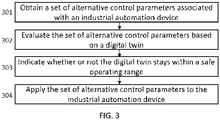
- FIG. 3 illustrates a flow chart according to an exemplary embodiment.
- the functions illustrated in FIG. 3 may be performed by an apparatus such as, or comprised in, a user device, a cloud server, or an industrial automation device.
- a set of alternative control parameters associated with the industrial automation device is obtained 301.
- the set of alternative control parameters may be received as input from a user, or the set of alternative control parameters may be received in a transmission from another device.
- the set of alternative control parameters is evaluated 302 by simulating a digital twin associated with the industrial automation device with multiple combinations of inputs, while the digital twin is configured to use the set of alternative control parameters.
- the digital twin may be a pre-defined digital twin that is obtained from an internal or external database.
- the simulation may be run locally in the apparatus, or remotely in another device such as a cloud server. It is then indicated 303 whether or not the digital twin stays within a safe operating range based on the simulating. For example, if the digital twin stays within the safe operating range, then the indication 303 may be displayed to a user together with a prompt for requesting the user to approve the set of alternative control parameters to be applied to the industrial automation device. Alternatively, if the digital twin does not stay within the safe operating range, then the indication 303 may be displayed to a user together with a request for adjusting the set of alternative control parameters. The indication 303 may also be transmitted to another device instead of directly displaying it to a user.
- the set of alternative control parameters is applied 304 to the industrial automation device, if the digital twin stays within the safe operating range based on the simulating and/or if the user approves the set of alternative control parameters.
- the set of alternative control parameters may be applied by transmitting the set of alternative control parameters to the industrial automation device along with an indication or command for applying the set of alternative control parameters at the industrial automation device.
- a user device receives a notification message from an industrial automation device indicating that there is an issue with the industrial automation device that needs to be resolved.
- the user of the user device then sends a service request message from the user device to a remote support device via a cloud server to request assistance from a remote support technician.
- the remote support technician then checks the historical data of the industrial automation device. After studying the situation and the historical data, the remote support technician identifies that there is an issue with the field bus module setting.
- the remote support technician determines a first set of adjusted control parameters for the industrial automation device in order to fix the issue. However, the remote support technician knows that the changes might potentially create a safety hazard.
- the remote support technician sends the first set of adjusted control parameters to the cloud server for validating the changes with a digital twin associated with the industrial automation device.
- the cloud server then sends an indication to the remote support device to indicate that the first set of adjusted control parameters is unsafe to be applied.
- the remote support technician then realizes that he had made a mistake with the first set of adjusted control parameters due to a hidden reference chain setting.
- the remote support technician determines a second set of adjusted parameters to correct the mistake, and sends it to the cloud server to be validated in the digital twin. This time, the cloud server sends an indication to the remote support device that the second set of adjusted control parameters is safe to be applied.
- the remote support technician then sends the second set of adjusted parameters to the user device via the cloud server, and suggests the user of the user device to apply the second set of adjusted parameters to the industrial automation device.
- the user of the user device approves the second set of adjusted parameters, and applies them to the industrial automation device.
- a technical advantage provided by some exemplary embodiments is that they enable validating the alternative control parameter settings of an industrial automation device based on a digital twin before usage in the real world, and thus the control parameter settings can be updated in a more safe manner by only using parameters that have been validated successfully.
- Some exemplary embodiments may be used to detect and prevent human errors associated with parameter changes to industrial automation devices, and thus improve safety. For example, some exemplary embodiments may prevent an accidental start of a motor caused by incorrect parameters entered by a user. Furthermore, some exemplary embodiments may optimize the operation of the industrial automation device, and thus reduce power consumption and/or prevent mechanical wear of the industrial automation device.
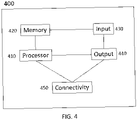
- FIG. 4 illustrates an apparatus 400, which may be an apparatus such as, or comprised in, a user device or a cloud server or an on-premise server or an industrial automation device, according to an exemplary embodiment.
- the user device may also be referred to as a terminal device or UE or user equipment.
- the apparatus 400 comprises a processor 410.
- the processor 410 interprets computer program instructions and processes data.
- the processor 410 may comprise one or more programmable processors.
- the processor 410 may comprise programmable hardware with embedded firmware and may, alternatively or additionally, comprise one or more application-specific integrated circuits (ASICs).
- ASICs application-specific integrated circuits
- the processor 410 is coupled to a memory 420.
- the processor is configured to read and write data to and from the memory 420.
- the memory 420 may comprise one or more memory units.
- the memory units may be volatile or non-volatile. It is to be noted that in some exemplary embodiments there may be one or more units of non-volatile memory and one or more units of volatile memory or, alternatively, one or more units of non-volatile memory, or, alternatively, one or more units of volatile memory.
- Volatile memory may be for example random-access memory (RAM), dynamic random-access memory (DRAM) or synchronous dynamic random-access memory (SDRAM).
- Non-volatile memory may be for example read-only memory (ROM), programmable read-only memory (PROM), electronically erasable programmable read-only memory (EEPROM), flash memory, optical storage or magnetic storage.
- ROM read-only memory
- PROM programmable read-only memory
- EEPROM electronically erasable programmable read-only memory
- flash memory optical storage or magnetic storage.
- memories may be referred to as non-transitory computer readable media.
- the memory 420 stores computer readable instructions that are executed by the processor 410.
- non-volatile memory stores the computer readable instructions and the processor 410 executes the instructions using volatile memory for temporary storage of data and/or instructions.
- the computer readable instructions may have been pre-stored to the memory 420 or, alternatively or additionally, they may be received, by the apparatus, via an electromagnetic carrier signal and/or may be copied from a physical entity such as a computer program product. Execution of the computer readable instructions causes the apparatus 400 to perform one or more of the functionalities described above.
- a "memory” or “computer-readable media” or “computer-readable medium” may be any non-transitory media or medium or means that can contain, store, communicate, propagate or transport the instructions for use by or in connection with an instruction execution system, apparatus, or device, such as a computer.
- the apparatus 400 may further comprise, or be connected to, an input unit 430.
- the input unit 430 may comprise one or more interfaces for receiving input.
- the one or more interfaces may comprise for example one or more temperature, motion and/or orientation sensors, one or more cameras, one or more accelerometers, one or more microphones, one or more buttons and/or one or more touch detection units.
- the input unit 430 may comprise an interface to which external devices may connect to.
- the apparatus 400 may also comprise an output unit 440.
- the output unit may comprise or be connected to one or more displays capable of rendering visual content, such as a light emitting diode (LED) display, a liquid crystal display (LCD) and/or a liquid crystal on silicon (LCoS) display.
- the output unit 440 may further comprise one or more audio outputs.
- the one or more audio outputs may be for example loudspeakers.
- the apparatus 400 further comprises a connectivity unit 450.
- the connectivity unit 450 enables wired and/or wireless connectivity to one or more external devices.
- the connectivity unit 450 may comprise at least one transmitter and at least one receiver that may be integrated to the apparatus 400 or that the apparatus 400 may be connected to.
- the at least one transmitter comprises at least one transmission antenna, and the at least one receiver comprises at least one receiving antenna.
- the connectivity unit 450 may comprise an integrated circuit or a set of integrated circuits that provide the communication capability for the apparatus 400.
- the connectivity may be a hardwired application-specific integrated circuit (ASIC).
- ASIC application-specific integrated circuit
- the connectivity unit 450 may comprise one or more components such as a power amplifier, digital front end (DFE), analog-to-digital converter (ADC), digital-to-analog converter (DAC), frequency converter, (de)modulator, and/or encoder/decoder circuitries, controlled by the corresponding controlling units.
- DFE digital front end
- ADC analog-to-digital converter
- DAC digital-to-analog converter
- frequency converter frequency converter
- demodulator demodulator
- encoder/decoder circuitries controlled by the corresponding controlling units.
- the apparatus 400 may further comprise various components not illustrated in FIG. 4 .
- the various components may be hardware components and/or software components.
- circuitry may refer to one or more or all of the following: a) hardware-only circuit implementations (such as implementations in only analog and/or digital circuitry); and b) combinations of hardware circuits and software, such as (as applicable): i) a combination of analog and/or digital hardware circuit(s) with software/firmware and ii) any portions of hardware processor(s) with software (including digital signal processor(s)), software, and memory(ies) that work together to cause an apparatus, such as a mobile phone, to perform various functions); and c) hardware circuit(s) and/or processor(s), such as a microprocessor(s) or a portion of a microprocessor(s), that requires software (for example firmware) for operation, but the software may not be present when it is not needed for operation.
- circuitry also covers an implementation of merely a hardware circuit or processor (or multiple processors) or portion of a hardware circuit or processor and its (or their) accompanying software and/or firmware.
- circuitry also covers, for example and if applicable to the particular claim element, a baseband integrated circuit or processor integrated circuit for a mobile device or a similar integrated circuit in server, a cellular network device, or other computing or network device.
- the techniques and methods described herein may be implemented by various means. For example, these techniques may be implemented in hardware (one or more devices), firmware (one or more devices), software (one or more modules), or combinations thereof.
- the apparatus(es) of exemplary embodiments may be implemented within one or more application-specific integrated circuits (ASICs), digital signal processors (DSPs), digital signal processing devices (DSPDs), programmable logic devices (PLDs), field programmable gate arrays (FPGAs), graphics processing units (GPUs), processors, controllers, micro-controllers, microprocessors, other electronic units designed to perform the functions described herein, or a combination thereof.
- ASICs application-specific integrated circuits
- DSPs digital signal processors
- DSPDs digital signal processing devices
- PLDs programmable logic devices
- FPGAs field programmable gate arrays
- GPUs graphics processing units
- processors controllers, micro-controllers, microprocessors, other electronic units designed to perform the functions described herein, or a
- the implementation can be carried out through modules of at least one chipset (for example procedures, functions, and so on) that perform the functions described herein.
- the software codes may be stored in a memory unit and executed by processors.
- the memory unit may be implemented within the processor or externally to the processor. In the latter case, it can be communicatively coupled to the processor via various means, as is known in the art.
- the components of the systems described herein may be rearranged and/or complemented by additional components in order to facilitate the achievements of the various aspects, etc., described with regard thereto, and they are not limited to the precise configurations set forth in the given figures, as will be appreciated by one skilled in the art.
Landscapes
- Physics & Mathematics (AREA)
- General Physics & Mathematics (AREA)
- Engineering & Computer Science (AREA)
- Automation & Control Theory (AREA)
- Testing And Monitoring For Control Systems (AREA)
Priority Applications (1)
| Application Number | Priority Date | Filing Date | Title |
|---|---|---|---|
| EP21175517.8A EP4095627B1 (fr) | 2021-05-24 | 2021-05-24 | Évaluation des paramètres de contrôle alternatifs basée sur un double numérique |
Applications Claiming Priority (1)
| Application Number | Priority Date | Filing Date | Title |
|---|---|---|---|
| EP21175517.8A EP4095627B1 (fr) | 2021-05-24 | 2021-05-24 | Évaluation des paramètres de contrôle alternatifs basée sur un double numérique |
Publications (3)
| Publication Number | Publication Date |
|---|---|
| EP4095627A1 true EP4095627A1 (fr) | 2022-11-30 |
| EP4095627B1 EP4095627B1 (fr) | 2024-12-18 |
| EP4095627C0 EP4095627C0 (fr) | 2024-12-18 |
Family
ID=76098794
Family Applications (1)
| Application Number | Title | Priority Date | Filing Date |
|---|---|---|---|
| EP21175517.8A Active EP4095627B1 (fr) | 2021-05-24 | 2021-05-24 | Évaluation des paramètres de contrôle alternatifs basée sur un double numérique |
Country Status (1)
| Country | Link |
|---|---|
| EP (1) | EP4095627B1 (fr) |
Cited By (8)
| Publication number | Priority date | Publication date | Assignee | Title |
|---|---|---|---|---|
| CN115933575A (zh) * | 2023-01-09 | 2023-04-07 | 北京北测数字技术有限公司 | 一种基于虚拟现实的工业实时操作控制系统和方法 |
| CN116700049A (zh) * | 2023-07-12 | 2023-09-05 | 山东大学 | 基于数据驱动的多能源网络数字孪生实时仿真系统及方法 |
| CN116859873A (zh) * | 2023-08-22 | 2023-10-10 | 广东凡易紧固件有限公司 | 一种紧固件生产工艺参数控制方法及系统 |
| CN118519399A (zh) * | 2024-05-11 | 2024-08-20 | 中国标准化研究院 | 工厂产线生产虚拟调试方法、系统及存储介质 |
| DE102023112506A1 (de) | 2023-05-11 | 2024-11-14 | Homag Plattenaufteiltechnik Gmbh | Maschinensystem zum Bearbeiten und/oder Handhaben von plattenförmigen Werkstücken, sowie Verfahren zum Betreiben eines solchen Maschinensystems |
| DE102023112486A1 (de) * | 2023-05-11 | 2024-11-14 | Homag Plattenaufteiltechnik Gmbh | Verfahren zum Betreiben einer Werkzeugmaschine, Recheneinrichtung und Werkzeugmaschine |
| WO2025251170A1 (fr) * | 2024-06-03 | 2025-12-11 | Zte Corporation | Double connectivité sans fil |
| CN121162272A (zh) * | 2025-11-19 | 2025-12-19 | 北京大学 | 基于数字孪生的采矿设备控制方法及相关产品 |
Citations (4)
| Publication number | Priority date | Publication date | Assignee | Title |
|---|---|---|---|---|
| US20160333855A1 (en) * | 2015-05-15 | 2016-11-17 | General Electric Company | Digital wind farm system |
| US9881430B1 (en) * | 2017-02-22 | 2018-01-30 | General Electric Company | Digital twin system for a cooling system |
| EP3611578A1 (fr) * | 2018-08-14 | 2020-02-19 | OMRON Corporation | Dispositif de pc industriel et procédé de fonctionnement d'un dispositif de pc industriel |
| WO2020240065A1 (fr) * | 2019-05-28 | 2020-12-03 | Consejo Superior De Investigaciones Científicas | Procédé de paramétrisation automatique de contrôleur par jumeau numérique d'un système cyberphysique |
Family Cites Families (1)
| Publication number | Priority date | Publication date | Assignee | Title |
|---|---|---|---|---|
| US20070038425A1 (en) * | 2005-07-27 | 2007-02-15 | Chunsheng Fu | Hybrid simulation system and method of simulating systems |
-
2021
- 2021-05-24 EP EP21175517.8A patent/EP4095627B1/fr active Active
Patent Citations (4)
| Publication number | Priority date | Publication date | Assignee | Title |
|---|---|---|---|---|
| US20160333855A1 (en) * | 2015-05-15 | 2016-11-17 | General Electric Company | Digital wind farm system |
| US9881430B1 (en) * | 2017-02-22 | 2018-01-30 | General Electric Company | Digital twin system for a cooling system |
| EP3611578A1 (fr) * | 2018-08-14 | 2020-02-19 | OMRON Corporation | Dispositif de pc industriel et procédé de fonctionnement d'un dispositif de pc industriel |
| WO2020240065A1 (fr) * | 2019-05-28 | 2020-12-03 | Consejo Superior De Investigaciones Científicas | Procédé de paramétrisation automatique de contrôleur par jumeau numérique d'un système cyberphysique |
Cited By (11)
| Publication number | Priority date | Publication date | Assignee | Title |
|---|---|---|---|---|
| CN115933575A (zh) * | 2023-01-09 | 2023-04-07 | 北京北测数字技术有限公司 | 一种基于虚拟现实的工业实时操作控制系统和方法 |
| CN115933575B (zh) * | 2023-01-09 | 2023-05-19 | 北京北测数字技术有限公司 | 一种基于虚拟现实的工业实时操作控制系统和方法 |
| DE102023112506A1 (de) | 2023-05-11 | 2024-11-14 | Homag Plattenaufteiltechnik Gmbh | Maschinensystem zum Bearbeiten und/oder Handhaben von plattenförmigen Werkstücken, sowie Verfahren zum Betreiben eines solchen Maschinensystems |
| DE102023112486A1 (de) * | 2023-05-11 | 2024-11-14 | Homag Plattenaufteiltechnik Gmbh | Verfahren zum Betreiben einer Werkzeugmaschine, Recheneinrichtung und Werkzeugmaschine |
| CN116700049A (zh) * | 2023-07-12 | 2023-09-05 | 山东大学 | 基于数据驱动的多能源网络数字孪生实时仿真系统及方法 |
| CN116700049B (zh) * | 2023-07-12 | 2024-05-28 | 山东大学 | 基于数据驱动的多能源网络数字孪生实时仿真系统及方法 |
| CN116859873A (zh) * | 2023-08-22 | 2023-10-10 | 广东凡易紧固件有限公司 | 一种紧固件生产工艺参数控制方法及系统 |
| CN116859873B (zh) * | 2023-08-22 | 2024-01-12 | 广东凡易紧固件有限公司 | 一种紧固件生产工艺参数控制方法及系统 |
| CN118519399A (zh) * | 2024-05-11 | 2024-08-20 | 中国标准化研究院 | 工厂产线生产虚拟调试方法、系统及存储介质 |
| WO2025251170A1 (fr) * | 2024-06-03 | 2025-12-11 | Zte Corporation | Double connectivité sans fil |
| CN121162272A (zh) * | 2025-11-19 | 2025-12-19 | 北京大学 | 基于数字孪生的采矿设备控制方法及相关产品 |
Also Published As
| Publication number | Publication date |
|---|---|
| EP4095627B1 (fr) | 2024-12-18 |
| EP4095627C0 (fr) | 2024-12-18 |
Similar Documents
| Publication | Publication Date | Title |
|---|---|---|
| EP4095627B1 (fr) | Évaluation des paramètres de contrôle alternatifs basée sur un double numérique | |
| AU2021293027B2 (en) | Edge controller for a facility | |
| US9124999B2 (en) | Method and apparatus for wireless communications in a process control or monitoring environment | |
| CN110253571B (zh) | 一种基于5g的机器人控制方法 | |
| EP3101777A1 (fr) | Communication de paramètres de convertisseur de fréquence | |
| US20170168473A1 (en) | Signalling of specification information on an industrial device | |
| CN113821017A (zh) | 作业机械控制方法、系统及作业机械 | |
| US12481278B2 (en) | Extrapolating motor energy consumption based on digital twin | |
| EP3855261B1 (fr) | Détermination des paramètres de commande pour un dispositif d'automatisation industrielle | |
| CN113765995B (zh) | 用于工业自动化的无线通信 | |
| CN110324398B (zh) | 用于远程支持电驱动器装置的方法 | |
| US12314027B2 (en) | Collecting data on an industrial automation device | |
| US10601924B2 (en) | Method for remote support of electric drive apparatus | |
| KR102685751B1 (ko) | 클라우드 컴퓨팅 기반의 스마트 팩토리 시스템 | |
| CN114095303A (zh) | 通信设备、数据传输方法及电子设备 | |
| US20210405618A1 (en) | Communication System And Method For Industrial Automation | |
| CN106054801A (zh) | 一种可通过蓝牙远程操控的控制盒及其运行方法 | |
| EP3514946B1 (fr) | Procédé de configuration d'appareil à commande électrique | |
| EP3951674A1 (fr) | Procédé et système de gestion de l'exécution d'une tâche industrielle dans un environnement de commande partagé | |
| CN109669422B (zh) | 一种实时数据采集的系统 | |
| CN109857082B (zh) | 自动变速器诊断方法及装置 | |
| KR20170086334A (ko) | 스마트 프레임워크용 iot 액츄에이터 단말기 | |
| EP3515042A1 (fr) | Procédé de contrôle d'accès d'un appareil à commande électrique | |
| KR102931244B1 (ko) | 자율제조를 위한 ai 기반 제조 공정 내 설비 제어 방법 | |
| CN110026992A (zh) | 联动方法、装置、系统及巡检机器人 |
Legal Events
| Date | Code | Title | Description |
|---|---|---|---|
| PUAI | Public reference made under article 153(3) epc to a published international application that has entered the european phase |
Free format text: ORIGINAL CODE: 0009012 |
|
| STAA | Information on the status of an ep patent application or granted ep patent |
Free format text: STATUS: THE APPLICATION HAS BEEN PUBLISHED |
|
| AK | Designated contracting states |
Kind code of ref document: A1 Designated state(s): AL AT BE BG CH CY CZ DE DK EE ES FI FR GB GR HR HU IE IS IT LI LT LU LV MC MK MT NL NO PL PT RO RS SE SI SK SM TR |
|
| STAA | Information on the status of an ep patent application or granted ep patent |
Free format text: STATUS: REQUEST FOR EXAMINATION WAS MADE |
|
| 17P | Request for examination filed |
Effective date: 20230524 |
|
| RBV | Designated contracting states (corrected) |
Designated state(s): AL AT BE BG CH CY CZ DE DK EE ES FI FR GB GR HR HU IE IS IT LI LT LU LV MC MK MT NL NO PL PT RO RS SE SI SK SM TR |
|
| STAA | Information on the status of an ep patent application or granted ep patent |
Free format text: STATUS: EXAMINATION IS IN PROGRESS |
|
| 17Q | First examination report despatched |
Effective date: 20230704 |
|
| GRAP | Despatch of communication of intention to grant a patent |
Free format text: ORIGINAL CODE: EPIDOSNIGR1 |
|
| STAA | Information on the status of an ep patent application or granted ep patent |
Free format text: STATUS: GRANT OF PATENT IS INTENDED |
|
| INTG | Intention to grant announced |
Effective date: 20240718 |
|
| GRAS | Grant fee paid |
Free format text: ORIGINAL CODE: EPIDOSNIGR3 |
|
| GRAA | (expected) grant |
Free format text: ORIGINAL CODE: 0009210 |
|
| STAA | Information on the status of an ep patent application or granted ep patent |
Free format text: STATUS: THE PATENT HAS BEEN GRANTED |
|
| AK | Designated contracting states |
Kind code of ref document: B1 Designated state(s): AL AT BE BG CH CY CZ DE DK EE ES FI FR GB GR HR HU IE IS IT LI LT LU LV MC MK MT NL NO PL PT RO RS SE SI SK SM TR |
|
| RIN1 | Information on inventor provided before grant (corrected) |
Inventor name: TAMMINIEMI, PETRI Inventor name: HU, ZHONGLIANG Inventor name: KOHVAKKA, MIKKO |
|
| REG | Reference to a national code |
Ref country code: CH Ref legal event code: EP |
|
| REG | Reference to a national code |
Ref country code: DE Ref legal event code: R096 Ref document number: 602021023442 Country of ref document: DE |
|
| REG | Reference to a national code |
Ref country code: IE Ref legal event code: FG4D |
|
| U01 | Request for unitary effect filed |
Effective date: 20250109 |
|
| U07 | Unitary effect registered |
Designated state(s): AT BE BG DE DK EE FI FR IT LT LU LV MT NL PT RO SE SI Effective date: 20250114 |
|
| PG25 | Lapsed in a contracting state [announced via postgrant information from national office to epo] |
Ref country code: HR Free format text: LAPSE BECAUSE OF FAILURE TO SUBMIT A TRANSLATION OF THE DESCRIPTION OR TO PAY THE FEE WITHIN THE PRESCRIBED TIME-LIMIT Effective date: 20241218 |
|
| PG25 | Lapsed in a contracting state [announced via postgrant information from national office to epo] |
Ref country code: NO Free format text: LAPSE BECAUSE OF FAILURE TO SUBMIT A TRANSLATION OF THE DESCRIPTION OR TO PAY THE FEE WITHIN THE PRESCRIBED TIME-LIMIT Effective date: 20250318 |
|
| PG25 | Lapsed in a contracting state [announced via postgrant information from national office to epo] |
Ref country code: GR Free format text: LAPSE BECAUSE OF FAILURE TO SUBMIT A TRANSLATION OF THE DESCRIPTION OR TO PAY THE FEE WITHIN THE PRESCRIBED TIME-LIMIT Effective date: 20250319 |
|
| PG25 | Lapsed in a contracting state [announced via postgrant information from national office to epo] |
Ref country code: RS Free format text: LAPSE BECAUSE OF FAILURE TO SUBMIT A TRANSLATION OF THE DESCRIPTION OR TO PAY THE FEE WITHIN THE PRESCRIBED TIME-LIMIT Effective date: 20250318 |
|
| U20 | Renewal fee for the european patent with unitary effect paid |
Year of fee payment: 5 Effective date: 20250528 |
|
| PG25 | Lapsed in a contracting state [announced via postgrant information from national office to epo] |
Ref country code: SM Free format text: LAPSE BECAUSE OF FAILURE TO SUBMIT A TRANSLATION OF THE DESCRIPTION OR TO PAY THE FEE WITHIN THE PRESCRIBED TIME-LIMIT Effective date: 20241218 |
|
| PG25 | Lapsed in a contracting state [announced via postgrant information from national office to epo] |
Ref country code: PL Free format text: LAPSE BECAUSE OF FAILURE TO SUBMIT A TRANSLATION OF THE DESCRIPTION OR TO PAY THE FEE WITHIN THE PRESCRIBED TIME-LIMIT Effective date: 20241218 |
|
| PG25 | Lapsed in a contracting state [announced via postgrant information from national office to epo] |
Ref country code: ES Free format text: LAPSE BECAUSE OF FAILURE TO SUBMIT A TRANSLATION OF THE DESCRIPTION OR TO PAY THE FEE WITHIN THE PRESCRIBED TIME-LIMIT Effective date: 20241218 |
|
| PG25 | Lapsed in a contracting state [announced via postgrant information from national office to epo] |
Ref country code: IS Free format text: LAPSE BECAUSE OF FAILURE TO SUBMIT A TRANSLATION OF THE DESCRIPTION OR TO PAY THE FEE WITHIN THE PRESCRIBED TIME-LIMIT Effective date: 20250418 |
|
| PG25 | Lapsed in a contracting state [announced via postgrant information from national office to epo] |
Ref country code: SK Free format text: LAPSE BECAUSE OF FAILURE TO SUBMIT A TRANSLATION OF THE DESCRIPTION OR TO PAY THE FEE WITHIN THE PRESCRIBED TIME-LIMIT Effective date: 20241218 |
|
| PG25 | Lapsed in a contracting state [announced via postgrant information from national office to epo] |
Ref country code: CZ Free format text: LAPSE BECAUSE OF FAILURE TO SUBMIT A TRANSLATION OF THE DESCRIPTION OR TO PAY THE FEE WITHIN THE PRESCRIBED TIME-LIMIT Effective date: 20241218 |
|
| PLBE | No opposition filed within time limit |
Free format text: ORIGINAL CODE: 0009261 |
|
| STAA | Information on the status of an ep patent application or granted ep patent |
Free format text: STATUS: NO OPPOSITION FILED WITHIN TIME LIMIT |
|
| REG | Reference to a national code |
Ref country code: CH Ref legal event code: L10 Free format text: ST27 STATUS EVENT CODE: U-0-0-L10-L00 (AS PROVIDED BY THE NATIONAL OFFICE) Effective date: 20251029 |
|
| 26N | No opposition filed |
Effective date: 20250919 |
|
| REG | Reference to a national code |
Ref country code: CH Ref legal event code: H13 Free format text: ST27 STATUS EVENT CODE: U-0-0-H10-H13 (AS PROVIDED BY THE NATIONAL OFFICE) Effective date: 20251223 |
|
| PG25 | Lapsed in a contracting state [announced via postgrant information from national office to epo] |
Ref country code: CH Free format text: LAPSE BECAUSE OF NON-PAYMENT OF DUE FEES Effective date: 20250531 |
|
| GBPC | Gb: european patent ceased through non-payment of renewal fee |
Effective date: 20250524 |
|
| PG25 | Lapsed in a contracting state [announced via postgrant information from national office to epo] |
Ref country code: MC Free format text: LAPSE BECAUSE OF FAILURE TO SUBMIT A TRANSLATION OF THE DESCRIPTION OR TO PAY THE FEE WITHIN THE PRESCRIBED TIME-LIMIT Effective date: 20241218 |
|
| PG25 | Lapsed in a contracting state [announced via postgrant information from national office to epo] |
Ref country code: GB Free format text: LAPSE BECAUSE OF NON-PAYMENT OF DUE FEES Effective date: 20250524 |
|
| PG25 | Lapsed in a contracting state [announced via postgrant information from national office to epo] |
Ref country code: IE Free format text: LAPSE BECAUSE OF NON-PAYMENT OF DUE FEES Effective date: 20250524 |