EP4095965B1 - Elektrodenanordnung, batteriezelle, batterie, vorrichtung - Google Patents
Elektrodenanordnung, batteriezelle, batterie, vorrichtung Download PDFInfo
- Publication number
- EP4095965B1 EP4095965B1 EP21916653.5A EP21916653A EP4095965B1 EP 4095965 B1 EP4095965 B1 EP 4095965B1 EP 21916653 A EP21916653 A EP 21916653A EP 4095965 B1 EP4095965 B1 EP 4095965B1
- Authority
- EP
- European Patent Office
- Prior art keywords
- electrode assembly
- tab
- accommodation cavity
- electrolytic solution
- guide path
- Prior art date
- Legal status (The legal status is an assumption and is not a legal conclusion. Google has not performed a legal analysis and makes no representation as to the accuracy of the status listed.)
- Active
Links
Images






Classifications
-
- H—ELECTRICITY
- H01—ELECTRIC ELEMENTS
- H01M—PROCESSES OR MEANS, e.g. BATTERIES, FOR THE DIRECT CONVERSION OF CHEMICAL ENERGY INTO ELECTRICAL ENERGY
- H01M10/00—Secondary cells; Manufacture thereof
- H01M10/04—Construction or manufacture in general
- H01M10/0431—Cells with wound or folded electrodes
-
- H—ELECTRICITY
- H01—ELECTRIC ELEMENTS
- H01M—PROCESSES OR MEANS, e.g. BATTERIES, FOR THE DIRECT CONVERSION OF CHEMICAL ENERGY INTO ELECTRICAL ENERGY
- H01M50/00—Constructional details or processes of manufacture of the non-active parts of electrochemical cells other than fuel cells, e.g. hybrid cells
- H01M50/70—Arrangements for stirring or circulating the electrolyte
-
- H—ELECTRICITY
- H01—ELECTRIC ELEMENTS
- H01M—PROCESSES OR MEANS, e.g. BATTERIES, FOR THE DIRECT CONVERSION OF CHEMICAL ENERGY INTO ELECTRICAL ENERGY
- H01M10/00—Secondary cells; Manufacture thereof
- H01M10/05—Accumulators with non-aqueous electrolyte
- H01M10/052—Li-accumulators
- H01M10/0525—Rocking-chair batteries, i.e. batteries with lithium insertion or intercalation in both electrodes; Lithium-ion batteries
-
- H—ELECTRICITY
- H01—ELECTRIC ELEMENTS
- H01M—PROCESSES OR MEANS, e.g. BATTERIES, FOR THE DIRECT CONVERSION OF CHEMICAL ENERGY INTO ELECTRICAL ENERGY
- H01M10/00—Secondary cells; Manufacture thereof
- H01M10/05—Accumulators with non-aqueous electrolyte
- H01M10/058—Construction or manufacture
- H01M10/0587—Construction or manufacture of accumulators having only wound construction elements, i.e. wound positive electrodes, wound negative electrodes and wound separators
-
- H—ELECTRICITY
- H01—ELECTRIC ELEMENTS
- H01M—PROCESSES OR MEANS, e.g. BATTERIES, FOR THE DIRECT CONVERSION OF CHEMICAL ENERGY INTO ELECTRICAL ENERGY
- H01M50/00—Constructional details or processes of manufacture of the non-active parts of electrochemical cells other than fuel cells, e.g. hybrid cells
- H01M50/10—Primary casings; Jackets or wrappings
- H01M50/102—Primary casings; Jackets or wrappings characterised by their shape or physical structure
- H01M50/107—Primary casings; Jackets or wrappings characterised by their shape or physical structure having curved cross-section, e.g. round or elliptic
-
- H—ELECTRICITY
- H01—ELECTRIC ELEMENTS
- H01M—PROCESSES OR MEANS, e.g. BATTERIES, FOR THE DIRECT CONVERSION OF CHEMICAL ENERGY INTO ELECTRICAL ENERGY
- H01M50/00—Constructional details or processes of manufacture of the non-active parts of electrochemical cells other than fuel cells, e.g. hybrid cells
- H01M50/10—Primary casings; Jackets or wrappings
- H01M50/147—Lids or covers
- H01M50/148—Lids or covers characterised by their shape
- H01M50/152—Lids or covers characterised by their shape for cells having curved cross-section, e.g. round or elliptic
-
- H—ELECTRICITY
- H01—ELECTRIC ELEMENTS
- H01M—PROCESSES OR MEANS, e.g. BATTERIES, FOR THE DIRECT CONVERSION OF CHEMICAL ENERGY INTO ELECTRICAL ENERGY
- H01M50/00—Constructional details or processes of manufacture of the non-active parts of electrochemical cells other than fuel cells, e.g. hybrid cells
- H01M50/50—Current conducting connections for cells or batteries
- H01M50/528—Fixed electrical connections, i.e. not intended for disconnection
-
- H—ELECTRICITY
- H01—ELECTRIC ELEMENTS
- H01M—PROCESSES OR MEANS, e.g. BATTERIES, FOR THE DIRECT CONVERSION OF CHEMICAL ENERGY INTO ELECTRICAL ENERGY
- H01M50/00—Constructional details or processes of manufacture of the non-active parts of electrochemical cells other than fuel cells, e.g. hybrid cells
- H01M50/60—Arrangements or processes for filling or topping-up with liquids; Arrangements or processes for draining liquids from casings
- H01M50/609—Arrangements or processes for filling with liquid, e.g. electrolytes
-
- H—ELECTRICITY
- H01—ELECTRIC ELEMENTS
- H01M—PROCESSES OR MEANS, e.g. BATTERIES, FOR THE DIRECT CONVERSION OF CHEMICAL ENERGY INTO ELECTRICAL ENERGY
- H01M50/00—Constructional details or processes of manufacture of the non-active parts of electrochemical cells other than fuel cells, e.g. hybrid cells
- H01M50/60—Arrangements or processes for filling or topping-up with liquids; Arrangements or processes for draining liquids from casings
- H01M50/609—Arrangements or processes for filling with liquid, e.g. electrolytes
- H01M50/627—Filling ports
-
- H—ELECTRICITY
- H01—ELECTRIC ELEMENTS
- H01M—PROCESSES OR MEANS, e.g. BATTERIES, FOR THE DIRECT CONVERSION OF CHEMICAL ENERGY INTO ELECTRICAL ENERGY
- H01M2220/00—Batteries for particular applications
- H01M2220/20—Batteries in motive systems, e.g. vehicle, ship, plane
-
- Y—GENERAL TAGGING OF NEW TECHNOLOGICAL DEVELOPMENTS; GENERAL TAGGING OF CROSS-SECTIONAL TECHNOLOGIES SPANNING OVER SEVERAL SECTIONS OF THE IPC; TECHNICAL SUBJECTS COVERED BY FORMER USPC CROSS-REFERENCE ART COLLECTIONS [XRACs] AND DIGESTS
- Y02—TECHNOLOGIES OR APPLICATIONS FOR MITIGATION OR ADAPTATION AGAINST CLIMATE CHANGE
- Y02E—REDUCTION OF GREENHOUSE GAS [GHG] EMISSIONS, RELATED TO ENERGY GENERATION, TRANSMISSION OR DISTRIBUTION
- Y02E60/00—Enabling technologies; Technologies with a potential or indirect contribution to GHG emissions mitigation
- Y02E60/10—Energy storage using batteries
-
- Y—GENERAL TAGGING OF NEW TECHNOLOGICAL DEVELOPMENTS; GENERAL TAGGING OF CROSS-SECTIONAL TECHNOLOGIES SPANNING OVER SEVERAL SECTIONS OF THE IPC; TECHNICAL SUBJECTS COVERED BY FORMER USPC CROSS-REFERENCE ART COLLECTIONS [XRACs] AND DIGESTS
- Y02—TECHNOLOGIES OR APPLICATIONS FOR MITIGATION OR ADAPTATION AGAINST CLIMATE CHANGE
- Y02P—CLIMATE CHANGE MITIGATION TECHNOLOGIES IN THE PRODUCTION OR PROCESSING OF GOODS
- Y02P70/00—Climate change mitigation technologies in the production process for final industrial or consumer products
- Y02P70/50—Manufacturing or production processes characterised by the final manufactured product
Definitions
- This application relates to the field of batteries, and in particular, to an electrode assembly, a battery cell, a battery, a device, a manufacturing method, and a manufacturing device.
- batteries such as a lithium-ion battery are widely used in electronic devices, electrical means of transport, electrical toys, and electrical devices.
- lithium-ion batteries are widely used in products such as a mobile phone, a notebook computer, an electric power cart, an electric vehicle, an electric airplane, an electric ship, an electric toy car, an electric toy ship, an electric toy airplane, and a power tool.
- An existing battery cell generally includes a housing and an electrode assembly accommodated in the housing, and the housing is filled with an electrolytic solution.
- the space available for storing the electrolytic solution inside the housing is relatively small, and a transmission rate of the electrolytic solution between electrode plates is relatively slow. Therefore, the electrode plates can hardly be infiltrated sufficiently in a short time, thereby affecting battery performance.
- JP2001093511A discloses a collector comprising a positive electrode plate and a negative electrode plate both having a plurality of holes, and a separator for separating both electrodes.
- the separator is made of a material to allow penetration of the electrolyte.
- the hollowed wound core is provided with a plurality of through holes, so that the electrolyte filled in the central part of the hollowed core can pass the through holes towards the collector, distributed through the small holes of the positive and negative electrodes, thus expediting the penetration of the electrolyte.
- US2013216879A1 discloses a battery including a wound plate pack formed with a positive electrode comprising a positive electrode coated part having a positive foil and a positive electrode uncoated part, and a negative electrode comprising a negative electrode coated part having a negative foil and a negative electrode uncoated part; a battery container into which electrolyte is injected; a positive terminal and a negative terminal provided on the battery container; a positive current collector connecting the positive electrode uncoated part and the positive terminal; and a negative current collector connecting the negative electrode uncoated part and the negative terminal, having multiple through holes between a joining part with the positive current collector in the positive electrode uncoated part and the positive electrode coated part; and multiple through holes between a joining part with the negative current collector in the negative electrode uncoated part and the negative electrode coated part.
- US2010227209A1 discloses an electrochemical cell including: an electrode including a first current collector, and first positive and negative active material layers disposed at both sides of the first current collector and spaced apart from each other with a current collector extension part being located therebetween, wherein a polarity of the electrode is used as an opposite polarity in a neighboring cell; a hollow core; an electrolyte isolation barrier wall disposed at the current collector extension part of the electrode; a case accommodating an electrode assembly formed by winding at least one electrode including the electrode around the core; and an electrolyte injection port disposed in a side surface of the case and connected to an inside area of the core, wherein a plurality of first electrolyte injection holes are formed in the current collector extension part of the electrode at predetermined intervals, and one or more second electrolyte injection holes corresponding to the first electrolyte injection holes are formed in a sidewall of the core.
- US2016351966A1 discloses an electrochemical storage cell comprising first and second electrode sheets wound around a cylindrical core forming a jellyroll structure, the first and second electrode sheets each comprising uncoated conductive edges parallel to end faces of the jellyroll structure, and coated opposing surfaces between the uncoated conductive edges, first and second separator sheets mechanically and electrically separating the coated opposing surfaces of the first and second electrode sheets and mechanically and electrically separating the cylindrical core and the coated opposing surfaces of the first electrode sheet, and slotted cutouts from the uncoated conductive edges, the slotted cutouts angularly co-located relative to the cylindrical core upon forming the jellyroll structure.
- an embodiment of this application discloses an electrode assembly, a battery cell, a battery and a device to improve the infiltration effect of an electrolytic solution in the electrode assembly.
- the present invention is defined by the electrode assembly of independent claim 1, the battery cell of independent claim 8, the battery of independent claim 9 and the electrical device of independent claim 10.
- an electrode assembly including: at least two electrode plates, including a first electrode plate and a second electrode plate that are of opposite polarities.
- the first electrode plate and the second electrode plate are wound around a winding axis to form a multilayer structure.
- the multilayer structure includes an accommodation cavity extending along a direction of the winding axis.
- the accommodation cavity is configured to accommodate an electrolytic solution.
- the electrode assembly further includes at least one guide path extending along a first direction.
- the first direction is a direction perpendicular to the winding axis.
- the guide path is configured to guide the electrolytic solution out of the accommodation cavity.
- the electrolytic solution in the accommodation cavity can not only be expelled outward through a gap between the first electrode plate and the second electrode plate, but also be expelled outward through the guide path, thereby increasing transmission paths of the electrolytic solution inside the electrode assembly, and improving the infiltration effect of the electrolytic solution in the electrode assembly.
- an active material region of the first electrode plate and an active material region of the second electrode plate are wound to form a body region.
- the body region includes a plurality of stacked active material portions.
- a non-active material region of the first electrode plate or a non-active material region of the second electrode plate is wound to form a tab region.
- the tab region includes a plurality of stacked tab portions.
- the accommodation cavity runs through the body region and the tab region along the direction of the winding axis.
- the electrolytic solution in the accommodation cavity can flow into the interior of the body region through an end of the tab region.
- the electrode assembly is a cylindrical structure, and the first direction is a radial direction of the cylindrical structure.
- the guide path extends along the radial direction of the cylindrical structure to guide the electrolytic solution in the accommodation cavity so that the electrolytic solution is transmitted outward along the radial direction. In this way, a relatively fast path is provided for transmitting the electrolytic solution, and the infiltration efficiency of the electrolytic solution in the electrode assembly is improved.
- the plurality of tab portions include a plurality of consecutively arranged first tab portions.
- Each first tab portion is provided with at least one first hole that runs through along a thickness direction of the first tab portion.
- the first holes of all the first tab portions are configured to be arranged opposite to each other along the first direction to form the guide path.
- the first holes are made on all the consecutively arranged first tab portions, and the first holes are arranged opposite to each other along the first direction to form the guide path.
- the guide path formed in this way is a continuous through path, and can shorten the transmission path of the electrolytic solution. In this way, the electrolytic solution can flow into a space between two adjacent first tab portions quickly through the guide path, and the electrolytic solution can flow into the interior of the body region.
- an outermost tab portion in the tab region is the first tab portion.
- An outer end of the guide path is in direct communication with an external space of the electrode assembly.
- a guide path with the outer end in direct communication with the external space of the electrode assembly is formed by making the first hole on the first tab portion that is outermost.
- an innermost tab portion in the tab region is the first tab portion.
- An inner end of the guide path is in direct communication with the accommodation cavity.
- a guide path with the inner end in direct communication with the accommodation cavity is formed by making the first hole on the first tab portion that is innermost. In this way, the electrolytic solution in the accommodation cavity can flow into the guide path directly, the electrolytic solution can flow into a space between the two adjacent first tab portions quickly through the guide path, and the electrolytic solution can flow into the interior of the body region.
- the plurality of tab portions further include a plurality of consecutively arranged second tab portions.
- the second tab portions are not provided with the first hole. All the plurality of second tab portions are located between the guide path and the accommodation cavity. An inner end of the guide path communicates to the accommodation cavity through a gap between two adjacent second tab portions.
- the inner end of the guide path communicates to the accommodation cavity through a gap between two adjacent second tab portions.
- the electrolytic solution in the accommodation cavity can flow into the guide path along the gap between two adjacent second tab portions.
- the second tab portion is located between the guide path and the accommodation cavity, which is equivalent to that the second tab portion is located at an inner side of the electrode assembly. Therefore, the area of each coil of second tab portion is relatively small. If the first hole is made on the second tab portion, the strength of the second tab portion will be affected. Relatively high strength of the second tab portion is ensured by omitting the first hole on the second tab portion.
- apertures of the plurality of first holes decrease progressively or are identical.
- each coil of active material portion located at the outer side of the electrode assembly is larger than the area of each coil of active material portion located at the inner side of the electrode assembly. Therefore, the former requires a larger amount of electrolytic solution.
- the apertures of the plurality of first holes are set to decrease progressively. In this way, the guide path located at the outer side of the electrode assembly is relatively large, and therefore, can meet the relatively great demand for the electrolytic solution for the active material portion located at the outer side of the electrode assembly.
- the apertures of the plurality of first holes are set to be identical. Therefore, the first holes of just one size need to be designed and processed, and the difficulty and cost of production are reduced.
- the accommodation cavity includes a first accommodation cavity located in the body region and a second accommodation cavity located in the tab region. Along a direction perpendicular to the winding axis, a size of the second accommodation cavity is larger than a size of the first accommodation cavity.
- the second accommodation cavity of a relatively large size is provided in the tab region that includes the guide path.
- the second accommodation cavity can store a relatively large amount of electrolytic solution.
- the electrolytic solution can flow into the guide path from the second accommodation cavity, thereby not only shortening the transmission path of the electrolytic solution, but also making a relatively large amount of electrolytic solution flow into the guide path, and further increasing the infiltration speed of the electrolytic solution.
- a central axis of the accommodation cavity coincides with the winding axis.
- the accommodation cavity is also located at the center of the electrode assembly, thereby equalizing the infiltration effect of the electrolytic solution from the center of the electrode assembly to the outer side.
- a battery cell including: a housing, an end cap, and the electrode assembly described in the first aspect above.
- An opening is made at an end of the housing along the direction of the winding axis.
- the end cap is configured to close the opening.
- the electrode assembly is disposed in the housing.
- an injection hole is made on the end cap.
- the injection hole is disposed opposite to the accommodation cavity along the direction of the winding axis, so that the electrolytic solution is able to enter the accommodation cavity through the injection hole.
- the electrolytic solution can directly flow into the accommodation cavity after being injected from the injection hole, thereby increasing the transmission speed of the electrolytic solution.
- a battery including the battery cell described in the second aspect above.
- an electrical device including the battery described in the third aspect above.
- the battery is configured to provide electrical energy.
- a method for manufacturing an electrode assembly including:
- a device for manufacturing an electrode assembly including:
- a plurality of referred to in this application means two or more (including two).
- a plurality of groups means two or more groups (including two groups)
- a plurality of pieces means two or more pieces (including two pieces).
- the primary battery (primary battery) is informally known as a "disposable" battery or a galvanic battery because the battery is not rechargeable and has to be discarded after consumption of electrical power.
- a rechargeable battery is also called a secondary battery (secondary battery), secondary cell, or storage battery.
- a material for and a process of manufacturing a rechargeable battery are different from those of a primary battery.
- An advantage of the rechargeable battery is that the battery can be used for a plurality of cycles after being charged. An output current load capacity of the rechargeable battery is higher than that of most primary batteries.
- lithium-ion battery exhibits advantages such as a light weight, a high capacity (the capacity is 1.5 to 2 times that of a nickel-metal hydride battery of the same weight), and no memory effect, and exhibits a very low self-discharge rate. Therefore, despite relative expensiveness, the lithium-ion battery is widely applied.
- the lithium-ion battery is also applied to pure electric vehicles and hybrid vehicles.
- the lithium-ion battery for use in such vehicles exhibits a relatively low capacity, but a relatively high output current and charge current and a relatively long life, but involves a relatively high cost.
- the battery described in the embodiments of this application means a rechargeable battery.
- the following describes the conception of this application using a lithium-ion battery as an example. Understandably, this application is applicable to any other suitable types of rechargeable batteries.
- the battery mentioned in the embodiments of this application means a stand-alone physical module that includes one or more battery cells to provide a higher voltage and a higher capacity.
- the battery mentioned in this application may include a battery module, a battery pack, or the like.
- a plurality of battery cells may be connected together in series and/or parallel through electrode terminals, so as to be applied in various scenarios.
- the use of a battery covers three levels: a battery cell, a battery module, and a battery pack.
- the battery module is formed by electrically connecting a specific quantity of battery cells together and putting the battery cells into a frame, so as to protect the battery cells from external impact, heat, vibration, and the like.
- the battery pack is a final state of a battery system mounted in an electric vehicle.
- BMS battery management system
- thermal management part on one or more battery modules.
- the battery module is omissible. That is, a battery pack is directly formed from battery cells. This improvement decreases the quantity of parts significantly while enhancing a gravimetric energy density and a volumetric energy density of the battery system.
- a battery referred to in this application includes a battery module or a battery pack.
- a battery cell is a basic structural unit of a battery module and a battery pack, and includes a housing and an electrode assembly accommodated in the housing.
- the housing is filled with an electrolytic solution.
- the electrode assembly mainly includes a positive electrode plate and a negative electrode plate that are stacked together. Generally, a separator is disposed between the positive electrode plate and the negative electrode plate.
- the parts, coated with an active material, of the positive electrode plate and the negative electrode plate, constitute a body region of the electrode assembly.
- the part, coated with no active material, of the positive electrode plate constitutes a positive tab region; and the part, coated with no active material, of the negative electrode plate, constitutes a negative tab region.
- the positive electrode plate may be made of aluminum.
- a positive active material may be lithium cobalt oxide (LiCoO 2 ), lithium manganese oxide (LiMn 2 O 4 ), lithium nickel oxide (LiNiO 2 ), lithium iron phosphate (LiFePO 4 ), or a ternary material such as lithium nickel cobalt manganese oxide (LiNiMnCoO 2 , or NMC), or the like.
- the negative electrode plate may be made of copper.
- a negative active material may be carbon, silicon, or the like.
- the separator is typically made of a polyolefin material exemplified by polyethylene (PE) and polypropylene (PP). The positive tab region and the negative tab region may be located at one end of the body region together or at two ends of the body region separately.
- battery cells are generally classed into three types: cylindrical battery cell, prismatic battery cell, and pouch-type battery cell.
- the positive electrode plate, the separator, and the negative electrode plate are wound or stacked to form an electrode assembly of a desired shape.
- the positive electrode plate, the separator, and negative electrode plate that are stacked in a cylindrical battery cell are wound into a cylinder-shaped electrode assembly.
- the positive electrode plate, the separator, and the negative electrode plate that are stacked in a prismatic battery cell are wound or stacked to form an electrode assembly in the shape of approximately a cuboid.
- An electrolytic solution is a carrier of ion transport in a lithium-ion battery.
- lithium ions are transported between the positive electrode plate and the negative electrode plate through the electrolytic solution.
- the electrolytic solution needs to sufficiently infiltrate the positive active material and the negative active material in the electrode assembly of the lithium-ion battery when the electrolytic solution is initially injected and during subsequent cyclic charging and discharging processes. If the transmission rate of the electrolytic solution in the electrode assembly is slow or the electrolytic solution between the positive electrode plate and the negative electrode plate is insufficient, the amount of the active material participating in the charge and discharge reactions may decrease, thereby affecting battery performance.
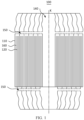
- the electrode assembly 100 includes at least two electrode plates, including a first electrode plate 110 and a second electrode plate 120 that are of opposite polarities.
- the first electrode plate 110 and the second electrode plate 120 are wound around a winding axis K to form a multilayer structure.
- the multilayer structure includes an accommodation cavity 140 extending along a direction of the winding axis K.
- the accommodation cavity 140 is configured to accommodate an electrolytic solution.
- the electrode assembly 100 further includes at least one guide path 150 extending along a first direction X.
- the first direction X is a direction perpendicular to the winding axis K.
- the guide path 150 is configured to guide the electrolytic solution out of the accommodation cavity 140.
- the first electrode plate 110 is a positive electrode plate
- the second electrode plate 120 is a negative electrode plate
- the first electrode plate 110 is a negative electrode plate
- the second electrode plate 120 is a positive electrode plate
- the direction of the winding axis K may be parallel to the horizontal plane or perpendicular to the horizontal plane, depending on the arrangement of the battery cells.
- FIG. 1 shows only a longitudinal section of the electrode assembly 100 sectioned along the winding axis K.
- a battery cell that includes the electrode assembly 100 can be placed in the battery vertically and horizontally. When the battery cell is placed vertically, the direction of the winding axis K is perpendicular to the horizontal plane. When the battery cell is placed horizontally, the direction of the winding axis K is parallel to the horizontal plane.
- the multilayer structure may be a flat multilayer structure or a cylindrical multilayer structure, including a plurality of layers of electrode plates.
- Each layer of electrode plate means a coil of electrode plate around the winding axis K. Two ends of each coil of electrode plate are not connected to each other, but are connected to two adjacent coils of electrode plates respectively.
- the number of the guide paths 150 may be one or more. A relatively large number of the guide paths 150 can increase transmission paths of the electrolytic solution inside the electrode assembly 100.
- the plurality of guide paths 150 may be symmetrically arranged in a plane that includes a line of direction perpendicular to the winding axis K, where the symmetrical arrangement is symmetry with respect to a center point of the accommodation cavity 140 in the plane, thereby equalizing the infiltration effect of the electrolytic solution from the center of the electrode assembly 100 to the outside.
- the guide path 150 can run through all electrode plates, for example, run through all electrode plates on one side of the winding axis K, or run through all electrode plates on both sides of the winding axis K, or run through just a part of the electrode plates.
- the guide path 150 may be arranged at one or more of an upper end, a middle part, or a lower end of the electrode assembly 100. That the first direction X is a direction perpendicular to the winding axis K falls in two circumstances.
- the first direction X is a direction perpendicular to the winding axis K and located in a plane that includes the winding axis K, where the central axis of the guide path 150 intersects the winding axis K.
- the first direction X is a direction perpendicular to the winding axis K and located in other planes such as a plane intersecting the winding axis K and a plane parallel to the winding axis K. where the central axis of the guide path 150 does not intersect the winding axis K.
- the expelling to the outside means that the electrolytic solution flows from the accommodation cavity 140 to the first electrode plate 110 and the second electrode plate 120, so as to infiltrate the electrode plates.
- the guide path 150 is disposed as a transmission path of the electrolytic solution.
- the electrolytic solution in the accommodation cavity 140 can not only be expelled outward through the gap between the first electrode plate 110 and the second electrode plate 120, but also be expelled outward through the guide path 150, thereby increasing transmission paths of the electrolytic solution inside the electrode assembly 100, and improving the infiltration effect of the electrolytic solution in the electrode assembly 100.
- the guide path 150 helps to expel the gas generated inside the electrode assembly 100.
- the central axis of the accommodation cavity 140 coincides with the winding axis K.
- the accommodation cavity 140 is also located at the center of the electrode assembly 100, thereby equalizing the infiltration effect of the electrolytic solution from the center of the electrode assembly 100 to the outer side.
- the central axis of the accommodation cavity 140 may coincide with the winding axis K not exactly, but by deviating to a slight degree. To the extent permitted by the processing errors, even if the central axis of the accommodation cavity 140 deviates slightly from the winding axis K, it is still considered that the central axis of the accommodation cavity 140 coincides with the winding axis K.
- the positive electrode plate is coated with a positive active material on a surface
- the negative electrode plate is coated with a negative active material on a surface.
- a region coated with an active material on the positive electrode plate is a positive active material region.
- a region coated with no active material on the positive electrode plate is a positive non-active material region.
- a region coated with an active material on the negative electrode plate is a negative active material region.
- a region coated with no active material on the negative electrode plate is a negative non-active material region.
- the active material region of the first electrode plate 110 and the active material region of the second electrode plate 120 are wound to form a body region A.
- the body region A includes a plurality of stacked active material portions 131.
- the non-active material region of the first electrode plate 110 or a non-active material region of the second electrode plate 120 is wound to form a tab region B.
- the tab region B includes a plurality of stacked tab portions 132.
- the accommodation cavity 140 runs through the body region A and the tab region B along the direction of the winding axis K.
- Each coil of the first electrode plate 110 around the winding axis K in the body region A or each coil of the second electrode plate 120 around the winding axis K in the body region A is an active material portion 131.
- Each coil of the first electrode plate 110 around the winding axis K in the tab region B or each coil of the second electrode plate 120 around the winding axis K in the tab region B is a tab portion 132.
- the positive tab region and the negative tab region may be both located at one end of the body region A, or at two ends of the body region A respectively.
- That the accommodation cavity 140 runs through the body region A and the tab region B along the direction of the winding axis K means: when the positive tab region and the negative tab region are both located at one end of the body region A, the accommodation cavity 140 runs through the tab region B and the body region A in sequence; when the positive tab region and the negative tab region are located at the two ends of the body region A respectively, the accommodation cavity 140 runs through the tab region B and the body region A of the positive electrode as well as the tab region B of the negative electrode in sequence, as shown in FIG. 1 .
- the electrolytic solution in the accommodation cavity 140 can flow into the interior of the body region A through an end of the tab region B.
- the electrode assembly 100 is a cylindrical structure, and the first direction X is a radial direction of the cylindrical structure.
- the radial direction of a cylindrical structure means a linear direction along a diameter or radius of a circle within a cross section of the cylindrical structure.
- the radial direction of the cylindrical structure means a direction from the outside of the electrode assembly 100 to the center of the accommodation cavity 140, or a direction from the center of the accommodation cavity 140 to the outside of the electrode assembly 100, within the cross section of the cylindrical structure.
- the guide path 150 extends along the radial direction of the cylindrical structure to guide the electrolytic solution in the accommodation cavity 140 so that the electrolytic solution is transmitted outward along the radial direction. In this way, a relatively fast path is provided for transmitting the electrolytic solution, and the infiltration efficiency of the electrolytic solution in the electrode assembly 100 is improved.
- a plurality of tab portions 132 include a plurality of consecutively arranged first tab portions 132a.
- Each first tab portion 132a is provided with at least one first hole 133 that runs through along a thickness direction of the first tab portion.
- the first holes 133 of all the first tab portions 132a are configured to be arranged opposite to each other along the first direction X to form the guide path 150.
- the plurality of consecutively arranged first tab portions 132a mean that all coils of first tab portions 132a are disposed adjacent to each other. For example, starting from the innermost side of the electrode assembly 100, all the n th to (n+i) th coils of tab portions are the first tab portions 132a.
- the number of first holes 133 may be one or more. That the first holes 133 of all the first tab portions 132a are disposed opposite to each other along the first direction X means that, in the first direction X, projections of any two first holes 133 overlap partly, so as to form the guide path 150 that runs through in the first direction X.
- centers of all the first holes 133 are exactly aligned, or the centers of some of the first holes 133 are staggered.
- positions of the first holes 133 in the electrode assembly 100 may be deviated from each other. The exact alignment is achieved as long as projections of any two first holes 133 in the first direction X overlap partly.
- the first holes 133 are made on all the consecutively arranged first tab portions 132a, and the first holes 133 are arranged opposite to each other along the first direction X to form the guide path 150.
- the guide path 150 formed in this way is a continuous through path, and can shorten the transmission path of the electrolytic solution. In this way, the electrolytic solution can flow into a space between two adjacent first tab portions 132a quickly through the guide path 150, and the electrolytic solution can flow into the interior of the body region A.
- the first tab portions 132a may be arranged in various ways. The following describes the arrangement of the first tab portions 132a.
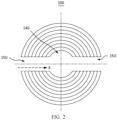
- FIG. 2 to FIG. 4 show a scenario in which all coils of tab portions 132 in the electrode assembly 100 are first tab portions 132a.
- An outer end of the guide path 150 is in direct communication with an external space of the electrode assembly 100, and an inner end of the guide path 150 is in direct communication with the accommodation cavity 140.
- the electrolytic solution in the accommodation cavity 140 and the electrolytic solution in the external space of the electrode assembly 100 can flow directly into a space between two adjacent first tab portions 132a through the guide path 150, so as to flow into the interior of the body region.
- an outermost tab portion in the tab region is the first tab portion 132a.
- An outer end of the guide path 150 is in direct communication with the external space of the electrode assembly 100.
- the outermost tab portion in the tab region means an outermost coil of tab portions.
- the outer end of the guide path 150 is an end that is of the guide path 150 and that is far away from the accommodation cavity 140 and close to the external space of the electrode assembly 100.
- a guide path 150 with the outer end in direct communication with the external space of the electrode assembly 100 is formed by making the first hole 133 on the first tab portion 132a that is outermost. In this way, the electrolytic solution in the external space of the electrode assembly 100 can flow into the guide path 150 directly, the electrolytic solution can flow into a space between the two adjacent first tab portions 132a quickly through the guide path 150, and the electrolytic solution can flow into the interior of the body region.
- first tab portions 132a are included. In addition to the outermost first tab portion 132a in the tab region, several tab portions adjacent to the outermost first tab portions 132a are also the first tab portions 132a. The first holes 133 are made on such first tab portions 132a.
- the plurality of tab portions further include a plurality of consecutively arranged second tab portions 132b.
- the second tab portions 132b are not provided with the first hole 133. All the plurality of second tab portions 132b are located between the guide path 150 and the accommodation cavity 140. An inner end of the guide path 150 communicates to the accommodation cavity 140 through a gap between two adjacent second tab portions 132b.
- the plurality of consecutively arranged second tab portions 132b mean that all coils of second tab portions 132b are disposed adjacent to each other. For example, starting from the innermost side of the electrode assembly 100, all the 1 st to m th coils of tab portions are the second tab portions 132b.
- the inner end of the guide path 150 is an end that is of the guide path 150 and that is close to the accommodation cavity 140 and away from the external space of the electrode assembly 100.
- the accommodation cavity 140 is formed by coiling the innermost second tab portion 132b, and is provided with an opening.
- the opening communicates to a first gap.
- the first gap is a gap between the innermost coil of second tab portion 132b and a second tab portion 132b adjacent to the innermost coil of second tab portion 132b. That the inner end of the guide path 150 communicates to the accommodation cavity 140 through a gap between two adjacent second tab portions 132b means that the inner end of the guide path 150 communicates to the accommodation cavity 140 through at least the first gap.
- the number of the second tab portions 132b is greater than two, the inner end of the guide path 150 communicates to the first gap through gaps between two adjacent second tab portions 132b in sequence, and finally communicates to the accommodation cavity 140.
- the inner end of the guide path 150 communicates to the accommodation cavity 140 through the gaps between the two adjacent second tab portions 132b.
- the electrolytic solution in the accommodation cavity 140 can flow into the guide path 150 along the gaps between the two adjacent second tab portions 132b.
- the second tab portion 132b is located between the guide path 150 and the accommodation cavity 140, which is equivalent to that the second tab portion 132b is located at an inner side of the electrode assembly 100. Therefore, the area of each coil of second tab portion 132b is relatively small. If the first hole 133 is made on the second tab portion 132b, the strength of the second tab portion 132b will be affected. Relatively high strength of the second tab portion 132b is ensured by omitting the first hole 133 on the second tab portion 132b.
- infiltration paths of the electrolytic solution include the following types of paths:
- an innermost tab portion in the tab region is the first tab portion 132a.
- An inner end of the guide path 150 is in direct communication with the accommodation cavity 140.
- the innermost tab portion in the tab region means an innermost coil of tab portions.
- a guide path 150 with the inner end in direct communication with the accommodation cavity 140 is formed by making the first hole 133 on the first tab portion 132a that is innermost. In this way, the electrolytic solution in the accommodation cavity 140 can flow into the guide path 150 directly, the electrolytic solution can flow into a space between the two adjacent first tab portions 132a quickly through the guide path 150, and the electrolytic solution can flow into the interior of the body region.
- the plurality of tab portions further include a plurality of consecutively arranged second tab portions 132b.
- the second tab portions 132b are not provided with the first hole 133. All the plurality of second tab portions 132b are located between the external space of the electrode assembly 100 and the guide path 150. An outer end of the guide path 150 communicates to the external space of the electrode assembly 100 through a gap between two adjacent second tab portions 132b.
- infiltration paths of the electrolytic solution include the following types of paths:
- the first tab portion 132a includes both the outermost tab portion and the innermost tab portion.
- the guide path includes a first guide path 151 and a second guide path 152.
- the outer end of the first guide path 151 is in direct communication with the external space of the electrode assembly 100.
- the inner end of the second guide path 152 is in direct communication with the accommodation cavity 140.
- the electrolytic solution in the external space of the electrode assembly 100 can flow into the interior of the body region through the first guide path 151 in direct communication with the external space of the electrode assembly.
- the electrolytic solution in the accommodation cavity 140 can flow into the interior of the body portion through the second guide path 152 in direct communication with the accommodation cavity.
- the first tab portion may be disposed on the tab portion at only one end of the electrode assembly 100, for example, on the tab portion of only the first electrode plate 110.
- the first hole 133 is made on the tab portion 132 of only the first electrode plate 110 to form the guide path.
- the first tab portion may be disposed on the tab portion of only the second electrode plate 120.
- the first hole 133 is made on the tab portion 132 of only the second electrode plate 120 to form the guide path.
- the first hole 133 may be made on the tab portions 132 at both ends of the electrode assembly 100. In this way, a guide path is formed at both ends of the electrode assembly 100, and more paths are available for transmitting the electrolytic solution inside the electrode assembly.
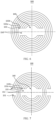
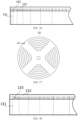
- apertures of the plurality of first holes 133 decrease progressively to form a guide path 150, of which a cross section perpendicular to the winding axis K is approximately sectoral, as shown in FIG. 11 .
- the shape of the first hole 133 may be a circle, an ellipse, a polygon (such as a square, a rectangle, or a trapezoid), or the like, as long as the shape can be processed conveniently in practical applications.
- the aperture of the first hole 133 means the length of the first hole 133 on a horizontal plane that includes a center point of the first hole 133 when the electrode assembly 100 is placed vertically.
- the aperture is equal to a diameter of the circle, a side length of the square, and the long side of the rectangle, or the like.
- the aperture of the first hole 133 on each coil of tab portion 132 is less than the aperture of the first hole 133 on a coil of tab portion 132 located outside said coil.
- a plurality of first holes 133 located on the same coil of tab portion 132 may have the same aperture or different apertures.
- the area of each coil of active material portion located at the outer side of the electrode assembly 100 is larger than the area of each coil of active material portion located at the inner side of the electrode assembly 100. Therefore, the former requires a larger amount of electrolytic solution.
- the apertures of the plurality of first holes 133 are set to decrease progressively. In this way, the guide path 150 located at the outer side of the electrode assembly 100 is relatively large, and therefore, can meet the relatively great demand for the electrolytic solution for the active material portion located at the outer side of the electrode assembly 100.
- the apertures of the plurality of first holes 133 are identical, so as to form a guide path 150, of which a cross section perpendicular to the winding axis K is approximately rectangular, as shown in FIG. 2 .
- the apertures of a plurality of first holes 133 are set to be identical.
- the first holes 133 of only one size need to be designed and processed, thereby reducing difficulty and cost of production.
- the accommodation cavity includes a first accommodation cavity 141 located in the body region A and a second accommodation cavity 142 located in the tab region B.
- a size of the second accommodation cavity 142 is larger than a size of the first accommodation cavity 141.
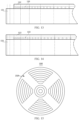
- the accommodation cavity may be formed by the following method: as shown in FIG. 13 , before the electrode plate is wound, a part of the tab is die-cut in advance.
- the die-cut part of the tab constitutes several coils of tab portions 132 located at the inner side of the electrode assembly 100 after winding.
- a first accommodation cavity 141 is formed around the winding axis K in the body region A
- a second accommodation cavity 142 is formed around the winding axis K in the tab region B.
- the second accommodation cavity 142 includes a first part and a second part.
- the first part corresponds to the position of the first accommodation cavity 141 in the direction of the winding axis K, and possesses the same aperture.
- the second part is formed by die-cutting the tab.
- the second accommodation cavity 142 of a relatively large size is provided in the tab region B that includes the guide path 150.
- the second accommodation cavity 142 can store a relatively large amount of electrolytic solution.
- the electrolytic solution can flow into the guide path 150 from the second accommodation cavity 142, thereby not only shortening the transmission path of the electrolytic solution, but also making a relatively large amount of electrolytic solution flow into the guide path 150, and further increasing the infiltration speed of the electrolytic solution.
- the lengths of several coils of tab portions 132 located at the inner side of the electrode assembly 100 are relatively small in a direction around the winding axis K, and it is difficult make holes in such tab portions. Therefore, in this embodiment, the tab is die-cut, without a need to make the first hole on the several coils of tab portions 132 located at the inner side, thereby reducing the difficulty and cost of production.
- the first hole 133 may be omitted on several tab portions 132 at the inner side of the electrode assembly 100, so as to form a guide path 150 shown in FIG. 15 .
- the difficulty and cost of production are reduced, and relatively high strength of the plurality of tab portions 132 at the inner side of the electrode assembly 100 is ensured.
- a first hole 133 with a relatively large aperture is made on a combination of several tab portions 132 at the inner side, so as to form a guide path 150 shown in FIG. 17 .
- the first hole is not made on a single tab portion 132 at the inner side, but a first hole 133 with a relatively large aperture is made on a combination of several tab portions 132 that are relatively short in the direction around the winding axis K, thereby ensuring good infiltration effects of the electrolytic solution and reducing the difficulty and cost of production.
- a first hole 133 with a relatively small aperture is made on several tab portions 132 at the inner side, and a first hole 133 with a relatively large aperture is made on the tab portion 132 at the outer side, so as to form a guide path 150 shown in FIG. 19 .
- the first hole 133 with a relatively small aperture is made on each tab portion 132 among several tab portions 132 at the inner side in the electrode assembly 100.
- the first holes with relatively small apertures not only ensure good infiltration effects of the electrolytic solution, but also reduce difficulty and cost of production, and ensure relatively high strength of the several tab portions 132 at the inner side of the electrode assembly 100.
- irregular first holes 133 may be made on the tab portions 132.
- the apertures of the first holes 133 and/or distances between adjacent holes are randomly arranged, so that the guide paths 150 take on irregular shapes similar to the shapes shown in FIG. 20 .
- the guide paths 150 communicate to each other tortuously. This method can reduce difficulty and cost of production.
- a second hole may be made in the body region additionally to form a second guide path that is similar to the guide path in the foregoing embodiment in terms of structure, location, and functions.
- the battery cell 200 includes: a housing 211, an end cap 212, and the electrode assembly 100 described in the foregoing embodiment.
- An opening 211a is made at an end of the housing 211 along the direction of the winding axis K.
- the end cap 212 is configured to close the opening 211a.
- the electrode assembly 100 is disposed in the housing 211.
- the guide path is disposed as a transmission path of the electrolytic solution.
- the electrolytic solution in the accommodation cavity 140 can not only be expelled outward through a gap between the first electrode plate and the second electrode plate, but also be expelled outward through the guide path, thereby increasing transmission paths of the electrolytic solution inside the electrode assembly 100, and improving the infiltration effect of the electrolytic solution in the electrode assembly 100.
- an injection hole 213 is made on the end cap 212.
- the injection hole 213 is disposed opposite to the accommodation cavity 140 along the direction of the winding axis, so that the electrolytic solution can enter the accommodation cavity 140 through the injection hole 213. That the injection hole 213 is disposed opposite to the accommodation cavity 140 along the direction of the winding axis means that, in the direction of the winding axis, the projection of the injection hole 213 partly overlaps the projection of the accommodation cavity 140, and at least a part of the injection hole 213 is in direct communication with the accommodation cavity 140 in the direction of the winding axis.
- the electrolytic solution can directly flow into the accommodation cavity 140 after being injected from the injection hole 213, thereby increasing the transmission speed of the electrolytic solution.
- the battery 300 includes the battery cell 200 described in the foregoing embodiment.
- the battery 300 generally further includes a box 301.
- the battery cell 200 is disposed in the box 301.
- the guide path is disposed in the electrode assembly as a transmission path of the electrolytic solution. Therefore, the electrolytic solution in the accommodation cavity can not only be expelled outward through a gap between the first electrode plate and the second electrode plate, but also be expelled outward through the guide path, thereby increasing transmission paths of the electrolytic solution inside the electrode assembly, and improving the infiltration effect of the electrolytic solution in the electrode assembly.
- An embodiment of this application further provides an electrical device, including the battery described in the foregoing embodiment.
- the battery is configured to provide electrical energy.
- the guide path is disposed in the electrode assembly as a transmission path of the electrolytic solution. Therefore, the electrolytic solution in the accommodation cavity can not only be expelled outward through a gap between the first electrode plate and the second electrode plate, but also be expelled outward through the guide path, thereby increasing transmission paths of the electrolytic solution inside the electrode assembly, and improving the infiltration effect of the electrolytic solution in the electrode assembly.
- the electrical device may be one of various electrical devices that use a battery, for example, a mobile phone, a portable device, a notebook computer, various vehicles (such as an electric power cart and an electric vehicle), a ship, a spacecraft, an electric toy, an electric tool.
- the spacecraft includes an airplane, a rocket, a space shuttle, a spaceship, and the like.
- the electric toy includes a fixed or mobile electric toy, such as a game console, an electric car toy, an electric ship toy, an electric airplane toy, and the like.
- the electric tool includes an electric tool for metal cutting, an electric grinding tool, an electric assembly tool, an electric tool for railways, such as an electric drill, an electric grinder, an electric wrench, an electric screwdriver, an electric hammer, an electric impact drill, a concrete vibrator, and an electric planer.
- the battery described in this embodiment of this application is not only applicable to the devices described above, but also applicable to all devices that use a battery. For brevity, the following embodiment is described by using a vehicle as an example.
- FIG. 23 is a brief schematic view of a vehicle 400 according to an embodiment of this application.
- the vehicle 400 may be an oil-fueled vehicle, a natural gas vehicle, or a new energy vehicle.
- the new energy vehicle may be a battery electric vehicle, a hybrid electric vehicle, a range-extended electric vehicle, or the like.
- the battery 300 may be disposed inside the vehicle 400.
- the battery 300 may be disposed at the bottom, front, or rear of the vehicle 400.
- the battery 300 may be configured to supply power to the vehicle 400.
- the battery 300 may serve as an operating power supply of the vehicle 400.
- the vehicle 400 may further include a controller 402 and a motor 401.
- the controller 402 is configured to control the battery 300 to supply power to the motor 401, for example, to start or navigate the vehicle 400, or meet the operating power requirements of the vehicle in operation.
- the battery 300 serves not only as an operating power supply of the vehicle 400, but may also serve as a drive power supply of the vehicle 400 to provide driving motive power for the vehicle 400 in place of or partially in place of oil or natural gas.
- the battery 300 referred to hereinafter may also be understood as a battery pack that includes a plurality of battery cells.
- the guide path is disposed in the electrode assembly as a transmission path of the electrolytic solution.
- the electrolytic solution in the accommodation cavity can not only be expelled outward through a gap between the first electrode plate and the second electrode plate, but also be expelled outward through the guide path, thereby increasing transmission paths of the electrolytic solution inside the electrode assembly, and improving the infiltration effect of the electrolytic solution in the electrode assembly.
- FIG. 24 is a schematic flowchart of a method 500 for manufacturing an electrode assembly according to an embodiment of this application.
- a method 500 for manufacturing an electrode assembly includes the following steps: 501: Provide at least two electrode plates, including a first electrode plate and a second electrode plate that are of opposite polarities; and 502: Wind the first electrode plate and the second electrode plate around a winding axis to form a multilayer structure, where the multilayer structure includes an accommodation cavity extending along a direction of the winding axis, the accommodation cavity is configured to accommodate an electrolytic solution, at least one guide path extending along a first direction is formed in the electrode assembly after the winding, the first direction is a direction perpendicular to the winding axis, and the guide path is configured to guide the electrolytic solution out of the accommodation cavity.
- FIG. 25 is a schematic block diagram of a device 600 for manufacturing an electrode assembly according to an embodiment of this application. As shown in FIG.
- the device 600 includes: an electrode plate placing module 601, configured to provide at least two electrode plates, including a first electrode plate and a second electrode plate that are of opposite polarities; and a winding module 602, configured to: wind the first electrode plate and the second electrode plate around a winding axis to form a multilayer structure.
- the multilayer structure includes an accommodation cavity extending along a direction of the winding axis.
- the accommodation cavity is configured to accommodate an electrolytic solution.
- At least one guide path extending along a first direction is formed in the electrode assembly after the winding.
- the first direction is a direction perpendicular to the winding axis.
- the guide path is configured to guide the electrolytic solution out of the accommodation cavity.
- the guide path is disposed as a transmission path of the electrolytic solution. Therefore, the electrolytic solution in the accommodation cavity can not only be expelled outward through a gap between the first electrode plate and the second electrode plate, but also be expelled outward through the guide path, thereby increasing transmission paths of the electrolytic solution inside the electrode assembly, and improving the infiltration effect of the electrolytic solution in the electrode assembly.
Landscapes
- Chemical & Material Sciences (AREA)
- Chemical Kinetics & Catalysis (AREA)
- Electrochemistry (AREA)
- General Chemical & Material Sciences (AREA)
- Engineering & Computer Science (AREA)
- Manufacturing & Machinery (AREA)
- Materials Engineering (AREA)
- Secondary Cells (AREA)
- Battery Electrode And Active Subsutance (AREA)
- Primary Cells (AREA)
Claims (10)
- Elektrodenanordnung (100), gekennzeichnet dadurch, dass die Elektrodenanordnung (100) aufweist:mindestens zwei Elektrodenplatten, die eine erste Elektrodenplatte und eine zweite Elektrodenplatte umfassen, die entgegengesetzte Polaritäten aufweisen, wobei die erste Elektrodenplatte und die zweite Elektrodenplatte um eine Wicklungsachse gewickelt sind, um eine mehrschichtige Struktur zu bilden, die mehrschichtige Struktur einen Aufnahmehohlraum (140) aufweist, der sich in einer Richtung der Wicklungsachse erstreckt, und der Aufnahmehohlraum (140) dazu eingerichtet ist, eine Elektrolytlösung aufzunehmen,wobei die Elektrodenanordnung (100) ferner mindestens einen Führungspfad (150) aufweist, der sich in einer ersten Richtung erstreckt, die erste Richtung eine Richtung senkrecht zu der Wicklungsachse ist und der Führungspfad (150) dazu eingerichtet ist, die Elektrolytlösung aus dem Aufnahmehohlraum (140) zu führen, undein Aktivmaterial-Bereich der ersten Elektrodenplatte und ein Aktivmaterial-Bereich der zweiten Elektrodenplatte gewickelt sind, sodass sie einen Körperbereich bilden, der Körperbereich mehrere gestapelte Aktivmaterialabschnitte (131) aufweist, ein Nichtaktivmaterial-Bereich der ersten Elektrodenplatte oder ein Nichtaktivmaterial-Bereich der zweiten Elektrodenplatte gewickelt ist, sodass er einen Anschlussfahnenabschnitt bildet, der Anschlussfahnenabschnitt mehrere gestapelte Anschlussfahnenabschnitte (132) aufweist und der Aufnahmehohlraum (140) in der Richtung der Wicklungsachse durch den Körperbereich und den Anschlussfahnenabschnitt läuft,wobei die mehreren Anschlussfahnenabschnitte (132) mehrere aufeinanderfolgend angeordnete erste Anschlussfahnenabschnitte (132a) umfassen, jeder erste Anschlussfahnenabschnitt (132a) mit mindestens einem ersten Loch (133) versehen ist, das in einer Dickenrichtung des ersten Anschlussfahnenabschnitts hindurch verläuft, und die ersten Löcher (133) aller ersten Anschlussfahnenabschnitte (132a) dazu eingerichtet sind, in der ersten Richtung einander gegenüberliegend angeordnet zu sein, um den Führungspfad (150) zu bilden,dadurch gekennzeichnet, dass die mehreren Anschlussfahnenabschnitte (132) ferner mehrere aufeinanderfolgend angeordnete zweite Anschlussfahnenabschnitte (132b) umfassen, die zweiten Anschlussfahnenabschnitte (132b) nicht mit dem ersten Loch (133) versehen sind, alle mehreren zweiten Anschlussfahnenabschnitte (132b) sich zwischen dem Führungspfad (150) und dem Aufnahmehohlraum (140) befinden und ein inneres Ende des Führungspfads (150) durch eine Lücke zwischen zwei benachbarten zweiten Anschlussfahnenabschnitten (132b) kommunizierend mit dem Aufnahmehohlraum (140) verbunden ist.
- Elektrodenanordnung nach Anspruch 1, dadurch gekennzeichnet, dass die Elektrodenanordnung (100) eine zylindrische Struktur ist und die erste Richtung eine Radialrichtung der zylindrischen Struktur ist.
- Elektrodenanordnung nach Anspruch 1, dadurch gekennzeichnet, dass ein äußerster Anschlussfahnenabschnitt (132) in dem Anschlussfahnenbereich der erste Anschlussfahnenabschnitt (132a) ist und ein äußeres Ende des Führungspfads (150) in direkter Kommunikationsverbindung mit einem Außenraum der Elektrodenanordnung (100) steht.
- Elektrodenanordnung nach Anspruch 1 oder 3, dadurch gekennzeichnet, dass ein innerster Anschlussfahrenabschnitt (132) in dem Anschlussfahnenbereich der erste Anschlussfahrenabschnitt (132a) ist und ein inneres Ende des Führungspfads (150) in direkter Kommunikationsverbindung mit dem Aufnahmehohlraum (140) steht.
- Elektrodenanordnung nach einem der Ansprüche 1 bis 4, dadurch gekennzeichnet, dass in einer Richtung von außerhalb nach innerhalb der Elektrodenanordnung (100) die Öffnungsgröße der mehreren ersten Löcher (133) progressiv abnimmt oder identisch ist.
- Elektrodenanordnung nach einem der Ansprüche 1 bis 5, dadurch gekennzeichnet, dass der Aufnahmehohlraum (140) einen ersten Aufnahmehohlraum (141), der sich in dem Körperbereich befindet, und einen zweiten Aufnahmehohlraum (142), der sich in dem Anschlussfahnenbereich befindet, umfasst und in einer Richtung senkrecht zu der Wicklungsachse eine Größe des zweiten Aufnahmehohlraums (142) größer ist als eine Größe des ersten Aufnahmehohlraums (141).
- Elektrodenanordnung nach einem der Ansprüche 1 bis 6, dadurch gekennzeichnet, dass eine Zentralachse des Aufnahmehohlraums (140) mit der Wicklungsachse übereinstimmt.
- Batteriezelle, dadurch gekennzeichnet, dass die Batteriezelle aufweist: ein Gehäuse (211), eine Endkappe (212) und die Elektrodenanordnung (100) nach einem der Ansprüche 1 bis 7, wobei eine Öffnung (211a) an einem Ende des Gehäuses (211) in der Richtung der Wicklungsachse ausgebildet ist, die Endkappe (212) dazu eingerichtet ist, die Öffnung (211a) zu verschließen, und die Elektrodenanordnung (100) in dem Gehäuse (211) angeordnet ist, insbesondere wobei ein Einspritzloch (213) auf der Endkappe (212) ausgebildet ist und das Einspritzloch (213) in der Richtung der Wicklungsachse gegenüber dem Aufnahmehohlraum (140) angeordnet ist, sodass die Elektrolytlösung in der Lage ist, durch das Einspritzloch (213) in den Aufnahmehohlraum (140) einzutreten.
- Batterie, dadurch gekennzeichnet, dass die Batterie die Batteriezelle (200) nach Anspruch 8 aufweist.
- Elektrische Einrichtung, dadurch gekennzeichnet, dass die elektrische Einrichtung die Batterie (300) nach Anspruch 9 aufweist und die Batterie (300) dazu eingerichtet ist, elektrische Energie bereitzustellen.
Priority Applications (1)
| Application Number | Priority Date | Filing Date | Title |
|---|---|---|---|
| HUE21916653A HUE072138T2 (hu) | 2021-02-09 | 2021-02-09 | Elektródszerelvény, akkumulátorcella, akkumulátor, elektromos berendezés |
Applications Claiming Priority (1)
| Application Number | Priority Date | Filing Date | Title |
|---|---|---|---|
| PCT/CN2021/076296 WO2022170496A1 (zh) | 2021-02-09 | 2021-02-09 | 电极组件及电池单体、电池、装置、制备方法和制备装置 |
Publications (4)
| Publication Number | Publication Date |
|---|---|
| EP4095965A1 EP4095965A1 (de) | 2022-11-30 |
| EP4095965A4 EP4095965A4 (de) | 2023-10-04 |
| EP4095965C0 EP4095965C0 (de) | 2025-05-14 |
| EP4095965B1 true EP4095965B1 (de) | 2025-05-14 |
Family
ID=82837384
Family Applications (1)
| Application Number | Title | Priority Date | Filing Date |
|---|---|---|---|
| EP21916653.5A Active EP4095965B1 (de) | 2021-02-09 | 2021-02-09 | Elektrodenanordnung, batteriezelle, batterie, vorrichtung |
Country Status (6)
| Country | Link |
|---|---|
| US (1) | US20220376371A1 (de) |
| EP (1) | EP4095965B1 (de) |
| CN (1) | CN116114117B (de) |
| ES (1) | ES3036985T3 (de) |
| PL (1) | PL4095965T3 (de) |
| WO (1) | WO2022170496A1 (de) |
Families Citing this family (2)
| Publication number | Priority date | Publication date | Assignee | Title |
|---|---|---|---|---|
| CA3237014A1 (en) * | 2021-11-09 | 2023-05-19 | Yun-Ju Lee | Jelly-roll with improved electrolyte impregnation property, and cylindrical battery cell, battery pack and vehicle including the same |
| CN115483488A (zh) * | 2022-10-13 | 2022-12-16 | 中创新航科技股份有限公司 | 圆柱电池 |
Family Cites Families (20)
| Publication number | Priority date | Publication date | Assignee | Title |
|---|---|---|---|---|
| JPH10162801A (ja) * | 1996-11-29 | 1998-06-19 | Nissan Motor Co Ltd | 二次電池 |
| US6387561B1 (en) * | 1998-10-13 | 2002-05-14 | Ngk Insulators, Ltd. | Electrolyte-solution filling method and battery structure of lithium secondary battery |
| JP2001093511A (ja) * | 1999-09-22 | 2001-04-06 | Honda Motor Co Ltd | 巻型円筒電池 |
| JP2002237292A (ja) * | 2001-02-09 | 2002-08-23 | Japan Storage Battery Co Ltd | 非水電解質二次電池 |
| JP4436587B2 (ja) * | 2002-01-31 | 2010-03-24 | パナソニック株式会社 | 電池及び組電池 |
| JP2004253284A (ja) * | 2003-02-20 | 2004-09-09 | Honda Motor Co Ltd | 蓄電素子の直列接続構造 |
| KR100964491B1 (ko) * | 2007-10-12 | 2010-06-21 | 킴스테크날리지 주식회사 | 전기화학셀 |
| KR100964490B1 (ko) * | 2007-10-12 | 2010-06-21 | 킴스테크날리지 주식회사 | 쿼지바이폴라 구조를 갖는 전기화학셀 |
| JP4814405B2 (ja) * | 2009-11-25 | 2011-11-16 | パナソニック株式会社 | 電池モジュール |
| JP5957239B2 (ja) * | 2012-02-21 | 2016-07-27 | 日立オートモティブシステムズ株式会社 | 二次電池 |
| JP6094810B2 (ja) * | 2013-07-17 | 2017-03-15 | トヨタ自動車株式会社 | 非水電解質二次電池 |
| JP6568532B2 (ja) * | 2014-01-28 | 2019-08-28 | リチウム ワークス テクノロジー ビーヴィー | 円筒状電気化学的電池及び円筒状電気化学的電池の製造方法 |
| JP2016207516A (ja) * | 2015-04-24 | 2016-12-08 | トヨタ自動車株式会社 | 電池 |
| DE102018207328A1 (de) * | 2018-05-09 | 2019-11-14 | Bayerische Motoren Werke Aktiengesellschaft | Speicherzelle für eine zum Speichern von elektrischer Energie ausgebildete Speichereinrichtung für ein Kraftfahrzeug, Speichereinrichtung sowie Kraftfahrzeug |
| KR102345048B1 (ko) * | 2018-09-04 | 2021-12-28 | 주식회사 엘지에너지솔루션 | 방열 플레이트가 구비된 이차전지 팩 |
| CN111261948B (zh) * | 2018-11-30 | 2021-06-15 | 北京好风光储能技术有限公司 | 一种圆柱形锂浆料电池及其制备方法 |
| CN209843858U (zh) * | 2019-06-27 | 2019-12-24 | 奕顺龙能源科技(北京)有限公司 | 大容量单体电池 |
| CN112310569B (zh) * | 2019-10-29 | 2022-03-11 | 宁德时代新能源科技股份有限公司 | 一种电池单体、电池模块、电池组、装置及加工方法 |
| CN212161994U (zh) * | 2020-06-02 | 2020-12-15 | 宁德时代新能源科技股份有限公司 | 电极组件及其制造装置、电池、电池模块、电池组、使用电池的装置 |
| CN212161993U (zh) * | 2020-06-02 | 2020-12-15 | 宁德时代新能源科技股份有限公司 | 电极组件、电池、电池模块、电池组、使用电池的装置和电极组件的制造装置 |
-
2021
- 2021-02-09 PL PL21916653.5T patent/PL4095965T3/pl unknown
- 2021-02-09 WO PCT/CN2021/076296 patent/WO2022170496A1/zh not_active Ceased
- 2021-02-09 CN CN202180058747.0A patent/CN116114117B/zh active Active
- 2021-02-09 ES ES21916653T patent/ES3036985T3/es active Active
- 2021-02-09 EP EP21916653.5A patent/EP4095965B1/de active Active
-
2022
- 2022-08-08 US US17/818,001 patent/US20220376371A1/en active Pending
Also Published As
| Publication number | Publication date |
|---|---|
| ES3036985T3 (en) | 2025-09-26 |
| CN116114117B (zh) | 2024-10-01 |
| EP4095965A4 (de) | 2023-10-04 |
| WO2022170496A1 (zh) | 2022-08-18 |
| PL4095965T3 (pl) | 2025-09-01 |
| US20220376371A1 (en) | 2022-11-24 |
| EP4095965C0 (de) | 2025-05-14 |
| EP4095965A1 (de) | 2022-11-30 |
| CN116114117A (zh) | 2023-05-12 |
| CN116114117A8 (zh) | 2024-05-24 |
Similar Documents
| Publication | Publication Date | Title |
|---|---|---|
| EP4131631A1 (de) | Elektrodenanordnung, batteriezelle, batterie und stromverbrauchende vorrichtung | |
| EP4723271A1 (de) | Batteriezelle, batterie und elektrische vorrichtung | |
| EP4068418A1 (de) | Elektrodenanordnung sowie herstellungsverfahren und system dafür, batteriezelle und batterie | |
| US12412933B2 (en) | Electrode assembly, battery cell, battery, manufacturing method and device for electrode assembly | |
| EP4553915B1 (de) | Elektrodenanordnung und herstellungsverfahren und herstellungssystem dafür, batteriezelle und batterie | |
| EP4333193A1 (de) | Batteriezelle und verfahren und vorrichtung zur herstellung davon, batterie und elektrische vorrichtung | |
| US20220407190A1 (en) | Battery, device, and method and apparatus for manufacturing battery | |
| CN219759676U (zh) | 电极组件、电池单体、电池和用电设备 | |
| CN116914381A (zh) | 电池单体、电池及用电装置 | |
| US12334584B2 (en) | Battery cell, battery, electric apparatus, and manufacturing method and device of battery cell | |
| US20250385382A1 (en) | Battery, electrical device, and energy storage device | |
| US20230148174A1 (en) | Battery, electrical device, and method and device for manufacturing battery | |
| US20240297370A1 (en) | Battery cooling structure, battery, and power consuming device | |
| US20260045607A1 (en) | Battery cell, battery, and electric device | |
| US20220376371A1 (en) | Electrode assembly, battery cell, battery, device, manufacturing method, and manufacturing device | |
| EP4277007A1 (de) | Elektrodenanordnung und herstellungsverfahren und -vorrichtung, batteriezelle, batterie und elektrische vorrichtung | |
| CN220341470U (zh) | 电池单体、电池及用电装置 | |
| EP4250406A1 (de) | Elektrodenanordnung und herstellungsverfahren und -system, batteriezelle, batterie und stromnutzungsvorrichtung | |
| KR20250081908A (ko) | 전극 어셈블리, 배터리 셀, 배터리 및 전기 기기 | |
| EP4328991A1 (de) | Elektrodenanordnung, batteriezelle, batterie und elektrische vorrichtung | |
| US20240429568A1 (en) | Battery and power consuming device | |
| EP4672470A1 (de) | Batteriezelle, batterie und elektrische vorrichtung | |
| CN220672722U (zh) | 电池单体、电池和用电装置 | |
| CN220774658U (zh) | 连接件、电池模组、电池、用电设备和储能设备 | |
| EP4636943A1 (de) | Batteriezelle, batterie und elektrische vorrichtung |
Legal Events
| Date | Code | Title | Description |
|---|---|---|---|
| STAA | Information on the status of an ep patent application or granted ep patent |
Free format text: STATUS: UNKNOWN |
|
| STAA | Information on the status of an ep patent application or granted ep patent |
Free format text: STATUS: THE INTERNATIONAL PUBLICATION HAS BEEN MADE |
|
| PUAI | Public reference made under article 153(3) epc to a published international application that has entered the european phase |
Free format text: ORIGINAL CODE: 0009012 |
|
| STAA | Information on the status of an ep patent application or granted ep patent |
Free format text: STATUS: REQUEST FOR EXAMINATION WAS MADE |
|
| 17P | Request for examination filed |
Effective date: 20220822 |
|
| AK | Designated contracting states |
Kind code of ref document: A1 Designated state(s): AL AT BE BG CH CY CZ DE DK EE ES FI FR GB GR HR HU IE IS IT LI LT LU LV MC MK MT NL NO PL PT RO RS SE SI SK SM TR |
|
| A4 | Supplementary search report drawn up and despatched |
Effective date: 20230901 |
|
| RIC1 | Information provided on ipc code assigned before grant |
Ipc: H01M 50/609 20210101ALI20230828BHEP Ipc: H01M 10/04 20060101AFI20230828BHEP |
|
| DAV | Request for validation of the european patent (deleted) | ||
| DAX | Request for extension of the european patent (deleted) | ||
| STAA | Information on the status of an ep patent application or granted ep patent |
Free format text: STATUS: EXAMINATION IS IN PROGRESS |
|
| RAP1 | Party data changed (applicant data changed or rights of an application transferred) |
Owner name: CONTEMPORARY AMPEREX TECHNOLOGY(HONG KONG) LIMITED |
|
| 17Q | First examination report despatched |
Effective date: 20240906 |
|
| GRAP | Despatch of communication of intention to grant a patent |
Free format text: ORIGINAL CODE: EPIDOSNIGR1 |
|
| STAA | Information on the status of an ep patent application or granted ep patent |
Free format text: STATUS: GRANT OF PATENT IS INTENDED |
|
| INTG | Intention to grant announced |
Effective date: 20250207 |
|
| GRAS | Grant fee paid |
Free format text: ORIGINAL CODE: EPIDOSNIGR3 |
|
| GRAA | (expected) grant |
Free format text: ORIGINAL CODE: 0009210 |
|
| STAA | Information on the status of an ep patent application or granted ep patent |
Free format text: STATUS: THE PATENT HAS BEEN GRANTED |
|
| AK | Designated contracting states |
Kind code of ref document: B1 Designated state(s): AL AT BE BG CH CY CZ DE DK EE ES FI FR GB GR HR HU IE IS IT LI LT LU LV MC MK MT NL NO PL PT RO RS SE SI SK SM TR |
|
| REG | Reference to a national code |
Ref country code: GB Ref legal event code: FG4D |
|
| REG | Reference to a national code |
Ref country code: CH Ref legal event code: EP |
|
| REG | Reference to a national code |
Ref country code: IE Ref legal event code: FG4D |
|
| REG | Reference to a national code |
Ref country code: DE Ref legal event code: R096 Ref document number: 602021030956 Country of ref document: DE |
|
| U01 | Request for unitary effect filed |
Effective date: 20250605 |
|
| U07 | Unitary effect registered |
Designated state(s): AT BE BG DE DK EE FI FR IT LT LU LV MT NL PT RO SE SI Effective date: 20250613 |
|
| REG | Reference to a national code |
Ref country code: ES Ref legal event code: FG2A Ref document number: 3036985 Country of ref document: ES Kind code of ref document: T3 Effective date: 20250926 |
|
| PG25 | Lapsed in a contracting state [announced via postgrant information from national office to epo] |
Ref country code: NO Free format text: LAPSE BECAUSE OF FAILURE TO SUBMIT A TRANSLATION OF THE DESCRIPTION OR TO PAY THE FEE WITHIN THE PRESCRIBED TIME-LIMIT Effective date: 20250814 Ref country code: GR Free format text: LAPSE BECAUSE OF FAILURE TO SUBMIT A TRANSLATION OF THE DESCRIPTION OR TO PAY THE FEE WITHIN THE PRESCRIBED TIME-LIMIT Effective date: 20250815 |
|
| PG25 | Lapsed in a contracting state [announced via postgrant information from national office to epo] |
Ref country code: HR Free format text: LAPSE BECAUSE OF FAILURE TO SUBMIT A TRANSLATION OF THE DESCRIPTION OR TO PAY THE FEE WITHIN THE PRESCRIBED TIME-LIMIT Effective date: 20250514 |
|
| PG25 | Lapsed in a contracting state [announced via postgrant information from national office to epo] |
Ref country code: RS Free format text: LAPSE BECAUSE OF FAILURE TO SUBMIT A TRANSLATION OF THE DESCRIPTION OR TO PAY THE FEE WITHIN THE PRESCRIBED TIME-LIMIT Effective date: 20250814 |
|
| PG25 | Lapsed in a contracting state [announced via postgrant information from national office to epo] |
Ref country code: IS Free format text: LAPSE BECAUSE OF FAILURE TO SUBMIT A TRANSLATION OF THE DESCRIPTION OR TO PAY THE FEE WITHIN THE PRESCRIBED TIME-LIMIT Effective date: 20250914 |
|
| REG | Reference to a national code |
Ref country code: HU Ref legal event code: AG4A Ref document number: E072138 Country of ref document: HU |
|
| PG25 | Lapsed in a contracting state [announced via postgrant information from national office to epo] |
Ref country code: SM Free format text: LAPSE BECAUSE OF FAILURE TO SUBMIT A TRANSLATION OF THE DESCRIPTION OR TO PAY THE FEE WITHIN THE PRESCRIBED TIME-LIMIT Effective date: 20250514 |
|
| PG25 | Lapsed in a contracting state [announced via postgrant information from national office to epo] |
Ref country code: CZ Free format text: LAPSE BECAUSE OF FAILURE TO SUBMIT A TRANSLATION OF THE DESCRIPTION OR TO PAY THE FEE WITHIN THE PRESCRIBED TIME-LIMIT Effective date: 20250514 |
|
| PG25 | Lapsed in a contracting state [announced via postgrant information from national office to epo] |
Ref country code: SK Free format text: LAPSE BECAUSE OF FAILURE TO SUBMIT A TRANSLATION OF THE DESCRIPTION OR TO PAY THE FEE WITHIN THE PRESCRIBED TIME-LIMIT Effective date: 20250514 |
|
| PGFP | Annual fee paid to national office [announced via postgrant information from national office to epo] |
Ref country code: HU Payment date: 20260211 Year of fee payment: 6 |
|
| PLBE | No opposition filed within time limit |
Free format text: ORIGINAL CODE: 0009261 |
|
| STAA | Information on the status of an ep patent application or granted ep patent |
Free format text: STATUS: NO OPPOSITION FILED WITHIN TIME LIMIT |
|
| REG | Reference to a national code |
Ref country code: CH Ref legal event code: L10 Free format text: ST27 STATUS EVENT CODE: U-0-0-L10-L00 (AS PROVIDED BY THE NATIONAL OFFICE) Effective date: 20260325 |
|
| U20 | Renewal fee for the european patent with unitary effect paid |
Year of fee payment: 6 Effective date: 20260224 |
|
| PGFP | Annual fee paid to national office [announced via postgrant information from national office to epo] |
Ref country code: GB Payment date: 20260224 Year of fee payment: 6 |
|
| PGFP | Annual fee paid to national office [announced via postgrant information from national office to epo] |
Ref country code: ES Payment date: 20260303 Year of fee payment: 6 |
|
| 26N | No opposition filed |
Effective date: 20260217 |