EP4096122B1 - Validation des heures locales synchronisées d'au moins une première et une seconde unité de commande - Google Patents
Validation des heures locales synchronisées d'au moins une première et une seconde unité de commande Download PDFInfo
- Publication number
- EP4096122B1 EP4096122B1 EP21176508.6A EP21176508A EP4096122B1 EP 4096122 B1 EP4096122 B1 EP 4096122B1 EP 21176508 A EP21176508 A EP 21176508A EP 4096122 B1 EP4096122 B1 EP 4096122B1
- Authority
- EP
- European Patent Office
- Prior art keywords
- control unit
- local time
- time
- synchronized
- synchronization message
- Prior art date
- Legal status (The legal status is an assumption and is not a legal conclusion. Google has not performed a legal analysis and makes no representation as to the accuracy of the status listed.)
- Active
Links
Images
Classifications
-
- H—ELECTRICITY
- H04—ELECTRIC COMMUNICATION TECHNIQUE
- H04J—MULTIPLEX COMMUNICATION
- H04J3/00—Time-division multiplex systems
- H04J3/02—Details
- H04J3/06—Synchronising arrangements
- H04J3/0635—Clock or time synchronisation in a network
- H04J3/0638—Clock or time synchronisation among nodes; Internode synchronisation
- H04J3/0644—External master-clock
-
- H—ELECTRICITY
- H04—ELECTRIC COMMUNICATION TECHNIQUE
- H04J—MULTIPLEX COMMUNICATION
- H04J3/00—Time-division multiplex systems
- H04J3/02—Details
- H04J3/06—Synchronising arrangements
- H04J3/0635—Clock or time synchronisation in a network
- H04J3/0638—Clock or time synchronisation among nodes; Internode synchronisation
- H04J3/0658—Clock or time synchronisation among packet nodes
- H04J3/0661—Clock or time synchronisation among packet nodes using timestamps
- H04J3/0664—Clock or time synchronisation among packet nodes using timestamps unidirectional timestamps
-
- H—ELECTRICITY
- H04—ELECTRIC COMMUNICATION TECHNIQUE
- H04J—MULTIPLEX COMMUNICATION
- H04J3/00—Time-division multiplex systems
- H04J3/02—Details
- H04J3/14—Monitoring arrangements
-
- H—ELECTRICITY
- H04—ELECTRIC COMMUNICATION TECHNIQUE
- H04J—MULTIPLEX COMMUNICATION
- H04J3/00—Time-division multiplex systems
- H04J3/02—Details
- H04J3/06—Synchronising arrangements
- H04J3/0635—Clock or time synchronisation in a network
- H04J3/0638—Clock or time synchronisation among nodes; Internode synchronisation
- H04J3/0658—Clock or time synchronisation among packet nodes
- H04J3/0661—Clock or time synchronisation among packet nodes using timestamps
- H04J3/0667—Bidirectional timestamps, e.g. NTP or PTP for compensation of clock drift and for compensation of propagation delays
-
- H—ELECTRICITY
- H04—ELECTRIC COMMUNICATION TECHNIQUE
- H04L—TRANSMISSION OF DIGITAL INFORMATION, e.g. TELEGRAPHIC COMMUNICATION
- H04L63/00—Network architectures or network communication protocols for network security
- H04L63/12—Applying verification of the received information
Definitions
- the present invention is directed to a method for validating synchronized local times of at least a first and a second control unit of a vehicle, and a communication network configured to carry out the method.
- the background of the invention is with respect to automated vehicles with functions corresponding to level 1 and/or level 2 according to SAE J3016, but is not limited thereto.
- an automated or autonomous vehicle e.g. a car
- the data processing may be done on one control unit (ECU), e.g., included in one of the sensors, thereby taking the data from the sensors as an input, fusing the data and processing the data before sending data, e.g., a control signal, to the vehicle.
- ECU control unit
- the data of the multiple sensors need to have the same, i.e., a synchronized, timestamp.
- ASIL B Automotive Safety Integrity Level, safety requirement level specified by ISO 26262 for safety-relevant systems in motor vehicles
- input sensors such as a camera, a radar sensor and/or a lidar sensor.
- One of the given sensors may act as a master and the other sensors may act as a slave providing the required data with ASIL integrity to the master.
- the input sensors including master and slave are not synchronized with respect to one global time, it may result into safety goal violation and hence non-fulfillment of the required ASIL integrity.
- WO 2021/003685 A1 (SZ DJI TECHNOLOGY CO LTD [CN]) 14 January 2021 (2021-01-14) discloses a multi-sensor system in which a master sensor sends time data to slave sensors. A slave sensor is using a code check, e.g. parity, for validation of time values.
- US 2020/295861 A1 (ZINNER HELGE [DE]) 17 September 2020 (2020-09-17) discloses a vehicle network in which a time difference is compared to determine whether a timestamp is valid or invalid.
- An object of the invention is to provide a solution to ensure that at least some, preferably all, sensors of a network uses a synchronized timestamp. More concretely, one object of the invention may be formulated as to provide a solution suitable to ensure a time synchronization for sensor fusion of data provided by multiple perception sensors used at a level 2 vehicle.
- the object is solved by a method for validating synchronized local times of at least a first and a second control unit of a vehicle.
- the method comprises a step of receiving, at each one of the at least two control units, a first synchronization message including a master time.
- the method further comprises a step of synchronizing, at each one of the at least two control units, a local time of the respective one of the at least two control units to the received master time.
- the method further comprises a step of communicating the synchronized local time from the first control unit to the second control unit.
- the method further comprises a step of comparing, at the second control unit, the communicated local time of the first control unit to the synchronized local time of the second control unit for validating the synchronized local times of the at least two control units.
- the step of comparing the communicated local time of the first control unit to the synchronized local time of the second control unit may include determining, at the second control unit, a difference between the communicated local time of the first control unit and the synchronized local time of the second control unit, and raising, at the second control unit, an error flag if the determined difference is larger than a predefined threshold.
- the step of communicating the synchronized local time from the first control unit to the second control unit may include sending a second synchronization message from the first control unit to the second control unit.
- the second synchronization message may include a first local time corresponding to the synchronized local time of the first control unit at the time of sending the second synchronization message.
- the step of communicating the synchronized local time from the first control unit to the second control unit may include sending a follow-up message from the first control unit to the second control unit when a predetermined time after sending the second synchronization message is expired.
- the follow-up message may include the first local time corresponding to the synchronized local time of the first control unit at the time of sending the second synchronization message.
- the step of comparing the communicated local time of the first control unit to the synchronized local time of the second control unit may include determining, at the second control unit, the communicated local time based on the second synchronization message and/or the follow-up message.
- the step of determining the communicated local time may include determining, at the second control unit, a first local time corresponding to the synchronized local time of the second control unit at the time of receiving the second synchronization message.
- the step of determining the communicated local time may further include determining, at the second control unit, a second local time corresponding to the synchronized local time of the second control unit at the time of receiving the follow-up message.
- the step of determining the communicated local time may further include determining, at the second control unit, a difference between the first local time corresponding to the synchronized local time of the first control unit at the time of sending the second synchronization message and the first local time corresponding to the synchronized local time of the second control unit at the time of receiving the second synchronization message.
- the step of determining the communicated local time may further include determining, at the second control unit, a sum of the difference and the second local time corresponding to the synchronized local time of the second control unit at the time of receiving the follow-up message for determining the communicated local time.
- Each one of multiple sensors inputting their data to a common sensor data fusion receives a synchronization message from a grand master.
- the master sensor carrying out the sensor data fusion also receives the synchronization message from the grand master and synchronizes itself with respect to a grand master time included in the synchronization message.
- All slave sensors irrespective of their communication standard (e.g., Flexray, CAN-FD or Ethernet), carry out a forward synchronization with respect to the time grand master and a backward synchronization method with respect to the master sensor.
- their communication standard e.g., Flexray, CAN-FD or Ethernet
- the master sensor receives a backward time synchronization message from each slave sensor indicating the time with which the respective slave sensor is synchronized.
- the master sensor verifies each received time synchronization message received from the slave sensors by cross checking it with the time synchronization message provided by the other slave sensors and also with its own synchronized local time.
- a synchronization error is detected and a corresponding error message, e.g., indicating 'time sync. failed', is set by the master sensor.
- the safety integrity level of the master sensor may also be claimed by the slave sensors. That is, if the master sensor is implemented as ASIL D, then the slave sensors could also claim ASIL D.
- the forward and/or backward synchronization may use the synchronized time-base manager (StbM) and the time synchronization communication stack with respect to each communication bus.
- StbM synchronized time-base manager
- the backward synchronization message may have a different EtherType than that of the forward Synchronization message.
- the forward and/or backward time synchronization may be done using the Precision Time Protocol (PTP) including four or five messages (i.e., synchronization message, (synchronization) follow-up message, delay request message, delay response message, and delay response follow-up message) at least partly.
- PTP Precision Time Protocol
- the backward synchronization message could be reduced to only two messages from the PTP communication protocol, i.e., the synchronization and the follow-up message, thereby reducing the CPU utilization.
- the backward synchronization could also be provided with five messages of communication protocol for sensors.
- a communication network comprising a first and a second control unit being connected to each other is provided.
- the first and/or the second control unit may be part of a sensor, such as a camera, a radar sensor and/or a lidar sensor.
- the first control unit may be called slave control unit.
- the second control unit may be called master control unit.
- the second control unit may be configured to carry out data processing, e.g., a sensor data fusion, with data provided by the first and/or the second control unit.
- the first and/or the second control unit may comprise a local clock providing the local time, respectively.
- the first and the second control unit are configured to receive a synchronization message including a master time, respectively.
- the communication network may further comprise a master time control unit, wherein the master time control unit may be configured to send the master time to the first and the second control unit, optionally cyclically or periodically.
- the master time control unit may comprise a hardware counter for providing the master time.
- Automotive Safety Integrity Level is a risk classification scheme defined by the ISO 26262 - Functional Safety for Road Vehicles standard. This classification helps defining the safety requirements necessary to be in line with the ISO 26262 standard.
- the ASIL is established by performing a risk analysis of a potential hazard by looking at the Severity, Exposure and Controllability of the vehicle operating scenario. The safety goal for that hazard in turn carries the ASIL requirements.
- ASIL D dictates the highest integrity requirements on the product and ASIL A the lowest. Hazards that are identified as QM do not dictate any safety requirements.
- the master time may also be provided with ASIL, e.g., with ASIL B.
- the first and the second control unit are configured to synchronize their local time to the received master time, respectively.
- the first control unit is configured to communicate the synchronized local time to the second control unit.
- the first control unit may be configured to communicate its synchronized local time with ASIL, e.g., ASIL B.
- ASIL e.g., ASIL B.
- the second control unit is configured to compare the communicated local time of the first control unit to the synchronized local time of the second control unit for validating the synchronized local times of the first and the second control unit.
- the second control unit may be configured to validate the synchronized local times with ASIL, e.g., ASIL B.
- ASIL e.g., ASIL B.
- the communication network may be configured to carry out the above describe method at least partly.
- the description given above with respect to the method applies mutatis mutandis to the communication network and vice versa.
- the second control unit may be configured to determine a difference between the communicated local time of the first control unit and the synchronized local time of the second control unit, and raise an error flag if the determined difference is larger than a predefined threshold.
- the first control unit may be configured to send a second synchronization message to the second control unit.
- the second synchronization message may include a first local time corresponding to the synchronized local time of the first control unit at the time of sending the synchronization message.
- the first control unit may be configured to send a follow-up message to the second control unit when a predetermined time after sending the second synchronization message is expired.
- the follow-up message may include the first local time corresponding to the synchronized local time of the first control unit at the time of sending the second synchronization message.
- the second control unit may be configured to determine the communicated local time based on the second synchronization message and/or the follow-up message.
- the second control unit may be configured to determine a first local time corresponding to the synchronized local time of the second control unit at the time of receiving the second synchronization message.
- the second control unit may be further configured to determine a second local time corresponding to the synchronized local time of the second control unit at the time of receiving the follow-up message.
- the second control unit may be further configured to determine a difference between the first local time corresponding to the synchronized local time of the first control unit at the time of sending the second synchronization message and the first local time corresponding to the synchronized local time of the second control unit at the time of receiving the second synchronization message.
- the second control unit may be further configured to determine a sum of the difference and the second local time corresponding to the synchronized local time of the second control unit at the time of receiving the follow-up message for determining the communicated local time.
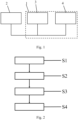
- the communication network 1 comprises a master control unit 3 and a slave control unit 4, and is connected to a master time control unit 2.
- the communication network 1 is configured to carry out the method for validating the synchronized local times of the master and the slave unit 3, 4.
- the master time control unit 2 sends a first synchronization message including a master time to the master control unit 3 and the slave control unit 4, respectively, such that both control units 3, 4 receive the first synchronization message including the master time.
- a second step S2 of the method the master and the slave control unit 3, 4 synchronize their local time to the received master time, respectively.
- the first and the second step S1, S2 may be called forward synchronization, wherein the PTP may be used for the forward synchronization.
- a third step S3 of the method the slave control unit 4 communicates its synchronized local time to the master control unit 3.
- a fourth step S4 of the method the master control unit 4 compares the communicated local time of the slave control unit 4 to the synchronized local time of the master control unit 3 for validating the synchronized local times of the two control units 3, 4.
- the master control unit 3 determines a difference between the communicated local time of the slave control unit 4 and the synchronized local time of the master control unit 3, and raises an error flag if the determined difference is larger than a predefined threshold.
- the slave control unit 4 sends a second synchronization message to the master control unit 3 in the third step S3, wherein the second synchronization message includes the local time corresponding to the synchronized local time of the slave control unit 3 at the time of sending the second synchronization message.
- the master control unit 3 determines the communicated local time based on the second synchronization message sent in the third step S3, e.g., the communicated local time is the local time included in the second synchronization message, and compares the determined communicated local time to the synchronized local time of the master control unit 4.
- the slave control unit 4 sends a second synchronization message to the master control unit 3 in the third step S3, wherein the second synchronization message does not necessarily include the local time corresponding to the synchronized local time of the slave control unit 3 at the time of sending the second synchronization message.
- the slave control unit 4 When a predetermined time after sending the second synchronization message is expired, the slave control unit 4 sends a follow-up message to the master control unit 3, wherein the follow-up message includes the local time corresponding to the synchronized local time of the first control unit at the time of sending the second synchronization message.
- the master control unit 3 determines the communicated local time based on the second synchronization message and the follow-up message of the third step S3, and compares the determined communicated local time to the synchronized local time of the master control unit 4.
- step S3, S4 may be carried out at least partly simultaneously.
- the master control unit 3 determines in the fourth step S4 a local time corresponding to, e.g., being, the synchronized local time of the master control unit 3 at the time of receiving the second synchronization message in the third step S3.
- the master control unit 3 determines in the fourth step S4 a local time corresponding to, e.g., being, the synchronized local time of the master control unit 3 at the time of receiving the follow-up message in the third step S3.
- the master control unit 3 determines a difference between the local time corresponding to the synchronized local time of the slave control unit 4 at the time of sending the second synchronization message, i.e., the time included in the follow-up message send in the third step S3, and the determined local time corresponding to the synchronized local time of the master control unit 3 at the time of receiving the second synchronization message in the third step S3.
- the master control unit 3 determines a sum of the determined difference and the local time corresponding to the synchronized local time of the master control unit 3 at the time of receiving the follow-up message. That is, the determined difference is added to the determined local time corresponding to the synchronized local time of the master control unit 3 at the time of receiving the follow-up message.
- the determined i.e., calculated sum, is in the present case equal to the communicated local time.
- the first two messages of the PTP are used for the backward synchronization.
- the invention is not limited thereto and it would also be possible to use all four messages, or even five messages, of the PTP by additionally providing a follow-up message following a delay response for carrying out the backward synchronization.
- the invention is not limited to two control units. It is also possible to provide more than two control units, e.g., one master control unit for several slave control units, and to carry out the above described method for every slave control unit, respectively, and/or do a cross checking of the synchronized local times of the slave control units using the above described method at a respective master control unit.
Landscapes
- Engineering & Computer Science (AREA)
- Computer Networks & Wireless Communication (AREA)
- Signal Processing (AREA)
- Synchronisation In Digital Transmission Systems (AREA)
Claims (12)
- Procédé de validation des heures locales synchronisées d'au moins une première et une seconde unité de commande (3, 4) d'un véhicule, le procédé comprenant:recevoir (S1), au niveau de chacune des au moins deux unités de commande (3, 4), un premier message de synchronisation incluant un temps maître,synchroniser (S2), au niveau de chacune des au moins deux unités de commande (3, 4), l'heure locale de l'une des au moins deux unités de commande (3, 4) avec l'heure maître reçue,communiquer (S3) l'heure locale synchronisée de la première unité de commande (4) à la seconde unité de commande (3), etcomparaître (S4), au niveau de la seconde unité de commande (3), l'heure locale communiquée par la première unité de commande (4) à l'heure locale synchronisée de la seconde unité de commande (3) pour valider les heures locales synchronisées des au moins deux unités de commande (3, 4).
- Le procédé selon la revendication 1, caractérisé en ce que la comparaison (S4) de l'heure locale communiquée par la première unité de commande (4) à l'heure locale synchronisée de la seconde unité de commande (3) comprend :déterminer, au niveau de la seconde unité de commande (3), une différence entre l'heure locale communiquée par la première unité de commande (4) et l'heure locale synchronisée de la seconde unité de commande (3), etlever, au niveau de la seconde unité de commande (3), un indicateur d'erreur si la différence déterminée est supérieure à un seuil prédéfini.
- Le procédé selon les revendications 1 ou 2, caractérisé en ce que la communication (S3) de l'heure locale synchronisée entre la première unité de commande (4) et la seconde unité de commande (3) comprend :envoyer un deuxième message de synchronisation de la première unité de commande (4) à la seconde unité de commande (3),le deuxième message de synchronisation comprenant éventuellement une première heure locale correspondant à l'heure locale synchronisée de la première unité de commande (4) au moment de l'envoi du message de synchronisation.
- Le procédé selon la revendication 3, caractérisé en ce que la communication (S3) de l'heure locale synchronisée de la première unité de commande (4) à la seconde unité de commande (3) comprend :envoyer un message de suivi de la première unité de commande (4) à la seconde unité de commande (3) lorsqu'un délai prédéterminé après l'envoi du deuxième message de synchronisation est expiré,le message de suivi incluant la première heure locale correspondant à l'heure locale synchronisée de la première unité de commande (4) au moment de l'envoi du deuxième message de synchronisation.
- Le procédé selon les revendications 3 ou 4, caractérisé en ce que la comparaison (S4) de l'heure locale communiquée par la première unité de commande (4) à l'heure locale synchronisée de la seconde unité de commande (3) comprend :
déterminer, au niveau de la seconde unité de commande (3), l'heure locale communiquée sur la base du deuxième message de synchronisation et/ou du message de suivi. - Le procédé selon la revendication 5, caractérisé en ce que la détermination (S4) de l'heure locale communiquée comprend :déterminer, au niveau de la seconde unité de commande (3), une première heure locale correspondant à l'heure locale synchronisée de la seconde unité de commande (3) au moment de la réception du deuxième message de synchronisation,déterminer, au niveau de la seconde unité de commande (3), une seconde heure locale correspondant à l'heure locale synchronisée de la seconde unité de commande (3) au moment de la réception du message de suivi,déterminer, au niveau de la seconde unité de commande (3), une différence entre la première heure locale correspondant à l'heure locale synchronisée de la première unité de commande (4) au moment de l'envoi du deuxième message de synchronisation et la première heure locale correspondant à l'heure locale synchronisée de la seconde unité de commande (3) au moment de la réception du deuxième message de synchronisation, etdéterminer, au niveau de la seconde unité de commande (3), une somme de la différence et de la seconde heure locale correspondant à l'heure locale synchronisée de la seconde unité de commande (3) au moment de la réception du message de suivi pour déterminer l'heure locale communiquée.
- Réseau de communication (1) comprenant une première et une seconde unité de commande (3, 4) connectées l'une à l'autre, dans lequel :la première et la seconde unité de commande (3, 4) sont respectivement configurées pour recevoir un premier message de synchronisation incluant un temps maître,la première et la seconde unité de commande (3, 4) sont respectivement configurées pour synchroniser leur heure locale avec l'heure maître reçue,la première unité de commande (4) est configurée pour communiquer l'heure locale synchronisée à la seconde unité de commande (3), etla seconde unité de commande (3) est configurée pour comparer l'heure locale communiquée par la première unité de commande (4) à l'heure locale synchronisée de la seconde unité de commande (3) afin de valider les heures locales synchronisées de la première et de la seconde unité de commande (3, 4).
- Le réseau de communication (1) selon la revendication 7, caractérisé en ce que, pour comparer l'heure locale communiquée par la première unité de commande (4) à l'heure locale synchronisée de la seconde unité de commande (3), la seconde unité de commande (3) est configurée pour :déterminer une différence entre l'heure locale communiquée par la première unité de commande (4) et l'heure locale synchronisée de la seconde unité de commande (3), etlever un indicateur d'erreur si la différence déterminée est supérieure à un seuil prédéfini.
- Le réseau de communication (1) selon les revendications 7 ou 8, caractérisé en ce que, pour communiquer l'heure locale synchronisée de la première unité de commande (4) à la seconde unité de commande (3), la première unité de commande (4) est configurée pour :envoyer un deuxième message de synchronisation à la seconde unité de commande (3),le deuxième message de synchronisation incluant éventuellement une première heure locale correspondant à l'heure locale synchronisée de la première unité de commande (4) au moment de l'envoi du deuxième message de synchronisation.
- Le réseau de communication (1) selon la revendication 9, caractérisé en ce que, pour communiquer l'heure locale synchronisée de la première unité de commande (4) à la seconde unité de commande (3), la première unité de commande (4) est configurée pour :envoyer un message de suivi à la seconde unité de commande (3) lorsqu'un délai prédéterminé après l'envoi du deuxième message de synchronisation est expiré,dans lequel le message de suivi inclut la première heure locale correspondant à l'heure locale synchronisée de la première unité de commande (4) au moment de l'envoi du deuxième message de synchronisation.
- Le réseau de communication (1) selon les revendications 9 ou 10 est caractérisé en ce que, pour comparer l'heure locale communiquée par la première unité de commande (4) à l'heure locale synchronisée de la seconde unité de commande (3), la seconde unité de commande (3) est configurée pour déterminer l'heure locale communiquée sur la base du deuxième message de synchronisation et/ou du message de suivi.
- Le réseau de communication (1) selon la revendication 11 est caractérisé en ce que, pour déterminer l'heure locale communiquée, la seconde unité de commande (3) est configurée pour :déterminer une première heure locale correspondant à l'heure locale synchronisée de la seconde unité de commande (3) au moment de la réception du deuxième message de synchronisation,déterminer une seconde heure locale correspondant à l'heure locale synchronisée de la seconde unité de commande (3) au moment de la réception du message de suivi,déterminer une différence entre la première heure locale correspondant à l'heure locale synchronisée de la première unité de commande (4) au moment de l'envoi du message de synchronisation et la première heure locale correspondant à l'heure locale synchronisée de la seconde unité de commande (3) au moment de la réception du message de synchronisation, etdéterminer une somme de la différence et de la seconde heure locale correspondant à l'heure locale synchronisée de la seconde unité de commande (3) au moment de la réception du message de suivi pour déterminer l'heure locale communiquée.
Priority Applications (4)
| Application Number | Priority Date | Filing Date | Title |
|---|---|---|---|
| EP21176508.6A EP4096122B1 (fr) | 2021-05-28 | 2021-05-28 | Validation des heures locales synchronisées d'au moins une première et une seconde unité de commande |
| US18/563,434 US20240243830A1 (en) | 2021-05-28 | 2022-04-26 | Validating Synchronized Local Times of at Least a First and a Second Control Unit |
| CN202280036329.6A CN117378155A (zh) | 2021-05-28 | 2022-04-26 | 验证至少第一和第二控制单元的被同步本地时间 |
| PCT/EP2022/060951 WO2022248137A1 (fr) | 2021-05-28 | 2022-04-26 | Validation de moments locaux synchronisés d'au moins une première et une seconde unité de commande |
Applications Claiming Priority (1)
| Application Number | Priority Date | Filing Date | Title |
|---|---|---|---|
| EP21176508.6A EP4096122B1 (fr) | 2021-05-28 | 2021-05-28 | Validation des heures locales synchronisées d'au moins une première et une seconde unité de commande |
Publications (2)
| Publication Number | Publication Date |
|---|---|
| EP4096122A1 EP4096122A1 (fr) | 2022-11-30 |
| EP4096122B1 true EP4096122B1 (fr) | 2024-11-13 |
Family
ID=76197243
Family Applications (1)
| Application Number | Title | Priority Date | Filing Date |
|---|---|---|---|
| EP21176508.6A Active EP4096122B1 (fr) | 2021-05-28 | 2021-05-28 | Validation des heures locales synchronisées d'au moins une première et une seconde unité de commande |
Country Status (4)
| Country | Link |
|---|---|
| US (1) | US20240243830A1 (fr) |
| EP (1) | EP4096122B1 (fr) |
| CN (1) | CN117378155A (fr) |
| WO (1) | WO2022248137A1 (fr) |
Citations (1)
| Publication number | Priority date | Publication date | Assignee | Title |
|---|---|---|---|---|
| WO2019001929A1 (fr) * | 2017-06-28 | 2019-01-03 | Bayerische Motoren Werke Aktiengesellschaft | Procédé, support lisible par ordinateur, système, et véhicule comprenant le système pour la validation d'une fonction temporelle d'un maître et du client dans un réseau d'un véhicule |
Family Cites Families (6)
| Publication number | Priority date | Publication date | Assignee | Title |
|---|---|---|---|---|
| KR101596759B1 (ko) * | 2014-11-26 | 2016-03-07 | 현대자동차주식회사 | 차량용 이더넷 통신망에서의 시간 동기화 제공 방법 및 장치 |
| DE102017219209B4 (de) * | 2017-10-26 | 2024-08-29 | Continental Automotive Technologies GmbH | Verfahren zum Erkennen eines fehlerhaften Zeitstempels einer Ethernet-Nachricht und Steuereinheit für ein Kraftfahrzeug |
| KR102208580B1 (ko) * | 2018-02-09 | 2021-01-28 | 한국전자통신연구원 | 무인 이동체, 무인 이동체들 사이의 시간 동기화 지원 장치 및 그 방법 |
| US11539451B2 (en) * | 2019-02-28 | 2022-12-27 | Nxp B.V. | Method and system for merging clocks from multiple precision time protocol (PTP) clock domains |
| WO2021003685A1 (fr) * | 2019-07-10 | 2021-01-14 | 深圳市大疆创新科技有限公司 | Procédé de synchronisation temporelle, système à capteurs multiples et plate-forme mobile |
| EP4324123B1 (fr) * | 2021-04-16 | 2025-12-03 | Bayerische Motoren Werke Aktiengesellschaft | Validation de synchronisation du temps |
-
2021
- 2021-05-28 EP EP21176508.6A patent/EP4096122B1/fr active Active
-
2022
- 2022-04-26 CN CN202280036329.6A patent/CN117378155A/zh active Pending
- 2022-04-26 WO PCT/EP2022/060951 patent/WO2022248137A1/fr not_active Ceased
- 2022-04-26 US US18/563,434 patent/US20240243830A1/en active Pending
Patent Citations (1)
| Publication number | Priority date | Publication date | Assignee | Title |
|---|---|---|---|---|
| WO2019001929A1 (fr) * | 2017-06-28 | 2019-01-03 | Bayerische Motoren Werke Aktiengesellschaft | Procédé, support lisible par ordinateur, système, et véhicule comprenant le système pour la validation d'une fonction temporelle d'un maître et du client dans un réseau d'un véhicule |
Also Published As
| Publication number | Publication date |
|---|---|
| CN117378155A (zh) | 2024-01-09 |
| EP4096122A1 (fr) | 2022-11-30 |
| WO2022248137A1 (fr) | 2022-12-01 |
| US20240243830A1 (en) | 2024-07-18 |
Similar Documents
| Publication | Publication Date | Title |
|---|---|---|
| EP4324123B1 (fr) | Validation de synchronisation du temps | |
| US9003271B2 (en) | Error detecting device and method of a dual controller system | |
| US8504864B2 (en) | Data sensor coordination using time synchronization in a multi-bus controller area network system | |
| EP3668765A1 (fr) | Systèmes et procédés de détection de vitesse de roue redondante | |
| US20210218656A1 (en) | Method for Determining a Synchronization Accuracy, Computer Program, Communication Unit and Motor Vehicle | |
| US12335360B2 (en) | Method and system for performing time-synchronization between units of a communication bus system | |
| KR101593571B1 (ko) | 차량 전자제어유닛의 이상 진단을 위한 블랙박스장치 및 이의 제어 방법 | |
| US10541830B2 (en) | Serial communication system | |
| EP4107880B1 (fr) | Procédé et système d'exécution de synchronisation temporelle | |
| KR102929021B1 (ko) | 시간 동기화의 검증 | |
| US20240243830A1 (en) | Validating Synchronized Local Times of at Least a First and a Second Control Unit | |
| US12101203B2 (en) | Relay device, communication network system, and communication control method | |
| EP4224744A1 (fr) | Procédé de répartition temporelle dans un réseau de communication de véhicule et réseau de communication | |
| US20250132854A1 (en) | Method and Device for Monitoring a Time Synchronization Distributed via a Network Switch to Be Used in a Communication Network of an Automated Vehicle | |
| CN112527702B (zh) | 用于处理相干数据的方法和系统 | |
| KR20140068766A (ko) | 메시지의 제공 및 전송을 위한 방법 |
Legal Events
| Date | Code | Title | Description |
|---|---|---|---|
| PUAI | Public reference made under article 153(3) epc to a published international application that has entered the european phase |
Free format text: ORIGINAL CODE: 0009012 |
|
| STAA | Information on the status of an ep patent application or granted ep patent |
Free format text: STATUS: THE APPLICATION HAS BEEN PUBLISHED |
|
| AK | Designated contracting states |
Kind code of ref document: A1 Designated state(s): AL AT BE BG CH CY CZ DE DK EE ES FI FR GB GR HR HU IE IS IT LI LT LU LV MC MK MT NL NO PL PT RO RS SE SI SK SM TR |
|
| STAA | Information on the status of an ep patent application or granted ep patent |
Free format text: STATUS: REQUEST FOR EXAMINATION WAS MADE |
|
| 17P | Request for examination filed |
Effective date: 20230301 |
|
| RBV | Designated contracting states (corrected) |
Designated state(s): AL AT BE BG CH CY CZ DE DK EE ES FI FR GB GR HR HU IE IS IT LI LT LU LV MC MK MT NL NO PL PT RO RS SE SI SK SM TR |
|
| P01 | Opt-out of the competence of the unified patent court (upc) registered |
Effective date: 20230424 |
|
| REG | Reference to a national code |
Ref country code: DE Ref legal event code: R079 Free format text: PREVIOUS MAIN CLASS: H04J0003140000 Ipc: H04L0009400000 Ref country code: DE Ref legal event code: R079 Ref document number: 602021021683 Country of ref document: DE Free format text: PREVIOUS MAIN CLASS: H04J0003140000 Ipc: H04L0009400000 |
|
| GRAP | Despatch of communication of intention to grant a patent |
Free format text: ORIGINAL CODE: EPIDOSNIGR1 |
|
| STAA | Information on the status of an ep patent application or granted ep patent |
Free format text: STATUS: GRANT OF PATENT IS INTENDED |
|
| RIC1 | Information provided on ipc code assigned before grant |
Ipc: H04L 9/40 20220101AFI20240513BHEP |
|
| INTG | Intention to grant announced |
Effective date: 20240606 |
|
| GRAS | Grant fee paid |
Free format text: ORIGINAL CODE: EPIDOSNIGR3 |
|
| GRAA | (expected) grant |
Free format text: ORIGINAL CODE: 0009210 |
|
| STAA | Information on the status of an ep patent application or granted ep patent |
Free format text: STATUS: THE PATENT HAS BEEN GRANTED |
|
| AK | Designated contracting states |
Kind code of ref document: B1 Designated state(s): AL AT BE BG CH CY CZ DE DK EE ES FI FR GB GR HR HU IE IS IT LI LT LU LV MC MK MT NL NO PL PT RO RS SE SI SK SM TR |
|
| REG | Reference to a national code |
Ref country code: GB Ref legal event code: FG4D |
|
| REG | Reference to a national code |
Ref country code: CH Ref legal event code: EP |
|
| REG | Reference to a national code |
Ref country code: IE Ref legal event code: FG4D |
|
| REG | Reference to a national code |
Ref country code: DE Ref legal event code: R096 Ref document number: 602021021683 Country of ref document: DE |
|
| P02 | Opt-out of the competence of the unified patent court (upc) changed |
Free format text: CASE NUMBER: APP_65315/2024 Effective date: 20241211 |
|
| REG | Reference to a national code |
Ref country code: LT Ref legal event code: MG9D |
|
| PG25 | Lapsed in a contracting state [announced via postgrant information from national office to epo] |
Ref country code: HR Free format text: LAPSE BECAUSE OF FAILURE TO SUBMIT A TRANSLATION OF THE DESCRIPTION OR TO PAY THE FEE WITHIN THE PRESCRIBED TIME-LIMIT Effective date: 20241113 Ref country code: IS Free format text: LAPSE BECAUSE OF FAILURE TO SUBMIT A TRANSLATION OF THE DESCRIPTION OR TO PAY THE FEE WITHIN THE PRESCRIBED TIME-LIMIT Effective date: 20250313 Ref country code: PT Free format text: LAPSE BECAUSE OF FAILURE TO SUBMIT A TRANSLATION OF THE DESCRIPTION OR TO PAY THE FEE WITHIN THE PRESCRIBED TIME-LIMIT Effective date: 20250313 |
|
| PG25 | Lapsed in a contracting state [announced via postgrant information from national office to epo] |
Ref country code: FI Free format text: LAPSE BECAUSE OF FAILURE TO SUBMIT A TRANSLATION OF THE DESCRIPTION OR TO PAY THE FEE WITHIN THE PRESCRIBED TIME-LIMIT Effective date: 20241113 Ref country code: NL Free format text: LAPSE BECAUSE OF FAILURE TO SUBMIT A TRANSLATION OF THE DESCRIPTION OR TO PAY THE FEE WITHIN THE PRESCRIBED TIME-LIMIT Effective date: 20241113 |
|
| REG | Reference to a national code |
Ref country code: AT Ref legal event code: MK05 Ref document number: 1742489 Country of ref document: AT Kind code of ref document: T Effective date: 20241113 |
|
| PG25 | Lapsed in a contracting state [announced via postgrant information from national office to epo] |
Ref country code: BG Free format text: LAPSE BECAUSE OF FAILURE TO SUBMIT A TRANSLATION OF THE DESCRIPTION OR TO PAY THE FEE WITHIN THE PRESCRIBED TIME-LIMIT Effective date: 20241113 |
|
| PG25 | Lapsed in a contracting state [announced via postgrant information from national office to epo] |
Ref country code: ES Free format text: LAPSE BECAUSE OF FAILURE TO SUBMIT A TRANSLATION OF THE DESCRIPTION OR TO PAY THE FEE WITHIN THE PRESCRIBED TIME-LIMIT Effective date: 20241113 |
|
| PG25 | Lapsed in a contracting state [announced via postgrant information from national office to epo] |
Ref country code: NO Free format text: LAPSE BECAUSE OF FAILURE TO SUBMIT A TRANSLATION OF THE DESCRIPTION OR TO PAY THE FEE WITHIN THE PRESCRIBED TIME-LIMIT Effective date: 20250213 |
|
| PG25 | Lapsed in a contracting state [announced via postgrant information from national office to epo] |
Ref country code: GR Free format text: LAPSE BECAUSE OF FAILURE TO SUBMIT A TRANSLATION OF THE DESCRIPTION OR TO PAY THE FEE WITHIN THE PRESCRIBED TIME-LIMIT Effective date: 20250214 Ref country code: LV Free format text: LAPSE BECAUSE OF FAILURE TO SUBMIT A TRANSLATION OF THE DESCRIPTION OR TO PAY THE FEE WITHIN THE PRESCRIBED TIME-LIMIT Effective date: 20241113 Ref country code: AT Free format text: LAPSE BECAUSE OF FAILURE TO SUBMIT A TRANSLATION OF THE DESCRIPTION OR TO PAY THE FEE WITHIN THE PRESCRIBED TIME-LIMIT Effective date: 20241113 |
|
| PG25 | Lapsed in a contracting state [announced via postgrant information from national office to epo] |
Ref country code: PL Free format text: LAPSE BECAUSE OF FAILURE TO SUBMIT A TRANSLATION OF THE DESCRIPTION OR TO PAY THE FEE WITHIN THE PRESCRIBED TIME-LIMIT Effective date: 20241113 |
|
| PG25 | Lapsed in a contracting state [announced via postgrant information from national office to epo] |
Ref country code: RS Free format text: LAPSE BECAUSE OF FAILURE TO SUBMIT A TRANSLATION OF THE DESCRIPTION OR TO PAY THE FEE WITHIN THE PRESCRIBED TIME-LIMIT Effective date: 20250213 |
|
| PG25 | Lapsed in a contracting state [announced via postgrant information from national office to epo] |
Ref country code: SM Free format text: LAPSE BECAUSE OF FAILURE TO SUBMIT A TRANSLATION OF THE DESCRIPTION OR TO PAY THE FEE WITHIN THE PRESCRIBED TIME-LIMIT Effective date: 20241113 |
|
| PGFP | Annual fee paid to national office [announced via postgrant information from national office to epo] |
Ref country code: DE Payment date: 20250512 Year of fee payment: 5 |
|
| PG25 | Lapsed in a contracting state [announced via postgrant information from national office to epo] |
Ref country code: DK Free format text: LAPSE BECAUSE OF FAILURE TO SUBMIT A TRANSLATION OF THE DESCRIPTION OR TO PAY THE FEE WITHIN THE PRESCRIBED TIME-LIMIT Effective date: 20241113 |
|
| PGFP | Annual fee paid to national office [announced via postgrant information from national office to epo] |
Ref country code: GB Payment date: 20250522 Year of fee payment: 5 |
|
| PGFP | Annual fee paid to national office [announced via postgrant information from national office to epo] |
Ref country code: IT Payment date: 20250530 Year of fee payment: 5 |
|
| PG25 | Lapsed in a contracting state [announced via postgrant information from national office to epo] |
Ref country code: EE Free format text: LAPSE BECAUSE OF FAILURE TO SUBMIT A TRANSLATION OF THE DESCRIPTION OR TO PAY THE FEE WITHIN THE PRESCRIBED TIME-LIMIT Effective date: 20241113 |
|
| PGFP | Annual fee paid to national office [announced via postgrant information from national office to epo] |
Ref country code: FR Payment date: 20250521 Year of fee payment: 5 |
|
| PG25 | Lapsed in a contracting state [announced via postgrant information from national office to epo] |
Ref country code: RO Free format text: LAPSE BECAUSE OF FAILURE TO SUBMIT A TRANSLATION OF THE DESCRIPTION OR TO PAY THE FEE WITHIN THE PRESCRIBED TIME-LIMIT Effective date: 20241113 |
|
| PG25 | Lapsed in a contracting state [announced via postgrant information from national office to epo] |
Ref country code: SK Free format text: LAPSE BECAUSE OF FAILURE TO SUBMIT A TRANSLATION OF THE DESCRIPTION OR TO PAY THE FEE WITHIN THE PRESCRIBED TIME-LIMIT Effective date: 20241113 |
|
| PG25 | Lapsed in a contracting state [announced via postgrant information from national office to epo] |
Ref country code: CZ Free format text: LAPSE BECAUSE OF FAILURE TO SUBMIT A TRANSLATION OF THE DESCRIPTION OR TO PAY THE FEE WITHIN THE PRESCRIBED TIME-LIMIT Effective date: 20241113 |
|
| REG | Reference to a national code |
Ref country code: DE Ref legal event code: R097 Ref document number: 602021021683 Country of ref document: DE |
|
| PG25 | Lapsed in a contracting state [announced via postgrant information from national office to epo] |
Ref country code: SE Free format text: LAPSE BECAUSE OF FAILURE TO SUBMIT A TRANSLATION OF THE DESCRIPTION OR TO PAY THE FEE WITHIN THE PRESCRIBED TIME-LIMIT Effective date: 20241113 |
|
| PLBE | No opposition filed within time limit |
Free format text: ORIGINAL CODE: 0009261 |
|
| STAA | Information on the status of an ep patent application or granted ep patent |
Free format text: STATUS: NO OPPOSITION FILED WITHIN TIME LIMIT |
|
| 26N | No opposition filed |
Effective date: 20250814 |
|
| REG | Reference to a national code |
Ref country code: CH Ref legal event code: H13 Free format text: ST27 STATUS EVENT CODE: U-0-0-H10-H13 (AS PROVIDED BY THE NATIONAL OFFICE) Effective date: 20251223 |
|
| PG25 | Lapsed in a contracting state [announced via postgrant information from national office to epo] |
Ref country code: LU Free format text: LAPSE BECAUSE OF NON-PAYMENT OF DUE FEES Effective date: 20250528 |
|
| PG25 | Lapsed in a contracting state [announced via postgrant information from national office to epo] |
Ref country code: CH Free format text: LAPSE BECAUSE OF NON-PAYMENT OF DUE FEES Effective date: 20250531 |
|
| REG | Reference to a national code |
Ref country code: BE Ref legal event code: MM Effective date: 20250531 |
|
| PG25 | Lapsed in a contracting state [announced via postgrant information from national office to epo] |
Ref country code: MC Free format text: LAPSE BECAUSE OF FAILURE TO SUBMIT A TRANSLATION OF THE DESCRIPTION OR TO PAY THE FEE WITHIN THE PRESCRIBED TIME-LIMIT Effective date: 20241113 |
|
| PG25 | Lapsed in a contracting state [announced via postgrant information from national office to epo] |
Ref country code: IE Free format text: LAPSE BECAUSE OF NON-PAYMENT OF DUE FEES Effective date: 20250528 |
|
| PG25 | Lapsed in a contracting state [announced via postgrant information from national office to epo] |
Ref country code: BE Free format text: LAPSE BECAUSE OF NON-PAYMENT OF DUE FEES Effective date: 20250531 |