EP4097472B1 - Procédé et système de détermination et de classification assistée par traceur de substance toxique dans un échantillon d'haleine - Google Patents
Procédé et système de détermination et de classification assistée par traceur de substance toxique dans un échantillon d'haleine Download PDFInfo
- Publication number
- EP4097472B1 EP4097472B1 EP21704333.0A EP21704333A EP4097472B1 EP 4097472 B1 EP4097472 B1 EP 4097472B1 EP 21704333 A EP21704333 A EP 21704333A EP 4097472 B1 EP4097472 B1 EP 4097472B1
- Authority
- EP
- European Patent Office
- Prior art keywords
- concentration
- breath
- tracer
- substance
- evaluation period
- Prior art date
- Legal status (The legal status is an assumption and is not a legal conclusion. Google has not performed a legal analysis and makes no representation as to the accuracy of the status listed.)
- Active
Links
Images





Classifications
-
- G—PHYSICS
- G01—MEASURING; TESTING
- G01N—INVESTIGATING OR ANALYSING MATERIALS BY DETERMINING THEIR CHEMICAL OR PHYSICAL PROPERTIES
- G01N33/00—Investigating or analysing materials by specific methods not covered by groups G01N1/00 - G01N31/00
- G01N33/48—Biological material, e.g. blood, urine; Haemocytometers
- G01N33/483—Physical analysis of biological material
- G01N33/497—Physical analysis of biological material of gaseous biological material, e.g. breath
- G01N33/4972—Determining alcohol content
-
- A—HUMAN NECESSITIES
- A61—MEDICAL OR VETERINARY SCIENCE; HYGIENE
- A61B—DIAGNOSIS; SURGERY; IDENTIFICATION
- A61B5/00—Measuring for diagnostic purposes; Identification of persons
- A61B5/08—Measuring devices for evaluating the respiratory organs
- A61B5/082—Evaluation by breath analysis, e.g. determination of the chemical composition of exhaled breath
-
- A—HUMAN NECESSITIES
- A61—MEDICAL OR VETERINARY SCIENCE; HYGIENE
- A61B—DIAGNOSIS; SURGERY; IDENTIFICATION
- A61B5/00—Measuring for diagnostic purposes; Identification of persons
- A61B5/16—Devices for psychotechnics; Testing reaction times ; Devices for evaluating the psychological state
- A61B5/18—Devices for psychotechnics; Testing reaction times ; Devices for evaluating the psychological state for vehicle drivers or machine operators
-
- A—HUMAN NECESSITIES
- A61—MEDICAL OR VETERINARY SCIENCE; HYGIENE
- A61B—DIAGNOSIS; SURGERY; IDENTIFICATION
- A61B5/00—Measuring for diagnostic purposes; Identification of persons
- A61B5/48—Other medical applications
- A61B5/4845—Toxicology, e.g. by detection of alcohol, drug or toxic products
-
- A—HUMAN NECESSITIES
- A61—MEDICAL OR VETERINARY SCIENCE; HYGIENE
- A61B—DIAGNOSIS; SURGERY; IDENTIFICATION
- A61B5/00—Measuring for diagnostic purposes; Identification of persons
- A61B5/72—Signal processing specially adapted for physiological signals or for diagnostic purposes
- A61B5/7235—Details of waveform analysis
- A61B5/7239—Details of waveform analysis using differentiation including higher order derivatives
-
- A—HUMAN NECESSITIES
- A61—MEDICAL OR VETERINARY SCIENCE; HYGIENE
- A61B—DIAGNOSIS; SURGERY; IDENTIFICATION
- A61B5/00—Measuring for diagnostic purposes; Identification of persons
- A61B5/72—Signal processing specially adapted for physiological signals or for diagnostic purposes
- A61B5/7235—Details of waveform analysis
- A61B5/7264—Classification of physiological signals or data, e.g. using neural networks, statistical classifiers, expert systems or fuzzy systems
-
- A—HUMAN NECESSITIES
- A61—MEDICAL OR VETERINARY SCIENCE; HYGIENE
- A61B—DIAGNOSIS; SURGERY; IDENTIFICATION
- A61B5/00—Measuring for diagnostic purposes; Identification of persons
- A61B5/72—Signal processing specially adapted for physiological signals or for diagnostic purposes
- A61B5/7235—Details of waveform analysis
- A61B5/7264—Classification of physiological signals or data, e.g. using neural networks, statistical classifiers, expert systems or fuzzy systems
- A61B5/7267—Classification of physiological signals or data, e.g. using neural networks, statistical classifiers, expert systems or fuzzy systems involving training the classification device
-
- A—HUMAN NECESSITIES
- A61—MEDICAL OR VETERINARY SCIENCE; HYGIENE
- A61B—DIAGNOSIS; SURGERY; IDENTIFICATION
- A61B5/00—Measuring for diagnostic purposes; Identification of persons
- A61B5/74—Details of notification to user or communication with user or patient; User input means
- A61B5/742—Details of notification to user or communication with user or patient; User input means using visual displays
-
- B—PERFORMING OPERATIONS; TRANSPORTING
- B60—VEHICLES IN GENERAL
- B60K—ARRANGEMENT OR MOUNTING OF PROPULSION UNITS OR OF TRANSMISSIONS IN VEHICLES; ARRANGEMENT OR MOUNTING OF PLURAL DIVERSE PRIME-MOVERS IN VEHICLES; AUXILIARY DRIVES FOR VEHICLES; INSTRUMENTATION OR DASHBOARDS FOR VEHICLES; ARRANGEMENTS IN CONNECTION WITH COOLING, AIR INTAKE, GAS EXHAUST OR FUEL SUPPLY OF PROPULSION UNITS IN VEHICLES
- B60K28/00—Safety devices for propulsion-unit control, specially adapted for, or arranged in, vehicles, e.g. preventing fuel supply or ignition in the event of potentially dangerous conditions
- B60K28/02—Safety devices for propulsion-unit control, specially adapted for, or arranged in, vehicles, e.g. preventing fuel supply or ignition in the event of potentially dangerous conditions responsive to conditions relating to the driver
- B60K28/06—Safety devices for propulsion-unit control, specially adapted for, or arranged in, vehicles, e.g. preventing fuel supply or ignition in the event of potentially dangerous conditions responsive to conditions relating to the driver responsive to incapacity of driver
-
- B—PERFORMING OPERATIONS; TRANSPORTING
- B60—VEHICLES IN GENERAL
- B60K—ARRANGEMENT OR MOUNTING OF PROPULSION UNITS OR OF TRANSMISSIONS IN VEHICLES; ARRANGEMENT OR MOUNTING OF PLURAL DIVERSE PRIME-MOVERS IN VEHICLES; AUXILIARY DRIVES FOR VEHICLES; INSTRUMENTATION OR DASHBOARDS FOR VEHICLES; ARRANGEMENTS IN CONNECTION WITH COOLING, AIR INTAKE, GAS EXHAUST OR FUEL SUPPLY OF PROPULSION UNITS IN VEHICLES
- B60K28/00—Safety devices for propulsion-unit control, specially adapted for, or arranged in, vehicles, e.g. preventing fuel supply or ignition in the event of potentially dangerous conditions
- B60K28/02—Safety devices for propulsion-unit control, specially adapted for, or arranged in, vehicles, e.g. preventing fuel supply or ignition in the event of potentially dangerous conditions responsive to conditions relating to the driver
- B60K28/06—Safety devices for propulsion-unit control, specially adapted for, or arranged in, vehicles, e.g. preventing fuel supply or ignition in the event of potentially dangerous conditions responsive to conditions relating to the driver responsive to incapacity of driver
- B60K28/063—Safety devices for propulsion-unit control, specially adapted for, or arranged in, vehicles, e.g. preventing fuel supply or ignition in the event of potentially dangerous conditions responsive to conditions relating to the driver responsive to incapacity of driver preventing starting of vehicles
-
- G—PHYSICS
- G01—MEASURING; TESTING
- G01N—INVESTIGATING OR ANALYSING MATERIALS BY DETERMINING THEIR CHEMICAL OR PHYSICAL PROPERTIES
- G01N21/00—Investigating or analysing materials by the use of optical means, i.e. using sub-millimetre waves, infrared, visible or ultraviolet light
- G01N21/17—Systems in which incident light is modified in accordance with the properties of the material investigated
- G01N21/25—Colour; Spectral properties, i.e. comparison of effect of material on the light at two or more different wavelengths or wavelength bands
- G01N21/31—Investigating relative effect of material at wavelengths characteristic of specific elements or molecules, e.g. atomic absorption spectrometry
- G01N21/35—Investigating relative effect of material at wavelengths characteristic of specific elements or molecules, e.g. atomic absorption spectrometry using infrared light
- G01N21/3504—Investigating relative effect of material at wavelengths characteristic of specific elements or molecules, e.g. atomic absorption spectrometry using infrared light for analysing gases, e.g. multi-gas analysis
-
- G—PHYSICS
- G01—MEASURING; TESTING
- G01N—INVESTIGATING OR ANALYSING MATERIALS BY DETERMINING THEIR CHEMICAL OR PHYSICAL PROPERTIES
- G01N33/00—Investigating or analysing materials by specific methods not covered by groups G01N1/00 - G01N31/00
- G01N33/48—Biological material, e.g. blood, urine; Haemocytometers
- G01N33/483—Physical analysis of biological material
- G01N33/497—Physical analysis of biological material of gaseous biological material, e.g. breath
-
- B—PERFORMING OPERATIONS; TRANSPORTING
- B60—VEHICLES IN GENERAL
- B60W—CONJOINT CONTROL OF VEHICLE SUB-UNITS OF DIFFERENT TYPE OR DIFFERENT FUNCTION; CONTROL SYSTEMS SPECIALLY ADAPTED FOR HYBRID VEHICLES; ROAD VEHICLE DRIVE CONTROL SYSTEMS FOR PURPOSES NOT RELATED TO THE CONTROL OF A PARTICULAR SUB-UNIT
- B60W2540/00—Input parameters relating to occupants
- B60W2540/24—Drug level, e.g. alcohol
-
- B—PERFORMING OPERATIONS; TRANSPORTING
- B60—VEHICLES IN GENERAL
- B60W—CONJOINT CONTROL OF VEHICLE SUB-UNITS OF DIFFERENT TYPE OR DIFFERENT FUNCTION; CONTROL SYSTEMS SPECIALLY ADAPTED FOR HYBRID VEHICLES; ROAD VEHICLE DRIVE CONTROL SYSTEMS FOR PURPOSES NOT RELATED TO THE CONTROL OF A PARTICULAR SUB-UNIT
- B60W2540/00—Input parameters relating to occupants
- B60W2540/26—Incapacity
Definitions
- the present invention relates to a breath analyzing system and method.
- the invention relates to a breath analyzing system and method arranged to provide rapid tracer-aided determination and classification of the presence of a breath intoxicating substance above a limit concentration providing status to a user about the progression of the classification.
- Breath analyzing equipment is becoming increasingly common, not the least in vehicles as a measure to detect and prevent driving under the influence of intoxicating substances, in particular, ethyl alcohol (ethanol).
- the breath analyzing equipment may be a stand-alone, even handheld, unit that gives a measured value of the content of a substance or substances in the driver's breath.
- breath analyzing equipment may be part of a system wherein also including equipment for identifying the driver and/or immobilizing the vehicle.
- Such breath analyzing equipment is typically permanently mounted in the vehicle and may be an integral part of the dashboard, for example.
- Breath analyzing equipment may also be stationary systems used to control access to a work area, a vehicle fleet depot or the like.
- breath analyzer that has appropriate sensitivity, is reliable and provides a reasonably fast analysis is far from trivial. This is especially true if the breath analyzing equipment should be able to detect a plurality of substances and not being disturbed by variation in moisture, CO 2 content etc. Breath analyzing equipment that fulfills these requirements are described in for example US7919754 and US9746454 .
- the breath analyzing equipment may be part of a system also including equipment for identifying the driver and/or immobilizing the vehicle, so called “alcolocks".
- Such breath analyzing equipment is typically permanently mounted in the vehicle and may be an integral part of the dashboard, for example, and connected to the control system of the vehicle.
- Alcolocks are in widespread use in offender programs as a mandatory accessory for rehabilitation of car owners who have been convicted for drunk driving.
- similar systems and devices are being used in commercial vehicles like buses, taxis and trains. However, it appears that these systems will also be common in private vehicles in a near future, and possibly also mandatory in at least some countries and regions.
- the up to the present day most common approach for vehicle mounted breath testing equipment is to use a mouthpiece to which, after a deep breath, the user should empty his or her airways.
- This approach is referred to as active detection.
- the user should deliver a forced expiration at almost full vital capacity. This requires substantial time and effort, especially for persons with limited capacity.
- the mouthpiece, or part of the mouthpiece is often a disposable plastic item for hygienic reasons. This results in cumbersome handling and the use of vast amounts of disposable plastic items, which would be the case if alcolocks become mandatory, is questionable from an environmental viewpoint.
- contactless detection An alternative approach is referred to as contactless detection wherein no mouthpiece is utilized and the breath testing apparatus typically receives a mixture of the exhaled breath and the surrounding air and a detection of an intoxicating substance is determined from a breath sample taken during the expiration at normal breathing.
- the detection may be truly passive wherein no action is required of the user, for example taking place while a user performs the regular starting up routine of a vehicle.
- the user may be instructed to perform certain actions that are meant to facilitate the detection process, for example the user may be instructed to breath towards an air inlet or the like.
- the challenge with contactless detection even if user is instructed to breath in a certain direction or the like, is the low concentration of the substances to be detected and analyzed.
- US 7,736,903 discloses a system and a method for passive detection of alcohol using a first and second tracer, and a first and second time period for compensating for environmental variations.
- the response time for such systems is typically minutes which is considered far too slow for practical use, both in automotive and other applications.
- US 8,377,705 discloses adding another tracer, water vapor, and another detection mode, in which the ethanol and tracer signals are measured at a first and a second time distinct from the first time. There is, however, no mention of how to avoid or manage measurement errors and the response time appears to be an issue also in this system/method.
- US 2015/219620 A1 discloses a breath test system comprising a sensor unit configured to sense the presence or concentration of a volatile substance present in air flowing through a predefined inlet area, and generate a signal corresponding to the concentration of said substance.
- the object of the invention is to provide a breath analyzing system and method of operation that overcomes the drawbacks of prior art passive detection systems.
- the method comprises the further step, to be taken during the evaluation period, of:
- the gap value is preferably presented to the user.
- a rate of change of the gap value is calculated which is used to estimate the remaining time to perform a reliable classification. Such estimate may also be presented to the user
- the step of analyzing the tracer substance signal to detect a peak comprises calculating and analyzing the first and/or second time derivate of the tracer signal.
- a peak onset time corresponds to a first zero crossing in the second derivative and a peak decline time corresponds to a consecutive zero crossing in the second derivative of the tracer signal.
- the evaluation period is terminated after a time corresponding to a predetermined average exhalation time period of a human respiratory cycle.
- m is the number of time samples
- a warning of missing data is issued.
- a warning or an instruction is issued to direct the user to take action.
- control unit is further arranged to in the calculation of the running average of the breath concentration of the intoxicating substance and the associated statistical spread include the tracer signal samples and the intoxicating substance signal samples associated with the present evaluation period and all previous evaluation periods.
- breath analysis system further comprises a vehicle drivability control unit in connection with the control unit, and wherein the control unit is arranged to, if the classification result is that concentration of the intoxicating substance user is not acceptable, instruct the vehicle drivability control unit to not allow the user to drive the vehicle.
- One advantage afforded by the present invention is that the gap to classification approval is being communicated to the user during the measurement/analyzing, until the measurement error is sufficiently reduced to be either below or above a preset limit value, i.e. until a correct classification has been reached. By providing this feedback to the user a higher degree of acceptance for the measurement/analyzing time period is to be expected.
- Another advantage is that the system starts collecting data immediately upon power-up, and classification occurs in real time based on available data. Thereby, startup time is immediate without need for steady-state conditions to become established.
- One further advantage is that the classification will only be performed when sufficient accuracy has been obtained, thus minimizing the risk for false classification results.
- classification in the present context is meant judging whether a subject's breath concentration of an intoxicating substance, e g ethyl alcohol, is above or below (at or below) a predefined limit value.
- a tracer is a physiological substance inherently associated with expired breath, e g carbon dioxide or water vapor.
- baseline is meant a signal level corresponding to the concentration of intoxicating substance or tracer to which other instantaneous signal values are referred.
- An offset error is a deviation from the baseline.
- a concentration peak is defined by a maximum in a measured concentration versus time with increasing concentration before the peak maximum and declining thereafter.
- breath analysis system and the method according to the invention will primarily be described as a contactless detection system mounted in a vehicle, which represents an important implementation of the invention.
- teachings are equally relevant for stand alone systems, for example systems at an entrance to a work area, fleet depot or the like.
- Fig. 1 is a schematic drawing of the breath analysis system 100 according to the invention.
- the breath analyzer 1 comprises a measuring unit 110 comprising a measuring cell or cavity into which a breath sample 2 is drawn for analyzing its content of tracer and intoxicating substances.
- the inlet 3 of the measuring cell 1 includes a heater of the air sample to avoid condensation of the inner walls 6 of the cavity 1, which may include an enclosure for housing a number of devices integrated with the breath analyzer 1.
- the outlet 4 of the chamber 1 includes a fan for driving the air flow through the chamber.
- the sensor signals according to one embodiment of the invention are generated by non-dispersive infrared (NDIR) spectroscopy, in which a beam 7a-d of infrared radiation is emitted by an IR source 12 inside the cavity 1.
- NDIR non-dispersive infrared
- the IR beam 7a-d is reflected several times at the inner wall 6 of the cavity 1, and will hit separate detectors 13, and 14 tuned to the absorption spectra of the tracer and intoxicating substances, respectively.
- CO 2 has a strong absorption peak at a wavelength of 4.26 ⁇ m
- H 2 O has relatively broad peaks at 2.5-2.8 and 5.3-7.6 ⁇ m.
- Ethyl alcohol has a specific peak at 9.5 ⁇ m not shared by any of the most frequent interfering substances, but with a small cross sensitivity to CO 2 .
- the IR source 12 and detectors 13, 14 are preferably operating synchronously, using a repetition and sampling rate exceeding the frequency bandwidth required for the analysis of breath signals. Synchronous operation using phase-locking techniques is preferable from the point of view of noise and interference suppression. A repetition and sampling rate of 5 Hz may be considered as a lower limit which is compatible with the response time of MEMS-based (Micro Electro-Mechanical Systems) IR emitters, and photovoltaic or thermopile IR detectors.
- MEMS-based Micro Electro-Mechanical Systems
- the air flow is heated to avoid water condensation at the mirror surfaces.
- a heater control circuit 11 is connected to the inlet 3 using temperature sensors to generate a feedback signal.
- the air flow through the breath analyzer cavity 1 is driven by a fan at the outlet 4 and controlled by a flow control unit 15 including tachometer sensing of the air flow velocity.
- Interface electronic circuitry 21, 22, 23, 24, 25 is controlling the preheater 11, IR source 12, tracer detector 13, substance detector 14, and flow control unit 15, respectively.
- Each of these subsystems include electronic drive and power supply control devices adapting the different functionalities to be manageable by a central processing unit, CPU, 31 which is a general-purpose digital microcontroller.
- CPU central processing unit
- memory devices 32, 33 for permanent and temporary storage of information.
- the CPU 31 and the memory devices 32 and 33 are arranged to control the transfer and storage of data including sensor signals during the analysis described below, and to control the method steps and in real time execute the mathematical operations described below.
- the breath analysis system is integrated with other measurement and/or controlling systems in a vehicle and the functions of the CPU 31 is provided by a main CPU in the vehicle also handling other tasks and the detectors 13, 14 and the other units of the breath analysis system 100 communicates via a vehicle bus system or similar.
- the breath analysis system 100 comprises a human/machine interface (HMI) unit 34 for audiovisual communication between the system and the subject.
- HMI unit 34 typically comprises communication means via microphone/loudspeaker, touch screen or other input/output devices. It has the capability of visual, verbal or symbolic communication of specific requests and classification results to the subject.
- the breath analysis system 100 is connected to and utilizes an existing infotainment system in the vehicle for the human/machine interface.
- the system may include a vehicle drivability control unit 35 directly connected to the vehicle control system, providing the "alcolock" functionality.
- the unit 35 may control the ignition, and in other types of vehicles it will control other basic driving mechanisms.
- a communication unit 36 for wireless information exchange between the breath analysis system 100 and other external units, preferably over the internet, may be provided and is useful in a wide range of applications, in which data concerning the sobriety status of a moving subject may be conserved or updated regardless of physical presence at a certain location.
- the vehicles external communication means if such are provided, is utilized.
- the method according to the invention of determining and classifying if a concentration of a specified intoxicating substance in the exhaled breath of a subject is acceptable i.e. at or below a predefined concentration limit is illustrated in the flowcharts of Fig. 5a-b .
- the method is performed during breath analysis of a human breath sample using the breath analysis system 100 according to the invention and the output is a classification based on if a determined concentration of specified intoxicating substance in the exhaled breath of the user is above (not accepted) or below (accepted) a predetermined concentration limit, L.
- the classification may initiate further steps, for example, is the classification is "not accepted” then the alcolock function is initiated.
- the method comprises the main steps, illustrated in the flowchart of Fig. 2a , of:
- the method and the breath analyzing system may be seen being in a monitoring mode wherein sensor signals are sampled and the tracer signal samples are analyzed after an indication or onset of a possible peak in the tracer substance signal. If an onset of a possible peak is detected the method and systems enters into an evaluation period immediately after the detection of the onset of a possible peak, without yet having verified that the onset relates to an actual peak in the tracer substance signal that can be assumed to be associated with an exhalation of the user/driver.
- By starting the process of analyzing the concentration of specified intoxicating substance already at the onset of a possible peak facilitates a real time measurement and classification and shortens the time period before a reliable classification may be performed and presented to the user.
- the verification of an actual peak is performed continuously but after calculations of the running average of the breath concentration and the statistical spread has been initiated. If no verification can be made the method/system returns to the monitoring mode to wait for a next peak onset.
- the sensor signals are sampled for the complete evaluation period and stored in for example the temporary memory device 33, and the calculation of the running average of the breath concentration and the statistical spread are performed after a verification of that a peak in the tracer signal has occurred. For the user this will still be perceived as a real time measurement and presentation of the classification result, as the duration of single evaluation period is short, typically a few seconds.
- the classification result exemplified with concentration classified as "acceptable” or “not acceptable” or a representation of the classification result is presented, for example displayed, to the user.
- the classification result is communicated to other units in the breath analyzing system, other units in the vehicle or externally.
- a classification being "not acceptable” initiate an alcolock function by the vehicle drivability control unit 35 or a similar functionality provided in the vehicle.
- Presenting the representation of the classification may be complemented with displaying also the determined concentration of the intoxicating substance.
- the determined concentration of the intoxicating substance may further be communicated to other entities, for example an external database, for gathering statistics and further analysis.
- the sampling continues at the predetermined rate during both the monitoring mode and the breath analyzing mode.
- a plurality of predetermined sampling rates are used, wherein for example one sample rate, a faster sampling rate is used during the evaluation period(s) and a slower sampling rate is used in between evaluation periods.
- the detection of possible peak in the tracer signal initiate a change of sampling rate.
- a small jitter may be present in the actual sampling rate due to conditions in the measuring cell unit 110, for example.
- the method comprises the further step, to be taken during the evaluation period, of:
- analyzing the tracer substance signal to detect a peak comprises calculating and analyzing the first and/or second time derivate of the tracer signal. If the first derivate is used inflection points are identified and if the second derivate is used zero crossings are identified and used to determine the duration of the peak and hence the evaluation period.
- the detection of the peak in the tracer signal may also incorporate other conditions to be met before a possible peak is verified as corresponding to an exhalation of the user.
- Such condition may include a minimum duration of the peak, the amplitude of the peak being larger than a predetermined threshold value and also more elaborate analysis including the shape of the curve.
- the decline of the peak may be hidden and it may be appropriate to consider using an inflection point or removing the background signal, if possible.
- the evaluation period is terminated after a predetermined time corresponding to, or slightly longer, than an average exhalation time period of a human respiratory cycle, even if the existence of the peak in the tracer signal could not be detected. According to one embodiment, if no peak is detected in the tracer signal during a first predetermined time period a warning of "missing data" is issued.
- the method comprises a monitoring mode comprising the steps of:
- the method comprises in the step 220:2 of calculating the gap value, G, of displaying a representation of the gap value.
- the rate of change of the gap value is calculated and used to estimate the remaining time to perform a reliable classification and a representation of the estimate is displayed as a complement or instead of the representation of the gap value.
- a running total measurement error estimate, E est is calculated during the evaluation period according to equation 6 (see below).
- the running total measurement error estimate being a function of at least the standard deviation of the breath concentration, a predetermined multiplicative error component, E mult , multiplied with the average breath concentration and a predetermined additive error component, E add .
- the gap value, G, according to equation 7 (see below) is a function of at least the predetermined concentration limit, the running average breath concentration and the running total measurement error estimate.
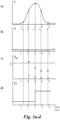
- Figs. 3a-b show typical tracer T (a) and substance S (b) concentration readings versus time by a sensor located 20 to 50 cm in front of a sober subject's face.
- the subject is a vehicle driver occupying the driver's seat, with the sensor being located at the steering wheel.
- t 1 the tracer signal is increasing from steady state as a result of exhaled breath from the subject arriving at the sensor.
- the onset time t 1 indicates the start of an evaluation period corresponding to the duration of an exhaled breath, or approximately five seconds.
- the onset time t 1 of the evaluation period may be determined by using preset criteria based on increasing slope and curvature of the tracer concentration as a function of time.
- the slope and curvature of the signal representing concentration may be determined by computing the first and second time derivative of the signal.
- the tracer concentration T 1 occurring at t 1 , the coordinate t 1 ;T 1 is preferably used as baseline for subsequent calculations of the T concentration.
- An alternative definition of the baseline is the smallest detected concentration within the current evaluation period.
- a third option is the average lowest concentration before and after a peak.
- the signals T and S are according to one embodiment sampled at a repetition rate of 5 samples per second or more using state of the art analog to digital converters.
- First and second time derivatives may be numerically computed in real time by recording first and second differences between subsequent signal samples.
- the signal illustrated in Fig. 3b corresponds to the local concentration of the intoxicating substance S exhibits characteristics of random noise throughout the recording in the absence of this substance in the driver's breath. Readings of the substance concentration S at the times t 1 , t 2 , t 3 , t 4 , t 5 referred to a baseline as previously described will be close to zero except for random fluctuations due to noise.
- the coincidence in time and shape of concentration peaks in the T and S channels may all be determined from analysis of the time curves and their first and second derivatives. By shape is meant, for example, asymmetry between the rising and declining phases, or the peak widths defined by, for example, the time difference between inflection points.
- T alv represents the alveolar tracer concentration, which is 42 000 ppm in the case of CO 2 as the tracer gas, and 60 000 for H 2 O. Further numerical values of variables and parameters are provided below in relation to describing the error management strategy using data from table 1.
- the proportionality factor T alv / ⁇ T i corresponds to the degree of dilution of the expired breath, referred to as dilution factor, DF.
- equation (1) is written using one of the alternative definitions of baseline, the coordinates t 1 ;T 1 as previously described. By redefining T 1 and S 1 to denote the baseline in the general case, equation (1) is still valid.
- the third graph from the top of Fig. 3 shows the accumulated calculated breath substance concentrations S Br-av over time.
- the running average breath concentration, S Br-av the running average breath concentration, S Br-av ,
- Each calculation of S Br-av is associated with an estimate of the total measurement error marked by the simultaneous 'o' in the third graph from top of Fig. 3 of the corresponding calculations.
- the error estimate includes both systematic and random errors, such as a multiple of the standard deviation expressed in equation (3).
- the error is decreasing with time as indicated in Fig. 3c , due to accumulating underlying data.
- the estimated error is below a preset limit value L.
- the signal contributions slowly decrease during the decline of the tracer peak, there is some further reduction of the error at t 4 .
- At t 5 there is no further error reduction.
- the running average breath concentration, SBr-av, and the statistical variance, SBr- ⁇ are calculated according to equations (2) and (3), respectively with samples from a current evaluation period or from a plurality of evaluation periods.
- Figs. 4a-d have the same graphical outline as Figs. 3a-d , but with a case when the subject is exhaling a non-zero intoxicating substance concentration.
- the two coinciding peaks shown in the tracer and substance concentrations are an effect of two expired breaths with a time interval of approximately 5 seconds.
- the instant t 1 occurs at the beginning of one breath, when the tracer concentration T is starting to increase.
- T i -T 1 slope and curvature are used as indicator for stopping the calculations at a time t N .
- New starting and stopping times are defined by the beginning and decline of the next peak as illustrated by the vertical dashed lines extending through the graphs of Fig. 4a-d .
- Fig. 4d depicts the drivability control signal D as a function of time, using the same time scale as in the previous three graphs.
- the preset level L At the time of crossing between the upper end of the R av error band the preset level L, full drivability should be warranted, whereas only limited drivability, or none at all, shall be allowed before this occurrence.
- the limitation could be a maximum velocity of 20 km/hour to make sure that no serious accidents due to drunk driving will occur.
- the drivability control unit should be adapted to its specific design and requirements.
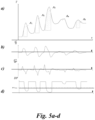
- Figs. 5a-d illustrates schematically the signal characteristics representing a series of exhaled breaths from an unexperienced subject.
- the sensor representing the tracer concentration on the top graph Fig. 5a is accompanied by its first, Fig. 5b and second time derivative Fig 5c , dT/dt, and D 2 T/dt 2 , respectively.
- the signal T in the graph of Fig. 5a shows a tight sequence of five concentration peaks A 1 -A 5 resulting from consecutive exhaled breaths.
- the time interval between the peaks are too small for the baseline to be returning to its original level between each breath. The reason is that residual gas from the previous breath was still present within the breath analyzer cavity, adding to the tracer concentration.
- the shaded areas below four of the five peaks represent time intervals at which peak parameters are being calculated.
- the timings and baselines for each calculation are determined by features from the graphs of dT/dt, d 2 T/dt 2 , and DF, shown below the top graph. All graphs share the same time scale.
- the starting and stopping points in time are determined by inflection points of the top curve, Fig. 5a , coinciding with zero crossings of d 2 T/dt 2 , Fig. 5c .
- the baseline in the exemplified embodiment is defined by the coordinates at which the dilution factor DF is below a preset limit DF max . These coordinates are evident from the fourth graph from the top of Fig. 5 .
- the fourth peak A 4 from left in Fig. 5d never reaches this level.
- the calculation step is performed if the dilution factor is above a preset limit DF max .
- Table 1 is a summary of error sources of various origin, either systematic or stochastic, additive or multiplicative, and their approximate magnitude.
- the exemplified case concerns ethyl alcohol as the intoxicating substance with either CO 2 or H 2 O, or both, as tracer substance.
- the error estimates are presented in relation to an assumed limit alcohol concentration of 50 ppm, which is the legal limit for vehicle drivers in Sweden.
- a maximum dilution factor DF 100 is assumed.
- the estimated magnitudes correspond to one standard deviation.
- Table 1. Estimated magnitude of error sources related to physiology, environment and technology. The estimations are partly based on the following literature: A. B. Lumb Nunn's Applied Respiratory Physiology, 6 th Ed. (2005), A.
- the first three variabilities are related to physiology, the next three are environmental, whereas the remaining five sources are related to technological performance.
- the categorization in systematic or stochastic nature is important for the management strategy.
- a systematic error source can be considered as a constant parameter, whereas a stochastic error should preferably be dynamically retrieved.
- the alveolar tracer variabilities of CO 2 and H 2 O are both inter-individual and related to the level of physical activity. Therefore, they include both systematic and stochastic elements depending on actual circumstances.
- the alveolar CO 2 concentration is approximately 42 000 ppm, and 60 000 ppm is the corresponding H 2 O concentration.
- the variabilities noted in Table 1 are one standard deviation from the average values. The influence from these variabilities are mainly multiplicative being part of the dilution factor DF.
- the physiological dead space is different for CO 2 compared to H 2 O since the origin of CO 2 is alveolar, whereas H 2 O is diffused from the entire respiratory tract.
- the background CO 2 variability is 400-1000 ppm in absolute numbers which is relatively small in comparison with the alveolar concentration 0f 42 000 ppm.
- the background H 2 O variability is much larger, and its limits are depending on systematic or circumstantial environmental variabilities. In extreme circumstances, the background concentration may exceed the alveolar concentration of 60000 ppm.
- Gas flow inhomogeneities may result from ambient air flow at the site of classification or from mixing effects due to the varying expiratory air flow. In the former case, the contribution will be additive, in the latter it will be multiplicative.
- Noise appearing in the sensor signals can be further categorized into thermal, flicker, or shot noise, depending on the underlying physical principle.
- thermal noise from the infrared detectors will dominate.
- the magnitude of this noise source is proportional to the square root of the bandwidth. Time averaging of the signal output will thus increase the signal to noise ratio.
- Offset errors may have different causes, ranging from alternative definitions of baseline deviation, to drift due to, for example, temperature, barometric pressure, and supply voltage. Offset occurring in the tracer signal will have multiplicative influence, whereas a substance offset error will be additive.
- Calibration errors are multiplicative deviations from linear sensor signal characteristics. They may occur both in the signals corresponding to the intoxicating or tracer substances.
- Cross sensitivity between the involved substances may result from overlap in the spectroscopic absorption curves.
- the influence is basically known from the spectroscopic data and may at least partly be considered as a systematic error source. In the general case it may be either additive or multiplicative.
- Equation (5) is written for the case of a symmetric error band. In the more general case, additive and subtractive contributions may be separated.
- equation (6) the stochastic and systematic contributions to E est are summarized.
- the estimated total breath substance concentration S Br-est is calculated using equation (5).
- E est M ⁇ S Br ⁇ ⁇ m + E add + E mult ⁇ S Br ⁇ av
- E add represents the combined systematic and additive error sources as listed in Table 1.
- the corresponding multiplicative error E mult is multiplied with S Br-av to provide the actual error contribution.
- a running total measurement error estimate, E est is calculated using equation (6).
- the gap is calculated in real time during and after the evaluation period.
- G>0 indicates that further measurement data are required before classification can be performed.
- the magnitude of G is visualized to the user, for example as a bar graph indicator. This is only valid for G>0.
- the gap value is calculated using equation (7) and utilized to classify the concentration of the intoxicating substance in the exhaled breath of the user.
- Figs. 7a-d illustrates how common sensor signal errors and disturbances are managed by the method according to the invention.
- Fig. 7 shows four graphs (a)-(d) in which the sensor signals representing the tracer (T) and intoxicating substances (S) are plotted as a function of time with a common time scale.
- T tracer
- S intoxicating substances
- the T and S signals are sampled with a sampling rate of at least five samples per second.
- a time period of five seconds, or less than a typical respiratory cycle, will thus comprise 25 or more signal samples which may be used for signal processing, mathematical or statistical analysis. For clarity of illustration, the effects of disturbances are somewhat exaggerated.
- the exact timing of concentration peaks is not controlled.
- the evaluation period is defined by localizing the target concentration peak by the points in time when the onset and the peak occurs. The location in time of these events directly follows from analysis of the first and second time derivatives of the target concentration signal, and finding their zero crossings.
- Fig. 7a illustrates an undisturbed situation involving distinct and coinciding peaks in the T and S channels.
- the location of the tracer peak concentration is marked with an 'o' in the graph.
- the first time derivative is zero.
- Two inflection points on each side of the peak are marked with 'x' in the graph corresponding to a shift in curvature of the T curve, coinciding with zero crossings of the second time derivative. From the coordinates of the peak and inflection points, the magnitude and width of both the T and S peaks can be calculated.
- Fig. 7b illustrates the occurrence of a static offset error occurring in the T channel caused by, for example, an elevated background tracer concentration.
- a static offset error occurring in the T channel caused by, for example, an elevated background tracer concentration.
- Fig. 7c shows an example of offset drift in time occurring in both the T and S channels. Such drift may occur during startup of the breath analyzer before steady state conditions have been established. By using the coordinates for the peak maximum and inflection points in one or both channels the drift may be quantified. A correction may be implemented by making use of an interpolated baseline determined by the time slope of the inflection points. The dashed lines illustrate such constructed baselines.
- Fig. 7d shows a case of a low signal level in the S channel, resulting from poor the signal to noise ratio.
- the situation may occur when the subject's breath is weak or not directed towards the sensor location. In such a case, the measured tracer and intoxicating substance concentrations will be small.
- the substance concentration is expected to be more than two orders of magnitude lower than the tracer concentration. Therefore, stochastic variations, or noise, in the S channel is likely to be a limiting factor to resolution and accuracy.
- Both the measurement result and error are according to the invention computed in real time by accumulating sensor data representing both the concentration of a tracer substance, e g CO 2 , or water vapor, H 2 O, always present in human expiratory air, and simultaneous data representing the concentration of an intoxicating substance, e g ethyl alcohol.
- the real time calculation and the continuous classification speeds up the process significantly.
- An advantage afforded by the present invention is that a normal detection procedure (no intoxicating substance) is always fast, while on indication of presence of an intoxicating substance (or tampering of the procedure) the classification process is allowed to take longer time. A short process time for the normal (no intoxicating substance) case is considered as critical for acceptance from users.
- a feedback may give incitement for the user to take actions facilitating the analysis, for example leaning towards the sensor inlet etc.
- the possibility to give a feedback on the status of the classification process is a further advantage of the invention.
Landscapes
- Health & Medical Sciences (AREA)
- Life Sciences & Earth Sciences (AREA)
- Engineering & Computer Science (AREA)
- Physics & Mathematics (AREA)
- Molecular Biology (AREA)
- Biomedical Technology (AREA)
- General Health & Medical Sciences (AREA)
- Pathology (AREA)
- Chemical & Material Sciences (AREA)
- Biophysics (AREA)
- Public Health (AREA)
- Heart & Thoracic Surgery (AREA)
- Medical Informatics (AREA)
- Veterinary Medicine (AREA)
- Surgery (AREA)
- Animal Behavior & Ethology (AREA)
- Artificial Intelligence (AREA)
- General Physics & Mathematics (AREA)
- Analytical Chemistry (AREA)
- Biochemistry (AREA)
- Immunology (AREA)
- Physiology (AREA)
- Psychiatry (AREA)
- Transportation (AREA)
- Combustion & Propulsion (AREA)
- Mechanical Engineering (AREA)
- Spectroscopy & Molecular Physics (AREA)
- Signal Processing (AREA)
- Computer Vision & Pattern Recognition (AREA)
- Food Science & Technology (AREA)
- Hematology (AREA)
- Medicinal Chemistry (AREA)
- Urology & Nephrology (AREA)
- Toxicology (AREA)
- Fuzzy Systems (AREA)
- Evolutionary Computation (AREA)
- Bioinformatics & Cheminformatics (AREA)
- Pharmacology & Pharmacy (AREA)
- Mathematical Physics (AREA)
- Educational Technology (AREA)
Claims (18)
- Procédé de détermination d'une concentration d'une substance toxique dans l'haleine expirée d'un utilisateur et de classification de la concentration déterminée, dans lequel le procédé classifie la concentration déterminée comme acceptable si la concentration déterminée est inférieure à une limite de concentration prédéterminée, L, le procédé comprenant les étapes suivantes :- (200) l'échantillonnage d'un signal de capteur représentant la concentration instantanée de la substance toxique et d'un signal de capteur représentant la concentration instantanée d'une substance traceuse et la répétition des échantillonnages à un taux d'échantillonnage prédéterminé ;- (210) l'analyse d'un ensemble courant d'échantillons de signal de substance traceuse et si une pente croissante est détectée, la pente croissante indiquant un pic possible dans le signal de substance traceuse, l'initiation d'une période d'évaluation ;caractérisé par :- (230:1) le calcul d'une moyenne mobile de concentration dans l'haleine, SBr-av , dudit signal de substance toxique pour le nombre croissant d'échantillons de signal de substance toxique de la période d'évaluation, le calcul de concentration dans l'haleine étant basé sur l'amplitude relative entre le signal de substance toxique et le signal de substance traceuse et le calcul d'une variance statistique, SBr-σ , de la concentration dans l'haleine en tant qu'estimation de la dispersion statistique associée ;- (230:3) le calcul d'une valeur d'écart, G, indiquant si une classification fiable peut être exécutée, la valeur d'écart étant fonction d'au moins la moyenne mobile de concentration dans l'haleine calculée SBr-av , et de la variance statistique, SBr-σ, et- (230:4) la répétition des étapes de calcul pour un nombre croissant d'échantillons de signal de capteur jusqu'à ce que la valeur de l'écart indique qu'une classification fiable peut être exécutée, et- (240:1) l'exécution de la classification en comparant la moyenne mobile de concentration dans l'haleine avec la limite de concentration prédéterminée, L, et- (220:2) l'analyse de la pente des échantillons de signal de traceur, et- (220:3) si une pente décroissante dans des échantillons consécutifs de signal de traceur est détectée au cours de la période d'évaluation, l'existence d'un pic est déterminée comme étant vérifiée et la classification est déterminée comme étant correcte et le résultat de la classification est émis (240:2) et le processus de classification est terminé, et- (220:4) si aucune pente décroissante dans des échantillons consécutifs de signal de traceur n'est détectée au cours de la période d'évaluation, la période d'évaluation est terminée, la moyenne mobile de concentration dans l'haleine calculée, SBr-av , la variance statistique de la concentration dans l'haleine, SBr-σ , la valeur d'écart, G, et la classification sont rejetées et le procédé revient aux étapes d'échantillonnage des signaux de capteur et d'analyse des échantillons de signal de substance traceuse.
- Procédé selon la revendication 1, dans lequel le procédé comprend l'étape supplémentaire suivante, à effectuer pendant la période d'évaluation :- (235) si l'estimation de la dispersion statistique associée indique que la comparaison ne peut pas être exécutée avec un niveau de précision prédéterminé au cours de la période d'évaluation, le retour à l'étape d'échantillonnage pour attendre un nouveau pic dans la détection de signal de substance traceuse ayant une nouvelle période d'évaluation associée, et pendant laquelle nouvelle période d'évaluation, le calcul de la moyenne mobile de la concentration dans l'haleine de la substance toxique et de la dispersion statistique associée comporte les échantillons de signal de traceur et les échantillons de signal de substance toxique associés à la période d'évaluation actuelle et à au moins la période d'évaluation précédente.
- Procédé selon la revendication 2, dans lequel le calcul de la moyenne mobile de la concentration dans l'haleine de la substance toxique et de la dispersion statistique associée comporte les échantillons de signal de traceur et les échantillons de signal de substance toxique associés à la période d'évaluation actuelle et à toutes les périodes d'évaluation précédentes.
- Procédé selon la revendication 6, dans lequel l'étape de calcul comprend en outre l'étape suivante :- (230:2) le calcul d'une estimation d'erreur de mesure totale mobile, Eest , l'estimation d'erreur de mesure totale mobile étant fonction d'au moins l'écart type de la concentration dans l'haleine, d'une composante d'erreur multiplicative prédéterminée, Emult , multipliée par la concentration dans l'haleine moyenne et d'une composante d'erreur additive prédéterminée, Eadd, et dans lequel la valeur d'écart, G, est une fonction d'au moins la limite de concentration prédéterminée, la moyenne mobile de concentration dans l'haleine et l'estimation d'erreur de mesure totale mobile.
- Procédé selon les revendications 1 à 4, comprenant une sous-étape supplémentaire d'affichage d'une représentation de la valeur d'écart.
- Procédé selon la revendication 5, comprenant en outre le calcul d'un taux de changement de la valeur d'écart, et l'estimation à partir du taux de changement du temps restant pour exécuter une classification et l'affichage d'une représentation du temps restant.
- Procédé selon l'une quelconque des revendications 1 à 6, dans lequel l'étape d'analyse du signal de substance traceuse pour détecter un pic comprend le calcul et l'analyse de la première et/ou de la seconde dérivée temporelle du signal de traceur.
- Procédé selon la revendication 7, dans lequel le temps d'apparition de pic correspond à un premier passage à zéro dans la seconde dérivée et le temps de déclin de pic correspond à un passage à zéro consécutif dans la seconde dérivée du signal de traceur.
- Procédé selon l'une quelconque des revendications 1 à 8, dans lequel la période d'évaluation est terminée après un temps correspondant à une période de temps d'expiration moyenne prédéterminée d'un cycle respiratoire humain.
- Procédé selon l'une quelconque des revendications 1 à 8, dans lequel la moyenne mobile de concentration dans l'haleine sur m échantillons de temps, SBr-av , est calculée selon


- Procédé selon la revendication 6, dans lequel la valeur d'écart, G, est calculée selon
 dans lequel l'addition de (L-SBr-av ) et Eest est utilisée lorsque SBr-av est supérieure à L, et la différence de (L-SBr-av ) et Eest est utilisée lorsque SBr-av est inférieure à L, etla classification est déterminée comme fiable, alors la condition G<0 est remplie.
 - Procédé selon l'une quelconque des revendications 1 à 11, dans lequel si aucun pic n'est détecté dans le signal de traceur pendant une première période de temps prédéterminée, un avertissement de données manquantes est émis.
- Procédé selon l'une quelconque des revendications 1 à 7, dans lequel si aucune pente décroissante n'est détectée dans le signal de traceur pendant une seconde période de temps prédéterminée, un avertissement ou une instruction est émis pour amener l'utilisateur à réaliser une action.
- Système d'analyse d'haleine (100) pour déterminer une concentration d'une substance toxique dans l'haleine expirée d'un utilisateur et classifier la concentration déterminée, le système d'analyse d'haleine (100) comprenant une unité de mesure (110) en connexion avec et sous la commande d'une unité de commande (31), qui est en connexion avec une unité d'interface homme/machine (34), l'unité de mesure (110) est dotée d'une entrée (3) qui est agencée pour diriger un échantillon d'haleine (2) d'un utilisateur dans une cellule de mesure de l'unité de mesure (110), l'entrée (3) étant prévue dans une position qui, pendant l'utilisation, se trouve devant l'utilisateur, le système d'analyse d'haleine (100), dans lequel l'unité de commande (31) est agencée pour :- (200) commander l'unité de mesure (110) pour échantillonner de manière répétitive un signal de capteur représentant la concentration instantanée de la substance toxique et un signal de capteur représentant la concentration instantanée d'une substance traceuse ;caractérisé en ce que l'unité de commande (31) est en outre agencée pour :- (210) analyser l'ensemble courant des échantillons de signal de substance traceuse et si une pente croissante est détectée, la pente croissante indiquant un pic possible dans le signal de substance traceuse, initier une période d'évaluation ;- (230:1) calculer une moyenne mobile de concentration dans l'haleine, SBr-av , dudit signal de substance toxique pour le nombre croissant d'échantillons de signal de substance toxique de la période d'évaluation, le calcul de concentration dans l'haleine étant basé sur l'amplitude relative entre le signal de substance toxique et le signal de substance traceuse et le calcul d'une variance statistique, SBr-σ , de la concentration dans l'haleine en tant qu'estimation de la dispersion statistique associée ;- (230:3) calculer une valeur d'écart, G, indiquant si une classification fiable peut être exécutée, la valeur d'écart étant fonction d'au moins la moyenne mobile de concentration dans l'haleine calculée SBr-av, et de la variance statistique, SBr-σ , et- (230:4) répéter les étapes de calcul pour un nombre croissant d'échantillons de signal de capteur jusqu'à ce que la valeur d'écart indique qu'une classification fiable peut être exécutée, et- (240:1) exécuter la classification en comparant la moyenne mobile de concentration dans l'haleine avec la limite de concentration prédéterminée, L, et- (220:2) analyser la pente des échantillons de signal de traceur, et- (220:3) si une pente décroissante dans des échantillons consécutifs de signal de traceur est détectée au cours de la période d'évaluation, l'existence d'un pic est déterminée comme étant vérifiée et la classification est déterminée comme étant correcte et le résultat de la classification est émis (240:2) et le processus de classification est terminé, et- (220:4) si aucune pente décroissante dans des échantillons consécutifs de signal de traceur n'est détectée au cours de la période d'évaluation, la période d'évaluation est terminée, la moyenne mobile de concentration dans l'haleine calculée, SBr-av , la variance statistique de la concentration dans l'haleine, SBr-σ , la valeur d'écart, G, et la classification sont rejetées et le procédé revient aux étapes d'échantillonnage des signaux de capteur et d'analyse des échantillons de signal de substance traceuse.
- Système d'analyse d'haleine (100) selon la revendication 14, dans lequel l'unité de commande (31) est en outre agencée pour- (235) si l'estimation de la dispersion statistique associée indique que la comparaison ne peut pas être exécutée avec un niveau de précision prédéterminé au cours de la période d'évaluation, stocker la moyenne mobile calculée de la concentration dans l'haleine de la substance toxique et l'estimation de la dispersion statistique associée dans un dispositif de mémoire (33), etcommander l'unité de mesure (110) afin de continuer l'échantillonnage pour attendre un nouveau pic dans la détection de signal de substance traceuse ayant une nouvelle période d'évaluation associée, et pendant laquelle nouvelle période d'évaluation, le calcul de la moyenne mobile de la concentration dans l'haleine de la substance toxique et de la dispersion statistique associée comporte les échantillons de signal de traceur et les échantillons de signal de substance toxique associés à la période d'évaluation actuelle et à au moins la période d'évaluation précédente.
- Système d'analyse d'haleine (100) selon la revendication 15, dans lequel l'unité de commande (31) est agencée pour comporter les échantillons de signal de traceur et les échantillons de signal de substance toxique associés à la période d'évaluation actuelle et à toutes les périodes d'évaluation précédentes dans le calcul de la moyenne mobile de la concentration dans l'haleine de la substance toxique et de la dispersion statistique associée.
- Système d'analyse d'haleine (100) selon l'une quelconque des revendications 14 et 15, dans lequel l'unité de commande (31) est agencée pour transmettre le résultat de classification à l'unité d'interface homme/machine (34), qui est agencée pour délivrer une représentation du résultat de classification à un utilisateur.
- Système d'analyse d'haleine (100) selon l'une quelconque des revendications 14 à 16, comprenant en outre une unité de commande de conduite de véhicule (35) en connexion avec l'unité de commande (31), et dans lequel l'unité de commande (31) est agencée pour, si le résultat de classification est que la concentration de l'utilisateur de substance toxique n'est pas acceptable, ordonner à l'unité de commande de conduite de véhicule (35) de ne pas autoriser l'utilisateur à conduire le véhicule.
Applications Claiming Priority (2)
| Application Number | Priority Date | Filing Date | Title |
|---|---|---|---|
| SE2050105A SE2050105A1 (en) | 2020-01-31 | 2020-01-31 | Method and system for tracer-aided determination and classification of intoxicating substance in breath sample |
| PCT/SE2021/050061 WO2021154147A1 (fr) | 2020-01-31 | 2021-01-29 | Procédé et système de détermination et de classification assistée par traceur de substance toxique dans un échantillon d'haleine |
Publications (2)
| Publication Number | Publication Date |
|---|---|
| EP4097472A1 EP4097472A1 (fr) | 2022-12-07 |
| EP4097472B1 true EP4097472B1 (fr) | 2024-10-23 |
Family
ID=74572833
Family Applications (1)
| Application Number | Title | Priority Date | Filing Date |
|---|---|---|---|
| EP21704333.0A Active EP4097472B1 (fr) | 2020-01-31 | 2021-01-29 | Procédé et système de détermination et de classification assistée par traceur de substance toxique dans un échantillon d'haleine |
Country Status (5)
| Country | Link |
|---|---|
| US (1) | US12504422B2 (fr) |
| EP (1) | EP4097472B1 (fr) |
| CN (1) | CN115380216A (fr) |
| SE (1) | SE2050105A1 (fr) |
| WO (1) | WO2021154147A1 (fr) |
Families Citing this family (6)
| Publication number | Priority date | Publication date | Assignee | Title |
|---|---|---|---|---|
| SE544863C2 (en) | 2020-07-29 | 2022-12-13 | Senseair Ab | Method and system for determination and classification of intoxicating substance in a breath sample facilitated by a user interaction scheme |
| DE102022201701A1 (de) * | 2022-02-18 | 2023-08-24 | Zf Friedrichshafen Ag | Fahrzeugbedienelement zum Messen von Konzentrationen von Substanzen in Ausatemluft und/oder Körpergeruch von Fahrzeuginsassen |
| DE102022212468A1 (de) * | 2022-11-23 | 2024-05-23 | Zf Friedrichshafen Ag | Fahrzeugbedienelement |
| SE548033C2 (en) * | 2022-12-16 | 2026-01-13 | Automotive Coalition For Traffic Safety Inc | Multipass spectroscopic absorption cell and gas sensor comprising such |
| DE102023121741A1 (de) * | 2023-08-15 | 2025-02-20 | Drägerwerk AG & Co. KGaA | Sensoranordnung |
| CN116952850B (zh) * | 2023-09-20 | 2024-01-05 | 安徽农业大学 | 一种基于非分散红外检测的动态减少抖动反演方法 |
Family Cites Families (180)
| Publication number | Priority date | Publication date | Assignee | Title |
|---|---|---|---|---|
| US3283563A (en) | 1963-07-17 | 1966-11-08 | Beckman Instruments Inc | Gas chromatographic system having barometric pressure compensation |
| US3301482A (en) | 1964-06-16 | 1967-01-31 | Barber Colman Co | Ramp program control system |
| US3792351A (en) | 1972-03-10 | 1974-02-12 | F Ireland | Absorption frequency meter having shielded inductor |
| US3780311A (en) | 1972-06-14 | 1973-12-18 | Environmental Metrology Corp | Breath alcohol detector and automotive ignition interlock employing same |
| US3830630A (en) | 1972-06-21 | 1974-08-20 | Triangle Environment Corp | Apparatus and method for alcoholic breath and other gas analysis |
| US3792272A (en) | 1973-01-12 | 1974-02-12 | Omicron Syst Corp | Breath test device for organic components, including alcohol |
| US3897659A (en) | 1974-08-30 | 1975-08-05 | Us Energy | Ultrasonic-acoustic grinding wheel setting station for automatic numerically-controlled machines |
| DE2610578B2 (de) | 1976-03-13 | 1978-05-11 | Draegerwerk Ag, 2400 Luebeck | Verfahren und Anordnung zur Bestimmung des Atemalkoholgehaltes |
| US4294327A (en) | 1978-12-15 | 1981-10-13 | Delta Systems, Inc. | Safety interlock for machine and engine with magneto ignition |
| US4535620A (en) | 1983-08-12 | 1985-08-20 | Internorth, Inc. | Method for automatically measuring the amount of water in a natural gas pipeline with the aid of a computer controlled gas chromatograph |
| US4678057A (en) | 1986-01-16 | 1987-07-07 | Autosense Corporation | Breath alcohol analyzer |
| GB8614515D0 (en) | 1986-06-14 | 1986-07-23 | Lion Lab Ltd | Alcohol detecting devices |
| US4749553A (en) | 1987-04-08 | 1988-06-07 | Life Loc, Inc. | Breath alcohol detector with improved compensation for environmental variables |
| US4843377A (en) | 1987-04-21 | 1989-06-27 | Guardian Technologies, Inc. | Remote confinement system |
| US4996161A (en) | 1987-10-16 | 1991-02-26 | Guardian Technologies, Inc. | Breath alcohol testing system |
| US5006315A (en) | 1988-02-25 | 1991-04-09 | Air Products And Chemicals, Inc. | Automated preparative gas chromatograph |
| US4916435A (en) | 1988-05-10 | 1990-04-10 | Guardian Technologies, Inc. | Remote confinement monitoring station and system incorporating same |
| CA2013603A1 (fr) | 1989-04-03 | 1990-10-03 | Anthony Porter | Analyseur d'haleine |
| US4975581A (en) | 1989-06-21 | 1990-12-04 | University Of New Mexico | Method of and apparatus for determining the similarity of a biological analyte from a model constructed from known biological fluids |
| WO1992022813A1 (fr) | 1991-06-19 | 1992-12-23 | Alcohol Measuring Equipment Pty. Limited | Appareil d'analyse de l'alcool contenu dans l'haleine |
| DE4127599A1 (de) | 1991-08-21 | 1993-02-25 | Fenyves U Gut Deutschland Gmbh | Einrichtung zur ueberwachung der atmung eines patienten |
| US5303575A (en) | 1993-06-01 | 1994-04-19 | Alcotech Research Inc. | Apparatus and method for conducting an unsupervised blood alcohol content level test |
| US5426415A (en) | 1993-06-21 | 1995-06-20 | Consumer Safety Technology | Breath analyzer for use in automobile ignition locking systems |
| US5485850A (en) | 1993-08-13 | 1996-01-23 | Dietz; Henry G. | Monitor of low pressure intervals with control capabilities |
| US5544276A (en) | 1993-11-30 | 1996-08-06 | Microsensors Technology, Inc. | Miniature gas chromatograph with heated gas inlet fitting, heated tubing, and heated microvalve assembly |
| CA2185655A1 (fr) | 1994-03-30 | 1995-10-12 | Neal Arthur Welti | Dispositif de controle et embout |
| US5906203A (en) | 1994-08-01 | 1999-05-25 | Safety Equipment Sweden Ab | Breathing apparatus |
| US5693944A (en) | 1994-09-02 | 1997-12-02 | Ntc Technology, Inc. | Gas analyzer cuvettes |
| WO1996027792A1 (fr) | 1995-03-03 | 1996-09-12 | Microsensor Technology, Inc. | Injecteur a volume fixe et capacite de reflux |
| US5731581A (en) | 1995-03-13 | 1998-03-24 | Ohmeda Inc. | Apparatus for automatic identification of gas samples |
| GB9512396D0 (en) | 1995-06-17 | 1995-08-16 | Lion Lab Plc | Breath testing apparatus |
| US6129680A (en) | 1995-06-19 | 2000-10-10 | Btg International Limited | Animal exhalation monitoring |
| DK0834073T3 (da) | 1995-06-19 | 2000-12-27 | Btg Int Ltd | Monitorering af dyreuddunstning |
| FI102511B (fi) | 1995-06-26 | 1998-12-31 | Instrumentarium Oy | Pitoisuusmittaus hengitysilmasta |
| US6152876A (en) | 1997-04-18 | 2000-11-28 | Rio Grande Medical Technologies, Inc. | Method for non-invasive blood analyte measurement with improved optical interface |
| US7016713B2 (en) | 1995-08-09 | 2006-03-21 | Inlight Solutions, Inc. | Non-invasive determination of direction and rate of change of an analyte |
| US5655530A (en) | 1995-08-09 | 1997-08-12 | Rio Grande Medical Technologies, Inc. | Method for non-invasive blood analyte measurement with improved optical interface |
| US5963679A (en) | 1996-01-26 | 1999-10-05 | Harris Corporation | Electric field fingerprint sensor apparatus and related methods |
| US6229908B1 (en) | 1996-04-26 | 2001-05-08 | Edmonds, Iii Dean Stockett | Driver alcohol ignition interlock |
| US5746973A (en) | 1996-07-10 | 1998-05-05 | Naraghi; Ali | Method for reducing odorant depletion |
| SE519902C2 (sv) | 1996-11-06 | 2003-04-22 | Servotek Ab | Sätt och apparat för att indirekt bestämma koncentrationen av ett förutbestämt ämne i blodet |
| US5877345A (en) | 1997-02-07 | 1999-03-02 | Rohm And Haas Company | Process for producing butyl acrylate |
| US5955886A (en) | 1997-07-10 | 1999-09-21 | Pcp, Inc. | Microliter-sized ionization device and method |
| JP3531663B2 (ja) | 1997-09-30 | 2004-05-31 | グローリー工業株式会社 | 個人認証装置 |
| US5830112A (en) | 1997-10-16 | 1998-11-03 | Greenmaster Industrial Corp. | Foldable jogging simulator |
| DE19811872C1 (de) | 1998-03-18 | 1999-08-19 | Siemens Ag | Zündanlaßschalter für ein Kraftfahrzeug |
| JP4080608B2 (ja) | 1998-09-25 | 2008-04-23 | 浜松ホトニクス株式会社 | 半導体レーザ光源装置 |
| US7098037B2 (en) | 1998-10-13 | 2006-08-29 | Inlight Solutions, Inc. | Accommodating subject and instrument variations in spectroscopic determinations |
| US6441388B1 (en) | 1998-10-13 | 2002-08-27 | Rio Grande Medical Technologies, Inc. | Methods and apparatus for spectroscopic calibration model transfer |
| US6157041A (en) | 1998-10-13 | 2000-12-05 | Rio Grande Medical Technologies, Inc. | Methods and apparatus for tailoring spectroscopic calibration models |
| US6123674A (en) | 1998-10-15 | 2000-09-26 | Ntc Technology Inc. | Airway valve to facilitate re-breathing, method of operation, and ventilator circuit so equipped |
| DE19851950A1 (de) | 1998-11-11 | 2000-05-25 | Bosch Gmbh Robert | Bedienvorrichtung für ein Kraftfahrzeug |
| DE19938064B4 (de) | 1999-01-29 | 2004-09-23 | Siemens Ag | Identifikationsvorrichtung, insbesondere für die Zugangskontrolle zu einem Objekt |
| US6142951A (en) | 1999-04-24 | 2000-11-07 | Park; Jun I. | Directional baton with a breath analyzer |
| US6748301B1 (en) | 1999-07-24 | 2004-06-08 | Ryu Jae-Chun | Apparatus and method for prevention of driving of motor vehicle under the influence of alcohol and prevention of vehicle theft |
| US6266353B1 (en) | 1999-07-30 | 2001-07-24 | The Regents Of The University Of California | Monolithic laser diode array with one metalized sidewall |
| US6468222B1 (en) | 1999-08-02 | 2002-10-22 | Healthetech, Inc. | Metabolic calorimeter employing respiratory gas analysis |
| AU6515000A (en) | 1999-08-02 | 2001-02-19 | Healthetech, Inc. | Metabolic calorimeter employing respiratory gas analysis |
| JP2001057440A (ja) | 2000-01-01 | 2001-02-27 | Matsushita Electric Ind Co Ltd | 波長選択受光素子 |
| US7137555B2 (en) | 2000-02-28 | 2006-11-21 | Psc Scanning, Inc. | Multi-format bar code reader |
| US6726636B2 (en) | 2000-04-12 | 2004-04-27 | Loran Technologies, Inc. | Breathalyzer with voice recognition |
| JP2002116141A (ja) | 2000-08-01 | 2002-04-19 | Society For Techno-Innovation Of Agriculture Forestry & Fisheries | ハンディ型果実成分非破壊測定器 |
| US6608399B2 (en) | 2000-10-17 | 2003-08-19 | Lear Corporation | Vehicle universal docking station and electronic feature modules |
| US6983176B2 (en) | 2001-04-11 | 2006-01-03 | Rio Grande Medical Technologies, Inc. | Optically similar reference samples and related methods for multivariate calibration models used in optical spectroscopy |
| US8174394B2 (en) | 2001-04-11 | 2012-05-08 | Trutouch Technologies, Inc. | System for noninvasive determination of analytes in tissue |
| US7202091B2 (en) | 2001-04-11 | 2007-04-10 | Inlight Solutions, Inc. | Optically similar reference samples |
| US7756558B2 (en) | 2004-05-24 | 2010-07-13 | Trutouch Technologies, Inc. | Apparatus and methods for mitigating the effects of foreign interferents on analyte measurements in spectroscopy |
| US6862091B2 (en) | 2001-04-11 | 2005-03-01 | Inlight Solutions, Inc. | Illumination device and method for spectroscopic analysis |
| AU2002355079C1 (en) | 2001-07-16 | 2008-03-06 | Sensor Tech, Inc. | Sensor device and method for qualitative and quantitative analysis of gas phase substances |
| EP1279368A3 (fr) | 2001-07-17 | 2004-09-15 | ndd Medizintechnik AG | Dispositif pour mesurer la vitesse de circulation et/ou la masse molaire des gaz ou de mélanges gazeux |
| US6633090B2 (en) | 2001-09-07 | 2003-10-14 | Delphi Technologies, Inc. | Starting system for an automotive vehicle using fingerprint recognition |
| DE10157907B4 (de) | 2001-11-26 | 2006-06-08 | Siemens Gebäudesicherheit GmbH & Co. oHG | Vorrichtung zur Erfassung von Fingerabdrücken |
| US6684099B2 (en) | 2002-04-04 | 2004-01-27 | Inlight Solutions, Inc. | Apparatus and method for reducing spectral complexity in optical sampling |
| US6876300B2 (en) | 2002-11-25 | 2005-04-05 | Richard L. Ponziani | Electronic intelligent turn signal control system |
| US7095501B2 (en) | 2003-01-21 | 2006-08-22 | Delphi Technologies, Inc. | Ethyl alcohol sensor and method of use |
| JP2004245799A (ja) | 2003-02-17 | 2004-09-02 | Minoru Industrial Co Ltd | アルコール検知機、設備管理装置、及び飲酒管理システム |
| JP2004287181A (ja) | 2003-03-24 | 2004-10-14 | Toyoda Mach Works Ltd | 光導波路、光導波路アレイ及びレーザ集光装置 |
| WO2004090786A2 (fr) | 2003-04-04 | 2004-10-21 | Lumidigm, Inc. | Capteur biometrique multispectral |
| JP2004305494A (ja) | 2003-04-08 | 2004-11-04 | Erc:Kk | 飲酒検出装置及び該装置を用いた飲酒運転防止システム |
| US7749169B2 (en) | 2003-04-10 | 2010-07-06 | Intoximeters, Inc. | Handheld breath tester housing and mouthpiece |
| DE10316333B3 (de) | 2003-04-10 | 2004-01-22 | Dräger Safety AG & Co. KGaA | Atemalkohol-Messgerät mit verbessertem Mundstück |
| GB2420442B (en) | 2003-09-19 | 2007-01-10 | Intoximeters Inc | Methods and apparatus for breath alcohol testing |
| US7204335B2 (en) | 2003-10-31 | 2007-04-17 | Sheram Enterprises, Inc. | Vehicle sobriety interlock device |
| US7451852B2 (en) | 2003-10-31 | 2008-11-18 | Sherman Enterprises, Inc. | Vehicle sobriety interlock system with personal identification element |
| JP4268021B2 (ja) | 2003-11-25 | 2009-05-27 | 東海電子株式会社 | アルコール検知システム |
| US7092832B2 (en) | 2003-12-11 | 2006-08-15 | Inlight Solutions, Inc. | Adaptive compensation for measurement distortions in spectroscopy |
| JP2005227553A (ja) | 2004-02-13 | 2005-08-25 | Nhk Spring Co Ltd | 光導波路と光素子を接続する装置および接続方法ならびに光モジュール |
| JP4215676B2 (ja) | 2004-04-09 | 2009-01-28 | 株式会社マップコーポレーション | 運転者検査システム |
| US20080319286A1 (en) | 2004-05-24 | 2008-12-25 | Trent Ridder | Optical Probes for Non-Invasive Analyte Measurements |
| US7848605B2 (en) | 2004-05-24 | 2010-12-07 | Trutouch Technologies, Inc. | Method of making optical probes for non-invasive analyte measurements |
| US20110178420A1 (en) | 2010-01-18 | 2011-07-21 | Trent Ridder | Methods and apparatuses for improving breath alcohol testing |
| ATE359339T1 (de) | 2004-07-23 | 2007-05-15 | Terumo Corp | Saccharid-messender fluoreszierender monomer, saccharid-messende fluoreszierende sensor- substanz und implantierbarer, saccharid-messender sensor |
| CN1586944A (zh) | 2004-09-09 | 2005-03-02 | 刘保权 | 车载酒精传感器自动控制汽车开启的方法及其控制装置 |
| JP2006075447A (ja) | 2004-09-13 | 2006-03-23 | Hitachi Ltd | 携帯ヘルスチェック装置およびそれを用いた呼気分析サービス方法 |
| DE102004044145B3 (de) | 2004-09-13 | 2006-04-13 | Robert Bosch Gmbh | Reflektormodul für einen photometrischen Gassensor |
| JP4530212B2 (ja) | 2004-09-28 | 2010-08-25 | 株式会社タニタ | 呼気分析装置 |
| US7279132B2 (en) | 2005-01-12 | 2007-10-09 | Delphi Technologies, Inc. | Chemical vapor sensor having an active and a passive measurement mode |
| US7700044B2 (en) | 2005-01-12 | 2010-04-20 | Delphi Technologies, Inc. | Chemical vapor sensor |
| US7671752B2 (en) | 2005-02-11 | 2010-03-02 | Stephanie Sofer | Car alcohol monitoring system |
| JP5328159B2 (ja) | 2005-03-01 | 2013-10-30 | セルカコア・ラボラトリーズ・インコーポレーテッド | 多波長センサ発光体 |
| US20060253711A1 (en) | 2005-05-09 | 2006-11-09 | Charles Kallmann | Biometric safety and security system |
| JP4285447B2 (ja) | 2005-06-20 | 2009-06-24 | セイコーエプソン株式会社 | レーザ光源装置、表示装置およびプロジェクタ |
| WO2007008159A2 (fr) | 2005-07-11 | 2007-01-18 | Volvo Technology Corporation | Procede et systeme de verification d'identite de conducteur |
| BG65874B1 (bg) | 2005-07-27 | 2010-04-30 | ДУНЕВ Стефан | Устройство за измерване температурата на издишвания въздух |
| US7736903B2 (en) | 2005-10-05 | 2010-06-15 | Delphi Technologies, Inc. | Tracer to compensate for environmental variations that influence a chemical vapor sensor measurement |
| GB2431470A (en) | 2005-10-21 | 2007-04-25 | Autoliv Dev | Assessing blood concentration of a volatile constituent |
| US20080006077A1 (en) | 2005-10-31 | 2008-01-10 | Crabtree James H | Near real-time air monitor having external injector and pressure based flow control |
| DE102006018970B3 (de) | 2006-04-25 | 2007-05-03 | Dräger Safety AG & Co. KGaA | Atemalkoholmessgerät mit Piezoantrieb |
| JP4850591B2 (ja) | 2006-06-13 | 2012-01-11 | 三菱電機株式会社 | 光結合装置および固体レーザ装置およびファイバレーザ装置 |
| DE102006038438A1 (de) | 2006-08-16 | 2008-02-21 | Keppler, Bernhard, Westport | Vorrichtung, multifunktionales System und Verfahren zur Ermittlung medizinischer und/oder biometrischer Daten eines Lebewesens |
| GB2441781B (en) | 2006-09-13 | 2010-05-19 | Autoliv Dev | Breath analyser |
| GB2442980B (en) | 2006-10-18 | 2011-11-23 | Autoliv Dev | Improvements in or relating to detection of substances in a subject |
| US20080107309A1 (en) | 2006-11-03 | 2008-05-08 | Cerni Consulting, Llc | Method and apparatus for biometric identification |
| US7446878B2 (en) | 2006-11-16 | 2008-11-04 | Trutouch Technologies, Inc. | Method and apparatus for improvement of spectrometer stability, and multivariate calibration transfer |
| JP4241904B2 (ja) | 2006-12-28 | 2009-03-18 | 株式会社豊田中央研究所 | ガス検出方法及びガス検出装置 |
| DE102007002505B3 (de) | 2007-01-17 | 2008-03-27 | Dräger Safety AG & Co. KGaA | Atemalkohol-Messgerät mit einem beleuchteten Mundstück |
| CN101588888A (zh) | 2007-01-17 | 2009-11-25 | 住友电气工业株式会社 | 激光加工装置及其加工方法 |
| JP2008177473A (ja) | 2007-01-22 | 2008-07-31 | Seiko Epson Corp | レーザ光源装置およびそれを用いたモニタ装置ならびに画像表示装置 |
| SE531742C2 (sv) | 2007-02-01 | 2009-07-28 | Hoek Instr Ab | Interaktiv alkometri |
| JP5092432B2 (ja) | 2007-02-02 | 2012-12-05 | 富士ゼロックス株式会社 | 面発光型半導体レーザ、面発光型半導体レーザの製造方法、光学装置、光照射装置、情報処理装置、光送信装置、光空間伝送装置および光伝送システム |
| JP2008203774A (ja) | 2007-02-22 | 2008-09-04 | Toyota Central R&D Labs Inc | レーザー集光装置 |
| KR101484566B1 (ko) | 2007-03-21 | 2015-01-20 | 루미다임 인크. | 국소적으로 일관된 피처를 기초로 하는 생체인식 |
| JP5303851B2 (ja) | 2007-04-03 | 2013-10-02 | 株式会社島津製作所 | 飲酒検知装置 |
| JP2008302915A (ja) | 2007-05-07 | 2008-12-18 | Auto Network Gijutsu Kenkyusho:Kk | 飲酒運転防止装置 |
| JP2008291710A (ja) | 2007-05-23 | 2008-12-04 | Auto Network Gijutsu Kenkyusho:Kk | 始動装置 |
| JP2008308037A (ja) | 2007-06-14 | 2008-12-25 | Auto Network Gijutsu Kenkyusho:Kk | 飲酒運転防止装置 |
| CA2692584C (fr) | 2007-07-05 | 2017-12-12 | Alcotek Inc. | Analyseur d'alcool buccal |
| JP4367537B2 (ja) | 2007-07-10 | 2009-11-18 | トヨタ自動車株式会社 | 飲酒検査装置 |
| US7823681B2 (en) | 2007-10-10 | 2010-11-02 | B.E.S.T. Labs, Inc. | Breath alcohol ignition interlock device with biometric facial recognition with real-time verification of the user |
| FR2922304B1 (fr) | 2007-10-12 | 2009-11-20 | Sp3H | Dispositif de spectrometrie pour l'analyse d'un fluide |
| US8370027B2 (en) | 2007-11-23 | 2013-02-05 | Autoliv Development Ab | Preventive and persuasive actions against drunk driving |
| JP5029433B2 (ja) | 2008-03-11 | 2012-09-19 | トヨタ自動車株式会社 | 車両用飲酒運転防止装置 |
| US8452498B2 (en) | 2008-03-31 | 2013-05-28 | GM Global Technology Operations LLC | Shifting system with tactile feedback |
| JP4993212B2 (ja) | 2008-04-11 | 2012-08-08 | 株式会社デンソー | アルコール検知器 |
| WO2009155048A1 (fr) | 2008-05-28 | 2009-12-23 | Lifesafer Interlock, Inc. | Système de détection de déficience chimique et procédé permettant de réduire les possibilités de contournement |
| CN101334399B (zh) | 2008-07-15 | 2012-06-27 | 重庆大学 | 一种肺癌诊断的便携式装置 |
| US8957771B2 (en) | 2008-07-17 | 2015-02-17 | Consumer Safety Technology, Inc. | Apparatus, system, and method for implementing and monitoring breath alcohol testing programs, usually from a fixed point location, such as a home |
| JP4706733B2 (ja) | 2008-08-07 | 2011-06-22 | 株式会社日本自動車部品総合研究所 | エンジン始動制御装置 |
| US8210008B2 (en) | 2008-08-08 | 2012-07-03 | Lear Corporation | Ignition module with multi-beam spring |
| CN101354394B (zh) | 2008-09-08 | 2012-10-10 | 尚沃医疗电子无锡有限公司 | 呼气一氧化氮检测装置 |
| JP4626704B2 (ja) | 2008-11-17 | 2011-02-09 | 株式会社日本自動車部品総合研究所 | 血中成分濃度測定装置および移動体用始動制御装置 |
| KR20080110567A (ko) | 2008-11-18 | 2008-12-18 | 김광남 | 음주운전 단속 시스템, 그에 사용되는 음주운전 단속기 및음주 측정기 |
| GB0821188D0 (en) | 2008-11-19 | 2008-12-24 | Isis Innovation | Measurment of gas concentrations in breath |
| JP5141524B2 (ja) | 2008-12-10 | 2013-02-13 | トヨタ自動車株式会社 | 気体成分検出装置 |
| KR101409416B1 (ko) | 2008-12-10 | 2014-06-24 | 노키아 솔루션스 앤드 네트웍스 오와이 | 컴퓨팅 디바이스의 다수의 네트워크 인터페이스들로 공통 네트워크 어드레스의 할당 |
| US8605959B2 (en) | 2008-12-22 | 2013-12-10 | International Business Machines Corporation | Apparatus, system, and method for sequenced biometric authentication |
| US8377705B2 (en) * | 2009-01-29 | 2013-02-19 | Delphi Technologies, Inc. | Breath analyzer system and method of operating the same |
| US20110283770A1 (en) | 2009-02-10 | 2011-11-24 | Hok Instrument Ab | Breath analysis |
| JP2010241369A (ja) | 2009-04-09 | 2010-10-28 | Toyota Motor Corp | 飲酒状態検出システム |
| US8773390B1 (en) | 2009-04-24 | 2014-07-08 | Cypress Semiconductor Corporation | Biometric identification devices, methods and systems having touch surfaces |
| DE102009027139A1 (de) | 2009-06-24 | 2010-12-30 | Robert Bosch Gmbh | Spektroskopischer Gassensor und Verfahren zur Ermittlung einer Alkoholkonzentration in einem zugeführten Luftvolumen, insbesondere Ausatemvolumen |
| CN101624015B (zh) | 2009-06-29 | 2013-10-16 | 浙江理工大学 | 一种可识别驾驶员的防酒后驾车车载系统 |
| JP5187596B2 (ja) | 2010-01-28 | 2013-04-24 | 株式会社デンソー | アルコール検出装置 |
| JP4709935B1 (ja) | 2010-06-17 | 2011-06-29 | 東海電子株式会社 | アルコール測定器 |
| US20120112879A1 (en) | 2010-11-09 | 2012-05-10 | Ekchian Caroline M | Apparatus and method for improved vehicle safety |
| SE535674C2 (sv) * | 2010-11-09 | 2012-11-06 | Hoek Instr Ab | Multifunktionell utandninganalysator |
| US8686864B2 (en) | 2011-01-18 | 2014-04-01 | Marwan Hannon | Apparatus, system, and method for detecting the presence of an intoxicated driver and controlling the operation of a vehicle |
| JP5716471B2 (ja) | 2011-03-18 | 2015-05-13 | セイコーエプソン株式会社 | アルコール検出装置、および駆動システム |
| DE102011106410B3 (de) | 2011-07-02 | 2012-08-02 | Dräger Safety Ag & Co.Kgaa | Atemalkoholgehaltmessgerät |
| JP2014529467A (ja) | 2011-08-29 | 2014-11-13 | オートモーティブ コアリション フォー トラフィック セーフティ, インコーポレイテッド | 自動車運転者において被分析物を非侵襲的に測定するためのシステムおよび方法 |
| SG11201402136WA (en) | 2011-12-02 | 2014-10-30 | Senseair Ab | Epoxy molded gas cell for optical measurement and method of forming |
| KR101369855B1 (ko) * | 2012-03-23 | 2014-03-06 | 도로교통공단 | 다중 분석 음주측정기 |
| PL236747B1 (pl) | 2012-05-29 | 2021-02-08 | Airoptic Spolka Z Ograniczona Odpowiedzialnoscia | Sposób i urządzenie do zdalnego wykrywania par alkoholu w atmosferze |
| US20140002237A1 (en) | 2012-06-14 | 2014-01-02 | Fist Enterprises, Llc | Apparatus and Method for Vehicle Operation Using Biometric Fingerprint identification |
| SE536782C2 (sv) | 2012-08-24 | 2014-08-05 | Automotive Coalition For Traffic Safety Inc | System för utandningsprov med hög noggrannhet |
| SE536784C2 (sv) | 2012-08-24 | 2014-08-05 | Automotive Coalition For Traffic Safety Inc | System för utandningsprov |
| US9002586B2 (en) | 2012-12-03 | 2015-04-07 | Honda Motor Co., Ltd. | Integrated biometric switch |
| US20140260537A1 (en) | 2013-03-15 | 2014-09-18 | Automotive Coalition For Traffic Safety, Inc. | Molecular detection system and methods of use |
| JP5813689B2 (ja) | 2013-04-02 | 2015-11-17 | 本田技研工業株式会社 | 車両制御システム |
| US9163718B2 (en) | 2013-04-24 | 2015-10-20 | Ford Global Technologies, Llc | Haptic feedback shift knob |
| EP2816352B1 (fr) | 2013-06-21 | 2016-12-28 | Sensirion AG | Mesures de concentration avec un dispositif mobile |
| WO2015030920A1 (fr) | 2013-08-27 | 2015-03-05 | Automotive Coalition For Traffic Safety, Inc. | Systèmes et procédés pour commander un allumage de véhicule à l'aide de données biométriques |
| CN103692912A (zh) | 2013-12-13 | 2014-04-02 | 黄育斌 | 一种主动式防止酒驾装置以及检测方法 |
| CA2939937A1 (fr) | 2014-03-04 | 2015-09-11 | University Of Florida Research Foundation | Dispositif de suivi de l'adhesion a un traitement |
| CN104816692B (zh) | 2015-05-21 | 2017-02-01 | 北方工业大学 | 一种基于多点检测的酒驾警示系统 |
| CN105109338B (zh) | 2015-05-29 | 2018-10-26 | 谢子聪 | 一种防止醉酒驾驶的汽车安全控制方法 |
| JP7028768B2 (ja) | 2015-06-05 | 2022-03-02 | オートモーティブ・コーリション・フォー・トラフィック・セーフティ,インコーポレーテッド | 一体化した呼吸アルコールセンサシステム |
| US11104227B2 (en) | 2016-03-24 | 2021-08-31 | Automotive Coalition For Traffic Safety, Inc. | Sensor system for passive in-vehicle breath alcohol estimation |
| EP3838139B1 (fr) * | 2016-12-05 | 2024-01-03 | Medipines Corporation | Dispositif de mesures respiratoires utilisant des échantillons de gaz respiratoire |
| CN110662897A (zh) * | 2017-06-16 | 2020-01-07 | 福特全球技术公司 | 车辆乘员损伤检测 |
-
2020
- 2020-01-31 SE SE2050105A patent/SE2050105A1/en unknown
-
2021
- 2021-01-29 WO PCT/SE2021/050061 patent/WO2021154147A1/fr not_active Ceased
- 2021-01-29 US US17/794,277 patent/US12504422B2/en active Active
- 2021-01-29 EP EP21704333.0A patent/EP4097472B1/fr active Active
- 2021-01-29 CN CN202180011995.XA patent/CN115380216A/zh active Pending
Also Published As
| Publication number | Publication date |
|---|---|
| CN115380216A (zh) | 2022-11-22 |
| US20230051132A1 (en) | 2023-02-16 |
| US12504422B2 (en) | 2025-12-23 |
| EP4097472A1 (fr) | 2022-12-07 |
| SE543554C2 (en) | 2021-03-30 |
| SE2050105A1 (en) | 2021-03-30 |
| WO2021154147A1 (fr) | 2021-08-05 |
Similar Documents
| Publication | Publication Date | Title |
|---|---|---|
| EP4097472B1 (fr) | Procédé et système de détermination et de classification assistée par traceur de substance toxique dans un échantillon d'haleine | |
| US11964558B2 (en) | Sensor system for passive in-vehicle breath alcohol estimation | |
| EP1938096B1 (fr) | Procede et appareil pour evaluer la concentration d'ethanol dans le sang | |
| US7919754B2 (en) | Breath analyzer | |
| US12565175B2 (en) | Method and system for determination and classification of intoxicating substance in a breath sample facilitated by a user interaction scheme | |
| JP2011133164A (ja) | 人数推定装置及び人数推定方法 | |
| US20180266919A1 (en) | Vehicle-mounted exhaust gas analyzer, exhaust gas analysis system, information processing device, program for exhaust gas analysis system, and exhaust gas analysis method | |
| EP4230993B1 (fr) | Procédé de mesure de poussière fine à l'aide d'un lidar | |
| JP5394668B2 (ja) | 換気量推定装置及び換気量推定方法 | |
| US20240268704A1 (en) | Method and system for preventing tampering of breath sample measurements | |
| GB2534173A (en) | A breath analyser device and a related method | |
| JP4967920B2 (ja) | ガス検出装置 | |
| US7253903B2 (en) | System and method for determining gas optical density changes in a non-linear measurement regime | |
| EP3106872B1 (fr) | Dispositif analyseur d'haleine et procédé associé | |
| US20250091435A1 (en) | Sensor system for passive in-vehicle breath alcohol estimation | |
| JP2025157150A (ja) | 車両内でのパッシブな呼気中アルコール推定用センサシステム | |
| CN120084989A (zh) | 车辆酒精锁酒精浓度检测的方法、装置、设备及存储介质 | |
| Abi Esber et al. | Comparison of trip average in-vehicle and exterior CO determinations by continuous and grab sampling using an electrochemical sensing method |
Legal Events
| Date | Code | Title | Description |
|---|---|---|---|
| STAA | Information on the status of an ep patent application or granted ep patent |
Free format text: STATUS: UNKNOWN |
|
| STAA | Information on the status of an ep patent application or granted ep patent |
Free format text: STATUS: THE INTERNATIONAL PUBLICATION HAS BEEN MADE |
|
| PUAI | Public reference made under article 153(3) epc to a published international application that has entered the european phase |
Free format text: ORIGINAL CODE: 0009012 |
|
| STAA | Information on the status of an ep patent application or granted ep patent |
Free format text: STATUS: REQUEST FOR EXAMINATION WAS MADE |
|
| 17P | Request for examination filed |
Effective date: 20220707 |
|
| AK | Designated contracting states |
Kind code of ref document: A1 Designated state(s): AL AT BE BG CH CY CZ DE DK EE ES FI FR GB GR HR HU IE IS IT LI LT LU LV MC MK MT NL NO PL PT RO RS SE SI SK SM TR |
|
| DAV | Request for validation of the european patent (deleted) | ||
| DAX | Request for extension of the european patent (deleted) | ||
| STAA | Information on the status of an ep patent application or granted ep patent |
Free format text: STATUS: EXAMINATION IS IN PROGRESS |
|
| 17Q | First examination report despatched |
Effective date: 20230511 |
|
| P01 | Opt-out of the competence of the unified patent court (upc) registered |
Effective date: 20230707 |
|
| GRAP | Despatch of communication of intention to grant a patent |
Free format text: ORIGINAL CODE: EPIDOSNIGR1 |
|
| STAA | Information on the status of an ep patent application or granted ep patent |
Free format text: STATUS: GRANT OF PATENT IS INTENDED |
|
| INTG | Intention to grant announced |
Effective date: 20240611 |
|
| GRAS | Grant fee paid |
Free format text: ORIGINAL CODE: EPIDOSNIGR3 |
|
| GRAA | (expected) grant |
Free format text: ORIGINAL CODE: 0009210 |
|
| STAA | Information on the status of an ep patent application or granted ep patent |
Free format text: STATUS: THE PATENT HAS BEEN GRANTED |
|
| AK | Designated contracting states |
Kind code of ref document: B1 Designated state(s): AL AT BE BG CH CY CZ DE DK EE ES FI FR GB GR HR HU IE IS IT LI LT LU LV MC MK MT NL NO PL PT RO RS SE SI SK SM TR |
|
| REG | Reference to a national code |
Ref country code: GB Ref legal event code: FG4D |
|
| REG | Reference to a national code |
Ref country code: CH Ref legal event code: EP |
|
| REG | Reference to a national code |
Ref country code: DE Ref legal event code: R096 Ref document number: 602021020621 Country of ref document: DE |
|
| REG | Reference to a national code |
Ref country code: IE Ref legal event code: FG4D |
|
| REG | Reference to a national code |
Ref country code: SE Ref legal event code: TRGR |
|
| REG | Reference to a national code |
Ref country code: LT Ref legal event code: MG9D |
|
| REG | Reference to a national code |
Ref country code: NL Ref legal event code: MP Effective date: 20241023 |
|
| REG | Reference to a national code |
Ref country code: AT Ref legal event code: MK05 Ref document number: 1735239 Country of ref document: AT Kind code of ref document: T Effective date: 20241023 |
|
| PG25 | Lapsed in a contracting state [announced via postgrant information from national office to epo] |
Ref country code: NL Free format text: LAPSE BECAUSE OF FAILURE TO SUBMIT A TRANSLATION OF THE DESCRIPTION OR TO PAY THE FEE WITHIN THE PRESCRIBED TIME-LIMIT Effective date: 20241023 |
|
| PG25 | Lapsed in a contracting state [announced via postgrant information from national office to epo] |
Ref country code: NL Free format text: LAPSE BECAUSE OF FAILURE TO SUBMIT A TRANSLATION OF THE DESCRIPTION OR TO PAY THE FEE WITHIN THE PRESCRIBED TIME-LIMIT Effective date: 20241023 |
|
| PG25 | Lapsed in a contracting state [announced via postgrant information from national office to epo] |
Ref country code: HR Free format text: LAPSE BECAUSE OF FAILURE TO SUBMIT A TRANSLATION OF THE DESCRIPTION OR TO PAY THE FEE WITHIN THE PRESCRIBED TIME-LIMIT Effective date: 20241023 Ref country code: PT Free format text: LAPSE BECAUSE OF FAILURE TO SUBMIT A TRANSLATION OF THE DESCRIPTION OR TO PAY THE FEE WITHIN THE PRESCRIBED TIME-LIMIT Effective date: 20250224 Ref country code: IS Free format text: LAPSE BECAUSE OF FAILURE TO SUBMIT A TRANSLATION OF THE DESCRIPTION OR TO PAY THE FEE WITHIN THE PRESCRIBED TIME-LIMIT Effective date: 20250223 |
|
| PG25 | Lapsed in a contracting state [announced via postgrant information from national office to epo] |
Ref country code: FI Free format text: LAPSE BECAUSE OF FAILURE TO SUBMIT A TRANSLATION OF THE DESCRIPTION OR TO PAY THE FEE WITHIN THE PRESCRIBED TIME-LIMIT Effective date: 20241023 |
|
| PG25 | Lapsed in a contracting state [announced via postgrant information from national office to epo] |
Ref country code: BG Free format text: LAPSE BECAUSE OF FAILURE TO SUBMIT A TRANSLATION OF THE DESCRIPTION OR TO PAY THE FEE WITHIN THE PRESCRIBED TIME-LIMIT Effective date: 20241023 |
|
| PG25 | Lapsed in a contracting state [announced via postgrant information from national office to epo] |
Ref country code: ES Free format text: LAPSE BECAUSE OF FAILURE TO SUBMIT A TRANSLATION OF THE DESCRIPTION OR TO PAY THE FEE WITHIN THE PRESCRIBED TIME-LIMIT Effective date: 20241023 |
|
| PG25 | Lapsed in a contracting state [announced via postgrant information from national office to epo] |
Ref country code: NO Free format text: LAPSE BECAUSE OF FAILURE TO SUBMIT A TRANSLATION OF THE DESCRIPTION OR TO PAY THE FEE WITHIN THE PRESCRIBED TIME-LIMIT Effective date: 20250123 |
|
| PG25 | Lapsed in a contracting state [announced via postgrant information from national office to epo] |
Ref country code: LV Free format text: LAPSE BECAUSE OF FAILURE TO SUBMIT A TRANSLATION OF THE DESCRIPTION OR TO PAY THE FEE WITHIN THE PRESCRIBED TIME-LIMIT Effective date: 20241023 Ref country code: AT Free format text: LAPSE BECAUSE OF FAILURE TO SUBMIT A TRANSLATION OF THE DESCRIPTION OR TO PAY THE FEE WITHIN THE PRESCRIBED TIME-LIMIT Effective date: 20241023 Ref country code: GR Free format text: LAPSE BECAUSE OF FAILURE TO SUBMIT A TRANSLATION OF THE DESCRIPTION OR TO PAY THE FEE WITHIN THE PRESCRIBED TIME-LIMIT Effective date: 20250124 |
|
| PG25 | Lapsed in a contracting state [announced via postgrant information from national office to epo] |
Ref country code: PL Free format text: LAPSE BECAUSE OF FAILURE TO SUBMIT A TRANSLATION OF THE DESCRIPTION OR TO PAY THE FEE WITHIN THE PRESCRIBED TIME-LIMIT Effective date: 20241023 |
|
| PG25 | Lapsed in a contracting state [announced via postgrant information from national office to epo] |
Ref country code: RS Free format text: LAPSE BECAUSE OF FAILURE TO SUBMIT A TRANSLATION OF THE DESCRIPTION OR TO PAY THE FEE WITHIN THE PRESCRIBED TIME-LIMIT Effective date: 20250123 |
|
| PG25 | Lapsed in a contracting state [announced via postgrant information from national office to epo] |
Ref country code: SM Free format text: LAPSE BECAUSE OF FAILURE TO SUBMIT A TRANSLATION OF THE DESCRIPTION OR TO PAY THE FEE WITHIN THE PRESCRIBED TIME-LIMIT Effective date: 20241023 |
|
| PG25 | Lapsed in a contracting state [announced via postgrant information from national office to epo] |
Ref country code: DK Free format text: LAPSE BECAUSE OF FAILURE TO SUBMIT A TRANSLATION OF THE DESCRIPTION OR TO PAY THE FEE WITHIN THE PRESCRIBED TIME-LIMIT Effective date: 20241023 |
|
| PG25 | Lapsed in a contracting state [announced via postgrant information from national office to epo] |
Ref country code: EE Free format text: LAPSE BECAUSE OF FAILURE TO SUBMIT A TRANSLATION OF THE DESCRIPTION OR TO PAY THE FEE WITHIN THE PRESCRIBED TIME-LIMIT Effective date: 20241023 |
|
| PG25 | Lapsed in a contracting state [announced via postgrant information from national office to epo] |
Ref country code: RO Free format text: LAPSE BECAUSE OF FAILURE TO SUBMIT A TRANSLATION OF THE DESCRIPTION OR TO PAY THE FEE WITHIN THE PRESCRIBED TIME-LIMIT Effective date: 20241023 |
|
| REG | Reference to a national code |
Ref country code: DE Ref legal event code: R097 Ref document number: 602021020621 Country of ref document: DE |
|
| PG25 | Lapsed in a contracting state [announced via postgrant information from national office to epo] |
Ref country code: SK Free format text: LAPSE BECAUSE OF FAILURE TO SUBMIT A TRANSLATION OF THE DESCRIPTION OR TO PAY THE FEE WITHIN THE PRESCRIBED TIME-LIMIT Effective date: 20241023 |
|
| RAP2 | Party data changed (patent owner data changed or rights of a patent transferred) |
Owner name: AUTOMOTIVE COALITION FOR TRAFFIC SAFETY, INC. |
|
| PLBE | No opposition filed within time limit |
Free format text: ORIGINAL CODE: 0009261 |
|
| REG | Reference to a national code |
Ref country code: CH Ref legal event code: PL |
|
| STAA | Information on the status of an ep patent application or granted ep patent |
Free format text: STATUS: NO OPPOSITION FILED WITHIN TIME LIMIT |
|
| PG25 | Lapsed in a contracting state [announced via postgrant information from national office to epo] |
Ref country code: LU Free format text: LAPSE BECAUSE OF NON-PAYMENT OF DUE FEES Effective date: 20250129 Ref country code: MC Free format text: LAPSE BECAUSE OF FAILURE TO SUBMIT A TRANSLATION OF THE DESCRIPTION OR TO PAY THE FEE WITHIN THE PRESCRIBED TIME-LIMIT Effective date: 20241023 |
|
| 26N | No opposition filed |
Effective date: 20250724 |
|
| REG | Reference to a national code |
Ref country code: CH Ref legal event code: K11 Free format text: ST27 STATUS EVENT CODE: U-0-0-K10-K11 (AS PROVIDED BY THE NATIONAL OFFICE) Effective date: 20251001 Ref country code: CH Ref legal event code: U11 Free format text: ST27 STATUS EVENT CODE: U-0-0-U10-U11 (AS PROVIDED BY THE NATIONAL OFFICE) Effective date: 20251001 |
|
| PG25 | Lapsed in a contracting state [announced via postgrant information from national office to epo] |
Ref country code: BE Free format text: LAPSE BECAUSE OF NON-PAYMENT OF DUE FEES Effective date: 20250131 |
|
| PG25 | Lapsed in a contracting state [announced via postgrant information from national office to epo] |
Ref country code: CH Free format text: LAPSE BECAUSE OF NON-PAYMENT OF DUE FEES Effective date: 20250131 |
|
| REG | Reference to a national code |
Ref country code: BE Ref legal event code: MM Effective date: 20250131 |
|
| PGFP | Annual fee paid to national office [announced via postgrant information from national office to epo] |
Ref country code: GB Payment date: 20251211 Year of fee payment: 6 |
|
| PGFP | Annual fee paid to national office [announced via postgrant information from national office to epo] |
Ref country code: FR Payment date: 20251208 Year of fee payment: 6 |
|
| PG25 | Lapsed in a contracting state [announced via postgrant information from national office to epo] |
Ref country code: CH Free format text: LAPSE BECAUSE OF NON-PAYMENT OF DUE FEES Effective date: 20250131 |
|
| PGFP | Annual fee paid to national office [announced via postgrant information from national office to epo] |
Ref country code: SE Payment date: 20251210 Year of fee payment: 6 |
|
| PGRI | Patent reinstated in contracting state [announced from national office to epo] |
Ref country code: CH Effective date: 20251001 |
|
| PG25 | Lapsed in a contracting state [announced via postgrant information from national office to epo] |
Ref country code: IE Free format text: LAPSE BECAUSE OF NON-PAYMENT OF DUE FEES Effective date: 20250129 |
|
| REG | Reference to a national code |
Ref country code: CH Ref legal event code: U11 Free format text: ST27 STATUS EVENT CODE: U-0-0-U10-U11 (AS PROVIDED BY THE NATIONAL OFFICE) Effective date: 20260201 |
|
| REG | Reference to a national code |
Ref country code: DE Ref legal event code: R081 Ref document number: 602021020621 Country of ref document: DE Owner name: AUTOMOTIVE COALITION FOR TRAFFIC SAFETY, INC.,, US Free format text: FORMER OWNER: SENSEAIR AB, DELSBO, SE |
|
| REG | Reference to a national code |
Ref country code: GB Ref legal event code: 732E Free format text: REGISTERED BETWEEN 20260226 AND 20260304 |
|
| PGFP | Annual fee paid to national office [announced via postgrant information from national office to epo] |
Ref country code: DE Payment date: 20251203 Year of fee payment: 6 |
|
| PGFP | Annual fee paid to national office [announced via postgrant information from national office to epo] |
Ref country code: IT Payment date: 20251219 Year of fee payment: 6 |
|
| PGFP | Annual fee paid to national office [announced via postgrant information from national office to epo] |
Ref country code: CH Payment date: 20260201 Year of fee payment: 6 Ref country code: CZ Payment date: 20260119 Year of fee payment: 6 |