EP4098143A1 - Insert d'outil pour la fabrication d'un objet de forme complexe, procédé de fabrication et objet de forme complexe - Google Patents
Insert d'outil pour la fabrication d'un objet de forme complexe, procédé de fabrication et objet de forme complexe Download PDFInfo
- Publication number
- EP4098143A1 EP4098143A1 EP21177170.4A EP21177170A EP4098143A1 EP 4098143 A1 EP4098143 A1 EP 4098143A1 EP 21177170 A EP21177170 A EP 21177170A EP 4098143 A1 EP4098143 A1 EP 4098143A1
- Authority
- EP
- European Patent Office
- Prior art keywords
- complex
- insert
- laminated core
- tool insert
- tool
- Prior art date
- Legal status (The legal status is an assumption and is not a legal conclusion. Google has not performed a legal analysis and makes no representation as to the accuracy of the status listed.)
- Withdrawn
Links
Images




Classifications
-
- B—PERFORMING OPERATIONS; TRANSPORTING
- B29—WORKING OF PLASTICS; WORKING OF SUBSTANCES IN A PLASTIC STATE IN GENERAL
- B29C—SHAPING OR JOINING OF PLASTICS; SHAPING OF MATERIAL IN A PLASTIC STATE, NOT OTHERWISE PROVIDED FOR; AFTER-TREATMENT OF THE SHAPED PRODUCTS, e.g. REPAIRING
- B29C33/00—Moulds or cores; Details thereof or accessories therefor
- B29C33/30—Mounting, exchanging or centering
- B29C33/301—Modular mould systems [MMS], i.e. moulds built up by stacking mould elements, e.g. plates, blocks, rods
- B29C33/302—Assembling a large number of mould elements to constitute one cavity
-
- B—PERFORMING OPERATIONS; TRANSPORTING
- B24—GRINDING; POLISHING
- B24B—MACHINES, DEVICES, OR PROCESSES FOR GRINDING OR POLISHING; DRESSING OR CONDITIONING OF ABRADING SURFACES; FEEDING OF GRINDING, POLISHING, OR LAPPING AGENTS
- B24B23/00—Portable grinding machines, e.g. hand-guided; Accessories therefor
- B24B23/02—Portable grinding machines, e.g. hand-guided; Accessories therefor with rotating grinding tools; Accessories therefor
- B24B23/022—Spindle-locking devices, e.g. for mounting or removing the tool
-
- B—PERFORMING OPERATIONS; TRANSPORTING
- B24—GRINDING; POLISHING
- B24B—MACHINES, DEVICES, OR PROCESSES FOR GRINDING OR POLISHING; DRESSING OR CONDITIONING OF ABRADING SURFACES; FEEDING OF GRINDING, POLISHING, OR LAPPING AGENTS
- B24B49/00—Measuring or gauging equipment for controlling the feed movement of the grinding tool or work; Arrangements of indicating or measuring equipment, e.g. for indicating the start of the grinding operation
-
- B—PERFORMING OPERATIONS; TRANSPORTING
- B24—GRINDING; POLISHING
- B24D—TOOLS FOR GRINDING, BUFFING OR SHARPENING
- B24D13/00—Wheels having flexibly-acting working parts, e.g. buffing wheels; Mountings therefor
- B24D13/14—Wheels having flexibly-acting working parts, e.g. buffing wheels; Mountings therefor acting by the front face
- B24D13/16—Wheels having flexibly-acting working parts, e.g. buffing wheels; Mountings therefor acting by the front face comprising pleated flaps or strips
-
- B—PERFORMING OPERATIONS; TRANSPORTING
- B24—GRINDING; POLISHING
- B24D—TOOLS FOR GRINDING, BUFFING OR SHARPENING
- B24D3/00—Physical features of abrasive bodies, or sheets, e.g. abrasive surfaces of special nature; Abrasive bodies or sheets characterised by their constituents
- B24D3/001—Physical features of abrasive bodies, or sheets, e.g. abrasive surfaces of special nature; Abrasive bodies or sheets characterised by their constituents the constituent being used as supporting member
-
- B—PERFORMING OPERATIONS; TRANSPORTING
- B24—GRINDING; POLISHING
- B24D—TOOLS FOR GRINDING, BUFFING OR SHARPENING
- B24D9/00—Wheels or drums supporting in exchangeable arrangement a layer of flexible abrasive material, e.g. sandpaper
- B24D9/08—Circular back-plates for carrying flexible material
- B24D9/085—Devices for mounting sheets on a backing plate
-
- B—PERFORMING OPERATIONS; TRANSPORTING
- B29—WORKING OF PLASTICS; WORKING OF SUBSTANCES IN A PLASTIC STATE IN GENERAL
- B29C—SHAPING OR JOINING OF PLASTICS; SHAPING OF MATERIAL IN A PLASTIC STATE, NOT OTHERWISE PROVIDED FOR; AFTER-TREATMENT OF THE SHAPED PRODUCTS, e.g. REPAIRING
- B29C45/00—Injection moulding, i.e. forcing the required volume of moulding material through a nozzle into a closed mould; Apparatus therefor
- B29C45/0025—Preventing defects on the moulded article, e.g. weld lines, shrinkage marks
-
- B—PERFORMING OPERATIONS; TRANSPORTING
- B29—WORKING OF PLASTICS; WORKING OF SUBSTANCES IN A PLASTIC STATE IN GENERAL
- B29C—SHAPING OR JOINING OF PLASTICS; SHAPING OF MATERIAL IN A PLASTIC STATE, NOT OTHERWISE PROVIDED FOR; AFTER-TREATMENT OF THE SHAPED PRODUCTS, e.g. REPAIRING
- B29C45/00—Injection moulding, i.e. forcing the required volume of moulding material through a nozzle into a closed mould; Apparatus therefor
- B29C45/16—Making multilayered or multicoloured articles
-
- B—PERFORMING OPERATIONS; TRANSPORTING
- B29—WORKING OF PLASTICS; WORKING OF SUBSTANCES IN A PLASTIC STATE IN GENERAL
- B29C—SHAPING OR JOINING OF PLASTICS; SHAPING OF MATERIAL IN A PLASTIC STATE, NOT OTHERWISE PROVIDED FOR; AFTER-TREATMENT OF THE SHAPED PRODUCTS, e.g. REPAIRING
- B29C45/00—Injection moulding, i.e. forcing the required volume of moulding material through a nozzle into a closed mould; Apparatus therefor
- B29C45/17—Component parts, details or accessories; Auxiliary operations
- B29C45/26—Moulds
- B29C45/2626—Moulds provided with a multiplicity of narrow cavities connected to a common cavity, e.g. for brushes, combs
-
- B—PERFORMING OPERATIONS; TRANSPORTING
- B29—WORKING OF PLASTICS; WORKING OF SUBSTANCES IN A PLASTIC STATE IN GENERAL
- B29C—SHAPING OR JOINING OF PLASTICS; SHAPING OF MATERIAL IN A PLASTIC STATE, NOT OTHERWISE PROVIDED FOR; AFTER-TREATMENT OF THE SHAPED PRODUCTS, e.g. REPAIRING
- B29C45/00—Injection moulding, i.e. forcing the required volume of moulding material through a nozzle into a closed mould; Apparatus therefor
- B29C45/17—Component parts, details or accessories; Auxiliary operations
- B29C45/26—Moulds
- B29C45/263—Moulds with mould wall parts provided with fine grooves or impressions, e.g. for record discs
-
- B—PERFORMING OPERATIONS; TRANSPORTING
- B29—WORKING OF PLASTICS; WORKING OF SUBSTANCES IN A PLASTIC STATE IN GENERAL
- B29C—SHAPING OR JOINING OF PLASTICS; SHAPING OF MATERIAL IN A PLASTIC STATE, NOT OTHERWISE PROVIDED FOR; AFTER-TREATMENT OF THE SHAPED PRODUCTS, e.g. REPAIRING
- B29C45/00—Injection moulding, i.e. forcing the required volume of moulding material through a nozzle into a closed mould; Apparatus therefor
- B29C45/17—Component parts, details or accessories; Auxiliary operations
- B29C45/26—Moulds
- B29C45/2673—Moulds with exchangeable mould parts, e.g. cassette moulds
- B29C45/2675—Mounting of exchangeable mould inserts
-
- B—PERFORMING OPERATIONS; TRANSPORTING
- B29—WORKING OF PLASTICS; WORKING OF SUBSTANCES IN A PLASTIC STATE IN GENERAL
- B29C—SHAPING OR JOINING OF PLASTICS; SHAPING OF MATERIAL IN A PLASTIC STATE, NOT OTHERWISE PROVIDED FOR; AFTER-TREATMENT OF THE SHAPED PRODUCTS, e.g. REPAIRING
- B29C45/00—Injection moulding, i.e. forcing the required volume of moulding material through a nozzle into a closed mould; Apparatus therefor
- B29C45/17—Component parts, details or accessories; Auxiliary operations
- B29C45/26—Moulds
- B29C45/37—Mould cavity walls, i.e. the inner surface forming the mould cavity, e.g. linings
- B29C45/372—Mould cavity walls, i.e. the inner surface forming the mould cavity, e.g. linings provided with means for marking or patterning, e.g. numbering articles
-
- B—PERFORMING OPERATIONS; TRANSPORTING
- B29—WORKING OF PLASTICS; WORKING OF SUBSTANCES IN A PLASTIC STATE IN GENERAL
- B29C—SHAPING OR JOINING OF PLASTICS; SHAPING OF MATERIAL IN A PLASTIC STATE, NOT OTHERWISE PROVIDED FOR; AFTER-TREATMENT OF THE SHAPED PRODUCTS, e.g. REPAIRING
- B29C45/00—Injection moulding, i.e. forcing the required volume of moulding material through a nozzle into a closed mould; Apparatus therefor
- B29C45/17—Component parts, details or accessories; Auxiliary operations
- B29C45/26—Moulds
- B29C45/37—Mould cavity walls, i.e. the inner surface forming the mould cavity, e.g. linings
- B29C45/376—Mould cavity walls, i.e. the inner surface forming the mould cavity, e.g. linings adjustable
-
- B—PERFORMING OPERATIONS; TRANSPORTING
- B29—WORKING OF PLASTICS; WORKING OF SUBSTANCES IN A PLASTIC STATE IN GENERAL
- B29C—SHAPING OR JOINING OF PLASTICS; SHAPING OF MATERIAL IN A PLASTIC STATE, NOT OTHERWISE PROVIDED FOR; AFTER-TREATMENT OF THE SHAPED PRODUCTS, e.g. REPAIRING
- B29C45/00—Injection moulding, i.e. forcing the required volume of moulding material through a nozzle into a closed mould; Apparatus therefor
- B29C2045/0093—Injection moulding, i.e. forcing the required volume of moulding material through a nozzle into a closed mould; Apparatus therefor of articles provided with an attaching element
-
- B—PERFORMING OPERATIONS; TRANSPORTING
- B29—WORKING OF PLASTICS; WORKING OF SUBSTANCES IN A PLASTIC STATE IN GENERAL
- B29C—SHAPING OR JOINING OF PLASTICS; SHAPING OF MATERIAL IN A PLASTIC STATE, NOT OTHERWISE PROVIDED FOR; AFTER-TREATMENT OF THE SHAPED PRODUCTS, e.g. REPAIRING
- B29C45/00—Injection moulding, i.e. forcing the required volume of moulding material through a nozzle into a closed mould; Apparatus therefor
- B29C45/16—Making multilayered or multicoloured articles
- B29C2045/1692—Making multilayered or multicoloured articles one layer comprising fibres
-
- B—PERFORMING OPERATIONS; TRANSPORTING
- B29—WORKING OF PLASTICS; WORKING OF SUBSTANCES IN A PLASTIC STATE IN GENERAL
- B29C—SHAPING OR JOINING OF PLASTICS; SHAPING OF MATERIAL IN A PLASTIC STATE, NOT OTHERWISE PROVIDED FOR; AFTER-TREATMENT OF THE SHAPED PRODUCTS, e.g. REPAIRING
- B29C45/00—Injection moulding, i.e. forcing the required volume of moulding material through a nozzle into a closed mould; Apparatus therefor
- B29C45/17—Component parts, details or accessories; Auxiliary operations
- B29C45/26—Moulds
- B29C45/2673—Moulds with exchangeable mould parts, e.g. cassette moulds
- B29C2045/2677—The exchangeable mould parts being combinable or rearrangeable in different ways
-
- B—PERFORMING OPERATIONS; TRANSPORTING
- B29—WORKING OF PLASTICS; WORKING OF SUBSTANCES IN A PLASTIC STATE IN GENERAL
- B29C—SHAPING OR JOINING OF PLASTICS; SHAPING OF MATERIAL IN A PLASTIC STATE, NOT OTHERWISE PROVIDED FOR; AFTER-TREATMENT OF THE SHAPED PRODUCTS, e.g. REPAIRING
- B29C45/00—Injection moulding, i.e. forcing the required volume of moulding material through a nozzle into a closed mould; Apparatus therefor
- B29C45/17—Component parts, details or accessories; Auxiliary operations
- B29C45/26—Moulds
- B29C2045/2697—Deformed geometry of the cavity
-
- B—PERFORMING OPERATIONS; TRANSPORTING
- B29—WORKING OF PLASTICS; WORKING OF SUBSTANCES IN A PLASTIC STATE IN GENERAL
- B29C—SHAPING OR JOINING OF PLASTICS; SHAPING OF MATERIAL IN A PLASTIC STATE, NOT OTHERWISE PROVIDED FOR; AFTER-TREATMENT OF THE SHAPED PRODUCTS, e.g. REPAIRING
- B29C45/00—Injection moulding, i.e. forcing the required volume of moulding material through a nozzle into a closed mould; Apparatus therefor
- B29C45/17—Component parts, details or accessories; Auxiliary operations
- B29C45/26—Moulds
- B29C45/37—Mould cavity walls, i.e. the inner surface forming the mould cavity, e.g. linings
- B29C2045/378—Mould cavity walls, i.e. the inner surface forming the mould cavity, e.g. linings built by a stack of modular elements
-
- B—PERFORMING OPERATIONS; TRANSPORTING
- B29—WORKING OF PLASTICS; WORKING OF SUBSTANCES IN A PLASTIC STATE IN GENERAL
- B29K—INDEXING SCHEME ASSOCIATED WITH SUBCLASSES B29B, B29C OR B29D, RELATING TO MOULDING MATERIALS OR TO MATERIALS FOR MOULDS, REINFORCEMENTS, FILLERS OR PREFORMED PARTS, e.g. INSERTS
- B29K2077/00—Use of PA, i.e. polyamides, e.g. polyesteramides or derivatives thereof, as moulding material
-
- B—PERFORMING OPERATIONS; TRANSPORTING
- B29—WORKING OF PLASTICS; WORKING OF SUBSTANCES IN A PLASTIC STATE IN GENERAL
- B29L—INDEXING SCHEME ASSOCIATED WITH SUBCLASS B29C, RELATING TO PARTICULAR ARTICLES
- B29L2031/00—Other particular articles
- B29L2031/727—Fastening elements
- B29L2031/729—Hook and loop-type fasteners
Definitions
- the present invention relates to a tool insert for the production of an object with a complex shape using the injection molding process, the proposed injection molding tool comprising an insert frame and at least one laminated core with a large number of individual laminates, the at least one laminated core being inserted in the insert frame.
- the invention relates to a method and a system for producing a complex-shaped object with curved surfaces using the proposed tool insert, as well as a complex-shaped object that can be produced with the proposed method.
- the system for manufacturing an object with a complex shape includes a tool insert and a sliding element.
- a basic idea of the invention is that curved surfaces can be introduced into the object with a complex shape in that the insert frame has curved surfaces and/or at least one warping cushion is arranged between the insert frame and the at least one laminated core.
- tool inserts for use as a mold in injection molding processes is known in the prior art, with the tool inserts being able to comprise laminated cores made up of a large number of individual bundles.
- Such tool inserts can also be referred to as injection molding tools.
- Such injection molding tools can be used in particular for the production of complex-shaped objects, such as grinding plates for grinding wheels for use in a grinding machine.
- the laminated cores can be arranged in an insert frame and the individual laminates of the laminated cores can have indented microstructures that enable microstructuring of the surface of the complex-shaped object to be produced.
- Velcro hooks could be molded onto a surface of the sanding pad with tool inserts of this type. The Velcro hooks can then interact with a Velcro fleece on the underside of a sanding attachment and form a Velcro (fastener) connection with which the sanding attachment can be attached to the sanding disc.
- Grinding machines for processing substrates are known in the prior art. Such grinding machines have a motor with which a grinding wheel can be driven.
- the grinding wheel includes a grinding plate and a grinding attachment.
- the sanding attachment includes a sanding means that is brought into contact with the subsoil and processes the subsoil by rotating the sanding disk. It is known that the grinding attachment or the abrasive can wear out, so that the attachment must be replaced regularly.
- various connection methods between the sanding disc and the sanding attachment are known in the prior art.
- the sanding pad and sanding attachment can be connected to one another with a Velcro connection.
- the Velcro hooks are usually attached to the sanding pad and the Velcro fleece to the sanding attachment.
- the Velcro hooks usually form a Velcro hook fabric that is glued to the sanding disc, with this adhesive connection having turned out to be technically challenging in the past.
- there are disadvantages associated with the adhesive connection such as time-consuming pre-treatment of the components involved through mechanical reworking, degreasing, application of a primer, low process reliability, the need for manual work steps, and a multi-part process chain with injection molding of the base body of the sanding pad, post-processing of the components and an application of the Velcro.
- the manufacturing process for sanding discs in which a hook and loop fabric is attached to the backing pad with an adhesive bond, is costly, complex, and labor intensive.
- the geometry of the Velcro hooks can be introduced into the individual sheets, for example, by means of a spark erosion process, which is referred to as microstructuring in the context of the present invention.
- the Velcro hooks are generally referred to as substructures. They preferably form a microstructure on the surface of the complex shaped object, thus in one embodiment of the invention refers to the Velcro hook layer that can be attached or sprayed onto the surface of the sanding pad.
- the substructures that are produced with conventional tool inserts, as are known from the prior art are mostly arranged along a straight line and parallel to one another.
- such an arrangement can lead to non-optimal power transmission if the sub-structures are used, for example, as Velcro hooks for a grinding plate of a grinding wheel.
- the sanding plate usually has an essentially circular basic shape, while its surface, which is to be connected to the sanding attachment, is essentially ring-shaped.
- laminated cores which usually have an angular basic shape and in which the sub-structures are present along a straight line and parallel to one another, can lead to an unfavorable arrangement of the microstructuring.
- the object on which the present invention is based is to overcome the above-described deficiencies and disadvantages of the prior art and to specify a tool insert and a method for producing a complex-shaped object using the injection molding process, with which orientation of the sub -Structures of the microstructure is made possible.
- Experts would also appreciate it if the sub-structures could be oriented in a circumferential direction of the complex-shaped object and if the invention could enable improved microstructuring of such complex-shaped objects that have a round or ring-shaped basic shape.
- a further concern underlying the invention is that a connection between the complex-shaped object and another object to be connected thereto should be as robust and strong as possible.
- a connection between a sanding disc and a sanding attachment that is as durable and difficult to break as possible is to be provided.
- an object with a complex shape is also to be provided, which can be manufactured using the tool insert and the manufacturing method.
- a tool insert for the production of a complex-shaped object using the injection molding process, the tool insert comprising an insert frame and at least one laminated core with a large number of individual laminates, the at least one laminated core being present in the insert frame.
- the tool insert is characterized in that at least one curved surface in the complex-shaped Object can be introduced in that the insert frame has curved surfaces and / or at least one delay cushion between the insert frame and the at least one laminated core is present.
- the term "tool” is preferably understood as “casting mold", it being possible for such a casting mold to be used to produce articles or objects.
- the invention relates in particular to a tool insert which, because of the laminated core that it comprises, can preferably be referred to as a "laminar tool insert". Furthermore, the tool insert can also be referred to as an "injection molding tool”. It is preferred within the meaning of the invention that the tool insert contains the microstructure to be molded with its substructures as a negative. This negative counter-structure, which is contained in the tool insert or in the individual laminations of the laminations, is referred to as "depressed microstructure” or as "negative microstructure” within the meaning of the invention.
- the insert frame of the injection molding tool has at least one curved surface.
- a delay cushion can be arranged between the insert frame and the at least one laminated core. It is preferred within the meaning of the invention that the delay cushion and/or the curved surfaces of the insert frame simulate a surface line of a desired surface of the complex-shaped object.
- This advantage of the proposed invention can be used, for example, in the production of sanding discs as an object with a complex shape, in that the sanding disc has a flat, microstructured surface after it has been produced, despite the distortion that occurs.
- This can preferably be achieved in that the tool insert has a curved surface for producing a microstructured sanding disc with a high degree of evenness. It is preferred within the meaning of the invention that the curvature, in interaction with the microstructuring by the sub-structures, accounts for the complexity of the object to be formed. It was completely surprising that tool inserts for the production of such complex structures, such as sanding discs, can be provided.
- the bulge represents a non-planar surface of the object, in which case depressions or openings can also represent such non-planar surfaces within the meaning of the invention.
- the proposed tool insert has a curvature, for example, which is preferably set up to enable the production of a non-planar object with microstructuring.
- the tool insert can also have other, preferably non-planar areas, in order to introduce depressions or openings in the complex-shaped object, for example.
- a product can be manufactured with a non-planar tool insert that assumes a desired shape, which can be planar, for example, due to the distortions taken into account and planned for in the manufacturing process.
- a further advantage of the invention is that the preferably planar tool surface with microstructuring can be iterated by processing the delay cushion without the metal sheets of the preferably laminar tool insert having to be modified.
- this advantage is achieved by performing a counter hold using the inverse of the warp of the desired complex shaped article.
- the term "inverse of the distortion of the desired complex-shaped object" includes, for example, a counter-shape that can be obtained mentally, for example, by a three-dimensional replica.
- the inverse of a bulge is a depression, or vice versa.
- the inverse of a concave shaped object can be formed by a convex structure, or vice versa.
- the individual laminations of the laminated core have different functionalities, which is imparted by a different microstructuring of the individual laminations.
- the sub-structures of the microstructure or the Velcro hooks of the Velcro hook layer can be produced with tool inserts which, for example, comprise alternatingly stacked laminations.
- the proposed sanding disc or the proposed object with a complex shape can be produced in particular with a laminar tool insert, with the tool inserts serving as molds for the injection molding process.
- the laminar tool insert can comprise a multiplicity of individual metal sheets which form a stack of metal sheets or a stack of metal sheets.
- These negative or indented microstructures can be the forms for the hook and loop hooks to be produced in the hook and loop hook layer or for the sub-structures of the microstructure form.
- the negative microstructures preferably form indentations into which a preferably non-reinforced plastic can penetrate. After cooling and forced demolding of the sanding pad or the complex-shaped object, the material that was present in the recessed microstructures of the laminar tool insert forms the Velcro hooks of the Velcro hook layer or the sub-structures of the microstructure.
- the sheet stack can be assembled alternately, for example, whereby an orientation pattern of alternately A- and B-oriented radially arranged rows of Velcro hooks or rows of sub-structures can be formed.
- This advantageously enables an arrangement of the radial rows in which the rows can be oriented alternately clockwise and counterclockwise.
- the stack of sheets may contain a sequence of sheets arranged as follows: 1) sheet with a microstructure that creates velcro hooks or sub-structures with an A-orientation, 2) spacer sheet as a spacer, 3) sheet with a microstructure that creates velcro hooks or sub -structures created with a B-orientation, 4) spacer plate as a spacer, etc.
- the individual rows of sub-structures are preferably each produced from a single sheet.
- the A- and B-oriented Velcro hooks can have the function (ality) of connecting the sanding pad particularly firmly to the sanding attachment, while the metal sheets, which act as spacers, allow the liquid plastic material filled in during the injection molding process to be vented, for example.
- the differently structured individual sheets contribute to the different functions of the sub-structures of the microstructure.
- sheet metal package or “sheet metal” is to be understood in the context of the invention in such a way that the individual components that form the layers in the “sheet metal packages” of the tool inserts are of course not only made of sheet metal, but also of other materials or metals can be or include them.
- sheet is therefore to be understood in the context of the invention as a preferably metallic component of a laminar tool insert, in which, for example, negative microstructures can be introduced or which can serve as a spacer between functionalized "sheets" within the tool insert.
- laminated core is to be understood as an arrangement of a large number of such laminations, with a laminar tool insert comprising at least one laminated core of preferably alternatingly arranged individual laminations.
- Another advantage that can be realized with the invention is that not only a load-oriented orientation of the sub-structures of the microstructure can be made possible, but also that complex-shaped objects with expanded or additional functionalities can be produced with the invention .
- the invention can be used to guide the microstructuring of the article around the opening or indentation.
- this preferably means that the sub-structures of the microstructure can be arranged on the complex-shaped object in such a way that they are not present in the area of the opening or depression, but rather in an arrangement optimized for the specific complex-shaped object. Additional functionalities of the complex-shaped object can preferably be provided with this optimized arrangement.
- the term “area moment of inertia” is preferably understood as a resistance to deformation. This property makes it possible to achieve concave and convex curvatures by clamping the laminated core between two contouring surfaces.
- the microstructures can thus be freely oriented in the plane through the targeted shaping of an insert frame.
- the invention thus relates to a system for producing a complex-shaped object, the system comprising a proposed tool insert and a sliding element, the sliding element having a surface which is designed as a counter-contour to a curved surface of the insert frame is.
- a sliding element can be used that preferably has a counter-contour to the preferably curved surface of the laminated core.
- the sliding element can preferably also be referred to as a “slider” or as a stamp. What is meant by these terms is a preferably movably designed form element in a tool insert that can be moved with or independently of the opening movement.
- Such sliding elements can be used in particular in injection molding processes.
- the sliding element has a concave/convex counter-contour to a convex/concave surface of the insert frame of the tool insert.
- the surface of the insert frame of the tool insert can be referred to as the contouring side for the complex-shaped object to be produced, while the sliding element is preferably designed to correspond thereto.
- the sliding element is preferably designed like a stamp and/or movable in order to be able to remove the sliding element from the opening of the insert frame of the tool insert and to be able to insert the metal sheets or stacks of metal sheets.
- this preferably means that the sliding element is designed to be movable and removable from the opening of the insert frame of the tool insert in order to enable the sheets or stacks of sheets to be inserted to produce the microstructuring of the object to be produced.
- the proposed system for manufacturing a complex-shaped object is presented in 1 shown.
- the present invention proposes a possibility of influencing the surface of the microstructure in the Z-direction without having to mechanically rework the laminated cores with the microstructure.
- This is achieved in that at least one so-called “warping cushion” is arranged between the insert frame and the at least one laminated core in order to introduce curved surfaces into the complex-shaped object to be produced.
- the delay cushion is designed to counter any delays.
- a "warping cushion” can be placed under the laminated core, which depicts the surface line of the desired surface. Since the individual sheets hit this "warping cushion", they form a stepped surface line or the desired surface shape. To rework or iterate the warpage, it is only necessary to adjust the warpage cushion without having to rework the laminated core. In particular, the provision of a warpage cushion makes it possible to counter warpage in the Z-direction.
- the X, Y and Z directions are explained in the figures and in the description of the figures.
- the particular advantage of using a delay cushion is that the laminated cores, once they have been produced, do not have to be changed if iteratively minimal corrections or Changes to the item to be produced or the sub-structures to be produced are required. Rather, the provision of a delay pad allows that only the delay pad itself has to be processed and changed in order to make minimal corrections or changes to the object to be produced by the injection molding process, here the sanding disc.
- the laminated core is arranged in an insert frame, the laminated core forming the laminar tool insert in the insert frame.
- the delay cushion is arranged between the insert frame and the laminated core.
- the warping pad maps the surface line of the desired surface. Since the metal sheets of the laminated core strike the delay cushion, the metal sheets or the laminated cores form this surface—preferably in a stepped manner. All that is required to rework or iterate the warpage is to adjust the warpage cushion without having to rework the laminated core or the tool insert.
- the insert frame to have concave or convex surfaces that can act like a warping cushion.
- the curvature of the surface of the insert frame is transferred to the laminated core, which - as described - is used in the insert frame.
- the laminated core is clamped between two contouring surfaces, for example, so that the desired microstructures, such as the Velcro hooks of the Velcro hook layer, can be produced by a targeted shaping of the insert frame.
- the microstructures can be freely oriented in the plane using the proposed method.
- the inventors enable economical and cost-effective production of injection molding tools for complex-shaped components with a non-planar, non-linearly oriented surface, which can also be functionalized with a microstructure.
- the invention can advantageously be used to orient the microstructuring in the tool plane (x-y plane) or, for example, to counter warpage with a Z-orientation.
- the laminated core is inserted into an insert frame of the tool insert.
- the invention relates to an object with a complex shape that can be produced using the proposed production method, the object with a complex shape having a base body and a microstructure on the surface of the base body, the base body comprising a fiber-reinforced plastic and the microstructure comprising a non-reinforced plastic includes.
- the object with a complex shape can be a sanding disc, on the surface of which a hook and loop hook layer can be injection-molded with hook and loop hooks.
- the abrasive body can comprise a fiber-reinforced material and the hook and loop hook layer can comprise an unreinforced material.
- the invention relates to a sanding pad that includes a base body as the supporting structure and an injection-molded layer that is preferably completely covered with Velcro hooks on the surface of the sanding pad.
- the base body is preferably made of a rigid material, while the Velcro hook layer is a soft component and consists of a softer, non-reinforced plastic material.
- the sanding disc is used to hold a sanding attachment with a fleece underside and a functional side, with the functional side preferably being provided with an abrasive.
- sanding pads with a base body made of fiber-reinforced plastic and the Velcro hook layer made of non-reinforced plastic have high flexural strength and are therefore very well suited for sanding, especially on hard surfaces such as concrete.
- the proposed sanding pad can be produced particularly easily and inexpensively using the 2K injection molding process, with the personnel costs and the number of manual process steps in particular being able to be significantly reduced.
- materials such as fiber-reinforced polyamide 6 (PA6) or polyamide 66 (PA66) with a mass fraction of glass fibers greater than 30% are used as the fiber-reinforced plastic for the base body of the sanding pad.
- PA6GF30 for the structural base body.
- the soft component, from which the Velcro hook layer with the Velcro hooks is preferably formed, can be made of PA6, for example. It has been shown that this combination of materials is particularly well suited to producing the components of the proposed sanding disc, preferably in one process.
- PA6GF30 for the base body and PA6 for the Velcro hook layer enables a strong, robust connection between the components of the proposed sanding pad, as well as flexibility in manufacture. For example, it is possible to connect the components of the sanding disc to one another in a form-fitting or material-locking manner.
- the proposed sanding pad can be used in particular to provide sanding pads with a low elongation at break and a high viscosity in the area of the base body, while the proposed sanding pads have a sufficiently high elongation at failure in the area of the Velcro hook layer to enable the Velcro hooks to be demoulded.
- the advantage of the invention is that one surface of the sanding disc is essentially completely covered by the layer of Velcro hooks.
- essentially the entire surface of the sanding pad is available for producing the Velcro connection with the sanding attachment, as a result of which a better adhesive effect between the sanding pad and the sanding attachment can be made possible. This significantly reduces the risk of the sanding attachment becoming detached from the sanding pad.
- sub-structures of the microstructure are arranged in rows on the surface of the complex-shaped object, with the sub-structures in the rows being oriented according to the arrangement of the individual laminations in the laminated core.
- the rows of substructures are evenly spaced between the boundaries of the complex shaped article. It is preferred within the meaning of the invention that the rows are arranged essentially equidistant from one another. In other words, this means that the distances between the rows are essentially the same.
- the rows are spaced in a range from 0.3 to 2 mm, preferably a distance in a range of 0.5 to 1.5 mm, more preferably a distance of 0.7 to 1.0 mm and most preferably a distance of 0.8 mm.
- the sub-structures which are preferably arranged in rows, have different orientations.
- a first row of sub-structures may have an A orientation
- a second row of sub-structures may have a B orientation.
- a first row of Velcro hooks can have an opening in a first spatial direction, for example, while the second row of Velcro hooks has an opening in an opposite spatial direction.
- the hook and loop fasteners of the rows are oriented alternately clockwise and counterclockwise.
- this preferably means that the Velcro hooks are in rows from the outside to the inside, for example in the outermost layer the Velcro hooks are oriented clockwise (orientation A), while the Velcro hooks in the second outermost layer are oriented counterclockwise (Orientation B).
- This advantageously results in an orientation pattern of alternately A- and B-oriented rows of Velcro hooks arranged radially.
- a surface of the complex-shaped object is essentially completely covered by the sub-structures of the microstructure.
- the advantage of the invention is that a surface of a grinding disk as a complex-shaped object is essentially completely covered by or with the layer of hook and loop fasteners.
- essentially the entire surface of the sanding pad is available for producing the Velcro connection with the sanding attachment, as a result of which a better adhesive effect between the sanding pad and the sanding attachment can be made possible. This significantly reduces the risk of the sanding attachment becoming detached from the sanding pad.
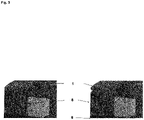
- FIG. 1 shows a preferred embodiment of a proposed tool insert 7.
- an insert frame 10 having a curved surface 13 .
- the individual metal sheets 11 of the at least one laminated core 8 can strike this curved surface 13 of the insert frame 10 and thus simulate the curved surface 13 of the insert frame 10 .
- the laminated core 8 also has a curved surface and can pass this on to the object 1 to be manufactured.
- the curved surface 13 of the insert frame 10 can be concave or convex.
- the term “concave” preferably stands for a depression that can be shaped like a mountain valley, for example.
- convex preferably stands for an elevation that can be shaped like a mountain in a mountain range, for example.
- a sliding element 15 is shown, which together with the proposed tool insert 7 can form a system for producing an object 1 with a complex shape.
- the sliding element 15 has a surface which is designed as a counter-contour to a curved surface 13 of the insert frame 10 .
- the sliding element 15 can be designed to be movable in an opening of the insert frame 10 .
- FIG 2 shows another preferred embodiment of a proposed tool insert 7.
- An insert frame 10 is shown, which is shown in the top left image of FIG 2 is formed from a top 10a and a bottom 10b. It is preferred within the meaning of the invention that the complex-shaped object 1 is formed between the halves of the insert frame 10, in particular by an injection molding process.
- the laminated core 8 which is formed from a plurality of individual sheets 11. It is preferred within the meaning of the invention that the laminated core 8 has a curved surface, with this curved surface being able to come about through a curved surface 13 in the insert frame 10 and/or through the provision of a delay cushion 9 in the insert frame 10.
- Such a delay cushion 9 is in particular in the 2 , 3 and 5 to see.
- the delay cushion 9 is preferably provided between the laminated core 8 and the insert frame 10 .
- the laminated core 8, which is in 2 is shown is preferably also referred to as a "curved laminated core" 8 within the meaning of the invention, since it has at least one curved surface.
- the inside 2 illustrated tool insert 7 can be produced in particular a sanding plate 1 with molded Velcro hooks 4. It is advantageous for the grinding disc 1 if the Velcro hooks 4 are oriented in the circumferential direction. In addition, it is preferred that the surface 5 of the sanding disc 1 is very flat.
- the warping of the sanding disc 1 is, to a good approximation, rotationally symmetrical. This rotationally symmetrical warpage can be counteracted by a sheet metal insert 8 consisting of individual sheets 11 bent in a substantially circular manner and a warpage cushion 9 .
- the delay cushion 9 can be conical, straight or rotationally symmetrical. It represents a significant advantage of the invention that the delay cushion can assume various conceivable surface shapes.
- the proposed method and the tool insert 7 can be used to produce very different items and objects. It is very particularly preferred within the meaning of the invention that the surface or its shape can be defined or fixed by any function of the radius. A corresponding function is preferably identical or essentially identical for all angles of rotation about the central axis.
- a delay cushion 9 of straight design is shown, while in the right half of the figure, a conical delay cushion 9 is shown.
- the delay cushion 9 which is preferably designed to be rotationally symmetrical, has to be machined.
- the surface 5 of the sanding disc 1 results from the possibility of relative movement of the individual sheets 11.
- the tool insert 7 is preferably fixed by friction by a central clamping mechanism.
- the delay cushion 9 is used in particular to counteract a rotationally symmetrical distortion of the sanding disk 1.
- FIG 4 shows a preferred embodiment of a proposed sanding pad 1, wherein the sanding pad 1 represents an example of an object 1 with a complex shape.
- the sanding disc 1 comprises a base body 2 and a Velcro hook layer 3 which comprises individual Velcro hooks 4 .
- the hook and loop hook layer 3 corresponds to the microstructure 3 of the object 1 with a complex shape, while the hook and loop hooks 4 correspond to the sub-structures 4 .
- the Velcro hooks 4 are preferably arranged in rows 6, which are arranged between the boundaries of a surface 5 of the sanding disc 1.
- the rows are preferably so-called radial rows 6, which are arranged at regular, preferably equidistant intervals from the outside inwards on the surface 5 of the sanding disk 1.
- the Velcro hooks 4 are arranged in radial rows 6, with the Velcro hooks 4 of the radial rows 6 alternating are oriented clockwise and counterclockwise. This enables a particularly strong and robust connection between the sanding disc 1 and a sanding attachment (not shown) to which the sanding disc 1 can be connected by means of a Velcro connection.
- the Velcro hooks 4 have openings aligned clockwise in a row 6 with A orientation, for example, while the openings of the Velcro hooks 4 are aligned counterclockwise in a row 6 with B orientation, for example.
- the surface 5 of the sanding disc 1 acts as an active surface and is designed in the shape of a ring.
- the base body 2 of the sanding disk 1 is formed from a fiber-reinforced plastic or includes such a material, while the Velcro hook layer 3 consists of an unreinforced plastic or includes such a material.
- FIG 5 shows a preferred embodiment of a tool insert 7.
- the tool insert 7 comprises an insert frame 10 and at least one laminated core 8.
- the laminated core 8 is formed from individual sheets 11, which can be used alternately in the insert frame 10, for example.
- a delay cushion 9 can be arranged between the insert frame 10 and the laminated core 8 to counteract any deformations and/or distortions.
- the individual laminations 11 of the laminated core 8 have indentations which are referred to as negative microstructuring 14 within the meaning of the invention.
- the negative microstructuring 14 is intended to receive the liquid plastic material during the manufacturing process and to give it its shape. It is preferred within the meaning of the invention that the negative microstructuring 14 represents a negative image of the hook and loop hook layer 3 or the microstructure 3 and forms it during the injection molding process.
- FIG. 6 shows a preferred embodiment of a Velcro hook 4 with its dimensions.
- 6 shows 6 the length L, the thickness D and the height H of an exemplary Velcro hook 4.
- the opening or longitudinal direction of the Velcro hook 4 is shown in 6 illustrated by the two-dimensional arrow pointing to the right in the figure.
- the thickness D of the Velcro hooks 4 can also be referred to as width within the meaning of the invention.
- this thickness D essentially corresponds to the width of a metal sheet 11 of the laminated core 8 minus any shrinkage of the plastic.
Landscapes
- Engineering & Computer Science (AREA)
- Mechanical Engineering (AREA)
- Manufacturing & Machinery (AREA)
- Moulds For Moulding Plastics Or The Like (AREA)
Priority Applications (4)
| Application Number | Priority Date | Filing Date | Title |
|---|---|---|---|
| EP21177170.4A EP4098143A1 (fr) | 2021-06-01 | 2021-06-01 | Insert d'outil pour la fabrication d'un objet de forme complexe, procédé de fabrication et objet de forme complexe |
| EP22730142.1A EP4346496A1 (fr) | 2021-06-01 | 2022-05-18 | Insert d'outil pour la fabrication d'un objet, procédé de fabrication et objet |
| US18/565,449 US20240262016A1 (en) | 2021-06-01 | 2022-05-18 | Tool insert for the production of an object, production method and object |
| PCT/EP2022/063402 WO2022253572A1 (fr) | 2021-06-01 | 2022-05-18 | Insert d'outil pour la fabrication d'un objet, procédé de fabrication et objet |
Applications Claiming Priority (1)
| Application Number | Priority Date | Filing Date | Title |
|---|---|---|---|
| EP21177170.4A EP4098143A1 (fr) | 2021-06-01 | 2021-06-01 | Insert d'outil pour la fabrication d'un objet de forme complexe, procédé de fabrication et objet de forme complexe |
Publications (1)
| Publication Number | Publication Date |
|---|---|
| EP4098143A1 true EP4098143A1 (fr) | 2022-12-07 |
Family
ID=76250096
Family Applications (2)
| Application Number | Title | Priority Date | Filing Date |
|---|---|---|---|
| EP21177170.4A Withdrawn EP4098143A1 (fr) | 2021-06-01 | 2021-06-01 | Insert d'outil pour la fabrication d'un objet de forme complexe, procédé de fabrication et objet de forme complexe |
| EP22730142.1A Pending EP4346496A1 (fr) | 2021-06-01 | 2022-05-18 | Insert d'outil pour la fabrication d'un objet, procédé de fabrication et objet |
Family Applications After (1)
| Application Number | Title | Priority Date | Filing Date |
|---|---|---|---|
| EP22730142.1A Pending EP4346496A1 (fr) | 2021-06-01 | 2022-05-18 | Insert d'outil pour la fabrication d'un objet, procédé de fabrication et objet |
Country Status (3)
| Country | Link |
|---|---|
| US (1) | US20240262016A1 (fr) |
| EP (2) | EP4098143A1 (fr) |
| WO (1) | WO2022253572A1 (fr) |
Citations (14)
| Publication number | Priority date | Publication date | Assignee | Title |
|---|---|---|---|---|
| US1906655A (en) * | 1928-11-03 | 1933-05-02 | Stimson Jonathan Cass | Process and apparatus for making reflecting devices |
| US2831394A (en) * | 1952-08-22 | 1958-04-22 | Elastic Stop Nut Corp | Catadioptric lenses |
| US3171319A (en) * | 1961-08-25 | 1965-03-02 | Gen Motors Corp | Laminated die and method of forming thereof |
| DE1435838A1 (de) * | 1961-11-14 | 1969-03-13 | Velcro Sa Soulie | Trennbares Befestigungsglied |
| DE3244410A1 (de) * | 1982-03-27 | 1983-10-13 | Michail 5880 Lüdenscheid Pafilis | Haftverschlussteil und werkzeug zur herstellung desselben |
| US5656226A (en) | 1991-03-06 | 1997-08-12 | Aircast, Inc. | Method and apparatus for injection-molding a thermoplastic device |
| US6224364B1 (en) * | 1998-09-21 | 2001-05-01 | Velcro Industries B.V. | Injection molding products having fastener elements |
| JP2002200619A (ja) * | 2000-12-28 | 2002-07-16 | Honda Motor Co Ltd | 樹脂用成形型及びこの成形型を用いる樹脂成形方法 |
| US20030221273A1 (en) * | 2002-05-28 | 2003-12-04 | Phillip Mark | Method and apparatus for injection molding a plastic monolith |
| EP1380388A1 (fr) * | 2002-07-09 | 2004-01-14 | YKK Europe Limited | Dispositif de montage d'un outil de ponçage |
| US20050238844A1 (en) * | 2004-04-27 | 2005-10-27 | Shih-Sheng Yang | Non-sewn adhesive tape and the manufacture thereof |
| DE102013009091A1 (de) * | 2013-05-28 | 2014-12-04 | Gottlieb Binder Gmbh & Co. Kg | Verfahren zum Herstellen eines Verbindungsteils, nach dem Verfahren hergestelltes Verbindungsteil, Werkzeug zum Herstellen eines solchen Verbindungsteils und Befestigungssystem mit einem derartigen Verbindungsteil |
| KR20180065316A (ko) * | 2016-12-07 | 2018-06-18 | 백영인 | 고글의 사출금형 |
| EP3444092A1 (fr) * | 2017-08-14 | 2019-02-20 | INL - International Iberian Nanotechnology Laboratory | Moule, procédé de formation d'un composant moulé et procédés de fourniture d'un moule |
-
2021
- 2021-06-01 EP EP21177170.4A patent/EP4098143A1/fr not_active Withdrawn
-
2022
- 2022-05-18 WO PCT/EP2022/063402 patent/WO2022253572A1/fr not_active Ceased
- 2022-05-18 EP EP22730142.1A patent/EP4346496A1/fr active Pending
- 2022-05-18 US US18/565,449 patent/US20240262016A1/en active Pending
Patent Citations (14)
| Publication number | Priority date | Publication date | Assignee | Title |
|---|---|---|---|---|
| US1906655A (en) * | 1928-11-03 | 1933-05-02 | Stimson Jonathan Cass | Process and apparatus for making reflecting devices |
| US2831394A (en) * | 1952-08-22 | 1958-04-22 | Elastic Stop Nut Corp | Catadioptric lenses |
| US3171319A (en) * | 1961-08-25 | 1965-03-02 | Gen Motors Corp | Laminated die and method of forming thereof |
| DE1435838A1 (de) * | 1961-11-14 | 1969-03-13 | Velcro Sa Soulie | Trennbares Befestigungsglied |
| DE3244410A1 (de) * | 1982-03-27 | 1983-10-13 | Michail 5880 Lüdenscheid Pafilis | Haftverschlussteil und werkzeug zur herstellung desselben |
| US5656226A (en) | 1991-03-06 | 1997-08-12 | Aircast, Inc. | Method and apparatus for injection-molding a thermoplastic device |
| US6224364B1 (en) * | 1998-09-21 | 2001-05-01 | Velcro Industries B.V. | Injection molding products having fastener elements |
| JP2002200619A (ja) * | 2000-12-28 | 2002-07-16 | Honda Motor Co Ltd | 樹脂用成形型及びこの成形型を用いる樹脂成形方法 |
| US20030221273A1 (en) * | 2002-05-28 | 2003-12-04 | Phillip Mark | Method and apparatus for injection molding a plastic monolith |
| EP1380388A1 (fr) * | 2002-07-09 | 2004-01-14 | YKK Europe Limited | Dispositif de montage d'un outil de ponçage |
| US20050238844A1 (en) * | 2004-04-27 | 2005-10-27 | Shih-Sheng Yang | Non-sewn adhesive tape and the manufacture thereof |
| DE102013009091A1 (de) * | 2013-05-28 | 2014-12-04 | Gottlieb Binder Gmbh & Co. Kg | Verfahren zum Herstellen eines Verbindungsteils, nach dem Verfahren hergestelltes Verbindungsteil, Werkzeug zum Herstellen eines solchen Verbindungsteils und Befestigungssystem mit einem derartigen Verbindungsteil |
| KR20180065316A (ko) * | 2016-12-07 | 2018-06-18 | 백영인 | 고글의 사출금형 |
| EP3444092A1 (fr) * | 2017-08-14 | 2019-02-20 | INL - International Iberian Nanotechnology Laboratory | Moule, procédé de formation d'un composant moulé et procédés de fourniture d'un moule |
Also Published As
| Publication number | Publication date |
|---|---|
| US20240262016A1 (en) | 2024-08-08 |
| EP4346496A1 (fr) | 2024-04-10 |
| WO2022253572A1 (fr) | 2022-12-08 |
Similar Documents
| Publication | Publication Date | Title |
|---|---|---|
| EP1103370B1 (fr) | Procédé pour la fabrication d'un profile en matière hibride | |
| DE102013021642B4 (de) | Verfahren zur automatisierten Herstellung einer räumlichen Struktur aus faserverstärktem Kunststoff und Vorrichtung zur Durchführung eines solchen Verfahrens | |
| DE602005002300T2 (de) | Ein Verfahren zur Herstellung eines strukturellen Verbundträgers für Flugzeuge | |
| DE69321916T2 (de) | Faserverstärkte stossstangenvorform, vorrichtung und verfahren zu dessen herstellung | |
| EP2637841A1 (fr) | Procédé et dispositif pour la fabrication d'une préforme tridimensionnelle dans le cadre de la fabrication d'éléments moulés renforcés de fibres | |
| DE69012629T2 (de) | Herstellungsverfahren eines mehrschichtigen metallischen Riemens. | |
| DE102011116119A1 (de) | Drapier- und Formpresswerkzeug und Verfahren zur Herstellungeiner Preform und eines Faserkunststoffverbundbauteils | |
| EP1655122B1 (fr) | Procédé d'injection, de compression ou d'emboutissage et moule correspondant | |
| DE102007056358A1 (de) | Umformwerkzeug sowie Verfahren zur Herstellung eines solchen Umformwerkzeugs | |
| EP2846986A1 (fr) | Procédé de consolidation au moins par endroits d'une préforme servant à fabriquer une pièce façonnée dans un outil de façonnage | |
| DE3715120A1 (de) | Duenne faserverstaerkte kunststoff-verbundplatte und verfahren zum formen derselben | |
| DE69822852T2 (de) | Herstellen von formvertiefungen | |
| DE102009060526A1 (de) | Pressenanlage zum Herstellen von Formteilen aus Kunststoff, insbesondere aus Faserverbundwerkstoff | |
| EP4098143A1 (fr) | Insert d'outil pour la fabrication d'un objet de forme complexe, procédé de fabrication et objet de forme complexe | |
| DE102015217404A1 (de) | Verfahren zur Herstellung von faserverstärkten Kunststoffbauteilen | |
| EP4098401A1 (fr) | Plateau de meulage pour un disque de meulage d'une machine de meulage et procédé de fabrication | |
| DE102016125958A1 (de) | Werkzeug zum Formen eines T-förmigen Halbzeugs | |
| CH652649A5 (de) | Verfahren und vorrichtung zur herstellung harter flaechen. | |
| DE102015010905A1 (de) | Verfahren zur Herstellung zumindest eines Durchbruchs in einem Faser-Matrix-Verbund | |
| EP3595876B1 (fr) | Procédé de fabrication d'un composant en matière plastique | |
| DE102015201896A1 (de) | Anlage und Verfahren zum Herstellen von Werkstücken | |
| DE102015118606B4 (de) | Werkzeug zum Tiefziehen und Verfahren zu seiner Herstellung | |
| DE19903516A1 (de) | Vorrichtung sowie Verfahren zum Anordnen und Verbinden einer Faseranordnung auf eine 2- oder 3-dimensionale Oberfläche | |
| DE102024124049A1 (de) | Verfahren, Werkzeugeinheit und Produktionsanlage zur Herstellung eines Mehrschichtbauteils | |
| DE102011113527B3 (de) | Werkzeug zum Warmumformen und Härten einer Blechplatine |
Legal Events
| Date | Code | Title | Description |
|---|---|---|---|
| PUAI | Public reference made under article 153(3) epc to a published international application that has entered the european phase |
Free format text: ORIGINAL CODE: 0009012 |
|
| STAA | Information on the status of an ep patent application or granted ep patent |
Free format text: STATUS: THE APPLICATION HAS BEEN PUBLISHED |
|
| AK | Designated contracting states |
Kind code of ref document: A1 Designated state(s): AL AT BE BG CH CY CZ DE DK EE ES FI FR GB GR HR HU IE IS IT LI LT LU LV MC MK MT NL NO PL PT RO RS SE SI SK SM TR |
|
| STAA | Information on the status of an ep patent application or granted ep patent |
Free format text: STATUS: THE APPLICATION IS DEEMED TO BE WITHDRAWN |
|
| 18D | Application deemed to be withdrawn |
Effective date: 20230608 |