EP4098366A1 - Dispositif de séparation permettant de séparer la contamination d'un fluide à nettoyer, dispositif de détermination de la charge pour un dispositif de séparation et procédé de détermination d'un état de charge en contamination - Google Patents
Dispositif de séparation permettant de séparer la contamination d'un fluide à nettoyer, dispositif de détermination de la charge pour un dispositif de séparation et procédé de détermination d'un état de charge en contamination Download PDFInfo
- Publication number
- EP4098366A1 EP4098366A1 EP21177043.3A EP21177043A EP4098366A1 EP 4098366 A1 EP4098366 A1 EP 4098366A1 EP 21177043 A EP21177043 A EP 21177043A EP 4098366 A1 EP4098366 A1 EP 4098366A1
- Authority
- EP
- European Patent Office
- Prior art keywords
- separating
- transmitter
- electromagnetic waves
- receiver
- separating device
- Prior art date
- Legal status (The legal status is an assumption and is not a legal conclusion. Google has not performed a legal analysis and makes no representation as to the accuracy of the status listed.)
- Pending
Links
Images

Classifications
-
- B—PERFORMING OPERATIONS; TRANSPORTING
- B04—CENTRIFUGAL APPARATUS OR MACHINES FOR CARRYING-OUT PHYSICAL OR CHEMICAL PROCESSES
- B04B—CENTRIFUGES
- B04B7/00—Elements of centrifuges
- B04B7/08—Rotary bowls
- B04B7/085—Rotary bowls fibre- or metal-reinforced
-
- B—PERFORMING OPERATIONS; TRANSPORTING
- B04—CENTRIFUGAL APPARATUS OR MACHINES FOR CARRYING-OUT PHYSICAL OR CHEMICAL PROCESSES
- B04B—CENTRIFUGES
- B04B5/00—Other centrifuges
- B04B5/005—Centrifugal separators or filters for fluid circulation systems, e.g. for lubricant oil circulation systems
-
- B—PERFORMING OPERATIONS; TRANSPORTING
- B04—CENTRIFUGAL APPARATUS OR MACHINES FOR CARRYING-OUT PHYSICAL OR CHEMICAL PROCESSES
- B04B—CENTRIFUGES
- B04B11/00—Feeding, charging, or discharging bowls
- B04B11/04—Periodical feeding or discharging; Control arrangements therefor
- B04B11/043—Load indication with or without control arrangements
-
- B—PERFORMING OPERATIONS; TRANSPORTING
- B04—CENTRIFUGAL APPARATUS OR MACHINES FOR CARRYING-OUT PHYSICAL OR CHEMICAL PROCESSES
- B04B—CENTRIFUGES
- B04B7/00—Elements of centrifuges
- B04B7/08—Rotary bowls
- B04B7/12—Inserts, e.g. armouring plates
-
- F—MECHANICAL ENGINEERING; LIGHTING; HEATING; WEAPONS; BLASTING
- F01—MACHINES OR ENGINES IN GENERAL; ENGINE PLANTS IN GENERAL; STEAM ENGINES
- F01M—LUBRICATING OF MACHINES OR ENGINES IN GENERAL; LUBRICATING INTERNAL COMBUSTION ENGINES; CRANKCASE VENTILATING
- F01M11/00—Component parts, details or accessories, not provided for in, or of interest apart from, groups F01M1/00 - F01M9/00
- F01M11/03—Mounting or connecting of lubricant purifying means relative to the machine or engine; Details of lubricant purifying means
-
- B—PERFORMING OPERATIONS; TRANSPORTING
- B04—CENTRIFUGAL APPARATUS OR MACHINES FOR CARRYING-OUT PHYSICAL OR CHEMICAL PROCESSES
- B04B—CENTRIFUGES
- B04B13/00—Control arrangements specially designed for centrifuges; Program control of centrifuges
- B04B2013/006—Interface detection or monitoring of separated components
-
- F—MECHANICAL ENGINEERING; LIGHTING; HEATING; WEAPONS; BLASTING
- F01—MACHINES OR ENGINES IN GENERAL; ENGINE PLANTS IN GENERAL; STEAM ENGINES
- F01M—LUBRICATING OF MACHINES OR ENGINES IN GENERAL; LUBRICATING INTERNAL COMBUSTION ENGINES; CRANKCASE VENTILATING
- F01M1/00—Pressure lubrication
- F01M1/10—Lubricating systems characterised by the provision therein of lubricant venting or purifying means, e.g. of filters
- F01M2001/1028—Lubricating systems characterised by the provision therein of lubricant venting or purifying means, e.g. of filters characterised by the type of purification
- F01M2001/1035—Lubricating systems characterised by the provision therein of lubricant venting or purifying means, e.g. of filters characterised by the type of purification comprising centrifugal filters
Definitions
- the invention relates to a separating device for separating contaminants from fluid to be cleaned, having at least one separating body with at least one collection area in which contaminants can collect, and with at least one load determination device, with which a contamination load state of at least part of at least one collection area can be determined.
- the invention also relates to a load determination device for a separating device for separating contaminants from fluid to be cleaned, with which a contaminant load state of at least part of at least one collection area of at least one separating body of the separating device, in which contaminants can collect, can be determined.
- the invention relates to a method for determining a contamination load state of at least part of at least one collecting area of at least one separating body of at least one separating device for separating contamination from a fluid to be cleaned.
- an indicator device for providing information, in particular for outputting a signal, about the contamination load status of a separating device, in particular a fluid centrifuge, for separating contaminants, in particular particles, from a fluid, in particular oil, in particular an internal combustion engine, in particular a motor vehicle Separator and rotor of a fluid centrifuge known.
- the indicator device has at least one in its shape and / or its position at least partially variable working part, which is at least partially in a collection area of the separating device, in particular a rotor of Fluid centrifuge, for separated contamination is or can be arranged so that it can be at least partially covered by separated contaminants depending on the contaminant loading condition.
- the invention is based on the object of designing a separating device, a load determination device and a method of the type mentioned at the outset, in which a contamination load state of the at least one separating body can be determined more reliably.
- the at least one load determination device has at least one transmitter for electromagnetic waves and at least one receiver for electromagnetic waves emitted by the at least one transmitter, the at least one transmitter and the at least one receiver being on opposite sides sides of at least one collection area for separated impurities of the at least one separating body, the at least one separating body being at least partially permeable at least in sections to the electromagnetic waves transmitted by the at least one transmitter, and the at least one transmitter and the at least one receiver are connected to at least one evaluation device, with which, from the electromagnetic waves received by the at least one receiver, the contamination load status of the at least one S collection area can be determined.
- At least one transmitter and at least one receiver for electromagnetic waves are arranged on opposite sides of a collecting area for impurities. Electromagnetic waves are sent through the collection area with the at least one transmitter and received with the at least one receiver. In the collection area, the electromagnetic waves are attenuated depending on the amount of contamination deposited there, i.e. the contamination load status. The attenuation experienced by the electromagnetic waves as they pass through the collection area is therefore related to the contamination loading condition. From the attenuation of the received electromagnetic waves compared to the transmitted electromagnetic waves, the contamination loading state of the at least one collection area is determined.
- the contaminant loading status of a collection area can characterize a degree of contaminant loading of the collection area.
- the contamination load state can be given in the form of a degree of attenuation of the electromagnetic waves, as the thickness of a so-called cake formed from impurities, or in the form of some other type of quantitative and/or qualitative indication.
- the contamination load status can be determined without contact. No mechanical connection is required between the load determination device and the at least one separating body. In this way, in the case of a moving separating body, in particular a rotor of a centrifugal separator, the movement of the separating body is not impaired by the determination of the load. In this way, the load can also be determined during ongoing operation of a separating device with a moving separating body.
- Various materials can affect the signal distribution of electromagnetic waves.
- the invention uses this damping property of different materials on electromagnetic waves.
- an attenuation of electromagnetic waves as they pass through the collection area, in particular due to contamination with which the collection area is loaded, can be determined.
- a correlation of the attenuation of the electromagnetic waves and the loading of the at least one collection area can be used to determine a maintenance interval for maintenance of the separating device.
- a maintenance indicator can be implemented which displays the contamination loading status of the separating device. It can be indicated when the level of contamination has reached such a level that maintenance, in particular cleaning or replacement of the at least one separating body, is required. In this way, the operating time of the separating device can be extended overall. Further the quality of the fluid to be cleaned can be improved. In this way, devices, in particular engines, in which the cleaned fluid is used can be better protected.
- the information about the contamination loading state is determined with at least one evaluation device.
- the at least one evaluation device can advantageously be connected to a control device and/or an output device, which can be arranged remotely from the separating device, in particular in a control stand or a dashboard of a motor vehicle or the like.
- the contamination loading status can thus also be monitored remotely from the separating device.
- At least one evaluation device can advantageously be an electronic evaluation device.
- the contamination loading state can be determined, in particular calculated, by software and/or hardware.
- the at least one evaluation device can be connected to a corresponding electric/electronic control device of a machine, in particular a motor, in particular an internal combustion engine, and/or a vehicle. Appropriate information about the impurity loading status of the separating device can thus be transmitted to the control device and appropriate measures can be initiated.
- the at least one evaluation device and/or at least one control device can be used to initiate the output of instructions, in particular acoustic and/or visual signals, or control functions for a machine.
- the load determination device can advantageously be part of an oil centrifuge of an internal combustion engine.
- the separating device in particular the oil centrifuge, can advantageously be part of an engine oil circuit of an internal combustion engine. It can be used to clean engine oil, which the Internal combustion engine is supplied.
- the invention is not limited to a separating device of an engine oil circuit of an internal combustion engine. Rather, it can also be used in other types of separating devices and/or other types of liquid systems, in particular fuel systems or hydraulic systems, of vehicles, in particular motor vehicles, or other machines.
- the separating device can be used in motor vehicle technology, in industrial engines or the like.
- the separating device can be a separating device for separating impurities from liquid and/or gaseous fluid.
- soot particles can be removed from engine oil with the separating device.
- the at least one separating device can be a centrifugal separator which has at least one rotor which can be rotated about a rotor axis and which has a separating wall which surrounds the circumference of the rotor axis and on the radially inner circumferential side of which a collection area for separated impurities is implemented , wherein at least the separating wall is at least partially permeable at least in sections for the electromagnetic waves.
- fluid to be cleaned can be brought into the interior of the at least one rotor.
- impurities in the fluid to be cleaned in particular soot particles or the like, can be transported radially outwards due to the centrifugal force.
- the impurities can be separated in the collection area on the radially inner peripheral side of the at least one rotor.
- the load determination device works without contact. In this way, a contamination loading state can be determined during operation, ie when the rotor is rotating. It is not necessary to stop the separator while the contaminant load condition is being determined.
- the at least one separating wall can be at least partially transparent to the electromagnetic waves, at least in sections. "Partially permeable" means that the at least one separating wall without electromagnetic waves Attenuation or with a this low attenuation passes. In this way, the electromagnetic waves can pass through the at least one separating wall. Thus, the electromagnetic waves can propagate with respect to the rotor axis from radially inside to radially outside or vice versa through the at least one separating wall and optionally the separated impurities. In this way, a contamination load state can be determined in connection with a thickness of the separated contaminants that is radial with respect to the rotor axis.
- the separating wall can be at least partially made of non-metallic material, in particular a plastic composite material, GRP or the like.
- the separating wall can be at least partially permeable to electromagnetic waves.
- At least one transmitter can be arranged radially outside the circumferential separating wall with respect to the rotor axis and/or at least one receiver can be arranged radially outside the circumferential separating wall with respect to the rotor axis.
- a space inside the separating wall can thus be used as a separating space for separating the impurity.
- the at least one transmitter and/or the at least one receiver can be arranged outside the separating space loaded with impurities. In this way, contamination of the at least one transmitter and/or the at least one receiver by impurities can be avoided. Soiling of the transmitter and/or receiver can impair the function of the load determination device.
- the at least one transmitter and/or the at least one receiver can be installed more easily outside the separating wall, in particular the rotor.
- the at least one rotor can have a spindle which can be rotated about the rotor axis and on which the separating wall is rotatably held, and an imaginary connecting line between at least one transmitter and at least one receiver can run outside the spindle.
- the spindle itself can thus be made of a material that is not or only slightly permeable to electromagnetic waves.
- an imaginary connecting line between the at least one transmitter and the at least one receiver can run tangentially to an imaginary circular cylinder shell coaxial with the rotor axis.
- the contamination loading state of the collection area can be determined at an axial height that is constant with respect to the rotor axis.
- the centrifugal separator can have at least one speed determination device for determining the speed of the at least one rotor. By considering the speed, the contamination load condition can be more accurately determined.
- At least one electronic evaluation device can be connected to the at least one rotational speed determination device and have means for determining a contamination load state from the received electromagnetic waves and the rotational speed of the rotor.
- the contamination load status can be determined electronically from the rotational speed of the rotor and the electromagnetic waves received, or the attenuation of the electromagnetic waves received.
- the electromagnetic waves can be radio waves.
- Simple, inexpensive and reliable transmitters and receivers can be used to generate and receive radio waves.
- Radio waves are known to be electromagnetic waves with a frequency below 3000 GHz.
- the electromagnetic waves can be directed.
- the electromagnetic waves can be directed towards the at least one collection area.
- the monitoring of the impurity load state can be performed more efficiently.
- the energy is spatially concentrated, particularly in the cross-section. The energy can be concentrated on the collection area. Energy losses in areas of no interest outside the collection area can be reduced will. Overall, a lower transmission energy can be used than with non-directional electromagnetic waves.
- At least some of the electromagnetic waves can be continuous signals and/or at least some of the electromagnetic waves can be pulsed signals.
- Continuous signals have the advantage that the contamination load status can be continuously monitored.
- Pulse signals have the advantage that, given the same transmission power, the total transmission energy required can be reduced overall, since transmission pauses are inserted between the pulses. Alternatively, a correspondingly larger transmission power per signal pulse can be used without having to increase the total transmission energy as a result.
- At least one transmitter and/or at least one receiver can be arranged on a housing inside of a housing of the separating device. In this way, the at least one transmitter and/or the at least one receiver can be fixedly mounted on the housing. The at least one transmitter and/or the at least one receiver do not have to be removed for maintenance of the separating device, in particular for cleaning and/or for replacing the at least one separating body.
- the housing of the separating device can advantageously be openable. In this way, the at least one separating body can be made freely accessible for maintenance purposes.
- the at least one transmitter and the at least one receiver can be arranged fixed to the housing and do not have to be moved with the at least one separating body.
- At least one transmitter and/or at least one receiver can be encapsulated in a fluid-tight manner. In this way, the at least one transmitter and/or at least one receiver can be protected from fluid and/or contamination.
- the at least one transmitter and/or the at least one receiver can advantageously be arranged in a fluid-tight encapsulated manner in a fluid-carrying area of the separating device, in particular within the housing.
- the object is achieved according to the invention with the load determination device in that the at least one load determination device has at least one transmitter for electromagnetic waves and at least one receiver for electromagnetic waves emitted by the at least one transmitter, the at least one transmitter and the at least one Receivers are arranged on opposite sides of at least one collection area for separated impurities of the at least one separating body, the at least one separating body being at least partially permeable, at least in sections, to the electromagnetic waves transmitted by the at least one transmitter, and the at least one transmitter and the at least one receiver is connected to at least one evaluation device, with which, from the electromagnetic waves received by the at least one receiver, the contamination load state of the w at least one collection area can be determined.
- the object is achieved according to the invention in the method in that at least one transmitter is used to send electromagnetic waves through at least one collection area of the at least one separating body for separated impurities, on the side opposite the transmitter with respect to the collection area, the electromagnetic waves penetrating through the at least one collection area are received with at least one receiver and with at least one evaluation device a contamination loading state of the at least one collection area is determined from the received electromagnetic waves.
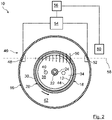
- a separating device in the form of an oil centrifuge 10 of an engine oil circuit of an internal combustion engine, which is otherwise not shown, is shown schematically in a section.
- the oil centrifuge 10 is arranged, for example, in a bypass of the engine oil circuit and is used to remove particles 12, for example soot particles or the like, from the engine oil 14.
- the oil centrifuge 10 comprises an openable centrifuge housing 16 in which a rotor 18 is arranged in an exchangeable manner.
- the rotor 18 is mounted in the centrifuge housing 16 so that it can rotate about an imaginary rotor axis 20 .
- the rotor axis 20 runs vertically in space. It can also be oriented differently. Whenever “radial”, “axial”, “coaxial”, “circumferential” or the like is mentioned in the following, this refers to the rotor axis 20, unless otherwise mentioned.
- the centrifuge housing 16 has a in the figure 1 lower end face an inlet 22 for engine oil to be cleaned 14. Inside the centrifuge housing 16, the inlet 22 is connected to an interior space of a coaxial spindle 24 of the rotor 18.
- the centrifuge housing 16 also has an outlet 26 for cleaned engine oil 14, which in the figure 1 leads out, for example, eccentrically from the lower end face of the centrifuge housing 16 .
- the centrifuge housing 16 can, for example, by removing a cover page in which figure 1 above, are opened so that the rotor 18 is accessible for maintenance purposes, for example for cleaning or replacement.
- the rotor 18 is mounted in the centrifuge housing 16 at the ends of the spindle 24 .
- the rotor 18 is constructed overall as a body of revolution with respect to the rotor axis 20 . It has a coaxial, circular-cylindrical in the exemplary embodiment, rotor housing 28 with a peripheral separating wall 30, a front cover section 32 and a front base section 34.
- the cover section 32 can be separated from the separating wall 30 for maintenance purposes, for example for cleaning the rotor 18.
- the spindle 24 leads coaxially through the base section 34 and the cover section 32.
- the spindle 24 has a plurality of oil passages 36 in its radially outer peripheral wall.
- the oil passages 36 connect the interior of the spindle 24 with a separation chamber 38 inside of the rotor housing 28.
- the bottom section 34 also has a plurality of oil drains 40 which are arranged eccentrically to the rotor axis 20 outside of the spindle 24 .
- the oil drains 40 connect the separation chamber 38 to an outlet chamber 42 of the centrifuge housing 16 above the base section 34.
- the outlet 26 leads out of the outlet chamber 42.
- the radially inner peripheral side of the separating wall 30 of the rotor 18 serves as a collecting area 44 for particles 12 separated from the engine oil 14.
- a so-called "cake" of separated particles 12 is indicated by way of example.
- the separating wall 30 is permeable to electromagnetic radio waves 50 .
- the separating wall 30 can be made of plastic.
- the oil centrifuge 10 has a loading determination device 46.
- the loading determination device 46 can be used to determine a contamination loading condition of the collection area 44 of the separating wall 30 in relation to separated particles 12.
- the contamination loading state indicates the extent to which the collection area 44 is loaded with particles 12 .
- the loading determination device 46 includes a transmitter 48 with which directed electromagnetic radio waves 50 can be emitted. Furthermore, the loading determination device 46 includes a receiver 52 with which the radio waves 50 can be received. The transmitter 48 and the receiver 52 are connected to an electronic control and evaluation device 54 of the loading determination device 46 . The control and evaluation device 54 in turn is connected to a control device 56 of the internal combustion engine, which is otherwise not shown.
- the transmitter 48 and the receiver 52 are fixed on opposite sides of the rotor 18 to the radially inner peripheral side of the centrifuge housing 16, respectively.
- Transmitter 48 and receiver 52 are each encapsulated in a fluid-tight manner.
- An imaginary connecting line 58 between the transmitter 48 and the receiver 52 extends tangentially to an imaginary circular cylinder coaxial with the rotor axis 20 .
- the connecting line 58 extends outside, ie eccentrically, to the spindle 24.
- the transmitter 48 and the receiver 52 are in relation to the rotor axis 20 at the same axial height.
- the transmitter 48 and the receiver 52 are located on opposite sides of the collecting area 44.
- the imaginary connecting line 58 crosses the separating wall 30 and the collecting area 44 twice each and runs transversely through the separating space 38.
- the transmitter 48 is aligned with the receiver 52 .
- the receiver 52 is aligned with the transmitter 48 accordingly.
- the radio waves 50 generated by the transmitter 48 traverse the interior of the centrifuge housing 16, a first section of the separating wall 30, which faces the transmitter 48, and the collection area 44 located behind it with the particles 12 separated there.
- the radio waves 50 first arrive in the separating chamber 38 to the collection area 44 with the separated particles 12 on the other side of the separating wall 30 and traverse a second section of the separating wall 30 on the side facing the receiver two 50 . Behind the second section of the separating wall 30, the radio waves 50 reach the receiver 52.
- the radio waves 50 are attenuated when crossing the collection area 44 twice, for example.
- the attenuation of the radio waves 50 is determined with the control and evaluation device 54 and the contamination loading state of the collection area 44 with particles 12 is determined therefrom.
- the contamination loading state is given as an example in the form of a loading level.
- the impurity load condition is communicated to the engine controller 56 .
- a corresponding indication is generated with the control device 56 that maintenance of the oil centrifuge 10 is required.
- the information can be forwarded to a corresponding output device, for example. Alternatively or additionally, the information can be read out if required.
- the oil centrifuge 10 optionally has a speed determination device 60 with which the speed of the rotor 18 can be determined.
- the speed determination device 60 is also connected to the control and evaluation device 54 . In this way, the speed can also be used to determine the impurity loading condition of the rotor 18 .
- Engine oil 14 to be cleaned during operation of the oil centrifuge 10 is conducted through the inlet 22 into the interior of the spindle 24 .
- the engine oil 14 to be cleaned flows under pressure through the oil passages 36 into the separation chamber 38.
- the rotor 18 is driven in rotation by the recoil. Due to the rotation of the rotor 18, the heavier particles 12 are conveyed radially outwards and are stored in the centrifugal force Collection area 44 on the radially inner peripheral side of the separating wall 30 and form the cake.
- the engine oil freed from the particles 12 sinks downwards and leaves the separation chamber 38 through the oil drains 40.
- the cleaned engine oil 14 enters the outlet chamber 42 and leaves it through the outlet 26.
- the contamination loading status is checked continuously while the oil centrifuge 10 is in operation while the rotor 18 is rotating.
Landscapes
- Engineering & Computer Science (AREA)
- Mechanical Engineering (AREA)
- General Engineering & Computer Science (AREA)
- Centrifugal Separators (AREA)
Priority Applications (5)
| Application Number | Priority Date | Filing Date | Title |
|---|---|---|---|
| EP21177043.3A EP4098366A1 (fr) | 2021-06-01 | 2021-06-01 | Dispositif de séparation permettant de séparer la contamination d'un fluide à nettoyer, dispositif de détermination de la charge pour un dispositif de séparation et procédé de détermination d'un état de charge en contamination |
| CN202280039837.XA CN117425527A (zh) | 2021-06-01 | 2022-05-05 | 用于从待清洁的流体中分离出杂质的分离装置、用于分离装置的负荷确定设备和用于确定杂质负荷状态的方法 |
| EP22728105.2A EP4347135A1 (fr) | 2021-06-01 | 2022-05-05 | Dispositif de séparation pour séparer des impuretés d'un fluide à purifier, dispositif de détermination de charge pour un dispositif de séparation et procédé pour déterminer un état de charge d'impuretés |
| PCT/EP2022/062148 WO2022253519A1 (fr) | 2021-06-01 | 2022-05-05 | Dispositif de séparation pour séparer des impuretés d'un fluide à purifier, dispositif de détermination de charge pour un dispositif de séparation et procédé pour déterminer un état de charge d'impuretés |
| US18/522,604 US20240109080A1 (en) | 2021-06-01 | 2023-11-29 | Separation Device for Separating Impurities from Fluid to be Cleaned, Load Determination Apparatus for a Separation Device, and Method for Determining an Impurity Load State |
Applications Claiming Priority (1)
| Application Number | Priority Date | Filing Date | Title |
|---|---|---|---|
| EP21177043.3A EP4098366A1 (fr) | 2021-06-01 | 2021-06-01 | Dispositif de séparation permettant de séparer la contamination d'un fluide à nettoyer, dispositif de détermination de la charge pour un dispositif de séparation et procédé de détermination d'un état de charge en contamination |
Publications (1)
| Publication Number | Publication Date |
|---|---|
| EP4098366A1 true EP4098366A1 (fr) | 2022-12-07 |
Family
ID=76217732
Family Applications (2)
| Application Number | Title | Priority Date | Filing Date |
|---|---|---|---|
| EP21177043.3A Pending EP4098366A1 (fr) | 2021-06-01 | 2021-06-01 | Dispositif de séparation permettant de séparer la contamination d'un fluide à nettoyer, dispositif de détermination de la charge pour un dispositif de séparation et procédé de détermination d'un état de charge en contamination |
| EP22728105.2A Pending EP4347135A1 (fr) | 2021-06-01 | 2022-05-05 | Dispositif de séparation pour séparer des impuretés d'un fluide à purifier, dispositif de détermination de charge pour un dispositif de séparation et procédé pour déterminer un état de charge d'impuretés |
Family Applications After (1)
| Application Number | Title | Priority Date | Filing Date |
|---|---|---|---|
| EP22728105.2A Pending EP4347135A1 (fr) | 2021-06-01 | 2022-05-05 | Dispositif de séparation pour séparer des impuretés d'un fluide à purifier, dispositif de détermination de charge pour un dispositif de séparation et procédé pour déterminer un état de charge d'impuretés |
Country Status (4)
| Country | Link |
|---|---|
| US (1) | US20240109080A1 (fr) |
| EP (2) | EP4098366A1 (fr) |
| CN (1) | CN117425527A (fr) |
| WO (1) | WO2022253519A1 (fr) |
Citations (5)
| Publication number | Priority date | Publication date | Assignee | Title |
|---|---|---|---|---|
| DE1127818B (de) * | 1959-09-07 | 1962-04-12 | Edmund Bail | Verfahren zum Messen des Fuellungsgrades von Schleudertrommeln in Zentrifugen, insbesondere Zuckerzentrifugen |
| GB1507742A (en) * | 1976-06-25 | 1978-04-19 | Glacier Metal Co Ltd | Centrifugal filters |
| DE10103997A1 (de) * | 2001-01-31 | 2002-08-14 | Mann & Hummel Filter | Freistrahlzentrifuge mit Überwachungsmitteln und Verfahren zu deren Überwachung |
| EP1712288A1 (fr) * | 2005-04-15 | 2006-10-18 | Mann+Hummel Gmbh | Séparateur centrifugeuse et un rotor |
| DE102015005226A1 (de) | 2015-04-23 | 2016-10-27 | Mann + Hummel Gmbh | lndikatoreinrichtung einer Abscheidevorrichtung, Abscheidevorrichtung und Rotor einer Fluidzentrifuge |
-
2021
- 2021-06-01 EP EP21177043.3A patent/EP4098366A1/fr active Pending
-
2022
- 2022-05-05 WO PCT/EP2022/062148 patent/WO2022253519A1/fr not_active Ceased
- 2022-05-05 CN CN202280039837.XA patent/CN117425527A/zh active Pending
- 2022-05-05 EP EP22728105.2A patent/EP4347135A1/fr active Pending
-
2023
- 2023-11-29 US US18/522,604 patent/US20240109080A1/en active Pending
Patent Citations (5)
| Publication number | Priority date | Publication date | Assignee | Title |
|---|---|---|---|---|
| DE1127818B (de) * | 1959-09-07 | 1962-04-12 | Edmund Bail | Verfahren zum Messen des Fuellungsgrades von Schleudertrommeln in Zentrifugen, insbesondere Zuckerzentrifugen |
| GB1507742A (en) * | 1976-06-25 | 1978-04-19 | Glacier Metal Co Ltd | Centrifugal filters |
| DE10103997A1 (de) * | 2001-01-31 | 2002-08-14 | Mann & Hummel Filter | Freistrahlzentrifuge mit Überwachungsmitteln und Verfahren zu deren Überwachung |
| EP1712288A1 (fr) * | 2005-04-15 | 2006-10-18 | Mann+Hummel Gmbh | Séparateur centrifugeuse et un rotor |
| DE102015005226A1 (de) | 2015-04-23 | 2016-10-27 | Mann + Hummel Gmbh | lndikatoreinrichtung einer Abscheidevorrichtung, Abscheidevorrichtung und Rotor einer Fluidzentrifuge |
Also Published As
| Publication number | Publication date |
|---|---|
| CN117425527A (zh) | 2024-01-19 |
| EP4347135A1 (fr) | 2024-04-10 |
| WO2022253519A1 (fr) | 2022-12-08 |
| US20240109080A1 (en) | 2024-04-04 |
Similar Documents
| Publication | Publication Date | Title |
|---|---|---|
| DE19619843C2 (de) | Ölversorgungseinrichtung | |
| EP2291617B1 (fr) | Système de surveillance d'un organe soumis à des vibrations | |
| DE202008014792U1 (de) | Vorrichtung zum Bewerten von Zerspanungsprozessen | |
| EP1306118A1 (fr) | Procédé et système de nettoyage d'un filtre | |
| EP1849672A2 (fr) | Cartouche, installation de traitement d'air comprimé et procédé de fonctionnement d'une installation de traitement d'air comprimé | |
| DE112015003365T5 (de) | Steuerungssysteme und -verfahren für den umgehungsdurchfluss bei der ansaugung | |
| DE202008003055U1 (de) | Druckminderer-Filter Anordnung mit Leckageschutz | |
| DE102013226516A1 (de) | Messanordnung | |
| DE102020216174A1 (de) | Luftblasenabscheider und einen Luftblasenabscheider umfassender Fluidkreislauf eines Kraftfahrzeugs | |
| EP2611666A1 (fr) | Transmission pour la chaîne cinématique d'un véhicule ferroviaire | |
| DE202007019096U1 (de) | Koaxiale Vollstrom- und Bypass-Ölfiltervorrichtung | |
| DE3931497A1 (de) | Vorrichtung zum erfassen von verschmutzungen in fluiden, insbesondere schmierstoffen | |
| WO2012084918A1 (fr) | Dispositif de pompage | |
| EP2434183B1 (fr) | Dispositif de filtration de lubrifiants dans une transmission | |
| DE102014012032B4 (de) | Verfahren und Vorrichtung zum Filtrieren einer Flüssigkeit | |
| EP4098366A1 (fr) | Dispositif de séparation permettant de séparer la contamination d'un fluide à nettoyer, dispositif de détermination de la charge pour un dispositif de séparation et procédé de détermination d'un état de charge en contamination | |
| DE68911747T2 (de) | Integrierte Trennvorrichtung für in einem Fluid enthaltene feste und gasförmige Verunreinigungen. | |
| EP1623766B1 (fr) | Séparateur centrifugeuse | |
| EP2885061B1 (fr) | Filtre pour fluide | |
| DE102006018725B4 (de) | Anlage zum Filtern von Kühl- oder Bearbeitungsmedien für Trenn-, Schleif- und Erodierprozesse | |
| DE102004053671A1 (de) | Vorrichtung zur Trennung eines Phasengemisches | |
| DE102015005226B4 (de) | Rotor einer Fluidzentrifuge mit lndikatoreinrichtung | |
| EP2429676B1 (fr) | Ensemble palier équipé d'un dispositif filtrant | |
| DE4440883C2 (de) | Vorrichtung zur Überwachung des mittels einer Förderpumpe durchgeführten Einfüllvorganges abrasiver, stark verschmutzter Flüssigkeiten, insbesondere Altöl an Tankfahrzeugen | |
| DE102011056903B4 (de) | Hubkolbenverdichter und Verfahren zum Abscheiden von Flüssigkeiten, insbesondere Öl |
Legal Events
| Date | Code | Title | Description |
|---|---|---|---|
| PUAI | Public reference made under article 153(3) epc to a published international application that has entered the european phase |
Free format text: ORIGINAL CODE: 0009012 |
|
| STAA | Information on the status of an ep patent application or granted ep patent |
Free format text: STATUS: THE APPLICATION HAS BEEN PUBLISHED |
|
| AK | Designated contracting states |
Kind code of ref document: A1 Designated state(s): AL AT BE BG CH CY CZ DE DK EE ES FI FR GB GR HR HU IE IS IT LI LT LU LV MC MK MT NL NO PL PT RO RS SE SI SK SM TR |
|
| STAA | Information on the status of an ep patent application or granted ep patent |
Free format text: STATUS: REQUEST FOR EXAMINATION WAS MADE |
|
| 17P | Request for examination filed |
Effective date: 20230328 |
|
| RBV | Designated contracting states (corrected) |
Designated state(s): AL AT BE BG CH CY CZ DE DK EE ES FI FR GB GR HR HU IE IS IT LI LT LU LV MC MK MT NL NO PL PT RO RS SE SI SK SM TR |
|
| STAA | Information on the status of an ep patent application or granted ep patent |
Free format text: STATUS: EXAMINATION IS IN PROGRESS |
|
| 17Q | First examination report despatched |
Effective date: 20251113 |