EP4099009A1 - Vorrichtung und verfahren zur zerstörungsfreien prüfung - Google Patents
Vorrichtung und verfahren zur zerstörungsfreien prüfung Download PDFInfo
- Publication number
- EP4099009A1 EP4099009A1 EP20916800.4A EP20916800A EP4099009A1 EP 4099009 A1 EP4099009 A1 EP 4099009A1 EP 20916800 A EP20916800 A EP 20916800A EP 4099009 A1 EP4099009 A1 EP 4099009A1
- Authority
- EP
- European Patent Office
- Prior art keywords
- inspection
- carrier
- path
- covers
- signal cable
- Prior art date
- Legal status (The legal status is an assumption and is not a legal conclusion. Google has not performed a legal analysis and makes no representation as to the accuracy of the status listed.)
- Withdrawn
Links
Images




Classifications
-
- G—PHYSICS
- G01—MEASURING; TESTING
- G01N—INVESTIGATING OR ANALYSING MATERIALS BY DETERMINING THEIR CHEMICAL OR PHYSICAL PROPERTIES
- G01N29/00—Investigating or analysing materials by the use of ultrasonic, sonic or infrasonic waves; Visualisation of the interior of objects by transmitting ultrasonic or sonic waves through the object
- G01N29/04—Analysing solids
- G01N29/043—Analysing solids in the interior, e.g. by shear waves
-
- A—HUMAN NECESSITIES
- A61—MEDICAL OR VETERINARY SCIENCE; HYGIENE
- A61B—DIAGNOSIS; SURGERY; IDENTIFICATION
- A61B1/00—Instruments for performing medical examinations of the interior of cavities or tubes of the body by visual or photographical inspection, e.g. endoscopes; Illuminating arrangements therefor
- A61B1/00147—Holding or positioning arrangements
- A61B1/0016—Holding or positioning arrangements using motor drive units
-
- F—MECHANICAL ENGINEERING; LIGHTING; HEATING; WEAPONS; BLASTING
- F16—ENGINEERING ELEMENTS AND UNITS; GENERAL MEASURES FOR PRODUCING AND MAINTAINING EFFECTIVE FUNCTIONING OF MACHINES OR INSTALLATIONS; THERMAL INSULATION IN GENERAL
- F16L—PIPES; JOINTS OR FITTINGS FOR PIPES; SUPPORTS FOR PIPES, CABLES OR PROTECTIVE TUBING; MEANS FOR THERMAL INSULATION IN GENERAL
- F16L55/00—Devices or appurtenances for use in, or in connection with, pipes or pipe systems
- F16L55/26—Pigs or moles, i.e. devices movable in a pipe or conduit with or without self-contained propulsion means
- F16L55/28—Constructional aspects
- F16L55/30—Constructional aspects of the propulsion means, e.g. towed by cables
- F16L55/32—Constructional aspects of the propulsion means, e.g. towed by cables being self-contained
-
- G—PHYSICS
- G01—MEASURING; TESTING
- G01N—INVESTIGATING OR ANALYSING MATERIALS BY DETERMINING THEIR CHEMICAL OR PHYSICAL PROPERTIES
- G01N29/00—Investigating or analysing materials by the use of ultrasonic, sonic or infrasonic waves; Visualisation of the interior of objects by transmitting ultrasonic or sonic waves through the object
- G01N29/22—Details, e.g. general constructional or apparatus details
- G01N29/225—Supports, positioning or alignment in moving situation
-
- G—PHYSICS
- G01—MEASURING; TESTING
- G01N—INVESTIGATING OR ANALYSING MATERIALS BY DETERMINING THEIR CHEMICAL OR PHYSICAL PROPERTIES
- G01N29/00—Investigating or analysing materials by the use of ultrasonic, sonic or infrasonic waves; Visualisation of the interior of objects by transmitting ultrasonic or sonic waves through the object
- G01N29/22—Details, e.g. general constructional or apparatus details
- G01N29/26—Arrangements for orientation or scanning by relative movement of the head and the sensor
- G01N29/265—Arrangements for orientation or scanning by relative movement of the head and the sensor by moving the sensor relative to a stationary material
-
- A—HUMAN NECESSITIES
- A61—MEDICAL OR VETERINARY SCIENCE; HYGIENE
- A61B—DIAGNOSIS; SURGERY; IDENTIFICATION
- A61B1/00—Instruments for performing medical examinations of the interior of cavities or tubes of the body by visual or photographical inspection, e.g. endoscopes; Illuminating arrangements therefor
- A61B1/005—Flexible endoscopes
- A61B1/0051—Flexible endoscopes with controlled bending of insertion part
- A61B1/0055—Constructional details of insertion parts, e.g. vertebral elements
-
- F—MECHANICAL ENGINEERING; LIGHTING; HEATING; WEAPONS; BLASTING
- F16—ENGINEERING ELEMENTS AND UNITS; GENERAL MEASURES FOR PRODUCING AND MAINTAINING EFFECTIVE FUNCTIONING OF MACHINES OR INSTALLATIONS; THERMAL INSULATION IN GENERAL
- F16L—PIPES; JOINTS OR FITTINGS FOR PIPES; SUPPORTS FOR PIPES, CABLES OR PROTECTIVE TUBING; MEANS FOR THERMAL INSULATION IN GENERAL
- F16L2101/00—Uses or applications of pigs or moles
- F16L2101/30—Inspecting, measuring or testing
-
- G—PHYSICS
- G01—MEASURING; TESTING
- G01N—INVESTIGATING OR ANALYSING MATERIALS BY DETERMINING THEIR CHEMICAL OR PHYSICAL PROPERTIES
- G01N21/00—Investigating or analysing materials by the use of optical means, i.e. using sub-millimetre waves, infrared, visible or ultraviolet light
- G01N21/84—Systems specially adapted for particular applications
- G01N21/88—Investigating the presence of flaws or contamination
- G01N21/95—Investigating the presence of flaws or contamination characterised by the material or shape of the object to be examined
- G01N21/954—Inspecting the inner surface of hollow bodies, e.g. bores
-
- G—PHYSICS
- G01—MEASURING; TESTING
- G01N—INVESTIGATING OR ANALYSING MATERIALS BY DETERMINING THEIR CHEMICAL OR PHYSICAL PROPERTIES
- G01N2291/00—Indexing codes associated with group G01N29/00
- G01N2291/02—Indexing codes associated with the analysed material
- G01N2291/023—Solids
- G01N2291/0231—Composite or layered materials
-
- G—PHYSICS
- G01—MEASURING; TESTING
- G01N—INVESTIGATING OR ANALYSING MATERIALS BY DETERMINING THEIR CHEMICAL OR PHYSICAL PROPERTIES
- G01N2291/00—Indexing codes associated with group G01N29/00
- G01N2291/02—Indexing codes associated with the analysed material
- G01N2291/023—Solids
- G01N2291/0234—Metals, e.g. steel
-
- G—PHYSICS
- G02—OPTICS
- G02B—OPTICAL ELEMENTS, SYSTEMS OR APPARATUS
- G02B23/00—Telescopes, e.g. binoculars; Periscopes; Instruments for viewing the inside of hollow bodies; Viewfinders; Optical aiming or sighting devices
- G02B23/24—Instruments or systems for viewing the inside of hollow bodies, e.g. fibrescopes
- G02B23/2476—Non-optical details, e.g. housings, mountings, supports
Definitions
- the present disclosure relates to a device for non-destructive inspection of a long inspection target.
- a composite component of an aircraft or the like is manufactured by laminating resins each containing carbon fiber and heat-curing the resins.
- inspection for a foreign substance and interlayer delamination is performed by means of ultrasonic flaw detection, for example.
- ultrasonic flaw detection To find the position of a foreign substance through ultrasonic flaw detection, it is necessary to accurately find the position of an inspection probe in an inspection target.
- a signal cable for transmission or the like of a signal related to inspection is connected to the inspection probe.
- an inspection probe In the case of a tubular inspection target, an inspection probe is supposed to be inserted through an opening at one end of the inspection target.
- a signal cable for the probe is also long and a weight including the weight of the signal cable is large.
- the signal cable since the rigidity of the signal cable is low, the signal cable may buckle on the way and become not able to be inserted further.
- proposed in PTL 1 is a method of connecting an internal probe and an external driving source to each other by means of a magnetic coupling and driving the internal probe and the external driving source. According to the method proposed in PTL 1, it is easy to drive an inspection probe. However, in a case where the thickness of a tubular inspection target is large, there is a decrease in adsorption force of the magnetic coupling. Therefore, transmission of power may become impossible due to the magnetic coupling falling off while the inspection probe is running or accurate detection of the position of the inspection probe may become impossible due to occurrence of positional deviation of the driving source and the inspection probe.
- the present disclosure provides a device with which it is possible to perform high-accuracy non-destructive inspection such as ultrasonic flaw detection inside an inspection target even in a case where the inspection target is long and tubular.
- a non-destructive inspection device including an inspection element that includes an inspection probe and a signal cable connected to the inspection probe and a moving element that moves the inspection element while supporting the inspection element.
- the moving element includes a carrier that moves along a movement path of the inspection element and a carrier guide that guides the carrier along the movement path.
- a non-destructive inspection method for a non-destructive inspection device including an inspection element that includes an inspection probe and a signal cable connected to the inspection probe and a moving element that moves the inspection element while supporting the inspection element.
- the moving element includes a carrier that supports the inspection element and moves along a movement path of the inspection element and a carrier guide that guides the carrier along the movement path.
- the carrier is configured by connecting a plurality of covers that have a rigidity higher than a rigidity of the signal cable.
- the inspection method includes a step (a) of moving the inspection element along an inspection target by means of the moving element and a step (b) of non-destructively inspecting the inspection target by causing the inspection probe to function during movement of the inspection element.
- the carrier is configured by connecting the plurality of covers that have the rigidity higher than the rigidity of the signal cable. Therefore, it is possible to perform high-accuracy non-destructive inspection inside an inspection target even in a case where the inspection target is long and tubular.
- the non-destructive inspection device 1 inspects, by means of a non-destructive test (JIS Z 2300 (0126)) with ultrasonic flaw detection, whether or not there is a flaw in a long inspection target 100 that has a trapezoidal or rectangular shape with a hollow cross section (CS), for example.
- a vertical direction V and a horizontal direction H are defined as shown in Figs. 1 and 2 .
- the non-destructive inspection device 1 includes an inspection element 3 including an inspection probe 10 and a signal cable 20 connected to the inspection probe 10.
- the non-destructive inspection device 1 includes a carrier 30 as a moving element 5 that covers the periphery of the signal cable 20.
- the non-destructive inspection device 1 includes a carrier guide 50 that guides the movement path of a plurality of the carriers 30 accommodating the signal cable 20.
- the non-destructive inspection device 1 includes a first support 60A that supports the inspection probe 10 inserted into the inspection target 100 and a second support 60B that supports the inspection probe 10 that has passed through the inspection target 100.
- the non-destructive inspection device 1 includes a movement mechanism 70 that moves the carrier 30 forward and backward and a control mechanism 80 that controls the operation of the non-destructive inspection device 1.
- the non-destructive inspection device 1 inspects the inspection target 100 with the inspection probe 10, the signal cable 20, and the carrier 30 being moved together along the carrier guide 50, the inspection probe 10, the signal cable 20, and the carrier 30 being moved by the movement mechanism 70 serving as a driving source.
- a side on which the inspection probe 10 is provided will be referred to as a front side (F) and a side opposite thereto will be referred to as a rear side (B).
- F front side
- B rear side
- the above-described definition is relative.
- the non-destructive inspection device 1 inspects the inspection target 100 by means of, for example, an ultrasonic test (UT).
- UT ultrasonic test
- ultrasonic waves have a short wavelength, have a property of proceeding straight, and are easily reflected at an interface between a solid and a liquid or gas
- the ultrasonic waves are used for detection of a flaw in a material.
- a method called a pulse reflection method is mainly used in which a voltage generated by a pulse oscillator is applied to a vibrator to generate an ultrasonic wave pulse having a frequency of 500 kHz to 10 MHz.
- the inspection probe 10 is combined with a vibrator and a damper and is incorporated in a housing.
- the vibrator is formed of a piezoelectric material selected from quartz, barium titanate, lead zirconate titanate, lithium sulfate, and the like.
- the non-destructive inspection device 1 based on ultrasonic flaw detection is used as an example.
- the present disclosure can be applied to other types of non-destructive tests. That is, the present disclosure can be applied to a radiographic test (RT), a magnetic test (MT), and an eddy current test (ET) in which an inspection probe is movable and a signal cable is provided.
- RT radiographic test
- MT magnetic test
- ET eddy current test
- the signal cable 20 has a low rigidity. Therefore, in a case where the long signal cable 20 is fed, the weight of the inspection probe 10 is added to the weight of the signal cable 20 and thus the signal cable 20 buckles. Therefore, for the non-destructive inspection device 1, the carrier 30 is used in order to prevent the signal cable 20 from buckling.
- the carrier 30 has a higher rigidity than the signal cable 20, and moves the inspection probe 10 and the signal cable 20 forward and backward while supporting the signal cable 20.
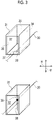
- the carrier 30 is formed by connecting a plurality of covers 31. Note that, in Figs. 1 and 2 , the covers 31 between the front side (F) and the rear side (B) are not shown.
- each of the covers 31 is a tubular member of which an opening has a rectangular shape and supports the signal cable 20 with the signal cable 20 accommodated in an internal space 32 thereof.
- the signal cable 20 may be supported by all of the covers 31 constituting the carrier 30 or may be supported intermittently by being supported by every fourth cover 31. In any case, the signal cable 20 is supported by the plurality of covers 31 and thus the signal cable 20 can be reliably supported by the carrier 30.
- the covers 31 are preferably formed of a metallic material or a resin material.
- the covers 31 formed of a metallic material have a high durability and the covers 31 made of a resin material are lightweight.
- the signal cable 20 may be supported by the covers 31 in any manner.
- an adhesive tape 37 or the like may be attached to an inner peripheral surface of any of four side walls 33, 34, 35, and 36 constituting the cover 31.
- a support 38 that supports the signal cable 20 may be provided inside the cover 31 over the vertical direction V and the signal cable 20 may be fastened to the support 38.
- each cover 31 receives a mechanical load from preceding and following covers 31 but has such a rigidity that the load does not cause deformation.
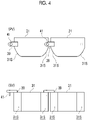
- PV means a plan view
- SV means a side view.
- a front end and a rear end of each of the covers 31 shown in Fig. 4 are provided with curved surfaces 31S so that a mechanical load acting when the covers 31 come into contact with each other while being curved as the carrier 30 is reduced.
- the carrier guide 50 guides the carrier 30 to move forward and backward along a predetermined movement path.
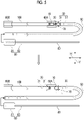
- the carrier guide 50 according to the present embodiment includes a first path 51 that is provided on a lower side in the vertical direction V and is linear, a second path 52 that is connected to one end of the first path 51 and is arc-shaped, and a third path 53 that is connected to one end of the second path 52, is provided on an upper side in the vertical direction V, and is linear.
- the carrier guide 50 is folded at the second path 52 to form a U-like shape.
- the carrier guide 50 is formed in two stages with the first path 51 and the third path 53 being on the upper and lower sides in the vertical direction V.
- the first path 51 and the third path 53 can be arranged in two stages in the horizontal direction H instead of being arranged in two stages in the vertical direction V. It is possible to reduce the size of a required space in the water level direction H when arranging the paths in two stages in the vertical direction V and it is possible to reduce the size of a required space in the vertical direction V when arranging the paths in two stages in the horizontal direction H. Therefore, in a case where the movement path is to be folded, a direction in which the movement path is folded back may be set in accordance with the surrounding environment.
- the outer shape of a cross section (CS) of the carrier guide 50 is rectangular and tubular throughout an area from the first path 51 to the third path 53.
- the carrier 30 moves forward and backward along the movement path composed of a space closed by the carrier guide 50. Regarding the space, it is preferable that gaps around the covers 31 are minimized on the assumption that the carrier 30 can move forward and backward. Since each cover 31 moves forward and backward without meandering, the amount of movement of the inspection probe 10 can be specified with high accuracy.
- the first support 60A and the second support 60B support the inspection target 100 at both of end portions thereof.
- An ultrasonic test is performed by moving the inspection probe 10 forward and backward with the inspection target 100 supported by the first support 60A and the second support 60B.
- the movement mechanism 70 is provided at a tip end of the third path 53 and at a position corresponding to the foremost cover 31 of the carrier 30 in a standby state.
- the movement mechanism 70 comes into contact with the covers 31 and applies thrust in a forward movement direction in this order: the foremost cover 31, the second foremost cover 31, the third foremost cover 31, ... and so forth. Since the covers 31 have a high rigidity, by applying thrust to any of the covers 31, it is possible to move the cover 31 preceding the cover 31 to which the thrust is applied and the cover 31 following the cover 31 to which the thrust is applied.
- thrust is applied to the covers 31 sequentially in a backward movement direction. The thrust in the backward movement direction is applied until the foremost cover 31 exits the inspection target 100 and reaches the first support 60A.
- the movement mechanism 70 in the present embodiment includes a pair of thrust rollers 71 pressed against the side walls 33 to 36 of at least one of the covers 31 and an electric motor 73 driving the thrust rollers 71. It is preferable that the electric motor 73 can perform rotation in forward and reverse directions and can change the rotation speed steplessly.
- the control mechanism 80 includes an inspection machine 81 that supplies a voltage to the inspection probe 10 via the signal cable 20 and receives an electric signal based on a reflected wave received by the inspection probe 10 and a guide 83 that guides movement of the inspection machine 81.
- the inspection machine 81 moves forward and backward while being guided by the guide 83 as the inspection probe 10 and the carrier 30 move.
- the non-destructive inspection device 1 moves the inspection probe 10 forward to feed the inspection probe 10 to the tip end of the inspection target 100 and performs ultrasonic flaw detection by receiving a reflected wave while causing the vibrator to perform ultrasonic wave infiltration during backward movement of the inspection probe 10.
- the inspection target 100 is brought in and supported by the first support 60A and the second support 60B when the inspection probe 10, the signal cable 20, and the carrier 30 are at standby positions thereof. In this manner, the ultrasonic test becomes ready to be carried out.
- the movement mechanism 70 is driven such that the inspection probe 10, the signal cable 20, and the carrier 30 are moved forward.
- the inspection probe 10 moves forward and reaches the tip end of the inspection target 100, application of thrust performed by the movement mechanism 70 is temporarily stopped.
- thrust in a reverse direction is applied to the covers 31 from the movement mechanism 70 so that the inspection probe 10, the signal cable 20, and the carrier 30 are moved backward.
- the vibrator of the inspection probe 10 is vibrated such that an ultrasonic wave is emitted toward the inspection target 100 and a reflected wave from the inspection target 100 is received for flaw detection.
- the application of thrust performed by the movement mechanism 70 is stopped. In this manner, a series of ultrasonic flaw detection is finished.
- the covers 31 have a high rigidity, the entire length of the carrier 30 does not change during movement of the signal cable 20 and the carrier 30 as described above and there is only a slight change even if there is a change in entire length of the carrier 30. Therefore, the position accuracy of the inspection probe 10 provided at a front end of the carrier 30 can be secured.
- the inspection probe 10 and the signal cable 20 can be moved forward or backward reliably with the carrier 30 being moved forward or backward. Furthermore, since the inspection probe 10 and the signal cable 20 are supported by the carrier 30, it is possible to prevent deformation such as bending or buckling of the signal cable 20. Therefore, according to the non-destructive inspection device 1, the amount of movement of the inspection probe 10 can be specified with high accuracy and thus high-accuracy ultrasonic flaw detection can be performed even in a case where the inspection target 100 is long and tubular.
- the second embodiment is for specifying the positional relationship between the adjacent covers 31. More specifically, the preceding cover 31 and the following cover 31 are brought into surface-contact with each other. Therefore, in addition to the presence of flat surfaces at a rear surface 31B of the preceding cover 31 and a front surface 31F of the following cover 31, positions at which the hook 39 and the pin 41 for connection between the preceding cover 31 and the following cover 31 are adjusted.
- preceding and following covers 31 come into surface-contact with each other at the rear surface 31B and the front surface 31F, a pressure applied to each cover 31 can be reduced and the rigidity of the covers 31 can be improved. Accordingly, it is possible to reduce the degree of deformation of each cover 31 or to prevent deformation of each cover 31. Therefore, it is possible to move the inspection probe 10 and the signal cable 20 reliably and accurately via the covers 31. It is possible to prevent an error in feeding amount measurement with respect to the inspection probe 10 and the signal cable 20 caused by looseness of the covers 31 connected to each other and it is possible to improve the accuracy of position detection of the inspection probe 10.
- the gist of the third embodiment is to provide a friction reduction configuration for the side walls 34 to 36 of the covers 31.
- rollers 42, 43, 44, and 45 rotatably provided on the respective side walls 33, 34, 35, and 36 are provided.
- Each of the rollers 42 to 44 can rotate around an axis thereof when resistance is applied thereto.
- the rollers 42 to 45 rotate during movement in the carrier guide 50 and movement in the inspection target 100 although the rollers 42 to 45 come into contact with the carrier guide 50 and the inspection target 100 during the movement. Therefore, friction can be reduced. Therefore, at the time of flaw detection, it is possible to prevent thrust applied by the movement mechanism 70 from being insufficient with respect to frictional resistance from the carrier guide 50 and the inspection target 100 that is caused by the weights of the signal cable 20 and the carrier 30. In addition, it is possible to reduce wear of the covers 31, the carrier guide 50, and the inspection target 100 caused by contact between the covers 31 and the carrier guide 50 and contact between the covers 31 and the inspection target 100.
- the rollers 42 to 45 are merely an example of friction reducing means.
- a spherical rotating body can be used as the friction reducing means.
- a member having a low coefficient of friction may be provided as the friction reducing means instead of the rollers 42 to 45.
- Examples of the material having a low coefficient of friction include polytetrafluoroethylene (PTFE) and the like.
- the non-destructive inspection device 1 and the inspection method described in the above embodiment are understood as follows.
- the non-destructive inspection device 1 includes the inspection element 3 that includes the inspection probe 10 and the signal cable 20 connected to the inspection probe 10 and the moving element 5 that moves the inspection element 3.
- the moving element 5 includes the carrier 30 that supports the inspection element 3 and moves along the movement path of the inspection element 3 and the carrier guide 50 that guides the carrier 30 along the movement path.
- the carrier 30 is configured by connecting the plurality of covers 31 that have a rigidity higher than a rigidity of the signal cable 20.
- the inspection probe 10 and the signal cable 20 can be moved forward or backward reliably with the carrier 30 being moved forward or backward. Furthermore, since the inspection probe 10 and the signal cable 20 are supported by the carrier 30, it is possible to prevent deformation such as bending or buckling of the signal cable 20. Therefore, according to the non-destructive inspection device 1, the amount of movement of the inspection probe 10 can be specified with high accuracy and thus high-accuracy ultrasonic flaw detection can be performed even in a case where the inspection target 100 is long and tubular.
- the carrier guide 50 includes the first path 51 that is linear, the second path 52 of which one end is connected to the first path 51 and that serves as a folded path, and the third path 53 that is connected to the other end of the second path 52.
- the non-destructive inspection device 1 of the second aspect since the movement path of the carrier guide 50 is folded, a long movement path can be secured in a narrow space.
- the first path 51 and the third path 53 are arranged in the vertical direction V or arranged in the horizontal direction H.
- the non-destructive inspection device 1 of the third aspect it is possible to reduce the size of a required space in the water level direction H when arranging the paths in two stages in the vertical direction V and it is possible to reduce the size of a required space in the vertical direction V when arranging the paths in two stages in the horizontal direction H. Therefore, in a case where the movement path is to be folded, a direction in which the movement path is folded back may be set in accordance with the surrounding environment.
- the carrier guide 50 is composed of a tubular body in which the hollow movement path is provided and the carrier 30 moves through the movement path in the tubular body.
- each cover 31 in a case where gaps around the covers 31 are minimized on the assumption that the carrier 30 can move forward and backward, each cover 31 can move forward and backward without meandering. Accordingly, the amount of movement of the inspection probe 10 can be specified with high accuracy.
- a hollow cable accommodation region is provided in the cover 31 and the signal cable 20 is supported by the plurality of covers 31 in the cable accommodation regions.
- the signal cable 20 is supported by the plurality of covers 31 and thus the signal cable 20 can be reliably supported by the carrier 30.
- the non-destructive inspection device 1 according to a sixth aspect further includes the movement mechanism 70 that comes into contact with the covers 31 and applies thrust to the covers 31.
- the covers 31 have a high rigidity, by applying thrust to any of the covers 31, it is possible to move the cover 31 preceding the cover 31 to which the thrust is applied and the cover 31 following the cover 31 to which the thrust is applied.
- the cover 31 includes a front surface and a rear surface that come into plane-contact with preceding and following covers 31.
- the non-destructive inspection device 1 of the seventh aspect since preceding and following covers 31 come into surface-contact with each other, a pressure applied to each cover 31 can be reduced and the rigidity of the covers 31 can be improved. Accordingly, it is possible to reduce the degree of deformation of each cover 31 or to prevent deformation of each cover 31. Therefore, it is possible to move the inspection probe 10 and the signal cable 20 reliably and accurately via the covers 31.
- At least one of the cover 31 and the carrier guide 50 includes a member that reduces friction with a counterpart.
- non-destructive inspection device 1 of the eighth aspect it is possible to reduce wear of the covers 31, the carrier guide 50, and the inspection target 100.
- a non-destructive inspection method is a non-destructive inspection method for the non-destructive inspection device 1 including the inspection element 3 that includes the inspection probe 10 and the signal cable 20 connected to the inspection probe 10 and the moving element 5 that moves the inspection element 3 while supporting the inspection element 3.
- the moving element 5 includes the carrier 30 that supports the inspection element 3 and moves along the movement path of the inspection element 3 and the carrier guide 50 that guides the carrier 30 along the movement path.
- the carrier 30 is configured by connecting the plurality of covers 31 that have a rigidity higher than a rigidity of the signal cable 20.
- the inspection method includes a step (a) of moving the inspection element 3 along the inspection target 100 by means of the moving element 5 and a step (b) of non-destructively inspecting the inspection target 100 by causing the inspection probe 10 to function during movement of the inspection element 3.
- the inspection probe 10 and the signal cable 20 can be moved forward or backward reliably with the carrier 30 being moved forward or backward. Furthermore, since the inspection probe 10 and the signal cable 20 are supported by the carrier 30, it is possible to prevent deformation such as bending or buckling of the signal cable 20. Therefore, according to the non-destructive inspection device 1, the amount of movement of the inspection probe 10 can be specified with high accuracy and thus high-accuracy ultrasonic flaw detection can be performed even in a case where the inspection target 100 is long and tubular.
- a rotary encoder and a linear encoder can be used as position detection means and the electric motor 73 can have a function as a rotary encoder.
- the covers 31 can have a sensor function and the carrier guide 50 can have a scale function.
- the rotary encoder and the linear encoder may be any of optical type encoders and magnetic type encoders.
- a combination of a slider attached to one end of each cover 31, a rack attached to the slider, a pinion gear meshing with the rack, and an electric motor rotationally driving the pinion gear can also be used.
- the driving of the slider is not limited to the above-described example and an electric linear motor, a ball screw, or the like can be used.
Landscapes
- Health & Medical Sciences (AREA)
- Life Sciences & Earth Sciences (AREA)
- Physics & Mathematics (AREA)
- Chemical & Material Sciences (AREA)
- Engineering & Computer Science (AREA)
- General Health & Medical Sciences (AREA)
- Pathology (AREA)
- Biochemistry (AREA)
- General Physics & Mathematics (AREA)
- Immunology (AREA)
- Analytical Chemistry (AREA)
- General Engineering & Computer Science (AREA)
- Combustion & Propulsion (AREA)
- Surgery (AREA)
- Radiology & Medical Imaging (AREA)
- Optics & Photonics (AREA)
- Nuclear Medicine, Radiotherapy & Molecular Imaging (AREA)
- Biomedical Technology (AREA)
- Heart & Thoracic Surgery (AREA)
- Medical Informatics (AREA)
- Molecular Biology (AREA)
- Animal Behavior & Ethology (AREA)
- Public Health (AREA)
- Veterinary Medicine (AREA)
- Biophysics (AREA)
- Acoustics & Sound (AREA)
- Mechanical Engineering (AREA)
- Investigating Or Analyzing Materials By The Use Of Ultrasonic Waves (AREA)
Applications Claiming Priority (1)
| Application Number | Priority Date | Filing Date | Title |
|---|---|---|---|
| PCT/JP2020/003306 WO2021152756A1 (ja) | 2020-01-30 | 2020-01-30 | 非破壊検査装置および非破壊検査方法 |
Publications (2)
| Publication Number | Publication Date |
|---|---|
| EP4099009A1 true EP4099009A1 (de) | 2022-12-07 |
| EP4099009A4 EP4099009A4 (de) | 2023-08-30 |
Family
ID=77078747
Family Applications (1)
| Application Number | Title | Priority Date | Filing Date |
|---|---|---|---|
| EP20916800.4A Withdrawn EP4099009A4 (de) | 2020-01-30 | 2020-01-30 | Vorrichtung und verfahren zur zerstörungsfreien prüfung |
Country Status (2)
| Country | Link |
|---|---|
| EP (1) | EP4099009A4 (de) |
| WO (1) | WO2021152756A1 (de) |
Families Citing this family (1)
| Publication number | Priority date | Publication date | Assignee | Title |
|---|---|---|---|---|
| JP7693577B2 (ja) * | 2021-09-16 | 2025-06-17 | 株式会社東芝 | 音波検査装置、音波検査方法、及び接触部材 |
Family Cites Families (19)
| Publication number | Priority date | Publication date | Assignee | Title |
|---|---|---|---|---|
| JPS58165044A (ja) * | 1982-03-25 | 1983-09-30 | Mitsubishi Heavy Ind Ltd | 容器の内部検査装置 |
| FR2670898B1 (fr) * | 1990-12-21 | 1994-05-27 | Framatome Sa | Dispositif de controle non destructif par ultrasons d'elements de forme allongee a section sensiblement constante. |
| US5174164A (en) * | 1991-09-16 | 1992-12-29 | Westinghouse Electric Corp. | Flexible cable |
| US5770800A (en) * | 1994-09-27 | 1998-06-23 | The United States Of America As Represented By The United States Department Of Energy | Flexible ultrasonic pipe inspection apparatus |
| GB0020461D0 (en) * | 2000-08-18 | 2000-10-11 | Oliver Crispin Consulting Ltd | Improvements in and relating to the robotic positioning of a work tool to a sensor |
| DE202004013045U1 (de) * | 2004-08-19 | 2005-09-08 | Cegelec Anlagen- Und Automatisierungstechnik Gmbh & Co. Kg | Ultraschall-Prüfeinrichtung |
| US7249512B2 (en) | 2005-01-24 | 2007-07-31 | The Boeing Company | Non-destructive stringer inspection apparatus and method |
| JP5294239B2 (ja) * | 2007-09-12 | 2013-09-18 | 国立大学法人東北大学 | 自走式ケーブル装置 |
| EP2249690B1 (de) * | 2008-02-06 | 2021-09-29 | Intuitive Surgical Operations, Inc. | Segmentiertes instrument mit bremsmöglichkeit |
| US9339264B2 (en) * | 2010-10-01 | 2016-05-17 | Cook Medical Technologies Llc | Port access visualization platform |
| US20120312103A1 (en) * | 2009-11-10 | 2012-12-13 | Kerstin Hannott | Inspection device and method for positioning an inspection device |
| US20150011830A1 (en) * | 2010-08-27 | 2015-01-08 | Massachusetts Institute Of Technology | Tip actuated disposable endoscope |
| EP2550908A1 (de) * | 2011-07-28 | 2013-01-30 | Fraunhofer-Gesellschaft zur Förderung der angewandten Forschung e.V. | Vorrichtung zur Bestimmung eines räumlichen Pfads eines flexiblen oder halbstarren länglichen Körpers |
| JP2014033853A (ja) * | 2012-08-09 | 2014-02-24 | Hoya Corp | 内視鏡の信号ケーブル |
| JP2014166806A (ja) * | 2013-02-28 | 2014-09-11 | Mitsubishi Heavy Ind Ltd | 管内走行装置及び管内検査装置 |
| CN108882836B (zh) * | 2016-08-02 | 2020-09-15 | 奥林巴斯株式会社 | 插入装置 |
| DE112017003899T5 (de) * | 2016-08-02 | 2019-04-18 | Olympus Corporation | Einführvorrichtung |
| JP6368884B2 (ja) * | 2016-08-02 | 2018-08-01 | オリンパス株式会社 | 挿入装置 |
| WO2019186694A1 (ja) * | 2018-03-27 | 2019-10-03 | オリンパス株式会社 | 可撓管挿入装置 |
-
2020
- 2020-01-30 WO PCT/JP2020/003306 patent/WO2021152756A1/ja not_active Ceased
- 2020-01-30 EP EP20916800.4A patent/EP4099009A4/de not_active Withdrawn
Also Published As
| Publication number | Publication date |
|---|---|
| EP4099009A4 (de) | 2023-08-30 |
| WO2021152756A1 (ja) | 2021-08-05 |
Similar Documents
| Publication | Publication Date | Title |
|---|---|---|
| EP2345881B1 (de) | Automatischer Kriechscanner zur zerstörungsfreien Inspektion von Luftfahrtstrukturelementen | |
| EP4357819A1 (de) | Strahlungsdetektor und strahlungsinspektionsvorrichtung damit | |
| US7315609B2 (en) | Real-time X-ray scanner and remote crawler apparatus and method | |
| EP4099009A1 (de) | Vorrichtung und verfahren zur zerstörungsfreien prüfung | |
| US7975549B2 (en) | Method, apparatus and system for inspecting a workpiece having a curved surface | |
| EP1842057B1 (de) | Zerstörungsfreie bogenüberprüfungsvorrichtung und entsprechendes verfahren | |
| EP2038646B1 (de) | Integriertes Ultraschallinspektionssystem und -verfahren zur Inspektion von Verbundwerkstoffen mit gekrümmten Bereichen | |
| EP3580559B1 (de) | Automatisierte ultraschallprüfung von klebeverbindungen und prüfverfahren dafür | |
| CA2763427A1 (en) | Non-destructive inspection scanning apparatus and non-destructive inspection apparatus | |
| JP5689481B2 (ja) | 磁気ばねバランス式ストリンガプローブを備える非破壊検査装置 | |
| US4294118A (en) | Fully automatic ultrasonic flaw detection apparatus | |
| KR20100110373A (ko) | 초음파를 이용한, 검사 대상 재료의 비파괴 검사 장치 | |
| EP4644844A1 (de) | Detektionssystem und detektionsverfahren | |
| JP2002034981A (ja) | 超音波振動子駆動モータ装置とそれを使用した超音波診断装置 | |
| EP3040719B1 (de) | Ultraschall-defekterkennungsvorrichtung | |
| US20140197829A1 (en) | Mobile carrier system for at least one sensor element designed for non-destructive testing | |
| CN108632730B (zh) | 超声波器件单元、超声波探头及超声波装置 | |
| CN114441640A (zh) | 用于工件无损检查的超声检查装置 | |
| KR20190133632A (ko) | 위치 제어 장치, 위치 제어 방법, 및 초음파 영상 시스템 | |
| CN217424294U (zh) | 一种管状零件内壁涂层检测装置 | |
| EP1899722A2 (de) | Untersuchungsvorrichtung und verfahren des übertragungstyps, wobei sender und empfänger über das zu untersuchende planare objekt hinweg magnetisch gegenseitig angezogen werden | |
| US20070100579A1 (en) | Control for hand-held imaging array using computer mouse configuration | |
| CN115963571A (zh) | 用于检测设备的传送系统 | |
| CN102589670A (zh) | 一种水下扫描测量装置及其测量方法 | |
| EP4471411A1 (de) | Inspektionsvorrichtung und inspektionsverfahren |
Legal Events
| Date | Code | Title | Description |
|---|---|---|---|
| STAA | Information on the status of an ep patent application or granted ep patent |
Free format text: STATUS: THE INTERNATIONAL PUBLICATION HAS BEEN MADE |
|
| PUAI | Public reference made under article 153(3) epc to a published international application that has entered the european phase |
Free format text: ORIGINAL CODE: 0009012 |
|
| STAA | Information on the status of an ep patent application or granted ep patent |
Free format text: STATUS: REQUEST FOR EXAMINATION WAS MADE |
|
| 17P | Request for examination filed |
Effective date: 20220509 |
|
| AK | Designated contracting states |
Kind code of ref document: A1 Designated state(s): AL AT BE BG CH CY CZ DE DK EE ES FI FR GB GR HR HU IE IS IT LI LT LU LV MC MK MT NL NO PL PT RO RS SE SI SK SM TR |
|
| DAV | Request for validation of the european patent (deleted) | ||
| DAX | Request for extension of the european patent (deleted) | ||
| A4 | Supplementary search report drawn up and despatched |
Effective date: 20230801 |
|
| RIC1 | Information provided on ipc code assigned before grant |
Ipc: A61B 1/005 20060101ALI20230726BHEP Ipc: G01N 21/954 20060101ALI20230726BHEP Ipc: G02B 23/24 20060101ALI20230726BHEP Ipc: A61B 1/01 20060101ALI20230726BHEP Ipc: A61B 1/00 20060101ALI20230726BHEP Ipc: G01N 29/265 20060101AFI20230726BHEP |
|
| STAA | Information on the status of an ep patent application or granted ep patent |
Free format text: STATUS: EXAMINATION IS IN PROGRESS |
|
| 17Q | First examination report despatched |
Effective date: 20241030 |
|
| STAA | Information on the status of an ep patent application or granted ep patent |
Free format text: STATUS: THE APPLICATION HAS BEEN WITHDRAWN |
|
| 18W | Application withdrawn |
Effective date: 20241231 |