EP4099326A1 - Procédé de remixage vidéo - Google Patents
Procédé de remixage vidéo Download PDFInfo
- Publication number
- EP4099326A1 EP4099326A1 EP21177649.7A EP21177649A EP4099326A1 EP 4099326 A1 EP4099326 A1 EP 4099326A1 EP 21177649 A EP21177649 A EP 21177649A EP 4099326 A1 EP4099326 A1 EP 4099326A1
- Authority
- EP
- European Patent Office
- Prior art keywords
- excerpt
- video
- sub
- onset
- sequences
- Prior art date
- Legal status (The legal status is an assumption and is not a legal conclusion. Google has not performed a legal analysis and makes no representation as to the accuracy of the status listed.)
- Ceased
Links
Images


Classifications
-
- G—PHYSICS
- G11—INFORMATION STORAGE
- G11B—INFORMATION STORAGE BASED ON RELATIVE MOVEMENT BETWEEN RECORD CARRIER AND TRANSDUCER
- G11B27/00—Editing; Indexing; Addressing; Timing or synchronising; Monitoring; Measuring tape travel
- G11B27/005—Reproducing at a different information rate from the information rate of recording
- G11B27/007—Reproducing at a different information rate from the information rate of recording reproducing continuously a part of the information, i.e. repeating
-
- G—PHYSICS
- G11—INFORMATION STORAGE
- G11B—INFORMATION STORAGE BASED ON RELATIVE MOVEMENT BETWEEN RECORD CARRIER AND TRANSDUCER
- G11B27/00—Editing; Indexing; Addressing; Timing or synchronising; Monitoring; Measuring tape travel
- G11B27/02—Editing, e.g. varying the order of information signals recorded on, or reproduced from, record carriers
- G11B27/031—Electronic editing of digitised analogue information signals, e.g. audio or video signals
Definitions
- the present invention is in the field of video editing.
- a (music) remix is a rearrangement of an older piece of music.
- a video remix is a rearrangement of a previously recorded video or parts of it.
- video remixing is a video editing application in which multiple video segments are combined in order to obtain a video remix.
- Video remixing is building upon a work that already exists and using it to make new meanings and express new ideas in creative ways.
- editing a video can be difficult and tedious, so it is desirable to produce technologies to aid people in this task.
- Video editing is the manipulation and arrangement of video previously recorded video or parts of it. Video editing is used to structure and present video information and has been dramatically democratized in recent years by editing software available for personal computers. Software allowing users to create short videos, which often feature music in the background and can be sped up, slowed down or edited with a filter is currently enjoying great popularity. To create a music video, users can choose background music from a variety of music genres or sound recordings and record a short video with speed adjustments. Thus, a video clip that matches a selected audio track can be created by hand.
- the technical problem underlying the present invention may be seen in the provision of a method for automatically creating a video remix from an original video. Therefore, a more convenient video remixing method is needed that is easy in handling and presents a fast way to edit video for a user.
- the present invention relates to automatic video remixing.
- the present disclosure provides a method for video remix generation, wherein a source video is automatically cut into precisely measured sub-sequences based on the audio information of the source video that are rearranged into a video remix.
- the repetition of the audio information in the video remix makes the audio sound musical, i.e. the remix has a rhythm.
- the created video remix is pleasing to the ear of many users, which is encouraging to many users to try the method on several of their own videos.
- the present disclosure provides a method for generating a video remix, the method comprising the steps of receiving an input video; selecting at least one excerpt from the input video, wherein an audio signal of the selected at least one excerpt includes at least one onset; determining a plurality of sub-sequences of the at least one excerpt; and rearranging the plurality of sub-sequences according to a predetermined pattern to form the video remix.
- a video is a sequence of images called frames and typically includes audio.
- An input video or source video may be captured by a high quality camera of a portable device, such as mobile phones, cameras or tablets.
- the device recording the input video may share the recorded source content with the device responsible for generating the video remix.
- a video remix is a rearrangement of a previously recorded video or part of it.
- a multi-clip video remix is a rearrangement of at least two previously recorded videos or two parts of the same video.
- An excerpt is a sequence of frames selected from the original input video for the video remix.
- an excerpt is a piece of a predetermined length of the input video which is taken/extracted from the larger input video.
- a sub-sequence is a sequence of frames within the (video) excerpt.
- a sub-sequence can be the whole or part of the excerpt.
- a specific order or arrangement of a plurality of sub-sequences is referred to as a pattern.
- a pattern can specify a song structure and may correspond to a specific song layout.
- a pattern is typically divided into "chunks" each comprising a plurality of sub-sequences.
- a pattern may provide repeating forms in songs.
- An "onset” in an audio signal refers to the beginning of a musical note or other sound, both of which may be present in an audio signal.
- Techniques for detection of onsets and their strengths are known in the art. More than one such technique may be used and their results may be combined.
- One technique may be performed using an audio signal processing library. For example the "librosa” python package may be used which includes an onset_strength attribute.
- Another technique may use the constant-Q transform "CQT", in which the data series is transformed into the frequency domain, and the librosa package may be used for this.
- onset detection is a well-known research area. Music onset detection may refer to detection of the instant when a discrete event begins in e.g. a music signal.
- a salient video clip can be determined automatically. Rearranging a plurality of sub-sequences of such excerpt including at least one onset in a predetermined rhythmic pattern allows to repeat the at least one onset throughout the video remix in a predictable or periodic manner. This allows the automation of video remix creation. For example, a person's footsteps can be turned into a drum-like rhythm. The repetition of the at least one onset imparts a rhythm to the created video remix, in the sense of the placement of sounds in time. At the same time the video image part corresponding to the onset is repeated in the video remix making the video remix salient.
- the present invention is based on the finding that a video remix can be automatically created when paying attention to the onsets in the audio signal of the input video. Depending on the predetermined pattern, a rhythm is imparted to the video remix which makes it easy to implement further automated video editing, like e.g. adding background music.
- the conversion of videos to video remixes according to the present invention may allow users to create salient video clips without having experience in designing musical remixes.
- the at least one excerpt may have a predetermined length, wherein each sub-sequence may have a length corresponding to a divisor of the predetermined length, and the video remix may have a length corresponding to a multiple of the predetermined length.
- the video remix may contain a high number of repetitions of sub-sequences.
- the length of the sub-sequences can be chosen to be e.g. 1, 1 ⁇ 2, 1 ⁇ 4, 1/8, 1/16 etc. of the excerpt. This allows to combine a high number of (different) sub-sequences while still matching the predetermined length.
- the at least one excerpt may begin with the at least one onset.
- the excerpt is selected such that its audio track begins with the at least one onset, wherein an increase in loudness associated with this onset may be particularly high.
- even very short sub-sequences e.g. corresponding to only 1/8 of the excerpt still include the at least one onset.
- the excerpt should not be quiet but chosen such that it has a high density of onsets.
- the method can include detecting the at least one onset by applying an onset detection function to the input video.
- Techniques for detection of onsets and their strengths are known in the art. More than one such technique may be used and their results may be combined.
- An onset detection function may be applied using an audio signal processing library.
- the onsets can be calculated with a third-party library, librosa, wherein the algorithm involves a peak detection from a spectral envelope of the signal and then backtracks from peaks to their proceeding local minima. Based on the detected onsets, the moments/points in the excerpts are identified that include an onset.
- An onsets may corresponds to a moment when e.g. a batter hits a baseball, or other events in the audio signal.
- the method may include applying onset selection in cases where more than one onset in the input video is detected, wherein onset selection is based on at least one of onset strength, onset loudness and onset density.
- the input videos include a plurality of onsets, wherein each onset has a different strength and/or loudness.
- the excerpt of a predetermined length should be chosen such that it contains a high number of detected onsets, the onsets with the highest strength or the onsets with maximum loudness or a combination of all three factors. In videos with speech, these criteria have been found sufficient to select excerpts with speech. It is also possible that a user selects one of these options in view of a particular input video. When the number of onsets in the input video is too high, a threshold can be implemented such that only onsets with a certain loudness of strength are considered as onsets for selection of the excerpt.
- the excerpt may be chopped into sub-sequences, wherein a majority of the sub-sequences includes the at least one onset.
- those sub-sequences are determined that are present in the predetermined pattern, wherein the excerpt is automatically chopped into sub-sequences according to their determined length. According to the predetermined pattern, the sub-sequences are assembled in a specific order.
- a loop point corresponding to an onset within the first half of the excerpt can be determined, wherein sub-sequences with a shorter length than the excerpt begin at the loop point.
- the loop point is chosen such that it corresponds to the onset, for example a second onset in the excerpt in proximity to the first onset at the beginning of the excerpt. Since the loop point is the point in time at which the shorter sub-sequences begin, it has to be within the first half of the excerpt.
- the loop point will be set to zero. The option of defining a loop point within the excerpt allows to create more complex video remixes including repetitions of different onsets.
- the predetermined pattern may correspond to a musical backing track. In particular, it may be built in the sense that it builds to a climax. Since the pattern determines how to cut up and reassemble the sub-sequences of the excerpt, a user may chose a predetermined pattern or a specific song layout at the beginning of the video remix creation process. It is also conceivable that the predetermined pattern may be chosen randomly from a number of predetermined patterns.
- a multi-clip option to create them. It is also possible that the method automatically selects the multi-clip option for input videos that e.g. contain a number of onsets at two distinct times of the input video that cannot be combined in one excerpt.
- a second excerpt is selected from the input video such that an audio signal of the second excerpt includes at least one onset.
- the second excerpt is chosen based on the same criteria as the first excerpt. Preferably, the first and second excerpt do not overlap.
- the plurality of sub-sequences of the second excerpt is determined and the plurality of sub-sequences of the first and second excerpts are rearranged into the video remix according to a predetermined multi-clip pattern.
- the predetermined multi-clip pattern may include at least two parts in which sub-sequences of the respective excerpt are arranged.
- the video remix may comprise a plurality of chunks each comprising a plurality of sub-sequences, preferably at least one chunk is repeated in the video remix. In some embodiments, it may be advantageous to repeat at least one chunk several times in the video remix or repeat it periodically throughout the video remix, so that the resulting audio sounds musical and to impart a song structure.
- the video remix may comprise at least one chunk comprising sub-sequences from the first excerpt and at least one other chunk comprising sub-sequences from the second excerpt.
- the audio track corresponds to at least one of a specifically composed musical backing track matching the predetermined pattern and/or a musical backing track based on instrument tracks.
- the audio track corresponds to at least one of a specifically composed musical backing track matching the predetermined pattern and/or a musical backing track based on instrument tracks.
- the beat of the background audio track should be chosen to match the length or a divisor of the length of the shortest sub-sequence present in the predetermined pattern.
- a user may select a special background music to generate the video remix, in which case the method will automatically chose a predetermined pattern matching said background music and vice versa.
- a background music may be designed that suits a specific music genre.
- a backing track may be generated from sounds from the source video and added to the video remix.
- the backing track may include a combination of the audio signal of a subsequence of the excerpt and silence(s).
- the method for generating a video remix may be fully automatic, at least some of the parameters of the method can be chosen or set by a user. It is also possible to add an element of surprise by allowing the method to choose some parameters randomly. For example, in the step of selecting at least one excerpt, the weighting between the onset strength, onset loudness and onset density could be changed so that a different excerpt is selected.
- the method for generating a video remix may be implemented by a computer.
- the methods described herein may be performed by software in machine readable form on a tangible storage medium e.g. in the form of a computer program comprising computer program code means adapted to perform all the steps of any of the methods described herein when the program is run on a computer and where the computer program may be embodied on a computer readable medium.
- tangible (or non-transitory) storage media include disks, thumb drives, memory cards etc. and do not include propagated signals.
- the software can be suitable for execution on a parallel processor or a serial processor such that the method steps may be carried out in any suitable order, or simultaneously.
- firmware and software can be valuable, separately tradable commodities. It is intended to encompass software, which runs on or controls “dumb” or standard hardware, to carry out the desired functions. It is also intended to encompass software which "describes” or defines the configuration of hardware, such as HDL (hardware description language) software, as is used for designing silicon chips, or for configuring universal programmable chips, to carry out desired functions.
- HDL hardware description language
- the present invention relates to a data processing system comprising a processor configured to perform the method for generating a video remix, a computer program comprising instructions which, when the program is executed by a computer, cause the computer to carry out the method for generating a video remix and/or a computer-readable medium comprising instructions which, when executed by a computer cause the computer to carry out the method for generating a video remix.
- Embodiments of the present invention are described below by way of example only. These examples represent the best mode of putting the invention into practice that are currently known to the Applicant although they are not the only ways in which this could be achieved.
- the description sets forth the functions of the example and the sequence of steps for constructing and operating the example. However, the same or equivalent functions and sequences may be accomplished by different examples.
- Figure 1 is a flow chart illustrating a method for generating a video remix.
- a first step 101 an input video is received.
- the input video may have any size/length.
- the input video may be captured by a user using a portable device, such as a mobile phone, camera, tablet or the like.
- onset detection is performed on the input video or parts of it.
- audio onset detection is concerned with finding time-locations of all sonic events in a piece of audio.
- the audio signal of the input video typically includes a plurality of onsets.
- at least one excerpt is selected based on at least one detected onset.
- Selecting the excerpt may include that the input video is trimmed or cut to a predetermined length such that it includes the at least one onset at the beginning or any other location within the first half of the excerpt.
- a predetermined length of the excerpt of 2 seconds (2 s) is used.
- any other predetermined length is equally suitable for generating a video remix.
- Selecting the excerpt from the input video based on the detected onsets may be based on one or all of the following factors:
- the audio signal typically includes a plurality of onsets, however, the above factors are used to determine a salient onset.
- An onset may be particularly "strong" the louder the sound and the quieter the preceding context. In videos with speech, these criteria have been found sufficient to select excerpts including speech.
- an input video may contain four onsets, wherein three onsets are nearer to each other at the beginning (e.g. at times 1.2 s, 1.3 s and 1.7 s) and a fourth later on (at e.g. 5.4 s).
- the selected excerpt shall have a predetermined length of 2 s corresponding to a 2 s window of the input video.
- the onset selection algorithm considers 2 s windows beginning at each of the four detected onsets and counts the total number of onsets in each window.
- first window beginning at 1.2 s containing three onsets
- second window beginning at 1.3 s containing two onsets
- third window beginning at 1.7 s containing one onset
- fourth window beginning at 5.4 s containing one onset. Therefore, when the excerpt is selected based on the onset density, the first window will be chosen as the excerpt.
- step 104 a plurality of sub-sequences is determined based on the selected excerpt. In practice, this step will depend on the sub-sequences of a predetermined length included in the predetermined pattern of the desired video remix as well as the position(s) of the at least one onset(s). The repetition of the audio signal according to the predetermined pattern will make the audio sound musical. Shorter sub-sequences may begin either at the beginning of the excerpt or within the excerpt at a so called loop point.
- step 105 the sub-sequences are rearranged according to the predetermined pattern to generate the video remix including audio and video.
- music can optionally be added to the video remix, which is described in further detail below.
- step 107 after the video remix has been generated, it can be stored or delivered to e.g. a user in any suitable manner.
- the method of Figure 1 may be carried out in any computing system.
- the invention may be implemented in software using one or more algorithms operating on a suitably configured processor.
- the steps or operations of the methods may be carried out on a single computer or in a distributed computing system across multiple locations.
- the software may be client based or web based, e.g. accessible via a server, or the software may be a combination of client and web based software.
- Figure 2 illustrates an example set of sub-sequences a) - d) of an excerpt.
- Each sub-sequence comprises a sequence of frames as indicated by the play-button and audio as indicated by the caption. All four sub-sequences have the same beginning in common, but each sub-sequence has a different length.
- the length of each sub-sequence corresponds to a divisor of the length of the excerpt. In other words, sub-sequences of the same length can be added up to correspond to the predetermined length of the excerpt/first sub-sequence.
- the length of the first sub-sequence '1' as depicted in Fig. 2a ) corresponds to the full length of the excerpt.
- the video excerpt has a predetermined length of 2 s.
- the second sub-sequence '2' as depicted in Fig. 2b ) corresponds to the first half of the excerpt.
- the third sub-sequence '3' as depicted in Fig. 2c ) corresponds to the first quarter of the excerpt,
- the fourth sub-sequence '4' as depicted in Fig. 2d has a length corresponding to 1/8 of the excerpt,
- the fifth sub-sequence '5' (not depicted) has a length corresponding to 1/16 of the excerpt and so on.
- the sub-sequence is indicated by its respective order number 'n', wherein the relationship between the order number and length of the sub-sequence with respect to the excerpt is given by (1/2) ⁇ (n-1), wherein n is an integer.
- a sub-sequence of the order n+1 has half the length of the sub-sequence of the order n.
- Figure 3 shows two example video remixes or parts of it, both of which are based on the same excerpt that is used in Figure 2 .
- Both video remixes are 4 s long, which corresponds to twice the length of the excerpt.
- Both remixes include two or more sub-sequences as indicated by the dashed vertical lines.
- the pattern of the video remix as depicted in Fig. 3a ) can be described by '1,1' meaning that two first sub-sequence '1' is played twice and one after another without a gap.
- the first sub-sequence '1' corresponds to the full excerpt.
- the pattern can be described by '3,3,1,2'.
- the video remix consists of four sub-sequences played in the order '3', '3', '1', '2'.
- the video remix When the video remix is played, it will show the first quarter of the excerpt twice, then a full excerpt and the first half of the excerpt.
- Other examples (not illustrated in Figure 3 ) for rhythmic patterns with a length of 4 s are '1,2,3,3', '3,3,3,3,3,3,4,4,4,4' or '4,4,4,4,4,4,4,4,4,4,4,4,4,4,4,4,5,5,5,5,5,5,5,5,5,5,5,6,6,6,6,6,6,3'.
- Patterns of a certain predefined length like e.g. '1,1', '3,3,1,2' and '3,3,3,3,3,4,4,4' are considered chunks.
- a video remix is made of a predefined number of chunks building a song structure/layout, e.g. four chunks. In the example shown in Figure 3 , each chunk is 4 s long.
- a video remix with a length of 16 second includes four such chunks, wherein different sequences of the chunks may be formed like e.g.
- 'AAAA', 'AABA' or 'ABAB' just to name a few examples.
- An example of a pattern comprising four chunks in the form 'AABC' that builds up to a climax in the third chunk is provided by this example: '1,2,3,3 1,2,3,3 4,4,4,4,4,4,4,4,5,5,5,5,5,5,5,5,5,6,6,6,6,6,6,3* 1,2,2' wherein '3*' indicates a silence of the same length as the third sub-sequence '3'.
- the short video clip that is selected as the excerpt in the examples illustrated in Figures 2 and 3 contains speech in the audio track in addition to visual information in the video track.
- the caption "Here's how old that guy is” has been included to demonstrate what cannot be heard/seen, i.e. sounds/spoken content that is important to understanding the content.
- Fig. 4 two excerpts were selected from the input video (so called multi-clip option) for generating a video remix.
- the excerpts 'X' and 'Y' are selected such that they do not overlap.
- the multi-clip option is selected at least one of four chunks will derive from the second excerpt, e.g. the chunks have a form 'XXXY'.
- Fig. 4a shows how excerpt 'X' is cut into a selection of precisely-measured sub-sequences '1', '2', '3' and '4', wherein Fig. 4b ) shows the same for excerpt 'Y'.
- the top row in Figure 4 shows the first sub-sequences '1' for both excerpts, which correspond to the full length of the excerpt. Independent from the selected loop point, the full excerpt is played.
- the second row shows the second sub-sequences '2' for both excerpts 'X' and 'Y' having an identical length corresponding to half of the original excerpts. However, the sub-sequences start at different times of the excerpt.
- Sub-sequence '2' of excerpt 'X' (which can also be indicated as 'X2') starts at loop point 0.5 (50%) which corresponds to the half of the video excerpt.
- the remaining sub-sequences '3' and '4' also start from the same loop point at 50% of the excerpt. Accordingly, when a loop point is selected, it is identical for all sub-sequences.
- the sub-sequences '2', '3' and '4' start at 33% of the video which corresponds to a loop point 0.33.
- Loop points are set so as to correspond to strong onset moments of the excerpts.
- the selected excerpt e.g. includes only one onset at the beginning
- the loop point will be set to zero.
- loop points can be chosen accordingly. Loop points can only be chosen between 0 and 0.5, i.e. in the first half of the video. In the videos with speech as shown in Fig. 4a and 4b , the loop points correspond to the beginning of the word sounds "guy" and "must".
- Figure 5 shows a video remix for which the multi-clip option is selected.
- the video remix includes the excerpts 'X' and 'Y' as depicted in Figure 4 , wherein 'X' has a loop point of 0.5 and 'Y' a loop point of 0.33. While 'X' and 'Y' refers to the respective excerpts the following numbers '1' and '2' correspond to the order of the sub-sequences as depicted in Figure 4 .
- the excerpts are arranged in a form 'XXYY', meaning that the first two chunks (top row in Fig. 5 ) use a different excerpt than the latter two chunks (bottom row in Fig. 5 ).
- the first two chunks and the second two chunks are played after another without a gap.
- the pattern structure of these four chunks is identical and can be described by 'AAAA'. That means that the sub-sequences of each excerpt are rearranged according to pattern '1,2,2' in each chuck.
- the (full) pattern of the video remix therefore corresponds to '1,2,2 1,2,2 1,2,2 1,2,2'.
- the resulting 16 s long remix will include the following "Here's how old that guy is - guy is - guy is; Here's how old that guy is - guy is - guy is; Things you must know about me - must know about me - must know about me; Things you must know about me - must know about me - must know about me”. Therefore, the predetermined pattern can be considered as a song layout that is imparted on the remix by rearranging the plurality of sub-sequences of the excerpt. In other words, audio and video is automatically generated according to a song layout. For example, it is possible to turn a person's footsteps into a drum-like rhythm.
- One of the advantages of this method is, that a user only has to input a video and receives the video remix with one click.
- the music can be added in form of a backing track that is generated from sounds of the input video or a fully composed backing track matching the predetermined pattern. For example, music can be selected that matches a specifically-designed predetermined pattern.
- a backing track can be assembled from pre-composed bits of music.
- four exemplary clip packs a) 'EDM', b) 'OLD Skool', c) 'Hip Hop' and d) 'Retro Groove' are shown from which a user manually selected d) 'Retro Groove'.
- Each clip pack comprises 40 short audio tracks for four different instruments, e.g. 10 short tracks for each instrument, like e.g. Drum, Bass, Chord or Other.
- four short tracks from different instruments are selected.
- the short tracks are e.g. instrument recordings that have been edited to loop seamlessly, i.e. to loop smoothly and continuously.
- the four short tracks with a length of 4 s each are first summed and then repeated as many times as necessary until they match the length of the output video remix, e.g. 16 s.
- the backing track can then be merged with the video remix and is automatically synced with the video remix.
- a user may select a fully pre-composed audio clip.
- the audio clip is then merged together with the video remix to obtain the musical video remix with a length identical to the length of the video remix.
- a backing track may be generated based on the same or a new video excerpt (using the same criteria as for selecting the excerpt from the input video as described above).
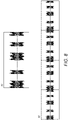
- Fig. 8a shows in an example of a backing track with a length of 4 s and pattern '4,4,_,_,4,_,_,_,4,4,_,_,4,_,_,4', wherein '4' refers to the fourth sub-sequences (i.e. the first 1/8 of the excerpt) and '_' to silence.
- the audio is generated according to the pattern, it is repeated four times to generate the 16 s backing track depicted in Fig. 8b ). This backing track can then be added to the video remix.
- the server may comprise a single server or network of servers.
- the functionality of the server may be provided by a network of servers distributed across a geographical area, such as a worldwide distributed network of servers, and a user may be connected to an appropriate one of the network of servers based upon a user location.
- a user or operator of the system may manually instruct some steps of the method to be carried out.
- the method may be designed so that each time a user inputs the same video, a different output video remix is created.
- the system may be implemented as any form of a computing and/or electronic device.
- a device may comprise one or more processors which may be microprocessors, controllers or any other suitable type of processors for processing computer executable instructions to control the operation of the device in order to gather and record routing information.
- the processors may include one or more fixed function blocks (also referred to as accelerators) which implement a part of the method in hardware (rather than software or firmware).
- Platform software comprising an operating system or any other suitable platform software may be provided at the computing-based device to enable application software to be executed on the device.
- Computer-readable media may include, for example, computer-readable storage media.
- Computer-readable storage media may include volatile or non-volatile, removable or non-removable media implemented in any method or technology for storage of information such as computer readable instructions, data structures, program modules or other data.
- a computer-readable storage media can be any available storage media that may be accessed by a computer.
- Such computer-readable storage media may comprise RAM, ROM, EEPROM, flash memory or other memory devices, CD-ROM or other optical disc storage, magnetic disc storage or other magnetic storage devices, or any other medium that can be used to carry or store desired program code in the form of instructions or data structures and that can be accessed by a computer.
- Disc and disk include compact disc (CD), laser disc, optical disc, digital versatile disc (DVD), floppy disk, and blu-ray disc (BD).
- BD blu-ray disc
- Computer-readable media also includes communication media including any medium that facilitates transfer of a computer program from one place to another.
- a connection for instance, can be a communication medium.
- the software is transmitted from a website, server, or other remote source using a coaxial cable, fiber optic cable, twisted pair, DSL, or wireless technologies such as infrared, radio, and microwave are included in the definition of communication medium.
- a coaxial cable, fiber optic cable, twisted pair, DSL, or wireless technologies such as infrared, radio, and microwave are included in the definition of communication medium.
- hardware logic components may include Field-programmable Gate Arrays (FPGAs), Program-specific Integrated Circuits (ASICs), Program-specific Standard Products (ASSPs), System-on-a-chip systems (SOCs). Complex Progrmmable Logic Devices (CPLDs), etc.
- FPGAs Field-programmable Gate Arrays
- ASICs Program-specific Integrated Circuits
- ASSPs Program-specific Standard Products
- SOCs System-on-a-chip systems
- CPLDs Complex Progrmmable Logic Devices
- the computing device may be a distributed system. Thus, for instance, several devices may be in communication by way of a network connection and may collectively perform tasks described as being performed by the computing device.
- the computing device may be located remotely and accessed via a network or other communication link (for example using a communication interface).
- 'computer' is used herein to refer to any device with processing capability such that it can execute instructions. Those skilled in the art will realise that such processing capabilities are incorporated into many different devices and therefore the term 'computer' includes PCs, servers, mobile telephones, personal digital assistants and many other devices.
- a remote computer may store an example of the process described as software.
- a local or terminal computer may access the remote computer and download a part or all of the software to run the program.
- the local computer may download pieces of the software as needed, or execute some software instructions at the local terminal and some at the remote computer (or computer network).
- a dedicated circuit such as a DSP, programmable logic array, or the like.
- any reference to 'an' item refers to one or more of those items.
- the term 'comprising' is used herein to mean including the method steps or elements identified, but that such steps or elements do not comprise an exclusive list and a method or apparatus may contain additional steps or elements.
- the terms "component” and “system” are intended to encompass computer-readable data storage that is configured with computer-executable instructions that cause certain functionality to be performed when executed by a processor.
- the computer-executable instructions may include a routine, a function, or the like. It is also to be understood that a component or system may be localized on a single device or distributed across several devices.
- the acts described herein may comprise computer-executable instructions that can be implemented by one or more processors and/or stored on a computer-readable medium or media.
- the computer-executable instructions can include routines, sub-routines, programs, threads of execution, and/or the like.
- results of acts of the methods can be stored in a computer-readable medium, displayed on a display device, and/or the like.
Landscapes
- Engineering & Computer Science (AREA)
- Multimedia (AREA)
- Television Signal Processing For Recording (AREA)
- Studio Circuits (AREA)
Priority Applications (4)
| Application Number | Priority Date | Filing Date | Title |
|---|---|---|---|
| EP21177649.7A EP4099326A1 (fr) | 2021-06-03 | 2021-06-03 | Procédé de remixage vidéo |
| CN202280035748.8A CN117337560A (zh) | 2021-06-03 | 2022-05-23 | 视频混音方法 |
| PCT/SG2022/050342 WO2022255941A2 (fr) | 2021-06-03 | 2022-05-23 | Procédé de remixage vidéo |
| US18/562,230 US12567445B2 (en) | 2021-06-03 | 2022-05-23 | Video remixing method |
Applications Claiming Priority (1)
| Application Number | Priority Date | Filing Date | Title |
|---|---|---|---|
| EP21177649.7A EP4099326A1 (fr) | 2021-06-03 | 2021-06-03 | Procédé de remixage vidéo |
Publications (1)
| Publication Number | Publication Date |
|---|---|
| EP4099326A1 true EP4099326A1 (fr) | 2022-12-07 |
Family
ID=76283558
Family Applications (1)
| Application Number | Title | Priority Date | Filing Date |
|---|---|---|---|
| EP21177649.7A Ceased EP4099326A1 (fr) | 2021-06-03 | 2021-06-03 | Procédé de remixage vidéo |
Country Status (4)
| Country | Link |
|---|---|
| US (1) | US12567445B2 (fr) |
| EP (1) | EP4099326A1 (fr) |
| CN (1) | CN117337560A (fr) |
| WO (1) | WO2022255941A2 (fr) |
Families Citing this family (1)
| Publication number | Priority date | Publication date | Assignee | Title |
|---|---|---|---|---|
| US12603113B1 (en) | 2022-09-26 | 2026-04-14 | Meta Platforms, Inc. | Synchronizing audio and video data |
Citations (2)
| Publication number | Priority date | Publication date | Assignee | Title |
|---|---|---|---|---|
| WO2014001607A1 (fr) * | 2012-06-29 | 2014-01-03 | Nokia Corporation | Système de remixage vidéo |
| US20140229831A1 (en) * | 2012-12-12 | 2014-08-14 | Smule, Inc. | Audiovisual capture and sharing framework with coordinated user-selectable audio and video effects filters |
Family Cites Families (11)
| Publication number | Priority date | Publication date | Assignee | Title |
|---|---|---|---|---|
| KR100650407B1 (ko) * | 2005-11-15 | 2006-11-29 | 삼성전자주식회사 | 멀티 모달 기반의 고속 비디오 요약 생성 방법 및 그 장치 |
| BR122018004903B1 (pt) * | 2007-04-12 | 2019-10-29 | Dolby Int Ab | ladrilhamento em codificação e decodificação de vídeo |
| US7569761B1 (en) * | 2007-09-21 | 2009-08-04 | Adobe Systems Inc. | Video editing matched to musical beats |
| KR101994291B1 (ko) * | 2014-10-14 | 2019-06-28 | 한화테크윈 주식회사 | 통합써머리를 제공하는 영상재생장치 및 방법 |
| US10509966B1 (en) * | 2017-08-16 | 2019-12-17 | Gopro, Inc. | Systems and methods for creating video summaries |
| US10726872B1 (en) * | 2017-08-30 | 2020-07-28 | Snap Inc. | Advanced video editing techniques using sampling patterns |
| US20190289327A1 (en) * | 2018-03-13 | 2019-09-19 | Mediatek Inc. | Method and Apparatus of Loop Filtering for VR360 Videos |
| CN110992993B (zh) * | 2019-12-17 | 2022-12-09 | Oppo广东移动通信有限公司 | 视频编辑方法、视频编辑装置、终端和可读存储介质 |
| WO2021137671A1 (fr) * | 2020-01-03 | 2021-07-08 | Samsung Electronics Co., Ltd. | Appareil de génération de vidéo et procédé de génération de vidéo exécuté par l'appareil de génération de vidéo |
| BR112022017094A2 (pt) * | 2020-03-02 | 2022-11-16 | Visual Supply Company | Sistemas e métodos para automatizar edição de vídeo |
| US11190726B1 (en) * | 2020-12-23 | 2021-11-30 | Gopro, Inc. | Looping presentation of video content |
-
2021
- 2021-06-03 EP EP21177649.7A patent/EP4099326A1/fr not_active Ceased
-
2022
- 2022-05-23 WO PCT/SG2022/050342 patent/WO2022255941A2/fr not_active Ceased
- 2022-05-23 US US18/562,230 patent/US12567445B2/en active Active
- 2022-05-23 CN CN202280035748.8A patent/CN117337560A/zh active Pending
Patent Citations (2)
| Publication number | Priority date | Publication date | Assignee | Title |
|---|---|---|---|---|
| WO2014001607A1 (fr) * | 2012-06-29 | 2014-01-03 | Nokia Corporation | Système de remixage vidéo |
| US20140229831A1 (en) * | 2012-12-12 | 2014-08-14 | Smule, Inc. | Audiovisual capture and sharing framework with coordinated user-selectable audio and video effects filters |
Non-Patent Citations (1)
| Title |
|---|
| TUTVID: "5 SPEED, STUTTER, & REVERSE Video Intro Effects in Premiere Pro", 3 August 2017 (2017-08-03), XP055861680, Retrieved from the Internet <URL:https://www.youtube.com/watch?v=4G0Wg-tAHZg> [retrieved on 20211115] * |
Also Published As
| Publication number | Publication date |
|---|---|
| US12567445B2 (en) | 2026-03-03 |
| CN117337560A (zh) | 2024-01-02 |
| WO2022255941A3 (fr) | 2023-01-05 |
| WO2022255941A2 (fr) | 2022-12-08 |
| US20240242736A1 (en) | 2024-07-18 |
Similar Documents
| Publication | Publication Date | Title |
|---|---|---|
| US11456017B2 (en) | Looping audio-visual file generation based on audio and video analysis | |
| CN103959372B (zh) | 用于使用呈现高速缓存针对所请求的音符提供音频的系统和方法 | |
| CA2764042C (fr) | Systeme et procede de reception, d'analyse et d'emission de contenu audio pour creer des compositions musicales | |
| CN104040618B (zh) | 用于制作更和谐音乐伴奏以及用于将效果链应用于乐曲的系统和方法 | |
| US10062367B1 (en) | Vocal effects control system | |
| US10192461B2 (en) | Transcribing voiced musical notes for creating, practicing and sharing of musical harmonies | |
| US20220253272A1 (en) | System for Managing Transitions Between Media Content Items | |
| US8115090B2 (en) | Mashup data file, mashup apparatus, and content creation method | |
| US10387481B2 (en) | Extracting an excerpt from a media object | |
| US9613605B2 (en) | Method, device and system for automatically adjusting a duration of a song | |
| US10460763B2 (en) | Generating audio loops from an audio track | |
| US11282407B2 (en) | Teaching vocal harmonies | |
| CN106469557B (zh) | 伴奏音乐的提供方法和装置 | |
| US9459828B2 (en) | Musically contextual audio advertisements | |
| Vande Veire et al. | From raw audio to a seamless mix: creating an automated DJ system for Drum and Bass | |
| US12236926B2 (en) | System for selection and playback of song versions from vinyl type control interfaces | |
| US12567445B2 (en) | Video remixing method | |
| EP2159797B1 (fr) | Générateur de signal audio, procédé de génération d'un signal audio, et programme informatique pour la génération d'un signal audio | |
| EP4524950A1 (fr) | Dispositif de traitement d'informations, procédé de traitement d'informations et programme | |
| US10847129B2 (en) | Data format | |
| CN117156173B (zh) | Vlog生成方法及相关装置 | |
| US20170039026A1 (en) | Auditory Transition System | |
| US20200162783A1 (en) | A Method Of Combining Data | |
| KR20240112699A (ko) | 음원과 동기화되는 동영상을 편집하는 방법 | |
| WO2025011233A1 (fr) | Procédé et appareil de traitement de données, dispositif électronique et support de stockage |
Legal Events
| Date | Code | Title | Description |
|---|---|---|---|
| PUAI | Public reference made under article 153(3) epc to a published international application that has entered the european phase |
Free format text: ORIGINAL CODE: 0009012 |
|
| STAA | Information on the status of an ep patent application or granted ep patent |
Free format text: STATUS: THE APPLICATION HAS BEEN PUBLISHED |
|
| AK | Designated contracting states |
Kind code of ref document: A1 Designated state(s): AL AT BE BG CH CY CZ DE DK EE ES FI FR GB GR HR HU IE IS IT LI LT LU LV MC MK MT NL NO PL PT RO RS SE SI SK SM TR |
|
| STAA | Information on the status of an ep patent application or granted ep patent |
Free format text: STATUS: REQUEST FOR EXAMINATION WAS MADE |
|
| 17P | Request for examination filed |
Effective date: 20230412 |
|
| RBV | Designated contracting states (corrected) |
Designated state(s): AL AT BE BG CH CY CZ DE DK EE ES FI FR GB GR HR HU IE IS IT LI LT LU LV MC MK MT NL NO PL PT RO RS SE SI SK SM TR |
|
| STAA | Information on the status of an ep patent application or granted ep patent |
Free format text: STATUS: EXAMINATION IS IN PROGRESS |
|
| 17Q | First examination report despatched |
Effective date: 20230828 |
|
| STAA | Information on the status of an ep patent application or granted ep patent |
Free format text: STATUS: THE APPLICATION HAS BEEN REFUSED |
|
| 18R | Application refused |
Effective date: 20240728 |