EP4099614A1 - Verfahren zum einrollen von daten, um die echtheit eines sicherheitsrelevanten datums zu überprüfen oder die echtheit eines sicherheitsrelevanten datums zu verifizieren - Google Patents
Verfahren zum einrollen von daten, um die echtheit eines sicherheitsrelevanten datums zu überprüfen oder die echtheit eines sicherheitsrelevanten datums zu verifizieren Download PDFInfo
- Publication number
- EP4099614A1 EP4099614A1 EP22175778.4A EP22175778A EP4099614A1 EP 4099614 A1 EP4099614 A1 EP 4099614A1 EP 22175778 A EP22175778 A EP 22175778A EP 4099614 A1 EP4099614 A1 EP 4099614A1
- Authority
- EP
- European Patent Office
- Prior art keywords
- data
- datum
- security
- random
- encoded
- Prior art date
- Legal status (The legal status is an assumption and is not a legal conclusion. Google has not performed a legal analysis and makes no representation as to the accuracy of the status listed.)
- Pending
Links
Images

Classifications
-
- H—ELECTRICITY
- H04—ELECTRIC COMMUNICATION TECHNIQUE
- H04L—TRANSMISSION OF DIGITAL INFORMATION, e.g. TELEGRAPHIC COMMUNICATION
- H04L9/00—Cryptographic mechanisms or cryptographic arrangements for secret or secure communications; Network security protocols
- H04L9/32—Cryptographic mechanisms or cryptographic arrangements for secret or secure communications; Network security protocols including means for verifying the identity or authority of a user of the system or for message authentication, e.g. authorization, entity authentication, data integrity or data verification, non-repudiation, key authentication or verification of credentials
- H04L9/3226—Cryptographic mechanisms or cryptographic arrangements for secret or secure communications; Network security protocols including means for verifying the identity or authority of a user of the system or for message authentication, e.g. authorization, entity authentication, data integrity or data verification, non-repudiation, key authentication or verification of credentials using a predetermined code, e.g. password, passphrase or PIN
- H04L9/3231—Biological data, e.g. fingerprint, voice or retina
-
- G—PHYSICS
- G06—COMPUTING OR CALCULATING; COUNTING
- G06F—ELECTRIC DIGITAL DATA PROCESSING
- G06F12/00—Accessing, addressing or allocating within memory systems or architectures
- G06F12/14—Protection against unauthorised use of memory or access to memory
- G06F12/1408—Protection against unauthorised use of memory or access to memory by using cryptography
-
- H—ELECTRICITY
- H04—ELECTRIC COMMUNICATION TECHNIQUE
- H04L—TRANSMISSION OF DIGITAL INFORMATION, e.g. TELEGRAPHIC COMMUNICATION
- H04L9/00—Cryptographic mechanisms or cryptographic arrangements for secret or secure communications; Network security protocols
- H04L9/30—Public key, i.e. encryption algorithm being computationally infeasible to invert or user's encryption keys not requiring secrecy
- H04L9/3006—Public key, i.e. encryption algorithm being computationally infeasible to invert or user's encryption keys not requiring secrecy underlying computational problems or public-key parameters
- H04L9/3033—Public key, i.e. encryption algorithm being computationally infeasible to invert or user's encryption keys not requiring secrecy underlying computational problems or public-key parameters details relating to pseudo-prime or prime number generation, e.g. primality test
-
- H—ELECTRICITY
- H04—ELECTRIC COMMUNICATION TECHNIQUE
- H04L—TRANSMISSION OF DIGITAL INFORMATION, e.g. TELEGRAPHIC COMMUNICATION
- H04L9/00—Cryptographic mechanisms or cryptographic arrangements for secret or secure communications; Network security protocols
- H04L9/32—Cryptographic mechanisms or cryptographic arrangements for secret or secure communications; Network security protocols including means for verifying the identity or authority of a user of the system or for message authentication, e.g. authorization, entity authentication, data integrity or data verification, non-repudiation, key authentication or verification of credentials
- H04L9/3236—Cryptographic mechanisms or cryptographic arrangements for secret or secure communications; Network security protocols including means for verifying the identity or authority of a user of the system or for message authentication, e.g. authorization, entity authentication, data integrity or data verification, non-repudiation, key authentication or verification of credentials using cryptographic hash functions
- H04L9/3239—Cryptographic mechanisms or cryptographic arrangements for secret or secure communications; Network security protocols including means for verifying the identity or authority of a user of the system or for message authentication, e.g. authorization, entity authentication, data integrity or data verification, non-repudiation, key authentication or verification of credentials using cryptographic hash functions involving non-keyed hash functions, e.g. modification detection codes [MDCs], MD5, SHA or RIPEMD
-
- G—PHYSICS
- G06—COMPUTING OR CALCULATING; COUNTING
- G06F—ELECTRIC DIGITAL DATA PROCESSING
- G06F2212/00—Indexing scheme relating to accessing, addressing or allocation within memory systems or architectures
- G06F2212/10—Providing a specific technical effect
- G06F2212/1052—Security improvement
-
- H—ELECTRICITY
- H04—ELECTRIC COMMUNICATION TECHNIQUE
- H04L—TRANSMISSION OF DIGITAL INFORMATION, e.g. TELEGRAPHIC COMMUNICATION
- H04L2209/00—Additional information or applications relating to cryptographic mechanisms or cryptographic arrangements for secret or secure communication H04L9/00
- H04L2209/16—Obfuscation or hiding, e.g. involving white box
Definitions
- the invention relates to methods for enlisting data to verify the authenticity of security data and for verifying the authenticity of security data.
- identity card identity card
- passport passport
- driving licence social security card
- social security card etc.
- Identity documents consist of a support generally made of paper or plastic on which are printed a photo as well as personal alphanumeric information (surname, first name, date of birth, etc.) of its holder. There is also a strip called MRZ (Machine-Readable Zone), which contains a code (usually two lines of 36 characters) summarizing the alphanumeric information of the document. Alternatively to the MRZ, one can find a PDF-417 type barcode containing the same information.
- identity documents have a large number of high-level security elements such as watermarks or holograms to prevent falsification.
- the lifespan of such a document is generally limited (10 or 15 years), because the appearance of its owner changes gradually, and the security elements evolve.
- the reference datum on the server it is "masked" by applying an encoding procedure (typically a sketch procedure of the secure sketch type) to the reference datum and to random data, and the masked reference data is stored in the database with a cryptographic hash, i.e. a hash, of a concatenation of the MRZ with said random.
- an encoding procedure typically a sketch procedure of the secure sketch type
- a candidate security datum is obtained from the photograph of the document presented, and it is then possible by application of a decoding procedure to find the hazard datum if the photograph of the document presented is identical to that on the basis of which the reference security datum was generated, and to verify that the hash of a concatenation of the MRZ (or the alphanumeric data) with said random number corresponds to the stored one.
- the reference security datum has n binary coordinates denoted w i , the Hamming remote obfuscation type encoding procedure comprising the drawing of n+1 prime numbers denoted p1, p2 ...pn, and q, and the calculation of a product ⁇ p I wi mod q.
- Said parameters of the predicate define a straight line and the variable point comparison type predicate is true if and only if said variable point is on this straight line.
- Said plurality of derived data consists of a first and a second derived data.
- the reference security datum is information representative of an expected appearance of a target personal datum.
- Either the target personal data is a visual element and said security data is of the Digital Photo Seal type; or the target personal datum is a biometric trait and said security datum is a biometric template.
- the target personal data comes from an identity document of an individual.
- step (e) further comprises verifying that a cryptographic fingerprint of a concatenation of a second calculated random datum and a third random datum stored on the data storage means of the server coincides with an expected cryptographic fingerprint stored on the data storage means of the server, the second hazard datum being calculated from the second decoded datum and a sum of the first and second hazard data stored on the storage means of server data.
- the candidate security datum is information representative of a visible appearance of a target personal datum in an image, step (a) comprising the extraction of said candidate datum from the image.
- Step (a) comprises the prior acquisition of said image by optical acquisition means of client equipment and transmission to the server.
- the invention proposes a computer program product comprising code instructions for the execution of a method according to the first or the second aspect of data enrollment to verify the authenticity of security data or verification of the authenticity of security data; and a storage means readable by computer equipment on which a computer program product comprises code instructions for the execution of a method according to the first or the second aspect of data enrollment to verify the authenticity of a security datum or verification of the authenticity of a security datum.
- the present invention relates on the one hand to a data enrollment method for verifying the authenticity of security data, and on the other hand to a method for verifying the authenticity of security data.
- These methods are advantageously part of the context of verifying the authenticity of target personal data represented by the security data (such as biometric data, but also any visual element such as a photograph) preferably from an identity document 1, in particular with a view to checking the identity of an individual or authenticating an identity document 1, but we will not be limited to this particular embodiment.
- This system comprises at least one server 2.
- the system can also comprise client equipment 3 connected to the server 2 via a network 20 such as the Internet.
- security data is any data derived from target personal data that it protects: the target personal data cannot be found from the security data, but this security data characterizes the target personal data.
- said target personal data is typically uniquely associated with an individual (i.e. it is identity data), in particular a photograph of said individual, preferably that visible on the identity document 1 of the individual, but also a fingerprint, a handwritten signature, or even the complete visual aspect of the individual's identity document 1, etc. It is understood that all these target personal data never have a unique appearance (two photos of the same individual will never be exactly identical), hence the need to extract derived security data and a "fuzzy" procedure to be able to compare two data.
- the server 2 is remote, secure equipment, typically from an authority or from a security solution provider. It comprises data processing means 21 (of the processor type) and data storage means 22 (a memory, for example a hard disk).
- the client equipment 3 is a local terminal advantageously comprising optical acquisition means 30 (typically a camera or a scanner), and suitable for obtaining and, if necessary, transmitting to the server 2 an image from which the security data (i.e. representing the target personal data, for example a photograph of the identity document on which the photograph of the individual is visible, or even expertly an image of the individual - in particular of a biometric trait of the individual ).
- the client equipment 3 and the server 2 advantageously comprise communication interfaces allowing them to communicate remotely. It should be noted that the client 3 can itself be a mobile terminal of the individual (in particular of the smartphone type).
- equipment 3 remains optional, security data to be processed can be provided directly to the server. It should also be noted that the client equipment 3 can comprise its own data processing means 31 and implement certain processing operations, see below.
- servers implement services consuming the assertions produced by the equipment 3, ie services wishing the authentication of an individual or of his identity document 1, for example a server of a bank, of a hotel, etc.
- the present methods preferably use as security data information representative of an appearance of the target personal data, that is to say data descriptive of at least one fragment of the target personal data as it appears, i.e. a "signature", which will allow comparisons.
- “Reference” security data is designated as information representative of the “theoretical” appearance of the target personal data, i.e. as expected.
- “candidate” security data is designated as information representative of the observed appearance of the target personal data, i.e. to be verified (on the basis of which an individual wishes for example to authenticate). It is understood as explained that this observed appearance is generally not perfectly identical to the expected appearance, due to the conditions of the defects inherent in the acquisition of an image, and to the variability of the shooting conditions (lighting, shake, distance, etc.).
- said information representative of the appearance is chosen such that if two target personal data have appearances that coincide (i.e. it is the same individual/same document 1 even if the shooting conditions are not identical ), then their security data coincides (i.e. present a distance according to a given metric lower than a threshold) as well.
- the reference security datum and the candidate security datum coincide if and only if the observed appearance and the expected appearance of the target personal datum coincide.
- the security data can be any biometric template, i.e. set of characteristics defining a biometric trait, for example the position of minutiae for a fingerprint.
- the target personal data is a visual element (typically a photograph of all or part of an identity document 1)
- the "Digital Photo Seal” can be used as security data, as described in the requests cited in the introduction or more precisely the application EP3206192 , based on the position of singular points of a graphic element, or any other "signature" of candidate personal data.
- the DPS of a photograph is a characteristic of this image which is not a biometric template (note that the DPS can be used as security data even if the target personal data is an image representing a biometric trait - for example the photograph of an individual's face as visible on his identity document - but we then understand that the personal data is processed as an image and not as biometric data), and can for example include a gradient histogram oriented (we then speak of a HOG descriptor algorithm).
- the security data item is then a feature map
- the candidate personal data item of the type using a convolutional neural network, also known by the acronym CNN (for English Convolutional Neural Network).
- CNN for English Convolutional Neural Network
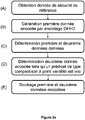
- a method is proposed implemented by the data processing means 21 of the data enrollment server 2 to verify the authenticity of a piece of security data.
- the method begins with a step (A) of obtaining a reference security datum, in particular representative of an expected appearance of a target personal datum.
- W the reference security datum
- W′ a candidate security datum.
- the server 2 can simply receive it from outside, for example from an authority.
- step (A) may include the extraction of the reference security data item from the target personal data item, the latter possibly being provided by an authority (for example the "official" photograph of the individual from the identity 1), or by the individual, for example by taking a photograph of their face or their identity document themselves via terminal 3.
- an authority for example the "official" photograph of the individual from the identity 1
- the individual for example by taking a photograph of their face or their identity document themselves via terminal 3.
- a first encoded datum is generated by applying to the reference security datum an original encoding procedure of the Hamming distance fuzzy obfuscation type, in English “Fuzzy Hamming Distance Obfuscator” or simply OFHD, see document Steven D. Galbraith, Lukas Zobernig: Obfuscated Fuzzy Hamming Distance and Conjunctions from Subset Product Problems. TCC 2019 , rather than secure sketch.
- We can therefore obfuscate the vector of x i , in particular the vector W (ie we take x i w i ).
- Decode ( o,W' ) the algorithm which, starting from a candidate security data item W' and from o(W), seeks to find W.
- OFHD compared to secure sketch is that in the event of an error, an attacker does not gain additional information about W. Indeed, Decode ( o,W' ) returns either W if W' is sufficiently close of W, either returns nothing, or another value W" otherwise, in all cases the attacker cannot determine if it is close to W, and he cannot converge.
- OFHD does not offer a "payload" in which it can store a hazard value. Indeed, the OFHD encoding procedure only takes security data as input.
- the present methods astutely propose to couple OFHD to another technique, called a predicate of variable point comparison type, to generate a second encoded datum this time carrying a payload for a hazard.
- said plurality of derived data consists of a first and a second derived data
- the first and second derived data are denoted W1 and W2.
- W1 and W2 There may well be more than two derived data, a third derived data, etc. (generally W1, W2,...Wk will be denoted said plurality of derived data).
- the k derived data can be seen as so many “coordinates” obtained from the security datum.
- the derived data are k cryptographic fingerprints obtained by k different hash functions (this including k different settings of the same hash function). It is possible to hash all or part of the security datum, and for example hash in the same way each of the parts obtained by division in accordance with the first mode.
- a first hazard datum is generated (as we will see, a second or even a third hazard datum can also be generated), and a second encoded datum is then determined such as a variable point comparison type predicate parameterized by the second encoded datum and the first random datum is true when said variable point has said derived data as coordinates (the first derived datum is a first coordinate, the second derived datum is a second coordinate , etc.).
- Random data is, as its name suggests, random value data providing randomness, which is important because knowledge of it will make it possible to prove that the reference security data is indeed available.
- Variable point comparison predicate predicate obfuscation is proposed in the document Lukas Zobernig, Steven D. Galbraith, Giovanni Russello: When are Opaque Predicates Useful? TrustCom/BigDataSE 2019 .
- a predicate ie a Boolean object of the form P(x 1 ,x 2 ,...x k ) a,b which is true substantially only when the x 1 ... x k have expected values.
- a and b are parameters of the predicate.
- the second encoded datum and the first random datum are chosen as parameters a and b and the predicate is a function of W1, W2, etc., i.e. the predicate is expressed as P(W1,W2,.. .Wk) a,b .
- said parameters of the predicate define a straight line and the predicate is true if and only if said variable point is on this straight line, which is thus notably the case (but not exclusively) when the variable point has said derived data as coordinates.
- said parameters of the predicate define a straight line and the predicate is true if and only if said variable point is on this straight line, which is thus notably the case (but not exclusively) when the variable point has said derived data as coordinates.
- there are two derived data it is a line in the plane
- in the case where there are three derived data it is a line in space, etc
- the associated decoding procedure is simple, because starting from the second encoded data a, if we have the right derived data W1 and W2, we can find b by calculating Wk-a 1 W1-a 2 W2...-a k -1 Wk-1.
- W' is not sufficiently close to W, then W" is not equal to W and the decoded datum b" is not the correct value of the random datum b.
- the present method completes the enrollment by a step (E) of storing on the data storage means 22 of the server 2 at least said first and second encoded data (o and a).
- step (E) can comprise the storage on the storage means 22 of an encrypted form of at least one other data item to be protected, such as personal alphanumeric data, with a key based on the first random datum (for example a cryptographic fingerprint of a concatenation of the first random datum and of said personal alphanumeric datum).
- a key based on the first random datum for example a cryptographic fingerprint of a concatenation of the first random datum and of said personal alphanumeric datum.
- an identity document 1 only has a limited lifespan, and must be regularly renewed.
- the candidate security datum is typically information representative of a visible appearance of a target personal datum (for example a biometric feature) in an image.
- the verification method begins in step (a) by obtaining in one way or another (for example via the acquisition means 30 of the client 3) an image , in particular an image of a user or an image of an identity document 1, the image representing at least the visible target personal data.
- said image can represent the entire identity document 1 and present the photograph of the individual holder of the identity document 1.
- Step (a) may further comprise the extraction of said candidate datum from the image (for example its DPS, or else a biometric template if the image is that of a biometric line), either by the server 2 (if the terminal 3 has sent it the image), or by the terminal 3 itself, and it then directly transmits the candidate security datum. If necessary, the procedure is exactly the same as in the enrollment process.
- said candidate datum for example its DPS, or else a biometric template if the image is that of a biometric line
- step (a) has taken place as described above, and that we are not in the presence of a forgery (for example an image which has been modified fraudulently).
- a forgery for example an image which has been modified fraudulently.
- the individual or any other entity who wishes the verification of the candidate security data item requests it from the server 2.
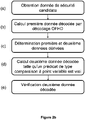
- the data processing means 21 of the server 2 calculate a first decoded datum by applying a decoding procedure of the Hamming distance fuzzy obfuscation type to the candidate security datum and to a first encoded datum stored on the data storage means 22 of the server 2.
- the server 2 accesses the first encoded data item o associated with the reference security data item (typically referenced with the fingerprint of an identifier, this identifier possibly being that of the individual or of his identity document) , and apply said aforementioned decoding procedure Decode (o , W') (use of Euclid's algorithm for example).
- Decode o , W'
- a first decoded datum W′′ is obtained at the output which corresponds to the reference security datum W if the reference security datum W and the candidate security datum W′ are sufficiently close in the sense of the Hamming distance.
- the result of a comparison of the candidate security datum and the reference security datum must show that they are identical, or at least present a distance less than a predetermined error threshold.
- a predetermined error threshold For example, for visual elements, it is commonly considered that security data of the Digital Photo Seal type coincide if they differ by less than 17%. Thus, for example, a maximum Hamming distance of 91 is taken for acceptance.
- a plurality of data derived from the first decoded data is determined from the first decoded data, exactly in the same way as the plurality of data derived from the reference security data during the 'enlistment (division into k parts, hash, etc.).
- a step (d) the server 2 accesses the second encoded datum a associated with the reference security datum and a second decoded datum is calculated, that is to say a payload of the second encoded datum a, denoted b", corresponding to a first random datum (i.e.
- variable point comparison type predicate parameterized by the second encoded datum and the second decoded datum is true when said variable point has as coordinates said derived data W1", W2",...Wk"
- said parameters of the predicate advantageously define a straight line and the variable point comparison type predicate is true if and only if said variable point is located on this straight line, i.e. the variable point having as coordinates said derived data W1", W2",...Wk” is located on the straight line defined by the second encoded data a and the second decoded data b"). Knowing that the derived data W1", W2", Wk" and the second encoded data a are defined, the only variable remains the second decoded data b".
- step (e) of verification of the second decoded data item comprises more precisely the verification that a cryptographic fingerprint of a concatenation of a second calculated random data item and a third random data item stored on the data storage means 22 of server 2 coincides with an expected cryptographic fingerprint stored on the data storage means 22 of server 2.
- the second random data can be recalculated from the second decoded data and a sum of the first and second random data stored on the data storage means 22 of the server 2 (i.e. the difference between said sum and the second decoded data).
- the fingerprint has been found, it means that the candidate security data is valid, i.e. not falsified. It is possible to deduce therefrom that a target personal datum is authentic and to authenticate a user or his identity document on this basis.
- this datum can be deciphered thanks to the second decoded datum (since it coincides with the first hazard datum).
- the second decoded datum corresponds to the first hazard datum and that the individual was able to successfully reconstruct the imprint.
- the said other data(s) to be protected, at its request, are then transferred to the client equipment 3.
- the server 2 provides the encrypted data as it is, and that it is at the level of the client 3 that the decryption takes place, so as to avoid any unencrypted transfer of personal data.
- the server 2 is proposed for the implementation of the methods according to the first or the second aspect, i.e. an enrollment server to verify the authenticity of a reference security datum and/or verification of the authenticity of a candidate security datum.
- the system can further comprise at least one client equipment 3 (typically connected to the server 2 via the network 20, directly or indirectly) comprising optical acquisition means 30 for acquiring said image (in particular of an individual or of his identity document 1).
- client equipment 3 typically connected to the server 2 via the network 20, directly or indirectly
- optical acquisition means 30 for acquiring said image (in particular of an individual or of his identity document 1).
- the invention relates to a computer program product comprising code instructions for the execution (in particular on the data processing means 21 of the server 2) of a method according to the first or the second aspect of the invention, as well as storage means readable by computer equipment (a memory 22 of the server 2) on which we find this product computer program.
Landscapes
- Engineering & Computer Science (AREA)
- Computer Security & Cryptography (AREA)
- Theoretical Computer Science (AREA)
- Computer Networks & Wireless Communication (AREA)
- Signal Processing (AREA)
- Computing Systems (AREA)
- General Engineering & Computer Science (AREA)
- Physics & Mathematics (AREA)
- General Physics & Mathematics (AREA)
- Life Sciences & Earth Sciences (AREA)
- Biodiversity & Conservation Biology (AREA)
- Biomedical Technology (AREA)
- General Health & Medical Sciences (AREA)
- Health & Medical Sciences (AREA)
- Collating Specific Patterns (AREA)
- Mobile Radio Communication Systems (AREA)
- Management, Administration, Business Operations System, And Electronic Commerce (AREA)
- Signal Processing For Digital Recording And Reproducing (AREA)
- Error Detection And Correction (AREA)
Applications Claiming Priority (1)
| Application Number | Priority Date | Filing Date | Title |
|---|---|---|---|
| FR2105799A FR3123742B1 (fr) | 2021-06-02 | 2021-06-02 | PROCEDES d’enrôlement de données pour vérifier l’authenticité d’une donnée de sécurité ou de vérification de l’authenticité d’une donnée de sécurité |
Publications (1)
| Publication Number | Publication Date |
|---|---|
| EP4099614A1 true EP4099614A1 (de) | 2022-12-07 |
Family
ID=77710907
Family Applications (1)
| Application Number | Title | Priority Date | Filing Date |
|---|---|---|---|
| EP22175778.4A Pending EP4099614A1 (de) | 2021-06-02 | 2022-05-27 | Verfahren zum einrollen von daten, um die echtheit eines sicherheitsrelevanten datums zu überprüfen oder die echtheit eines sicherheitsrelevanten datums zu verifizieren |
Country Status (4)
| Country | Link |
|---|---|
| US (1) | US12105642B2 (de) |
| EP (1) | EP4099614A1 (de) |
| FR (1) | FR3123742B1 (de) |
| IL (1) | IL293413B2 (de) |
Citations (1)
| Publication number | Priority date | Publication date | Assignee | Title |
|---|---|---|---|---|
| EP3206192A1 (de) | 2016-02-11 | 2017-08-16 | Safran Identity & Security | Verfahren zur sicherung und überprüfung eines dokuments |
-
2021
- 2021-06-02 FR FR2105799A patent/FR3123742B1/fr active Active
-
2022
- 2022-05-27 IL IL293413A patent/IL293413B2/en unknown
- 2022-05-27 EP EP22175778.4A patent/EP4099614A1/de active Pending
- 2022-05-27 US US17/804,409 patent/US12105642B2/en active Active
Patent Citations (2)
| Publication number | Priority date | Publication date | Assignee | Title |
|---|---|---|---|---|
| EP3206192A1 (de) | 2016-02-11 | 2017-08-16 | Safran Identity & Security | Verfahren zur sicherung und überprüfung eines dokuments |
| FR3047688A1 (fr) | 2016-02-11 | 2017-08-18 | Morpho | Procede de securisation et de verification d'un document |
Non-Patent Citations (4)
| Title |
|---|
| LUKAS ZOBERNIGSTEVEN D. GALBRAITHGIOVANNI RUSSELLO: "When are Opaque Predicates Useful?", TRUSTCOM/BIGDATASE, 2019 |
| STEVEN D GALBRAITH ET AL: "Obfuscated Fuzzy Hamming Distance and Conjunctions from Subset Product Problems", vol. 20190603:073202, 3 June 2019 (2019-06-03), pages 1 - 30, XP061032808, Retrieved from the Internet <URL:http://eprint.iacr.org/2019/620.pdf> [retrieved on 20190601] * |
| STEVEN D. GALBRAITHLUKAS ZOBERNIG: "Obfuscated Fuzzy Hamming Distance and Conjunctions", SUBSET PRODUCT PROBLEMS, 2019 |
| ZOBERNIG LUKAS ET AL: "When are Opaque Predicates Useful?", 2019 18TH IEEE INTERNATIONAL CONFERENCE ON TRUST, SECURITY AND PRIVACY IN COMPUTING AND COMMUNICATIONS/13TH IEEE INTERNATIONAL CONFERENCE ON BIG DATA SCIENCE AND ENGINEERING (TRUSTCOM/BIGDATASE), IEEE, 5 August 2019 (2019-08-05), pages 168 - 175, XP033653708, DOI: 10.1109/TRUSTCOM/BIGDATASE.2019.00031 * |
Also Published As
| Publication number | Publication date |
|---|---|
| US12105642B2 (en) | 2024-10-01 |
| US20220391327A1 (en) | 2022-12-08 |
| IL293413A (en) | 2023-01-01 |
| IL293413B1 (en) | 2025-09-01 |
| IL293413B2 (en) | 2026-01-01 |
| FR3123742B1 (fr) | 2024-08-30 |
| FR3123742A1 (fr) | 2022-12-09 |
Similar Documents
| Publication | Publication Date | Title |
|---|---|---|
| EP3731116B1 (de) | Verfahrem zur authentifizierung von einem identifikationsdocument für eine person und authentifizierung von dieser person. | |
| FR3054905B1 (fr) | Procede de generation de cle et procede de controle d'acces | |
| EP3742699B1 (de) | Starkes authentifizierungsverfahren einer person | |
| EP3690686B1 (de) | Authentifizierungsverfahren, server und elektronische identitätsvorrichtung | |
| EP3206192B1 (de) | Verfahren zur sicherung und überprüfung eines dokuments | |
| EP3731117B1 (de) | Verfahren zur speicherung von daten eines identifikationsdokuments und authentifizierung von diesem identifikationsdokument | |
| EP3316549B1 (de) | Verfahren zur identitätskontrolle eines benutzers von mindestens einer öffentlichen datenbank | |
| CA2888103C (fr) | Procede de signature electronique a signature ephemere | |
| FR2974924A1 (fr) | Procedes d'enrolement et de verification biometrique, systemes et dispositifs associes. | |
| FR3003061B1 (fr) | Procede de traitement securise de donnees et application a la biometrie | |
| EP2826200B1 (de) | Verfahren zur verschlüsselung einer vielzahl von daten in einem sicheren datensatz | |
| EP3543966A1 (de) | Datenerfassungsverfahren zur kontrolle einer identität, und identitätskontrollverfahren | |
| EP3239902B1 (de) | Überprüfungsverfahren einer authentifizierung oder einer biometrischen identifizierung | |
| EP3262553B1 (de) | Verfahren zur transaktion ohne körperliche unterstützung eines sicherheitsidentifikators und ohne token, abgesichert durch strukturelle entkopplung der persönlichen und dienstidentifikatoren | |
| EP4099614A1 (de) | Verfahren zum einrollen von daten, um die echtheit eines sicherheitsrelevanten datums zu überprüfen oder die echtheit eines sicherheitsrelevanten datums zu verifizieren | |
| WO2009083528A1 (fr) | Procédé et système pour générer des données biométriques stables | |
| FR3135544A1 (fr) | Procédé d’authentification d’un document d’identité d’un individu et éventuellement d’authentification dudit individu et d’authentification d’un individu présentant un document d’identité comme étant le sien | |
| FR2913551A1 (fr) | Methode d'authentification mutuelle et recurrente sur internet. | |
| EP3284209B1 (de) | Verfahren zur erzeugung und verifizierung eines sicherheitsschlüssels einer virtuellen geldeinheit | |
| FR3116626A1 (fr) | procédé et dispositif de génération d'informations d'authentification associées à un individu et procédé dispositif de contrôle d'identité associés | |
| FR3116627A1 (fr) | procédé et dispositif de génération de données associées à un signal numérique | |
| EP3210334A1 (de) | Auswertung des zuverlässigkeitsniveaus bei der informationssammlung durch ein kommunikationsendgerät im verhältnis zu abzügen |
Legal Events
| Date | Code | Title | Description |
|---|---|---|---|
| PUAI | Public reference made under article 153(3) epc to a published international application that has entered the european phase |
Free format text: ORIGINAL CODE: 0009012 |
|
| STAA | Information on the status of an ep patent application or granted ep patent |
Free format text: STATUS: THE APPLICATION HAS BEEN PUBLISHED |
|
| STAA | Information on the status of an ep patent application or granted ep patent |
Free format text: STATUS: REQUEST FOR EXAMINATION WAS MADE |
|
| AK | Designated contracting states |
Kind code of ref document: A1 Designated state(s): AL AT BE BG CH CY CZ DE DK EE ES FI FR GB GR HR HU IE IS IT LI LT LU LV MC MK MT NL NO PL PT RO RS SE SI SK SM TR |
|
| 17P | Request for examination filed |
Effective date: 20221110 |
|
| RBV | Designated contracting states (corrected) |
Designated state(s): AL AT BE BG CH CY CZ DE DK EE ES FI FR GB GR HR HU IE IS IT LI LT LU LV MC MK MT NL NO PL PT RO RS SE SI SK SM TR |
|
| P01 | Opt-out of the competence of the unified patent court (upc) registered |
Effective date: 20230919 |
|
| RAP1 | Party data changed (applicant data changed or rights of an application transferred) |
Owner name: IDEMIA PUBLIC SECURITY FRANCE |
|
| STAA | Information on the status of an ep patent application or granted ep patent |
Free format text: STATUS: EXAMINATION IS IN PROGRESS |
|
| 17Q | First examination report despatched |
Effective date: 20260211 |