EP4100498B1 - Dérivés de chitosane en tant qu'agents anti-salissures - Google Patents
Dérivés de chitosane en tant qu'agents anti-salissures Download PDFInfo
- Publication number
- EP4100498B1 EP4100498B1 EP21703162.4A EP21703162A EP4100498B1 EP 4100498 B1 EP4100498 B1 EP 4100498B1 EP 21703162 A EP21703162 A EP 21703162A EP 4100498 B1 EP4100498 B1 EP 4100498B1
- Authority
- EP
- European Patent Office
- Prior art keywords
- acid
- weight
- washing
- groups
- agent
- Prior art date
- Legal status (The legal status is an assumption and is not a legal conclusion. Google has not performed a legal analysis and makes no representation as to the accuracy of the status listed.)
- Active
Links
Classifications
-
- C—CHEMISTRY; METALLURGY
- C11—ANIMAL OR VEGETABLE OILS, FATS, FATTY SUBSTANCES OR WAXES; FATTY ACIDS THEREFROM; DETERGENTS; CANDLES
- C11D—DETERGENT COMPOSITIONS; USE OF SINGLE SUBSTANCES AS DETERGENTS; SOAP OR SOAP-MAKING; RESIN SOAPS; RECOVERY OF GLYCEROL
- C11D3/00—Other compounding ingredients of detergent compositions covered in group C11D1/00
- C11D3/16—Organic compounds
- C11D3/34—Organic compounds containing sulfur
- C11D3/349—Organic compounds containing sulfur additionally containing nitrogen atoms, e.g. nitro, nitroso, amino, imino, nitrilo, nitrile groups containing compounds or their derivatives or thio urea
-
- C—CHEMISTRY; METALLURGY
- C11—ANIMAL OR VEGETABLE OILS, FATS, FATTY SUBSTANCES OR WAXES; FATTY ACIDS THEREFROM; DETERGENTS; CANDLES
- C11D—DETERGENT COMPOSITIONS; USE OF SINGLE SUBSTANCES AS DETERGENTS; SOAP OR SOAP-MAKING; RESIN SOAPS; RECOVERY OF GLYCEROL
- C11D3/00—Other compounding ingredients of detergent compositions covered in group C11D1/00
- C11D3/16—Organic compounds
- C11D3/20—Organic compounds containing oxygen
- C11D3/22—Carbohydrates or derivatives thereof
- C11D3/222—Natural or synthetic polysaccharides, e.g. cellulose, starch, gum, alginic acid or cyclodextrin
- C11D3/227—Natural or synthetic polysaccharides, e.g. cellulose, starch, gum, alginic acid or cyclodextrin with nitrogen-containing groups
-
- C—CHEMISTRY; METALLURGY
- C08—ORGANIC MACROMOLECULAR COMPOUNDS; THEIR PREPARATION OR CHEMICAL WORKING-UP; COMPOSITIONS BASED THEREON
- C08B—POLYSACCHARIDES; DERIVATIVES THEREOF
- C08B37/00—Preparation of polysaccharides not provided for in groups C08B1/00 - C08B35/00; Derivatives thereof
- C08B37/0006—Homoglycans, i.e. polysaccharides having a main chain consisting of one single sugar, e.g. colominic acid
- C08B37/0024—Homoglycans, i.e. polysaccharides having a main chain consisting of one single sugar, e.g. colominic acid beta-D-Glucans; (beta-1,3)-D-Glucans, e.g. paramylon, coriolan, sclerotan, pachyman, callose, scleroglucan, schizophyllan, laminaran, lentinan or curdlan; (beta-1,6)-D-Glucans, e.g. pustulan; (beta-1,4)-D-Glucans; (beta-1,3)(beta-1,4)-D-Glucans, e.g. lichenan; Derivatives thereof
- C08B37/0027—2-Acetamido-2-deoxy-beta-glucans; Derivatives thereof
- C08B37/003—Chitin, i.e. 2-acetamido-2-deoxy-(beta-1,4)-D-glucan or N-acetyl-beta-1,4-D-glucosamine; Chitosan, i.e. deacetylated product of chitin or (beta-1,4)-D-glucosamine; Derivatives thereof
-
- C—CHEMISTRY; METALLURGY
- C11—ANIMAL OR VEGETABLE OILS, FATS, FATTY SUBSTANCES OR WAXES; FATTY ACIDS THEREFROM; DETERGENTS; CANDLES
- C11D—DETERGENT COMPOSITIONS; USE OF SINGLE SUBSTANCES AS DETERGENTS; SOAP OR SOAP-MAKING; RESIN SOAPS; RECOVERY OF GLYCEROL
- C11D3/00—Other compounding ingredients of detergent compositions covered in group C11D1/00
- C11D3/0005—Other compounding ingredients characterised by their effect
- C11D3/001—Softening compositions
-
- C—CHEMISTRY; METALLURGY
- C11—ANIMAL OR VEGETABLE OILS, FATS, FATTY SUBSTANCES OR WAXES; FATTY ACIDS THEREFROM; DETERGENTS; CANDLES
- C11D—DETERGENT COMPOSITIONS; USE OF SINGLE SUBSTANCES AS DETERGENTS; SOAP OR SOAP-MAKING; RESIN SOAPS; RECOVERY OF GLYCEROL
- C11D3/00—Other compounding ingredients of detergent compositions covered in group C11D1/00
- C11D3/0005—Other compounding ingredients characterised by their effect
- C11D3/0036—Soil deposition preventing compositions; Antiredeposition agents
-
- C—CHEMISTRY; METALLURGY
- C11—ANIMAL OR VEGETABLE OILS, FATS, FATTY SUBSTANCES OR WAXES; FATTY ACIDS THEREFROM; DETERGENTS; CANDLES
- C11D—DETERGENT COMPOSITIONS; USE OF SINGLE SUBSTANCES AS DETERGENTS; SOAP OR SOAP-MAKING; RESIN SOAPS; RECOVERY OF GLYCEROL
- C11D3/00—Other compounding ingredients of detergent compositions covered in group C11D1/00
- C11D3/16—Organic compounds
- C11D3/20—Organic compounds containing oxygen
- C11D3/22—Carbohydrates or derivatives thereof
- C11D3/222—Natural or synthetic polysaccharides, e.g. cellulose, starch, gum, alginic acid or cyclodextrin
- C11D3/228—Natural or synthetic polysaccharides, e.g. cellulose, starch, gum, alginic acid or cyclodextrin with phosphorus- or sulfur-containing groups
-
- C—CHEMISTRY; METALLURGY
- C11—ANIMAL OR VEGETABLE OILS, FATS, FATTY SUBSTANCES OR WAXES; FATTY ACIDS THEREFROM; DETERGENTS; CANDLES
- C11D—DETERGENT COMPOSITIONS; USE OF SINGLE SUBSTANCES AS DETERGENTS; SOAP OR SOAP-MAKING; RESIN SOAPS; RECOVERY OF GLYCEROL
- C11D2111/00—Cleaning compositions characterised by the objects to be cleaned; Cleaning compositions characterised by non-standard cleaning or washing processes
- C11D2111/10—Objects to be cleaned
- C11D2111/12—Soft surfaces, e.g. textile
Definitions
- the present invention relates to the use of certain soil-removing active ingredients to enhance the cleaning performance of detergents when washing textiles.
- detergents In addition to the ingredients that are essential for the washing process, such as surfactants and builder materials, detergents generally contain other components that can be summarized under the term washing aids and that include such diverse groups of active ingredients as foam regulators, graying inhibitors, bleaching agents, bleach activators and color transfer inhibitors. Such auxiliary substances also include substances that give the laundry fibers dirt-repellent properties and, if present during the washing process, support the dirt-removing ability of the other detergent ingredients. The same applies to cleaning agents for hard surfaces.
- Such dirt-removing substances are often referred to as "soil release" active ingredients or, because of their ability to make the treated surface, for example the fiber, dirt-repellent, as “soil repellents.”
- the US patent US$ 4 136 038 the dirt-removing effect of methylcellulose.
- the European patent application EP0 213 729 discloses the reduced redeposition when using detergents containing a combination of soap and non-ionic surfactant with alkyl hydroxyalkyl cellulose. From the European patent application EP0 213 730 Textile treatment agents are known that contain cationic surfactants and non-ionic cellulose ethers with HLB values of 3.1 to 3.8.
- the US patent US$ 4 000 093 discloses detergents containing 0.1% to 3% by weight of alkyl cellulose, hydroxyalkyl cellulose or alkyl hydroxyalkyl cellulose and 5% to 50% by weight of surfactant, the surfactant component consisting essentially of C 10 to C 13 alkyl sulfate and containing up to 5% by weight of C 14 alkyl sulfate and less than 5% by weight of alkyl sulfate with alkyl radicals of C 15 and higher.
- surfactant component consisting essentially of C 10 to C 13 alkyl sulfate and containing up to 5% by weight of C 14 alkyl sulfate and less than 5% by weight of alkyl sulfate with alkyl radicals of C 15 and higher.
- copolyesters that contain dicarboxylic acid units such as terephthalic acid or sulfoisophthalic acid, alkylene glycol units such as ethylene glycol or propylene glycol and polyalkylene glycol units such as polyethylene glycol.
- dicarboxylic acid units such as terephthalic acid or sulfoisophthalic acid
- alkylene glycol units such as ethylene glycol or propylene glycol
- polyalkylene glycol units such as polyethylene glycol.
- the polymers known from the state of the art have the disadvantage that they have no or only insufficient effectiveness, especially in textiles that do not consist of polyester or at least do not consist predominantly of polyester.
- a large proportion of today's textiles are made of but made of cotton or cotton-polyester blends, so that there is a need for dirt-removing agents that are more effective, particularly for greasy soiling on such textiles.
- the invention relates to the use of chitosan derivatives containing modified anhydroglucoside units of the general formula (I), in which the radicals R independently of one another stand for -H, -(CH 2 ) n COOH, -(CH 2 ) n COO - X + , -(CH 2 ) m SO 3 H, -(CH 2 ) m SO 3 - X + , n and m independently of one another stand for numbers from 1 to 3, preferably n is 1 and/or m is 2, and X + stands for a charge-balancing cation, in particular an alkali metal ion such as sodium or potassium and/or an ammonium ion, where at least some of the radicals R do not stand for -H-, for enhancing the cleaning performance of detergents when washing textiles.
- the radicals R independently of one another stand for -H, -(CH 2 ) n COOH, -(CH 2 ) n COO -
- the average degree of substitution (DS) based on the proportion of -NR 2 residues which are not -NH 2 in the chitosan derivative to be used according to the invention is preferably in the range from 0.1 to 1.0, in particular from 0.2 to 0.9.
- the average degree of polymerization (DPn) in the chitosan used for the production of the chitosan derivatives to be used according to the invention is preferably in the range from 100 to 1200, preferably in the range from 200 to 800.
- chitosan derivatives to be used according to the invention those with a number-average molecular weight in the range from 5000 g/mol to 150000 g/mol, in particular in the range from 30000 g/mol to 110000 g/mol, to be determined for example by means of size exclusion chromatography (GPC, eluent 0.08 M Na 2 HPO 4 , flow rate 1 ml/min, system JASCO ® , pump: PU-980, detector: RI-2031 Plus, column: PSS Novema 1000 and PSS Novema 30 in series) and pullulan as calibration standard, are preferred.
- GPC size exclusion chromatography
- the chitosan derivative has no further units than those of the general formula (I).
- the invention further relates to a method for washing textiles, in which a detergent and a dirt-removing agent in the form of a chitosan derivative as defined above are used.
- a detergent and a dirt-removing agent in the form of a chitosan derivative as defined above are used.
- These methods can be carried out manually or, if necessary, with the aid of a conventional household washing machine. It is possible to use the detergent and the dirt-removing agent simultaneously or one after the other. Simultaneous use can be carried out particularly advantageously by using a detergent that contains the dirt-removing agent.
- the method essentially consists in bringing a textile in need of cleaning or at least the soiled part of its surface into contact with an aqueous preparation that contains the chitosan derivative as defined above, allowing the aqueous preparation to act on the textile or at least the soiled part of its surface for a certain time and removing the aqueous preparation, for example by rinsing the textile with water.
- the effect of the active ingredient to be used according to the invention is particularly pronounced when used multiple times, i.e. in particular for removing soiling from textiles that had already been washed and/or post-treated in the presence of the active ingredient before they were stained.
- post-treatment it should be noted that the positive aspect described can also be achieved by a washing process in which the textile is washed after the actual washing process, which is carried out with the aid of a detergent, which may contain a named active ingredient, but in this case may also be free of it, is brought into contact with a post-treatment agent, for example as part of a fabric softener step, which contains an active ingredient to be used according to the invention, in the presence of water.
- the washing performance-enhancing effect of the active ingredients to be used according to the invention occurs during the next washing process, even if, if desired, a detergent without an active ingredient to be used according to the invention is used again.
- This effect is significantly higher than that resulting from the use of a conventional soil release active ingredient.
- the active ingredient essential to the invention is added in the fabric softener cycle of the textile washing, in particular in a machine.
- the active ingredient used according to the invention leads to significantly better removal of grease and cosmetic stains on textiles, especially those made of cotton or fabrics containing cotton, than is the case when using compounds previously known for this purpose. Alternatively, significant amounts of surfactants can be saved while maintaining the same grease removal capacity.
- the uses according to the invention can be carried out in the context of a washing process in such a way that the soil-removing active ingredient is added to a liquor containing detergent or, preferably, the active ingredient is introduced as a component of a detergent into the liquor which contains the object to be cleaned or which is brought into contact with it.
- the use according to the invention in the context of a laundry aftertreatment process can accordingly be carried out in such a way that the dirt-removing active ingredient is added separately to the rinsing liquor that is used after the wash cycle using a detergent, or it is introduced as a component of the laundry aftertreatment agent, in particular a fabric softener.
- the detergent used before the laundry aftertreatment agent can also contain an active ingredient to be used according to the invention, but can also be free of it.
- the invention therefore further relates to detergents and laundry aftertreatment agents which contain chitosan derivatives as defined above.
- the washing process preferably takes place at a temperature of 15 °C to 60 °C, particularly preferably at a temperature of 20 °C to 40 °C.
- the washing process also preferably takes place at a pH of 6 to 11, particularly preferably at a pH of 7.5 to 9.5.
- the concentration of the chitosan derivative used in the washing liquor is preferably 0.0001 g/l to 1 g/l, in particular 0.001 g/l to 0.2 g/l.
- Detergents which contain an active ingredient to be used according to the invention in the form of the chitosan derivative mentioned or which are used together with it or are used in processes according to the invention can contain all other usual constituents of such agents which do not interact in an undesirable manner with the active ingredient essential to the invention, in particular surfactant.
- the active ingredient defined above is preferably used in amounts of 0.01% by weight to 10% by weight, particularly preferably 0.1% by weight to 3% by weight, whereby these and the following quantities refer to the entire agent, unless otherwise stated.
- an agent according to the invention or used in the process according to the invention or used in the context of the use according to the invention is water-containing and liquid; it contains in particular 2% by weight to 92% by weight, particularly preferably 3% by weight to 85% by weight of water.
- the active ingredient used according to the invention has a positive effect on the effect of certain other detergent ingredients and that, conversely, the effect of the soil release active ingredient is further enhanced by certain other detergent ingredients.
- these effects occur in particular with bleaching agents, with enzymatic active ingredients, in particular proteases and lipases, with water-soluble inorganic and/or organic builders, in particular based on oxidized carbohydrates or polymeric polycarboxylates, with synthetic anionic surfactants of the sulfate and sulfonate type, and with color transfer inhibitors, for example vinylpyrrolidone, vinylpyridine or vinylimidazole polymers or copolymers or corresponding polybetaines, which is why the use of at least one of the other ingredients mentioned together with the active ingredient to be used according to the invention is preferred.
- An agent which contains an active ingredient to be used according to the invention or is used together with it or is used in the process according to the invention preferably contains peroxygen-based bleaching agents, in particular in amounts in the range from 3% by weight to 70% by weight, and optionally bleach activator, in particular in amounts in the range from 0.5% by weight to 10% by weight, but in another preferred embodiment can also be free of bleaching agents and bleach activator.
- the bleaching agents under consideration are preferably the peroxygen compounds generally used in detergents, such as percarboxylic acids, for example dodecanediperic acid or phthaloylaminoperoxicaproic acid, hydrogen peroxide, alkali perborate, which can be present as a tetrahydrate or monohydrate, percarbonate, perpyrophosphate and persilicate, which are generally present as alkali salts, in particular as sodium salts.
- Such bleaching agents are present in detergents which contain an active ingredient used according to the invention, preferably in amounts of up to 25% by weight, in particular up to 15% by weight and particularly preferably from 3% by weight to 15% by weight, in each case based on the entire agent, with percarbonate being used in particular.
- the optionally present component of the bleach activators comprises the N- or O-acyl compounds commonly used, for example multiply acylated alkylenediamines, in particular tetraacetylethylenediamine, acylated glycolurils, in particular tetraacetylglycoluril, N-acylated hydantoins, hydrazides, triazoles, urazoles, diketopiperazines, sulfurylamides and cyanurates, as well as carboxylic acid anhydrides, in particular phthalic acid anhydride, carboxylic acid esters, in particular sodium isononanoylphenolsulfonate, and acylated sugar derivatives, in particular pentaacetylglucose, and cationic nitrile derivatives such as trimethylammonium acetonitrile salts.
- N- or O-acyl compounds commonly used, for example multiply acylated alkylenediamines, in particular tetraace
- the bleach activators can be coated with coating substances or granulated in a known manner, with tetraacetylethylenediamine granulated with the aid of carboxymethylcellulose with weight-average grain sizes of 0.01 mm to 0.8 mm, granulated 1,5-diacetyl-2,4-dioxohexahydro-1,3,5-triazine, and/or trialkylammonium acetonitrile prepared in particle form being particularly preferred.
- such bleach activators are preferably contained in amounts of up to 8% by weight, in particular from 0.5% by weight to 6% by weight, in each case based on the entire agent.
- an agent used according to the invention or employed in the process according to the invention contains nonionic surfactant selected from fatty alkyl polyglycosides, fatty alkyl polyalkoxylates, in particular ethoxylates and/or propoxylates, fatty acid polyhydroxyamides and/or ethoxylation and/or propoxylation products of fatty alkylamines, vicinal diols, fatty acid alkyl esters and/or fatty acid amides and mixtures thereof, in particular in an amount in the range of 2% by weight to 25% by weight.
- nonionic surfactant selected from fatty alkyl polyglycosides, fatty alkyl polyalkoxylates, in particular ethoxylates and/or propoxylates, fatty acid polyhydroxyamides and/or ethoxylation and/or propoxylation products of fatty alkylamines, vicinal diols, fatty acid alkyl esters and/or fatty acid amides and mixtures thereof
- a further embodiment of such agents comprises the presence of synthetic anionic surfactants of the sulfate and/or sulfonate type, in particular fatty alkyl sulfate, fatty alkyl ether sulfate, sulfofatty acid esters and/or sulfofatty acid disalts, in particular in an amount in the range from 2% by weight to 25% by weight.
- the anionic surfactant is preferably selected from the alkyl or alkenyl sulfates and/or the alkyl or alkenyl ether sulfates in which the alkyl or alkenyl group has 8 to 22, in particular 12 to 18 C atoms. These are usually not individual substances, but rather cuts or mixtures. Among these, those whose proportion of compounds with longer-chain residues in the range from 16 to 18 C atoms is over 20% by weight are preferred.
- the non-ionic surfactants that can be used include alkoxylates, in particular ethoxylates and/or propoxylates of saturated or mono- to polyunsaturated linear or branched-chain alcohols with 10 to 22 C atoms, preferably 12 to 18 C atoms.
- the degree of alkoxylation of the alcohols is generally between 1 and 20, preferably between 3 and 10. They can be produced in a known manner by reacting the corresponding alcohols with the corresponding alkylene oxides.
- Derivatives of fatty alcohols are particularly suitable, although their branched-chain isomers, in particular so-called oxo alcohols, can also be used to produce usable alkoxylates.
- alkoxylates in particular ethoxylates, of primary alcohols with linear, in particular dodecyl, tetradecyl, hexadecyl or octadecyl residues and mixtures thereof are suitable.
- corresponding alkoxylation products of alkylamines, vicinal diols and carboxamides which correspond to the alcohols mentioned with regard to the alkyl part can be used.
- the ethylene oxide and/or propylene oxide insertion products of fatty acid alkyl esters and fatty acid polyhydroxyamides come into consideration.
- alkyl polyglycosides suitable for incorporation into the agents according to the invention are compounds of the general formula (G) n -OR 12 , in which R 12 is an alkyl or alkenyl radical with 8 to 22 C atoms, G is a glycose unit and n is a number between 1 and 10.
- the glycoside component (G) n is an oligomer or polymer made from naturally occurring aldose or ketose monomers, which include in particular glucose, mannose, fructose, galactose, talose, gulose, altrose, allose, idose, ribose, arabinose, xylose and lyxose.
- the oligomers consisting of such glycosidically linked monomers are characterized not only by the type of sugar they contain but also by their number, the so-called degree of oligomerization.
- the degree of oligomerization n is a quantity to be determined analytically and generally takes on fractional numerical values; it is between 1 and 10, and for the glycosides preferably used it is below a value of 1.5, in particular between 1.2 and 1.4.
- the preferred monomer building block is glucose because of its good availability.
- Nonionic surfactant is contained in agents which contain a soil release agent used according to the invention, are used according to the invention or are employed in the process according to the invention, preferably in amounts of 1 wt.% to 30 wt.%, in particular 1 wt.% to 25 wt.%, with amounts in the upper part of this range being more likely to be found in liquid detergents and particulate detergents preferably containing smaller amounts of up to 5 wt.%.
- the agents can contain other surfactants, preferably synthetic anionic surfactants of the sulfate or sulfonate type, such as alkylbenzenesulfonates, in amounts of preferably not more than 20% by weight, in particular from 0.1% by weight to 18% by weight, in each case based on the total agent.
- Synthetic anionic surfactants that are particularly suitable for use in such agents are alkyl and/or alkenyl sulfates with 8 to 22 carbon atoms, which carry an alkali, ammonium or alkyl or hydroxyalkyl-substituted ammonium ion as a countercation.
- alkyl and alkenyl sulfates can be prepared in a known manner by reacting the corresponding alcohol component with a conventional sulfating reagent, in particular sulfur trioxide or chlorosulfonic acid, and then neutralizing it with alkali, ammonium or alkyl or hydroxyalkyl-substituted ammonium bases.
- a conventional sulfating reagent in particular sulfur trioxide or chlorosulfonic acid
- the sulfate-type surfactants that can be used also include the sulfated alkoxylation products of the alcohols mentioned, so-called ether sulfates.
- Such ether sulfates preferably contain 2 to 30, in particular 4 to 10 ethylene glycol groups per molecule.
- Suitable anionic surfactants of the sulfonate type include the ⁇ -sulfoesters obtainable by reacting fatty acid esters with sulfur trioxide and subsequent neutralization, in particular the sulfonation products derived from fatty acids having 8 to 22 C atoms, preferably 12 to 18 C atoms, and linear alcohols having 1 to 6 C atoms, preferably 1 to 4 C atoms, as well as the sulfofatty acids resulting from these by formal saponification.
- soaps with saturated fatty acid soaps such as the salts of lauric acid, myristic acid, palmitic acid or stearic acid, and soaps derived from natural fatty acid mixtures, for example coconut, palm kernel or tallow fatty acids, being suitable.
- soap mixtures are preferred which are composed of 50% by weight to 100% by weight of saturated C 12 -C 18 fatty acid soaps and up to 50% by weight of oleic acid soap. Soap is preferably contained in amounts of 0.1% by weight to 5% by weight. However, in particular in liquid agents which contain a polymer used according to the invention, higher amounts of soap, generally up to 20% by weight, can also be contained.
- the agents can also contain betaines and/or cationic surfactants, which - if present - are preferably used in amounts of 0.5% to 7% by weight.
- betaines and/or cationic surfactants which - if present - are preferably used in amounts of 0.5% to 7% by weight.
- esterquats discussed below are particularly preferred.
- the agent contains water-soluble and/or water-insoluble builder, in particular selected from alkali aluminosilicate, crystalline alkali silicate with modulus above 1, monomeric polycarboxylate, polymeric polycarboxylate and mixtures thereof, in particular in amounts in the range from 2.5 wt.% to 60 wt.%.
- water-soluble and/or water-insoluble builder in particular selected from alkali aluminosilicate, crystalline alkali silicate with modulus above 1, monomeric polycarboxylate, polymeric polycarboxylate and mixtures thereof, in particular in amounts in the range from 2.5 wt.% to 60 wt.%.
- the agent preferably contains 20% to 55% by weight of water-soluble and/or water-insoluble, organic and/or inorganic builders.
- the water-soluble organic builder substances include in particular those from the class of polycarboxylic acids, in particular citric acid and sugar acids, and polymeric (poly)carboxylic acids, in particular the polycarboxylates accessible by oxidation of polysaccharides, polymeric acrylic acids, methacrylic acids, maleic acids and copolymers thereof, which may also contain small amounts of polymerizable substances without carboxylic acid functionality in copolymerized form.
- the relative molecular mass of the homopolymers of unsaturated carboxylic acids is generally between 5000 g/mol and 200,000 g/mol, that of the copolymers between 2000 g/mol and 200,000 g/mol, preferably 50,000 g/mol to 120,000 g/mol, based on the free acid.
- a particularly preferred acrylic acid-maleic acid copolymer has a relative molecular weight of 50,000 g/mol to 100,000 g/mol.
- Suitable, although less preferred, compounds of this class are copolymers of acrylic acid or methacrylic acid with vinyl ethers, such as vinyl methyl ethers, vinyl esters, ethylene, propylene and styrene, in which the proportion of acid is at least 50% by weight.
- Terpolymers which contain two carboxylic acids and/or their salts as monomers and vinyl alcohol and/or a vinyl alcohol derivative or a carbohydrate as the third monomer can also be used as water-soluble organic builder substances.
- the first acidic monomer or its salt is derived from a monoethylenically unsaturated C 3 -C 8 carboxylic acid and preferably from a C 3 -C 4 monocarboxylic acid, in particular from (meth)acrylic acid.
- the second acidic monomer or its salt can be a derivative of a C 4 -C 8 dicarboxylic acid, with maleic acid being particularly preferred.
- the third monomeric unit is formed in this case from vinyl alcohol and/or preferably an esterified vinyl alcohol.
- Vinyl alcohol derivatives which are an ester of short-chain carboxylic acids, for example of C 1 -C 4 carboxylic acids, with vinyl alcohol are particularly preferred.
- Preferred terpolymers contain 60% to 95% by weight, in particular 70% to 90% by weight, of (meth)acrylic acid or (meth)acrylate, particularly preferably acrylic acid or acrylate, and maleic acid or maleate, and also 5% to 40% by weight, preferably 10% to 30% by weight, of vinyl alcohol and/or vinyl acetate.
- Terpolymers in which the weight ratio of (meth)acrylic acid or (meth)acrylate to maleic acid or maleate is between 1:1 and 4:1, preferably between 2:1 and 3:1 and in particular 2:1 and 2.5:1, are particularly preferred.
- the second acidic monomer or its salt can also be a derivative of an allylsulfonic acid which is substituted in the 2-position with an alkyl radical, preferably with a C 1 -C 4 alkyl radical, or an aromatic radical which is preferably derived from benzene or benzene derivatives.
- Preferred terpolymers contain 40% to 60% by weight, in particular 45 to 55% by weight of (meth)acrylic acid or (meth)acrylate, particularly preferably acrylic acid or acrylate, 10% to 30% by weight, preferably 15% to 25% by weight of methallylsulfonic acid or methallylsulfonate and, as a third monomer, 15% to 40% by weight, preferably 20% to 40% by weight of a carbohydrate.
- This carbohydrate can be, for example, a mono-, di-, oligo- or polysaccharide, with mono-, di- or oligosaccharides being preferred, sucrose being particularly preferred.
- the use of the third monomer presumably creates predetermined breaking points in the polymer, which are responsible for the good biodegradability of the polymer.
- These terpolymers generally have a relative molecular mass of between 1000 g/mol and 200,000 g/mol, preferably between 3000 g/mol and 10,000 g/mol. They can be used in the form of aqueous solutions, preferably in the form of 30 to 50 percent by weight aqueous solutions, particularly for the production of liquid agents. All of the polycarboxylic acids mentioned are generally used in the form of their water-soluble salts, in particular their alkali salts.
- Such organic builder substances are preferably contained in amounts of up to 40% by weight, in particular up to 25% by weight and particularly preferably from 1% by weight to 5% by weight. Amounts close to the stated upper limit are preferably used in paste-like or liquid, in particular water-containing, agents.
- crystalline or amorphous alkali aluminosilicates are used in particular, in amounts of up to 50 wt. %, preferably not more than 40 wt. %, and in liquid agents in particular from 1 wt. % to 5 wt. %.
- crystalline aluminosilicates in detergent quality in particular zeolite NaA and optionally NaX, are preferred.
- Amounts close to the stated upper limit are preferably used in solid, particulate agents.
- Suitable aluminosilicates in particular do not have any particles with a grain size of more than 30 mm and preferably consist of at least 80 wt.
- % particles with a size of less than 10 mm are % particles with a size of less than 10 mm.
- Their calcium binding capacity which according to the information in the German patent specification DE 24 12 837 can be determined is in the range of 100 to 200 mg CaO per gram.
- Suitable substitutes or partial substitutes for the aluminosilicate mentioned are crystalline alkali silicates, which can be present alone or in a mixture with amorphous silicates.
- the alkali silicates which can be used as builders in the agents preferably have a molar ratio of alkali oxide to SiO2 of less than 0.95, in particular from 1:1.1 to 1:12, and can be amorphous or crystalline.
- Preferred alkali silicates are sodium silicates, in particular amorphous sodium silicates, with a molar ratio Na2O:SiO2 of 1:2 to 1:2.8.
- amorphous alkali silicates are commercially available, for example, under the name Portil ® . During production, they are preferably added as a solid and not in the form of a solution.
- Crystalline silicates which can be present alone or in a mixture with amorphous silicates are preferably crystalline layered silicates of the general formula Na 2 Si x O 2x+1 yH 2 O, in which x, the so-called module, is a number from 1.9 to 4 and y is a number from 0 to 20 and preferred values for ⁇ are 2, 3 or 4.
- Preferred crystalline layered silicates are those in which x in the general formula mentioned assumes the values 2 or 3. In particular, both ⁇ - and ⁇ -sodium disilicates (Na 2 Si 2 O 5 ⁇ yH 2 O) are preferred.
- anhydrous crystalline alkali silicates produced from amorphous alkali silicates of the above-mentioned general formula Formula in which x is a number from 1.9 to 2.1 can be used in agents which contain an active ingredient to be used according to the invention.
- a crystalline sodium layer silicate with a modulus of 2 to 3 is used, as can be produced from sand and soda.
- Crystalline sodium silicates with a modulus in the range from 1.9 to 3.5 are used in a further preferred embodiment of detergents which contain an active ingredient used according to the invention.
- Their alkali silicate content is preferably 1% to 50% by weight and in particular 5% to 35% by weight, based on the anhydrous active substance.
- alkali silicate in particular zeolite
- the alkali silicate content is preferably 1% to 15% by weight and in particular 2% to 9% by weight, based on the anhydrous active substance.
- the weight ratio of aluminosilicate to silicate, based on anhydrous active substances is then preferably 4:1 to 10:1.
- the weight ratio of amorphous alkali silicate to crystalline alkali silicate is preferably 1:2 to 2:1 and in particular 1:1 to 2:1.
- water-soluble or water-insoluble inorganic substances can be contained in the agents which contain an active ingredient to be used according to the invention, are used together with it or are employed in processes according to the invention. Suitable in this context are alkali carbonates, alkali hydrogen carbonates and alkali sulfates and mixtures thereof. Such additional inorganic material can be present in amounts of up to 70% by weight.
- the agents can contain other ingredients commonly found in washing and cleaning agents.
- These optional ingredients include in particular enzymes, enzyme stabilizers, complexing agents for heavy metals, for example aminopolycarboxylic acids, aminohydroxypolycarboxylic acids, polyphosphonic acids and/or aminopolyphosphonic acids, foam inhibitors, for example organopolysiloxanes or paraffins, solvents and optical brighteners, for example stilbenedisulfonic acid derivatives.
- agents which contain an active ingredient used according to the invention contain up to 1% by weight, in particular 0.01% by weight to 0.5% by weight, of optical brighteners, in particular compounds from the class of substituted 4,4'-bis-(2,4,6-triamino-s-triazinyl)-stilbene-2,2'-disulfonic acids, up to 5% by weight, in particular 0.1% by weight to 2% by weight, of complexing agents for heavy metals, in particular aminoalkylenephosphonic acids and their salts, and up to 2% by weight, in particular 0.1% by weight to 1% by weight, of foam inhibitors, the weight proportions mentioned in each case referring to the entire agent.
- optical brighteners in particular compounds from the class of substituted 4,4'-bis-(2,4,6-triamino-s-triazinyl)-stilbene-2,2'-disulfonic acids
- complexing agents for heavy metals in particular aminoalkylenephosphonic acids and their salts
- foam inhibitors the weight proportions mentioned in
- Solvents that can be used especially for liquid agents are, in addition to water, preferably those that are water-miscible. These include the lower alcohols, for example Ethanol, propanol, isopropanol, and the isomeric butanols, glycerin, lower glycols, for example ethylene and propylene glycol, and the ethers derivable from the above-mentioned classes of compounds.
- the active ingredients used according to the invention are generally present in dissolved or suspended form.
- Any enzymes present are preferably selected from the group comprising protease, amylase, lipase, cellulase, hemicellulase, oxidase, peroxidase or mixtures thereof.
- Protease obtained primarily from microorganisms such as bacteria or fungi is suitable. It can be obtained in a known manner from suitable microorganisms by fermentation processes. Proteases are commercially available under the names BLAP ® , Savinase ® , Esperase ® , Maxatase ® , Optimase ® , Alcalase ® , Durazym ® or Maxapem ® , for example.
- the lipase that can be used can be obtained, for example, from Humicola lanuginosa, from Bacillus species, from Pseudomonas species, from Fusarium species, from Rhizopus species or from Aspergillus species.
- Suitable lipases are commercially available under the names Lipolase ® , Lipozym ® , Lipomax ® , Lipex ® , Amano ® -Lipase, Toyo-Jozo ® -Lipase, Meito ® -Lipase and Diosynth ® -Lipase.
- Suitable amylases are commercially available under the names Maxamyl ® , Termamyl ® , Duramyl ® and Purafect ® OxAm.
- the cellulase used can be an enzyme obtained from bacteria or fungi, which has an optimum pH preferably in the slightly acidic to slightly alkaline range of 6 to 9.5.
- Cellulases of this type are commercially available under the names Celluzyme ® , Carezyme ® and Ecostone ® .
- the usual enzyme stabilizers that may be present, particularly in liquid agents include amino alcohols, for example mono-, di-, triethanol- and -propanolamine and mixtures thereof, lower carboxylic acids, boric acid or alkali borates, boric acid-carboxylic acid combinations, boric acid esters, boronic acid derivatives, calcium salts, for example Ca-formic acid combination, magnesium salts, and/or sulfur-containing reducing agents.
- Suitable foam inhibitors include long-chain soaps, in particular behen soap, fatty acid amides, paraffins, waxes, microcrystalline waxes, organopolysiloxanes and mixtures thereof, which may also contain microfine, optionally silanized or otherwise hydrophobized silica.
- foam inhibitors are preferably bound to granular, water-soluble carrier substances.
- an agent into which the active ingredient to be used according to the invention is incorporated is particulate and contains up to 25% by weight, in particular 4% by weight to 20% by weight of bleaching agent, in particular alkali percarbonate, up to 15% by weight, in particular 1% by weight to 10% by weight of bleach activator, 20% by weight to 55% by weight of inorganic builder, up to 10% by weight, in particular 2% by weight to 8% by weight of water-soluble organic builder, 10% by weight to 25% by weight of synthetic anionic surfactant, 1% by weight to 5% by weight of nonionic surfactant and up to 25 wt.%, in particular 0.1 wt.% to 25 wt.% of inorganic salts, in particular alkali carbonate and/or hydrogen carbonate.
- an agent into which the active ingredient to be used according to the invention is incorporated is liquid and contains 1% to 25% by weight, in particular 5% to 15% by weight, nonionic surfactant, up to 10% by weight, in particular 0.5% to 8% by weight, synthetic anionic surfactant, 3% to 15% by weight, in particular 5% to 10% by weight, soap, 0.5% to 5% by weight, in particular 1% to 4% by weight, organic builder, in particular polycarboxylate such as citrate, up to 1.5% by weight, in particular 0.1% to 1% by weight, complexing agent for heavy metals, such as phosphonate, and in addition to any enzyme, enzyme stabilizer, colorant and/or fragrance that may be present, water and/or water-miscible solvent.
- polyester-active soil-releasing polymers that can be used in addition to the active ingredients essential to the invention include copolyesters of dicarboxylic acids, for example adipic acid, phthalic acid or terephthalic acid, diols, for example ethylene glycol or propylene glycol, and polydiols, for example polyethylene glycol or polypropylene glycol.
- dicarboxylic acids for example adipic acid, phthalic acid or terephthalic acid
- diols for example ethylene glycol or propylene glycol
- polydiols for example polyethylene glycol or polypropylene glycol.
- the preferably used soil-releasing polyesters include those compounds that are formally accessible by esterification of two monomer parts, the first monomer being a dicarboxylic acid HOOC-Ph-COOH and the second monomer being a diol HO-(CHR 11 -) a OH, which can also be present as a polymeric diol H-(O-(CHR 11 -) a ) b OH.
- Ph is an o-, m- or p-phenylene radical which can carry 1 to 4 substituents selected from alkyl radicals having 1 to 22 C atoms, sulfonic acid groups, carboxyl groups and mixtures thereof
- R 11 is hydrogen, an alkyl radical having 1 to 22 C atoms and mixtures thereof
- a is a number from 2 to 6
- b is a number from 1 to 300.
- the polyesters obtainable from these contain both monomer diol units -O-(CHR 11 -) a O- and polymer diol units -(O-(CHR 11 -) a ) b O-.
- the molar ratio of monomer diol units to polymer diol units is preferably 100:1 to 1:100, in particular 10:1 to 1:10.
- the degree of polymerization b is preferably in the range from 4 to 200, in particular from 12 to 140.
- the molecular weight or the average molecular weight or the maximum of the molecular weight distribution of preferred soil-releasing polyesters is in the range from 250 g/mol to 100,000 g/mol, in particular from 500 g/mol to 50,000 g/mol.
- the residue Ph is based on Acid is preferably selected from terephthalic acid, isophthalic acid, phthalic acid, trimellitic acid, mellitic acid, the isomers of sulfophthalic acid, sulfoisophthalic acid and sulfoterephthalic acid and mixtures thereof. If their acid groups are not part of the ester bonds in the polymer, they are preferably present in salt form, in particular as alkali or ammonium salt. Of these, the sodium and potassium salts are particularly preferred.
- small amounts, in particular not more than 10 mol% based on the amount of Ph with the meaning given above, of other acids which have at least two carboxyl groups can be contained in the soil-releasing polyester instead of the monomer HOOC-Ph-COOH.
- these include, for example, alkylene and alkenylene dicarboxylic acids such as malonic acid, succinic acid, fumaric acid, maleic acid, glutaric acid, adipic acid, pimelic acid, suberic acid, azelaic acid and sebacic acid.
- the preferred diols HO-(CHR 11 -) a OH include those in which R 11 is hydrogen and a is a number from 2 to 6, and those in which a has the value 2 and R 11 is selected from hydrogen and the alkyl radicals having 1 to 10, in particular 1 to 3, carbon atoms.
- R 11 is hydrogen and a is a number from 2 to 6
- R 11 is selected from hydrogen and the alkyl radicals having 1 to 10, in particular 1 to 3, carbon atoms.
- those of the formula HO-CH 2 -CHR 11 -OH, in which R 11 has the meaning given above are particularly preferred.
- diol components are ethylene glycol, 1,2-propylene glycol, 1,3-propylene glycol, 1,4-butanediol, 1,5-pentanediol, 1,6-hexanediol, 1,8-octanediol, 1,2-decanediol, 1,2-dodecanediol and neopentyl glycol.
- Particularly preferred among the polymeric diols is polyethylene glycol with an average molecular weight in the range of 1000 g/mol to 6000 g/mol.
- these polyesters composed as described above can also be end-capped, with possible end groups being alkyl groups with 1 to 22 C atoms and esters of monocarboxylic acids.
- the end groups bonded via ester bonds can be based on alkyl, alkenyl and aryl monocarboxylic acids with 5 to 32 C atoms, in particular 5 to 18 C atoms.
- valeric acid caproic acid, enanthic acid, caprylic acid, pelargonic acid, capric acid, undecanoic acid, undecenoic acid, lauric acid, lauroleic acid, tridecanoic acid, myristic acid, myristoleic acid, pentadecanoic acid, palmitic acid, stearic acid, petroselinic acid, petroselaidic acid, oleic acid, linoleic acid, linolaidic acid, linolenic acid, eleostearic acid, arachidic acid, gadoleic acid, arachidonic acid, behenic acid, erucic acid, brassidic acid, clupanodonic acid, lignoceric acid, cerotic acid, melissic acid, benzoic acid, which can carry 1 to 5 substituents with a total of up to 25 C atoms, in particular 1 to 12 C atoms, for example tert-butyl
- the end groups can also be based on hydroxymonocarboxylic acids with 5 to 22 carbon atoms, which include, for example, hydroxyvaleric acid, hydroxycaproic acid, ricinoleic acid, its hydrogenation product hydroxystearic acid, and o-, m- and p-hydroxybenzoic acid.
- the hydroxymonocarboxylic acids can in turn be linked to one another via their hydroxyl group and their carboxyl group and thus be present multiple times in an end group.
- the number of hydroxymonocarboxylic acid units per end group, i.e. their degree of oligomerization, is preferably in the range from 1 to 50, in particular from 1 to 10.
- polymers of ethylene terephthalate and Polyethylene oxide terephthalate in which the polyethylene glycol units have molecular weights of 750 to 5000 and the molar ratio of ethylene terephthalate to polyethylene oxide terephthalate is 50:50 to 90:10, is used in combination with an active ingredient essential to the invention.
- polyester-active soil-removing polymers are preferably water-soluble, whereby the term "water-soluble” is understood to mean a solubility of at least 0.01 g, preferably at least 0.1 g of the polymer per liter of water at room temperature and pH 8.
- Preferably used polymers have a solubility of at least 1 g per liter, in particular at least 10 g per liter, under these conditions.
- Preferred laundry aftertreatment agents which contain an active ingredient to be used according to the invention have a so-called esterquat as the laundry softening active ingredient, i.e. a quaternized ester of carboxylic acid and amino alcohol.
- esterquat as the laundry softening active ingredient, i.e. a quaternized ester of carboxylic acid and amino alcohol.
- These are known substances which can be obtained using the relevant methods of preparative organic chemistry, for example by partially esterifying triethanolamine with fatty acids in the presence of hypophosphorous acid, passing air through them and then quaternizing them with dimethyl sulfate or ethylene oxide.
- the production of solid esterquats is also known, in which the quaternization of triethanolamine esters is carried out in the presence of suitable dispersants, preferably fatty alcohols.
- Esterquats preferred in the compositions are quaternized fatty acid triethanolamine ester salts which follow the formula (IV), in which R 1 CO is an acyl radical having 6 to 22 carbon atoms, R 2 and R 3 independently of one another are hydrogen or R 1 CO, R 4 is an alkyl radical having 1 to 4 carbon atoms or a (CH 2 CH 2 O) q H group, m, n and p in total are 0 or numbers from 1 to 12, q is numbers from 1 to 12 and X is a charge-balancing anion such as halide, alkyl sulfate or alkyl phosphate.
- R 1 CO is an acyl radical having 6 to 22 carbon atoms
- R 2 and R 3 independently of one another are hydrogen or R 1 CO
- R 4 is an alkyl radical having 1 to 4 carbon atoms or a (CH 2 CH 2 O) q H group
- m, n and p in total are 0 or numbers from 1 to 12
- q is
- esterquats which can be used in the sense of the invention are products based on caproic acid, caprylic acid, capric acid, lauric acid, myristic acid, palmitic acid, isostearic acid, stearic acid, oleic acid, elaidic acid, arachidic acid, behenic acid and erucic acid as well as technical mixtures thereof, as arise, for example, in the pressure splitting of natural fats and oils.
- technical C 12/18 coconut fatty acids and in particular partially hydrogenated C 16/18 tallow or palm fatty acids as well as elaidic acid-rich C 16/18 fatty acid cuts are used.
- the fatty acids and triethanolamine can generally be used in a molar ratio of 1.1:1 to 3:1.
- a ratio of 1.2:1 to 2.2:1, preferably 1.5:1 to 1.9:1 has proven to be particularly advantageous.
- the esterquats preferably used are technical mixtures of mono-, di- and triesters with an average degree of esterification of 1.5 to 1.9 and are derived from technical C 16/18 tallow or palm fatty acid (iodine number 0 to 40).
- quaternized ester salts of carboxylic acids with diethanolalkylamines of the formula (V) can also be considered as esterquats, in which R 1 CO stands for an acyl radical having 6 to 22 carbon atoms, R 2 stands for hydrogen or R 1 CO, R 4 and R 5 independently of one another stand for alkyl radicals having 1 to 4 carbon atoms, m and n in total stand for 0 or numbers from 1 to 12 and X stands for a charge-balancing anion such as halide, alkyl sulfate or alkyl phosphate.
- esterquats are the quaternized ester salts of carboxylic acids with 1,2-dihydroxypropyldialkylamines of the formula (VI), in which R 1 CO stands for an acyl radical having 6 to 22 carbon atoms, R 2 stands for hydrogen or R 1 CO, R 4 , R 6 and R 7 independently of one another stand for alkyl radicals having 1 to 4 carbon atoms, m and n in total stand for 0 or numbers from 1 to 12 and X stands for a charge-balancing anion such as halide, alkyl sulfate or alkyl phosphate.
- R 1 CO stands for an acyl radical having 6 to 22 carbon atoms
- R 2 stands for hydrogen or R 1 CO
- R 4 , R 6 and R 7 independently of one another stand for alkyl radicals having 1 to 4 carbon atoms
- m and n in total stand for 0 or numbers from 1 to 12
- X stands for a charge-balancing anion such as halide, alky
- esterquats are usually sold in the form of 50 to 90 percent by weight alcoholic solutions, which can also be easily diluted with water, with ethanol, propanol and isopropanol being the usual alcoholic solvents.
- Esterquats are preferably used in amounts of 5% to 25% by weight, in particular 8% to 20% by weight, based in each case on the total laundry aftertreatment agent.
- the laundry aftertreatment agents used according to the invention can additionally contain the detergent ingredients listed above, provided they do not interact negatively with the esterquat in an unreasonable manner.
- the agent is preferably a liquid, water-containing agent.
- Table 1 shows the composition (ingredients in percent by weight, each based on the total agent) of the detergent M1 according to the invention and of the agent V1 free of a corresponding active ingredient and of the N,O-carboxymethylchitosan (obtained according to Example 1 a of WO 2019/243108 A1 ) containing agent V2:
- Table 1 Composition V1 V2 M1 C 9 - 13 alkylbenzenesulfonate, sodium salt 9 9 9 9 Sodium lauryl ether sulfate with 2 EO 3 3 3 C 12-14 fatty alcohol with 7 EO 7 7 7 C 12-18 fatty acid, sodium salt 2 2 2 NaOH 0.5 0.5 0.5 Citric acid 2 2 2 1-Hydroxyethane-1,1-diphosphonate, sodium salt 0.6 0.6 0.6 Cellulase - - - Other enzymes, dyes, optical brighteners, alcohols, boric acid, solvents 14 14 14 N,O-Carboxymethylchitos
- Table 2 shows the differences in brightness changes ( ⁇ Y values) of the materials after 5 washes under the specified conditions with agent M1 or with agent V2 compared to the brightness change after 5 washes with agent V1.
- Table 2 Differences in brightness changes Textile / Medium M1 V2 WFK 12A terry cloth 5.8 1.7 Fottier towel 4.9 1.3 EMPA 221 100% cotton 1.4 0.4 WFK11A 1.1.13 2.4 0.2 Double rib cotton fabric 2.6 1.9 viscose 3.0 0.2 55% Polyester / 45% Cotton 3.8 0.8 Anvil ® T-Shirt 4.5 -0.4 Barleycorn Towel 3.9 0.2 Terry towel 100% cotton 3.6 1.8
- the materials When using the agent M1 according to the invention, the materials turn grey significantly less than when using the agent V2, which contains a known cleaning performance-enhancing active ingredient.
Landscapes
- Chemical & Material Sciences (AREA)
- Life Sciences & Earth Sciences (AREA)
- Engineering & Computer Science (AREA)
- Chemical Kinetics & Catalysis (AREA)
- Organic Chemistry (AREA)
- Oil, Petroleum & Natural Gas (AREA)
- Wood Science & Technology (AREA)
- Health & Medical Sciences (AREA)
- Molecular Biology (AREA)
- Emergency Medicine (AREA)
- General Health & Medical Sciences (AREA)
- Materials Engineering (AREA)
- Medicinal Chemistry (AREA)
- Polymers & Plastics (AREA)
- Biochemistry (AREA)
- Detergent Compositions (AREA)
- Treatments For Attaching Organic Compounds To Fibrous Goods (AREA)
Claims (10)
- Utilisation de dérivés de chitosane qui contiennent un motif anhydroglucose modifié de formule générale I,

- Utilisation selon la revendication 1, caractérisée en ce que les textiles avaient été lavés et/ou traités ultérieurement en présence de la substance active avant d'avoir été pourvus de salissures.
- Utilisation de dérivés de chitosane qui contiennent un motif anhydroglucose modifié de formule générale (I),
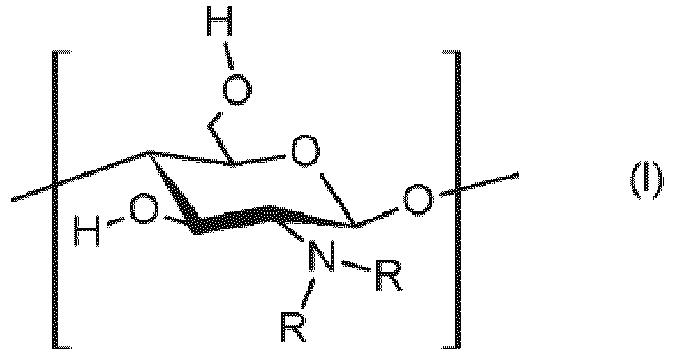
- Procédé permettant le lavage de textiles, dans lequel sont utilisés un agent de lavage et un dérivé de chitosane qui contient un motif anhydroglucose modifié de formule générale (I),

- Procédé selon la revendication 4, caractérisé en ce que la concentration du dérivé de chitosane utilisée dans le bain de lavage va de 0,0001 g/l à 1 g/l, en particulier de 0,001 g/l à 0,2 g/l.
- Procédé selon la revendication 4 ou 5, caractérisé en ce qu'il est mis en oeuvre en utilisant un agent de lavage contenant le dérivé de chitosane.
- Procédé permettant le lavage de textiles selon l'une des revendications 4 à 6, caractérisé en ce qu'il est mis en oeuvre en utilisant un agent de traitement ultérieur du linge, en particulier un agent assouplissant, contenant le dérivé de chitosane.
- Agent de lavage ou agent de traitement ultérieur du linge, contenant un dérivé de chitosane qui contient un motif anhydroglucose modifié de formule générale I,

- Agent selon la revendication 8, caractérisé en ce qu'il contient le dérivé de chitosane en des quantités allant de 0,01 % en poids à 10 % en poids, en particulier de 0,1 % en poids à 3 % en poids.
- Utilisation selon l'une des revendications 1 à 3, procédé selon l'une des revendications 4 à 7, ou agent selon la revendication 8 ou 9, caractérisé en ce que, dans la formule générale (I), n représente 1 et/ou m représente 2 ; et/ou en ce que le degré de substitution (DS) moyen dans le dérivé de chitosane se situe dans la plage allant de 0,1 à 1,0, en particulier dans la plage allant de 0,2 à 0,9 ; et/ou en ce que la masse moléculaire moyenne du dérivé de chitosane se situe dans la plage allant de 5 000 g/mol à 150 000 g/mol, en particulier dans la plage allant de 30 000 g/mol à 110 000 g/mol.
Applications Claiming Priority (2)
| Application Number | Priority Date | Filing Date | Title |
|---|---|---|---|
| DE102020201317.9A DE102020201317A1 (de) | 2020-02-04 | 2020-02-04 | Chitosanderivate als schmutzablösevermögende Wirkstoffe |
| PCT/EP2021/051658 WO2021156093A1 (fr) | 2020-02-04 | 2021-01-26 | Dérivés de chitosane en tant qu'agents anti-salissures |
Publications (2)
| Publication Number | Publication Date |
|---|---|
| EP4100498A1 EP4100498A1 (fr) | 2022-12-14 |
| EP4100498B1 true EP4100498B1 (fr) | 2024-04-10 |
Family
ID=74550611
Family Applications (1)
| Application Number | Title | Priority Date | Filing Date |
|---|---|---|---|
| EP21703162.4A Active EP4100498B1 (fr) | 2020-02-04 | 2021-01-26 | Dérivés de chitosane en tant qu'agents anti-salissures |
Country Status (5)
| Country | Link |
|---|---|
| US (1) | US12570928B2 (fr) |
| EP (1) | EP4100498B1 (fr) |
| DE (1) | DE102020201317A1 (fr) |
| ES (1) | ES2980772T3 (fr) |
| WO (1) | WO2021156093A1 (fr) |
Families Citing this family (24)
| Publication number | Priority date | Publication date | Assignee | Title |
|---|---|---|---|---|
| CN118119692A (zh) | 2021-10-14 | 2024-05-31 | 宝洁公司 | 包含阳离子去垢性聚合物和脂肪酶的织物和家庭护理产品 |
| EP4321604A1 (fr) | 2022-08-08 | 2024-02-14 | The Procter & Gamble Company | Tissu et composition de soins à domicile comprenant un tensioactif et un polyester |
| EP4612210A1 (fr) | 2022-11-04 | 2025-09-10 | The Procter & Gamble Company | Composition d'entretien textile et ménager |
| WO2024094790A1 (fr) | 2022-11-04 | 2024-05-10 | Clariant International Ltd | Polyesters |
| EP4612211A1 (fr) | 2022-11-04 | 2025-09-10 | The Procter & Gamble Company | Composition d'entretien textile et ménager |
| EP4630526A1 (fr) | 2022-12-05 | 2025-10-15 | The Procter & Gamble Company | Composition de soin textile et ménager comprenant un composé de carbonate de polyalkylène |
| EP4634352A1 (fr) | 2022-12-12 | 2025-10-22 | The Procter & Gamble Company | Composition de soin textile et ménager |
| EP4386074B1 (fr) | 2022-12-16 | 2025-12-03 | The Procter & Gamble Company | Composition de soin pour le linge et le domicile |
| EP4458932A1 (fr) | 2023-05-04 | 2024-11-06 | The Procter & Gamble Company | Tissu et composition de soins à domicile |
| EP4458933A1 (fr) | 2023-05-05 | 2024-11-06 | The Procter & Gamble Company | Composition de tissu et de soins à domicile comprenant un polyol propoxylé |
| EP4484536A1 (fr) | 2023-06-26 | 2025-01-01 | The Procter & Gamble Company | Composition de soin pour le linge et le domicile |
| EP4549540A1 (fr) | 2023-11-02 | 2025-05-07 | The Procter & Gamble Company | Composition de soin pour le linge et le domicile |
| EP4549541A1 (fr) | 2023-11-02 | 2025-05-07 | The Procter & Gamble Company | Composition de soin pour le linge et le domicile |
| EP4553137A1 (fr) | 2023-11-08 | 2025-05-14 | The Procter & Gamble Company | Composition de soin domestique et de tissu comprenant un polyester |
| EP4570893A1 (fr) | 2023-12-15 | 2025-06-18 | The Procter & Gamble Company | Composition de soin pour le linge et le domicile |
| EP4570892A1 (fr) | 2023-12-15 | 2025-06-18 | The Procter & Gamble Company | Composition de détergent à lessive |
| EP4610340A1 (fr) | 2024-03-01 | 2025-09-03 | The Procter & Gamble Company | Composition de détergent à lessive comprenant un polyester |
| EP4624555A1 (fr) | 2024-03-26 | 2025-10-01 | The Procter & Gamble Company | Compositions de soin pour tissus et maisons |
| EP4624554A1 (fr) | 2024-03-26 | 2025-10-01 | The Procter & Gamble Company | Compositions d'entretien de tissus |
| EP4636063A1 (fr) | 2024-04-19 | 2025-10-22 | The Procter & Gamble Company | Produit détergent à lessive à dose unitaire |
| EP4660287A1 (fr) | 2024-06-06 | 2025-12-10 | The Procter & Gamble Company | Utilisation d'un ester de polysaccharide dans une composition de détergent pour lessive |
| EP4663733A1 (fr) | 2024-06-10 | 2025-12-17 | The Procter & Gamble Company | Utilisation d'un polymère greffé dans un procédé de blanchissage |
| EP4663732A1 (fr) | 2024-06-10 | 2025-12-17 | The Procter & Gamble Company | Utilisation de polymère greffé dans une composition de détergent pour lessive |
| US20260176557A1 (en) | 2024-12-19 | 2026-06-25 | The Procter & Gamble Company | Fabric and home care compositions |
Citations (1)
| Publication number | Priority date | Publication date | Assignee | Title |
|---|---|---|---|---|
| EP0628655B1 (fr) * | 1993-06-11 | 2001-05-16 | Ciba SC Holding AG | Adjuvants de blanchiment |
Family Cites Families (17)
| Publication number | Priority date | Publication date | Assignee | Title |
|---|---|---|---|---|
| AT330930B (de) | 1973-04-13 | 1976-07-26 | Henkel & Cie Gmbh | Verfahren zur herstellung von festen, schuttfahigen wasch- oder reinigungsmitteln mit einem gehalt an calcium bindenden substanzen |
| US4000093A (en) | 1975-04-02 | 1976-12-28 | The Procter & Gamble Company | Alkyl sulfate detergent compositions |
| US4136038A (en) | 1976-02-02 | 1979-01-23 | The Procter & Gamble Company | Fabric conditioning compositions containing methyl cellulose ether |
| GB8519046D0 (en) | 1985-07-29 | 1985-09-04 | Unilever Plc | Detergent compositions |
| GB8519047D0 (en) | 1985-07-29 | 1985-09-04 | Unilever Plc | Detergent composition |
| DE19741721A1 (de) * | 1997-09-22 | 1999-03-25 | Huels Chemische Werke Ag | Wasch- und Reinigungsmittelformulierungen mit Chitin/Chitosan-Derivaten als Schmutzlösepolymer |
| US6908608B1 (en) * | 1998-11-02 | 2005-06-21 | Ciba Specialty Chemical Corporation | Stabilization of body-care and household products |
| GB0127036D0 (en) | 2001-11-09 | 2002-01-02 | Unilever Plc | Polymers for laundry applications |
| AU2003288970A1 (en) | 2002-11-04 | 2004-06-07 | The Procter And Gamble Company | Fabric treatment compositions comprising oppositely charged polymers |
| US7217298B2 (en) * | 2003-01-16 | 2007-05-15 | L'oreal S.A. | Ready-to-use bleaching compositions, preparation process and bleaching process |
| GB0508883D0 (en) | 2005-04-29 | 2005-06-08 | Unilever Plc | Polymers for laundry applications |
| GB0508882D0 (en) | 2005-04-29 | 2005-06-08 | Unilever Plc | Polymers for laundry applications |
| CN101821372B (zh) * | 2007-09-05 | 2012-07-18 | 巴斯夫欧洲公司 | 含有染料-聚合物络合物的家庭和织物护理组合物 |
| ES2394066T3 (es) | 2010-06-24 | 2013-01-16 | The Procter & Gamble Company | Composiciones estables que comprenden polímero de celulosa catiónica y celulasa |
| CN108753470A (zh) * | 2018-06-01 | 2018-11-06 | 郴州博太超细石墨股份有限公司 | 一种衣物用除甲醛剂 |
| DE102018210012A1 (de) | 2018-06-20 | 2019-12-24 | Henkel Ag & Co. Kgaa | Chitosanderivate als schmutzablösevermögende Wirkstoffe |
| US11484857B2 (en) * | 2020-01-30 | 2022-11-01 | Trucapsol Llc | Environmentally biodegradable microcapsules |
-
2020
- 2020-02-04 DE DE102020201317.9A patent/DE102020201317A1/de not_active Withdrawn
-
2021
- 2021-01-26 EP EP21703162.4A patent/EP4100498B1/fr active Active
- 2021-01-26 ES ES21703162T patent/ES2980772T3/es active Active
- 2021-01-26 WO PCT/EP2021/051658 patent/WO2021156093A1/fr not_active Ceased
-
2022
- 2022-08-04 US US17/881,521 patent/US12570928B2/en active Active
Patent Citations (1)
| Publication number | Priority date | Publication date | Assignee | Title |
|---|---|---|---|---|
| EP0628655B1 (fr) * | 1993-06-11 | 2001-05-16 | Ciba SC Holding AG | Adjuvants de blanchiment |
Also Published As
| Publication number | Publication date |
|---|---|
| US12570928B2 (en) | 2026-03-10 |
| EP4100498A1 (fr) | 2022-12-14 |
| DE102020201317A1 (de) | 2021-08-05 |
| US20220389351A1 (en) | 2022-12-08 |
| WO2021156093A1 (fr) | 2021-08-12 |
| ES2980772T3 (es) | 2024-10-03 |
Similar Documents
| Publication | Publication Date | Title |
|---|---|---|
| EP3810742B1 (fr) | Carbamates de xylose utilisés comme agents antisalissures | |
| EP3414310B1 (fr) | 6-désoxy-6-amino-celluloses utilisées comme agents antisalissures | |
| WO2021156093A1 (fr) | Dérivés de chitosane en tant qu'agents anti-salissures | |
| EP3049508B1 (fr) | Carbamates de cellulose utilisés comme principes actifs ayant la capacité de dissoudre les saletés | |
| WO2019243108A1 (fr) | Dérivés de chitosane utilisés comme agents antisalissures | |
| WO2019243072A1 (fr) | Dérivés de pullulane utilisés comme agents antisalissures | |
| EP2054495B1 (fr) | Détergents contenant un dérivé de cellulose à pouvoir de décollement des salissures, actif sur le coton | |
| EP2836580B1 (fr) | Cellulose microfibrillaire en tant que substance active à pouvoir détachant | |
| EP1592766B1 (fr) | Procede pour renforcer la puissance de nettoyage de produits de lavage au moyen d'une combinaison de derives de cellulose | |
| EP1888733B1 (fr) | Renforcement de l'activite nettoyante de lessives par l'intermediaire de polymeres | |
| EP1592763B2 (fr) | Detergent contenant un agent de blanchiment et un derive de cellulose facilitant l'elimination des salissures sur les textiles en coton | |
| EP3083918B1 (fr) | Copolymères comprenant des groupes siloxane, utilisés comme agents antisalissures | |
| EP1592764B1 (fr) | Augmentation de la capacite d'absorption d'eau de textiles | |
| EP4469549B1 (fr) | Agents polymères antisalissures | |
| EP1888732B1 (fr) | Renforcement du pouvoir detersif de detergents par l'intermediaire d'un polymere | |
| EP2917319B1 (fr) | Polymères comportant des groupes polaires, servant de substances actives à pouvoir détachant | |
| DE102010028378A1 (de) | Polyelektrolyt-Komplexe als schmutzablösevermögende Wirkstoffe | |
| EP3848441A1 (fr) | Poly(2-vinylpyridine) carboxyméthylée comme principe actif facilitant l'élimination des saletés | |
| DE102022200127A1 (de) | Ulvane als vergrauungsinhibierende Wirkstoffe | |
| DE102022200126A1 (de) | Fucoidane als vergrauungsinhibierende Wirkstoffe | |
| DE102022200269A1 (de) | Saccharosederivate als vergrauungsinhibierende Wirkstoffe | |
| DE102014206987A1 (de) | Glycerinesterderivate als schmutzablösevermögende Wirkstoffe |
Legal Events
| Date | Code | Title | Description |
|---|---|---|---|
| STAA | Information on the status of an ep patent application or granted ep patent |
Free format text: STATUS: UNKNOWN |
|
| STAA | Information on the status of an ep patent application or granted ep patent |
Free format text: STATUS: THE INTERNATIONAL PUBLICATION HAS BEEN MADE |
|
| PUAI | Public reference made under article 153(3) epc to a published international application that has entered the european phase |
Free format text: ORIGINAL CODE: 0009012 |
|
| STAA | Information on the status of an ep patent application or granted ep patent |
Free format text: STATUS: REQUEST FOR EXAMINATION WAS MADE |
|
| 17P | Request for examination filed |
Effective date: 20220705 |
|
| AK | Designated contracting states |
Kind code of ref document: A1 Designated state(s): AL AT BE BG CH CY CZ DE DK EE ES FI FR GB GR HR HU IE IS IT LI LT LU LV MC MK MT NL NO PL PT RO RS SE SI SK SM TR |
|
| P01 | Opt-out of the competence of the unified patent court (upc) registered |
Effective date: 20230530 |
|
| GRAP | Despatch of communication of intention to grant a patent |
Free format text: ORIGINAL CODE: EPIDOSNIGR1 |
|
| STAA | Information on the status of an ep patent application or granted ep patent |
Free format text: STATUS: GRANT OF PATENT IS INTENDED |
|
| INTG | Intention to grant announced |
Effective date: 20240102 |
|
| GRAS | Grant fee paid |
Free format text: ORIGINAL CODE: EPIDOSNIGR3 |
|
| GRAA | (expected) grant |
Free format text: ORIGINAL CODE: 0009210 |
|
| STAA | Information on the status of an ep patent application or granted ep patent |
Free format text: STATUS: THE PATENT HAS BEEN GRANTED |
|
| AK | Designated contracting states |
Kind code of ref document: B1 Designated state(s): AL AT BE BG CH CY CZ DE DK EE ES FI FR GB GR HR HU IE IS IT LI LT LU LV MC MK MT NL NO PL PT RO RS SE SI SK SM TR |
|
| REG | Reference to a national code |
Ref country code: GB Ref legal event code: FG4D Free format text: NOT ENGLISH |
|
| REG | Reference to a national code |
Ref country code: CH Ref legal event code: EP |
|
| REG | Reference to a national code |
Ref country code: DE Ref legal event code: R096 Ref document number: 502021003293 Country of ref document: DE |
|
| REG | Reference to a national code |
Ref country code: IE Ref legal event code: FG4D Free format text: LANGUAGE OF EP DOCUMENT: GERMAN |
|
| REG | Reference to a national code |
Ref country code: LT Ref legal event code: MG9D |
|
| REG | Reference to a national code |
Ref country code: NL Ref legal event code: MP Effective date: 20240410 |
|
| PG25 | Lapsed in a contracting state [announced via postgrant information from national office to epo] |
Ref country code: NL Free format text: LAPSE BECAUSE OF FAILURE TO SUBMIT A TRANSLATION OF THE DESCRIPTION OR TO PAY THE FEE WITHIN THE PRESCRIBED TIME-LIMIT Effective date: 20240410 |
|
| PG25 | Lapsed in a contracting state [announced via postgrant information from national office to epo] |
Ref country code: NL Free format text: LAPSE BECAUSE OF FAILURE TO SUBMIT A TRANSLATION OF THE DESCRIPTION OR TO PAY THE FEE WITHIN THE PRESCRIBED TIME-LIMIT Effective date: 20240410 |
|
| REG | Reference to a national code |
Ref country code: ES Ref legal event code: FG2A Ref document number: 2980772 Country of ref document: ES Kind code of ref document: T3 Effective date: 20241003 |
|
| PG25 | Lapsed in a contracting state [announced via postgrant information from national office to epo] |
Ref country code: IS Free format text: LAPSE BECAUSE OF FAILURE TO SUBMIT A TRANSLATION OF THE DESCRIPTION OR TO PAY THE FEE WITHIN THE PRESCRIBED TIME-LIMIT Effective date: 20240810 |
|
| PG25 | Lapsed in a contracting state [announced via postgrant information from national office to epo] |
Ref country code: BG Free format text: LAPSE BECAUSE OF FAILURE TO SUBMIT A TRANSLATION OF THE DESCRIPTION OR TO PAY THE FEE WITHIN THE PRESCRIBED TIME-LIMIT Effective date: 20240410 |
|
| PG25 | Lapsed in a contracting state [announced via postgrant information from national office to epo] |
Ref country code: FI Free format text: LAPSE BECAUSE OF FAILURE TO SUBMIT A TRANSLATION OF THE DESCRIPTION OR TO PAY THE FEE WITHIN THE PRESCRIBED TIME-LIMIT Effective date: 20240410 Ref country code: HR Free format text: LAPSE BECAUSE OF FAILURE TO SUBMIT A TRANSLATION OF THE DESCRIPTION OR TO PAY THE FEE WITHIN THE PRESCRIBED TIME-LIMIT Effective date: 20240410 |
|
| PG25 | Lapsed in a contracting state [announced via postgrant information from national office to epo] |
Ref country code: GR Free format text: LAPSE BECAUSE OF FAILURE TO SUBMIT A TRANSLATION OF THE DESCRIPTION OR TO PAY THE FEE WITHIN THE PRESCRIBED TIME-LIMIT Effective date: 20240711 |
|
| PG25 | Lapsed in a contracting state [announced via postgrant information from national office to epo] |
Ref country code: PT Free format text: LAPSE BECAUSE OF FAILURE TO SUBMIT A TRANSLATION OF THE DESCRIPTION OR TO PAY THE FEE WITHIN THE PRESCRIBED TIME-LIMIT Effective date: 20240812 |
|
| PG25 | Lapsed in a contracting state [announced via postgrant information from national office to epo] |
Ref country code: PL Free format text: LAPSE BECAUSE OF FAILURE TO SUBMIT A TRANSLATION OF THE DESCRIPTION OR TO PAY THE FEE WITHIN THE PRESCRIBED TIME-LIMIT Effective date: 20240410 |
|
| PG25 | Lapsed in a contracting state [announced via postgrant information from national office to epo] |
Ref country code: LV Free format text: LAPSE BECAUSE OF FAILURE TO SUBMIT A TRANSLATION OF THE DESCRIPTION OR TO PAY THE FEE WITHIN THE PRESCRIBED TIME-LIMIT Effective date: 20240410 |
|
| PG25 | Lapsed in a contracting state [announced via postgrant information from national office to epo] |
Ref country code: PT Free format text: LAPSE BECAUSE OF FAILURE TO SUBMIT A TRANSLATION OF THE DESCRIPTION OR TO PAY THE FEE WITHIN THE PRESCRIBED TIME-LIMIT Effective date: 20240812 Ref country code: PL Free format text: LAPSE BECAUSE OF FAILURE TO SUBMIT A TRANSLATION OF THE DESCRIPTION OR TO PAY THE FEE WITHIN THE PRESCRIBED TIME-LIMIT Effective date: 20240410 Ref country code: NO Free format text: LAPSE BECAUSE OF FAILURE TO SUBMIT A TRANSLATION OF THE DESCRIPTION OR TO PAY THE FEE WITHIN THE PRESCRIBED TIME-LIMIT Effective date: 20240710 Ref country code: LV Free format text: LAPSE BECAUSE OF FAILURE TO SUBMIT A TRANSLATION OF THE DESCRIPTION OR TO PAY THE FEE WITHIN THE PRESCRIBED TIME-LIMIT Effective date: 20240410 Ref country code: IS Free format text: LAPSE BECAUSE OF FAILURE TO SUBMIT A TRANSLATION OF THE DESCRIPTION OR TO PAY THE FEE WITHIN THE PRESCRIBED TIME-LIMIT Effective date: 20240810 Ref country code: HR Free format text: LAPSE BECAUSE OF FAILURE TO SUBMIT A TRANSLATION OF THE DESCRIPTION OR TO PAY THE FEE WITHIN THE PRESCRIBED TIME-LIMIT Effective date: 20240410 Ref country code: GR Free format text: LAPSE BECAUSE OF FAILURE TO SUBMIT A TRANSLATION OF THE DESCRIPTION OR TO PAY THE FEE WITHIN THE PRESCRIBED TIME-LIMIT Effective date: 20240711 Ref country code: FI Free format text: LAPSE BECAUSE OF FAILURE TO SUBMIT A TRANSLATION OF THE DESCRIPTION OR TO PAY THE FEE WITHIN THE PRESCRIBED TIME-LIMIT Effective date: 20240410 Ref country code: BG Free format text: LAPSE BECAUSE OF FAILURE TO SUBMIT A TRANSLATION OF THE DESCRIPTION OR TO PAY THE FEE WITHIN THE PRESCRIBED TIME-LIMIT Effective date: 20240410 Ref country code: RS Free format text: LAPSE BECAUSE OF FAILURE TO SUBMIT A TRANSLATION OF THE DESCRIPTION OR TO PAY THE FEE WITHIN THE PRESCRIBED TIME-LIMIT Effective date: 20240710 |
|
| REG | Reference to a national code |
Ref country code: DE Ref legal event code: R097 Ref document number: 502021003293 Country of ref document: DE |
|
| PG25 | Lapsed in a contracting state [announced via postgrant information from national office to epo] |
Ref country code: DK Free format text: LAPSE BECAUSE OF FAILURE TO SUBMIT A TRANSLATION OF THE DESCRIPTION OR TO PAY THE FEE WITHIN THE PRESCRIBED TIME-LIMIT Effective date: 20240410 |
|
| PG25 | Lapsed in a contracting state [announced via postgrant information from national office to epo] |
Ref country code: EE Free format text: LAPSE BECAUSE OF FAILURE TO SUBMIT A TRANSLATION OF THE DESCRIPTION OR TO PAY THE FEE WITHIN THE PRESCRIBED TIME-LIMIT Effective date: 20240410 |
|
| PG25 | Lapsed in a contracting state [announced via postgrant information from national office to epo] |
Ref country code: CZ Free format text: LAPSE BECAUSE OF FAILURE TO SUBMIT A TRANSLATION OF THE DESCRIPTION OR TO PAY THE FEE WITHIN THE PRESCRIBED TIME-LIMIT Effective date: 20240410 |
|
| PG25 | Lapsed in a contracting state [announced via postgrant information from national office to epo] |
Ref country code: SK Free format text: LAPSE BECAUSE OF FAILURE TO SUBMIT A TRANSLATION OF THE DESCRIPTION OR TO PAY THE FEE WITHIN THE PRESCRIBED TIME-LIMIT Effective date: 20240410 Ref country code: RO Free format text: LAPSE BECAUSE OF FAILURE TO SUBMIT A TRANSLATION OF THE DESCRIPTION OR TO PAY THE FEE WITHIN THE PRESCRIBED TIME-LIMIT Effective date: 20240410 |
|
| PG25 | Lapsed in a contracting state [announced via postgrant information from national office to epo] |
Ref country code: SM Free format text: LAPSE BECAUSE OF FAILURE TO SUBMIT A TRANSLATION OF THE DESCRIPTION OR TO PAY THE FEE WITHIN THE PRESCRIBED TIME-LIMIT Effective date: 20240410 |
|
| PG25 | Lapsed in a contracting state [announced via postgrant information from national office to epo] |
Ref country code: SM Free format text: LAPSE BECAUSE OF FAILURE TO SUBMIT A TRANSLATION OF THE DESCRIPTION OR TO PAY THE FEE WITHIN THE PRESCRIBED TIME-LIMIT Effective date: 20240410 Ref country code: SK Free format text: LAPSE BECAUSE OF FAILURE TO SUBMIT A TRANSLATION OF THE DESCRIPTION OR TO PAY THE FEE WITHIN THE PRESCRIBED TIME-LIMIT Effective date: 20240410 Ref country code: RO Free format text: LAPSE BECAUSE OF FAILURE TO SUBMIT A TRANSLATION OF THE DESCRIPTION OR TO PAY THE FEE WITHIN THE PRESCRIBED TIME-LIMIT Effective date: 20240410 Ref country code: EE Free format text: LAPSE BECAUSE OF FAILURE TO SUBMIT A TRANSLATION OF THE DESCRIPTION OR TO PAY THE FEE WITHIN THE PRESCRIBED TIME-LIMIT Effective date: 20240410 Ref country code: DK Free format text: LAPSE BECAUSE OF FAILURE TO SUBMIT A TRANSLATION OF THE DESCRIPTION OR TO PAY THE FEE WITHIN THE PRESCRIBED TIME-LIMIT Effective date: 20240410 Ref country code: CZ Free format text: LAPSE BECAUSE OF FAILURE TO SUBMIT A TRANSLATION OF THE DESCRIPTION OR TO PAY THE FEE WITHIN THE PRESCRIBED TIME-LIMIT Effective date: 20240410 |
|
| PLBE | No opposition filed within time limit |
Free format text: ORIGINAL CODE: 0009261 |
|
| STAA | Information on the status of an ep patent application or granted ep patent |
Free format text: STATUS: NO OPPOSITION FILED WITHIN TIME LIMIT |
|
| 26N | No opposition filed |
Effective date: 20250113 |
|
| PG25 | Lapsed in a contracting state [announced via postgrant information from national office to epo] |
Ref country code: SI Free format text: LAPSE BECAUSE OF FAILURE TO SUBMIT A TRANSLATION OF THE DESCRIPTION OR TO PAY THE FEE WITHIN THE PRESCRIBED TIME-LIMIT Effective date: 20240410 |
|
| PGFP | Annual fee paid to national office [announced via postgrant information from national office to epo] |
Ref country code: AT Payment date: 20250417 Year of fee payment: 5 |
|
| REG | Reference to a national code |
Ref country code: CH Ref legal event code: PL |
|
| PG25 | Lapsed in a contracting state [announced via postgrant information from national office to epo] |
Ref country code: SE Free format text: LAPSE BECAUSE OF FAILURE TO SUBMIT A TRANSLATION OF THE DESCRIPTION OR TO PAY THE FEE WITHIN THE PRESCRIBED TIME-LIMIT Effective date: 20240410 |
|
| PG25 | Lapsed in a contracting state [announced via postgrant information from national office to epo] |
Ref country code: LU Free format text: LAPSE BECAUSE OF NON-PAYMENT OF DUE FEES Effective date: 20250126 Ref country code: MC Free format text: LAPSE BECAUSE OF FAILURE TO SUBMIT A TRANSLATION OF THE DESCRIPTION OR TO PAY THE FEE WITHIN THE PRESCRIBED TIME-LIMIT Effective date: 20240410 |
|
| PG25 | Lapsed in a contracting state [announced via postgrant information from national office to epo] |
Ref country code: BE Free format text: LAPSE BECAUSE OF NON-PAYMENT OF DUE FEES Effective date: 20250131 |
|
| PG25 | Lapsed in a contracting state [announced via postgrant information from national office to epo] |
Ref country code: CH Free format text: LAPSE BECAUSE OF NON-PAYMENT OF DUE FEES Effective date: 20250131 |
|
| REG | Reference to a national code |
Ref country code: BE Ref legal event code: MM Effective date: 20250131 |
|
| PG25 | Lapsed in a contracting state [announced via postgrant information from national office to epo] |
Ref country code: IE Free format text: LAPSE BECAUSE OF NON-PAYMENT OF DUE FEES Effective date: 20250126 |
|
| REG | Reference to a national code |
Ref country code: DE Ref legal event code: R084 Ref document number: 502021003293 Country of ref document: DE |
|
| PGFP | Annual fee paid to national office [announced via postgrant information from national office to epo] |
Ref country code: GB Payment date: 20260123 Year of fee payment: 6 |
|
| PGFP | Annual fee paid to national office [announced via postgrant information from national office to epo] |
Ref country code: ES Payment date: 20260227 Year of fee payment: 6 |
|
| PGFP | Annual fee paid to national office [announced via postgrant information from national office to epo] |
Ref country code: DE Payment date: 20260121 Year of fee payment: 6 |
|
| PGFP | Annual fee paid to national office [announced via postgrant information from national office to epo] |
Ref country code: IT Payment date: 20260126 Year of fee payment: 6 |
|
| PGFP | Annual fee paid to national office [announced via postgrant information from national office to epo] |
Ref country code: FR Payment date: 20260123 Year of fee payment: 6 |
|
| PG25 | Lapsed in a contracting state [announced via postgrant information from national office to epo] |
Ref country code: CY Free format text: LAPSE BECAUSE OF FAILURE TO SUBMIT A TRANSLATION OF THE DESCRIPTION OR TO PAY THE FEE WITHIN THE PRESCRIBED TIME-LIMIT Effective date: 20240410 |
|
| PG25 | Lapsed in a contracting state [announced via postgrant information from national office to epo] |
Ref country code: TR Free format text: LAPSE BECAUSE OF FAILURE TO SUBMIT A TRANSLATION OF THE DESCRIPTION OR TO PAY THE FEE WITHIN THE PRESCRIBED TIME-LIMIT Effective date: 20240410 |
|
| PG25 | Lapsed in a contracting state [announced via postgrant information from national office to epo] |
Ref country code: LT Free format text: LAPSE BECAUSE OF FAILURE TO SUBMIT A TRANSLATION OF THE DESCRIPTION OR TO PAY THE FEE WITHIN THE PRESCRIBED TIME-LIMIT Effective date: 20240410 |