EP4101436A1 - Elektrostatisch sprühbare hautpflegeformulierung - Google Patents
Elektrostatisch sprühbare hautpflegeformulierung Download PDFInfo
- Publication number
- EP4101436A1 EP4101436A1 EP21179033.2A EP21179033A EP4101436A1 EP 4101436 A1 EP4101436 A1 EP 4101436A1 EP 21179033 A EP21179033 A EP 21179033A EP 4101436 A1 EP4101436 A1 EP 4101436A1
- Authority
- EP
- European Patent Office
- Prior art keywords
- formulation
- cosmetic formulation
- cosmetic
- oil component
- emollients
- Prior art date
- Legal status (The legal status is an assumption and is not a legal conclusion. Google has not performed a legal analysis and makes no representation as to the accuracy of the status listed.)
- Withdrawn
Links
Images


Classifications
-
- A—HUMAN NECESSITIES
- A61—MEDICAL OR VETERINARY SCIENCE; HYGIENE
- A61K—PREPARATIONS FOR MEDICAL, DENTAL OR TOILETRY PURPOSES
- A61K8/00—Cosmetics or similar toiletry preparations
- A61K8/02—Cosmetics or similar toiletry preparations characterised by special physical form
- A61K8/04—Dispersions; Emulsions
- A61K8/046—Aerosols; Foams
-
- A—HUMAN NECESSITIES
- A61—MEDICAL OR VETERINARY SCIENCE; HYGIENE
- A61K—PREPARATIONS FOR MEDICAL, DENTAL OR TOILETRY PURPOSES
- A61K8/00—Cosmetics or similar toiletry preparations
- A61K8/18—Cosmetics or similar toiletry preparations characterised by the composition
- A61K8/30—Cosmetics or similar toiletry preparations characterised by the composition containing organic compounds
- A61K8/33—Cosmetics or similar toiletry preparations characterised by the composition containing organic compounds containing oxygen
- A61K8/34—Alcohols
-
- A—HUMAN NECESSITIES
- A61—MEDICAL OR VETERINARY SCIENCE; HYGIENE
- A61K—PREPARATIONS FOR MEDICAL, DENTAL OR TOILETRY PURPOSES
- A61K8/00—Cosmetics or similar toiletry preparations
- A61K8/18—Cosmetics or similar toiletry preparations characterised by the composition
- A61K8/30—Cosmetics or similar toiletry preparations characterised by the composition containing organic compounds
- A61K8/33—Cosmetics or similar toiletry preparations characterised by the composition containing organic compounds containing oxygen
- A61K8/37—Esters of carboxylic acids
-
- A—HUMAN NECESSITIES
- A61—MEDICAL OR VETERINARY SCIENCE; HYGIENE
- A61K—PREPARATIONS FOR MEDICAL, DENTAL OR TOILETRY PURPOSES
- A61K8/00—Cosmetics or similar toiletry preparations
- A61K8/18—Cosmetics or similar toiletry preparations characterised by the composition
- A61K8/30—Cosmetics or similar toiletry preparations characterised by the composition containing organic compounds
- A61K8/33—Cosmetics or similar toiletry preparations characterised by the composition containing organic compounds containing oxygen
- A61K8/37—Esters of carboxylic acids
- A61K8/375—Esters of carboxylic acids the alcohol moiety containing more than one hydroxy group
-
- A—HUMAN NECESSITIES
- A61—MEDICAL OR VETERINARY SCIENCE; HYGIENE
- A61K—PREPARATIONS FOR MEDICAL, DENTAL OR TOILETRY PURPOSES
- A61K8/00—Cosmetics or similar toiletry preparations
- A61K8/18—Cosmetics or similar toiletry preparations characterised by the composition
- A61K8/30—Cosmetics or similar toiletry preparations characterised by the composition containing organic compounds
- A61K8/60—Sugars; Derivatives thereof
- A61K8/602—Glycosides, e.g. rutin
-
- A—HUMAN NECESSITIES
- A61—MEDICAL OR VETERINARY SCIENCE; HYGIENE
- A61K—PREPARATIONS FOR MEDICAL, DENTAL OR TOILETRY PURPOSES
- A61K8/00—Cosmetics or similar toiletry preparations
- A61K8/18—Cosmetics or similar toiletry preparations characterised by the composition
- A61K8/92—Oils, fats or waxes; Derivatives thereof, e.g. hydrogenation products thereof
- A61K8/922—Oils, fats or waxes; Derivatives thereof, e.g. hydrogenation products thereof of vegetable origin
-
- A—HUMAN NECESSITIES
- A61—MEDICAL OR VETERINARY SCIENCE; HYGIENE
- A61Q—SPECIFIC USE OF COSMETICS OR SIMILAR TOILETRY PREPARATIONS
- A61Q19/00—Preparations for care of the skin
-
- A—HUMAN NECESSITIES
- A61—MEDICAL OR VETERINARY SCIENCE; HYGIENE
- A61K—PREPARATIONS FOR MEDICAL, DENTAL OR TOILETRY PURPOSES
- A61K2800/00—Properties of cosmetic compositions or active ingredients thereof or formulation aids used therein and process related aspects
- A61K2800/80—Process related aspects concerning the preparation of the cosmetic composition or the storage or application thereof
- A61K2800/87—Application Devices; Containers; Packaging
-
- B—PERFORMING OPERATIONS; TRANSPORTING
- B05—SPRAYING OR ATOMISING IN GENERAL; APPLYING FLUENT MATERIALS TO SURFACES, IN GENERAL
- B05D—PROCESSES FOR APPLYING FLUENT MATERIALS TO SURFACES, IN GENERAL
- B05D1/00—Processes for applying liquids or other fluent materials
- B05D1/02—Processes for applying liquids or other fluent materials performed by spraying
- B05D1/04—Processes for applying liquids or other fluent materials performed by spraying involving the use of an electrostatic field
Definitions
- the present invention relates to an electrostatically sprayable cosmetic formulation, which can be easily applied on the skin surface of a subject and has a sufficient skin caring effect.
- a youthful and vital appearance is a desirable goal for many. This includes a smooth and healthy looking skin. Therefore, numerous cosmetic formulations have been developed to protect the skin from moisture loss. Many of such skin caring products come in form of an oil, creme, lotion or gel, whereby most of the products are crèmes or lotions. Thereby, it is desirable that the formulation is easy and even to apply, absorbs quickly into the skin and leaves the skin feeling comfortable.
- the number of methods for applying the cosmetic formulation, which is a creme or lotion, on the surface of the skin is limited.
- the simple method is to apply the creme or lotion by hand.
- This method includes many disadvantages.
- the method does not ensure that a sufficient amount of the lotion is applied on the surface of the skin and in particular this application method does not provide a sufficient coverage of the skin.
- unnecessary high amounts of the formulation are applied on skin surface that may result into uncomfortable sticky feeling.
- Another application method which should ensure that a sufficient amount of the formulation is applied on the surface of the skin, but in an adequate manner, is the use of pump sprays or pre-pressurized aerosol containers so as to have the formulation atomized and sprayed with the aid of propellant gas.
- conventional aerosol sprays frequently employ volatile compounds as propellants, which are environmentally unfriendly, possible hazardous to health and indeed are being legislated against in many countries.
- This application method can be carried out without the aid of environmentally unfriendly propellants and provides a constant and uniform flow of the product. Hence, it is possible to apply a sufficient amount of the cosmetic formulation on for example the surface of the skin and thus a nearly full coverage of the skin may be possible.
- the cosmetic formulations contain oil components of synthetic or plant (natural) origin that show a poor electrostatic sprayability.
- additional components may be added to the cosmetic formulations. In doing so, it has to be ensure that these additional components do not diminish the skin caring effect.
- a requirement which cannot be easily achieved.
- ethanol is suitable for improving electrostatic sprayability of cosmetic formulations, however, the use of high amounts of ethanol in cosmetic formulations bears the risk that the skin desiccates and thus, it is preferred that the amount of ethanol present in a skin caring formulation is as low as possible.
- the use of alcohol even in high quantities in a cosmetic formulation does not ensure good electrostatic sprayability of the cosmetic formulation in every case.
- Figure 1 schematically shows the undesired "zebra crossing" pattern on the skin, which occurs if the cosmetic formulation is not uniformly sprayable and thus, uneven distribution of the formulation on the skin is possible.
- emulsions can be water-in-oil-emulsions, oil-in-water-emulsions, alcohol-in-oil-emulsions, oil-in-alcohol emulsions, or oil-in-oil-emulsions.
- an emulsion is a thermodynamically unstable system consisting of at least two immiscible liquid phase one of which is dispersed as droplets/globules in other liquid phase. The instability of emulsions leads to floating of droplets, cohesion between droplets, and finally to creaming and separation and thus, usually, the electrostatic sprayability of emulsions is poor.
- surfactants are substances that decrease the surface tension between the two immiscible liquid phases and thus improves the stability of the emulsion.
- Surfactant are classified in anionic, cationic, amphoteric and non-ionic surfactant.
- surfactants are: glyceryl esters of fatty acids, polyethylene glycol esters of fatty acids and alkoxylated derivatives thereof, sodium laurate sulfate, sulfated castor oil, sodium coco-sulfate, sodium cocoyl-glutamate, glycolipids, quaternary ammonium compounds such as methyl triethanolammonium, coco-glucoside, lauryl glucoside, polygylceryl-4-caprate, cocamidopropyl betaine, capryl/capramidopropyl betaine, polysorbats, etc.
- object of the application was to provide an electrostatically sprayable cosmetic formulation having an improved sprayability by maintaining its good skin caring effect.
- the electrostatic sprayability of the cosmetic formulation can be improved, if the cosmetic formulation comprises in addition to a combination of ethanol, a polar oil component and a further oil component that differs from the polar oil component and which is chosen from components of plant origin a glycolipid as surfactant, i.e. a lipid with a carbohydrate attached by a glycoside (covalent) bond.
- a glycolipid as surfactant i.e. a lipid with a carbohydrate attached by a glycoside (covalent) bond.
- the amount of ethanol present in the formulation is in a range, which does not diminish the skin caring effect of the cosmetic formulation.
- the present invention provides an electrostatically sprayable cosmetic formulation, comprising
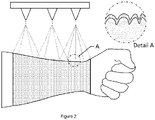
- Figure 2 schematically shows the full coverage of the skin by using a cosmetic formulation of the invention, i.e. no streaking effect occurs.
- the enlarged section "Detail A" of Figure 2 shows a part of the skin, which is covered with the cosmetic formulation according to the invention.
- the cosmetic formulation of the invention is a homogenous stable (transparent) solution, i.e. all components are completely dissolved in the formulation. In other words, there is no formation of flakes or crystals due to insufficiently dissolved components in the formulation, which may negatively influence the properties, in particular the electrostatic sprayability, of the cosmetic formulation.
- wt.-% or "w/w”, as used herein, means “weight percentage” and refers to the weight amount of a compound in relation to the (total) weight of a formulation of compounds or of a substrate if nothing else is explicitly stated or obvious under the circumstances.
- the electrostatically sprayable cosmetic formulation having the specific combination of components according to the invention preferably shows an specific electrical resistance of 15 to 100 GOhm ⁇ mm 2 /m, more preferably of 20 to 85 GOhm ⁇ mm 2 /m, it is even more preferred that the specific electrical resistance is not higher than 80, not higher than 60, not higher than 50 GOhm ⁇ mm 2 /m, most preferably the electrostatic resistance is between 35 to 48 GOhm ⁇ mm 2 /m, determined as described below (see measurement methods). This ensures that the formulation is good electrostatically sprayable and thus no undesired streaking effect on the skin occurs.
- the formulation preferably has a surface tension of 15 to 50 mN/m, more preferably of 20 to 45 mN/m, 22 to 40 mN/m, more preferably 24 to 35 mN/m determined by the stamp method as described below (see measurement methods).
- the relative permittivity of the cosmetic formulation according to the invention may be at least 1.0, preferably at least 1.5.
- the relative permittivity of cosmetic formulation preferably is between 1.2 and 5.0, more preferably between 1.5 and 3.0, or between 1.7 and 2.0.
- the measurement method for determining the relative permittivity according to the invention is described below (see measurement methods).
- the cosmetic formulation of the invention may have a viscosity of from 0.65 mPa ⁇ s to 5000 mPa ⁇ s, preferably of from 1.0 to 1000 mPa ⁇ s, 5.0 to 500 mPa ⁇ s, more preferably of from 10.0 to 100 mPa*s, determined as described below (see measurement methods).
- a good spraying behavior of the cosmetic formulation can be observed if the cosmetic formulation has a viscosity below 4.0 mPa ⁇ s.
- a cosmetic formulation having a viscosity of at least 8.0 mPa ⁇ s shows a sufficient spraying behavior.
- every electrostatic device known in the art can be used. However, it is preferred to use a device as described in DE 10 2017 108 610.2 , which is further specified in DE 10 2017 108 612.9 , DE 10 2017 108 613.7 , DE 10 2107 108 614.5 and DE 10 2107 108 615.3 .
- the cosmetic formulation comprises at least one polar oil component (first oil component) chosen from emollients that have a polarity of log K ow of 2 to 10, and a further oil component, i.e. a second oil component, that differs from the emollients constituting the polar oil component and which is chosen from oils of plant origin.
- first oil component chosen from emollients that have a polarity of log K ow of 2 to 10
- a further oil component i.e. a second oil component
- Emollients also referred to as cosmetic oils, are used in numerous cosmetic formulations for softening and smoothing the scales of the skin, which help to reduce rough and flaky skin. They are frequently occlusive agents, i.e. substances that provide a layer of protection that help prevent moisture (water) loss from the skin.
- emollients are silicones, such as dimethicone or cyclomethicone, stearyl alcohol or cetyl alcohol, and petrolatum derivatives such a petroleum jelly or mineral oil.
- most of the emollients as used in cosmetic formulation are non-polar and thus due to their electrical characteristics, i.e. resistivity and permittivity, most of the emollients show a poor electrostatic sprayability. However, some of them have a sufficient polarity and thus are interesting for electrostatically sprayable cosmetic formulations.
- n-octanol/water partition coefficient K ow or P
- the partition-coefficient refers to the ratio of concentrations of the compounds in the mixture of these two immiscible phases at equilibrium. Hence, the partition coefficient measures how hydrophilic ("water-loving") or hydrophobic ("water-fearing") the tested compound is. In most of the cases the n-octanol/water partition coefficient is stated as decade logarithms log K ow or log P. The determination of the n-octanol/water partition coefficient is described for example in J. Sangster, "Octanol-Water Partition Coefficients: Fundamentals and Physical Chemistry", Vol. 2 of Wiley Series in solution chemistry, John Wiley & Sons, Chichester, 1997 .
- the log K ow of the emollients which are suitable for the cosmetic formulation of the invention, is between 2.0 to 10.0, preferably between 2.5 and 9.5, 3.0 and 8.5, or between 3.5 and 7.5.
- the emollients used in the cosmetic formulation of the invention are preferably selected from the group consisting of octyldodecanol dibutyl adipate, cocoglyceride, PPG-15 stearyl ether, PPG-3 myristyl ether, PPG-14 butyl ether, dicaprylyl carbonate, isoamyl cocoate, diethylhexyl carbonate, isopropyl myristate, isopropyl palmitate, decyl cocoate, phenoxyethyl caprylate, C12-C15 alkyl benzoate and combinations thereof, more preferred is that the at least one emollient is octyldodecanol (e.g.
- Eutanol G ® dibutyl adipate (e.g. Cetiol B ® ) or cocoglyceride (e.g. Myritol 331 ® , modified coconut oil, CASR-No. 68606-18-8).
- dibutyl adipate e.g. Cetiol B ®
- cocoglyceride e.g. Myritol 331 ® , modified coconut oil, CASR-No. 68606-18-8.
- the cosmetic formulation of the invention comprises as polar oil component a mixture of at least two or more different emollients, at least three, but not more than five different emollients.
- the polar oil component of the cosmetic formulation comprises or is a mixture of octyldodecanol, dibutyl adipate and cocoglyceride.
- the different emollients of the cosmetic formulation are used in different or equal amounts in the formulation so that the total amount of emollients constituting the polar oil component is between 50 to 80 wt.-%, based on the total weight of the formulation.
- the total amount of emollients present in the formulation is from 52 to 75 wt.-%, 55 to 70 wt.-%, more preferably from 57 to 65 wt.-%, based on the total weight of the formulation.
- the further (second) oil component present in the cosmetic formulation of the invention differs from the emollients constituting the polar oil component of the cosmetic formulation and is chosen from oils of plant origin, also called natural oils or vegetable oils. Oil components of plant origin, which are suitable for cosmetic formulations, are well known in the art.
- Examples thereof are hydrogenated palm kernel oil, jojoba oil ( simmondsia chinensis seed oil ) , althea officinalis extract, apricot ( prunus armeniaca ) kernel oil, arnica montana extract, birch ( betula alba ) bark extract, borage ( Borago officinalis ) extract, butcherbroom ( ruscus aculeatus ) extract, candelilla ( euphorbia cerifera ) wax, calendula officinalis extract, canola oil, cardamon ( elettaria cardamomum ) oil, carnauba ( copernicia cerifera ) wax, carrot ( Daucus carota sativa ) oil, castor oil ( ricinus communis seed oil ) , chamomile ( anthemis nobilis ) oil, clary ( salvia sclarea ) oil, cocoa ( Theobroma cacao) butter, coconut ( Cocos
- the second oil component is selected from the group of natural oils consisting of simmondsia chinensis seed oil, macademia ternifolia seed oil, ricinus communis seed oil, prunus amygdalus dulcis (sweet almond) oil, persea gratissima (Avocado) oil, argania spinosa (argan) kernel oil, melaleuca alternifolia (tea tree) leaf oil and mixtures thereof.
- natural oils consisting of simmondsia chinensis seed oil, macademia ternifolia seed oil, ricinus communis seed oil, prunus amygdalus dulcis (sweet almond) oil, persea gratissima (Avocado) oil, argania spinosa (argan) kernel oil, melaleuca alternifolia (tea tree) leaf oil and mixtures thereof.
- the second oil component of the cosmetic formulation of the invention is selected from the group of natural oil consisting of simmondsia chinensis seed oil, macademia ternifolia seed oil, ricinus communis seed oil, and mixtures thereof, and more preferred that the second oil component comprises or is a mixture of chinensis seed oil, macademia ternifolia seed oil and ricinus communis seed oil.
- the second oil component is present in an amount of 5 to 30 wt.-%, preferably in amount of 10 to 25 wt.-%, more preferably in amount of 15 to 20 wt.-%, based on the total weight of the formulation, in the cosmetic formulation.
- the formulation according to the invention additionally comprises ethanol. It has been found that an ethanol amount of 10 to 30 wt.-%, based on the total weight of the composition is sufficient in case the cosmetic formulation contains additionally a glycolipid surfactant. Preferably the amount of ethanol is between 15 and 28 wt.-%, or between 17 and 25 wt.-%, more preferably between 18 and 23 wt.-%, based on the total weight of the formulation.
- the surfactant used in the cosmetic formulation has to be a glycolipid in order to improve the electrostatic sprayability of the formulation.
- Glycolipids which are suitable for cosmetic formulations are sophorolipids, rhamnolipids and mannosylerythritol lipids as for example described in the publication of Lourith et al., International Journal of Cosmetic Science, 2009, 31, pages 255-261 , hereby incorporated as reference.
- the cosmetic formulation of the invention includes a rhamnolipid as surfactant.
- Rhamnolipids can be produced by Pseudomonas sp. or Pseudomonas aeruginosa and are commercial available.
- Rhamnolipids are composed of one or two rhamnose molecules and are bonded to up to three molecules of hydroxyl fatty acids of varying chain length from 8 to 14 carbon atoms of which ⁇ -hydroxydecanoic acid is predominant.
- an amount of between 0.5 and 3.0 wt.-% of the glycolipid is sufficient to improve the electrostatic sprayability of the cosmetic formulation.
- the amount is between 0.6 and 2.5 wt.-%, 0.7 and 2.0 wt.-%, more preferably between 0.75 and 1.5 wt.-%, based on the total weight of the formulation.
- the cosmetic formulation comprises oil components
- the cosmetic formulation may comprises at least one moisture agent for further improving the skin caring effect of the formulation.
- Suitable moisture agents are for example fructose, glucose, glycerin, propylene glycol, 1,3-butylene glycol, linolenic acid, hyaluronic acid, beeswax, hydrogenated starch hydrolysate, acetylate lanolin alcohol, ceramides, ceresin, collagen, collagen, algae extract, aloe barbadensis, aloe-barbadensis extract, aloe barbadensis gel, and mixtures thereof.
- the moisture agent is selected from the group consisting of glycerin, propylene glycol, aloe barbadensis, aloe-barbadensis extract and aloe barbadensis gel and mixtures thereof.
- the cosmetic formulation comprises aloe barbadensis leaf extract, more preferably aloe barbadensis leaf extract/isopropyl myristate as moisture agent.
- the amount of the moisture agent present in the cosmetic formulation of the invention is preferably of 0.05 up to 2.0 wt.-%, 0.1 up to 1.5 wt.-%, and more preferably 0.8 up to 1.0 wt.-%, based on the total weight of the formulation.
- cosmetic formulations comprise in addition to the above described active compounds also cosmetic additives such as cosmetically acceptable carriers, sterols, amino acids powders, colorants, pigments, dyes, pH adjusters, perfumes, antioxidants, vitamins E, pro-vitamins, essential fatty acid, sphingolipids, UV filters etc. and combinations thereof.
- cosmetic additives such as cosmetically acceptable carriers, sterols, amino acids powders, colorants, pigments, dyes, pH adjusters, perfumes, antioxidants, vitamins E, pro-vitamins, essential fatty acid, sphingolipids, UV filters etc. and combinations thereof.
- the additives are selected from the group consisting of perfumes, vitamins and/or pro-vitamins such as tocopherol and/or tocopheryl acetate, and combinations thereof. It is particular it is preferred that the formulation includes at least tocopherol as additive.
- the cosmetic formulation of the invention preferably comprises 0.2 to 3.0 wt.-% of at least one cosmetic additive, more preferably of 0.5 to 2.5 wt.-%, 1.0 to 2.0 wt.-%, even more preferably of 1.2 to 1.8 wt.-%, based on the total weight of the formulation.
- the cosmetic formulation of the invention may include minor amounts of water.
- minor amounts of water usually, for example surfactant added to the cosmetic formulation in form of aqueous mixtures. These minor amounts of water do no influence negatively the electrostatic sprayability of the formulation.
- the amount of water should be not higher than 5 wt.-%, based on the total weight of the formulation. It is more preferred that the amount of water present in the cosmetic formulation of the invention is less than 5 wt.-%, preferably less than 3.5 wt.-%, less than 2.5 wt.-%, more preferably less than 1 wt.-%, based on the total weight of the formulation.
- the amount of water present in the cosmetic formulation is between 0.5 and 4.9 wt.-%, between 0.70 wt.-% and 2.0 wt.-%, and more preferred between 0.75 wt.-% and 1.0 wt.-%, based on the total weight of the cosmetic formulation.
- the formulation further comprises a propellant in order to ensure that the formulation is sprayable.
- propellants for example, chemicallyinert hydrocarbons such as propane, n-butane, isobutene and cyclopropane, and mixtures thereof, as well as halogenated hydrocarbons such as for example dichlorodifluormethane or 1,1-dichloro-1,1,2,2-tetrafluoroethane.
- isobutane used singly or mixed with other hydrocarbons, particularly propane is for example preferred used in aerosol.
- the use of propellants involves numerous disadvantages that can be avoided by providing the formulation of the invention.
- the cosmetic formulation of the invention can be used alone or in a mixture comprising other cosmetic formulations.
- the cosmetic formulation is a creme or a lotion, more preferably the cosmetic formulation is a lotion, and even more preferred a body lotion.
- the electrostatically sprayable cosmetic formulation consists of
- electrostatically sprayable cosmetic formulation consists of
- the specific electrical resistance was determined by the means of an Electrospray Paint Test Meter of DCA Electronic Ltd. The measuring current was between 85 ⁇ A and 100 ⁇ A or higher. The measuring range was 10 kOhm up to 5 MOhm. The measured electrical resistance was approximately conversed to the specific electrical resistance according to ASTDM D5682-08.
- the surface tensions of the formulations as described herein were measured by the stamp method as described below:
- the metal stamp can be used to determine the surface tension of liquids and highly viscous media (e.g. polymer melt or adhesives).
- the liquid is applied to the stamp, which forms an entire surface and a drop on the stamp.
- the stamp material has no influence on the measurement result.
- the surface tension of the liquid can be calculated from the drop contour and the density of the liquid using the SCA 20 software (www.dataphysics-instruments.com , DATAPhysics OCA20) and the Young-Laplace equation (see Figure 3 ).
- the contact angle and the volume of the drop are also measured.
- the determined surface tension is independent of the contact angle.
- the same surface tension values are measured both when the droplet is enlarged and when it is reduced by suction.
- the relative permittivity was determined by the means of a High Frequency Liquid Dielectric Constant Meter (Time Domain Reflection) "ALPHA TDR-5000" of Zadow Electronics (ww.zadow-electronics.de) having two parallel wire sensors that have a length of 5 cm.
- the relative permittivity of the formulation was calculated on the basis of the determined dielectric constant.
- the electrical conductivity was measured by means of Sartorious PT-20, hand-held conductivity meter, measuring cell PY-CL1 (www.sartorius.de). Measurement at room temperature.
- the viscosity was determined by means of a Universal Dynamic spectrometer "Physica UDS 200" at shear rates of 1 to 3000 s -1 and 22 °C.
- the spraying test was carried out such that the distance from a spraying nozzles to the outer left side of a metal tube was 13 cm.
- the pre-set voltage of test was 8 kV.
- the cosmetic formulation was applied on the skin by each consumer her/himself over a period of fourteen days by using an IONIQ spraying system, which is described in detail in DE 10 2017 108 610.2 , DE 10 2017 108 612.9 , DE 10 2017 108 613.7 , DE 10 2107 108 614.5 and. DE 10 2107 108 615.3 , by using a pre-set voltage of 8 kV.
- the consumers were interviewed at four predetermined time points regarding their impression of the cosmetic formulation according to the invention with respect to the following issues:
- the used ethanol was denaturized quality (denaturant: isopropyl and tert.-butanol; Ethanol 96%)
- the used aloe barbadensis extract was aloe barbadensis herbasol extract IPM 201100.02.2 from Lipoid GmbH and the simmondsia chinensis seed oil was Ewanol Jo from Wagner
- the used macadamia ternifolia seed oil was Ewanol MN-R from Wagner
- the used ricinus communis seed oil was Ewanol Ri-G from Wagner.
- each formulation was mixed together, whereby in a first step the oil components were mixed with ethanol to obtain a homogenous and transparent mixture. Afterwards, the further components were added to the mixture.
- each surfactant was added to the cosmetic formulation in form of an aqueous surfactant mixture in an amount of 1.5 wt.-%, based on the total weight of the formulation, such that the active matter of the tested surfactants present in the cosmetic formulation was between 0.04 and 0.75 wt.-%, based on the total weight of the cosmetic formulation (see Table 2 below).
- Particular care was taken to maintain the transparency of the cosmetic formulation, because the transparency of the cosmetic formulation is an indicator for its stability.
- the mixture of oil component(s) and ethanol is a transparent and homogenous solution.
- the further components, which are added to the mixture, in particular the surfactant may be not dissolved properly in the cosmetic formulation.
- composition of the cosmetic formulation without surfactant is given in Table 1 below:
- the cosmetic formulation had a sufficient stability and contained ethanol in combination with a mixture of polar emollients and natural oils (see Table 1 above), the electrostatic sprayability of the cosmetic formulation were not sufficient without the use of a surfactant in the formulation.
- any surfactant in the cosmetic formulation also did not provide the desired improvement of the spraying behavior of the cosmetic formulation.
- Table 2 only the use of a glycolipid, e.g. rhamnolipid, as surfactant provides a transparent solution and additionally an improved spraying result.
- the cosmetic formulation according to the invention has a specific electrostatic resistance of 63.4 GOhm ⁇ mm 2 /m, a surface tension of 26.74 mN/m, a relative permittivity of 1.99 and viscosity of 9 mPa ⁇ s at a shear rate of 100/s.
Landscapes
- Health & Medical Sciences (AREA)
- Life Sciences & Earth Sciences (AREA)
- General Health & Medical Sciences (AREA)
- Veterinary Medicine (AREA)
- Public Health (AREA)
- Animal Behavior & Ethology (AREA)
- Birds (AREA)
- Epidemiology (AREA)
- Emergency Medicine (AREA)
- Chemical & Material Sciences (AREA)
- Dermatology (AREA)
- Oil, Petroleum & Natural Gas (AREA)
- Dispersion Chemistry (AREA)
- Cosmetics (AREA)
Priority Applications (2)
| Application Number | Priority Date | Filing Date | Title |
|---|---|---|---|
| EP21179033.2A EP4101436A1 (de) | 2021-06-11 | 2021-06-11 | Elektrostatisch sprühbare hautpflegeformulierung |
| PCT/EP2022/065865 WO2022258819A1 (en) | 2021-06-11 | 2022-06-10 | Electrostatically sprayable skin caring formulation |
Applications Claiming Priority (1)
| Application Number | Priority Date | Filing Date | Title |
|---|---|---|---|
| EP21179033.2A EP4101436A1 (de) | 2021-06-11 | 2021-06-11 | Elektrostatisch sprühbare hautpflegeformulierung |
Publications (1)
| Publication Number | Publication Date |
|---|---|
| EP4101436A1 true EP4101436A1 (de) | 2022-12-14 |
Family
ID=76392285
Family Applications (1)
| Application Number | Title | Priority Date | Filing Date |
|---|---|---|---|
| EP21179033.2A Withdrawn EP4101436A1 (de) | 2021-06-11 | 2021-06-11 | Elektrostatisch sprühbare hautpflegeformulierung |
Country Status (2)
| Country | Link |
|---|---|
| EP (1) | EP4101436A1 (de) |
| WO (1) | WO2022258819A1 (de) |
Citations (6)
| Publication number | Priority date | Publication date | Assignee | Title |
|---|---|---|---|---|
| WO1994011119A1 (en) | 1992-11-18 | 1994-05-26 | Unilever Plc | Cosmetic delivery system |
| WO2001012139A1 (en) | 1999-08-18 | 2001-02-22 | The Procter & Gamble Company | Stable, electrostatically sprayable topical compositions |
| US20100116897A1 (en) | 2006-06-26 | 2010-05-13 | Battelle Memorial Institute | Handheld sprayer with removable cartridge and method of using same |
| US20190053602A1 (en) * | 2015-10-19 | 2019-02-21 | Kao Corporation | Method for producing coating film |
| US20190343731A1 (en) * | 2016-12-28 | 2019-11-14 | Kao Corporation | Method for manufacturing coating film |
| EP3795137A1 (de) | 2019-09-17 | 2021-03-24 | IONIQ Skincare GmbH & Co. KG | Elektrostatisch sprühbare kosmetische formulierung |
-
2021
- 2021-06-11 EP EP21179033.2A patent/EP4101436A1/de not_active Withdrawn
-
2022
- 2022-06-10 WO PCT/EP2022/065865 patent/WO2022258819A1/en not_active Ceased
Patent Citations (6)
| Publication number | Priority date | Publication date | Assignee | Title |
|---|---|---|---|---|
| WO1994011119A1 (en) | 1992-11-18 | 1994-05-26 | Unilever Plc | Cosmetic delivery system |
| WO2001012139A1 (en) | 1999-08-18 | 2001-02-22 | The Procter & Gamble Company | Stable, electrostatically sprayable topical compositions |
| US20100116897A1 (en) | 2006-06-26 | 2010-05-13 | Battelle Memorial Institute | Handheld sprayer with removable cartridge and method of using same |
| US20190053602A1 (en) * | 2015-10-19 | 2019-02-21 | Kao Corporation | Method for producing coating film |
| US20190343731A1 (en) * | 2016-12-28 | 2019-11-14 | Kao Corporation | Method for manufacturing coating film |
| EP3795137A1 (de) | 2019-09-17 | 2021-03-24 | IONIQ Skincare GmbH & Co. KG | Elektrostatisch sprühbare kosmetische formulierung |
Non-Patent Citations (2)
| Title |
|---|
| J. SANGSTER: "Wiley Series in solution chemistry", vol. 2, 1997, JOHN WILEY & SONS, article "Octanol-Water Partition Coefficients: Fundamentals and Physical Chemistry" |
| LOURITH ET AL., INTERNATIONAL JOURNAL OF COSMETIC SCIENCE, vol. 31, 2009, pages 255 - 261 |
Also Published As
| Publication number | Publication date |
|---|---|
| WO2022258819A1 (en) | 2022-12-15 |
Similar Documents
| Publication | Publication Date | Title |
|---|---|---|
| CN108938439B (zh) | 液晶型乳化组合物及其制备方法和应用 | |
| AU2008250298B2 (en) | Surfactant-free foam formulations | |
| EP2814451B1 (de) | Stabile wasser in öl emulsionen mit spreitfähigen ölen | |
| DE19924277A1 (de) | Zubereitungen von Emulsionstyp W/O mit erhöhtem Wassergehalt mit einem Gehalt an mittelpolaren Lipiden und Siliconemulgatoren und gegebenenfalls kationischen Polymeren | |
| US20130345317A1 (en) | Water-releasing cosmetic composition including a hydrophobic silica and a co-emulsifier | |
| EP1049452A2 (de) | Lipidreduzierte, fliessfähige kosmetische oder dermatologische zubereitungen | |
| CN111568782B (zh) | 一种具有改善皮肤屏障的纳米乳液组合物及其应用 | |
| CN114760984B (zh) | 使水润感最大化的油包水型化妆品组合物 | |
| JP2021501149A (ja) | パーソナルケア製品 | |
| KR102695333B1 (ko) | 오일 드롭형 화장료 조성물 | |
| KR20160109869A (ko) | 산성 pH의 마크로 액정 유화 입자를 포함하는 유화 화장료 조성물 | |
| EP4101436A1 (de) | Elektrostatisch sprühbare hautpflegeformulierung | |
| CN104519857B (zh) | 光彩组合物和使用方法 | |
| US20240252407A1 (en) | Electrostatically sprayable tanning formulation | |
| KR101978827B1 (ko) | 실리콘 조성물을 배합하여 분사각을 증진시킨 펌프식 분사용 화장료 조성물 | |
| US6653397B2 (en) | Preparations of the w/o emulsion type with an increased water content, comprising moderately polar and/or nonpolar lipids and one or more interface-active polyethers of the a-o-b-o-a type, and comprising at least one substance chosen from the group of cationic polymers | |
| KR101645939B1 (ko) | 이층상 화장료 조성물 | |
| ES2877998T3 (es) | Emulsiones de agua en aceite estables con propiedades sensoriales mejoradas | |
| WO2014038078A1 (en) | Cosmetic or dermatological composition for hydrating skin | |
| EP4609847A1 (de) | Elektrostatisch sprühbare gerbzusammensetzung | |
| KR20210046392A (ko) | 피부 보습용 화장료 조성물 | |
| WO2023245098A1 (en) | Topical skin care composition | |
| US20220183954A1 (en) | Electrostatically sprayable cosmetic formulation | |
| KR100681705B1 (ko) | 지방알코올 및 셀룰로오스 알킬 에테르를 유효성분으로함유하는 유중수형 화장료 조성물 | |
| KR102951021B1 (ko) | 리포좀 조성물 및 이를 포함하는 화장료 조성물 |
Legal Events
| Date | Code | Title | Description |
|---|---|---|---|
| PUAI | Public reference made under article 153(3) epc to a published international application that has entered the european phase |
Free format text: ORIGINAL CODE: 0009012 |
|
| STAA | Information on the status of an ep patent application or granted ep patent |
Free format text: STATUS: THE APPLICATION HAS BEEN PUBLISHED |
|
| AK | Designated contracting states |
Kind code of ref document: A1 Designated state(s): AL AT BE BG CH CY CZ DE DK EE ES FI FR GB GR HR HU IE IS IT LI LT LU LV MC MK MT NL NO PL PT RO RS SE SI SK SM TR |
|
| STAA | Information on the status of an ep patent application or granted ep patent |
Free format text: STATUS: THE APPLICATION IS DEEMED TO BE WITHDRAWN |
|
| 18D | Application deemed to be withdrawn |
Effective date: 20230615 |