EP4101757A1 - Aéronef à décollage et atterrissage verticaux - Google Patents
Aéronef à décollage et atterrissage verticaux Download PDFInfo
- Publication number
- EP4101757A1 EP4101757A1 EP21750259.0A EP21750259A EP4101757A1 EP 4101757 A1 EP4101757 A1 EP 4101757A1 EP 21750259 A EP21750259 A EP 21750259A EP 4101757 A1 EP4101757 A1 EP 4101757A1
- Authority
- EP
- European Patent Office
- Prior art keywords
- vertical takeoff
- cabin
- landing
- rotors
- landing aircraft
- Prior art date
- Legal status (The legal status is an assumption and is not a legal conclusion. Google has not performed a legal analysis and makes no representation as to the accuracy of the status listed.)
- Granted
Links
Images


Classifications
-
- B—PERFORMING OPERATIONS; TRANSPORTING
- B64—AIRCRAFT; AVIATION; COSMONAUTICS
- B64C—AEROPLANES; HELICOPTERS
- B64C1/00—Fuselages; Constructional features common to fuselages, wings, stabilising surfaces or the like
- B64C1/28—Parts of fuselage relatively movable to improve pilots view
-
- B—PERFORMING OPERATIONS; TRANSPORTING
- B64—AIRCRAFT; AVIATION; COSMONAUTICS
- B64C—AEROPLANES; HELICOPTERS
- B64C27/00—Rotorcraft; Rotors peculiar thereto
- B64C27/22—Compound rotorcraft, i.e. aircraft using in flight the features of both aeroplane and rotorcraft
- B64C27/28—Compound rotorcraft, i.e. aircraft using in flight the features of both aeroplane and rotorcraft with forward-propulsion propellers pivotable to act as lifting rotors
-
- B—PERFORMING OPERATIONS; TRANSPORTING
- B64—AIRCRAFT; AVIATION; COSMONAUTICS
- B64C—AEROPLANES; HELICOPTERS
- B64C11/00—Propellers, e.g. of ducted type; Features common to propellers and rotors for rotorcraft
- B64C11/001—Shrouded propellers
-
- B—PERFORMING OPERATIONS; TRANSPORTING
- B64—AIRCRAFT; AVIATION; COSMONAUTICS
- B64C—AEROPLANES; HELICOPTERS
- B64C27/00—Rotorcraft; Rotors peculiar thereto
- B64C27/04—Helicopters
- B64C27/08—Helicopters with two or more rotors
-
- B—PERFORMING OPERATIONS; TRANSPORTING
- B64—AIRCRAFT; AVIATION; COSMONAUTICS
- B64C—AEROPLANES; HELICOPTERS
- B64C27/00—Rotorcraft; Rotors peculiar thereto
- B64C27/20—Rotorcraft characterised by having shrouded rotors, e.g. flying platforms
-
- B—PERFORMING OPERATIONS; TRANSPORTING
- B64—AIRCRAFT; AVIATION; COSMONAUTICS
- B64C—AEROPLANES; HELICOPTERS
- B64C27/00—Rotorcraft; Rotors peculiar thereto
- B64C27/22—Compound rotorcraft, i.e. aircraft using in flight the features of both aeroplane and rotorcraft
- B64C27/26—Compound rotorcraft, i.e. aircraft using in flight the features of both aeroplane and rotorcraft characterised by provision of fixed wings
-
- B—PERFORMING OPERATIONS; TRANSPORTING
- B64—AIRCRAFT; AVIATION; COSMONAUTICS
- B64U—UNMANNED AERIAL VEHICLES [UAV]; EQUIPMENT THEREFOR
- B64U30/00—Means for producing lift; Empennages; Arrangements thereof
- B64U30/20—Rotors; Rotor supports
- B64U30/29—Constructional aspects of rotors or rotor supports; Arrangements thereof
- B64U30/296—Rotors with variable spatial positions relative to the UAV body
- B64U30/297—Tilting rotors
-
- B—PERFORMING OPERATIONS; TRANSPORTING
- B64—AIRCRAFT; AVIATION; COSMONAUTICS
- B64U—UNMANNED AERIAL VEHICLES [UAV]; EQUIPMENT THEREFOR
- B64U30/00—Means for producing lift; Empennages; Arrangements thereof
- B64U30/20—Rotors; Rotor supports
- B64U30/29—Constructional aspects of rotors or rotor supports; Arrangements thereof
- B64U30/299—Rotor guards
Definitions
- the present invention relates to a vertical takeoff and landing aircraft.
- Vertical takeoff and landing aircrafts come in a variety of forms.
- a system (1) of providing propulsion devices separately for vertical takeoff and landing and for horizontal flight a system (2) of changing the angle of a propulsion device (e.g., Patent Literature 1), and a system (3) of changing, like a tail-sitter, the tilt of a fuselage itself.
- Patent Literature 1 JP 2016 - 501 773 A
- the system (1) is disadvantageous in terms of weight and cost because propulsion devices are provided separately for vertical takeoff and landing and for horizontal flight.
- the system (2) is disadvantageous in terms of weight, cost and reliability because a mechanism and/or control to change the angle of the propulsion device is complex.
- the system (3) is not always good in terms of comfort of a crew who gets in the fuselage and carrying of cargo that is loaded in the fuselage because the attitude of the fuselage itself greatly changes.
- the present invention has been conceived in view of the above points, and objects thereof include providing a vertical takeoff and landing aircraft that is capable of both vertical takeoff and landing and high-speed horizontal flight while keeping a crew, cargo and/or the like horizontal, and can achieve weight reduction, low cost and improvement of reliability.
- the present invention stated in claim 1 is a vertical takeoff and landing aircraft capable of vertical takeoff and landing and horizontal flight, including:
- the present invention stated in claim 2 is the vertical takeoff and landing aircraft according to claim 1, wherein parts of the protectors function as the fixed wings.
- the present invention stated in claim 3 is the vertical takeoff and landing aircraft according to claim 1 or 2, wherein as the hinge, a damper hinge is used, the damper hinge providing a greater resistance against the rotation of the connector as an angular velocity of the connector with respect to the cabin is greater.
- the present invention stated in claim 4 is the vertical takeoff and landing aircraft according to any one of claims 1 to 3, wherein the vertical takeoff and landing aircraft is configured to obtain a lift during the vertical takeoff and landing by the rotation of the rotors and obtain the lift during the horizontal flight by the fixed wings.
- the present invention stated in claim 5 is the vertical takeoff and landing aircraft according to any one of claims 1 to 4, wherein the protectors are configured such that parts of each of the protectors being a lower side and an upper side during the horizontal flight function as the fixed wings.
- the present invention stated in claim 6 is the vertical takeoff and landing aircraft according to any one of claims 1 to 5, wherein the hinge is provided at a position higher than a center of gravity of the cabin.
- a vertical takeoff and landing aircraft is capable of both vertical takeoff and landing and high-speed horizontal flight while keeping a crew, cargo and/or the like horizontal, and can achieve weight reduction, low cost and improvement of reliability.
- the vertical takeoff and landing aircraft of this embodiment is capable of vertical takeoff and landing and horizontal flight.
- FIG. 1A is a plan view showing the configuration of the vertical takeoff and landing aircraft of this embodiment during vertical takeoff and landing.
- FIG. 1B is a side view thereof.
- a vertical takeoff and landing aircraft 1 mainly includes a fuselage 2, (sets of) rotors 3, protectors 4, connectors 5, and hinges 6.
- the cabin 2 is a housing in which a crew can get and/or cargo can be loaded.
- the cabin 2 as a whole is formed to have a streamlined external shape.
- FIG. 1A and FIG. 1B show the cabin 2 in which only one crew member gets
- the cabin 2 may be configured as a cabin for a plurality of crew members to get in or as an unmanned or manned cabin to load and transport cargo.
- the rotors 3 are arranged.
- the rotors 3 are provided at two places on the front side and two places on the rear side, four places in total, so as to face in the upward/downward direction.
- the rotors 3 are driven by motors 31 to rotate.
- the rotors 3 on the front side rotate in opposite directions to one another
- the rotors 3 on the rear side rotate in opposite directions to one another. That is, in FIG. 1A , for example, the left-front rotors 3A and the right-rear rotors 3D rotate clockwise, and the right-front rotors 3B and the left-rear rotors 3C rotate counterclockwise.
- the protectors 4 are provided, one that surrounds and protects the rotors 3 at two places on the front side, and the other that surrounds and protects the rotors 3 at two places on the rear side.
- parts of the protectors 4 function as fixed wings 4A to 4D, which will be described later.
- the abovementioned motors 31 are attached to fixing members 41 that are provided at the lower end parts of the protectors 4, so that the rotors 3 are fixed to the protectors 4.
- the protectors 4 are opened in their upper sides and lower sides, and during vertical takeoff and landing, by rotation of the rotors 3, air above the protectors 4 is drawn into the protectors 4 and ejected from the protectors 4 downward as downward airflow.
- two connectors 5 are arranged parallel to one another so as to extend in the front-rear direction.
- the protectors 4 are attached, so that the front protector 4 and the rear protector 4 are connected to one another by the connectors 5.
- the connectors 5 are attached to the left side and the right side of the cabin 2 via the hinges 6 such that the connectors 5 are rotatable with respect to the cabin 2.
- the connectors 5 are thus attached to the cabin 2 via the hinges 6. Hence, as will be described later, even when the connectors 5 tilt from the state of extending in the horizontal direction (front-rear direction) and rotate such that the rear sides of the connectors 5 go up, the cabin 2 does not tilt from the state of facing in the front/rear direction shown in FIG. 1B . This is shown in FIG. 3 and will be described later.
- damper hinges are used as the hinges 6.
- the damper hinges provide greater resistance against rotation of the connectors 5 as the angular velocity of the connectors 5 with respect to the cabin 2 is greater.
- the hinges 6 do not have the damper function, namely, if, unlike this embodiment, the hinges 6 are not damper hinges, when the connectors 5 rotate rapidly with respect to the cabin 2, the cabin 2 may swing back and forth, namely, perform a pendulum motion, during and after the rapid rotation of the connectors 5, whereas if, like this embodiment, damper hinges are used as the hinges 6, even when the connectors 5 rotate rapidly, the hinges 6 resist the swing of the cabin 2 and can accurately prevent or reduce the back-and-forth swing of the cabin 2.
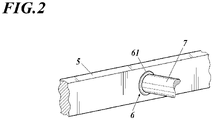
- the hinges 6 are each provided at an attachment part of an attachment 7 to the connector 5, the attachment 7 being attached to the cabin 2, which is not shown in FIG. 2 .
- a friction material 61 may be interposed as shown in FIG. 2 .
- oil may be interposed.
- dampers may be provided separately from the hinges 6.
- the connectors 5 are attached to the attachments 7 by the hinges 6 so as to rotate with no resistance, and the dampers function to provide resistance against rotation of the connectors 5.
- the hinges 6 are provided at positions higher than the center of gravity of the cabin 2. This configuration makes the cabin 2 kind of hang from the hinges 6.
- the hinges 6 are provided at positions lower than the center of gravity of the cabin 2, the cabin 2 is likely to rotate by falling forward or backward centering on the hinges 6 by its own weight, which decreases stability.
- the hinges 6 are provided at positions higher than the center of gravity of the cabin 2, the cabin 2 hangs from the hinges 6 as described above, and hence does not rotate with respect to the hinges 6, which maintains stability of the cabin 2.
- the hinges 6 are configured by damper hinges (or separate dampers from the hinges 6 are provided), the back-and-forth swing of the cabin 2 with respect to the hinges 6 is also prevented or reduced, which maintains stability of the cabin 2 more certainly.
- the hinges 6 are provided slightly forward of the center of gravity of the cabin 2. This is for the cabin 2 to keep the attitude to face in the substantially horizontal direction in balance with the crew and/or cargo in the cabin 2.
- the positions of the hinges 6 in the front-rear direction are determined as appropriate in accordance with the arrangement of the crew and/or cargo in the cabin 2.
- FIG. 3 is a side view showing the configuration of the vertical takeoff and landing aircraft of this embodiment during horizontal flight.
- the vertical takeoff and landing aircraft 1 of this embodiment obtains lift by rotation of the rotors 3 during vertical takeoff and landing.
- the connectors 5 rotate such that the rear sides of the connectors 5 go up while the cabin 2 keeps facing in the substantially horizontal direction, and as shown in FIG. 3 , tilt to the state of being nearly vertical.
- rotation of the rotors 3 contributes little to the lift of the vertical takeoff and landing aircraft 1, but generates airflow behind the vertical takeoff and landing aircraft 1. Accordingly, the vertical takeoff and landing aircraft 1 obtains forward thrust for horizontal flight by rotation of the rotors 3.
- parts of the protectors 4 function as the fixed wings 4A to 4D, and the vertical takeoff and landing aircraft 1 obtains the lift during horizontal flight by the fixed wings 4A to 4D.
- the vertical takeoff and landing aircraft 1 of this embodiment can perform vertical takeoff and landing and horizontal flight by the connectors 5 rotating with respect to the cabin 2 and accordingly the rotors 3 and the fixed wings 4A to 4D rotating around the cabin 2.
- the protectors 4 are formed at the both end parts of the connectors 5 so as to surround the rotors 3, and configured such that during horizontal flight ( FIG. 3 ), the lower parts 4A, 4C and the upper parts 4B, 4D of the protectors 4, which are during vertical takeoff and landing ( FIG. 1A and FIG. 1B ), the front parts 4A, 4C and the rear parts 4B, 4D of the protectors 4, function as the fixed wings 4A to 4D.
- the fixed wings 4A to 4D can each be formed, for example, to have a cross-section shape of the upper surface bulging more than the lower surface, which is a shape often used for wings of airplanes, they each may be formed, as shown in FIG. 4 , to have a cross-section shape of being perfectly symmetrical about the centerline.
- the rotors 3 (their rates of rotation or the like) of the vertical takeoff and landing aircraft 1 are controlled basically in the same manner as those of a quadcopter having the same number of (sets of) rotors as the number of (sets of) rotors 3 of the vertical takeoff and landing aircraft 1.
- a quadcopter when rotors tilt to the extent that they face in the substantial horizontal direction, the lift cannot be obtained from rotation of the rotors, and accordingly possibility of crashes increases. Hence, the rotors cannot be tilted greatly.
- the lift is obtained from the fixed wings 4A to 4D.
- the rotors 3 (connectors 5) can be tilted to the extent that they face in the substantially horizontal direction, and rotation of the rotors 3 can be used as the thrust, which enables high-speed flight.
- the connectors 5 are attached to the left side and the right side of the cabin 2, which is capable of carrying a crew and/or cargo, via the hinges 6 such that the connectors 5 are rotatable with respect to the cabin 2, and the rotors 3 are arranged in the protectors 4 that are attached to the both ends of the connectors 5 (front end and rear end of each of the connectors 5 during vertical takeoff and landing).
- the vertical takeoff and landing aircraft 1 is configured to perform vertical takeoff and landing by obtaining lift by rotation of the rotors 3 and perform horizontal flight by obtaining lift by the fixed wings 4A to 4D and thrust by rotation of the rotors 3, by the connectors 5 rotating with respect to the cabin 2.
- the vertical takeoff and landing aircraft 1 of this embodiment uses the rotors 3 as a vertical propulsion device during vertical takeoff and landing and as a forward propulsion device during horizontal flight.
- the vertical takeoff and landing aircraft 1 of this embodiment does not require any mechanism or control to change the angle of the rotors 3, which are of the propulsion devices, namely, to change the state of the rotors 3 from the state of facing upward during vertical takeoff and landing to the state of facing sideways during horizontal flight.
- the angle of the rotors 3 can be changed by only increasing the rate of rotation (lift) of the rotors 3 positioned on the rear side during vertical takeoff and landing to be higher than the rate of rotation (lift) of the rotors 3 positioned on the front side during vertical takeoff and landing.
- the cabin 2 does not tilt accordingly and keeps facing in the horizontal direction.
- the vertical takeoff and landing aircraft 1 of this embodiment can fly while keeping a crew who boards the aircraft 1, cargo that is loaded in the cabin 2 and/or the like horizontal, and hence is excellent in terms of comfort of the crew who boards the aircraft 1, stability of carrying of the cargo that is loaded into the cabin 2, and so forth.
- the vertical takeoff and landing aircraft 1 of this embodiment is capable of both vertical takeoff and landing and high-speed horizontal flight while keeping a crew, cargo and/or the like horizontal.
- parts of the protectors 4 function as the fixed wings 4A to 4D, but, instead of parts of the protectors 4 functioning as the fixed wings 4A to 4D, fixed wings may be provided separately from the protectors 4.
- the present invention is applicable to a vertical takeoff and landing aircraft.
Landscapes
- Engineering & Computer Science (AREA)
- Aviation & Aerospace Engineering (AREA)
- Mechanical Engineering (AREA)
- Chemical & Material Sciences (AREA)
- Combustion & Propulsion (AREA)
- Body Structure For Vehicles (AREA)
- Fluid-Damping Devices (AREA)
- Vehicle Step Arrangements And Article Storage (AREA)
Applications Claiming Priority (2)
| Application Number | Priority Date | Filing Date | Title |
|---|---|---|---|
| JP2020016677A JP7541830B2 (ja) | 2020-02-04 | 2020-02-04 | 垂直離着陸機 |
| PCT/JP2021/001700 WO2021157343A1 (fr) | 2020-02-04 | 2021-01-19 | Aéronef à décollage et atterrissage verticaux |
Publications (3)
| Publication Number | Publication Date |
|---|---|
| EP4101757A1 true EP4101757A1 (fr) | 2022-12-14 |
| EP4101757A4 EP4101757A4 (fr) | 2024-01-17 |
| EP4101757B1 EP4101757B1 (fr) | 2026-04-29 |
Family
ID=77199266
Family Applications (1)
| Application Number | Title | Priority Date | Filing Date |
|---|---|---|---|
| EP21750259.0A Active EP4101757B1 (fr) | 2020-02-04 | 2021-01-19 | Aéronef à décollage et atterrissage verticaux |
Country Status (5)
| Country | Link |
|---|---|
| US (1) | US12195174B2 (fr) |
| EP (1) | EP4101757B1 (fr) |
| JP (1) | JP7541830B2 (fr) |
| CN (1) | CN115003599A (fr) |
| WO (1) | WO2021157343A1 (fr) |
Cited By (1)
| Publication number | Priority date | Publication date | Assignee | Title |
|---|---|---|---|---|
| PL444951A1 (pl) * | 2023-05-22 | 2024-11-25 | Sieć Badawcza Łukasiewicz - Instytut Lotnictwa | Pionowzlot |
Family Cites Families (18)
| Publication number | Priority date | Publication date | Assignee | Title |
|---|---|---|---|---|
| CH490733A (de) | 1968-11-07 | 1970-05-15 | Ghielmetti Ag | Schaltvorrichtung mit einem Datenträger, zum Einsetzen in eine Prozess-Steuereinrichtung |
| US8733690B2 (en) * | 2009-08-24 | 2014-05-27 | Joby Aviation, Inc. | Lightweight vertical take-off and landing aircraft and flight control paradigm using thrust differentials |
| CN102363445B (zh) * | 2011-06-21 | 2014-07-30 | 杨朝习 | 倾转动力式垂直起降陆空两用飞行器 |
| FR2999150B1 (fr) | 2012-12-10 | 2015-10-09 | Bermond Gerome Maurice Paul | Aeronef convertible pourvu de deux rotors carenes en bout d'aile et d'un fan horizontal dans le fuselage |
| JP5277342B1 (ja) * | 2012-12-11 | 2013-08-28 | 和博 高橋 | 垂直離着陸機 |
| US10011351B2 (en) * | 2016-07-01 | 2018-07-03 | Bell Helicopter Textron Inc. | Passenger pod assembly transportation system |
| US9963228B2 (en) * | 2016-07-01 | 2018-05-08 | Bell Helicopter Textron Inc. | Aircraft with selectively attachable passenger pod assembly |
| US10252796B2 (en) * | 2016-08-09 | 2019-04-09 | Kitty Hawk Corporation | Rotor-blown wing with passively tilting fuselage |
| CN206871353U (zh) * | 2017-05-16 | 2018-01-12 | 许育俊 | 一种便携式折叠飞行器 |
| US10822101B2 (en) * | 2017-07-21 | 2020-11-03 | General Electric Company | Vertical takeoff and landing aircraft having a forward thrust propulsor |
| CN111566008A (zh) * | 2017-12-12 | 2020-08-21 | 卡梅伦·斯潘塞 | 可变几何形状垂直起降(vtol)飞行器系统 |
| JP6384013B1 (ja) * | 2018-04-09 | 2018-09-05 | 株式会社エアロネクスト | 飛行体 |
| RO133664B1 (ro) * | 2018-04-17 | 2024-07-30 | Răzvan Sabie | Aparat de zbor cu decolare şi aterizare verticală |
| FR3086641B1 (fr) * | 2018-09-28 | 2020-09-04 | Airbus Helicopters | Aeronef multirotor a motorisation electrique ou hybride avec une consommation energetique optimisee |
| US11148799B2 (en) * | 2018-11-26 | 2021-10-19 | Textron Innovations Inc. | Tilting duct compound helicopter |
| US11597509B1 (en) * | 2020-11-04 | 2023-03-07 | Reynaldo Thomas Alfaro | Vertical take-off and landing aircraft and methods of taking-off, landing, and aircraft control |
| EP4015362B1 (fr) * | 2020-12-18 | 2024-10-09 | Aurora Flight Sciences Corporation, a subsidiary of The Boeing Company | Système de propulsion à soufflante de sustentation et d'un volet à lamelles |
| US11548621B1 (en) * | 2021-11-04 | 2023-01-10 | Horizon Aircraft Inc. | Aircraft airfoil having an internal thrust unit, and aircraft having the same |
-
2020
- 2020-02-04 JP JP2020016677A patent/JP7541830B2/ja active Active
-
2021
- 2021-01-19 WO PCT/JP2021/001700 patent/WO2021157343A1/fr not_active Ceased
- 2021-01-19 US US17/792,888 patent/US12195174B2/en active Active
- 2021-01-19 EP EP21750259.0A patent/EP4101757B1/fr active Active
- 2021-01-19 CN CN202180010452.6A patent/CN115003599A/zh active Pending
Cited By (1)
| Publication number | Priority date | Publication date | Assignee | Title |
|---|---|---|---|---|
| PL444951A1 (pl) * | 2023-05-22 | 2024-11-25 | Sieć Badawcza Łukasiewicz - Instytut Lotnictwa | Pionowzlot |
Also Published As
| Publication number | Publication date |
|---|---|
| WO2021157343A1 (fr) | 2021-08-12 |
| US20230054385A1 (en) | 2023-02-23 |
| EP4101757A4 (fr) | 2024-01-17 |
| US12195174B2 (en) | 2025-01-14 |
| JP2021123190A (ja) | 2021-08-30 |
| JP7541830B2 (ja) | 2024-08-29 |
| EP4101757B1 (fr) | 2026-04-29 |
| CN115003599A (zh) | 2022-09-02 |
Similar Documents
| Publication | Publication Date | Title |
|---|---|---|
| US10370100B2 (en) | Aerodynamically actuated thrust vectoring devices | |
| US11820506B2 (en) | Aerial vehicle with counterweight mechanism | |
| EP3366582B1 (fr) | Aéronef multirotor ayant une cellule et un agencement d'unités de production de poussée | |
| EP3768592B1 (fr) | Construction de structure pour aéronef et aéronef comprenant la construction de structure | |
| JP6384013B1 (ja) | 飛行体 | |
| JP2018203226A (ja) | 飛行体 | |
| US12377977B2 (en) | Manned aircraft | |
| JP6664820B1 (ja) | 飛行体 | |
| JP2019182390A (ja) | 飛行体 | |
| US11628951B2 (en) | Electronic component and aircraft with electronic component attached thereto | |
| KR102208350B1 (ko) | 2 자유도 관절을 이용하여 비행 성능을 유지 가능한 회전익형 비행체 | |
| US11072422B2 (en) | Counter torque device | |
| US12195174B2 (en) | Vertical takeoff and landing aircraft | |
| US11536565B2 (en) | System and method for gimbal lock avoidance in an aircraft | |
| JP7584168B2 (ja) | 有人飛行体 | |
| EP3919377B1 (fr) | Hélicoptère combiné | |
| US11814162B2 (en) | Rotatable winglets for a rotary wing aircraft | |
| JP6671705B2 (ja) | 飛行体 | |
| JP6664821B2 (ja) | 飛行体 | |
| JP2022016568A (ja) | 翼回転垂直離着陸長距離航空機 |
Legal Events
| Date | Code | Title | Description |
|---|---|---|---|
| STAA | Information on the status of an ep patent application or granted ep patent |
Free format text: STATUS: THE INTERNATIONAL PUBLICATION HAS BEEN MADE |
|
| PUAI | Public reference made under article 153(3) epc to a published international application that has entered the european phase |
Free format text: ORIGINAL CODE: 0009012 |
|
| STAA | Information on the status of an ep patent application or granted ep patent |
Free format text: STATUS: REQUEST FOR EXAMINATION WAS MADE |
|
| 17P | Request for examination filed |
Effective date: 20220715 |
|
| AK | Designated contracting states |
Kind code of ref document: A1 Designated state(s): AL AT BE BG CH CY CZ DE DK EE ES FI FR GB GR HR HU IE IS IT LI LT LU LV MC MK MT NL NO PL PT RO RS SE SI SK SM TR |
|
| DAV | Request for validation of the european patent (deleted) | ||
| DAX | Request for extension of the european patent (deleted) | ||
| A4 | Supplementary search report drawn up and despatched |
Effective date: 20231220 |
|
| RIC1 | Information provided on ipc code assigned before grant |
Ipc: B64C 27/20 20060101ALI20231214BHEP Ipc: B64C 29/00 20060101ALI20231214BHEP Ipc: B64C 11/00 20060101ALI20231214BHEP Ipc: B64C 1/28 20060101ALI20231214BHEP Ipc: B64C 29/02 20060101ALI20231214BHEP Ipc: B64C 27/28 20060101ALI20231214BHEP Ipc: B64C 27/26 20060101ALI20231214BHEP Ipc: B64C 27/08 20060101AFI20231214BHEP |
|
| RIC1 | Information provided on ipc code assigned before grant |
Ipc: B64C 27/20 20060101ALI20240112BHEP Ipc: B64C 29/00 20060101ALI20240112BHEP Ipc: B64C 11/00 20060101ALI20240112BHEP Ipc: B64C 1/28 20060101ALI20240112BHEP Ipc: B64C 29/02 20060101ALI20240112BHEP Ipc: B64C 27/28 20060101ALI20240112BHEP Ipc: B64C 27/26 20060101ALI20240112BHEP Ipc: B64C 27/08 20060101AFI20240112BHEP |
|
| GRAP | Despatch of communication of intention to grant a patent |
Free format text: ORIGINAL CODE: EPIDOSNIGR1 |
|
| STAA | Information on the status of an ep patent application or granted ep patent |
Free format text: STATUS: GRANT OF PATENT IS INTENDED |
|
| INTG | Intention to grant announced |
Effective date: 20250605 |
|
| GRAJ | Information related to disapproval of communication of intention to grant by the applicant or resumption of examination proceedings by the epo deleted |
Free format text: ORIGINAL CODE: EPIDOSDIGR1 |
|
| STAA | Information on the status of an ep patent application or granted ep patent |
Free format text: STATUS: REQUEST FOR EXAMINATION WAS MADE |
|
| INTC | Intention to grant announced (deleted) | ||
| GRAP | Despatch of communication of intention to grant a patent |
Free format text: ORIGINAL CODE: EPIDOSNIGR1 |
|
| STAA | Information on the status of an ep patent application or granted ep patent |
Free format text: STATUS: GRANT OF PATENT IS INTENDED |
|
| GRAJ | Information related to disapproval of communication of intention to grant by the applicant or resumption of examination proceedings by the epo deleted |
Free format text: ORIGINAL CODE: EPIDOSDIGR1 |
|
| STAA | Information on the status of an ep patent application or granted ep patent |
Free format text: STATUS: REQUEST FOR EXAMINATION WAS MADE |
|
| GRAP | Despatch of communication of intention to grant a patent |
Free format text: ORIGINAL CODE: EPIDOSNIGR1 |
|
| STAA | Information on the status of an ep patent application or granted ep patent |
Free format text: STATUS: GRANT OF PATENT IS INTENDED |
|
| INTG | Intention to grant announced |
Effective date: 20251028 |
|
| INTC | Intention to grant announced (deleted) | ||
| INTG | Intention to grant announced |
Effective date: 20251119 |
|
| GRAS | Grant fee paid |
Free format text: ORIGINAL CODE: EPIDOSNIGR3 |
|
| GRAA | (expected) grant |
Free format text: ORIGINAL CODE: 0009210 |
|
| STAA | Information on the status of an ep patent application or granted ep patent |
Free format text: STATUS: THE PATENT HAS BEEN GRANTED |
|
| AK | Designated contracting states |
Kind code of ref document: B1 Designated state(s): AL AT BE BG CH CY CZ DE DK EE ES FI FR GB GR HR HU IE IS IT LI LT LU LV MC MK MT NL NO PL PT RO RS SE SI SK SM TR |
|
| REG | Reference to a national code |
Ref country code: CH Ref legal event code: F10 Free format text: ST27 STATUS EVENT CODE: U-0-0-F10-F00 (AS PROVIDED BY THE NATIONAL OFFICE) Effective date: 20260429 |