EP4101825A1 - Brennerfläche - Google Patents
Brennerfläche Download PDFInfo
- Publication number
- EP4101825A1 EP4101825A1 EP21382518.5A EP21382518A EP4101825A1 EP 4101825 A1 EP4101825 A1 EP 4101825A1 EP 21382518 A EP21382518 A EP 21382518A EP 4101825 A1 EP4101825 A1 EP 4101825A1
- Authority
- EP
- European Patent Office
- Prior art keywords
- infiltrated
- burner surface
- burner
- ceramic
- dispersion
- Prior art date
- Legal status (The legal status is an assumption and is not a legal conclusion. Google has not performed a legal analysis and makes no representation as to the accuracy of the status listed.)
- Withdrawn
Links
Images
Classifications
-
- C—CHEMISTRY; METALLURGY
- C04—CEMENTS; CONCRETE; ARTIFICIAL STONE; CERAMICS; REFRACTORIES
- C04B—LIME, MAGNESIA; SLAG; CEMENTS; COMPOSITIONS THEREOF, e.g. MORTARS, CONCRETE OR LIKE BUILDING MATERIALS; ARTIFICIAL STONE; CERAMICS; REFRACTORIES; TREATMENT OF NATURAL STONE
- C04B35/00—Shaped ceramic products characterised by their composition; Ceramics compositions; Processing powders of inorganic compounds preparatory to the manufacturing of ceramic products
- C04B35/515—Shaped ceramic products characterised by their composition; Ceramics compositions; Processing powders of inorganic compounds preparatory to the manufacturing of ceramic products based on non-oxide ceramics
- C04B35/56—Shaped ceramic products characterised by their composition; Ceramics compositions; Processing powders of inorganic compounds preparatory to the manufacturing of ceramic products based on non-oxide ceramics based on carbides or oxycarbides
- C04B35/565—Shaped ceramic products characterised by their composition; Ceramics compositions; Processing powders of inorganic compounds preparatory to the manufacturing of ceramic products based on non-oxide ceramics based on carbides or oxycarbides based on silicon carbide
-
- C—CHEMISTRY; METALLURGY
- C04—CEMENTS; CONCRETE; ARTIFICIAL STONE; CERAMICS; REFRACTORIES
- C04B—LIME, MAGNESIA; SLAG; CEMENTS; COMPOSITIONS THEREOF, e.g. MORTARS, CONCRETE OR LIKE BUILDING MATERIALS; ARTIFICIAL STONE; CERAMICS; REFRACTORIES; TREATMENT OF NATURAL STONE
- C04B35/00—Shaped ceramic products characterised by their composition; Ceramics compositions; Processing powders of inorganic compounds preparatory to the manufacturing of ceramic products
- C04B35/01—Shaped ceramic products characterised by their composition; Ceramics compositions; Processing powders of inorganic compounds preparatory to the manufacturing of ceramic products based on oxide ceramics
- C04B35/10—Shaped ceramic products characterised by their composition; Ceramics compositions; Processing powders of inorganic compounds preparatory to the manufacturing of ceramic products based on oxide ceramics based on aluminium oxide
- C04B35/111—Fine ceramics
-
- C—CHEMISTRY; METALLURGY
- C04—CEMENTS; CONCRETE; ARTIFICIAL STONE; CERAMICS; REFRACTORIES
- C04B—LIME, MAGNESIA; SLAG; CEMENTS; COMPOSITIONS THEREOF, e.g. MORTARS, CONCRETE OR LIKE BUILDING MATERIALS; ARTIFICIAL STONE; CERAMICS; REFRACTORIES; TREATMENT OF NATURAL STONE
- C04B35/00—Shaped ceramic products characterised by their composition; Ceramics compositions; Processing powders of inorganic compounds preparatory to the manufacturing of ceramic products
- C04B35/01—Shaped ceramic products characterised by their composition; Ceramics compositions; Processing powders of inorganic compounds preparatory to the manufacturing of ceramic products based on oxide ceramics
- C04B35/10—Shaped ceramic products characterised by their composition; Ceramics compositions; Processing powders of inorganic compounds preparatory to the manufacturing of ceramic products based on oxide ceramics based on aluminium oxide
- C04B35/111—Fine ceramics
- C04B35/117—Composites
-
- C—CHEMISTRY; METALLURGY
- C04—CEMENTS; CONCRETE; ARTIFICIAL STONE; CERAMICS; REFRACTORIES
- C04B—LIME, MAGNESIA; SLAG; CEMENTS; COMPOSITIONS THEREOF, e.g. MORTARS, CONCRETE OR LIKE BUILDING MATERIALS; ARTIFICIAL STONE; CERAMICS; REFRACTORIES; TREATMENT OF NATURAL STONE
- C04B35/00—Shaped ceramic products characterised by their composition; Ceramics compositions; Processing powders of inorganic compounds preparatory to the manufacturing of ceramic products
- C04B35/01—Shaped ceramic products characterised by their composition; Ceramics compositions; Processing powders of inorganic compounds preparatory to the manufacturing of ceramic products based on oxide ceramics
- C04B35/14—Shaped ceramic products characterised by their composition; Ceramics compositions; Processing powders of inorganic compounds preparatory to the manufacturing of ceramic products based on oxide ceramics based on silica
-
- C—CHEMISTRY; METALLURGY
- C04—CEMENTS; CONCRETE; ARTIFICIAL STONE; CERAMICS; REFRACTORIES
- C04B—LIME, MAGNESIA; SLAG; CEMENTS; COMPOSITIONS THEREOF, e.g. MORTARS, CONCRETE OR LIKE BUILDING MATERIALS; ARTIFICIAL STONE; CERAMICS; REFRACTORIES; TREATMENT OF NATURAL STONE
- C04B35/00—Shaped ceramic products characterised by their composition; Ceramics compositions; Processing powders of inorganic compounds preparatory to the manufacturing of ceramic products
- C04B35/01—Shaped ceramic products characterised by their composition; Ceramics compositions; Processing powders of inorganic compounds preparatory to the manufacturing of ceramic products based on oxide ceramics
- C04B35/16—Shaped ceramic products characterised by their composition; Ceramics compositions; Processing powders of inorganic compounds preparatory to the manufacturing of ceramic products based on oxide ceramics based on silicates other than clay
-
- C—CHEMISTRY; METALLURGY
- C04—CEMENTS; CONCRETE; ARTIFICIAL STONE; CERAMICS; REFRACTORIES
- C04B—LIME, MAGNESIA; SLAG; CEMENTS; COMPOSITIONS THEREOF, e.g. MORTARS, CONCRETE OR LIKE BUILDING MATERIALS; ARTIFICIAL STONE; CERAMICS; REFRACTORIES; TREATMENT OF NATURAL STONE
- C04B35/00—Shaped ceramic products characterised by their composition; Ceramics compositions; Processing powders of inorganic compounds preparatory to the manufacturing of ceramic products
- C04B35/01—Shaped ceramic products characterised by their composition; Ceramics compositions; Processing powders of inorganic compounds preparatory to the manufacturing of ceramic products based on oxide ceramics
- C04B35/16—Shaped ceramic products characterised by their composition; Ceramics compositions; Processing powders of inorganic compounds preparatory to the manufacturing of ceramic products based on oxide ceramics based on silicates other than clay
- C04B35/18—Shaped ceramic products characterised by their composition; Ceramics compositions; Processing powders of inorganic compounds preparatory to the manufacturing of ceramic products based on oxide ceramics based on silicates other than clay rich in aluminium oxide
- C04B35/185—Mullite 3Al2O3-2SiO2
-
- C—CHEMISTRY; METALLURGY
- C04—CEMENTS; CONCRETE; ARTIFICIAL STONE; CERAMICS; REFRACTORIES
- C04B—LIME, MAGNESIA; SLAG; CEMENTS; COMPOSITIONS THEREOF, e.g. MORTARS, CONCRETE OR LIKE BUILDING MATERIALS; ARTIFICIAL STONE; CERAMICS; REFRACTORIES; TREATMENT OF NATURAL STONE
- C04B35/00—Shaped ceramic products characterised by their composition; Ceramics compositions; Processing powders of inorganic compounds preparatory to the manufacturing of ceramic products
- C04B35/515—Shaped ceramic products characterised by their composition; Ceramics compositions; Processing powders of inorganic compounds preparatory to the manufacturing of ceramic products based on non-oxide ceramics
- C04B35/56—Shaped ceramic products characterised by their composition; Ceramics compositions; Processing powders of inorganic compounds preparatory to the manufacturing of ceramic products based on non-oxide ceramics based on carbides or oxycarbides
- C04B35/565—Shaped ceramic products characterised by their composition; Ceramics compositions; Processing powders of inorganic compounds preparatory to the manufacturing of ceramic products based on non-oxide ceramics based on carbides or oxycarbides based on silicon carbide
- C04B35/571—Shaped ceramic products characterised by their composition; Ceramics compositions; Processing powders of inorganic compounds preparatory to the manufacturing of ceramic products based on non-oxide ceramics based on carbides or oxycarbides based on silicon carbide obtained from Si-containing polymer precursors or organosilicon monomers
-
- C—CHEMISTRY; METALLURGY
- C04—CEMENTS; CONCRETE; ARTIFICIAL STONE; CERAMICS; REFRACTORIES
- C04B—LIME, MAGNESIA; SLAG; CEMENTS; COMPOSITIONS THEREOF, e.g. MORTARS, CONCRETE OR LIKE BUILDING MATERIALS; ARTIFICIAL STONE; CERAMICS; REFRACTORIES; TREATMENT OF NATURAL STONE
- C04B35/00—Shaped ceramic products characterised by their composition; Ceramics compositions; Processing powders of inorganic compounds preparatory to the manufacturing of ceramic products
- C04B35/515—Shaped ceramic products characterised by their composition; Ceramics compositions; Processing powders of inorganic compounds preparatory to the manufacturing of ceramic products based on non-oxide ceramics
- C04B35/58—Shaped ceramic products characterised by their composition; Ceramics compositions; Processing powders of inorganic compounds preparatory to the manufacturing of ceramic products based on non-oxide ceramics based on borides, nitrides, i.e. nitrides, oxynitrides, carbonitrides or oxycarbonitrides or silicides
- C04B35/584—Shaped ceramic products characterised by their composition; Ceramics compositions; Processing powders of inorganic compounds preparatory to the manufacturing of ceramic products based on non-oxide ceramics based on borides, nitrides, i.e. nitrides, oxynitrides, carbonitrides or oxycarbonitrides or silicides based on silicon nitride
-
- C—CHEMISTRY; METALLURGY
- C04—CEMENTS; CONCRETE; ARTIFICIAL STONE; CERAMICS; REFRACTORIES
- C04B—LIME, MAGNESIA; SLAG; CEMENTS; COMPOSITIONS THEREOF, e.g. MORTARS, CONCRETE OR LIKE BUILDING MATERIALS; ARTIFICIAL STONE; CERAMICS; REFRACTORIES; TREATMENT OF NATURAL STONE
- C04B35/00—Shaped ceramic products characterised by their composition; Ceramics compositions; Processing powders of inorganic compounds preparatory to the manufacturing of ceramic products
- C04B35/622—Forming processes; Processing powders of inorganic compounds preparatory to the manufacturing of ceramic products
- C04B35/626—Preparing or treating the powders individually or as batches ; preparing or treating macroscopic reinforcing agents for ceramic products, e.g. fibres; mechanical aspects section B
- C04B35/62605—Treating the starting powders individually or as mixtures
- C04B35/62625—Wet mixtures
- C04B35/6263—Wet mixtures characterised by their solids loadings, i.e. the percentage of solids
-
- C—CHEMISTRY; METALLURGY
- C04—CEMENTS; CONCRETE; ARTIFICIAL STONE; CERAMICS; REFRACTORIES
- C04B—LIME, MAGNESIA; SLAG; CEMENTS; COMPOSITIONS THEREOF, e.g. MORTARS, CONCRETE OR LIKE BUILDING MATERIALS; ARTIFICIAL STONE; CERAMICS; REFRACTORIES; TREATMENT OF NATURAL STONE
- C04B35/00—Shaped ceramic products characterised by their composition; Ceramics compositions; Processing powders of inorganic compounds preparatory to the manufacturing of ceramic products
- C04B35/622—Forming processes; Processing powders of inorganic compounds preparatory to the manufacturing of ceramic products
- C04B35/626—Preparing or treating the powders individually or as batches ; preparing or treating macroscopic reinforcing agents for ceramic products, e.g. fibres; mechanical aspects section B
- C04B35/63—Preparing or treating the powders individually or as batches ; preparing or treating macroscopic reinforcing agents for ceramic products, e.g. fibres; mechanical aspects section B using additives specially adapted for forming the products, e.g.. binder binders
- C04B35/632—Organic additives
- C04B35/634—Polymers
- C04B35/63404—Polymers obtained by reactions only involving carbon-to-carbon unsaturated bonds
- C04B35/63416—Polyvinylalcohols [PVA]; Polyvinylacetates
-
- C—CHEMISTRY; METALLURGY
- C04—CEMENTS; CONCRETE; ARTIFICIAL STONE; CERAMICS; REFRACTORIES
- C04B—LIME, MAGNESIA; SLAG; CEMENTS; COMPOSITIONS THEREOF, e.g. MORTARS, CONCRETE OR LIKE BUILDING MATERIALS; ARTIFICIAL STONE; CERAMICS; REFRACTORIES; TREATMENT OF NATURAL STONE
- C04B35/00—Shaped ceramic products characterised by their composition; Ceramics compositions; Processing powders of inorganic compounds preparatory to the manufacturing of ceramic products
- C04B35/622—Forming processes; Processing powders of inorganic compounds preparatory to the manufacturing of ceramic products
- C04B35/626—Preparing or treating the powders individually or as batches ; preparing or treating macroscopic reinforcing agents for ceramic products, e.g. fibres; mechanical aspects section B
- C04B35/63—Preparing or treating the powders individually or as batches ; preparing or treating macroscopic reinforcing agents for ceramic products, e.g. fibres; mechanical aspects section B using additives specially adapted for forming the products, e.g.. binder binders
- C04B35/632—Organic additives
- C04B35/634—Polymers
- C04B35/63404—Polymers obtained by reactions only involving carbon-to-carbon unsaturated bonds
- C04B35/63436—Halogen-containing polymers, e.g. PVC
-
- C—CHEMISTRY; METALLURGY
- C04—CEMENTS; CONCRETE; ARTIFICIAL STONE; CERAMICS; REFRACTORIES
- C04B—LIME, MAGNESIA; SLAG; CEMENTS; COMPOSITIONS THEREOF, e.g. MORTARS, CONCRETE OR LIKE BUILDING MATERIALS; ARTIFICIAL STONE; CERAMICS; REFRACTORIES; TREATMENT OF NATURAL STONE
- C04B35/00—Shaped ceramic products characterised by their composition; Ceramics compositions; Processing powders of inorganic compounds preparatory to the manufacturing of ceramic products
- C04B35/622—Forming processes; Processing powders of inorganic compounds preparatory to the manufacturing of ceramic products
- C04B35/626—Preparing or treating the powders individually or as batches ; preparing or treating macroscopic reinforcing agents for ceramic products, e.g. fibres; mechanical aspects section B
- C04B35/63—Preparing or treating the powders individually or as batches ; preparing or treating macroscopic reinforcing agents for ceramic products, e.g. fibres; mechanical aspects section B using additives specially adapted for forming the products, e.g.. binder binders
- C04B35/632—Organic additives
- C04B35/634—Polymers
- C04B35/63404—Polymers obtained by reactions only involving carbon-to-carbon unsaturated bonds
- C04B35/63444—Nitrogen-containing polymers, e.g. polyacrylamides, polyacrylonitriles, polyvinylpyrrolidone [PVP], polyethylenimine [PEI]
-
- C—CHEMISTRY; METALLURGY
- C04—CEMENTS; CONCRETE; ARTIFICIAL STONE; CERAMICS; REFRACTORIES
- C04B—LIME, MAGNESIA; SLAG; CEMENTS; COMPOSITIONS THEREOF, e.g. MORTARS, CONCRETE OR LIKE BUILDING MATERIALS; ARTIFICIAL STONE; CERAMICS; REFRACTORIES; TREATMENT OF NATURAL STONE
- C04B35/00—Shaped ceramic products characterised by their composition; Ceramics compositions; Processing powders of inorganic compounds preparatory to the manufacturing of ceramic products
- C04B35/622—Forming processes; Processing powders of inorganic compounds preparatory to the manufacturing of ceramic products
- C04B35/626—Preparing or treating the powders individually or as batches ; preparing or treating macroscopic reinforcing agents for ceramic products, e.g. fibres; mechanical aspects section B
- C04B35/63—Preparing or treating the powders individually or as batches ; preparing or treating macroscopic reinforcing agents for ceramic products, e.g. fibres; mechanical aspects section B using additives specially adapted for forming the products, e.g.. binder binders
- C04B35/632—Organic additives
- C04B35/636—Polysaccharides or derivatives thereof
-
- C—CHEMISTRY; METALLURGY
- C04—CEMENTS; CONCRETE; ARTIFICIAL STONE; CERAMICS; REFRACTORIES
- C04B—LIME, MAGNESIA; SLAG; CEMENTS; COMPOSITIONS THEREOF, e.g. MORTARS, CONCRETE OR LIKE BUILDING MATERIALS; ARTIFICIAL STONE; CERAMICS; REFRACTORIES; TREATMENT OF NATURAL STONE
- C04B35/00—Shaped ceramic products characterised by their composition; Ceramics compositions; Processing powders of inorganic compounds preparatory to the manufacturing of ceramic products
- C04B35/622—Forming processes; Processing powders of inorganic compounds preparatory to the manufacturing of ceramic products
- C04B35/626—Preparing or treating the powders individually or as batches ; preparing or treating macroscopic reinforcing agents for ceramic products, e.g. fibres; mechanical aspects section B
- C04B35/63—Preparing or treating the powders individually or as batches ; preparing or treating macroscopic reinforcing agents for ceramic products, e.g. fibres; mechanical aspects section B using additives specially adapted for forming the products, e.g.. binder binders
- C04B35/632—Organic additives
- C04B35/636—Polysaccharides or derivatives thereof
- C04B35/6365—Cellulose or derivatives thereof
-
- C—CHEMISTRY; METALLURGY
- C04—CEMENTS; CONCRETE; ARTIFICIAL STONE; CERAMICS; REFRACTORIES
- C04B—LIME, MAGNESIA; SLAG; CEMENTS; COMPOSITIONS THEREOF, e.g. MORTARS, CONCRETE OR LIKE BUILDING MATERIALS; ARTIFICIAL STONE; CERAMICS; REFRACTORIES; TREATMENT OF NATURAL STONE
- C04B35/00—Shaped ceramic products characterised by their composition; Ceramics compositions; Processing powders of inorganic compounds preparatory to the manufacturing of ceramic products
- C04B35/622—Forming processes; Processing powders of inorganic compounds preparatory to the manufacturing of ceramic products
- C04B35/626—Preparing or treating the powders individually or as batches ; preparing or treating macroscopic reinforcing agents for ceramic products, e.g. fibres; mechanical aspects section B
- C04B35/63—Preparing or treating the powders individually or as batches ; preparing or treating macroscopic reinforcing agents for ceramic products, e.g. fibres; mechanical aspects section B using additives specially adapted for forming the products, e.g.. binder binders
- C04B35/638—Removal thereof
-
- C—CHEMISTRY; METALLURGY
- C04—CEMENTS; CONCRETE; ARTIFICIAL STONE; CERAMICS; REFRACTORIES
- C04B—LIME, MAGNESIA; SLAG; CEMENTS; COMPOSITIONS THEREOF, e.g. MORTARS, CONCRETE OR LIKE BUILDING MATERIALS; ARTIFICIAL STONE; CERAMICS; REFRACTORIES; TREATMENT OF NATURAL STONE
- C04B38/00—Porous mortars, concrete, artificial stone or ceramic ware; Preparation thereof
- C04B38/06—Porous mortars, concrete, artificial stone or ceramic ware; Preparation thereof by burning-out added substances by burning natural expanding materials or by sublimating or melting out added substances
- C04B38/063—Preparing or treating the raw materials individually or as batches
- C04B38/0635—Compounding ingredients
- C04B38/0645—Burnable, meltable, sublimable materials
-
- C—CHEMISTRY; METALLURGY
- C04—CEMENTS; CONCRETE; ARTIFICIAL STONE; CERAMICS; REFRACTORIES
- C04B—LIME, MAGNESIA; SLAG; CEMENTS; COMPOSITIONS THEREOF, e.g. MORTARS, CONCRETE OR LIKE BUILDING MATERIALS; ARTIFICIAL STONE; CERAMICS; REFRACTORIES; TREATMENT OF NATURAL STONE
- C04B2235/00—Aspects relating to ceramic starting mixtures or sintered ceramic products
- C04B2235/02—Composition of constituents of the starting material or of secondary phases of the final product
- C04B2235/30—Constituents and secondary phases not being of a fibrous nature
- C04B2235/48—Organic compounds becoming part of a ceramic after heat treatment, e.g. carbonising phenol resins
- C04B2235/483—Si-containing organic compounds, e.g. silicone resins, (poly)silanes, (poly)siloxanes or (poly)silazanes
-
- C—CHEMISTRY; METALLURGY
- C04—CEMENTS; CONCRETE; ARTIFICIAL STONE; CERAMICS; REFRACTORIES
- C04B—LIME, MAGNESIA; SLAG; CEMENTS; COMPOSITIONS THEREOF, e.g. MORTARS, CONCRETE OR LIKE BUILDING MATERIALS; ARTIFICIAL STONE; CERAMICS; REFRACTORIES; TREATMENT OF NATURAL STONE
- C04B2235/00—Aspects relating to ceramic starting mixtures or sintered ceramic products
- C04B2235/02—Composition of constituents of the starting material or of secondary phases of the final product
- C04B2235/50—Constituents or additives of the starting mixture chosen for their shape or used because of their shape or their physical appearance
- C04B2235/52—Constituents or additives characterised by their shapes
- C04B2235/5208—Fibers
- C04B2235/5216—Inorganic
- C04B2235/522—Oxidic
- C04B2235/5236—Zirconia
-
- C—CHEMISTRY; METALLURGY
- C04—CEMENTS; CONCRETE; ARTIFICIAL STONE; CERAMICS; REFRACTORIES
- C04B—LIME, MAGNESIA; SLAG; CEMENTS; COMPOSITIONS THEREOF, e.g. MORTARS, CONCRETE OR LIKE BUILDING MATERIALS; ARTIFICIAL STONE; CERAMICS; REFRACTORIES; TREATMENT OF NATURAL STONE
- C04B2235/00—Aspects relating to ceramic starting mixtures or sintered ceramic products
- C04B2235/02—Composition of constituents of the starting material or of secondary phases of the final product
- C04B2235/50—Constituents or additives of the starting mixture chosen for their shape or used because of their shape or their physical appearance
- C04B2235/52—Constituents or additives characterised by their shapes
- C04B2235/528—Spheres
-
- C—CHEMISTRY; METALLURGY
- C04—CEMENTS; CONCRETE; ARTIFICIAL STONE; CERAMICS; REFRACTORIES
- C04B—LIME, MAGNESIA; SLAG; CEMENTS; COMPOSITIONS THEREOF, e.g. MORTARS, CONCRETE OR LIKE BUILDING MATERIALS; ARTIFICIAL STONE; CERAMICS; REFRACTORIES; TREATMENT OF NATURAL STONE
- C04B2235/00—Aspects relating to ceramic starting mixtures or sintered ceramic products
- C04B2235/02—Composition of constituents of the starting material or of secondary phases of the final product
- C04B2235/50—Constituents or additives of the starting mixture chosen for their shape or used because of their shape or their physical appearance
- C04B2235/52—Constituents or additives characterised by their shapes
- C04B2235/5296—Constituents or additives characterised by their shapes with a defined aspect ratio, e.g. indicating sphericity
-
- C—CHEMISTRY; METALLURGY
- C04—CEMENTS; CONCRETE; ARTIFICIAL STONE; CERAMICS; REFRACTORIES
- C04B—LIME, MAGNESIA; SLAG; CEMENTS; COMPOSITIONS THEREOF, e.g. MORTARS, CONCRETE OR LIKE BUILDING MATERIALS; ARTIFICIAL STONE; CERAMICS; REFRACTORIES; TREATMENT OF NATURAL STONE
- C04B2235/00—Aspects relating to ceramic starting mixtures or sintered ceramic products
- C04B2235/02—Composition of constituents of the starting material or of secondary phases of the final product
- C04B2235/50—Constituents or additives of the starting mixture chosen for their shape or used because of their shape or their physical appearance
- C04B2235/54—Particle size related information
- C04B2235/5418—Particle size related information expressed by the size of the particles or aggregates thereof
- C04B2235/5427—Particle size related information expressed by the size of the particles or aggregates thereof millimeter or submillimeter sized, i.e. larger than 0,1 mm
-
- C—CHEMISTRY; METALLURGY
- C04—CEMENTS; CONCRETE; ARTIFICIAL STONE; CERAMICS; REFRACTORIES
- C04B—LIME, MAGNESIA; SLAG; CEMENTS; COMPOSITIONS THEREOF, e.g. MORTARS, CONCRETE OR LIKE BUILDING MATERIALS; ARTIFICIAL STONE; CERAMICS; REFRACTORIES; TREATMENT OF NATURAL STONE
- C04B2235/00—Aspects relating to ceramic starting mixtures or sintered ceramic products
- C04B2235/60—Aspects relating to the preparation, properties or mechanical treatment of green bodies or pre-forms
- C04B2235/602—Making the green bodies or pre-forms by moulding
- C04B2235/6027—Slip casting
-
- C—CHEMISTRY; METALLURGY
- C04—CEMENTS; CONCRETE; ARTIFICIAL STONE; CERAMICS; REFRACTORIES
- C04B—LIME, MAGNESIA; SLAG; CEMENTS; COMPOSITIONS THEREOF, e.g. MORTARS, CONCRETE OR LIKE BUILDING MATERIALS; ARTIFICIAL STONE; CERAMICS; REFRACTORIES; TREATMENT OF NATURAL STONE
- C04B2235/00—Aspects relating to ceramic starting mixtures or sintered ceramic products
- C04B2235/60—Aspects relating to the preparation, properties or mechanical treatment of green bodies or pre-forms
- C04B2235/604—Pressing at temperatures other than sintering temperatures
-
- C—CHEMISTRY; METALLURGY
- C04—CEMENTS; CONCRETE; ARTIFICIAL STONE; CERAMICS; REFRACTORIES
- C04B—LIME, MAGNESIA; SLAG; CEMENTS; COMPOSITIONS THEREOF, e.g. MORTARS, CONCRETE OR LIKE BUILDING MATERIALS; ARTIFICIAL STONE; CERAMICS; REFRACTORIES; TREATMENT OF NATURAL STONE
- C04B2235/00—Aspects relating to ceramic starting mixtures or sintered ceramic products
- C04B2235/60—Aspects relating to the preparation, properties or mechanical treatment of green bodies or pre-forms
- C04B2235/608—Green bodies or pre-forms with well-defined density
-
- C—CHEMISTRY; METALLURGY
- C04—CEMENTS; CONCRETE; ARTIFICIAL STONE; CERAMICS; REFRACTORIES
- C04B—LIME, MAGNESIA; SLAG; CEMENTS; COMPOSITIONS THEREOF, e.g. MORTARS, CONCRETE OR LIKE BUILDING MATERIALS; ARTIFICIAL STONE; CERAMICS; REFRACTORIES; TREATMENT OF NATURAL STONE
- C04B2235/00—Aspects relating to ceramic starting mixtures or sintered ceramic products
- C04B2235/60—Aspects relating to the preparation, properties or mechanical treatment of green bodies or pre-forms
- C04B2235/614—Gas infiltration of green bodies or pre-forms
-
- C—CHEMISTRY; METALLURGY
- C04—CEMENTS; CONCRETE; ARTIFICIAL STONE; CERAMICS; REFRACTORIES
- C04B—LIME, MAGNESIA; SLAG; CEMENTS; COMPOSITIONS THEREOF, e.g. MORTARS, CONCRETE OR LIKE BUILDING MATERIALS; ARTIFICIAL STONE; CERAMICS; REFRACTORIES; TREATMENT OF NATURAL STONE
- C04B2235/00—Aspects relating to ceramic starting mixtures or sintered ceramic products
- C04B2235/70—Aspects relating to sintered or melt-casted ceramic products
- C04B2235/74—Physical characteristics
- C04B2235/77—Density
-
- C—CHEMISTRY; METALLURGY
- C04—CEMENTS; CONCRETE; ARTIFICIAL STONE; CERAMICS; REFRACTORIES
- C04B—LIME, MAGNESIA; SLAG; CEMENTS; COMPOSITIONS THEREOF, e.g. MORTARS, CONCRETE OR LIKE BUILDING MATERIALS; ARTIFICIAL STONE; CERAMICS; REFRACTORIES; TREATMENT OF NATURAL STONE
- C04B2235/00—Aspects relating to ceramic starting mixtures or sintered ceramic products
- C04B2235/70—Aspects relating to sintered or melt-casted ceramic products
- C04B2235/96—Properties of ceramic products, e.g. mechanical properties such as strength, toughness, wear resistance
- C04B2235/9669—Resistance against chemicals, e.g. against molten glass or molten salts
- C04B2235/9684—Oxidation resistance
-
- F—MECHANICAL ENGINEERING; LIGHTING; HEATING; WEAPONS; BLASTING
- F23—COMBUSTION APPARATUS; COMBUSTION PROCESSES
- F23D—BURNERS
- F23D2203/00—Gaseous fuel burners
- F23D2203/10—Flame diffusing means
- F23D2203/105—Porous plates
-
- F—MECHANICAL ENGINEERING; LIGHTING; HEATING; WEAPONS; BLASTING
- F23—COMBUSTION APPARATUS; COMBUSTION PROCESSES
- F23D—BURNERS
- F23D2212/00—Burner material specifications
- F23D2212/10—Burner material specifications ceramic
- F23D2212/105—Particles
Definitions
- the present invention relates to the area of burner surfaces. More specifically, the present invention relates to an infiltrated burner surface, a burner assembly, methods for preparing the same and their uses.
- Ceramic materials have good thermal properties and are useful for several applications wherein resistance to high temperatures is required, being common materials in the composition of burner surfaces together with metals.
- burner surfaces comprising ceramic and/or metal burner plates have deficiencies related to high pressure drop or high thermal mass that cause burner inefficiency and fragility.
- Patent Application EP3819280A1 describes burner surfaces which have been reinforced by liquid infiltration.
- the use of liquid infiltration methods left high amounts of infiltrated material concentrated in specific areas that after suffering form thermal expansion and contraction, might negatively affect the microstructure of the burner surface.
- some applications i.e. hydrogen combustion
- a greater control of the microstructure of the final burner surface is needed.
- the authors of the present invention have developed an infiltrated burner surface, a burner assembly and a method for the preparation of the infiltrated burner surface. Additional aspects of the invention are the use of the infiltrated burner surface and the use of the burner assembly.
- the infiltrated burner surface of the present invention has surprisingly an improved structural integrity over previous burners.
- the infiltrated burner surface of the present invention has a higher resistance to oxidation during combustion cycles than previous burners and, consequently, an increased working life.
- the authors have observed that using gas infiltration leads to stoichiometric ceramic coatings and to a more homogeneous distribution of the ceramic infiltrations inside the burner surface than using liquid infiltration techniques.
- the use of gas infiltration left small amounts of infiltrated material homogeneously distributed overcoming, thus, the issues of liquid infiltration techniques.
- a first aspect of the invention is directed to an infiltrated burner surface obtainable by the method comprising the steps of
- the present invention is directed to
- the present invention is directed to a method for the preparation of the infiltrated burner surface of the invention comprising the steps of:
- the present invention is directed to the use of the infiltrated burner surface of the invention or of the burner assembly of the invention, in boilers, water heaters and/or cooking burners.
- the present invention is directed to the use of the infiltrated burner surface of the invention or of the burner assembly of the invention in hydrogen based applications.
- a first aspect of the invention is directed an infiltrated burner surface obtainable by the method comprising the steps of
- the infiltrated burner surface is obtainable by the method consisting of the steps of
- the ceramic coating coats all the surfaces of the infiltrated burner surface; particularly, including the internal surface of the perforations of the infiltrated burner surface (for example the surface of the "channels" created by the perforations).
- the infiltrated burner surface obtainable by the method comprising the steps of:
- the continuous composite surface is obtainable by the method described above that comprises a step (i) of providing a dispersion comprising
- ceramic particles refers to particles of ceramic materials such as ceramic oxides, non-oxide ceramics or combinations thereof.
- ceramic oxides are alumina, alumina-silica, alumina-boria-silica, aluminum borosilicate, alumina-mullite, silica, zirconia, zirconia-silica, titania, titania-silica, rare earth oxides or a combination thereof.
- Non-limiting examples of “non-oxide ceramics” are silicon carbide, silicon carbonitride, silicon oxycarbide, silicon titanium oxycarbide, silicon nitride, aluminum nitride, silicon titanium, silicon alumina nitride or a combination thereof.
- the ceramic particles of step (i) are selected from silicon carbide (SiC), silicon carbonitride (SiCN), alumina (Al 2 O 3 ), alumina-mullite, aluminum borosilicate and silica (SiO 2 ) particles; preferably selected from silicon carbide (SiC), silicon carbonitride (SiCN), aluminium borosilicate and silica (SiO 2 ) particles; more preferably silicon carbide (SiC) particles.
- the ceramic particles have an aspect ratio of below 5 (length/diameter); preferably below 4; more preferably of below 3; even more preferably of below 2.
- the aspect ratio of a ceramic particle refers to the ratio of the length of said particle to the diameter of said particle (for example an aspect ratio of 5 can be expressed as 5:1 (length: diameter)).
- the ceramic particles are spherical or semispherical particles.
- the ceramic particles do not comprise ceramic fibers.
- the ceramic particles have an average diameter of between 1 and 500 microns; more preferably of between 2 and 200 microns; even more preferably between 3 and 150 microns; even much more preferably of between 4 and 120 microns.
- the average diameter or the aspect ratio of the ceramic particles might been calculated from data from microscopy techniques or other techniques known in the art.
- binder refers to a substance that helps the ceramic particles to stick together by adhesion or cohesion.
- the at least one polymeric binder of step (i) is a polymer selected from a carbohydrate, thermoplastic polymer, polyacrylate, polyurethane, epoxy resins, phenol resins, thermo curing resins, light sensitive resins, polyester resins and/or a combination thereof; preferably selected from a carbohydrate, thermoplastic polymer and a combination thereof.
- the carbohydrate is a monomeric or polymeric carbohydrate; more preferably cellulose, starch or dextrin; even more preferably cellulose.
- the thermoplastic polymer is selected from polyvinylalcohol (PVA), polyhydroxyethylmethacrylate polyvinylalcohol (PVA), poly(methyl methacrylate) (PMMA), polycarbonate (PC), polystyrene (PS), polypropylene (PP), polyethylene (PE), polyglycolide (PGA), poly(propylenefumarate) (PPF), polycyanoacrylate (PCA), polycaprolactone (PCL), poly(glycerol sebacate) (PGS), poly(glycerol sebacate acrylate) (PGSA), polyvinylidenefuoride (PVDF), polyvinylidene chloride (PVDC), polyethylene terephthalate (PET), polybutylene therephtalate (PBT), polyphenylene oxide (PPO), polyimide (PI), polyvinyl chloride (PVC), cellulose acetate (CA), cyclic olefin copolymer (C
- the thermoplastic polymer is a vinyl polymer; preferably selected from polyvinyl chloride (PVC), poly(vinyl acetate) and polyvinyl alcohol (PVA); preferably polyvinyl alcohol (PVA).
- the at least one polymeric binder of step (i) is selected from polyvinyl alcohol (PVA), polyimide (PI), dextrin and cellulose; preferably selected from polyvinyl alcohol (PVA), polyimide (PI) and dextrin; more preferably polyvinyl alcohol (PVA).
- the at least one polymeric binder is in below 40 wt% of the total weight of the solids of the dispersion; preferably below 30 wt%; more preferably below 25 wt%; more preferably below 20 wt%.
- the at least one polymeric binder is in between 0.1 and 40 wt% of the total weight of the solids of the dispersion; preferably in between 0.5 and 30 wt%; more preferably in between 1 and 25 wt%; even more preferably between 2 and 20 wt%.
- the at least one polymeric binder of step (i) is a polymer fiber.
- the pore forming precursor is selected from any of the pore former precursors known in the art.
- the pore forming precursors are carbon based pore forming precursors.
- Non limiting examples of pore former precursors are carbohydrates such as cellulose, starch or dextrin; resins such as acrylic resins; carbon materials such as coke; or combinations thereof.
- the pore former precursor is in below 20 wt% of the total weight of the solids of the dispersion; preferably below 15 wt%; more preferably below 10 wt%.
- the dispersion of the present invention further comprises a carbon source; particularly carbon, carbon-based compound or a mixture of compounds.
- the carbon source is a resin; preferably an epoxy resin.
- the carbon source is in below 20 wt% of the total weight of the solids of the dispersion; preferably below 15 wt%; more preferably below 10 wt%.
- the carbon source is in between 0.1 and 20 wt% of the total weight of the solids of the dispersion; preferably in between 0.5 and 15 wt%; more preferably in between 1 and 10 wt%.
- the dispersion further comprises one or more additive admixtures.
- the one or more additive admixtures are chosen from thickeners, surfactants, and/or ceramic precursors.
- the dispersion of step (i) further comprises at least one thickener.
- thickener refers to a compound that increases the density of the dispersion of step (i).
- Suitable thickeners according to the present invention include colloidal silica, colloidal alumina, sodium alginate (E-401), potassium alginate (E-402), ammonium alginate (E-403), calcium alginate (E-404) and mixtures thereof.
- the dispersion of step (i) further comprises at least one dispersant, preferably a surfactant.
- Suitable surfactants include anionic surfactants, cationic surfactants, nonionic surfactants, amphoteric surfactants or combinations thereof.
- Exemplary of the anionic surfactant are carboxylic acid, sulfuric acid ester, sulfonic acid, and phosphoric acid ester type surfactants.
- Exemplary of the cationic surfactant are amine salt, primary amine salt, secondary amine salt, tertiary amine salt, and quaternary amine salt type surfactants.
- Exemplary of the nonionic surfactant are ester, ester-ether, and ether type surfactants.
- Exemplary of the amphoteric surfactant are amino acid and sulfo-betaine type surfactants.
- the at least one dispersant is in less than a 20 wt% of the total weight of the solids of the dispersion; preferably less than a 15 wt%; more preferably less than a 12wt%.
- the at least one dispersant is in between 0.1 and 20 wt% of the total weight of the solids of the dispersion; preferably in between 0.5 and 15 wt%; more preferably in between 1 and 10 wt%.
- Non-limiting examples of solvents suitable for the dispersion are methanol, 2-propanol, chloroform, toluene, anisole, cyclohexane, dimethyl formamide, methanol, dichloromethane, trichloroethane, water, acetone, ethyl acetate, N-methyl-2-pyrrolidone and mixtures thereof.
- the dispersion comprises a solvent selected from methanol, ethanol and water; preferably water.
- the dispersion of the present invention comprises an amount of solids of less than 80 wt% of the total weight of the dispersion; preferably less than 70 wt%; more preferably less than 65 wt%; even more preferably less than 60 wt%.
- the solids of the dispersion consist of all the components of the dispersion except the solvent.
- the viscosity of the dispersion was adjusted to a value of between 10 and 2000 mPa ⁇ s; preferably between 20 and 1500 mPa ⁇ s; more preferably between 50 and 1200 mPa ⁇ s.
- the viscosity of the dispersion has been measured by techniques known in the art such as using a viscometer, at room temperature and atmospheric pressure; preferably at 20°C and 1 atm.
- the dispersion comprises:
- the dispersion of step (i) and (ii) is at room temperature.
- room temperature refers to a temperature between 15 degrees (°C) and 35 °C.
- the dispersion of steps (i) and (ii) is at a temperature between 50 and 100 °C.
- the dispersion is at atmospheric pressure (i.e. 1 atm).
- the dispersion provided in step (i) may be prepared by dispersing the ceramic particles and the at least one polymeric binder and, optionally, other additive such as a pore forming precursors, in a suitable solvent by applying energy via mechanical methods known in the art for example by means of dispersers, agitators or by ultrasonic baths and or probes.
- Other alternatives known in the art to prepare stable dispersions that are suitable for the invention include the addition of surface tension control additives (surfactants) to the dispersion, or modification of the ceramic particles surface by bound or unbound ligand molecules.
- the dispersion quality may be assessed by the stability of the dispersions during a certain time without flocculation or precipitation.
- the ceramic particles should not aggregate and flocculate in the time frame of the fabrication process, i.e.: from several minutes to hours.
- Turbidimetry or nephelometry and/or dynamic light scattering can be used for monitoring the stability of the dispersions.
- the authors of the present invention have observed that the use of at least one polymeric binder in the dispersion improves the stability of said dispersion, i.e. reduces the precipitation and/or flocculation of the ceramic particles.
- the continuous composite surface is obtainable by the method described above that comprises a step (ii) of slip casting said dispersion in a mold to obtain a structure.
- slip casting refers to the technique known in the art to make shaped ceramic materials using a mold.
- the slip casting is pressure slip casting; preferably wherein the pressure slip casting is performed at a pressure of between 1 and 100 bar, more preferably of between 2 and 80 bar; even more preferably between 4 and 60 bar.
- the mold is porous comprising apertures; preferably with average aperture diameters of between 50 and 150 microns.
- the mold is made of resin. The average diameters might be calculated from a significant number of measures performed by microscopy techniques known in the art.
- the pressure slip casting step comprises the following steps:
- the structure of step (ii) is a "green" ceramic structure as known in the art.
- the structure of step (ii) is porous; preferably has a porosity of at least 2%; preferably of at least 3%, 4% or 5% of the total volume of the structure.
- the expression "porosity" in relation with any one of the structure, stabilized structure, burner surface or infiltrated burner surface refers to a void fraction created by the pores or the interstices among the ceramic particles and is a fraction of the volume of voids over the total volume expressed as a percentage between 0% and 100%.
- the porosity may be calculated by a liquid displacement method, like a water displacement method, as known in the art. Therefore, in the context of the present invention, the term "pore” in singular or plural refers to the interstices among the ceramic particles. Said pores are generally created during the slip casting step of the process.
- the method described above comprises a step (iii) of heating the structure obtained in step (ii) at a temperature high enough to decompose said at least one polymeric binder to obtain a stabilized structure.
- the expression "to decompose” in relation to said at least one polymeric binder refers to a thermal decomposition.
- thermal decomposition are: burning or pyrolyzing said at least one polymeric binder.
- step (iii) is performed under air.
- step (iii) is performed by burning said at least one polymeric binder.
- the heating of step (iii) is at a temperature of between 10 and 500°C; preferably of between 20 and 400°C; more preferably of between 30 and 300°C; even more preferably at between 40 and 260°C.
- step (iii) is performed during between 1 and 100 hours, preferably during between 5 and 50 hours, more preferably during between 10 and 20 hours.
- step (iii) is performed below 100 mbar, preferably at between 2 and 50 mbar, more preferably at between 5 and 30 mbar.
- step (iii) is performed in a furnace; preferably in a vacuum furnace; more preferably in a hot wall vacuum furnace; even more preferably in a chemical vapor deposition furnace.
- the authors of the present invention have observed that by decomposition of the at least one polymeric binder the thermal resistance and mechanical properties of the stabilized structure of step (iii) are improved. Moreover, the authors have observed that by selecting an specific polymeric binder the porosity of the stabilized structure may be changed.
- the continuous composite surface is obtainable by the method described above that comprises a step (iii) of perforating the stabilized structure of step (iii) to obtain a burner surface.
- step (iv) is performed by a laser perforation technique, preferably by a femtosecond laser.
- perforating the stabilized structure refers to making perforations, holes, openings, apertures and/or slits in the stabilized structure.
- the perforation of step is performed by means of a laser equipment; preferably by means of a a femtosecond or picosecond laser machine; more preferably by means of a femtosecond laser machine.
- the perforation is performed by using a software.
- software suitable for the present invention is Computer Aid Design (CAD).
- the authors of the invention observed that by using a femtosecond laser, the burner surface suffered less damage than using other types of laser and/or other perforation techniques.
- the authors of the present invention believe that when said laser apertures have a larger diameter or opening near the top surface of the burner surface and a smaller diameter or opening near the bottom surface of the burner surface, during a combustion the flames are held closer to the top surface of the burner surface reducing the emissions generated during combustion, particularly during hydrogen combustion. Without being bound to any theory in particular, the authors of the present invention believe that the presence of apertures help to held the flame and modulating the burner combustion at different combustion conditions, particularly in the case of hydrogen combustion.
- the continuous composite surface is obtainable by the method described above that comprises a step (v) of infiltrating the burner surface of step (iv) with at least one preceramic precursor at a temperature of between 700 and 1500°C to obtain an infiltrated burner surface; wherein said at least one preceramic precursor is in gas or vapor phase.
- the step (v) might comprise one or more infiltration steps; preferably more than one infiltration step; more preferably at least two infiltration steps.
- the infiltration is performed by vapor infiltration; preferably by chemical vapor infiltration (CVI).
- CVI chemical vapor infiltration
- vapor infiltration refers to conventional gas or vapor phase infiltration techniques such as chemical vapor infiltration or a physical vapor infiltration techniques known in the art that are able to coat, deposit and/or impregnate the surface of the burner surface and to infiltrate the burner surface with a gaseous preceramic precursor.
- Said preceramic precursor is able to create bridges among the ceramic particles of the infiltrated burner surface.
- the infiltration is performed at a temperature of between 800 and 1300 °C, more preferably between 850 and 1250 °C; more preferably of between 900 and 1200°C.
- the infiltration is performed during between 1 and 100 hours, preferably during between 5 and 80 hours, more preferably during between 10 and 60 hours.
- the infiltration is performed at a pressure below 200 mbar, preferably between 2 mbar and 150 mbar, more preferably between 5 mbar and 100 mbar.
- the infiltration is performed under inert atmosphere, preferably under N 2 or Ar gas; more preferably under N 2 .
- Each of the infiltrations of step (v) may have the temperature, time and pressure conditions described above; or a combination of any of the mentioned conditions.
- step (v) comprises an additional heating step at a temperature of between 700 and 2000°C, preferably performed during between 1 and 100 hours, before or after the infiltration step(s); preferably before the infiltration step(s); more preferably between 800 and 1900 °C and during between 5 and 50 hours, even more preferably during between 10 and 50 hours.
- additional heating step of step (v) is performed under inert gas or under air; preferably under inert gas; more preferably under N 2 gas.
- pyrolyzing refers to the thermal decomposition of organic materials in an inert atmosphere by pyrolysis that usually leaves pyrolytic carbon as residue.
- the at least one polymeric binder is pyrolized.
- step (v) is performed in a furnace; preferably in a vacuum furnace; more preferably in a hot wall vacuum furnace; even more preferably in a chemical vapor deposition furnace.
- the preceramic precursor is able to form a ceramic material as a result of its decomposition, particularly at high temperatures.
- the at least one preceramic precursor is in gas or vapor phase; preferably is a gaseous preceramic precursor.
- the at least one preceramic precursor is a precursor of ceramic oxides, non-oxide ceramics or combinations thereof.
- the at least one preceramic precursor comprises an element selected from the list consisting of Si, Al, Zr, Ti, C and a combination thereof; preferably selected from the list consisting of Si, Al, C and a combination thereof; more preferably selected from the list consisting of Si, C and a combination thereof.
- the preceramic precursor further comprises H and/or CI.
- the at least one preceramic precursor comprising C is an organic molecule; preferably an aliphatic or aromatic molecule; more preferably an aliphatic molecule; more preferably an alkane; even more preferably an alkane having between 1 and 10 carbon atoms; even more preferably is an alkane having between 1 and 5 carbon atoms; even much more preferably is propane.
- Non-limiting examples of the at least one preceramic precursor comprising C are methane, ethane, propane, butane, pentane and hexane.
- the at least one preceramic precursor is a metal, semimetal or semiconductor compound.
- the metal, semimetal or semiconductor element of the metal, semimetal or semiconductor compound is selected from the list consisting of Si, Al, Zr, Ti or a combination thereof; preferably Si or Al; more preferably Si.
- the at least one preceramic precursor is a metal, semimetal or semiconductor compound selected from halides, alkoxides, alkyls, diketonates, alkylamides, amidinates and aryls; preferably wherein the metal, semimetal or semiconductor compound is selected from the list consisting of Si, Al, Zr, Ti or a combination thereof; preferably Si or Al; more preferably Si.
- the at least one preceramic precursor is a Si, Al, Zr or Ti compound.
- the Si compound is a silicon hydride, a silicon halide or an organosilicon compound.
- the organosilicon compound is a silane or silane derivative.
- the organosilicon compound is selected from the group consisting of alkylsilanes, alkylarylsilanes, alkoxysilanes, organoheterosilanes, silyl ethers, N-silyl compounds, silanols, silazanes, siloxanes, their derivatives and combinations thereof; preferably is a silane derivative; more preferalby a clorosilane; even more preferalby is methyltrichlorosilane.
- Non-limiting examples of the Si compound are silanols such as trimethylsilanol, triethylsilanol, 1 tris(tert-butoxy)silanol or tris(tert-pentoxy)silanol; silanes such as (3-aminopropyl)triethoxysilane, nitrilotris(trimethylsilane), chloropentamethyldisilane, tetraethylsilane, methyltrichlorosilane, dichlorotetramethyldisilane, dodecamethylcyclohexasilane, disilane; tetramethyldisilane, pentamethyldisilane, hexamethyldisilane, N,N',N'-tri-tert-butylsilanetriamine or; silazanes such as 1,3-diethyl-1,1,3,3-tetramethyldisilazane or hexamethyldisil
- Non-limiting examples of the Al compound are trimethylaluminum, triisobutylaluminum, aluminum tris(2,2,6,6-tetramethyl-3,5-heptanedionate), tris(dimethylamido)aluminum or aluminum trichloride.
- Non-limiting examples of the Zr compound are bis(cyclopentadienyl)zirconium(IV), bis(cyclopentadienyl)dimethylzirconium, bis(methyl- ⁇ 5 -cyclopentadienyl)methoxymethylzirconium, dimethylbis(pentamethylcyclopentadienyl)zirconium(IV), tetrakis(diethylamido)zirconium(IV), tetrakis(dimethylamido)zirconium(IV), tetrakis(ethylmethylamido)zirconium(IV), zirconium(IV) dibutoxide(bis-2,4-pentanedionate), zirconium(IV) 2-ethylhexanoate or zirconium tetrakis(2,2,6,6-tetramethyl-3,5-heptanedionate).
- Non-limiting examples of the Ti compound are tetrakis(diethylamido)titanium(IV), tetrakis(dimethylamido)titanium(IV), tetrakis(ethylmethylamido)titanium(IV), titanium(IV) diisopropoxide bis(2,2,6,6-tetramethyl-3,5-heptanedionate), titanium(IV) isopropoxide or titanium tetrachloride.
- step (v) comprises the following steps:
- step (v) consist of the following steps:
- step (v) comprises the following steps:
- step (v) can be repeated at least once; preferably at least twice; more preferably at least 5 times.
- the infiltrated burner surface of the present invention comprises at least 100 perforations; preferably at least 300 perforations; more preferably at least 800 perforations.
- the number or pattern of perforations in the infiltrated burner surface of the present invention may be tailored to provide the desired efficiency for the application.
- the perforations of the infiltrated burner surface of the present invention have a continuous or discontinuous diameter throughout its length; preferably a continuous diameter.
- the averaged diameter of the perforations of the infiltrated burner surface is below 2 mm; preferably below 1.5 mm; more preferalby below 1 mm; even more preferably below 0.8 mm; much more preferably below 0,5 mm
- the perforations of the infiltrated burner surface are cylindrical or conical; preferably conical.
- the perforations of the burner surface of the present invention have a larger diameter or opening near the top surface of the burner surface and a smaller diameter or opening near the bottom surface.
- the perforations of the infiltrated burner surface of the present invention are less than 40% of the total volume of the infiltrated burner surface; preferably less than 30%, more preferably less than 250%, even more preferably less than 20%.
- the perforations of the infiltrated burner surface of the present invention follow a pattern or a logo.
- patterns or logos can be used to adjust the efficiency, change the pressure drop, and/or strengthen the burner surface without changing the overall size of the burner surface.
- the ceramic coating of the infiltrated burner surface has a thickness of below 50 microns; preferably of below 30 microns; more preferably of below 10 micron; even much more preferably below 5 microns.
- the ceramic coating of the infiltrated burner surface has a thickness of between 0.01 and 50 microns; preferably of between 0.05 and 30 microns; more preferably of between 0.08 and 10 microns; even more preferably of between 0.1 and 5 micron.
- the ceramic coating of the invention covers all the surface of the infiltrated burner surface, including the inner surface of the perforations.
- the authors of the present invention have observed that the combination of the coating of all the surface of the infiltrated burner surface with a ceramic coating (including the inner surface of the perforations) and the infiltrations, the resistance of the burner surface to high temperatures and oxidation is improved.
- the infiltrated burner surface comprises homogeneously distributed ceramic infiltrations; preferably through all its thickness; more preferably from one side to the infiltrated burner surface to the opposite side of the infiltrated burner surface.
- the ceramic infiltrations are distributed through all the thickness of the infiltrated burner surface.
- the ceramic coating and the ceramic infiltrations of the infiltrated burner surface comprise comprises an element selected from the list consisting of Si, Al, Zr, Ti, C and a combination thereof; preferably selected from the list consisting of Si, Al, C and a combination thereof; more preferably selected from the list consisting of Si, C and a combination thereof.
- the ceramic coating and the ceramic infiltrations of the infiltrated burner surface comprise ceramic oxides, non-oxide ceramics or combinations thereof; preferably comprise silicon carbide (SiC), silicon carbonitride (SiCN), alumina (Al 2 O 3 ), alumina-mullite, aluminum borosilicate, silica (SiO 2 ) or combinations thereof; preferably silicon carbide (SiC), silicon carbonitride (SiCN), aluminium borosilicate, silica (SiO 2 ) or combinations thereof; more preferably silicon carbide (SiC).
- the ceramic coating and the ceramic infiltrations of the infiltrated burner surface consist of ceramic oxides, non-oxide ceramics or combinations thereof; preferably consist of a material selected from selected from silicon carbide (SiC), silicon carbonitride (SiCN), alumina (Al 2 O 3 ), alumina-mullite, aluminum borosilicate, silica (SiO 2 ) or combinations thereof; preferably selected from silicon carbide (SiC), silicon carbonitride (SiCN), aluminium borosilicate, silica (SiO 2 ) or combinations thereof; more preferably silicon carbide (SiC).
- the infiltrated burner surface comprises additional ceramic coatings and/or ceramic infiltrations.
- the infiltrated burner surface has a porosity of between 4 and 50 % of the total volume of the burner surface; preferably of between 5 and 35 %; more preferably of between 6 and 30 %.
- the infiltrated burner surface further comprises the ceramic particles of the invention as defined in any of the particular embodiments described above regarding step (i).
- the authors of the present invention have observed that the ceramic infiltrations of the infiltrated burner surface act as bridges between the ceramic particles, reinforcing the microstructure of the burner surface and the resistance of the burner surface to high temperatures and oxidation.
- the burner surface comprises a pyrolytic carbon residue; preferably comprises between 0.1 and 10 wt% of the total weight of the burner surface; more preferably between 1 and 60 wt% pyrolytic carbon residue of the initial total weight of the at least one polymeric binder; preferably between 2 and 20 wt%.
- the carbonaceous residue left is below 20 wt% of the initial total weight of the at least one polymeric binder; preferably below 10 wt%; more preferably below 5 wt%.
- the carbonaceous residue left is below 70 wt% of the initial total weight of the at least one polymeric binder; preferably between 20 and 70 wt%; more preferably between 30 and 60 wt%.
- the present invention is directed to a burner assembly comprising
- plenum chamber In the context of the present invention the expressions “plenum chamber”, “gas inlet port” have the meanings commonly known in the art.
- a plenum chamber is a pressurized housing containing a fluid (typically gas) at positive pressure.
- the burner assembly is a combustion burner assembly.
- the burner assembly of the present invention is a hydrogen or hydrogen-mixture combustion burner assembly.
- the present invention is directed to a method for the preparation of the infiltrated burner surface of the invention comprising the steps of:
- the method of the invention consists of the steps of
- the method comprises the steps of
- the method of the present invention includes all particular embodiments, characteristics, options and definitions described above for the product by process defined infiltrated burner surface, in particular those directed to steps (i), (ii), (iii), (iv) and (v).
- the present invention is directed to the use of an infiltrated burner surface as defined in any of the embodiments above in boilers, water heaters and/or cooking burners using a gas or a mixture of gases; but preferably using hydrogen or mixtures of gases comprising hydrogen.
- the present invention is directed to the use of a burner assembly as defined in any of the embodiments above in boilers, water heaters and/or cooking burners using a gas or a mixture of gases; preferably using hydrogen or mixtures of gases comprising hydrogen.
- the mixture of gases is a mixture of gases comprising a hydrocarbon or hydrogen; preferably is a hydrocarbon/air mixture or a hydrogen/air mixture.
- hydrocarbons suitable for the present invention are propane, butane or methane.
- the present invention is directed to the use of an infiltrated burner surface as defined in any of the embodiments above in hydrogen based applications; preferably in hydrogen based combustion.
- the present invention is directed to the use of a burner assembly as defined in any of the embodiments above in in hydrogen based applications; preferably in hydrogen based combustion.
- the burner assembly the method for the preparation of the infiltrated burner surface, the use of the infiltrated burner surface and the use of a burner assembly present all the advantages and characteristics as defined above for the infiltrated burner surface of the present invention in any of its embodiments.
- the terms “about” or “around” means a slight variation of the value specified, preferably within 10 percent of the value specified. Nevertheless, the term “about” or the term “around” can mean a higher tolerance of variation depending on for instance the experimental technique used. Said variations of a specified value are understood by the skilled person and are within the context of the present invention. Further, to provide a more concise description, some of the quantitative expressions given herein are not qualified with the term "about”.
- Example 1 Preparation of a infiltrated burner surface.
- a continuous composite surface was prepared as follows.
- a dispersion was made comprising Alfa-Silicon carbide (SiC) ceramic particles obtained under the trademark designation "SIC-HF" powders from H.C. Starck GmbH Company were used.
- the Alfa-Silicon carbide (SiC) ceramic particles were dispersed in water.
- the amount of SiC particles was between 40 and 98 wt% of the total amount of solids of the final dispersion.
- Poly(vinyl alcohol)(PVA) (less than 20 wt% of the total amount of solids) as binder, dispersants (between 1 and 10 wt% of the total amount of solids) and a carbon source (less than 10 wt% of the total amount of solids) were also added to the dispersion.
- the total amount of solids is below 60 wt% of the total final weight of the dispersion.
- the viscosity of the dispersion was adjusted to a value between 50 mPa-seg a 1200 mPa-seg.
- dextrin or epoxy resins were also used as binders
- a structure comprising the ceramic particles and PVA with a thickness of between 1-5 mm was formed by pressure slip casting the dispersion in a mould during 20-250 seconds (at a pressure of between 5 and 40 bar).
- the structure was stabilized under heating at a temperature between 50 and 250 °C to obtain a stabilized structure.
- the authors have observed that the stabilized structure comprises a non-full dense packing of ceramic particles, binder and residues of the binder left after its stabilization.
- the stabilized structure was perforated by a laser machine (TruMatic model from Trumpf Company) that uses a picosencond laser or a Laser Machine that uses a femtosecond laser to obtain burner surfaces.
- a laser machine TruMatic model from Trumpf Company
- a Laser Machine that uses a femtosecond laser to obtain burner surfaces.
- Different aperture shapes and diameters, and complex patterns were done by laser perforation. For example, conical-shaped perforations and perpendicular and tangential perforations to the burner surface were made.
- the authors of the invention observed that by using a femtosecond laser, the burner surface suffered less damage than using other types of laser and/or other perforation techniques.
- the burner surface was heated at temperatures of between 900°C and 1100°C in a low pressure conditions (between 20 mbar and 100 mbar) during 10 and 60 hours. Then, a chemical vapour infiltration (CVI) step was performed using propane as carbon precursor in an inert gas flow. Methane was also tested as carbon precursor. As consequence of said infiltration step the burner surface was coated with a pyrolytic carbon coating with a thickness in the range of 0.1 microns to 0.4 microns and infiltrated. A second coating/infiltration step was performed using a preceramic precursor such as methyltrichlorosilane (MTS) using similar temperatures and pressures on than during the first infiltration step. Then, a coated and infiltrated burner surface was obtained. The infiltrated burner surface had a porosity of less than 30 % of the total volume of the surface measured by both optical and scanning electron microscopy (SEM) techniques.
- SEM scanning electron microscopy
- a first pyrolytic carbon coating/infiltration step improves the performance of subsequent infiltration and/or coating steps of preceramic precursors, in particular of Si-based precursors.
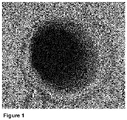
- Figure 1 shows a scanning electron microscopy micrograph of an opening in a burner surface before the infiltration step.
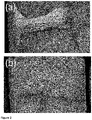
- Figure 2 shows scanning electron microscopy micrographs of lateral sections of an infiltrated burner surface such as (a) the lateral section of an aperture and (b) the lateral section of a continuous part of the burner surface. Results showed that the external surface of the burner surface and the inner surface of the perforations are coated with a continuous homogeneous ceramic coating. In addition, homogeneous ceramic infiltrations can be seen through the whole thickness of the burner surface. Moreover, the infiltrated burner surfaces showed in the scanning electron microscopy micrographs have a highly packaged microstructure that leads to lower porosity values than other burner surfaces of the art.
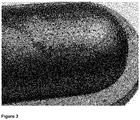
- Figure 3 shows an image of an infiltrated burner surface.
- the obtained burner surfaces showed improved mechanical properties and stability at high temperatures overtime over non-infiltrated burner surfaces and over burner surfaces infiltrated "before” perforation.
- gas infiltration "after” perforation of the surface an enhanced stabilization of the burner structure was observed.
- the ceramic infiltrations act as "bridges" between the ceramic particles of the burner surface.
- the authors have observed that the ceramic coating generated in the interior surface of the perforations by the chemical vapor infiltration (CVI) step reduce the average diameters of said perforations in less than a 5% of the initial value but increases the resistance of the surface to high temperatures.
- CVI chemical vapor infiltration
Landscapes
- Chemical & Material Sciences (AREA)
- Engineering & Computer Science (AREA)
- Ceramic Engineering (AREA)
- Manufacturing & Machinery (AREA)
- Materials Engineering (AREA)
- Structural Engineering (AREA)
- Organic Chemistry (AREA)
- Inorganic Chemistry (AREA)
- Chemical Kinetics & Catalysis (AREA)
- Composite Materials (AREA)
- Ceramic Products (AREA)
Priority Applications (1)
| Application Number | Priority Date | Filing Date | Title |
|---|---|---|---|
| EP21382518.5A EP4101825A1 (de) | 2021-06-11 | 2021-06-11 | Brennerfläche |
Applications Claiming Priority (1)
| Application Number | Priority Date | Filing Date | Title |
|---|---|---|---|
| EP21382518.5A EP4101825A1 (de) | 2021-06-11 | 2021-06-11 | Brennerfläche |
Publications (1)
| Publication Number | Publication Date |
|---|---|
| EP4101825A1 true EP4101825A1 (de) | 2022-12-14 |
Family
ID=76730492
Family Applications (1)
| Application Number | Title | Priority Date | Filing Date |
|---|---|---|---|
| EP21382518.5A Withdrawn EP4101825A1 (de) | 2021-06-11 | 2021-06-11 | Brennerfläche |
Country Status (1)
| Country | Link |
|---|---|
| EP (1) | EP4101825A1 (de) |
Citations (4)
| Publication number | Priority date | Publication date | Assignee | Title |
|---|---|---|---|---|
| US20060141412A1 (en) * | 2004-12-27 | 2006-06-29 | Masten James H | Burner plate and burner assembly |
| US20060286498A1 (en) * | 2005-06-15 | 2006-12-21 | Daimlerchrysler Ag | Porous burner having a flame barrier |
| WO2019228683A1 (en) * | 2018-05-31 | 2019-12-05 | Orkli S. Coop | Continuous composite surface and burner surface |
| EP3819280A1 (de) | 2019-11-06 | 2021-05-12 | Orkli, S. Coop. | Kontinuierliche kompositoberflächen und brenneroberflächen |
-
2021
- 2021-06-11 EP EP21382518.5A patent/EP4101825A1/de not_active Withdrawn
Patent Citations (4)
| Publication number | Priority date | Publication date | Assignee | Title |
|---|---|---|---|---|
| US20060141412A1 (en) * | 2004-12-27 | 2006-06-29 | Masten James H | Burner plate and burner assembly |
| US20060286498A1 (en) * | 2005-06-15 | 2006-12-21 | Daimlerchrysler Ag | Porous burner having a flame barrier |
| WO2019228683A1 (en) * | 2018-05-31 | 2019-12-05 | Orkli S. Coop | Continuous composite surface and burner surface |
| EP3819280A1 (de) | 2019-11-06 | 2021-05-12 | Orkli, S. Coop. | Kontinuierliche kompositoberflächen und brenneroberflächen |
Similar Documents
| Publication | Publication Date | Title |
|---|---|---|
| US12054432B2 (en) | Ceramic matrix composite structures with controlled microstructures fabricated using chemical vapor infiltration (CVI) | |
| CN102239129B (zh) | 用于使由cmc材料制备的部件的表面平滑的方法 | |
| Bao et al. | Preparation of silicon carbide foams using polymeric precursor solutions | |
| CN105324350A (zh) | 用碳化物基质制备复合材料的方法 | |
| CN103910533B (zh) | 一种双组元陶瓷改性炭/炭复合材料的制备方法 | |
| EP1867619B1 (de) | Verfahren zur beschichtung eines keramischen filz | |
| CN105948775B (zh) | 一种耐高温抗氧化型轻质碳/碳隔热材料的制备方法 | |
| US12037292B2 (en) | Particulate composite ceramic material, part comprising said material, and method for the preparation of said part | |
| EP3315478B1 (de) | Vorläufermaterial zur generativen fertigung von keramikteilen und verfahren zur herstellung davon | |
| US20060141154A1 (en) | Method for treating the surface of a part made of a heat-structured composite material and use thereof in brazing parts made of a heat-structured composite material | |
| WO2006004999A1 (en) | A process for the manufacturing of dense silicon carbide | |
| JP2016175823A (ja) | 化学気相含浸法(cvi)を用いて製作した積層構造 | |
| RU2333888C1 (ru) | Способ получения высокодисперсных тугоплавких карбидов для покрытий и композитов на их основе | |
| EP3803209B1 (de) | Kontinuierliche kompositoberfläche und brenneroberfläche | |
| KR101787065B1 (ko) | 화학 기상 침착 장치 | |
| JP7753349B2 (ja) | セラミック基複合材製造のためのケイ素から炭化ケイ素への転化 | |
| Vaidyaraman et al. | Forced flow-thermal gradient chemical vapor infiltration (FCVI) for fabrication of carbon/carbon | |
| CN118184355A (zh) | 一种C/C-(Ti,Zr,Hf,Mo,W)C-SiC复合材料的制备方法 | |
| CN103724046A (zh) | 一种SiC泡沫及其制备方法 | |
| CN109553429A (zh) | 制造复合材料的方法及相应的复合材料 | |
| EP3819280A1 (de) | Kontinuierliche kompositoberflächen und brenneroberflächen | |
| CN118271104A (zh) | 一种应用多层涂层的抗氧化碳碳复合材料制备方法 | |
| US20090130307A1 (en) | Method for the rapid densification of a porous substrate, comprising the formation of a solid deposit within the porosity of the substrate | |
| WO2025132956A1 (en) | Method and system for producing a thermal insulator | |
| CN116143543B (zh) | 高纯度多孔碳化硅陶瓷及其制备方法和应用 |
Legal Events
| Date | Code | Title | Description |
|---|---|---|---|
| PUAI | Public reference made under article 153(3) epc to a published international application that has entered the european phase |
Free format text: ORIGINAL CODE: 0009012 |
|
| STAA | Information on the status of an ep patent application or granted ep patent |
Free format text: STATUS: THE APPLICATION HAS BEEN PUBLISHED |
|
| AK | Designated contracting states |
Kind code of ref document: A1 Designated state(s): AL AT BE BG CH CY CZ DE DK EE ES FI FR GB GR HR HU IE IS IT LI LT LU LV MC MK MT NL NO PL PT RO RS SE SI SK SM TR |
|
| STAA | Information on the status of an ep patent application or granted ep patent |
Free format text: STATUS: THE APPLICATION IS DEEMED TO BE WITHDRAWN |
|
| 18D | Application deemed to be withdrawn |
Effective date: 20230615 |