EP4101932A1 - Imagerie multiplexée utilisant un déplacement de brin - Google Patents
Imagerie multiplexée utilisant un déplacement de brin Download PDFInfo
- Publication number
- EP4101932A1 EP4101932A1 EP22183178.7A EP22183178A EP4101932A1 EP 4101932 A1 EP4101932 A1 EP 4101932A1 EP 22183178 A EP22183178 A EP 22183178A EP 4101932 A1 EP4101932 A1 EP 4101932A1
- Authority
- EP
- European Patent Office
- Prior art keywords
- strand
- docking
- target
- imager
- strands
- Prior art date
- Legal status (The legal status is an assumption and is not a legal conclusion. Google has not performed a legal analysis and makes no representation as to the accuracy of the status listed.)
- Pending
Links
Images




Classifications
-
- C—CHEMISTRY; METALLURGY
- C12—BIOCHEMISTRY; BEER; SPIRITS; WINE; VINEGAR; MICROBIOLOGY; ENZYMOLOGY; MUTATION OR GENETIC ENGINEERING
- C12Q—MEASURING OR TESTING PROCESSES INVOLVING ENZYMES, NUCLEIC ACIDS OR MICROORGANISMS; COMPOSITIONS OR TEST PAPERS THEREFOR; PROCESSES OF PREPARING SUCH COMPOSITIONS; CONDITION-RESPONSIVE CONTROL IN MICROBIOLOGICAL OR ENZYMOLOGICAL PROCESSES
- C12Q1/00—Measuring or testing processes involving enzymes, nucleic acids or microorganisms; Compositions therefor; Processes of preparing such compositions
- C12Q1/68—Measuring or testing processes involving enzymes, nucleic acids or microorganisms; Compositions therefor; Processes of preparing such compositions involving nucleic acids
- C12Q1/6806—Preparing nucleic acids for analysis, e.g. for polymerase chain reaction [PCR] assay
-
- A—HUMAN NECESSITIES
- A61—MEDICAL OR VETERINARY SCIENCE; HYGIENE
- A61K—PREPARATIONS FOR MEDICAL, DENTAL OR TOILETRY PURPOSES
- A61K47/00—Medicinal preparations characterised by the non-active ingredients used, e.g. carriers or inert additives; Targeting or modifying agents chemically bound to the active ingredient
- A61K47/50—Medicinal preparations characterised by the non-active ingredients used, e.g. carriers or inert additives; Targeting or modifying agents chemically bound to the active ingredient the non-active ingredient being chemically bound to the active ingredient, e.g. polymer-drug conjugates
- A61K47/51—Medicinal preparations characterised by the non-active ingredients used, e.g. carriers or inert additives; Targeting or modifying agents chemically bound to the active ingredient the non-active ingredient being chemically bound to the active ingredient, e.g. polymer-drug conjugates the non-active ingredient being a modifying agent
- A61K47/68—Medicinal preparations characterised by the non-active ingredients used, e.g. carriers or inert additives; Targeting or modifying agents chemically bound to the active ingredient the non-active ingredient being chemically bound to the active ingredient, e.g. polymer-drug conjugates the non-active ingredient being a modifying agent the modifying agent being an antibody, an immunoglobulin or a fragment thereof, e.g. an Fc-fragment
-
- C—CHEMISTRY; METALLURGY
- C07—ORGANIC CHEMISTRY
- C07K—PEPTIDES
- C07K16/00—Immunoglobulins [IG], e.g. monoclonal or polyclonal antibodies
-
- C—CHEMISTRY; METALLURGY
- C12—BIOCHEMISTRY; BEER; SPIRITS; WINE; VINEGAR; MICROBIOLOGY; ENZYMOLOGY; MUTATION OR GENETIC ENGINEERING
- C12Q—MEASURING OR TESTING PROCESSES INVOLVING ENZYMES, NUCLEIC ACIDS OR MICROORGANISMS; COMPOSITIONS OR TEST PAPERS THEREFOR; PROCESSES OF PREPARING SUCH COMPOSITIONS; CONDITION-RESPONSIVE CONTROL IN MICROBIOLOGICAL OR ENZYMOLOGICAL PROCESSES
- C12Q1/00—Measuring or testing processes involving enzymes, nucleic acids or microorganisms; Compositions therefor; Processes of preparing such compositions
- C12Q1/68—Measuring or testing processes involving enzymes, nucleic acids or microorganisms; Compositions therefor; Processes of preparing such compositions involving nucleic acids
- C12Q1/6804—Nucleic acid analysis using immunogens
-
- C—CHEMISTRY; METALLURGY
- C12—BIOCHEMISTRY; BEER; SPIRITS; WINE; VINEGAR; MICROBIOLOGY; ENZYMOLOGY; MUTATION OR GENETIC ENGINEERING
- C12Q—MEASURING OR TESTING PROCESSES INVOLVING ENZYMES, NUCLEIC ACIDS OR MICROORGANISMS; COMPOSITIONS OR TEST PAPERS THEREFOR; PROCESSES OF PREPARING SUCH COMPOSITIONS; CONDITION-RESPONSIVE CONTROL IN MICROBIOLOGICAL OR ENZYMOLOGICAL PROCESSES
- C12Q1/00—Measuring or testing processes involving enzymes, nucleic acids or microorganisms; Compositions therefor; Processes of preparing such compositions
- C12Q1/68—Measuring or testing processes involving enzymes, nucleic acids or microorganisms; Compositions therefor; Processes of preparing such compositions involving nucleic acids
- C12Q1/6844—Nucleic acid amplification reactions
- C12Q1/6853—Nucleic acid amplification reactions using modified primers or templates
- C12Q1/6855—Ligating adaptors
-
- C—CHEMISTRY; METALLURGY
- C12—BIOCHEMISTRY; BEER; SPIRITS; WINE; VINEGAR; MICROBIOLOGY; ENZYMOLOGY; MUTATION OR GENETIC ENGINEERING
- C12Q—MEASURING OR TESTING PROCESSES INVOLVING ENZYMES, NUCLEIC ACIDS OR MICROORGANISMS; COMPOSITIONS OR TEST PAPERS THEREFOR; PROCESSES OF PREPARING SUCH COMPOSITIONS; CONDITION-RESPONSIVE CONTROL IN MICROBIOLOGICAL OR ENZYMOLOGICAL PROCESSES
- C12Q1/00—Measuring or testing processes involving enzymes, nucleic acids or microorganisms; Compositions therefor; Processes of preparing such compositions
- C12Q1/68—Measuring or testing processes involving enzymes, nucleic acids or microorganisms; Compositions therefor; Processes of preparing such compositions involving nucleic acids
- C12Q1/6869—Methods for sequencing
-
- G—PHYSICS
- G01—MEASURING; TESTING
- G01N—INVESTIGATING OR ANALYSING MATERIALS BY DETERMINING THEIR CHEMICAL OR PHYSICAL PROPERTIES
- G01N33/00—Investigating or analysing materials by specific methods not covered by groups G01N1/00 - G01N31/00
- G01N33/48—Biological material, e.g. blood, urine; Haemocytometers
- G01N33/50—Chemical analysis of biological material, e.g. blood, urine; Testing involving biospecific ligand binding methods; Immunological testing
- G01N33/58—Chemical analysis of biological material, e.g. blood, urine; Testing involving biospecific ligand binding methods; Immunological testing involving labelled substances
-
- C—CHEMISTRY; METALLURGY
- C12—BIOCHEMISTRY; BEER; SPIRITS; WINE; VINEGAR; MICROBIOLOGY; ENZYMOLOGY; MUTATION OR GENETIC ENGINEERING
- C12Q—MEASURING OR TESTING PROCESSES INVOLVING ENZYMES, NUCLEIC ACIDS OR MICROORGANISMS; COMPOSITIONS OR TEST PAPERS THEREFOR; PROCESSES OF PREPARING SUCH COMPOSITIONS; CONDITION-RESPONSIVE CONTROL IN MICROBIOLOGICAL OR ENZYMOLOGICAL PROCESSES
- C12Q2525/00—Reactions involving modified oligonucleotides, nucleic acids, or nucleotides
- C12Q2525/10—Modifications characterised by
- C12Q2525/191—Modifications characterised by incorporating an adaptor
-
- G—PHYSICS
- G01—MEASURING; TESTING
- G01N—INVESTIGATING OR ANALYSING MATERIALS BY DETERMINING THEIR CHEMICAL OR PHYSICAL PROPERTIES
- G01N2458/00—Labels used in chemical analysis of biological material
- G01N2458/10—Oligonucleotides as tagging agents for labelling antibodies
Definitions
- DNA strand displacement is a method for the isothermal and dynamic exchange of DNA complexes.
- 1-3 Strand displacement can be designed and intentionally controlled based on an understanding of DNA hybridization interactions and thermodynamics, and can be facilitated by introducing engineered handles which are known as "toehold domains.”
- the ability to modulate binding interactions and exchange hybridization partners gives rise to a series of potential applications. Several of these applications have been proposed and demonstrated by Diehl and coworkers, 4-7 including multiplexed protein detection and signal amplification applications in fixed cells using immunofluorescence microscopy.
- a method for imaging of at least one target in a sample comprises: (a) providing at least one target-recognizing antibody bound to an adapter strand oligonucleotide; (b) providing a bridge strand oligonucleotide with a region capable of specifically binding the adapter strand oligonucleotide and a docking strand region; and (c) providing an imager strand oligonucleotide capable of specifically binding the docking strand region of the bridge strand oligonucleotide, wherein the imager strand is labeled with a detectable label.
- a method for imaging of at least one target in a sample comprises (a) providing at least one target-recognizing antibody bound to a docking strand oligonucleotide; (b) providing a blocker strand that hybridizes to the docking strand over a first region, but not over its full length or the full length of the docking strand; (c) providing an imager strand oligonucleotide that hybridizes to the docking strand oligonucleotide at least in the region of the docking strand that does not hybridize to the blocker strand, wherein the imager strand is labeled with a detectable label; (d) allowing the imager strand to hybridize to the docking strand, displacing the blocker strand; (e) determining whether the target-recognizing antibody has bound to the target.
- a method for imaging of at least two target in a sample comprises (a) providing at least two target-recognizing antibodies bound to a docking strand oligonucleotide; (b) providing a first imager strand oligonucleotide capable of hybridizing to the docking strand on the first target-recognizing antibody and providing a first blocking strand capable of hybridizing to the docking strand on the second target-recognizing antibody, wherein the imager strand is labeled with a detectable label and the blocking strand is not labeled with a detectable label and wherein optionally additional blocking strands are used if more than two target-recognizing antibodies are present; (c) imaging the first target and removing the imager strand and blocking strand with at least one bouncer strand; (d) providing a second imager strand oligonucleotide capable of hybridizing to the docking strand on the second target-recognizing antibody and providing a second blocking strand capable of hybridizing to the docking strand on the first target-recognizing
- a method for imaging of at least one target in a sample comprises: (a) providing at least one first target-recognizing antibody bound to a first docking strand oligonucleotide; (b) providing at least one second target-recognizing antibody bound to a second docking strand oligonucleotide; (c) providing an imager strand oligonucleotide capable of specifically binding to the first docking strand oligonucleotide and the second docking strand oligonucleotide when the first docking strand oligonucleotide and the second docking strand oligonucleotide are in proximity to each other forming a full-length docking strand, wherein the imager strand does not specifically bind either the first or second docking strand oligonucleotide alone; (d) detecting the imager strand, wherein the imager strand is labeled.
- Docking strands are defined as oligonucleotides which are attached to targets of interest, in some embodiments, through an intermediate molecule (e.g., antibody including full length antibodies and antigen binding fragments thereof) to form a nucleic acid-target recognition complex.
- a docking site is defined as a region of complementarity or specific binding affinity between the docking strand and the imager strand.
- Imager strands are defined as oligonucleotides attached to a label (e.g., fluorophore, nanoparticle, etc.).
- Blocker strands are defined as oligonucleotides with regions of complementarity to docking strands that, when bound to a docking strand, block association with any off-target imager strands; blocker strands likewise can be oligonucleotides with regions of complementarity to imager strands that, when bound to an imager strand, block association with any off-target docking strands (see Figure 2 ).
- Bouncer strands are defined as oligonucleotides with regions of complementarity to blocker or imager strands that result in strand displacement of blocker or imager strands that are bound to docking strands.
- high ionic strength buffer conditions e.g. 1x saline sodium citrate buffer, or 150 mM, 200 mM, 300 mM, 400 mM, 500 mM, or 600 mM sodium chloride in phosphate buffer
- 1x saline sodium citrate buffer or 150 mM, 200 mM, 300 mM, 400 mM, 500 mM, or 600 mM sodium chloride in phosphate buffer
- the Docking Strand is usually linked to the target via a target-recognizing molecule such as an antibody (including antigen binding fragments thereof) or an aptamer.
- a target-recognizing molecule such as an antibody (including antigen binding fragments thereof) or an aptamer.
- Antibody is a popular type of target-recognizing molecule.
- Many antibody-DNA conjugation methods have been described in the past, including ones only involving covalent bonds and ones involving non-covalent bonds. Examples of conjugation methods involving non-covalent bonds include ones involving naturally occurring and engineered antibody-binding proteins, such as Protein A, Protein G and Protein A/G, as well as secondary antibodies and antibody fragments (e.g. Fab, Fab', F(ab') 2 ) that recognize the constant region/domains (e.g., Fc, CH1, CH2, CH3, CL domains).
- the bridge strand comprises two domains: one (104) complementary to the universal adaptor (103), and the other (105) serving as the docking site.
- the new, three-part complex can be used with or without purification.
- the primary antibody is I derived from mouse
- one may use stand-alone DNA strand 103 to quench the excess bridge strand (104-105) so that the bridge strand does not bind universal adaptor strand bound to other targets.
- the Imager Strand is introduced to the sample (which contains the Docking Strand as a single-stranded DNA) as a part of a duplex that also contains a 'protector' strand with sequence complementary to the Imager Strand.
- the protector strand 'shields' some bases on the Imager Strand and may prevent it from interacting with non-target molecules via unwanted Watson-Crick pairing or other nonspecific interactions.
- this design requires that the Imager Strand is long.
- the portion of the Imager Strand that is complementary to the docking site has to be long because it must contain two domains: (a) a single-stranded toehold domain that initiates the interaction with the docking site, and (b) a domain that is bound to the protector strand.
- the toehold of (a) must be at least ⁇ 5-nt-long (assuming ⁇ 50% GC content) to initiate fast strand displacement, and the protector-bound domain of (b) must be at least ⁇ 12-nt-long (assuming ⁇ 50% GC content) to ensure stable hybridization.
- the total length of the portion of the Imager Strand that is complementary to the docking site has to be at least ⁇ 17-nt (assuming ⁇ 50% GC content).
- the docking site also has to be at least ⁇ 17-nt (assuming ⁇ 50% GC content).
- the Imager Strand can be introduced as a single-stranded DNA without the protector strand.
- the length requirement of the portion of the Imager Strand that is complementary to the docking site is long enough to ensure stable hybridization with the Docking Strand, in some embodiments with the minimum length being ⁇ 12-nt (assuming ⁇ 50% GC content).
- the docking site can also be of similar length. The shorter length can make the design more compact and reduce the chance of DNA-induced non-specific binding.
- a standard way to carry out toehold-mediated strand-displacement is to use 3-way branch migration involving a common strand, an incumbent strand, and an invading strand.
- An example of this process is shown in the 'label' reaction of Figure 2 A of US2016/0002704 A1 , where the fluorescent-labeled strand is the common strand, the 'waste' strand is the incumbent strand, and the NA tag is the invading strand.
- a drawback of 3-way branch migration is that the invading strand must be single-stranded. Such a long (at least ⁇ 17-nt as described before) single-stranded DNA may cause unwanted non-specific binding.
- FIG. 2 shows a docking strand attached to a target-recognizing antibody with a docking strand 1 which hybridizes over part of its length to a blocker strand 3 and over at least some of the remaining length to imager strand 2 with an observable label.
- Imager strand 2 also hybridizes over part of its length to a blocker strand 4. This allows imager strand 2 to replace blocker strand 3.
- blocker strand 3 and blocker strand 4 hybridize to each other over their full length.
- This embodiment shows both blocker strands to docking strands and blocker strands to imager strands.
- molecules or moieties include, but are not limited to, metal particles, plasmonic enhancers, enzymes (e.g., HRP), primer, capture oligonucleotide or splint of rolling circle amplification, initiator of finite or infinite hybridization chain reaction, etc.
- Multiplexed imaging can be carried out with efficient exchange (e.g. via strand displacement) of imager strands from one imaging round to the next. For example, one may image the first target with the first imager strand, then displace the first imager strand with a washing step, then introduce a second imager strand to image a second target, and so on.
- One aspect is the addition of blocker strands for any targets that are not actively being imaged in order to reduce cross-reactivity and prevent imager strands binding to off-target docking strands.
- Blocker strands must be specific to one or more domain(s) of the docking strand, which is complexed to a specific target through a target-recognition entity.
- the blocker strand is bound to a portion of the docking strand such that a toehold domain that is complementary to the imager strand remains unhybridized.
- an imager strand that is complementary to multiple domains of the docking strand including, but not limited to the toehold domain can be introduced to displace the blocker strand prior to imaging the target.
- a bouncer strand can be introduced to strip the imager strand off of the docking strand.
- Figures 4A-D and Figure 5 demonstrate embodiments of the components and methods used for multiplexed imaging with the addition of blocker and bouncer strands for exchange.
- One embodiment is a method for universal exchange of imager strands and replacement of blocker strands to streamline sequential rounds of imaging.
- one or more targets are detected with one or more rounds of imaging wherein a cocktail of all bouncer strands or all blocker strands are introduced as intermediary steps between imaging rounds.
- a composition involving a mixture of all types of bouncer strands is contemplated as a washing buffer to displace any bound imager strands.
- a composition involving a mixture of all types of blocker strands is contemplated as an additive step prior to the addition of any imager strands.
- This composition could be part of a kit. This method could be manual, or partially or fully automated. Fluidics could be incorporated for liquid handling. Software could be incorporated for image acquisition and analysis. This method could be applied to immunohistochemistry and immunofluorescence on cell or tissue samples.
- Another way to achieve similarly simplified workflow and reduce cross hybridization among DNA species is to use mixtures comprising Imager Strand(s) and Blocker Strand(s). Specifically, to image one target, one can mix the Imager Strand for this target and the Blocker Strands for all other target and apply them to the sample containing all Docking Strands. Even if the Imager Strand incorrectly binds to the Docking Strand on a wrong target, it can be displaced by the Blocker Strand for that target.
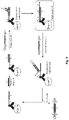
- Figure 4D One example is shown Figure 4D . In this example we suppose there are 3 primary antibodies (201, 202, 203) that are bound to 3 targets (204, 205, 206), and are attached with 3 Docking Strands (207, 208, 209), respectively.
- Stage A After staining the sample with 3 DNA-attached antibodies (Stage A), one can add a mixture of (i) fluorescent-labeled Imager Strand 210, which is complementary to Docking Strand 207, (ii) unlabeled Blocker Strand 211, which is complementary to Docking Strand 208, and (iii) unlabeled Blocker Strand 212, which is complementary to Docking Strand 209. After washing one can image target 204 (Stage B). Next, one can add a mixture of Bouncer strands that are complementary to Imager/Blocker Strands 210, 211 and 212 to remove these strands from the sample (Stage C).
- a composition for a semi-universal blocker strand is described.
- Such a semi-universal blocker strand may contain one domain that is universal (i.e. constant across all docking strands complexed to all targets) and one domain that is target specific.
- a composition for a universal bouncer strand is described.
- a universal bouncer strand reduces the complexity of finding unique sequences to pair with each type of docking strand; and thus, may facilitate ultra-high multiplexing.
- the universal bouncer strand is composed of one domain that binds to a region of a docking strand that is held constant for all target complexes. Binding of the universal bouncer strand may occur through toehold mediated strand displacement and may displace a semi-universal blocker strand.
- a method for reiterative imaging and sequential multiplexing with semi-universal blocker strands and universal bouncer strands is described ( Figure 6 ).
- the complex includes a docking strand that may contain a constant domain (in Figure 6 labeled as u ⁇ ) and a target-specific domain (in Figure 6 labeled as N ⁇ for the Nth target).
- Semi-universal blocker strands e.g. composed of a constant domain u, and a target specific domain N
- a mixture can be added containing the universal bouncer strands, imager strand for the Nth target, and all semi-universal blocker strands excluding any containing a domain specific to the Nth target.
- the universal bouncer binds to a toehold available in the constant region of the docking strand and begins to displace the blocker strand.
- the imager strand binds to a toehold available in domain N ⁇ of the docking strand to complete the displacement of the blocker strand.
- the cocktail of semi-universal blocker strands for all other targets is added to ensure those targets remain blocked. Then, image acquisition can be carried out to detect the Nth target.
- a mixture of all semi-universal blocker strands can be used to displace all imager strands and universal bouncer strands prior to the next cycle or round of imaging. This cycle can be repeated for additional rounds of imaging of other targets for sequential multiplexing. It must be appreciated that the thermodynamics of each binding pair must be precisely understood, and the equilibrium for each forward reaction precisely controlled to facilitate a method involving a universal bouncer strand and semi-universal blocker strand.
- a method of multiplexed proximity detection is proposed.
- Proximity detection is accomplished using a pair of nucleic acid-target recognition complexes, each of which contain a domain corresponding to a partial (such as a half of a) docking site for an imager strand.
- the pair of nucleic acid-target recognition complexes are in proximity to each other, the full docking site is formed allowing an imager or blocker strand to bind.
- the distance between target-recognition complexes can vary based on the design of the docking strand, which can vary in length from 8, 9, 10, 11, 12, 13, 14, 15, 16, 17, 18, 19, 20, 25, 30, 50, 100 or more nucleotides.
- Proximity detection can be designed for distance lengths of 5 nm, 10 nm, 15 nm, 20 nm, 30 nm, 50 nm, 100 nm, or more.
- High ionic strength buffer conditions e.g. 1x saline sodium citrate buffer, or 150 mM, 200 mM, 300 mM, 400 mM, 500 mM, or 600 mM sodium chloride in phosphate buffer
- the pair of nucleic acid-target recognition complexes can be designed to bind to a signal molecular target or two separate targets.
- An imager strand may contain two domains, one domain complementary to the full docking site, and one domain that serves as a toehold for strand displacement.
- a target is bound with two DNA-conjugated antibodies that bind to different epitopes on the same target, bringing the DNA strands in proximity to form the full docking site.
- the imager strand will bind to the full docking site, and the target can be imaged (e.g. with epi-fluorescence, confocal microscopy, TIRF, etc.).
- the imager strand can be displaced by the addition of a bouncer strand which binds to a toehold on the imager strand.
- Multiplexed proximity detection of multiple targets can be carried out with one or more rounds of strand displacement.
- the term about refers to a numeric value, including, for example, whole numbers, fractions, and percentages, whether or not explicitly indicated.
- the term about generally refers to a range of numerical values (e.g., +/-5-10% of the recited range) that one of ordinary skill in the art would consider equivalent to the recited value (e.g., having the same function or result).
- the terms modify all of the values or ranges provided in the list.
- the term about may include numerical values that are rounded to the nearest significant figure.
Landscapes
- Chemical & Material Sciences (AREA)
- Health & Medical Sciences (AREA)
- Life Sciences & Earth Sciences (AREA)
- Organic Chemistry (AREA)
- Engineering & Computer Science (AREA)
- Immunology (AREA)
- Proteomics, Peptides & Aminoacids (AREA)
- Molecular Biology (AREA)
- General Health & Medical Sciences (AREA)
- Wood Science & Technology (AREA)
- Zoology (AREA)
- Analytical Chemistry (AREA)
- Biochemistry (AREA)
- Physics & Mathematics (AREA)
- Biotechnology (AREA)
- Microbiology (AREA)
- Biophysics (AREA)
- Genetics & Genomics (AREA)
- Bioinformatics & Cheminformatics (AREA)
- Medicinal Chemistry (AREA)
- General Engineering & Computer Science (AREA)
- Hematology (AREA)
- Urology & Nephrology (AREA)
- Biomedical Technology (AREA)
- Pathology (AREA)
- Chemical Kinetics & Catalysis (AREA)
- Cell Biology (AREA)
- Food Science & Technology (AREA)
- General Physics & Mathematics (AREA)
- Pharmacology & Pharmacy (AREA)
- Epidemiology (AREA)
- Animal Behavior & Ethology (AREA)
- Public Health (AREA)
- Veterinary Medicine (AREA)
- Measuring Or Testing Involving Enzymes Or Micro-Organisms (AREA)
- Investigating Or Analysing Biological Materials (AREA)
Applications Claiming Priority (4)
| Application Number | Priority Date | Filing Date | Title |
|---|---|---|---|
| US201662336676P | 2016-05-15 | 2016-05-15 | |
| US201662343791P | 2016-05-31 | 2016-05-31 | |
| EP17799912.5A EP3458858B1 (fr) | 2016-05-15 | 2017-05-12 | Imagerie multiplexée utilisant un déplacement de brin |
| PCT/US2017/032398 WO2017200870A1 (fr) | 2016-05-15 | 2017-05-12 | Imagerie multiplexée utilisant un déplacement de brin |
Related Parent Applications (1)
| Application Number | Title | Priority Date | Filing Date |
|---|---|---|---|
| EP17799912.5A Division EP3458858B1 (fr) | 2016-05-15 | 2017-05-12 | Imagerie multiplexée utilisant un déplacement de brin |
Publications (1)
| Publication Number | Publication Date |
|---|---|
| EP4101932A1 true EP4101932A1 (fr) | 2022-12-14 |
Family
ID=60326096
Family Applications (2)
| Application Number | Title | Priority Date | Filing Date |
|---|---|---|---|
| EP17799912.5A Active EP3458858B1 (fr) | 2016-05-15 | 2017-05-12 | Imagerie multiplexée utilisant un déplacement de brin |
| EP22183178.7A Pending EP4101932A1 (fr) | 2016-05-15 | 2017-05-12 | Imagerie multiplexée utilisant un déplacement de brin |
Family Applications Before (1)
| Application Number | Title | Priority Date | Filing Date |
|---|---|---|---|
| EP17799912.5A Active EP3458858B1 (fr) | 2016-05-15 | 2017-05-12 | Imagerie multiplexée utilisant un déplacement de brin |
Country Status (6)
| Country | Link |
|---|---|
| US (3) | US11060132B2 (fr) |
| EP (2) | EP3458858B1 (fr) |
| JP (1) | JP2019521703A (fr) |
| CN (1) | CN109313180B (fr) |
| AU (1) | AU2017267469A1 (fr) |
| WO (1) | WO2017200870A1 (fr) |
Families Citing this family (10)
| Publication number | Priority date | Publication date | Assignee | Title |
|---|---|---|---|---|
| US9909167B2 (en) | 2014-06-23 | 2018-03-06 | The Board Of Trustees Of The Leland Stanford Junior University | On-slide staining by primer extension |
| WO2017200870A1 (fr) * | 2016-05-15 | 2017-11-23 | Ultivue, Inc. | Imagerie multiplexée utilisant un déplacement de brin |
| CN109891218A (zh) * | 2016-06-02 | 2019-06-14 | 乌尔蒂维尤股份有限公司 | 促进基于抗体的交换成像的组合物和方法 |
| EP3551765B1 (fr) | 2016-12-09 | 2026-02-04 | Ultivue, Inc. | Procédés améliorés d'imagerie multiplex utilisant des agents d'imagerie d'acides nucléiques marqués |
| EP3601339A4 (fr) | 2017-03-31 | 2020-11-04 | Ultivue, Inc. | Échange adn-antigène et amplification |
| WO2020014036A1 (fr) * | 2018-07-09 | 2020-01-16 | Ultivue, Inc. | Procédés d'imagerie multiplex multicolore |
| CN113544494A (zh) * | 2019-01-08 | 2021-10-22 | 阿库亚生物科学公司 | 灵活的检测系统 |
| WO2020193977A1 (fr) * | 2019-03-25 | 2020-10-01 | University Of Exeter | Procédé de détection d'un analyte |
| CN115917007A (zh) * | 2020-02-18 | 2023-04-04 | 新加坡科技研究局 | 核酸探针 |
| EP4653542A1 (fr) * | 2024-05-21 | 2025-11-26 | Leica Microsystems CMS GmbH | Étiquette, marqueur et procédé d'analyse d'un échantillon biologique |
Citations (5)
| Publication number | Priority date | Publication date | Assignee | Title |
|---|---|---|---|---|
| WO2010059820A1 (fr) * | 2008-11-21 | 2010-05-27 | Saint Louis University | Biocapteur pour la détection de multiples épitopes sur une cible |
| WO2012160083A1 (fr) * | 2011-05-24 | 2012-11-29 | Olink Ab | Essai multiplexe de ligature de proximité |
| WO2013177046A1 (fr) * | 2012-05-21 | 2013-11-28 | Solulink, Inc. | Procédés et/ou utilisation de conjugués oligonucléotidiques pour la suppression d'arrière-plan dû à l'hybridation croisée |
| WO2014028538A2 (fr) * | 2012-08-13 | 2014-02-20 | William Marsh Rice University | Analyses moléculaires in situ en multiplexe et sondes moléculaires programmables pour une amplification de signal régulée |
| WO2017027370A1 (fr) * | 2015-08-07 | 2017-02-16 | President And Fellows Of Harvard College | Imagerie à super-résolution d'interactions protéine-protéine |
Family Cites Families (7)
| Publication number | Priority date | Publication date | Assignee | Title |
|---|---|---|---|---|
| AU2003291249A1 (en) * | 2002-12-18 | 2004-07-29 | Aclara Biosciences, Inc. | Multiplexed immunohistochemical assays using molecular tags |
| CN101410530B (zh) * | 2003-04-18 | 2013-03-27 | 贝克顿·迪金森公司 | 免疫-扩增 |
| US7733659B2 (en) * | 2006-08-18 | 2010-06-08 | Delphi Technologies, Inc. | Lightweight audio system for automotive applications and method |
| WO2012071428A2 (fr) | 2010-11-22 | 2012-05-31 | Solulink, Inc. | Procédés et/ou utilisation de conjugués d'oligonucléotide pour des essais et des détections |
| AU2013314405A1 (en) | 2012-09-11 | 2015-04-09 | Unisense Diagnostics Aps | Detection of non-nucleic acid analytes using strand displacement exchange reactions |
| EP3027773B1 (fr) * | 2013-07-30 | 2020-03-25 | President and Fellows of Harvard College | Imagerie à très haute résolution et imagerie reposant sur l'adn quantitatif |
| WO2017200870A1 (fr) * | 2016-05-15 | 2017-11-23 | Ultivue, Inc. | Imagerie multiplexée utilisant un déplacement de brin |
-
2017
- 2017-05-12 WO PCT/US2017/032398 patent/WO2017200870A1/fr not_active Ceased
- 2017-05-12 EP EP17799912.5A patent/EP3458858B1/fr active Active
- 2017-05-12 AU AU2017267469A patent/AU2017267469A1/en not_active Abandoned
- 2017-05-12 EP EP22183178.7A patent/EP4101932A1/fr active Pending
- 2017-05-12 CN CN201780026652.4A patent/CN109313180B/zh active Active
- 2017-05-12 JP JP2019511836A patent/JP2019521703A/ja active Pending
-
2018
- 2018-08-30 US US16/117,194 patent/US11060132B2/en active Active
-
2021
- 2021-06-08 US US17/341,490 patent/US11773428B2/en active Active
-
2023
- 2023-08-29 US US18/457,805 patent/US12486530B2/en active Active
Patent Citations (6)
| Publication number | Priority date | Publication date | Assignee | Title |
|---|---|---|---|---|
| WO2010059820A1 (fr) * | 2008-11-21 | 2010-05-27 | Saint Louis University | Biocapteur pour la détection de multiples épitopes sur une cible |
| WO2012160083A1 (fr) * | 2011-05-24 | 2012-11-29 | Olink Ab | Essai multiplexe de ligature de proximité |
| WO2013177046A1 (fr) * | 2012-05-21 | 2013-11-28 | Solulink, Inc. | Procédés et/ou utilisation de conjugués oligonucléotidiques pour la suppression d'arrière-plan dû à l'hybridation croisée |
| WO2014028538A2 (fr) * | 2012-08-13 | 2014-02-20 | William Marsh Rice University | Analyses moléculaires in situ en multiplexe et sondes moléculaires programmables pour une amplification de signal régulée |
| US20160002704A1 (en) | 2012-08-13 | 2016-01-07 | William Marsh Rice University | Mutliplexed in situ molecular analyses and programmable molecular probes for regulated amplification |
| WO2017027370A1 (fr) * | 2015-08-07 | 2017-02-16 | President And Fellows Of Harvard College | Imagerie à super-résolution d'interactions protéine-protéine |
Non-Patent Citations (11)
| Title |
|---|
| DUOSE, D. Y. ET AL., CONFIGURING ROBUST DNA STRAND DISPLACEMENT REACTIONS FOR IN SITU MOLECULAR ANALYSES, vol. 40, 2012, pages 3289 - 3298 |
| DUOSE, D. Y.SCHWELLER, R. M.HITTELMAN, W. N.DIEHL, M. R.: "Multiplexed and Reiterative Fluorescence Labeling via DNA Circuitry", BIOCONJUG. CHEM., vol. 21, 2010, pages 2327 - 2331, XP055097266, DOI: 10.1021/bc100348q |
| JING SHANG ET AL: "Multiplexed In-cell Immunoassay for Same-sample Protein Expression Profiling", SCIENTIFIC REPORTS, vol. 5, no. 1, 2 September 2015 (2015-09-02), XP055647194, DOI: 10.1038/srep13651 * |
| MAX B. SCHEIBLE ET AL: "Single Molecule Characterization of DNA Binding and Strand Displacement Reactions on Lithographic DNA Origami Microarrays", NANO LETTERS, vol. 14, no. 3, 12 March 2014 (2014-03-12), pages 1627 - 1633, XP055180183, ISSN: 1530-6984, DOI: 10.1021/nl500092j * |
| RALF JUNGMANN ET AL: "Multiplexed 3D cellular super-resolution imaging with DNA-PAINT and Exchange-PAINT", NATURE METHODS, vol. 11, no. 3, 1 March 2014 (2014-03-01), New York, pages 313 - 318, XP055549435, ISSN: 1548-7091, DOI: 10.1038/nmeth.2835 * |
| RYAN M. SCHWELLER ET AL: "Multiplexed In Situ Immunofluorescence Using Dynamic DNA Complexes", ANGEWANDTE CHEMIE INTERNATIONAL EDITION, vol. 51, no. 37, 15 August 2012 (2012-08-15), pages 9292 - 9296, XP055097179, ISSN: 1433-7851, DOI: 10.1002/anie.201204304 * |
| SCHWELLER, R. M. ET AL.: "Multiplexed In Situ Immunofluorescence Using Dynamic DNA Complexes", ANGEW. CHEMIE INT. ED., vol. 51, 2012, pages 9292 - 9296, XP055097179, DOI: 10.1002/anie.201204304 |
| YURKE, B.MILLS, A., USING DNA TO POWER NANOSTRUCTURES, 2003, pages 111 - 122 |
| YURKE, B.TURBER, A. J., JR, A. P. M.SIMMEL, F. C.NEUMANN, J. L., A DNA-FUELLED MOLECULAR MACHINE MADE OF DNA, vol. 406, 2000, pages 605 - 608 |
| ZHANG, D. Y.TURBERFIELD, A.YURKE, B.WINFREE, E.: "Engineering Entropy-Driven Reactions and Networks Catalyzed by DNA", SCIENCE (80-., vol. 318, 2007, pages 1121, XP002715513, DOI: 10.1126/science.1148532 |
| ZIMAK, J.SCHWELLER, R. M.DUOSE, D. Y.HITTELMAN, W. N.DIEHL, M. R., PROGRAMMING IN SITU IMMUNOFLUORESCENCE INTENSITIES THROUGH INTERCHANGEABLE REACTIONS OF DYNAMIC DNA COMPLEXES, vol. 77054, 2012, pages 2722 - 2728 |
Also Published As
| Publication number | Publication date |
|---|---|
| CN109313180A (zh) | 2019-02-05 |
| US11060132B2 (en) | 2021-07-13 |
| EP3458858A1 (fr) | 2019-03-27 |
| US20180371532A1 (en) | 2018-12-27 |
| WO2017200870A1 (fr) | 2017-11-23 |
| US11773428B2 (en) | 2023-10-03 |
| CN109313180B (zh) | 2022-06-28 |
| EP3458858A4 (fr) | 2020-01-08 |
| AU2017267469A1 (en) | 2018-11-15 |
| US20210292815A1 (en) | 2021-09-23 |
| JP2019521703A (ja) | 2019-08-08 |
| EP3458858B1 (fr) | 2022-07-06 |
| US20230407371A1 (en) | 2023-12-21 |
| US12486530B2 (en) | 2025-12-02 |
Similar Documents
| Publication | Publication Date | Title |
|---|---|---|
| US12486530B2 (en) | Multiplexed imaging using strand displacement | |
| EP3880843B1 (fr) | Procédé de détection d'arn | |
| KR102606620B1 (ko) | 표지된 핵산 조영제를 사용한 다중 이미지형성을 위한 개선된 방법 | |
| CN112105743B (zh) | 复用型催化报告分子沉积 | |
| US12331349B2 (en) | Method for detection of analytes via polymer complexes | |
| US11293053B2 (en) | Bifunctional oligonucleotide probe for universal real time multianalyte detection | |
| US20200209229A1 (en) | Sequential multiplex western blotting | |
| JP2023171748A (ja) | 近接検出アッセイのための制御 | |
| US12123869B2 (en) | Rapid and sensitive detection and quantification of analytes in complex samples using polymer-based methods | |
| JP2023550568A (ja) | コンカテマーを用いた分析物検出方法 | |
| WO2020227444A1 (fr) | Détection rapide d'acide nucléique sans préparation d'échantillon | |
| WO2017210387A1 (fr) | Compositions et procédés permettant d'accélérer une imagerie par échange à base d'anticorps | |
| US20210230676A1 (en) | Sequential Staining for Multiplex Analyses of Tissues and Cells |
Legal Events
| Date | Code | Title | Description |
|---|---|---|---|
| PUAI | Public reference made under article 153(3) epc to a published international application that has entered the european phase |
Free format text: ORIGINAL CODE: 0009012 |
|
| STAA | Information on the status of an ep patent application or granted ep patent |
Free format text: STATUS: THE APPLICATION HAS BEEN PUBLISHED |
|
| AC | Divisional application: reference to earlier application |
Ref document number: 3458858 Country of ref document: EP Kind code of ref document: P |
|
| AK | Designated contracting states |
Kind code of ref document: A1 Designated state(s): AL AT BE BG CH CY CZ DE DK EE ES FI FR GB GR HR HU IE IS IT LI LT LU LV MC MK MT NL NO PL PT RO RS SE SI SK SM TR |
|
| STAA | Information on the status of an ep patent application or granted ep patent |
Free format text: STATUS: REQUEST FOR EXAMINATION WAS MADE |
|
| 17P | Request for examination filed |
Effective date: 20230613 |
|
| RBV | Designated contracting states (corrected) |
Designated state(s): AL AT BE BG CH CY CZ DE DK EE ES FI FR GB GR HR HU IE IS IT LI LT LU LV MC MK MT NL NO PL PT RO RS SE SI SK SM TR |
|
| STAA | Information on the status of an ep patent application or granted ep patent |
Free format text: STATUS: EXAMINATION IS IN PROGRESS |
|
| 17Q | First examination report despatched |
Effective date: 20250814 |