EP4101957A1 - Vorrichtung und verfahren zur bestimmung einer klassifizierung des aktuellen leistung eines oder mehrerer teile einer spinnerei - Google Patents
Vorrichtung und verfahren zur bestimmung einer klassifizierung des aktuellen leistung eines oder mehrerer teile einer spinnerei Download PDFInfo
- Publication number
- EP4101957A1 EP4101957A1 EP21200069.9A EP21200069A EP4101957A1 EP 4101957 A1 EP4101957 A1 EP 4101957A1 EP 21200069 A EP21200069 A EP 21200069A EP 4101957 A1 EP4101957 A1 EP 4101957A1
- Authority
- EP
- European Patent Office
- Prior art keywords
- performance
- current
- expected
- electronic device
- spinning mill
- Prior art date
- Legal status (The legal status is an assumption and is not a legal conclusion. Google has not performed a legal analysis and makes no representation as to the accuracy of the status listed.)
- Withdrawn
Links
Images



Classifications
-
- D—TEXTILES; PAPER
- D01—NATURAL OR MAN-MADE THREADS OR FIBRES; SPINNING
- D01H—SPINNING OR TWISTING
- D01H13/00—Other common constructional features, details or accessories
- D01H13/32—Counting, measuring, recording or registering devices
Definitions
- the disclosure relates to a device and a method for determining a classification of a current performance of at least one or more parts of a spinning mill.
- Spinning mills include large numbers of textile machines and other components such as transport systems, power units, air conditioning devices, etc., and are designed for converting natural and man-made fibers and their blends into desired quantities of desired yarn types having desired properties, such as quality, structure, texture, etc.
- a spinning mill or subsets of a spinning mill can be configured differently in order to produce different yarns. Some configurations of the spinning mill or subsets of the spinning mill can enable production of a single yarn type at high quantities, and other configurations of the spinning mill or subsets of the spinning mill can enable production of a plurality of different yarn types at the same time, e.g. at lower quantities each.
- a spinning mill is often operated in work shifts of for example 8 hours, and after each work shift, or after other predetermined time periods, the configuration of the spinning mill is changed from one configuration to another configuration for respectively enabling that at the end of the work shift, or at the end of another predetermined time period, a desired total result of desired quantities of desired yarn types is completed.
- control devices and/or shift operators continuously monitor, control, maintain, etc. the spinning mill and/or subsets of the spinning mill, namely individual parts such as textile machines, transport systems, etc., as well as quality, quantity, etc. of intermediate or final textile materials. It is however difficult for control devices and/or shift operators to classify from this the current performance of the spinning mill, e.g. to classify if the spinning mill runs normally or abnormally.
- control devices and/or shift operators should initiate actions, in particular for improving performance of the spinning mill or at least one part of it. Actions may include determining degraded parts of the spinning mill which may have an effect on the current performance of the spinning mill, maintenance work, configuration changes (e.g. adjusting conveyor or rotation speeds), relocation of production, etc.
- An aspect of the invention relates to an electronic device for determining a classification of a current performance of at least one or more parts of a spinning mill.
- the electronic device is configured to determine a current configuration of the spinning mill.
- the electronic device is configured to lookup, based on the current configuration, an expected performance of the at least one or more parts of the spinning mill in a database having stored configurations of spinning mills assigned to respective expected performances.
- the electronic device is configured to determine the classification of the current performance by evaluating the current performance with respect to the expected performance.
- the electronic device may relate to a control device or an operator device of a spinning mill which includes for example programs executed by a processor to provide the operations and functions of the electronic device.
- the current configuration of the spinning mill may relate to a configuration of the spinning mill for producing output textile materials such as yarn of a desired quantity and/or quality during a predefined time period such as during a work shift, or during a shorter or longer time period.
- the current configuration may define how textile machines interoperate with each other, for example which subsequent textile machine receives the output of which previous textile machine.
- the current configuration may define operating parameters of textile machines such as rotation speed and other parameters.
- the database having stored configurations of spinning mills assigned to respective expected performances may relate to any ordered set of information, such as a knowledge-based database having stored configurations and expected performances of previously executed configurations.
- the current configuration of the spinning mill may relate to a subset of the spinning mill. Looking up the expected performance may relate to minimizing a distance between the current configuration of the spinning mill and the configurations stored in the database, in particular in case the current configuration does not have an exact match in the database.
- Determining the classification of the current performance by evaluating the current performance with respect to the expected performance may relate to any useful set of information, such as a binary information based on a comparison with a threshold of the difference between the current and the expected performance for distinguishing between a normal current performance, e.g. a green performance, and an abnormal current performance, e.g. a red performance, or such as more complex information including time series of the current performance and the related expected performance, which enable to provide a more detailed classification of the current performance than a binary information, e.g. by graphically displaying the information on an operator terminal, or by analyzing the information with a control device of the spinning mill.
- a binary information based on a comparison with a threshold of the difference between the current and the expected performance for distinguishing between a normal current performance, e.g. a green performance, and an abnormal current performance, e.g. a red performance, or such as more complex information including time series of the current performance and the related expected performance, which enable to provide a more detailed classification of
- Performance of the spinning mill may relate to a quantity and/or a quality of produced textile materials.
- the classification of the current performance enables taking actions for improving the performance of the spinning mill, such as adjusting a conveyor and/or rotation speeds, adjusting a configuration for a next shift, such as machine settings, staff, etc., transmitting early information to logistics and/or customers, e.g. a delay in delivery, etc.
- evaluating the current performance with respect to the expected performance includes determining a difference between the current performance and the expected performance, and in particular further includes comparing the difference with a threshold. Determining the difference between the current performance and the expected performance may enable classifying the current performance into different levels, such as "normal”, “below normal”, ..., "abnormal", wherein an operator person may be instructed to take action only in case of an "abnormal” level, and/or wherein a control device of the spinning mill may be configured to control the spinning mill in case of a level other than "normal".
- evaluating the current performance with respect to the expected performance includes visualizing on an operator device a time series of the current performance relative to the expected performance.
- the electronic device is further configured to determine a trust level of the expected performance, and to determine the classification of the current performance depending on the trust level.
- the trust level may be low in case of a configuration of the spinning mill which has not be executed before, and high in case of a configuration which has been executed many times before. For example, in case of a low trust level, determining the classification of the current performance may result in a "normal" performance, wherein the same current performance may result in a "below normal" performance in case of a high trust level.
- evaluating the current performance with respect to the expected performance includes visualizing on an operator device current and expected performances of individual textile materials.
- Individual textile materials may relate to textile materials produced by individual textile machines, either textile materials producing an intermediate textile material and/or textile machines producing the desired final textile material.
- evaluating the current performance with respect to the expected performance includes visualizing on an operator device current and expected performances of individual parts of the spinning mill.
- the current and expected performances relate to a produced quantity and/or quality of a plurality of textile materials.
- providing the classification includes determining, and in particular visualizing, a difference between the current and expected performances.
- the electronic device is further configured to initiate an alarm function depending on the determined classification.
- the alarm function may include sending an alarm in the form of an SMS (Short Message System), an electronic mail, etc. to an operator device such as a smartphone.
- the electronic device may be configured to interact with an operator device, such that an operator may perform an analysis upon receipt of an alarm.
- the classification relates or further relates to a subset of parts of the spinning mill, and wherein lookup of the expected performance is based on a database having stored configurations of subsets of parts of spinning mills assigned to respective expected performances. Performance of subsets of spinning mills can be classified, for example with higher precision, more often, etc.
- the electronic device is further configured to determine a plurality of classifications and to enable switching between the plurality of classifications upon detection of a manipulation of a user interface by an operator person. Performance problems can be identified and/or analyzed more quickly and/or more precisely.
- the electronic device is further configured to update the database with information of a current configuration and its current performance.
- the database may be updated after a predefined time period, such as a work shift.
- the database may be updated with the performance achieved after a predefined time period, such as a work shift.
- a trust level assigned to an expected performance stored in the database can evolve over time, and may take into account accumulation of experience, variation, etc.
- the electronic device may be configured to make updates to the database only after confirmation by an operator person, to update the expected performance of a particular configuration only, to store a new data record in the database, etc.
- the invention also relates to a method for classifying a current performance of at least one or more parts of a spinning mill, wherein the method includes the steps executed by an electronic device of: determining a current configuration of the spinning mill; looking up, based on the current configuration, an expected performance of the at least one or more parts of the spinning mill in a database having stored configurations of spinning mills assigned to respective expected performances; determining the classification of the current performance by evaluating the current performance with respect to the expected performance.
- evaluating the current performance with respect to the expected performance includes determining a difference between the current performance and the expected performance, and in particular further includes comparing the difference with a threshold.
- evaluating the current performance with respect to the expected performance includes visualizing on an operator device a time series of the current performance relative to the expected performance.
- the method further includes determining a trust level of the expected performance, and determining the classification of the current performance depending on the trust level.
- Fig. 1 illustrates schematically an exemplary spinning mill M according to the prior art.
- the spinning mill M comprises exemplary textile machines 12, 23, 34, 45, 56, 67, 67', 56', 67" for processing input textile materials 1, 2, 3, 4, 5, 6, 6' into output textile materials 2, 3, 4, 5, 6, 7, 7', 6', 7".
- the spinning mill M is designed for converting natural and man-made fibers and their blends, for example input textile material 1 such as raw cotton, into desired quantities of desired output textile materials 7, 7', 7", for example different yarns, having desired properties, such as quality, structure, texture, etc.
- the spinning mill M is configured for processing an input textile material 1, such as raw cotton, via intermediate textile materials 2, 3, 4, 5, 6, 6' into desired output textile materials 7, 7', 7", such as different yarns arranged on cones.
- the spinning mill M includes different types of textile machines 12, 23, 34, 45, 56, 56', 67, 67', 67", for example as follows.
- One or more blow room textile machines may be arranged for processing raw cotton into chute matt.
- One or more carding textile machines may be arranged for processing chute matt into carded sliver.
- One or more breaker draw frame textile machines may be arranged for processing carded sliver into break drawn sliver.
- One or more finisher draw frame textile machines may be arranged for processing break drawn sliver into finisher draw sliver.
- One or more flyer frame textile machines may be arranged for processing drawn sliver into roving.
- One or more ring frame textile machines may be arranged for processing roving into ring cops.
- One or more winding textile machines may be arranged for processing ring cops into yarn cones.
- the textile machines 45, 56, 56' include subunits 45.1, 45.2, 56.1, 56.2, 56.3, 56.4, 56.1', 56.2', 56.3', 56.4', for example in order to provide a required throughput, as standby units, etc.
- the spinning mill M includes one or more controllers C, Ca, Cb, ... for monitoring, controlling, maintaining, etc. the spinning mill M, such as a master controller C, section controllers Ca, Cb, ..., etc.
- the spinning mill M includes one or more operator devices O for enabling operator persons to interact with the spinning mill M, such as for monitoring, controlling, maintaining, etc. operation of the spinning mill M.
- the spinning mill M includes communication networks (not illustrated) for enabling data and information communication between the controllers C, Ca, Cb, ..., the operator devices O, the textile machines 12, 23, 34, 45, 56, 67, 67', 56', 67", etc.
- the controllers C, Ca, Cb and/or operator devices O may also be built into one or more textile machines 12, 23, 34, 45, 56, 67, 67', 56', 67" or into a local central control console for controlling and/or monitoring at least a part of a spinning mill M.
- a local central control console for controlling and/or monitoring at least a part of a spinning mill M.
- an operating console with which at least two parallel draw frames can be monitored and controlled.
- an operating console with which several sequential machines of a blow room can be controlled and monitored.
- one or more controllers, C, Ca, Cb, ... and/or one or more operator devices O may be embodied in the form of computers. Furthermore, one or more controllers C, Ca, Cb, ... and one or more operator devices O may be included into a single computer. Such computers may relate to computers that are generally used in one place (such as conventional desktop computers, workstations, servers, etc.) or to computers that are generally portable (such as laptops, notebooks, tablets, handheld computers, etc.). The computers may include machine-readable media having stored thereon instructions which program processors of the computers to perform some or all of the operations and functions described in this disclosure.
- Machine-readable media may include any mechanism for storing, receiving or transmitting information in a form readable by a machine (e.g., a computer), such as Hard Disk drives (HD), Solid State Disk drives (SSD), Compact Disc Read-Only Memory (CD-ROMs), Read-Only Memory (ROMs), Random Access Memory (RAM), Erasable Programmable Read-Only Memory (EPROM), etc.
- the machine-readable media include instructions stored thereon, which when executed by a processor, causes the processor to perform the operations and functions on the control devices C, Ca, Cb, ... and/or the operator devices O as described in this disclosure. In other embodiments, some of these operations and functions might be performed by fixed hardware circuit components of the controllers C, Ca, Cb, ... and/or operator devices O that contain hardwired logic. The operations and functions might alternatively be performed by any combination of programmable computer components and fixed hardware circuit components.
- the control devices C, Ca, Cb, ... and/or the operator devices O may be configured for monitoring, controlling, maintaining, etc. the spinning mill M.
- the operator devices O may be configured for displaying information about the state of the spinning mill M on a display for respectively informing operator persons.
- Information about the state of the spinning mill M may relate to current states of parts of the spinning mill M, such as a fill level of lubricant, etc., to the current configuration of the spinning mill M, to quantity, quality, etc. of produced intermediate textile materials or output textile materials 7, 7', 7", etc.
- the configuration of the spinning mill M illustrated in Fig. 1 is an exemplary first one of a plurality of possible configurations of the spinning mill M.
- the textile machine 56' is not in operation and the textile machine 67" receives input textile materials 6 from textile machine 56 instead from textile machine 56' for producing output textile material 7" of a different kind.
- the configuration of the spinning mill M does not only relate to a layout of parts of the spinning mill M, such as illustrated with the previous first and second examples, but also to a mode of operation of parts of the spinning mill M, such as rotation speeds, throughputs, etc. of textile machines. For example, in order to enable a predetermined quality level, it may be required to reduce a throughput of a textile machine.
- the spinning mill M can be configured in accordance with different needs for producing desired output textile materials 7, 7', 7". Some configurations may enable producing at the same time a plurality of output textile materials 7, 7', 7" at for example moderate quantities. Other configurations may enable producing a single output textile material 7 at for example high quantities.
- control devices C, Ca, Cb, ... and/or operator devices O it is however difficult for control devices C, Ca, Cb, ... and/or operator devices O to enable a classification of a current result of a current configuration of a spinning mill M, in particular because spinning mills M include large numbers of parts and enable large numbers of different configurations.
- the degraded part may relate to a textile machine having a reduced throughput.
- the degraded textile machine may not be or only marginally be in operation (e.g. a ring spinning machine in which several spinning positions have stopped working) and the reduced throughput may therefore have no or little effect on the desired total result.
- the reduced throughput may prevent achieving the desired total result, because these configurations may require that the degraded textile machine is heavily in operation, wherein the degraded textile machine cannot deliver the required throughput.
- Fig. 2 illustrates an electronic device V for determining a classification L, La, Lb of a current performance cP of at least one part of a spinning mill M.
- the electronic device V may be arranged together with a spinning mill M according to the prior art as illustrated in Fig. 1 .
- the electronic device V may relate to a computer as described above.
- the electronic device V may include one or more processors and a memory storing one or more programs configured to be executed by the one or more processors, the one or more programs including instructions for enabling various functions as described in the present disclosure.
- the electronic device V may be included in a controller C, Ca, Cb or an operator terminal O as described above, for example in the form of programs stored in a memory and being designed for execution by respective processors.
- the electronic device V may include one or more controllers C, Ca, Cb, ... and/or operator terminals O as described above.
- the electronic device V e.g. a program stored in a memory of the electronic device V, is configured to determine a current configuration F of the spinning mill M, the current configuration F being designed for execution within a predetermined time period such as a work shift for producing desired textile materials 7, 7', 7".
- the electronic device V is configured to lookup, based on the planned configuration F, an expected performance eP of the spinning mill M in a database DB having stored configurations F1, F2, ..., FN of spinning mills M assigned to respective expected performances eP1, eP2, ..., ePN.
- the electronic device V is configured to determine the classification L, La, Lb of the current performance cP by evaluating the current performance cP with respect to the expected performance eP. Good results may be achieved if the database DB is a cloud database that can be accessed by multiple spinning mills.
- the current configuration F may be stored in a controller C, Ca, Cb of the spinning mill M and may relate to a predetermined time period such as a work shift which starts at a time t0 and ends at a time t1, for example.
- the total time of the predetermined time period such as a work shift may be 8 hours, for example.
- the predetermined time period may relate to shorter or longer time periods, such as 2 hours, 4 hours, 12 hours, 16 hours, etc.
- the current configuration F enables the spinning mill M to produce during a predefined time period such as a work shift desired output textile materials 7, 7', 7" at desired quantities and/or qualities.
- the database DB having stored configurations F1, F2, ..., FN of spinning mills M assigned to respective expected performances eP1, eP2, ..., ePN may relate to any organized collection of data.
- the configurations F1, F2, ..., FN of spinning mills may relate to particular layouts of spinning mills, wherein each part of a respective spinning mill is operated at specific operation modes.
- a possible configuration of a spinning mill M is illustrated in Fig. 1 , 2 , wherein textile materials are transported from one textile machine to another textile machine according to a predefined layout, and wherein the textile machines are operated at predetermined operation modes, such as regards a rotation speed, throughput, etc.
- the database DB has stored for each configuration F1, F2, ..., FN a respective expected performance eP1, eP2, ..., ePN.
- the expected performances eP1, eP2, ..., ePN may relate to a total quantity of produced output textile materials 7, 7', 7", for example.
- the expected performances eP1, eP2, ..., ePN may relate to an expected quantity of each one of the produced output textile materials 7, 7', 7".
- the expected performances eP1, eP2, ..., ePN may relate to an expected quantity of a produced output textile material 7" produced at subunits 67.1'', 67.2", 67.3", 67.4", 67.5" (not shown in Fig. 1 , 2 ) of a textile machine 67".
- Quantities of textile materials 7, 7', 7" may relate to kg/h (kilogram per hour) or m/s (meter per second).
- the expected performance eP and the current performance cP may relate to relative values expressed as percentages, normalized values, etc.
- looking up the expected performance eP in the database DB may include determining from the stored configurations F1, F2, ..., FN a configuration Fx which matches as close as possible the current configuration F, in particular in case the database DB does not include a stored configuration F1, F2, ..., FN with an identical match to the current configuration F, for example by minimizing a distance between the current configuration F and the stored configurations F1, F2, ..., FN.
- the electronic device V may be further configured to determine a trust level TL of the expected performance eP, and to determine the classification L, La, Lb of the current performance depending on the trust level TL.
- one or more expected performances eP1, eP2, ..., ePN may have assigned respective trust levels TL1, TL2, ..., TLN, for example in the form of respective numbers.
- higher numbers representing higher trust levels may be assigned to expected performances eP1, eP2, ..., ePN of often executed and well-established configurations F1, F2, ..., FN
- lower numbers representing lower trust levels may be assigned to expected performances eP1, eP2, ..., ePN of less frequently executed and less established configurations F1, F2, ..., FN.
- the trust level TL of the expected performance eP may be determined when looking up the current configuration F in the database DB.
- the trust level TL of the expected performance eP is taken into account.
- the classification L, La, Lb may include tolerance details related to the trust level, in particular indicating a larger tolerance for deviating from nominal values in case of a lower trust level TL than in case of a larger trust level TL.
- Evaluating the current performance cP with respect to the expected performance eP for determining a classification of the current performance cP may include determining a difference between an expected quantity and a current quantity of produced output textile materials 7, 7', 7''.
- the difference may relate to a difference at a current time, or to an estimation of a difference which has to be expected at the end of a predefined time period, such as at the end of a work shift.
- Evaluating the current performance with respect to the expected performance eP may include comparing the difference between the current performance cP and the expected performance eP with a threshold. For example, if the difference exceeds a threshold, the electronic device V may be configured to initiate one or more actions, such as modifying a mode of operation of the spinning mill M, executing an alarm function, etc.
- Fig. 3 illustrates schematically determining a classification L of the current performance cP by evaluating the current performance cP with respect to the expected performance eP by visualizing on an operator device O a time series of the current performance cP relative to the expected performance eP.
- the current configuration F of the spinning mill M is determined, and by lookup in the database DB, the expected performance eP is determined.
- a trust level TL of the expected performance eP may be determined as described above.
- the expected performance eP may relate to the total quantity of the sum of output textile materials 7, 7', 7".
- the current performance cP of the spinning mill is measured accordingly on the basis of respective sensors arranged at textile machines 67, 67', 67".
- the current performance cP e.g. the sum of the quantities of currently produced output textile materials 7, 7', 7" is visualized in the form of a time series displayed with respect to the expected performance eP.
- operator persons have access to a classification of the current performance cP of the spinning mill M, and can initiate actions if the difference between the current performance cP and the expected performance is not acceptable.
- tolerance details may be included in the classification L of the current performance cP in the form of tolerance details related to the trust level TL, which tolerance details include an indication about how much the current performance cP may deviate from the expected performance eP.
- Fig. 4 illustrates schematically determining a classification La of the current performance cP by evaluating the current performance cP with respect to the expected performance eP by visualizing on an operator device O current and expected performances cP, eP of individual textile materials 1, 2, 3, 4, 5, 6, 6', 7, 7', 7", in particular of individual output textile materials 7, 7', 7".
- Fig. 3 which visualizes the sum of the performance of produced output textile materials 7, 7', 7" for each one of the produced output textile materials 7, 7', 7", the current performance cP and the expected performance eP, respectively the current quantity and the expected quantity of produced textile materials, is visualized.
- the classification L according to Fig.
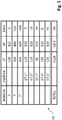
- Fig. 5 illustrates schematically determining a classification Lb of the current performance cP by evaluating the current performance cP with respect to the expected performance eP by visualizing on an operator device O current and expected performances cP, eP of individual parts 67.1", 67.2", 67.3", 67.4", 67.5" of the spinning mill M, in particular of subunits of a particular textile machine 67" producing output textile material 7".
- Fig. 4 which visualizes the current performance La of a textile machine 67", for each part 67.1'', 67.2", 67.3", 67.4", 67.5” of the textile machine 67" the current performance cP and the expected performance eP, respectively the current quantity and the expected quantity of produced textile materials, is visualized.
- the electronic device V for example in cooperation with an operator terminal O, may be configured to enable an operator person to switch between any of the classifications L, La, Lb according to Fig. 3, 4 , 5 .
- the classification L according to Fig. 3 indicates a below than normal performance
- it may be enabled that the operator may switch to the classification La according to Fig. 4 by manipulating a user interface of the operator terminal O, such as by clicking on the current performance cP visualized in Fig. 3 .
- the classification La according to Fig. 4 indicates a below than normal performance, by respective manipulation, e.g.
- the operator person may switch to the classification Lb according to Fig. 5 . Accordingly, the operator person is enabled to quickly and precisely determine which actions seem necessary or likely for improving the performance of the spinning mill M.
- the electronic device V, and/or control devices C, Ca, Cb, and/or operator terminals O may be configured to determine actions to be taken by automatically evaluating the classifications L, La, Lb as illustrated in Fig. 3, 4 , 5 , and to initiate such actions automatically, or after confirmation by an operator person, etc.
- Fig. 6 illustrates schematically possible method steps of a method for determining a classification L, La, Lb of a current performance cP of a spinning mill M.
- a current configuration F of the spinning mill is determined.
- the expected performance eP of the spinning mill M is looked up in a database DB having stored mill configurations F1, F2, ..., FN and respective expected performances eP1, eP2, ..., ePN.
- a classification L, La, Lb of the current performance cP is determined by evaluating the current performance cP with respect to the expected performance eP.
Landscapes
- Engineering & Computer Science (AREA)
- Mechanical Engineering (AREA)
- Textile Engineering (AREA)
- Preliminary Treatment Of Fibers (AREA)
Priority Applications (3)
| Application Number | Priority Date | Filing Date | Title |
|---|---|---|---|
| PCT/IB2022/055200 WO2022259108A1 (en) | 2021-06-11 | 2022-06-03 | Device and method for determining a classification of a current production output of at least one or more parts of a spinning mill |
| US18/568,032 US20240368810A1 (en) | 2021-06-11 | 2022-06-03 | Device and method for determining a classification of a current production output of at least one or more parts of a spinning mill |
| EP22730987.9A EP4352289A1 (de) | 2021-06-11 | 2022-06-03 | Vorrichtung und verfahren zum ermitteln einer klassifizierung einer stromabgabe wenigstens eines oder mehrerer teile einer spinnerei |
Applications Claiming Priority (1)
| Application Number | Priority Date | Filing Date | Title |
|---|---|---|---|
| IN202141026072 | 2021-06-11 |
Publications (1)
| Publication Number | Publication Date |
|---|---|
| EP4101957A1 true EP4101957A1 (de) | 2022-12-14 |
Family
ID=78085800
Family Applications (1)
| Application Number | Title | Priority Date | Filing Date |
|---|---|---|---|
| EP21200069.9A Withdrawn EP4101957A1 (de) | 2021-06-11 | 2021-09-30 | Vorrichtung und verfahren zur bestimmung einer klassifizierung des aktuellen leistung eines oder mehrerer teile einer spinnerei |
Country Status (2)
| Country | Link |
|---|---|
| EP (1) | EP4101957A1 (de) |
| CN (1) | CN117813426A (de) |
Cited By (1)
| Publication number | Priority date | Publication date | Assignee | Title |
|---|---|---|---|---|
| DE102023002794A1 (de) * | 2023-07-08 | 2025-01-09 | Oerlikon Textile Gmbh & Co. Kg | Verfahren und Vorrichtung zur Qualitätserkennung eines synthetischen Fadens |
Citations (8)
| Publication number | Priority date | Publication date | Assignee | Title |
|---|---|---|---|---|
| US4656465A (en) * | 1984-03-22 | 1987-04-07 | Maschinenfabrik Rieter Ag | Method and arrangement for evaluating the performance of a yarn processing machine |
| US5560194A (en) * | 1992-12-31 | 1996-10-01 | Zellweger Uster, Inc. | Method for optimally controlling fiber processing machines |
| US5799476A (en) * | 1993-10-18 | 1998-09-01 | Rieter Ingolstadt Spinnereimaschinenbau Ag | Spinning station error signalling and qualifying device |
| EP2352867B1 (de) * | 2008-11-14 | 2014-04-16 | Uster Technologies AG | Verfahren zur optimalisierung eines herstellungsprozesses in einer textilanlage |
| WO2018055508A1 (en) * | 2016-09-26 | 2018-03-29 | Maschinenfabrik Rieter Ag | Method and system of predictive maintenance of a textile machine |
| EP3654114A1 (de) * | 2018-11-16 | 2020-05-20 | Maschinenfabrik Rieter AG | Parametermanager, zentrale vorrichtung und verfahren zur anpassung von betriebsparametern in einer textilmaschine |
| CN111636124A (zh) * | 2020-01-20 | 2020-09-08 | 武汉裕大华纺织有限公司 | 一种智能并条管理系统 |
| EP3760772A1 (de) * | 2019-06-18 | 2021-01-06 | Saurer Spinning Solutions GmbH & Co. KG | Optimierung des betriebes einer spinnmaschine |
Family Cites Families (2)
| Publication number | Priority date | Publication date | Assignee | Title |
|---|---|---|---|---|
| GB1404761A (en) * | 1970-05-26 | 1975-09-03 | Toyoda Automatic Loom Works | Method of controllig a spinning operation |
| JP2002087703A (ja) * | 2000-09-12 | 2002-03-27 | Murata Mach Ltd | 繊維機械の機台情報表示システム |
-
2021
- 2021-09-30 EP EP21200069.9A patent/EP4101957A1/de not_active Withdrawn
-
2022
- 2022-06-03 CN CN202280056065.0A patent/CN117813426A/zh active Pending
Patent Citations (8)
| Publication number | Priority date | Publication date | Assignee | Title |
|---|---|---|---|---|
| US4656465A (en) * | 1984-03-22 | 1987-04-07 | Maschinenfabrik Rieter Ag | Method and arrangement for evaluating the performance of a yarn processing machine |
| US5560194A (en) * | 1992-12-31 | 1996-10-01 | Zellweger Uster, Inc. | Method for optimally controlling fiber processing machines |
| US5799476A (en) * | 1993-10-18 | 1998-09-01 | Rieter Ingolstadt Spinnereimaschinenbau Ag | Spinning station error signalling and qualifying device |
| EP2352867B1 (de) * | 2008-11-14 | 2014-04-16 | Uster Technologies AG | Verfahren zur optimalisierung eines herstellungsprozesses in einer textilanlage |
| WO2018055508A1 (en) * | 2016-09-26 | 2018-03-29 | Maschinenfabrik Rieter Ag | Method and system of predictive maintenance of a textile machine |
| EP3654114A1 (de) * | 2018-11-16 | 2020-05-20 | Maschinenfabrik Rieter AG | Parametermanager, zentrale vorrichtung und verfahren zur anpassung von betriebsparametern in einer textilmaschine |
| EP3760772A1 (de) * | 2019-06-18 | 2021-01-06 | Saurer Spinning Solutions GmbH & Co. KG | Optimierung des betriebes einer spinnmaschine |
| CN111636124A (zh) * | 2020-01-20 | 2020-09-08 | 武汉裕大华纺织有限公司 | 一种智能并条管理系统 |
Cited By (1)
| Publication number | Priority date | Publication date | Assignee | Title |
|---|---|---|---|---|
| DE102023002794A1 (de) * | 2023-07-08 | 2025-01-09 | Oerlikon Textile Gmbh & Co. Kg | Verfahren und Vorrichtung zur Qualitätserkennung eines synthetischen Fadens |
Also Published As
| Publication number | Publication date |
|---|---|
| CN117813426A (zh) | 2024-04-02 |
Similar Documents
| Publication | Publication Date | Title |
|---|---|---|
| US12299588B2 (en) | Device and method for detecting a fault in a spinning mill and for estimating one or more sources of the fault | |
| EP3832479B1 (de) | Produktionslinienüberwachungsverfahren und -vorrichtung und elektronische vorrichtung und lesbares speichermedium | |
| US8466783B2 (en) | Alarm analysis system and a method for providing statistics on alarms from a process control system | |
| US9939793B2 (en) | Plant control monitoring system | |
| Mori et al. | Development of remote monitoring and maintenance system for machine tools | |
| CA2816469A1 (en) | Faults and performance issue prediction | |
| CN112095188B (zh) | 对纺纱机的运行的优化 | |
| CN109844193A (zh) | 纺织机的预测性维护的方法和系统 | |
| JP2018066084A (ja) | 紡績機械管理システム及び管理方法 | |
| US10162334B2 (en) | Numerical control device | |
| CN107636741A (zh) | 金融终端的故障预警方法、终端设备及存储介质 | |
| EP4101957A1 (de) | Vorrichtung und verfahren zur bestimmung einer klassifizierung des aktuellen leistung eines oder mehrerer teile einer spinnerei | |
| US20240368810A1 (en) | Device and method for determining a classification of a current production output of at least one or more parts of a spinning mill | |
| CN111539638A (zh) | 一种预警方法、装置及预警设备和存储介质 | |
| EP3187950B1 (de) | Verfahren zur verwaltung von alarmen in einem steuerungssystem | |
| US12398491B2 (en) | Device and method for enabling displaying on a user display an operational readiness index related to a spinning mill | |
| CN111679634A (zh) | 一种智能粗纱管理系统 | |
| CN110687851A (zh) | 一种终端运行监控系统及方法 | |
| JPH06207332A (ja) | 機械管理システム | |
| CN116708156A (zh) | 一种基于物联网的it运维管理方法 | |
| WO2021025006A1 (ja) | 改善対策リコメンドシステム | |
| EP3264209A1 (de) | Mechanisches vorrichtungsverwaltungssystem, mechanische vorrichtungsverwaltungsvorrichtung, server zur verwaltung einer mechanischen vorrichtung, mechanische vorrichtung und mechanisches vorrichtungsverwaltungsverfahren | |
| EP4108816A1 (de) | Vorrichtung und verfahren zur bestimmung von informationen zur zumindest teilweisen verbesserung des betriebs einer spinnerei | |
| EP4359593A1 (de) | Vorrichtung und verfahren zur ermittlung von informationen für zumindest teilweise verbesserten betrieb einer spinnerei | |
| JP2010211670A (ja) | Spcによる品質管理方法および装置 |
Legal Events
| Date | Code | Title | Description |
|---|---|---|---|
| PUAI | Public reference made under article 153(3) epc to a published international application that has entered the european phase |
Free format text: ORIGINAL CODE: 0009012 |
|
| STAA | Information on the status of an ep patent application or granted ep patent |
Free format text: STATUS: THE APPLICATION HAS BEEN PUBLISHED |
|
| AK | Designated contracting states |
Kind code of ref document: A1 Designated state(s): AL AT BE BG CH CY CZ DE DK EE ES FI FR GB GR HR HU IE IS IT LI LT LU LV MC MK MT NL NO PL PT RO RS SE SI SK SM TR |
|
| P01 | Opt-out of the competence of the unified patent court (upc) registered |
Effective date: 20230519 |
|
| STAA | Information on the status of an ep patent application or granted ep patent |
Free format text: STATUS: THE APPLICATION IS DEEMED TO BE WITHDRAWN |
|
| 18D | Application deemed to be withdrawn |
Effective date: 20230615 |