EP4103251B1 - Auto-injecteur équipé d'un manchon de protection d'aiguille - Google Patents
Auto-injecteur équipé d'un manchon de protection d'aiguille Download PDFInfo
- Publication number
- EP4103251B1 EP4103251B1 EP21704737.2A EP21704737A EP4103251B1 EP 4103251 B1 EP4103251 B1 EP 4103251B1 EP 21704737 A EP21704737 A EP 21704737A EP 4103251 B1 EP4103251 B1 EP 4103251B1
- Authority
- EP
- European Patent Office
- Prior art keywords
- sleeve
- housing
- needle protection
- spring
- protection sleeve
- Prior art date
- Legal status (The legal status is an assumption and is not a legal conclusion. Google has not performed a legal analysis and makes no representation as to the accuracy of the status listed.)
- Active
Links
Images




Classifications
-
- A—HUMAN NECESSITIES
- A61—MEDICAL OR VETERINARY SCIENCE; HYGIENE
- A61M—DEVICES FOR INTRODUCING MEDIA INTO, OR ONTO, THE BODY; DEVICES FOR TRANSDUCING BODY MEDIA OR FOR TAKING MEDIA FROM THE BODY; DEVICES FOR PRODUCING OR ENDING SLEEP OR STUPOR
- A61M5/00—Devices for bringing media into the body in a subcutaneous, intra-vascular or intramuscular way; Accessories therefor, e.g. filling or cleaning devices, arm-rests
- A61M5/178—Syringes
- A61M5/20—Automatic syringes, e.g. with automatically actuated piston rod, with automatic needle injection, filling automatically
- A61M5/2033—Spring-loaded one-shot injectors with or without automatic needle insertion
-
- A—HUMAN NECESSITIES
- A61—MEDICAL OR VETERINARY SCIENCE; HYGIENE
- A61M—DEVICES FOR INTRODUCING MEDIA INTO, OR ONTO, THE BODY; DEVICES FOR TRANSDUCING BODY MEDIA OR FOR TAKING MEDIA FROM THE BODY; DEVICES FOR PRODUCING OR ENDING SLEEP OR STUPOR
- A61M5/00—Devices for bringing media into the body in a subcutaneous, intra-vascular or intramuscular way; Accessories therefor, e.g. filling or cleaning devices, arm-rests
- A61M5/178—Syringes
- A61M5/31—Details
- A61M5/315—Pistons; Piston-rods; Guiding, blocking or restricting the movement of the rod or piston; Appliances on the rod for facilitating dosing ; Dosing mechanisms
- A61M5/31511—Piston or piston-rod constructions, e.g. connection of piston with piston-rod
-
- A—HUMAN NECESSITIES
- A61—MEDICAL OR VETERINARY SCIENCE; HYGIENE
- A61M—DEVICES FOR INTRODUCING MEDIA INTO, OR ONTO, THE BODY; DEVICES FOR TRANSDUCING BODY MEDIA OR FOR TAKING MEDIA FROM THE BODY; DEVICES FOR PRODUCING OR ENDING SLEEP OR STUPOR
- A61M5/00—Devices for bringing media into the body in a subcutaneous, intra-vascular or intramuscular way; Accessories therefor, e.g. filling or cleaning devices, arm-rests
- A61M5/178—Syringes
- A61M5/20—Automatic syringes, e.g. with automatically actuated piston rod, with automatic needle injection, filling automatically
- A61M2005/2006—Having specific accessories
- A61M2005/2013—Having specific accessories triggering of discharging means by contact of injector with patient body
-
- A—HUMAN NECESSITIES
- A61—MEDICAL OR VETERINARY SCIENCE; HYGIENE
- A61M—DEVICES FOR INTRODUCING MEDIA INTO, OR ONTO, THE BODY; DEVICES FOR TRANSDUCING BODY MEDIA OR FOR TAKING MEDIA FROM THE BODY; DEVICES FOR PRODUCING OR ENDING SLEEP OR STUPOR
- A61M5/00—Devices for bringing media into the body in a subcutaneous, intra-vascular or intramuscular way; Accessories therefor, e.g. filling or cleaning devices, arm-rests
- A61M5/178—Syringes
- A61M5/20—Automatic syringes, e.g. with automatically actuated piston rod, with automatic needle injection, filling automatically
- A61M2005/2073—Automatic syringes, e.g. with automatically actuated piston rod, with automatic needle injection, filling automatically preventing premature release, e.g. by making use of a safety lock
-
- A—HUMAN NECESSITIES
- A61—MEDICAL OR VETERINARY SCIENCE; HYGIENE
- A61M—DEVICES FOR INTRODUCING MEDIA INTO, OR ONTO, THE BODY; DEVICES FOR TRANSDUCING BODY MEDIA OR FOR TAKING MEDIA FROM THE BODY; DEVICES FOR PRODUCING OR ENDING SLEEP OR STUPOR
- A61M2205/00—General characteristics of the apparatus
- A61M2205/58—Means for facilitating use, e.g. by people with impaired vision
- A61M2205/581—Means for facilitating use, e.g. by people with impaired vision by audible feedback
-
- A—HUMAN NECESSITIES
- A61—MEDICAL OR VETERINARY SCIENCE; HYGIENE
- A61M—DEVICES FOR INTRODUCING MEDIA INTO, OR ONTO, THE BODY; DEVICES FOR TRANSDUCING BODY MEDIA OR FOR TAKING MEDIA FROM THE BODY; DEVICES FOR PRODUCING OR ENDING SLEEP OR STUPOR
- A61M2205/00—General characteristics of the apparatus
- A61M2205/58—Means for facilitating use, e.g. by people with impaired vision
- A61M2205/582—Means for facilitating use, e.g. by people with impaired vision by tactile feedback
-
- A—HUMAN NECESSITIES
- A61—MEDICAL OR VETERINARY SCIENCE; HYGIENE
- A61M—DEVICES FOR INTRODUCING MEDIA INTO, OR ONTO, THE BODY; DEVICES FOR TRANSDUCING BODY MEDIA OR FOR TAKING MEDIA FROM THE BODY; DEVICES FOR PRODUCING OR ENDING SLEEP OR STUPOR
- A61M5/00—Devices for bringing media into the body in a subcutaneous, intra-vascular or intramuscular way; Accessories therefor, e.g. filling or cleaning devices, arm-rests
- A61M5/178—Syringes
- A61M5/31—Details
- A61M5/32—Needles; Details of needles pertaining to their connection with syringe or hub; Accessories for bringing the needle into, or holding the needle on, the body; Devices for protection of needles
- A61M5/3202—Devices for protection of the needle before use, e.g. caps
- A61M5/3204—Needle cap remover, i.e. devices to dislodge protection cover from needle or needle hub, e.g. deshielding devices
-
- A—HUMAN NECESSITIES
- A61—MEDICAL OR VETERINARY SCIENCE; HYGIENE
- A61M—DEVICES FOR INTRODUCING MEDIA INTO, OR ONTO, THE BODY; DEVICES FOR TRANSDUCING BODY MEDIA OR FOR TAKING MEDIA FROM THE BODY; DEVICES FOR PRODUCING OR ENDING SLEEP OR STUPOR
- A61M5/00—Devices for bringing media into the body in a subcutaneous, intra-vascular or intramuscular way; Accessories therefor, e.g. filling or cleaning devices, arm-rests
- A61M5/178—Syringes
- A61M5/31—Details
- A61M5/32—Needles; Details of needles pertaining to their connection with syringe or hub; Accessories for bringing the needle into, or holding the needle on, the body; Devices for protection of needles
- A61M5/3205—Apparatus for removing or disposing of used needles or syringes, e.g. containers; Means for protection against accidental injuries from used needles
- A61M5/321—Means for protection against accidental injuries by used needles
- A61M5/3243—Means for protection against accidental injuries by used needles being axially-extensible, e.g. protective sleeves coaxially slidable on the syringe barrel
- A61M5/326—Fully automatic sleeve extension, i.e. in which triggering of the sleeve does not require a deliberate action by the user
Definitions
- an injection device in particular an auto-injector, which has a so-called start click, which is supported on the piston rod and, when the auto-injector is triggered, separates from the piston rod and is moved in the proximal direction by means of a drive spring in order to generate a start click.
- the auto-injector comprises a housing and a product container arranged in the housing.
- the product container can in particular be a syringe which has a syringe body, at the distal end of which an injection needle is fixedly arranged.
- the preferably cylindrical syringe body surrounds a piston which is displaceable with respect to the syringe body and is displaced towards the distal end for the product dispensing, whereby the liquid product, in particular medicament, arranged between the piston and the injection needle is dispensed from the product container through the injection needle.
- the syringe body can at its proximal, i.e.
- the syringes have a flange, also known as a finger flange, at the end opposite the injection needle.
- a syringe designed in this way is available as a standard syringe, so a specially adapted syringe does not necessarily need to be developed for the auto-injector.
- the plunger forms a seal against the inner diameter of the syringe body.
- the housing is preferably elongated and forms the longitudinal axis of the auto-injector.
- the housing is preferably sleeve-shaped and/or cylindrical, in particular circular-cylindrical.
- the product container is arranged in the housing.
- the container can be arranged displaceably in the housing, i.e., for automatic piercing, it can be displaced in the distal direction relative to the housing, so that the needle tip protrudes from an opening at the distal end of the auto-injector and can be automatically inserted into the patient.
- the needle tip can be moved into the distal end of the device after the product has been dispensed, in particular the product container can be moved in the proximal direction relative to the housing.
- the product container is accommodated in the housing so as to be non-displaceable along its longitudinal axis, in particular by means of a product container holder or syringe holder which holds the product container axially fixed and is connected, in particular locked, to the housing in an axially fixed manner.
- the needle tip preferably projects beyond the distal end of the housing in the distal direction. This allows the needle to be inserted into the puncture site by moving the housing towards the patient.
- a needle protection sleeve is preferably provided which forms the distal end of the auto-injector and has an opening for the injection needle, wherein the needle can pass through the opening.
- the needle protection sleeve In its initial position with respect to the needle tip, the needle protection sleeve can be arranged such that the needle protection sleeve projects distally beyond the needle tip or such that the needle tip projects distally beyond the distal end of the needle protection sleeve.
- the needle protection sleeve can be displaced relative to the housing from its initial position in the proximal direction by one actuation stroke into an actuated position, in particular displaced into the housing, so that the needle protrudes or protrudes further from the distal end or through the opening of the needle protection sleeve.
- the needle protection sleeve can be displaced by one needle protection stroke from the actuated position relative to the housing in the distal direction into a needle protection position in which the distal end of the needle protection sleeve protrudes distally beyond the needle tip in order to prevent, after use of the device or after product dispensing, a risk of injury emanating from an exposed needle tip.
- the needle protection sleeve can be displaced, for example, in the proximal direction against the force of a spring, which can be referred to as a needle protection spring.
- the spring which can be, for example, the second spring described below or a separate spring, moves the needle protection sleeve from the actuated position into the distal direction, i.e., into the needle protection position. can be displaced.
- the auto-injector can have a locking member, e.g., spring-mounted, which locks the needle protection sleeve in its needle protection position, in particular with respect to the housing, and blocks the needle protection sleeve from being pushed back in the proximal direction or into the housing.
- the locking member locks the needle protection sleeve at least such that the needle cannot protrude from the distal end of the needle protection sleeve.
- the needle protection sleeve can, e.g., be displaced from the needle protection position only far enough in the proximal direction that the needle tip does not protrude from the distal end of the needle protection sleeve.
- the auto-injector further comprises a propulsion member which acts on the piston, in particular rests against the piston, at least during product dispensing, and a first spring which acts on the propulsion member, for example by being supported, in particular, with its distal end, on the propulsion member.
- the propulsion member can be sleeve-shaped, for example.
- the propulsion member can comprise one or more ribs, which are arranged, for example, in the region of the distal end of the propulsion member.
- the distal end of the first spring can be supported on the rib.
- the rib can extend in the proximal direction.
- the rib can be provided inside the propulsion member.
- the rib of the propulsion member can, for example, be provided on an inner side of the propulsion member.
- the first spring is preferably arranged inside the sleeve-shaped propulsion member.
- the rib of the propulsion member can serve to adjust the spring tension of the first spring. For example, a longer rib can generate a higher spring preload.
- the rib can be designed such that the spring tension of the first spring is or is preloaded such that the liquid product, in particular the entire medication in the product container, can be poured out.
- the length of the rib or the rib can determine a preload of the first spring such that it can pour the product out of the product container by displacing the propulsion member by a dispensing stroke (H A ).
- the rib can also serve to reinforce the propulsion member, in particular that part of the propulsion member on which the first spring is supported.
- the spring tension can be selected such that the liquid product, in particular the entire medication in the product container, can be poured out.
- At least two auto-injectors may be present, wherein the corresponding length of the ribs differs in order to achieve a desired spring force.
- at least two auto-injectors may be present, each containing different springs with correspondingly different spring tensions in order to achieve a desired spring force.
- a first and a second auto-injector may be provided, wherein the length of the ribs of the first auto-injector differs from the length the ribs of the second auto-injector, and that the auto-injectors are otherwise identical.
- the first spring is preferably a helical spring acting as a compression spring, which is preferably made of metal.
- the first spring is pre-tensioned so strongly, particularly in the as-delivered state of the auto-injector, that it or the energy stored in it is sufficient to essentially completely dispense the product from the product container by displacing the propulsion member by one dispensing stroke.
- the piston is also displaced by displacing the propulsion member by the dispensing stroke.
- the dispensing stroke of the piston is smaller than the dispensing stroke of the propulsion member, which is preferred because the piston remains unloaded until use, thereby avoiding unwanted premature product dispensing.
- the propulsion member it is also possible for the propulsion member to rest against the piston in the as-delivered state and not only during product dispensing.
- the piston's discharge stroke corresponds to the discharge stroke of the propulsion element.
- the proximal end of the first spring which can also be referred to as a discharge spring due to its function, can be supported on the housing or a housing-fixed element, in particular an element that is only temporarily axially fixed to the housing.
- the auto-injector comprises a signal element, a signal stop, and a second spring.
- the second spring can exert a spring force on the signal element acting counter to the dispensing direction or in the proximal direction.
- the second spring can be supported, for example, with its proximal end on the signal element.
- the second spring can, for example, be a helical spring acting as a compression spring, the proximal end of which is supported on the signaling element.
- the second spring is preferably made of metal.
- the distal end of the second spring can, for example, be supported on the housing or a housing-fixed element.
- the distal end of the second spring is particularly preferably supported on the needle protection sleeve or an element which is displaced with the needle protection sleeve, in particular when the needle protection sleeve is displaced relative to the housing.
- the element can be a switching module or a switching sleeve, as described further below.
- the element can, in particular, be arranged kinematically and/or geometrically between the needle protection sleeve and the distal end of the second spring.
- the advantage here is that the needle protection sleeve can be displaced from its actuated position into the needle protection position by means of the second spring.
- the spring can thus preferably fulfill a dual function, since it additionally exerts the above-mentioned force on the signaling element.
- the signal element in the delivery state or during a first partial stroke of the discharge stroke of the propulsion element, can be axially fixedly coupled to the propulsion element, so that the The signaling member is displaceable with the propulsion member along the longitudinal axis and in particular relative to the housing, in particular in the distal direction.
- the axially fixed coupling with the propulsion member ensures that the signaling member is entrained during the displacement of the propulsion member in the dispensing direction, in particular during the execution of the first partial stroke of the dispensing stroke, and the second spring is tensioned.
- the axially fixed coupling between the signaling member and the propulsion member is thus releasable.
- the signaling member can be accelerated by means of the second, preloaded spring against the dispensing direction and relative to the propulsion member and/or the housing. Due to the drive element driving the signal element along the first partial stroke, a gap is created between the signal stop and the signal element, extending, for example, along the longitudinal axis and corresponding in particular to the first partial stroke.
- the second spring can accelerate the signal element over this distance, causing the signal element to strike the signal stop at a speed such that an impulse is transmitted to the signal element, generating an acoustic (audible) and/or tactile (perceptible) signal.
- the signal stop can be formed by the housing or by an element that is at least axially and preferably also rotationally fixedly connected to the housing.
- this element can be a closure cap at the proximal end of the housing and/or form the proximal end of the auto-injector.
- the closure cap can be connected to the housing, particularly preferably in a form-fitting manner, or alternatively in a force-fitting or material-fitting manner.
- the element is preferably latched to the housing.
- a separate cap has the advantage of facilitating assembly of the device, with at least some of the components being introduced into the housing via the proximal end, which is then closed with the cap.
- the cap can form a resonating body if the signal stop is arranged on the cap, and the auditory impression of the acoustic signal can be modified within certain limits by designing the material thickness and shape of the cap.
- the signaling element has a first engagement element, in particular a resilient element or/and arranged on a resilient arm, which engages releasably in the propulsion element, in particular in a recess of the propulsion element.
- the propulsion element is axially fixedly coupled to the signaling element, wherein the axially fixed coupling between the propulsion element and the signaling element is released when the signaling element, in particular the first engagement element, is disengaged from the engagement with the propulsion element, in particular the recess of the propulsion element, or is pushed out.
- the first engagement member is released from engagement with the propulsion member at the end of the first partial stroke of the propulsion member.
- the signal stop is arranged along the longitudinal axis of the auto-injector such that it is aligned with the signal element. This ensures that the signal element strikes the signal stop with a movement along the longitudinal axis of the auto-injector.
- the locking member and, if applicable, the other locking member can be arranged resiliently, in particular each on a resilient arm.
- the switching sleeve can surround and/or guide the locking sleeve.
- the needle protection sleeve or the switching module in particular the locking sleeve, can have, for example, a further recess into which the second engagement member of the signaling member, e.g. B. for the axially fixed coupling between the signaling element and the switching module, in particular the locking sleeve, or the needle protection sleeve.
- the advancing element can have a recess into which the first engagement element engages for the axially fixed coupling between the advancing element and the signaling element.
- the advancing member can have a recess for the first engagement element of the holding element, wherein this coupling between the advancing member and the holding element is released when the holding element, in particular the first engagement element, is disengaged from the engagement with the advancing member, in particular the recess of the advancing member.
- the first engagement element can be released from the engagement with the advancing member by displacing the needle protection sleeve from the starting position into the actuated position by the actuating stroke.
- the first engagement element can be held in axially fixed engagement with the advancing member by the needle protection sleeve or the switching module, in particular the locking sleeve, when the needle protection sleeve is not in its actuated position or in its starting position.
- an inner circumference of the needle protection sleeve or the switching module, in particular the locking sleeve can hold the first engagement element in engagement with the advancing member, wherein e.g. B. a second engagement element, which is described below, can bear against the inner circumference.
- the needle protection sleeve or the switching module can allow the first engagement element of the holding element to disengage from the propulsion member, in particular with a movement transverse to the longitudinal axis of the auto-injector.
- a recess in particular for the second engagement element of the holding element, which is formed on the needle protection sleeve or the switching module, in particular the locking sleeve, can be arranged in the same position relative to the longitudinal axis as the first and/or second engagement element, so that the first engagement element can disengage from the propulsion member.
- the propulsion member can press the first engagement element out of engagement with the propulsion member when the needle protection sleeve is in its actuated position.
- the first engagement element of the holding element can, for example, point radially to the longitudinal axis and/or be arranged on a resilient arm of the holding element.
- the holding element can - as mentioned - have a second engagement element, which is movable by the disengagement movement of the first engagement element from the drive member into an axially fixed engagement with the needle protection sleeve or the switching module, in particular the locking sleeve.
- the second engagement element can, for example, be arranged on the arm on which the first engagement element is arranged and/or, for example, point radially away from the longitudinal axis.
- the first engagement element and the second engagement element can be coordinated with one another in such a way that the second engagement element already engages axially fixedly in its recess, which is formed by the needle protection sleeve or the switching module, in particular the locking sleeve, when the first engagement element is not yet completely released from engagement with the drive member.
- This advantageously ensures that the axially fixed connection between the holding element and the needle protection sleeve or the switching module is first established before the axially fixed connection between the holding element and the drive element is released, thus preventing the needle protection sleeve from being pushed back again or further.
- the propulsion member when the second engagement element of the holding element is in its recess, the propulsion member can move in the distal direction relative to the holding element, in particular due to the energy stored in the preloaded spring.
- the propulsion member can prevent the second engagement element from disengaging from the axially fixed engagement with the needle protection sleeve or the switching module, in particular the locking sleeve, when the propulsion member moves in the distal direction relative to the signaling member.
- This preferably also applies at the end of the dispensing stroke, in particular when the second engagement element of the signaling member is released from its recess in order to be accelerated by the second spring against the dispensing direction.
- the second engagement element disengages from its recess at the end of the dispensing stroke in order to be able to move the needle protection sleeve from the actuated position into the needle protection position after the product has been administered.
- the drive member can have a recess into which the first engagement element can engage, with the second engagement element simultaneously disengaging from its recess, in particular to enable the movement of the needle protection sleeve in the distal direction.
- the second engagement element remains in place even at the end of the dispensing stroke such that the second engagement element prevents the locking sleeve from being moved in the distal direction relative to the housing and/or the second engagement element, wherein the switching sleeve and/or the needle protection sleeve are displaceable in the distal direction relative to the locking sleeve, in particular due to the energy stored in the second spring, whereby the needle protection sleeve is moved in particular into its needle protection position.
- the locking member can engage between the locking sleeve and the switching sleeve, preventing the switching sleeve from being displaced in the proximal direction relative to the locking sleeve.
- movement of the locking sleeve in the proximal direction is prevented by the locking sleeve abutting either the housing or an element fixed to the housing, such as a mechanism holder, or the signaling element.
- a further aspect of the invention relates to the design of a product container holder, in particular a tip holder for an auto-injector, in particular for an auto-injector in which the product container is immovable with respect to the housing or for an auto-injector of the type described above.
- the invention is based on a syringe module, which is particularly intended for use in an auto-injector.
- an auto-injector can be provided which has such a syringe module.
- the syringe module comprises a syringe and a syringe holder.
- the syringe has a syringe body, a plunger, and a needle.
- the needle is, for example, permanently attached to a needle-holding section of the syringe, and the plunger is displaceably arranged in a cylindrical section of the syringe body.
- the syringe body has a tapered section or region arranged between the needle-holding section and the cylindrical section.
- the syringe further has a needle protection cap, which can be, for example, a so-called soft needle shield or, preferably, a rigid needle shield.
- a soft needle shield is preferably made of a rubber-elastic plastic, while a rigid needle shield is formed from a sleeve made of hard plastic, in which a sleeve made of a rubber-elastic plastic is arranged.
- the rubber-elastic plastic sleeve and the hard plastic sleeve together form the rigid needle shield.
- the needle protection cap which covers the needle and is attached to the needle holding section, which extends conically toward the needle tip, preferably keeps the needle protected from dirt and sterile.
- a gap is formed between the tapered section and the needle protection cap, particularly the hard plastic sleeve.
- the syringe holder has at least one engagement member, in particular a shoulder, against which the tapered portion of the syringe rests in the distal direction and which engages in the gap between the needle protection cap and the tapered portion.
- the engagement of the tapered portion against the at least one shoulder prevents the syringe from moving in the distal direction relative to the syringe holder.
- the syringe body may have a finger flange at its proximal end, wherein a gap is formed between the finger flange and the syringe body when the tapered portion abuts the shoulder, whereby the finger flange remains essentially unloaded. This advantageously prevents the finger flange from being overloaded and breaking the syringe body.
- the syringe holder has at least one holding member, in particular an outwardly directed projection, with which the syringe holder can be or is connected in an axially fixed manner to a housing of the auto-injector, in particular snapped or snappable.
- the housing of the auto-injector can, for example, have a holding portion that rests against the syringe holder, in particular against an outer surface or an outer circumference of the syringe holder, and prevents the at least one engagement member of the syringe holder from moving transversely to the longitudinal axis away from the longitudinal axis.
- the holding portion can be cylindrical and surround the at least one engagement member, preferably two or three or four engagement members, such that the at least one engagement member is arranged within the holding portion.
- the syringe module or the syringe holder When the syringe is fully inserted into the syringe holder, in particular the at least one engagement member engages in the gap between the tapered portion and the needle protection cap, the syringe module or the syringe holder is brought into engagement with the holding portion, so that the at least one engagement member is prevented from moving out of engagement with the tapered portion transversely to the longitudinal axis, in particular away from the longitudinal axis or outwards.
- the at least one engagement member can be resilient, in particular formed on an arm on the syringe holder, wherein the syringe is inserted via the proximal end with the needle first into the syringe holder, which is preferably sleeve-shaped, wherein the needle protection cap deflects the at least one engagement member transversely to the longitudinal axis outwards, i.e. away from the longitudinal axis, wherein, when the needle protection cap has been moved completely past the at least one engagement member, the at least one engagement member snaps into the gap between the tapered region and the needle protection cap.
- the housing comprises a holding section.
- the holding section of the housing can be sleeve-shaped and arranged inside the housing.
- a stop for limiting the axial movement of the needle protection sleeve in the proximal direction can be provided between the sleeve-shaped holding section of the housing and the sleeve-shaped housing.
- the holding section of the housing preferably projects beyond the distal end of the housing in the distal direction.
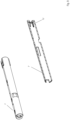
- the holding section can have one or more grooves which, in conjunction with a rail or rails provided on the needle protection sleeve, form an anti-twist device between the housing and the needle protection sleeve.
- the rail of the needle protection sleeve is preferably provided on an inner surface of the needle protection sleeve.
- the groove of the holding section is preferably arranged on an outer surface of the holding section.
- the needle protection sleeve can preferably be moved axially in a rotationally fixed manner between the holding section of the housing and the housing.
- the one or more grooves can be provided on the needle shield and the one or more rails can be provided on the retaining portion of the housing to form an insurance between the housing and the needle shield.
- the groove of the needle shield is preferably provided on an inner surface of the needle shield.
- the rail of the retaining portion is preferably arranged on an outer surface of the retaining portion.
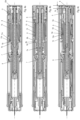
- the auto-injector comprises a sleeve-shaped, elongated housing 2 with a longitudinal axis L, which has a closure cap 12 at its proximal end, which is positively connected to the housing 2 in a rotationally and axially fixed manner and forms the proximal end of the auto-injector.
- the closure cap 12 is snapped onto the housing 2.
- the closure cap 12 has a locking member 12a, which is engaged in a recess 2a on the housing 2, preferably in such a way that the closure cap 12 cannot be detached from the housing 2 or cannot be easily detached.
- a pull-off cap 4 is arranged, which is pulled off, or twisted off, and removed before using the auto-injector.
- a product container 13 in the shape of a syringe is accommodated in the housing 2 so as to be immovable along the longitudinal axis L with respect to the housing 2 - apart from the assembly of the auto-injector.
- the product container 13 has a sleeve-shaped syringe body surrounding a piston 13b that bears sealingly against the inner circumference of the syringe body.
- the syringe body has, at its distal end, an injection needle 13a that is in particular permanently connected to the syringe body and whose distal end is formed by the needle tip.
- a liquid product in particular a medication, is arranged within the syringe body between the injection needle 13a and the piston 13b, wherein the liquid product is dispensed from the product container 13 through the hollow injection needle 13a by displacing the piston 13b in a dispensing direction, i.e., in the distal direction or towards the injection needle 13a.
- the syringe body has a so-called finger flange at its proximal end, which projects radially outwards over the outer circumference of the cylindrical syringe body.
- the product container 13 is received in a product container holder, which is referred to as syringe holder 1, such that it is secured at least against movement along the longitudinal axis L in the distal direction relative to the syringe holder 1.
- the syringe holder 1 is, as best seen from Figure 2a As can be seen, it is positively connected, in particular latched, to the housing 2.
- the housing 2 has recesses into which latching elements engage, which are formed here at the proximal end of the syringe holder 1.
- the syringe holder 1 has at least one inwardly projecting shoulder 1b, against which a tapered section of the product container 13, which is distal to the cylindrical syringe body section that guides the piston 13b, is supported.
- the product container 13 is pressed at its proximal end into engagement with the shoulder 1b by a holder acting on the syringe body.
- the holder is formed by a retaining spring section 5c of a mechanical holder 5.
- the mechanical holder 5 is arranged in particular immovably and/or rotationally fixed with respect to the housing 2 along the longitudinal axis L.
- the sleeve-shaped mechanical holder 5 can be snapped onto the housing 2.
- the retaining spring section 5c can compensate for differences in the length of the product container 13 that may arise due to manufacturing tolerances, whereby the firm fit of the product container 13 on the shoulder 1b is ensured.
- the product container 13 is arranged with respect to the housing 2 such that the needle tip projects distally beyond the distal end of the housing 2.
- the needle 13a is covered by a needle protection cap 14, which in the example shown is designed as a so-called rigid needle shield known to those skilled in the art, or alternatively as a soft needle shield, in order to protect the needle 13a from contamination and to keep the needle 13a and the medication sterile.
- the rigid needle shield 14 is arranged on a needle holding section of the syringe body, wherein the tapered section of the syringe body is located between the needle holding section and the cylindrical section of the syringe body.
- the shoulder 1b is arranged between the syringe body and the proximal end of the rigid needle shield 14, in particular such that a gap—albeit a small one—is created between the rigid needle shield 14 and the shoulder 1b in order to prevent the shoulder 1b from exerting a force on the rigid needle shield 14, which could, for example, endanger the sterility of the needle 13a or the liquid product.
- the pull-off cap 4 is releasably snapped to the housing 2 or a needle protection sleeve 3, wherein this snap connection is released when the pull-off cap 4 is removed from the housing 2 or the needle protection sleeve 3.
- the snap connection is formed by a snap geometry 3b of the needle protection sleeve 3 and a snap hook 4a of the pull-off cap 4 ( Figure 2b ).
- This Snap hooks 4a further secure the pull-off cap 4 against proximal movement relative to the housing 2 by finding housing-fixed support on the housing 2 or on a distal end face on the syringe holder 1.
- the pull-off cap 4 further has, in particular on a snap hook 4a, at least one snap 4b that engages in a gap between the syringe body, in particular its tapered region, and the proximal end of the rigid needle shield 14.
- the snap 4b hooks into the proximal end of the rigid needle shield 14, whereby the rigid needle shield 14 is detached from the product container 13 and removed from the auto-injector together with the cover cap 4.
- the snap 4b can hook into a lateral surface of the rigid needle shield 14 or into a lateral surface of the soft needle shield.
- the auto-injector has a needle protection sleeve 3, which is displaceable relative to the housing 2 and along the longitudinal axis L by an actuation stroke HB in the proximal direction into an actuated position in order to trigger a product dispensing.
- a needle protection sleeve 3 which is displaceable relative to the housing 2 and along the longitudinal axis L by an actuation stroke HB in the proximal direction into an actuated position in order to trigger a product dispensing.
- the distal end of the needle protection sleeve 3 projects distally beyond the needle tip of the needle 13a, so that access to the needle tip is initially prevented.
- the needle protection sleeve 3 By moving the needle protection sleeve 3 by the actuating stroke HB, the needle protection sleeve 3 is moved far enough in the proximal direction that the needle 13a protrudes from the distal end of the needle protection sleeve 3, in particular protrudes to a length which corresponds to the injection depth of the needle into the puncture site.
- the needle 13a should protrude far enough beyond the distal end of the needle protection sleeve 3 so that a subcutaneous injection can take place.
- the housing 2 can form a stop 2c against which the needle protection sleeve 3 rests in the actuated position.
- the first spring 9 is supported with its proximal end on a holding element 6, which in this example has two arms 6c, with a first engagement element 6a and a second engagement element 6b arranged on each arm 6c.
- the first engagement element 6a points radially towards the longitudinal axis L, with the second engagement element 6b pointing radially away from the longitudinal axis L.
- the first engagement element 6a engages in a first recess 7a formed by the propulsion element 7, thereby preventing movement of the propulsion member 7 relative to the holding element 6 in the distal direction or in the dispensing direction. This holds the first spring 9 in its tensioned state.
- the auto-injector has a switching module 8, 15, which has a switching sleeve 15 and a locking sleeve 8 surrounded by the switching sleeve 15.
- the first engagement element 6a is held in engagement with the first recess 7a by the inner circumference of the locking sleeve 8, which bears against the second engagement element 6b.
- the switching sleeve 15 is connected to the proximal end 3a of the needle protection sleeve 3 or at least rests against the proximal end 3a of the needle protection sleeve 3.
- the second spring 10 is a metal spring acting as a compression spring and designed as a helical spring.
- the second spring 10 is supported with its proximal end on a signal element 11, in particular on a projection 11c, which is axially displaceable and rotationally fixed into the Housing 2 engages and extends through a slot-shaped groove 5b of the mechanism holder 5.
- the second spring 10 thus also surrounds the mechanism holder 4 at least partially, preferably completely.
- the switching element 15 has a recess 15a into which a locking element 8a of the locking sleeve 8 engages.
- the locking element 8a is sawtooth-shaped and protrudes radially from the longitudinal axis L.
- the locking element 8a is resiliently arranged on an arm formed by the locking sleeve 8. By displacing the switching sleeve 15 in the proximal direction, the locking sleeve 8 is driven in the proximal direction via the engagement of the locking element 8a.
- the switching sleeve 15 is also moved along by the actuation stroke HB , thereby tensioning the second spring 10. If the needle protection sleeve 3 is not moved completely into the actuated position, the second spring 10 can move the switching sleeve 15 and the needle protection sleeve 3 back to the starting position, whereby the locking sleeve 8 is also moved along by the switching sleeve 15 via the engagement of the locking member 8a.
- the particularly sleeve-shaped signaling member 11 is in axially fixed engagement with the propulsion member 7 in the delivery state or before the product dispensing is triggered.
- the signaling member 11 has a first engagement member 11a, which engages in a recess 7b of the propulsion member 7, and a second engagement member 11b.
- the first engagement member 11a and the second engagement member 11b are resiliently arranged at the end of an arm 11d.
- the signaling member 11 has two such arms 11d with a first engagement member 11a and a second engagement member 11b.
- the first engagement member 11a points radially toward the longitudinal axis L, with the second engagement member 11b pointing radially away from the longitudinal axis L.
- the first engagement member 11a is held in axially fixed engagement with the propulsion member 7 by the inner circumference of the locking sleeve 8.
- the recess 7b can be designed in such a way, in particular a recess 7b extending in the longitudinal direction, that during a first partial stroke of the dispensing stroke, an axial relative movement takes place between the propulsion member 7 and the signaling member 11, and during a second partial stroke of the dispensing stroke, the first engagement member 11a is held in axially fixed engagement with the propulsion member 7, at least in the distal direction.
- the second engagement member 11b bears against the inner circumference of the switching sleeve 8.
- the closure cap 12 has a signal stop 12b, against which the signaling member 11 can strike to generate a signal and preferably against which the signaling member 11 bears in the as-delivered state of the device.
- the pull-off cap 4 is removed from the auto-injector together with the rigid needle shield 14.
- the distal end of the needle shield 3 is placed against the puncture site of a patient, whereby the housing 2 is displaced towards the puncture site, whereby the needle shield 3 moves from its initial position by the actuation stroke HB in the proximal direction relative to the housing 2 into the actuated position.
- the locking sleeve 8 has a first recess 8b, which is brought into the position of the second engagement element 6b by displacing the locking sleeve 8 by the actuation stroke HB along the longitudinal axis L, as shown in the Figures 3a-3c shown.
- the first engagement element 6a is moved out of engagement with the propulsion member 7 with a movement transverse to and away from the longitudinal axis L, while simultaneously the second engagement element 6b is moved into engagement with the locking sleeve 8, in particular its first recess 8b.
- the propulsion member 7 is released for movement by the discharge stroke HA in the discharge direction.
- the holding element 6, which is movable at least a short distance relative to the housing 2 and along the longitudinal axis L, can be moved by the first spring 9 in the proximal direction, wherein the holding element 6, via the engagement of the second engagement element 6b in the recess 8b, moves the locking sleeve 8 by a start signal stroke H K ( Figure 3c ), whereby the locking sleeve 8 strikes a start signal stop 5a formed by the mechanism holder 5, and thereby emits an acoustic and/or tactile signal which signals to the user of the device that the product dispensing has started.
- the locking member 8a By displacing the locking sleeve 8 by the actuating stroke HB, the locking member 8a is released for movement transversely and towards the longitudinal axis L, since the mechanism holder 5 has a recess 5d which permits such a movement of the locking member 8a when the locking sleeve 8 has been displaced by the actuating stroke HB or when the needle protection sleeve 3 is in its actuated position.
- the signal element 11 Since the signal element 11 is still axially fixed to the propulsion element 7, it is driven by a first partial stroke H S of the discharge stroke H A in the discharge direction, whereby the signal element 11 is moved away from the signal stop 12b by approximately the first partial stroke H S , as best seen from Figure 4c can be seen.
- the first engagement member 11a At the end of the first partial stroke H S , during which the first and second engagement members 11a, 11b are moved relative to the locking sleeve 8, the first engagement member 11a is pressed out of engagement with the propulsion member 7, wherein at the same time the second engagement member 11b is moved into the second recess 8c of the locking sleeve 8 with a movement transverse to the longitudinal axis L and radially away from the longitudinal axis L.
- the second engagement member 11b is held by the outer circumference of the drive member 7 in engagement with the recess 8c ( Figure 4a ), when the propulsion member 7 is moved by its second partial stroke of the discharge stroke H A.
- the outer peripheral surface of the propulsion member 7 holds the second engagement element 6b in engagement with the first recess 8b of the locking sleeve 8, as best seen from Figure 4b can be seen.
- the propulsion member 7 releases the second engagement member 11b from engagement with the locking sleeve 8, whereby the second engagement member 11b is moved out of engagement with the recess 8c, in particular towards the longitudinal axis L, so that the second spring 10 accelerates the signaling member 11 against the dispensing direction, ie in the proximal direction, so that when the signaling member 11 hits the signal stop 12b, an acoustic and/or tactile signal is generated.
- the second spring 10 can move the switching sleeve 15 and the needle protection sleeve 3 from the actuated position to the needle protection position by the needle protection stroke H N , whereby the locking member 8a is pressed out of engagement with the recess 15a, whereby the switching sleeve 15 moves in the distal direction relative to the locking sleeve 8.
- the locking member 8a snaps into the switching sleeve 15, whereby the locking member 8a prevents the needle protection sleeve 3 from being pushed back into its actuated position.
- the switching member 15 When attempting to push the needle protection sleeve 3 back from the needle protection position to the actuated position, the switching member 15 abuts the locking member 8a, which prevents the needle protection sleeve 3 from moving into the actuated position.
- the locking sleeve 8 is supported axially on the start signal stop 5a of the mechanism holder 5.
Landscapes
- Health & Medical Sciences (AREA)
- Vascular Medicine (AREA)
- Engineering & Computer Science (AREA)
- Anesthesiology (AREA)
- Biomedical Technology (AREA)
- Heart & Thoracic Surgery (AREA)
- Hematology (AREA)
- Life Sciences & Earth Sciences (AREA)
- Animal Behavior & Ethology (AREA)
- General Health & Medical Sciences (AREA)
- Public Health (AREA)
- Veterinary Medicine (AREA)
- Infusion, Injection, And Reservoir Apparatuses (AREA)
Claims (14)
- Auto-injecteur permettant la distribution d'un produit liquide, en particulier d'un médicament, comprenant :a) un boîtier (2) et un récipient à produit (13), en particulier une seringue, disposé dans le boîtier (2) et qui présente un piston (13b) qui peut être coulissé, dans lequel le piston (13b) peut être coulissé dans une direction de distribution pour la distribution du produit contenu dans le récipient à produit (13),b) un élément de traction (7 ; 7') qui agit sur le piston (13b) pendant la distribution de produit, et un premier ressort (9) qui agit sur l'élément de traction (7 ; 7'),c) une douille de protection d'aiguille (3) qui peut être coulissé dans la direction proximale, en particulier sur une course d'actionnement (HB), à partir de sa position initiale par rapport au boîtier (2) et le long d'un axe longitudinal (L) de l'auto-injecteur pour le déclenchement de la distribution de produit, moyennant quoi un second ressort (10) est tendu et, en particulier, la distribution de produit est déclenchée, dans lequel la douille de protection d'aiguille (3) agit sur le second ressort (10),
caractérisé en ce qued) le boîtier (2) comprend une section de maintien, dans lequel la section de maintien du boîtier fait saillie dans la direction distale au-delà d'une extrémité distale du boîtier, et dans lequel la section de maintien du boîtier (2) présente une ou plusieurs cannelures (2d) ou, alternativement, un ou plusieurs rails qui, en liaison avec le ou les rails (3c) prévus sur la douille de protection d'aiguille (3) ou, alternativement, en liaison avec la ou les cannelures prévues sur la douille de protection d'aiguille (3), forment un blocage de rotation entre le boîtier (2) et la douille de protection d'aiguille (3), ete) l'élément de traction (7 ; 7') présente, sur un côté intérieur, une nervure (7c ; 7c') faisant saillie vers l'intérieur ou des nervures (7c ; 7c') faisant saillie vers l'intérieur permettant le réglage d'une tension de ressort du premier ressort (9), dans lequel la longueur de la nervure (7c ; 7c') ou des nervures (7c ; 7c') détermine une prétension du premier ressort (9) de telle sorte qu'il peut distribuer le produit hors du récipient à produit (13b) en coulissant l'élément de traction (9) sur une course de distribution (HA). - Auto-injecteur selon la revendication 1, caractérisé en ce que la section de maintien du boîtier (2) est réalisée en forme de douille et est disposée à l'intérieur du boîtier (2).
- Auto-injecteur selon la revendication 1 or 2, caractérisé en ce que la cannelure (2d) ou le rail de la section de maintien du boîtier (2) est disposé sur une surface extérieure d'enveloppe de la section de maintien du boîtier (2).
- Auto-injecteur selon l'une des revendications précédentes, caractérisé en ce que la cannelure ou le rail (3c) de la douille de protection d'aiguille (3) est prévu sur une surface intérieure d'enveloppe de la douille de protection d'aiguille (3).
- Auto-injecteur selon l'une des revendications précédentes, caractérisé en ce qu'une butée est prévue entre la section de maintien en forme de douille du boîtier (2) et le boîtier (2) en forme de douille pour la limitation du déplacement axial de la douille de protection d'aiguille (3) dans la direction proximale.
- Auto-injecteur selon l'une des revendications précédentes, caractérisé par un module de commutation (8, 15) qui est disposé cinématiquement et/ou géométriquement entre le second ressort (10) et la douille de protection d'aiguille (3), dans lequel le module de commutation (8, 15) est emporté par la douille de protection d'aiguille (3) dans la direction proximale lorsque la douille de protection d'aiguille (3) est coulissée hors de sa position initiale dans la direction proximale.
- Auto-injecteur selon la revendication 6, caractérisé en ce que le module de commutation (8, 15) présente une douille de commutation (15) et une douille d'arrêt (8), dans lequel la douille d'arrêt (8) présente un élément de verrouillage (8a) agissant de manière unidirectionnelle, lequel vient en prise dans la douille de commutation (15), dans lequel la douille de commutation (15), lors de son déplacement par rapport au boîtier (2) dans la direction proximale, emporte la douille d'arrêt (8) par l'intermédiaire de l'élément de verrouillage (8a) et la douille de commutation, lors de son déplacement par rapport au boîtier (2) dans la direction proximale, est coulissée par rapport à la douille d'arrêt (8) dans une autre position d'arrêt dans laquelle l'élément de verrouillage (8a) arrête un déplacement de la douille de commutation (15) par rapport à la douille d'arrêt (8) dans la direction proximale.
- Auto-injecteur selon l'une des revendications précédentes, caractérisé en ce que, après la distribution de produit, en particulier lorsque l'élément de traction (7 ; 7') est coulissé sur la course de distribution (HA) dans la direction distale, la douille de protection d'aiguille (3) peut être coulissée par le second ressort (10) par rapport au boîtier (2) dans la direction distale, en particulier sur une course de protection d'aiguille (Hs) dans une position de protection d'aiguille dans laquelle la douille de protection d'aiguille (3) se trouve en position distale au-dessus de la pointe d'aiguille d'une aiguille d'injection (13a) du récipient à produit (13).
- Auto-injecteur selon la revendication 8, caractérisé par un élément de verrouillage (12a) qui verrouille la douille de protection d'aiguille (3) dans sa position de protection d'aiguille par rapport au boîtier (2) pour l'empêcher de coulisser en sens inverse dans la direction proximale, en particulier la verrouille au moins de telle sorte que la pointe d'aiguille ne peut pas faire saillie hors de l'extrémité distale de la douille de protection d'aiguille (3).
- Auto-injecteur selon l'une des revendications précédentes, caractérisé par un élément de signalisation (11), une butée de signalisation (12b) et le second ressort (10) qui exerce sur l'élément de signalisation (11) une tension de ressort agissant à l'encontre de la direction de distribution, dans lequel l'élément de signalisation (11) est accouplé de manière axialement solidaire à l'élément de traction (7 ; 7'), de sorte que l'élément de signalisation (11) est emporté pendant le coulissement de l'élément de traction (7 ; 7') dans la direction de distribution et que le second ressort (10) est tendu, dans lequel l'accouplement axialement solidaire entre l'élément de signalisation (11) et l'élément de traction (7 ; 7') peut être rompu et l'élément de signalisation (11) peut être accéléré au moyen du second ressort (10) à l'encontre de la direction de distribution et par rapport à l'élément de traction (7 ; 7') et/ou au boîtier (2), dans lequel l'élément de signalisation (11) désaccouplé de l'accouplement axialement solidaire avec l'élément de traction (7 ; 7') et accéléré par le second ressort (10) vient buter contre la butée de signalisation (12b), moyennant quoi un signal acoustique et/ou tactile est créé.
- Auto-injecteur selon la revendication 10, caractérisé en ce que l'élément de signalisation (11) présente un premier élément de mise en prise (11a) qui vient en prise de manière amovible dans l'élément de traction (7 ; 7'), moyennant quoi l'élément de traction (7 ; 7') est accouplé de manière axialement solidaire à l'élément de signalisation (11), dans lequel l'accouplement axialement solidaire entre l'élément de traction (7 ; 7') et l'élément de signalisation (11) est rompu lorsque l'élément de signalisation (11) n'est plus en prise avec l'élément de traction (7 ; 7').
- Auto-injecteur selon la revendication 10 ou 11, caractérisé en ce que la butée de signalisation (12b) est formée par le boîtier (2) ou par un élément (12) relié au moins de manière axialement solidaire, de préférence également solidaire en rotation, au boîtier (2) comme par exemple un capuchon de fermeture (12) qui ferme l'extrémité proximale du boîtier (2).
- Auto-injecteur selon l'une des revendications 10 à 12, caractérisé en ce que la butée de signalisation (12b) est disposée le long de l'axe longitudinal (L) de l'auto-injecteur, en particulier du boîtier (2), en affleurement avec l'élément de signalisation (11).
- Premier et second auto-injecteur selon l'une des revendications précédentes, caractérisés en ce que la longueur de la nervure ou des nervures (7c) du premier auto-injecteur diffère de la longueur de la nervure ou des nervures (7c') du second auto-injecteur, et en ce que les auto-injecteurs sont autrement identiques.
Applications Claiming Priority (3)
| Application Number | Priority Date | Filing Date | Title |
|---|---|---|---|
| CH00149/20A CH717120A2 (de) | 2020-02-11 | 2020-02-11 | Autoinjektor mit einer Signalisierungseinrichtung. |
| CH00150/20A CH717121A2 (de) | 2020-02-11 | 2020-02-11 | Autoinjektor mit einer Nadelschutzhülse |
| PCT/EP2021/052898 WO2021160540A1 (fr) | 2020-02-11 | 2021-02-08 | Auto-injecteur équipé d'un manchon de protection d'aiguille |
Publications (2)
| Publication Number | Publication Date |
|---|---|
| EP4103251A1 EP4103251A1 (fr) | 2022-12-21 |
| EP4103251B1 true EP4103251B1 (fr) | 2025-06-04 |
Family
ID=74591966
Family Applications (1)
| Application Number | Title | Priority Date | Filing Date |
|---|---|---|---|
| EP21704737.2A Active EP4103251B1 (fr) | 2020-02-11 | 2021-02-08 | Auto-injecteur équipé d'un manchon de protection d'aiguille |
Country Status (2)
| Country | Link |
|---|---|
| EP (1) | EP4103251B1 (fr) |
| WO (1) | WO2021160540A1 (fr) |
Families Citing this family (16)
| Publication number | Priority date | Publication date | Assignee | Title |
|---|---|---|---|---|
| CA2790193A1 (fr) | 2010-02-18 | 2011-08-25 | Sanofi-Aventis Deutschland Gmbh | Injecteur automatique |
| EP2489385A1 (fr) | 2011-02-18 | 2012-08-22 | Sanofi-Aventis Deutschland GmbH | Auto-injecteur |
| EP2489389A1 (fr) | 2011-02-18 | 2012-08-22 | Sanofi-Aventis Deutschland GmbH | Mécanisme d'encliquetage |
| EP2823841A1 (fr) | 2013-07-09 | 2015-01-14 | Sanofi-Aventis Deutschland GmbH | Auto-injecteur |
| EP2923714A1 (fr) | 2014-03-28 | 2015-09-30 | Sanofi-Aventis Deutschland GmbH | Auto-injecteur declenché par contact avec la peau |
| TW201707738A (zh) | 2015-06-03 | 2017-03-01 | 賽諾菲阿凡提斯德意志有限公司 | 注射器支架及自動注射器(二) |
| EP3991771A1 (fr) | 2020-10-29 | 2022-05-04 | Ypsomed AG | Dispositif d'administration de médicament à sécurité améliorée |
| EP4122512A1 (fr) | 2021-07-22 | 2023-01-25 | Ypsomed AG | Injecteur automatique pourvu de module électronique séparable |
| CH719185A2 (de) | 2021-11-29 | 2023-06-15 | Ypsomed Ag | Injektionsvorrichtung mit mindestens zwei Schalenteilen und Verfahren zum Montieren einer solchen Injektionsvorrichtung. |
| WO2025000420A1 (fr) * | 2023-06-25 | 2025-01-02 | 易安适医疗科技(苏州)有限公司 | Stylo d'injection jetable |
| CN117838988B (zh) * | 2024-01-24 | 2024-09-06 | 苏州森恩博医疗科技有限公司 | 一种自动注射笔的防止误触发结构 |
| US20250276131A1 (en) | 2024-03-04 | 2025-09-04 | Genzyme Corporation | Medicament delivery device |
| US12268858B1 (en) | 2024-03-04 | 2025-04-08 | Genzyme Corporation | Injector device |
| US12274873B1 (en) | 2024-03-04 | 2025-04-15 | Genzyme Corporation | Medicament delivery device |
| US12274874B1 (en) | 2024-03-04 | 2025-04-15 | Genzyme Corporation | Injector device |
| WO2026078010A1 (fr) | 2024-10-07 | 2026-04-16 | Ypsomed Ag | Dispositif d'injection |
Family Cites Families (5)
| Publication number | Priority date | Publication date | Assignee | Title |
|---|---|---|---|---|
| DE102008037310B4 (de) | 2008-08-11 | 2023-11-16 | Ypsomed Ag | Automatische Injektionsvorrichtung für die Verabreichung einer festen Dosis |
| US20100274185A1 (en) * | 2009-04-28 | 2010-10-28 | Thomas Chun | Automatic injection syringe assembly |
| EP2781230B2 (fr) | 2013-03-22 | 2025-05-14 | Ypsomed AG | Dispositif de distribution de substances avec dispositif de signal |
| CH711240A2 (de) * | 2015-06-23 | 2016-12-30 | Tecpharma Licensing Ag | Autoinjektionsvorrichtung. |
| CH712753A2 (de) * | 2016-07-28 | 2018-01-31 | Tecpharma Licensing Ag | Trennen einer Nadelschutzkappe von einem Produktbehälter und Verfahren zum Montieren einer Injektionsvorrichtung. |
-
2021
- 2021-02-08 EP EP21704737.2A patent/EP4103251B1/fr active Active
- 2021-02-08 WO PCT/EP2021/052898 patent/WO2021160540A1/fr not_active Ceased
Also Published As
| Publication number | Publication date |
|---|---|
| WO2021160540A1 (fr) | 2021-08-19 |
| EP4103251A1 (fr) | 2022-12-21 |
Similar Documents
| Publication | Publication Date | Title |
|---|---|---|
| EP4103251B1 (fr) | Auto-injecteur équipé d'un manchon de protection d'aiguille | |
| EP3650064B1 (fr) | Injecteur automatique avec support de seringue ayant épaule à ressort | |
| EP2129415B1 (fr) | Dispositif d'injection pourvu d'une aiguille dont le retrait est commandé | |
| EP2745866B1 (fr) | Sécurité de déclenchement pour un injecteur de voiture | |
| EP4126118A1 (fr) | Auto-injecteur pourvu d'un récipient de produit à chambres multiples | |
| EP3280472B1 (fr) | Dispositif d'injection pourvu d'un filetage à pas variable | |
| EP2954914B1 (fr) | Dispositif d'injection, notamment auto-injecteur comprenant une protection contre la piqûre involontaire et/ou une sécurité contre la surcharge, pour un réservoir à produit | |
| EP2401009B1 (fr) | Support de réservoir à produit pour un dispositif d'injection et pour la réception d'un réservoir à produit | |
| CH717046A2 (de) | Autoinjektor mit einer Nadelschutzhülse. | |
| EP2129416A1 (fr) | Ensemble ressort dans un dispositif d'injection | |
| WO2008113199A1 (fr) | Ensemble ressort dans un dispositif d'injection | |
| WO2010136077A1 (fr) | Dispositif d'injection, en particulier auto-injecteur comprenant un dispositif de commutation destiné à un manchon de protection d'aiguille | |
| EP0956875A2 (fr) | Dispositif pour l'application dosée d'un produit injectable | |
| WO2010136076A1 (fr) | Dispositif d'injection comprenant un système destiné à séparer un capuchon de protection d'aiguille d'un réservoir à produit | |
| DE102005007614A1 (de) | Autoinjektor mit einer Auslöseverriegelung | |
| DE102007030327A1 (de) | Injektionsvorrichtung mit einer Feder für eine Nadelschutzhülse | |
| WO2008113864A1 (fr) | Dispositif d'injection à systèmes de sécurité anti-déclenchement | |
| EP4363009A1 (fr) | Auto-injecteur pourvu d'un module électronique | |
| CH717121A2 (de) | Autoinjektor mit einer Nadelschutzhülse | |
| CH717120A2 (de) | Autoinjektor mit einer Signalisierungseinrichtung. | |
| EP4552674A1 (fr) | Auto-injecteur avec manchon de verrouillage | |
| WO2026017289A1 (fr) | Autoinjecteur comprenant un manchon de verrouillage | |
| EP4085945A1 (fr) | Injecteur automatique à bilan carbone amélioré |
Legal Events
| Date | Code | Title | Description |
|---|---|---|---|
| STAA | Information on the status of an ep patent application or granted ep patent |
Free format text: STATUS: UNKNOWN |
|
| STAA | Information on the status of an ep patent application or granted ep patent |
Free format text: STATUS: THE INTERNATIONAL PUBLICATION HAS BEEN MADE |
|
| PUAI | Public reference made under article 153(3) epc to a published international application that has entered the european phase |
Free format text: ORIGINAL CODE: 0009012 |
|
| STAA | Information on the status of an ep patent application or granted ep patent |
Free format text: STATUS: REQUEST FOR EXAMINATION WAS MADE |
|
| 17P | Request for examination filed |
Effective date: 20220912 |
|
| AK | Designated contracting states |
Kind code of ref document: A1 Designated state(s): AL AT BE BG CH CY CZ DE DK EE ES FI FR GB GR HR HU IE IS IT LI LT LU LV MC MK MT NL NO PL PT RO RS SE SI SK SM TR |
|
| DAV | Request for validation of the european patent (deleted) | ||
| DAX | Request for extension of the european patent (deleted) | ||
| GRAP | Despatch of communication of intention to grant a patent |
Free format text: ORIGINAL CODE: EPIDOSNIGR1 |
|
| STAA | Information on the status of an ep patent application or granted ep patent |
Free format text: STATUS: GRANT OF PATENT IS INTENDED |
|
| INTG | Intention to grant announced |
Effective date: 20241018 |
|
| P01 | Opt-out of the competence of the unified patent court (upc) registered |
Free format text: CASE NUMBER: APP_66721/2024 Effective date: 20241217 |
|
| GRAJ | Information related to disapproval of communication of intention to grant by the applicant or resumption of examination proceedings by the epo deleted |
Free format text: ORIGINAL CODE: EPIDOSDIGR1 |
|
| STAA | Information on the status of an ep patent application or granted ep patent |
Free format text: STATUS: REQUEST FOR EXAMINATION WAS MADE |
|
| GRAP | Despatch of communication of intention to grant a patent |
Free format text: ORIGINAL CODE: EPIDOSNIGR1 |
|
| STAA | Information on the status of an ep patent application or granted ep patent |
Free format text: STATUS: GRANT OF PATENT IS INTENDED |
|
| INTC | Intention to grant announced (deleted) | ||
| INTG | Intention to grant announced |
Effective date: 20250314 |
|
| GRAS | Grant fee paid |
Free format text: ORIGINAL CODE: EPIDOSNIGR3 |
|
| GRAA | (expected) grant |
Free format text: ORIGINAL CODE: 0009210 |
|
| STAA | Information on the status of an ep patent application or granted ep patent |
Free format text: STATUS: THE PATENT HAS BEEN GRANTED |
|
| AK | Designated contracting states |
Kind code of ref document: B1 Designated state(s): AL AT BE BG CH CY CZ DE DK EE ES FI FR GB GR HR HU IE IS IT LI LT LU LV MC MK MT NL NO PL PT RO RS SE SI SK SM TR |
|
| REG | Reference to a national code |
Ref country code: GB Ref legal event code: FG4D Free format text: NOT ENGLISH |
|
| REG | Reference to a national code |
Ref country code: CH Ref legal event code: EP |
|
| REG | Reference to a national code |
Ref country code: DE Ref legal event code: R096 Ref document number: 502021007652 Country of ref document: DE |
|
| REG | Reference to a national code |
Ref country code: IE Ref legal event code: FG4D Free format text: LANGUAGE OF EP DOCUMENT: GERMAN |
|
| REG | Reference to a national code |
Ref country code: NL Ref legal event code: MP Effective date: 20250604 |
|
| PG25 | Lapsed in a contracting state [announced via postgrant information from national office to epo] |
Ref country code: FI Free format text: LAPSE BECAUSE OF FAILURE TO SUBMIT A TRANSLATION OF THE DESCRIPTION OR TO PAY THE FEE WITHIN THE PRESCRIBED TIME-LIMIT Effective date: 20250604 Ref country code: ES Free format text: LAPSE BECAUSE OF FAILURE TO SUBMIT A TRANSLATION OF THE DESCRIPTION OR TO PAY THE FEE WITHIN THE PRESCRIBED TIME-LIMIT Effective date: 20250604 |
|
| REG | Reference to a national code |
Ref country code: LT Ref legal event code: MG9D |
|
| PG25 | Lapsed in a contracting state [announced via postgrant information from national office to epo] |
Ref country code: NO Free format text: LAPSE BECAUSE OF FAILURE TO SUBMIT A TRANSLATION OF THE DESCRIPTION OR TO PAY THE FEE WITHIN THE PRESCRIBED TIME-LIMIT Effective date: 20250904 Ref country code: GR Free format text: LAPSE BECAUSE OF FAILURE TO SUBMIT A TRANSLATION OF THE DESCRIPTION OR TO PAY THE FEE WITHIN THE PRESCRIBED TIME-LIMIT Effective date: 20250905 |
|
| PG25 | Lapsed in a contracting state [announced via postgrant information from national office to epo] |
Ref country code: PL Free format text: LAPSE BECAUSE OF FAILURE TO SUBMIT A TRANSLATION OF THE DESCRIPTION OR TO PAY THE FEE WITHIN THE PRESCRIBED TIME-LIMIT Effective date: 20250604 |
|
| PG25 | Lapsed in a contracting state [announced via postgrant information from national office to epo] |
Ref country code: BG Free format text: LAPSE BECAUSE OF FAILURE TO SUBMIT A TRANSLATION OF THE DESCRIPTION OR TO PAY THE FEE WITHIN THE PRESCRIBED TIME-LIMIT Effective date: 20250604 |
|
| PG25 | Lapsed in a contracting state [announced via postgrant information from national office to epo] |
Ref country code: HR Free format text: LAPSE BECAUSE OF FAILURE TO SUBMIT A TRANSLATION OF THE DESCRIPTION OR TO PAY THE FEE WITHIN THE PRESCRIBED TIME-LIMIT Effective date: 20250604 |
|
| PG25 | Lapsed in a contracting state [announced via postgrant information from national office to epo] |
Ref country code: RS Free format text: LAPSE BECAUSE OF FAILURE TO SUBMIT A TRANSLATION OF THE DESCRIPTION OR TO PAY THE FEE WITHIN THE PRESCRIBED TIME-LIMIT Effective date: 20250904 |
|
| PG25 | Lapsed in a contracting state [announced via postgrant information from national office to epo] |
Ref country code: LV Free format text: LAPSE BECAUSE OF FAILURE TO SUBMIT A TRANSLATION OF THE DESCRIPTION OR TO PAY THE FEE WITHIN THE PRESCRIBED TIME-LIMIT Effective date: 20250604 |
|
| PG25 | Lapsed in a contracting state [announced via postgrant information from national office to epo] |
Ref country code: NL Free format text: LAPSE BECAUSE OF FAILURE TO SUBMIT A TRANSLATION OF THE DESCRIPTION OR TO PAY THE FEE WITHIN THE PRESCRIBED TIME-LIMIT Effective date: 20250604 |
|
| PG25 | Lapsed in a contracting state [announced via postgrant information from national office to epo] |
Ref country code: PT Free format text: LAPSE BECAUSE OF FAILURE TO SUBMIT A TRANSLATION OF THE DESCRIPTION OR TO PAY THE FEE WITHIN THE PRESCRIBED TIME-LIMIT Effective date: 20251006 |
|
| PG25 | Lapsed in a contracting state [announced via postgrant information from national office to epo] |
Ref country code: IS Free format text: LAPSE BECAUSE OF FAILURE TO SUBMIT A TRANSLATION OF THE DESCRIPTION OR TO PAY THE FEE WITHIN THE PRESCRIBED TIME-LIMIT Effective date: 20251004 |
|
| PG25 | Lapsed in a contracting state [announced via postgrant information from national office to epo] |
Ref country code: SM Free format text: LAPSE BECAUSE OF FAILURE TO SUBMIT A TRANSLATION OF THE DESCRIPTION OR TO PAY THE FEE WITHIN THE PRESCRIBED TIME-LIMIT Effective date: 20250604 |
|
| PG25 | Lapsed in a contracting state [announced via postgrant information from national office to epo] |
Ref country code: CZ Free format text: LAPSE BECAUSE OF FAILURE TO SUBMIT A TRANSLATION OF THE DESCRIPTION OR TO PAY THE FEE WITHIN THE PRESCRIBED TIME-LIMIT Effective date: 20250604 |
|
| PG25 | Lapsed in a contracting state [announced via postgrant information from national office to epo] |
Ref country code: EE Free format text: LAPSE BECAUSE OF FAILURE TO SUBMIT A TRANSLATION OF THE DESCRIPTION OR TO PAY THE FEE WITHIN THE PRESCRIBED TIME-LIMIT Effective date: 20250604 |
|
| PG25 | Lapsed in a contracting state [announced via postgrant information from national office to epo] |
Ref country code: SK Free format text: LAPSE BECAUSE OF FAILURE TO SUBMIT A TRANSLATION OF THE DESCRIPTION OR TO PAY THE FEE WITHIN THE PRESCRIBED TIME-LIMIT Effective date: 20250604 |
|
| PG25 | Lapsed in a contracting state [announced via postgrant information from national office to epo] |
Ref country code: IT Free format text: LAPSE BECAUSE OF FAILURE TO SUBMIT A TRANSLATION OF THE DESCRIPTION OR TO PAY THE FEE WITHIN THE PRESCRIBED TIME-LIMIT Effective date: 20250604 |
|
| REG | Reference to a national code |
Ref country code: CH Ref legal event code: U11 Free format text: ST27 STATUS EVENT CODE: U-0-0-U10-U11 (AS PROVIDED BY THE NATIONAL OFFICE) Effective date: 20260301 |
|
| REG | Reference to a national code |
Ref country code: DE Ref legal event code: R097 Ref document number: 502021007652 Country of ref document: DE |
|
| PGFP | Annual fee paid to national office [announced via postgrant information from national office to epo] |
Ref country code: GB Payment date: 20260219 Year of fee payment: 6 |
|
| PLBE | No opposition filed within time limit |
Free format text: ORIGINAL CODE: 0009261 |
|
| STAA | Information on the status of an ep patent application or granted ep patent |
Free format text: STATUS: NO OPPOSITION FILED WITHIN TIME LIMIT |
|
| PG25 | Lapsed in a contracting state [announced via postgrant information from national office to epo] |
Ref country code: DK Free format text: LAPSE BECAUSE OF FAILURE TO SUBMIT A TRANSLATION OF THE DESCRIPTION OR TO PAY THE FEE WITHIN THE PRESCRIBED TIME-LIMIT Effective date: 20250604 |
|
| PGFP | Annual fee paid to national office [announced via postgrant information from national office to epo] |
Ref country code: DE Payment date: 20260217 Year of fee payment: 6 |
|
| REG | Reference to a national code |
Ref country code: CH Ref legal event code: L10 Free format text: ST27 STATUS EVENT CODE: U-0-0-L10-L00 (AS PROVIDED BY THE NATIONAL OFFICE) Effective date: 20260416 |
|
| PGFP | Annual fee paid to national office [announced via postgrant information from national office to epo] |
Ref country code: FR Payment date: 20260223 Year of fee payment: 6 |
|
| PGFP | Annual fee paid to national office [announced via postgrant information from national office to epo] |
Ref country code: CH Payment date: 20260301 Year of fee payment: 6 |