EP4104541B1 - Selektive übermittlung von berichten über den leistungsspielraum - Google Patents
Selektive übermittlung von berichten über den leistungsspielraum Download PDFInfo
- Publication number
- EP4104541B1 EP4104541B1 EP21710123.7A EP21710123A EP4104541B1 EP 4104541 B1 EP4104541 B1 EP 4104541B1 EP 21710123 A EP21710123 A EP 21710123A EP 4104541 B1 EP4104541 B1 EP 4104541B1
- Authority
- EP
- European Patent Office
- Prior art keywords
- pathloss
- phr
- differential
- threshold
- vector
- Prior art date
- Legal status (The legal status is an assumption and is not a legal conclusion. Google has not performed a legal analysis and makes no representation as to the accuracy of the status listed.)
- Active
Links
Images




Classifications
-
- H—ELECTRICITY
- H04—ELECTRIC COMMUNICATION TECHNIQUE
- H04B—TRANSMISSION
- H04B17/00—Monitoring; Testing
- H04B17/30—Monitoring; Testing of propagation channels
- H04B17/309—Measuring or estimating channel quality parameters
- H04B17/347—Path loss
-
- H—ELECTRICITY
- H04—ELECTRIC COMMUNICATION TECHNIQUE
- H04W—WIRELESS COMMUNICATION NETWORKS
- H04W24/00—Supervisory, monitoring or testing arrangements
- H04W24/10—Scheduling measurement reports ; Arrangements for measurement reports
-
- H—ELECTRICITY
- H04—ELECTRIC COMMUNICATION TECHNIQUE
- H04W—WIRELESS COMMUNICATION NETWORKS
- H04W52/00—Power management, e.g. Transmission Power Control [TPC] or power classes
- H04W52/04—Transmission power control [TPC]
- H04W52/18—TPC being performed according to specific parameters
- H04W52/24—TPC being performed according to specific parameters using SIR [Signal to Interference Ratio] or other wireless path parameters
- H04W52/242—TPC being performed according to specific parameters using SIR [Signal to Interference Ratio] or other wireless path parameters taking into account path loss
-
- H—ELECTRICITY
- H04—ELECTRIC COMMUNICATION TECHNIQUE
- H04W—WIRELESS COMMUNICATION NETWORKS
- H04W52/00—Power management, e.g. Transmission Power Control [TPC] or power classes
- H04W52/04—Transmission power control [TPC]
- H04W52/30—Transmission power control [TPC] using constraints in the total amount of available transmission power
- H04W52/36—Transmission power control [TPC] using constraints in the total amount of available transmission power with a discrete range or set of values, e.g. step size, ramping or offsets
- H04W52/365—Power headroom reporting
-
- H—ELECTRICITY
- H04—ELECTRIC COMMUNICATION TECHNIQUE
- H04W—WIRELESS COMMUNICATION NETWORKS
- H04W52/00—Power management, e.g. Transmission Power Control [TPC] or power classes
- H04W52/04—Transmission power control [TPC]
- H04W52/06—TPC algorithms
- H04W52/14—Separate analysis of uplink or downlink
- H04W52/146—Uplink power control
Definitions
- aspects of the disclosure relate generally to wireless communications, and more particularly to selective transmission of power headroom reports (PHRs).
- PHRs power headroom reports
- Wireless communication systems have developed through various generations, including a first-generation analog wireless phone service (1G), a second-generation (2G) digital wireless phone service (including interim 2.5G networks), a third-generation (3G) high speed data, Internet-capable wireless service and a fourth-generation (4G) service (e.g., LTE or WiMax).
- 1G first-generation analog wireless phone service
- 2G second-generation digital wireless phone service
- 3G third-generation high speed data
- Internet-capable wireless service e.g., LTE or WiMax
- 4G fourth-generation
- wireless communication systems including cellular and personal communications service (PCS) systems.
- PCS personal communications service
- Examples of known cellular systems include the cellular analog advanced mobile phone system (AMPS), and digital cellular systems based on code division multiple access (CDMA), frequency division multiple access (FDMA), time division multiple access (TDMA), the Global System for Mobile access (GSM) variation of TDMA, etc.
- CDMA code division multiple access
- FDMA frequency division multiple access
- a fifth generation (5G) wireless standard referred to as New Radio (NR)
- NR New Radio
- the 5G standard according to the Next Generation Mobile Networks Alliance, is designed to provide data rates of several tens of megabits per second to each of tens of thousands of users, with 1 gigabit per second to tens of workers on an office floor.
- Several hundreds of thousands of simultaneous connections should be supported in order to support large wireless sensor deployments. Consequently, the spectral efficiency of 5G mobile communications should be significantly enhanced compared to the current 4G standard.
- signaling efficiencies should be enhanced and latency should be substantially reduced compared to current standards.
- US 2014/241301 A1 describes a communication system including multiple mobile station apparatuses and at least one base station apparatus, the base station apparatus controls transmission of an uplink signal to the mobile station apparatuses.
- a path loss calculator calculates path loss on the basis of a reference signal received by a reception processing unit.
- a transmit power setter sets desired transmit power of an uplink signal using the path loss calculated by the path loss calculator.
- a power head room controller generates power head room that is information concerning a margin of the transmit power using the desired transmit power set in the transmit power setter to control transmission of the power head room. The power head room controller determines to transmit the power head room upon switching of a kind of the reference signal used in the calculation in the path loss calculator.
- EP 3567 939 A1 describes a method and apparatus from the perspective of a User Equipment, UE.
- the method includes the UE deriving a first pathloss value from a first pathloss reference of a serving cell, wherein the first pathloss value is used for deriving a power headroom value included in a first power headroom report.
- the method also includes the UE deriving a second pathloss value from a second pathloss reference of the serving cell after deriving the first pathloss value, wherein the second pathloss reference is used for power control for a first Physical Uplink Shared Channel, PUSCH, transmission on the serving cell.
- PUSCH Physical Uplink Shared Channel
- the method further includes the UE deriving the pathloss change based on the first pathloss value and the second pathloss value.
- the method includes the UE determining whether a second power headroom report is triggered based on whether the pathloss change is more than a threshold.
- sequences of actions to be performed by, for example, elements of a computing device. It will be recognized that various actions described herein can be performed by specific circuits (e.g., application specific integrated circuits (ASICs)), by program instructions being executed by one or more processors, or by a combination of both. Additionally, the sequence(s) of actions described herein can be considered to be embodied entirely within any form of non-transitory computer-readable storage medium having stored therein a corresponding set of computer instructions that, upon execution, would cause or instruct an associated processor of a device to perform the functionality described herein.
- ASICs application specific integrated circuits
- a UE may be any wireless communication device (e.g., a mobile phone, router, tablet computer, laptop computer, tracking device, wearable (e.g., smartwatch, glasses, augmented reality (AR) / virtual reality (VR) headset, etc.), vehicle (e.g., automobile, motorcycle, bicycle, etc.), Internet of Things (IoT) device, etc.) used by a user to communicate over a wireless communications network.
- a UE may be mobile or may (e.g., at certain times) be stationary, and may communicate with a radio access network (RAN).
- RAN radio access network
- UE may be referred to interchangeably as an "access terminal” or “AT,” a “client device,” a “wireless device,” a “subscriber device,” a “subscriber terminal,” a “subscriber station,” a “user terminal” or UT, a “mobile terminal,” a “mobile station,” or variations thereof.
- AT access terminal
- client device a “wireless device”
- subscriber device a “subscriber terminal”
- subscriber station a “user terminal” or UT
- UEs can communicate with a core network via a RAN, and through the core network the UEs can be connected with external networks such as the Internet and with other UEs.
- WLAN wireless local area network
- a base station may operate according to one of several RATs in communication with UEs depending on the network in which it is deployed, and may be alternatively referred to as an access point (AP), a network node, a NodeB, an evolved NodeB (eNB), a New Radio (NR) Node B (also referred to as a gNB or gNodeB), etc.
- AP access point
- eNB evolved NodeB
- NR New Radio
- a base station may provide purely edge node signaling functions while in other systems it may provide additional control and/or network management functions.
- a communication link through which UEs can send signals to a base station is called an uplink (UL) channel (e.g., a reverse traffic channel, a reverse control channel, an access channel, etc.).
- UL uplink
- a communication link through which the base station can send signals to UEs is called a downlink (DL) or forward link channel (e.g., a paging channel, a control channel, a broadcast channel, a forward traffic channel, etc.).
- DL downlink
- forward link channel e.g., a paging channel, a control channel, a broadcast channel, a forward traffic channel, etc.
- traffic channel can refer to either an UL / reverse or DL / forward traffic channel.
- base station may refer to a single physical transmission-reception point (TRP) or to multiple physical TRPs that may or may not be co-located.
- TRP transmission-reception point
- the physical TRP may be an antenna of the base station corresponding to a cell of the base station.
- the physical TRPs may be an array of antennas (e.g., as in a multiple-input multiple-output (MIMO) system or where the base station employs beamforming) of the base station.
- MIMO multiple-input multiple-output
- the physical TRPs may be a distributed antenna system (DAS) (a network of spatially separated antennas connected to a common source via a transport medium) or a remote radio head (RRH) (a remote base station connected to a serving base station).
- DAS distributed antenna system
- RRH remote radio head
- the non-co-located physical TRPs may be the serving base station receiving the measurement report from the UE and a neighbor base station whose reference RF signals the UE is measuring. Because a TRP is the point from which a base station transmits and receives wireless signals, as used herein, references to transmission from or reception at a base station are to be understood as referring to a particular TRP of the base station.
- An "RF signal” comprises an electromagnetic wave of a given frequency that transports information through the space between a transmitter and a receiver.
- a transmitter may transmit a single "RF signal” or multiple “RF signals” to a receiver.
- the receiver may receive multiple "RF signals” corresponding to each transmitted RF signal due to the propagation characteristics of RF signals through multipath channels.
- the same transmitted RF signal on different paths between the transmitter and receiver may be referred to as a "multipath" RF signal.
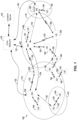
- FIG. 1 illustrates an exemplary wireless communications system 100.
- the wireless communications system 100 (which may also be referred to as a wireless wide area network (WWAN)) may include various base stations 102 and various UEs 104.
- the base stations 102 may include macro cell base stations (high power cellular base stations) and/or small cell base stations (low power cellular base stations).
- the macro cell base station may include eNBs where the wireless communications system 100 corresponds to an LTE network, or gNBs where the wireless communications system 100 corresponds to a NR network, or a combination of both, and the small cell base stations may include femtocells, picocells, microcells, etc.
- the base stations 102 may collectively form a RAN and interface with a core network 170 (e.g., an evolved packet core (EPC) or next generation core (NGC)) through backhaul links 122, and through the core network 170 to one or more location servers 172.
- a core network 170 e.g., an evolved packet core (EPC) or next generation core (NGC)
- EPC evolved packet core
- NTC next generation core
- different cells may be configured according to different protocol types (e.g., machine-type communication (MTC), narrowband IoT (NB-IoT), enhanced mobile broadband (eMBB), or others) that may provide access for different types of UEs.
- MTC machine-type communication
- NB-IoT narrowband IoT
- eMBB enhanced mobile broadband
- a cell may refer to either or both the logical communication entity and the base station that supports it, depending on the context.
- the term “cell” may also refer to a geographic coverage area of a base station (e.g., a sector), insofar as a carrier frequency can be detected and used for communication within some portion of geographic coverage areas 110.
- While neighboring macro cell base station 102 geographic coverage areas 110 may partially overlap (e.g., in a handover region), some of the geographic coverage areas 110 may be substantially overlapped by a larger geographic coverage area 110.
- a small cell base station 102' may have a coverage area 110' that substantially overlaps with the coverage area 110 of one or more macro cell base stations 102.
- a network that includes both small cell and macro cell base stations may be known as a heterogeneous network.
- a heterogeneous network may also include home eNBs (HeNBs), which may provide service to a restricted group known as a closed subscriber group (CSG).
- HeNBs home eNBs
- CSG closed subscriber group
- the communication links 120 between the base stations 102 and the UEs 104 may include UL (also referred to as reverse link) transmissions from a UE 104 to a base station 102 and/or downlink (DL) (also referred to as forward link) transmissions from a base station 102 to a UE 104.
- the communication links 120 may use MIMO antenna technology, including spatial multiplexing, beamforming, and/or transmit diversity.
- the communication links 120 may be through one or more carrier frequencies. Allocation of carriers may be asymmetric with respect to DL and UL (e.g., more or less carriers may be allocated for DL than for UL).
- the wireless communications system 100 may further include a wireless local area network (WLAN) access point (AP) 150 in communication with WLAN stations (STAs) 152 via communication links 154 in an unlicensed frequency spectrum (e.g., 5 GHz).
- WLAN STAs 152 and/or the WLAN AP 150 may perform a clear channel assessment (CCA) or listen before talk (LBT) procedure prior to communicating in order to determine whether the channel is available.
- CCA clear channel assessment
- LBT listen before talk
- the small cell base station 102' may operate in a licensed and/or an unlicensed frequency spectrum. When operating in an unlicensed frequency spectrum, the small cell base station 102' may employ LTE or NR technology and use the same 5 GHz unlicensed frequency spectrum as used by the WLAN AP 150. The small cell base station 102', employing LTE / 5G in an unlicensed frequency spectrum, may boost coverage to and/or increase capacity of the access network.
- NR in unlicensed spectrum may be referred to as NR-U.
- LTE in an unlicensed spectrum may be referred to as LTE-U, licensed assisted access (LAA), or MulteFire.
- the wireless communications system 100 may further include a millimeter wave (mmW) base station 180 that may operate in mmW frequencies and/or near mmW frequencies in communication with a UE 182.
- Extremely high frequency (EHF) is part of the RF in the electromagnetic spectrum. EHF has a range of 30 GHz to 300 GHz and a wavelength between 1 millimeter and 10 millimeters. Radio waves in this band may be referred to as a millimeter wave.
- Near mmW may extend down to a frequency of 3 GHz with a wavelength of 100 millimeters.
- the super high frequency (SHF) band extends between 3 GHz and 30 GHz, also referred to as centimeter wave.
- the mmW base station 180 and the UE 182 may utilize beamforming (transmit and/or receive) over a mmW communication link 184 to compensate for the extremely high path loss and short range.
- one or more base stations 102 may also transmit using mmW or near mmW and beamforming. Accordingly, it will be appreciated that the foregoing illustrations are merely examples and should not be construed to limit the various aspects disclosed herein.
- Transmit beamforming is a technique for focusing an RF signal in a specific direction.
- a network node e.g., a base station
- transmit beamforming the network node determines where a given target device (e.g., a UE) is located (relative to the transmitting network node) and projects a stronger downlink RF signal in that specific direction, thereby providing a faster (in terms of data rate) and stronger RF signal for the receiving device(s).
- a network node can control the phase and relative amplitude of the RF signal at each of the one or more transmitters that are broadcasting the RF signal.
- a network node may use an array of antennas (referred to as a "phased array” or an “antenna array”) that creates a beam of RF waves that can be "steered” to point in different directions, without actually moving the antennas.
- the RF current from the transmitter is fed to the individual antennas with the correct phase relationship so that the radio waves from the separate antennas add together to increase the radiation in a desired direction, while cancelling to suppress radiation in undesired directions.
- Transmit beams may be quasi-collocated, meaning that they appear to the receiver (e.g., a UE) as having the same parameters, regardless of whether or not the transmitting antennas of the network node themselves are physically collocated.
- the receiver e.g., a UE
- QCL relation of a given type means that certain parameters about a second reference RF signal on a second beam can be derived from information about a source reference RF signal on a source beam.
- the receiver can use the source reference RF signal to estimate the Doppler shift, Doppler spread, average delay, and delay spread of a second reference RF signal transmitted on the same channel.
- the receiver can use the source reference RF signal to estimate the Doppler shift and Doppler spread of a second reference RF signal transmitted on the same channel. If the source reference RF signal is QCL Type C, the receiver can use the source reference RF signal to estimate the Doppler shift and average delay of a second reference RF signal transmitted on the same channel. If the source reference RF signal is QCL Type D, the receiver can use the source reference RF signal to estimate the spatial receive parameter of a second reference RF signal transmitted on the same channel.
- the receiver uses a receive beam to amplify RF signals detected on a given channel.
- the receiver can increase the gain setting and/or adjust the phase setting of an array of antennas in a particular direction to amplify (e.g., to increase the gain level of) the RF signals received from that direction.
- a receiver is said to beamform in a certain direction, it means the beam gain in that direction is high relative to the beam gain along other directions, or the beam gain in that direction is the highest compared to the beam gain in that direction of all other receive beams available to the receiver. This results in a stronger received signal strength (e.g., reference signal received power (RSRP), reference signal received quality (RSRQ), signal-to-interference-plus-noise ratio (SINR), etc.) of the RF signals received from that direction.
- RSRP reference signal received power
- RSRQ reference signal received quality
- SINR signal-to-interference-plus-noise ratio
- Receive beams may be spatially related.
- a spatial relation means that parameters for a transmit beam for a second reference signal can be derived from information about a receive beam for a first reference signal.
- a UE may use a particular receive beam to receive a reference downlink reference signal (e.g., synchronization signal block (SSB)) from a base station.
- the UE can then form a transmit beam for sending an uplink reference signal (e.g., sounding reference signal (SRS)) to that base station based on the parameters of the receive beam.
- SSB synchronization signal block
- SRS sounding reference signal
- a "downlink" beam may be either a transmit beam or a receive beam, depending on the entity forming it. For example, if a base station is forming the downlink beam to transmit a reference signal to a UE, the downlink beam is a transmit beam. If the UE is forming the downlink beam, however, it is a receive beam to receive the downlink reference signal.
- an "uplink" beam may be either a transmit beam or a receive beam, depending on the entity forming it. For example, if a base station is forming the uplink beam, it is an uplink receive beam, and if a UE is forming the uplink beam, it is an uplink transmit beam.
- the frequency spectrum in which wireless nodes is divided into multiple frequency ranges, FR1 (from 450 to 6000 MHz), FR2 (from 24250 to 52600 MHz), FR3 (above 52600 MHz), and FR4 (between FR1 and FR2).
- the anchor carrier is the carrier operating on the primary frequency (e.g., FR1) utilized by a UE 104/182 and the cell in which the UE 104/182 either performs the initial radio resource control (RRC) connection establishment procedure or initiates the RRC connection reestablishment procedure.
- RRC radio resource control
- the primary carrier carries all common and UE-specific control channels, and may be a carrier in a licensed frequency (however, this is not always the case).
- a secondary carrier is a carrier operating on a second frequency (e.g., FR2) that may be configured once the RRC connection is established between the UE 104 and the anchor carrier and that may be used to provide additional radio resources.
- the secondary carrier may be a carrier in an unlicensed frequency.
- the secondary carrier may contain only necessary signaling information and signals, for example, those that are UE-specific may not be present in the secondary carrier, since both primary uplink and downlink carriers are typically UE-specific. This means that different UEs 104/182 in a cell may have different downlink primary carriers. The same is true for the uplink primary carriers.
- the network is able to change the primary carrier of any UE 104/182 at any time. This is done, for example, to balance the load on different carriers.
- a "serving cell” (whether a PCell or an SCell) corresponds to a carrier frequency / component carrier over which some base station is communicating, the term “cell,” “serving cell,” “component carrier,” “carrier frequency,” and the like can be used interchangeably.
- one of the frequencies utilized by the macro cell base stations 102 may be an anchor carrier (or "PCell") and other frequencies utilized by the macro cell base stations 102 and/or the mmW base station 180 may be secondary carriers ("SCells").
- PCell anchor carrier
- SCells secondary carriers
- the simultaneous transmission and/or reception of multiple carriers enables the UE 104/182 to significantly increase its data transmission and/or reception rates. For example, two 20 MHz aggregated carriers in a multi-carrier system would theoretically lead to a two-fold increase in data rate (i.e., 40 MHz), compared to that attained by a single 20 MHz carrier.
- the wireless communications system 100 may further include one or more UEs, such as UE 190, that connects indirectly to one or more communication networks via one or more device-to-device (D2D) peer-to-peer (P2P) links.
- UE 190 has a D2D P2P link 192 with one of the UEs 104 connected to one of the base stations 102 (e.g., through which UE 190 may indirectly obtain cellular connectivity) and a D2D P2P link 194 with WLAN STA 152 connected to the WLAN AP 150 (through which UE 190 may indirectly obtain WLAN-based Internet connectivity).
- the D2D P2P links 192 and 194 may be supported with any well-known D2D RAT, such as LTE Direct (LTE-D), WiFi Direct (WiFi-D), Bluetooth ® , and so on.
- the wireless communications system 100 may further include a UE 164 that may communicate with a macro cell base station 102 over a communication link 120 and/or the mmW base station 180 over a mmW communication link 184.
- the macro cell base station 102 may support a PCell and one or more SCells for the UE 164 and the mmW base station 180 may support one or more SCells for the UE 164.
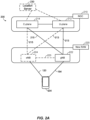
- FIG. 2A illustrates an example wireless network structure 200.
- an NGC 210 also referred to as a "5GC”
- control plane functions 214 e.g., UE registration, authentication, network access, gateway selection, etc.
- user plane functions 212 e.g., UE gateway function, access to data networks, IP routing, etc.
- User plane interface (NG-U) 213 and control plane interface (NG-C) 215 connect the gNB 222 to the NGC 210 and specifically to the control plane functions 214 and user plane functions 212.
- an eNB 224 may also be connected to the NGC 210 via NG-C 215 to the control plane functions 214 and NG-U 213 to user plane functions 212. Further, eNB 224 may directly communicate with gNB 222 via a backhaul connection 223. In some configurations, the New RAN 220 may only have one or more gNBs 222, while other configurations include one or more of both eNBs 224 and gNBs 222. Either gNB 222 or eNB 224 may communicate with UEs 204 (e.g., any of the UEs depicted in FIG. 1 ).
- location server 230 may be in communication with the NGC 210 to provide location assistance for UEs 204.
- the location server 230 can be implemented as a plurality of separate servers (e.g., physically separate servers, different software modules on a single server, different software modules spread across multiple physical servers, etc.), or alternately may each correspond to a single server.
- the location server 230 can be configured to support one or more location services for UEs 204 that can connect to the location server 230 via the core network, NGC 210, and/or via the Internet (not illustrated). Further, the location server 230 may be integrated into a component of the core network, or alternatively may be external to the core network.
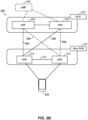
- FIG. 2B illustrates another example wireless network structure 250.
- an NGC 260 (also referred to as a "5GC") can be viewed functionally as control plane functions, provided by an access and mobility management function (AMF) / user plane function (UPF) 264, and user plane functions, provided by a session management function (SMF) 262, which operate cooperatively to form the core network (i.e., NGC 260).
- AMF access and mobility management function
- UPF user plane function
- SMF session management function
- User plane interface 263 and control plane interface 265 connect the eNB 224 to the NGC 260 and specifically to SMF 262 and AMF/UPF 264, respectively.
- a gNB 222 may also be connected to the NGC 260 via control plane interface 265 to AMF/UPF 264 and user plane interface 263 to SMF 262. Further, eNB 224 may directly communicate with gNB 222 via the backhaul connection 223, with or without gNB direct connectivity to the NGC 260.
- the New RAN 220 may only have one or more gNBs 222, while other configurations include one or more of both eNBs 224 and gNBs 222. Either gNB 222 or eNB 224 may communicate with UEs 204 (e.g., any of the UEs depicted in FIG. 1 ).
- the base stations of the New RAN 220 communicate with the AMF-side of the AMF/UPF 264 over the N2 interface and the UPF-side of the AMF/UPF 264 over the N3 interface.
- the functions of the AMF include registration management, connection management, reachability management, mobility management, lawful interception, transport for session management (SM) messages between the UE 204 and the SMF 262, transparent proxy services for routing SM messages, access authentication and access authorization, transport for short message service (SMS) messages between the UE 204 and the short message service function (SMSF) (not shown), and security anchor functionality (SEAF).
- the AMF also interacts with the authentication server function (AUSF) (not shown) and the UE 204, and receives the intermediate key that was established as a result of the UE 204 authentication process.
- AUSF authentication server function
- USIM subscriber identity module
- the functions of the AMF also include security context management (SCM).
- SCM receives a key from the SEAF that it uses to derive access-network specific keys.
- the functionality of the AMF also includes location services management for regulatory services, transport for location services messages between the UE 204 and the location management function (LMF) 270, as well as between the New RAN 220 and the LMF 270, evolved packet system (EPS) bearer identifier allocation for interworking with the EPS, and UE 204 mobility event notification.
- LMF location management function
- EPS evolved packet system
- the AMF also supports functionalities for non-3GPP access networks.
- Functions of the UPF include acting as an anchor point for intra-/inter-RAT mobility (when applicable), acting as an external protocol data unit (PDU) session point of interconnect to the data network (not shown), providing packet routing and forwarding, packet inspection, user plane policy rule enforcement (e.g., gating, redirection, traffic steering), lawful interception (user plane collection), traffic usage reporting, quality of service (QoS) handling for the user plane (e.g., UL/DL rate enforcement, reflective QoS marking in the DL), UL traffic verification (service data flow (SDF) to QoS flow mapping), transport level packet marking in the UL and DL, DL packet buffering and DL data notification triggering, and sending and forwarding of one or more "end markers" to the source RAN node.
- PDU protocol data unit
- the functions of the SMF 262 include session management, UE Internet protocol (IP) address allocation and management, selection and control of user plane functions, configuration of traffic steering at the UPF to route traffic to the proper destination, control of part of policy enforcement and QoS, and downlink data notification.
- IP Internet protocol
- the interface over which the SMF 262 communicates with the AMF-side of the AMF/UPF 264 is referred to as the N11 interface.
- LMF 270 may be in communication with the NGC 260 to provide location assistance for UEs 204.
- the LMF 270 can be implemented as a plurality of separate servers (e.g., physically separate servers, different software modules on a single server, different software modules spread across multiple physical servers, etc.), or alternately may each correspond to a single server.
- the LMF 270 can be configured to support one or more location services for UEs 204 that can connect to the LMF 270 via the core network, NGC 260, and/or via the Internet (not illustrated).
- apparatuses in a system may include components similar to those described to provide similar functionality.
- a given apparatus may contain one or more of the components.
- an apparatus may include multiple transceiver components that enable the apparatus to operate on multiple carriers and/or communicate via different technologies.
- the WWAN transceivers 310 and 350 may be variously configured for transmitting and encoding signals 318 and 358 (e.g., messages, indications, information, and so on), respectively, and, conversely, for receiving and decoding signals 318 and 358 (e.g., messages, indications, information, pilots, and so on), respectively, in accordance with the designated RAT.
- the transceivers 310 and 350 include one or more transmitters 314 and 354, respectively, for transmitting and encoding signals 318 and 358, respectively, and one or more receivers 312 and 352, respectively, for receiving and decoding signals 318 and 358, respectively.
- the UE 302 and the base station 304 also include, at least in some cases, wireless local area network (WLAN) transceivers 320 and 360, respectively.
- WLAN transceivers 320 and 360 may be connected to one or more antennas 326 and 366, respectively, for communicating with other network nodes, such as other UEs, access points, base stations, etc., via at least one designated RAT (e.g., WiFi, LTE-D, Bluetooth ® , etc.) over a wireless communication medium of interest.
- RAT e.g., WiFi, LTE-D, Bluetooth ® , etc.
- the WLAN transceivers 320 and 360 may be variously configured for transmitting and encoding signals 328 and 368 (e.g., messages, indications, information, and so on), respectively, and, conversely, for receiving and decoding signals 328 and 368 (e.g., messages, indications, information, pilots, and so on), respectively, in accordance with the designated RAT.
- the transceivers 320 and 360 include one or more transmitters 324 and 364, respectively, for transmitting and encoding signals 328 and 368, respectively, and one or more receivers 322 and 362, respectively, for receiving and decoding signals 328 and 368, respectively.
- a receiver may include or be coupled to a plurality of antennas (e.g., antennas 316, 336, and 376), such as an antenna array, that permits the respective apparatus to perform receive beamforming, as described herein.
- the transmitter and receiver may share the same plurality of antennas (e.g., antennas 316, 336, and 376), such that the respective apparatus can only receive or transmit at a respective time for the respective element, not both at the same time.
- a wireless communication device e.g., one or both of the transceivers 310 and 320 and/or 350 and 360
- NLM network listen module
- the base station 304 and the network entity 306 each include at least one network interfaces 380 and 390 for communicating with other network entities.
- the network interfaces 380 and 390 e.g., one or more network access ports
- the network interfaces 380 and 390 may be implemented as transceivers configured to support wire-based or wireless signal communication. This communication may involve, for example, sending and receiving: messages, parameters, or other types of information.
- the apparatuses 302, 304, and 306 also include other components that may be used in conjunction with the operations as disclosed herein.
- the UE 302 includes processor circuitry implementing a processing system 332 for providing functionality relating to, for example, false base station (FBS) detection as disclosed herein and for providing other processing functionality.
- the base station 304 includes a processing system 384 for providing functionality relating to, for example, FBS detection as disclosed herein and for providing other processing functionality.
- the network entity 306 includes a processing system 394 for providing functionality relating to, for example, FBS detection as disclosed herein and for providing other processing functionality.
- processing systems 332, 384, and 394 may include, for example, one or more general purpose processors, multi-core processors, ASICs, digital signal processors (DSPs), field programmable gate arrays (FPGA), or other programmable logic devices or processing circuitry.
- general purpose processors multi-core processors
- ASICs application-specific integrated circuits
- DSPs digital signal processors
- FPGA field programmable gate arrays
- the apparatuses 302, 304, and 306 include memory circuitry implementing memory components 340, 386, and 396 (e.g., each including a memory device), respectively, for maintaining information (e.g., information indicative of reserved resources, thresholds, parameters, and so on).
- the apparatus 302 may include power headroom report (PHR) module 342.
- PHR power headroom report
- the PHR module 342 may comprise a hardware circuit that is part of or coupled to the processing system 332, that, when executed, cause the apparatus 302, to perform the functionality described herein.
- the PHR module 342 may be external to the processing system 332 (e.g., part of a modem processing system, integrated with another processing system, etc.).
- the PHR module 342 may be a memory module (as shown in FIGS. 3A ) stored in the memory component 340, that, when executed by the processing system 332 (e.g., or a modem processing system, another processing system, etc.), cause the apparatus 302 to perform the functionality described herein.
- the processing system 332 e.g., or a modem processing system, another processing system, etc.
- the UE 302 may include one or more sensors 344 coupled to the processing system 332 to provide movement and/or orientation information that is independent of motion data derived from signals received by the WWAN transceiver 310, the WLAN transceiver 320, and/or the SPS receiver 330.
- the sensor(s) 344 may include an accelerometer (e.g., a micro-electrical mechanical systems (MEMS) device), a gyroscope, a geomagnetic sensor (e.g., a compass), an altimeter (e.g., a barometric pressure altimeter), and/or any other type of movement detection sensor.
- MEMS micro-electrical mechanical systems
- the senor(s) 344 may include a plurality of different types of devices and combine their outputs in order to provide motion information.
- the sensor(s) 344 may use a combination of a multi-axis accelerometer and orientation sensors to provide the ability to compute positions in 2D and/or 3D coordinate systems.
- the UE 302 includes a user interface 346 for providing indications (e.g., audible and/or visual indications) to a user and/or for receiving user input (e.g., upon user actuation of a sensing device such a keypad, a touch screen, a microphone, and so on).
- a user interface 346 for providing indications (e.g., audible and/or visual indications) to a user and/or for receiving user input (e.g., upon user actuation of a sensing device such a keypad, a touch screen, a microphone, and so on).
- the apparatuses 304 and 306 may also include user interfaces.
- IP packets from the network entity 306 may be provided to the processing system 384.
- the processing system 384 may implement functionality for an RRC layer, a packet data convergence protocol (PDCP) layer, a radio link control (RLC) layer, and a medium access control (MAC) layer.
- PDCP packet data convergence protocol
- RLC radio link control
- MAC medium access control
- the processing system 384 may provide RRC layer functionality associated with broadcasting of system information (e.g., master information block (MIB), system information blocks (SIBs)), RRC connection control (e.g., RRC connection paging, RRC connection establishment, RRC connection modification, and RRC connection release), inter-RAT mobility, and measurement configuration for UE measurement reporting; PDCP layer functionality associated with header compression/decompression, security (ciphering, deciphering, integrity protection, integrity verification), and handover support functions; RLC layer functionality associated with the transfer of upper layer packet data units (PDUs), error correction through ARQ, concatenation, segmentation, and reassembly of RLC service data units (SDUs), re-segmentation of RLC data PDUs, and reordering of RLC data PDUs; and MAC layer functionality associated with mapping between logical channels and transport channels, scheduling information reporting, error correction, priority handling, and logical channel prioritization.
- RRC layer functionality associated with broadcasting of system information (e
- the transmitter 354 and the receiver 352 may implement Layer-1 functionality associated with various signal processing functions.
- Layer-1 which includes a physical (PHY) layer, may include error detection on the transport channels, forward error correction (FEC) coding/decoding of the transport channels, interleaving, rate matching, mapping onto physical channels, modulation/demodulation of physical channels, and MIMO antenna processing.
- FEC forward error correction
- the transmitter 354 handles mapping to signal constellations based on various modulation schemes (e.g., binary phase-shift keying (BPSK), quadrature phase-shift keying (QPSK), M-phase-shift keying (M-PSK), M-quadrature amplitude modulation (M-QAM)).
- BPSK binary phase-shift keying
- QPSK quadrature phase-shift keying
- M-PSK M-phase-shift keying
- M-QAM M-quadrature amplitude modulation
- Each stream may then be mapped to an orthogonal frequency division multiplexing (OFDM) subcarrier, multiplexed with a reference signal (e.g., pilot) in the time and/or frequency domain, and then combined together using an Inverse Fast Fourier Transform (IFFT) to produce a physical channel carrying a time domain OFDM symbol stream.
- OFDM orthogonal frequency division multiplexing
- IFFT Inverse Fast Fourier Transform
- the OFDM stream is spatially precoded to produce multiple spatial streams.
- Channel estimates from a channel estimator may be used to determine the coding and modulation scheme, as well as for spatial processing.
- the channel estimate may be derived from a reference signal and/or channel condition feedback transmitted by the UE 302.
- Each spatial stream may then be provided to one or more different antennas 356.
- the transmitter 354 may modulate an RF carrier with a respective spatial stream for transmission.
- the receiver 312 receives a signal through its respective antenna(s) 316.
- the receiver 312 recovers information modulated onto an RF carrier and provides the information to the processing system 332.
- the transmitter 314 and the receiver 312 implement Layer-1 functionality associated with various signal processing functions.
- the receiver 312 may perform spatial processing on the information to recover any spatial streams destined for the UE 302. If multiple spatial streams are destined for the UE 302, they may be combined by the receiver 312 into a single OFDM symbol stream.
- the receiver 312 then converts the OFDM symbol stream from the time-domain to the frequency domain using a fast Fourier transform (FFT).
- FFT fast Fourier transform
- the frequency domain signal comprises a separate OFDM symbol stream for each subcarrier of the OFDM signal.
- the symbols on each subcarrier, and the reference signal are recovered and demodulated by determining the most likely signal constellation points transmitted by the base station 304. These soft decisions may be based on channel estimates computed by a channel estimator. The soft decisions are then decoded and de-interleaved to recover the data and control signals that were originally transmitted by the base station 304 on the physical channel. The data and control signals are then provided to the processing system 332, which implements Layer-3 and Layer-2 functionality.
- the processing system 332 provides demultiplexing between transport and logical channels, packet reassembly, deciphering, header decompression, and control signal processing to recover IP packets from the core network.
- the processing system 332 is also responsible for error detection.
- the processing system 332 provides RRC layer functionality associated with system information (e.g., MIB, SIBs) acquisition, RRC connections, and measurement reporting; PDCP layer functionality associated with header compression/decompression, and security (ciphering, deciphering, integrity protection, integrity verification); RLC layer functionality associated with the transfer of upper layer PDUs, error correction through ARQ, concatenation, segmentation, and reassembly of RLC SDUs, re-segmentation of RLC data PDUs, and reordering of RLC data PDUs; and MAC layer functionality associated with mapping between logical channels and transport channels, multiplexing of MAC SDUs onto transport blocks (TBs), demultiplexing of MAC SDUs from TBs, scheduling information reporting, error correction through HARQ, priority handling, and logical channel prioritization.
- RRC layer functionality associated with system information (e.g., MIB, SIBs) acquisition, RRC connections, and measurement reporting
- PDCP layer functionality associated with header compression/
- Channel estimates derived by the channel estimator from a reference signal or feedback transmitted by the base station 304 may be used by the transmitter 314 to select the appropriate coding and modulation schemes, and to facilitate spatial processing.
- the spatial streams generated by the transmitter 314 may be provided to different antenna(s) 316.
- the transmitter 314 may modulate an RF carrier with a respective spatial stream for transmission.
- the UL transmission is processed at the base station 304 in a manner similar to that described in connection with the receiver function at the UE 302.
- the receiver 352 receives a signal through its respective antenna(s) 356.
- the receiver 352 recovers information modulated onto an RF carrier and provides the information to the processing system 384.
- the processing system 384 provides demultiplexing between transport and logical channels, packet reassembly, deciphering, header decompression, control signal processing to recover IP packets from the UE 302. IP packets from the processing system 384 may be provided to the core network.
- the processing system 384 is also responsible for error detection.
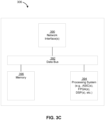
- FIGS. 3A-C For convenience, the apparatuses 302, 304, and/or 306 are shown in FIGS. 3A-C as including various components that may be configured according to the various examples described herein. It will be appreciated, however, that the illustrated blocks may have different functionality in different designs.
- the various components of the apparatuses 302, 304, and 306 may communicate with each other over data buses 334, 382, and 392, respectively.
- the components of FIGS. 3A-C may be implemented in various ways.
- the components of FIGS. 3A-C may be implemented in one or more circuits such as, for example, one or more processors and/or one or more ASICs (which may include one or more processors).
- each circuit may use and/or incorporate at least one memory component for storing information or executable code used by the circuit to provide this functionality.
- some or all of the functionality represented by blocks 310 to 346 may be implemented by processor and memory component(s) of the UE 302 (e.g., by execution of appropriate code and/or by appropriate configuration of processor components).
- some or all of the functionality represented by blocks 350 to 386 may be implemented by processor and memory component(s) of the base station 304 (e.g., by execution of appropriate code and/or by appropriate configuration of processor components).
- some or all of the functionality represented by blocks 390 to 396 may be implemented by processor and memory component(s) of the network entity 306 (e.g., by execution of appropriate code and/or by appropriate configuration of processor components).
- various operations, acts, and/or functions are described herein as being performed “by a UE,” “by a base station,” “by a positioning entity,” etc.
- FIG. 4A is a diagram 400 illustrating an example of a DL frame structure, according to aspects of the disclosure.
- FIG. 4B is a diagram 430 illustrating an example of channels within the DL frame structure, according to aspects of the disclosure.
- Other wireless communications technologies may have a different frame structures and/or different channels.
- LTE and in some cases NR, utilizes OFDM on the downlink and single-carrier frequency division multiplexing (SC-FDM) on the uplink.
- SC-FDM single-carrier frequency division multiplexing
- OFDM and SC-FDM partition the system bandwidth into multiple (K) orthogonal subcarriers, which are also commonly referred to as tones, bins, etc.
- K multiple orthogonal subcarriers
- Each subcarrier may be modulated with data.
- modulation symbols are sent in the frequency domain with OFDM and in the time domain with SC-FDM.
- the spacing between adjacent subcarriers may be fixed, and the total number of subcarriers (K) may be dependent on the system bandwidth.
- the spacing of the subcarriers may be 15 kHz and the minimum resource allocation (resource block) may be 12 subcarriers (or 180 kHz). Consequently, the nominal FFT size may be equal to 128, 256, 512, 1024, or 2048 for system bandwidth of 1.25, 2.5, 5, 10, or 20 megahertz (MHz), respectively.
- the system bandwidth may also be partitioned into subbands. For example, a subband may cover 1.08 MHz (i.e., 6 resource blocks), and there may be 1, 2, 4, 8, or 16 subbands for system bandwidth of 1.25, 2.5, 5, 10, or 20 MHz, respectively.
- LTE supports a single numerology (subcarrier spacing, symbol length, etc.).
- NR may support multiple numerologies, for example, subcarrier spacing of 15 kHz, 30 kHz, 60 kHz, 120 kHz and 204 kHz or greater may be available.
- Table 1 provided below lists some various parameters for different NR numerologies.
- Table 1 Subcarrier spacing (kHz) Symbols / slot slots / subframe slots / frame slot (ms) Symbol duration ( ⁇ s) Max. nominal system BW (MHz) with 4K FFT size 15 14 1 10 1 66.7 50 30 14 2 20 0.5 33.3 100 60 14 4 40 0.25 16.7 100 120 14 8 80 0.125 8.33 400 240 14 16 160 0.0625 4.17 800
- a numerology of 15 kHz is used.
- a frame e.g., 10 ms
- each subframe includes one time slot.
- time is represented horizontally (e.g., on the X axis) with time increasing from left to right
- frequency is represented vertically (e.g., on the Y axis) with frequency increasing (or decreasing) from bottom to top.
- a resource grid may be used to represent time slots, each time slot including one or more time concurrent resource blocks (RBs) (also referred to as physical RBs (PRBs)) in the frequency domain.
- the resource grid is further divided into multiple resource elements (REs).
- An RE may correspond to one symbol length in the time domain and one subcarrier in the frequency domain.
- an RB may contain 12 consecutive subcarriers in the frequency domain and 7 consecutive symbols (for DL, OFDM symbols; for UL, SC-FDMA symbols) in the time domain, for a total of 84 REs.
- an RB may contain 12 consecutive subcarriers in the frequency domain and 6 consecutive symbols in the time domain, for a total of 72 REs.
- the number of bits carried by each RE depends on the modulation scheme.
- the DL-RS may include demodulation reference signals (DMRS) and channel state information reference signals (CSI-RS), exemplary locations of which are labeled "R" in FIG. 4A .
- DMRS demodulation reference signals
- CSI-RS channel state information reference signals
- FIG. 4B illustrates an example of various channels within a DL subframe of a frame.
- the physical downlink control channel (PDCCH) carries DL control information (DCI) within one or more control channel elements (CCEs), each CCE including nine RE groups (REGs), each REG including four consecutive REs in an OFDM symbol.
- the DCI carries information about UL resource allocation (persistent and non-persistent) and descriptions about DL data transmitted to the UE.
- Multiple (e.g., up to 8) DCIs can be configured in the PDCCH, and these DCIs can have one of multiple formats. For example, there are different DCI formats for UL scheduling, for non-MIMO DL scheduling, for MIMO DL scheduling, and for UL power control.
- a primary synchronization signal is used by a UE to determine subframe/symbol timing and a physical layer identity.
- a secondary synchronization signal is used by a UE to determine a physical layer cell identity group number and radio frame timing. Based on the physical layer identity and the physical layer cell identity group number, the UE can determine a PCI. Based on the PCI, the UE can determine the locations of the aforementioned DL-RS.
- the physical broadcast channel (PBCH), which carries an MIB, may be logically grouped with the PSS and SSS to form an SSB (also referred to as an SS/PBCH).
- the MIB provides a number of RBs in the DL system bandwidth and a system frame number (SFN).
- the physical downlink shared channel (PDSCH) carries user data, broadcast system information not transmitted through the PBCH such as system information blocks (SIBs), and paging messages.
- SIBs system information blocks
- the DL RS illustrated in FIG. 4A may be positioning reference signals (PRS).
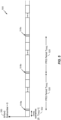
- FIG. 5 illustrates an exemplary PRS configuration 500 for a cell supported by a wireless node (such as a base station 102).
- FIG. 5 shows how PRS positioning occasions are determined by a system frame number (SFN), a cell specific subframe offset ( ⁇ PRS ) 552, and the PRS periodicity ( T PRS ) 520.
- SFN system frame number
- ⁇ PRS cell specific subframe offset
- T PRS PRS periodicity
- the cell specific PRS subframe configuration is defined by a "PRS Configuration Index" I PRS included in observed time difference of arrival (OTDOA) assistance data.
- OTDOA observed time difference of arrival
- the PRS periodicity ( T PRS ) 520 and the cell specific subframe offset ( ⁇ PRS ) are defined based on the PRS configuration index I PRS , as illustrated in Table 2 below.
- a PRS configuration is defined with reference to the SFN of a cell that transmits PRS.
- the cell specific subframe offset ⁇ PRS 552 may be defined in terms of the number of subframes transmitted starting from system frame number 0 (Slot 'Number 0', marked as slot 550) to the start of the first (subsequent) PRS positioning occasion.
- the number of consecutive positioning subframes ( N PRS ) in each of the consecutive PRS positioning occasions 518a, 518b, and 518c equals 4. That is, each shaded block representing PRS positioning occasions 518a, 518b, and 518c represents four subframes.
- the UE may determine the PRS periodicity T PRS 520 and PRS subframe offset ⁇ PRS using Table 2. The UE may then determine the radio frame, subframe, and slot when a PRS is scheduled in the cell (e.g., using equation (1)).
- the OTDOA assistance data may be determined by, for example, the location server (e.g., location server 230, LMF 270), and includes assistance data for a reference cell, and a number of neighbor cells supported by various base stations.
- PRS occasions from all cells in a network that use the same frequency are aligned in time and may have a fixed known time offset (e.g., cell-specific subframe offset 552) relative to other cells in the network that use a different frequency.
- all wireless nodes e.g., base stations 102
- SFN-synchronous networks all wireless nodes (e.g., base stations 102) may be aligned on both frame boundary and system frame number. Therefore, in SFN-synchronous networks, all cells supported by the various wireless nodes may use the same PRS configuration index for any particular frequency of PRS transmission.
- the various wireless nodes may be aligned on a frame boundary, but not system frame number.
- the PRS configuration index for each cell may be configured separately by the network so that PRS occasions align in time.
- a UE may determine the timing of the PRS occasions of the reference and neighbor cells for OTDOA positioning, if the UE can obtain the cell timing (e.g., SFN) of at least one of the cells, e.g., the reference cell or a serving cell.
- the timing of the other cells may then be derived by the UE based, for example, on the assumption that PRS occasions from different cells overlap.
- 3GPP Rel. 15 introduced the power headroom report (PHR) as a MAC Control Element (CE).
- PHR reports the headroom between the current UE transmit power (estimated power) and the nominal power.
- the serving cell may use the PHR to estimate how much uplink bandwidth the UE is permitted to use for a particular subframe.
- the PHR may be triggered by PHR functional configuration or reconfiguration, cell activation, periodically, or by variation in pathloss or a power-backoff (P-MPR c ) prior to a next periodic trigger for PHR.
- P-MPR c power-backoff
- the PL-RS may be SSB or CSI-RS, and the UE can maintain up to four (4) PL-RSs per serving cell for all UL transmissions (e.g., Physical Uplink Control Channel (PUCCH), Physical Uplink Shared Channel (PUSCH), SRS, etc.).
- PUCCH Physical Uplink Control Channel
- PUSCH Physical Uplink Shared Channel
- SRS etc.
- 3GPP Rel. 16 expanded upon the number of PL-RSs that may trigger PHRs.
- a UL SRS for positioning (which may be characterized as a UL PRS) can be associated with SSB or DL PRS as PL-RS.
- Up to N PL-RSs may be used across all UL PRS sets in addition to the 4 PL RSs per serving cell as in 3GPP Rel. 15.
- N is configurable as a UE capability (e.g., via RRC signaling), and may be equal to 0, 4, 8 or 16.
- SSB may be from serving or neighboring cell (e.g., cell ID is indicated).
- DL PRS may be from any TRP (e.g., TRP is indicated).
- SSB and PRS transmit power is also indicated.
- One or more embodiments of the disclosure are directed to implementing a PHR function (e.g., monitoring one or more conditions associated with a PL-RS for selectively triggering a PHR) in a selective manner.
- a PHR function e.g., monitoring one or more conditions associated with a PL-RS for selectively triggering a PHR
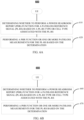
- FIG. 6A illustrates an exemplary process 600 of wireless communication, according to aspects of the disclosure.
- the process 600 may be performed by a UE.
- the UE determines whether to perform a power headroom report (PHR) function for a pathloss reference signal (PL-RS) based on a PL-RS type or cell type associated with the PL-RS.
- PHR power headroom report
- PL-RS pathloss reference signal
- the determination of 610 may be based upon at least one rule associated with PHRs for PL-RSs.
- the at least one rule may be pre-defined (e.g., defined in the relevant standard).
- the at least one rule may be dynamically configured (e.g., via DCI or MAC-CE in some designs, via higher-layer signaling in other designs, such as RRC signaling).
- operation 610 may be performed by receiver(s) 312, WWAN transceiver 310, processing system 332, memory 340, PHR module 342, etc.
- the UE performing a PHR function or one or more pathloss measurements for the PL-RS based on the determination.
- the performing of operation 620 performs the PHR function and the one or more pathloss measurements for the PL-RS (e.g., if the determination of 610 is to perform the PHR function).
- the performing performs only the one or more pathloss measurements for the PL-RS (e.g., if the determination of 610 is not to perform the PHR function).
- the PHR function may comprise monitoring one or more conditions associated with a respective PL-RS for selectively triggering a PHR.
- these PHR triggering condition(s) may comprise PHR functional configuration or reconfiguration, cell activation, periodically, or by variation in pathloss or a power-backoff (P-MPR c ) prior to a next periodic trigger for PHR.
- operation 620 may be performed by transmitter(s) 314, WWAN transceiver 310, processing system 332, memory 340, PHR module 342, etc.
- the UE can be characterized as 'refraining' from performing the PHR function for that PL-RS, which may be interpreted as the UE refraining from generating and/or transmitting a PHR, irrespective of whether one or more PHR triggering condition(s) are satisfied. So, the at least one rule effectively overrides the PHR triggering condition(s) such that a PHR is not reported in a scenario where a PHR would have been transmitted if the determination at 610 determines to perform the PHR function.
- the UE performs one or more pathloss measurements on the PL-RS in association with one or more UL PRSs.
- the UE further optionally performs power control for the UL PRS(s) based on the one or more pathloss measurements at 620.
- the determination of 610 is not to perform the PHR function, then the one or more pathloss measurements are ignored for PHR-related consideration for the PL-RS.
- one or more of these optional pathloss measurement(s) may be used to selectively trigger a PHR if the determination of 610 is to perform the PHR function.
- PL-RSs for which the determination of 610 is to perform the PHR function may correspond to a first set of PL-RSs
- PL-RSs for which the determination of 610 is not to perform the PHR function may correspond to a second set of PL-RSs.
- the UL PRSs may or may not include the cell(s) associated with the first set of PL-RS, and limiting pathloss on the second set of PL-RSs may be unnecessary (e.g., redundant with the pathloss management performed for the first set of PL-RSs is the same cell(s) are involved), in which case the optional pathloss measurements may not be performed for the second set of PL-RSs.
- the first set of PL-RSs is used to selectively trigger the PHR, whereas both the first and second sets of PL-RSs are used for the UL-PRSs.
- excluding certain PL-RS(s) from the PHR function provides one or more technical advantages (e.g., relative to simply performing the PHR function on all PL-RSs), such as reduced power consumption at the UE, reduced system overhead and/or interference, scalability (e.g., more PL-RSs can be supported without experiencing PHR-related bottlenecks), and so on.
- technical advantages e.g., relative to simply performing the PHR function on all PL-RSs
- reduced power consumption at the UE reduced system overhead and/or interference
- scalability e.g., more PL-RSs can be supported without experiencing PHR-related bottlenecks
- the least one rule may be to characterize the 4 legacy 3GPP Rel. 15 PL-RSs as part of the first set of PL-RSs, while characterizing any other PL-RSs as part of the second set of PL-RSs. In this case, the inclusion of additional PL-RSs will have no impact to PHR.
- the at least one rule may comprise excluding, from participation in the PHR function, any RS serving as a PL-RS for a UL PRS.
- exclusion of a PL-RS from the PHR function implies characterization of that excluded PL-RS as part of the second set of PL-RSs.
- an "UL PRS" may be any combination of an SRS explicitly identified as an 'SRS for positioning' (or equivalent), or a subset of such SRSs (e.g., SRS that are for positioning while further satisfying minimum and/or maximum bandwidth thresholds, comb-density, duration, a comb-staggering condition such as whether comb-staggering is enabled/disabled, etc.).
- the at least one rule may comprise excluding, from participation in the PHR function, any RS serving as a PL-RS for only a UL PRS.
- a first PL-RS that is common to a UL PRS as well as other UL channel(s) may be part of the first set (i.e., included for PHR function)
- a second PL-RS that is specific to a UL PRS and is not associated with other UL channel(s) may be part of the second set (i.e., excluded for PHR function)
- the at least one rule may comprise excluding, from participation in the PHR function, any DL PRS serving as RS.
- one DL-PRS serving as a PL-RS for a UL-PRS may be excluded in a more selective manner, e.g., based on TRP-ID (e.g., DL PRSs associated with certain TRPs are part of the first set, and DL PRSs associated with other TRPs are part of the second set).
- the at least one rule may comprise excluding, from participation in the PHR function, any DL PRS associated with a non-serving cell (e.g., determined based on TRP-ID).
- a first PL for a DL PRS that is associated with a serving cell may be part of the first set (i.e., included for PHR function), whereas a second PL for a DL PRS that is associated with a non-serving cell may be part of the second set (i.e., excluded for PHR function).
- the at least one rule may comprise excluding, from participation in the PHR function, any RS serving as a PL-RS for any DL RS associated with a non-serving cell.
- the non-serving cell may be identified based on an associated TRP-ID.
- the at least one rule may comprise multiple rules, such as any of the rules noted above, implemented in combination.
- the at least one rule may comprise excluding, from participation in the PHR function any RS serving as a PL-RS for an UL PRS, any RS serving as a PL-RS for only a UL PRS, any DL-PRS serving as PL-RS for UL-PRS, any RS serving as a PL-RS for a DL PRS associated with a non-serving cell, any RS serving as a PL-RS for any DL RS associated with a non-serving cell, or any combination thereof.
- FIG. 6B illustrates an exemplary process 650 of wireless communication, according to aspects of the disclosure.
- the process 650 may be performed by a UE.
- the UE determines whether to perform a power headroom report (PHR) function for a pathloss reference signal (PL-RS) based on an indication associated with the PL-RS that is received from a serving cell of the UE.
- PHR power headroom report
- PL-RS pathloss reference signal
- the determination of 660 may be based upon at least one rule associated with PHRs for PL-RSs.
- the at least one rule may be pre-defined (e.g., defined in the relevant standard).
- the at least one rule may be dynamically configured (e.g., via DCI or MAC-CE in some designs, via higher-layer signaling in other designs, such as RRC signaling).
- operation 660 may be performed by receiver(s) 312, WWAN transceiver 310, processing system 332, memory 340, PHR module 342, etc.
- the UE performing a PHR function or one or more pathloss measurements for the PL-RS based on the determination.
- the performing of operation 670 performs the PHR function and the one or more pathloss measurements for the PL-RS (e.g., if the determination of 660 is to perform the PHR function).
- the performing performs only the one or more pathloss measurements for the PL-RS (e.g., if the determination of 660 is not to perform the PHR function).
- the PHR function may comprise monitoring one or more conditions associated with a respective PL-RS for selectively triggering a PHR.
- these PHR triggering condition(s) may comprise PHR functional configuration or reconfiguration, cell activation, periodically, or by variation in pathloss or a power-backoff (P-MPR c ) prior to a next periodic trigger for PHR.
- operation 670 may be performed by transmitter(s) 314, WWAN transceiver 310, processing system 332, memory 340, PHR module 342, etc.
- the UE can be characterized as 'refraining' from performing the PHR function for that PL-RS, which may be interpreted as the UE refraining from generating and/or transmitting a PHR, irrespective of whether one or more PHR triggering condition(s) are satisfied. So, the at least one rule effectively overrides the PHR triggering condition(s) such that a PHR is not reported in a scenario where a PHR would have been transmitted if the determination at 660 determines to perform the PHR function.
- the UE performs one or more pathloss measurements on the PL-RS in association with one or more UL PRSs.
- the UE further optionally performs power control for the UL PRS(s) based on the one or more pathloss measurements at 670.
- the determination of 660 is not to perform the PHR function, then the one or more pathloss measurements are ignored for PHR-related consideration for the PL-RS.
- one or more of these optional pathloss measurement(s) may be used to selectively trigger a PHR if the determination of 660 is to perform the PHR function.
- PL-RSs for which the determination of 660 is to perform the PHR function may correspond to a first set of PL-RSs
- PL-RSs for which the determination of 660 is not to perform the PHR function may correspond to a second set of PL-RSs.
- the UL PRSs may or may not include the cell(s) associated with the first set of PL-RS, and limiting pathloss on the second set of PL-RSs may be unnecessary (e.g., redundant with the pathloss management performed for the first set of PL-RSs is the same cell(s) are involved), in which case the optional pathloss measurements may not be performed for the second set of PL-RSs.
- the first set of PL-RSs is used to selectively trigger the PHR, whereas both the first and second sets of PL-RSs are used for the UL-PRSs.
- excluding certain PL-RS(s) from the PHR function provides one or more technical advantages (e.g., relative to simply performing the PHR function on all PL-RSs), such as reduced power consumption at the UE, reduced system overhead and/or interference, scalability (e.g., more PL-RSs can be supported without experiencing PHR-related bottlenecks), and so on.
- technical advantages e.g., relative to simply performing the PHR function on all PL-RSs
- reduced power consumption at the UE reduced system overhead and/or interference
- scalability e.g., more PL-RSs can be supported without experiencing PHR-related bottlenecks
- the at least one rule may comprise excluding, from participation in the PHR function, any RS serving as a PL-RS for which an explicit indication is provided that indicates PHR function exclusion (e.g., an explicit 'opt-out' rule).
- the at least one rule may comprise excluding, from participation in the PHR function, any RS serving as a PL-RS for which no explicit indication is provided that indicates PHR function inclusion (e.g., an explicit 'opt-in' rule).
- the explicit opt-in rule or explicit opt-out rule may be implemented for particular RS types, such as RSs that serve as PL-RS for at least one UL PRS, or that only serve as PL-RS for UL PRS (e.g., as opposed to a common PL-RS that is associated with both UL PRS and other channel type(s)).
- the explicit opt-in rule or explicit opt-out rule may apply to one or more of the 4 legacy 3GPP Rel. 15 PL-RSs.
- the at least one rule may comprise excluding, from participation in the PHR function, any RS serving as a PL-RS for which an implicit indication is provided that indicates PHR function exclusion (e.g., an implicit 'opt-out' rule).
- the at least one rule may comprise excluding, from participation in the PHR function, any RS serving as a PL-RS for which no implicit indication is provided that indicates PHR function inclusion (e.g., an implicit 'opt-in' rule).
- the implicit opt-in rule or implicit opt-out rule may be implemented for particular RS types, such as RSs that serve as PL-RS for at least one UL PRS, or that only serve as PL-RS for UL PRS (e.g., as opposed to a common PL-RS that is associated with both UL PRS and other channel type(s)).
- the implicit opt-in rule or implicit opt-out rule may apply to one or more of the 4 legacy 3GPP Rel. 15 PL-RSs.
- the at least one rule may comprise multiple rules, such as any of the rules noted above, implemented in combination.
- the at least one rule may comprise excluding, from participation in the PHR function, any RS serving as a PL-RS for which an explicit indication is provided that indicates PHR function exclusion, excluding, from participation in the PHR function, any RS serving as a PL-RS for which no explicit indication is provided that indicates PHR function inclusion, excluding, from participation in the PHR function, any RS serving as a PL-RS for which an implicit indication is provided that indicates PHR function exclusion, excluding, from participation in the PHR function, any RS serving as a PL-RS for which no implicit indication is provided that indicates PHR function inclusion, or any combination thereof.
- While the processes 600 and 650 of FIGS. 6A-6B relates to reducing PHR overhead (and associated UE power consumption) by restricting the PHR function to a particular subset of PL-RSs, other embodiments of the disclosure are directed to selective triggering of PHRs for PL-RS(s) for which the PHR function is performed.
- pathloss variation is one potential PHR trigger.
- 3GPP Rel. 15 triggers PHR based upon a differential between an 'old' pathloss value and a 'new' pathloss value.
- the old pathloss value is based on a PL-RS associated with the most recent PHR transmission.
- the new pathloss value is for any PL-RS monitored after the most recent PHR transmission.
- the pathloss differential value per 3GPP Rel. 15 is potentially between two different PL-RSs.
- different PL-RSs can be associated with different TRPs and potentially even different cells.
- PHR is computed based on a real or virtual PUSCH or SRS.
- the PL-RS for the PUSCH or SRS may or may not be the same as the PL-RS for the old pathloss value and/or the new pathloss value (e.g., if not the same PL-RS, then unnecessary PHRs may be triggered which causes interference in the UL power control, similar to different TRPs).
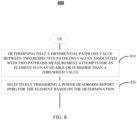
- Embodiments of the disclosure are directed to providing the technical advantage of solving one or more of the aforementioned problems, as will be described below with respect to FIGS. 7-8 .
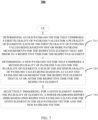
- FIG. 7 illustrates a process 700 of wireless communication, according to embodiments of the invention.
- the process 700 may be performed by a UE.
- the UE determines an old pathloss vector that comprises a first plurality of pathloss values for a plurality of elements, each of the first plurality of pathloss values being based on one or more pathloss measurements for the respective element that are prior to a respective time for the respective element.
- the respective time may correspond to a time of transmission of a previously transmitted PHR associated with the respective element.
- the respective time may vary from element to element, and may be associated with a PHR transmission time on an element-specific basis.
- the old pathloss vector may be a matrix or table that comprises at least one pathloss value for each of N respective elements, whereby N is greater than or equal to 1.
- At least one element in the old pathloss vector may correspond to one respective PL-RS. In other designs, at least one element in the old pathloss vector may correspond to multiple PL-RSs. For example, one particular PL-RS may be selected from multiple PL-RS as representative for those multiple PL-RSs for a particular cell or TRP, and an element may correspond to this particular representative PL-RS.
- the representative PL-RS may be selected as a configured PL-RS, a most recent PL-RS (e.g., a most recently measured PL-RS, such that if a group of PL-RSs are associated with one cell, the latest measured PL-RS for that cell is reported, which may be pre-configured, persistent, or semi-static, based on an associated ID (e.g., select the PL-RS with the highest or lowest ID as the representative PL-RS, etc.).
- at least one element among the plurality of elements may be associated with a non-serving cell of the UE, at least one element among the plurality of elements may be associated with a serving cell of the UE, or a combination thereof.
- operation 710 may be performed by receiver(s) 312, WWAN transceiver 310, processing system 332, memory 340, PHR module 342, sensor(s) 344, etc.
- the UE determines a new pathloss vector that comprises a second plurality of pathloss values for the plurality of elements, each of the second plurality of pathloss values being based on at least one pathloss measurement that is at or after (e.g., more recent than) the respective time for the respective element (e.g., a transmission time of the previously transmitted PHR associated with the respective element).
- the old pathloss vector and the new pathloss vector are aligned element-by-element.
- 3GPP Rel. 15 permits a mixing-and-matching of old and new pathloss values associated with disparate PL-RSs (or elements), which has potential negative PHR impacts as noted above.
- operation 720 may be performed by receiver(s) 312, WWAN transceiver 310, processing system 332, memory 340, PHR module 342, sensor(s) 344, etc.
- the UE selectively triggers, for a given element among the plurality of elements, a PHR based upon respective pathloss values for the given element in the old pathloss vector and the new pathloss vector.
- the selective triggering at 730 is associated with a differential between the respective pathloss values for the respective element.
- the selective triggering triggers the PHR at 730 if the differential exceeds a first threshold.
- the UE may obtain a threshold vector that comprises a plurality of thresholds for the plurality of elements, wherein the first threshold corresponds to a respective threshold in the plurality of thresholds corresponding to the respective element.
- the plurality of thresholds may vary based on various factors, such as component carrier (CC), environmental factors, frequency attenuation differentials associated with different cells, TRPs or PL-RS types, quasi-location (QCL) information and/or beam characteristics (e.g., broad vs. narrow beams), etc.
- CC component carrier
- QCL quasi-location
- different elements may use different thresholds for triggering PHRs.
- operation 720 may be performed by processing system 332, memory 340, PHR module 342, etc.
- the PHR reports a default pathloss value instead of the differential.
- the PHR reports the differential (e.g., instead of the default value).
- the second threshold may be specifically associated with certain cells, such as non-serving cells. In this case, elements that are associated with a serving cell of the UE may transmit the differential (e.g., instead of the default value) irrespective whether the differential exceeds the second threshold
- the second threshold can be set to a value that is unrealistically or impractically large. For example, for an ISD range of 200 m, the maximum PL is T, and current RL-RS is x. In this case, the second threshold can be set to
- the addition of a new non-serving cell may result in an increase to the number of elements in the respective pathloss vectors (e.g., due to an increase in PL-RS(s)). This may occur at an initial configuration or a reconfiguration of the new non-serving cell.
- not all elements among the respective pathloss vectors may have quantitative pathloss values for the old and new pathloss values.
- the UE may experience pathloss measurement failure when that element is measured, such that a differential pathloss value associated with old/new pathloss value(s) associated with pathloss measurement failure is set to a default value (e.g., a null value such as -1).
- a default value e.g., a null value such as -1
- the presence of such a default value may trigger a PHR for that element (e.g., for serving cells) or may alternatively result is no PHR being transmitted (e.g., for non-serving cells).
- a PHR can be triggered for an element for other reasons as noted above.
- a default value (or default values) for the differential pathloss value can be reported in the PHR.
- one or more supplemental PHR triggering conditions may be specified for those element(s) (e.g., in addition to the pathloss differential aspect and/or using a different threshold or offset v).
- syncing old pathloss values and old pathloss values to the same respective elements results in improved PHR computations, which can reduce transmission of unnecessary PHRs. This in turn reduces power consumption at the UE, system overhead and/or interference, and improves scalability (e.g., more PL-RSs can be supported without experiencing PHR-related bottlenecks), and so on.
- FIG. 8 illustrates an exemplary process 800 of wireless communication, according to aspects of the disclosure. This exemplary process does not, by itself, include all of the features of the independent claims and so does not, by itself, fall within the scope of the independent claims.
- the process 800 may be performed by a UE.
- the UE determines that a differential pathloss value between two respective pathloss values associated with two pathloss measurement attempts for an element (e.g., PL-RS or representative PL-RS) is unavailable or is higher than a threshold value.
- the determination of 810 may be based on at least one of the two respective values being outside of a defined value range (e.g., a so-called 'impossible' value, indicative of an improper measurement, would cause any differential pathloss value based on that impossible value to be higher than the threshold value).
- the determination of 810 may be based on at least one of the two pathloss measurement attempts resulting in measurement failure.
- the determination of 810 may be based on a pathloss value for only one pathloss measurement attempt being available (e.g., no old pathloss value is available, which may occur upon initial configuration or reconfiguration of a respective cell, etc.).
- operation 810 may be performed by receiver(s) 312, WWAN transceiver 310, processing system 332, memory 340, PHR module 342, sensor(s) 344, etc.
- the UE selectively triggers a PHR for the element based on the determination.
- operation 810 may be performed by processing system 332, memory 340, PHR module 342, etc.
- 820 may comprise transmission of the PHR for the element (e.g., indicating a default value, including a differential pathloss value that is based on a pathloss value associated with a different element, in some cases, for particular cell types, such as serving cells, etc.).
- 820 may comprise refraining from transmission of the PHR for the element (e.g., delay PHR reporting until two valid old/new pathloss values are available, in some cases, for particular cell types such as non-serving cells, etc.).
- operation 810 may be performed by processing system 332, memory 340, PHR module 342, sensor(s) 344, etc.
- a general purpose processor may be a microprocessor, but in the alternative, the processor may be any conventional processor, controller, microcontroller, or state machine.
- a processor may also be implemented as a combination of computing devices, e.g., a combination of a DSP and a microprocessor, a plurality of microprocessors, one or more microprocessors in conjunction with a DSP core, or any other such configuration.
- a software module may reside in random access memory (RAM), flash memory, read-only memory (ROM), erasable programmable ROM (EPROM), electrically erasable programmable ROM (EEPROM), registers, hard disk, a removable disk, a CD-ROM, or any other form of storage medium known in the art.
- An exemplary storage medium is coupled to the processor such that the processor can read information from, and write information to, the storage medium.
- the storage medium may be integral to the processor.
- the processor and the storage medium may reside in an ASIC.
- the ASIC may reside in a user terminal (e.g., UE).
- the processor and the storage medium may reside as discrete components in a user terminal.
- the functions described may be implemented in hardware, software, firmware, or any combination thereof. If implemented in software, the functions may be stored on or transmitted over as one or more instructions or code on a computer-readable medium.
- Computer-readable media includes both computer storage media and communication media including any medium that facilitates transfer of a computer program from one place to another.
- a storage media may be any available media that can be accessed by a computer.
- such computer-readable media can comprise RAM, ROM, EEPROM, CD-ROM or other optical disk storage, magnetic disk storage or other magnetic storage devices, or any other medium that can be used to carry or store desired program code in the form of instructions or data structures and that can be accessed by a computer.
- any connection is properly termed a computer-readable medium.
- the software is transmitted from a website, server, or other remote source using a coaxial cable, fiber optic cable, twisted pair, digital subscriber line (DSL), or wireless technologies such as infrared, radio, and microwave
- the coaxial cable, fiber optic cable, twisted pair, DSL, or wireless technologies such as infrared, radio, and microwave are included in the definition of medium.
- Disk and disc includes compact disc (CD), laser disc, optical disc, digital versatile disc (DVD), floppy disk and Blu-ray disc where disks usually reproduce data magnetically, while discs reproduce data optically with lasers. Combinations of the above should also be included within the scope of computer-readable media.
Landscapes
- Engineering & Computer Science (AREA)
- Computer Networks & Wireless Communication (AREA)
- Signal Processing (AREA)
- Quality & Reliability (AREA)
- Physics & Mathematics (AREA)
- Electromagnetism (AREA)
- Mobile Radio Communication Systems (AREA)
Claims (10)
- Verfahren zum Betreiben eines Benutzergeräts (UE), das Folgendes beinhaltet:Bestimmen (710) eines alten Pfadverlustvektors, der eine Mehrzahl von Elementen und eine erste Mehrzahl von Pfadverlustwerten für die Mehrzahl von Elementen umfasst, wobei jedes Element mit mindestens einem Pfadverlust-Referenzsignal, PL-RS, assoziiert ist, wobei jeder aus der ersten Mehrzahl von Pfadverlustwerten auf einer oder mehreren Pfadverlustmessungen für das jeweilige Element basiert, die vor einem jeweiligen Zeitpunkt für das jeweilige Element liegen;Bestimmen (720) eines neuen Pfadverlustvektors, der eine zweite Mehrzahl von Pfadverlustwerten für die Mehrzahl von Elementen umfasst, wobei jeder aus der zweiten Mehrzahl von Pfadverlustwerten auf mindestens einer Pfadverlustmessung für das jeweilige Element basiert, die auf oder nach dem jeweiligen Zeitpunkt für das jeweilige Element liegt;selektives Auslösen (730), für ein gegebenes Element aus der Mehrzahl von Elementen, eines Leistungsreserveberichts, PHR, auf der Basis von jeweiligen Pfadverlustwerten für das gegebene Element in dem alten Pfadverlustvektor und dem neuen Pfadverlustvektor;wobei das selektive Auslösen (730) mit einer Differenz zwischen den jeweiligen Pfadverlustwerten für das gegebene Element assoziiert ist;wobei das selektive Auslösen (730) den PHR auslöst, wenn die Differenz einen ersten Schwellenwert überschreitet;dadurch gekennzeichnet, dass, wenn die Differenz nicht berechnet werden kann oder wenn die Differenz einen zweiten Schwellenwert überschreitet, der höher als der erste Schwellenwert ist, der PHR anstelle der Differenz einen Standard-Pfadverlustwert meldet, undwenn die Differenz den zweiten Schwellenwert nicht überschreitet, der PHR die Differenz meldet.
- Verfahren nach Anspruch 1, wobei eines oder mehrere aus der Mehrzahl von Elementen mit einem bestimmten Pfadverlust-Referenzsignal PL-RS assoziiert sind.
- Verfahren nach Anspruch 2, wobei das bestimmte PL-RS für eine Mehrzahl von PL-RS repräsentativ ist, die mit einer Zelle oder einem Übertragungsempfangspunkt, TRP, assoziiert sind.
- Verfahren nach Anspruch 3, wobei das repräsentative PL-RS ein konfiguriertes PL-RS, ein aktuellstes PL-RS, ein PL-RS mit einer niedrigsten oder höchsten ID oder eine Kombination davon ist.
- Verfahren nach Anspruch 4, das ferner Folgendes beinhaltet:Erhalten eines Schwellenwertvektors, der eine Mehrzahl von Schwellenwerten für die Mehrzahl von Elementen umfasst,wobei der erste Schwellenwert einem jeweiligen Schwellenwert in der Mehrzahl von Schwellenwerten entsprechend dem gegebenen Element entspricht.
- Verfahren nach Anspruch 1, wobei das gegebene Element mit einer nicht bedienenden Zelle des UE assoziiert ist.
- Verfahren nach Anspruch 6,wobei ein anderes Element unter der Mehrzahl von Elementen mit einer bedienenden Zelle des UE assoziiert ist, undwobei ein PHR auf der Basis von jeweiligen Pfadverlustwerten des anderen Elements in dem alten Pfadverlustvektor und dem neuen Pfadverlustvektor ein jeweiliges Differential umfasst, unabhängig davon, ob die Differenz den zweiten Schwellenwert überschreitet.
- Verfahren nach Anspruch 1, wobei die jeweilige Zeit für das jeweilige Element auf einem zuvor übertragenen PHR für das gegebene Element basiert.
- Benutzergerät, UE, (302), das Folgendes umfasst:Mittel zum Bestimmen (710) eines alten Pfadverlustvektors, der eine Mehrzahl von Elementen und eine erste Mehrzahl von Pfadverlustwerten für die Mehrzahl von Elementen umfasst, wobei jedes Element mit mindestens einem Pfadverlust-Referenzsignal, PL-RS, assoziiert ist, wobei jeder aus der ersten Mehrzahl von Pfadverlustwerten auf einer oder mehreren Pfadverlustmessungen für das jeweilige Element basiert, die vor einem jeweiligen Zeitpunkt für das jeweilige Element liegen;Mittel zum Bestimmen (720) eines neuen Pfadverlustvektors, der eine zweite Mehrzahl von Pfadverlustwerten für die Mehrzahl von Elementen umfasst, wobei jeder aus der zweiten Mehrzahl von Pfadverlustwerten auf mindestens einer Pfadverlustmessung für das jeweilige Element basiert, die auf oder nach dem jeweiligen Zeitpunkt für das jeweilige Element liegt;Mittel zum selektives Auslösen (730), für ein gegebenes Element aus der Mehrzahl von Elementen, eines Leistungsreserveberichts, PHR, auf der Basis von jeweiligen Pfadverlustwerten für das gegebene Element in dem alten Pfadverlustvektor und dem neuen Pfadverlustvektor;wobei das selektive Auslösen (730) mit einer Differenz zwischen den jeweiligen Pfadverlustwerten für das gegebene Element assoziiert ist;wobei das selektive Auslösen (730) den PHR auslöst, wenn die Differenz einen ersten Schwellenwert überschreitet;dadurch gekennzeichnet, dass, wenn die Differenz nicht berechnet werden kann oder wenn die Differenz einen zweiten Schwellenwert überschreitet, der höher als der erste Schwellenwert ist, der PHR anstelle der Differenz einen Standard-Pfadverlustwert meldet, undwenn die Differenz den zweiten Schwellenwert nicht überschreitet, der PHR die Differenz meldet.
- Nichtflüchtiges computerlesbares Medium, das einen Satz von Befehlen speichert, wobei der Satz von Befehlen einen oder mehrere Befehle umfasst, die bei Ausführung durch einen oder mehrere Prozessoren (342) eines Benutzergeräts (UE) (302) das UE (302) zum Durchführen des Verfahrens nach einem der Ansprüche 1 bis 8 veranlassen.
Priority Applications (1)
| Application Number | Priority Date | Filing Date | Title |
|---|---|---|---|
| EP24207323.7A EP4472299A3 (de) | 2020-02-10 | 2021-02-09 | Selektive übertragung von leistungsreserveberichten |
Applications Claiming Priority (3)
| Application Number | Priority Date | Filing Date | Title |
|---|---|---|---|
| US202062972150P | 2020-02-10 | 2020-02-10 | |
| US17/170,165 US11825420B2 (en) | 2020-02-10 | 2021-02-08 | Selective transmission of power headroom reports |
| PCT/US2021/017225 WO2021163041A1 (en) | 2020-02-10 | 2021-02-09 | Selective transmission of power headroom reports |
Related Child Applications (2)
| Application Number | Title | Priority Date | Filing Date |
|---|---|---|---|
| EP24207323.7A Division EP4472299A3 (de) | 2020-02-10 | 2021-02-09 | Selektive übertragung von leistungsreserveberichten |
| EP24207323.7A Division-Into EP4472299A3 (de) | 2020-02-10 | 2021-02-09 | Selektive übertragung von leistungsreserveberichten |
Publications (2)
| Publication Number | Publication Date |
|---|---|
| EP4104541A1 EP4104541A1 (de) | 2022-12-21 |
| EP4104541B1 true EP4104541B1 (de) | 2025-03-19 |
Family
ID=77176970
Family Applications (2)
| Application Number | Title | Priority Date | Filing Date |
|---|---|---|---|
| EP21710123.7A Active EP4104541B1 (de) | 2020-02-10 | 2021-02-09 | Selektive übermittlung von berichten über den leistungsspielraum |
| EP24207323.7A Pending EP4472299A3 (de) | 2020-02-10 | 2021-02-09 | Selektive übertragung von leistungsreserveberichten |
Family Applications After (1)
| Application Number | Title | Priority Date | Filing Date |
|---|---|---|---|
| EP24207323.7A Pending EP4472299A3 (de) | 2020-02-10 | 2021-02-09 | Selektive übertragung von leistungsreserveberichten |
Country Status (5)
| Country | Link |
|---|---|
| US (1) | US11825420B2 (de) |
| EP (2) | EP4104541B1 (de) |
| CN (1) | CN115053581B (de) |
| TW (1) | TW202137795A (de) |
| WO (1) | WO2021163041A1 (de) |
Families Citing this family (5)
| Publication number | Priority date | Publication date | Assignee | Title |
|---|---|---|---|---|
| KR102800743B1 (ko) * | 2020-12-31 | 2025-04-28 | 아서스테크 컴퓨터 인코포레이션 | 무선 통신 시스템에서 다중-trp에 관한 전력 헤드룸 보고를 위한 방법 및 장치 |
| US11844031B2 (en) * | 2021-02-17 | 2023-12-12 | Verizon Patent And Licensing Inc. | Component carrier management service |
| CN115996481A (zh) * | 2021-10-19 | 2023-04-21 | 大唐移动通信设备有限公司 | 一种数据传输方法、装置及终端 |
| CN119835744A (zh) * | 2024-04-12 | 2025-04-15 | 荣耀终端股份有限公司 | 一种被用于无线通信的节点中的方法和装置 |
| EP4693960A1 (de) * | 2024-08-09 | 2026-02-11 | Panasonic Intellectual Property Corporation of America | Endgeràt, basisstation und verfahren zur bestimmung von uplink-pfadverlust |
Family Cites Families (9)
| Publication number | Priority date | Publication date | Assignee | Title |
|---|---|---|---|---|
| US8537767B2 (en) * | 2010-04-06 | 2013-09-17 | Sunplus Technology Co., Ltd | Method for performing power headroom reporting procedure and PHR MAC control element |
| US9615338B2 (en) * | 2011-02-15 | 2017-04-04 | Samsung Electronics Co., Ltd. | Power headroom report method and apparatus of UE |
| WO2013046964A1 (ja) * | 2011-09-28 | 2013-04-04 | シャープ株式会社 | 移動局装置、通信システム、通信方法および集積回路 |
| US20140241301A1 (en) * | 2011-09-28 | 2014-08-28 | Sharp Kabushiki Kaisha | Mobile station apparatus, communication system, communication method, and integrated circuit |
| CN106134264B (zh) * | 2014-03-21 | 2019-07-16 | 诺基亚技术有限公司 | 用于触发功率余量报告的方法和装置 |
| TWI717570B (zh) * | 2016-11-08 | 2021-02-01 | 華碩電腦股份有限公司 | 在無線通訊系統中觸發功率餘量回報用於波束運作之方法與設備 |
| US11178698B2 (en) * | 2017-05-31 | 2021-11-16 | Telefonaktiebolaget Lm Ericsson (Publ) | Power control of random access in NB-IoT |
| US10986585B2 (en) | 2018-05-10 | 2021-04-20 | Asustek Computer Inc. | Method and apparatus for triggering power headroom report for multiple pathloss reference in a wireless communication system |
| WO2020063560A1 (en) * | 2018-09-25 | 2020-04-02 | FG Innovation Company Limited | Method and apparatus for triggering power headroom reports |
-
2021
- 2021-02-08 US US17/170,165 patent/US11825420B2/en active Active
- 2021-02-09 EP EP21710123.7A patent/EP4104541B1/de active Active
- 2021-02-09 CN CN202180012599.9A patent/CN115053581B/zh active Active
- 2021-02-09 TW TW110105099A patent/TW202137795A/zh unknown
- 2021-02-09 EP EP24207323.7A patent/EP4472299A3/de active Pending
- 2021-02-09 WO PCT/US2021/017225 patent/WO2021163041A1/en not_active Ceased
Also Published As
| Publication number | Publication date |
|---|---|
| EP4472299A2 (de) | 2024-12-04 |
| TW202137795A (zh) | 2021-10-01 |
| WO2021163041A1 (en) | 2021-08-19 |
| CN115053581B (zh) | 2024-09-06 |
| EP4472299A3 (de) | 2025-03-12 |
| US20210250876A1 (en) | 2021-08-12 |
| US11825420B2 (en) | 2023-11-21 |
| CN115053581A (zh) | 2022-09-13 |
| EP4104541A1 (de) | 2022-12-21 |
Similar Documents
| Publication | Publication Date | Title |
|---|---|---|
| EP4042767B1 (de) | Verfahren und vorrichtungen zur meldung der pro-band-fähigkeit und des verhältnisses zu band-agnostischen positionierungssignalen | |
| US11533144B2 (en) | Indication of time-frequency synchronization signal block (SSB) locations of neighboring transmission-reception points for positioning reference signal puncturing purposes | |
| WO2021154373A1 (en) | Downlink control information (dci)-based triggered positioning reference signals (prs) | |
| EP4104541B1 (de) | Selektive übermittlung von berichten über den leistungsspielraum | |
| US11770791B2 (en) | Positioning measurement data reported via L1 or L2 signaling | |
| KR20220131913A (ko) | L1 또는 l2 시그널링을 통해 보고되는 포지셔닝 측정 데이터 | |
| EP4629551A2 (de) | Dampfungsmusterkonfigurationsoptionen for downlink- positionierungsreferenzsignale (prs) | |
| EP4097994B1 (de) | Positionsmessdaten | |
| US11646837B2 (en) | Interference measurement report with indication of inter-cell interference burst dynamic | |
| US12348364B2 (en) | Constraints on a source reference signal for quasi-collocation timing reference of a positioning reference signal | |
| US20230232259A1 (en) | Secondary cell group in dormant state with data traffic disabled | |
| US11356301B2 (en) | Determining a path loss for semi-persistent sounding reference signals for positioning | |
| WO2022126302A1 (en) | Determining an initial prach preamble transmission power based on historical completed prach procedures | |
| EP4104540B1 (de) | Selektive übertragung von leistungsreserveberichten | |
| WO2021232226A1 (en) | Modifying a beam failure threshold based upon user equipment movement information | |
| WO2021223076A1 (en) | Optimizing physical downlink control channel (pdcch) power | |
| WO2021164008A1 (en) | Dci-guided pdcch dmrs reception bundling | |
| WO2022027554A1 (en) | Aperiodic measurements for a secondary cell group in a dormant state |
Legal Events
| Date | Code | Title | Description |
|---|---|---|---|
| STAA | Information on the status of an ep patent application or granted ep patent |
Free format text: STATUS: UNKNOWN |
|
| STAA | Information on the status of an ep patent application or granted ep patent |
Free format text: STATUS: THE INTERNATIONAL PUBLICATION HAS BEEN MADE |
|
| PUAI | Public reference made under article 153(3) epc to a published international application that has entered the european phase |
Free format text: ORIGINAL CODE: 0009012 |
|
| STAA | Information on the status of an ep patent application or granted ep patent |
Free format text: STATUS: REQUEST FOR EXAMINATION WAS MADE |
|
| 17P | Request for examination filed |
Effective date: 20220714 |
|
| AK | Designated contracting states |
Kind code of ref document: A1 Designated state(s): AL AT BE BG CH CY CZ DE DK EE ES FI FR GB GR HR HU IE IS IT LI LT LU LV MC MK MT NL NO PL PT RO RS SE SI SK SM TR |
|
| DAV | Request for validation of the european patent (deleted) | ||
| DAX | Request for extension of the european patent (deleted) | ||
| STAA | Information on the status of an ep patent application or granted ep patent |
Free format text: STATUS: EXAMINATION IS IN PROGRESS |
|
| 17Q | First examination report despatched |
Effective date: 20230928 |
|
| GRAP | Despatch of communication of intention to grant a patent |
Free format text: ORIGINAL CODE: EPIDOSNIGR1 |
|
| STAA | Information on the status of an ep patent application or granted ep patent |
Free format text: STATUS: GRANT OF PATENT IS INTENDED |
|
| INTG | Intention to grant announced |
Effective date: 20240919 |
|
| GRAS | Grant fee paid |
Free format text: ORIGINAL CODE: EPIDOSNIGR3 |
|
| GRAA | (expected) grant |
Free format text: ORIGINAL CODE: 0009210 |
|
| STAA | Information on the status of an ep patent application or granted ep patent |
Free format text: STATUS: THE PATENT HAS BEEN GRANTED |
|
| AK | Designated contracting states |
Kind code of ref document: B1 Designated state(s): AL AT BE BG CH CY CZ DE DK EE ES FI FR GB GR HR HU IE IS IT LI LT LU LV MC MK MT NL NO PL PT RO RS SE SI SK SM TR |
|
| REG | Reference to a national code |
Ref country code: GB Ref legal event code: FG4D |
|
| REG | Reference to a national code |
Ref country code: CH Ref legal event code: EP |
|
| REG | Reference to a national code |
Ref country code: IE Ref legal event code: FG4D |
|
| REG | Reference to a national code |
Ref country code: DE Ref legal event code: R096 Ref document number: 602021027787 Country of ref document: DE |
|
| PG25 | Lapsed in a contracting state [announced via postgrant information from national office to epo] |
Ref country code: RS Free format text: LAPSE BECAUSE OF FAILURE TO SUBMIT A TRANSLATION OF THE DESCRIPTION OR TO PAY THE FEE WITHIN THE PRESCRIBED TIME-LIMIT Effective date: 20250619 |
|
| PG25 | Lapsed in a contracting state [announced via postgrant information from national office to epo] |
Ref country code: FI Free format text: LAPSE BECAUSE OF FAILURE TO SUBMIT A TRANSLATION OF THE DESCRIPTION OR TO PAY THE FEE WITHIN THE PRESCRIBED TIME-LIMIT Effective date: 20250319 |
|
| REG | Reference to a national code |
Ref country code: LT Ref legal event code: MG9D |
|
| PG25 | Lapsed in a contracting state [announced via postgrant information from national office to epo] |
Ref country code: NO Free format text: LAPSE BECAUSE OF FAILURE TO SUBMIT A TRANSLATION OF THE DESCRIPTION OR TO PAY THE FEE WITHIN THE PRESCRIBED TIME-LIMIT Effective date: 20250619 |
|
| PG25 | Lapsed in a contracting state [announced via postgrant information from national office to epo] |
Ref country code: HR Free format text: LAPSE BECAUSE OF FAILURE TO SUBMIT A TRANSLATION OF THE DESCRIPTION OR TO PAY THE FEE WITHIN THE PRESCRIBED TIME-LIMIT Effective date: 20250319 |
|
| PG25 | Lapsed in a contracting state [announced via postgrant information from national office to epo] |
Ref country code: LV Free format text: LAPSE BECAUSE OF FAILURE TO SUBMIT A TRANSLATION OF THE DESCRIPTION OR TO PAY THE FEE WITHIN THE PRESCRIBED TIME-LIMIT Effective date: 20250319 |
|
| PG25 | Lapsed in a contracting state [announced via postgrant information from national office to epo] |
Ref country code: GR Free format text: LAPSE BECAUSE OF FAILURE TO SUBMIT A TRANSLATION OF THE DESCRIPTION OR TO PAY THE FEE WITHIN THE PRESCRIBED TIME-LIMIT Effective date: 20250620 Ref country code: BG Free format text: LAPSE BECAUSE OF FAILURE TO SUBMIT A TRANSLATION OF THE DESCRIPTION OR TO PAY THE FEE WITHIN THE PRESCRIBED TIME-LIMIT Effective date: 20250319 |
|
| REG | Reference to a national code |
Ref country code: NL Ref legal event code: MP Effective date: 20250319 |
|
| REG | Reference to a national code |
Ref country code: AT Ref legal event code: MK05 Ref document number: 1778020 Country of ref document: AT Kind code of ref document: T Effective date: 20250319 |
|
| PG25 | Lapsed in a contracting state [announced via postgrant information from national office to epo] |
Ref country code: NL Free format text: LAPSE BECAUSE OF FAILURE TO SUBMIT A TRANSLATION OF THE DESCRIPTION OR TO PAY THE FEE WITHIN THE PRESCRIBED TIME-LIMIT Effective date: 20250319 |
|
| PG25 | Lapsed in a contracting state [announced via postgrant information from national office to epo] |
Ref country code: SE Free format text: LAPSE BECAUSE OF FAILURE TO SUBMIT A TRANSLATION OF THE DESCRIPTION OR TO PAY THE FEE WITHIN THE PRESCRIBED TIME-LIMIT Effective date: 20250319 |
|
| PG25 | Lapsed in a contracting state [announced via postgrant information from national office to epo] |
Ref country code: SM Free format text: LAPSE BECAUSE OF FAILURE TO SUBMIT A TRANSLATION OF THE DESCRIPTION OR TO PAY THE FEE WITHIN THE PRESCRIBED TIME-LIMIT Effective date: 20250319 |
|
| PG25 | Lapsed in a contracting state [announced via postgrant information from national office to epo] |
Ref country code: ES Free format text: LAPSE BECAUSE OF FAILURE TO SUBMIT A TRANSLATION OF THE DESCRIPTION OR TO PAY THE FEE WITHIN THE PRESCRIBED TIME-LIMIT Effective date: 20250319 Ref country code: PT Free format text: LAPSE BECAUSE OF FAILURE TO SUBMIT A TRANSLATION OF THE DESCRIPTION OR TO PAY THE FEE WITHIN THE PRESCRIBED TIME-LIMIT Effective date: 20250721 |
|
| PG25 | Lapsed in a contracting state [announced via postgrant information from national office to epo] |
Ref country code: PL Free format text: LAPSE BECAUSE OF FAILURE TO SUBMIT A TRANSLATION OF THE DESCRIPTION OR TO PAY THE FEE WITHIN THE PRESCRIBED TIME-LIMIT Effective date: 20250319 Ref country code: IT Free format text: LAPSE BECAUSE OF FAILURE TO SUBMIT A TRANSLATION OF THE DESCRIPTION OR TO PAY THE FEE WITHIN THE PRESCRIBED TIME-LIMIT Effective date: 20250319 |
|
| PG25 | Lapsed in a contracting state [announced via postgrant information from national office to epo] |
Ref country code: AT Free format text: LAPSE BECAUSE OF FAILURE TO SUBMIT A TRANSLATION OF THE DESCRIPTION OR TO PAY THE FEE WITHIN THE PRESCRIBED TIME-LIMIT Effective date: 20250319 |
|
| PG25 | Lapsed in a contracting state [announced via postgrant information from national office to epo] |
Ref country code: CZ Free format text: LAPSE BECAUSE OF FAILURE TO SUBMIT A TRANSLATION OF THE DESCRIPTION OR TO PAY THE FEE WITHIN THE PRESCRIBED TIME-LIMIT Effective date: 20250319 Ref country code: EE Free format text: LAPSE BECAUSE OF FAILURE TO SUBMIT A TRANSLATION OF THE DESCRIPTION OR TO PAY THE FEE WITHIN THE PRESCRIBED TIME-LIMIT Effective date: 20250319 |
|
| PG25 | Lapsed in a contracting state [announced via postgrant information from national office to epo] |
Ref country code: RO Free format text: LAPSE BECAUSE OF FAILURE TO SUBMIT A TRANSLATION OF THE DESCRIPTION OR TO PAY THE FEE WITHIN THE PRESCRIBED TIME-LIMIT Effective date: 20250319 |
|
| PG25 | Lapsed in a contracting state [announced via postgrant information from national office to epo] |
Ref country code: SK Free format text: LAPSE BECAUSE OF FAILURE TO SUBMIT A TRANSLATION OF THE DESCRIPTION OR TO PAY THE FEE WITHIN THE PRESCRIBED TIME-LIMIT Effective date: 20250319 |
|
| PG25 | Lapsed in a contracting state [announced via postgrant information from national office to epo] |
Ref country code: IS Free format text: LAPSE BECAUSE OF FAILURE TO SUBMIT A TRANSLATION OF THE DESCRIPTION OR TO PAY THE FEE WITHIN THE PRESCRIBED TIME-LIMIT Effective date: 20250719 |
|
| REG | Reference to a national code |
Ref country code: DE Ref legal event code: R097 Ref document number: 602021027787 Country of ref document: DE |
|
| PG25 | Lapsed in a contracting state [announced via postgrant information from national office to epo] |
Ref country code: DK Free format text: LAPSE BECAUSE OF FAILURE TO SUBMIT A TRANSLATION OF THE DESCRIPTION OR TO PAY THE FEE WITHIN THE PRESCRIBED TIME-LIMIT Effective date: 20250319 |
|
| PLBE | No opposition filed within time limit |
Free format text: ORIGINAL CODE: 0009261 |
|
| STAA | Information on the status of an ep patent application or granted ep patent |
Free format text: STATUS: NO OPPOSITION FILED WITHIN TIME LIMIT |
|
| REG | Reference to a national code |
Ref country code: CH Ref legal event code: L10 Free format text: ST27 STATUS EVENT CODE: U-0-0-L10-L00 (AS PROVIDED BY THE NATIONAL OFFICE) Effective date: 20260128 |
|
| 26N | No opposition filed |
Effective date: 20251222 |
|
| PGFP | Annual fee paid to national office [announced via postgrant information from national office to epo] |
Ref country code: GB Payment date: 20260113 Year of fee payment: 6 |
|
| PGFP | Annual fee paid to national office [announced via postgrant information from national office to epo] |
Ref country code: DE Payment date: 20260115 Year of fee payment: 6 |
|
| PGFP | Annual fee paid to national office [announced via postgrant information from national office to epo] |
Ref country code: FR Payment date: 20260109 Year of fee payment: 6 |