EP4104676A1 - Procédé et système de suivi de l'oestrus et de l'ovulation - Google Patents
Procédé et système de suivi de l'oestrus et de l'ovulation Download PDFInfo
- Publication number
- EP4104676A1 EP4104676A1 EP21180232.7A EP21180232A EP4104676A1 EP 4104676 A1 EP4104676 A1 EP 4104676A1 EP 21180232 A EP21180232 A EP 21180232A EP 4104676 A1 EP4104676 A1 EP 4104676A1
- Authority
- EP
- European Patent Office
- Prior art keywords
- time
- animal
- activity
- period
- estrus
- Prior art date
- Legal status (The legal status is an assumption and is not a legal conclusion. Google has not performed a legal analysis and makes no representation as to the accuracy of the status listed.)
- Withdrawn
Links
Images
Classifications
-
- A—HUMAN NECESSITIES
- A01—AGRICULTURE; FORESTRY; ANIMAL HUSBANDRY; HUNTING; TRAPPING; FISHING
- A01K—ANIMAL HUSBANDRY; AVICULTURE; APICULTURE; PISCICULTURE; FISHING; REARING OR BREEDING ANIMALS, NOT OTHERWISE PROVIDED FOR; NEW BREEDS OF ANIMALS
- A01K29/00—Other apparatus for animal husbandry
- A01K29/005—Monitoring or measuring activity
-
- A—HUMAN NECESSITIES
- A61—MEDICAL OR VETERINARY SCIENCE; HYGIENE
- A61D—VETERINARY INSTRUMENTS, IMPLEMENTS, TOOLS, OR METHODS
- A61D17/00—Devices for indicating trouble during labour of animals ; Methods or instruments for detecting pregnancy-related states of animals
- A61D17/002—Devices for indicating trouble during labour of animals ; Methods or instruments for detecting pregnancy-related states of animals for detecting period of heat of animals, i.e. for detecting oestrus
Definitions
- This invention relates to a method for monitoring estrus and ovulation, and for determining time for insemination of an animal, preferably a pig.
- the present invention furthermore relates to a system for monitoring estrus and ovulation, and for determining time for insemination of an animal, preferably a pig.
- Estrus detection together with effective targeting of the right time for insemination, are the key components for efficient breeding of animals. This part of the herd management has a significant impact on herd profitability.
- the latter is questioned critically in Europe, in particular.
- the regular check of the sows'standing response is a major challenge, since checking several hundred sows at regular intervals requires specific skills and a lot of time. In most of the countries with intensive animal production systems the lack of skilled workers and a high fluctuation of farm staff is a growing problem, therefore these farms have a high demand for an automated, technical solution for the determination of the optimal time for insemination.
- sow insemination has to happen within a relatively short time in the sow's estrus period.
- the ideal time is approximately up to twenty-four hours before ovulation, which occurs in general at the beginning of the last third of estrus period.
- this ideal time is entirely theoretical because he does not know how long the estrus period will be and when ovulation will occur. It usually lasts between 40 and 60 hours but it can be as short as 24 hours, or even extend up to 96 hours and more.
- managers of breeding operations find it challenging to inseminate the sows at the right moment in their estrus period.
- US patent 8,551,012 discloses a method for monitoring estrus by detecting the posture of an animal, in particular its standing time.
- CN 109984054 describes a heat detection method and device wherein a sow's standing index and restlessness index is generated from said sow's movement information. Together with a predictive index, estrus probability is generated. It is detected whether the sow is standing or lying.
- this object is solved by a method for determining estrus and ovulation of an animal / for determining time for insemination, comprising the steps of
- this object is solved by a system for determining estrus and ovulation of an animal / for determining time for insemination, comprising
- the present invention provides a method for determining estrus and ovulation of an animal.
- the method of the present invention is thus a method for determining the time for insemination.
- the method of the present invention determines circadian activity evolution (CAE).
- CAE circadian activity evolution
- the term "circadian activity” refers to an animal's behavior or evolution within a time period of 24 hours.
- Said method comprises the steps of
- step (1) at least one animal is monitored from above the crate or pen using at least one camera.
- Said at least one camera collects images at time points over a period of time.
- image refers to a single image and to images obtained from a video sequence.
- the animal is preferably a pig, a cow, a sheep, more preferably a pig.
- the period of time is preferably in a range from two days to one month, more preferably two days to 23 days, even more preferably three to seven days. In one example, the period of time is four days.
- the period of time starts with stabling the animal, such as stabling the sow.
- Stabling means in this context transferring the sow from the farrowing pen to the pen or crate in the breeding area for heat checking and artificial insemination. This transfer is usually combined with weaning (removing the piglets from the sow, thus finishing the lactation period), which triggers the physiological events to start the next estrus cycle. For gilts and other sows like repeat breeders, stabling means also the transfer from the previous pen to the pen or crate in the breeding area.
- the time points in said period of time are preferably in a range from every second to every hour, more preferably every second to every 30 seconds, even more preferably every 5 to 20 seconds. In one example, the time points are every 10 seconds.
- one camera collects images for 4 to 5 crates.
- more than one camera can be useful.
- step (2) at each time point, the grey value in each pixel of the collected image is obtained.
- grey value refers to the brightness of a pixel, wherein the color and/or RGB composition of the pixel is not considered.
- the recorded images are analyzed as grey value images. Thereby it is not of interest whether the animal, such as the sow, is standing or laying.
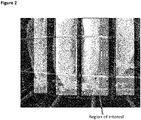
- the grey value of the image is determined within a region of interest (ROI) of said image.
- ROI region of interest
- the camera can observe from above and take images of the animal (e.g. the sow) in the crate.
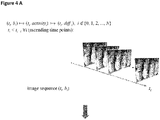
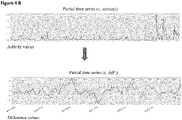
- step (3) the grey value of each of the pixel of the images of two consecutive time points is compared, thereby an activity value is obtained for each image by summing up the changes over all pixel.
- Steps (1) to (3) are repeated for an activity interval of time, thereby creating a sample of activity values within this interval of time. By repeating steps (1) to (3) for an activity interval of time a sample of activity values for said activity interval of time is obtained.
- the activity interval of time is in a range from one hour to 10 hours, more preferably 2 to 6 hours. In one example, the activity interval of time is 4 hours.
- step (4) the activity values obtained in (3), i.e. said sample of activity values obtained therefrom, are analyzed by extracting a statistical estimator from said sample of activity values.
- Steps (1) to (4) are repeated.
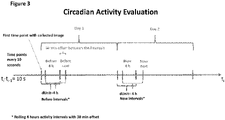
- the value of the statistical estimator for said sample of activity values of said activity interval of time, as obtained in step (4), is compared with the value of the statistical estimator of a sample of activity values of the respective activity interval of time 24 hours ago.
- Said difference value shows the difference of the activity of the animal within said activity interval of time of one day compared to the day before, such as of today compared to yesterday, i.e. 24 hours ago. Said difference value describes changes in animal behavior 24 hours ago. Said difference value reflects the change in activity of the individual animal in its circadian rhythm.
- the method of the present invention is based on said circadian comparison. Thereby, the actual behavior of the animal (e.g. the sow) is compared with its own behavior one day (24 hours) before.
- Step (5) is repeated at time differences over said period of time, thereby obtaining a time series of the difference values over said period of time.
- the time differences are preferably in a range from one minute to 6 hours, more preferably one minute to one hour, even more preferably 10 to 45 minutes. For example, the time differences are 30 minutes.
- the difference values are determined in a "rolling manner". For example, in case the time differences are 30 minutes: 48 difference values are determined within 24 hours.
- estrus and ovulation time of the animal is obtained from the time series of the difference values, such time series showing the difference values over the period of time.
- the ovulation time which is obtained in step (7) refers to a period of time, such as several hours, e.g. four hours, six hours, eight hours or an interval of time from e.g. 10 am to 6 pm.
- the method of the present invention is based on transformations and compressions of time series. Starting from image b i , different transformations and compressions of time series are carried out in order to extract sufficient information to forecast biologically relevant time points.
- the method of the present invention i.e. the algorithm underlying the method of the present invention, was trained using a learning sample consisting of a group of animals which were phenotypically very well characterized. Thereby, the time series di ⁇ s i were correlated with the phenotypes of the learning sample, i.e. the time of ovulation observed in the sows of the learning sample.
- the mating behavior, estrus and ovulation can be determined with known methods in the art, such as
- the method of the present invention allows to predict from the time series di ⁇ s i a target value, such as an ovulation time and/or best time of insemination, Particularly, the present invention allows to predict from a (relatively) short sequence (di ⁇ s i ) a target value in the future.
- a target value such as an ovulation time and/or best time of insemination
- the present invention allows to predict from a (relatively) short sequence (di ⁇ s i ) a target value in the future.
- the time series di ⁇ s i can be analyzed with different mathematical tools, such as linear regression, metrics and others.
- the period of time starts with stabling the animal, such as stabling the sow.
- Stabling means in this context transferring the sow from the farrowing pen to the pen or crate in the breeding area for heat checking and subsequent artificial insemination. This transfer is usually combined with weaning (removing the piglets from the sow, thus finishing the lactation period), which triggers the physiological events to start the next estrus cycle. For gilts and other sows like repeat breeders, stabling means also the transfer from the previous pen to the pen or crate in the breeding area.
- further information about the animal is used, such as age, number of former pregnancies, number of offspring per pregnancy, back fat thickness to define the moment for insemination.
- the method of the invention further comprises the steps
- the method of the invention further comprises monitoring of the success of artificial insemination and/or predicting the probability of early pregnancy.
- the present invention provides a system for determining estrus and ovulation of an animal.
- the system of the present invention is thus a system for determining the time for insemination.
- the system of the present invention is suitable for individual housing as well as for group housing of animals.
- Said system comprises
- one camera collects images for 4 to 5 crates.
- the animal is preferably a pig, a cow, a sheep, more preferably a pig.
- the period of time is preferably in a range from two days to one month, more preferably two days to 23 days, even more preferably three to seven days. In one example, the period of time is four days.
- the period of time starts with stabling the animal, such as stabling the sow.
- Stabling means in this context transferring the sow from the farrowing pen to the pen or crate in the breeding area for heat checking and subsequent artificial insemination. This transfer is usually combined with weaning (removing the piglets from the sow, thus finishing the lactation period), which triggers the physiological events to start the next estrus cycle. For gilts and other sows like repeat breeders, stabling means also the transfer from the previous pen to the pen or crate in the breeding area.
- the time points in said period of time are preferably in a range from every second to every hour, more preferably every second to every 30 seconds, even more preferably every 5 to 20 seconds, such as every 10 seconds.
- the time points are every 10 seconds.
- the software of the system carries out steps (2) to (7) of the method of the present invention.
- the method of the present invention determines circadian activity evolution (CAE) of the animal, as disclosed herein.
- CAE circadian activity evolution
- the system of the present invention comprises means for sending a signal that the animal is in estrus to the farmer.
- Said means preferably also send a proposed time of insemination to the farmer.
- the learning sample consisted of 85 sows from a commercial sow farm in Germany.
- the sows were all housed in accordance with the respective regulatory guidelines and laws for animal keeping in Germany. All sows were weaned on the day of being stabled in the crates of the breeding area.
- Sows of the learning sample were randomly selected from the group of weaned sows of that week, providing a variety of ages and performance records of previous breedings to the learning sample.
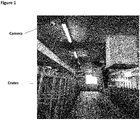
- Sows were under constant surveillance from the cameras as shown in Figure 1 .
- Ultrasound examinations were performed 3 times a day from day 4 until day 8 after entering the breeding area. Ultrasound was done at 7:00, 15:00 and 23:00 using a MyLab One ultrasound scanner with transabdominal 5 Mhz sector scanner with Doppler effect from esaote. This examination schedules covers the period of time in which the sows most probably will ovulate. Recording of the ovarian status from each examination, estrus behavior and time of insemination as determined according to the subjective evaluation of the animal caretaker were done in order to provide a complete characterization of the reproductive behavior of the sows in the learning sample.
- the images are transmitted via Ethernet connection to a network storage (NAS) from QNAP and provided there for the evaluation.
- the evaluation takes place on an external PC connected to the NAS.
- NAS network storage
Landscapes
- Life Sciences & Earth Sciences (AREA)
- Health & Medical Sciences (AREA)
- Biophysics (AREA)
- Animal Husbandry (AREA)
- Veterinary Medicine (AREA)
- Environmental Sciences (AREA)
- Pregnancy & Childbirth (AREA)
- Engineering & Computer Science (AREA)
- Biodiversity & Conservation Biology (AREA)
- Wood Science & Technology (AREA)
- Zoology (AREA)
- Animal Behavior & Ethology (AREA)
- General Health & Medical Sciences (AREA)
- Public Health (AREA)
- Investigating Or Analysing Biological Materials (AREA)
Priority Applications (5)
| Application Number | Priority Date | Filing Date | Title |
|---|---|---|---|
| EP21180232.7A EP4104676A1 (fr) | 2021-06-18 | 2021-06-18 | Procédé et système de suivi de l'oestrus et de l'ovulation |
| EP22730916.8A EP4355089A1 (fr) | 2021-06-18 | 2022-05-31 | Procédé et système de surveillance de l'oestrus et de l'ovulation |
| CN202280043045.XA CN117500372A (zh) | 2021-06-18 | 2022-05-31 | 用于监测发情和排卵的方法和系统 |
| PCT/EP2022/064761 WO2022263166A1 (fr) | 2021-06-18 | 2022-05-31 | Procédé et système de surveillance de l'oestrus et de l'ovulation |
| US18/289,287 US20240225807A1 (en) | 2021-06-18 | 2022-05-31 | Method and system for monitoring estrus and ovulation |
Applications Claiming Priority (1)
| Application Number | Priority Date | Filing Date | Title |
|---|---|---|---|
| EP21180232.7A EP4104676A1 (fr) | 2021-06-18 | 2021-06-18 | Procédé et système de suivi de l'oestrus et de l'ovulation |
Publications (1)
| Publication Number | Publication Date |
|---|---|
| EP4104676A1 true EP4104676A1 (fr) | 2022-12-21 |
Family
ID=76522875
Family Applications (2)
| Application Number | Title | Priority Date | Filing Date |
|---|---|---|---|
| EP21180232.7A Withdrawn EP4104676A1 (fr) | 2021-06-18 | 2021-06-18 | Procédé et système de suivi de l'oestrus et de l'ovulation |
| EP22730916.8A Withdrawn EP4355089A1 (fr) | 2021-06-18 | 2022-05-31 | Procédé et système de surveillance de l'oestrus et de l'ovulation |
Family Applications After (1)
| Application Number | Title | Priority Date | Filing Date |
|---|---|---|---|
| EP22730916.8A Withdrawn EP4355089A1 (fr) | 2021-06-18 | 2022-05-31 | Procédé et système de surveillance de l'oestrus et de l'ovulation |
Country Status (4)
| Country | Link |
|---|---|
| US (1) | US20240225807A1 (fr) |
| EP (2) | EP4104676A1 (fr) |
| CN (1) | CN117500372A (fr) |
| WO (1) | WO2022263166A1 (fr) |
Citations (4)
| Publication number | Priority date | Publication date | Assignee | Title |
|---|---|---|---|---|
| US8551012B2 (en) | 2007-05-25 | 2013-10-08 | Walter Signorini | Method for monitoring estrus and ovulation of animals, and for planning a useful fertilization time zone and a preferred fertilization time zone |
| TWI614698B (zh) * | 2014-10-23 | 2018-02-11 | 美和學校財團法人美和科技大學 | 四足動物發情偵測方法 |
| EP3430897A1 (fr) * | 2016-03-14 | 2019-01-23 | Fujitsu Limited | Dispositif de surveillance, procédé de surveillance et programme de surveillance |
| CN109984054A (zh) | 2019-04-19 | 2019-07-09 | 广州影子科技有限公司 | 发情检测方法、发情检测装置和发情检测系统 |
Family Cites Families (1)
| Publication number | Priority date | Publication date | Assignee | Title |
|---|---|---|---|---|
| US11096375B2 (en) * | 2019-06-20 | 2021-08-24 | High Tech Ranch Solutions, Llc | Smart cattle reproduction management and digital farm to market transparency metrics |
-
2021
- 2021-06-18 EP EP21180232.7A patent/EP4104676A1/fr not_active Withdrawn
-
2022
- 2022-05-31 EP EP22730916.8A patent/EP4355089A1/fr not_active Withdrawn
- 2022-05-31 WO PCT/EP2022/064761 patent/WO2022263166A1/fr not_active Ceased
- 2022-05-31 CN CN202280043045.XA patent/CN117500372A/zh active Pending
- 2022-05-31 US US18/289,287 patent/US20240225807A1/en active Pending
Patent Citations (4)
| Publication number | Priority date | Publication date | Assignee | Title |
|---|---|---|---|---|
| US8551012B2 (en) | 2007-05-25 | 2013-10-08 | Walter Signorini | Method for monitoring estrus and ovulation of animals, and for planning a useful fertilization time zone and a preferred fertilization time zone |
| TWI614698B (zh) * | 2014-10-23 | 2018-02-11 | 美和學校財團法人美和科技大學 | 四足動物發情偵測方法 |
| EP3430897A1 (fr) * | 2016-03-14 | 2019-01-23 | Fujitsu Limited | Dispositif de surveillance, procédé de surveillance et programme de surveillance |
| CN109984054A (zh) | 2019-04-19 | 2019-07-09 | 广州影子科技有限公司 | 发情检测方法、发情检测装置和发情检测系统 |
Non-Patent Citations (2)
| Title |
|---|
| AHN SUNG-JIN ET AL: "Real-time cow action recognition based on motion history image feature", 2018 IEEE INTERNATIONAL CONFERENCE ON CONSUMER ELECTRONICS (ICCE), IEEE, 12 January 2018 (2018-01-12), pages 1 - 2, XP033341566, DOI: 10.1109/ICCE.2018.8326090 * |
| HIGAKI SHOGO ET AL: "Estrus Detection Using Background Image Subtraction Technique in Tie-Stalled Cows", ANIMALS, vol. 11, no. 6, 16 June 2021 (2021-06-16), pages 1795, XP055871664, DOI: 10.3390/ani11061795 * |
Also Published As
| Publication number | Publication date |
|---|---|
| WO2022263166A1 (fr) | 2022-12-22 |
| EP4355089A1 (fr) | 2024-04-24 |
| US20240225807A1 (en) | 2024-07-11 |
| CN117500372A (zh) | 2024-02-02 |
Similar Documents
| Publication | Publication Date | Title |
|---|---|---|
| Elischer et al. | Validating the accuracy of activity and rumination monitor data from dairy cows housed in a pasture-based automatic milking system | |
| US20200214266A1 (en) | Domestic animal information management system, domestic animal barn, domestic animal information management program, and domestic animal information management method | |
| DK2690948T3 (en) | DEVICE AND PROCEDURE FOR USING INFRARED THERMOGRAPHY AND BEHAVIOR INFORMATION FOR IDENTIFICATION OF BIOLOGICAL IMPORTANT CONDITIONS OF ANIMALS | |
| Halachmi et al. | Automatic assessment of dairy cattle body condition score using thermal imaging | |
| Tekin et al. | Precision livestock farming technologies: Novel direction of information flow | |
| NZ551182A (en) | Integrated animal management system and method | |
| Franchi et al. | Estimating body weight in conventional growing pigs using a depth camera | |
| KR20230057379A (ko) | 실시간 영상에 기반한 배아 평가 | |
| Biszkup et al. | Detectability of multi-dimensional movement and behaviour in cattle using sensor data and machine learning algorithms: Study on a Charolais bull | |
| Williams et al. | Lying behaviour of housed and outdoor-managed pregnant sheep | |
| Agrawal et al. | Precision dairy farming: A boon for dairy farm management | |
| US20240225807A1 (en) | Method and system for monitoring estrus and ovulation | |
| CN118173259A (zh) | 用于犊牛养殖的智能化监控管理方法及系统 | |
| Christensen et al. | Evaluation of producer-recorded causes of preweaning mortality in Danish sow herds | |
| Kinsel | An epidemiologic approach to investigating abortion problems in dairy herds | |
| Canga et al. | Information and communication technologies (ICT) and precision livestock (PLF) applications in farm conditions | |
| Craig et al. | Use of Thermographic Technology to Detect Reproductive State in Sows and Improve Piglet Performance in a Commercial Farrowing House | |
| Frandsen | Benchmarking in dairy production:“how to transform data to valuable decision support” | |
| Bobade et al. | New age dairy farming: Precision dairy farming (PDF): A review | |
| JP2023523916A (ja) | 妊娠検出のためのコンピュータ実施方法、コントローラ、装置、および搾乳システム | |
| Gresse | Alternative approaches for analyses of production performance from automatic milking systems in South Africa | |
| Ouweltjes et al. | At-market sensor technologies to develop proxies for resilience and efficiency in dairy cows | |
| Price | Using bio-logging to improve sheep health and performance | |
| Brocklehurst et al. | Quantitative Methods for Real Time Auto-Monitoring of Livestock | |
| Biszkup et al. | Artificial Intelligence in Agriculture |
Legal Events
| Date | Code | Title | Description |
|---|---|---|---|
| PUAI | Public reference made under article 153(3) epc to a published international application that has entered the european phase |
Free format text: ORIGINAL CODE: 0009012 |
|
| STAA | Information on the status of an ep patent application or granted ep patent |
Free format text: STATUS: THE APPLICATION HAS BEEN PUBLISHED |
|
| AK | Designated contracting states |
Kind code of ref document: A1 Designated state(s): AL AT BE BG CH CY CZ DE DK EE ES FI FR GB GR HR HU IE IS IT LI LT LU LV MC MK MT NL NO PL PT RO RS SE SI SK SM TR |
|
| STAA | Information on the status of an ep patent application or granted ep patent |
Free format text: STATUS: THE APPLICATION IS DEEMED TO BE WITHDRAWN |
|
| 18D | Application deemed to be withdrawn |
Effective date: 20230622 |