EP4105266A1 - Prepreg zur verwendung bei der herstellung von verbundteilen, die heisse und nasse bedingungen tolerieren - Google Patents
Prepreg zur verwendung bei der herstellung von verbundteilen, die heisse und nasse bedingungen tolerieren Download PDFInfo
- Publication number
- EP4105266A1 EP4105266A1 EP22181303.3A EP22181303A EP4105266A1 EP 4105266 A1 EP4105266 A1 EP 4105266A1 EP 22181303 A EP22181303 A EP 22181303A EP 4105266 A1 EP4105266 A1 EP 4105266A1
- Authority
- EP
- European Patent Office
- Prior art keywords
- resin
- prepreg
- epoxy resin
- particles
- uncured
- Prior art date
- Legal status (The legal status is an assumption and is not a legal conclusion. Google has not performed a legal analysis and makes no representation as to the accuracy of the status listed.)
- Granted
Links
Images
Classifications
-
- C—CHEMISTRY; METALLURGY
- C08—ORGANIC MACROMOLECULAR COMPOUNDS; THEIR PREPARATION OR CHEMICAL WORKING-UP; COMPOSITIONS BASED THEREON
- C08J—WORKING-UP; GENERAL PROCESSES OF COMPOUNDING; AFTER-TREATMENT NOT COVERED BY SUBCLASSES C08B, C08C, C08F, C08G or C08H
- C08J5/00—Manufacture of articles or shaped materials containing macromolecular substances
- C08J5/04—Reinforcing macromolecular compounds with loose or coherent fibrous material
- C08J5/0405—Reinforcing macromolecular compounds with loose or coherent fibrous material with inorganic fibres
- C08J5/042—Reinforcing macromolecular compounds with loose or coherent fibrous material with inorganic fibres with carbon fibres
-
- B—PERFORMING OPERATIONS; TRANSPORTING
- B32—LAYERED PRODUCTS
- B32B—LAYERED PRODUCTS, i.e. PRODUCTS BUILT-UP OF STRATA OF FLAT OR NON-FLAT, e.g. CELLULAR OR HONEYCOMB, FORM
- B32B27/00—Layered products comprising a layer of synthetic resin
- B32B27/06—Layered products comprising a layer of synthetic resin as the main or only constituent of a layer, which is next to another layer of the same or of a different material
- B32B27/08—Layered products comprising a layer of synthetic resin as the main or only constituent of a layer, which is next to another layer of the same or of a different material of synthetic resin
-
- B—PERFORMING OPERATIONS; TRANSPORTING
- B32—LAYERED PRODUCTS
- B32B—LAYERED PRODUCTS, i.e. PRODUCTS BUILT-UP OF STRATA OF FLAT OR NON-FLAT, e.g. CELLULAR OR HONEYCOMB, FORM
- B32B27/00—Layered products comprising a layer of synthetic resin
- B32B27/38—Layered products comprising a layer of synthetic resin comprising epoxy resins
-
- B—PERFORMING OPERATIONS; TRANSPORTING
- B32—LAYERED PRODUCTS
- B32B—LAYERED PRODUCTS, i.e. PRODUCTS BUILT-UP OF STRATA OF FLAT OR NON-FLAT, e.g. CELLULAR OR HONEYCOMB, FORM
- B32B5/00—Layered products characterised by the non- homogeneity or physical structure, i.e. comprising a fibrous, filamentary, particulate or foam layer; Layered products characterised by having a layer differing constitutionally or physically in different parts
- B32B5/02—Layered products characterised by the non- homogeneity or physical structure, i.e. comprising a fibrous, filamentary, particulate or foam layer; Layered products characterised by having a layer differing constitutionally or physically in different parts characterised by structural features of a fibrous or filamentary layer
- B32B5/022—Non-woven fabric
-
- B—PERFORMING OPERATIONS; TRANSPORTING
- B32—LAYERED PRODUCTS
- B32B—LAYERED PRODUCTS, i.e. PRODUCTS BUILT-UP OF STRATA OF FLAT OR NON-FLAT, e.g. CELLULAR OR HONEYCOMB, FORM
- B32B5/00—Layered products characterised by the non- homogeneity or physical structure, i.e. comprising a fibrous, filamentary, particulate or foam layer; Layered products characterised by having a layer differing constitutionally or physically in different parts
- B32B5/02—Layered products characterised by the non- homogeneity or physical structure, i.e. comprising a fibrous, filamentary, particulate or foam layer; Layered products characterised by having a layer differing constitutionally or physically in different parts characterised by structural features of a fibrous or filamentary layer
- B32B5/024—Woven fabric
-
- B—PERFORMING OPERATIONS; TRANSPORTING
- B32—LAYERED PRODUCTS
- B32B—LAYERED PRODUCTS, i.e. PRODUCTS BUILT-UP OF STRATA OF FLAT OR NON-FLAT, e.g. CELLULAR OR HONEYCOMB, FORM
- B32B5/00—Layered products characterised by the non- homogeneity or physical structure, i.e. comprising a fibrous, filamentary, particulate or foam layer; Layered products characterised by having a layer differing constitutionally or physically in different parts
- B32B5/02—Layered products characterised by the non- homogeneity or physical structure, i.e. comprising a fibrous, filamentary, particulate or foam layer; Layered products characterised by having a layer differing constitutionally or physically in different parts characterised by structural features of a fibrous or filamentary layer
- B32B5/026—Knitted fabric
-
- B—PERFORMING OPERATIONS; TRANSPORTING
- B32—LAYERED PRODUCTS
- B32B—LAYERED PRODUCTS, i.e. PRODUCTS BUILT-UP OF STRATA OF FLAT OR NON-FLAT, e.g. CELLULAR OR HONEYCOMB, FORM
- B32B5/00—Layered products characterised by the non- homogeneity or physical structure, i.e. comprising a fibrous, filamentary, particulate or foam layer; Layered products characterised by having a layer differing constitutionally or physically in different parts
- B32B5/22—Layered products characterised by the non- homogeneity or physical structure, i.e. comprising a fibrous, filamentary, particulate or foam layer; Layered products characterised by having a layer differing constitutionally or physically in different parts characterised by the presence of two or more layers which are next to each other and are fibrous, filamentary, formed of particles or foamed
- B32B5/24—Layered products characterised by the non- homogeneity or physical structure, i.e. comprising a fibrous, filamentary, particulate or foam layer; Layered products characterised by having a layer differing constitutionally or physically in different parts characterised by the presence of two or more layers which are next to each other and are fibrous, filamentary, formed of particles or foamed one layer being a fibrous or filamentary layer
- B32B5/26—Layered products characterised by the non- homogeneity or physical structure, i.e. comprising a fibrous, filamentary, particulate or foam layer; Layered products characterised by having a layer differing constitutionally or physically in different parts characterised by the presence of two or more layers which are next to each other and are fibrous, filamentary, formed of particles or foamed one layer being a fibrous or filamentary layer another layer next to it also being fibrous or filamentary
-
- C—CHEMISTRY; METALLURGY
- C08—ORGANIC MACROMOLECULAR COMPOUNDS; THEIR PREPARATION OR CHEMICAL WORKING-UP; COMPOSITIONS BASED THEREON
- C08G—MACROMOLECULAR COMPOUNDS OBTAINED OTHERWISE THAN BY REACTIONS ONLY INVOLVING UNSATURATED CARBON-TO-CARBON BONDS
- C08G59/00—Polycondensates containing more than one epoxy group per molecule; Macromolecules obtained by polymerising compounds containing more than one epoxy group per molecule using curing agents or catalysts which react with the epoxy groups
- C08G59/18—Macromolecules obtained by polymerising compounds containing more than one epoxy group per molecule using curing agents or catalysts which react with the epoxy groups ; e.g. general methods of curing
- C08G59/20—Macromolecules obtained by polymerising compounds containing more than one epoxy group per molecule using curing agents or catalysts which react with the epoxy groups ; e.g. general methods of curing characterised by the epoxy compounds used
- C08G59/32—Epoxy compounds containing three or more epoxy groups
-
- C—CHEMISTRY; METALLURGY
- C08—ORGANIC MACROMOLECULAR COMPOUNDS; THEIR PREPARATION OR CHEMICAL WORKING-UP; COMPOSITIONS BASED THEREON
- C08G—MACROMOLECULAR COMPOUNDS OBTAINED OTHERWISE THAN BY REACTIONS ONLY INVOLVING UNSATURATED CARBON-TO-CARBON BONDS
- C08G59/00—Polycondensates containing more than one epoxy group per molecule; Macromolecules obtained by polymerising compounds containing more than one epoxy group per molecule using curing agents or catalysts which react with the epoxy groups
- C08G59/18—Macromolecules obtained by polymerising compounds containing more than one epoxy group per molecule using curing agents or catalysts which react with the epoxy groups ; e.g. general methods of curing
- C08G59/20—Macromolecules obtained by polymerising compounds containing more than one epoxy group per molecule using curing agents or catalysts which react with the epoxy groups ; e.g. general methods of curing characterised by the epoxy compounds used
- C08G59/32—Epoxy compounds containing three or more epoxy groups
- C08G59/38—Epoxy compounds containing three or more epoxy groups together with di-epoxy compounds
-
- C—CHEMISTRY; METALLURGY
- C08—ORGANIC MACROMOLECULAR COMPOUNDS; THEIR PREPARATION OR CHEMICAL WORKING-UP; COMPOSITIONS BASED THEREON
- C08G—MACROMOLECULAR COMPOUNDS OBTAINED OTHERWISE THAN BY REACTIONS ONLY INVOLVING UNSATURATED CARBON-TO-CARBON BONDS
- C08G59/00—Polycondensates containing more than one epoxy group per molecule; Macromolecules obtained by polymerising compounds containing more than one epoxy group per molecule using curing agents or catalysts which react with the epoxy groups
- C08G59/18—Macromolecules obtained by polymerising compounds containing more than one epoxy group per molecule using curing agents or catalysts which react with the epoxy groups ; e.g. general methods of curing
- C08G59/40—Macromolecules obtained by polymerising compounds containing more than one epoxy group per molecule using curing agents or catalysts which react with the epoxy groups ; e.g. general methods of curing characterised by the curing agents used
- C08G59/50—Amines
-
- C—CHEMISTRY; METALLURGY
- C08—ORGANIC MACROMOLECULAR COMPOUNDS; THEIR PREPARATION OR CHEMICAL WORKING-UP; COMPOSITIONS BASED THEREON
- C08J—WORKING-UP; GENERAL PROCESSES OF COMPOUNDING; AFTER-TREATMENT NOT COVERED BY SUBCLASSES C08B, C08C, C08F, C08G or C08H
- C08J5/00—Manufacture of articles or shaped materials containing macromolecular substances
- C08J5/24—Impregnating materials with prepolymers which can be polymerised in situ, e.g. manufacture of prepregs
- C08J5/241—Impregnating materials with prepolymers which can be polymerised in situ, e.g. manufacture of prepregs using inorganic fibres
- C08J5/243—Impregnating materials with prepolymers which can be polymerised in situ, e.g. manufacture of prepregs using inorganic fibres using carbon fibres
-
- C—CHEMISTRY; METALLURGY
- C08—ORGANIC MACROMOLECULAR COMPOUNDS; THEIR PREPARATION OR CHEMICAL WORKING-UP; COMPOSITIONS BASED THEREON
- C08J—WORKING-UP; GENERAL PROCESSES OF COMPOUNDING; AFTER-TREATMENT NOT COVERED BY SUBCLASSES C08B, C08C, C08F, C08G or C08H
- C08J5/00—Manufacture of articles or shaped materials containing macromolecular substances
- C08J5/24—Impregnating materials with prepolymers which can be polymerised in situ, e.g. manufacture of prepregs
- C08J5/249—Impregnating materials with prepolymers which can be polymerised in situ, e.g. manufacture of prepregs characterised by the additives used in the prepolymer mixture
-
- C—CHEMISTRY; METALLURGY
- C08—ORGANIC MACROMOLECULAR COMPOUNDS; THEIR PREPARATION OR CHEMICAL WORKING-UP; COMPOSITIONS BASED THEREON
- C08L—COMPOSITIONS OF MACROMOLECULAR COMPOUNDS
- C08L81/00—Compositions of macromolecular compounds obtained by reactions forming in the main chain of the macromolecule a linkage containing sulfur with or without nitrogen, oxygen or carbon only; Compositions of polysulfones; Compositions of derivatives of such polymers
- C08L81/06—Polysulfones; Polyethersulfones
-
- B—PERFORMING OPERATIONS; TRANSPORTING
- B32—LAYERED PRODUCTS
- B32B—LAYERED PRODUCTS, i.e. PRODUCTS BUILT-UP OF STRATA OF FLAT OR NON-FLAT, e.g. CELLULAR OR HONEYCOMB, FORM
- B32B2260/00—Layered product comprising an impregnated, embedded, or bonded layer wherein the layer comprises an impregnation, embedding, or binder material
- B32B2260/02—Composition of the impregnated, bonded or embedded layer
- B32B2260/021—Fibrous or filamentary layer
-
- B—PERFORMING OPERATIONS; TRANSPORTING
- B32—LAYERED PRODUCTS
- B32B—LAYERED PRODUCTS, i.e. PRODUCTS BUILT-UP OF STRATA OF FLAT OR NON-FLAT, e.g. CELLULAR OR HONEYCOMB, FORM
- B32B2260/00—Layered product comprising an impregnated, embedded, or bonded layer wherein the layer comprises an impregnation, embedding, or binder material
- B32B2260/04—Impregnation, embedding, or binder material
- B32B2260/046—Synthetic resin
-
- B—PERFORMING OPERATIONS; TRANSPORTING
- B32—LAYERED PRODUCTS
- B32B—LAYERED PRODUCTS, i.e. PRODUCTS BUILT-UP OF STRATA OF FLAT OR NON-FLAT, e.g. CELLULAR OR HONEYCOMB, FORM
- B32B2262/00—Composition or structural features of fibres which form a fibrous or filamentary layer or are present as additives
- B32B2262/02—Synthetic macromolecular fibres
- B32B2262/0261—Polyamide fibres
- B32B2262/0269—Aromatic polyamide fibres
-
- B—PERFORMING OPERATIONS; TRANSPORTING
- B32—LAYERED PRODUCTS
- B32B—LAYERED PRODUCTS, i.e. PRODUCTS BUILT-UP OF STRATA OF FLAT OR NON-FLAT, e.g. CELLULAR OR HONEYCOMB, FORM
- B32B2262/00—Composition or structural features of fibres which form a fibrous or filamentary layer or are present as additives
- B32B2262/10—Inorganic fibres
- B32B2262/101—Glass fibres
-
- B—PERFORMING OPERATIONS; TRANSPORTING
- B32—LAYERED PRODUCTS
- B32B—LAYERED PRODUCTS, i.e. PRODUCTS BUILT-UP OF STRATA OF FLAT OR NON-FLAT, e.g. CELLULAR OR HONEYCOMB, FORM
- B32B2262/00—Composition or structural features of fibres which form a fibrous or filamentary layer or are present as additives
- B32B2262/10—Inorganic fibres
- B32B2262/106—Carbon fibres, e.g. graphite fibres
-
- B—PERFORMING OPERATIONS; TRANSPORTING
- B32—LAYERED PRODUCTS
- B32B—LAYERED PRODUCTS, i.e. PRODUCTS BUILT-UP OF STRATA OF FLAT OR NON-FLAT, e.g. CELLULAR OR HONEYCOMB, FORM
- B32B2264/00—Composition or properties of particles which form a particulate layer or are present as additives
- B32B2264/02—Synthetic macromolecular particles
- B32B2264/0207—Particles made of materials belonging to B32B25/00
-
- B—PERFORMING OPERATIONS; TRANSPORTING
- B32—LAYERED PRODUCTS
- B32B—LAYERED PRODUCTS, i.e. PRODUCTS BUILT-UP OF STRATA OF FLAT OR NON-FLAT, e.g. CELLULAR OR HONEYCOMB, FORM
- B32B2264/00—Composition or properties of particles which form a particulate layer or are present as additives
- B32B2264/02—Synthetic macromolecular particles
- B32B2264/0214—Particles made of materials belonging to B32B27/00
- B32B2264/0228—Vinyl resin particles, e.g. polyvinyl acetate, polyvinyl alcohol polymers or ethylene-vinyl acetate copolymers
- B32B2264/0235—Aromatic vinyl resin, e.g. styrenic (co)polymers
-
- B—PERFORMING OPERATIONS; TRANSPORTING
- B32—LAYERED PRODUCTS
- B32B—LAYERED PRODUCTS, i.e. PRODUCTS BUILT-UP OF STRATA OF FLAT OR NON-FLAT, e.g. CELLULAR OR HONEYCOMB, FORM
- B32B2264/00—Composition or properties of particles which form a particulate layer or are present as additives
- B32B2264/02—Synthetic macromolecular particles
- B32B2264/0214—Particles made of materials belonging to B32B27/00
- B32B2264/025—Acrylic resin particles, e.g. polymethyl methacrylate or ethylene-acrylate copolymers
-
- B—PERFORMING OPERATIONS; TRANSPORTING
- B32—LAYERED PRODUCTS
- B32B—LAYERED PRODUCTS, i.e. PRODUCTS BUILT-UP OF STRATA OF FLAT OR NON-FLAT, e.g. CELLULAR OR HONEYCOMB, FORM
- B32B2264/00—Composition or properties of particles which form a particulate layer or are present as additives
- B32B2264/02—Synthetic macromolecular particles
- B32B2264/0214—Particles made of materials belonging to B32B27/00
- B32B2264/0264—Polyamide particles
-
- B—PERFORMING OPERATIONS; TRANSPORTING
- B32—LAYERED PRODUCTS
- B32B—LAYERED PRODUCTS, i.e. PRODUCTS BUILT-UP OF STRATA OF FLAT OR NON-FLAT, e.g. CELLULAR OR HONEYCOMB, FORM
- B32B2264/00—Composition or properties of particles which form a particulate layer or are present as additives
- B32B2264/10—Inorganic particles
- B32B2264/101—Glass
-
- B—PERFORMING OPERATIONS; TRANSPORTING
- B32—LAYERED PRODUCTS
- B32B—LAYERED PRODUCTS, i.e. PRODUCTS BUILT-UP OF STRATA OF FLAT OR NON-FLAT, e.g. CELLULAR OR HONEYCOMB, FORM
- B32B2264/00—Composition or properties of particles which form a particulate layer or are present as additives
- B32B2264/10—Inorganic particles
- B32B2264/102—Oxide or hydroxide
-
- B—PERFORMING OPERATIONS; TRANSPORTING
- B32—LAYERED PRODUCTS
- B32B—LAYERED PRODUCTS, i.e. PRODUCTS BUILT-UP OF STRATA OF FLAT OR NON-FLAT, e.g. CELLULAR OR HONEYCOMB, FORM
- B32B2264/00—Composition or properties of particles which form a particulate layer or are present as additives
- B32B2264/10—Inorganic particles
- B32B2264/104—Oxysalt, e.g. carbonate, sulfate, phosphate or nitrate particles
-
- B—PERFORMING OPERATIONS; TRANSPORTING
- B32—LAYERED PRODUCTS
- B32B—LAYERED PRODUCTS, i.e. PRODUCTS BUILT-UP OF STRATA OF FLAT OR NON-FLAT, e.g. CELLULAR OR HONEYCOMB, FORM
- B32B2264/00—Composition or properties of particles which form a particulate layer or are present as additives
- B32B2264/10—Inorganic particles
- B32B2264/105—Metal
-
- B—PERFORMING OPERATIONS; TRANSPORTING
- B32—LAYERED PRODUCTS
- B32B—LAYERED PRODUCTS, i.e. PRODUCTS BUILT-UP OF STRATA OF FLAT OR NON-FLAT, e.g. CELLULAR OR HONEYCOMB, FORM
- B32B2264/00—Composition or properties of particles which form a particulate layer or are present as additives
- B32B2264/10—Inorganic particles
- B32B2264/107—Ceramic
- B32B2264/108—Carbon, e.g. graphite particles
-
- B—PERFORMING OPERATIONS; TRANSPORTING
- B32—LAYERED PRODUCTS
- B32B—LAYERED PRODUCTS, i.e. PRODUCTS BUILT-UP OF STRATA OF FLAT OR NON-FLAT, e.g. CELLULAR OR HONEYCOMB, FORM
- B32B2307/00—Properties of the layers or laminate
- B32B2307/30—Properties of the layers or laminate having particular thermal properties
- B32B2307/308—Heat stability
-
- B—PERFORMING OPERATIONS; TRANSPORTING
- B32—LAYERED PRODUCTS
- B32B—LAYERED PRODUCTS, i.e. PRODUCTS BUILT-UP OF STRATA OF FLAT OR NON-FLAT, e.g. CELLULAR OR HONEYCOMB, FORM
- B32B2307/00—Properties of the layers or laminate
- B32B2307/50—Properties of the layers or laminate having particular mechanical properties
- B32B2307/542—Shear strength
-
- B—PERFORMING OPERATIONS; TRANSPORTING
- B32—LAYERED PRODUCTS
- B32B—LAYERED PRODUCTS, i.e. PRODUCTS BUILT-UP OF STRATA OF FLAT OR NON-FLAT, e.g. CELLULAR OR HONEYCOMB, FORM
- B32B2307/00—Properties of the layers or laminate
- B32B2307/70—Other properties
- B32B2307/748—Releasability
-
- B—PERFORMING OPERATIONS; TRANSPORTING
- B32—LAYERED PRODUCTS
- B32B—LAYERED PRODUCTS, i.e. PRODUCTS BUILT-UP OF STRATA OF FLAT OR NON-FLAT, e.g. CELLULAR OR HONEYCOMB, FORM
- B32B2605/00—Vehicles
- B32B2605/18—Aircraft
-
- B—PERFORMING OPERATIONS; TRANSPORTING
- B64—AIRCRAFT; AVIATION; COSMONAUTICS
- B64D—EQUIPMENT FOR FITTING IN OR TO AIRCRAFT; FLIGHT SUITS; PARACHUTES; ARRANGEMENT OR MOUNTING OF POWER PLANTS OR PROPULSION TRANSMISSIONS IN AIRCRAFT
- B64D29/00—Power-plant nacelles, fairings or cowlings
-
- C—CHEMISTRY; METALLURGY
- C08—ORGANIC MACROMOLECULAR COMPOUNDS; THEIR PREPARATION OR CHEMICAL WORKING-UP; COMPOSITIONS BASED THEREON
- C08J—WORKING-UP; GENERAL PROCESSES OF COMPOUNDING; AFTER-TREATMENT NOT COVERED BY SUBCLASSES C08B, C08C, C08F, C08G or C08H
- C08J2363/00—Characterised by the use of epoxy resins; Derivatives of epoxy resins
-
- C—CHEMISTRY; METALLURGY
- C08—ORGANIC MACROMOLECULAR COMPOUNDS; THEIR PREPARATION OR CHEMICAL WORKING-UP; COMPOSITIONS BASED THEREON
- C08J—WORKING-UP; GENERAL PROCESSES OF COMPOUNDING; AFTER-TREATMENT NOT COVERED BY SUBCLASSES C08B, C08C, C08F, C08G or C08H
- C08J2363/00—Characterised by the use of epoxy resins; Derivatives of epoxy resins
- C08J2363/02—Polyglycidyl ethers of bis-phenols
-
- C—CHEMISTRY; METALLURGY
- C08—ORGANIC MACROMOLECULAR COMPOUNDS; THEIR PREPARATION OR CHEMICAL WORKING-UP; COMPOSITIONS BASED THEREON
- C08J—WORKING-UP; GENERAL PROCESSES OF COMPOUNDING; AFTER-TREATMENT NOT COVERED BY SUBCLASSES C08B, C08C, C08F, C08G or C08H
- C08J2363/00—Characterised by the use of epoxy resins; Derivatives of epoxy resins
- C08J2363/04—Epoxynovolacs
-
- C—CHEMISTRY; METALLURGY
- C08—ORGANIC MACROMOLECULAR COMPOUNDS; THEIR PREPARATION OR CHEMICAL WORKING-UP; COMPOSITIONS BASED THEREON
- C08J—WORKING-UP; GENERAL PROCESSES OF COMPOUNDING; AFTER-TREATMENT NOT COVERED BY SUBCLASSES C08B, C08C, C08F, C08G or C08H
- C08J2481/00—Characterised by the use of macromolecular compounds obtained by reactions forming in the main chain of the macromolecule a linkage containing sulfur with or without nitrogen, oxygen, or carbon only; Polysulfones; Derivatives of such polymers
- C08J2481/06—Polysulfones; Polyethersulfones
Definitions
- the present invention relates generally to pre-impregnated composite material (prepreg) that is used in making high performance composite parts that are especially well suited for use as aerospace components.
- prepreg pre-impregnated composite material
- the present invention is more particularly directed to prepreg that is used to make aerospace composite parts or structures that must tolerate simultaneous exposure to hot temperatures and wet conditions.
- Composite materials are typically composed of a resin matrix and reinforcing fibers as the two primary constituents. Composite materials are often required to perform in demanding environments, such as in the field of aerospace where the physical limits and characteristics of the composite part or structure is of critical importance.
- Pre-impregnated composite material is used widely in the manufacture of composite parts.
- Prepreg is a combination that typically includes uncured resin and fibers, which is in a form that is ready for molding and curing into the final composite part.
- the manufacturer can carefully control the amount and location of resin that is impregnated into the fiber network and ensure that the resin is distributed in the network as desired. It is well known that the relative amount of fibers and resin in a composite part and the distribution of resin within the fiber network affect the structural properties of the part.
- Prepreg is a preferred material for use in manufacturing load-bearing or primary structural parts and particularly aerospace primary structural parts, such as wings, fuselages, bulkheads and control surfaces. It is important that these parts have sufficient strength, damage tolerance and other requirements that are routinely established for such parts and structures.
- the nacelle which surrounds the jet engine, is a unique structural component of the aircraft due to the nacelle's close proximity to a significant heat source and the exposure of the nacelle to exterior environmental elements. Many of the composite parts and structures that are present in the nacelle must be able to tolerate both hot and wet conditions.
- the fibers that are commonly used in aerospace prepreg are multidirectional woven fabrics or unidirectional tape that contains fibers extending parallel to each other.
- the fibers are typically in the form of a bundle of numerous individual fibers or filaments that is referred to as a "tow".
- the fibers or tows can also be chopped and randomly oriented in the resin to form a non-woven mat. These various fiber configurations are combined with a carefully controlled amount of uncured resin.
- the resulting prepreg is typically placed between protective layers and rolled up for storage or transport to the manufacturing facility.
- the compressive strength of a cured composite part is dictated by the individual properties of the reinforcing fiber and matrix resin, as well as the interaction between these two components. In addition, the fiber-resin volume ratio, as well as the orientation of the prepreg in the part, are factors which affect compressive strength. In many aerospace applications, it is desirable that the composite part exhibit high compression strength.
- the open hole compression (OHC) test is a standard measure of the compression strength of a cured composite material.
- the composite part or structure exhibit high compression strength under both room temperature/dry conditions and hot/wet conditions. This is particularly important with respect to the composite parts and structures that are located near the jet engine where exposure to both high temperature and moisture is a consideration.
- attempts to keep compression strengths high under hot and wet conditions may result in negative effects on other desirable properties, such as the glass transition temperature of the uncured resin (sub Tg) used to form the prepreg.
- the sub Tg of the uncured resin is related to the viscosity of the resin. If the sub Tg is too high, the uncured resin may become too viscous and unsuitable for use in forming a prepreg. Likewise, if the sub Tg is too low, the uncured resin may have a viscosity that is unsuitably low for use as a prepreg resin. Accordingly, any attempt to alter a resin formulation to maximize the compressive strength of a resulting cured composite material under both room temperature/dry conditions and hot/wet conditions, must be weighed against the potential negative impact on the sub Tg of the uncured resin.
- Resins that include an epoxy resin are commonly used in many aerospace prepregs. It is known that various combinations of different types of epoxy resins may result in wide variations in the properties of the uncured resin and final composite part.
- the curing agent used to cure the epoxy resin matrix can also substantially affect the properties of both the uncured resin and the final composite part.
- an epoxy resin for use as the resin matrix in aerospace prepreg it is difficult to predict if a new or altered combination of epoxy resin types and curatives will negatively or positively alter existing properties of the uncured resin and/or the cured composite part. This makes the process of altering resin formulations to achieve desired combinations of properties particularly problematic.
- An example of a desired combination of properties is where the uncured resin has a viscosity that is suitable for making prepreg and where the resulting prepreg is suitable for making jet engine nacelle parts and structures that must be able to tolerate hot and wet conditions.
- thermoplastic toughening agent such as polyether sulfone (PES) or polyetherimide (PEI)
- PES polyether sulfone
- PEI polyetherimide
- Thermoplastic toughened epoxy resins have been widely used in combination with carbon fiber to make aerospace prepreg. Varying the amount of toughening agent affects the sub Tg and viscosity of the uncured resin as well as properties of the resulting cured composite material.
- pre-impregnated composite material prepreg
- pre-impregnated composite material prepreg
- pre-impregnated composite material can be molded to form composite parts or structures that have high levels of compressive strength under both room temperature/dry conditions and hot/wet conditions.
- the prepreg of the present invention is composed of fibers and an uncured resin.
- the uncured resin includes a resin component made up of a triglycidyl aminophenol epoxy resin, a tetrafunctional epoxy resin and a solid epoxy resin.
- the uncured resin further includes a thermoplastic toughening agent and a curing agent.
- the present invention also covers methods for making the prepreg and methods for molding the prepreg into composite parts or structures that retain compressive strength when exposed to hot and wet conditions.
- the invention also covers the composite parts and structures that are made using the improved prepreg.
- the invention is particularly applicable to the parts and structures of aircraft engine nacelles.
- resins having the formulation have a sub Tg and viscosity that is suitable for use in making prepreg and that the prepreg can be molded to form composite parts and structures that are able to tolerate the hot and wet conditions present in the environment of a jet engine nacelle.
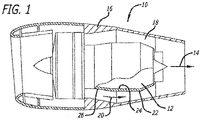
- FIG. 1 is a simplified sectional view of a jet engine which includes a nacelle that is composed of parts and structures made using prepreg in accordance with the present invention.
- Uncured epoxy resin compositions in accordance with the present invention may be used in a wide variety of situations where a thermoplastictoughened epoxy resin matrix is desired.
- the uncured epoxy resin composition may be used alone, the compositions are used in this invention as a matrix resin that is combined with fibers to form a composite material composed of the fibers and the resin matrix.
- the composite material may be in the form of a prepreg, partially cured prepreg or a completely cured final part made from one or more layers of prepreg.
- uncured when used herein in connection with: prepreg; the resin before impregnation into the fibers; the resin matrix that is formed when the fibers are impregnated with the resin; or composite material, is intended to cover items that may have been subjected to some curing, but which have not been completely cured to form the final composite part or structure.
- the uncured composite materials may be used for any intended purpose, they are preferably used in making parts for aerospace vehicles, such as commercial and military aircraft.
- the uncured composite materials may be used to make non-primary (secondary) aircraft structures.
- the preferred use of the uncured composite material is for structural applications, such as primary aircraft structures.
- Primary aircraft structures or parts are those elements of either fixed-wing or rotary wing aircraft that undergo significant stress during flight and which are essential for the aircraft to maintain controlled flight.
- the nacelle that surrounds the internal components of an aircraft jet engine is considered to be a primary aircraft structure.
- the prepreg of the present invention is particularly well suited for use in making the composite parts and structures that are present in the nacelle.
- the jet engine 10 includes a combustion core or hot section 12 which generates a primary hot air flow as represented by arrow 14.
- the hot air flow within the hot section or high temperature area 12 can be at temperatures ranging from 500°F (260°C) to 750°F (399°C) and higher depending upon the jet engine type and design.
- a nacelle structure 16 is located around the hot section 12 to provide an annular duct 18 through which cold secondary air flows as represented by arrow 20. The cold air flow enters the jet engine at a temperature equal to the outside air temperature and is heated as it passes through the annular duct 18 to temperatures that are equal to or slightly less than the temperature of the hot section 12.
- the prepreg of the present invention may be used as a replacement for existing prepreg that is presently being used to form the composite parts and structures that are present in the nacelle 16.
- One aspect of the invention involves substituting the resin formulations of the present invention in place of existing resins that are being used to make prepreg that is molded to form nacelle parts or structures.
- the resin formulations of the present invention are suitable for use as the matrix resin in conventional manufacturing and curing processes involving prepreg that is used to make the parts and structures associated with a jet engine nacelle.
- the prepreg of the present invention is composed of fibers and an uncured resin matrix.
- the fibers can be any of the conventional fiber configurations that are used in the prepreg and composite sheet molding industry. Fiber types and configurations that are presently being used to make jet engine nacelle parts and structures are preferred. Carbon fibers are the preferred fiber type.
- the uncured resin that is used to form the resin matrix includes an epoxy resin component that is made up of a trifunctional epoxy resin, a tetrafunctional epoxy resin and a solid epoxy resin.
- the resin further includes a thermoplastic toughening agent and a curing agent.
- a preferred exemplary trifunctional epoxy resin is triglycidyl meta-aminophenol.
- Triglycidyl meta-aminophenol is available from Huntsman Advanced Materials (The Woodlands, TX) under the trade name Araldite MY0610.
- Triglycidyl meta-aminophenol is also available from Kukdo Chemicals (Seoul, South Korea) under the trade name KDS-8808 and from Sumitomo Chemical Co. (Osaka, Japan) under the trade name ELM-120.
- Another suitable trifunctional epoxy resin is triglycidyl para-aminophenol.
- Triglycidyl para-aminophenol is available from Huntsman Advanced Materials (The Woodlands, TX) under the trade name Araldite MY0510.
- Other trifunctional epoxy resins may be used provided that they have properties that are the same or similar to the properties of triglycidyl meta-aminophenol or triglycidyl para-aminophenol.
- An exemplary tetrafunctional epoxy resin is N,N,N',N'-tetraglycidyl-4,4'-diaminodiphenyl methane (TGDDM) which is available as Araldite MY720 and MY721 from Huntsman Advanced Materials (The Woodlands, TX), or ELM 434 from Sumitomo Chemical Industries, Ltd. (Chuo, Tokyo). MY721 is preferred.
- Other tetrafunctional epoxy resins may be used provided that they have properties that are the same or similar to the properties of N,N,N',N'-tetraglycidyl-4,4'-diaminodiphenyl methane.
- tetra-functional epoxy resins based on N,N,N',N'-tetraglycidyl-4,4'-methylenebis-benzenamine are also suitable.
- Such resins are available from Huntsman Advanced Materials (The Woodlands, TX) under the trade name Araldite MY9663.
- the weight ratio between the trifunctional and tetrafunctional resins be from 1.0:1.4 to 1.4:1.0. It is particularly preferred that the weight ratio between the trifunctional and tetrafunctional resins be from 1.2:1.0 to 1.2:1.0. Most preferred are formulations where the weight ratio between the trifunctional and tetrafunctional epoxy resins is 1.0:1.0.
- the epoxy resin component also contains a solid epoxy resin.
- a solid epoxy resin is considered to be an epoxy resin that is solid or semi-solid at room temperature (20-25°C) and which has a softening point of 40-90°C.
- a first exemplary solid epoxy resin has the following formula:
- the first exemplary solid epoxy resin is available from Huntsman (The Woodlands, TX) under the trade name Tactix 742.
- Tactix 742 is semi-solid at room temperature and has a softening point of 48.9°C.
- the epoxy equivalent weight of Tactix 742 is 150-170 g/eq.
- the density of the resin at 25°C is 1.23 g/cm 3 with the flash point (closed cup) of the resin being 204°C.
- a second exemplary solid epoxy resin has the following formula:
- the second exemplary resin is also known as 9,9-bis[4-(glycidyloxy)phenyl]fluorene.
- the second exemplary solid epoxy resin is available from Shin A T&C (Overland Park, Kansas) under the trade name SE 250.
- the third exemplary solid epoxy resin is available from Nippon Kayaku (Tokyo, Japan) under the trade name NC7000H.
- a fourth exemplary solid epoxy resin has the following formula:
- HP4770 is a naphthalene type epoxy that has an epoxy equivalent weight of 200-210 g/eq and a softening point of 67-77°C.
- HP4700 which is a naphthalene type epoxy that is available from DIC (Singapore), is also suitable.
- the uncured resin includes at least one curing agent.
- Suitable curing agents are those which facilitate the curing of the epoxy-functional compounds and, particularly, facilitate the ring opening polymerization of such epoxy compounds.
- Such curing agents include those compounds which polymerize with the epoxy-functional compound or compounds, in the ring opening polymerization thereof.
- Any of the curing agents that have been used to cure epoxy resins in aerospace prepregs that are used in making primary structures and parts may be suitable. Two or more such curing agents may be used in combination.
- Exemplary preferred curing agents include 4,4'-diaminodiphenyl sulphone (4,4'-DDS) and 3,3'-diaminodiphenyl sulphone (3,3'-DDS), both commercially available from Huntsman (The Woodlands, TX). 3,3'-DDS is the preferred curing agent.
- Accelerators may also being included to enhance or promote curing.
- Suitable accelerators are any of the urone compounds that have been commonly used in the curing of epoxy resins.
- Specific examples of accelerators, which may be used alone or in combination, include N,N-dimethyl, N'-3,4-dichlorphenyl urea (Diuron), N'-3-chlorophenyl urea (Monuron), and preferably N,N-(4-methyl-m-phenylene bis[N',N'-dimethylurea] (e.g. Dyhard UR500 available from Degussa).
- the uncured resin matrix of the present invention also includes a thermoplastic toughening agent.
- the thermoplastic toughening agent is added to the resin mix as particles that are dissolved in the resin mixture by heating prior to addition of the curing agent. Once the thermoplastic agent is substantially dissolved in the hot resin precursor (i.e. the blend of epoxy resins), the precursor is cooled and the curing agent is added and mixed with the cooled resin blend.
- a suitable toughening agent is particulate polyethersulfone (PES) that is sold under the trade name Sumikaexcel 5003P, and which is commercially available from Sumitomo Chemicals (New York, NY).
- PES particulate polyethersulfone
- 5003P is sold under the trade name Sumikaexcel 5003P, and which is commercially available from Sumitomo Chemicals (New York, NY).
- Alternatives to 5003P are Solvay polyethersulphone 105RP, or the non-hydroxyl terminated grades such as Solvay 1054P which is commercially available from Solvay Chemicals (Houston, TX).
- Densified PES particles may be used as the toughening agent. The form of the PES is not particularly important since the PES is dissolved during formation of the resin. Densified PES particles can be made in accordance with the teachings of U.S. Patent No.
- Densified PES particles are also available commercially from Hexcel Corporation (Dublin, CA) under the trade name HRI-1.
- the average particle size of the toughening agent should be less than 100 microns to promote and insure complete dissolution of the PES in the resin precursor.
- the uncured resin may also include additional ingredients, such as performance enhancing or modifying agents provided they do not adversely affect the viscosity of the uncured resin or the compressive strength of the cured composite material when measured under both room temperature/dry conditions and hot/wet conditions.
- the performance enhancing or modifying agents may be selected from core shell rubbers, flame retardants, wetting agents, pigments/dyes, UV absorbers, anti-fungal compounds, fillers, conducting particles, and viscosity modifiers.
- Exemplary core shell rubber (CSR) particles are composed of a cross-linked rubber core, typically a copolymer of butadiene, and a shell composed of styrene, methyl methacrylate, glycidyl methacrylate and/or acrylonitrile.
- the core shell particles are usually provided as particles dispersed in an epoxy resin. The size range of the particles is typically from 50 to 150 nm.
- Suitable CSR particles are described in detail in U.S. Patent Publication US2007/0027233A1 , the contents of which is hereby incorporated by reference.
- Preferred core shell particles are MX core-shell particles, which are available from Kane Ace (Pasadena, Texas).
- a preferred core shell particle for inclusion in the uncured resin is Kane Ace MX-418.
- MX-418 is supplied as a 25 wt% suspension of core shell particles in a tetrafunctional epoxy resin.
- the core shell particles in MX-418 are poly butadiene (PBd) core shell particles which have an average particle size of 100 nanometers.
- Suitable fillers include, by way of example, any of the following either alone or in combination: silica, alumina, titania, glass, calcium carbonate and calcium oxide.
- Suitable conducting particles include any of the following either alone or in combination: silver, gold, copper, aluminum, nickel, conducting grades of carbon, buckminsterfullerene, carbon nanotubes and carbon nanofibres.
- Metal-coated fillers may also be used, for example nickel coated carbon particles and silver coated copper particles.
- Potato shaped graphite (PSG) particles are suitable conducting particles.
- the use of PSG particles in carbon fiber/epoxy resin composites is described in detail in U.S. Patent Publication No. US 2015/0179298 A1 , the contents of which is hereby incorporated by reference.
- the PSG particles are commercially available from NGS Naturgraphit (Germany) as SG25/99.95 SC particles or from Nippon Power Graphite Company (Japan) as GHDR-15-4 particles. These commercially available PSG particles have average particle sizes of from 10-30 microns with the GHDR-15-4 particles having a vapor deposited coating of carbon on the outer surface of the PSG particles.
- the uncured resin is made in accordance with standard prepreg matrix resin processing.
- the trifunctional epoxy resin, tetrafunctional epoxy resin and solid epoxy resin are mixed together at room temperature to form a resin mix to which the thermoplastic toughening agent is added.
- This mixture is then heated to about 120°C for about 1 to 2 hours to dissolve the thermoplastic toughening agent.
- the mixture is then cooled down to about 80°C.
- the curing agent, thermoplastic particles and additional ingredients, if any, are then mixed into the resin to form the final uncured resin that is further cooled to room temperature or below.
- the uncured resin is applied to the fibrous reinforcement to form an uncured resin matrix surrounding the fibers in accordance with any of the known prepreg manufacturing techniques.
- the fibrous reinforcement may be fully or partially impregnated with the uncured resin.
- the uncured resin may be applied to the fiber fibrous reinforcement as a separate layer, which is proximal to, and in contact with, the fibrous reinforcement, but does not substantially impregnate the fibrous reinforcement.
- the prepreg which is also referred to as semi-preg, is typically covered on both sides with a protective film and rolled up for storage and shipment at temperatures that are typically kept well below room temperature to avoid premature curing.
- the actual resin matrix is not formed until further processing of the semi-preg. Any of the other prepreg manufacturing processes and storage/shipping systems may be used if desired.
- the fibrous portion of the prepreg which is also referred to as the fibrous reinforcement or fibrous support, may be selected from any fiberglass, carbon or aramid (aromatic polyamide) fibers.
- the fibrous reinforcement is preferably carbon fibers.
- Preferred carbon fibers are in the form of tows that contain from 3,000 to 50,000 carbon filaments (3K to 50K). Commercially available carbon fiber tows that contain 6,000, 12,000 or 24,000 carbon filaments (6K, 12K or 24K) are preferred.
- the fibrous portion of the prepreg may comprise cracked (i.e. stretch-broken) or selectively discontinuous fibers, or continuous fibers.
- the use of cracked or selectively discontinuous fibers may facilitate lay-up of the composite material prior to being fully cured, and improve its capability of being shaped.
- the fibrous reinforcement may be in a woven, non-crimped, non-woven, unidirectional, or multi-axial textile structure form, such as quasiisotropic chopped prepreg that is used to form sheet molding compound.
- the woven form may be selected from a plain, satin, or twill weave style.
- the non-crimped and multi-axial forms may have a number of plies and fiber orientations. Such styles and forms are well known in the composite reinforcement field, and are commercially available from a number of companies, including Hexcel Reinforcements (Les Avenieres, France).
- the prepreg may be in the form of continuous tapes, towpregs, webs, or chopped lengths (chopping and slitting operations may be carried out at any point after impregnation).
- the prepreg may be an adhesive or surfacing film and may additionally have embedded carriers in various forms both woven, knitted, and non-woven.
- the prepreg may be fully or only partially impregnated, for example, to facilitate air removal during curing.
- the following exemplary resin formulation is impregnated into a fibrous support to form a prepreg in accordance with the present invention (all weight percentages are based on the total resin weight): 22 wt% to 26 wt% triglycidyl-m-aminophenol; 22 wt% to 26 wt% tetrafunctional epoxy; 4 wt% to 8 wt% solid epoxy resin; 15 wt% to 19 wt% polyethersulfone; and 27 wt% to 32 wt% 3,3'-DDS as the curing agent.
- the prepreg may be molded using any of the standard techniques used to form composite parts. Typically, one or more layers of prepreg are placed in a suitable mold and cured to form the final composite part.
- the prepreg of the invention may be fully or partially cured using any suitable temperature, pressure, and time conditions known in the art. Typically, the prepreg will be cured in an autoclave at temperatures of between 160°C and 190°C.
- the composite material may be cured using a method selected from microwave radiation, electron beam, gamma radiation, or other suitable thermal or non-thermal radiation.
- Composite parts made from the improved prepreg of the present invention are particularly well suited for use in making the composite parts and structures that are present in jet engine nacelles.
- the sub Tg of the uncured resin is suitable for use in making prepreg and the composite parts and structures that are molded from the prepreg are able to tolerate the hot and wet conditions present in the environment of a jet engine nacelle.
- a composite part or structure is considered to be able to tolerate hot and wet conditions if the open hole compression (OHC) of the cured composite material of the part or structure is 37 or greater when measured at 132°C under wet conditions (hot/wet OHC) as set forth in the current version of ASTM D6484.
- the 132°C /wet OHC of the cured composite material will be at least 38.
- the sub Tg of the resin should be in the range of -10°C to 5°C, as determined by differential scanning calorimetry (DSC) conducted at a heating rate of 10°C per minute.
- the sub Tg will be from -5°C to 5°C and most preferably between 0°C and 5°C.
- a first preferred exemplary uncured resin formulation in accordance with the present invention is set forth in TABLE 1.
- the uncured resin was prepared by mixing the epoxy ingredients at room temperature with the polyethersulfone to form a resin blend that was heated to 120°C for 60 minutes to completely dissolve the polyethersulfone. The mixture was cooled to 80°C and the curing agent was added and mixed in thoroughly.
- the sub Tg of the resin was measured by DSC at a heating rate of 10C°/minute and found to be 2.2°C.
- Exemplary prepreg was prepared by impregnating one or more layers of unidirectional carbon fibers with the resin formulation of TABLE 1.
- the unidirectional carbon fibers (12K AS4) available from Hexcel Corporation) were used to make a prepreg in which the matrix resin amounted to 35 weight percent of the total uncured prepreg weight and the fiber areal weight was 192 grams per square meter (gsm).
- a 26-ply laminate was prepared using standard prepreg fabrication procedures. The laminate was cured in an autoclave at 177°C for about 2 hours. The cured laminate was tested to determine OHC in accordance with ASTM D6484 under room temperature/dry conditions; 82°C/wet conditions; and 132°C/wet conditions. The results were 55.7, 45.4 and 38.6, respectively.
- a second preferred exemplary uncured resin having the formula set forth in TABLE 2 was prepared in the same manner as Example 1.
- TABLE 2 Ingredient Amount (Wt%) Trifunctional meta-glycidyl amine (MY0610) 23.8 N,N,N',N'-tetraglycidyl-4,4'-diaminodiphenyl methane (MY721) 23.8 Solid epoxy (SE 250) 6.0
- Thermoplastic Toughening Agent polyether sulfone - 5003P
- Aromatic diamine curing agent (3,3-DDS) 29.5
- the sub Tg of the resin was measured in the same manner as Example 1 and found to be 2.4°C
- a 26-ply laminate was prepared, cured and tested for OHC in the same manner as Example 1.
- the OHC's of the laminate under room temperature/dry conditions; 82°C/wet conditions; and 132°C/wet conditions were 54.3, 42.3 and 38.3, respectively.
- a third preferred exemplary uncured resin having the formula set forth in TABLE 3 was prepared in the same manner as Example 1.
- TABLE 3 Ingredient Amount (Wt%) Trifunctional meta-glycidyl amine (MY0610) 23.8 N,N,N',N'-tetraglycidyl-4,4'-diaminodiphenyl methane (MY721) 23.8 Solid epoxy (NC 7000H) 6.0
- Thermoplastic Toughening Agent polyether sulfone - 5003P
- Aromatic diamine curing agent (3,3-DDS) 29.5
- the sub Tg of the resin was measured in the same manner as Example 1 and found to be 2.6°C.
- a 26-ply laminate was prepared, cured and tested for OHC in the same manner as Example 1.
- the OHC's of the laminate under room temperature/dry conditions; 82°C/wet conditions; and 132°C/wet conditions were 53.4, 45.0 and 37.8, respectively.
- a fourth preferred exemplary uncured resin having the formula set forth in TABLE 4 was prepared in the same manner as Example 1.
- TABLE 4 Ingredient Amount (Wt%) Trifunctional meta-glycidyl amine (MY0610) 23.8 N,N,N',N'-tetraglycidyl-4,4'-diaminodiphenyl methane (MY721) 23.8 Solid epoxy (HP 4770) 6.0
- Thermoplastic Toughening Agent polyether sulfone - 5003P
- Aromatic diamine curing agent (3,3-DDS) 29.5
- the sub Tg of the resin was measured in the same manner as Example 1 and found to be 2.4°C.
- a 26-ply laminate was prepared, cured and tested for OHC in the same manner as Example 1.
- the OHC's of the laminate under room temperature/dry conditions; 82°C/wet conditions; and 132°C/wet conditions were 54.7, 44.9 and 37.1, respectively.
- All of the preferred exemplary uncured resins are particularly well suited for making prepreg that is used in making the composite parts and structures that are present in jet engine nacelles because the uncured resins all had sub Tg's of between 2°C and 3°C and the laminates made from the resins all had an OHC under 132°C/wet conditions of between 37 and 39.
- Comparative examples of uncured resin having the formulas set forth in TABLE 5 were prepared in the same manner as Example 1. 26-ply laminates were prepared, cured and tested for OHC in the same manner as Example 1. The uncured comparative resins were also tested for sub Tg in the same manner as Example 1. The results of the OHC and sub Tg testing are set forth in TABLE 5.
- Comparative Examples 1-4 demonstrate that a lack of solid epoxy resin in the resin formulation prevents one from reaching a the preferred sub Tg (0°C to 5°C) and/or suitable OHC (at least 37) under 132°C/wet conditions in accordance with the present invention.
- Comparative Examples 5-6 demonstrate that the addition of substantial amounts of solid epoxy (over 10 weight percent) provide a suitable OHC under 132°C/wet conditions, but the sub Tg (almost 17°C) is significantly above the preferred sub Tg range in accordance with the present invention that is suitable for making nacelle prepreg.
- Tactix 556 which is used in Comparative Example 7, is a hydrocarbon epoxy novolac resin having a dicyclopentadiene backbone that is available from Huntsman (The Woodlands, TX). Tactix 556 is a semi-solid resin which has a softening point of 53°C.
- thermoplastic particles (1 to 5 wt%, based on the total weight of the uncured resin) are included in the uncured resin as a thermoplastic particle component to provide increased interlaminar fracture toughness.
- the amount of thermoplastic particles in the thermoplastic particle component will be 3 wt% ⁇ 1 wt%, based on the total weight of the uncured resin.
- thermoplastic particles may be included in the uncured resin to form the thermoplastic particle component.
- exemplary thermoplastic particles are polyamide particles which are formed from the polymeric condensation product of a methyl derivative of bis(4-aminocyclohexyl)methane and an aliphatic dicarboxylic acid selected from the group consisting of decane dicarboxylic acid and dodecane dicarboxylic acid.
- Methyl derivatives of bis(4-aminocyclohexyl)methane, which are referred to herein as the "amine component” are also known as methyl derivatives of 4,4'-diaminocyclohexylmethane.
- This type of polyamide particle and the methods for making them are described in detail in U.S. Patent Nos. 3,936,426 and 5,696,202 , the contents of which are hereby incorporated by reference.
- the formula for the amine component of the polymeric condensation product is where R 2 is hydrogen and R 1 is either methyl or hydrogen.
- the formula for the monomeric unit of the polymeric condensation product may be represented as follows:
- the molecular number of the polymeric condensation product will range from 14,000 to 20,000 with a molecular numbers of about 17,000 being preferred.
- the polyamide particles should have particle sizes of below 100 microns. It is preferred that the particles range in size from 5 to 60 microns and more preferably from 10 to 30 microns. It is preferred that the average particle size is from 15 to 25 microns.
- the polyamide particles may be regular or irregular in shape. For example, the particles may be substantially spherical or they can be particles with a jagged shape.
- One exemplary polyamide particle is made from polyamide where the amine component of the polymeric condensation product has the above formula in which R 1 both are methyl and R 2 both are hydrogen.
- Such polyamide particles may be made from the polymeric condensation product of 3,3'-dimethyl-bis(4-aminocyclohexyl)-methane and 1,10-decane dicarboxylic acid.
- the polyamide particles are made by combining, in a heated receiving vessel, 13,800 grams of 1,10- decane dicarboxylic acid and 12,870 grams of 3,3'-dimethyl-bis(4-aminocyclohexyl)methane with 30 grams of 50% aqueous phosphoric acid, 150 grams benzoic acid and 101 grams of water.
- GRILAMID TR90 is the polymeric condensation product of 3,3'-dimethyl-bis(4-aminocyclohexyl)-methane and 1,10-decane dicarboxylic acid.
- polyamide particle is made from polyamide where the amine component of the polymeric condensation product has the above formula in which R 1 both are hydrogen and R 2 both are hydrogen.
- polyamide particles may be made in the same manner as described above, except that polyamide is the polymeric condensation product of 3,3'-dimethyl-bis(4-aminocyclohexyl)-propane and 1,10-decane dicarboxylic acid.
- Polyamide particles where R 1 both are hydrogen and R 2 both are hydrogen can also be made from TROGAMIDE CX7323 or CX9705, which are commercially available from Evonik (Mobile, AL).
- CX7323 and CX9705 are the polymeric condensation products of 3,3'-dimethyl-bis(4-aminocyclohexyl)-propane and 1,10-decane dicarboxylic acid.
- the thermoplastic particle component may include one or more types of polyamide particles that are typically used in thermoplastic toughened epoxy resins including, for example, polyamide (PA) 11, PA6, PA12, PA6/PA12 copolymer, PA4, PA8, PA6.6, PA4.6, PA10.10, PA6.10 and PA10.12.
- PA polyamide
- PA6 PA6, PA12, PA6/PA12 copolymer, PA4, PA8, PA6.6, PA4.6, PA10.10, PA6.10 and PA10.12.
- An exemplary thermoplastic particle component contains a first group of polyamide particles which do not contain crosslinked polyamide and a second group of polyamide particles that do contain crosslinked polyamide.
- the first group of polyamide particles may be any of the polyamide particle that do not contain crosslinked polyamide and which are typically used in thermoplastic toughened epoxy-based prepreg.
- Such particles may be composed of polyamide (PA) 11, PA6, PA12, PA6/PA12 copolymer, PA4, PA8, PA6.6, PA4.6, PA10.10, PA6.10 and PA10.12.
- Non-crosslinked polyamide particles are available commercially from a number of sources.
- Suitable non-crosslinked polyamide 12 particles are available from Kobo Products under the trade name SP10L. SP10L particles contain over 98 wt% PA 12.
- the particle size distribution is from 7 microns to 13 microns with the average particle size being 10 microns.
- the density of the particles is 1 g/cm 3 . It is preferred that the PA12 particles are at least 95 wt% PA12, excluding moisture content.
- Orgasol 1002 powder is composed of 100% PA6 particles having an average particle size of 20 microns.
- Orgasol 3803 is composed of particles that are a copolymer of 80% PA12 and 20% PA6 with the mean particle size being from 17 to 24 microns.
- Orgasol 2002 is a powder composed of non-crosslinked PA12 particles that may also be used in the first group of particles.
- Exemplary non-crosslinked polyamide particles for the first group of thermoplastic particles are polyamide 11 particles, which are also available commercially from a number of sources.
- the preferred polyamide 11 particles are available from Arkema (Colombes, France) under the trade name Rislan PA11. These particles contain over 98 wt% PA 11 and have a particle size distribution of 15 microns to 25 microns. The average particle size is 20 microns.
- the density of the Rislan PA11 particles is 1 g/cm 3 . It is preferred that the PA 11 particles are at least 95 wt% PA11, excluding moisture content.
- the second group of thermoplastic polyamide particles are particles that contain crosslinked polyamide on the surface of the particle, in the interior of the particle or both.
- the crosslinked polyamide particles may be made from polyamide that has been crosslinked prior to particle formation or non-crosslinked polyamide particles may be treated with suitable crosslinking agents to produce crosslinked polyamide particles.
- Suitable crosslinked particles contain crosslinked PA11, PA6, PA12, PA6/PA12 copolymer, PA4, PA8, PA6.6, PA4.6, PA10.10, PA6.10 and PA10.12.
- Any of the crosslinking agents commonly used to cross link polyamide are suitable.
- Exemplary crosslinking agents are epoxy-based crosslinking agents, isocyanate-based crosslinking agents, carbodiimide-based crosslinking agents, acyllactam-based crosslinking agents and oxazoline-based crosslinking agent.
- Preferred crosslinked particles are PA12 particles that contain PA12 that has been crosslinked with an epoxy crosslinking agent.
- the procedures used to cross link thermoplastic polymers, including polyamide, are known. For examples, see U.S. Patent No. 6399714 , U.S. Patent No. 8846818 and U.S. Published Patent Application US 2016/0152782 A1 . The contents of these three references are hereby incorporated by reference.
- Crosslinked PA12 particles are available commercially from Arkema (Colombes, France) under the tradename ORGASOL 2009 polyamide powder, which is also known as CG352.
- the PA12 particles present in ORGASOL 2009 polyamide powder are composed of at least 40% PA12 that has been cross linked with an epoxy-based crosslinking agent.
- the ORGASOL 2009 crosslinked polyamide particles have an average particle size of 14.2 microns with only 0.2% of the particles having a diameter of greater than 30 microns.
- the melting point of ORGASOL 2009 crosslinked particles is 180°C.
- the specific surface area of the ORGASOL 2009 particles is 1.9 and the moisture content of the particles is 0.34%.
- the crosslinked polyamide particles should each contain from 40 to 70% crosslinked polyamide. Preferably, the crosslinked polyamide particles should each contain from 40 to 60% crosslinked polyamide.
- both the non-crosslinked and crosslinked polyamide particles should have particle sizes of below 100 microns. It is preferred that the particles range in size from 5 to 60 microns and more preferably from 5 to 30 microns. It is preferred that the average particle size is from 5 to 20 microns.
- the particles may be regular or irregular in shape. For example, the particles may be substantially spherical or they can be particles with a jagged shape. It is preferred that the non-crosslinked particles have an average particle size that is larger than the crosslinked particles.
- the average non-crosslinked particles size will range from 15 to 25 microns and the average crosslinked particle size will range from 10 to 20 microns.
- the relative amounts of non-crosslinked and crosslinked particles may be varied when a combination of crosslinked and non-crosslinked particles are used.
- Weight ratios of non-crosslinked particles to crosslinked particles may range from 4:1 to 1.5:1.
- the weight ratios of non-crosslinked particles to crosslinked particles will range from 3.5:1 to 2.5:1.
- thermoplastic particle component may include a combination of polyimide particles and polyamide particles where the polyamide particles are composed of the polymeric condensation product of a methyl derivative of bis(4-aminocyclohexyl)methane and an aliphatic dicarboxylic acid.
- Preferred polyimide particles are available commercially from HP Polymer GmbH (Lenzig, Austria) as P84 polyimide molding powder. Suitable polyamide particles are also available commercially from Evonik Industries (Austria) under the tradename P84NT.
- the polyimide used to make the particles is disclosed in U.S. Pat. No. 3,708,458 , the contents of which is hereby incorporated by reference.
- the polyimide is made by combining benzophenone-3,3',4,4'-tetracarboxylic acid dianhydride with a mixture of 4,4'-methylenebis(phenyl isocyanate) and toluene diisocyanate (2,4- or 2,6-isomer).
- the amine analogs may be used in place of the aromatic iso- and diisocyanates.
- the CAS Registry No. of the polyimide is 58698-66-1.
- the polyimide particles are composed of an aromatic polyimide having the repeating monomer formula: where from 10 to 90% of the R groups in the overall polymer are an aromatic group having the formula: with the remaining R groups in the polymer being
- the size of the polyimide particles in the powder typically ranges from 2 microns to 35 microns.
- a preferred polyimide powder will contain particles that range in size from 2 to 30 microns with the average particle size ranging from 5 microns to 15 microns.
- Preferably, at least 90 weight percent of the polyimide particles in the powder will be in the size range of 2 microns to 20 microns.
- the polyimide particles may be regular or irregular in shape.
- the particles may be substantially spherical or they can be particles with a jagged shape.
- the polyimide particles contain at least 95 weight percent polyimide. Small amounts (up to 5 weight percent) of other materials may be included in the particles provided that they do not adversely affect the overall characteristics of the particles.
- the glass transition temperature (Tg) of the polyimide particles should be about 330°C with the density of individual particles being 1.34 grams per cubic centimeter.
- the linear coefficient of thermal expansion of the particles is 50.
- the weight ratio between the polyamide particles and the polyimide particles may range from 3.5:1.0 to 1.0:1.0.
- the weight ratio between the polyamide particles and polyimide particles is between 3.2:1.0 and 2.8:1.0.
- thermoplastic particle component examples of practice with respect to the inclusion of a thermoplastic particle component in the uncured resin are as follows:
- a preferred exemplary uncured resin having the formula set forth in TABLE 5A was prepared in the same manner as Example 1, except that a thermoplastic particle component (particles of CX9705 having particles sizes less than 20 microns with an average particle size of 5 microns) was mixed in with the uncured resin at the same time as the curing agent.
- a thermoplastic particle component particles of CX9705 having particles sizes less than 20 microns with an average particle size of 5 microns
- Exemplary prepreg was prepared by impregnating one or more layers of carbon fiber fabric with the resin formulation of TABLE 5A.
- the carbon fiber fabric (AS4D carbon fiber fabric available from Hexcel Corporation, Dublin, CA) was used to make a prepreg in which the matrix resin amounted to 35 weight percent of the total uncured prepreg weight and the carbon fiber areal weight was 193 grams per square meter (gsm).
- a 20-ply laminate was prepared using standard prepreg fabrication procedures. The laminate was cured in an autoclave at 177°C for about 2 hours. The cured laminate, which was 0.16 ⁇ 0.01 inch thick, was tested to determine G1c in accordance with the current version of BSS 7273.
- the G1c was found to be 4.0 in-lb/in 2 .
- the sub Tg of the uncured resin was -5.8 °C.
- the resin set forth in Example 4, which lacks thermoplastic particles, was used to make prepreg that was equivalent to Example 5 and subjected to the same G1c testing procedure.
- the G1c of the Example 4 prepreg was 2.8 in-lb/in 2 .
- TABLE 6 An exemplary uncured resin having the formula set forth in TABLE 6 was prepared in the same manner as Example 5.
- Ingredient Amount (Wt%) Trifunctional meta-glycidyl amine (MY0610) 25.8 N,N,N',N'-tetraglycidyl-4,4'-diaminodiphenyl methane (MY721) 25.8 Solid epoxy (HP 4770) 6.0
- Thermoplastic Toughening Agent polyether sulfone - 5003P
- Thermoplastic Particle Component (CX9705 particles) 2.0 Aromatic diamine curing agent (3,3-DDS) 25.5
- Prepreg and laminates were prepared and cured in the same manner as Example 5 and tested for G1c.
- the G1c was found to be 3.2 in-lb/in 2 .
- the sub Tg of the uncured resin was 2.0°C.
- Prepreg and laminates were prepared and cured in the same manner as Example 5 and tested for G1c.
- the G1c was found to be 3.5 in-lb/in 2 .
- the sub Tg was -5.3 °C.
- An exemplary uncured resin having the formula set forth in TABLE 8 was prepared in the same manner as Example 5, except that Rislan PA11 particles were used in place of CX9705 particles.
- TABLE 8 Ingredient Amount (Wt%) Trifunctional meta-glycidyl amine (MY0610) 25.8 N,N,N',N'-tetraglycidyl-4,4'-diaminodiphenyl methane (MY721) 25.8 Solid epoxy (HP 4770) 6.0
- Thermoplastic Toughening Agent polyether sulfone - 5003P
- Thermoplastic Particle Component (Rislan PA-11 particles) 3.0 Aromatic diamine curing agent (3,3-DDS) 25.5
- Prepreg and laminates were prepared and cured in the same manner as Example 5 and tested for G1c.
- the G1c was found to be 3.02 in-lb/in 2 .
- the sub Tg of the uncured resin was -3.2 °C.
- An exemplary uncured resin having the formula set forth in TABLE 9 was prepared in the same manner as Example 8.
- TABLE 9 Ingredient Amount (Wt%) Trifunctional meta-glycidyl amine (MY0610) 25.8 N,N,N',N'-tetraglycidyl-4,4'-diaminodiphenyl methane (MY721) 25.8 Solid epoxy (HP 4770) 6.0
- Thermoplastic Toughening Agent polyether sulfone - 5003P
- Thermoplastic Particle Component (Rislan PA-11 particles) 2.0 Aromatic diamine curing agent (3,3-DDS) 25.5
- Prepreg and laminates were prepared and cured in the same manner as Example 5 and tested for G1c.
- the G1c was found to be 3.03 in-lb/in 2 .
- the sub Tg of the uncured resin was -3.4 °C.
Landscapes
- Chemical & Material Sciences (AREA)
- Engineering & Computer Science (AREA)
- Organic Chemistry (AREA)
- Health & Medical Sciences (AREA)
- Chemical Kinetics & Catalysis (AREA)
- Medicinal Chemistry (AREA)
- Polymers & Plastics (AREA)
- Materials Engineering (AREA)
- Manufacturing & Machinery (AREA)
- Inorganic Chemistry (AREA)
- Textile Engineering (AREA)
- Reinforced Plastic Materials (AREA)
- Compositions Of Macromolecular Compounds (AREA)
Applications Claiming Priority (4)
| Application Number | Priority Date | Filing Date | Title |
|---|---|---|---|
| US15/886,008 US10472479B2 (en) | 2018-02-01 | 2018-02-01 | Prepreg for use in making composite parts which tolerate hot and wet conditions |
| US16/158,151 US10577472B2 (en) | 2018-02-01 | 2018-10-11 | Thermoplastic particle-toughened prepreg for use in making composite parts which tolerate hot and wet conditions |
| PCT/US2019/013794 WO2019152190A1 (en) | 2018-02-01 | 2019-01-16 | Prepreg for use in making composite parts which tolerate hot and wet conditions |
| EP19706792.9A EP3746499B1 (de) | 2018-02-01 | 2019-01-16 | Prepreg zur verwendung bei der herstellung von verbundteilen, die heisse und nasse bedingungen tolerieren |
Related Parent Applications (2)
| Application Number | Title | Priority Date | Filing Date |
|---|---|---|---|
| EP19706792.9A Division EP3746499B1 (de) | 2018-02-01 | 2019-01-16 | Prepreg zur verwendung bei der herstellung von verbundteilen, die heisse und nasse bedingungen tolerieren |
| EP19706792.9A Division-Into EP3746499B1 (de) | 2018-02-01 | 2019-01-16 | Prepreg zur verwendung bei der herstellung von verbundteilen, die heisse und nasse bedingungen tolerieren |
Publications (2)
| Publication Number | Publication Date |
|---|---|
| EP4105266A1 true EP4105266A1 (de) | 2022-12-21 |
| EP4105266B1 EP4105266B1 (de) | 2024-09-18 |
Family
ID=65516731
Family Applications (2)
| Application Number | Title | Priority Date | Filing Date |
|---|---|---|---|
| EP22181303.3A Active EP4105266B1 (de) | 2018-02-01 | 2019-01-16 | Prepreg zur verwendung bei der herstellung von verbundteilen, die heisse und nasse bedingungen tolerieren |
| EP19706792.9A Active EP3746499B1 (de) | 2018-02-01 | 2019-01-16 | Prepreg zur verwendung bei der herstellung von verbundteilen, die heisse und nasse bedingungen tolerieren |
Family Applications After (1)
| Application Number | Title | Priority Date | Filing Date |
|---|---|---|---|
| EP19706792.9A Active EP3746499B1 (de) | 2018-02-01 | 2019-01-16 | Prepreg zur verwendung bei der herstellung von verbundteilen, die heisse und nasse bedingungen tolerieren |
Country Status (8)
| Country | Link |
|---|---|
| US (1) | US10577472B2 (de) |
| EP (2) | EP4105266B1 (de) |
| JP (1) | JP7299225B2 (de) |
| CN (1) | CN111902464B (de) |
| AU (1) | AU2019215293B2 (de) |
| CA (1) | CA3089811A1 (de) |
| ES (2) | ES2951479T3 (de) |
| WO (1) | WO2019152190A1 (de) |
Families Citing this family (6)
| Publication number | Priority date | Publication date | Assignee | Title |
|---|---|---|---|---|
| GB201815759D0 (en) * | 2018-09-27 | 2018-11-14 | Rolls Royce Plc | Nacelle intake |
| CN111187438B (zh) * | 2020-02-10 | 2021-03-05 | 北京航空航天大学 | 一种真空袋成型工艺用碳纤维/增韧环氧树脂预浸料的制备方法 |
| KR20230018438A (ko) * | 2020-05-28 | 2023-02-07 | 스미또모 가가꾸 가부시키가이샤 | 수지 입자 및 필름 |
| JP7764143B2 (ja) * | 2021-05-25 | 2025-11-05 | 帝人株式会社 | 複合材料およびプリプレグ |
| WO2023132317A1 (ja) * | 2022-01-07 | 2023-07-13 | 太陽ホールディングス株式会社 | 硬化性樹脂組成物 |
| CN114933778B (zh) * | 2022-04-01 | 2023-11-03 | 航天特种材料及工艺技术研究所 | 一种交联网状增韧结构的自动铺丝预浸料及其制备方法 |
Citations (14)
| Publication number | Priority date | Publication date | Assignee | Title |
|---|---|---|---|---|
| US3708458A (en) | 1971-03-16 | 1973-01-02 | Upjohn Co | Copolyimides of benzophenone tetracarboxylic acid dianhydride and mixture of diisocyanates |
| US3936426A (en) | 1971-12-21 | 1976-02-03 | Phillips Petroleum Company | Amorphous, optically clear polyamide from a bis(4-aminocyclohexyl)methane and a phenylindan dicarboxylic acid |
| US4945154A (en) | 1989-07-07 | 1990-07-31 | Hexcel Corporation | Densified polyethersulfone |
| US5696202A (en) | 1995-02-01 | 1997-12-09 | Ems-Inventa Ag | Transparent, colorless, amorphous polyamides and molded articles |
| US6399714B1 (en) | 2000-09-27 | 2002-06-04 | Michigan Biotechnology Institute | Crosslinked polyamide |
| US20070027233A1 (en) | 2003-06-09 | 2007-02-01 | Katsumi Yamaguchi | Process for producing modified epoxy resin |
| US20100087582A1 (en) * | 2008-10-07 | 2010-04-08 | Hexcel Corporation | Epoxy resins with improved burn properties |
| US20140135443A1 (en) * | 2012-11-15 | 2014-05-15 | Cytec Industries Inc. | Thermoset Resin Composite Materials Comprising Inter-Laminar Toughening Particles |
| US8846818B2 (en) | 2009-05-29 | 2014-09-30 | Cytec Technology Corp. | Engineered cross-linked thermoplastic particles for interlaminar toughening |
| US20150179298A1 (en) | 2012-06-14 | 2015-06-25 | Hexcel Composites Limited | Composite materials |
| US20150252182A1 (en) * | 2014-03-07 | 2015-09-10 | Hexcel Corporation | Extended room temperature storage of epoxy resins |
| US20160152782A1 (en) | 2013-05-17 | 2016-06-02 | Arkema France | Method for the surface crosslinking of polymer particles |
| US20160362528A1 (en) * | 2014-02-06 | 2016-12-15 | Hexcel Corporation | Extended room temperature storage of epoxy resins |
| US20170369663A1 (en) * | 2016-06-22 | 2017-12-28 | Hexcel Corporation | Composite material with thermoplastic toughened novolac-based epoxy resin matrix |
Family Cites Families (22)
| Publication number | Priority date | Publication date | Assignee | Title |
|---|---|---|---|---|
| JPH068341B2 (ja) * | 1985-08-12 | 1994-02-02 | 東レ株式会社 | プリプレグ用エポキシ樹脂組成物 |
| JP3481304B2 (ja) | 1994-06-03 | 2003-12-22 | 日本ヒドラジン工業株式会社 | 常温安定性に優れた耐熱性エポキシ樹脂組成物及びエポキシ樹脂用硬化剤 |
| JP4829766B2 (ja) * | 2006-12-13 | 2011-12-07 | 横浜ゴム株式会社 | 繊維強化複合材料用エポキシ樹脂組成物 |
| GB2460050A (en) | 2008-05-14 | 2009-11-18 | Hexcel Composites Ltd | Epoxy composite |
| JP2010059225A (ja) | 2008-09-01 | 2010-03-18 | Toray Ind Inc | 炭素繊維強化複合材料用エポキシ樹脂組成物、プリプレグおよび炭素繊維強化複合材料 |
| KR101605581B1 (ko) | 2008-09-29 | 2016-03-22 | 도레이 카부시키가이샤 | 에폭시 수지 조성물, 프리프레그 및 섬유 강화 복합 재료 |
| US7897703B2 (en) * | 2009-05-20 | 2011-03-01 | Hexcel Corporation | Epoxy resin and 4,4′-diaminobenzanilide powder |
| US8470923B2 (en) * | 2010-04-21 | 2013-06-25 | Hexcel Corporation | Composite material for structural applications |
| JP5929046B2 (ja) | 2010-09-17 | 2016-06-01 | 東レ株式会社 | 炭素繊維織物プリプレグおよび炭素繊維強化複合材料 |
| US9187636B2 (en) * | 2012-08-26 | 2015-11-17 | Hexcel Corporation | Composite material with polyamide particle mixtures |
| GB201217226D0 (en) | 2012-09-26 | 2012-11-07 | Hexcel Composites Ltd | Resin composition and composite structure containing resin |
| CN104870511B (zh) | 2013-01-15 | 2017-04-26 | 东丽株式会社 | 环氧树脂组合物、预浸料坯及碳纤维增强复合材料 |
| JP2014167103A (ja) | 2013-01-29 | 2014-09-11 | Toray Ind Inc | エポキシ樹脂組成物、プリプレグおよび繊維強化複合材料 |
| JP6094234B2 (ja) | 2013-01-29 | 2017-03-15 | 東レ株式会社 | エポキシ樹脂組成物、成形材料および繊維強化複合材料 |
| CN106062051B (zh) | 2014-02-13 | 2019-12-06 | 赫克赛尔公司 | 具有聚酰胺颗粒混合物的复合材料 |
| US20180134837A1 (en) | 2015-06-19 | 2018-05-17 | Toray Industries, Inc. | Epoxy resin composition, prepreg and fiber-reinforced composite material |
| KR20180045863A (ko) | 2015-08-27 | 2018-05-04 | 도레이 카부시키가이샤 | 에폭시 수지 조성물 및 이로부터 제조된 섬유 강화 복합 재료 |
| KR20180048454A (ko) | 2015-09-03 | 2018-05-10 | 도레이 카부시키가이샤 | 에폭시 수지 조성물, 프리프레그 및 탄소섬유 강화 복합 재료 |
| WO2017163129A1 (en) | 2016-03-24 | 2017-09-28 | Toray Industries, Inc. | Epoxy resin composition, prepreg, and fiber reinforced plastic material |
| JP6782553B2 (ja) | 2016-04-12 | 2020-11-11 | 帝人株式会社 | プリプレグの製造方法 |
| US10472479B2 (en) * | 2018-02-01 | 2019-11-12 | Hexcel Corporation | Prepreg for use in making composite parts which tolerate hot and wet conditions |
| JP2018012797A (ja) | 2016-07-22 | 2018-01-25 | 東レ株式会社 | エポキシ樹脂組成物、プリプレグ、樹脂硬化物および繊維強化複合材料 |
-
2018
- 2018-10-11 US US16/158,151 patent/US10577472B2/en active Active
-
2019
- 2019-01-16 AU AU2019215293A patent/AU2019215293B2/en active Active
- 2019-01-16 CN CN201980019790.9A patent/CN111902464B/zh active Active
- 2019-01-16 ES ES19706792T patent/ES2951479T3/es active Active
- 2019-01-16 WO PCT/US2019/013794 patent/WO2019152190A1/en not_active Ceased
- 2019-01-16 ES ES22181303T patent/ES2991278T3/es active Active
- 2019-01-16 EP EP22181303.3A patent/EP4105266B1/de active Active
- 2019-01-16 EP EP19706792.9A patent/EP3746499B1/de active Active
- 2019-01-16 CA CA3089811A patent/CA3089811A1/en active Pending
- 2019-01-16 JP JP2020541935A patent/JP7299225B2/ja active Active
Patent Citations (14)
| Publication number | Priority date | Publication date | Assignee | Title |
|---|---|---|---|---|
| US3708458A (en) | 1971-03-16 | 1973-01-02 | Upjohn Co | Copolyimides of benzophenone tetracarboxylic acid dianhydride and mixture of diisocyanates |
| US3936426A (en) | 1971-12-21 | 1976-02-03 | Phillips Petroleum Company | Amorphous, optically clear polyamide from a bis(4-aminocyclohexyl)methane and a phenylindan dicarboxylic acid |
| US4945154A (en) | 1989-07-07 | 1990-07-31 | Hexcel Corporation | Densified polyethersulfone |
| US5696202A (en) | 1995-02-01 | 1997-12-09 | Ems-Inventa Ag | Transparent, colorless, amorphous polyamides and molded articles |
| US6399714B1 (en) | 2000-09-27 | 2002-06-04 | Michigan Biotechnology Institute | Crosslinked polyamide |
| US20070027233A1 (en) | 2003-06-09 | 2007-02-01 | Katsumi Yamaguchi | Process for producing modified epoxy resin |
| US20100087582A1 (en) * | 2008-10-07 | 2010-04-08 | Hexcel Corporation | Epoxy resins with improved burn properties |
| US8846818B2 (en) | 2009-05-29 | 2014-09-30 | Cytec Technology Corp. | Engineered cross-linked thermoplastic particles for interlaminar toughening |
| US20150179298A1 (en) | 2012-06-14 | 2015-06-25 | Hexcel Composites Limited | Composite materials |
| US20140135443A1 (en) * | 2012-11-15 | 2014-05-15 | Cytec Industries Inc. | Thermoset Resin Composite Materials Comprising Inter-Laminar Toughening Particles |
| US20160152782A1 (en) | 2013-05-17 | 2016-06-02 | Arkema France | Method for the surface crosslinking of polymer particles |
| US20160362528A1 (en) * | 2014-02-06 | 2016-12-15 | Hexcel Corporation | Extended room temperature storage of epoxy resins |
| US20150252182A1 (en) * | 2014-03-07 | 2015-09-10 | Hexcel Corporation | Extended room temperature storage of epoxy resins |
| US20170369663A1 (en) * | 2016-06-22 | 2017-12-28 | Hexcel Corporation | Composite material with thermoplastic toughened novolac-based epoxy resin matrix |
Also Published As
| Publication number | Publication date |
|---|---|
| AU2019215293A1 (en) | 2020-08-20 |
| JP2021512199A (ja) | 2021-05-13 |
| WO2019152190A1 (en) | 2019-08-08 |
| EP3746499A1 (de) | 2020-12-09 |
| JP7299225B2 (ja) | 2023-06-27 |
| EP4105266B1 (de) | 2024-09-18 |
| ES2991278T3 (es) | 2024-12-03 |
| ES2951479T3 (es) | 2023-10-23 |
| US20190233602A1 (en) | 2019-08-01 |
| AU2019215293B2 (en) | 2023-02-16 |
| WO2019152190A9 (en) | 2019-11-14 |
| US10577472B2 (en) | 2020-03-03 |
| CN111902464B (zh) | 2023-03-21 |
| CA3089811A1 (en) | 2019-08-08 |
| CN111902464A (zh) | 2020-11-06 |
| EP3746499B1 (de) | 2023-07-12 |
Similar Documents
| Publication | Publication Date | Title |
|---|---|---|
| EP3746499B1 (de) | Prepreg zur verwendung bei der herstellung von verbundteilen, die heisse und nasse bedingungen tolerieren | |
| AU2011313942B2 (en) | Improving solvent resistance of epoxy resins toughened with polyethersulfone | |
| CN103328529B (zh) | 耐溶剂的热塑性塑料增韧的环氧树脂 | |
| JP7592651B2 (ja) | ハイブリッドポリアミド粒子で強化されたマトリックス樹脂 | |
| US10208176B2 (en) | Composite material with thermoplastic toughened novolac-based epoxy resin matrix | |
| US10465052B2 (en) | Composite material with thermoplastic toughened novolac-based epoxy resin matrix | |
| JP7637677B2 (ja) | ナノ粒子を含有する熱可塑性強化マトリックス樹脂 | |
| US10472474B2 (en) | Semipreg with thermoplastic toughened novolac-based epoxy resin matrix | |
| US10472479B2 (en) | Prepreg for use in making composite parts which tolerate hot and wet conditions | |
| CN111448244A (zh) | 具有热塑性增韧的线型酚醛基环氧树脂基质的半浸料 | |
| US10731014B2 (en) | Matrix resins toughened with hybrid polyamide particles |
Legal Events
| Date | Code | Title | Description |
|---|---|---|---|
| PUAI | Public reference made under article 153(3) epc to a published international application that has entered the european phase |
Free format text: ORIGINAL CODE: 0009012 |
|
| STAA | Information on the status of an ep patent application or granted ep patent |
Free format text: STATUS: THE APPLICATION HAS BEEN PUBLISHED |
|
| AC | Divisional application: reference to earlier application |
Ref document number: 3746499 Country of ref document: EP Kind code of ref document: P |
|
| AK | Designated contracting states |
Kind code of ref document: A1 Designated state(s): AL AT BE BG CH CY CZ DE DK EE ES FI FR GB GR HR HU IE IS IT LI LT LU LV MC MK MT NL NO PL PT RO RS SE SI SK SM TR |
|
| STAA | Information on the status of an ep patent application or granted ep patent |
Free format text: STATUS: REQUEST FOR EXAMINATION WAS MADE |
|
| 17P | Request for examination filed |
Effective date: 20230608 |
|
| P01 | Opt-out of the competence of the unified patent court (upc) registered |
Effective date: 20230530 |
|
| RBV | Designated contracting states (corrected) |
Designated state(s): AL AT BE BG CH CY CZ DE DK EE ES FI FR GB GR HR HU IE IS IT LI LT LU LV MC MK MT NL NO PL PT RO RS SE SI SK SM TR |
|
| RAP3 | Party data changed (applicant data changed or rights of an application transferred) |
Owner name: HEXCEL CORPORATION |
|
| STAA | Information on the status of an ep patent application or granted ep patent |
Free format text: STATUS: EXAMINATION IS IN PROGRESS |
|
| 17Q | First examination report despatched |
Effective date: 20231025 |
|
| GRAP | Despatch of communication of intention to grant a patent |
Free format text: ORIGINAL CODE: EPIDOSNIGR1 |
|
| STAA | Information on the status of an ep patent application or granted ep patent |
Free format text: STATUS: GRANT OF PATENT IS INTENDED |
|
| GRAS | Grant fee paid |
Free format text: ORIGINAL CODE: EPIDOSNIGR3 |
|
| INTG | Intention to grant announced |
Effective date: 20240709 |
|
| GRAA | (expected) grant |
Free format text: ORIGINAL CODE: 0009210 |
|
| STAA | Information on the status of an ep patent application or granted ep patent |
Free format text: STATUS: THE PATENT HAS BEEN GRANTED |
|
| AC | Divisional application: reference to earlier application |
Ref document number: 3746499 Country of ref document: EP Kind code of ref document: P |
|
| AK | Designated contracting states |
Kind code of ref document: B1 Designated state(s): AL AT BE BG CH CY CZ DE DK EE ES FI FR GB GR HR HU IE IS IT LI LT LU LV MC MK MT NL NO PL PT RO RS SE SI SK SM TR |
|
| REG | Reference to a national code |
Ref country code: GB Ref legal event code: FG4D |
|
| REG | Reference to a national code |
Ref country code: CH Ref legal event code: EP |
|
| REG | Reference to a national code |
Ref country code: IE Ref legal event code: FG4D |
|
| REG | Reference to a national code |
Ref country code: DE Ref legal event code: R096 Ref document number: 602019059330 Country of ref document: DE |
|
| REG | Reference to a national code |
Ref country code: ES Ref legal event code: FG2A Ref document number: 2991278 Country of ref document: ES Kind code of ref document: T3 Effective date: 20241203 |
|
| REG | Reference to a national code |
Ref country code: LT Ref legal event code: MG9D |
|
| PG25 | Lapsed in a contracting state [announced via postgrant information from national office to epo] |
Ref country code: NO Free format text: LAPSE BECAUSE OF FAILURE TO SUBMIT A TRANSLATION OF THE DESCRIPTION OR TO PAY THE FEE WITHIN THE PRESCRIBED TIME-LIMIT Effective date: 20241218 |
|
| PG25 | Lapsed in a contracting state [announced via postgrant information from national office to epo] |
Ref country code: GR Free format text: LAPSE BECAUSE OF FAILURE TO SUBMIT A TRANSLATION OF THE DESCRIPTION OR TO PAY THE FEE WITHIN THE PRESCRIBED TIME-LIMIT Effective date: 20241219 Ref country code: FI Free format text: LAPSE BECAUSE OF FAILURE TO SUBMIT A TRANSLATION OF THE DESCRIPTION OR TO PAY THE FEE WITHIN THE PRESCRIBED TIME-LIMIT Effective date: 20240918 |
|
| PG25 | Lapsed in a contracting state [announced via postgrant information from national office to epo] |
Ref country code: BG Free format text: LAPSE BECAUSE OF FAILURE TO SUBMIT A TRANSLATION OF THE DESCRIPTION OR TO PAY THE FEE WITHIN THE PRESCRIBED TIME-LIMIT Effective date: 20240918 |
|
| PG25 | Lapsed in a contracting state [announced via postgrant information from national office to epo] |
Ref country code: LV Free format text: LAPSE BECAUSE OF FAILURE TO SUBMIT A TRANSLATION OF THE DESCRIPTION OR TO PAY THE FEE WITHIN THE PRESCRIBED TIME-LIMIT Effective date: 20240918 |
|
| PG25 | Lapsed in a contracting state [announced via postgrant information from national office to epo] |
Ref country code: HR Free format text: LAPSE BECAUSE OF FAILURE TO SUBMIT A TRANSLATION OF THE DESCRIPTION OR TO PAY THE FEE WITHIN THE PRESCRIBED TIME-LIMIT Effective date: 20240918 |
|
| REG | Reference to a national code |
Ref country code: NL Ref legal event code: MP Effective date: 20240918 |
|
| PG25 | Lapsed in a contracting state [announced via postgrant information from national office to epo] |
Ref country code: RS Free format text: LAPSE BECAUSE OF FAILURE TO SUBMIT A TRANSLATION OF THE DESCRIPTION OR TO PAY THE FEE WITHIN THE PRESCRIBED TIME-LIMIT Effective date: 20241218 |
|
| PG25 | Lapsed in a contracting state [announced via postgrant information from national office to epo] |
Ref country code: RS Free format text: LAPSE BECAUSE OF FAILURE TO SUBMIT A TRANSLATION OF THE DESCRIPTION OR TO PAY THE FEE WITHIN THE PRESCRIBED TIME-LIMIT Effective date: 20241218 Ref country code: NO Free format text: LAPSE BECAUSE OF FAILURE TO SUBMIT A TRANSLATION OF THE DESCRIPTION OR TO PAY THE FEE WITHIN THE PRESCRIBED TIME-LIMIT Effective date: 20241218 Ref country code: LV Free format text: LAPSE BECAUSE OF FAILURE TO SUBMIT A TRANSLATION OF THE DESCRIPTION OR TO PAY THE FEE WITHIN THE PRESCRIBED TIME-LIMIT Effective date: 20240918 Ref country code: HR Free format text: LAPSE BECAUSE OF FAILURE TO SUBMIT A TRANSLATION OF THE DESCRIPTION OR TO PAY THE FEE WITHIN THE PRESCRIBED TIME-LIMIT Effective date: 20240918 Ref country code: GR Free format text: LAPSE BECAUSE OF FAILURE TO SUBMIT A TRANSLATION OF THE DESCRIPTION OR TO PAY THE FEE WITHIN THE PRESCRIBED TIME-LIMIT Effective date: 20241219 Ref country code: FI Free format text: LAPSE BECAUSE OF FAILURE TO SUBMIT A TRANSLATION OF THE DESCRIPTION OR TO PAY THE FEE WITHIN THE PRESCRIBED TIME-LIMIT Effective date: 20240918 Ref country code: BG Free format text: LAPSE BECAUSE OF FAILURE TO SUBMIT A TRANSLATION OF THE DESCRIPTION OR TO PAY THE FEE WITHIN THE PRESCRIBED TIME-LIMIT Effective date: 20240918 |
|
| REG | Reference to a national code |
Ref country code: AT Ref legal event code: MK05 Ref document number: 1724665 Country of ref document: AT Kind code of ref document: T Effective date: 20240918 |
|
| PG25 | Lapsed in a contracting state [announced via postgrant information from national office to epo] |
Ref country code: NL Free format text: LAPSE BECAUSE OF FAILURE TO SUBMIT A TRANSLATION OF THE DESCRIPTION OR TO PAY THE FEE WITHIN THE PRESCRIBED TIME-LIMIT Effective date: 20240918 |
|
| PG25 | Lapsed in a contracting state [announced via postgrant information from national office to epo] |
Ref country code: IS Free format text: LAPSE BECAUSE OF FAILURE TO SUBMIT A TRANSLATION OF THE DESCRIPTION OR TO PAY THE FEE WITHIN THE PRESCRIBED TIME-LIMIT Effective date: 20250118 Ref country code: PT Free format text: LAPSE BECAUSE OF FAILURE TO SUBMIT A TRANSLATION OF THE DESCRIPTION OR TO PAY THE FEE WITHIN THE PRESCRIBED TIME-LIMIT Effective date: 20250120 |
|
| PG25 | Lapsed in a contracting state [announced via postgrant information from national office to epo] |
Ref country code: RO Free format text: LAPSE BECAUSE OF FAILURE TO SUBMIT A TRANSLATION OF THE DESCRIPTION OR TO PAY THE FEE WITHIN THE PRESCRIBED TIME-LIMIT Effective date: 20240918 Ref country code: SM Free format text: LAPSE BECAUSE OF FAILURE TO SUBMIT A TRANSLATION OF THE DESCRIPTION OR TO PAY THE FEE WITHIN THE PRESCRIBED TIME-LIMIT Effective date: 20240918 |
|
| PG25 | Lapsed in a contracting state [announced via postgrant information from national office to epo] |
Ref country code: AT Free format text: LAPSE BECAUSE OF FAILURE TO SUBMIT A TRANSLATION OF THE DESCRIPTION OR TO PAY THE FEE WITHIN THE PRESCRIBED TIME-LIMIT Effective date: 20240918 Ref country code: EE Free format text: LAPSE BECAUSE OF FAILURE TO SUBMIT A TRANSLATION OF THE DESCRIPTION OR TO PAY THE FEE WITHIN THE PRESCRIBED TIME-LIMIT Effective date: 20240918 |
|
| PG25 | Lapsed in a contracting state [announced via postgrant information from national office to epo] |
Ref country code: CZ Free format text: LAPSE BECAUSE OF FAILURE TO SUBMIT A TRANSLATION OF THE DESCRIPTION OR TO PAY THE FEE WITHIN THE PRESCRIBED TIME-LIMIT Effective date: 20240918 Ref country code: PL Free format text: LAPSE BECAUSE OF FAILURE TO SUBMIT A TRANSLATION OF THE DESCRIPTION OR TO PAY THE FEE WITHIN THE PRESCRIBED TIME-LIMIT Effective date: 20240918 |
|
| PG25 | Lapsed in a contracting state [announced via postgrant information from national office to epo] |
Ref country code: IT Free format text: LAPSE BECAUSE OF FAILURE TO SUBMIT A TRANSLATION OF THE DESCRIPTION OR TO PAY THE FEE WITHIN THE PRESCRIBED TIME-LIMIT Effective date: 20240918 Ref country code: SK Free format text: LAPSE BECAUSE OF FAILURE TO SUBMIT A TRANSLATION OF THE DESCRIPTION OR TO PAY THE FEE WITHIN THE PRESCRIBED TIME-LIMIT Effective date: 20240918 |
|
| REG | Reference to a national code |
Ref country code: DE Ref legal event code: R097 Ref document number: 602019059330 Country of ref document: DE |
|
| PG25 | Lapsed in a contracting state [announced via postgrant information from national office to epo] |
Ref country code: DK Free format text: LAPSE BECAUSE OF FAILURE TO SUBMIT A TRANSLATION OF THE DESCRIPTION OR TO PAY THE FEE WITHIN THE PRESCRIBED TIME-LIMIT Effective date: 20240918 |
|
| PLBE | No opposition filed within time limit |
Free format text: ORIGINAL CODE: 0009261 |
|
| STAA | Information on the status of an ep patent application or granted ep patent |
Free format text: STATUS: NO OPPOSITION FILED WITHIN TIME LIMIT |
|
| 26N | No opposition filed |
Effective date: 20250619 |
|
| REG | Reference to a national code |
Ref country code: CH Ref legal event code: PL |
|
| PG25 | Lapsed in a contracting state [announced via postgrant information from national office to epo] |
Ref country code: SE Free format text: LAPSE BECAUSE OF FAILURE TO SUBMIT A TRANSLATION OF THE DESCRIPTION OR TO PAY THE FEE WITHIN THE PRESCRIBED TIME-LIMIT Effective date: 20240918 |
|
| PG25 | Lapsed in a contracting state [announced via postgrant information from national office to epo] |
Ref country code: LU Free format text: LAPSE BECAUSE OF NON-PAYMENT OF DUE FEES Effective date: 20250116 Ref country code: MC Free format text: LAPSE BECAUSE OF FAILURE TO SUBMIT A TRANSLATION OF THE DESCRIPTION OR TO PAY THE FEE WITHIN THE PRESCRIBED TIME-LIMIT Effective date: 20240918 |
|
| PG25 | Lapsed in a contracting state [announced via postgrant information from national office to epo] |
Ref country code: BE Free format text: LAPSE BECAUSE OF NON-PAYMENT OF DUE FEES Effective date: 20250131 |
|
| PG25 | Lapsed in a contracting state [announced via postgrant information from national office to epo] |
Ref country code: CH Free format text: LAPSE BECAUSE OF NON-PAYMENT OF DUE FEES Effective date: 20250131 |
|
| REG | Reference to a national code |
Ref country code: BE Ref legal event code: MM Effective date: 20250131 |
|
| PGFP | Annual fee paid to national office [announced via postgrant information from national office to epo] |
Ref country code: GB Payment date: 20251204 Year of fee payment: 8 |
|
| PGFP | Annual fee paid to national office [announced via postgrant information from national office to epo] |
Ref country code: FR Payment date: 20251208 Year of fee payment: 8 |
|
| PG25 | Lapsed in a contracting state [announced via postgrant information from national office to epo] |
Ref country code: IE Free format text: LAPSE BECAUSE OF NON-PAYMENT OF DUE FEES Effective date: 20250116 |
|
| PGFP | Annual fee paid to national office [announced via postgrant information from national office to epo] |
Ref country code: ES Payment date: 20260209 Year of fee payment: 8 |
|
| PGFP | Annual fee paid to national office [announced via postgrant information from national office to epo] |
Ref country code: DE Payment date: 20251203 Year of fee payment: 8 |