EP4106867B1 - Erzeugung und anwendung robuster dosisprädiktionsmodelle - Google Patents
Erzeugung und anwendung robuster dosisprädiktionsmodelle Download PDFInfo
- Publication number
- EP4106867B1 EP4106867B1 EP21707183.6A EP21707183A EP4106867B1 EP 4106867 B1 EP4106867 B1 EP 4106867B1 EP 21707183 A EP21707183 A EP 21707183A EP 4106867 B1 EP4106867 B1 EP 4106867B1
- Authority
- EP
- European Patent Office
- Prior art keywords
- dose
- volume
- perturbations
- nominal values
- model
- Prior art date
- Legal status (The legal status is an assumption and is not a legal conclusion. Google has not performed a legal analysis and makes no representation as to the accuracy of the status listed.)
- Active
Links
Images


Classifications
-
- G—PHYSICS
- G06—COMPUTING OR CALCULATING; COUNTING
- G06N—COMPUTING ARRANGEMENTS BASED ON SPECIFIC COMPUTATIONAL MODELS
- G06N5/00—Computing arrangements using knowledge-based models
- G06N5/04—Inference or reasoning models
-
- A—HUMAN NECESSITIES
- A61—MEDICAL OR VETERINARY SCIENCE; HYGIENE
- A61N—ELECTROTHERAPY; MAGNETOTHERAPY; RADIATION THERAPY; ULTRASOUND THERAPY
- A61N5/00—Radiation therapy
- A61N5/10—X-ray therapy; Gamma-ray therapy; Particle-irradiation therapy
- A61N5/103—Treatment planning systems
- A61N5/1031—Treatment planning systems using a specific method of dose optimization
-
- G—PHYSICS
- G06—COMPUTING OR CALCULATING; COUNTING
- G06N—COMPUTING ARRANGEMENTS BASED ON SPECIFIC COMPUTATIONAL MODELS
- G06N20/00—Machine learning
-
- G—PHYSICS
- G16—INFORMATION AND COMMUNICATION TECHNOLOGY [ICT] SPECIALLY ADAPTED FOR SPECIFIC APPLICATION FIELDS
- G16H—HEALTHCARE INFORMATICS, i.e. INFORMATION AND COMMUNICATION TECHNOLOGY [ICT] SPECIALLY ADAPTED FOR THE HANDLING OR PROCESSING OF MEDICAL OR HEALTHCARE DATA
- G16H20/00—ICT specially adapted for therapies or health-improving plans, e.g. for handling prescriptions, for steering therapy or for monitoring patient compliance
- G16H20/40—ICT specially adapted for therapies or health-improving plans, e.g. for handling prescriptions, for steering therapy or for monitoring patient compliance relating to mechanical, radiation or invasive therapies, e.g. surgery, laser therapy, dialysis or acupuncture
-
- A—HUMAN NECESSITIES
- A61—MEDICAL OR VETERINARY SCIENCE; HYGIENE
- A61N—ELECTROTHERAPY; MAGNETOTHERAPY; RADIATION THERAPY; ULTRASOUND THERAPY
- A61N5/00—Radiation therapy
- A61N5/10—X-ray therapy; Gamma-ray therapy; Particle-irradiation therapy
- A61N5/103—Treatment planning systems
- A61N2005/1041—Treatment planning systems using a library of previously administered radiation treatment applied to other patients
Definitions
- radiation therapy involves directing a beam of high energy proton, photon, ion, or electron radiation ("therapeutic radiation") into a target, or target volume (e.g., a volume that includes a tumor or lesion).
- a beam of high energy proton, photon, ion, or electron radiation ("therapeutic radiation") into a target, or target volume (e.g., a volume that includes a tumor or lesion).
- the plan defines various aspects of the therapy using simulations and optimizations based on past experiences.
- the purpose of the treatment plan is to deliver sufficient radiation to the unhealthy tissue while minimizing exposure of surrounding healthy tissue to the radiation.
- the planner's goal is to find a solution that is optimal with respect to multiple clinical goals that may be contradictory in the sense that an improvement toward one goal may have a detrimental effect on reaching another goal. For example, a treatment plan that spares the liver from receiving a dose of radiation may result in the stomach receiving too much radiation.
- a critical component of treatment planning is predicting the dosage and dose distribution of the radiation to be applied to the patient.
- knowledge-based dose prediction information from previously planned radiation treatments can be used to gain knowledge of what is an achievable dose distribution in a new case without performing the actual planning.
- One approach to knowledge-based dose prediction is to use a set of treatment plans to create a model that can then be used to predict the dose for a new case. The prediction can be transformed into optimization objectives that, when used in combination with an optimization algorithm, produce a complete treatment plan.
- Document US 2015/095043 discloses generation of dose prediction models, using previous patient data as input. DVHs are provided as output. Quality of several models can be tested by comparing the predicted dose distributions to the actual dose distributions of select treatment plans.
- Document WO2019016305 describes a method for determination a plurality of dose distributions, wherein a plurality of treatment plans is accessed and for each treatment field of the treatment plans, a field-specific planning target volume, fsPTV), is determined. Further, CTVs and OARs are delineated, wherein each OAR volume comprises at least one sub-volume that is delineated based on spatial relationships between each said OAR volume and the CTV and the fsPTV for said each treatment field.
- the present invention provides computer-implemented methods as defined in the claims.
- the dose prediction models are "robust,” so that they account for perturbations that can occur during treatment.
- a patient's position may change during treatment, and preferably the dose prediction model can account for patient movement when the model is used to optimize the objectives of a radiation or radiotherapy treatment plan prior to treating the patient.
- Embodiments according to the present invention provide an improved method of radiation treatment planning. More specifically, embodiments according to the invention pertain to the generation of robust dose prediction models, and to the application of those models to develop and optimize radiation treatment plans.
- a computer-implemented method comprising:
- Each model of the dose prediction models may comprise information that associates said each model with a dose distribution used to train said each model.
- the method may comprise comprising applying the dose prediction models to a radiation treatment plan, wherein said applying comprises: calculating dose-volume histograms for the radiation treatment plan using the dose prediction models, wherein the dose-volume histograms comprise a dose-volume histogram calculated using the nominal values and dose-volume histograms calculated using the perturbations of the nominal values; and generating objectives of the radiation treatment plan using the dose prediction models and based on the dose-volume histograms.
- nominal values of parameters, and perturbations of the nominal values, that are associated with previously defined radiation treatment plans are accessed.
- a field-specific planning target volume fsPTV
- CTV clinical target volume
- OAR organ-at-risk
- Each OAR includes at least one sub-volume that is delineated based on spatial relationships between each OAR and the CTV and the fsPTV for each treatment field.
- Dose distributions for the sub-volumes are determined based on the nominal values and based on the perturbations. For example, if there are N perturbations, then N+1 dose distributions are determined: a dose distribution based on the nominal values, and a dose distribution based on each of the perturbations.
- multiple robust dose prediction models are generated for each sub-volume. For example, if there are N perturbations, then N+1 dose prediction models are generated for each sub-volume: a dose prediction model that is trained using the dose distribution based on the nominal values, and a dose prediction model that is trained using each dose distribution based on each of the perturbations.
- only one robust dose prediction model is generated for each sub-volume. However, that model is trained using all of the dose distributions. For example, if there are N perturbations, then the dose prediction model is trained using the N+1 dose distributions described above.
- robust dose prediction models are generated that are trained on and as such account for potential perturbations in plan parameters during treatment.
- the perturbations are inserted as parameters into the models to develop the optimization objectives. More specifically, the models are used to predict dose-volume histograms (DVHs) for the plan. If there are N perturbations and therefore N+1 models, then a set of N+1 DVHs per sub-volume are determined for the plan. The dose prediction models can then be used to generate the optimization objectives based on the DVHs.
- VHs dose-volume histograms
- a computer-implemented method comprising:
- the dose prediction model may comprise information that associates the dose prediction model with the dose distributions used to train the dose prediction model.
- the method may further comprise applying the dose prediction model to a radiation treatment plan, wherein said applying comprises: calculating dose-volume histograms for the radiation treatment plan using the dose prediction model and using the nominal values; and generating objectives of the radiation treatment plan using the dose prediction model and based on the dose-volume histograms.
- That model is used to predict a nominal DVH per sub-volume.
- the dose prediction model can then be used to generate the optimization objectives based on the nominal DVH.
- Embodiments according to the invention improve radiation treatment planning, and hence the treatment itself, by increasing the robustness of the dose prediction models, which are in turn used to develop and optimize radiation treatment plans for the benefit of the patients being treated.
- Robust models can be utilized to deliver sufficient doses to the CTV in perturbed treatment scenarios while ensuring that OARs do not receive too much dose in any perturbed scenario.
- Robust models are particularly important for proton beam treatments but are important as well for other modalities.
- the computer system or similar electronic computing device manipulates and transforms data represented as physical (electronic) quantities within the computer system memories, registers or other such information storage, transmission or display devices.
- Terms such as “dose,” “dose rate,” or some other parameter or attribute generally refer to a dose value, dose rate value, attribute value, or parameter value, respectively; the use of such terms will be clear from the context of the surrounding discussion.
- Embodiments described herein may be discussed in the general context of computer-executable instructions residing on some form of computer-readable storage medium, such as program modules, executed by one or more computers or other devices.
- computer-readable storage media may comprise non-transitory computer storage media and communication media.
- program modules include routines, programs, objects, components, data structures, etc., that perform particular tasks or implement particular abstract data types.
- the functionality of the program modules may be combined or distributed as desired in various embodiments.
- Computer storage media includes volatile and nonvolatile, removable and non-removable media implemented in any method or technology for storage of information such as computer-readable instructions, data structures, program modules or other data.
- Computer storage media includes, but is not limited to, random access memory (RAM), read only memory (ROM), electrically erasable programmable ROM (EEPROM), flash memory or other memory technology, compact disk ROM (CD-ROM), digital versatile disks (DVDs) or other optical storage, magnetic cassettes, magnetic tape, magnetic disk storage or other magnetic storage devices, or any other medium that can be used to store the desired information and that can accessed to retrieve that information.
- Communication media can embody computer-executable instructions, data structures, and program modules, and includes any information delivery media.
- communication media includes wired media such as a wired network or direct-wired connection, and wireless media such as acoustic, radio frequency (RF), infrared and other wireless media. Combinations of any of the above can also be included within the scope of computer-readable media.
- wired media such as a wired network or direct-wired connection
- wireless media such as acoustic, radio frequency (RF), infrared and other wireless media. Combinations of any of the above can also be included within the scope of computer-readable media.
- RF radio frequency
- Figures 1A , 2 , 4 , and 5 are flowcharts 100, 200, 400, and 500, respectively, of examples of computer-implemented operations for generating dose prediction models or applying such models to radiation treatment plans in embodiments according to the present invention.
- the flowcharts 100, 200, 400, and 500 can be implemented as computer-executable instructions (e.g., the models 650 and 651 of Figure 6 ) residing on some form of computer-readable storage medium (e.g., in memory of the computer system 600 of Figure 6 ).
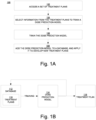
- Figure 1A is a flowchart 100 that provides an overview of a computer-implemented method of generating and applying a dose prediction model in embodiments according to the present invention.
- Figure 1A is discussed with reference also to Figure 1B , which is a block diagram illustrating elements in the process of Figure 1A .
- a set of previously defined treatment plans 110 are accessed from a treatment plan database (e.g., a knowledge-based database 112).
- a treatment plan database e.g., a knowledge-based database 112
- information in those treatment plans such as information for each organ-at-risk (OAR) and dose-volume histograms (DVHs), is selected for use in training a new dose prediction model.
- OAR organ-at-risk
- DHs dose-volume histograms
- a new dose prediction model 114 is trained.
- the training process includes identification of acceptable clinical goals, including acceptable trade-offs between target dose coverage versus doses to organs-at-risk (OARs).
- the training process can also include calculating DVHs using the model being trained, which can be compared to the DVHs in the treatment plan training set.
- the prediction model can be added to the database 112 or to another database, and it can also be used to predict DVHs and doses for a treatment plan 116 being developed for radiation treatment of a patient.
- the dose prediction model can be used for developing treatment plans for, but not limited to, intensity-modulated radiotherapy (IMRT) and volumetric modulated arc therapy (VMAT).
- IMRT intensity-modulated radiotherapy
- VMAT volumetric modulated arc therapy
- Figure 2 is a flowchart 200 of a computer-implemented method of generating a new and robust dose prediction model in embodiments according to the present invention.
- Figure 2 is discussed with reference also to Figure 3 , which illustrates sub-volumes that are used when generating the dose prediction model.
- a set of previously defined treatment plans (which may be referred to herein as the training set) is selected and accessed from, for example, a database.
- the new dose prediction model is generated for a particular anatomical region (e.g., head and neck, or torso, etc.), and the training set will include treatment plans for the same anatomical region.
- 20 or more treatment plans are accessed.
- the number of plans that are accessed is sufficient to properly train and generate a robust dose prediction model.
- the number of plans that are selected can be more or less than 20, depending on the results of the training process.
- the number of plans that are selected may also depend on the anatomical region being modeled.
- the selected treatment plans include nominal values of parameters that have an impact on the treatment dose to be delivered.
- the nominal values for a treatment plan may be stored in the plan itself or linked to the plan.
- nominal values of the training set are accessed in block 202.
- These parameters may include, for example, patient movement (shifts of the isocenters of treatment fields with respect to patient position), beam calibration (e.g., changes in the computed tomography (CT) calibration curve), field size, beam attenuation, and imaging during planning and treatment.
- CT computed tomography
- a number of perturbations e.g., uncertainties, tolerances, ranges
- the perturbations are the same as those used to train the set of previously defined treatment plans, although the invention is not so limited.
- the perturbations for a treatment plan may be stored in the plan itself or linked to the plan.
- At least one OAR volume 302 is defined, and at least one clinical target volume (CTV) 304 is defined.
- the CTV 304 includes the target volume (e.g., the volume of the tumor being treated) and also accounts for uncertainties in the boundaries of the target volume (e.g., tumor spread that may not be imaged).
- a field-specific planning target volume (fsPTV) based on the perturbations is determined for each treatment field (e.g., the fields 310 and 312 of Figure 3 ) of the predefined set of treatment plans.
- a planning target volume (PTV) includes the CTV and also accounts for the perturbations.
- a fsPTV is a separate PTV for each treatment field.
- a geometry-based expected dose is calculated using the fsPTV for each treatment field as the target volume.
- the GEDs provide an estimate of the dose distributions.
- the GEDs provide metrics that map the treatment beam and the patient's geometry to the DVHs.
- a nominal GED is calculated using the nominal values of the parameters and using the fsPTV for each treatment field as the target volume. GEDs corresponding to the perturbations of the nominal values are then estimated using the nominal GED. More specifically, the nominal GED can be shifted laterally relative to a treatment beam according to an isocenter shift due to the perturbations (e.g., patient movement), or it can be shifted toward or away from the beam source due to, for example, perturbations associated with the CT image or calibration curve that affect the range of the beam.
- each OAR volume is divided into one or more sub-volumes that are delineated based on spatial relationships between each OAR volume and the CTV and the fsPTV for each treatment field.
- the sub-volumes include: an in-field fsPTV region that includes at least a part of an OAR volume that overlaps with the projection of a fsPTV from at least one the treatment fields; an in-field CTV region that includes at least a part of an OAR volume that overlaps with the projection of a CTV from at least one of the treatment fields; an overlap fsPTV region that includes at least a part of an OAR volume that is inside a union of all of the fsPTVs; and an overlap CTV region that includes at least a part of an OAR volume that is inside any of the CTV(s).
- projection is a term of art and may be defined differently for different treatment modalities (e.g., beam types). For example, for a photon beam, it is the projection of the target treatment field in the beam direction, extending through the target volume. As another example, for a proton beam, it is the projection of the treatment field that is proximal to the target volume (between the beam source and the target volume, but not extending beyond the target volume).
- the in-field region 306 of Figure 3 is divided into an in-field fsPTV region that includes at least a part of an OAR volume that overlaps with the projection of a fsPTV from at least one the treatment fields, and an in-field CTV region that includes at least a part of an OAR volume that overlaps with the projection of a CTV from at least one of the treatment fields; and the out-of-field region 308 of Figure 3 is divided into an overlap fsPTV region that includes at least a part of an OAR volume that is inside a union of all of the fsPTVs, and an overlap CTV region that includes at least a part of an OAR volume that is inside any of the CTV(s).
- data is extracted from the treatment plans in the training set. More specifically, dose distributions are determined for each sub-volume identified in block 206.
- the dose distributions per sub-volume include a dose distribution based on the nominal values and dose distributions based on the perturbations. For example, if there are N perturbations, then N+1 dose distributions per sub-volume are determined per treatment plan: a dose distribution based on the nominal values, and a dose distribution based on each of the perturbations.
- multiple dose prediction models are generated for each sub-volume.
- the models include a model trained using the dose distribution based on the nominal values and models trained using the dose distributions based on the perturbations. Thus, for example, if there are N perturbations, then N+1 dose prediction models are generated for each sub-volume, one model for each perturbation.
- each dose prediction model includes information that associates the model with the dose distribution used to train the model.
- each dose prediction model has information that identifies the perturbation that it is associated with.
- Figure 4 is a flowchart 400 of a computer-implemented method of generating a new and robust dose prediction model in other embodiments according to the present invention. Blocks 202, 204, 206, 208, and 212 of Figure 4 are described above in conjunction with Figure 2 . In the flowchart 400, block 412 replaces block 212 of Figure 2 .
- a single dose prediction model is generated for each sub-volume. However, that model is trained using all of the dose distributions. For example, if there are N perturbations plus the nominal values, then the dose prediction model is trained using N+1 dose distributions.
- the dose prediction model includes information that associates the model with the dose distributions used to train the model.
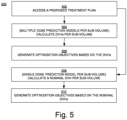
- Figure 5 is a flowchart 500 of a computer-implemented method of applying a new and robust dose prediction model in embodiments according to the present invention.
- a proposed radiation treatment plan is accessed.
- DVHs are calculated for the radiation treatment plan.
- a DVH is calculated using the nominal values, and DVHs are calculated using the perturbations.
- the perturbations are inserted as parameters into the models to develop the optimization objectives. If there are N perturbations and therefore N+1 models, then a set of N+1 DVHs per sub-volume are determined for the plan.
- the dose prediction models are used to generate optimization objectives based on the DVHs.
- An optimization objective may be, for example, that the maximum dose in any of the perturbed scenarios for an OAR cannot exceed a certain value.
- the dose prediction model is used to generate optimization objectives based on the nominal DVHs.
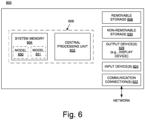
- Figure 6 shows a block diagram of an example of a computer system 600 upon which the embodiments described herein may be implemented.
- the system 600 includes at least one processing unit 602 and memory 604. This most basic configuration is illustrated in Figure 6 by dashed line 606.
- the system 600 may also have additional features and/or functionality.
- the system 600 may also include additional storage (removable and/or non-removable) including, but not limited to, magnetic or optical disks or tape. Such additional storage is illustrated in Figure 6 by removable storage 608 and non-removable storage 620.
- the system 600 may also contain communications connection(s) 622 that allow the device to communicate with other devices, e.g., in a networked environment using logical connections to one or more remote computers.
- the system 600 also includes input device(s) 624 such as keyboard, mouse, pen, voice input device, touch input device, etc.
- input device(s) 624 such as keyboard, mouse, pen, voice input device, touch input device, etc.
- output device(s) 626 such as a display device, speakers, printer, etc., are also included.
- the memory 604 includes computer-readable instructions, data structures, program modules, and the like associated with a model 650 for generating dose prediction models, and a model 651 for applying a dose prediction model to a radiation treatment plan, as described above in conjunction with Figures 1A , 2 , 4 , and 5 .
- the models 650 and 651 may instead reside in any one of the computer storage media used by the system 600, or may be distributed over some combination of the computer storage media, or may be distributed over some combination of networked computers.
- embodiments according to the present invention provide an improved method of radiation treatment planning. More specifically, embodiments according to the invention pertain to the generation of robust dose prediction models, and to the application of those models to develop and optimize radiation treatment plans.
- the robust dose prediction models are trained on and as such account for potential perturbations in plan parameters during treatment.
- Embodiments according to the invention improve radiation treatment planning, and hence the treatment itself, by increasing the robustness of the dose prediction models, which are in turn used to develop and optimize radiation treatment plans for the benefit of the patients being treated.
- Robust models can be utilized to deliver sufficient doses to the CTV in perturbed treatment scenarios while ensuring that OARs do not receive too much dose in any perturbed scenario.
- Robust models are particularly important for proton beam treatments but are important as well for other modalities.
- the dose prediction models are trained using a training set that includes multiple treatment plans, with multiple parameters that include nominal values and perturbations of the nominal values. For each of the plans, multiple fsPTV volumes are determined, and structures in the treatment region are divided into multiple sub-volumes. Dose distributions are determined considering all of these factors. Development of a dose prediction model or models is therefore a complex task that is beyond the capability of a human and relies on the use of a computing system.
- dose prediction models to proposed radiation treatment plans can also be a complex task.
- the degrees of freedom available include beam shaping (collimation), beam weighting (spot scanning), beam intensity or energy, beam directions, dose rate, and number and arrangement of spots. Parameters such as those mentioned previously herein that can affect dose rate also are considered. If the target volume is divided into sub-volumes or voxels, then the values of the parameters can be on a per-sub-volume or per-voxel basis (e.g., a value per sub-volume or voxel).
Landscapes
- Engineering & Computer Science (AREA)
- Health & Medical Sciences (AREA)
- Theoretical Computer Science (AREA)
- Biomedical Technology (AREA)
- Software Systems (AREA)
- Public Health (AREA)
- General Health & Medical Sciences (AREA)
- Nuclear Medicine, Radiotherapy & Molecular Imaging (AREA)
- Medical Informatics (AREA)
- Evolutionary Computation (AREA)
- Mathematical Physics (AREA)
- General Physics & Mathematics (AREA)
- General Engineering & Computer Science (AREA)
- Computing Systems (AREA)
- Physics & Mathematics (AREA)
- Data Mining & Analysis (AREA)
- Artificial Intelligence (AREA)
- Pathology (AREA)
- Animal Behavior & Ethology (AREA)
- Life Sciences & Earth Sciences (AREA)
- Radiology & Medical Imaging (AREA)
- Veterinary Medicine (AREA)
- Epidemiology (AREA)
- Primary Health Care (AREA)
- Computer Vision & Pattern Recognition (AREA)
- Computational Linguistics (AREA)
- Surgery (AREA)
- Urology & Nephrology (AREA)
- Radiation-Therapy Devices (AREA)
- Bioethics (AREA)
Claims (15)
- Computerimplementiertes Verfahren, umfassend:Zugreifen auf eine Vielzahl von Behandlungsplänen, die dieser zugeordnete Störungen von Nominalwerten von Parametern der Behandlungspläne aufweist;für jedes Behandlungsfeld der Behandlungspläne Bestimmen eines feldspezifischen Planungszielvolumens (field-specific planning target volume - fsPTV) basierend auf den Störungen;Zugreifen auf Informationen, die mindestens ein klinisches Zielvolumen (clinical target volume - CTV) abgrenzen, und Informationen, die mindestens ein Volumen eines Risikoorgans (organ-at-risk - OAR) abgrenzen, wobei jedes OAR-Volumen mindestens ein Teilvolumen umfasst, das basierend auf räumlichen Beziehungen zwischen jedem OAR-Volumen und dem CTV und dem fsPTV für jedes Behandlungsfeld abgegrenzt ist; undentweder:(a) Bestimmen von Dosisverteilungen für jedes Teilvolumen, wobei die Dosisverteilungen eine auf den Nominalwerten basierende Dosisverteilung und auf den Störungen basierende Dosisverteilungen umfassen; und Erzeugen von Dosisprädiktionsmodellen für jedes Teilvolumen, wobei die Modelle ein Modell, das unter Verwendung der auf den Nominalwerten basierenden Dosisverteilung trainiert ist, und Modelle, die unter Verwendung der auf den Störungen basierenden Dosisverteilungen trainiert sind, umfassen; oder(b) Bestimmen einer Vielzahl von Dosisverteilungen, umfassend eine auf den Nominalwerten basierende Dosisverteilung und auf den Störungen basierende Dosisverteilungen; und Erzeugen eines Dosisprädiktionsmodells für jedes Teilvolumen, wobei das Modell unter Verwendung der Vielzahl von Dosisverteilungen trainiert ist.
- Verfahren nach Anspruch 1, einschließlich der Schritte (a), wobei jedes Modell der Dosisprädiktionsmodelle Informationen umfasst, die das jeweilige Modell einer Dosisverteilung zuordnen, die zum Trainieren des jeweiligen Modells verwendet wird.
- Verfahren nach Anspruch 1 oder 2, einschließlich der Schritte (a), ferner umfassend Anwenden der Dosisprädiktionsmodelle auf einen Strahlenbehandlungsplan.
- Verfahren nach Anspruch 3, wobei das Anwenden Folgendes umfasst:Berechnen von Dosis-Volumen-Histogrammen für den Strahlenbehandlungsplan unter Verwendung der Dosisprädiktionsmodelle, wobei die Dosis-Volumen-Histogramme ein unter Verwendung der Nominalwerte berechnetes Dosis-Volumen-Histogramm und unter Verwendung der Störungen der Nominalwerte berechnete Dosis-Volumen-Histogramme umfassen; undErzeugen von Zielen des Strahlenbehandlungsplans unter Verwendung der Dosisprädiktionsmodelle und basierend auf den Dosis-Volumen-Histogrammen.
- Verfahren nach Anspruch 1, einschließlich der Schritte (b), wobei das Dosisprädiktionsmodell Informationen umfasst, die das Dosisprädiktionsmodell den Dosisverteilungen zuordnen, die zum Trainieren des Dosisprädiktionsmodells verwendet werden.
- Verfahren nach Anspruch 1 oder 5, einschließlich der Schritte (a), ferner umfassend Anwenden des Dosisprädiktionsmodells auf einen Strahlenbehandlungsplan.
- Verfahren nach Anspruch 6, wobei das Anwenden Folgendes umfasst:Berechnen von Dosis-Volumen-Histogrammen für den Strahlenbehandlungsplan unter Verwendung des Dosisprädiktionsmodells und unter Verwendung der Nominalwerte; undErzeugen von Zielen des Strahlenbehandlungsplans unter Verwendung des Dosisprädiktionsmodells und basierend auf den Dosis-Volumen-Histogrammen.
- Verfahren nach einem der Ansprüche 1 bis 7, wobei das mindestens eine Teilvolumen ein Teilvolumen umfasst, das aus der Gruppe ausgewählt ist, die aus Folgenden besteht: einer In-Field-fsPTV-Region, die mindestens einen Teil eines OAR-Volumens umfasst, der mit einer Projektion eines fsPTV von mindestens einem von jedem Behandlungsfeld überlappt; einer In-Field-CTV-Region, die mindestens einen Teil eines OAR-Volumens umfasst, der mit einer Projektion eines CTV von mindestens einem von jedem Behandlungsfeld überlappt; einer überlappenden fsPTV-Region, die mindestens einen Teil eines OAR-Volumens umfasst, der sich innerhalb einer Einheit aller fsPTVs befindet; und einer überlappenden CTV-Region, die mindestens einen Teil eines OAR-Volumens umfasst, der sich innerhalb eines des mindestens einen CTV befindet.
- Verfahren nach einem der Ansprüche 1 bis 8, wobei das Bestimmen Berechnen einer geometriebasierten erwarteten Dosis (GED) umfasst.
- Verfahren nach Anspruch 9, wobei die GED unter Verwendung des fsPTV für jedes Behandlungsfeld als Zielvolumen berechnet wird.
- Verfahren nach Anspruch 9, wobei das Berechnen Folgendes umfasst:Berechnen einer nominalen GED unter Verwendung der Nominalwerte der Parameter und unter Verwendung des fsPTV für jedes Behandlungsfeld als Zielvolumen; undVerwenden der nominalen GED, um GEDs zu schätzen, die den Störungen der Nominalwerte entsprechen.
- Computerimplementiertes Verfahren, umfassend:Zugreifen auf einen Strahlenbehandlungsplan;Berechnen von Dosis-Volumen-Histogrammen für den Strahlenbehandlungsplan unter Verwendung einer Vielzahl von Dosisprädiktionsmodellen, wobei die Dosisprädiktionsmodelle diesen zugeordnete Nominalwerte von Parametern des Strahlenbehandlungsplans und Störungen der Nominalwerte aufweisen, und wobei das Berechnen Folgendes umfasst:Berechnen eines Dosis-Volumen-Histogramms unter Verwendung der Nominalwerte; undBerechnen von Dosis-Volumen-Histogrammen unter Verwendung der Störungen; undErzeugen von Zielen des Strahlenbehandlungsplans unter Verwendung der Vielzahl von Dosisprädiktionsmodellen und basierend auf der Vielzahl von Dosis-Volumen-Histogrammen für den Strahlenbehandlungsplan.
- Verfahren nach Anspruch 12, wobei das Berechnen eines Dosis-Volumen-Histogramms unter Verwendung der Nominalwerte Verwenden eines Dosisprädiktionsmodells umfasst, das unter Verwendung der Nominalwerte trainiert ist.
- Verfahren nach Anspruch 12 oder 13, wobei das Berechnen von Dosis-Volumen-Histogrammen unter Verwendung der Störungen Verwenden von Dosisprädiktionsmodellen umfasst, die unter Verwendung der Störungen trainiert sind.
- Verfahren nach Anspruch 12, 13 oder 14, wobei jedes Modell der Vielzahl von Dosisprädiktionsmodellen Informationen umfasst, die das jeweilige Modell einer Dosisverteilung zuordnen, die zum Trainieren des jeweiligen Modells verwendet wird.
Applications Claiming Priority (2)
| Application Number | Priority Date | Filing Date | Title |
|---|---|---|---|
| US16/795,143 US11537912B2 (en) | 2020-02-19 | 2020-02-19 | Generating and applying robust dose prediction models |
| PCT/EP2021/053788 WO2021165270A1 (en) | 2020-02-19 | 2021-02-16 | Generating and applying robust dose prediction models |
Publications (2)
| Publication Number | Publication Date |
|---|---|
| EP4106867A1 EP4106867A1 (de) | 2022-12-28 |
| EP4106867B1 true EP4106867B1 (de) | 2023-08-02 |
Family
ID=74673186
Family Applications (1)
| Application Number | Title | Priority Date | Filing Date |
|---|---|---|---|
| EP21707183.6A Active EP4106867B1 (de) | 2020-02-19 | 2021-02-16 | Erzeugung und anwendung robuster dosisprädiktionsmodelle |
Country Status (4)
| Country | Link |
|---|---|
| US (2) | US11537912B2 (de) |
| EP (1) | EP4106867B1 (de) |
| CN (1) | CN115135380B (de) |
| WO (1) | WO2021165270A1 (de) |
Families Citing this family (4)
| Publication number | Priority date | Publication date | Assignee | Title |
|---|---|---|---|---|
| CN115154924A (zh) * | 2022-05-31 | 2022-10-11 | 深圳市奥沃医学新技术发展有限公司 | 一种辐射递送控制方法、计算机设备及存储介质 |
| CN117797405B (zh) * | 2023-12-29 | 2024-07-02 | 应脉医疗科技(上海)有限公司 | 一种肿瘤治疗场系统及其调控方法 |
| CN117690596B (zh) * | 2024-02-04 | 2024-06-11 | 福建自贸试验区厦门片区Manteia数据科技有限公司 | 器官耐受剂量的确定装置、电子设备及存储介质 |
| CN120452840B (zh) * | 2025-04-30 | 2026-04-21 | 国科离子医疗科技有限公司 | 剂量预测方法、装置及电子设备 |
Family Cites Families (12)
| Publication number | Priority date | Publication date | Assignee | Title |
|---|---|---|---|---|
| US9616247B2 (en) * | 2007-03-30 | 2017-04-11 | Koninklijke Philips N.V. | Treatment plan evaluation in radiotherapy by stochastic analysis of delineation uncertainty |
| US8812240B2 (en) | 2008-03-13 | 2014-08-19 | Siemens Medical Solutions Usa, Inc. | Dose distribution modeling by region from functional imaging |
| DE102011086930B4 (de) * | 2011-11-23 | 2015-07-16 | Siemens Aktiengesellschaft | Verfahren zum Betreiben einer Strahlentherapieanlage und Strahlentherapieanlage |
| US9409039B2 (en) * | 2013-05-21 | 2016-08-09 | Varian Medical Systems International Ag | Systems and methods for automatic creation of dose prediction models and therapy treatment plans as a cloud service |
| US9827445B2 (en) | 2013-09-27 | 2017-11-28 | Varian Medical Systems International Ag | Automatic creation and selection of dose prediction models for treatment plans |
| CN105592887B (zh) | 2013-09-30 | 2018-11-16 | 瓦里安医疗系统国际股份公司 | 使用3d信息作为输入来预测可实现的剂量分布 |
| EP3215220B1 (de) * | 2014-11-07 | 2017-10-18 | RaySearch Laboratories AB | Erstellung eines plans für eine robuste röntgentherapiebehandlung |
| US10188873B2 (en) * | 2017-03-22 | 2019-01-29 | Varian Medical Systems International Ag | Systems and methods for dose calculation in generating radiation treatment plans |
| EP3395405B1 (de) | 2017-04-24 | 2021-10-13 | RaySearch Laboratories AB | System und methode zur strahlentherapie-behandlungs-planung |
| US10092774B1 (en) * | 2017-07-21 | 2018-10-09 | Varian Medical Systems International, AG | Dose aspects of radiation therapy planning and treatment |
| EP3466487A1 (de) * | 2017-10-03 | 2019-04-10 | Koninklijke Philips N.V. | Robustheitsauswertung eines brachytherapiebehandlungplans |
| JP2023512214A (ja) * | 2020-01-28 | 2023-03-24 | リフレクション メディカル, インコーポレイテッド | 放射性核種および外部ビーム放射線療法の共同最適化 |
-
2020
- 2020-02-19 US US16/795,143 patent/US11537912B2/en active Active
-
2021
- 2021-02-16 EP EP21707183.6A patent/EP4106867B1/de active Active
- 2021-02-16 CN CN202180015489.8A patent/CN115135380B/zh active Active
- 2021-02-16 WO PCT/EP2021/053788 patent/WO2021165270A1/en not_active Ceased
-
2022
- 2022-12-22 US US18/087,756 patent/US11941544B2/en active Active
Also Published As
| Publication number | Publication date |
|---|---|
| WO2021165270A1 (en) | 2021-08-26 |
| US20230130526A1 (en) | 2023-04-27 |
| EP4106867A1 (de) | 2022-12-28 |
| US11941544B2 (en) | 2024-03-26 |
| CN115135380B (zh) | 2025-12-12 |
| US11537912B2 (en) | 2022-12-27 |
| CN115135380A (zh) | 2022-09-30 |
| US20210256399A1 (en) | 2021-08-19 |
Similar Documents
| Publication | Publication Date | Title |
|---|---|---|
| US12290704B2 (en) | Dose aspects of radiation therapy planning and treatment | |
| US12161881B2 (en) | Radiation treatment based on dose rate | |
| US12023519B2 (en) | Radiation treatment planning for delivering high dose rates to spots in a target | |
| US10898730B2 (en) | Triggered treatment systems and methods | |
| US11116995B2 (en) | Radiation treatment planning based on dose rate | |
| US11941544B2 (en) | Generating and applying robust dose prediction models | |
| US20200286601A1 (en) | Graphical display of dose rate information for radiation treatment planning | |
| US12599781B2 (en) | Assessing treatment parameters for radiation treatment planning | |
| Crijns et al. | Dosimetric adaptive IMRT driven by fiducial points |
Legal Events
| Date | Code | Title | Description |
|---|---|---|---|
| STAA | Information on the status of an ep patent application or granted ep patent |
Free format text: STATUS: UNKNOWN |
|
| STAA | Information on the status of an ep patent application or granted ep patent |
Free format text: STATUS: THE INTERNATIONAL PUBLICATION HAS BEEN MADE |
|
| PUAI | Public reference made under article 153(3) epc to a published international application that has entered the european phase |
Free format text: ORIGINAL CODE: 0009012 |
|
| STAA | Information on the status of an ep patent application or granted ep patent |
Free format text: STATUS: REQUEST FOR EXAMINATION WAS MADE |
|
| 17P | Request for examination filed |
Effective date: 20220802 |
|
| AK | Designated contracting states |
Kind code of ref document: A1 Designated state(s): AL AT BE BG CH CY CZ DE DK EE ES FI FR GB GR HR HU IE IS IT LI LT LU LV MC MK MT NL NO PL PT RO RS SE SI SK SM TR |
|
| RIN1 | Information on inventor provided before grant (corrected) |
Inventor name: KUUSELA, ESA Inventor name: CORDERO MARCOS, MARIA Inventor name: JYSKE, TOUMAS Inventor name: LINDBERG, JARI Inventor name: NIEMELAE, PERTTU |
|
| GRAP | Despatch of communication of intention to grant a patent |
Free format text: ORIGINAL CODE: EPIDOSNIGR1 |
|
| STAA | Information on the status of an ep patent application or granted ep patent |
Free format text: STATUS: GRANT OF PATENT IS INTENDED |
|
| INTG | Intention to grant announced |
Effective date: 20230324 |
|
| DAV | Request for validation of the european patent (deleted) | ||
| DAX | Request for extension of the european patent (deleted) | ||
| GRAS | Grant fee paid |
Free format text: ORIGINAL CODE: EPIDOSNIGR3 |
|
| GRAA | (expected) grant |
Free format text: ORIGINAL CODE: 0009210 |
|
| STAA | Information on the status of an ep patent application or granted ep patent |
Free format text: STATUS: THE PATENT HAS BEEN GRANTED |
|
| AK | Designated contracting states |
Kind code of ref document: B1 Designated state(s): AL AT BE BG CH CY CZ DE DK EE ES FI FR GB GR HR HU IE IS IT LI LT LU LV MC MK MT NL NO PL PT RO RS SE SI SK SM TR |
|
| REG | Reference to a national code |
Ref country code: GB Ref legal event code: FG4D |
|
| REG | Reference to a national code |
Ref country code: CH Ref legal event code: EP |
|
| REG | Reference to a national code |
Ref country code: DE Ref legal event code: R096 Ref document number: 602021004001 Country of ref document: DE |
|
| REG | Reference to a national code |
Ref country code: IE Ref legal event code: FG4D |
|
| REG | Reference to a national code |
Ref country code: LT Ref legal event code: MG9D |
|
| REG | Reference to a national code |
Ref country code: NL Ref legal event code: MP Effective date: 20230802 |
|
| REG | Reference to a national code |
Ref country code: AT Ref legal event code: MK05 Ref document number: 1593960 Country of ref document: AT Kind code of ref document: T Effective date: 20230802 |
|
| PG25 | Lapsed in a contracting state [announced via postgrant information from national office to epo] |
Ref country code: GR Free format text: LAPSE BECAUSE OF FAILURE TO SUBMIT A TRANSLATION OF THE DESCRIPTION OR TO PAY THE FEE WITHIN THE PRESCRIBED TIME-LIMIT Effective date: 20231103 |
|
| PG25 | Lapsed in a contracting state [announced via postgrant information from national office to epo] |
Ref country code: IS Free format text: LAPSE BECAUSE OF FAILURE TO SUBMIT A TRANSLATION OF THE DESCRIPTION OR TO PAY THE FEE WITHIN THE PRESCRIBED TIME-LIMIT Effective date: 20231202 |
|
| PG25 | Lapsed in a contracting state [announced via postgrant information from national office to epo] |
Ref country code: SE Free format text: LAPSE BECAUSE OF FAILURE TO SUBMIT A TRANSLATION OF THE DESCRIPTION OR TO PAY THE FEE WITHIN THE PRESCRIBED TIME-LIMIT Effective date: 20230802 Ref country code: RS Free format text: LAPSE BECAUSE OF FAILURE TO SUBMIT A TRANSLATION OF THE DESCRIPTION OR TO PAY THE FEE WITHIN THE PRESCRIBED TIME-LIMIT Effective date: 20230802 Ref country code: PT Free format text: LAPSE BECAUSE OF FAILURE TO SUBMIT A TRANSLATION OF THE DESCRIPTION OR TO PAY THE FEE WITHIN THE PRESCRIBED TIME-LIMIT Effective date: 20231204 Ref country code: NO Free format text: LAPSE BECAUSE OF FAILURE TO SUBMIT A TRANSLATION OF THE DESCRIPTION OR TO PAY THE FEE WITHIN THE PRESCRIBED TIME-LIMIT Effective date: 20231102 Ref country code: NL Free format text: LAPSE BECAUSE OF FAILURE TO SUBMIT A TRANSLATION OF THE DESCRIPTION OR TO PAY THE FEE WITHIN THE PRESCRIBED TIME-LIMIT Effective date: 20230802 Ref country code: LV Free format text: LAPSE BECAUSE OF FAILURE TO SUBMIT A TRANSLATION OF THE DESCRIPTION OR TO PAY THE FEE WITHIN THE PRESCRIBED TIME-LIMIT Effective date: 20230802 Ref country code: LT Free format text: LAPSE BECAUSE OF FAILURE TO SUBMIT A TRANSLATION OF THE DESCRIPTION OR TO PAY THE FEE WITHIN THE PRESCRIBED TIME-LIMIT Effective date: 20230802 Ref country code: IS Free format text: LAPSE BECAUSE OF FAILURE TO SUBMIT A TRANSLATION OF THE DESCRIPTION OR TO PAY THE FEE WITHIN THE PRESCRIBED TIME-LIMIT Effective date: 20231202 Ref country code: HR Free format text: LAPSE BECAUSE OF FAILURE TO SUBMIT A TRANSLATION OF THE DESCRIPTION OR TO PAY THE FEE WITHIN THE PRESCRIBED TIME-LIMIT Effective date: 20230802 Ref country code: GR Free format text: LAPSE BECAUSE OF FAILURE TO SUBMIT A TRANSLATION OF THE DESCRIPTION OR TO PAY THE FEE WITHIN THE PRESCRIBED TIME-LIMIT Effective date: 20231103 Ref country code: FI Free format text: LAPSE BECAUSE OF FAILURE TO SUBMIT A TRANSLATION OF THE DESCRIPTION OR TO PAY THE FEE WITHIN THE PRESCRIBED TIME-LIMIT Effective date: 20230802 Ref country code: AT Free format text: LAPSE BECAUSE OF FAILURE TO SUBMIT A TRANSLATION OF THE DESCRIPTION OR TO PAY THE FEE WITHIN THE PRESCRIBED TIME-LIMIT Effective date: 20230802 |
|
| PG25 | Lapsed in a contracting state [announced via postgrant information from national office to epo] |
Ref country code: PL Free format text: LAPSE BECAUSE OF FAILURE TO SUBMIT A TRANSLATION OF THE DESCRIPTION OR TO PAY THE FEE WITHIN THE PRESCRIBED TIME-LIMIT Effective date: 20230802 |
|
| PG25 | Lapsed in a contracting state [announced via postgrant information from national office to epo] |
Ref country code: ES Free format text: LAPSE BECAUSE OF FAILURE TO SUBMIT A TRANSLATION OF THE DESCRIPTION OR TO PAY THE FEE WITHIN THE PRESCRIBED TIME-LIMIT Effective date: 20230802 |
|
| PG25 | Lapsed in a contracting state [announced via postgrant information from national office to epo] |
Ref country code: SM Free format text: LAPSE BECAUSE OF FAILURE TO SUBMIT A TRANSLATION OF THE DESCRIPTION OR TO PAY THE FEE WITHIN THE PRESCRIBED TIME-LIMIT Effective date: 20230802 Ref country code: RO Free format text: LAPSE BECAUSE OF FAILURE TO SUBMIT A TRANSLATION OF THE DESCRIPTION OR TO PAY THE FEE WITHIN THE PRESCRIBED TIME-LIMIT Effective date: 20230802 Ref country code: ES Free format text: LAPSE BECAUSE OF FAILURE TO SUBMIT A TRANSLATION OF THE DESCRIPTION OR TO PAY THE FEE WITHIN THE PRESCRIBED TIME-LIMIT Effective date: 20230802 Ref country code: EE Free format text: LAPSE BECAUSE OF FAILURE TO SUBMIT A TRANSLATION OF THE DESCRIPTION OR TO PAY THE FEE WITHIN THE PRESCRIBED TIME-LIMIT Effective date: 20230802 Ref country code: DK Free format text: LAPSE BECAUSE OF FAILURE TO SUBMIT A TRANSLATION OF THE DESCRIPTION OR TO PAY THE FEE WITHIN THE PRESCRIBED TIME-LIMIT Effective date: 20230802 Ref country code: CZ Free format text: LAPSE BECAUSE OF FAILURE TO SUBMIT A TRANSLATION OF THE DESCRIPTION OR TO PAY THE FEE WITHIN THE PRESCRIBED TIME-LIMIT Effective date: 20230802 Ref country code: SK Free format text: LAPSE BECAUSE OF FAILURE TO SUBMIT A TRANSLATION OF THE DESCRIPTION OR TO PAY THE FEE WITHIN THE PRESCRIBED TIME-LIMIT Effective date: 20230802 |
|
| REG | Reference to a national code |
Ref country code: DE Ref legal event code: R097 Ref document number: 602021004001 Country of ref document: DE |
|
| PG25 | Lapsed in a contracting state [announced via postgrant information from national office to epo] |
Ref country code: IT Free format text: LAPSE BECAUSE OF FAILURE TO SUBMIT A TRANSLATION OF THE DESCRIPTION OR TO PAY THE FEE WITHIN THE PRESCRIBED TIME-LIMIT Effective date: 20230802 |
|
| PLBE | No opposition filed within time limit |
Free format text: ORIGINAL CODE: 0009261 |
|
| STAA | Information on the status of an ep patent application or granted ep patent |
Free format text: STATUS: NO OPPOSITION FILED WITHIN TIME LIMIT |
|
| 26N | No opposition filed |
Effective date: 20240503 |
|
| PG25 | Lapsed in a contracting state [announced via postgrant information from national office to epo] |
Ref country code: SI Free format text: LAPSE BECAUSE OF FAILURE TO SUBMIT A TRANSLATION OF THE DESCRIPTION OR TO PAY THE FEE WITHIN THE PRESCRIBED TIME-LIMIT Effective date: 20230802 |
|
| PG25 | Lapsed in a contracting state [announced via postgrant information from national office to epo] |
Ref country code: MC Free format text: LAPSE BECAUSE OF FAILURE TO SUBMIT A TRANSLATION OF THE DESCRIPTION OR TO PAY THE FEE WITHIN THE PRESCRIBED TIME-LIMIT Effective date: 20230802 |
|
| REG | Reference to a national code |
Ref country code: CH Ref legal event code: PL |
|
| PG25 | Lapsed in a contracting state [announced via postgrant information from national office to epo] |
Ref country code: LU Free format text: LAPSE BECAUSE OF NON-PAYMENT OF DUE FEES Effective date: 20240216 |
|
| PG25 | Lapsed in a contracting state [announced via postgrant information from national office to epo] |
Ref country code: CH Free format text: LAPSE BECAUSE OF NON-PAYMENT OF DUE FEES Effective date: 20240229 |
|
| PG25 | Lapsed in a contracting state [announced via postgrant information from national office to epo] |
Ref country code: LU Free format text: LAPSE BECAUSE OF NON-PAYMENT OF DUE FEES Effective date: 20240216 Ref country code: CH Free format text: LAPSE BECAUSE OF NON-PAYMENT OF DUE FEES Effective date: 20240229 |
|
| PG25 | Lapsed in a contracting state [announced via postgrant information from national office to epo] |
Ref country code: BG Free format text: LAPSE BECAUSE OF FAILURE TO SUBMIT A TRANSLATION OF THE DESCRIPTION OR TO PAY THE FEE WITHIN THE PRESCRIBED TIME-LIMIT Effective date: 20230802 |
|
| PG25 | Lapsed in a contracting state [announced via postgrant information from national office to epo] |
Ref country code: BG Free format text: LAPSE BECAUSE OF FAILURE TO SUBMIT A TRANSLATION OF THE DESCRIPTION OR TO PAY THE FEE WITHIN THE PRESCRIBED TIME-LIMIT Effective date: 20230802 |
|
| REG | Reference to a national code |
Ref country code: BE Ref legal event code: MM Effective date: 20240229 |
|
| PG25 | Lapsed in a contracting state [announced via postgrant information from national office to epo] |
Ref country code: BE Free format text: LAPSE BECAUSE OF NON-PAYMENT OF DUE FEES Effective date: 20240229 |
|
| PG25 | Lapsed in a contracting state [announced via postgrant information from national office to epo] |
Ref country code: FR Free format text: LAPSE BECAUSE OF NON-PAYMENT OF DUE FEES Effective date: 20240229 |
|
| PG25 | Lapsed in a contracting state [announced via postgrant information from national office to epo] |
Ref country code: IE Free format text: LAPSE BECAUSE OF NON-PAYMENT OF DUE FEES Effective date: 20240216 |
|
| PG25 | Lapsed in a contracting state [announced via postgrant information from national office to epo] |
Ref country code: BE Free format text: LAPSE BECAUSE OF NON-PAYMENT OF DUE FEES Effective date: 20240229 Ref country code: IE Free format text: LAPSE BECAUSE OF NON-PAYMENT OF DUE FEES Effective date: 20240216 Ref country code: FR Free format text: LAPSE BECAUSE OF NON-PAYMENT OF DUE FEES Effective date: 20240229 |
|
| PGFP | Annual fee paid to national office [announced via postgrant information from national office to epo] |
Ref country code: DE Payment date: 20250417 Year of fee payment: 5 |
|
| PG25 | Lapsed in a contracting state [announced via postgrant information from national office to epo] |
Ref country code: CY Free format text: LAPSE BECAUSE OF FAILURE TO SUBMIT A TRANSLATION OF THE DESCRIPTION OR TO PAY THE FEE WITHIN THE PRESCRIBED TIME-LIMIT; INVALID AB INITIO Effective date: 20210216 |
|
| PG25 | Lapsed in a contracting state [announced via postgrant information from national office to epo] |
Ref country code: HU Free format text: LAPSE BECAUSE OF FAILURE TO SUBMIT A TRANSLATION OF THE DESCRIPTION OR TO PAY THE FEE WITHIN THE PRESCRIBED TIME-LIMIT; INVALID AB INITIO Effective date: 20210216 |
|
| PG25 | Lapsed in a contracting state [announced via postgrant information from national office to epo] |
Ref country code: TR Free format text: LAPSE BECAUSE OF FAILURE TO SUBMIT A TRANSLATION OF THE DESCRIPTION OR TO PAY THE FEE WITHIN THE PRESCRIBED TIME-LIMIT Effective date: 20230802 |
|
| PGFP | Annual fee paid to national office [announced via postgrant information from national office to epo] |
Ref country code: GB Payment date: 20260310 Year of fee payment: 6 |