EP4108532B1 - Appareil de commande d'entraînement pour véhicule hybride - Google Patents
Appareil de commande d'entraînement pour véhicule hybride Download PDFInfo
- Publication number
- EP4108532B1 EP4108532B1 EP22158596.1A EP22158596A EP4108532B1 EP 4108532 B1 EP4108532 B1 EP 4108532B1 EP 22158596 A EP22158596 A EP 22158596A EP 4108532 B1 EP4108532 B1 EP 4108532B1
- Authority
- EP
- European Patent Office
- Prior art keywords
- vehicle
- driving
- driving mode
- engine
- acceleration
- Prior art date
- Legal status (The legal status is an assumption and is not a legal conclusion. Google has not performed a legal analysis and makes no representation as to the accuracy of the status listed.)
- Active
Links
Images

Classifications
-
- B—PERFORMING OPERATIONS; TRANSPORTING
- B60—VEHICLES IN GENERAL
- B60W—CONJOINT CONTROL OF VEHICLE SUB-UNITS OF DIFFERENT TYPE OR DIFFERENT FUNCTION; CONTROL SYSTEMS SPECIALLY ADAPTED FOR HYBRID VEHICLES; ROAD VEHICLE DRIVE CONTROL SYSTEMS FOR PURPOSES NOT RELATED TO THE CONTROL OF A PARTICULAR SUB-UNIT
- B60W10/00—Conjoint control of vehicle sub-units of different type or different function
- B60W10/04—Conjoint control of vehicle sub-units of different type or different function including control of propulsion units
- B60W10/06—Conjoint control of vehicle sub-units of different type or different function including control of propulsion units including control of combustion engines
-
- B—PERFORMING OPERATIONS; TRANSPORTING
- B60—VEHICLES IN GENERAL
- B60W—CONJOINT CONTROL OF VEHICLE SUB-UNITS OF DIFFERENT TYPE OR DIFFERENT FUNCTION; CONTROL SYSTEMS SPECIALLY ADAPTED FOR HYBRID VEHICLES; ROAD VEHICLE DRIVE CONTROL SYSTEMS FOR PURPOSES NOT RELATED TO THE CONTROL OF A PARTICULAR SUB-UNIT
- B60W10/00—Conjoint control of vehicle sub-units of different type or different function
- B60W10/04—Conjoint control of vehicle sub-units of different type or different function including control of propulsion units
- B60W10/08—Conjoint control of vehicle sub-units of different type or different function including control of propulsion units including control of electric propulsion units, e.g. motors or generators
-
- B—PERFORMING OPERATIONS; TRANSPORTING
- B60—VEHICLES IN GENERAL
- B60W—CONJOINT CONTROL OF VEHICLE SUB-UNITS OF DIFFERENT TYPE OR DIFFERENT FUNCTION; CONTROL SYSTEMS SPECIALLY ADAPTED FOR HYBRID VEHICLES; ROAD VEHICLE DRIVE CONTROL SYSTEMS FOR PURPOSES NOT RELATED TO THE CONTROL OF A PARTICULAR SUB-UNIT
- B60W30/00—Purposes of road vehicle drive control systems not related to the control of a particular sub-unit, e.g. of systems using conjoint control of vehicle sub-units
- B60W30/14—Adaptive cruise control
- B60W30/16—Control of distance between vehicles, e.g. keeping a distance to preceding vehicle
- B60W30/162—Speed limiting therefor
-
- B—PERFORMING OPERATIONS; TRANSPORTING
- B60—VEHICLES IN GENERAL
- B60W—CONJOINT CONTROL OF VEHICLE SUB-UNITS OF DIFFERENT TYPE OR DIFFERENT FUNCTION; CONTROL SYSTEMS SPECIALLY ADAPTED FOR HYBRID VEHICLES; ROAD VEHICLE DRIVE CONTROL SYSTEMS FOR PURPOSES NOT RELATED TO THE CONTROL OF A PARTICULAR SUB-UNIT
- B60W2554/00—Input parameters relating to objects
- B60W2554/40—Dynamic objects, e.g. animals, windblown objects
- B60W2554/404—Characteristics
- B60W2554/4042—Longitudinal speed
-
- B—PERFORMING OPERATIONS; TRANSPORTING
- B60—VEHICLES IN GENERAL
- B60W—CONJOINT CONTROL OF VEHICLE SUB-UNITS OF DIFFERENT TYPE OR DIFFERENT FUNCTION; CONTROL SYSTEMS SPECIALLY ADAPTED FOR HYBRID VEHICLES; ROAD VEHICLE DRIVE CONTROL SYSTEMS FOR PURPOSES NOT RELATED TO THE CONTROL OF A PARTICULAR SUB-UNIT
- B60W2554/00—Input parameters relating to objects
- B60W2554/80—Spatial relation or speed relative to objects
-
- Y—GENERAL TAGGING OF NEW TECHNOLOGICAL DEVELOPMENTS; GENERAL TAGGING OF CROSS-SECTIONAL TECHNOLOGIES SPANNING OVER SEVERAL SECTIONS OF THE IPC; TECHNICAL SUBJECTS COVERED BY FORMER USPC CROSS-REFERENCE ART COLLECTIONS [XRACs] AND DIGESTS
- Y02—TECHNOLOGIES OR APPLICATIONS FOR MITIGATION OR ADAPTATION AGAINST CLIMATE CHANGE
- Y02T—CLIMATE CHANGE MITIGATION TECHNOLOGIES RELATED TO TRANSPORTATION
- Y02T10/00—Road transport of goods or passengers
- Y02T10/60—Other road transportation technologies with climate change mitigation effect
- Y02T10/62—Hybrid vehicles
Definitions
- the present invention relates to a driving control apparatus for a hybrid vehicle, and more particularly, relates to a driving control apparatus for a hybrid vehicle having an ACC function.
- a hybrid vehicle including an engine and a motor in a drive system is required to be controlled so that driving performance and fuel efficiency which are appropriate to a situation are obtained by switching an engine driving mode in which the vehicle drives with only the driving force of the engine, an EV driving mode in which the vehicle drives with only the driving force of the motor, and an HEV driving mode in which the vehicle drives with the driving force of the engine and the driving force of the motor.
- JP 4 581 988 B2 discloses that the distribution ratio of the driving force of a motor to required driving force is increased as the inter-vehicle distance from a vehicle ahead is shorter in order to increase the acceleration responsiveness and enhance the ability to follow the vehicle ahead by utilizing the control responsiveness of the motor in a hybrid vehicle having an inter-vehicle distance control function.
- GB 2 508 669 A discloses a speed control system for a hybrid electric vehicle which comprises an engine and at least one electric machine.
- the system is operable to allow a driver to set a target vehicle speed, the system being operable in first and second speed control modes to control the vehicle to maintain the target vehicle speed.
- first speed control mode the system is configured to limit operation of the vehicle to an electric vehicle (EV) mode.
- second speed control mode the system is configured not to limit operation of the vehicle to the EV mode.
- the control system is in the first mode and one of a prescribed one or more conditions is met, the system is operable to not limit operation of the vehicle to the EV mode.
- the vehicle shifts to the EV driving mode in a low speed range to enhance fuel efficiency.
- the vehicle shifts to the EV driving mode in a decelerated state to perform regenerative braking. Even when the vehicle stops after the deceleration, the EV driving mode is still maintained. At the time of starting, the vehicle starts in the EV driving mode, but the vehicle shifts to the HEV driving mode by stepping on the accelerator.
- the present invention has been made in view of the above circumstances, and has an object to provide a driving control apparatus for a hybrid vehicle that achieves both enhancement in fuel efficiency and the ability to follow a vehicle ahead in an ACC function.
- a driving control apparatus with the features of claim 1 for a hybrid vehicle with an engine and a motor in a drive system, and with a control system for controlling braking/driving force of the engine and the motor, and adapted to selectively perform:
- the driving control apparatus for a hybrid vehicle executes the acceleration control according to a torque demand which increases with a greater inclination than that in the engine driving mode and the HEV driving mode, so that the timing of switching from the EV driving mode to the HEV driving mode is advanced, which is advantageous in enhancing the ability to follow the vehicle ahead from the EV driving mode.
- a vehicle 1 is a hybrid vehicle including an internal combustion engine 2 and a motor 3 in a drive system, and includes an engine controller 20 for controlling the engine 2, and an HEV controller 30 for controlling the motor 3 in cooperation with the engine controller 20.
- the vehicle 1 is a mild hybrid vehicle including, as the motor 3, an ISG (Integrated Starter Generator) that is directly connected to a crank shaft of the engine 2 or can transmit driving force via a belt, and in addition to restart of the engine 2 and regenerative power generation by the motor 3, can drive in an engine driving mode in which the vehicle drives with only the driving force of the engine 2, an HEV driving mode in which the vehicle is driven by the driving force of the engine 2 and the driving force of the motor 3, and an EV driving mode in which the vehicle drives with only the driving force of the motor 3 while performing cylinder deactivation on the engine 2.
- ISG Integrated Starter Generator
- the vehicle 1 includes a brake system that includes a brake controller 40 for controlling the braking force of a brake 4 of each wheel via a brake actuator, and a wheel speed sensor 14 that can individually detect the speed of each wheel, constituting an ABS/vehicle behavior stabilizing device.
- a brake controller 40 for controlling the braking force of a brake 4 of each wheel via a brake actuator
- a wheel speed sensor 14 that can individually detect the speed of each wheel, constituting an ABS/vehicle behavior stabilizing device.
- the vehicle 1 includes an ACC controller 10 for collectively controlling the engine controller 20, the HEV controller 30, and the brake controller 40, and also includes vehicle ahead detecting means 11 that constitutes an ACC system together with the ACC controller 10.
- the vehicle ahead detecting means 11 can utilize one or a plurality of detection means which have a function of detecting the presence of a vehicle ahead or an object (obstacle, structure) in front of the vehicle 1 and also can measure the relative distance between the vehicle ahead or obstacle and the vehicle 1, such as a millimeter wave radar, a stereo camera, or a LIDAR.
- the measurement of the relative distance is dynamically executed at a predetermined time rate, and the relative speed of the vehicle ahead with respect to the vehicle 1 is determined as the relative distance change per unit time, and the acceleration rate/deceleration rate of the vehicle ahead is determined.
- Each of the engine controller 20, the HEV controller 30, the brake controller 40, and the ACC controller 10 is configured with a microcomputer (MCU) including ROM for storing control programs, setting data, and the like, RAM for temporarily storing arithmetic processing results, CPU for performing arithmetic processing, communication I/F, etc., or an electronic control unit (ECU), and is connected to a sensor group including the vehicle ahead detecting means 11 and the wheel speed sensor 14 via an in-vehicle network (CAN or the like) so as to be capable of mutually communicating with each other.
- MCU microcomputer
- ROM read only memory
- RAM random access memory
- CPU for performing arithmetic processing results
- communication I/F etc.
- ECU electronice control unit
- the ACC controller 10 can issue an acceleration/deceleration command to the engine controller 20, the HEV controller 30, and the brake controller 40 based on detection information from the vehicle ahead detecting means 11 and a vehicle speed calculated from a detection value from the wheel speed sensor 14 in place of a driver's accelerating/braking operation to perform adaptive cruise control (constant speed driving/following driving control/deceleration stop and restart control) adaptable to all vehicle speed ranges.
- adaptive cruise control constant speed driving/following driving control/deceleration stop and restart control
- the vehicle 1 drives at a constant speed according to a target vehicle speed when no vehicle ahead is present in the travel lane of the vehicle 1, the vehicle 1 drives according to a target inter-vehicle time while following a vehicle ahead when the vehicle ahead is present in the travel lane of the vehicle 1, the vehicle 1 decelerates and stops while maintaining a set inter-vehicle distance when the vehicle ahead decelerates and stops, and the vehicle 1 restarts when the vehicle ahead starts.
- the vehicle 1 drives in the EV driving mode as much as possible in order to enhance fuel efficiency, and when the torque of the motor 3 is insufficient for the acceleration command from the ACC controller 10, the vehicle 1 switches to the HEV driving mode.
- the HEV controller 30 when an acceleration command (torque demand) is issued from the ACC controller 10 due to the acceleration of the vehicle ahead during following and driving in the EV driving mode, the HEV controller 30 operates the motor 3 according to the demanded torque to accelerate the vehicle 1.
- a torque demand value from the ACC controller 10 exceeds a threshold value, the HEV controller 30 switches from the EV driving mode to the HEV driving mode, starts the engine 2 by the engine controller 20, and accelerates the vehicle 1 by the driving force of the engine 2.
- the HEV controller 30 switches the motor 3 to a regeneration mode to perform regenerative braking.
- the brake controller 40 generates the braking force of the brake 4 by the brake actuator to decelerate the vehicle 1.
- the HEV controller 30 switches from the HEV driving mode to the EV driving mode in the decelerated state, and the engine controller 20 stops the operation of the engine 2. Thereafter, when the vehicle stops from the decelerated state due to the stop of the vehicle ahead, the engine 2 is maintained in the stopped state, and the EV driving mode is maintained even during the stop of the vehicle.
- the ACC controller 10 executes acceleration control according to a first torque demand T1 if the vehicle 1 is in the engine driving mode or the HEV driving mode, and (ii) executes acceleration control according to a second torque demand T2 if the vehicle 1 is in the EV driving mode.
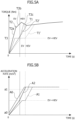
- Both of the first and second torque demands T1 and T2 are given by a torque map which is dynamically determined according to the acceleration rate (relative speed) of the vehicle ahead. As shown in Figure 5A , the torque map is set so that
- the second section T2b include a section T2c which shifts to the same torque demand value as the first torque demand T1 with a negative inclination.
- the switching timing from the EV driving mode to the HEV driving mode is advanced in the control of the HEV controller 30 described above, and the vehicle thus shifts early to driving in which the driving force of the engine 2 is mainly used, so that the ability to follow the vehicle ahead is enhanced.
- a torque demand greater than a default torque demand value (the same as the first torque demand T1) is issued upon start of the control to temporarily increase an actual torque above the default torque demand value, and then shift the actual torque to the default value, whereby the ability to follow the vehicle ahead is further enhanced, but it is possible to prevent occurrence of sudden acceleration that may make the driver feel uncomfortable.
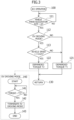
- FIG. 2 is a flowchart corresponding to the control in the first embodiment of the present invention.
- the acceleration rate of a vehicle ahead followed by the ACC function that is, the increase rate of the inter-vehicle time is constantly monitored (step 111), and when it is detected that the acceleration rate of the vehicle ahead (the increase rate of the inter-vehicle time) is equal to or greater than a threshold value a0,
- step 130 After any of the above steps is executed, if an end condition for each step is satisfied, one flow ends (step 130), but this flow is constantly executed during the operation of the ACC function.
- the threshold value a0 may be simply set to a positive value (a0>0), but it is preferable that the threshold value a0 be set to a significant value from the viewpoint of control stability. Furthermore, the threshold value a0 may be dynamically set according to the vehicle speed. It is preferable that the threshold value a0 be set to a value which excludes a case in which the acceleration rate of the vehicle ahead is small when the vehicle speed is zero, that is, when the vehicle restarts.
- FIG. 3 is a flowchart corresponding to the control in the second embodiment of the present invention, and shows an aspect in which different control is performed between a case in which upon following the vehicle ahead, the vehicle restarts from a decelerated and stopped state, and a case in which upon following the vehicle ahead, the vehicle re-accelerates during driving.
- the acceleration rate of the vehicle ahead which is followed by the ACC function that is, the increase rate of the inter-vehicle time
- the threshold value a0 the acceleration rate of the vehicle ahead which is followed by the ACC function
- step 122 when the actual torque has reached a predetermined threshold value T3 (step 141) after starting from the stopped state in the EV driving mode (step 140), the HEV controller 30 switches to the HEV driving mode (step 142), and the engine controller 20 starts the engine 2, so that the EV driving mode terminates (step 143).
- step 130 After any of the above steps 121 and 122 is executed, one flow ends if the end condition for each step is satisfied (step 130), but this flow is constantly executed during the operation of the ACC function.
- the above threshold value (0 km/h) for determining the stopped state of the vehicle 1 can be set to a value (for example, 1 to 3 km/h) that enables the vehicle to be regarded as being substantially in the stopped state.
- the acceleration control in a case in which an acceleration command is issued from the ACC controller 10 upon start of the vehicle ahead when the vehicle stops in the EV driving mode, and thus, the vehicle follows the vehicle ahead to restart, the acceleration control is executed according to the second torque demand T2. Therefore, as indicated by reference sign T2' in Figure 5A , the switching timing from the EV driving mode to the HEV driving mode is advanced, the vehicle early shifts to acceleration according to the driving force of the engine 2, and the rise of the actual torque T2' is faster, so that the rise of the acceleration rate is also faster as indicated by reference sign A2 in Figure 5B , and the ability to follow the vehicle ahead is enhanced.
- the vehicle when an acceleration command is issued from the ACC controller 10 upon re-acceleration of the vehicle ahead or the like during the driving in the EV driving mode and the vehicle re-accelerates, the vehicle can follow the vehicle ahead with a lower torque as compared with the case in which the vehicle restarts from the stopped state, so that the control prioritizing fuel efficiency and ride comfort can be executed by switching from the EV driving mode to the HEV driving mode at normal timing without executing the processing of suddenly increasing the torque demand value.
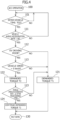
- FIG. 4 shows a flowchart corresponding to the control in the third embodiment of the present invention.
- the third embodiment is identical to the second embodiment in that different control is executed between the case in which the vehicle follows the vehicle ahead to restart from the decelerated and stopped state and the case in which the vehicle follows the vehicle ahead to re-accelerate during the driving, but different from the second embodiment in that the acceleration control is executed in consideration of the target in-vehicle time TG in the ACC function.
- the ACC controller 10 is set to execute the control of step S111 and subsequent steps thereto when the target in-vehicle time TG is set to "short (TG1)" on a short side in the set range during the operation of the ACC function (step 100) (step S101, YES) as shown in Figure 4 .
- the acceleration control according to the second torque demand T2 is continued (step 124).
- the acceleration control is switched to the acceleration control according to the first torque demand T1.
- the acceleration control according to the third embodiment when the short target inter-vehicle time TG1 is set in the set range of the target inter-vehicle time (target inter-vehicle distance), it can be considered that the driver intends to focus on the ability to follow. Therefore, in such a case, the control of advancing the switching timing from the EV driving mode to the HEV driving mode and early shifting to acceleration according to the driving force of the engine 2 is performed to enhance acceleration performance and the ability to follow the vehicle ahead, whereby it is possible to implement driving that matches the driver's taste.
- the acceleration control is switched to the acceleration control according to the first torque demand T1, whereby it is possible to suppress excessive approach or unnecessary braking in a situation in which the shorter target inter-vehicle time TG1 is set.
- the vehicle 1 is a mild hybrid vehicle, but the control apparatus according to the present invention can be implemented in a full hybrid vehicle in which the maximum output can be obtained in the HEV driving mode in which the vehicle drives by the driving force of the engine 2 and the motor 3.
Landscapes
- Engineering & Computer Science (AREA)
- Chemical & Material Sciences (AREA)
- Combustion & Propulsion (AREA)
- Transportation (AREA)
- Mechanical Engineering (AREA)
- Automation & Control Theory (AREA)
- Hybrid Electric Vehicles (AREA)
- Control Of Driving Devices And Active Controlling Of Vehicle (AREA)
- Electric Propulsion And Braking For Vehicles (AREA)
- Control Of Vehicle Engines Or Engines For Specific Uses (AREA)
Claims (4)
- Appareil de commande d'entraînement (10) pour un véhicule hybride (1) doté d'un moteur (2) et d'un moteur électrique (3) dans un système d'entraînement, et doté d'un système de commande pour commander la force de freinage/d'entraînement du moteur (2) et du moteur électrique (3), et adapté pour réaliser sélectivement :un mode d'entraînement de moteur dans lequel le véhicule hybride (1) est entraîné uniquement par la force d'entraînement du moteur (2) ;un mode d'entraînement EV dans lequel le véhicule hybride (1) est entraîné uniquement par la force d'entraînement du moteur électrique (3) ; etun mode d'entraînement HEV dans lequel le véhicule hybride (1) est entraîné par la force d'entraînement du moteur (2) et la force motrice du moteur électrique (3), l'appareil de commande d'entraînement ayant une fonction ACC qui réalise une circulation à vitesse constante en fonction d'une vitesse de véhicule cible lorsqu'un autre véhicule qui précède n'est pas présent dans la voie de circulation du véhicule et réalise une circulation de suivi en conservant un temps intervéhicules prédéterminé lorsque le véhicule qui précède est présent ;dans lequel l'appareil de commande d'entraînement (10) est configuré,dans le cas où le véhicule qui précède suivi par la fonction ACC, accélère,pour exécuter une commande d'accélération selon une première demande de couple (T1) déterminée par un taux d'accélération du véhicule qui précède dans le mode d'entraînement de moteur ou le mode d'entraînement HEV, etpour exécuter une commande d'accélération selon une deuxième demande de couple (T2) déterminée par le taux d'accélération du véhicule qui précède dans le mode d'entraînement EV, etla deuxième demande de couple (T2) augmente avec une inclinaison supérieure à la première demande de couple (T1).
- Appareil de commande d'entraînement (10) pour le véhicule hybride (1) selon la revendication 1, dans lequel le système de commande est adapté pour exécuter une commande de passage au mode d'entraînement EV lorsqu'un couple réel devient inférieur à une valeur seuil prédéterminée (a0), et de passage au mode d'entraînement HEV lorsque le couple réel devient égal ou supérieur à la valeur seuil prédéterminée (a0) pendant l'entraînement dans le mode d'entraînement EV.
- Appareil de commande d'entraînement (10) pour le véhicule hybride (1) selon la revendication 1, dans lequel la commande d'accélération selon la deuxième demande de couple (T2) est exécutée dans le cas où le véhicule qui précède étant suivi par la fonction ACC démarre pendant que le véhicule (1) s'arrête en mode d'entraînement EV en raison de l'arrêt du véhicule qui précède.
- Appareil de commande d'entraînement (10) pour le véhicule hybride (1) selon l'une quelconque des revendications 1 à 3, dans lequel la commande d'accélération dans le mode d'entraînement EV selon la deuxième demande de couple (T2) est exécutée lorsque le temps intervéhicules dans la fonction ACC est inférieur ou égal à une valeur prédéterminée dans une plage définie de celle-ci.
Applications Claiming Priority (1)
| Application Number | Priority Date | Filing Date | Title |
|---|---|---|---|
| JP2021102562A JP7716647B2 (ja) | 2021-06-21 | 2021-06-21 | ハイブリッド車両の走行制御装置 |
Publications (2)
| Publication Number | Publication Date |
|---|---|
| EP4108532A1 EP4108532A1 (fr) | 2022-12-28 |
| EP4108532B1 true EP4108532B1 (fr) | 2024-01-31 |
Family
ID=80735706
Family Applications (1)
| Application Number | Title | Priority Date | Filing Date |
|---|---|---|---|
| EP22158596.1A Active EP4108532B1 (fr) | 2021-06-21 | 2022-02-24 | Appareil de commande d'entraînement pour véhicule hybride |
Country Status (2)
| Country | Link |
|---|---|
| EP (1) | EP4108532B1 (fr) |
| JP (1) | JP7716647B2 (fr) |
Family Cites Families (9)
| Publication number | Priority date | Publication date | Assignee | Title |
|---|---|---|---|---|
| DE69839616D1 (de) * | 1997-04-25 | 2008-07-24 | Hitachi Ltd | Verfahren zur Einstellung eines Sollantriebsmoments und entsprechender Fahrzeugsteuerung |
| JP4581988B2 (ja) | 2005-12-20 | 2010-11-17 | 日産自動車株式会社 | ハイブリッド車両の制御装置 |
| JP5418676B2 (ja) * | 2010-06-25 | 2014-02-19 | トヨタ自動車株式会社 | 電動車両およびその制御方法 |
| DE102011003486B4 (de) * | 2011-02-02 | 2022-01-13 | Bayerische Motoren Werke Aktiengesellschaft | Abstandsbezogenes elektronisch gesteuertes Fahrgeschwindigkeitsregelsystem für Kraftfahrzeuge |
| JP6008425B2 (ja) * | 2012-09-11 | 2016-10-19 | ダイムラー・アクチェンゲゼルシャフトDaimler AG | ハイブリッド車両のオートクルーズ制御装置 |
| GB2508669A (en) * | 2012-12-10 | 2014-06-11 | Jaguar Land Rover Ltd | A speed control system for a hybrid electric vehicle |
| JP6154680B2 (ja) * | 2013-07-01 | 2017-06-28 | 株式会社Subaru | ハイブリッド車両のクルーズコントロール装置 |
| JP6154679B2 (ja) * | 2013-07-01 | 2017-06-28 | 株式会社Subaru | ハイブリッド車両のクルーズコントロール装置 |
| KR20180086782A (ko) * | 2017-01-23 | 2018-08-01 | 현대자동차주식회사 | 하이브리드 차량의 주행 제어 방법 |
-
2021
- 2021-06-21 JP JP2021102562A patent/JP7716647B2/ja active Active
-
2022
- 2022-02-24 EP EP22158596.1A patent/EP4108532B1/fr active Active
Also Published As
| Publication number | Publication date |
|---|---|
| JP7716647B2 (ja) | 2025-08-01 |
| JP2023001690A (ja) | 2023-01-06 |
| EP4108532A1 (fr) | 2022-12-28 |
Similar Documents
| Publication | Publication Date | Title |
|---|---|---|
| EP3318460B1 (fr) | Appareil de commande pour véhicule | |
| JP4269523B2 (ja) | エンジン制御装置 | |
| CN114701496B (zh) | 车辆驾驶支援装置 | |
| CN109720334B (zh) | 混合动力车辆 | |
| JP6874639B2 (ja) | 車両 | |
| US11485362B2 (en) | Operating a motor vehicle with an advanced motor restart out of the engine-off coasting mode | |
| EP4056437A1 (fr) | Appareil de commande d'entraînement pour véhicule | |
| CN107150677A (zh) | 车辆的控制装置 | |
| EP3744596A1 (fr) | Procédé de commande de véhicule et dispositif de commande de véhicule | |
| US11667290B2 (en) | Method for reducing vehicle fuel consumption during coasting | |
| EP4108532B1 (fr) | Appareil de commande d'entraînement pour véhicule hybride | |
| JP4281746B2 (ja) | ハイブリッド車両の運行制御システム | |
| JP2004245099A (ja) | エンジン自動停止装置 | |
| JP7114171B2 (ja) | 車両制御装置 | |
| JP2014172456A (ja) | アイドルストップ車の制御装置 | |
| JP2020131996A (ja) | 走行制御装置、車両、および走行制御方法 | |
| WO2018008536A1 (fr) | Dispositif de commande de véhicule | |
| CN121697630A (zh) | 驾驶辅助装置 | |
| JP2024044206A (ja) | 車両の走行制御装置 | |
| JP2023121041A (ja) | 駆動力制御装置 | |
| KR20240148975A (ko) | 하이브리드 차량 제어 시스템 및 그 방법 | |
| WO2022196205A1 (fr) | Dispositif de commande de véhicule et procédé de commande de véhicule | |
| JP2014173455A (ja) | アイドルストップ車の制御装置 | |
| CN110920615A (zh) | 一种用于退出车辆航行功能的方法 |
Legal Events
| Date | Code | Title | Description |
|---|---|---|---|
| PUAI | Public reference made under article 153(3) epc to a published international application that has entered the european phase |
Free format text: ORIGINAL CODE: 0009012 |
|
| STAA | Information on the status of an ep patent application or granted ep patent |
Free format text: STATUS: REQUEST FOR EXAMINATION WAS MADE |
|
| 17P | Request for examination filed |
Effective date: 20220224 |
|
| AK | Designated contracting states |
Kind code of ref document: A1 Designated state(s): AL AT BE BG CH CY CZ DE DK EE ES FI FR GB GR HR HU IE IS IT LI LT LU LV MC MK MT NL NO PL PT RO RS SE SI SK SM TR |
|
| GRAP | Despatch of communication of intention to grant a patent |
Free format text: ORIGINAL CODE: EPIDOSNIGR1 |
|
| STAA | Information on the status of an ep patent application or granted ep patent |
Free format text: STATUS: GRANT OF PATENT IS INTENDED |
|
| INTG | Intention to grant announced |
Effective date: 20230915 |
|
| GRAS | Grant fee paid |
Free format text: ORIGINAL CODE: EPIDOSNIGR3 |
|
| GRAA | (expected) grant |
Free format text: ORIGINAL CODE: 0009210 |
|
| STAA | Information on the status of an ep patent application or granted ep patent |
Free format text: STATUS: THE PATENT HAS BEEN GRANTED |
|
| AK | Designated contracting states |
Kind code of ref document: B1 Designated state(s): AL AT BE BG CH CY CZ DE DK EE ES FI FR GB GR HR HU IE IS IT LI LT LU LV MC MK MT NL NO PL PT RO RS SE SI SK SM TR |
|
| REG | Reference to a national code |
Ref country code: GB Ref legal event code: FG4D Ref country code: CH Ref legal event code: EP |
|
| REG | Reference to a national code |
Ref country code: DE Ref legal event code: R096 Ref document number: 602022001716 Country of ref document: DE |
|
| REG | Reference to a national code |
Ref country code: IE Ref legal event code: FG4D |
|
| REG | Reference to a national code |
Ref country code: LT Ref legal event code: MG9D |
|
| REG | Reference to a national code |
Ref country code: NL Ref legal event code: MP Effective date: 20240131 |
|
| PG25 | Lapsed in a contracting state [announced via postgrant information from national office to epo] |
Ref country code: IS Free format text: LAPSE BECAUSE OF FAILURE TO SUBMIT A TRANSLATION OF THE DESCRIPTION OR TO PAY THE FEE WITHIN THE PRESCRIBED TIME-LIMIT Effective date: 20240531 |
|
| PG25 | Lapsed in a contracting state [announced via postgrant information from national office to epo] |
Ref country code: LT Free format text: LAPSE BECAUSE OF FAILURE TO SUBMIT A TRANSLATION OF THE DESCRIPTION OR TO PAY THE FEE WITHIN THE PRESCRIBED TIME-LIMIT Effective date: 20240131 |
|
| PG25 | Lapsed in a contracting state [announced via postgrant information from national office to epo] |
Ref country code: GR Free format text: LAPSE BECAUSE OF FAILURE TO SUBMIT A TRANSLATION OF THE DESCRIPTION OR TO PAY THE FEE WITHIN THE PRESCRIBED TIME-LIMIT Effective date: 20240501 |
|
| REG | Reference to a national code |
Ref country code: AT Ref legal event code: MK05 Ref document number: 1653679 Country of ref document: AT Kind code of ref document: T Effective date: 20240131 |
|
| PG25 | Lapsed in a contracting state [announced via postgrant information from national office to epo] |
Ref country code: RS Free format text: LAPSE BECAUSE OF FAILURE TO SUBMIT A TRANSLATION OF THE DESCRIPTION OR TO PAY THE FEE WITHIN THE PRESCRIBED TIME-LIMIT Effective date: 20240430 Ref country code: HR Free format text: LAPSE BECAUSE OF FAILURE TO SUBMIT A TRANSLATION OF THE DESCRIPTION OR TO PAY THE FEE WITHIN THE PRESCRIBED TIME-LIMIT Effective date: 20240131 Ref country code: NL Free format text: LAPSE BECAUSE OF FAILURE TO SUBMIT A TRANSLATION OF THE DESCRIPTION OR TO PAY THE FEE WITHIN THE PRESCRIBED TIME-LIMIT Effective date: 20240131 |
|
| PG25 | Lapsed in a contracting state [announced via postgrant information from national office to epo] |
Ref country code: ES Free format text: LAPSE BECAUSE OF FAILURE TO SUBMIT A TRANSLATION OF THE DESCRIPTION OR TO PAY THE FEE WITHIN THE PRESCRIBED TIME-LIMIT Effective date: 20240131 |
|
| PG25 | Lapsed in a contracting state [announced via postgrant information from national office to epo] |
Ref country code: AT Free format text: LAPSE BECAUSE OF FAILURE TO SUBMIT A TRANSLATION OF THE DESCRIPTION OR TO PAY THE FEE WITHIN THE PRESCRIBED TIME-LIMIT Effective date: 20240131 |
|
| PG25 | Lapsed in a contracting state [announced via postgrant information from national office to epo] |
Ref country code: RS Free format text: LAPSE BECAUSE OF FAILURE TO SUBMIT A TRANSLATION OF THE DESCRIPTION OR TO PAY THE FEE WITHIN THE PRESCRIBED TIME-LIMIT Effective date: 20240430 Ref country code: NO Free format text: LAPSE BECAUSE OF FAILURE TO SUBMIT A TRANSLATION OF THE DESCRIPTION OR TO PAY THE FEE WITHIN THE PRESCRIBED TIME-LIMIT Effective date: 20240430 Ref country code: NL Free format text: LAPSE BECAUSE OF FAILURE TO SUBMIT A TRANSLATION OF THE DESCRIPTION OR TO PAY THE FEE WITHIN THE PRESCRIBED TIME-LIMIT Effective date: 20240131 Ref country code: LT Free format text: LAPSE BECAUSE OF FAILURE TO SUBMIT A TRANSLATION OF THE DESCRIPTION OR TO PAY THE FEE WITHIN THE PRESCRIBED TIME-LIMIT Effective date: 20240131 Ref country code: IS Free format text: LAPSE BECAUSE OF FAILURE TO SUBMIT A TRANSLATION OF THE DESCRIPTION OR TO PAY THE FEE WITHIN THE PRESCRIBED TIME-LIMIT Effective date: 20240531 Ref country code: HR Free format text: LAPSE BECAUSE OF FAILURE TO SUBMIT A TRANSLATION OF THE DESCRIPTION OR TO PAY THE FEE WITHIN THE PRESCRIBED TIME-LIMIT Effective date: 20240131 Ref country code: GR Free format text: LAPSE BECAUSE OF FAILURE TO SUBMIT A TRANSLATION OF THE DESCRIPTION OR TO PAY THE FEE WITHIN THE PRESCRIBED TIME-LIMIT Effective date: 20240501 Ref country code: FI Free format text: LAPSE BECAUSE OF FAILURE TO SUBMIT A TRANSLATION OF THE DESCRIPTION OR TO PAY THE FEE WITHIN THE PRESCRIBED TIME-LIMIT Effective date: 20240131 Ref country code: ES Free format text: LAPSE BECAUSE OF FAILURE TO SUBMIT A TRANSLATION OF THE DESCRIPTION OR TO PAY THE FEE WITHIN THE PRESCRIBED TIME-LIMIT Effective date: 20240131 Ref country code: BG Free format text: LAPSE BECAUSE OF FAILURE TO SUBMIT A TRANSLATION OF THE DESCRIPTION OR TO PAY THE FEE WITHIN THE PRESCRIBED TIME-LIMIT Effective date: 20240131 Ref country code: AT Free format text: LAPSE BECAUSE OF FAILURE TO SUBMIT A TRANSLATION OF THE DESCRIPTION OR TO PAY THE FEE WITHIN THE PRESCRIBED TIME-LIMIT Effective date: 20240131 |
|
| PG25 | Lapsed in a contracting state [announced via postgrant information from national office to epo] |
Ref country code: PT Free format text: LAPSE BECAUSE OF FAILURE TO SUBMIT A TRANSLATION OF THE DESCRIPTION OR TO PAY THE FEE WITHIN THE PRESCRIBED TIME-LIMIT Effective date: 20240531 Ref country code: PL Free format text: LAPSE BECAUSE OF FAILURE TO SUBMIT A TRANSLATION OF THE DESCRIPTION OR TO PAY THE FEE WITHIN THE PRESCRIBED TIME-LIMIT Effective date: 20240131 |
|
| PG25 | Lapsed in a contracting state [announced via postgrant information from national office to epo] |
Ref country code: SE Free format text: LAPSE BECAUSE OF FAILURE TO SUBMIT A TRANSLATION OF THE DESCRIPTION OR TO PAY THE FEE WITHIN THE PRESCRIBED TIME-LIMIT Effective date: 20240131 Ref country code: PT Free format text: LAPSE BECAUSE OF FAILURE TO SUBMIT A TRANSLATION OF THE DESCRIPTION OR TO PAY THE FEE WITHIN THE PRESCRIBED TIME-LIMIT Effective date: 20240531 Ref country code: PL Free format text: LAPSE BECAUSE OF FAILURE TO SUBMIT A TRANSLATION OF THE DESCRIPTION OR TO PAY THE FEE WITHIN THE PRESCRIBED TIME-LIMIT Effective date: 20240131 Ref country code: LV Free format text: LAPSE BECAUSE OF FAILURE TO SUBMIT A TRANSLATION OF THE DESCRIPTION OR TO PAY THE FEE WITHIN THE PRESCRIBED TIME-LIMIT Effective date: 20240131 |
|
| PG25 | Lapsed in a contracting state [announced via postgrant information from national office to epo] |
Ref country code: DK Free format text: LAPSE BECAUSE OF FAILURE TO SUBMIT A TRANSLATION OF THE DESCRIPTION OR TO PAY THE FEE WITHIN THE PRESCRIBED TIME-LIMIT Effective date: 20240131 |
|
| PG25 | Lapsed in a contracting state [announced via postgrant information from national office to epo] |
Ref country code: SM Free format text: LAPSE BECAUSE OF FAILURE TO SUBMIT A TRANSLATION OF THE DESCRIPTION OR TO PAY THE FEE WITHIN THE PRESCRIBED TIME-LIMIT Effective date: 20240131 |
|
| PG25 | Lapsed in a contracting state [announced via postgrant information from national office to epo] |
Ref country code: LU Free format text: LAPSE BECAUSE OF NON-PAYMENT OF DUE FEES Effective date: 20240224 |
|
| PG25 | Lapsed in a contracting state [announced via postgrant information from national office to epo] |
Ref country code: EE Free format text: LAPSE BECAUSE OF FAILURE TO SUBMIT A TRANSLATION OF THE DESCRIPTION OR TO PAY THE FEE WITHIN THE PRESCRIBED TIME-LIMIT Effective date: 20240131 Ref country code: CZ Free format text: LAPSE BECAUSE OF FAILURE TO SUBMIT A TRANSLATION OF THE DESCRIPTION OR TO PAY THE FEE WITHIN THE PRESCRIBED TIME-LIMIT Effective date: 20240131 |
|
| PG25 | Lapsed in a contracting state [announced via postgrant information from national office to epo] |
Ref country code: SK Free format text: LAPSE BECAUSE OF FAILURE TO SUBMIT A TRANSLATION OF THE DESCRIPTION OR TO PAY THE FEE WITHIN THE PRESCRIBED TIME-LIMIT Effective date: 20240131 |
|
| PG25 | Lapsed in a contracting state [announced via postgrant information from national office to epo] |
Ref country code: SM Free format text: LAPSE BECAUSE OF FAILURE TO SUBMIT A TRANSLATION OF THE DESCRIPTION OR TO PAY THE FEE WITHIN THE PRESCRIBED TIME-LIMIT Effective date: 20240131 Ref country code: SK Free format text: LAPSE BECAUSE OF FAILURE TO SUBMIT A TRANSLATION OF THE DESCRIPTION OR TO PAY THE FEE WITHIN THE PRESCRIBED TIME-LIMIT Effective date: 20240131 Ref country code: RO Free format text: LAPSE BECAUSE OF FAILURE TO SUBMIT A TRANSLATION OF THE DESCRIPTION OR TO PAY THE FEE WITHIN THE PRESCRIBED TIME-LIMIT Effective date: 20240131 Ref country code: LU Free format text: LAPSE BECAUSE OF NON-PAYMENT OF DUE FEES Effective date: 20240224 Ref country code: EE Free format text: LAPSE BECAUSE OF FAILURE TO SUBMIT A TRANSLATION OF THE DESCRIPTION OR TO PAY THE FEE WITHIN THE PRESCRIBED TIME-LIMIT Effective date: 20240131 Ref country code: DK Free format text: LAPSE BECAUSE OF FAILURE TO SUBMIT A TRANSLATION OF THE DESCRIPTION OR TO PAY THE FEE WITHIN THE PRESCRIBED TIME-LIMIT Effective date: 20240131 Ref country code: CZ Free format text: LAPSE BECAUSE OF FAILURE TO SUBMIT A TRANSLATION OF THE DESCRIPTION OR TO PAY THE FEE WITHIN THE PRESCRIBED TIME-LIMIT Effective date: 20240131 |
|
| REG | Reference to a national code |
Ref country code: DE Ref legal event code: R097 Ref document number: 602022001716 Country of ref document: DE |
|
| PG25 | Lapsed in a contracting state [announced via postgrant information from national office to epo] |
Ref country code: MC Free format text: LAPSE BECAUSE OF FAILURE TO SUBMIT A TRANSLATION OF THE DESCRIPTION OR TO PAY THE FEE WITHIN THE PRESCRIBED TIME-LIMIT Effective date: 20240131 |
|
| PG25 | Lapsed in a contracting state [announced via postgrant information from national office to epo] |
Ref country code: MC Free format text: LAPSE BECAUSE OF FAILURE TO SUBMIT A TRANSLATION OF THE DESCRIPTION OR TO PAY THE FEE WITHIN THE PRESCRIBED TIME-LIMIT Effective date: 20240131 |
|
| PG25 | Lapsed in a contracting state [announced via postgrant information from national office to epo] |
Ref country code: IT Free format text: LAPSE BECAUSE OF FAILURE TO SUBMIT A TRANSLATION OF THE DESCRIPTION OR TO PAY THE FEE WITHIN THE PRESCRIBED TIME-LIMIT Effective date: 20240131 |
|
| PLBE | No opposition filed within time limit |
Free format text: ORIGINAL CODE: 0009261 |
|
| STAA | Information on the status of an ep patent application or granted ep patent |
Free format text: STATUS: NO OPPOSITION FILED WITHIN TIME LIMIT |
|
| REG | Reference to a national code |
Ref country code: BE Ref legal event code: MM Effective date: 20240229 |
|
| PG25 | Lapsed in a contracting state [announced via postgrant information from national office to epo] |
Ref country code: IT Free format text: LAPSE BECAUSE OF FAILURE TO SUBMIT A TRANSLATION OF THE DESCRIPTION OR TO PAY THE FEE WITHIN THE PRESCRIBED TIME-LIMIT Effective date: 20240131 |
|
| 26N | No opposition filed |
Effective date: 20241101 |
|
| PG25 | Lapsed in a contracting state [announced via postgrant information from national office to epo] |
Ref country code: BE Free format text: LAPSE BECAUSE OF NON-PAYMENT OF DUE FEES Effective date: 20240229 |
|
| PG25 | Lapsed in a contracting state [announced via postgrant information from national office to epo] |
Ref country code: IE Free format text: LAPSE BECAUSE OF NON-PAYMENT OF DUE FEES Effective date: 20240224 |
|
| PG25 | Lapsed in a contracting state [announced via postgrant information from national office to epo] |
Ref country code: IE Free format text: LAPSE BECAUSE OF NON-PAYMENT OF DUE FEES Effective date: 20240224 Ref country code: BE Free format text: LAPSE BECAUSE OF NON-PAYMENT OF DUE FEES Effective date: 20240229 |
|
| PG25 | Lapsed in a contracting state [announced via postgrant information from national office to epo] |
Ref country code: SI Free format text: LAPSE BECAUSE OF FAILURE TO SUBMIT A TRANSLATION OF THE DESCRIPTION OR TO PAY THE FEE WITHIN THE PRESCRIBED TIME-LIMIT Effective date: 20240131 |
|
| PG25 | Lapsed in a contracting state [announced via postgrant information from national office to epo] |
Ref country code: CY Free format text: LAPSE BECAUSE OF FAILURE TO SUBMIT A TRANSLATION OF THE DESCRIPTION OR TO PAY THE FEE WITHIN THE PRESCRIBED TIME-LIMIT; INVALID AB INITIO Effective date: 20220224 |
|
| REG | Reference to a national code |
Ref country code: CH Ref legal event code: PL |
|
| PG25 | Lapsed in a contracting state [announced via postgrant information from national office to epo] |
Ref country code: CH Free format text: LAPSE BECAUSE OF NON-PAYMENT OF DUE FEES Effective date: 20250228 |
|
| PG25 | Lapsed in a contracting state [announced via postgrant information from national office to epo] |
Ref country code: TR Free format text: LAPSE BECAUSE OF FAILURE TO SUBMIT A TRANSLATION OF THE DESCRIPTION OR TO PAY THE FEE WITHIN THE PRESCRIBED TIME-LIMIT Effective date: 20240131 |
|
| PGFP | Annual fee paid to national office [announced via postgrant information from national office to epo] |
Ref country code: FR Payment date: 20251231 Year of fee payment: 5 |
|
| PGFP | Annual fee paid to national office [announced via postgrant information from national office to epo] |
Ref country code: DE Payment date: 20260102 Year of fee payment: 5 |