EP4108545A1 - Procédé de détermination d'une trajectoire pouvant être actuellement parcourue pour un véhicule automobile fonctionnant au moins partiellement de manière assistée, ainsi que système d'aide - Google Patents
Procédé de détermination d'une trajectoire pouvant être actuellement parcourue pour un véhicule automobile fonctionnant au moins partiellement de manière assistée, ainsi que système d'aide Download PDFInfo
- Publication number
- EP4108545A1 EP4108545A1 EP22178379.8A EP22178379A EP4108545A1 EP 4108545 A1 EP4108545 A1 EP 4108545A1 EP 22178379 A EP22178379 A EP 22178379A EP 4108545 A1 EP4108545 A1 EP 4108545A1
- Authority
- EP
- European Patent Office
- Prior art keywords
- trajectory
- trajectories
- quality measure
- assistance system
- determined
- Prior art date
- Legal status (The legal status is an assumption and is not a legal conclusion. Google has not performed a legal analysis and makes no representation as to the accuracy of the status listed.)
- Granted
Links
Images
Classifications
-
- B—PERFORMING OPERATIONS; TRANSPORTING
- B60—VEHICLES IN GENERAL
- B60W—CONJOINT CONTROL OF VEHICLE SUB-UNITS OF DIFFERENT TYPE OR DIFFERENT FUNCTION; CONTROL SYSTEMS SPECIALLY ADAPTED FOR HYBRID VEHICLES; ROAD VEHICLE DRIVE CONTROL SYSTEMS FOR PURPOSES NOT RELATED TO THE CONTROL OF A PARTICULAR SUB-UNIT
- B60W40/00—Estimation or calculation of non-directly measurable driving parameters for road vehicle drive control systems not related to the control of a particular sub unit, e.g. by using mathematical models
- B60W40/10—Estimation or calculation of non-directly measurable driving parameters for road vehicle drive control systems not related to the control of a particular sub unit, e.g. by using mathematical models related to vehicle motion
-
- B—PERFORMING OPERATIONS; TRANSPORTING
- B62—LAND VEHICLES FOR TRAVELLING OTHERWISE THAN ON RAILS
- B62D—MOTOR VEHICLES; TRAILERS
- B62D15/00—Steering not otherwise provided for
- B62D15/02—Steering position indicators ; Steering position determination; Steering aids
- B62D15/027—Parking aids, e.g. instruction means
- B62D15/0285—Parking performed automatically
-
- B—PERFORMING OPERATIONS; TRANSPORTING
- B60—VEHICLES IN GENERAL
- B60W—CONJOINT CONTROL OF VEHICLE SUB-UNITS OF DIFFERENT TYPE OR DIFFERENT FUNCTION; CONTROL SYSTEMS SPECIALLY ADAPTED FOR HYBRID VEHICLES; ROAD VEHICLE DRIVE CONTROL SYSTEMS FOR PURPOSES NOT RELATED TO THE CONTROL OF A PARTICULAR SUB-UNIT
- B60W60/00—Drive control systems specially adapted for autonomous road vehicles
- B60W60/001—Planning or execution of driving tasks
- B60W60/0011—Planning or execution of driving tasks involving control alternatives for a single driving scenario, e.g. planning several paths to avoid obstacles
-
- B—PERFORMING OPERATIONS; TRANSPORTING
- B60—VEHICLES IN GENERAL
- B60W—CONJOINT CONTROL OF VEHICLE SUB-UNITS OF DIFFERENT TYPE OR DIFFERENT FUNCTION; CONTROL SYSTEMS SPECIALLY ADAPTED FOR HYBRID VEHICLES; ROAD VEHICLE DRIVE CONTROL SYSTEMS FOR PURPOSES NOT RELATED TO THE CONTROL OF A PARTICULAR SUB-UNIT
- B60W60/00—Drive control systems specially adapted for autonomous road vehicles
- B60W60/001—Planning or execution of driving tasks
- B60W60/0013—Planning or execution of driving tasks specially adapted for occupant comfort
-
- G—PHYSICS
- G01—MEASURING; TESTING
- G01C—MEASURING DISTANCES, LEVELS OR BEARINGS; SURVEYING; NAVIGATION; GYROSCOPIC INSTRUMENTS; PHOTOGRAMMETRY OR VIDEOGRAMMETRY
- G01C21/00—Navigation; Navigational instruments not provided for in groups G01C1/00 - G01C19/00
- G01C21/26—Navigation; Navigational instruments not provided for in groups G01C1/00 - G01C19/00 specially adapted for navigation in a road network
- G01C21/34—Route searching; Route guidance
- G01C21/3453—Special cost functions, i.e. other than distance or default speed limit of road segments
-
- G—PHYSICS
- G01—MEASURING; TESTING
- G01C—MEASURING DISTANCES, LEVELS OR BEARINGS; SURVEYING; NAVIGATION; GYROSCOPIC INSTRUMENTS; PHOTOGRAMMETRY OR VIDEOGRAMMETRY
- G01C21/00—Navigation; Navigational instruments not provided for in groups G01C1/00 - G01C19/00
- G01C21/26—Navigation; Navigational instruments not provided for in groups G01C1/00 - G01C19/00 specially adapted for navigation in a road network
- G01C21/34—Route searching; Route guidance
- G01C21/3453—Special cost functions, i.e. other than distance or default speed limit of road segments
- G01C21/3484—Personalized, e.g. from learned user behaviour or user-defined profiles
-
- G—PHYSICS
- G05—CONTROLLING; REGULATING
- G05D—SYSTEMS FOR CONTROLLING OR REGULATING NON-ELECTRIC VARIABLES
- G05D1/00—Control of position, course, altitude or attitude of land, water, air or space vehicles, e.g. using automatic pilots
- G05D1/02—Control of position or course in two dimensions
- G05D1/021—Control of position or course in two dimensions specially adapted to land vehicles
- G05D1/0212—Control of position or course in two dimensions specially adapted to land vehicles with means for defining a desired trajectory
- G05D1/0217—Control of position or course in two dimensions specially adapted to land vehicles with means for defining a desired trajectory in accordance with energy consumption, time reduction or distance reduction criteria
-
- G—PHYSICS
- G08—SIGNALLING
- G08G—TRAFFIC CONTROL SYSTEMS
- G08G1/00—Traffic control systems for road vehicles
- G08G1/16—Anti-collision systems
- G08G1/168—Driving aids for parking, e.g. acoustic or visual feedback on parking space
-
- B—PERFORMING OPERATIONS; TRANSPORTING
- B60—VEHICLES IN GENERAL
- B60W—CONJOINT CONTROL OF VEHICLE SUB-UNITS OF DIFFERENT TYPE OR DIFFERENT FUNCTION; CONTROL SYSTEMS SPECIALLY ADAPTED FOR HYBRID VEHICLES; ROAD VEHICLE DRIVE CONTROL SYSTEMS FOR PURPOSES NOT RELATED TO THE CONTROL OF A PARTICULAR SUB-UNIT
- B60W2530/00—Input parameters relating to vehicle conditions or values, not covered by groups B60W2510/00 or B60W2520/00
-
- B—PERFORMING OPERATIONS; TRANSPORTING
- B60—VEHICLES IN GENERAL
- B60W—CONJOINT CONTROL OF VEHICLE SUB-UNITS OF DIFFERENT TYPE OR DIFFERENT FUNCTION; CONTROL SYSTEMS SPECIALLY ADAPTED FOR HYBRID VEHICLES; ROAD VEHICLE DRIVE CONTROL SYSTEMS FOR PURPOSES NOT RELATED TO THE CONTROL OF A PARTICULAR SUB-UNIT
- B60W2530/00—Input parameters relating to vehicle conditions or values, not covered by groups B60W2510/00 or B60W2520/00
- B60W2530/10—Weight
-
- B—PERFORMING OPERATIONS; TRANSPORTING
- B60—VEHICLES IN GENERAL
- B60W—CONJOINT CONTROL OF VEHICLE SUB-UNITS OF DIFFERENT TYPE OR DIFFERENT FUNCTION; CONTROL SYSTEMS SPECIALLY ADAPTED FOR HYBRID VEHICLES; ROAD VEHICLE DRIVE CONTROL SYSTEMS FOR PURPOSES NOT RELATED TO THE CONTROL OF A PARTICULAR SUB-UNIT
- B60W2530/00—Input parameters relating to vehicle conditions or values, not covered by groups B60W2510/00 or B60W2520/00
- B60W2530/201—Dimensions of vehicle
-
- B—PERFORMING OPERATIONS; TRANSPORTING
- B60—VEHICLES IN GENERAL
- B60W—CONJOINT CONTROL OF VEHICLE SUB-UNITS OF DIFFERENT TYPE OR DIFFERENT FUNCTION; CONTROL SYSTEMS SPECIALLY ADAPTED FOR HYBRID VEHICLES; ROAD VEHICLE DRIVE CONTROL SYSTEMS FOR PURPOSES NOT RELATED TO THE CONTROL OF A PARTICULAR SUB-UNIT
- B60W2540/00—Input parameters relating to occupants
- B60W2540/30—Driving style
Definitions
- the invention relates to a method for determining a currently drivable trajectory for an at least partially assisted motor vehicle using an assistance system, in which a reference trajectory is specified and in which a large number of further, potentially drivable trajectories are determined, with a respective further trajectory being dependent a respective quality measure is determined from the reference trajectory by means of an electronic computing device of the assistance system and depending on the determined quality measure the currently navigable trajectory is determined from the plurality of other potentially navigable trajectories by means of the electronic computing device. Furthermore, the invention relates to a computer program product and an assistance system.
- So-called trained parking is already known from the prior art, in which a trajectory to a fixed end position is learned. This training is also referred to as teach-in.
- the motor vehicle later drives along the taught route automatically, which is also referred to as redrive.
- the driver of the motor vehicle can be inside or outside the motor vehicle, or the motor vehicle is driving autonomously.
- the primary goal of using a quality measure is to filter out "bad" trajectories. In the case of these trajectories, for example, something occurred in the teach-in that is perceived as unpleasant for a user in the redrive.
- the DE 10 2016 207 330 A1 relates to a method for operating a vehicle, in particular for driving the vehicle to a predetermined parking space, with a first trajectory for an automated drive of the vehicle to the predetermined parking space being stored in a vehicle-side memory device, which trajectory is stored during a manual drive of the vehicle to the predetermined parking space was recorded, the first trajectory is assigned tolerance values for a deviation from the first trajectory, by which the vehicle may deviate at most from the first trajectory during an automated drive to the specified parking space, with at least one further manual drive of the vehicle to the specified parking space the further trajectory traversed in the process is automatically detected, the first trajectory and the further trajectory together are compared and in the event that, with regard to at least one predefinable point of the first trajectory, a deviation in relation to the travel path of the vehicle through the further trajectory is determined, this deviation from the predefinable point of the first trajectory is assigned in such a way that the detected deviation and the specifiable point of the first trajectory associated tolerance value is added and stored as a new
- the DE 10 2017 200 234 A1 relates to a method for referencing a local trajectory in a global coordinate system, the local trajectory comprising ordered local positions in a local coordinate system, comprising the following steps: receiving at least one global position, referred to a global coordinate system, of a global trajectory corresponding to the local trajectory, Determining a quality for the at least one global position, selecting at least one anchor position from the at least one global position based on the determined quality, determining a displacement vector between the local trajectory and the global trajectory at the at least one anchor position, transforming the local positions of the local trajectory into the global coordinate system based on the displacement vector at the at least one anchor position, outputting the local positions transformed into the global coordinate system.
- the object of the present invention is to create a method, a computer program product and an assistance system, by means of which an improved evaluation of trajectories can be implemented.
- One aspect of the invention relates to a method for determining a currently navigable trajectory for an at least partially assisted motor vehicle using an assistance system, in which a reference trajectory is specified and in which a large number of other, potentially navigable trajectories are determined, with each additional trajectory depending on the reference trajectory, a respective quality measure is determined by means of an electronic computing device of the assistance system, and depending on the determined quality measure, the currently passable trajectory from the plurality is determined by further, potentially drivable trajectories by means of the electronic computing device.
- vehicle-specific and/or driver-specific properties are taken into account in the quality measure.
- a method for the qualitative evaluation of trajectories in particular within the framework of trained parking, is therefore proposed in order to select the suitable trajectory, taking into account defined evaluation criteria.
- the primary goal here is the use of a quality measure, whereby the focus here is on filtering out so-called "bad" trajectories. With these trajectories, for example, something occurred in the so-called teach-in that is perceived as unpleasant in the redrive. This can, for example, be an additional stopping point or driving around a dynamic or temporary obstacle.
- the qualitative evaluation or the use of the quality measure of trajectories results in a number of advantages for use in parking and maneuvering functions such as trained parking or reversing assist.
- the quality of individual trajectories or trajectory segments is objectified and this enables comparability be created.
- the quality measure serves as a basis for evaluating trajectories.
- the use for the predicted suitability or the quality of the functions at a specific location or route segment can also be implemented.
- a possibility is created for data reduction by selecting the "best" trajectories for storage.
- a possibility is created for determining a “bad” database for a trajectory area, in order to suggest a new teach-in, for example.
- the multiplicity of trajectories can then in turn be classified, in particular on the basis of the goods measure.
- a trajectory can be evaluated using various criteria. For example distance to the wall/obstacles, driving style or the like. These evaluation criteria can be weighted differently depending on the driver's preferences weighting factors. Thus, for example, a different trajectory can be optimal for a cautious driver than for a driver who wants to reach his destination quickly. To assess the quality of a trajectory, assessment criteria can have different priorities. The quality depends both on the use, for example different scenarios in which different objectives are pursued, the intended use and according to the preferences of the user.
- the driver's driving style can be classified, for example cautious or dynamic.
- the driver can be offered preferred trajectories that correspond to his driving style.
- the driving style can be learned using known methods, for example by means of machine learning, on an electronic computing device external to the vehicle during the analysis of transmitted trajectories, or can be derived from existing driver profiles.
- Driver profiles can also be determined, for example, with the help of the trajectories from a buffer for ADAS functions (Advanced Driver Assistance System), i.e. so-called driver assistance systems, with these being automatically recorded while driving.
- ADAS functions Advanced Driver Assistance System
- the trajectory can either be a trajectory that was recorded directly by the vehicle using it, or a trajectory that was generated synthetically. It can also be a complete trajectory or a trajectory segment.
- the reference trajectory is decisive for the evaluation.
- the reference trajectory is either recorded in a so-called teach-in or generated by evaluating several trips or an evaluation of additional data for the route or a route segment. If the number of motor vehicles has a similar deviation from the reference trajectory, an adjustment of the reference trajectory may be necessary, for example. This is possible, for example, in the case of a construction site or a change in traffic routing.
- the quality measure is thus proposed as an idea according to the invention.
- the quality measure is set up specifically for the problem.
- the basis is the so-called general quality measure.
- the quality measure is the comparison operator of a trajectory x i to be evaluated with the reference trajectory x r .
- a so-called tuning or an adjustment of the quality measure can then take place via a corresponding penalty/weighting function or penalty/weighting factors k i .
- G trajectory , i ⁇ t begin t End f k 1 . . . . n , x ⁇ i , x ⁇ right German .
- k i are the penalty/weighting factors.
- x i are any trajectory data as a vector over time.
- x r are the reference trajectories, ie those trajectories with which the trajectory to be evaluated is "compared”.
- f in turn is the quality functional, which corresponds, for example, to the square of the differences to the mean trajectory.
- t start is the start time of the trajectory or the trajectory section and t end is the end time of the trajectory or the trajectory section.
- the reference trajectory is particularly considered to be ideal. It is irrelevant for the assessment how the reference trajectory was generated, for example a particularly good teach-in or a synthetically generated trajectory or trajectory segment.
- the result of the evaluation depends on the defined reference trajectory.
- the reference trajectory can also be taken for a trajectory segment.
- the reference trajectory can also be calculated on the basis of previously run trajectories, for example by using the mean value of all trajectories. Depending on a nature of the value, the minimum of the values, for example in lateral acceleration, or the maximum, for example speed of the vehicle, can also be used.
- the reference trajectory can also be post-processed, for example automatically or manually, for example by smoothing in order to prevent outliers.
- the size, the turning circle, the wheelbase and the weight of the motor vehicle can be viewed under vehicle-specific properties.
- a sporty driving style or a defensive driving style can be viewed as a driver-specific property.
- At least one driving dynamics property of the motor vehicle on the further trajectory is additionally taken into account in the quality measure.
- other vehicle measurement data such as speeds, accelerations, in particular both lateral acceleration, longitudinal acceleration and vertical acceleration can be taken into account.
- the quality measure can thus be determined in an improved manner.
- At least one current environmental condition is additionally taken into account in the quality measure.
- corresponding weather conditions or time- and event-dependent data can be used as environmental conditions.
- detection of static and dynamic obstacles and free spaces can be recognized as environmental conditions as environment data.
- the traffic volume can be taken into account in the time- and event-dependent data, in which case a distinction can be made between a typical traffic volume on specific weekdays versus a peak volume at the weekend or a greatly increased traffic volume for concerts or the like.
- the multiplicity of further, potentially navigable trajectories is generated by real recording and/or simulation.
- the simulation involves, in particular, so-called synthetically generated trajectories.
- the recorded trajectories which corresponds to a real recording, or synthesized trajectories, have at least location data and the course of these trajectories over time.
- a large number of potentially travelable trajectories can thus be provided in a simple manner, as a result of which the current trajectory to be traveled can be determined in an improved manner.
- the large number of further, potentially navigable trajectories is pre-filtered before the quality measure evaluation and non-relevant further trajectories are filtered out.
- a pre-processing or pre-filtering of the trajectories thus takes place.
- incomplete data sets or data sets with measurement errors can be removed.
- data records that comprise less than a complete segment can also be removed.
- "extreme" data sets can also be removed, for example if they show very strong accelerations beyond a certain threshold value.
- the vehicle-specific and/or driver-specific properties are weighted within the quality measure.
- This can be realized in particular via the so-called penalty/weighting factors k i .
- the punishment/weighting factors can upgrade or downgrade special properties/events, for example vehicle type, driving style, driver, weather, driving dynamics effects or events. For example, periods with the occurrence of high lateral acceleration can be devalued, since a greater scatter can be expected and which should not have a major impact, or a high quantified traffic volume can be used as punishment, since high deviations can also be expected there. The trajectory currently traveled can thus be selected in an improved manner.
- the reference trajectory is adapted as a function of trajectories actually traveled.
- the reference trajectory is initially considered to be fixed.
- it may make sense to modify the reference trajectory It can happen, for example, that the passable route changes, for example due to a construction site, a change in traffic routing, breakdowns or other temporary abnormalities.
- the trajectories that follow the new traffic route for example, would be discarded as outliers.
- an accumulation of previously discarded trajectories can be recognized, in which case the reference trajectory can then be adapted, for example, to the new traffic routing.
- the "currently best" trajectory will contain the detour around the construction site after a time/frequency. If similar deviations from the original reference trajectory are increasingly detected, in particular those that correspond to the mean of the measurement data, real changes in outliers or faulty data can be verified and update hypotheses can thereby be generated. For example, changes in the car park, construction sites, breakdowns or other temporary abnormalities can be recognized, differentiated and processed.
- a scattering of trajectory segments actually traversed within the trajectory actually traversed is taken into account. It may be the case, for example, that some route segments have a higher scatter of the individual trajectories than other route segments. For example, in segments with straight-ahead driving, there will be less scatter across the different vehicle classes than in segments with curves, where the steering points vary depending on the vehicle size can distinguish. In addition, different accelerations or the like can also exhibit a scatter. Groups can be formed from the parameters that have a greater spread in order to generate trajectories that are relevant for the driver or to evaluate the trajectories more precisely. Such groups can be, for example: dynamic driving style, large vehicles or cautious driving style, for example with low acceleration and high distance to obstacles.
- a further aspect of the invention therefore relates to a computer program product with program code means which cause an electronic computing device to carry out a method according to the preceding aspect when the program code means are processed by the electronic computing device.
- a further aspect of the invention therefore also relates to a computer-readable storage medium with the computer program product.
- the invention also relates to an assistance system for determining a currently drivable trajectory for an at least partially assisted motor vehicle, with at least one electronic computing device, the assistance system being designed to carry out a method according to the preceding aspect.
- the method is carried out using the assistance system.
- the electronic computing device has in particular processors, circuits, in particular integrated circuits, and other electronic components in order to be able to carry out a corresponding method.
- the invention also relates to an at least partially assisted motor vehicle with an assistance system.
- the motor vehicle can also be fully autonomous.
- the invention also includes developments of the assistance system according to the invention and of the motor vehicle that have features as have already been described in connection with the developments of the method according to the invention. For this reason, the corresponding developments of the assistance system according to the invention and of the motor vehicle are not described again here.
- the invention also includes the combinations of features of the described embodiments.
- the exemplary embodiment explained below is a preferred exemplary embodiment of the invention.
- the described components each represent individual features of the invention to be considered independently of one another, which also develop the invention independently of one another and are therefore also to be regarded as part of the invention individually or in a combination other than that shown.
- the exemplary embodiment described can also be supplemented by further features of the invention that have already been described.
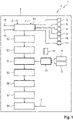
- the figure shows a schematic flow chart according to an embodiment of a method.
- an assistance system 1 with at least one electronic computing device 2 is shown purely schematically, which carries out the method steps according to an embodiment of the invention.
- the figure shows in particular that real trajectories 3 or simulated trajectories 4 are generated or recorded in a first step S1.
- These real trajectories 3 or simulated trajectories 4 have at least location data 5 and in particular a time profile of the corresponding trajectories 3, 4.
- the real trajectories 3 and the simulated trajectories 4 are also used as reference trajectories 18.
- the real trajectories 3 and the simulated trajectories 4 in turn form the basis for further trajectories 16.
- driving dynamics properties 6 of the motor vehicle 7, which is also shown purely schematically, can be taken into account with the assistance system 1. These are, for example, speeds or lateral accelerations, longitudinal accelerations or vertical accelerations of motor vehicle 7.
- Vehicle-specific properties 8, such as size, turning circle, wheelbase or weight of motor vehicle 7, can also be taken into account.
- Driver-specific properties 9, such as sporty driving or defensive driving, are also taken into account, with a so-called driving profile being able to be formed in particular.
- environmental conditions 10 can also be taken into account, this including, for example, the detection of static and dynamic obstacles or free spaces.
- Time- or event-dependent data as well as a Traffic volume 11 are taken into account, with a typical traffic volume 11 on weekdays versus a peak volume on the weekend being able to be taken into account, as well as a greatly increased traffic volume 11 for concerts, for example.
- a second step S2 the trajectories are stored on an electronic computing device external to the vehicle or in the motor vehicle 1 itself, then, for example, in a memory device 12 of the electronic computing device 2.
- the data sets are preprocessed or prefiltered, with the removal of incomplete data sets and data sets with measurement errors. Furthermore, data sets that comprise less than a complete trajectory segment can be removed, as well as extreme data sets, for example with acceleration values above a threshold value, can be removed.
- a quality measure 13 is again calculated for the individual, further trajectories 16, with both the vehicle-specific properties 8 and the driver-specific properties 9 being taken into account in particular.
- a punishment 14 in the quality criterion can be carried out in the optimization and a weighting 15 in the quality criterion depending on the purpose or use, for example in different scenarios in which different objectives are pursued.
- a fifth step S5 the trajectories 16 or the trajectory segments are evaluated.
- the further trajectories 16 or the trajectory segments are selected on the basis of the calculated quality measure 13.
- the selected or generated further trajectories 16 are stored, both in the vehicle on the memory device 12 or on the vehicle-external electronic Computing device, in particular a so-called backend, can be realized.
- a selected trajectory 17 is then used again in a so-called redrive, or further synthetic trajectories 16 can be generated on the basis of the selected or determined trajectory 17.
- the figure shows the method for determining the currently passable trajectory 17, in which a reference trajectory 18 is specified and in which a plurality of other, potentially passable trajectories 16 is determined, wherein for a respective additional trajectory 16 as a function of reference trajectory 18, a respective quality measure 13 is determined by means of electronic computing device 2 of assistance system 1, and depending on determined quality measure 13, trajectory 17 currently navigable from the large number of further, potentially navigable trajectories 16 is determined by means of the electronic Computing device 2 is determined. Provision is made here for vehicle-specific properties 8 and/or driver-specific properties 9 to be taken into account in the quality measure 13 .
- the invention therefore proposes quality measure 13 as a main point.
- the quality measure 13 is set up specifically for the problem.
- the basis is a so-called general quality measure.
- the general quality measure 13 is the comparison operator of a trajectory x i to be evaluated with the reference trajectory x r .
- a corresponding adjustment of the measure of quality 13 can then take place via penalty factors 14 or weighting factors 15, which are referred to below as k i .
- G trajectory , i ⁇ t begin t End f k 1 . . . . n , x ⁇ i , x ⁇ right German .
- k i are the punishment/weighting factors 14, 15.
- the punishment/weighting factors 14, 15 can upgrade or devalue particular properties or events.
- x i are any trajectory data as a vector over time, for example speeds, accelerations, location data, brake pressure, angle of inclination, spring deflection of the dampers or the like.
- the trajectory 16 does not have to be recorded directly by the motor vehicle 7 . It can also be generated synthetically, for example using maps or a simulation, or indirectly by measuring other road users.
- x r are the reference trajectories 18, ie those trajectories with which the trajectory to be evaluated is “compared”.
- f is the quality functional, for example the square of the differences to the mean trajectory.
- t start is the start time of the trajectory/the trajectory section and t end is the end time of the trajectory/the trajectory section.
- G trajectory , i ⁇ t begin t End k driving style , k traffic volume x Middle t ⁇ x trajectory , i t y Middle t ⁇ y trajectory , i t a l , Middle t ⁇ a l , trajectory , i t a q , Middle t ⁇ a q , trajectory , i t 2 German to be discribed.
- k Driving style is a weighting factor for the driver's driving style, for example inconspicuous versus dynamic.
- k Traffic volume is a weighting factor of high traffic volume.
- x i (t) is the x coordinate of trajectory number i at time t.
- y i (t) is the y coordinate of trajectory number i at time t.
- a l,i (t) is the longitudinal acceleration of trajectory number i at time t.
- a q,i (t) is the lateral acceleration of trajectory number i at time t.
- x mean (t) is the x-coordinate of the transmitted trajectory at time t.
- y mean (t) is the y-coordinate of the mean trajectory at time t.
- a l,mean (t) is the longitudinal acceleration of the averaged trajectory at time t.
- a q,mean (t) is the lateral acceleration of the averaged trajectory at time t.
- the averaged trajectory is used as the reference trajectory 18 in this example. Further weighting factors or trajectory data can be added as desired.
- penalty factors 14 or weighting factors 15 can be the dynamic driving style or high acceleration values as a subjective impression of the lateral and longitudinal accelerations. Furthermore, the number of braking and acceleration processes and the number of steering interventions and the obstacles in the route can also be viewed as punishment/weighting factors 14, 15. An atypical volume of traffic 11, multiple trains, stopping points, distance from static obstacles and other environment and vehicle parameters that influence the quality of the trajectory 16 can be regarded as punishment/weighting factors 14, 15. The set of penalty/weighting factors 14, 15 can be expanded depending on the application or the available trajectory data.
- the quality measure 13 is in particular normalized so that the results of the quality measure 13 can be compared across different trajectories 16 .
- the absolute numerical value can be used directly for evaluating a trajectory 16 .
- the normalization takes place via a length property of the trajectory 16, for example the distance covered in the reference trajectory 3, 4 or the distance between the start and end point of the reference trajectory 3, 4.
- the normalization over time can also be normalized over the route, for example per route segment or another suitable variable.
- the reference trajectory 18 is initially regarded as fixed. Depending on the application, it may make sense to modify the reference trajectory 18. It can happen, for example, that the passable route changes, for example due to a construction site, a change in traffic routing, breakdowns or other temporary abnormalities. In this case, trajectories 16 that follow the new traffic route, for example, would be discarded as outliers. If after a certain time or event correlates to a number of trajectories 17 that can be driven on, an accumulation of previously discarded trajectories 16 is detected, the reference trajectory 18 can be adapted to new traffic routes, for example.
- the new “currently best” trajectory 17 will contain the detour around the construction site after a certain period of time or after a frequency. If similar deviations from the original reference trajectory 18, in particular those that correspond to the average of the mass data, are increasingly detected, real changes in outliers or faulty data can be verified and update hypotheses can thereby be generated. For example, changes in the car park, construction sites, breakdowns or other temporary abnormalities can be recognized, differentiated and processed.
- route segments may also be the case that some route segments have a greater spread of the individual trajectories 16 than other route segments, for example in segments with straight-ahead driving there will probably be less spread across the various vehicle classes than in segments with curves, in which the steering points vary depending on the vehicle size can distinguish.
- different accelerations or the like can also exhibit a scatter.
- Groups can be formed from the parameters that have a greater spread in order to generate trajectories 16 relevant to the driver or to evaluate the trajectories 16 more precisely. Examples of these groups are dynamic driving, large vehicles and cautious vehicles.
- a specific quality measure 13 can also be determined, in which case this specific quality measure 13 can be formulated, in particular if certain purposes of use require it, with these then deviating in particular from the general quality measure.
- a quality measure 13 can be proposed which is acceleration-optimized or distance-optimized. In particular, a so-called sense of security can be adjusted accordingly by the minimum distance to obstacles or walls.
- a careful approach at intersections a time-optimized quality measure 13, loading or trailer-optimized quality measure 13, a traffic volume-dependent quality measure 13 and a safety-optimized quality measure 13 can be provided.
Landscapes
- Engineering & Computer Science (AREA)
- Remote Sensing (AREA)
- Radar, Positioning & Navigation (AREA)
- Automation & Control Theory (AREA)
- Physics & Mathematics (AREA)
- Mechanical Engineering (AREA)
- Transportation (AREA)
- General Physics & Mathematics (AREA)
- Human Computer Interaction (AREA)
- Chemical & Material Sciences (AREA)
- Combustion & Propulsion (AREA)
- Health & Medical Sciences (AREA)
- General Health & Medical Sciences (AREA)
- Social Psychology (AREA)
- Mathematical Physics (AREA)
- Aviation & Aerospace Engineering (AREA)
- Traffic Control Systems (AREA)
Applications Claiming Priority (1)
| Application Number | Priority Date | Filing Date | Title |
|---|---|---|---|
| DE102021206413.2A DE102021206413A1 (de) | 2021-06-22 | 2021-06-22 | Verfahren zum Bestimmen einer aktuell befahrbaren Trajektorie für ein zumindest teilweise assistiert betriebenes Kraftfahrzeug, sowie Assistenzsystem |
Publications (2)
| Publication Number | Publication Date |
|---|---|
| EP4108545A1 true EP4108545A1 (fr) | 2022-12-28 |
| EP4108545B1 EP4108545B1 (fr) | 2025-10-29 |
Family
ID=82019748
Family Applications (1)
| Application Number | Title | Priority Date | Filing Date |
|---|---|---|---|
| EP22178379.8A Active EP4108545B1 (fr) | 2021-06-22 | 2022-06-10 | Procédé de détermination d'une trajectoire pouvant être actuellement parcourue pour un véhicule automobile fonctionnant au moins partiellement de manière assistée, ainsi que système d'aide |
Country Status (3)
| Country | Link |
|---|---|
| EP (1) | EP4108545B1 (fr) |
| CN (1) | CN115583247A (fr) |
| DE (1) | DE102021206413A1 (fr) |
Families Citing this family (3)
| Publication number | Priority date | Publication date | Assignee | Title |
|---|---|---|---|---|
| DE102023117282A1 (de) | 2023-06-30 | 2025-01-02 | Valeo Schalter Und Sensoren Gmbh | Verfahren zum Betreiben einer zumindest assistierten Parkfunktion für ein Fahrzeug |
| DE102023211810A1 (de) * | 2023-11-27 | 2025-05-28 | Zf Friedrichshafen Ag | Trainingsverfahren zum Trainieren eines neuronalen Netzes für eine Bewegungsplanung eines Fahrzeugs |
| DE102024107458A1 (de) | 2024-03-15 | 2025-09-18 | Aumovio Autonomous Mobility Germany Gmbh | Verfahren zur Planung einer Trajektorie für eine zumindest teilautomatisierte Führung eines Ego-Fahrzeugs |
Citations (8)
| Publication number | Priority date | Publication date | Assignee | Title |
|---|---|---|---|---|
| DE102016207330A1 (de) | 2015-05-12 | 2016-11-17 | GM Global Technology Operations LLC | System und Verfahren zur Bestimmung eines Ölverschmutzungsgrades eines Motors auf der Grundlage einer Schaltperiode eines Ventilhubs-Aktuators, um die Motorstarts zu verbessern |
| DE102017200234A1 (de) | 2017-01-10 | 2018-07-12 | Volkswagen Aktiengesellschaft | Verfahren und Vorrichtung zum Referenzieren einer lokalen Trajektorie in einem globalen Koordinatensystem |
| DE102018109883A1 (de) * | 2018-04-24 | 2018-12-20 | Continental Teves Ag & Co. Ohg | Verfahren und Vorrichtung zum kooperativen Abstimmen von zukünftigen Fahrmanövern eines Fahrzeugs mit Fremdmanövern zumindest eines Fremdfahrzeugs |
| US20190317512A1 (en) * | 2018-04-17 | 2019-10-17 | Baidu Usa Llc | Method to evaluate trajectory candidates for autonomous driving vehicles (advs) |
| DE102019110217A1 (de) * | 2019-04-17 | 2020-10-22 | Zf Friedrichshafen Ag | Verfahren zum automatisierten Steuern eines Kraftfahrzeugs |
| US20200339159A1 (en) * | 2018-01-10 | 2020-10-29 | Huawei Technologies Co., Ltd. | Automatic driving track obtaining method and apparatus |
| US20200387156A1 (en) * | 2019-06-06 | 2020-12-10 | Denso International America, Inc. | Autonomous Coach Vehicle Learned From Human Coach |
| US20210114617A1 (en) * | 2019-10-18 | 2021-04-22 | Uatc, Llc | Method for Using Lateral Motion to Optimize Trajectories for Autonomous Vehicles |
Family Cites Families (3)
| Publication number | Priority date | Publication date | Assignee | Title |
|---|---|---|---|---|
| DE102010028109A1 (de) * | 2010-04-22 | 2011-10-27 | Robert Bosch Gmbh | Verfahren zur Verbesserung der Fahrstabilität eines Fahrzeugs |
| DE102019206562A1 (de) | 2019-05-07 | 2020-11-12 | Volkswagen Aktiengesellschaft | Verfahren zum Ermitteln einer Fahrzeugtrajektorie |
| US20210173402A1 (en) * | 2019-12-06 | 2021-06-10 | Lyft, Inc. | Systems and methods for determining vehicle trajectories directly from data indicative of human-driving behavior |
-
2021
- 2021-06-22 DE DE102021206413.2A patent/DE102021206413A1/de active Pending
-
2022
- 2022-06-10 EP EP22178379.8A patent/EP4108545B1/fr active Active
- 2022-06-22 CN CN202210714005.5A patent/CN115583247A/zh active Pending
Patent Citations (8)
| Publication number | Priority date | Publication date | Assignee | Title |
|---|---|---|---|---|
| DE102016207330A1 (de) | 2015-05-12 | 2016-11-17 | GM Global Technology Operations LLC | System und Verfahren zur Bestimmung eines Ölverschmutzungsgrades eines Motors auf der Grundlage einer Schaltperiode eines Ventilhubs-Aktuators, um die Motorstarts zu verbessern |
| DE102017200234A1 (de) | 2017-01-10 | 2018-07-12 | Volkswagen Aktiengesellschaft | Verfahren und Vorrichtung zum Referenzieren einer lokalen Trajektorie in einem globalen Koordinatensystem |
| US20200339159A1 (en) * | 2018-01-10 | 2020-10-29 | Huawei Technologies Co., Ltd. | Automatic driving track obtaining method and apparatus |
| US20190317512A1 (en) * | 2018-04-17 | 2019-10-17 | Baidu Usa Llc | Method to evaluate trajectory candidates for autonomous driving vehicles (advs) |
| DE102018109883A1 (de) * | 2018-04-24 | 2018-12-20 | Continental Teves Ag & Co. Ohg | Verfahren und Vorrichtung zum kooperativen Abstimmen von zukünftigen Fahrmanövern eines Fahrzeugs mit Fremdmanövern zumindest eines Fremdfahrzeugs |
| DE102019110217A1 (de) * | 2019-04-17 | 2020-10-22 | Zf Friedrichshafen Ag | Verfahren zum automatisierten Steuern eines Kraftfahrzeugs |
| US20200387156A1 (en) * | 2019-06-06 | 2020-12-10 | Denso International America, Inc. | Autonomous Coach Vehicle Learned From Human Coach |
| US20210114617A1 (en) * | 2019-10-18 | 2021-04-22 | Uatc, Llc | Method for Using Lateral Motion to Optimize Trajectories for Autonomous Vehicles |
Also Published As
| Publication number | Publication date |
|---|---|
| EP4108545B1 (fr) | 2025-10-29 |
| DE102021206413A1 (de) | 2022-12-22 |
| CN115583247A (zh) | 2023-01-10 |
Similar Documents
| Publication | Publication Date | Title |
|---|---|---|
| EP2925584B1 (fr) | Procédé d'adaptation, imposée par la fluidité du trafic, de procédures d'arrêt à un profil de vitesse modulé de manière synthétique le long d'un trajet parcouru par un véhicule et appareil de commande permettant de mettre en uvre le procédé | |
| EP3465090B1 (fr) | Procédé pour fournir une information de trajectoire de véhicule et procédé pour localiser un nid de poule | |
| WO2019060938A1 (fr) | Procédé et dispositif pour générer un profil de vitesse dynamique d'un véhicule automobile | |
| EP4108545A1 (fr) | Procédé de détermination d'une trajectoire pouvant être actuellement parcourue pour un véhicule automobile fonctionnant au moins partiellement de manière assistée, ainsi que système d'aide | |
| EP2989421B1 (fr) | Procédé de détermination du tracé d'une voie de circulation | |
| EP3260346B1 (fr) | Procédé, dispositif, système, programme informatique d'affichage des facteurs d'influence des sections du trajet sur un véhicule | |
| EP1259778A1 (fr) | Systeme de navigation et procede de configuration d'un systeme de navigation | |
| DE102011077941A1 (de) | Verfahren und Vorrichtung zur Bestimmung einer Tauglichkeit einer Route | |
| DE102009046913A1 (de) | Verfahren und Steuergerät zur Müdigkeitserkennung | |
| DE102017221286A1 (de) | Verfahren zum Einstellen vollautomatischer Fahrzeugführungsfunktionen in einer vordefinierten Navigationsumgebung und Kraftfahrzeug | |
| WO2022200217A1 (fr) | Analyse de conducteur basée sur un segment et assistance au conducteur individualisée | |
| EP1303845A1 (fr) | Procede de determination d'informations relatives a la situation du trafic | |
| EP4027245A1 (fr) | Procédé mis en uvre par ordinateur destiné à la détermination des valeurs de similitude des scénarios de circulation | |
| EP3239903A1 (fr) | Procédé et dispositif de comparaison de deux cartes comprenant des amers enregistrés | |
| DE102021108071A1 (de) | Vorrichtung und Verfahren zur Ermittlung von Sicherheitsinformation in Bezug auf die Sicherheit einer Fahrweg-Anordnung | |
| EP3947075B1 (fr) | Système de conduite et procédé de sélection d'une option d'action d'un véhicule automobile automatisé | |
| DE102018007022A1 (de) | Verfahren und Vorrichtung zum Betrieb eines Assistenzsystems eines Fahrzeuges und Fahrzeug | |
| EP1957939B1 (fr) | Dispositif et procede de fourniture d'informations de guidage vers une destination dans un systeme de navigation | |
| EP4412882A1 (fr) | Procédé de planification d'une trajectoire d'une man?uvre de conduite d'un véhicule motorisé, produit de programme informatique, support de stockage lisible par ordinateur, et véhicule | |
| DE102018007298A1 (de) | Verfahren zur Routenplanung | |
| DE102017206862B4 (de) | Auswählen einer Handlungsoption betreffend die Längsführung eines Kraftfahrzeugs mit zumindest automatisierter Längsführung | |
| DE102021206233B4 (de) | Verfahren zum Ermitteln eines Komfortwerts für ein betriebenes Kraftfahrzeug | |
| DE10243536B4 (de) | Verfahren und Vorrichtung zur Auslegung von Fahrzeugen und/oder Fahrzeugbauteilen | |
| EP3398828B1 (fr) | Système d'aide à la conduite et procédé permettant d'assister un conducteur d'un véhicule ferroviaire | |
| DE102021207528A1 (de) | Erkennung von Verbindungsmustern anhand von Trajektoriendaten |
Legal Events
| Date | Code | Title | Description |
|---|---|---|---|
| PUAI | Public reference made under article 153(3) epc to a published international application that has entered the european phase |
Free format text: ORIGINAL CODE: 0009012 |
|
| STAA | Information on the status of an ep patent application or granted ep patent |
Free format text: STATUS: THE APPLICATION HAS BEEN PUBLISHED |
|
| AK | Designated contracting states |
Kind code of ref document: A1 Designated state(s): AL AT BE BG CH CY CZ DE DK EE ES FI FR GB GR HR HU IE IS IT LI LT LU LV MC MK MT NL NO PL PT RO RS SE SI SK SM TR |
|
| STAA | Information on the status of an ep patent application or granted ep patent |
Free format text: STATUS: REQUEST FOR EXAMINATION WAS MADE |
|
| 17P | Request for examination filed |
Effective date: 20230628 |
|
| RBV | Designated contracting states (corrected) |
Designated state(s): AL AT BE BG CH CY CZ DE DK EE ES FI FR GB GR HR HU IE IS IT LI LT LU LV MC MK MT NL NO PL PT RO RS SE SI SK SM TR |
|
| GRAP | Despatch of communication of intention to grant a patent |
Free format text: ORIGINAL CODE: EPIDOSNIGR1 |
|
| STAA | Information on the status of an ep patent application or granted ep patent |
Free format text: STATUS: GRANT OF PATENT IS INTENDED |
|
| INTG | Intention to grant announced |
Effective date: 20250212 |
|
| GRAJ | Information related to disapproval of communication of intention to grant by the applicant or resumption of examination proceedings by the epo deleted |
Free format text: ORIGINAL CODE: EPIDOSDIGR1 |
|
| STAA | Information on the status of an ep patent application or granted ep patent |
Free format text: STATUS: REQUEST FOR EXAMINATION WAS MADE |
|
| GRAP | Despatch of communication of intention to grant a patent |
Free format text: ORIGINAL CODE: EPIDOSNIGR1 |
|
| STAA | Information on the status of an ep patent application or granted ep patent |
Free format text: STATUS: GRANT OF PATENT IS INTENDED |
|
| P01 | Opt-out of the competence of the unified patent court (upc) registered |
Free format text: CASE NUMBER: APP_20682/2025 Effective date: 20250430 |
|
| INTC | Intention to grant announced (deleted) | ||
| INTG | Intention to grant announced |
Effective date: 20250528 |
|
| GRAS | Grant fee paid |
Free format text: ORIGINAL CODE: EPIDOSNIGR3 |
|
| GRAA | (expected) grant |
Free format text: ORIGINAL CODE: 0009210 |
|
| STAA | Information on the status of an ep patent application or granted ep patent |
Free format text: STATUS: THE PATENT HAS BEEN GRANTED |
|
| AK | Designated contracting states |
Kind code of ref document: B1 Designated state(s): AL AT BE BG CH CY CZ DE DK EE ES FI FR GB GR HR HU IE IS IT LI LT LU LV MC MK MT NL NO PL PT RO RS SE SI SK SM TR |
|
| REG | Reference to a national code |
Ref country code: CH Ref legal event code: F10 Free format text: ST27 STATUS EVENT CODE: U-0-0-F10-F00 (AS PROVIDED BY THE NATIONAL OFFICE) Effective date: 20251029 Ref country code: GB Ref legal event code: FG4D Free format text: NOT ENGLISH |
|
| REG | Reference to a national code |
Ref country code: IE Ref legal event code: FG4D Free format text: LANGUAGE OF EP DOCUMENT: GERMAN |
|
| REG | Reference to a national code |
Ref country code: DE Ref legal event code: R096 Ref document number: 502022005906 Country of ref document: DE |
|
| REG | Reference to a national code |
Ref country code: NL Ref legal event code: MP Effective date: 20251029 |
|
| PG25 | Lapsed in a contracting state [announced via postgrant information from national office to epo] |
Ref country code: ES Free format text: LAPSE BECAUSE OF FAILURE TO SUBMIT A TRANSLATION OF THE DESCRIPTION OR TO PAY THE FEE WITHIN THE PRESCRIBED TIME-LIMIT Effective date: 20251029 |
|
| REG | Reference to a national code |
Ref country code: LT Ref legal event code: MG9D |
|
| PG25 | Lapsed in a contracting state [announced via postgrant information from national office to epo] |
Ref country code: NO Free format text: LAPSE BECAUSE OF FAILURE TO SUBMIT A TRANSLATION OF THE DESCRIPTION OR TO PAY THE FEE WITHIN THE PRESCRIBED TIME-LIMIT Effective date: 20260129 |
|
| PG25 | Lapsed in a contracting state [announced via postgrant information from national office to epo] |
Ref country code: HR Free format text: LAPSE BECAUSE OF FAILURE TO SUBMIT A TRANSLATION OF THE DESCRIPTION OR TO PAY THE FEE WITHIN THE PRESCRIBED TIME-LIMIT Effective date: 20251029 Ref country code: FI Free format text: LAPSE BECAUSE OF FAILURE TO SUBMIT A TRANSLATION OF THE DESCRIPTION OR TO PAY THE FEE WITHIN THE PRESCRIBED TIME-LIMIT Effective date: 20251029 |
|
| PG25 | Lapsed in a contracting state [announced via postgrant information from national office to epo] |
Ref country code: NL Free format text: LAPSE BECAUSE OF FAILURE TO SUBMIT A TRANSLATION OF THE DESCRIPTION OR TO PAY THE FEE WITHIN THE PRESCRIBED TIME-LIMIT Effective date: 20251029 |
|
| PG25 | Lapsed in a contracting state [announced via postgrant information from national office to epo] |
Ref country code: RS Free format text: LAPSE BECAUSE OF FAILURE TO SUBMIT A TRANSLATION OF THE DESCRIPTION OR TO PAY THE FEE WITHIN THE PRESCRIBED TIME-LIMIT Effective date: 20260129 |
|
| PG25 | Lapsed in a contracting state [announced via postgrant information from national office to epo] |
Ref country code: IS Free format text: LAPSE BECAUSE OF FAILURE TO SUBMIT A TRANSLATION OF THE DESCRIPTION OR TO PAY THE FEE WITHIN THE PRESCRIBED TIME-LIMIT Effective date: 20260228 |
|
| PG25 | Lapsed in a contracting state [announced via postgrant information from national office to epo] |
Ref country code: PT Free format text: LAPSE BECAUSE OF FAILURE TO SUBMIT A TRANSLATION OF THE DESCRIPTION OR TO PAY THE FEE WITHIN THE PRESCRIBED TIME-LIMIT Effective date: 20260302 |
|
| PG25 | Lapsed in a contracting state [announced via postgrant information from national office to epo] |
Ref country code: PL Free format text: LAPSE BECAUSE OF FAILURE TO SUBMIT A TRANSLATION OF THE DESCRIPTION OR TO PAY THE FEE WITHIN THE PRESCRIBED TIME-LIMIT Effective date: 20251029 |
|
| PG25 | Lapsed in a contracting state [announced via postgrant information from national office to epo] |
Ref country code: LV Free format text: LAPSE BECAUSE OF FAILURE TO SUBMIT A TRANSLATION OF THE DESCRIPTION OR TO PAY THE FEE WITHIN THE PRESCRIBED TIME-LIMIT Effective date: 20251029 |