EP4109620A1 - Wasserfreier elektrolyt für lithiumsekundärbatterie und lithiumsekundärbatterie damit - Google Patents
Wasserfreier elektrolyt für lithiumsekundärbatterie und lithiumsekundärbatterie damit Download PDFInfo
- Publication number
- EP4109620A1 EP4109620A1 EP21880317.9A EP21880317A EP4109620A1 EP 4109620 A1 EP4109620 A1 EP 4109620A1 EP 21880317 A EP21880317 A EP 21880317A EP 4109620 A1 EP4109620 A1 EP 4109620A1
- Authority
- EP
- European Patent Office
- Prior art keywords
- compound
- electrolyte solution
- aqueous electrolyte
- additive
- lithium
- Prior art date
- Legal status (The legal status is an assumption and is not a legal conclusion. Google has not performed a legal analysis and makes no representation as to the accuracy of the status listed.)
- Pending
Links
Images
Classifications
-
- H—ELECTRICITY
- H01—ELECTRIC ELEMENTS
- H01M—PROCESSES OR MEANS, e.g. BATTERIES, FOR THE DIRECT CONVERSION OF CHEMICAL ENERGY INTO ELECTRICAL ENERGY
- H01M10/00—Secondary cells; Manufacture thereof
- H01M10/05—Accumulators with non-aqueous electrolyte
- H01M10/052—Li-accumulators
- H01M10/0525—Rocking-chair batteries, i.e. batteries with lithium insertion or intercalation in both electrodes; Lithium-ion batteries
-
- H—ELECTRICITY
- H01—ELECTRIC ELEMENTS
- H01M—PROCESSES OR MEANS, e.g. BATTERIES, FOR THE DIRECT CONVERSION OF CHEMICAL ENERGY INTO ELECTRICAL ENERGY
- H01M10/00—Secondary cells; Manufacture thereof
- H01M10/05—Accumulators with non-aqueous electrolyte
- H01M10/056—Accumulators with non-aqueous electrolyte characterised by the materials used as electrolytes, e.g. mixed inorganic/organic electrolytes
- H01M10/0564—Accumulators with non-aqueous electrolyte characterised by the materials used as electrolytes, e.g. mixed inorganic/organic electrolytes the electrolyte being constituted of organic materials only
- H01M10/0566—Liquid materials
- H01M10/0567—Liquid materials characterised by the additives
-
- H—ELECTRICITY
- H01—ELECTRIC ELEMENTS
- H01M—PROCESSES OR MEANS, e.g. BATTERIES, FOR THE DIRECT CONVERSION OF CHEMICAL ENERGY INTO ELECTRICAL ENERGY
- H01M10/00—Secondary cells; Manufacture thereof
- H01M10/05—Accumulators with non-aqueous electrolyte
- H01M10/052—Li-accumulators
-
- H—ELECTRICITY
- H01—ELECTRIC ELEMENTS
- H01M—PROCESSES OR MEANS, e.g. BATTERIES, FOR THE DIRECT CONVERSION OF CHEMICAL ENERGY INTO ELECTRICAL ENERGY
- H01M10/00—Secondary cells; Manufacture thereof
- H01M10/05—Accumulators with non-aqueous electrolyte
- H01M10/056—Accumulators with non-aqueous electrolyte characterised by the materials used as electrolytes, e.g. mixed inorganic/organic electrolytes
- H01M10/0564—Accumulators with non-aqueous electrolyte characterised by the materials used as electrolytes, e.g. mixed inorganic/organic electrolytes the electrolyte being constituted of organic materials only
- H01M10/0566—Liquid materials
- H01M10/0569—Liquid materials characterised by the solvents
-
- H—ELECTRICITY
- H01—ELECTRIC ELEMENTS
- H01M—PROCESSES OR MEANS, e.g. BATTERIES, FOR THE DIRECT CONVERSION OF CHEMICAL ENERGY INTO ELECTRICAL ENERGY
- H01M2300/00—Electrolytes
- H01M2300/0017—Non-aqueous electrolytes
- H01M2300/0025—Organic electrolyte
-
- H—ELECTRICITY
- H01—ELECTRIC ELEMENTS
- H01M—PROCESSES OR MEANS, e.g. BATTERIES, FOR THE DIRECT CONVERSION OF CHEMICAL ENERGY INTO ELECTRICAL ENERGY
- H01M2300/00—Electrolytes
- H01M2300/0017—Non-aqueous electrolytes
- H01M2300/0025—Organic electrolyte
- H01M2300/0028—Organic electrolyte characterised by the solvent
- H01M2300/0037—Mixture of solvents
-
- Y—GENERAL TAGGING OF NEW TECHNOLOGICAL DEVELOPMENTS; GENERAL TAGGING OF CROSS-SECTIONAL TECHNOLOGIES SPANNING OVER SEVERAL SECTIONS OF THE IPC; TECHNICAL SUBJECTS COVERED BY FORMER USPC CROSS-REFERENCE ART COLLECTIONS [XRACs] AND DIGESTS
- Y02—TECHNOLOGIES OR APPLICATIONS FOR MITIGATION OR ADAPTATION AGAINST CLIMATE CHANGE
- Y02E—REDUCTION OF GREENHOUSE GAS [GHG] EMISSIONS, RELATED TO ENERGY GENERATION, TRANSMISSION OR DISTRIBUTION
- Y02E60/00—Enabling technologies; Technologies with a potential or indirect contribution to GHG emissions mitigation
- Y02E60/10—Energy storage using batteries
Definitions
- the present invention relates to a non-aqueous electrolyte solution for a lithium secondary battery, and a lithium secondary battery including the same.
- a transition metal oxide containing lithium is used as the positive electrode material, and carbon-based materials such as graphite and alloybased materials such as silicon are applied to the negative electrode as the negative electrode material.
- carbon-based materials such as graphite and alloybased materials such as silicon are applied to the negative electrode as the negative electrode material.
- Such a lithium secondary battery is composed of a positive electrode composed of a transition metal oxide containing lithium, a negative electrode capable of storing lithium, an electrolyte solution used for transferring lithium ions, and a separator.
- the electrolyte solution is known as a component which significantly affects the stability and safety of the battery, and a lot of researches on the electrolyte solution are currently conducted.
- An electrolyte solution for a lithium secondary battery is composed of a lithium salt, an organic solvent which dissolves the lithium salt, and a functional additive.
- a lithium salt in order to improve electrochemical characteristics of the battery, it is important to appropriately select these components.
- Examples of currently used lithium salt include LiPF 6 , LiBF 4 , LiFSI (lithium fluorosulfonyl imide, LiN(SO 2 F) 2 ), LiTFSI (lithium(bis)trifluoromethanesulfonyl imide, LiN(SO 2 CF 3 ) 2 ) or LiBOB (lithium bis(oxalate) borate, LiB(C 2 O 4 ) 2 ), and examples of the organic solvent include a carbonate-based organic solvent, an ester-based organic solvent, or an ether-based organic solvent.
- a graphite-based negative electrode In the case of an electrode material of a lithium ion battery, particularly a negative electrode, a graphite-based negative electrode is usually used. In the case of graphite, the operation potential is equal to or less than 0.3V (vs. Li/Li+), and the currently used electrolyte solution is reduced and decomposed. Such a reduction-decomposed product allows lithium ions to be permeated, but the additional decomposition of the electrolyte solution forms a solid electrolyte interphase (SEI) film.
- SEI solid electrolyte interphase
- the SEI film fails to have a passivation capability enough to suppress additional decomposition of the electrolyte solution, the electrolyte solution is additionally decomposed during storage, and the charged graphite is self-discharged, thereby showing a phenomenon that the potential of the entire battery drops.
- HF and PF 5 which are generated by thermal decomposition of LiPF 6 which is a lithium salt.
- LiPF 6 which is a lithium salt.
- a transition metal is eluted in the positive electrode, by which the resistance increases, and the redox center is lost, which may decrease the capacity.
- eluted metal ions are deposited on the negative electrode, and the irreversible capacity increases by consumption of electrons due to deposition of metal and additional electrolyte decomposition, thereby generating a cell capacity decrease and causing a resistance increase and self-discharge of a graphite negative electrode.
- Korean Patent Publication No. 10-2016-0004665 discloses that a non-aqueous electrolyte solution, which contains a compound having a structure where functional groups of an isocyanate group and a nitrile group coexist in one molecule, shows an effect of suppressing a thickness change at a high temperature and cycle characteristics at a high voltage of a lithium secondary battery.However, a compound, which was used in the example of the above literature, did not show a satisfactory effect in terms of low voltage improvement.
- an aspect of the present invention provides a non-aqueous electrolyte solution for a lithium secondary battery capable of showing effects in low voltage improvement by suppressing transition metal precipitation in a negative electrode by being more strongly deposited on the surface of a positive electrode, and a lithium secondary battery including the non-aqueous electrolyte solution.
- a non-aqueous electrolyte solution according to the present invention for solving the above problems includes: a lithium salt; an organic solvent; and a first additive, wherein the first additive is one or two of compounds represented by following chemical formula 1a and chemical formula 1b:
- the first additive is a compound represented by chemical formula 1a.
- an amount of the first additive contained in the electrolyte solution corresponds to 0.01 to 5 wt% of a total weight of the electrolyte solution, and preferably 0.1 to 3 wt% of the total weight of the electrolyte solution.
- the non-aqueous electrolyte solution of the present invention may include a second additive, and the second additive includes at least one selected from the group consisting of halogen-substituted or unsubstituted cyclic carbonate compound, nitrile compound, phosphate compound, borate compound, sulfate compound, sultone compound, amine compound, silane compound, benzene compound and lithium compound.
- the second additive may include vinylene carbonate and propane sultone, and more preferably, the second additive may further include LiBF 4 .
- an amount of the second additive contained in the electrolyte solution corresponds to 0.01 to 10 wt% of a total weight of the electrolyte solution.
- the organic solvent includes one or a combination of two or more selected from the group consisting of a carbonate compound, an ether compound, an ester compound, a ketone compound, and an alcohol compound.
- a lithium secondary battery of the present invention includes: a positive electrode; a negative electrode; a separator; and the above-described non-aqueous electrolyte solution for a lithium secondary battery.
- a first additive which is contained in the non-aqueous electrolyte solution for a lithium secondary battery of the present invention, shows an effect of improving a low voltage by suppressing elution of a transition metal in a negative electrode by including an isocyanate group and is excellent in high voltage and high temperature characteristics.
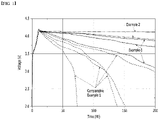
- FIG. 1 is graph showing the experimental result of metal elution suppressing evaluation.
- the present invention provides a non-aqueous electrolyte solution for a lithium secondary battery, including: a lithium salt; an organic solvent; and a first additive, in which the first additive is one or two of compounds represented by following chemical formula 1a and chemical formula 1b:
- a lithium salt which is commonly used in an electrolyte solution for a lithium secondary battery may be used without limitation.
- Li + is included as the cation of the lithium salt, and at least one selected from the group consisting of F - , Cl - , Br - , I - , NO 3 - , N(CN) 2 - , ClO 4 - , BF 4 - , B 10 Cl 10 - , PF 6 - , CF 3 SO 3 - , CH 3 CO 2 - , CF 3 CO 2 - , AsF 6 - , SbF6-, AlCl 4 - , AlO 4 - , CH 3 SO 3 - , BF 2 C 2 O 4 - , BC 4 O 8 - , PF 4 C 2 O 4 - , PF 2 C 4 O 8 - , (CF 3 ,
- the lithium salt may contain one or a combination of two or more selected from the group consisting of LiCl, LiBr, LiI, LiClO 4 , LiBF 4 , LiB 10 Cl 10 , LiPF 6 , LiCF 3 SO 3 , LiCH 3 CO 2 , LiCF 3 CO 2 , LiAsF 6 , LiSbF 6 , LiAlCl 4 , LiAlO 4 , LiCH 3 SO 3 , LiFSI (lithium fluorosulfonyl imide, LiN(SO 2 F) 2 ), LiTFSI (lithium (bis)trifluoromethanesulfonimide, LiN(SO 2 CF 3 ) 2 ) and LiBETI (lithium bisperfluoroethanesulfonimide, LiN(SO 2 C 2 F 5 ) 2 ).More specifically, the lithium salt may contain one or a mixture of two or more selected from group consisting of LiPF 6 , LiBF 4 , LiCH 3 CO 2
- the lithium salt can be appropriately changed within a typically available range, but specifically, 0.1M to 3M lithium salt and more specifically 0.8M to 2.5M lithium salt may be included in the electrolyte solution. If the concentration of the lithium salt exceeds 3M, the viscosity of the non-aqueous electrolyte solution is increased, and the lithium ion transfer effect is lowered and the non-aqueous electrolyte solution wettability is lowered, so that it is difficult to form a SEI film having a uniform thickness on the surface of the electrode.
- the organic solvent may be minimized in decomposition by oxidation reaction during the charge/discharge of the secondary battery, and there is no limit to the kind of the organic solvent as long as it can show desired characteristics together with the additive.
- a carbonate organic solvent, an ether organic solvent or an ester organic solvent, and the like can be used alone or in combination of two or more.
- the carbonate organic solvent in the organic solvent may include at least one of a cyclic carbonate organic solvent and a linear carbonate organic solvent.
- the cyclic carbonate-based organic solvent may include at least one selected from the group consisting of ethylene carbonate (EC), propylene carbonate (PC), 1,2-butylene carbonate, 2,3-butylene carbonate, 1,2-pentylalene carbonate, 2,3-pentylene carbonate, vinylene carbonate and fluoroethylene carbonate (FEC), and may specifically include a mixed solvent of ethylene carbonate having a high dielectric constant, and propylene carbonate having a relatively low melting point, compared to ethylene carbonate.
- the linear carbonate-based organic solvent is a solvent having a low viscosity and a low dielectric constant and may include at least one selected from the group consisting of dimethyl carbonate (DMC), diethyl carbonate (DEC), dipropyl carbonate, ethyl methyl carbonate (EMC), methylpropyl carbonate, and ethylpropyl carbonate, and may specifically include dimethyl carbonate.
- DMC dimethyl carbonate
- DEC diethyl carbonate
- EMC ethyl methyl carbonate
- methylpropyl carbonate methylpropyl carbonate
- ethylpropyl carbonate methylpropyl carbonate
- ethylpropyl carbonate methylpropyl carbonate
- any one selected from the group consisting of dimethyl ether, diethyl ether, dipropyl ether, methylethyl ether, methylpropyl ether, and ethylpropyl ether, or a mixture of two or more thereof may be used, but is not limited thereto.
- Th ester-based organic solvent may be at least one selected from the group consisting of a linear ester-based organic solvent and a cyclic ester-based organic solvent.
- one or a mixture of two or more selected from the group consisting of methyl acetate, ethyl acetate, propyl acetate, methyl propionate, ethyl propionate, propyl propionate, and butyl propionate may be used as the linear ester-based organic solvent, but the present invention is not limited to these examples.
- One or a mixture of two or more selected from the group consisting of y-butyrolactone, ⁇ -valerolactone, ⁇ -caprolactone, ⁇ -valerolactone, and ⁇ -caprolactone may be used as the cyclic ester-based organic solvent, but the present invention is not limited to these examples.
- a cyclic carbonate-based organic solvent having a high viscosity capable of easily dissociating lithium salt in the electrolyte due to a high dielectric constant may be used as the organic solvent.
- a linear carbonate compound and a linear ester compound having a low viscosity and a low dielectric constant, such as dimethyl carbonate and diethyl carbonate may be mixed together with the cyclic carbonate-based organic solvent at an appropriate ratio.
- the organic solvent may be obtained by mixing the cyclic carbonate compound with the linear carbonate compound, and the weight ratio of the cyclic carbonate compound and the linear carbonate compound may be in the range of 10: 90 to 70: 30.
- non-aqueous electrolyte solution for a lithium secondary battery of the present invention contains one or two of compounds represented by chemical formula 1a and chemical formula 1b below.
- the functional group of the nitrile group contained in the compound represented by chemical formula 1a and chemical formula 1b may be strongly bonded with the surface of the positive electrode at a high temperature to form a complex, and the formed complex may act as a protective film for blocking the activated portion of the surface of the positive electrode and prevent a part of the transition metal from being eluted and precipitated in the negative electrode during charge/discharge and may suppress gas generation and side reaction occurring between the electrolyte solution and the positive electrode, thereby improving high temperature performance characteristics.
- the functional group of the isocyanate group contained in the compound represented by the chemical formula 1 is combined with a hydroxyl group existing on the surface of the negative electrode composed of carbons and silicon and may significantly improve the reliability at the time when a battery was preserved at a high temperature state for a long time.
- the low voltage suppressing effects are different depending on the position of the functional group of the nitrile group and the functional group of the isocyanate group.
- the para-compound of chemical formula 1a where these functional groups are substituted at the 1, 4 position of the phenyl group shows more excellent effects of suppressing the low voltage than the metal compound of the chemical formula 1b where the functional groups are substituted at 1, 3 position of the phenyl group.
- the compound of the chemical formula 1a is preferably selected as the first additive.
- an amount of the first additive contained in the electrolyte solution corresponds to 0.01 to 5 wt%, preferably 0.1 to 3 wt%, and more preferably 0.3 to 1.5 wt% of a total weight of the electrolyte solution.
- the content of the first additive is in the above range, secondary batteries having improved performance can be manufactured.
- the effects of removing byproducts and the effects of suppressing metal elution are excellent, and accordingly, it is possible to manufacture a secondary battery having improved a low voltage defect.
- the non-aqueous electrolyte solution of the present invention may further include a second additive which can form a stable film on the surface of the negative electrode and the positive electrode or suppress decomposition of a solvent in the non-aqueous electrolyte solution and act as a complementary element for improving mobility of lithium ions while not significantly increasing the initial resistance in addition to the effects of the first additive by being used together with the first additive.
- a second additive which can form a stable film on the surface of the negative electrode and the positive electrode or suppress decomposition of a solvent in the non-aqueous electrolyte solution and act as a complementary element for improving mobility of lithium ions while not significantly increasing the initial resistance in addition to the effects of the first additive by being used together with the first additive.
- Any additive for forming an SEI film capable of forming a stable film on the surface of the positive electrode and the negative electrode terminal may be used as the second additive.
- examples of the additive for forming the SEI film may include at least one selected from the group consisting of halogen-substituted or unsubstituted cyclic carbonate compound, nitrile compound, phosphate compound, borate compound, sulfate compound, sultone compound, amine compound, silane compound, benzene compound and lithium compound.
- the halogen-substituted cyclic carbonate compound or the halogen-unsubstituted cyclic carbonate compound may improve durability of the battery by forming a stable SEI film on the surface of the negative electrode during battery activation.
- Fluoroethylene carbonate may be used as the halogen-substituted cyclic carbonate compound, and vinylene carbonate (VC) or vinyl ethylene carbonate may be as the halogen-unsubstituted cyclic carbonate compound.
- the content of the halogen-substituted cyclic carbonate compound or the halogen-unsubstituted cyclic carbonate compound may correspond to 5 wt% of the total weight of the non-aqueous electrolyte solution.
- the content of the cyclic carbonate compound in the non-aqueous electrolyte solution exceeds 5 wt%, the cell swelling suppressing performance and initial resistance may be deteriorated.
- the nitrile compound When used together with the above-described mixed additive, effects of improvement of high temperature characteristics, etc. can be expected by positive/negative electrode film stabilization. Namely, it may act as a supplementary element in forming a negative electrode SEI film, suppress decomposition of a solvent in the electrolyte, and improve mobility of lithium ions.
- nitrile compound may include at least one selected from the group consisting of succinonitrile, adiponitrile, acetonitrile, propionitrile, butyronitrile, valeronitrile, caprylonitrile, heptanenitrile, cyclopentane carbonitrile, cyclohexane carbonitrile, 2-fluorobenzonitrile, 4-fluorobenzonitrile, difluorobenzonitrile, trifluorobenzonitrile, phenylacetonitrile, 2-fluorophenylacetonitrile, 4-fluorophenylacetonitrile, 1,4-dicyano-2-butene, glutaronitrile, 1,3,6-hexanetricarbonitrile, and pimelonitrile.
- the content of the nitrile compound may correspond to 8 or less wt% of the total weight of the non-aqueous electrolyte solution.
- the resistance increases due to the increase of the film formed on the surface of the electrode, thereby deteriorating the performance of the battery.
- the phosphate compound stabilizes PF6 anions in the electrolyte solution and helps formation of a positive electrode and negative electrode film, thereby improving durability of the battery.
- the phosphate-based compounds may include at least one selected from the group consisting of lithium difluorophosphate (LiDFP, LiPO 2 F 2 ), lithium tetramethyl trimethyl silyl phosphate, trimethyl silyl phosphite (TMSPi), trimethyl silyl phosphate (TMSPa), ethyl di(prop-2-yn-1-yl)phosphate, allyl diphosphate, tris(2, 2,2-trifluoroethyl) phosphate (TFEPa) and tris(trifluoroethyl) phosphite, and the content of the phosphate-based compound may correspond to 3 or less of the total weight of the non-aqueous electrolyte solution.
- the borate compound may improve mobility of the lithium ions by promoting ion pair separation, lower the interface resistance of the SEI film, and may solve problems such as hydrofluoric acid gas generation by dissociating materials such as LiF, which are generated during battery reaction and are not easily separated.
- LiBOB, LiB(C 2 O 4 ) 2 , lithium oxalyldifluoroborate, or tetramethyl trimethylsilylborate (TMSB) may be used as the borate compound, and the content of the borate compound may be equal to or less than 3 wt% of the total weight of the non-aqueous electrolyte solution.
- At least one compound selected from the group consisting of 1,3-propane sultone (PS), 1,4-butene sultone, ethane sultone, 1,3-propene sultone, and 1-methyl-1,3-propene sultone may be used as the sultone compound, and the content of the sultone compound may be in the range of 0.3 to 5 wt% and specifically 1 to 5 wt% of the total weight of the non-aqueous electrolyte solution.
- PS 1,3-propane sultone
- 1,4-butene sultone 1,4-butene sultone
- ethane sultone 1,3-propene sultone
- 1-methyl-1,3-propene sultone 1-methyl-1,3-propene sultone
- the content of the sultone compound may be in the range of 0.3 to 5 wt% and specifically 1 to 5 wt% of the total weight of the non
- the sulfate-based compound is a material which may be electrically decomposed and may form a stable SEI film even at high temperature storage, and some examples thereof include ethylene sulfate (Esa), trimethylene sulfate (TMS), or methyltrimethylene sulfate (MTMS).
- Esa ethylene sulfate
- TMS trimethylene sulfate
- MTMS methyltrimethylene sulfate
- Triethanolamine or ethylene diamine may be used as the amine compound, and tetravinylsilane may be used as the silane compound.
- Fluorobenzene Monofluorobenzene (hereinafter, referred to as "fluorobenzene”), difluorobenzene, trifluorobenzene, tetrafluorobenzene, etc. may be used as the benzene compound.
- the lithium salt-based compound is a compound which is different from a lithium salt contained in the non-aqueous electrolyte solution.
- the lithium salt-based compound include one or more selected from the group consisting of lithium methylsulfate, lithium ethylsulfate, lithium 2-trifluoromethyl-4,5-dicyanoimidazole, lithium tetrafluorooxalatophosphate, LiODFB and LiBF 4 , and the content of the lithium salt-based compound may be equal to or less than 3 wt% of the total weight of the non-aqueous electrolyte solution.
- the content of the second additives may correspond to 15 wt% or less, preferably 0.01 to 10 wt%, and more preferably 0.1 to 5.0 wt% of the total weight of the electrolyte solution.
- the content of the second additive is less than 0.01 wt%, high temperature storage characteristics and gas reduction effects, which are intended to be implemented from the additive, are very weak, and if the content of the second additive exceeds 15 wt%, the side reaction may excessively occur.
- the content of the second additive exceeds 15 wt%, the side reaction may excessively occur.
- the resistance increases, and the lifespan characteristics of the secondary battery may be deteriorated.
- a lithium secondary battery including a non-aqueous electrolyte solution for a secondary battery of the present invention is provided.
- the lithium secondary battery of the present invention can be manufactured by injecting the non-aqueous electrolyte solution of the present invention into an electrode assembly which is obtained as a positive electrode, a negative electrode, and a separator interposed between the positive electrode and the negative electrode are sequentially laminated.
- a positive electrode, a negative electrode and a separator which have been commonly used in manufacturing a lithium secondary battery, may be used as the positive electrode, the negative electrode, and the separator which form an electrode assembly.
- the positive electrode and the negative electrode which form a lithium secondary battery of the present invention, can be manufactured in a general method and used.
- the positive electrode may be manufactured by forming a positive electrode mixture layer on a positive electrode current collector.
- the positive electrode mixture layer can be formed by coating a positive electrode slurry, which includes a positive electrode active material, a binder, a conductive material, and a solvent, on a positive electrode current collector, and then drying the slurry and rolling the positive electrode current collector.
- the positive electrode current collector is not particularly limited as long as it has conductivity without causing a chemical change in the battery.
- Examples of the positive electrode current collector include stainless steel, aluminum, nickel, titanium, sintered carbon or aluminum or stainless steel of which the surface has been treated with carbon, nickel, titanium, silver, or the like.
- the positive electrode active material is a compound capable of reversible intercalation and deintercalation of lithium, and may specifically include a lithium metal oxide containing lithium and at least one metal such as cobalt, manganese, nickel or aluminum.
- Examples of the positive electrode active material may include Li(Ni 1/3 Mn 1/3 Co 1/3 )O 2 , Li(Ni 0.35 Mn 0.28 Co 0.37 )O 2 , Li(Ni 0.6 Mn 0.2 Co 0.2 )O 2 ,Li(Ni 0.5 Mn 0.3 Co 0.2 )O 2 , Li(Ni 0.7 Mn 0.15 Co 0.15 )O 2 , Li(Ni 0.8 Mn 0.1 Co 0.1 )O 2 or Li(Ni 0.8 Co 0.15 Al 0.05 )O 2 .
- the content of the positive electrode active material may correspond to 90 to 99 wt% and specifically 93 to 98 wt% of the total weight of solids in the positive electrode slurry.
- the binder is added in an amount of 1 to 30% by weight, on the basis of the total weight of solids in the positive electrode slurry, as a component that assists in bonding between the active material and the conductive material and bonding to the current collector.
- binders include polyvinylidene fluoride, polyvinyl alcohol, carboxymethylcellulose, starch, hydroxypropylcellulose, regenerated cellulose, polyvinylpyrrolidone, tetrafluoroethylene, polyethylene, polypropylene, ethylene-propylene-diene terpolymer, sulfonated ethylene-propylene-diene terpolymer, styrene butadiene rubber, fluorine rubber, and various copolymers.
- Such a conductive material is not particularly limited as long as it has electrical conductivity without causing a chemical change in the battery, and examples thereof include: carbon powders such as carbon black, acetylene black, Ketjen black, channel black, furnace black, lamp black, or thermal black; graphite powders such as natural graphite or artificial graphite, or graphite, of which the crystal structure has been very much developed; conductive fibers such as carbon fiber and metal fiber; conductive powders such as carbon fluoride, aluminum and nickel powder; conductive whiskey such as zinc oxide and potassium titanate; conductive metal oxides such as titanium oxide; and conductive materials such as polyphenylene derivatives and the like.
- the conductive material is usually added in an amount of 1 to 30% by weight based on the total weight of solids in the positive electrode slurry.
- the solvent may include an organic solvent such as NMP (N-methyl-2-pyrrolidone), and may be used in an amount that becomes a desirable viscosity when the positive electrode active material and optionally a binder and a conductive material are included.
- NMP N-methyl-2-pyrrolidone
- the concentration of the solids in the slurry containing the positive electrode active material and, optionally, the binder and the conductive material may be in an amount of 10 wt% to 70 wt%, preferably 20 wt% to 60 wt%.
- the negative electrode may be manufactured by forming a negative electrode mixture layer on a negative electrode current collector.
- the negative electrode mixture layer may be formed by coating a slurry including a negative electrode active material, a binder, a conductive material, a solvent, and the like on a negative electrode current collector, followed by drying and rolling.
- the negative electrode current collector is generally made to a thickness of 3 to 500 micrometers.
- the negative electrode current collector is not particularly limited as long as it has high electrical conductivity without causing chemical changes in the battery, and examples thereof include copper, stainless steel, aluminum, nickel, titanium, sintered carbon, copper or stainless steel of which the surface has been treated with carbon, nickel, titanium, silver or the like, aluminum-cadmium alloy, or the like.
- fine unevenness can be formed on the surface to enhance the bonding force of the negative electrode active material, and it can be used in various forms such as a film, a sheet, a foil, a net, a porous body, a foam, and a nonwoven fabric.
- the negative electrode active material may include at least one selected from the group consisting of lithium metal, a carbon material capable of reversibly intercalating/deintercalating lithium ions, metal or an alloy of a metal and lithium, a metal oxide, a material capable of doping and dedoping lithium, and a transition metal oxide.
- Any carbon-based negative electrode active material which is generally used in a lithium ion secondary battery, may be used as a carbon material capable of reversibly intercalating/deintercalating the lithium ions, and representative examples thereof may include crystalline carbon, amorphous carbon, or a combination thereof.
- the crystalline carbon may include amorphous, flaky, spherical, or fibrous natural graphite or artificial graphite, and some examples of the amorphous carbon may include soft carbon, hard carbon, mesophase pitch carbide, and calcined coke.
- a metal selected from the group consisting of Cu, Ni, Na, K, Rb, Cs, Fr, Be, Mg, Ca, Sr, Si, Sb, Pb, In, Zn, Ba, Ra, Ge, Al and Sn, or an alloy of lithium and these metals may be used.
- materials capable of doping and dedoping the lithium may include Si, SiO x (0 ⁇ x ⁇ 2), Si-Y alloy (Y is one selected from the group consisting of alkali metal, alkali earth metal, group 13 element, group 14 element, transition metal, rare earth element, and is not Si), Sn, SnO 2 , Sn-Y (Y is one selected from the group consisting of alkali metal, alkali earth metal, group 13 element, group 14 element, transition metal, rare earth element, and is not Sn), and at least one of them may be mixed with SiO 2 .
- transition metal oxide examples include lithium-containing titanium oxide (LTO), vanadium oxide, lithium vanadium oxide, and the like.
- the negative electrode active material may be included in 80% by weight to 99% by weight based on the total weight of solids in the negative electrode slurry.
- the binder is a component that assists the bonding between the conductive material, the active material and the current collector, and is typically added in an amount of 1 to 30 wt% based on the total weight of solids in the negative electrode slurry.
- binders include polyvinylidene fluoride, polyvinyl alcohol, carboxymethylcellulose, starch, hydroxypropylcellulose, regenerated cellulose, polyvinylpyrrolidone, tetrafluoroethylene, polyethylene, polypropylene, ethylene-propylene-diene polymer, sulfonated ethylene-propylene-diene terpolymer, styrene butadiene rubber, fluorine rubber, and various copolymers thereof.
- the conductive material is a component for further improving the conductivity of the negative electrode active material, and may be added in an amount of 1 to 20 wt% based on the total weight of solids in the negative electrode slurry.
- a conductive material is not particularly limited as long as it has electrical conductivity without causing a chemical change in the battery, and examples thereof include graphite such as natural graphite and artificial graphite; carbon black such as acetylene black, Ketjen black, channel black, furnace black, lamp black, and thermal black; conductive fibers such as carbon fiber and metal fiber; conductive powders such as carbon fluoride, aluminum and nickel powder; conductive whiskey such as zinc oxide and potassium titanate; conductive metal oxides such as titanium oxide; and conductive materials such as polyphenylene derivatives and the like.
- the solvent may include water or an organic solvent such as, NMP or alcohol, and may be used in an amount that becomes a desirable viscosity when the negative electrode active material and optionally a binder and a conductive material are included.
- concentration of the solids in the slurry containing the negative electrode active material and, optionally, the binder and the conductive material may be in an amount of 50 wt% to 75 wt%, preferably 50 wt% to 65 wt%.
- An organic separator or an organic and inorganic composite separator can be used as the separator.
- a porous polymer film which is prepared by a polyolefin-based polymer such as ethylene homopolymer, propylene homopolymer, ethylene/butene copolymer, ethylene/hexene copolymer, and ethylene/methacrylate copolymer, may be used alone, or a laminate thereof may be used as the organic separator.
- a general porous nonwoven fabric such as a non-woven fabric made of a glass fiber having a high melting point, a polyethylene terephthalate fiber, etc. may be used as the organic separator.
- An organic/inorganic complex porous safety-reinforcing separator which is obtained as a porous coating layer containing inorganic particles and a binder polymer is applied on the porous polyolefin-based separator substrate, may be used as the organic and inorganic complex separator.
- Inorganic particles having lithium ion transfer capability or mixtures thereof are preferably used as the inorganic particles, and some examples of the inorganic particles include one or a mixture of two or more selected from the group consisting of BaTiO 3 , BaTiO 3 , Pb(Zr,Ti)O 3 (PZT), Pb 1-x La x Zr 1-y Ti y O 3 (PLZT, herein, 0 ⁇ x ⁇ 1, 0 ⁇ y ⁇ 1), HfO 2 , SrTiO 3 , SnO 2 , CeO 2 , MgO, NiO, CaO, ZnO, ZrO 2 , Y 2 O 3 , Al 2 O 3 , TiO 2 , SiC, and a mixture thereof.
- PZT Pb(Zr,Ti)O 3
- PZT Pb 1-x La x Zr 1-y Ti y O 3
- the outer shape of the lithium secondary battery of the present invention is not particularly limited, but the lithium secondary battery may have a cylindrical shape using a can, a prismatic shape, a pouch shape or a coin shape.
- Ethylene carbonate (EC) and ethylmethyl carbonate (EMC) were mixed at the volume ratio of 30: 70, and LiPF 6 and LiFSI were dissolved therein to have 1.0 M concentration of LiPF 6 and 0.2M concentration of LiFSI, to thereby manufacture a non-aqueous organic solvent.
- a non-aqueous electrolyte solution of the present invention was manufactured by adding 0.3 wt% of a compound represented by chemical formula 1a, to the non-aqueous organic solvent.
- a positive electrode active material slurry (50 wt% solids concentration) was manufactured by adding a positive electrode active material (Li(Ni 0.6 Mn 0.2 Co 0.2 )O 2 ), a conductive material (carbon black) and a binder (polyvinylidene fluoride) at the weight ratio of 90: 5: 5, to N-methyl-2-pyrrolidone (NMP) as a solvent.
- a positive electrode was manufactured by applying the positive electrode active material slurry on a positive electrode current collector (Al film) having a thickness of 100 ⁇ m, then drying the slurry and roll-pressing the positive electrode current collector.
- a negative electrode active material slurry (60 wt% of solids concentration) was manufactured by adding a negative electrode active material (artificial graphite), a binder (PVDF), and a conductive material (carbon black) at the weight ratio of 95: 2: 3, to NMP as a solvent.
- a negative electrode was manufactured by applying the negative electrode active material slurry on a negative electrode current collector (Cu film) having a thickness of 100 ⁇ m, then drying the slurry and roll-pressing the negative electrode current collector.
- a non-aqueous electrolyte solution was prepared by changing the kind and amount of the first additive and the kind and amount of the second additive in the example 1 as shown in Table 1.Further, an electrode and a secondary battery were prepared in the same manner as in Example 1.
- a non-aqueous electrolyte solution was prepared by changing the kind and amount of the first additive and the kind and amount of the second additive in the example 1 as shown in Table 1. Further, an electrode and a secondary battery were prepared in the same manner as in Example 1.
- each secondary battery was set to SOC 100% charge state and was then stored at 60°C for 12 weeks.
- Capacity retention rate % Discharge capacity after high temperature storage / Initial discharge capacity ⁇ 100
- the capacity retention rate after high temperature storage of the lithium secondary battery of examples 1 to 10 including the first additive of the present invention was equal to or more excellent than that of the comparative examples 1 to 4.
- the initial resistance value was obtained by measuring a voltage drop, which was shown in a state that discharging pulses were given with 2.5C constant current for 10 seconds, using PNE-0506 charge-discharge device (manufacturer: PNE Solution Co., Ltd., 5V, 6A).Thereafter, charging was performed at conditions of 0.33C/4.2V constant current/ constant voltage (CC/CV) and 4.2V/0.05C at the voltage operating range of 2.5 to 4.2V, to thereby charge the battery to SOC 100% state.
- PNE-0506 charge-discharge device manufactured by measuring a voltage drop, which was shown in a state that discharging pulses were given with 2.5C constant current for 10 seconds, using PNE-0506 charge-discharge device (manufacturer: PNE Solution Co., Ltd., 5V, 6A).Thereafter, charging was performed at conditions of 0.33C/4.2V constant current/ constant voltage (CC/CV) and 4.2V/0.05C at the voltage operating range of 2.5 to 4.2V, to thereby
- Resistance increase rate (%) for each secondary battery was calculated from the ratio of a resistance, which increased after high temperature storage compared to the initial resistance using the following formula (2), and the result was shown in Table 1 below.
- Resistance increase rate % resistance after high temperature storage ⁇ initial resistance / initial resistance ⁇ 100
- the resistance increase rate of secondary batteries after high temperature storage of examples 1 to 10 is much better than those of the secondary batteries of comparative examples 1 to 4. Further, the resistance increase rate of secondary batteries of examples 1 to 4, in which a compound represented by chemical formula 1a was applied as the first additive, was smaller than the resistance increase rate of examples 5 to 8, in which a compound represented by chemical formula 1b was applied as the first additive, and comparative examples 2 to 3.
- the discharge capacity after one time and the discharge capacity after 200 times were measured using PNE-0506 charge-discharge device (manufacturer: PNE Solution Co., Ltd., 5V, 6A), and the discharge capacity after one time was set as the initial capacity. Thereafter, the capacity retention rate was calculated by the formula (1) by comparing the discharge capacity after 200 times with the initial capacity (100%), and the result was shown in Table 1.
- the charging at conditions of 4.2V, 66mA (0.33C, 0.05C cut-off) CC/CV and the discharging at conditions of 2.5V, 66mA (0.33C) CC were performed 200 times at a high temperature of 45°C, respectively.
- the lithium secondary battery was moved to a charge-discharge device at a room temperature (25°C), and SOC 50% was set.
- secondary batteries of examples 1 to 10 including the first additive of the present invention have more excellent high temperature charge/discharge characteristics and characteristics after high temperature storage than those of secondary batteries of the comparative example 1.
- chemical formula 2a or 2b of additives of comparative examples 2 and 3 includes functional groups of the nitrile group and isocyanate group, but their high temperature characteristics and characteristics after high temperature storage are inferior to those of the additive (chemical formula 1a and chemical formula 1b) of the present invention.
- the non-aqueous electrolyte solution containing an additive of the present invention had excellent characteristics after high temperature storage and charge/discharge characteristics at a high temperature.
- Secondary batteries of examples 2 and 6 and comparative example 1 were manufactured by attaching copper particles having a diameter of about 100 micrometers on a positive electrode when preparing the positive electrode. After performing formation for the manufactured lithium secondary batteries at the condition of 20 mA current (0.1C rate), respectively, gas in each battery was removed (degassing process).After full-charging the degassed secondary battery, the voltage according to time was measured, and the result is shown in FIG. 1 .
- the voltage drop amount of the secondary battery according to the examples of the present invention was much smaller than that of the secondary battery of the comparative example 1.
- the voltage drop amount of the secondary battery of the example 2 in which the compound represented by chemical formula 1a was added decreased, compared to the example 6 in which the compound represented by chemical formula 1b was added.
- the voltage drop amount decreased because the compound represented by chemical formula 1a showed more excellent effects of blocking metal elution.
Landscapes
- Chemical & Material Sciences (AREA)
- Engineering & Computer Science (AREA)
- Manufacturing & Machinery (AREA)
- Chemical Kinetics & Catalysis (AREA)
- Electrochemistry (AREA)
- General Chemical & Material Sciences (AREA)
- Physics & Mathematics (AREA)
- Condensed Matter Physics & Semiconductors (AREA)
- General Physics & Mathematics (AREA)
- Inorganic Chemistry (AREA)
- Materials Engineering (AREA)
- Secondary Cells (AREA)
Applications Claiming Priority (2)
| Application Number | Priority Date | Filing Date | Title |
|---|---|---|---|
| KR1020200131541A KR20220048542A (ko) | 2020-10-13 | 2020-10-13 | 리튬 이차전지용 비수전해액 및 이를 포함하는 리튬 이차전지 |
| PCT/KR2021/012024 WO2022080669A1 (ko) | 2020-10-13 | 2021-09-06 | 리튬 이차전지용 비수전해액 및 이를 포함하는 리튬 이차전지 |
Publications (2)
| Publication Number | Publication Date |
|---|---|
| EP4109620A1 true EP4109620A1 (de) | 2022-12-28 |
| EP4109620A4 EP4109620A4 (de) | 2024-09-18 |
Family
ID=81208293
Family Applications (1)
| Application Number | Title | Priority Date | Filing Date |
|---|---|---|---|
| EP21880317.9A Pending EP4109620A4 (de) | 2020-10-13 | 2021-09-06 | Wasserfreier elektrolyt für lithiumsekundärbatterie und lithiumsekundärbatterie damit |
Country Status (6)
| Country | Link |
|---|---|
| US (1) | US20230352735A1 (de) |
| EP (1) | EP4109620A4 (de) |
| JP (1) | JP2023518592A (de) |
| KR (1) | KR20220048542A (de) |
| CN (1) | CN115336071A (de) |
| WO (1) | WO2022080669A1 (de) |
Families Citing this family (1)
| Publication number | Priority date | Publication date | Assignee | Title |
|---|---|---|---|---|
| KR20250027951A (ko) * | 2023-08-21 | 2025-02-28 | 에스케이온 주식회사 | 리튬 이차 전지 |
Family Cites Families (15)
| Publication number | Priority date | Publication date | Assignee | Title |
|---|---|---|---|---|
| US20110207000A1 (en) * | 2006-09-07 | 2011-08-25 | Jow T Richard | Nitrile additive for non-aqueous electrolyte rechargeable electrochemical cells |
| US10335318B2 (en) * | 2010-04-22 | 2019-07-02 | Melissa Bamberg | Light blocking eye cover attachable to a pillow |
| KR101309157B1 (ko) * | 2011-02-16 | 2013-09-17 | 삼성에스디아이 주식회사 | 리튬 이차 전지용 전해액 및 이를 포함하는 리튬 이차 전지 |
| CN102208682B (zh) * | 2011-05-06 | 2013-05-01 | 北京理工大学 | 一种锂二次电池电解液添加剂及溶剂 |
| KR102186402B1 (ko) * | 2014-07-03 | 2020-12-03 | 삼성에스디아이 주식회사 | 리튬 이차 전지용 전해액 및 이를 포함하는 리튬 이차 전지 |
| JP2016048624A (ja) * | 2014-08-27 | 2016-04-07 | 日立マクセル株式会社 | リチウム二次電池 |
| CN106356561B (zh) * | 2015-07-13 | 2019-07-30 | 宁德时代新能源科技股份有限公司 | 防过充电解液及锂离子电池 |
| MX2019001629A (es) * | 2016-08-12 | 2019-09-16 | Pellion Tech Inc | Aditivo que contiene electrolitos para baterías recargables de ánodo de metal de alta eficiencia energética. |
| WO2019235883A1 (ko) * | 2018-06-07 | 2019-12-12 | 주식회사 엘지화학 | 저온 특성 및 고온 특성이 향상된 리튬 이차전지 |
| US11870036B2 (en) * | 2018-07-02 | 2024-01-09 | Lg Energy Solution, Ltd. | Lithium secondary battery having improved high-temperature characteristics |
| KR20200005369A (ko) * | 2018-07-06 | 2020-01-15 | 삼성에스디아이 주식회사 | 리튬 이차 전지용 전해액 및 이를 포함하는 리튬 이차 전지 |
| CN110970658B (zh) * | 2018-09-28 | 2021-08-06 | 宁德时代新能源科技股份有限公司 | 锂离子电池 |
| CN111224160B (zh) * | 2018-11-26 | 2022-04-15 | 中国科学院大连化学物理研究所 | 一种锂离子电池用电解液及其应用 |
| KR102624807B1 (ko) | 2019-05-14 | 2024-01-16 | 주식회사 엘지에너지솔루션 | 전극 조립체 및 이의 검사 방법 |
| CN110931869B (zh) * | 2019-12-02 | 2022-05-27 | 广州天赐高新材料股份有限公司 | 一种高温型锂二次电池电解液及电池 |
-
2020
- 2020-10-13 KR KR1020200131541A patent/KR20220048542A/ko not_active Ceased
-
2021
- 2021-09-06 JP JP2022557967A patent/JP2023518592A/ja active Pending
- 2021-09-06 CN CN202180022991.1A patent/CN115336071A/zh active Pending
- 2021-09-06 US US17/914,588 patent/US20230352735A1/en active Pending
- 2021-09-06 EP EP21880317.9A patent/EP4109620A4/de active Pending
- 2021-09-06 WO PCT/KR2021/012024 patent/WO2022080669A1/ko not_active Ceased
Also Published As
| Publication number | Publication date |
|---|---|
| WO2022080669A1 (ko) | 2022-04-21 |
| US20230352735A1 (en) | 2023-11-02 |
| KR20220048542A (ko) | 2022-04-20 |
| EP4109620A4 (de) | 2024-09-18 |
| JP2023518592A (ja) | 2023-05-02 |
| CN115336071A (zh) | 2022-11-11 |
Similar Documents
| Publication | Publication Date | Title |
|---|---|---|
| KR102452329B1 (ko) | 리튬 이차전지용 비수전해액 및 이를 포함하는 리튬 이차전지 | |
| EP3648231B1 (de) | Wasserfreier elektrolyt für lithiumsekundärbatterie und lithiumsekundärbatterie damit | |
| CN113614974A (zh) | 锂二次电池用非水性电解质溶液和包含其的锂二次电池 | |
| KR102452330B1 (ko) | 비수전해액 첨가제, 이를 포함하는 리튬 이차전지용 비수전해액 및 리튬 이차전지 | |
| EP3893312A1 (de) | Wasserfreier elektrolyt für lithiumsekundärbatterie und lithiumsekundärbatterie damit | |
| EP4099470B1 (de) | Wasserfreier elektrolyt für lithiumsekundärbatterie und lithiumsekundärbatterie damit | |
| EP4123782B1 (de) | Nichtwässriger elektrolyt für lithiumsekundärbatterie | |
| EP4435921A1 (de) | Lithiumsekundärbatterie | |
| EP4102611B1 (de) | Wasserfreier elektrolyt für lithiumsekundärbatterie und lithiumsekundärbatterie damit | |
| EP4170773A1 (de) | Lithiumsekundärbatterie | |
| KR20210059232A (ko) | 비수 전해액 및 이를 포함하는 리튬 이차 전지 | |
| EP3934001B1 (de) | Wasserfreies elektrolytlösungsadditiv für lithiumsekundärbatterie und wasserfreie elektrolytlösung für lithiumsekundärbatterie sowie lithium-sekundärbatterie die diese enthalten | |
| KR20220031290A (ko) | 리튬 이차 전지 | |
| KR102953613B1 (ko) | 리튬 이차전지용 비수전해액 및 이를 포함하는 리튬 이차전지 | |
| KR20230068666A (ko) | 리튬 이차전지 | |
| EP4379890B1 (de) | Lithiumsekundärbatterie | |
| EP4109620A1 (de) | Wasserfreier elektrolyt für lithiumsekundärbatterie und lithiumsekundärbatterie damit | |
| EP4329040A1 (de) | Wasserfreier elektrolyt für lithiumsekundärbatterie und lithiumsekundärbatterie damit |
Legal Events
| Date | Code | Title | Description |
|---|---|---|---|
| STAA | Information on the status of an ep patent application or granted ep patent |
Free format text: STATUS: THE INTERNATIONAL PUBLICATION HAS BEEN MADE |
|
| PUAI | Public reference made under article 153(3) epc to a published international application that has entered the european phase |
Free format text: ORIGINAL CODE: 0009012 |
|
| STAA | Information on the status of an ep patent application or granted ep patent |
Free format text: STATUS: REQUEST FOR EXAMINATION WAS MADE |
|
| 17P | Request for examination filed |
Effective date: 20220919 |
|
| AK | Designated contracting states |
Kind code of ref document: A1 Designated state(s): AL AT BE BG CH CY CZ DE DK EE ES FI FR GB GR HR HU IE IS IT LI LT LU LV MC MK MT NL NO PL PT RO RS SE SI SK SM TR |
|
| DAV | Request for validation of the european patent (deleted) | ||
| DAX | Request for extension of the european patent (deleted) | ||
| A4 | Supplementary search report drawn up and despatched |
Effective date: 20240816 |
|
| RIC1 | Information provided on ipc code assigned before grant |
Ipc: H01M 10/0569 20100101ALN20240809BHEP Ipc: H01M 10/0525 20100101ALI20240809BHEP Ipc: H01M 10/0567 20100101AFI20240809BHEP |
|
| STAA | Information on the status of an ep patent application or granted ep patent |
Free format text: STATUS: EXAMINATION IS IN PROGRESS |
|
| 17Q | First examination report despatched |
Effective date: 20250806 |
|
| GRAP | Despatch of communication of intention to grant a patent |
Free format text: ORIGINAL CODE: EPIDOSNIGR1 |
|
| STAA | Information on the status of an ep patent application or granted ep patent |
Free format text: STATUS: GRANT OF PATENT IS INTENDED |
|
| RIC1 | Information provided on ipc code assigned before grant |
Ipc: H01M 10/0567 20100101AFI20260119BHEP Ipc: H01M 10/0525 20100101ALI20260119BHEP Ipc: H01M 10/0569 20100101ALN20260119BHEP |
|
| INTG | Intention to grant announced |
Effective date: 20260220 |