EP4110845B1 - Amin-epoxidharz-addukt - Google Patents
Amin-epoxidharz-addukt Download PDFInfo
- Publication number
- EP4110845B1 EP4110845B1 EP21705988.0A EP21705988A EP4110845B1 EP 4110845 B1 EP4110845 B1 EP 4110845B1 EP 21705988 A EP21705988 A EP 21705988A EP 4110845 B1 EP4110845 B1 EP 4110845B1
- Authority
- EP
- European Patent Office
- Prior art keywords
- diamine
- adduct
- bis
- formula
- amine
- Prior art date
- Legal status (The legal status is an assumption and is not a legal conclusion. Google has not performed a legal analysis and makes no representation as to the accuracy of the status listed.)
- Active
Links
Classifications
-
- C—CHEMISTRY; METALLURGY
- C08—ORGANIC MACROMOLECULAR COMPOUNDS; THEIR PREPARATION OR CHEMICAL WORKING-UP; COMPOSITIONS BASED THEREON
- C08G—MACROMOLECULAR COMPOUNDS OBTAINED OTHERWISE THAN BY REACTIONS ONLY INVOLVING UNSATURATED CARBON-TO-CARBON BONDS
- C08G59/00—Polycondensates containing more than one epoxy group per molecule; Macromolecules obtained by polymerising compounds containing more than one epoxy group per molecule using curing agents or catalysts which react with the epoxy groups
- C08G59/18—Macromolecules obtained by polymerising compounds containing more than one epoxy group per molecule using curing agents or catalysts which react with the epoxy groups ; e.g. general methods of curing
- C08G59/40—Macromolecules obtained by polymerising compounds containing more than one epoxy group per molecule using curing agents or catalysts which react with the epoxy groups ; e.g. general methods of curing characterised by the curing agents used
- C08G59/50—Amines
-
- C—CHEMISTRY; METALLURGY
- C08—ORGANIC MACROMOLECULAR COMPOUNDS; THEIR PREPARATION OR CHEMICAL WORKING-UP; COMPOSITIONS BASED THEREON
- C08G—MACROMOLECULAR COMPOUNDS OBTAINED OTHERWISE THAN BY REACTIONS ONLY INVOLVING UNSATURATED CARBON-TO-CARBON BONDS
- C08G59/00—Polycondensates containing more than one epoxy group per molecule; Macromolecules obtained by polymerising compounds containing more than one epoxy group per molecule using curing agents or catalysts which react with the epoxy groups
- C08G59/18—Macromolecules obtained by polymerising compounds containing more than one epoxy group per molecule using curing agents or catalysts which react with the epoxy groups ; e.g. general methods of curing
- C08G59/182—Macromolecules obtained by polymerising compounds containing more than one epoxy group per molecule using curing agents or catalysts which react with the epoxy groups ; e.g. general methods of curing using pre-adducts of epoxy compounds with curing agents
- C08G59/184—Macromolecules obtained by polymerising compounds containing more than one epoxy group per molecule using curing agents or catalysts which react with the epoxy groups ; e.g. general methods of curing using pre-adducts of epoxy compounds with curing agents with amines
-
- C—CHEMISTRY; METALLURGY
- C08—ORGANIC MACROMOLECULAR COMPOUNDS; THEIR PREPARATION OR CHEMICAL WORKING-UP; COMPOSITIONS BASED THEREON
- C08G—MACROMOLECULAR COMPOUNDS OBTAINED OTHERWISE THAN BY REACTIONS ONLY INVOLVING UNSATURATED CARBON-TO-CARBON BONDS
- C08G59/00—Polycondensates containing more than one epoxy group per molecule; Macromolecules obtained by polymerising compounds containing more than one epoxy group per molecule using curing agents or catalysts which react with the epoxy groups
- C08G59/18—Macromolecules obtained by polymerising compounds containing more than one epoxy group per molecule using curing agents or catalysts which react with the epoxy groups ; e.g. general methods of curing
- C08G59/20—Macromolecules obtained by polymerising compounds containing more than one epoxy group per molecule using curing agents or catalysts which react with the epoxy groups ; e.g. general methods of curing characterised by the epoxy compounds used
- C08G59/22—Di-epoxy compounds
- C08G59/24—Di-epoxy compounds carbocyclic
- C08G59/245—Di-epoxy compounds carbocyclic aromatic
-
- C—CHEMISTRY; METALLURGY
- C08—ORGANIC MACROMOLECULAR COMPOUNDS; THEIR PREPARATION OR CHEMICAL WORKING-UP; COMPOSITIONS BASED THEREON
- C08G—MACROMOLECULAR COMPOUNDS OBTAINED OTHERWISE THAN BY REACTIONS ONLY INVOLVING UNSATURATED CARBON-TO-CARBON BONDS
- C08G59/00—Polycondensates containing more than one epoxy group per molecule; Macromolecules obtained by polymerising compounds containing more than one epoxy group per molecule using curing agents or catalysts which react with the epoxy groups
- C08G59/18—Macromolecules obtained by polymerising compounds containing more than one epoxy group per molecule using curing agents or catalysts which react with the epoxy groups ; e.g. general methods of curing
- C08G59/40—Macromolecules obtained by polymerising compounds containing more than one epoxy group per molecule using curing agents or catalysts which react with the epoxy groups ; e.g. general methods of curing characterised by the curing agents used
- C08G59/50—Amines
- C08G59/5033—Amines aromatic
-
- C—CHEMISTRY; METALLURGY
- C08—ORGANIC MACROMOLECULAR COMPOUNDS; THEIR PREPARATION OR CHEMICAL WORKING-UP; COMPOSITIONS BASED THEREON
- C08G—MACROMOLECULAR COMPOUNDS OBTAINED OTHERWISE THAN BY REACTIONS ONLY INVOLVING UNSATURATED CARBON-TO-CARBON BONDS
- C08G2150/00—Compositions for coatings
-
- C—CHEMISTRY; METALLURGY
- C08—ORGANIC MACROMOLECULAR COMPOUNDS; THEIR PREPARATION OR CHEMICAL WORKING-UP; COMPOSITIONS BASED THEREON
- C08G—MACROMOLECULAR COMPOUNDS OBTAINED OTHERWISE THAN BY REACTIONS ONLY INVOLVING UNSATURATED CARBON-TO-CARBON BONDS
- C08G2170/00—Compositions for adhesives
-
- C—CHEMISTRY; METALLURGY
- C08—ORGANIC MACROMOLECULAR COMPOUNDS; THEIR PREPARATION OR CHEMICAL WORKING-UP; COMPOSITIONS BASED THEREON
- C08G—MACROMOLECULAR COMPOUNDS OBTAINED OTHERWISE THAN BY REACTIONS ONLY INVOLVING UNSATURATED CARBON-TO-CARBON BONDS
- C08G2190/00—Compositions for sealing or packing joints
Definitions
- the invention relates to amine-functional adducts of diamines with diepoxides and their use as hardeners for epoxy resin compositions, which are particularly suitable as floor coatings.
- Epoxy resin-based coatings are widely used in the construction industry. They consist of liquid resin and hardener components that are mixed before application and harden at ambient temperatures in the range of around 5 to 35 °C.
- the coatings should have as low a viscosity as possible during application so that they flow well at ambient temperature. After application, they should harden as quickly and smoothly as possible, even in damp and cold conditions, and form a flawless surface without clouding, stains, stickiness or craters. After curing, they should have a high hardness with low brittleness and a high glass transition temperature in order to withstand mechanical stress as well as possible. For visually demanding applications, such as floor coverings, they should also have a high degree of gloss and as little tendency to yellow under the influence of light as possible.
- Adducts produced with a small excess of diamine contain less unreacted diamine and more higher molecular weight adduct molecules with two, three or more diepoxide units. Such adducts would be advantageous in themselves. They have little odor, are particularly less susceptible to blushing and allow the adduct to be used in large quantities and/or combined with other amines. Adducts produced with a small excess of diamine are, however, very viscous or even solid, which means that they can only be handled at room temperature with considerable quantities of thinners such as benzyl alcohol.
- Thinners are not incorporated into the resin matrix during curing and can be released into the environment through evaporation or diffusion processes.
- thinners can therefore only be used in small quantities or not at all.
- WO 2017/046293 discloses adducts of N-benzyl-1,2-propanediamine or N-benzyl-1,2-ethanediamine purified by distillation and bisphenol A diglycidyl ether, which enable coatings with beautiful surfaces. These adducts are produced with a high excess of diamine, which greatly limits the freedom of combination with other amines.
- adducts of alkylated diamines with epoxides as components of hardeners for aqueous epoxy resin products, for example from EP1,956,034
- the adducts contain polyether chains and are diluted after the reaction with unadducted diamines and large amounts of water.
- WO2018/166996A1 discloses a process for producing a hardener for epoxy resins in which an amine mixture containing a starting amine and an alkylated amine is reacted with a glycidyl ether.
- the object of the present invention is therefore to provide a diamine-epoxy resin adduct which, even with a small excess of diamine during production without the addition of thinners, is liquid at room temperature and has as low a viscosity as possible and, when used as a hardener for epoxy resin coatings, enables good processability, rapid curing and defect-free, glossy surfaces, even under damp and cold conditions.
- the adduct according to the invention is liquid at room temperature and has a surprisingly low viscosity. Even with a small content of dialkylated diamine, the adduct is much less viscous than a corresponding adduct that was produced without the presence of the dialkylated diamine.
- the adduct is used as a hardener for epoxy resins, surprisingly neither the curing speed nor the final hardness are significantly adversely affected by the dialkylated diamine.
- the massively lower viscosity of the adduct is very advantageous and could not have been expected given the state of the art.
- the adduct according to the invention is particularly cost-effective since it is obtainable from an amine mixture that is technically easy to prepare.
- the adduct according to the invention enables low-emission or emission-free epoxy resin coatings with surprisingly good processability and surprisingly rapid curing, which have a high hardness and low tendency to yellowing and are hardly prone to blushing-related defects even in damp, cold conditions.
- a “primary amino group” is an amino group that is bonded to a single organic residue and carries two hydrogen atoms; a “secondary amino group” is an amino group that is bonded to two organic residues, which may also be part of a ring, and carries one hydrogen atom; and a “tertiary amino group” is an amino group that is bonded to three organic residues, which may also be part of one or more rings in twos or threes, and does not carry a hydrogen atom.
- amine hydrogen The hydrogen atoms of primary and secondary amino groups are called "amine hydrogen".
- amine hydrogen equivalent weight is the mass of an amine or an amine-containing composition that contains one molar equivalent of amine hydrogen. It is expressed in the unit of measurement "g/Eq".
- the “epoxide equivalent weight” is the mass of a compound or composition containing epoxy groups that contains one molar equivalent of epoxy groups. It is expressed in the unit of measurement "g/Eq”.
- a “thinner” is a substance that is soluble in an epoxy resin and reduces its viscosity, but which is not chemically bound into the epoxy resin polymer during curing.
- molecular weight refers to the molar mass (in grams per mole) of a molecule.
- average molecular weight refers to the number average M n of a polydisperse mixture of oligomeric or polymeric molecules, which is usually determined by gel permeation chromatography (GPC) against polystyrene as a standard.
- the “gel time” is the period of time from the mixing of the components of an epoxy resin composition until they gel.
- room temperature A temperature of 23 °C is referred to as “room temperature”.
- the amine mixture used for the adduct according to the invention preferably contains no or only small amounts of other amines not corresponding to formulas (I) and (II).
- the amine mixture preferably has a purity based on the sum of diamine of formula (I) and diamine of formula (II) of at least 95% by weight, in particular at least 97% by weight.
- the amine mixture used to produce the adduct preferably contains a content of diamine of the formula H 2 NA-NH 2 , where A has the meaning already mentioned, of at most 5% by weight, preferably at most 3% by weight, particularly preferably at most 2% by weight, in particular at most 1% by weight.
- a content of diamine of the formula H 2 NA-NH 2 where A has the meaning already mentioned, of at most 5% by weight, preferably at most 3% by weight, particularly preferably at most 2% by weight, in particular at most 1% by weight.
- Such an amine mixture has a particularly low odor and enables low-viscosity adducts which cause hardly any blushing when used as hardeners for epoxy resins.
- A is selected from the group consisting of 1,2-ethylene, 1,2-propylene, 1,3-propylene, 1,4-butylene, 1,3-butylene, 2-methyl-1,2-propylene, 1,3-pentylene, 1,5-pentylene, 2,2-dimethyl-1,3-propylene, 1,6-hexylene, 2-methyl-1,5-pentylene, 1,7-heptylene, 1,8-octylene, 2,5-dimethyl-1,6-hexylene, 1,9-nonylene, 2,2(4),4-trimethyl-1,6-hexylene, 1,10-decylene, 1,11-undecylene, 2-butyl-2-ethyl-1,5-pentylene, 1,12-dodecylene, 1,2-cyclohexylene, 1,3-cyclohexylene, 1,4-cyclohexylene, (1,5,5-trimethylcyclohexan-1-yl)methane-1,3,
- A is selected from the group consisting of 1,2-ethylene, 1,2-propylene, 2-methyl-1,2-propylene, 1,3-pentylene, 1,2-cyclohexylene, 1,4-cyclohexylene, 4(2)-methyl-1,3-cyclohexylene, 1,3-cyclohexylene-bis(methylene), 1,4-cyclohexylene-bis(methylene), 1,3-phenylene-bis(methylene) and 1,4-phenylene-bis(methylene).
- A is 1,2-ethylene.
- R is selected from the group consisting of methyl, ethyl, propyl, isopropyl, n-butyl, isobutyl, sec-butyl, n-pentyl, 3-methyl-but-2-yl, hexyl, 4-methyl-pent-2-yl, 2-ethylhexyl, octyl, nonyl, decyl, undecyl, dodecyl and an optionally substituted 1-phenylethyl, 2-phenylethyl, benzyl, naphthylmethyl, cyclohexylmethyl and 2-cyclohexylethyl radical.
- Preferred radicals R have 6 to 12 C atoms, in particular 6 to 8 C atoms.
- R is selected from the group consisting of 2-ethylhexyl, 2-phenylethyl, benzyl, 1-naphthylmethyl and cyclohexylmethyl.
- R is benzyl.
- the diamine of formula (I) is selected from the group consisting of N-benzyl-1,2-ethanediamine, N-(1-naphthylmethyl)-1,2-ethanediamine, N-cyclohexylmethyl-1,2-ethanediamine, N-benzyl-1,2-propanediamine and N-(2-ethylhexyl)-bis(aminomethyl)-1,3-benzene.
- the most preferred diamine of formula (I) is N-benzyl-1,2-ethanediamine. This diamine enables particularly low-viscosity and reactive adducts.
- radicals A and R in the diamines of the formula (I) and (II) are identical radicals.
- Such an amine mixture is particularly easily available as a reaction product of an alkylation.
- the diamine of formula (I) is N-benzyl-1,2-ethanediamine and the diamine of formula (II) is N,N'-dibenzyl-1,2-ethanediamine.
- the weight ratio between the diamine of formula (I) and the diamine of formula (II) is in the range from 70/30 to 95/5, particularly preferably 80/20 to 90/10.
- Such an adduct is particularly reactive and enables high hardnesses.
- the diamine of formula (I) and the diamine of formula (II) are preferably prepared by partial alkylation of at least one amine of formula H 2 NA-NH 2 with at least one alkylating agent.
- the alkylation is a reductive alkylation, wherein an aldehyde or ketone and hydrogen are used as the alkylating agent.
- the reductive alkylation is preferably carried out in the presence of a suitable catalyst.
- Preferred catalysts are palladium on carbon (Pd/C), platinum on carbon (Pt/C), Adams catalyst or Raney nickel, in particular palladium on carbon or Raney nickel.
- the reductive alkylation is preferably carried out in a pressure apparatus at a hydrogen pressure of 5 to 150 bar, in particular 10 to 100 bar. This can be carried out in a batch process or, preferably, in a continuous process.
- the reductive alkylation is preferably carried out at a temperature in the range of 40 to 120 °C, in particular 60 to 100 °C.
- reaction product obtained can be used as an amine mixture without further purification.
- the diamine of formula (I) and the diamine of formula (II) can also be prepared separately and mixed to form the amine mixture.
- the reaction mixture from the reductive alkylation is preferably further purified, in particular by distillation.
- the reaction mixture is not further purified, but contains the diamine of formula (I) and the diamine of formula (II) in the ratio according to the invention.
- a reaction mixture is particularly cost-effective.
- the amine mixture comprising at least one diamine of the formula (I) and at least one diamine of the formula (II) is a reaction product from the reductive alkylation of at least one amine of the formula H 2 NA-NH 2 with at least one aldehyde or ketone and hydrogen.
- Preferred aldehydes or ketones are formaldehyde, acetaldehyde, 1-propanal, acetone, 1-butanal, isobutyralaldehyde, methyl ethyl ketone, 1-pentanal, methyl isopropyl ketone, 1-hexanal, methyl isobutyl ketone, 2-ethylhexanal, 1-octanal, 1-nonanal, 1-decanal, 1-undecanal, 1-dodecanal, methyl phenyl ketone, benzaldehyde, 1-naphthaldehyde or cyclohexanecarbaldehyde.
- 2-ethylhexanal is particularly preferred, 2-ethylhexanal, benzaldehyde, 1-naphthaldehyde or cyclohexanecarbaldehyde, especially benzaldehyde.
- an amine of the formula H 2 NA-NH 2 is 1,2-ethanediamine.
- the diepoxide is preferably an aromatic diepoxide.
- a diepoxide is referred to as "aromatic" if it contains at least one aromatic ring.
- the aromatic diepoxide is preferably free of polyether chains. Such an aromatic diepoxide is particularly suitable as a hardener for non-aqueous epoxy resin products that are particularly stable against weather influences.
- the diepoxide is selected from the group consisting of bisphenol A diglycidyl ether, bisphenol F diglycidyl ether, mixtures of bisphenol A and bisphenol F diglycidyl ether, pyrocatechol diglycidyl ether, resorcinol diglycidyl ether, hydroquinone diglycidyl ether, bis(4-hydroxy-3-methylphenyl)methane diglycidyl ether, 2,2-bis(4-hydroxy-3-methylphenyl)propane diglycidyl ether, bis(3,5-dimethyl-4-hydroxyphenyl)methane diglycidyl ether, 2,2-bis(3,5-dimethyl-4-hydroxyphenyl)propane diglycidyl ether, 2,2-bis(4-hydroxy-3-tert.butylphenyl)propane diglycidyl ether, 2,2-bis(4-hydroxy-3-tert.butylphenyl)propane diglycidyl ether,
- the diepoxide is a bisphenol A diglycidyl ether, bisphenol F diglycidyl ether or bisphenol A/F diglycidyl ether, in particular a bisphenol A diglycidyl ether.
- the diglycidyl ethers are preferably used in a technical quality.
- Particularly preferred are commercially available liquid resins, such as in particular Araldite ® GY 240, Araldite ® GY 250, Araldite ® GY 281, Araldite ® GY 282, Araldite ® GY 285, Araldite ® PY 304 or Araldite ® PY 720 (all from Huntsman), or DER ® 330, DER ® 331, DER ® 332, DER ® 336, DER ® 351, DER ® 352, DER ® 354 or DER ® 356 (all from Dow).
- the diepoxide has an epoxy equivalent weight in the range of 110 to 260 g/Eq, preferably 156 to 200 g/Eq.
- the amine mixture is preferably used in the conversion to the adduct according to the invention in an amount such that the stoichiometric ratio is in the range from 1.3 to 2, in particular 1.4 to 1.7, mol of diamine of the formula (I) to 1 mol equivalent of epoxide groups of the diepoxide.
- Such an adduct contains particularly few unreacted diamines and a high content of adduct molecules. It is particularly odorless and surprisingly low in viscosity. It enables particularly rapid curing and a great deal of flexibility when combining with other amines.
- the temperature during the reaction is preferably in the range from 40 to 120 °C, in particular 60 to 100 °C.
- unreacted diamine of formula (I) and diamine of formula (II) are preferably not removed from the adduct, but remain in it and are a component of the adduct.
- the adduct contains so-called 2:1 adducts from the addition of 2 moles of diamine of formula (I) or (II) and 1 mole of diepoxide.
- the adduct mainly contains the following 2:1 adduct, Further 2:1 adducts are those with secondary amino groups added to epoxide groups, such as the following or
- the adduct contains higher adducts, in particular so-called 3:2 adducts from the addition of 3 mol diamine of formula (I) or (II) and 2 mol diepoxide.
- 3:2 adducts from the addition of 3 mol diamine of formula (I) or (II) and 2 mol diepoxide.
- N-benzyl-1,2-ethanediamine as diamine of formula (I) and bisphenol A diglycidyl ether mainly the following 3:2 adduct where 3:2 adducts from the reaction with secondary amino groups are also present.
- the adduct contains further higher adducts, so-called >3:2 adducts, in particular those from the addition of 4 mol diamine of the formula (I) or (II) and 3 mol diepoxide or 5 mol diamine of the formula (I) or (II) and 4 mol diepoxide.
- the adduct according to the invention preferably contains 2:1 adducts and higher adducts in a weight ratio in the range from 30/70 to 80/20, preferably 35/65 to 70/30.
- Such an adduct enables a particularly advantageous combination of low viscosity and rapid curing.
- the adduct according to the invention particularly preferably contains 2:1 adducts and higher adducts in a weight ratio in the range from 30/70 to 49.9/50.1, in particular 35/65 to 49/51.
- Such an adduct is in particular prepared in a stoichiometric ratio in the range from 1.4 to 1.7 mol of diamine of formula (I) to 1 mol equivalent of epoxy groups of the diepoxide. It enables particularly rapid curing.
- the adduct contains less than 1% by weight of diluent or water.
- the adduct preferably has a viscosity at 20 °C in the range from 5 to 500 Pa s, preferably 10 to 250 Pa s, in particular 20 to 150 Pa s, measured by means of a cone-plate viscometer at a shear rate of 10 s -1 .
- the adduct according to the invention is particularly suitable for curing an epoxy resin.
- Another object of the invention is a hardener for epoxy resins, comprising the adduct according to the invention and at least one further component selected from the group consisting of further amines, accelerators and diluents.
- the hardener preferably contains 1 to 80% by weight, preferably 2 to 60% by weight, in particular 5 to 50% by weight, of the adduct according to the invention.
- the hardener for epoxy resins is preferably not water-based. In particular, it contains less than 15% by weight, preferably less than 10% by weight, of water. Such a hardener is suitable for non-aqueous epoxy resin products, in particular floor coatings.
- the hardener preferably contains at least one further amine with aliphatic amino groups and at least three amine hydrogens.
- This further amine is preferably only added after the amine mixture has reacted with the diepoxide to form the adduct.
- This further amine can be the same amine as that which was used in the reaction to form the adduct as the diamine of formula (I), or it can be a different amine.
- Suitable amines are in particular N-benzyl-1,2-ethanediamine, N-benzyl-1,2-propanediamine, N-benzyl-bis(aminomethyl)-1,3-benzene, N-(2-ethylhexyl)-bis(aminomethyl)-1,3-benzene or N-(2-phenylethyl)-bis(aminomethyl)-1,3-benzene, as well as 2,2-dimethyl-1,3-propanediamine, 1,3-pentanediamine (DAMP), 1,5-pentanediamine, 1,5-diamino-2-methylpentane (MPMD), 2-butyl-2-ethyl-1,5-pentanediamine (C11-neodiamine), 1,6-hexanediamine, 2,5-dimethyl-1,6-hexanediamine, 2,2(4),4-trimethyl-1,6-hexanediamine (TMD), 1,7-heptanediamine, 1,8-oc
- the hardener according to the invention contains a combination of two or more further amines.
- the hardener particularly preferably contains at least one further amine selected from the group consisting of N-benzyl-1,2-ethanediamine, TMD, 1,2-diaminocyclohexane, 1,3-bis(aminomethyl)cyclohexane, 1,4-bis(aminomethyl)cyclohexane, IPDA, 2(4)-methyl-1,3-diaminocyclohexane, MXDA, polyoxypropylenediamines having an average molecular weight M n in the range from 200 to 500 g/mol and polyoxypropylenetriamines having an average molecular weight M n in the range from 300 to 500 g/mol.
- TMD 1,2-diaminocyclohexane
- 1,3-bis(aminomethyl)cyclohexane 1,4-bis(aminomethyl)cyclohexane
- IPDA 1,4-bis(aminomethyl)cyclohexane
- MXDA polyoxypropyl
- Another particularly preferred amine is N-benzyl-1,2-ethanediamine. This amine enables hardeners with particularly good processability, rapid curing and little tendency towards blushing effects.
- Another particularly preferred amine is MXDA, optionally in the form of an amine-functional adduct with an epoxy resin. This amine enables particularly rapid curing.
- IPDA is a particularly preferred amine
- Another particularly preferred amine is IPDA, optionally in the form of an amine-functional adduct with an epoxy resin. This amine enables a particularly high glass transition temperature and final hardness.
- Suitable accelerators are in particular acids or compounds that can be hydrolysed to acids, in particular organic carboxylic acids such as acetic acid, benzoic acid, salicylic acid, 2-nitrobenzoic acid, lactic acid, organic sulfonic acids such as methanesulfonic acid, p-toluenesulfonic acid or 4-dodecylbenzenesulfonic acid, sulfonic acid esters, other organic or inorganic acids such as in particular phosphoric acid, or mixtures of the aforementioned acids and Acid esters; nitrates such as calcium nitrate; tertiary amines such as in particular 1,4-diazabicyclo[2.2.2]octane, benzyldimethylamine, ⁇ -methylbenzyldimethylamine, triethanolamine, dimethylaminopropylamine, imidazoles such as in particular N-methylimidazole, N-vinylimidazole or 1,2-dimethylimidazo
- Preferred accelerators are acids, nitrates, tertiary amines or Mannich bases, in particular salicylic acid, calcium nitrate or 2,4,6-tris(dimethylaminomethyl)phenol, or a combination of these accelerators.
- Suitable thinners are in particular xylene, 2-methoxyethanol, dimethoxyethanol, 2-ethoxyethanol, 2-propoxyethanol, 2-isopropoxyethanol, 2-butoxyethanol, 2-phenoxyethanol, 2-benzyloxyethanol, benzyl alcohol, ethylene glycol, ethylene glycol dimethyl ether, ethylene glycol diethyl ether, ethylene glycol dibutyl ether, ethylene glycol diphenyl ether, diethylene glycol, diethylene glycol monomethyl ether, diethylene glycol monoethyl ether, diethylene glycol mono-n-butyl ether, diethylene glycol dimethyl ether, diethylene glycol diethyl ether, diethylene glycol di-n-butylyl ether, propylene glycol butyl ether, propylene glycol phenyl ether, dipropylene glycol, dipropylene glycol monomethyl ether, dipropylene glycol dimethyl ether, dipropylene glycol di-n-butyl ether
- Thinners with a boiling point of more than 200 °C are preferred.
- the thinner is preferably selected from the group consisting of benzyl alcohol, styrenated phenol, ethoxylated phenol, aromatic hydrocarbon resins containing phenol groups, in particular the Novares ® types LS 500, LX 200, LA 300 or LA 700 (from Rütgers), diisopropylnaphthalene and cardanol.
- Benzyl alcohol is particularly preferred.
- Phenol group-containing thinners also act as accelerators.
- the hardener component comprises the hardener described above.
- a suitable epoxy resin is obtained in a known manner, in particular from the reaction of epichlorohydrin with polyols, polyphenols or amines.
- the epoxy resin is a liquid resin or a mixture containing two or more epoxy liquid resins.
- epoxy liquid resin is a technical polyepoxide with a glass transition temperature below 25°C.
- the resin component also contains portions of solid epoxy resin.
- the epoxy resin is in particular a liquid resin based on a bisphenol, in particular a bisphenol-A diglycidyl ether and/or bisphenol-F diglycidyl ether, as are commercially available, for example, from Olin, Huntsman or Momentive.
- These liquid resins have a low viscosity for epoxy resins and enable rapid curing and high hardness. They can contain proportions of bisphenol A solid resin or novolak glycidyl ethers.
- the resin component may contain a reactive diluent.
- Preferred reactive diluents are reactive diluents containing epoxy groups, in particular butanediol diglycidyl ether, hexanediol diglycidyl ether, trimethylolpropane di- or triglycidyl ether, phenyl glycidyl ether, cresyl glycidyl ether, guaiacol glycidyl ether, 4-methoxyphenyl glycidyl ether, pn-butylphenyl glycidyl ether, p-tert-butylphenyl glycidyl ether, 4-nonylphenyl glycidyl ether, 4-dodecylphenyl glycidyl ether, cardanol glycidyl ether, benzyl glycidyl ether, allyl glycidyl ether, butyl glycid
- the epoxy resin composition contains at least one further component selected from the group consisting of thinners, accelerators and fillers.
- Suitable accelerators are those already mentioned, in particular salicylic acid, calcium nitrate or 2,4,6-tris(dimethylaminomethyl)phenol or a combination thereof.
- thinners especially those with a boiling point of more than 200°C.
- the thinner is preferably selected from the group consisting of benzyl alcohol, styrenated phenol, ethoxylated phenol, aromatic hydrocarbon resins containing phenol groups, in particular the Novares ® types LS 500, LX 200, LA 300 or LA 700 (from Rütgers), diisopropylnaphthalene and cardanol.
- Benzyl alcohol is particularly preferred.
- Suitable fillers are in particular ground or precipitated calcium carbonate, which may be coated with fatty acid, in particular stearates, barite (barite), talc, quartz powder, quartz sand, silicon carbide, Micaceous iron oxide, dolomite, wollastonite, kaolin, mica (potassium aluminum silicate), molecular sieve, aluminum oxide, aluminum hydroxide, magnesium hydroxide, silica, cement, gypsum, fly ash, soot, graphite, metal powders such as aluminum, copper, iron, zinc, silver or steel, PVC powder or hollow spheres.
- fatty acid in particular stearates, barite (barite), talc, quartz powder, quartz sand, silicon carbide, Micaceous iron oxide, dolomite, wollastonite, kaolin, mica (potassium aluminum silicate), molecular sieve, aluminum oxide, aluminum hydroxide, magnesium hydroxide, silica, cement, gypsum, fly
- Calcium carbonate, quartz powder, quartz sand or a combination thereof is preferred.
- the epoxy resin composition preferably contains further auxiliaries and additives, in particular pigments, wetting agents, flow agents and/or defoamers.
- the epoxy resin composition preferably contains only a small amount of thinners. It preferably contains less than 20% by weight, particularly preferably less than 15% by weight, in particular less than 10% by weight, of thinner. This enables low-emission or emission-free epoxy resin products.
- the epoxy resin composition contains only a small amount of water, preferably less than 5% by weight, in particular less than 1% by weight, of water.
- the ratio of the number of groups reactive towards epoxy groups to the number of epoxy groups is preferably in the range of 0.5 to 1.5, in particular 0.7 to 1.2.
- the primary and secondary amino groups present in the epoxy resin composition and any other groups reactive towards epoxy groups react with the epoxy groups to open their ring (Addition reaction). As a result of this reaction, the composition polymerizes and thereby hardens.
- the resin and hardener components of the epoxy resin composition are stored in separate containers.
- Other components of the epoxy resin composition can be present as components of the resin or hardener component, with other components that are reactive towards epoxy groups preferably being part of the hardener component. It is also possible for other components to be present as separate, additional components.
- a suitable container for storing the resin or hardener component is in particular a barrel, a hobbock, a bag, a bucket, a can, a cartridge or a tube.
- the components are storable, which means that they can be kept for several months up to a year or longer before use without their respective properties changing to an extent relevant to their use.
- To use the epoxy resin composition the components are mixed together shortly before or during application.
- the mixing ratio between the resin and hardener components is preferably chosen so that the groups of the hardener component that are reactive towards epoxy groups are in a suitable ratio to the epoxy groups of the resin component, as described above. In parts by weight, the mixing ratio between the resin component and the hardener component is usually in the range of 1:10 to 10:1.
- the components are mixed using a suitable process; it can be done continuously or in batches. If mixing is not done immediately before application, care must be taken to ensure that not too much time passes between mixing the components and application and that application is done within the pot life. Mixing is done in particular at ambient temperature, which is typically in the range of about 5 to 40°C, preferably about 10 to 35°C.
- curing begins through a chemical reaction, as described above. Curing typically takes place at a temperature in the range of 0 to 150°C. It preferably takes place at ambient temperature and typically lasts for several days to weeks. The duration depends on the temperature, the reactivity of the components and their stoichiometry, as well as the presence of accelerators.
- the epoxy resin composition In the freshly mixed state, the epoxy resin composition has a low viscosity.
- the viscosity 10 minutes after mixing the resin and hardener components at 20 °C is preferably in the range from 300 to 4,000 mPa ⁇ s, preferably 300 to 3,000 mPa ⁇ s, in particular 300 to 2,000 mPa ⁇ s, measured using a cone-plate viscometer at a shear rate of 10 s -1 .
- the substrates can be pretreated before application, in particular by physical and/or chemical cleaning processes or the application of an activator or a primer.
- the epoxy resin composition is preferably used as a coating, primer, adhesive, sealant, potting compound, casting resin, impregnating resin or as a matrix for fiber composite materials (composites) such as in particular CFRP or GFRP.
- the epoxy resin composition is particularly preferably used as a coating.
- Coatings are understood to mean all types of surface-applied coverings, in particular floor coverings, paints, varnishes, sealants, primers or protective coatings, in particular those for heavy corrosion protection.
- the epoxy resin composition is particularly suitable as a floor covering or floor coating for interior spaces such as offices, industrial halls, gymnasiums or cold storage rooms, or outdoors for balconies, terraces, parking decks, bridges or roofs, as a protective coating for concrete, cement, metals, plastics or wood, for example for surface sealing of wooden structures, vehicles, loading areas, tanks, silos, shafts, pipes, pipelines, machines or steel structures, for example of ships, piers, offshore platforms, lock gates, hydroelectric power plants, river structures, swimming pools, Wind turbines, bridges, chimneys, cranes or sheet piling, or as a primer, adhesion coat, corrosion protection primer or for hydrophobizing surfaces.
- the epoxy resin composition is particularly advantageous in low-emission coatings with eco-quality seals, for example according to Emicode (EC1 Plus), AgBB, DIBt, Der Blaue Engel, AFSSET, RTS (M1) and US Green Building Council (LEED).
- Emicode EC1 Plus
- AgBB AgBB
- DIBt DIBt
- Der Blaue Engel AFSSET
- RTS RTS
- M1 US Green Building Council
- the epoxy resin composition advantageously has a liquid consistency with low viscosity and good flow properties.
- the mixed composition is typically applied to a substrate as a thin film with a layer thickness of about 50 ⁇ m to about 5 mm within the pot life, typically at ambient temperature.
- the application is carried out in particular by pouring it onto the substrate to be coated and then evenly distributing it using, for example, a squeegee or a notched trowel.
- the application can also be carried out with a brush or roller or by spraying, for example as an anti-corrosion coating on steel.
- cured When cured, largely homogeneous, glossy and non-sticky films of high hardness are typically formed, which have good adhesion to a wide variety of substrates.
- a further coating can be applied to the fully or partially cured composition, whereby this further layer can also be an epoxy resin composition, but also a other material, in particular a polyurethane or polyurea coating.
- the epoxy resin composition is particularly preferably used as an adhesive.
- the epoxy resin composition typically has a pasty consistency with pseudoplastic properties after the components have been mixed.
- the mixed adhesive is applied to at least one of the substrates to be bonded within the pot life and the two substrates are bonded together within the open time of the adhesive.
- the mixed adhesive is applied in particular by means of a brush, roller, spatula, squeegee, trowel, or from a tube, cartridge or dosing device.
- the adhesive is particularly suitable for use in the construction industry, in particular for reinforcing structures using steel slats or slats made of carbon fiber reinforced composite plastics (CFRP), for structures containing bonded precast concrete parts, in particular bridges or concrete towers for wind turbines, shafts, pipelines or tunnels, for example, or for structures containing bonded natural stone, ceramic elements or parts made of fiber cement, steel, cast iron, aluminum, wood or polyester, for anchoring dowels or steel rods in drill holes, for fixing railings, parapets or door frames, for repairs such as filling edges, holes or joints during concrete repairs, or for bonding films made of polyvinyl chloride (PVC), flexibilized polyolefin (Combiflex ® ) or adhesion-modified chlorosulfonated polyethylene (Hypalon ® ) to concrete or steel.
- CFRP carbon fiber reinforced composite plastics
- Such an epoxy resin adhesive is also suitable for filling cavities such as cracks, gaps or drill holes, whereby the adhesive is filled or injected into the cavity and, after curing, fills it and connects or bonds the flanks of the cavity together in a force-fitting manner.
- An “anchor” is a reinforcing iron, a threaded rod or a bolt.
- Such an anchor is glued or anchored in a wall, ceiling or foundation in such a way that part of it is glued in a force-fitting manner and part of it protrudes and can be structurally loaded.
- An article is obtained from the application and curing of the epoxy resin composition.
- a further object of the invention is thus an article obtained from the use of the epoxy resin composition.
- the article is preferably a building or a part thereof, in particular a building of civil or structural engineering, an office, an industrial hall, a gymnasium, a cold storage room, a silo, a bridge, a roof, a staircase, a floor, a Balcony, terrace or parking deck, or an industrial or consumer good, in particular a pier, an offshore platform, a lock gate, a crane, a sheet pile wall, a pipeline or a rotor blade of a wind turbine, or a means of transport such as in particular an automobile, a truck, a rail vehicle, a ship, an aircraft or a helicopter, or an attachment thereof.
- the epoxy resin composition is characterized by advantageous properties. It can be formulated with little or no thinner and is surprisingly low-viscosity and very easy to process. It hardens reliably and surprisingly quickly, especially in damp and cold conditions. This creates mechanically high-quality coatings with a high surface quality. Such epoxy resin products are particularly suitable as coatings, especially for floors.
- AHEW stands for amine hydrogen equivalent weight
- NK standard climate
- the viscosity was measured on a thermostatted cone-plate viscometer Rheotec RC30 (cone diameter 50 mm, cone angle 1°, cone tip-plate distance 0.05 mm, shear rate 10 s -1 ).
- the amine number was determined by titration (with 0.1N HClO 4 in acetic acid against crystal violet).
- Ultrahigh performance liquid chromatography (UHPLC) was performed for the quantitative determination of N-benzyl-1,2-ethanediamine after derivatization with phenyl isocyanate against external calibration.
- GPC Gel permeation chromatography
- Araldite ® GY 250 Bisphenol A diglycidyl ether, EEW 187 g/eq (from Huntsman)
- Araldite ® DY-E Monoglycidyl ether of C 12 - to C 14 -alcohols, EEW approx. 290 g/Eq (from Huntsman)
- B-EDA mix Amine mixture containing approx. 85% by weight of N-benzyl-1,2-ethanediamine and approx.
- N,N'-dibenzyl-1,2-ethanediamine prepared as described below, AHEW 55 g/Eq B-EDA-pure purified N-benzyl-1,2-ethanediamine, prepared as described below, 150.2 g/mol, AHEW 50 g/Eq DB-EDA N, N'-Dibenzyl-1,2-ethanediamine, 240.4 g/mol, AHEW 120.2 g/Eq (from Sigma Aldrich) IPDA 3-Aminomethyl-3,5,5-trimethylcyclohexylamine, AHEW42.6 g/Eq (Vestamin ® IPD, from Evonik)
- the hydrogenated solution was concentrated on a rotary evaporator at 65 °C, whereby unreacted 1,2-ethanediamine, water and isopropanol were removed.
- the reaction mixture obtained was a clear, slightly yellowish liquid with an amine number of 678 mg KOH/g and a content of N-benzyl-1,2-ethanediamine of approx. 85% by weight (retention time 8.47 - 8.57 min) and N,N'-dibenzyl-1,2-ethanediamine of approx. 14% by weight (retention time 14.27 min), determined by GC. This corresponds to a weight ratio between N-benzyl-1,2-ethanediamine and N,N'-dibenzyl-1,2-ethanediamine of 86/14.
- Adduct A1 (inventive example)
- Adduct A2 (inventive example)
- Adduct A3 (inventive example)
- Adduct A4 (comparative example)
- the resin component ingredients listed in Tables 1 to 3 were mixed in the indicated amounts (in parts by weight) using a centrifugal mixer (SpeedMixer TM DAC 150, FlackTek Inc.) and stored in an atmosphere protected from moisture.
- a centrifugal mixer SpeedMixer TM DAC 150, FlackTek Inc.
- the gelling time was determined under standard conditions by moving the mixed composition (25 g) from time to time using a spatula until it began to gel.
- a first film was applied to a glass plate in a layer thickness of 500 ⁇ m and stored or cured in a standard climate.
- the Koenigs hardness (Koenig pendulum hardness, measured according to DIN EN ISO 1522) was determined on this film after 1 day (“Koenigs hardness (1d NK)”), after 2 days (“Koenigs hardness (2d NK)”), after 4 days (“Koenigs hardness (4d NK)”), after 7 days (“Koenigs hardness (7d NK)”) and after 14 days (“Koenigs hardness (14d NK)”). If values of more than 200 s were reached, the King hardness was not determined again.
- a film was described as “beautiful” if it had a shiny and non-sticky surface without structure.
- “Structure” refers to any type of drawing or pattern on the surface.
- a second film was applied to a glass plate in a layer thickness of 500 ⁇ m and immediately after application, this was stored or cured for 7 days at 8°C and 80% relative humidity and then for 2 weeks in a standard climate.
- 24 hours after application a polypropylene bottle cap was placed on the film, under which a damp sponge was placed. After a further 24 hours, the sponge and the cap were removed and placed in a new place on the film, where they were removed again after 24 hours and repositioned, a total of 4 times.
- the aspect of this film was then assessed (referred to in the tables as " Aspect (8°/80%) ") in the same way as described for aspect (NK). The number and type of visible marks that had been created in the film by the damp sponge or the attached cap were also stated.
- the Königs hardness was again determined on the films cured in this way, after 7 days at 8°C and 80% relative humidity ("König hardness (7d 8°/80%)"), then after a further 2 days in the NK ("König hardness (+2d NK)") or 7 days in the NK ("König hardness (+7d NK)”) or 14d in the NK ("König hardness (+14d NK)"). If values of more than 190 s were reached, the Königs hardness was not determined again.
- the color change after exposure was also determined in a weathering tester.
- another film with a layer thickness of 500 ⁇ m was applied to a glass plate and stored or cured in a standard climate for 2 weeks and then tested in a Q-Sun Xenon Xe-1 weathering tester with a Q-SUN Daylight-Q optical filter. and a xenon lamp with a luminous intensity of 0.51 W/m 2 at 340 nm at a temperature of 65°C for 72 hours (Q-Sun (72h)).
- the color difference ⁇ E of the film thus exposed was then determined in comparison to the corresponding unexposed film using a colorimeter NH310 from Shenzen 3NH Technology Co. LTD, equipped with Silicon Photoelectric Diode Detector, Light Source A, Color Space Measurement Interface CIE L*a*b*C*H*. ⁇ E values up to 5 indicate slight yellowing.
Landscapes
- Chemical & Material Sciences (AREA)
- Health & Medical Sciences (AREA)
- Chemical Kinetics & Catalysis (AREA)
- Medicinal Chemistry (AREA)
- Polymers & Plastics (AREA)
- Organic Chemistry (AREA)
- Epoxy Resins (AREA)
- Manufacture Of Macromolecular Shaped Articles (AREA)
- Reinforced Plastic Materials (AREA)
- Paints Or Removers (AREA)
Description
- Die Erfindung betrifft aminfunktionelle Addukte von Diaminen mit Diepoxiden und deren Verwendung als Härter für Epoxidharz-Zusammensetzungen, welche insbesondere geeignet sind als Bodenbeschichtung.
- Beschichtungen auf Epoxidharz-Basis sind im Bauwesen weit verbreitet. Sie bestehen aus flüssigen Harz- und Härterkomponenten, welche vor der Applikation gemischt werden und bei Umgebungstemperaturen im Bereich von etwa 5 bis 35 °C aushärten. Die Beschichtungen sollen bei der Applikation möglichst niedrigviskos sein, so dass sie bei Umgebungstemperatur gut verlaufen. Nach der Applikation sollen sie möglichst schnell und störungsfrei aushärten, auch bei feuchtkalten Bedingungen, und dabei eine fehlerfreie Oberfläche ohne Trübungen, Flecken, Klebrigkeit oder Krater ausbilden. Nach der Aushärtung sollen sie eine hohe Härte bei geringer Sprödigkeit und hoher Glasübergangstemperatur besitzen, um mechanischer Beanspruchung möglichst gut zu widerstehen. Für optisch anspruchsvolle Anwendungen, beispielsweise Deckbeläge von Fussböden, sollen sie zudem einen hohen Glanzgrad und eine möglichst geringe Neigung zum Vergilben unter Lichteinfluss aufweisen.
- Oft haben solche Epoxidharz-Beschichtungen aber eine Neigung zu Oberflächenstörungen wie Trübungen, Flecken, Rauheit oder Klebrigkeit, was auch als "Blushing" bezeichnet wird. Blushing wird durch die Salzbildung der in der Härterkomponente enthaltenen Amine mit Kohlendioxid aus der Luft verursacht und tritt besonders bei hoher Luftfeuchtigkeit und tiefen Temperaturen auf. Viele Härter für Epoxidharz-Beschichtungen enthalten Addukte von Diaminen mit Epoxidharz. Dies vermindert die Blushing-Effekte und ermöglicht zudem eine schnellere Aushärtung. Diamin-Epoxidharz-Addukte sind aber deutlich höherviskos als die freien Diamine. Um die Viskosität einzugrenzen, wird das Diamin gegenüber dem Epoxidharz in einem hohen stöchiometrischen Überschuss eingesetzt. Je nach Stöchiometrie bzw. Höhe des Diamin-Überschusses bei der Herstellung der Addukte ist der Gehalt an nicht umgesetztem Diamin und die Verteilung der verschiedenen Addukt-Moleküle unterschiedlich. Addukte, welche mit einem geringen Diamin-Überschuss hergestellt wurden, enthalten weniger nicht umgesetztes Diamin und mehr höhermolekulare Addukt-Moleküle mit zwei, drei oder mehr Diepoxid-Einheiten. Solche Addukte wären an sich vorteilhaft. Sie sind geruchsarm, besonders wenig anfällig auf Blushing und ermöglichen, das Addukt in hoher Menge einzusetzen und/oder mit weiteren Aminen zu kombinieren. Mit geringem Diamin-Überschuss hergestellte Addukte sind aber sehr hochviskos oder gar fest, woduch sie bei Raumtemperatur nur mit erheblichen Mengen an Verdünnern wie Benzylalkohol handhabbar sind. Verdünner werden bei der Aushärtung nicht in die Harzmatrix eingebaut und können durch Verdampfungs- oder Diffusionsprozesse in die Umgebung freigesetzt werden. Heutzutage werden aber zunehmend emissionsarme Produkte gewünscht, die nach der Aushärtung einen geringen Gehalt an freisetzbaren Substanzen aufweisen. Für emissionsarme oder emissionsfreie Epoxidharz-Zusammensetzungen können Verdünner deshalb nur in geringer Menge oder gar nicht eingesetzt werden.
-
WO 2017/046293 offenbart Addukte von mittels Destillation gereinigtem N-Benzyl-1,2-propandiamin oder N-Benzyl-1,2-ethandiamin und Bisphenol A-Diglycidylether, welche Beschichtungen mit schönen Oberflächen ermöglichen. Diese Addukte sind mit hohem Diamin-Überschuss hergestellt, wodurch die Freiheit beim Kombinieren mit weiteren Aminen stark eingeschränkt ist. - Ebenfalls bekannt sind Addukte von alkylierten Diaminen mit Epoxiden als Bestandteil von Härtern für wässrige Epoxidharz-Produkte, beispielsweise aus
EP 1,956,034 . Die Addukte enthalten Polyether-Ketten und werden nach der Umsetzung mit unadduktierten Diaminen und hohen Mengen Wasser verdünnt. -
WO2018/166996A1 offenbart ein Verfahren zur Herstellung eines Härters für Epoxidharze, in dem ein Amingemisch enthaltend ein Ausgangs-Amin und ein alkyliertes Amin mit einem Glycidylether umgesetzt wird. - Aufgabe der vorliegenden Erfindung ist es daher, ein Diamin-Epoxidharz-Addukt zur Verfügung zu stellen, welches auch bei geringem Diamin-Überschuss bei der Herstellung ohne Zusatz von Verdünnern bei Raumtemperatur flüssig und möglichst niedrigviskos ist und bei seiner Verwendung als Härter für Epoxidharz-Beschichtungen eine gute Verarbeitbarkeit, eine schnelle Aushärtung und fehlerfreie, glänzende Oberflächen ermöglicht, auch bei feuchtkalten Bedingungen.
- Diese Aufgabe wird mit dem Addukt wie in Anspruch 1 beschrieben gelöst. Es wird erhalten durch Umsetzung von einem Amingemisch enthaltend ein monoalkyliertes Diamin und ein dialkyliertes Diamin mit einem Diepoxid in einem stöchiometrischen Verhältnis von mindestens 1.2 mol monoalkyliertes Diamin auf 1 Mol-Equivalent Epoxidgruppen.
- Das erfindungsgemässe Addukt ist trotz geringem Diamin-Überschuss bei Raumtemperatur flüssig und überraschend niedrigviskos. Bereits bei einem geringen Gehalt an dialkyliertem Diamin ist das Addukt massiv weniger viskos als ein entsprechendes Addukt, welches ohne Anwesenheit des dialkylierten Diamins hergestellt wurde. Beim Einsatz des Addukts als Härter für Epoxidharze werden überraschenderweise weder die Aushärtegeschwindigkeit noch die Endhärte durch das dialkylierte Diamin nennenswert nachteilig beeinflusst. Die massiv geringere Viskosität des Addukts ist sehr vorteilhaft und konnte aufgrund des Standes der Technik nicht erwartet werden.
- Das erfindungsgemässe Addukt ist besonders kostengünstig, da es aus einem technisch einfach herstellbaren Amingemisch erhältlich ist.
- Das erfindungsgemässe Addukt ermöglicht emissionsarme oder emissionsfreie Epoxidharz-Beschichtungen mit überraschend guter Verarbeitbarkeit bei überraschend schneller Aushärtung, welche über eine hohe Härte und geringe Neigung zum Vergilben verfügen und auch bei feuchtkalten Bedingungen kaum zu Blushing-bedingten Fehlern neigen.
- Weitere Aspekte der Erfindung sind Gegenstand weiterer unabhängiger Ansprüche. Besonders bevorzugte Ausführungsformen der Erfindung sind Gegenstand der abhängigen Ansprüche.
- Gegenstand der Erfindung ist ein aminfunktionelles Addukt aus der Umsetzung von
- (i) einem Amingemisch enthaltend mindestens ein Diamin der Formel (I) und mindestens ein Diamin der Formel (II) in einem Gewichtsverhältnis im Bereich von 65/35 bis 95/5,

- A für einen Alkylenrest, Cycloalkylenrest oder Arylalkylenrest mit 2 bis 12 C-Atomen steht, und
- R für einen Alkylrest, Cycloalkylrest oder Arylalkylrest mit 1 bis 12 C-Atomen steht,
- wobei die beiden Stickstoffatome im Diamin der Formel (I) und (II) jeweils durch mindestens zwei C-Atome voneinander getrennt sind und das Diamin der Formel (I) insgesamt 8 bis 15 C-Atome aufweist,
- (ii) mit mindestens einem Diepoxid
- Als "primäre Aminogruppe" wird eine Aminogruppe bezeichnet, die an einen einzigen organischen Rest gebunden ist und zwei Wasserstoffatome trägt; als "sekundäre Aminogruppe" wird eine Aminogruppe bezeichnet, die an zwei organische Reste, welche auch gemeinsam Teil eines Rings sein können, gebunden ist und ein Wasserstoffatom trägt; und als "tertiäre Aminogruppe" wird eine Aminogruppe bezeichnet, die an drei organische Reste, welche auch zu zweit oder zu dritt Teil eines oder mehrerer Ringe sein können, gebunden ist und kein Wasserstoffatom trägt.
- Als "Aminwasserstoff" werden die Wasserstoffatome von primären und sekundären Aminogruppen bezeichnet.
- Als "Aminwasserstoff-Equivalentgewicht" wird die Masse eines Amins oder einer Amin-haltigen Zusammensetzung, die ein Molequivalent Aminwasserstoff enthält, bezeichnet. Es wird angegeben in der Masseinheit "g/Eq".
- Als "Epoxid-Equivalentgewicht" wird die Masse einer Epoxidgruppen-haltigen Verbindung oder Zusammensetzung bezeichnet, die ein Mol-Equivalent Epoxidgruppen enthält. Es wird angegeben in der Masseinheit "g/Eq".
- Mit "Poly" beginnende Substanznamen wie Polyamin oder Polyepoxid bezeichnen Substanzen, die formal zwei oder mehr der in ihrem Namen vorkommenden funktionellen Gruppen pro Molekül enthalten.
- Als "Verdünner" wird eine in einem Epoxidharz lösliche und dessen Viskosität senkende Substanz bezeichnet, welche bei der Aushärtung chemisch nicht in das Epoxidharz-Polymer eingebunden wird.
- Als "Molekulargewicht" wird die molare Masse (in Gramm pro Mol) eines Moleküls bezeichnet. Als "mittleres Molekulargewicht" wird das Zahlenmittel Mn einer polydispersen Mischung von oligomeren oder polymeren Molekülen bezeichnet, welches üblicherweise mittels Gelpermeationschromatographie (GPC) gegen Polystyrol als Standard bestimmt wird.
- Als "Gelierzeit" wird die Zeitspanne ab dem Mischen der Komponenten einer Epoxidharz-Zusammensetzung bis zu deren Gelieren bezeichnet.
- Als "Raumtemperatur" wird eine Temperatur von 23 °C bezeichnet.
- Das für das erfindungsgemässe Addukt eingesetzte Amingemisch enthält bevorzugt keine oder nur geringe Mengen an anderen, nicht der Formeln (I) und (II) entsprechenden, Aminen. Bevorzugt weist das Amingemisch eine Reinheit bezogen auf die Summe aus Diamin der Formel (I) und Diamin der Formel (II) von mindestens 95 Gewichts-%, insbesondere mindestens 97 Gewichts-%, auf.
- Bevorzugt enthält das für die Herstellung des Addukts eingesetzte Amingemisch einen Gehalt an Diamin der Formel H2N-A-NH2, wobei A die bereits erwähnte Bedeutung aufweist, von höchstens 5 Gewichts-%, bevorzugt höchstens 3 Gewichts-%, besonders bevorzugt höchstens 2 Gewichts-%, insbesondere höchstens 1 Gewichts-%. Ein solches Amingemisch ist besonders geruchsarm und ermöglicht niedrigviskose Addukte, welche bei der Verwendung als Härter für Epoxidharze kaum Blushing verursachen.
- Bevorzugt ist A ausgewählt aus der Gruppe bestehend aus 1,2-Ethylen, 1,2-Propylen, 1,3-Propylen, 1,4-Butylen, 1,3-Butylen, 2-Methyl-1,2-propylen, 1,3-Pentylen, 1,5-Pentylen, 2,2-Dimethyl-1,3-propylen, 1,6-Hexylen, 2-Methyl-1,5-pentylen, 1,7-Heptylen, 1,8-Octylen, 2,5-Dimethyl-1,6-hexylen, 1,9-Nonylene, 2,2(4),4-Trimethyl-1,6-hexylen, 1,10-Decylen, 1,11-Undecylen, 2-Butyl-2-ethyl-1,5-pentylen, 1,12-Dodecylen, 1,2-Cyclohexylen, 1,3-Cyclohexylen, 1,4-Cyclohexylen, (1,5,5-Trimethylcyclohexan-1-yl)methan-1,3, 4(2)-Methyl-1,3-cyclohexylen, 1,3-Cyclohexylen-bis(methylen), 1,4-Cyclohexylen-bis(methylen), 1,3-Phenylen-bis(methylen) und 1,4-Phenylen-bis(methylen). Diese Diamine der Formel (I) und (II) sind abgeleitet von kommerziell gut verfügbaren primären Diaminen.
- Insbesondere ist A ausgewählt aus der Gruppe bestehend aus 1,2-Ethylen, 1,2-Propylen, 2-Methyl-1,2-propylen, 1,3-Pentylen, 1,2-Cyclohexylen, 1,4-Cyclohexylen, 4(2)-Methyl-1,3-cyclohexylen, 1,3-Cyclohexylen-bis(methylen), 1,4-Cyclohexylen-bis(methylen), 1,3-Phenylen-bis(methylen) und 1,4-Phenylen-bis(methylen).
- Am meisten bevorzugt steht A für 1,2-Ethylen. Diese Diamine der Formel (I) und (II) ermöglichen Addukte mit besonders niedriger Viskosität und besonders hoher Reaktivität und ermöglichen eine besonders geringe Neigung zum Vergilben.
- Bevorzugt ist R ausgewählt aus der Gruppe bestehend aus Methyl, Ethyl, Propyl, Isopropyl, n-Butyl, Isobutyl, sec.Butyl, n-Pentyl, 3-Methyl-but-2-yl, Hexyl, 4-Methyl-pent-2-yl, 2-Ethylhexyl, Octyl, Nonyl, Decyl, Undecyl, Dodecyl und einem gegebenenfalls substituierten 1-Phenylethyl-, 2-Phenylethyl-, Benzyl-, Naphthylmethyl-, Cyclohexylmethyl- und 2-Cyclohexylethyl-Rest.
- Bevorzugt sind Reste R mit 6 bis 12 C-Atomen, insbesondere 6 bis 8 C-Atomen.
- Besonders bevorzugt ist R ausgewählt aus der Gruppe bestehend aus 2-Ethylhexyl, 2-Phenylethyl, Benzyl, 1-Naphthylmethyl und Cyclohexylmethyl.
- Am meisten bevorzugt steht R für Benzyl. Diese Diamine der Formel (I) und (II) ermöglichen Addukte mit besonders niedriger Viskosität und hoher Reaktivität sowie besonders wenig Neigung zu Blushing-Effekten und Vergilben, insbesondere in Kombination mit Resten A, welche frei sind von aromatischen Gruppen.
- Besonders bevorzugt ist das Diamin der Formel (I) ausgewählt aus der Gruppe bestehend aus N-Benzyl-1,2-ethandiamin, N-(1-Naphthylmethyl)-1,2-ethandiamin, N-Cyclohexylmethyl-1,2-ethandiamin, N-Benzyl-1,2-propandiamin und N-(2-Ethylhexyl)-bis(aminomethyl)-1,3-benzol.
- Am meisten bevorzugt als Diamin der Formel (I) ist N-Benzyl-1 ,2-ethandiamin. Dieses Diamin ermöglicht besonders niedrigviskose und reaktive Addukte.
- Bevorzugt stehen die Reste A und R in den Diaminen der Formel (I) und (II) für identische Reste. Ein solches Amingemisch ist besonders einfach verfügbar als Reaktionsprodukt einer Alkylierung.
- Besonders bevorzugt steht das Diamin der Formel (I) für N-Benzyl-1 ,2-ethandiamin und das Diamin der Formel (II) für N,N'-Dibenzyl-1,2-ethandiamin.
- Bevorzugt liegt das Gewichtsverhältnis zwischen dem Diamin der Formel (I) und dem Diamin der Formel (II) im Bereich von 70/30 bis 95/5, besonders bevorzugt 80/20 bis 90/10. Ein solches Addukt ist besonders reaktiv und ermöglicht hohe Härten.
- Das Diamin der Formel (I) und das Diamin der Formel (II) werden bevorzugt mittels partieller Alkylierung von mindestens einem Amin der Formel H2N-A-NH2 mit mindestens einem Alkylierungsmittel hergestellt.
- Bevorzugt ist die Alkylierung eine reduktive Alkylierung, wobei als Alkylierungsmittel ein Aldehyd oder Keton und Wasserstoff eingesetzt wird.
- Bevorzugt wird die reduktive Alkylierung in Anwesenheit eines geeigneten Katalysators durchgeführt. Als Katalysator bevorzugt sind Palladium auf Kohle (Pd/C), Platin auf Kohle (Pt/C), Adams-Katalysator oder Raney-Nickel, insbesondere Palladium auf Kohle oder Raney-Nickel.
- Bei Verwendung von molekularem Wasserstoff wird die reduktive Alkylierung bevorzugt in einer Druckapparatur bei einem Wasserstoff-Druck von 5 bis 150 bar, insbesondere 10 bis 100 bar, gearbeitet. Dies kann in einem Batch-Prozess oder bevorzugt in einem kontinuierlichen Prozess erfolgen.
- Die reduktive Alkylierung wird bevorzugt bei einer Temperatur im Bereich von 40 bis 120 °C, insbesondere 60 bis 100 °C, durchgeführt.
- Im Fall von kleinen flüchtigen Aminen, wie insbesondere 1,2-Ethandiamin oder 1,2-Propandiamin, wird dieses bevorzugt im stöchiometrischen Überschuss gegenüber dem Aldehyd oder Keton eingesetzt und nach der Alkylierung nicht umgesetztes Amin teilweise oder vollständig aus der Reaktionsmischung entfernt, insbesondere mittels Destillation oder Stripping.
- Für den Fall, dass A und R in den Diaminen der Formel (I) und (II) für identische Reste stehen, kann das erhaltene Reaktionsprodukt ohne weitere Aufreinigung als Amingemisch eingesetzt werden.
- Das Diamin der Formel (I) und das Diamin der Formel (II) können aber auch jeweils separat hergestellt und zum Amingemisch vermischt werden. Dafür wird die Reaktionsmischung aus der reduktiven Alkylierung bevorzugt weiter gereinigt, insbesondere durch Destillation.
- Bevorzugt wird die Reaktionsmischung nicht weiter gereinigt, sondern enthält das Diamin der Formel (I) und das Diamin der Formel (II) im erfindungsgemässen Verhältnis. Eine solche Reaktionsmischung ist besonders kostengünstig.
- Bevorzugt ist das Amingemisch enthaltend mindestens ein Diamin der Formel (I) und mindestens ein Diamin der Formel (II) ein Reaktionsprodukt aus der reduktiven Alkylierung von mindestens einem Amin der Formel H2N-A-NH2 mit mindestens einem Aldehyd oder Keton und Wasserstoff.
- Bevorzugt als Aldehyd oder Keton ist Formaldehyd, Acetaldehyd, 1-Propanal, Aceton, 1-Butanal, Isobutyraldhehyd, Methylethylketon, 1-Pentanal, Methylisopropylketon, 1-Hexanal, Methylisobutylketon, 2-Ethylhexanal, 1-Octanal, 1-Nonanal, 1-Decanal, 1-Undecanal, 1-Dodecanal, Methylphenylketon, Benzaldehyd, 1-Naphthaldehyd oder Cyclohexancarbaldehyd.
- Besonders bevorzugt ist 2-Ethylhexanal, Benzaldehyd, 1-Naphthaldehyd oder Cyclohexancarbaldehyd, insbesondere Benzaldehyd.
- Besonders bevorzugt als Amin der Formel H2N-A-NH2 ist 1,2-Ethandiamin.
- Das Diepoxid ist bevorzugt ein aromatisches Diepoxid. Als "aromatisch" wird ein Diepoxid bezeichnet, welches mindestens einen aromatischen Ring enthält.
- Das aromatische Diepoxid ist bevorzugt frei von Polyether-Ketten. Ein solches aromatisches Diepoxid ist besonders geeignet als Härter für nicht-wässrige Epoxidharz-Produkte, welche besonders stabil gegenüber Witterungseinflüssen sind.
- Bevorzugt ist das Diepoxid ausgewählt aus der Gruppe bestehend aus Bisphenol A-Diglycidylether, Bisphenol F-Diglycidylether, Mischungen von Bisphenol A- und Bisphenol F-Diglycidylether, Brenzcatechin-Diglycidylether, Resorcinol-Diglycidylether, Hydrochinon-Diglycidylether, Bis(4-hydroxy-3-methylphenyl)methan-Diglycidylether, 2,2-Bis(4-hydroxy-3-methylphenyl)propan-Diglycidylether, Bis(3,5-dimethyl-4-hydroxyphenyl)methan-Diglycidylether, 2,2-Bis(3,5-dimethyl-4-hydroxyphenyl)propan-Diglycidylether, 2,2-Bis(4-hydroxy-3-tert.butylphenyl)propan-Diglycidylether, 2,2-Bis(4-hydroxyphenyl)butan-Diglycidylether, 3,3-Bis(4-hydroxyphenyl)pentan-Diglycidylether, 3,4-Bis(4-hydroxyphenyl)hexan-Diglycidylether, 4,4-Bis(4-hydroxyphenyl)heptan-Diglycidylether, 2,4-Bis(4-hydroxyphenyl)-2-methylbutan-Diglycidylether und 4,4'-Dihydroxybiphenyl-Diglycidylether.
- Besonders bevorzugt ist das Diepoxid ein Bisphenol A-Diglycidylether, Bisphenol F-Diglycidylether oder Bisphenol A/F-Diglycidylether, insbesondere ein Bisphenol A-Diglycidylether.
- Die Diglycidylether werden bevorzugt in einer technischen Qualität eingesetzt. Besonders bevorzugt sind kommerziell verfügbare Flüssigharze, wie insbesondere Araldite® GY 240, Araldite® GY 250, Araldite® GY 281, Araldite® GY 282, Araldite® GY 285, Araldite® PY 304 oder Araldite® PY 720 (alle von Huntsman), oder D.E.R.® 330, D.E.R.® 331, D.E.R.® 332, D.E.R.® 336, D.E.R.® 351, D.E.R.® 352, D.E.R.® 354 oder D.E.R.® 356 (alle von Dow).
- Bevorzugt weist das Diepoxid ein Epoxid-Equivalentgewicht im Bereich von 110 bis 260 g/Eq, bevorzugt 156 bis 200 g/Eq, auf.
- Das Amingemisch wird wird bei der Umsetzung zum erfindungsgemässen Addukt bevorzugt in einer solchen Menge eingesetzt, dass das stöchiometrische Verhältnis im Bereich von 1.3 bis 2, insbesondere 1.4 bis 1.7, mol Diamin der Formel (I) auf 1 Mol-Equivalent Epoxidgruppen des Diepoxids liegt.
- Ein solches Addukt enthält besonders wenig nicht umgesetzte Diamine und einen hohen Gehalt an Addukt-Molekülen. Es ist besonders geruchsarm und dabei überraschend niedrigviskos. Es ermöglicht eine besonders schnelle Aushärtung und einen grossen Spielraum bei der Kombination mit weiteren Aminen.
- Bevorzugt liegt die Temperatur bei der Umsetzung im Bereich von 40 bis 120 °C, insbesondere 60 bis 100 °C.
- Nach der Umsetzung wird nicht umgesetztes Diamin der Formel (I) und Diamin der Formel (II) bevorzugt nicht aus dem Addukt entfernt, sondern verbleibt in diesem und ist ein Bestandteil des Adduktes.
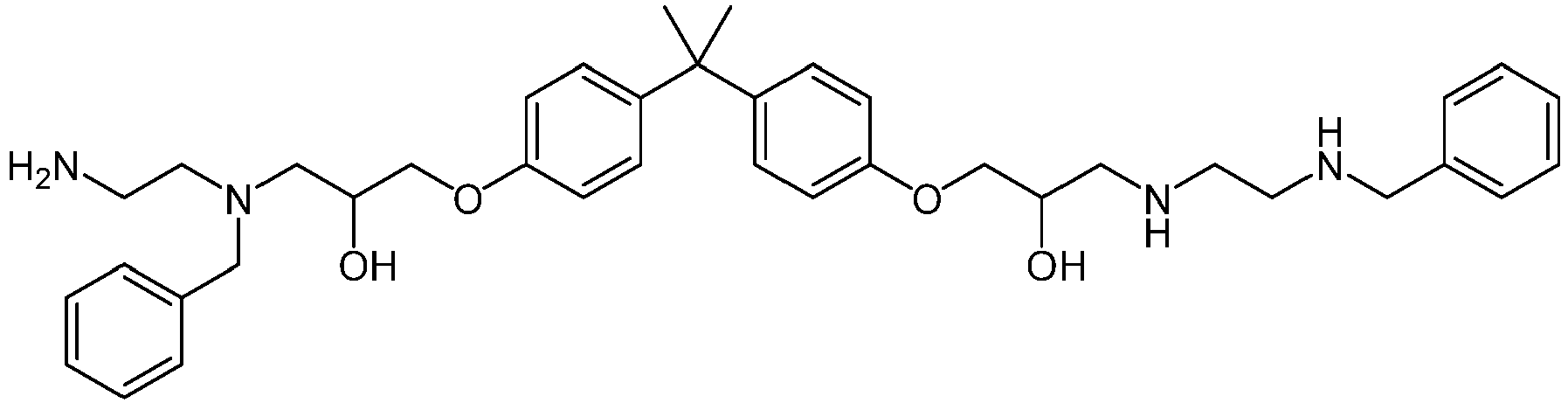
- Das Addukt enthält sogenannte 2:1 Addukte aus der Addition von 2 mol Diamin der Formel (I) oder (II) und 1 mol Diepoxid. Im Fall von N-Benzyl-1,2-ethandiamin als Diamin der Formel (I), N,N'-Dibenzyl-1,2-ethandiamin als Diamin der Formel (II) und Bisphenol A-Diglycidylether enthält das Addukt hauptsächlich das folgende 2:1 Addukt,



- Weiterhin enthält das Addukt höhere Addukte, insbesondere sogenannte 3:2 Addukte aus der Addition von 3 mol Diamin der Formel (I) oder (II) und 2 mol Diepoxid. Im Fall von N-Benzyl-1,2-ethandiamin als Diamin der Formel (I) und Bisphenol A-Diglycidylether hauptsächlich das folgende 3:2 Addukt

- Weiterhin enthält das Addukt weitere höhere Addukte, sogenannte >3:2 Addukte, insbesondere solche aus der Addition von 4 mol Diamin der Formel (I) oder (II) und 3 mol Diepoxid bzw. 5 mol Diamin der Formel (I) oder (II) und 4 mol Diepoxid.
- Bevorzugt enthält das erfindungsgemässe Addukt 2:1 Addukte und höhere Addukte in einem Gewichtsverhältnis im Bereich von 30/70 bis 80/20, bevorzugt 35/65 bis 70/30. Ein solches Addukt ermöglicht eine besonders vorteilhafte Kombination aus niedriger Viskosität und schneller Aushärtung.
- Besonders bevorzugt enthält das erfindungsgemässe Addukt 2:1 Addukte und höhere Addukte in einem Gewichtsverhältnis im Bereich von 30/70 bis 49.9/50.1, insbesondere 35/65 bis 49/51. Ein solches Addukt ist insbesondere hergestellt in einem stöchiometrischen Verhältnis im Bereich von 1.4 bis 1.7 mol Diamin der Formel (I) auf 1 Mol-Equivalent Epoxidgruppen des Diepoxids. Es ermöglicht eine besonders schnelle Aushärtung.
- Bevorzugt enthält das Addukt weniger als 1 Gewichts-% Verdünner oder Wasser.
- Bevorzugt hat das Addukt eine Viskosität bei 20 °C im Bereich von 5 bis 500 Pa s, bevorzugt 10 bis 250 Pa s, insbesondere 20 bis 150 Pa s, gemessen mittels Kegel-Platten Viskosimeter bei einer Schergeschwindigkeit von 10 s-1.
- Das erfindungsgemässe Addukt ist besonders geeignet zum Aushärten eines Epoxidharzes.
- Ein weiterer Gegenstand der Erfindung ist ein Härter für Epoxidharze, umfassend das erfindungsgemässe Addukt und mindestens einen weiteren Bestandteil ausgewählt aus der Gruppe bestehend aus weiteren Aminen, Beschleunigern und Verdünnern.
- Der Härter enthält bevorzugt 1 bis 80 Gewichts-%, bevorzugt 2 bis 60 Gewichts-%, insbesondere 5 bis 50 Gewichts-%, des erfindungsgemässen Addukts.
- Der Härter für Epoxidharze ist bevorzugt nicht wasserbasiert. Er enthält insbesondere weniger als 15 Gewichts-%, bevorzugt weniger als 10 Gewichts-%, Wasser. Ein solcher Härter ist geeignet für nicht-wässrige Epoxidharz-Produkte, insbesondere Bodenbeschichtungen.
- Bevorzugt enthält der Härter mindestens ein weiteres Amin mit aliphatischen Aminogruppen und mindestens drei Aminwasserstoffen. Dieses weitere Amin wird bevorzugt erst nach erfolgter Umsetzung des Amingemisches mit dem Diepoxid zum Addukt zugemischt. Dabei kann es sich bei diesem weiteren Amin um das gleiche Amin handeln wie jenes, welches in der Umsetzung zum Addukt als Diamin der Formel (I) eingesetzt wurde, oder um ein anderes Amin.
- Als weiteres Amin geeignet sind insbesondere N-Benzyl-1,2-ethandiamin, N-Benzyl-1,2-propandiamin, N-Benzyl-bis(aminomethyl)-1,3-benzol, N-(2-Ethylhexyl)-bis(aminomethyl)-1,3-benzol oder N-(2-Phenylethyl)-bis(aminomethyl)-1,3-benzol, sowie weiterhin 2,2-Dimethyl-1,3-propandiamin, 1,3-Pentandiamin (DAMP), 1,5-Pentandiamin, 1,5-Diamino-2-methylpentan (MPMD), 2-Butyl-2-ethyl-1,5-pentandiamin (C11-Neodiamin), 1,6-Hexandiamin, 2,5-Dimethyl-1,6-hexandiamin, 2,2(4),4-Trimethyl-1,6-hexandiamin (TMD), 1,7-Heptandiamin, 1,8-Octandiamin, 1,9-Nonandiamin, 1,10-Decandiamin, 1,11-Undecandiamin, 1,12-Dodecandiamin, 1,2-, 1,3- oder 1,4-Diaminocyclohexan, 1,3-Bis(aminomethyl)cyclohexan, 1,4-Bis(aminomethyl)cyclohexan, Bis(4-aminocyclohexyl)methan, Bis(4-amino-3-methylcyclohexyl)methan, Bis(4-amino-3-ethylcyclohexyl)methan, Bis(4-amino-3,5-dimethylcyclohexyl)methan, Bis(4-amino-3-ethyl-5-methylcyclohexyl)-methan, 1-Amino-3-aminomethyl-3,5,5-trimethylcyclohexan (IPDA), 2(4)-Methyl-1,3-diaminocyclohexan, 2,5(2,6)-Bis(aminomethyl)bicyclo[2.2.1]heptan (NBDA), 3(4),8(9)-Bis(aminomethyl)tricyclo[5.2.1.02,6]decan, 1,4-Diamino-2,2,6-trimethylcyclohexan (TMCDA), 1,8-Menthandiamin, 3,9-Bis(3-aminopropyl)-2,4,8,10-tetraoxaspiro[5.5]undecan, 1,3-Bis(aminomethyl)benzol (MXDA), 1,4-Bis(aminomethyl)benzol, Bis(2-aminoethyl)ether, 3,6-Dioxaoctan-1,8-diamin, 4,7-Dioxadecan-1,10-diamin, 4,7-Dioxadecan-2,9-diamin, 4,9-Dioxadodecan-1,12-diamin, 5,8-Dioxadodecan-3,10-diamin, 4,7,10-Trioxatridecan-1,13-diamin oder höhere Oligomere dieser Diamine, Bis(3-aminopropyl)polytetrahydrofurane oder andere Polytetrahydrofurandiamine, Polyoxyalkylendi- oder -triamine, insbesondere Polyoxypropylendiamine oder Polyoxypropylentriamine wie Jeffamine® D-230, Jeffamine® D-400 oder Jeffamine® T-403 (alle von Huntsman), Diethylentriamin (DETA), Triethylentetramin (TETA), Tetraethylenpentamin (TEPA), Pentaethylenhexamin (PEHA), Dipropylentriamin (DPTA), N-(2-Aminoethyl)-1,3-propandiamin (N3-Amin), N,N'-Bis(3-aminopropyl)ethylendiamin (N4-Amin), N,N'-Bis(3-aminopropyl)-1,4-diaminobutan, N5-(3-Aminopropyl)-2-methyl-1,5-pentandiamin, N3-(3-Aminopentyl)-1,3-pentandiamin, N5-(3-Amino-1-ethylpropyl)-2-methyl-1,5-pentandiamin, N,N'-Bis(3-amino-1-ethylpropyl)-2-methyl-1,5-pentandiamin, 3-(2-Aminoethyl)aminopropylamin, Bis(hexamethylen)triamin (BHMT), N-Aminoethylpiperazin, 3-Dimethylaminopropylamin (DMAPA) oder 3-(3-(Dimethylamino)propylamino)propylamin (DMAPAPA).
- Es kann vorteilhaft sein, wenn der erfindungsgemässe Härter eine Kombination aus zwei oder mehr weiteren Aminen enthält.
- Bevorzugt sind weitere Amine ausgewählt aus der Gruppe bestehend aus N-Benzyl-1,2-ethandiamin, N-Benzyl-1,2-propandiamin, N-Benzyl-bis(aminomethyl)-1,3-benzol, N-(2-Ethylhexyl)-bis(aminomethyl)-1,3-benzol, N-(2-Phenylethyl)-bis-(aminomethyl)-1,3-benzol, TMD, 1,2-Diaminocyclohexan, 1,3-Diaminocyclohexan, 1,4-Diaminocyclohexan, 1,3-Bis(aminomethyl)cyclohexan, 1,4-Bis(aminomethyl)-cyclohexan, Bis(4-aminocyclohexyl)methan, IPDA, 2(4)-Methyl-1,3-diaminocyclohexan, MXDA, Polyoxypropylendiaminen mit einem mittlerem Molekulargewicht Mn im Bereich von 200 bis 500 g/mol, Polyoxypropylentriaminen mit einem mittlerem Molekulargewicht Mn im Bereich von 300 bis 500 g/mol, DMAPAPA, BHMT, DETA, TETA, TEPA, PEHA, DPTA, N3-Amin und N4-Amin.
- Besonders bevorzugt enthält der Härter mindestens ein weiteres Amin ausgewählt aus der Gruppe bestehend aus N-Benzyl-1,2-ethandiamin, TMD, 1,2-Diaminocyclohexan, 1,3-Bis(aminomethyl)cyclohexan, 1,4-Bis(aminomethyl)cyclohexan, IPDA, 2(4)-Methyl-1,3-diaminocyclohexan, MXDA, Polyoxypropylendiaminen mit einem mittlerem Molekulargewicht Mn im Bereich von 200 bis 500 g/mol und Polyoxypropylentriaminen mit einem mittlerem Molekulargewicht Mn im Bereich von 300 bis 500 g/mol.
- Als weiteres Amin besonders bevorzugt ist N-Benzyl-1,2-ethandiamin. Dieses Amin ermöglicht Härter mit besonders guter Verarbeitbarkeit, schneller Aushärtung und wenig Neigung zu Blushing-Effekten.
- Als weiteres Amin besonders bevorzugt ist weiterhin MXDA, gegebenenfalls in Form eines aminfunktionellen Addukts mit einem Epoxidharz. Dieses Amin ermöglicht eine besonders schnelle Aushärtung.
- Als weiteres Amin besonders bevorzugt ist weiterhin IPDA, gegebenenfalls in Form eines aminfunktionellen Addukts mit einem Epoxidharz. Dieses Amin ermöglicht eine besonders hohe Glasübergangstemperatur und Endhärte.
- Geeignete Beschleuniger sind insbesondere Säuren oder zu Säuren hydrolysierbare Verbindungen, insbesondere organische Carbonsäuren wie Essigsäure, Benzoesäure, Salicylsäure, 2-Nitrobenzoesäure, Milchsäure, organische Sulfonsäuren wie Methansulfonsäure, p-Toluolsulfonsäure oder 4-Dodecylbenzolsulfonsäure, Sulfonsäureester, andere organische oder anorganische Säuren wie insbesondere Phosphorsäure, oder Mischungen der vorgenannten Säuren und Säureester; Nitrate wie insbesondere Calciumnitrat; tertiäre Amine wie insbesondere 1,4-Diazabicyclo[2.2.2]octan, Benzyldimethylamin, α-Methylbenzyldimethylamin, Triethanolamin, Dimethylaminopropylamin, Imidazole wie insbesondere N-Methylimidazol, N-Vinylimidazol oder 1,2-Dimethylimidazol, Salze solcher tertiärer Amine, quaternäre Ammoniumsalze, wie insbesondere Benzyltrimethylammoniumchlorid, Amidine wie insbesondere 1,8-Diazabicyclo[5.4.0]-undec-7-en, Guanidine wie insbesondere 1,1,3,3-Tetramethylguanidin, Phenole, insbesondere Bisphenole, Phenol-Harze oder Mannich-Basen wie insbesondere 2-(Dimethylaminomethyl)phenol, 2,4,6-Tris(dimethylaminomethyl)phenol oder Polymere aus Phenol, Formaldehyd und N,N-Dimethyl-1,3-propandiamin, Phosphite wie insbesondere Di- oder Triphenylphosphite, oder Mercaptogruppen aufweisende Verbindungen.
- Bevorzugt sind Säuren, Nitrate, tertiäre Amine oder Mannich-Basen, insbesondere Salicylsäure, Calciumnitrat oder 2,4,6-Tris(dimethylaminomethyl)phenol, oder eine Kombination dieser Beschleuniger.
- Geeignete Verdünner sind insbesondere Xylol, 2-Methoxyethanol, Dimethoxyethanol, 2-Ethoxyethanol, 2-Propoxyethanol, 2-Isopropoxyethanol, 2-Butoxyethanol, 2-Phenoxyethanol, 2-Benzyloxyethanol, Benzylalkohol, Ethylenglykol, Ethylenglykoldimethylether, Ethylenglykoldiethylether, Ethylenglykoldibutylether, Ethylenglykoldiphenylether, Diethylenglykol, Diethylenglykolmonomethylether, Diethylenglykolmonoethylether, Diethylenglykolmono-n-butylether, Diethylenglykoldimethylether, Diethylenglykoldiethylether, Diethylenglykoldi-n-butylylether, Propylenglykolbutylether, Propylenglykolphenylether, Dipropylenglykol, Dipropylenglykolmonomethylether, Dipropylenglykoldimethylether, Dipropylenglykoldi-n-butylether, Diphenylmethan, Diisopropylnaphthalin, Erdölfraktionen wie zum Beispiel Solvesso®-Typen (von Exxon), Alkylphenole wie tert.Butylphenol, Nonylphenol, Dodecylphenol, Cardanol (aus Cashewschalen-Öl, enthaltend als Hauptbestandteil 3-(8,11-Pentadecadienyl)phenol), styrolisiertes Phenol, Bisphenole, aromatische Kohlenwasserstoffharze, insbesondere Phenolgruppen-haltige Typen, alkoxyliertes Phenol, insbesondere ethoxyliertes oder propoxyliertes Phenol, insbesondere 2-Phenoxyethanol, Adipate, Sebacate, Phthalate, Benzoate, organische Phosphor- oder Sulfonsäureester oder Sulfonamide.
- Bevorzugt sind Verdünner mit einem Siedepunkt von mehr als 200 °C.
- Bevorzugt ist der Verdünner ausgewählt aus der Gruppe bestehend aus Benzylalkohol, styrolisiertem Phenol, ethoxyliertem Phenol, phenolgruppenhaltigen aromatischen Kohlenwasserstoffharzen, insbesondere den Novares®-Typen LS 500, LX 200, LA 300 oder LA 700 (von Rütgers), Diisopropylnaphthalin und Cardanol. Besonders bevorzugt ist Benzylalkohol.
- Phenolgruppen-haltige Verdünner zeigen auch eine Wirkung als Beschleuniger.
- Der Härter kann weitere Bestandteile enthalten, insbesondere die Folgenden:
- weitere Addukte, insbesondere Addukte von IPDA, MXDA, DETA, TETA oder TEPA mit Bisphenol A-, F- oder A/F-Diglycidylethern, oder Addukte von MPMD oder 1,2-Ethandiamin oder 1,2-Propandiamin mit Kresylglycidylether, bei welchen nicht umgesetztes MPMD, 1,2-Ethandiamin oder 1,2-Propandiamin nach der Umsetzung destillativ entfernt wurde;
- Monoamine wie insbesondere Benzylamin oder Furfurylamin;
- Polyamidoamine, insbesondere Umsetzungsprodukte aus einer ein- oder mehrwertigen Carbonsäure oder deren Ester oder Anhydrid, insbesondere einer Dimerfettsäure, mit einem im stöchiometrischen Überschuss eingesetzten Polyamin, insbesondere DETA oder TETA;
- Mannich-Basen, insbesondere Phenalkamine, also Umsetzungsprodukte von Phenolen, insbesondere Cardanol, mit Aldehyden, insbesondere Formaldehyd, und Polyaminen;
- aromatische Polyamine wie insbesondere 4,4'-, 2,4' und/oder 2,2'-Diaminodiphenylmethan, 2,4- und/oder 2,6-Toluylendiamin, 3,5-Dimethylthio-2,4- und/oder -2,6-toluylendiamin, 3,5-Diethyl-2,4- und/oder -2,6-toluylendiamin;
- Mercaptogruppen aufweisende Verbindungen, insbesondere flüssige Mercaptan-terminierte Polysulfidpolymere, Mercaptan-terminierte Polyoxyalkylenether, Mercaptan-terminierte Polyoxyalkylen-Derivate, Polyester von Thiocarbonsäuren, 2,4,6-Trimercapto-1,3,5-triazin, Triethylenglykoldimercaptan oder Ethandithiol.
- Ein weiterer Gegenstand der vorliegenden Erfindung ist eine Epoxidharz-Zusammensetzung umfassend
- eine Harz-Komponente enthaltend mindestens ein Epoxidharz und
- eine Härter-Komponente umfassend das erfindungsgemässe Addukt.
- Bevorzugt umfasst die Härter-Komponente den vorgängig beschriebenen Härter.
- Ein geeignetes Epoxidharz wird auf bekannte Art und Weise erhalten, insbesondere aus der Reaktion von Epichlorhydrin mit Polyolen, Polyphenolen oder Aminen.
- Geeignete Epoxidharze sind insbesondere aromatische Epoxidharze, insbesondere die Glycidylether von:
- Bisphenol A, Bisphenol F oder Bisphenol A/F, wobei A für Aceton und F für Formaldehyd steht, welche als Edukte zur Herstellung dieser Bisphenole dienten. Im Fall von Bisphenol F können auch Stellungsisomere vorhanden sein, insbesondere abgeleitet von 2,4'- oder 2,2'-Hydroxyphenylmethan.
- Dihydroxybenzol-Derivaten wie Resorcin, Hydrochinon oder Brenzcatechin;
- weiteren Bisphenolen oder Polyphenolen wie Bis(4-hydroxy-3-methylphenyl)-methan, 2,2-Bis(4-hydroxy-3-methylphenyl)propan (Bisphenol-C), Bis(3,5-dimethyl-4-hydroxyphenyl)methan, 2,2-Bis(3,5-dimethyl-4-hydroxyphenyl)propan, 2,2-Bis(3,5-dibromo-4-hydroxyphenyl)propan, 2,2-Bis(4-hydroxy-3-tert.butylphenyl)propan, 2,2-Bis(4-hydroxyphenyl)butan (Bisphenol-B), 3,3-Bis(4-hydroxyphenyl)pentan, 3,4-Bis(4-hydroxyphenyl)hexan, 4,4-Bis(4-hydroxyphenyl)-heptan, 2,4-Bis(4-hydroxyphenyl)-2-methylbutan, 2,4-Bis(3,5-dimethyl-4-hydroxyphenyl)-2-methylbutan, 1,1-Bis(4-hydroxyphenyl)cyclohexan (Bisphenol-Z), 1,1-Bis(4-hydroxyphenyl)-3,3,5-trimethylcyclohexan (Bisphenol-TMC), 1,1-Bis(4-hydroxyphenyl)-1-phenylethan, 1,4-Bis[2-(4-hydroxyphenyl)-2-propyl]-benzol (Bisphenol-P), 1,3-Bis[2-(4-hydroxyphenyl)-2-propyl]benzol (Bisphenol-M), 4,4'-Dihydroxydiphenyl (DOD), 4,4'-Dihydroxybenzophenon, Bis(2-hydroxy-naphth-1-yl)methan, Bis(4-hydroxynaphth-1-yl)methan, 1,5-Dihydroxynaphthalin, Tris(4-hydroxyphenyl)methan, 1,1,2,2-Tetrakis(4-hydroxyphenyl)ethan, Bis(4-hydroxyphenyl)ether oder Bis(4-hydroxyphenyl)sulfon;
- Novolaken, welche insbesondere Kondensationsprodukte von Phenol oder Kresolen mit Formaldehyd bzw. Paraformaldehyd oder Acetaldehyd oder Crotonaldehyd oder Isobutyraldehyd oder 2-Ethylhexanal oder Benzaldehyd oder Furfural sind;
- aromatischen Aminen, wie Anilin, Toluidin, 4-Aminophenol, 4,4'-Methylendiphenyldiamin, 4,4'-Methylendiphenyldi-(N-methyl)amin, 4,4'-[1,4-Phenylen-bis(1-methylethyliden)]bisanilin (Bisanilin-P) oder 4,4'-[1,3-Phenylen-bis(1-methylethyliden)]bisanilin (Bisanilin-M).
- Weitere geeignete Epoxidharze sind aliphatische oder cycloaliphatische Polyepoxide, insbesondere
- Glycidylether von gesättigten oder ungesättigten, verzweigten oder unverzweigten, zyklischen oder offenkettigen di-, tri- oder tetrafunktionellen C2- bis C30-Alkoholen, insbesondere Ethylenglykol, Propylenglykol, Butylenglykol, Hexandiol, Octandiol, Polypropylenglykolen, Dimethylolcyclohexan, Neopentylglykol, Dibromoneopentylglykol, Rizinusöl, Trimethylolpropan, Trimethylolethan, Pentaerythrol, Sorbit oder Glycerin, oder alkoxyliertes Glycerin oder alkoxyliertes Trimethylolpropan;
- ein hydriertes Bisphenol-A-, -F- oder -A/F-Flüssigharz, beziehungsweise die Glycidylisierungsprodukte von hydriertem Bisphenol-A, -F oder -A/F;
- ein N-Glycidylderivat von Amiden oder heterocyclischen Stickstoffbasen, wie Triglycidylcyanurat oder Triglycidylisocyanurat, oder Umsetzungsprodukte von Epichlorhydrin mit Hydantoin.
- Bevorzugt ist das Epoxidharz ein Flüssigharz oder eine Mischung enthaltend zwei oder mehr Epoxid-Flüssigharze.
- Als "Epoxid-Flüssigharz" wird ein technisches Polyepoxid mit einer Glasübergangstemperatur unterhalb von 25°C bezeichnet.
- Gegebenenfalls enthält die Harz-Komponente zusätzlich Anteile von Epoxid-Festharz.
- Das Epoxidharz ist insbesondere ein Flüssigharz auf der Basis eines Bisphenols, insbesondere ein Bisphenol-A Diglycidylether und/oder Bisphenol-F-Diglycidylether, wie sie kommerziell beispielsweise von Olin, Huntsman oder Momentive erhältlich sind. Diese Flüssigharze weisen eine für Epoxidharze niedrige Viskosität auf und ermöglichen eine schnelle Aushärtung und hohe Härten. Sie können Anteile von Bisphenol A-Festharz oder Novolak-Glycidylethern enthalten.
- Die Harz-Komponente kann einen Reaktivverdünner enthalten.
- Als Reaktivverdünner bevorzugt sind Epoxidgruppen-haltige Reaktivverdünner, insbesondere Butandioldiglycidylether, Hexandioldiglycidylether, Trimethylolpropandi- oder triglycidylether, Phenylglycidylether, Kresylglycidylether, Guaiacolglycidylether, 4-Methoxyphenylglycidylether, p-n-Butylphenylglycidylether, p-tert.Butylphenylglycidylether, 4-Nonylphenylglycidylether, 4-Dodecylphenylglycidylether, Cardanolglycidylether, Benzylglycidylether, Allylglycidylether, Butylglycidylether, Hexylglycidylether, 2-Ethylhexylglycidylether, oder Glycidylether von natürlichen Alkoholen wie insbesondere C8- bis C10- oder C12- bis C14- oder C13-bis C15-Alkylglycidylether.
- Bevorzugt enthält die Epoxidharz-Zusammensetzung mindestens einen weiteren Bestandteil ausgewählt aus der Gruppe bestehend aus Verdünnern, Beschleunigern und Füllstoffen.
- Als Beschleuniger geeignet sind die bereits genannten, insbesondere Salicylsäure, Calciumnitrat oder 2,4,6-Tris(dimethylaminomethyl)phenol oder eine Kombination davon.
- Als Verdünner geeignet sind die bereits genannten, insbesondere solche mit einem Siedepunkt von mehr als 200°C.
- Bevorzugt ist der Verdünner ausgewählt aus der Gruppe bestehend aus Benzylalkohol, styrolisiertem Phenol, ethoxyliertem Phenol, phenolgruppenhaltigen aromatischen Kohlenwasserstoffharzen, insbesondere den Novares®-Typen LS 500, LX 200, LA 300 oder LA 700 (von Rütgers), Diisopropylnaphthalin und Cardanol. Besonders bevorzugt ist Benzylalkohol.
- Geeignete Füllstoffe sind insbesondere gemahlenes oder gefälltes Calciumcarbonat, welches gegebenenfalls mit Fettsäure, insbesondere Stearaten, beschichtet ist, Baryt (Schwerspat), Talk, Quarzmehl, Quarzsand, Siliciumcarbid, Eisenglimmer, Dolomit, Wollastonit, Kaolin, Mica (Kalium-Aluminium-Silikat), Molekularsieb, Aluminiumoxid, Aluminiumhydroxid, Magnesiumhydroxid, Kieselsäure, Zement, Gips, Flugasche, Russ, Graphit, Metall-Pulver wie Aluminium, Kupfer, Eisen, Zink, Silber oder Stahl, PVC-Pulver oder Hohlkugeln.
- Bevorzugt ist Calciumcarbonat, Quarzmehl, Quarzsand oder eine Kombination davon.
- Gegebenenfalls enthält die Epoxidharz-Zusammensetzung weitere Hilfs- und Zusatzstoffe, insbesondere die Folgenden:
- Reaktivverdünner, insbesondere die bereits vorgängig erwähnten, oder epoxidiertes Sojaöl oder Leinöl, Acetoacetatgruppen aufweisende Verbindungen, insbesondere acetoacetylierte Polyole, Butyrolakton, Carbonate, Aldehyde, Isocyanate oder Reaktivgruppen aufweisende Silikone;
- Polymere, insbesondere Polyamide, Polysulfide, Polyvinylformal (PVF), Polyvinylbutyral (PVB), Polyurethane (PUR), Polymere mit Carboxylgruppen, Polyamide, Butadien-Acrylnitril-Copolymere, Styrol-Acrylnitril-Copolymere, Butadien-Styrol-Copolymere, Homo- oder Copolymere von ungesättigten Monomeren, insbesondere aus der Gruppe umfassend Ethylen, Propylen, Butylen, Isobutylen, Isopren, Vinylacetat oder Alkyl(meth)acrylate, insbesondere chlorsulfonierte Polyethylene oder Fluor-haltige Polymere oder Sulfonamid-modifizierte Melamine;
- Fasern, insbesondere Glasfasern, Kohlefasern, Metallfasern, Keramikfasern oder Kunststofffasern wie Polyamidfasern oder Polyethylenfasern;
- Pigmente, insbesondere Titandioxid, Eisenoxide oder Chrom(III)oxid;
- Rheologie-Modifizierer, insbesondere Verdicker oder Antiabsetzmittel;
- Haftverbesserer, insbesondere Organoalkoxysilane;
- flammhemmende Substanzen, insbesondere die bereits genannten Füllstoffe Aluminiumhydroxid oder Magnesiumhydroxid, Antimontrioxid, Antimonpentoxid, Borsäure (B(OH)3), Zinkborat, Zinkphosphat, Melaminborat, Melamincyanurat, Ammoniumpolyphosphat, Melaminphosphat, Melaminpyrophosphat, polybromierte Diphenyloxide oder Diphenylether, Phosphate wie insbesondere Diphenylkresylphosphat, Resorcinol-bis(diphenylphosphat), Resorcinoldiphosphat-Oligomer, Tetraphenylresorcinoldiphosphit, Ethylendiamindiphosphat, Bisphenol-A-bis(diphenylphosphat), Tris(chloroethyl)phosphat, Tris(chloropropyl)-phosphat, Tris(dichloroisopropyl)phosphat, Tris[3-bromo-2,2-bis(bromomethyl)-propyl]phosphat, Tetrabromo-Bisphenol-A, Bis(2,3-dibromopropylether) von Bisphenol A, bromierte Epoxidharze, Ethylen-bis(tetrabromophthalimid), Ethylen-bis(dibromonorbornandicarboximid), 1,2-Bis(tribromophenoxy)ethan, Tris(2,3-dibromopropyl)isocyanurat, Tribromophenol, Hexabromocyclododecan, Bis(hexachlorocyclopentadieno)cyclooctan oder Chlorparaffine; oder
- Additive, insbesondere dispergiertes Paraffinwachs, Filmbildehilfsmittel, Netzmittel, Verlaufmittel, Entschäumer, Entlüfter, Stabilisatoren gegen Oxidation, Wärme, Licht oder UV-Strahlung oder Biozide.
- Bevorzugt enthält die Epoxidharz-Zusammensetzung weitere Hilfs- und Zusatzstoffe, insbesondere Pigmente, Netzmittel, Verlaufsmittel und/oder Entschäumer.
- Bevorzugt enthält die Epoxidharz-Zusammensetzung nur einen geringen Gehalt an Verdünnern. Bevorzugt enthält sie weniger als 20 Gewichts-%, besonders bevorzugt weniger als 15 Gewichts-%, insbesondere weniger als 10 Gewichts-%, Verdünner. Dies ermöglicht emissionsarme oder emissionsfreie Epoxidharz-Produkte.
- Bevorzugt enthält die Epoxidharz-Zusammensetzung nur einen geringen Gehalt an Wasser, bevorzugt weniger als 5 Gewichts-%, insbesondere weniger als 1 Gewichts-%, Wasser.
- In der Epoxidharz-Zusammensetzung liegt das Verhältnis der Anzahl von gegenüber Epoxidgruppen reaktiven Gruppen gegenüber der Anzahl Epoxidgruppen bevorzugt im Bereich von 0.5 bis 1.5, insbesondere 0.7 bis 1.2.
- Die in der Epoxidharz-Zusammensetzung vorhandenen primären und sekundären Aminogruppen und gegebenenfalls vorhandene weitere gegenüber Epoxidgruppen reaktive Gruppen reagieren mit den Epoxidgruppen unter deren Ringöffnung (Additionsreaktion). Als Ergebnis hauptsächlich dieser Reaktion polymerisiert die Zusammensetzung und härtet dadurch aus.
- Die Harz- und die Härter-Komponente der Epoxidharz-Zusammensetzung werden in voneinander getrennten Gebinden gelagert. Weitere Bestandteile der Epoxidharz-Zusammensetzung können als Bestandteil der Harz- oder der Härter-Komponente vorhanden sein, wobei gegenüber Epoxidgruppen reaktive weitere Bestandteile bevorzugt ein Bestandteil der Härter-Komponente sind. Ebenfalls möglich ist, dass weitere Bestandteile als eigene, weitere Komponente vorhanden sind.
- Ein geeignetes Gebinde zum Lagern der Harz- oder der Härter-Komponente ist insbesondere ein Fass, ein Hobbock, ein Beutel, ein Eimer, eine Büchse, eine Kartusche oder eine Tube. Die Komponenten sind lagerfähig, das heisst, dass sie vor ihrer Anwendung während mehreren Monaten bis zu einem Jahr und länger aufbewahrt werden können, ohne dass sie sich in ihren jeweiligen Eigenschaften in einem für ihren Gebrauch relevanten Ausmass verändern. Zur Anwendung der Epoxidharz-Zusammensetzung werden die Komponenten kurz vor oder während der Applikation miteinander vermischt. Das Mischungsverhältnis zwischen der Harz- und der Härter-Komponente wird bevorzugt so gewählt, dass die gegenüber Epoxidgruppen reaktiven Gruppen der Härter-Komponente in einem geeigneten Verhältnis zu den Epoxidgruppen der Harz-Komponente stehen, wie vorgängig beschrieben. In Gewichtsteilen liegt das Mischungsverhältnis zwischen der Harz-Komponente und der Härter-Komponente üblicherweise im Bereich von 1:10 bis 10:1.
- Die Vermischung der Komponenten erfolgt mittels eines geeigneten Verfahrens; sie kann kontinuierlich oder batchweise erfolgen. Falls das Vermischen nicht unmittelbar vor der Applikation erfolgt, muss darauf geachtet werden, dass zwischen dem Vermischen der Komponenten und der Applikation nicht zu viel Zeit vergeht und die Applikation innerhalb der Topfzeit erfolgt. Die Vermischung erfolgt insbesondere bei Umgebungstemperatur, welche typischerweise im Bereich von etwa 5 bis 40°C, bevorzugt bei etwa 10 bis 35°C, liegt.
- Mit dem Vermischen der beiden Komponenten beginnt die Aushärtung durch chemische Reaktion, wie vorgängig beschrieben. Die Aushärtung erfolgt typischerweise bei einer Temperatur im Bereich von 0 bis 150°C. Bevorzugt erfolgt sie bei Umgebungstemperatur und erstreckt sich typischerweise über einige Tage bis Wochen. Die Dauer hängt unter anderem von der Temperatur, der Reaktivität der Bestandteile und deren Stöchiometrie sowie der Gegenwart von Beschleunigern ab.
- Im frisch vermischten Zustand hat die Epoxidharz-Zusammensetzung eine niedrige Viskosität. Bevorzugt liegt die Viskosität 10 Minuten nach dem Vermischen der Harz- und der Härter-Komponente bei 20 °C im Bereich von 300 bis 4'000 mPa·s, bevorzugt 300 bis 3'000 mPa·s, insbesondere 300 bis bis 2'000 mPa·s, gemessen mittels Kegel-Platten Viskosimeter bei einer Schergeschwindigkeit von 10 s-1.
- Die Applikation der Epoxidharz-Zusammensetzung erfolgt auf mindestens ein Substrat, wobei die Folgenden besonders geeignet sind:
- Glas, Glaskeramik, Beton, Mörtel, Zementestrich, Faserzement, Backstein, Ziegel, Gips oder Natursteine wie Granit oder Marmor;
- Reparatur- oder Nivelliermassen auf Basis PCC (Polymer-modifizierter Zementmörtel) oder ECC (Epoxidharz-modifizierter Zementmörtel);
- Metalle oder Legierungen wie Aluminium, Eisen, Stahl, Kupfer, weitere Buntmetalle, inklusive oberflächenveredelte Metalle oder Legierungen wie verzinkte oder verchromte Metalle;
- Asphalt oder Bitumen;
- Leder, Textilien, Papier, Holz, mit Harzen, beispielsweise Phenol-, Melamin- oder Epoxidharzen, gebundene Holzwerkstoffe, Harz-Textil-Verbundwerkstoffe oder weitere sogenannte Polymer-Composites;
- Kunststoffe wie Hart- und Weich-PVC, Polycarbonat, Polystyrol, Polyester, Polyamid, PMMA, ABS, SAN, Epoxidharze, Phenolharze, PUR, POM, TPO, PE, PP, EPM oder EPDM, jeweils unbehandelt oder oberflächenbehandelt, beispielsweise mittels Plasma, Corona oder Flammen;
- Faserverstärkte Kunststoffe, wie Kohlefaser-verstärkte Kunststoffe (CFK), Glasfaser-verstärkte Kunststoffe (GFK) und Sheet Moulding Compounds (SMC);
- Isolierschäume, insbesondere aus EPS, XPS, PUR, PIR, Steinwolle, Glaswolle oder geschäumtem Glas (Foamglas);
- beschichtete oder lackierte Substrate, insbesondere lackierte Fliesen, gestrichener Beton, pulverbeschichtete Metalle oder Legierungen oder lackierte Bleche;
- Beschichtungen, Farben oder Lacke, insbesondere beschichtete Böden, welche mit einer weiteren Bodenbelagsschicht überschichtet werden.
- Die Substrate können bei Bedarf vor dem Applizieren vorbehandelt werden, insbesondere durch physikalische und/oder chemische Reinigungsverfahren oder das Aufbringen eines Aktivators oder eines Primers.
- Aus der Aushärtung der Epoxidharz-Zusammensetzung wird eine ausgehärtete Zusammensetzung erhalten.
- Die Epoxidharz-Zusammensetzung wird bevorzugt verwendet als Beschichtung, Primer, Klebstoff, Dichtstoff, Vergussmasse, Giessharz, Imprägnierharz oder als Matrix für Faserverbundwerkstoffe (Composites) wie insbesondere CFK oder GFK.
- Besonders bevorzugt wird die Epoxidharz-Zusammensetzung als Beschichtung verwendet. Als Beschichtung werden dabei flächig aufgebrachte Beläge aller Art verstanden, insbesondere Bodenbeläge, Anstriche, Lacke, Versiegelungen, Grundierungen, Primer oder Schutzbeschichtungen, insbesondere auch solche für schweren Korrosionsschutz.
- Besonders geeignet ist die Epoxidharz-Zusammensetzung als Bodenbelag oder Bodenbeschichtung für Innenräume wie Büros, Industriehallen, Turnhallen oder Kühlräume, oder im Aussenbereich für Balkone, Terrassen, Parkdecks, Brücken oder Dächer, als Schutzbeschichtung für Beton, Zement, Metalle, Kunststoffe oder Holz, beispielsweise zur Oberflächenversiegelung von Holzkonstruktionen, Fahrzeugen, Ladeflächen, Tanks, Silos, Schächten, Rohrleitungen, Pipelines, Maschinen oder Stahlkonstruktionen, beispielsweise von Schiffen, Piers, Offshore-Plattformen, Schleusentoren, Wasserkraftwerken, Flussbauten, Schwimmbädern, Windkraftanlagen, Brücken, Kaminen, Kranen oder Spundwänden, oder als Voranstrich, Haftanstrich, Korrosionsschutz-Primer oder zur Hydrophobierung von Oberflächen.
- Besonders vorteilhaft wird die Epoxidharz-Zusammensetzung in emissionsarmen Beschichtungen mit Öko-Gütesiegeln, beispielsweise nach Emicode (EC1 Plus), AgBB, DIBt, Der Blaue Engel, AFSSET, RTS (M1) und US Green Building Council (LEED), verwendet.
- Für die Verwendung als Beschichtung weist die Epoxidharz-Zusammensetzung vorteilhaft eine flüssige Konsistenz mit niedriger Viskosität und guten Verlaufseigenschaften auf. Die vermischte Zusammensetzung wird innerhalb der Topfzeit typischerweise flächig als dünner Film mit einer Schichtdicke von etwa 50 µm bis etwa 5 mm auf ein Substrat appliziert, typischerweise bei Umgebungstemperatur. Die Applikation erfolgt insbesondere durch Aufgiessen auf das zu beschichtende Substrat und anschliessendem gleichmässigem Verteilen mit Hilfe beispielsweise eines Rakels oder einer Zahntraufel. Die Applikation kann auch mit einem Pinsel oder Roller oder als Spritzapplikation erfolgen, beispielsweise als Korrosionsschutzbeschichtung auf Stahl. Bei der Aushärtung entstehen typischerweise weitgehend homogene, glänzende und nichtklebrige Filme von hoher Härte, welche eine gute Haftung zu verschiedensten Substraten aufweisen.
- Dabei wird die Epoxidharz-Zusammensetzung insbesondere in einem Verfahren zum Beschichten eingesetzt, umfassend die Schritte
- (i) Vermischen der Komponenten der Epoxidharz-Zusammensetzung,
- (ii) Applizieren der vermischten Zusammensetzung auf ein Substrat innerhalb der Topfzeit,
- Auf die vollständig oder teilweise ausgehärtete Zusammensetzung kann eine weitere Beschichtung appliziert werden, wobei es sich bei dieser weiteren Schicht ebenfalls um eine Epoxidharz-Zusammensetzung handeln kann, aber auch um ein anderes Material, insbesondere um eine Polyurethan- oder Polyharnstoff-Beschichtung.
- Weiterhin besonders bevorzugt wird die Epoxidharz-Zusammensetzung als Klebstoff verwendet. Typischerweise weist die Epoxidharz-Zusammensetzung bei der Verwendung als Klebstoff nach dem Vermischen der Komponenten eine pastöse Konsistenz mit strukturviskosen Eigenschaften auf. Bei der Applikation wird der vermischte Klebstoff innerhalb der Topfzeit auf mindestens eines der zu verklebenden Substrate aufgetragen und die beiden Substrate innerhalb der Offenzeit des Klebstoffs zu einer Verklebung gefügt.
- Der vermischte Klebstoff wird insbesondere mittels Pinsel, Rolle, Spatel, Rakel, Kelle, oder aus einer Tube, Kartusche oder Dosiervorrichtung appliziert bzw. aufgetragen.
- Der Klebstoff ist besonders geeignet für Verwendungen in der Bauindustrie, insbesondere für die Armierung von Bauwerken mittels Stahllamellen oder Lamellen aus Kohlefaser-verstärkten Composite-Kunststoffen (CFK), für Konstruktionen, welche geklebte Beton-Fertigteile enthalten, insbesondere Brücken oder Betontürme für beispielsweise Windkraftanlagen, Schächte, Rohrleitungen oder Tunnels, oder für Konstruktionen, welche geklebte Natursteine, keramische Elemente oder Teile aus Faserzement, Stahl, Gusseisen, Aluminium, Holz oder Polyester enthalten, für die Verankerung von Dübeln oder Stahlstäben in Bohrlöchern, für die Fixierung von beispielsweise Geländern, Brüstungen oder Türrahmen, für Reparaturen wie insbesondere die Verfüllung von Kanten, Löchern oder Fugen bei der Betoninstandsetzung, oder für das Aufkleben von Folien aus Polyvinylchlorid (PVC), flexibilisiertem Polyolefin (Combiflex®) oder haftungsmodifiziertem chlorsulfoniertem Polyethylen (Hypalon®) auf Beton oder Stahl.
- Weitere Einsatzgebiete betreffen das strukturelle Kleben in der Bau- oder Fertigungsindustrie, insbesondere als Klebemörtel, Montageklebstoff, Armierungsklebstoff wie insbesondere für das Verkleben von Lamellen aus CFK oder Stahl auf Beton, Mauerwerk oder Holz, als Element-Klebstoff für beispielsweise Brückenelemente, Sandwichelementklebstoff, Fassadenelementklebstoff, Verstärkungsklebstoff, Karrosserieklebstoff oder Halbschalenklebstoff für Rotorblätter von Windturbinen.
- Ebenfalls geeignet ist ein solcher Epoxidharz-Klebstoff für das Verfüllen von Hohlräumen wie Rissen, Spalten oder Bohrlöchern, wobei der Klebstoff in den Hohlraum gefüllt oder injiziert wird und nach der Aushärtung diesen ausfüllt und die Flanken des Hohlraums kraftschlüssig miteinander verbindet bzw. verklebt.
- Dabei wird die Epoxidharz-Zusammensetzung insbesondere in einem Verfahren zum Verkleben eingesetzt, umfassend die Schritte
- (i) Vermischen der Komponenten der Epoxidharz-Zusammensetzung,
- (ii) Applizieren der vermischten Zusammensetzung innerhalb der Topfzeit,
- entweder auf mindestens eines der zu verklebenden Substrate und Fügen der Substrate zu einer Verklebung innerhalb der Offenzeit,
- oder in einen Hohlraum oder Spalt zwischen mehreren Substraten und gegebenenfalls Einfügen eines Ankers in den Hohlraum oder Spalt innerhalb der Offenzeit,
- Als "Anker" wird dabei insbesondere ein Armierungseisen, ein Gewindestab oder ein Bolzen bezeichnet. Ein solcher wird insbesondere so in einer Mauer, Wand, Decke oder in einem Fundament eingeklebt bzw. verankert, dass ein Teil davon kraftschlüssig verklebt ist und ein Teil davon vorsteht und konstruktiv belastet werden kann.
- Verklebt werden können gleichartige oder verschiedene Substrate.
- Aus der Applikation und Aushärtung der Epoxidharz-Zusammensetzung wird ein Artikel erhalten.
- Ein weiterer Gegenstand der Erfindung ist somit ein Artikel, erhalten aus der Verwendung der Epoxidharz-Zusammensetzung.
- Der Artikel ist bevorzugt ein Bauwerk oder ein Teil davon, insbesondere ein Bauwerk des Hoch- oder Tiefbaus, ein Büro, eine Industriehalle, eine Turnhalle, ein Kühlraum, ein Silo, eine Brücke, ein Dach, ein Treppenhaus, ein Fussboden, ein Balkon, eine Terrasse oder ein Parkdeck, oder ein industrielles Gut oder ein Konsumgut, insbesondere ein Pier, eine Offshore-Plattform, ein Schleusentor, ein Kran, eine Spundwand, eine Rohrleitung oder ein Rotorblatt einer Windkraftanlage, oder ein Transportmittel wie insbesondere ein Automobil, ein Lastkraftwagen, ein Schienenfahrzeug, ein Schiff, ein Flugzeug oder ein Helikopter, oder ein Anbauteil davon.
- Die Epoxidharz-Zusammensetzung zeichnet sich durch vorteilhafte Eigenschaften aus. Sie ist auch mit wenig oder ganz ohne Verdünner formulierbar und dabei überraschend niedrigviskos und sehr gut verarbeitbar und härtet zuverlässig und überraschend schnell aus, insbesondere auch bei feuchtkalten Bedingungen. Dabei entstehen mechanisch hochwertige Beschichtungen mit hoher Oberflächenqualität. Solche Epoxidharz-Produkte sind besonders geeignet als Beschichtungen, insbesondere für Böden.
- Im Folgenden sind Ausführungsbeispiele aufgeführt, welche die beschriebene Erfindung näher erläutern sollen. Selbstverständlich ist die Erfindung nicht auf diese beschriebenen Ausführungsbeispiele beschränkt.
- "AHEW" steht für das Aminwasserstoff-Equivalentgewicht.
- "EEW" steht für das Epoxid-Equivalentgewicht.
- Als "Normklima" ("NK") wird eine Temperatur von 23±1°C und eine relative Luftfeuchtigkeit von 50±5% bezeichnet.
- Die verwendeten Chemikalien waren, sofern nicht anders bezeichnet, von Sigma-Aldrich Chemie GmbH.
- Die Viskosität wurde auf einem thermostatisierten Kegel-Platten-Viskosimeter Rheotec RC30 (Kegeldurchmesser 50 mm, Kegelwinkel 1°, Kegelspitze-PlattenAbstand 0.05 mm, Scherrate 10 s-1) gemessen.
- Die Aminzahl wurde durch Titration bestimmt (mit 0.1N HClO4 in Essigsäure gegen Kristallviolett).
- Flüssigchromatografie (UHPLC) wurde für die quantitative Bestimmung von N-Benzyl-1,2-ethandiamin nach Derivatisierung mit Phenylisocyanat gegen externe Kalibration durchgeführt.
- Gelpermeationschromatografie (GPC) wurde für die Bestimmung der Gewichtsverhältnisse zwischen 2:1-Addukt, 3:2 Addukt und > 3:2 Addukt gegen Polystyrol als Standard durchgeführt.
-
Araldite® GY 250: Bisphenol A-Diglycidylether, EEW 187 g/Eq (von Huntsman) Araldite® DY-E: Monoglycidylether von C12- bis C14-Alkoholen, EEW ca. 290 g/Eq (von Huntsman) B-EDA-mix Amingemisch enthaltend ca. 85 Gewichts-% N-Benzyl-1,2-ethandiamin und ca. 14 Gewichts-% N,N'-Dibenzyl-1,2-ethan-diamin, hergestellt wie nachfolgend beschrieben, AHEW 55 g/Eq B-EDA-pure gereinigtes N-Benzyl-1,2-ethandiamin, hergestellt wie nachfolgend beschrieben, 150.2 g/mol, AHEW 50 g/Eq DB-EDA N, N'-Dibenzyl-1,2-ethandiamin, 240.4 g/mol, AHEW 120.2 g/Eq (von Sigma Aldrich) IPDA 3-Aminomethyl-3,5,5-trimethylcyclohexylamin, AHEW42.6 g/Eq (Vestamin® IPD, von Evonik) - In einem Rundkolben wurden 180.3 g (3 mol) 1,2-Ethandiamin unter Stickstoffatmosphäre bei Raumtemperatur vorgelegt. Unter gutem Rühren wurde langsam eine Lösung aus 106.1 g (1 mol) Benzaldehyd in 1200 ml Isopropanol dazugetropft und 2 Stunden nachgerührt. Die Reaktionsmischung wurde anschliessend bei einem Wasserstoff-Druck von 80 bar, einer Temperatur von 80°C und einem Fluss von 5 ml/min auf einer kontinuierlich arbeitenden Hydrierapparatur mit Pd/C-Festbettkatalysator hydriert. Zur Reaktionskontrolle wurde mittels IR-Spektroskopie überprüft, ob die Iminbande bei ca. 1665 cm-1 verschwunden war. Darauf wurde die hydrierte Lösung am Rotationsverdampfer bei 65 °C eingeengt, wobei unreagiertes 1,2-Ethandiamin, Wasser und Isopropanol entfernt wurden. Die so erhaltene Reaktionsmischung war eine klare, leicht gelbliche Flüssigkeit mit einer Aminzahl von 678 mg KOH/g und einem mittels GC bestimmten Gehalt an N-Benzyl-1,2-ethandiamin von ca. 85 Gewichts-% (Retentionszeit 8.47 - 8.57 min) und N,N'-Dibenzyl-1,2-ethandiamin von ca. 14 Gewichts-% (Retentionszeit 14.27 min). Dies entspricht einem Gewichtsverhältnis zwischen N-Benzyl-1,2-ethandiamin und N,N'-Dibenzyl-1,2-ethandiamin von 86/14.
- 50 g des wie beschrieben hergestellten Amingemisches enthaltend N-Benzyl-1,2-ethandiamin und N,N'-Dibenzyl-1,2-ethandiamin (B-EDA-mix) wurden bei 80°C unter Vakuum destilliert, wobei 31.3 g Destillat (N-Benzyl-1,2-ethandiamin) bei einer Dampftemperatur von 60 bis 65°C und 0.06 mbar aufgefangen wurden. Erhalten wurde eine farblose Flüssigkeit mit einer Viskosität von 8 mPa s bei 20°C, einer Aminzahl von 750 mg KOH/g und einer mittels GC bestimmten Reinheit von > 97%.
- 53.0 g des Amingemisches B-EDA-mix (enthaltend 0.3 mol N-Benzyl-1,2-ethandiamin und 0.03 mol N,N'-Dibenzyl-1,2-ethandiamin), hergestellt wie vorgängig beschrieben, wurden unter Stickstoffatmosphäre vorgelegt und auf 80 °C erwärmt. Unter gutem Rühren wurden langsam 36.8 g (0.2 mol Epoxidgruppen) Araldite® GY 250 zugegeben, wobei die Temperatur der Reaktionsmischung durch Kühlung zwischen 70 und 90 °C gehalten wurde. Die Reaktionsmischung wurde während einer Stunde in diesem Temperaturbereich belassen und anschliessend abgekühlt. Es wurde eine klare, leicht gelbliche Flüssigkeit mit einer Viskosität bei 20 °C von 74 Pa s und einem berechneten AHEW von 117 g/Eq erhalten.
- Das Addukt A1 enthielt gemäss UHPLC 27.8 Gewichts-% N-Benzyl-1,2-ethandiamin und gemäss GPC Addukt-Moleküle im Gewichts-Verhältnis 2:1 Addukte / 3:2 Addukte / > 3:2 Addukte = 46.5 / 27.2 /26.3.
- 45.0 g (0.3 mol) gereinigtes N-Benzyl-1,2-ethandiamin (B-EDA-pure), hergestellt wie vorgängig beschrieben, und 11.3 g (0.05 mol) N,N'-Dibenzyl-1,2-ethandiamin (DB-EDA), wurden unter Stickstoffatmosphäre vorgelegt, vermischt und auf 80 °C erwärmt. Unter gutem Rühren wurden langsam 36.8 g (0.2 mol Epoxidgruppen) Araldite® GY 250 zugegeben, wobei die Temperatur der Reaktionsmischung durch Kühlung zwischen 70 und 90 °C gehalten wurde. Die Reaktionsmischung wurde während einer Stunde in diesem Temperaturbereich belassen und anschliessend abgekühlt. Es wurde eine klare, leicht gelbliche Flüssigkeit mit einer Viskosität bei 20 °C von 47 Pa s und einem berechneten AHEW von 117.3 g/Eq erhalten.
- 45.0 g (0.3 mol) gereinigtes N-Benzyl-1,2-ethandiamin (B-EDA-pure), hergestellt wie vorgängig beschrieben, und 19.3 g (0.08 mol) N,N'-Dibenzyl-1,2-ethandiamin (DB-EDA), wurden unter Stickstoffatmosphäre vorgelegt, vermischt und auf 80 °C erwärmt. Unter gutem Rühren wurden langsam 36.8 g (0.2 mol Epoxidgruppen) Araldite® GY 250 zugegeben, wobei die Temperatur der Reaktionsmischung durch Kühlung zwischen 70 und 90 °C gehalten wurde. Die Reaktionsmischung wurde während einer Stunde in diesem Temperaturbereich belassen und anschliessend abgekühlt. Es wurde eine klare, leicht gelbliche Flüssigkeit mit einer Viskosität bei 20 °C von 19 Pa s und einem berechneten AHEW von 117.5 g/Eq erhalten.
- 45.0 g (0.3 mol) gereinigtes N-Benzyl-1,2-ethandiamin (B-EDA-pure), hergestellt wie vorgängig beschrieben, wurden unter Stickstoffatmosphäre vorgelegt und auf 80 °C erwärmt. Unter gutem Rühren wurden langsam 36.8 g (0.2 mol Epoxidgruppen) Araldite® GY 250 zugegeben, wobei die Temperatur der Reaktionsmischung durch Kühlung zwischen 70 und 90 °C gehalten wurde. Die Reaktionsmischung wurde während einer Stunde in diesem Temperaturbereich belassen und anschliessend abgekühlt. Es wurde eine klare, leicht gelbliche Flüssigkeit mit einer Viskosität bei 20 °C von 262 Pa s und einem berechneten AHEW von 116.3 g/Eq erhalten.
- Das Addukt A4 enthielt gemäss UHPLC 24.2 Gewichts-% N-Benzyl-1,2-ethandiamin und gemäss GPC Addukt-Moleküle im Gewichts-Verhältnis 2:1 Addukte / 3:2 Addukte / > 3:2 Addukte = 42.5 / 27.0 /30.5.
- Für jedes Beispiel wurden die in den Tabellen 1 bis 3 angegebenen Inhaltsstoffe der Harz-Komponente in den angegebenen Mengen (in Gewichtsteilen) mittels eines Zentrifugalmischers (SpeedMixer™ DAC 150, FlackTek Inc.) vermischt und unter Ausschluss von Feuchtigkeit aufbewahrt.
- Ebenso wurden die in den Tabellen 1 bis 3 angegebenen Inhaltsstoffe der Härter-Komponente verarbeitet und aufbewahrt.
- Anschliessend wurden die beiden Komponenten jeder Zusammensetzung mittels des Zentrifugalmischers zu einer homogenen Flüssigkeit verarbeitet und diese unverzüglich folgendermassen geprüft:
10 Minuten nach dem Vermischen wurde die Viskosität bei 20°C gemessen ("Viskosität (10')"). - Die Gelierzeit wurde im Normklima bestimmt, indem die vermischte Zusammensetzung (25 g) mittels eines Spatels von Zeit zu Zeit bewegt wurde, bis sie zu gelieren begann.
- Für die Bestimmung der Shore D-Härte nach DIN 53505 wurden je zwei zylindrische Prüfkörper (Durchmesser 20 mm, Dicke 5 mm) hergestellt. Einer wurde im Normklima gelagert und die Härte nach 1 Tag und nach 2 Tagen gemessen (1d NK) bzw. (2d NK), der andere wurde bei 8°C und 80% relativer Feuchtigkeit gelagert und die Härte nach 1 Tag und nach 2 Tagen im kalten Zustand gemessen (1d 8°/80%) bzw. (2d 8°/80%).
- Ein erster Film wurde in einer Schichtdicke von 500 µm auf eine Glasplatte aufgezogen und dieser im Normklima gelagert bzw. ausgehärtet. An diesem Film wurde die Königshärte (Pendelhärte nach König, gemessen nach DIN EN ISO 1522) nach 1 Tag ("Königshärte (1d NK)"), nach 2 Tagen ("Königshärte (2d NK)"), nach 4 Tagen ("Königshärte (4d NK)"), nach 7 Tagen ("Königshärte (7d NK)") und nach 14 Tagen ("Königshärte (14d NK)") bestimmt. Falls Werte von mehr als 200 s erreicht waren, wurde die Königshärte nicht erneut bestimmt. Nach 14 Tagen wurde der Aspekt des Films beurteilt (in der Tabelle mit "Aspekt (NK)" bezeichnet). Als "schön" wurde ein Film bezeichnet, welcher eine glänzende und nichtklebrige Oberfläche ohne Struktur aufwies. Als "Struktur" wird dabei jegliche Art von Zeichnung oder Muster auf der Oberfläche bezeichnet.
- Ein zweiter Film wurde in einer Schichtdicke von 500 µm auf eine Glasplatte aufgezogen und dieser unmittelbar nach dem Applizieren während 7 Tagen bei 8°C und 80% relativer Feuchtigkeit und anschliessend während 2 Wochen im Normklima gelagert, beziehungsweise ausgehärtet. 24 Stunden nach der Applikation wurde ein Flaschendeckel aus Polypropylen auf den Film aufgesetzt, unter welchem ein feuchter Schwamm platziert war. Nach weiteren 24 Stunden wurden der Schwamm und der Deckel entfernt und an einer neuen Stelle des Films platziert, wo sie nach 24 Stunden wieder entfernt und neu platziert wurden, insgesamt 4 mal. Anschliessend wurde der Aspekt dieses Films beurteilt (in den Tabellen mit "Aspekt (8°/80%)" bezeichnet), auf die gleiche Weise wie für den Aspekt (NK) beschrieben. Dabei wurde jeweils auch die Anzahl und Art der sichtbaren Marken angegeben, die im Film durch den feuchten Schwamm oder den aufgesetzten Deckel entstanden waren. Als "Blushing" wurde die Anzahl weiss verfärbte Flecken angegeben. Als "(1)" wurde ein schwacher, weiss verfärbter Fleck bezeichnet. Als "Ring" wurde angegeben, ob ein ringförmiger Abdruck durch Einsinken des ersten, 24h nach Applikation aufgesetzten Deckels vorhanden war. Ein solcher ringförmiger Abdruck zeigt an, dass die Beschichtung noch nicht begehbar ist. An den so ausgehärteten Filmen wurde wiederum die Königshärte bestimmt, jeweils nach 7 Tagen bei 8°C und 80% relativer Feuchtigkeit ("Königshärte (7d 8°/80%)"), dann nach weiteren 2 Tagen im NK ("Königshärte (+2d NK)") bzw. 7 Tagen im NK ("Königshärte (+7d NK)") bzw. 14d im NK ("Königshärte (+14d NK)"). Falls Werte von mehr als 190 s erreicht waren, wurde die Königshärte nicht erneut bestimmt.
- Als Mass für die Vergilbung wurde weiterhin die Farbveränderung nach Belastung in einem Bewitterungstester bestimmt. Dazu wurde ein weiterer Film in einer Schichtdicke von 500 µm auf eine Glasplatte aufgezogen und dieser im Normklima während 2 Wochen gelagert bzw. ausgehärtet und anschliessend in einem Bewitterungstester des Typs Q-Sun Xenon Xe-1 mit optischem Filter Q-SUN Daylight-Q und einer Xenon Lampe mit einer Lichtstärke von 0.51 W/m2 bei 340 nm bei einer Temperatur von 65°C während 72 Stunden belastet (Q-Sun (72h)). Anschliessend wurde der Farbunterschied ΔE des so belasteten Films im Vergleich zum entsprechenden nicht belasteten Film mittels eines Colorimeters NH310 von Shenzen 3NH Technology Co. LTD, ausgerüstet mit Silicon Photoelectric Diode Detector, Light Source A, Color Space Measurement Interface CIE L*a*b*C*H*, bestimmt. ΔE-Werte bis 5 stehen für eine leichte Vergilbung.
- Die Resultate sind in den Tabellen 1 bis 3 angegeben.
- Die mit "(Ref.)" bezeichneten Beispiele sind Vergleichsbeispiele.
Tabelle 1: Zusammensetzung und Eigenschaften der Beispiele 1 bis 4. Beispiel 1 2 3 4 (Ref.) Harz-Komponente: Araldite® GY 250: 167.2 167.2 167.2 167.2 Araldite® DY-E: 31.8 31.8 31.8 31.8 Härter-Komponente: Addukt A1 117.0 - - - Addukt A2 - 117.3 - - Addukt A3 - - 117.5 - Addukt A4 - - - 116.3 Viskosität (10') [Pa·s] 7.8 7.6 5.4 13.3 Gelierzeit (h:min) 3:15 3:15 3:30 2:50 Shore D (1d NK) 75 74 77 78 (2d NK) 76 79 77 78 Shore D (1d 8°/80%) 72 60 60 73 (2d 8°/80%) 78 78 74 79 Königshärte [s] (1d NK) 174 176 161 182 (2d NK) 203 200 190 207 (7d NK) 209 Aspekt (NK) schön schön schön schön Q-Sun (72h) ΔE 2.9 n.b. n.b. 3.1 Königshärte [s] (7d 8°/80%) 95 88 71 97 (+2d NK) 192 190 185 195 Aspekt (8°/80%) schön schön schön schön Blushing (1) (1) 0 (1) Ring kein kein kein kein "n.b." steht für "nicht bestimmt" Tabelle 2: Zusammensetzung und Eigenschaften der Beispiele 5 bis 8. Beispiel 5 6 7 8 (Ref.) Harz-Komponente: Araldite® GY 250: 167.2 167.2 167.2 167.2 Araldite® DY-E: 31.8 31.8 31.8 31.8 Härter-Komponente: Addukt A1 64.4 - - - Addukt A2 - 64.5 - Addukt A3 - 64.6 Addukt A4 - - - 64.0 B-EDA-pure 22.6 22.6 22.6 22.6 Viskosität (10') [Pa·s] 1.59 1.54 1.38 2.20 Gelierzeit (h:min) 3:30 3:45 4:05 3:25 Shore D (1d NK) 78 78 77 78 (2d NK) 79 80 77 78 Shore D (1d8°/80%) 65 60 60 64 (2d 8°/80%) 78 78 65 77 Königshärte [s] (1d NK) 154 158 147 165 (2d NK) 189 183 185 195 (7d NK) 206 205 203 206 Aspekt (NK) schön schön schön schön Q-Sun (72h) ΔE 3.5 n.b. n.b. 3.6 Königshärte [s] (7d 8°/80%) 87 70 64 98 (+2d NK) 162 172 172 179 (+7d NK) 178 193 186 196 (+14d NK) 193 203 195 201 Aspekt (8°/80%) schön schön schön schön Blushing (1) 0 0 (1) Ring kein kein kein kein "n.b." steht für "nicht bestimmt" Tabelle 3: Zusammensetzung und Eigenschaften der Beispiele 9 bis 12. Beispiel 9 10 11 12 (Ref.) Harz-Komponente: Araldite® GY 250: 167.2 167.2 167.2 167.2 Araldite® DY-E: 31.8 31.8 31.8 31.8 Härter-Komponente: Addukt A1 58.5 - - - Addukt A2 - 58.7 - - Addukt A3 - - 58.8 - Addukt A4 - - - 58.2 IPDA 21.3 21.3 21.3 21.3 Benzylalkohol 20.0 20.0 20.0 20.0 Viskosität (10') [Pa·s] 2.00 1.65 1.57 2.41 Gelierzeit (h:min) 3:25 3:40 4:00 3:15 Shore D (1d NK) 68 74 68 70 (2d NK) 74 76 72 73 Shore D (1d 8°/80%) 39 40 21 41 (2d 8°/80%) 72 72 59 73 Königshärte [s] (1d NK) 55 62 56 57 (2d NK) 102 104 92 104 (7d NK) 162 156 123 164 (14d NK) 168 167 168 174 Aspekt (NK) schön schön schön schön Q-Sun (72h) ΔE 3.5 n.b. n.b. 2.9 Königshärte [s] (7d 8°/80%) 41 34 31 48 (+2d NK) 123 115 108 132 (+7d NK) 161 154 146 155 (+14d NK) 164 174 168 168 Aspekt (8°/80%) schön schön schön schön Blushing (1) (1) (1) (1) Ring kein ja ja kein "n.b." steht für "nicht bestimmt"
Claims (16)
- Aminfunktionelles Addukt aus der Umsetzung von(i) einem Amingemisch enthaltend mindestens ein Diamin der Formel (I) und mindestens ein Diamin der Formel (II) in einem Gewichtsverhältnis im Bereich von 65/35 bis 95/5,
 A für einen Alkylenrest, Cycloalkylenrest oder Arylalkylenrest mit 2 bis 12 C-Atomen steht, undR für einen Alkylrest, Cycloalkylrest oder Arylalkylrest mit 1 bis 12 C-Atomen steht,wobei die beiden Stickstoffatome im Diamin der Formel (I) und (II) jeweils durch mindestens zwei C-Atome voneinander getrennt sind und das Diamin der Formel (I) insgesamt 8 bis 15 C-Atome aufweist,(ii) mit mindestens einem Diepoxidin einem stöchiometrischen Verhältnis von mindestens 1.2 mol Diamin der Formel (I) auf 1 Mol-Equivalent Epoxidgruppen.
 - Addukt gemäss Anspruch 1, dadurch gekennzeichnet, dass das für die Herstellung des Addukts eingesetzte Amingemisch einen Gehalt an Diamin der Formel H2N-A-NH2 von höchstens 5 Gewichts-%, bevorzugt höchstens 3 Gewichts-%, besonders bevorzugt höchstens 2 Gewichts-%, insbesondere höchstens 1 Gewichts-%, enthält.
- Addukt gemäss einem der Ansprüche 1 oder 2, dadurch gekennzeichnet, dass die Reste A und R in den Diaminen der Formeln (I) und (II) für identische Reste stehen.
- Addukt gemäss einem der Ansprüche 1 bis 3, dadurch gekennzeichnet, dass das Diamin der Formel (I) für N-Benzyl-1,2-ethandiamin und das Diamin der Formel (II) für N,N'-Dibenzyl-1,2-ethandiamin steht.
- Addukt gemäss einem der Ansprüche 1 bis 4, dadurch gekennzeichnet, dass das Gewichtsverhältnis zwischen dem Diamin der Formel (I) und dem Diamin der Formel (II) im Bereich von 70/30 bis 95/5, bevorzugt 80/20 bis 90/10, liegt.
- Addukt gemäss einem der Ansprüche 1 bis 5, dadurch gekennzeichnet, dass das Amingemisch ein Reaktionsprodukt aus der reduktiven Alkylierung von mindestens einem Amin der Formel H2N-A-NH2 mit mindestens einem Aldehyd oder Keton und Wasserstoff ist.
- Addukt gemäss einem der Ansprüche 1 bis 6, dadurch gekennzeichnet, dass das Diepoxid ein aromatisches Diepoxid ist.
- Addukt gemäss einem der Ansprüche 1 bis 7, dadurch gekennzeichnet, dass das stöchiometrische Verhältnis im Bereich von 1.3 bis 2, insbesondere 1.4 bis 1.7, mol Diamin der Formel (I) auf 1 Mol-Equivalent Epoxidgruppen des Diepoxids liegt.
- Addukt gemäss Anspruch 8, dadurch gekennzeichnet, dass es 2:1 Addukte und höhere Addukte in einem Gewichtsverhältnis im Bereich von 30/70 bis 80/20 enthält.
- Addukt gemäss einem der Ansprüche 1 bis 9, dadurch gekennzeichnet, dass es weniger als 1 Gewichts-% Verdünner oder Wasser enthält.
- Härter für Epoxidharze umfassend das Addukt gemäss einem der Ansprüche 1 bis 10 und mindestens einen weiteren Bestandteil ausgewählt aus der Gruppe bestehend aus weiteren Aminen, Beschleunigern und Verdünnern.
- Härter für Epoxidharze gemäss Anspruch 11, dadurch gekennzeichnet, dass mindestens ein weiteres Amin mit aliphatischen Aminogruppen und mindestens drei Aminwasserstoffen enthalten ist, welches bei der Herstellung des Adduktes nicht zugegen war.
- Härter für Epoxidharze gemäss einem der Ansprüche 11 bis 12, dadurch gekennzeichnet, dass das weitere Amin ausgewählt ist aus der Gruppe bestehend aus N-Benzyl-1,2-ethandiamin, 2,2(4),4-Trimethyl-1,6-hexandiamin, 1,2-Diaminocyclohexan, 1,3-Bis(aminomethyl)cyclohexan, 1,4-Bis(aminomethyl)-cyclohexan, 1-Amino-3-aminomethyl-3,5,5-trimethylcyclohexan, 2(4)-Methyl-1,3-diaminocyclohexan, 1,3-Bis(aminomethyl)benzol, Polyoxypropylendiaminen mit einem mittlerem Molekulargewicht Mn im Bereich von 200 bis 500 g/mol und Polyoxypropylentriaminen mit einem mittlerem Molekulargewicht Mn im Bereich von 300 bis 500 g/mol enthalten ist.
- Epoxidharz-Zusammensetzung umfassend- eine Harz-Komponente enthaltend mindestens ein Epoxidharz und- eine Härter-Komponente enthaltend das Addukt gemäss einem der Ansprüche 1 bis 9 oder den Härter gemäss einem der Ansprüche 11 bis 13.
- Verwendung der Epoxidharz-Zusammensetzung gemäss Anspruch 14 als Beschichtung, Primer, Klebstoff, Dichtstoff, Vergussmasse, Giessharz, Imprägnierharz oder als Matrix für Faserverbundwerkstoffe.
- Artikel erhalten aus der Verwendung gemäss Anspruch 15.
Applications Claiming Priority (2)
| Application Number | Priority Date | Filing Date | Title |
|---|---|---|---|
| EP20158929 | 2020-02-24 | ||
| PCT/EP2021/054252 WO2021170511A1 (de) | 2020-02-24 | 2021-02-22 | Amin-epoxidharz-addukt |
Publications (3)
| Publication Number | Publication Date |
|---|---|
| EP4110845A1 EP4110845A1 (de) | 2023-01-04 |
| EP4110845C0 EP4110845C0 (de) | 2024-09-04 |
| EP4110845B1 true EP4110845B1 (de) | 2024-09-04 |
Family
ID=69844361
Family Applications (1)
| Application Number | Title | Priority Date | Filing Date |
|---|---|---|---|
| EP21705988.0A Active EP4110845B1 (de) | 2020-02-24 | 2021-02-22 | Amin-epoxidharz-addukt |
Country Status (7)
| Country | Link |
|---|---|
| US (1) | US12516148B2 (de) |
| EP (1) | EP4110845B1 (de) |
| JP (1) | JP7744912B2 (de) |
| CN (1) | CN115003725B (de) |
| ES (1) | ES2991644T3 (de) |
| PL (1) | PL4110845T3 (de) |
| WO (1) | WO2021170511A1 (de) |
Families Citing this family (1)
| Publication number | Priority date | Publication date | Assignee | Title |
|---|---|---|---|---|
| JP2023514488A (ja) * | 2020-02-24 | 2023-04-06 | シーカ テクノロジー アクチェンゲゼルシャフト | アミン-エポキシ樹脂付加生成物 |
Family Cites Families (9)
| Publication number | Priority date | Publication date | Assignee | Title |
|---|---|---|---|---|
| DE3728762A1 (de) * | 1987-08-28 | 1989-03-09 | Basf Lacke & Farben | Bindemittel fuer die kathodische elektrotauchlackierung |
| US8143331B2 (en) | 2007-02-07 | 2012-03-27 | Air Products And Chemicals, Inc. | Alkylated polyalkyleneamines and uses thereof |
| US7993751B2 (en) * | 2007-02-07 | 2011-08-09 | Air Products And Chemicals, Inc. | Alkylated aminopropylated methylene-di-(cyclohexylamine) and uses thereof |
| US8729213B2 (en) | 2011-09-23 | 2014-05-20 | Air Products And Chemicals, Inc. | Benzylated polyamine curing agents |
| RU2674676C2 (ru) | 2014-08-13 | 2018-12-12 | Сикэ Текнолоджи Аг | Амин для низкоэмиссионных композиций эпоксидных смол |
| EP3138863A1 (de) | 2015-09-01 | 2017-03-08 | Sika Technology AG | Emissionsarme epoxidharz-zusammensetzung |
| EP3144334A1 (de) * | 2015-09-17 | 2017-03-22 | Sika Technology AG | Härter für emissionsarme epoxidharz-zusammensetzungen |
| EP3375802A1 (de) * | 2017-03-14 | 2018-09-19 | Sika Technology Ag | Verfahren zur herstellung eines härters für emissionsarme epoxidharz-zusammensetzungen |
| EP3861046B1 (de) * | 2018-10-01 | 2022-06-29 | Sika Technology AG | Beschleuniger für die aushärtung von epoxidharzen mit alkylierten aminen |
-
2021
- 2021-02-22 JP JP2022544282A patent/JP7744912B2/ja active Active
- 2021-02-22 EP EP21705988.0A patent/EP4110845B1/de active Active
- 2021-02-22 US US17/785,553 patent/US12516148B2/en active Active
- 2021-02-22 PL PL21705988.0T patent/PL4110845T3/pl unknown
- 2021-02-22 ES ES21705988T patent/ES2991644T3/es active Active
- 2021-02-22 CN CN202180010437.1A patent/CN115003725B/zh active Active
- 2021-02-22 WO PCT/EP2021/054252 patent/WO2021170511A1/de not_active Ceased
Also Published As
| Publication number | Publication date |
|---|---|
| US20230068858A1 (en) | 2023-03-02 |
| ES2991644T3 (es) | 2024-12-04 |
| EP4110845A1 (de) | 2023-01-04 |
| JP2023515315A (ja) | 2023-04-13 |
| CN115003725A (zh) | 2022-09-02 |
| EP4110845C0 (de) | 2024-09-04 |
| PL4110845T3 (pl) | 2025-01-27 |
| CN115003725B (zh) | 2025-06-27 |
| JP7744912B2 (ja) | 2025-09-26 |
| US12516148B2 (en) | 2026-01-06 |
| WO2021170511A1 (de) | 2021-09-02 |
Similar Documents
| Publication | Publication Date | Title |
|---|---|---|
| EP3861047B1 (de) | Härter für epoxidharze | |
| EP3180383B1 (de) | Amin für emissionsarme epoxidharz-zusammensetzungen | |
| EP3861049B1 (de) | Härter für epoxidharze | |
| EP3861046B1 (de) | Beschleuniger für die aushärtung von epoxidharzen mit alkylierten aminen | |
| EP4110846B1 (de) | Amin-epoxidharz-addukt | |
| EP3144334A1 (de) | Härter für emissionsarme epoxidharz-zusammensetzungen | |
| EP4110847B1 (de) | Härter für epoxidharz-beschichtungen | |
| EP4370578B1 (de) | Beschleuniger für epoxidharze | |
| EP4110845B1 (de) | Amin-epoxidharz-addukt | |
| EP3861048A1 (de) | Härter für epoxidharz-klebstoffe | |
| EP3252091B1 (de) | Tetrahydrofuran-diamin | |
| EP4284853B1 (de) | Addukt von alkyliertem diamin und novolak-epoxidharz | |
| EP3344678A1 (de) | Amin für emissionsarme epoxidharz-zusammensetzungen | |
| EP4370580B1 (de) | Härter für epoxidharze |
Legal Events
| Date | Code | Title | Description |
|---|---|---|---|
| STAA | Information on the status of an ep patent application or granted ep patent |
Free format text: STATUS: UNKNOWN |
|
| STAA | Information on the status of an ep patent application or granted ep patent |
Free format text: STATUS: THE INTERNATIONAL PUBLICATION HAS BEEN MADE |
|
| PUAI | Public reference made under article 153(3) epc to a published international application that has entered the european phase |
Free format text: ORIGINAL CODE: 0009012 |
|
| STAA | Information on the status of an ep patent application or granted ep patent |
Free format text: STATUS: REQUEST FOR EXAMINATION WAS MADE |
|
| 17P | Request for examination filed |
Effective date: 20220926 |
|
| AK | Designated contracting states |
Kind code of ref document: A1 Designated state(s): AL AT BE BG CH CY CZ DE DK EE ES FI FR GB GR HR HU IE IS IT LI LT LU LV MC MK MT NL NO PL PT RO RS SE SI SK SM TR |
|
| DAV | Request for validation of the european patent (deleted) | ||
| DAX | Request for extension of the european patent (deleted) | ||
| GRAP | Despatch of communication of intention to grant a patent |
Free format text: ORIGINAL CODE: EPIDOSNIGR1 |
|
| STAA | Information on the status of an ep patent application or granted ep patent |
Free format text: STATUS: GRANT OF PATENT IS INTENDED |
|
| INTG | Intention to grant announced |
Effective date: 20240507 |
|
| GRAS | Grant fee paid |
Free format text: ORIGINAL CODE: EPIDOSNIGR3 |
|
| GRAA | (expected) grant |
Free format text: ORIGINAL CODE: 0009210 |
|
| STAA | Information on the status of an ep patent application or granted ep patent |
Free format text: STATUS: THE PATENT HAS BEEN GRANTED |
|
| AK | Designated contracting states |
Kind code of ref document: B1 Designated state(s): AL AT BE BG CH CY CZ DE DK EE ES FI FR GB GR HR HU IE IS IT LI LT LU LV MC MK MT NL NO PL PT RO RS SE SI SK SM TR |
|
| REG | Reference to a national code |
Ref country code: GB Ref legal event code: FG4D Free format text: NOT ENGLISH |
|
| REG | Reference to a national code |
Ref country code: CH Ref legal event code: EP |
|
| REG | Reference to a national code |
Ref country code: IE Ref legal event code: FG4D Free format text: LANGUAGE OF EP DOCUMENT: GERMAN |
|
| REG | Reference to a national code |
Ref country code: DE Ref legal event code: R096 Ref document number: 502021005043 Country of ref document: DE |
|
| U01 | Request for unitary effect filed |
Effective date: 20241004 |
|
| U07 | Unitary effect registered |
Designated state(s): AT BE BG DE DK EE FI FR IT LT LU LV MT NL PT RO SE SI Effective date: 20241028 |
|
| REG | Reference to a national code |
Ref country code: ES Ref legal event code: FG2A Ref document number: 2991644 Country of ref document: ES Kind code of ref document: T3 Effective date: 20241204 |
|
| PG25 | Lapsed in a contracting state [announced via postgrant information from national office to epo] |
Ref country code: NO Free format text: LAPSE BECAUSE OF FAILURE TO SUBMIT A TRANSLATION OF THE DESCRIPTION OR TO PAY THE FEE WITHIN THE PRESCRIBED TIME-LIMIT Effective date: 20241204 |
|
| PG25 | Lapsed in a contracting state [announced via postgrant information from national office to epo] |
Ref country code: GR Free format text: LAPSE BECAUSE OF FAILURE TO SUBMIT A TRANSLATION OF THE DESCRIPTION OR TO PAY THE FEE WITHIN THE PRESCRIBED TIME-LIMIT Effective date: 20241205 |
|
| PG25 | Lapsed in a contracting state [announced via postgrant information from national office to epo] |
Ref country code: HR Free format text: LAPSE BECAUSE OF FAILURE TO SUBMIT A TRANSLATION OF THE DESCRIPTION OR TO PAY THE FEE WITHIN THE PRESCRIBED TIME-LIMIT Effective date: 20240904 |
|
| PG25 | Lapsed in a contracting state [announced via postgrant information from national office to epo] |
Ref country code: RS Free format text: LAPSE BECAUSE OF FAILURE TO SUBMIT A TRANSLATION OF THE DESCRIPTION OR TO PAY THE FEE WITHIN THE PRESCRIBED TIME-LIMIT Effective date: 20241204 |
|
| PG25 | Lapsed in a contracting state [announced via postgrant information from national office to epo] |
Ref country code: RS Free format text: LAPSE BECAUSE OF FAILURE TO SUBMIT A TRANSLATION OF THE DESCRIPTION OR TO PAY THE FEE WITHIN THE PRESCRIBED TIME-LIMIT Effective date: 20241204 Ref country code: NO Free format text: LAPSE BECAUSE OF FAILURE TO SUBMIT A TRANSLATION OF THE DESCRIPTION OR TO PAY THE FEE WITHIN THE PRESCRIBED TIME-LIMIT Effective date: 20241204 Ref country code: HR Free format text: LAPSE BECAUSE OF FAILURE TO SUBMIT A TRANSLATION OF THE DESCRIPTION OR TO PAY THE FEE WITHIN THE PRESCRIBED TIME-LIMIT Effective date: 20240904 Ref country code: GR Free format text: LAPSE BECAUSE OF FAILURE TO SUBMIT A TRANSLATION OF THE DESCRIPTION OR TO PAY THE FEE WITHIN THE PRESCRIBED TIME-LIMIT Effective date: 20241205 |
|
| U20 | Renewal fee for the european patent with unitary effect paid |
Year of fee payment: 5 Effective date: 20250228 |
|
| PG25 | Lapsed in a contracting state [announced via postgrant information from national office to epo] |
Ref country code: IS Free format text: LAPSE BECAUSE OF FAILURE TO SUBMIT A TRANSLATION OF THE DESCRIPTION OR TO PAY THE FEE WITHIN THE PRESCRIBED TIME-LIMIT Effective date: 20250104 |
|
| PG25 | Lapsed in a contracting state [announced via postgrant information from national office to epo] |
Ref country code: SM Free format text: LAPSE BECAUSE OF FAILURE TO SUBMIT A TRANSLATION OF THE DESCRIPTION OR TO PAY THE FEE WITHIN THE PRESCRIBED TIME-LIMIT Effective date: 20240904 |
|
| PG25 | Lapsed in a contracting state [announced via postgrant information from national office to epo] |
Ref country code: CZ Free format text: LAPSE BECAUSE OF FAILURE TO SUBMIT A TRANSLATION OF THE DESCRIPTION OR TO PAY THE FEE WITHIN THE PRESCRIBED TIME-LIMIT Effective date: 20240904 |
|
| PG25 | Lapsed in a contracting state [announced via postgrant information from national office to epo] |
Ref country code: SK Free format text: LAPSE BECAUSE OF FAILURE TO SUBMIT A TRANSLATION OF THE DESCRIPTION OR TO PAY THE FEE WITHIN THE PRESCRIBED TIME-LIMIT Effective date: 20240904 |
|
| PLBE | No opposition filed within time limit |
Free format text: ORIGINAL CODE: 0009261 |
|
| STAA | Information on the status of an ep patent application or granted ep patent |
Free format text: STATUS: NO OPPOSITION FILED WITHIN TIME LIMIT |
|
| 26N | No opposition filed |
Effective date: 20250605 |
|
| PG25 | Lapsed in a contracting state [announced via postgrant information from national office to epo] |
Ref country code: MC Free format text: LAPSE BECAUSE OF FAILURE TO SUBMIT A TRANSLATION OF THE DESCRIPTION OR TO PAY THE FEE WITHIN THE PRESCRIBED TIME-LIMIT Effective date: 20240904 |
|
| PG25 | Lapsed in a contracting state [announced via postgrant information from national office to epo] |
Ref country code: IE Free format text: LAPSE BECAUSE OF NON-PAYMENT OF DUE FEES Effective date: 20250222 |
|
| REG | Reference to a national code |
Ref country code: CH Ref legal event code: U11 Free format text: ST27 STATUS EVENT CODE: U-0-0-U10-U11 (AS PROVIDED BY THE NATIONAL OFFICE) Effective date: 20260301 |
|
| U20 | Renewal fee for the european patent with unitary effect paid |
Year of fee payment: 6 Effective date: 20260302 |
|
| PGFP | Annual fee paid to national office [announced via postgrant information from national office to epo] |
Ref country code: GB Payment date: 20260121 Year of fee payment: 6 |
|
| PGFP | Annual fee paid to national office [announced via postgrant information from national office to epo] |
Ref country code: ES Payment date: 20260302 Year of fee payment: 6 |
|
| PGFP | Annual fee paid to national office [announced via postgrant information from national office to epo] |
Ref country code: TR Payment date: 20260126 Year of fee payment: 6 |
|
| PGFP | Annual fee paid to national office [announced via postgrant information from national office to epo] |
Ref country code: CH Payment date: 20260301 Year of fee payment: 6 |
|
| PGFP | Annual fee paid to national office [announced via postgrant information from national office to epo] |
Ref country code: PL Payment date: 20260126 Year of fee payment: 6 |