EP4112063B1 - Procédés et traitement de traumatisme - Google Patents
Procédés et traitement de traumatisme Download PDFInfo
- Publication number
- EP4112063B1 EP4112063B1 EP22191477.3A EP22191477A EP4112063B1 EP 4112063 B1 EP4112063 B1 EP 4112063B1 EP 22191477 A EP22191477 A EP 22191477A EP 4112063 B1 EP4112063 B1 EP 4112063B1
- Authority
- EP
- European Patent Office
- Prior art keywords
- level
- blood
- reduced
- patient
- stored blood
- Prior art date
- Legal status (The legal status is an assumption and is not a legal conclusion. Google has not performed a legal analysis and makes no representation as to the accuracy of the status listed.)
- Active
Links
Images










Classifications
-
- A—HUMAN NECESSITIES
- A61—MEDICAL OR VETERINARY SCIENCE; HYGIENE
- A61K—PREPARATIONS FOR MEDICAL, DENTAL OR TOILETRY PURPOSES
- A61K35/00—Medicinal preparations containing materials or reaction products thereof with undetermined constitution
- A61K35/12—Materials from mammals; Compositions comprising non-specified tissues or cells; Compositions comprising non-embryonic stem cells; Genetically modified cells
- A61K35/14—Blood; Artificial blood
-
- A—HUMAN NECESSITIES
- A61—MEDICAL OR VETERINARY SCIENCE; HYGIENE
- A61P—SPECIFIC THERAPEUTIC ACTIVITY OF CHEMICAL COMPOUNDS OR MEDICINAL PREPARATIONS
- A61P1/00—Drugs for disorders of the alimentary tract or the digestive system
- A61P1/16—Drugs for disorders of the alimentary tract or the digestive system for liver or gallbladder disorders, e.g. hepatoprotective agents, cholagogues, litholytics
-
- A—HUMAN NECESSITIES
- A61—MEDICAL OR VETERINARY SCIENCE; HYGIENE
- A61P—SPECIFIC THERAPEUTIC ACTIVITY OF CHEMICAL COMPOUNDS OR MEDICINAL PREPARATIONS
- A61P11/00—Drugs for disorders of the respiratory system
-
- A—HUMAN NECESSITIES
- A61—MEDICAL OR VETERINARY SCIENCE; HYGIENE
- A61P—SPECIFIC THERAPEUTIC ACTIVITY OF CHEMICAL COMPOUNDS OR MEDICINAL PREPARATIONS
- A61P13/00—Drugs for disorders of the urinary system
- A61P13/12—Drugs for disorders of the urinary system of the kidneys
-
- A—HUMAN NECESSITIES
- A61—MEDICAL OR VETERINARY SCIENCE; HYGIENE
- A61P—SPECIFIC THERAPEUTIC ACTIVITY OF CHEMICAL COMPOUNDS OR MEDICINAL PREPARATIONS
- A61P29/00—Non-central analgesic, antipyretic or antiinflammatory agents, e.g. antirheumatic agents; Non-steroidal antiinflammatory drugs [NSAID]
-
- A—HUMAN NECESSITIES
- A61—MEDICAL OR VETERINARY SCIENCE; HYGIENE
- A61P—SPECIFIC THERAPEUTIC ACTIVITY OF CHEMICAL COMPOUNDS OR MEDICINAL PREPARATIONS
- A61P7/00—Drugs for disorders of the blood or the extracellular fluid
- A61P7/04—Antihaemorrhagics; Procoagulants; Haemostatic agents; Antifibrinolytic agents
-
- A—HUMAN NECESSITIES
- A61—MEDICAL OR VETERINARY SCIENCE; HYGIENE
- A61P—SPECIFIC THERAPEUTIC ACTIVITY OF CHEMICAL COMPOUNDS OR MEDICINAL PREPARATIONS
- A61P9/00—Drugs for disorders of the cardiovascular system
-
- A—HUMAN NECESSITIES
- A61—MEDICAL OR VETERINARY SCIENCE; HYGIENE
- A61P—SPECIFIC THERAPEUTIC ACTIVITY OF CHEMICAL COMPOUNDS OR MEDICINAL PREPARATIONS
- A61P9/00—Drugs for disorders of the cardiovascular system
- A61P9/02—Non-specific cardiovascular stimulants, e.g. drugs for syncope, antihypotensives
-
- A—HUMAN NECESSITIES
- A61—MEDICAL OR VETERINARY SCIENCE; HYGIENE
- A61P—SPECIFIC THERAPEUTIC ACTIVITY OF CHEMICAL COMPOUNDS OR MEDICINAL PREPARATIONS
- A61P9/00—Drugs for disorders of the cardiovascular system
- A61P9/04—Inotropic agents, i.e. stimulants of cardiac contraction; Drugs for heart failure
-
- Y—GENERAL TAGGING OF NEW TECHNOLOGICAL DEVELOPMENTS; GENERAL TAGGING OF CROSS-SECTIONAL TECHNOLOGIES SPANNING OVER SEVERAL SECTIONS OF THE IPC; TECHNICAL SUBJECTS COVERED BY FORMER USPC CROSS-REFERENCE ART COLLECTIONS [XRACs] AND DIGESTS
- Y02—TECHNOLOGIES OR APPLICATIONS FOR MITIGATION OR ADAPTATION AGAINST CLIMATE CHANGE
- Y02A—TECHNOLOGIES FOR ADAPTATION TO CLIMATE CHANGE
- Y02A50/00—TECHNOLOGIES FOR ADAPTATION TO CLIMATE CHANGE in human health protection, e.g. against extreme weather
- Y02A50/30—Against vector-borne diseases, e.g. mosquito-borne, fly-borne, tick-borne or waterborne diseases whose impact is exacerbated by climate change
Definitions
- the present disclosure relates to oxygen reduced stored blood for use in the treatment of trauma and hemorrhagic shock.
- Penetrating wounds e.g., gunshot or stabbing
- blunt trauma e.g., fall or automobile accident
- the resulting shock is a condition of inadequate oxygen supply to tissues from massive hemorrhage causing oxygen debt, anaerobic metabolism and raise of plasma lactate level.
- Failure to reverse shock by restoring circulation and oxygen delivery can result in permanent tissue damage, multiple organ failure and mortality.
- Clinical sequelae of hemorrhagic trauma and shock include mortality from exsanguination within several hours of trauma, as well as after 24 hours from morbidity from trauma and massive transfusion.
- morbidity includes multiple organ failure including lung, kidney, liver from acute traumatic coagulopathy or inflammation, and infection/sepsis from transfusion related immune modulation; both morbidities are heightened by lower quality of transfused blood products as well as higher volume of transfused pRBC.
- Oxidative damage initiates many RBC storage lesions in conventionally stored blood and their downstream consequences; thus, methods to reduce the extent of oxidative stress are required to reduce the RBC storage lesions.
- a number of approaches have been developed aimed at minimizing storage lesions and improving transfusion outcomes. Approaches include additive solutions (for example, U.S. Patent No. 4,769,318 to Hamasaki et al. and U.S. Patent No. 4,880,786 to Sasakawa et al. U.S. Patent No. 6,447,987 to Hess et al. ) , frozen storage ( see U.S. Patent No. 6,413,713 to Serebrennikov Chaplin et al.
- U.S. Patent No. 5,624,794 to Bitensky et al . U.S. Patent No. 6,162,396 to Bitensky et al .
- U.S. Patent No. 5,476,764 to Bitensky are directed to the storage of red blood cells under oxygen-depleted conditions.
- U.S. Patent No. 5,789,151 to Bitensky et al. is directed to blood storage additive solutions.
- OR oxygen reduced
- OCR oxygen and carbon dioxide reduced
- OR and OCR blood in rats provides for surprising improvements in clinical outcomes when transfused to treat hemorrhagic trauma.
- OR or OCR RBCs provide for reduced organ damage relative to conventionally stored blood.
- OR or OCR RBCs provide for reversal of the shock state using smaller pRBC volumes.
- OR or OCR RBCs when transfused to treat hemorrhagic shock more rapidly stabilized hemodynamics compared to conventionally stored pRBC of same storage duration.
- OR and OCR RBCs provide for improved methods for treatment of trauma resulting in exsanguination to reduce mortality and morbidity over conventionally stored blood.
- OR and OCR RBCs provide for reduced organ failure, including reductions in levels of markers of lung and liver damage.
- OR and OCR RBCs further provide reductions in the amounts of blood necessary to restore and stabilize hemodynamic function.
- OR and OCR RBCs can provide for reducing the volume of RBCs required for transfusion therapy when treating hemorrhagic trauma.
- the improved quality of OR and OCR in addition to the previously demonstrated improvements to the ability of stored RBCs to deliver oxygen, also provides for unexpected reductions in organ damage, morbidity, and mortality associated with trauma.
- WO2016/187353 describes methods for the storage of whole blood, and compositions thereof.
- WO2013/006631 describes a system for extended storage of red blood cells and methods of use.
- US2010/311657 describes hemoglobin compositions.
- WO2008/100140 describes the treatment of trauma hemorrhage with short oligopeptides.
- Simti et al, 2017 in Blood Transfusion describes red blood cell storage time and transfusion: current practice, concerns and future perspectives.
- the invention provides Oxygen reduced stored blood for use in a method of treating hemorrhagic trauma in a patient in need thereof, wherein the oxygen reduced stored blood comprises an initial oxygen saturation of 20% or less and is maintained at an oxygen saturation of 20% or less for a storage period, wherein the hemorrhagic trauma patient in need thereof is in hemorrhagic shock prior to administration of the oxygen reduced stored blood, and wherein the hemorrhagic shock is reversed after administration of the oxygen reduced stored blood, wherein the method comprises transfusion therapy.
- a volume of oxygen reduced stored blood required for transfusion therapy when treating the hemorrhagic trauma patient in need thereof may be at least 10% less than a volume of non-oxygen reduced conventionally stored blood required for transfusion therapy when treating a hemorrhagic trauma patient in hemorrhagic shock.
- the volume of oxygen reduced stored blood required for transfusion therapy when treating the hemorrhagic trauma patient in need thereof may be at least 30% less than a volume of non-oxygen reduced conventionally stored blood required for transfusion therapy when treating a hemorrhagic trauma patient in hemorrhagic shock.
- a hemodynamic function of the hemorrhagic trauma patient may be restored or stabilized after the administration.
- the hemorrhagic trauma patient in need thereof may have an elevated lactate level prior to the administration, and wherein the elevated lactate level may be reduced to between 0.5 and 2.5 millimoles per liter (mmol/L) after the administration.
- the hemorrhagic trauma patient in need thereof may have an elevated blood glucose level prior to the administration, and wherein the elevated blood glucose level may be reduced to between 70 and 120 milligrams per deciliter (mg/dL) after the administration.
- a level of an liver enzyme that indicates liver damage or injury in the hemorrhagic trauma patient in need thereof may be between 1.5-fold and 10-fold lower after the administration than in a hemorrhagic trauma patient administered non-oxygen reduced conventionally stored blood, wherein the liver enzyme may be aspartate aminotransferase (AST) or alanine aminotransferase (ALT).
- AST aspartate aminotransferase
- ALT alanine aminotransferase
- the hemorrhagic trauma patient in need thereof may have an elevated level of a marker of kidney function prior to the administration, wherein the marker of kidney function may be selected from the group consisting of urine neutrophil gelatinase-associated lipocalin (u-NGAL), serum creatinine, and blood urea nitrogen (BUN), and wherein the elevated level of a marker of kidney function may be reduced after the administration.
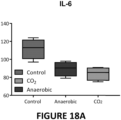
- a level of an inflammatory factor selected from the group consisting of CXC motif chemokine ligand 1 (CXCL1), interleukin-6 (IL-6), and CD45+ neutrophils in the hemorrhagic trauma patient in need thereof may be reduced after the administration.
- the hemorrhagic trauma patient in need thereof may have a pre-existing or underlying condition selected from the group consisting of diabetes, ischemic heart disease, systemic inflammatory syndrome brought on by trauma or infection, multiple organ failure brought on by trauma or infection, smoke inhalation, chronic pulmonary obstructive disease, a coagulopathy disorder, and an autoimmune disease.
- the hemorrhagic trauma patient in need thereof may be a blunt force trauma patient.
- the hemorrhagic trauma patient in need thereof may have a low mean arterial pressure prior to the administration.
- the oxygen reduced stored blood may be oxygen reduced stored whole blood, oxygen reduced leukoreduced stored red blood cells (RBCs), oxygen reduced platelet reduced stored RBCs, or oxygen reduced leukoreduced and platelet reduced stored RBCs.
- the storage period may be up to 42 days.
- the hemorrhagic trauma patient in need thereof may be in need of two or more units of blood as transfusion therapy.
- Methods of the present disclosure provide for, and include, providing a hemorrhagic trauma patient with oxygen reduced stored blood that has an oxygen saturation of 20% or less prior to and during storage. Methods also provide for providing a hemorrhagic trauma patient with oxygen reduced stored blood that has an oxygen saturation of between 15 and 20% prior to and during storage. Methods also provide for providing a hemorrhagic trauma patient with oxygen reduced stored blood that has an oxygen saturation of between 10 and 15% prior to and during storage. Methods also provide for providing a hemorrhagic trauma patient with oxygen reduced stored blood that has an oxygen saturation of between 5 and 10% prior to and during storage. Methods also provide for providing a hemorrhagic trauma patient with oxygen reduced stored blood that has an oxygen saturation of between 3 and 5% prior to and during storage.
- Methods also provide for providing oxygen reduced stored blood that has an oxygen saturation of 20% or less prior to and during storage for transfusion to a person having hemorrhagic shock. Methods also provide for providing oxygen reduced stored blood that has an oxygen saturation of 20% or less prior to and during storage for transfusion to a person having hemorrhagic trauma. Also included are methods comprising transfusing oxygen reduced stored blood that has an oxygen saturation of 20% or less prior to and during storage to a patient having an increased risk of trauma due to surgery. Methods providing oxygen reduced stored blood having an initial oxygen saturation of 20% or less include providing oxygen reduced stored blood having an initial oxygen saturation of 10% or less. Methods of providing oxygen reduced stored blood having an initial oxygen saturation of 20% or less further include providing oxygen reduced stored blood having an initial oxygen saturation of 5% or less. Methods of providing oxygen reduced stored blood having an initial oxygen saturation of 20% or less further include providing oxygen reduced stored blood having an initial oxygen saturation of 3% or less.
- Methods of the present disclosure provide for, and include, providing oxygen reduced stored blood for the treatment of trauma having an oxygen saturation of 20% or less prior to and during storage for a storage period of at least one week, at least two weeks, at least 3 weeks, at least 4 weeks, at least 5 weeks, or at least 6 weeks. Methods also provide for providing oxygen reduced stored blood for the treatment of trauma having an oxygen saturation of 15% or less after a storage period of at least one week, at least two weeks, at least 3 weeks, at least 4 weeks, at least 5 weeks, or at least 6 weeks. Methods also provide for providing oxygen reduced stored blood for the treatment of trauma having an oxygen saturation of 10% or less after a storage period of at least one week, at least two weeks, at least 3 weeks, at least 4 weeks, at least 5 weeks, or at least 6 weeks.
- Methods further provide for providing oxygen reduced stored blood for the treatment of trauma having an oxygen saturation of 5% or less after a storage period of at least one week, at least two weeks, at least 3 weeks, at least 4 weeks, at least 5 weeks, or at least 6 weeks.
- Methods further provide for providing oxygen reduced stored blood for the treatment of trauma having an oxygen saturation of 3% or less after a storage period of at least one week, at least two weeks, at least 3 weeks, at least 4 weeks, at least 5 weeks, or at least 6 weeks.
- Methods also provide for providing oxygen reduced stored blood for the treatment of trauma having an oxygen saturation of between 3 and 5% after a storage period of at least one week, at least two weeks, at least 3 weeks, at least 4 weeks, at least 5 weeks, or at least 6 weeks.
- Methods also provide for providing oxygen reduced stored blood for the treatment of trauma having an oxygen saturation of between 5 and 10% after a storage period of at least one week, at least two weeks, at least 3 weeks, at least 4 weeks, at least 5 weeks, or at least 6 weeks. Methods also provide for providing oxygen reduced stored blood for the treatment of trauma having an oxygen saturation of between 10 and 15% after a storage period of at least one week, at least two weeks, at least 3 weeks, at least 4 weeks, at least 5 weeks, or at least 6 weeks. Methods also provide for providing oxygen reduced stored blood for the treatment of trauma having an oxygen saturation of between 15 and 20% after a storage period of at least one week, at least two weeks, at least 3 weeks, at least 4 weeks, at least 5 weeks, or at least 6 weeks.
- Methods of the present disclosure provide for, and include, providing a trauma patient with oxygen reduced stored blood that has an oxygen saturation of 20% or less prior to and during storage.
- a trauma patient suffers from a head trauma, a penetrating wound, blunt force trauma, injury due to a fall, or injury due to a car accident.
- a trauma patient is a hemorrhagic trauma patient.
- a trauma patient is hemorrhagic due to surgery, a penetrating wound, blunt force trauma, an injury due to a fall, or an injury due to a car accident.
- a trauma patient or hemorrhagic trauma patient is a subject in need of OR and OCR stored blood.
- a trauma patient is a hemorrhagic trauma patient in need of one or more units of blood as transfusion therapy.
- a trauma patient is a hemorrhagic trauma patient in need of two or more units of blood as transfusion therapy.
- a trauma patient is a hemorrhagic trauma patient in need of three or more units of blood as transfusion therapy.
- a trauma patient is a patient in hemorrhagic shock.
- a trauma patient is in hemorrhagic shock due to a head trauma, a penetrating wound, blunt force trauma, injury from a fall, or injury from a car accident.
- a hemorrhagic trauma patient is a patient with a class I hemorrhage.
- a hemorrhagic trauma patient is a patient with a class II hemorrhage.
- a hemorrhagic trauma patient is a patient with a class III hemorrhage.
- a hemorrhagic trauma patient is a patient with a class IV hemorrhage.
- a hemorrhagic trauma patient loses up to 15% of blood volume.
- a hemorrhagic trauma patient loses between 15 and 30% of blood volume.
- a hemorrhagic trauma patient loses between 30 and 40% of blood volume.
- a hemorrhagic trauma patient loses greater than 40% of blood volume.
- the present disclosure provides for, and includes, a patient in need of transfusion therapy with OR or OCR RBCs exhibits one or more signs selected from the group consisting of decreased mean arterial pressure, a decreased hematocrit, increased lactate, increased glucose, increased aspartate aminotransferase (AST), increased alanine aminotransferase (ALT), increased urine neutrophil gelatinase-associated lipocalin (u-NGAL), increased serum creatinine, and increased blood urea nitrogen.
- a patient in need of transfusion therapy with OR or OCR RBCs is a hemorrhagic trauma patient having a decreased mean arterial pressure.
- the present disclosure provides for, and includes, a patient in need of transfusion therapy with OR or OCR RBCs exhibits increased aspartate aminotransferase (AST) and increased alanine aminotransferase (ALT).
- AST aspartate aminotransferase
- ALT alanine aminotransferase
- the present disclosure provides for, and includes, a patient in need of transfusion therapy with OR or OCR RBCs exhibits decreased mean arterial pressure and increased lactate.
- the present disclosure provides for, and includes, a patient in need of transfusion therapy with OR or OCR RBCs exhibits increased aspartate aminotransferase (AST), increased alanine aminotransferase (ALT), and increased blood urea nitrogen.
- the present disclosure provides for, and includes, a patient in need of transfusion therapy with OR or OCR RBCs exhibits increased aspartate aminotransferase (AST), increased alanine aminotransferase (ALT), increased serum creatinine, and increased blood urea nitrogen.
- AST aspartate aminotransferase
- ALT alanine aminotransferase
- ALT serum creatinine
- a nitrogen increased blood urea nitrogen.
- the present disclosure provides for, and includes, a patient in need of transfusion therapy with OR or OCR RBCs exhibits increased lactate and increased glucose.
- the present disclosure provides for, and includes, a patient in need of transfusion therapy with OR or OCR RBCs exhibiting increased urine neutrophil gelatinase-associated lipocalin (u-NGAL), increased serum creatinine, and increased blood urea nitrogen.
- u-NGAL urine neutrophil gelatinase-associated lipocalin
- a patient in need of transfusion therapy with OR or OCR RBCs is a hemorrhagic trauma patient having a decreased hematocrit.
- a patient in need of transfusion therapy with OR or OCR RBCs is a hemorrhagic trauma patient having increased lactate.
- a patient in need of transfusion therapy with OR or OCR RBCs is a hemorrhagic trauma patient having increased glucose.
- a patient in need of transfusion therapy with OR or OCR RBCs is a hemorrhagic trauma patient having increased alanine aminotransferase (ALT).
- a patient in need of transfusion therapy with OR or OCR RBCs is a hemorrhagic trauma patient having increased urine neutrophil gelatinase-associated lipocalin (u-NGAL).
- u-NGAL urine neutrophil gelatinase-associated lipocalin
- a patient in need of transfusion therapy with OR or OCR RBCs is a hemorrhagic trauma patient having increased serum creatinine.
- a patient in need of transfusion therapy with OR or OCR RBCs is a hemorrhagic trauma patient having increased blood urea nitrogen.
- the OR and OCR stored blood for use in transfusion therapy of a trauma patient in need thereof has an initial oxygen saturation of 20% or less.
- OR and OCR stored blood has an initial oxygen saturation of 10% or less.
- OR and OCR stored blood has an initial oxygen saturation of 5% or less.
- OR and OCR stored blood has an initial oxygen saturation of 3% or less.
- the OCR stored blood for use in transfusion therapy of a trauma patient in need thereof has an initial pCO 2 (at 37°C) of between 10 and 40 mmHg.
- OCR stored blood has an initial pCO 2 of between 10 and 30 mmHg.
- OCR stored blood has an initial pCO 2 of between 10 and 20 mmHg.
- OCR stored blood has an initial pCO 2 of between 10 and 15 mmHg.
- OCR stored blood has an initial pCO 2 of less than 10 mmHg.
- OR and OCR stored blood for use in transfusion therapy of a trauma patient in need thereof has an initial oxygen saturation of 20% or less and is stored for less than 2 days.
- OR and OCR stored blood has an initial oxygen saturation of 20% or less is stored for less than 7 days.
- OR and OCR stored blood has an initial oxygen saturation of 20% or less is stored for less than 14 days.
- oxygen reduced stored blood has an initial oxygen saturation of 20% or less is stored for less than 21 days.
- oxygen reduced stored blood for use in transfusion therapy of a trauma patient in need thereof has an initial oxygen saturation of 20% or less is stored for less than 28 days.
- oxygen reduced stored blood has an initial oxygen saturation of 20% or less is stored for less than 35 days.
- oxygen reduced stored blood has an initial oxygen saturation of 20% or less is stored for less than 42 days. In another aspect, oxygen reduced stored blood has an initial oxygen saturation of 20% or less is stored for less than 45 days. In an aspect of the present disclosure, OR and OCR stored blood has an oxygen saturation of 20% or less during storage.
- Suitable blood for use methods according to the present disclosure for use in transfusion therapy of a trauma patient in need thereof comprise oxygen reduced stored blood having an anticoagulant.
- oxygen reduced red blood cells is stored for up to 3 weeks to produce oxygen reduced stored blood.
- oxygen reduced stored blood usually further comprise an additive solution.
- Suitable additive solutions according to the present disclosure include AS-1, AS-3 (Nutricel ® ), AS-5, SAGM, PAGG-SM, PAGG-GM, MAP, AS-7, ESOL-5, EAS61, OFAS1, OFAS3, and combinations thereof.
- the additive solution is added at the time of component separation.
- the additive solution is AS-1.
- the additive solution is AS-3.
- the additive solution is SAGM.
- Methods of the present disclosure provide for, and include, increasing the mean arterial pressure (MAP) in a hemorrhagic trauma patient in need of transfusion therapy comprising providing a trauma patient with oxygen reduced stored blood that has an oxygen saturation of 20% or less prior to and during storage.
- MAP mean arterial pressure
- the mean arterial pressure is increased by between 20 and 60%.
- the mean arterial pressure is increased by between 30 and 60%.
- the mean arterial pressure of a trauma patient receiving transfusion therapy of OR or OCR blood is increased by between 30 and 50%.
- the mean arterial pressure is increased by between 30 and 60%.
- the mean arterial pressure of a trauma patient receiving transfusion therapy of OR or OCR blood is increased by between 30 and 40%.
- the mean arterial pressure is increased by at least 10, 20, 30, 40, 50, 60, 70, 80, or 90% more than the mean arterial pressure of a patient transfused with conventionally stored blood.
- the mean arterial pressure is increased by at least 1.5 fold. In another aspect, the mean arterial pressure of a trauma patient receiving transfusion therapy of OR or OCR blood is increased by at least 2 fold. In a further aspect, the mean arterial pressure is increased by between 1 and 2 fold. In an aspect of the present disclosure, the mean arterial pressure of a trauma patient receiving transfusion therapy of OR or OCR blood is increased by at least 10 mmHg, at least 20 mmHg, at least 30 mmHg, at least 40 mmHg, at least 50 mmHg, or at least 60 mmHg. In another aspect, the mean arterial pressure of a trauma patient receiving transfusion therapy of OR or OCR blood is increased by between 20 and 50 mmHg. In a further aspect, the mean arterial pressure is increased by between 30 and 50 mmHg.
- Methods of the present disclosure provide for, and include, increasing the mean arterial pressure in a trauma patient in need of transfusion therapy to between 70 and 110 mmHg comprising providing a trauma patient with oxygen reduced stored blood that has an oxygen saturation of 20% or less prior to, and during storage.
- the mean arterial pressure of a trauma patient receiving transfusion therapy of OR or OCR blood is increased to at least 70 mmHg.
- the mean arterial pressure of a trauma patient receiving transfusion therapy of OR or OCR blood is increased to at least 80mmHg.
- the mean arterial pressure is increased to at least 90 mmHg.
- the mean arterial pressure is increased to at least 100 mmHg.
- the mean arterial pressure in a subject in need thereof remains between 70 and 110 mmHg for at least 1 hour after transfusion. In another aspect, the mean arterial pressure remains between 70 and 110 mmHg for at least 2 hours after transfusion. In yet another aspect, the mean arterial pressure remains between 70 and 105 mmHg for at least 3 hours after transfusion. In another aspect, the mean arterial pressure remains between 70 and 110 mmHg for at least 4 hours after transfusion. In another aspect, the mean arterial pressure remains between 70 and 110 mmHg for at least 5 hours after transfusion.
- Methods of the present disclosure provide for, and include, increasing the mean arterial pressure in a trauma patient in need of transfusion therapy at a rate faster than the mean arterial pressure of a patient transfused with conventionally stored blood comprising providing a trauma patient with oxygen reduced stored blood that has an oxygen saturation of 20% or less prior to and during storage.
- the mean arterial pressure of a patient transfused with OR or OCR blood is restored to within normal physiologic parameters in half the time when compared to conventionally stored blood.
- Methods of the present disclosure provide for, and include, reducing the amount of stored blood needed for transfusion in a hemorrhagic trauma patient in need of transfusion therapy comprising providing a trauma patient with oxygen reduced stored blood that has an oxygen saturation of 20% or less prior to and during storage.
- the amount of OR stored blood needed for transfusion is between 10 and 90% less than the amount of conventionally stored blood needed.
- the amount of OR stored blood needed for transfusion is between 10 and 30% less than the amount of conventionally stored blood needed.
- the amount of OR stored blood needed for transfusion is between 20 and 50% less than the amount of conventionally stored blood needed.
- the amount of OR stored blood needed for transfusion is between 20 and 80% less than the amount of conventionally stored blood needed.
- the amount of OR stored blood needed for transfusion is between 30 and 80% less than the amount of conventionally stored blood needed. In yet another aspect, the amount of OR stored blood needed for transfusion is between 40 and 85% less than the amount of conventionally stored blood needed. In a further aspect, the amount of OR stored blood needed for transfusion is between 50 and 90% less than the amount of conventionally stored blood needed.
- Methods of the present disclosure provide for, and include, reducing the amount of stored blood needed for transfusion in a hemorrhagic trauma patient in need of transfusion therapy by at least 10% less comprising providing a trauma patient with oxygen reduced stored blood that has an oxygen saturation of 20% or less prior to and during storage.
- the amount of OR stored blood needed for transfusion is at least 20% less than the amount of conventionally stored blood needed.
- the amount of OR stored blood needed for transfusion is at least 30% less than the amount of conventionally stored blood needed.
- the amount of OR stored blood needed for transfusion is at least 40% less than the amount of conventionally stored blood needed.
- the amount of OR stored blood needed for transfusion is at least 50% less than the amount of conventionally stored blood needed.
- the amount of OR stored blood needed for transfusion is at least 60% less than the amount of conventionally stored blood needed. In another aspect, the amount of OR stored blood needed for transfusion is at least 70% less than the amount of conventionally stored blood needed. In a further aspect, the amount of OR stored blood needed for transfusion is between about 10 and 20%, about 20 and 30%, about 30 and 40%, about 40 and 50%, about 50 and 60%, about 60 and 70%, about 70 and 80%, about 80 and 90%, or about 90 and 95% less than the amount of conventionally stored blood needed.
- the amount of OR stored blood needed for transfusion in a trauma patient in need of transfusion therapy is between 10 and 20%, 20 and 30%, 30 and 40%, 40 and 50%, 50 and 60%, 60 and 70%, 70 and 80%, 80 and 90%, or 90 and 95% less than the amount of conventionally stored blood needed.
- Lactate clearance is a biomarker for resuscitation from hemorrhagic shock. See Hashmi et al., "Predictors of mortality in geriatric trauma patients: a systematic review and meta-analysis," The journal of trauma and acute care surgery, 76:894-901 (2014 ); Regnier et al., “Prognostic significance of blood lactate and lactate clearance in trauma patients," Anesthesiology, 117:1276-88 (2012 ); and Zhang et al., “Lactate clearance is a useful biomarker for the prediction of all-cause mortality in critically ill patients: a systematic review and meta-analysis," Critical care medicine, 42:2118-25 (2014 ) ("Zhang 2014").
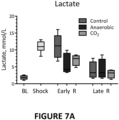
- lactate clearance is useful in predicting the outcome of patients with septic shock and critically ill patients without evident circulatory shock. Elevated lactate is an indicator of adverse clinical outcome, and its rapid clearance is universally associated with improved outcome in heterogeneous ICU or ED patient population. See Zhang 2014. Decreased lactate levels in animals resuscitated with OR-RBCs compared to conventionally RBCs support the notion that resuscitation with OR RBCs can significantly improve patients' clinical outcome. See Figures 7A and 7B .
- Methods of the present disclosure provide for, and include, reducing the lactate level in a trauma patient in need of transfusion therapy comprising providing a trauma patient with oxygen reduced (OR) stored blood that has an oxygen saturation of 20% or less prior to and during storage.
- OR oxygen reduced
- the lactate level is reduced by between 10 and 90%.
- transfusion with OR stored blood reduces the lactate level in a trauma patient in need of transfusion therapy by between 10 and 50%.
- transfusion with OR stored blood reduces the lactate level in a trauma patient in need of transfusion therapy by between 20 and 40%.
- transfusion with OR stored blood reduces the lactate level in a trauma patient in need of transfusion therapy by between 50 and 90%.
- transfusion with OR stored blood reduces the lactate level in a trauma patient in need of transfusion therapy by between 60 and 90%.
- transfusion with OR stored blood reduces the lactate level in a trauma patient in need of transfusion therapy by between 10 and 20%, 20 and 30%, 30 and 40%, 40 and 50%, 50 and 60%, 60 and 70%, 70 and 80%, or 80 and 90%.
- transfusion with OR stored blood reduces the lactate level in a trauma patient in need of transfusion therapy by at least 10%.
- transfusion with OR stored blood reduces the lactate level in a trauma patient in need of transfusion therapy by at least 20%.
- transfusion with OR stored blood reduces the lactate level in a trauma patient in need of transfusion therapy by at least 30, at least 40, at least 50, at least 60, at least 70, at least 80, or at least 90%.
- Methods of the present disclosure provide for, and include, reducing elevated lactate levels in a trauma patient in need of transfusion therapy to between about 0.5 and about 2.5 mmol/L comprising providing a trauma patient with oxygen reduced stored blood that has an oxygen saturation of 20% or less prior to and during storage.
- the lactate level in a trauma patient in need of transfusion therapy is reduced to between about 0.9 and about 2 mmol/L.
- the lactate level in a trauma patient in need of transfusion therapy is reduced to between about 0.9 and about 1.7 mmol/L.
- the lactate level in a patient in need of transfusion therapy is reduced to between about 1.4 and about 2.4 mmol/L.
- the lactate level in a trauma patient in need of transfusion therapy is reduced to between about 1.7 and about 2.5 mmol/L. In yet another aspect, the lactate level in a trauma patient in need of transfusion therapy is reduced to less than about 2.5 mmol/L. In a further aspect, the lactate level in a trauma patient in need of transfusion therapy is reduced to less than about 2.0 mmol/L. In another aspect, the lactate level in a trauma patient in need of transfusion therapy is reduced to less than about 1.5 mmol/L. In another aspect, the lactate level in a trauma patient in need of transfusion therapy is reduced to less than about 1.0 mmol/L. In yet another aspect, the lactate level in a trauma patient in need of transfusion therapy is reduced to between about 0.5 and about 1.0 mmol/L.
- Methods of the present disclosure provide for, and include, reducing elevated lactate levels in a trauma patient in need of transfusion therapy to between 0.5 and 2.5 mmol/L comprising providing a trauma patient with oxygen reduced stored blood that has an oxygen saturation of 20% or less prior to and during storage.
- the lactate level in a patient in need of transfusion therapy is reduced to between 0.9 and 2 mmol/L.
- the lactate level in a trauma patient in need of transfusion therapy is reduced to between 0.9 and 1.7 mmol/L.
- the lactate level in a trauma patient in need of transfusion therapy is reduced to between 1.4 and 2.4 mmol/L.
- the lactate level in a trauma patient in need of transfusion therapy is reduced to between 1.7 and 2.5 mmol/L. In another aspect, the lactate level in a trauma patient in need of transfusion therapy is reduced to between 0.5 and 1 mmol/L.
- Methods of the present disclosure provide for, and include, reducing elevated lactate levels in a hemorrhagic trauma patient in need of transfusion therapy to less than 4 mmol/L comprising providing a trauma patient with oxygen reduced stored blood that has an oxygen saturation of 20% or less prior to and during storage.
- the lactate level in a trauma patient in need of transfusion therapy is reduced to less than 3mmol/L.
- the lactate level in a trauma patient in need of transfusion therapy is reduced to less than 2.5 mmol/L.
- the lactate level in a patient is reduced to less than 2.3 mmol/L.
- the lactate level in a trauma patient in need of transfusion therapy is reduced to less than 2 mmol/L.
- the lactate level in a trauma patient in need of transfusion therapy is reduced to less than 2 mmol/L. In another aspect, the lactate level in a trauma patient in need of transfusion therapy is reduced to less than 1.5 mmol/L. In another aspect, the lactate level in a trauma patient in need of transfusion therapy is reduced to less than 1 mmol/L.
- Blood glucose level is also known to be a predictor for outcome in several disease patterns and particularly in trauma patients. Trauma patients are more prone to poor outcome due to hyperglycemia than other critically ill patients. See Kreutziger et al., "Admission blood glucose predicted hemorrhagic shock in multiple trauma patients," Injury, 46:15-20 (2015 ). Studies evaluating the relationship of early hyperglycemia and trauma patients examined early hyperglycemia at three possible cutoffs: glucose ⁇ 110 mg/dL, glucose ⁇ 150 mg/dL, and glucose ⁇ 200 mg/dL. See Laird et al., "Relationship of early hyperglycemia to mortality in trauma patients," J Trauma, 56:1058-62 (2004 ).
- a glucose level ⁇ 200 mg/dL is associated with significantly higher infection and mortality rates in trauma patients independent of injury characteristics. This was not true at the cutoffs of ⁇ 110 mg/dL or ⁇ 150 mg/dL.
- Decreased glucose levels in animals resuscitated with OR- and OCR-RBCs compared to conventionally RBCs support the notion that resuscitation with OR-RBCs can significantly improve patients' clinical outcome. See Figures 8A and 8B .
- Methods of the present disclosure provide for, and include, reducing glucose in a trauma patient in need of transfusion therapy comprising providing a trauma patient with oxygen reduced (OR) stored blood that has an oxygen saturation of 20% or less prior to and during storage.
- glucose is reduced by between 10 and 90% as compared to transfusion of blood stored under conventional conditions.
- transfusion with OR stored blood reduces glucose by between 10 and 50% as compared to transfusion of blood stored under conventional conditions.
- transfusion with OR stored blood reduces glucose by between 20 and 40% as compared to transfusion of blood stored under conventional conditions.
- transfusion with OR stored blood reduces glucose by between 50 and 90% as compared to transfusion of blood stored under conventional conditions.
- transfusion with OR stored blood reduces glucose by between 60 and 90%.
- transfusion with OR stored blood reduces glucose by between 10 and 20%, 20 and 30%, 30 and 40%, 40 and 50%, 50 and 60%, 60 and 70%, 70 and 80%, or 80 and 90% as compared to transfusion of blood stored under conventional conditions.
- transfusion with OR stored blood reduces glucose by at least 10% as compared to transfusion of blood stored under conventional conditions.
- transfusion with OR stored blood reduces glucose by at least 20%.
- transfusion with OR stored blood reduces glucose by at least 30, at least 40, at least 50, at least 60, at least 70, at least 80, or at least 90%.
- Methods of the present disclosure provide for, and include, reducing glucose levels in a trauma patient in need of transfusion therapy to between about 70 and about 120 mg/dL comprising providing a trauma patient with oxygen reduced stored blood that has an oxygen saturation of 20% or less prior to and during storage.
- glucose in a patient after transfusion therapy with OR or OCR blood is between about 70 and about 110 mg/dL.
- glucose in a patient after transfusion therapy with OR or OCR blood is between about 70 and about 100 mg/dL.
- glucose in a trauma patient after transfusion therapy with OR or OCR blood is between about 90 and about 120 mg/dL.
- glucose in a trauma patient after transfusion therapy with OR or OCR blood is between about 90 and about 100 mg/dL.
- Methods of the present disclosure provide for, and include, reducing glucose levels in a trauma patient in need of transfusion therapy to between 70 and 120 mg/dL comprising providing a trauma patient with oxygen reduced stored blood that has an oxygen saturation of 20% or less prior to and during storage.
- glucose in a patient after transfusion therapy with OR or OCR blood is between 70 and 110 mg/dL.
- glucose in a patient is between 70 and 100 mg/dL.
- glucose in a patient is between 90 and 120 mg/dL.
- glucose in a patient after transfusion therapy with OR or OCR blood is between 90 and 100 mg/dL.
- Methods of the present disclosure provide for, and include, reducing glucose levels in a trauma patient in need of transfusion therapy to less than 120 mg/dL comprising providing a trauma patient with oxygen reduced stored blood that has an oxygen saturation of 20% or less prior to and during storage.
- glucose in a patient after transfusion therapy with OR or OCR blood is less than 110 mmol/L.
- glucose in a patient after transfusion therapy with OR or OCR blood is less than 100 mg/dL.
- glucose in a patient after transfusion therapy with OR or OCR blood is less than 200 mg/dL.
- glucose in a patient after transfusion therapy with OR or OCR blood is less than 90 mg/dL.
- glucose in a patient after transfusion therapy with OR or OCR blood is less than 80 mg/dL.
- a trauma patient is at increased risk of complications from transfusion therapies based on a pre-existing or underlying condition.
- a trauma patient has a pre-existing or underlying condition selected from the group consisting of a diabetes, ischemic heart disease, systemic inflammatory syndrome brought on by trauma or infection, multiple organ failure brought on by trauma or infection, smoke inhalation, chronic pulmonary obstructive disease such as systemic inflammation due to infection, a coagulopathy disorder, and autoimmune diseases.
- a trauma patient has one or more pre-existing or underlying conditions selected from the group consisting of a diabetes, ischemic heart disease, systemic inflammatory syndrome brought on by trauma or infection, multiple organ failure brought on by trauma or infection, smoke inhalation, and chronic pulmonary obstructive disease such as systemic inflammation due to infection, a coagulopathy disorder, and autoimmune diseases.
- a trauma patient has two or more pre-existing or underlying conditions selected from the group consisting of a diabetes, ischemic heart disease, systemic inflammatory syndrome brought on by trauma or infection, multiple organ failure brought on by trauma or infection, smoke inhalation, chronic pulmonary obstructive disease such as systemic inflammation due to infection, a coagulopathy disorder, and autoimmune diseases.
- a trauma patient has three or more pre-existing or underlying conditions selected from the group consisting of a diabetes, ischemic heart disease, systemic inflammatory syndrome brought on by trauma or infection, multiple organ failure brought on by trauma or infection, smoke inhalation, chronic pulmonary obstructive disease such as systemic inflammation due to infection, a coagulopathy disorder, and autoimmune diseases.
- the present disclosure provides for, and includes, a patient in need of transfusion therapy with OR or OCR RBCs exhibits one or more adverse event selected from the group consisting of liver damage or failure, kidney damage or failure, or lung damage or failure.
- the present disclosure provides for, and includes, a patient in need of transfusion therapy with OR or OCR RBCs exhibits two or more adverse event selected from the group consisting of liver damage or failure, kidney damage or failure, or lung damage or failure.
- Methods of the present disclosure provide for, and include, reducing an adverse event in a trauma patient comprising providing a trauma patient in need of transfusion therapy with oxygen reduced stored blood that has an oxygen saturation of 20% or less prior to and during storage.
- the adverse event after transfusion therapy with OR or OCR blood is reduced by at least 5%.
- the adverse event after transfusion therapy with OR or OCR blood is reduced by at least 10%.
- the adverse event after transfusion therapy with OR or OCR blood is reduced by at least 20%.
- the adverse event after transfusion therapy with OR or OCR blood is reduced by at least 30%.
- the adverse event after transfusion therapy with OR or OCR blood is reduced by at least 40%.
- the adverse event after transfusion therapy with OR or OCR blood is reduced by at least 50%. In another aspect, the adverse event after transfusion therapy with OR or OCR blood is reduced by at least 60%. In another aspect, the adverse event is reduced by at least 70%. In another aspect, the adverse event after transfusion therapy with OR or OCR blood is reduced by at least 80%. In another aspect, the adverse event is reduced by at least 90%. In a further aspect, the adverse event after transfusion therapy with OR or OCR blood is reduced by between 1 and 10%, 10 and 20%, 20 and 30%, 30 and 40%, 40 and 50%, 50 and 60%, 60 and 70%, 70 and 80%, 80 and 90%, or 90 and 95%. In an aspect, the adverse event after transfusion therapy with OR or OCR blood is liver injury or damage. In another aspect, the adverse event is lung injury or damage. In yet another aspect, the adverse event is kidney injury or damage. In a further aspect, an adverse event is liver injury, lung injury, kidney injury, or a combination thereof.
- Elevated levels of liver enzymes including but not limited to aspartate aminotransferase (AST) and alanine aminotransferase (ALT), signify some form of liver damage, shock, or injury.
- Methods of the present disclosure provide for, and include, reducing elevated levels of liver enzymes in a trauma patient comprising providing a trauma patient with oxygen reduced stored blood that has an oxygen saturation of 20% or less prior to and during storage.
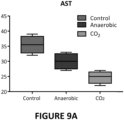
- Methods of the present disclosure provide for, and include, reducing AST levels in a trauma patient in need of transfusion therapy comprising providing a trauma patient with oxygen reduced stored blood that has an oxygen saturation of 20% or less prior to and during storage.
- the AST level is reduced by at least 5% relative to the AST level of a patient transfused with conventionally stored blood.
- the AST level is reduced by at least 10% relative to the AST level of a patient transfused with conventionally stored blood.
- the AST level is reduced by at least 20% relative to the AST level of a patient transfused with conventionally stored blood.
- the AST level is reduced by at least 30% relative to the AST level of a patient transfused with conventionally stored blood.
- the AST level is reduced by at least 40%. In another aspect, the AST level is reduced by at least 50% relative to the AST level of a patient transfused with conventionally stored blood. In another aspect, the AST level is reduced by at least 60%. In another aspect, the AST level is reduced by at least 70% relative to the AST level of a patient transfused with conventionally stored blood. In yet another aspect, the AST level is reduced by at least 80%. In a further aspect, the AST level is reduced by at least 90% relative to the AST level of a patient transfused with conventionally stored blood.
- the AST level is reduced by between 1 and 10%, 10 and 20%, 20 and 30%, 30 and 40%, 40 and 50%, 50 and 60%, 60 and 70%, 70 and 80%, 80 and 90%, or 90 and 95% relative to the AST level of a patient transfused with conventionally stored blood.
- Methods of the present disclosure provide for, and include, reducing AST levels in a trauma patient in need of transfusion therapy by between 1.5 and 10 fold comprising providing a trauma patient with oxygen reduced stored blood that has an oxygen saturation of 20% or less prior to and during storage.
- the AST level is reduced by between 2 and 3 fold relative to the AST level of a patient transfused with conventionally stored blood.
- the AST level is reduced by between 3 and 4 fold.
- the AST level is reduced by between 4 and 10 fold.
- the AST level is reduced by between 6 and 9 fold relative to the AST level of a patient transfused with conventionally stored blood.
- the AST level is reduced by between 2 and 5 fold.
- the AST level is reduced by between 10 and 50 fold relative to the AST level of a patient transfused with conventionally stored blood.
- Methods of the present disclosure provide for, and include, reducing AST levels in a trauma patient in need of transfusion therapy by at least 1.5 fold comprising providing a trauma patient with oxygen reduced stored blood that has an oxygen saturation of 20% or less prior to and during storage.
- the AST level is reduced by at least 2 fold relative to the AST level of a patient transfused with conventionally stored blood.
- the AST level is reduced by at least 3 fold relative to the AST level of a patient transfused with conventionally stored blood.
- the AST level is reduced by at least 4 fold relative to the AST level of a patient transfused with conventionally stored blood.
- the AST level is reduced by at least 5 fold relative to the AST level of a patient transfused with conventionally stored blood. In a further aspect, the AST level is reduced by at least 6 fold. In another aspect, the AST level is reduced by at least 7 fold relative to the AST level of a patient transfused with conventionally stored blood. In another aspect, the AST level is reduced by at least 8 fold. In another aspect, the AST level is reduced by at least 9 fold relative to the AST level of a patient transfused with conventionally stored blood. In another aspect, the AST level is reduced by at least 10 fold relative to the AST level of a patient transfused with conventionally stored blood. In a further aspect, the AST level is reduced by at least 50 fold relative to the AST level of a patient transfused with conventionally stored blood.
- Methods of the present disclosure provide for, and include, reducing ALT levels in a trauma patient in need of transfusion therapy comprising providing a trauma patient with oxygen reduced stored blood that has an oxygen saturation of 20% or less prior to and during storage.
- the ALT level is reduced by at least 5% relative to the ALT level of a patient transfused with conventionally stored blood.
- the ALT level is reduced by at least 10% relative to the ALT level of a patient transfused with conventionally stored blood.
- the ALT level is reduced by at least 20% relative to the ALT level of a patient transfused with conventionally stored blood.
- the ALT level is reduced by at least 30% relative to the ALT level of a patient transfused with conventionally stored blood.
- the ALT level is reduced by at least 40% relative to the AS ALT T level of a patient transfused with conventionally stored blood. In another aspect, the ALT level is reduced by at least 50% relative to the ALT level of a patient transfused with conventionally stored blood. In another aspect, the ALT level is reduced by at least 60% relative to the ALT level of a patient transfused with conventionally stored blood. In another aspect, the ALT level is reduced by at least 70% relative to the ALT level of a patient transfused with conventionally stored blood. In yet another aspect, the ALT level is reduced by at least 80% relative to the ALT level of a patient transfused with conventionally stored blood. In a further aspect, the ALT level is reduced by at least 90%.
- the ALT level is reduced by between 1 and 10%, 10 and 20%, 20 and 30%, 30 and 40%, 40 and 50%, 50 and 60%, 60 and 70%, 70 and 80%, 80 and 90%, or 90 and 95% relative to the ALT level of a patient transfused with conventionally stored blood.
- Methods of the present disclosure provide for, and include, reducing ALT levels in a trauma patient in need of transfusion therapy by between 1.5 and 10 fold comprising providing a trauma patient with oxygen reduced stored blood that has an oxygen saturation of 20% or less prior to and during storage.
- the ALT level is reduced by between 2 and 3 fold relative to the ALT level of a patient transfused with conventionally stored blood.
- the ALT level is reduced by between 3 and 4 fold relative to the ALT level of a patient transfused with conventionally stored blood.
- the ALT level is reduced by between 4 and 10 fold relative to the ALT level of a patient transfused with conventionally stored blood.
- the ALT level is reduced by between 6 and 9 fold relative to the ALT level of a patient transfused with conventionally stored blood. In a further aspect, the ALT level is reduced by between 2 and 5 fold. In another aspect, the ALT level is reduced by between 10 and 50 fold relative to the ALT level of a patient transfused with conventionally stored blood.
- Methods of the present disclosure provide for, and include, reducing ALT levels in a trauma patient in need of transfusion therapy by at least 1.5 fold comprising providing a trauma patient with oxygen reduced stored blood that has an oxygen saturation of 20% or less prior to and during storage.
- the ALT level is reduced by at least 2 fold relative to the ALT level of a patient transfused with conventionally stored blood.
- the ALT level is reduced by at least 3 fold relative to the ALT level of a patient transfused with conventionally stored blood.
- the ALT level is reduced by at least 4 fold relative to the ALT level of a patient transfused with conventionally stored blood.
- the ALT level is reduced by at least 5 fold relative to the ALT level of a patient transfused with conventionally stored blood. In a further aspect, the ALT level is reduced by at least 6 fold relative to the ALT level of a patient transfused with conventionally stored blood. In another aspect, the ALT level is reduced by at least 7 fold relative to the ALT level of a patient transfused with conventionally stored blood. In another aspect, the ALT level is reduced by at least 8 fold relative to the ALT level of a patient transfused with conventionally stored blood. In another aspect, the ALT level is reduced by at least 9 fold relative to the ALT level of a patient transfused with conventionally stored blood.
- the ALT level is reduced by at least 10 fold relative to the ALT level of a patient transfused with conventionally stored blood. In a further aspect, the ALT level is reduced by at least 50 fold relative to the ALT level of a patient transfused with conventionally stored blood.
- Markers of kidney function during and after hemorrhagic trauma include urine neutrophil gelatinase-associated lipocalin (u-NGAL), serum creatinine, and blood urea nitrogen (BUN).
- u-NGAL urine neutrophil gelatinase-associated lipocalin
- BUN blood urea nitrogen
- BUN BUN Decreased levels of BUN are also a concern and can point to fluid excess, trauma, surgery, opioids, malnutrition, and anabolic steroid use. See Pagana, “Mosby's Manual of Diagnostic and Laboratory Tests,” St. Louis Mosby, Inc., (1998 ); and Gowda, et al., “Markers of renal function tests,” N Am J Med Sci. 2(4): 170-173(2010 ).
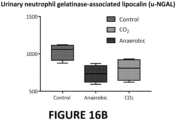
- Methods of the present disclosure provide for, and include, reducing urinary neutrophil gelatinase-associated lipocalin (u-NGAL) levels in a trauma patient in need of transfusion therapy comprising providing a trauma patient with oxygen reduced stored blood that has an oxygen saturation of 20% or less prior to and during storage.
- u-NGAL urinary neutrophil gelatinase-associated lipocalin
- the u-NGAL level is reduced by at least 5% relative to the u-NGAL level of a patient transfused with conventionally stored blood.
- the u-NGAL level is reduced by at least 10% relative to the u-NGAL level of a patient transfused with conventionally stored blood.
- the u-NGAL level is reduced by at least 20% relative to the u-NGAL level of a patient transfused with conventionally stored blood.
- the u-NGAL level is reduced by at least 30%. In another aspect, the u-NGAL level is reduced by at least 40% relative to the u-NGAL level of a patient transfused with conventionally stored blood. In another aspect, the u-NGAL level is reduced by at least 50% relative to the u-NGAL level of a patient transfused with conventionally stored blood. In another aspect, the u-NGAL level is reduced by at least 60% relative to the u-NGAL level of a patient transfused with conventionally stored blood. In another aspect, the u-NGAL level is reduced by at least 70% relative to the u-NGAL level of a patient transfused with conventionally stored blood.
- the u-NGAL level is reduced by at least 80% relative to the u-NGAL level of a patient transfused with conventionally stored blood. In a further aspect, the u-NGAL level is reduced by at least 90% relative to the u-NGAL level of a patient transfused with conventionally stored blood. In a further aspect, the u-NGAL level is reduced by between 1 and 10%, 10 and 20%, 20 and 30%, 30 and 40%, 40 and 50%, 50 and 60%, 60 and 70%, 70 and 80%, 80 and 90%, or 90 and 95% relative to the u-NGAL level of a patient transfused with conventionally stored blood.
- Methods of the present disclosure provide for, and include, reducing urinary neutrophil gelatinase-associated lipocalin (u-NGAL) levels in a trauma patient in need of transfusion therapy comprising providing a trauma patient by between 1.5 and 10 fold with oxygen reduced stored blood that has an oxygen saturation of 20% or less prior to and during storage.
- u-NGAL level is reduced by between 2 and 3 fold relative to the u-NGAL level of a patient transfused with conventionally stored blood.
- the u-NGAL level is reduced by between 3 and 4 fold relative to the u-NGAL level of a patient transfused with conventionally stored blood.
- the u-NGAL level is reduced by between 4 and 10 folds.
- the u-NGAL level is reduced by between 6 and 9 fold relative to the u-NGAL level of a patient transfused with conventionally stored blood. In a further aspect, the u-NGAL level is reduced by between 2 and 5 fold relative to the u-NGAL level of a patient transfused with conventionally stored blood. In another aspect, the u-NGAL level is reduced by between 10 and 50 fold relative to the u-NGAL level of a patient transfused with conventionally stored blood.
- Methods of the present disclosure provide for, and include, reducing urinary neutrophil gelatinase-associated lipocalin (u-NGAL) levels in a trauma patient in need of transfusion therapy comprising providing a trauma patient by at least 1.5 fold with oxygen reduced stored blood that has an oxygen saturation of 20% or less prior to and during storage.
- u-NGAL urinary neutrophil gelatinase-associated lipocalin
- the u-NGAL level is reduced by at least 2 fold relative to the u-NGAL level of a patient transfused with conventionally stored blood.
- the u-NGAL level is reduced by at least 3 fold relative to the u-NGAL level of a patient transfused with conventionally stored blood.
- the u-NGAL level is reduced by at least 4 fold relative to the u-NGAL level of a patient transfused with conventionally stored blood. In another aspect, the u-NGAL level is reduced by at least 5 fold relative to the u-NGAL level of a patient transfused with conventionally stored blood. In a further aspect, the u-NGAL level is reduced by at least 6 fold relative to the u-NGAL level of a patient transfused with conventionally stored blood. In another aspect, the u-NGAL level is reduced by at least 7 fold relative to the u-NGAL level of a patient transfused with conventionally stored blood.
- the u-NGAL level is reduced by at least 8 fold relative to the u-NGAL level of a patient transfused with conventionally stored blood. In another aspect, the u-NGAL level is reduced by at least 9 fold. In another aspect, the u-NGAL level is reduced by at least 10 fold. In a further aspect, the u-NGAL level is reduced by at least 50 fold.
- Methods of the present disclosure provide for, and include, reducing serum creatinine levels in a trauma patient in need of transfusion therapy comprising providing a trauma patient with oxygen reduced stored blood that has an oxygen saturation of 20% or less prior to and during storage.
- the serum creatinine level is reduced by at least 5% relative to the serum creatinine level of a patient transfused with conventionally stored blood.
- the serum creatinine level is reduced by at least 10% relative to the serum creatinine level of a patient transfused with conventionally stored blood.
- the serum creatinine level is reduced by at least 20% relative to the serum creatinine level of a patient transfused with conventionally stored blood.
- the serum creatinine level is reduced by at least 30% relative to the serum creatinine level of a patient transfused with conventionally stored blood. In another aspect, the serum creatinine level is reduced by at least 40% relative to the serum creatinine level of a patient transfused with conventionally stored blood. In another aspect, the serum creatinine level is reduced by at least 50% relative to the serum creatinine level of a patient transfused with conventionally stored blood. In another aspect, the serum creatinine level is reduced by at least 60% relative to the serum creatinine level of a patient transfused with conventionally stored blood. In another aspect, the serum creatinine level is reduced by at least 70% relative to the serum creatinine level of a patient transfused with conventionally stored blood.
- the serum creatinine level is reduced by at least 80% relative to the serum creatinine level of a patient transfused with conventionally stored blood. In a further aspect, the serum creatinine level is reduced by at least 90% relative to the serum creatinine level of a patient transfused with conventionally stored blood. In a further aspect, the serum creatinine level is reduced by between 1 and 10%, 10 and 20%, 20 and 30%, 30 and 40%, 40 and 50%, 50 and 60%, 60 and 70%, 70 and 80%, 80 and 90%, or 90 and 95% relative to the serum creatinine level of a patient transfused with conventionally stored blood.
- Methods of the present disclosure provide for, and include, reducing serum creatinine levels in a trauma patient in need of transfusion therapy by between 1.5 and 10 fold comprising providing a trauma patient with oxygen reduced stored blood that has an oxygen saturation of 20% or less prior to and during storage.
- the serum creatinine level is reduced by between 2 and 3 fold relative to the serum creatinine level of a patient transfused with conventionally stored blood.
- the serum creatinine level is reduced by between 3 and 4 fold relative to the serum creatinine level of a patient transfused with conventionally stored blood.
- the serum creatinine level is reduced by between 4 and 10 fold relative to the serum creatinine level of a patient transfused with conventionally stored blood.
- the serum creatinine level is reduced by between 6 and 9 fold relative to the serum creatinine level of a patient transfused with conventionally stored blood. In a further aspect, the serum creatinine level is reduced by between 2 and 5 fold relative to the serum creatinine level of a patient transfused with conventionally stored blood. In another aspect, the serum creatinine level is reduced by between 10 and 50 fold relative to the serum creatinine level of a patient transfused with conventionally stored blood.
- Methods of the present disclosure provide for, and include, reducing serum creatinine levels in a trauma patient in need of transfusion therapy by at least 1.5 fold comprising providing a trauma patient with oxygen reduced stored blood that has an oxygen saturation of 20% or less prior to and during storage.
- the serum creatinine level is reduced by at least 2 fold relative to the serum creatinine level of a patient transfused with conventionally stored blood.
- the serum creatinine level is reduced by at least 3 fold relative to the AST level of a patient transfused with conventionally stored blood.
- the serum creatinine level is reduced by at least 4 fold relative to the serum creatinine level of a patient transfused with conventionally stored blood.
- the serum creatinine level is reduced by at least 5 fold.
- the serum creatinine level is reduced by at least 6 fold relative to the serum creatinine level of a patient transfused with conventionally stored blood. In another aspect, the serum creatinine level is reduced by at least 7 fold relative to the serum creatinine level of a patient transfused with conventionally stored blood. In another aspect, the serum creatinine level is reduced by at least 8 fold relative to the serum creatinine level of a patient transfused with conventionally stored blood. In another aspect, the serum creatinine level is reduced by at least 9 fold relative to the serum creatinine level of a patient transfused with conventionally stored blood. In another aspect, the serum creatinine level is reduced by at least 10 fold relative to the serum creatinine level of a patient transfused with conventionally stored blood.
- Methods of the present disclosure provide for, and include, reducing serum creatinine levels in a trauma patient in need of transfusion therapy to between 0.5 and 1.5 mg/dL comprising providing a trauma patient with oxygen reduced stored blood that has an oxygen saturation of 20% or less prior to and during storage.
- the serum creatinine level is reduced to between 0.5 and 1 mg/dL relative to the serum creatinine level of a patient transfused with conventionally stored blood.
- the serum creatinine level is reduced to between 0.8 and 1 mg/dL relative to the serum creatinine level of a patient transfused with conventionally stored blood.
- the serum creatinine level is reduced to between 0.7 and 1.5 mg/dL relative to the serum creatinine level of a patient transfused with conventionally stored blood.
- Methods of the present disclosure provide for, and include, reducing serum creatinine levels in a trauma patient in need of transfusion therapy to less than 1.5 mg/dL comprising providing a trauma patient with oxygen reduced stored blood that has an oxygen saturation of 20% or less prior to and during storage.
- the serum creatinine level is reduced to less than 1.4 mg/dL relative to the serum creatinine level of a patient transfused with conventionally stored blood.
- the serum creatinine level is reduced to less than 1 mg/dL.
- the serum creatinine level is reduced to less than 0.8 mg/dL relative to the serum creatinine level of a patient transfused with conventionally stored blood.
- Methods of the present disclosure provide for, and include, reducing BUN levels in a trauma patient comprising providing a trauma patient in need of transfusion therapy with oxygen reduced stored blood that has an oxygen saturation of 20% or less prior to and during storage.
- the BUN level is reduced by at least 5% relative to the BUN level of a patient transfused with conventionally stored blood.
- the BUN level is reduced by at least 10% relative to the BUN level of a patient transfused with conventionally stored blood.
- the BUN level is reduced by at least 20% relative to the BUN level of a patient transfused with conventionally stored blood.
- the BUN level is reduced by at least 30% relative to the BUN level of a patient transfused with conventionally stored blood.
- the BUN level is reduced by at least 40% relative to the BUN level of a patient transfused with conventionally stored blood. In another aspect, the BUN level is reduced by at least 50% relative to the BUN level of a patient transfused with conventionally stored blood. In another aspect, the BUN level is reduced by at least 60% relative to the BUN level of a patient transfused with conventionally stored blood. In another aspect, the BUN level is reduced by at least 70% relative to the BUN level of a patient transfused with conventionally stored blood. In yet another aspect, the BUN level is reduced by at least 80% relative to the BUN level of a patient transfused with conventionally stored blood.
- the BUN level is reduced by at least 90% relative to the BUN level of a patient transfused with conventionally stored blood. In a further aspect, the BUN level is reduced by between 1 and 10%, 10 and 20%, 20 and 30%, 30 and 40%, 40 and 50%, 50 and 60%, 60 and 70%, 70 and 80%, 80 and 90%, or 90 and 95% relative to the BUN level of a patient transfused with conventionally stored blood.
- Methods of the present disclosure provide for, and include, reducing BUN levels in a trauma patient by between 1.5 and 10 fold comprising providing a trauma patient with oxygen reduced stored blood that has an oxygen saturation of 20% or less prior to and during storage.
- the BUN level is reduced by between 2 and 3 fold relative to the BUN level of a patient transfused with conventionally stored blood.
- the BUN level is reduced by between 3 and 4 folds.
- the BUN level is reduced by between 4 and 10 fold relative to the BUN level of a patient transfused with conventionally stored blood.
- the BUN level is reduced by between 6 and 9 fold relative to the BUN level of a patient transfused with conventionally stored blood.
- the BUN level is reduced by between 2 and 5 fold relative to the BUN level of a patient transfused with conventionally stored blood. In another aspect, the BUN level is reduced by between 10 and 100 fold relative to the BUN level of a patient transfused with conventionally stored blood.
- Methods of the present disclosure provide for, and include, reducing BUN levels in a trauma patient by at least 1.5 fold comprising providing a trauma patient in need of transfusion therapy with oxygen reduced stored blood that has an oxygen saturation of 20% or less prior to and during storage.
- the BUN level is reduced by at least 2 fold relative to the BUN level of a patient transfused with conventionally stored blood.
- the BUN level is reduced by at least 3 fold relative to the BUN level of a patient transfused with conventionally stored blood.
- the BUN level is reduced by at least 4 fold relative to the BUN level of a patient transfused with conventionally stored blood.
- the BUN level is reduced by at least 5 fold relative to the BUN level of a patient transfused with conventionally stored blood. In a further aspect, the BUN level is reduced by at least 6 fold. In another aspect, the BUN level is reduced by at least 7 fold relative to the BUN level of a patient transfused with conventionally stored blood. In another aspect, the BUN level is reduced by at least 8 fold relative to the BUN level of a patient transfused with conventionally stored blood. In another aspect, the BUN level is reduced by at least 9 fold relative to the BUN level of a patient transfused with conventionally stored blood. In another aspect, the BUN level is reduced by at least 10 fold relative to the BUN level of a patient transfused with conventionally stored blood.
- Methods of the present disclosure provide for, and include, reducing the percentage of CD45+ neutrophils in a trauma patient comprising providing a trauma patient with oxygen reduced stored blood that has an oxygen saturation of 20% or less prior to and during storage.
- the percentage of CD45+ neutrophils is reduced by at least 5% relative to the CD45+ neutrophil level of a patient transfused with conventionally stored blood.
- the percentage of CD45+ neutrophils is reduced by at least 10% relative to the CD45+ neutrophil level of a patient transfused with conventionally stored blood.
- the percentage of CD45+ neutrophils is reduced by at least 20% relative to the CD45+ neutrophil level of a patient transfused with conventionally stored blood.
- the percentage of CD45+ neutrophils is reduced by at least 30% relative to the CD45+ neutrophil level of a patient transfused with conventionally stored blood. In another aspect, the percentage of CD45+ neutrophils is reduced by at least 40% relative to the CD45+ neutrophil level of a patient transfused with conventionally stored blood. In another aspect, the percentage of CD45+ neutrophils is reduced by at least 50% relative to the CD45+ neutrophil level of a patient transfused with conventionally stored blood. In another aspect, the percentage of CD45+ neutrophils is reduced by at least 60% relative to the CD45+ neutrophil level of a patient transfused with conventionally stored blood.
- the percentage of CD45+ neutrophils is reduced by at least 70% relative to the CD45+ neutrophil level of a patient transfused with conventionally stored blood. In yet another aspect, the percentage of CD45+ neutrophils is reduced by at least 80% relative to the CD45+ neutrophil level of a patient transfused with conventionally stored blood. In a further aspect, the percentage of CD45+ neutrophils is reduced by at least 90% relative to the CD45+ neutrophil level of a patient transfused with conventionally stored blood.
- the percentage of CD45+ neutrophils is reduced by between 1 and 10%, 10 and 20%, 20 and 30%, 30 and 40%, 40 and 50%, 50 and 60%, 60 and 70%, 70 and 80%, 80 and 90%, or 90 and 95% relative to the CD45+ neutrophil level of a patient transfused with conventionally stored blood.
- Methods of the present disclosure provide for, and include, reducing the percentage of CD45+ neutrophils in a trauma patient in need of transfusion therapy by between 1.5 and 10 fold comprising providing a trauma patient with oxygen reduced stored blood that has an oxygen saturation of 20% or less prior to and during storage.
- the percentage of CD45+ neutrophils is reduced by between 2 and 3 fold relative to the CD45+ neutrophil level of a patient transfused with conventionally stored blood.
- the percentage of CD45+ neutrophils is reduced by between 3 and 4 fold relative to the CD45+ neutrophil level of a patient transfused with conventionally stored blood.
- the percentage of CD45+ neutrophils is reduced by between 4 and 10 fold relative to the CD45+ neutrophil level of a patient transfused with conventionally stored blood. In another aspect, the percentage of CD45+ neutrophils is reduced by between 6 and 9 fold relative to the CD45+ neutrophil level of a patient transfused with conventionally stored blood. In a further aspect, the percentage of CD45+ neutrophils is reduced by between 2 and 5 fold relative to the CD45+ neutrophil level of a patient transfused with conventionally stored blood. In another aspect, the percentage of CD45+ neutrophils is reduced by between 10 and 50 fold relative to the CD45+ neutrophil level of a patient transfused with conventionally stored blood.
- Methods of the present disclosure provide for, and include, reducing the percentage of CD45+ neutrophils in a trauma patient in need of transfusion therapy by at least 1.5 fold comprising providing a trauma patient with oxygen reduced stored blood that has an oxygen saturation of 20% or less prior to and during storage.
- the percentage of CD45+ neutrophils is reduced by at least 2 fold relative to the CD45+ neutrophil level of a patient transfused with conventionally stored blood.
- the percentage of CD45+ neutrophils is reduced by at least 3 fold relative to the CD45+ neutrophil level of a patient transfused with conventionally stored blood.
- the percentage of CD45+ neutrophils is reduced by at least 4 fold relative to the CD45+ neutrophil level of a patient transfused with conventionally stored blood.
- the percentage of CD45+ neutrophils is reduced by at least 5 fold relative to the CD45+ neutrophil level of a patient transfused with conventionally stored blood. In a further aspect, the percentage of CD45+ neutrophils is reduced by at least 6 fold relative to the CD45+ neutrophil level of a patient transfused with conventionally stored blood. In another aspect, the percentage of CD45+ neutrophils is reduced by at least 7 fold relative to the CD45+ neutrophil level of a patient transfused with conventionally stored blood. In another aspect, the percentage of CD45+ neutrophils is reduced by at least 8 fold relative to the CD45+ neutrophil level of a patient transfused with conventionally stored blood.
- the percentage of CD45+ neutrophils is reduced by at least 9 fold relative to the CD45+ neutrophil level of a patient transfused with conventionally stored blood. In another aspect, the percentage of CD45+ neutrophils is reduced by at least 10 fold relative to the CD45+ neutrophil level of a patient transfused with conventionally stored blood.
- Methods of the present disclosure provide for, and include, reducing the CXCL1 levels in a trauma patient in need of transfusion therapy comprising providing a trauma patient with oxygen reduced stored blood that has an oxygen saturation of 20% or less prior to and during storage.
- the CXCL1 level is reduced by at least 5% relative to the CXCL1 level of a patient transfused with conventionally stored blood.
- the CXCL1 level is reduced by at least 10% relative to the CXCL1 level of a patient transfused with conventionally stored blood.
- the CXCL1 level is reduced by at least 20% relative to the CXCL1 level of a patient transfused with conventionally stored blood.
- the CXCL1 level is reduced by at least 30% relative to the CXCL1 level of a patient transfused with conventionally stored blood. In another aspect, the CXCL1 level is reduced by at least 40% relative to the CXCL1 level of a patient transfused with conventionally stored blood. In another aspect, the CXCL1 level is reduced by at least 50% relative to the CXCL1 level of a patient transfused with conventionally stored blood. In another aspect, the CXCL1 level is reduced by at least 60% relative to the CXCL1 level of a patient transfused with conventionally stored blood. In another aspect, the CXCL1 level is reduced by at least 70% relative to the CXCL1 level of a patient transfused with conventionally stored blood.
- the CXCL1 level is reduced by at least 80% relative to the CXCL1 level of a patient transfused with conventionally stored blood. In a further aspect, the CXCL1 level is reduced by at least 90% relative to the CXCL1 level of a patient transfused with conventionally stored blood. In a further aspect, the CXCL1 level is reduced by between 1 and 10%, 10 and 20%, 20 and 30%, 30 and 40%, 40 and 50%, 50 and 60%, 60 and 70%, 70 and 80%, 80 and 90%, or 90 and 95% relative to the CXCL1 level of a patient transfused with conventionally stored blood
- Methods of the present disclosure provide for, and include, reducing the CXCL1 levels in a trauma patient by between 1.5 and 10 fold comprising providing a trauma patient with oxygen reduced stored blood that has an oxygen saturation of 20% or less prior to and during storage.
- the CXCL1 level is reduced by between 2 and 3 fold relative to the CXCL1 level of a patient transfused with conventionally stored blood.
- the CXCL1 level is reduced by between 3 and 4 fold relative to the CXCL1 level of a patient transfused with conventionally stored blood.
- the CXCL1 level is reduced by between 4 and 10 fold relative to the CXCL1 level of a patient transfused with conventionally stored blood.
- the CXCL1 level is reduced by between 6 and 9 fold relative to the CXCL1 level of a patient transfused with conventionally stored blood. In a further aspect, the CXCL1 level is reduced by between 2 and 5 fold relative to the CXCL1 level of a patient transfused with conventionally stored blood. In another aspect, the CXCL1 level is reduced by between 10 and 100 fold relative to the CXCL1 level of a patient transfused with conventionally stored blood.
- Methods of the present disclosure provide for, and include, reducing the CXCL1 levels in a trauma patient by at least 1.5 fold comprising providing a trauma patient with oxygen reduced stored blood that has an oxygen saturation of 20% or less prior to and during storage.
- the CXCL1 level is reduced by at least 2 fold relative to the CXCL1 level of a patient transfused with conventionally stored blood.
- the CXCL1 level is reduced by at least 3 fold relative to the CXCL1 level of a patient transfused with conventionally stored blood.
- the CXCL1 level is reduced by at least 4 fold relative to the CXCL1 level of a patient transfused with conventionally stored blood.
- the CXCL1 level is reduced by at least 5 fold relative to the CXCL1 level of a patient transfused with conventionally stored blood. In a further aspect, the CXCL1 level is reduced by at least 6 fold relative to the CXCL1 level of a patient transfused with conventionally stored blood. In another aspect, the CXCL1 level is reduced by at least 7 fold relative to the CXCL1 level of a patient transfused with conventionally stored blood. In another aspect, the CXCL1 level is reduced by at least 8 fold relative to the CXCL1 level of a patient transfused with conventionally stored blood. In another aspect, the CXCL1 level is reduced by at least 9 fold relative to the CXCL1 level of a patient transfused with conventionally stored blood. In another aspect, the CXCL1 level is reduced by at least 10 fold relative to the CXCL1 level of a patient transfused with conventionally stored blood.
- Methods of the present disclosure provide for, and include, reducing the IL-6 levels in a trauma patient in need of transfusion therapy comprising providing a trauma patient with oxygen reduced stored blood that has an oxygen saturation of 20% or less prior to and during storage.
- the IL-6 level is reduced by at least 5% relative to the IL-6 level of a patient transfused with conventionally stored blood.
- the IL-6 level is reduced by at least 10% relative to the IL-6 level of a patient transfused with conventionally stored blood.
- the IL-6 level is reduced by at least 20%.
- the IL-6 level is reduced by at least 30% relative to the IL-6 level of a patient transfused with conventionally stored blood.
- the IL-6 level is reduced by at least 40% relative to the IL-6 level of a patient transfused with conventionally stored blood. In another aspect, the IL-6 level is reduced by at least 50% relative to the IL-6 level of a patient transfused with conventionally stored blood. In another aspect, the IL-6 level is reduced by at least 60% relative to the IL-6 level of a patient transfused with conventionally stored blood. In another aspect, the IL-6 level is reduced by at least 70% relative to the IL-6 level of a patient transfused with conventionally stored blood. In yet another aspect, the IL-6 level is reduced by at least 80% relative to the IL-6 level of a patient transfused with conventionally stored blood.
- the IL-6 level is reduced by at least 90% relative to the IL-6 level of a patient transfused with conventionally stored blood. In a further aspect, the IL-6 level is reduced by between 1 and 10%, 10 and 20%, 20 and 30%, 30 and 40%, 40 and 50%, 50 and 60%, 60 and 70%, 70 and 80%, 80 and 90%, or 90 and 95% relative to the IL-6 level of a patient transfused with conventionally stored blood.
- Methods of the present disclosure provide for, and include, reducing the IL-6 levels in a trauma patient by between 1.5 and 10 fold comprising providing a trauma patient with oxygen reduced stored blood that has an oxygen saturation of 20% or less prior to and during storage.
- the IL-6 level is reduced by between 2 and 3 fold relative to the IL-6 level of a patient transfused with conventionally stored blood.
- the IL-6 level is reduced by between 3 and 4 fold relative to the IL-6 level of a patient transfused with conventionally stored blood.
- the IL-6 level is reduced by between 4 and 10 folds.
- the IL-6 level is reduced by between 6 and 9 fold relative to the IL-6 level of a patient transfused with conventionally stored blood.
- the IL-6 level is reduced by between 2 and 5 fold relative to the IL-6 level of a patient transfused with conventionally stored blood. In another aspect, the IL-6 level is reduced by between 10 and 100 fold relative to the IL-6 level of a patient transfused with conventionally stored blood.
- Methods of the present disclosure provide for, and include, reducing the IL-6 levels in a trauma patient by at least 1.5 fold comprising providing a trauma patient in need of transfusion therapy with oxygen reduced stored blood that has an oxygen saturation of 20% or less prior to and during storage.
- the IL-6 level is reduced by at least 2 fold relative to the IL-6 level of a patient transfused with conventionally stored blood.
- the IL-6 level is reduced by at least 3 fold relative to the IL-6 level of a patient transfused with conventionally stored blood.
- the IL-6 level is reduced by at least 4 fold relative to the IL-6 level of a patient transfused with conventionally stored blood.
- the IL-6 level is reduced by at least 5 fold.
- the IL-6 level is reduced by at least 6 fold relative to the IL-6 level of a patient transfused with conventionally stored blood. In another aspect, the IL-6 level is reduced by at least 7 fold relative to the IL-6 level of a patient transfused with conventionally stored blood. In another aspect, the IL-6 level is reduced by at least 8 fold relative to the IL-6 level of a patient transfused with conventionally stored blood. In another aspect, the IL-6 level is reduced by at least 9 fold relative to the IL-6 level of a patient transfused with conventionally stored blood. In another aspect, the IL-6 level is reduced by at least 10 fold relative to the IL-6 level of a patient transfused with conventionally stored blood.
- the terms “higher”, “greater” or “increased” means that the measured values of oxygen reduced and anaerobically stored blood, when compared to the measured values of otherwise equivalently treated conventionally stored blood, are at least 1 standard deviation greater, with a sample size of at least 2 for each compared measured condition.
- the terms “reduce”, “reduced”, “lower”, “decreased” or “less” means that the measured values of oxygen reduced and anaerobically stored blood when compared to the measured values of otherwise equivalently treated normoxic or hyperoxic conventionally stored blood RBCs, are at least 1 standard deviation lower, with a sample size of at least 5 for each compared measured condition.
- the term “less than” refers to a smaller amount and an amount greater than zero.
- compositions, method or structure can include additional ingredients, steps and/or parts, but only if the additional ingredients, steps and/or parts do not materially alter the basic and novel characteristics of the claimed composition, method or structure.
- blood refers to whole blood, leukoreduced RBCs, platelet reduced RBCs, and leukocyte and platelet reduced RBCs.
- the term blood further includes packed red blood cells, platelet reduced packed red blood cells, leukocyte reduced packed red blood cells, and leukocyte and platelet reduced packed red blood cells.
- the temperature of blood can vary depending on the stage of the collection process, starting at the normal body temperature of 37 °C at the time and point of collection, but decreasing rapidly to about 30 °C as soon as the blood leaves the patient's body and further thereafter to room temperature in about 6 hours when untreated, and ultimately being refrigerated at between about 4 °C and 6 °C. Human red blood cells in vivo are in a dynamic state.
- the red blood cells contain hemoglobin, the iron-containing protein that carries oxygen throughout the body and gives red blood its color.
- the percentage of blood volume composed of red blood cells is called the hematocrit.
- RBCs also includes packed red blood cells (pRBCs). Packed red blood cells are prepared from whole blood using centrifugation techniques commonly known in the art.
- pRBCs packed red blood cells
- oxygen reduced stored RBCs can include oxygen and carbon dioxide reduced stored RBCs.
- oxygen reduced (OR) blood can include oxygen and carbon dioxide (OCR) reduced blood.
- patient and “subject” is used interchangeably to mean a person or animal in need of transfusion.
- Trauma includes exsanguination, hemorrhagic trauma.
- hemorhagic shock is shock brought on by a loss of circulating blood volume and/or oxygen carrying capacity. Hemorrhagic shock results from any condition associated with blood loss, internal ( e . g ., gastrointestinal bleeding) or external hemorrhage, and trauma ( e . g ., penetrating or blunt trauma), among others.
- the term "adverse event” includes an event resulting from hemorrhagic shock in a hemorrhagic trauma patient.
- injury refers to an organ not functioning properly or not functioning as is expected in a person or animal without disease or injury.
- a "unit" of blood is about 450-500 ml including anticoagulant.
- Suitable anticoagulants include CPD, CPDA1, ACD, and ACD-A.
- the term "method" refers to manners, means, techniques, and procedures for accomplishing a given task including, but not limited to, providing a human patient in need of a blood transfusion with oxygen reduced stored blood having an initial oxygen saturation of 20% or less and stored for at least 2 days.
- Each pool of red blood cells are collected from a total of 12-14 rats in CP2D anticoagulant.
- the pooled blood is leukoreduced using neonatal leukoreduction filter, component separated and RBCs are stored in AS-3 additive solution. Total of two pools of RBCs are collected.
- Each pool is split four ways: Unprocessed control (C), sham control (SC), oxygen-reduced (OR) and oxygen and carbon dioxide reduced (OCR).
- C, SC, OR and OCR units RBC subunit is processed by transferring into 80 mL PVC blood transfer bag and final RBC products are made by gas exchange process.
- the RBC bags except for C are filled with 100% N 2 (for OR), or 95% N 2 / 5% CO 2 (for OCR) or air (SC) through sterile filter and gently rotated on its long side at 2-3 RPM (except for C).
- N 2 for OR
- OCR 95% N 2 / 5% CO 2
- SC air
- target %SO2 of 5-10% as measured by ABL-90 cooximeter (Radiometer Copenhagen) is achieved.
- SC unit is rotated without any gas exchange for 60 minutes.
- OR and OCR units are stored anaerobically in a N 2 -filled canister, while C and SC units are stored in ambient air. All units are stored for 3 weeks at 4°C and sampled at days 0 or 1, 7, 14, 21, and 28. Two pools were prepared and stored.
- ATP levels are higher in OR-blood at day 21 and OCR-blood at days 7, 14, 21, and 28 compared to conventionally stored blood (control).
- OR-blood also has higher levels of 2.3-DPG at days 2, 7, and 14, compared to control.
- OCR-blood also shows a higher level of 2,3-DPG on days 2, 7, and 14 compared to control. See Figure 2 .
- a small volume (less than 200 ⁇ L) of Control, OR-, and OCR-blood stored for 3 weeks is labeled with techniteum-99m.
- Animals are transfused with labeled RBC (less than 200uL) and circulating radioactivity is measured periodically up to 24 hours in order to estimate fraction of transfused RBC surviving 24 hours after transfusion.
- RBC labeled RBC
- FIG. 3 significantly more OR- and OCR-RBCs are recovered compared to control RBCs when RBCs were stored for three weeks.
- Each pool of red blood cells are collected from a total of 12-14 rats in CP2D anticoagulant.
- the pooled blood is leukoreduced using neonatal leukoreduction filter, component separated and RBCs are stored in AS-3 additive solution.
- Total of six pools of RBCs are collected.
- Two pools are prepared for conventional storage (control).
- Two pools are depleted of oxygen (oxygen reduced; OR), and the remaining two pools of blood are depleted of oxygen and carbon dioxide (oxygen and carbon dioxide reduced; OCR).
- Each of the four pools to be reduced is processed by transferring RBCs into 600mL PVC blood transfer bag and final RBC products are made by gas exchange process.
- the RBC bag is filled with 100% N 2 (for OR), or 95% N 2 / 5% CO 2 (for OCR) through sterile filter and gently rotated on its long side at 60-90 RPM. After 10 minutes, gas is removed through the filter and fresh gas is introduced for subsequent gas exchange process. This process is repeated 5-8 times until target %SO2 of 5-10% as measured by ABL-90 cooximeter (Radiometer Copenhagen) is achieved. OR and OCR blood is stored anaerobically in a N 2 -filled canister.
- mice are anesthetized by administering 40 mg/kg of sodium pentobarbital intraperitoneally. Animals are placed in the supine position on a heating pad to maintain core body temperature at 37 C. Animals are prepared with: (i) a left jugular vein and left femoral artery catheterization, (ii) tracheotomy (polyethylene-90 tube), and (iii) left ventricle (LV) conductance catheter introduction through the right carotid artery.
- Animals are mechanically ventilated (TOPO ventilator, Kent Scientific, Torrington, CT) using room air, with a respiration rate of 50-70 breaths per min and a peak inspiratory pressure of 10-15 cmH2O.
- volatile anesthesia (1.5%/vol Isoflurane, Dragerwerk AG, Laubeck, Germany) is administered using a vaporizer connected to the ventilator. Depth of anesthesia is continually verified via toe pinch, as needed, isoflurane was increased by 0.1%/vol to prevent animal discomfort.
- Anesthetized animals are hemorrhaged by withdrawing 50% of the animal's blood volume (BV; estimated 7% of body weight) via the femoral artery catheter within 10 min, placing the animals in a hypovolemic shock condition.
- the hypovolemic shock condition is maintained for 30 min.
- Resuscitation is implemented by infusion of previously stored RBCs at 300 microliters per min ( ⁇ L/min) via the femoral artery until Mean arterial pressure (MAP) is stabilized at 90% of the baseline during 60 minutes resuscitation period.
- MAP and heart rate (HR) are obtained from a femoral artery catheter (PowerLab, AD Instruments, Colorado Springs, CO).
- Hct hematocrit
- EXAMPLE 4 Hematocrit analysis in a rat model of hemorrhagic shock
- Hematocrit is reduced by approximately 30 to 40% after hypovolemic shock is induced.
- Providing conventionally, OR, or OCR blood stored for 1 week is capable of restoring hematocrit to normal levels. See Figure 4A .
- OR-blood stored for one week show an increased percent hematocrit compared to control and OCR-blood after 10 mins of resuscitation (Early R).
- the percent hematocrit of OR-blood remains improved compared to control after 60 mins (Late R) of resuscitation.
- Mean arterial pressure is obtained from the femoral artery catheter (PowerLab, AD Instruments, Colorado Springs, CO). As shown in Figure 5A , baseline MAP is between 80 and 110 mmHg. MAP is reduced to between 20 and 60 mmHg during hemorrhagic shock. Resuscitation of animals with OR and OCR blood stored for one week increases the MAP to approximately 80 and 90 mmHg, respectively. As shown in Figure 5B , resuscitation with OR blood, after 10 mins, is able to restore MAP to normal range compared to control. Control and OCR stored blood is able to restore MAP to a normal range after 60 mins of resuscitation. The amount of blood required to resuscitate and preserve hemodynamics with conventionally stored RBCs (control) was greater than OR and OCR RBCs required. See Figure 6A and Figure 6B .
- Hemorrhagic shock in animals increases the lactate level from about 2 mmol/L to between about 8 and 14 mmol/L.
- Resuscitation with OR and OCR RBCs stored for one week reduces lactate levels to near normal levels after just 10 mins of resuscitation.
- Figure 7A Lactate levels of animals resuscitated with control blood are similar to lactate levels of animals in hemorrhagic shock. Animals treated with control, OR and OCR RBCs for 60 mins show similar lactate levels.
- OR RBCs stored for 3 weeks are also able to reduce lactate levels compared to control after 10 mins of resuscitation.
- OCR RBCs restored lactate levels to a normal range.
- Control and OR RBCs were able to reduce lactate levels but not to the normal range of 1 to 3 mmol/L.
- Analysis of glucose levels show that the normal range of about 160 mg/dL to about 240 mg/dL glucose is increased to a range of about 320 to about 510 mg/dL in animals under hemorrhagic shock. See .
- Figure 8A and Figure 8B Both OR and OCR RBCs stored for one week decrease glucose levels compared to control after 10 mins of resuscitation. All three samples restored glucose levels to the normal range after 60 mins of resuscitation.
- OR and OCR RBCs stored for three weeks are also able to decrease glucose levels compared to control after 10 mins of resuscitation. Unlike the RBCs stored for one week, only OR and OCR RBCs were able to restore glucose within the normal range. Thus, both lactate and glucose levels are reduced faster in OR and OCR RBCs compared to control RBCs.
- AST Aspartate aminotransferase
- ALT alanine aminotransferase
- Serum creatinine and blood urea nitrogen (BUN) levels were analyzed to determine kidney function.
- OR and OCR RBCs stored for one week reduced serum creatinine levels greater than 30% compared to control RBCs ( Figure 11A ). After three weeks of storage serum creatinine levels of animals treated with control, OR, and OCR RBCs overlap ( Figure 11B ). BUN levels are decreased by greater than 30% in animals treated with OCR RBCs stored for one week compared to control ( Figure 12A ). BUN levels also decreased by greater than 30% in animals treated with OR RBCs stored for three weeks compared to control ( Figure 12B ). Overall, vital organ function was preserved with OR and OCR RBCs compared to control RBCs
- CXCL1 urinary neutrophil gelatinase-associated lipocalin (u-NGAL), IL-6, and neutrophils.
- CXCL1 is reduced in animals treated with OR and OCR RBCs stored for one or three weeks, compared to control stored for the same period of time ( Figure 13A , B , Figure 14A , B, and Figure 15A , B ).
- u-NGAL is reduced in the kidneys of animals treated with OR or OCR RBCs, stored for one or three weeks, compared to control RBCs stored for an equivalent amount of time ( Figure 16 ).
Landscapes
- Health & Medical Sciences (AREA)
- Life Sciences & Earth Sciences (AREA)
- Engineering & Computer Science (AREA)
- Pharmacology & Pharmacy (AREA)
- Veterinary Medicine (AREA)
- Chemical & Material Sciences (AREA)
- Public Health (AREA)
- General Health & Medical Sciences (AREA)
- Medicinal Chemistry (AREA)
- Animal Behavior & Ethology (AREA)
- Bioinformatics & Cheminformatics (AREA)
- Chemical Kinetics & Catalysis (AREA)
- Organic Chemistry (AREA)
- Nuclear Medicine, Radiotherapy & Molecular Imaging (AREA)
- General Chemical & Material Sciences (AREA)
- Cardiology (AREA)
- Heart & Thoracic Surgery (AREA)
- Hematology (AREA)
- Biotechnology (AREA)
- Biomedical Technology (AREA)
- Diabetes (AREA)
- Cell Biology (AREA)
- Developmental Biology & Embryology (AREA)
- Immunology (AREA)
- Virology (AREA)
- Zoology (AREA)
- Epidemiology (AREA)
- Rheumatology (AREA)
- Pain & Pain Management (AREA)
- Gastroenterology & Hepatology (AREA)
- Urology & Nephrology (AREA)
- Hospice & Palliative Care (AREA)
- Pulmonology (AREA)
- Medicines Containing Material From Animals Or Micro-Organisms (AREA)
- Pharmaceuticals Containing Other Organic And Inorganic Compounds (AREA)
- Saccharide Compounds (AREA)
- Medicines Containing Antibodies Or Antigens For Use As Internal Diagnostic Agents (AREA)
- Percussion Or Vibration Massage (AREA)
- Agricultural Chemicals And Associated Chemicals (AREA)
- Medicinal Preparation (AREA)
Claims (15)
- Sang stocké à teneur réduite en oxygène pour une utilisation dans un procédé de traitement d'un traumatisme hémorragique chez un patient qui en a besoin, le sang stocké à teneur réduite en oxygène comprenant une saturation initiale en oxygène de 20 % ou moins et étant maintenu à une saturation en oxygène de 20 % ou moins pendant une période de stockage, le patient atteint d'un traumatisme hémorragique en ayant besoin étant en choc hémorragique avant administration du sang stocké à teneur réduite en oxygène, et le choc hémorragique étant inversé après administration du sang stocké à teneur réduite en oxygène, le procédé comprenant une thérapie par transfusion.
- Sang stocké à teneur réduite en oxygène pour une utilisation selon la revendication 1, un volume de sang stocké à teneur réduite en oxygène requis pour une thérapie par transfusion lors d'un traitement du patient atteint d'un traumatisme hémorragique en ayant besoin étant au moins 10 % inférieur à un volume de sang stocké de manière conventionnelle non à teneur réduite en oxygène requis pour une thérapie par transfusion lors d'un traitement d'un patient atteint d'un traumatisme hémorragique en choc hémorragique.
- Sang stocké à teneur réduite en oxygène pour une utilisation selon la revendication 2, le volume de sang stocké à teneur réduite en oxygène requis pour une thérapie par transfusion lors d'un traitement du patient atteint d'un traumatisme hémorragique en ayant besoin étant au moins 30 % inférieur à un volume de sang stocké de manière conventionnelle non à teneur réduite en oxygène requis pour une thérapie par transfusion lors d'un traitement d'un patient atteint d'un traumatisme hémorragique en choc hémorragique.
- Sang stocké à teneur réduite en oxygène pour une utilisation selon l'une quelconque des revendications 1 à 3, une fonction hémodynamique du patient atteint d'un traumatisme hémorragique étant restaurée ou stabilisée après l'administration.
- Sang stocké à teneur réduite en oxygène pour une utilisation selon l'une quelconque des revendications 1 à 4, le patient atteint d'un traumatisme hémorragique en ayant besoin ayant un taux de lactate élevé avant l'administration, et le taux de lactate élevé étant réduit jusqu'à entre 0,5 et 2,5 millimoles par litre (mmole/L) après l'administration.
- Sang stocké à teneur réduite en oxygène pour une utilisation selon l'une quelconque des revendications 1 à 5, le patient atteint d'un traumatisme hémorragique en ayant besoin ayant une glycémie élevée avant l'administration, et la glycémie élevée étant réduite jusqu'à entre 70 et 120 milligrammes par décilitre (mg/dL) après l'administration.
- Sang stocké à teneur réduite en oxygène pour une utilisation selon l'une quelconque des revendications 1 à 6, un taux d'une enzyme hépatique qui indique un dommage ou une lésion hépatique chez le patient atteint d'un traumatisme hémorragique en ayant besoin étant compris entre 1,5 fois et 10 fois plus bas après l'administration que chez un patient atteint d'un traumatisme hémorragique auquel on a administré du sang stocké de manière conventionnelle non à teneur réduite en oxygène, l'enzyme hépatique étant l'aspartate aminotransférase (AST) ou l'alanine aminotransférase (ALT).
- Sang stocké à teneur réduite en oxygène pour une utilisation selon l'une quelconque des revendications 1 à 7, le patient atteint d'un traumatisme hémorragique en ayant besoin ayant un taux élevé d'un marqueur de fonction rénale avant l'administration, le marqueur de fonction rénale étant choisi dans le groupe constitué par la lipocaline associée à la gélatinase des neutrophiles urinaires (u-NGAL), la créatinine sérique et de l'azote uréique du sang (BUN), et le taux élevé d'un marqueur de fonction rénale étant réduit après l'administration.
- Sang stocké à teneur réduite en oxygène pour une utilisation selon l'une quelconque des revendications 1 à 8, un taux d'un facteur inflammatoire choisi dans le groupe constitué par le ligand de chimiokine à motif CXC 1 (CXCL1), l'interleukine-6 (IL-6) et des neutrophiles CD45+ chez le patient atteint d'un traumatisme hémorragique en ayant besoin étant réduit après l'administration.
- Sang stocké à teneur réduite en oxygène pour une utilisation selon l'une quelconque des revendications 1 à 9, le patient atteint d'un traumatisme hémorragique en ayant besoin ayant une affection pré-existante ou sous-jacente choisie dans le groupe constitué par le diabète, la cardiopathie ischémique, le syndrome inflammatoire systémique provoqué par un traumatisme ou une infection, la défaillance multiviscérale provoquée par un traumatisme ou une infection, l'inhalation de fumée, la maladie pulmonaire obstructive chronique, un trouble de la coagulopathie et une maladie auto-immune.
- Sang stocké à teneur réduite en oxygène pour une utilisation selon l'une quelconque des revendications 1 à 10, le patient atteint d'un traumatisme hémorragique en ayant besoin étant un patient victime d'un traumatisme contondant.
- Sang stocké à teneur réduite en oxygène pour une utilisation selon l'une quelconque des revendications 1 à 11, le patient atteint d'un traumatisme hémorragique en ayant besoin ayant une faible pression artérielle moyenne avant l'administration.
- Sang stocké à teneur réduite en oxygène pour une utilisation selon l'une quelconque des revendications 1 à 12, le sang stocké à teneur réduite en oxygène étant du sang entier à teneur réduite en oxygène, des globules rouges (RBC) stockés à teneur réduite en oxygène à teneur réduite en leucocytes, des RBC stockés à teneur réduite en oxygène à teneur réduite en plaquettes, ou des RBC stockés à teneur réduite en oxygène à teneur réduite en leucocytes et à teneur réduite en plaquettes.
- Sang stocké à teneur réduite en oxygène pour une utilisation selon l'une quelconque des revendications 1 à 13, la période de stockage allant jusqu'à 42 jours.
- Sang stocké à teneur réduite en oxygène pour une utilisation selon l'une quelconque des revendications 1 à 14, le patient atteint d'un traumatisme hémorragique en ayant besoin ayant besoin de deux unités de sang ou plus en tant que thérapie par transfusion.
Priority Applications (1)
| Application Number | Priority Date | Filing Date | Title |
|---|---|---|---|
| EP24207661.0A EP4470616A3 (fr) | 2017-05-19 | 2018-05-18 | Procédés et traitement de traumatisme |
Applications Claiming Priority (3)
| Application Number | Priority Date | Filing Date | Title |
|---|---|---|---|
| US201762508783P | 2017-05-19 | 2017-05-19 | |
| EP18729288.3A EP3624812B1 (fr) | 2017-05-19 | 2018-05-18 | Procédés et traitement de traumatisme |
| PCT/US2018/033404 WO2018213714A1 (fr) | 2017-05-19 | 2018-05-18 | Procédés et traitement de traumatisme |
Related Parent Applications (1)
| Application Number | Title | Priority Date | Filing Date |
|---|---|---|---|
| EP18729288.3A Division EP3624812B1 (fr) | 2017-05-19 | 2018-05-18 | Procédés et traitement de traumatisme |
Related Child Applications (1)
| Application Number | Title | Priority Date | Filing Date |
|---|---|---|---|
| EP24207661.0A Division EP4470616A3 (fr) | 2017-05-19 | 2018-05-18 | Procédés et traitement de traumatisme |
Publications (2)
| Publication Number | Publication Date |
|---|---|
| EP4112063A1 EP4112063A1 (fr) | 2023-01-04 |
| EP4112063B1 true EP4112063B1 (fr) | 2024-10-23 |
Family
ID=62528888
Family Applications (4)
| Application Number | Title | Priority Date | Filing Date |
|---|---|---|---|
| EP22191477.3A Active EP4112063B1 (fr) | 2017-05-19 | 2018-05-18 | Procédés et traitement de traumatisme |
| EP20173204.7A Active EP3708174B1 (fr) | 2017-05-19 | 2018-05-18 | Procédés et traitement de traumatisme |
| EP24207661.0A Pending EP4470616A3 (fr) | 2017-05-19 | 2018-05-18 | Procédés et traitement de traumatisme |
| EP18729288.3A Active EP3624812B1 (fr) | 2017-05-19 | 2018-05-18 | Procédés et traitement de traumatisme |
Family Applications After (3)
| Application Number | Title | Priority Date | Filing Date |
|---|---|---|---|
| EP20173204.7A Active EP3708174B1 (fr) | 2017-05-19 | 2018-05-18 | Procédés et traitement de traumatisme |
| EP24207661.0A Pending EP4470616A3 (fr) | 2017-05-19 | 2018-05-18 | Procédés et traitement de traumatisme |
| EP18729288.3A Active EP3624812B1 (fr) | 2017-05-19 | 2018-05-18 | Procédés et traitement de traumatisme |
Country Status (13)
| Country | Link |
|---|---|
| US (7) | US11026970B2 (fr) |
| EP (4) | EP4112063B1 (fr) |
| JP (3) | JP7837502B2 (fr) |
| CN (1) | CN110636850A (fr) |
| AU (2) | AU2018270096B2 (fr) |
| BR (1) | BR112019024249A2 (fr) |
| CA (1) | CA3063445A1 (fr) |
| ES (3) | ES2931228T3 (fr) |
| IL (2) | IL270534B2 (fr) |
| MX (2) | MX2019013785A (fr) |
| PT (3) | PT3708174T (fr) |
| WO (1) | WO2018213714A1 (fr) |
| ZA (1) | ZA202211980B (fr) |
Families Citing this family (3)
| Publication number | Priority date | Publication date | Assignee | Title |
|---|---|---|---|---|
| CA3063445A1 (fr) * | 2017-05-19 | 2018-11-22 | New Health Sciences, Inc. | Procedes et traitement de traumatisme |
| CN113365642A (zh) * | 2018-11-16 | 2021-09-07 | 希玛奈克斯特股份有限公司 | 用于控制炎症患者中不良事件的方法 |
| EP4590312A1 (fr) * | 2022-09-20 | 2025-07-30 | Hemanext Inc. | Sang à teneur réduite en oxygène destiné à être utilisé dans le traitement d'un traumatisme crânio-cérébral accompagné d'un choc hémorragique |
Family Cites Families (20)
| Publication number | Priority date | Publication date | Assignee | Title |
|---|---|---|---|---|
| US6447987B1 (en) | 1978-09-09 | 2002-09-10 | The United States Of America As Represented By The Secretary Of The Army | Prolonged storage of red blood cells |
| US4769318A (en) | 1986-06-03 | 1988-09-06 | Ube Industries, Ltd. | Additive solution for blood preservation and activation |
| US4880786A (en) | 1987-01-14 | 1989-11-14 | Ube Industries, Ltd. | Additive solution for blood preservation and activation |
| US5476764A (en) | 1994-09-16 | 1995-12-19 | The Regents Of The University Of California | Method using CO for extending the useful shelf-life of refrigerated red blood cells |
| US5624794A (en) | 1995-06-05 | 1997-04-29 | The Regents Of The University Of California | Method for extending the useful shelf-life of refrigerated red blood cells by flushing with inert gas |
| US6162396A (en) | 1997-04-26 | 2000-12-19 | The Regents Of The University Of California | Blood storage device and method for oxygen removal |
| US5789151A (en) | 1997-05-15 | 1998-08-04 | The Regents Of The University Of California | Prolonged cold storage of red blood cells by oxygen removal and additive usage |
| US6413713B1 (en) | 1998-10-30 | 2002-07-02 | Hyperbaric Systems | Method for preserving blood platelets |
| DK2120991T3 (da) | 2007-02-12 | 2014-04-28 | Biotempt Bv | Behandling af traumatisk blødning med korte oligopeptider |
| NO2440239T3 (fr) * | 2009-06-09 | 2018-02-10 | ||
| US9199016B2 (en) | 2009-10-12 | 2015-12-01 | New Health Sciences, Inc. | System for extended storage of red blood cells and methods of use |
| US9067004B2 (en) * | 2011-03-28 | 2015-06-30 | New Health Sciences, Inc. | Method and system for removing oxygen and carbon dioxide during red cell blood processing using an inert carrier gas and manifold assembly |
| EP2729000B1 (fr) | 2011-07-05 | 2022-12-14 | Hemanext Inc. | Un procédé pour le stockage prolongé des érythrocytes |
| PT3970731T (pt) * | 2015-03-10 | 2026-02-24 | Hemanext Inc | Kits descartáveis de redução de oxigénio, dispositivos e métodos de utilização dos mesmos |
| CA2985799A1 (fr) | 2015-05-18 | 2016-11-24 | New Health Sciences, Inc. | Procedes pour le stockage de sang total et compositions correspondantes |
| US10335538B2 (en) * | 2015-12-08 | 2019-07-02 | Priya Visweswaran Balakrishnan | System and treatment method to increase circulation and pluripotency of stem and progenitor cells within a patient |
| KR20240132129A (ko) * | 2016-05-27 | 2024-09-02 | 헤마넥스트 인코포레이티드 | 혐기성 혈액 저장 및 병원체 불활성화 방법 |
| JP7053508B2 (ja) * | 2016-06-23 | 2022-04-12 | ヘマネクスト インコーポレイテッド | 輸血を必要とする患者集団における有害事象を管理するための方法 |
| CA3063445A1 (fr) * | 2017-05-19 | 2018-11-22 | New Health Sciences, Inc. | Procedes et traitement de traumatisme |
| EP3936185A1 (fr) | 2017-07-18 | 2022-01-12 | Boston Scientific Neuromodulation Corporation | Systèmes et procédés de gestion de la douleur basés sur des capteurs |
-
2018
- 2018-05-18 CA CA3063445A patent/CA3063445A1/fr active Pending
- 2018-05-18 WO PCT/US2018/033404 patent/WO2018213714A1/fr not_active Ceased
- 2018-05-18 EP EP22191477.3A patent/EP4112063B1/fr active Active
- 2018-05-18 PT PT201732047T patent/PT3708174T/pt unknown
- 2018-05-18 ES ES18729288T patent/ES2931228T3/es active Active
- 2018-05-18 MX MX2019013785A patent/MX2019013785A/es unknown
- 2018-05-18 CN CN201880032791.2A patent/CN110636850A/zh active Pending
- 2018-05-18 ES ES20173204T patent/ES2935691T3/es active Active
- 2018-05-18 IL IL270534A patent/IL270534B2/en unknown
- 2018-05-18 ES ES22191477T patent/ES3007157T3/es active Active
- 2018-05-18 EP EP20173204.7A patent/EP3708174B1/fr active Active
- 2018-05-18 EP EP24207661.0A patent/EP4470616A3/fr active Pending
- 2018-05-18 AU AU2018270096A patent/AU2018270096B2/en active Active
- 2018-05-18 US US16/614,683 patent/US11026970B2/en active Active
- 2018-05-18 JP JP2019563864A patent/JP7837502B2/ja active Active
- 2018-05-18 PT PT187292883T patent/PT3624812T/pt unknown
- 2018-05-18 BR BR112019024249-0A patent/BR112019024249A2/pt unknown
- 2018-05-18 PT PT221914773T patent/PT4112063T/pt unknown
- 2018-05-18 IL IL312474A patent/IL312474A/en unknown
- 2018-05-18 EP EP18729288.3A patent/EP3624812B1/fr active Active
-
2019
- 2019-11-19 MX MX2025003895A patent/MX2025003895A/es unknown
-
2020
- 2020-02-14 US US16/791,697 patent/US10898517B2/en active Active
- 2020-04-15 US US16/849,614 patent/US11033581B2/en active Active
- 2020-06-16 US US16/903,108 patent/US11026971B2/en active Active
- 2020-08-14 US US16/994,243 patent/US11052110B2/en active Active
-
2021
- 2021-06-04 US US17/339,283 patent/US11576931B2/en active Active
-
2022
- 2022-11-03 ZA ZA2022/11980A patent/ZA202211980B/en unknown
-
2023
- 2023-01-09 US US18/152,140 patent/US12582674B2/en active Active
- 2023-02-03 JP JP2023015530A patent/JP2023063294A/ja active Pending
-
2024
- 2024-12-18 AU AU2024278573A patent/AU2024278573A1/en active Pending
-
2025
- 2025-03-11 JP JP2025038030A patent/JP2025106261A/ja active Pending
Also Published As
Similar Documents
| Publication | Publication Date | Title |
|---|---|---|
| US12582674B2 (en) | Methods and treatment of trauma | |
| US20230248767A1 (en) | Methods for Managing Adverse Events in Patients with Inflammation |
Legal Events
| Date | Code | Title | Description |
|---|---|---|---|
| PUAI | Public reference made under article 153(3) epc to a published international application that has entered the european phase |
Free format text: ORIGINAL CODE: 0009012 |
|
| STAA | Information on the status of an ep patent application or granted ep patent |
Free format text: STATUS: THE APPLICATION HAS BEEN PUBLISHED |
|
| AC | Divisional application: reference to earlier application |
Ref document number: 3624812 Country of ref document: EP Kind code of ref document: P |
|
| AK | Designated contracting states |
Kind code of ref document: A1 Designated state(s): AL AT BE BG CH CY CZ DE DK EE ES FI FR GB GR HR HU IE IS IT LI LT LU LV MC MK MT NL NO PL PT RO RS SE SI SK SM TR |
|
| P01 | Opt-out of the competence of the unified patent court (upc) registered |
Effective date: 20230518 |
|
| STAA | Information on the status of an ep patent application or granted ep patent |
Free format text: STATUS: REQUEST FOR EXAMINATION WAS MADE |
|
| 17P | Request for examination filed |
Effective date: 20230704 |
|
| RBV | Designated contracting states (corrected) |
Designated state(s): AL AT BE BG CH CY CZ DE DK EE ES FI FR GB GR HR HU IE IS IT LI LT LU LV MC MK MT NL NO PL PT RO RS SE SI SK SM TR |
|
| STAA | Information on the status of an ep patent application or granted ep patent |
Free format text: STATUS: EXAMINATION IS IN PROGRESS |
|
| 17Q | First examination report despatched |
Effective date: 20231120 |
|
| GRAP | Despatch of communication of intention to grant a patent |
Free format text: ORIGINAL CODE: EPIDOSNIGR1 |
|
| STAA | Information on the status of an ep patent application or granted ep patent |
Free format text: STATUS: GRANT OF PATENT IS INTENDED |
|
| INTG | Intention to grant announced |
Effective date: 20240517 |
|
| GRAS | Grant fee paid |
Free format text: ORIGINAL CODE: EPIDOSNIGR3 |
|
| GRAA | (expected) grant |
Free format text: ORIGINAL CODE: 0009210 |
|
| STAA | Information on the status of an ep patent application or granted ep patent |
Free format text: STATUS: THE PATENT HAS BEEN GRANTED |
|
| AC | Divisional application: reference to earlier application |
Ref document number: 3624812 Country of ref document: EP Kind code of ref document: P |
|
| AK | Designated contracting states |
Kind code of ref document: B1 Designated state(s): AL AT BE BG CH CY CZ DE DK EE ES FI FR GB GR HR HU IE IS IT LI LT LU LV MC MK MT NL NO PL PT RO RS SE SI SK SM TR |
|
| REG | Reference to a national code |
Ref country code: GB Ref legal event code: FG4D |
|
| REG | Reference to a national code |
Ref country code: CH Ref legal event code: EP |
|
| REG | Reference to a national code |
Ref country code: DE Ref legal event code: R096 Ref document number: 602018075887 Country of ref document: DE |
|
| REG | Reference to a national code |
Ref country code: IE Ref legal event code: FG4D |
|
| REG | Reference to a national code |
Ref country code: PT Ref legal event code: SC4A Ref document number: 4112063 Country of ref document: PT Date of ref document: 20250127 Kind code of ref document: T Free format text: AVAILABILITY OF NATIONAL TRANSLATION Effective date: 20250121 |
|
| REG | Reference to a national code |
Ref country code: SE Ref legal event code: TRGR |
|
| REG | Reference to a national code |
Ref country code: NL Ref legal event code: FP |
|
| REG | Reference to a national code |
Ref country code: LT Ref legal event code: MG9D |
|
| REG | Reference to a national code |
Ref country code: ES Ref legal event code: FG2A Ref document number: 3007157 Country of ref document: ES Kind code of ref document: T3 Effective date: 20250319 |
|
| PG25 | Lapsed in a contracting state [announced via postgrant information from national office to epo] |
Ref country code: HR Free format text: LAPSE BECAUSE OF FAILURE TO SUBMIT A TRANSLATION OF THE DESCRIPTION OR TO PAY THE FEE WITHIN THE PRESCRIBED TIME-LIMIT Effective date: 20241023 Ref country code: IS Free format text: LAPSE BECAUSE OF FAILURE TO SUBMIT A TRANSLATION OF THE DESCRIPTION OR TO PAY THE FEE WITHIN THE PRESCRIBED TIME-LIMIT Effective date: 20250223 |
|
| PG25 | Lapsed in a contracting state [announced via postgrant information from national office to epo] |
Ref country code: FI Free format text: LAPSE BECAUSE OF FAILURE TO SUBMIT A TRANSLATION OF THE DESCRIPTION OR TO PAY THE FEE WITHIN THE PRESCRIBED TIME-LIMIT Effective date: 20241023 |
|
| PG25 | Lapsed in a contracting state [announced via postgrant information from national office to epo] |
Ref country code: BG Free format text: LAPSE BECAUSE OF FAILURE TO SUBMIT A TRANSLATION OF THE DESCRIPTION OR TO PAY THE FEE WITHIN THE PRESCRIBED TIME-LIMIT Effective date: 20241023 |
|
| PG25 | Lapsed in a contracting state [announced via postgrant information from national office to epo] |
Ref country code: LV Free format text: LAPSE BECAUSE OF FAILURE TO SUBMIT A TRANSLATION OF THE DESCRIPTION OR TO PAY THE FEE WITHIN THE PRESCRIBED TIME-LIMIT Effective date: 20241023 Ref country code: GR Free format text: LAPSE BECAUSE OF FAILURE TO SUBMIT A TRANSLATION OF THE DESCRIPTION OR TO PAY THE FEE WITHIN THE PRESCRIBED TIME-LIMIT Effective date: 20250124 |
|
| PG25 | Lapsed in a contracting state [announced via postgrant information from national office to epo] |
Ref country code: PL Free format text: LAPSE BECAUSE OF FAILURE TO SUBMIT A TRANSLATION OF THE DESCRIPTION OR TO PAY THE FEE WITHIN THE PRESCRIBED TIME-LIMIT Effective date: 20241023 |
|
| PG25 | Lapsed in a contracting state [announced via postgrant information from national office to epo] |
Ref country code: RS Free format text: LAPSE BECAUSE OF FAILURE TO SUBMIT A TRANSLATION OF THE DESCRIPTION OR TO PAY THE FEE WITHIN THE PRESCRIBED TIME-LIMIT Effective date: 20250123 |
|
| PG25 | Lapsed in a contracting state [announced via postgrant information from national office to epo] |
Ref country code: SM Free format text: LAPSE BECAUSE OF FAILURE TO SUBMIT A TRANSLATION OF THE DESCRIPTION OR TO PAY THE FEE WITHIN THE PRESCRIBED TIME-LIMIT Effective date: 20241023 |
|
| PGFP | Annual fee paid to national office [announced via postgrant information from national office to epo] |
Ref country code: DE Payment date: 20250325 Year of fee payment: 8 |
|
| PG25 | Lapsed in a contracting state [announced via postgrant information from national office to epo] |
Ref country code: DK Free format text: LAPSE BECAUSE OF FAILURE TO SUBMIT A TRANSLATION OF THE DESCRIPTION OR TO PAY THE FEE WITHIN THE PRESCRIBED TIME-LIMIT Effective date: 20241023 |
|
| PGFP | Annual fee paid to national office [announced via postgrant information from national office to epo] |
Ref country code: ES Payment date: 20250605 Year of fee payment: 8 |
|
| PGFP | Annual fee paid to national office [announced via postgrant information from national office to epo] |
Ref country code: NO Payment date: 20250509 Year of fee payment: 8 |
|
| PGFP | Annual fee paid to national office [announced via postgrant information from national office to epo] |
Ref country code: IT Payment date: 20250422 Year of fee payment: 8 |
|
| PGFP | Annual fee paid to national office [announced via postgrant information from national office to epo] |
Ref country code: PT Payment date: 20250519 Year of fee payment: 8 |
|
| PG25 | Lapsed in a contracting state [announced via postgrant information from national office to epo] |
Ref country code: EE Free format text: LAPSE BECAUSE OF FAILURE TO SUBMIT A TRANSLATION OF THE DESCRIPTION OR TO PAY THE FEE WITHIN THE PRESCRIBED TIME-LIMIT Effective date: 20241023 |
|
| PGFP | Annual fee paid to national office [announced via postgrant information from national office to epo] |
Ref country code: CH Payment date: 20250601 Year of fee payment: 8 |
|
| PG25 | Lapsed in a contracting state [announced via postgrant information from national office to epo] |
Ref country code: RO Free format text: LAPSE BECAUSE OF FAILURE TO SUBMIT A TRANSLATION OF THE DESCRIPTION OR TO PAY THE FEE WITHIN THE PRESCRIBED TIME-LIMIT Effective date: 20241023 |
|
| PGFP | Annual fee paid to national office [announced via postgrant information from national office to epo] |
Ref country code: AT Payment date: 20250425 Year of fee payment: 8 |
|
| REG | Reference to a national code |
Ref country code: DE Ref legal event code: R097 Ref document number: 602018075887 Country of ref document: DE |
|
| PG25 | Lapsed in a contracting state [announced via postgrant information from national office to epo] |
Ref country code: SK Free format text: LAPSE BECAUSE OF FAILURE TO SUBMIT A TRANSLATION OF THE DESCRIPTION OR TO PAY THE FEE WITHIN THE PRESCRIBED TIME-LIMIT Effective date: 20241023 |
|
| PG25 | Lapsed in a contracting state [announced via postgrant information from national office to epo] |
Ref country code: CZ Free format text: LAPSE BECAUSE OF FAILURE TO SUBMIT A TRANSLATION OF THE DESCRIPTION OR TO PAY THE FEE WITHIN THE PRESCRIBED TIME-LIMIT Effective date: 20241023 |
|
| PLBE | No opposition filed within time limit |
Free format text: ORIGINAL CODE: 0009261 |
|
| STAA | Information on the status of an ep patent application or granted ep patent |
Free format text: STATUS: NO OPPOSITION FILED WITHIN TIME LIMIT |
|
| 26N | No opposition filed |
Effective date: 20250724 |
|
| PG25 | Lapsed in a contracting state [announced via postgrant information from national office to epo] |
Ref country code: LU Free format text: LAPSE BECAUSE OF NON-PAYMENT OF DUE FEES Effective date: 20250518 |
|
| REG | Reference to a national code |
Ref country code: BE Ref legal event code: MM Effective date: 20250531 |
|
| PG25 | Lapsed in a contracting state [announced via postgrant information from national office to epo] |
Ref country code: MC Free format text: LAPSE BECAUSE OF FAILURE TO SUBMIT A TRANSLATION OF THE DESCRIPTION OR TO PAY THE FEE WITHIN THE PRESCRIBED TIME-LIMIT Effective date: 20241023 |
|
| PGFP | Annual fee paid to national office [announced via postgrant information from national office to epo] |
Ref country code: SE Payment date: 20260312 Year of fee payment: 9 |
|
| PGFP | Annual fee paid to national office [announced via postgrant information from national office to epo] |
Ref country code: GB Payment date: 20260313 Year of fee payment: 9 |
|
| PG25 | Lapsed in a contracting state [announced via postgrant information from national office to epo] |
Ref country code: IE Free format text: LAPSE BECAUSE OF NON-PAYMENT OF DUE FEES Effective date: 20250518 |
|
| PG25 | Lapsed in a contracting state [announced via postgrant information from national office to epo] |
Ref country code: BE Free format text: LAPSE BECAUSE OF NON-PAYMENT OF DUE FEES Effective date: 20250531 |
|
| PGFP | Annual fee paid to national office [announced via postgrant information from national office to epo] |
Ref country code: NL Payment date: 20260317 Year of fee payment: 9 |
|
| PGFP | Annual fee paid to national office [announced via postgrant information from national office to epo] |
Ref country code: FR Payment date: 20260309 Year of fee payment: 9 |