EP4112202A2 - Hochflexible tischfalzmaschine nach dem prinzip der segmentierten steuerung und falzverfahren - Google Patents
Hochflexible tischfalzmaschine nach dem prinzip der segmentierten steuerung und falzverfahren Download PDFInfo
- Publication number
- EP4112202A2 EP4112202A2 EP20944762.2A EP20944762A EP4112202A2 EP 4112202 A2 EP4112202 A2 EP 4112202A2 EP 20944762 A EP20944762 A EP 20944762A EP 4112202 A2 EP4112202 A2 EP 4112202A2
- Authority
- EP
- European Patent Office
- Prior art keywords
- hemming
- pressing
- pressing knife
- tire mold
- mold
- Prior art date
- Legal status (The legal status is an assumption and is not a legal conclusion. Google has not performed a legal analysis and makes no representation as to the accuracy of the status listed.)
- Pending
Links
Images




Classifications
-
- B—PERFORMING OPERATIONS; TRANSPORTING
- B21—MECHANICAL METAL-WORKING WITHOUT ESSENTIALLY REMOVING MATERIAL; PUNCHING METAL
- B21D—WORKING OR PROCESSING OF SHEET METAL OR METAL TUBES, RODS OR PROFILES WITHOUT ESSENTIALLY REMOVING MATERIAL; PUNCHING METAL
- B21D39/00—Application of procedures in order to connect objects or parts, e.g. coating with sheet metal otherwise than by plating; Tube expanders
- B21D39/02—Application of procedures in order to connect objects or parts, e.g. coating with sheet metal otherwise than by plating; Tube expanders of sheet metal by folding, e.g. connecting edges of a sheet to form a cylinder
- B21D39/021—Application of procedures in order to connect objects or parts, e.g. coating with sheet metal otherwise than by plating; Tube expanders of sheet metal by folding, e.g. connecting edges of a sheet to form a cylinder for panels, e.g. vehicle doors
-
- B—PERFORMING OPERATIONS; TRANSPORTING
- B21—MECHANICAL METAL-WORKING WITHOUT ESSENTIALLY REMOVING MATERIAL; PUNCHING METAL
- B21C—MANUFACTURE OF METAL SHEETS, WIRE, RODS, TUBES, PROFILES OR LIKE SEMI-MANUFACTURED PRODUCTS OTHERWISE THAN BY ROLLING; AUXILIARY OPERATIONS USED IN CONNECTION WITH METAL-WORKING WITHOUT ESSENTIALLY REMOVING MATERIAL
- B21C51/00—Measuring, gauging, indicating, counting, or marking devices specially adapted for use in the production or manipulation of material in accordance with subclasses B21B - B21F
-
- B—PERFORMING OPERATIONS; TRANSPORTING
- B21—MECHANICAL METAL-WORKING WITHOUT ESSENTIALLY REMOVING MATERIAL; PUNCHING METAL
- B21D—WORKING OR PROCESSING OF SHEET METAL OR METAL TUBES, RODS OR PROFILES WITHOUT ESSENTIALLY REMOVING MATERIAL; PUNCHING METAL
- B21D19/00—Flanging or other edge treatment, e.g. of tubes
- B21D19/08—Flanging or other edge treatment, e.g. of tubes by single or successive action of pressing tools, e.g. vice jaws
-
- B—PERFORMING OPERATIONS; TRANSPORTING
- B21—MECHANICAL METAL-WORKING WITHOUT ESSENTIALLY REMOVING MATERIAL; PUNCHING METAL
- B21D—WORKING OR PROCESSING OF SHEET METAL OR METAL TUBES, RODS OR PROFILES WITHOUT ESSENTIALLY REMOVING MATERIAL; PUNCHING METAL
- B21D53/00—Making other particular articles
- B21D53/88—Making other particular articles other parts for vehicles, e.g. cowlings, mudguards
-
- B—PERFORMING OPERATIONS; TRANSPORTING
- B21—MECHANICAL METAL-WORKING WITHOUT ESSENTIALLY REMOVING MATERIAL; PUNCHING METAL
- B21D—WORKING OR PROCESSING OF SHEET METAL OR METAL TUBES, RODS OR PROFILES WITHOUT ESSENTIALLY REMOVING MATERIAL; PUNCHING METAL
- B21D37/00—Tools as parts of machines covered by this subclass
- B21D37/18—Lubricating, e.g. lubricating tool and workpiece simultaneously
Definitions
- the present disclosure relates to the technical field of sheet metal processing equipment, in particular to a highly flexible table-type hemming machine and a hemming method based on a segmented control principle.
- the four doors and two covers of a car are an important part of the car body assembly. Due to the characteristics of opening and closing, the edges of the four doors and two covers need to be beautiful and smooth. Therefore, the hemming process is irreplaceable for four doors and two covers compared to welding, riveting and other connection processes.
- hemming methods for car door covers include press hemming and robot trimming.
- Robot trimming system is mainly composed of trimming fixture, trimming tool, robot and its control system.
- the principle is to use rollers to roll the flanging of the door cover for many times, so as to achieve the purpose of wrapping the inner plate by the outer plate.
- the advantages are high flexibility and flexible debugging.
- the disadvantages are that the trimming speed is slow, the takt is generally not more than 50JPH, and the long-term quality stability is not high, requiring more maintenance and correction.
- the press hemming is mainly composed of a pressure body and a switchable hemming mold.
- the principle is to use the buckle of the upper mold and the lower mold to complete the pre-flanging and final wrapping, so as to achieve the purpose of wrapping the inner plate by the outer plate.
- the advantages are fast hemming speed and stable hemming quality.
- the disadvantages are large footprint, poor flexibility, and high cost.
- Old-fashioned hydraulic presses also have defects such as loud noise and oil pollution, which cannot comply with the current trend of energy conservation and emission reduction.
- US20080302161A1 discloses a hemming device and method.
- the lifting mechanism mainly adopts the cylinder, connecting rod and cam mechanism to realize the reciprocating lifting function, and cooperates with the pressing mechanism and the plate fixing mechanism to realize the hemming.
- the lifting structure is relatively complex, the load that can be endured is relatively small, the control of the lifting stroke is difficult, and the stability is poor.
- the structure of the pressing mechanism is simple, and it is difficult to match different plates of multiple models, and the compatibility is relatively poor.
- CN203265351U discloses a hemming machine for automobile doors.
- the output torque of the motor is converted into the forward thrust of the nut seat through the ball screw.
- the nut seat drives the connecting rod 2 and the connecting rod 3 to rotate around their respective other fulcrums.
- Connecting rod 2 and connecting rod 3 rotate around the fulcrum at the same time, respectively push the connecting rod 1 and connecting rod 5 to rotate around their fulcrum on the main frame.
- the force-increasing process is completed through the force-increasing hinge composed of connecting rod 2 and connecting rod 3. That is, the ball screw and the multi-link mechanism are used to realize the thrust of the hemming, which acts on the pressing mechanism.
- the above structure can bear a small load range, has poor stability, and the pressing mechanism is small, which is mainly suitable for the hemming of some narrow space, and the hemming consistency of the entire door cover is relatively poor.
- the purpose of the present disclosure is to provide a highly flexible table-type hemming machine based on a segmented control principle, so as to realize fast and stable hemming of automobile door covers.
- the present disclosure provides a highly flexible table-type hemming machine based on a segmented control principle, including a base, a tire mold mounting seat, a jacking mechanism, a tire mold provided on the tire mold mounting seat, a plurality of pressing knife mechanisms located around the tire mold, a pressing mold mechanism located above the tire mold, and an overturning mechanism that drives the pressing mold mechanism to rotate;
- the jacking mechanism is configured to drive the tire mold and a door cover to move up and down, and the pressing knife mechanism is configured to drive a horizontal movement of a pressing knife to hem the door cover; and the plurality of the pressing knife mechanisms are spliced into contour shape of an automobile door cover to hem the automobile door cover.
- multiple sets of pressing knives are provided in a ring shape according to the contour shape of the processed door cover, so as to realize the one-time full-circle hemming of the door cover.
- the design has the advantages of improving production takt and good process consistency.
- the pressing knife mechanism includes a bottom plate, a pressing knife base, a linear driving unit, a pre-hemming pressing knife provided on an upper layer of the pressing knife base and a final hemming pressing knife provided on a lower layer of the pressing knife base.
- both the pre-hemming pressing knife and the final hemming pressing knife are formed by splicing several segments of pressing knife blades.
- the pressing knife mechanism further includes a self-locking mechanism for restricting the bottom plate to move.
- the jacking mechanism includes a drive base, a servo motor, a ball screw, a jacking block, and a left wedge block and a right wedge block symmetrical to the left wedge block.
- rollers are respectively provided on the left wedge block and the right wedge block
- the jacking block has bottom inclined surfaces matched with the left wedge block and the right wedge block respectively, the bottom inclined surface includes a pre-hemming surface and a final hemming surface at both ends, and a rapid stroke surface in a middle, an inclination of the rapid stroke surface is greater than inclinations of the pre-hemming surface and the final hemming surface;
- a guide rail plate is provided on a front side of the bottom inclined surface of the jacking block, the guide rail plate is a three-segment guide rail, the three-segment guide rail includes a pre-hemming guide rail, a rapid stroke guide rail and a final hemming guide rail, an inclination of the pre-hemming guide rail is equal to an inclination of the pre-hemming surface, and an inclination of the final hemming guide rail is equal to an inclination of the final hemming surface.
- the pressing mold mechanism includes an upper mold, an upper mold driving cylinder and a guide rod.
- the upper mold is divided into several zones, one clamping block is provided in each zone, the divided clamping blocks are annularly provided at a bottom of the upper mold along an edge of the door cover, and are respectively driven by a clamping cylinder, and a pressure sensor is provided between the clamping block and the clamping cylinder.
- the upper mold driving cylinder is equipped with a pressure relief valve and a proportional valve.
- the present disclosure further provides a highly flexible hemming method based on a segmented control principle, including the following operations:
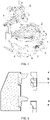
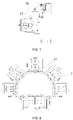
- FIG. 1 to FIG. 18 shows some embodiments of the present disclosure.
- a highly flexible table-type hemming machine based on a segmented control principle includes a base 5, a tire mold mounting seat 4, a jacking mechanism 3, a tire mold 2 provided on the tire mold mounting seat 4, a plurality of pressing knife mechanisms 1 located around the tire mold 2, a pressing mold mechanism 6 located above the tire mold 2, and an overturning mechanism 7 that drives the pressing mold mechanism 6 to rotate.
- the jacking mechanism 3 is configured to drive the tire mold mounting seat 4 and the tire mold 2 to slide along the vertical direction in the base 5.
- Both the outer plate and the inner plate of the automobile door cover are placed on the tire mold 2.
- the outer plate is fixed by the outer plate positioning mechanism on the tire mold 2.
- the pressing mold mechanism 6 is driven to turn over to the working position by the overturning mechanism 7.
- the pressing mold mechanism 6 is pressed to the inner plate by the cylinder, so far the inner plate and the outer plate are both positioned and clamped.
- the pressing knife mechanism 1 cooperates with the tire mold 2 to complete the pre-pressing and final pressing of the outer plate, to realize the hemming of the door cover.
- the pressing knife mechanism 1 has a pressing knife on the upper layer and a pressing knife on the lower layer, which are respectively the pre-hemming pressing knife 8 of the upper layer and the final hemming pressing knife 9 of the lower layer. Both the pre-hemming pressing knife 8 and the final hemming pressing knife 9 are mounted on the triangular pressing knife base 11, and the pressing knife base 11 is integrally cast.
- both the pre-hemming pressing knife 8 and the final hemming pressing knife 9 are formed by splicing several segments of pressing knife blades 41.
- An adjustable spacer 10 is installed above each segment of the pressing knife blade 41.
- the adjustable spacer 10 is used to adjust the position of the pressing knife blade 41 in the height direction.
- the shape of the cutter head of each segment of the pressing knife blade 41 is not exactly the same. After splicing several segments of the pressing knife blades 41, they can be matched with the outer contour of the door cover at the corresponding position. All the pre-hemming pressing knives 8 and the final hemming pressing knives 9 can form a circle after splicing, and their shape matches the outer contour of the entire door cover.
- the automobile door cover can be hemmed in a whole circle at one time.
- the takt of hemming is greatly accelerated, and the quality, stability and consistency of hemming are greatly improved.
- a single pressing knife mechanism is equipped with a plurality of segmented pressing knife blades 41.
- the installation height of the pressing knife blade mounting surface in the vertical direction is the same. But there are other situations.
- the height deviation of a certain position of the door cover is larger than that of other positions, that is, a certain position of the door cover is upturned.
- the relative position of the pressing knife blade 41 corresponding to the upturned position needs to be adjusted.
- the installation surfaces of the vertical direction of a single pressing knife mechanism on the same layer are not at the same height, and there is a situation of mutual staggering or angular deviation, so as to adapt to the shape of the door cover.
- a linear driving unit 16 is provided on the lower side of the bottom plate 12, the piston rod of the linear driving unit 16 is fixedly connected with the bottom plate 12, the cylinder of the linear driving unit 16 is fixedly connected with the frame, and the linear driving unit 16 drives the bottom plate 12 and the upper mechanism to reciprocate back and forth along the two side pressing plates 14.
- the front of the bottom plate 12 is provided with a front side pressing plate 13, and the front side pressing plate 13 is pressed on the bottom plate 12, which further reduces the overall force deformation of the pressing knife base 11 during hemming.
- the lower surface of the protruding portion of the bottom plate 12 is in contact with the jacking mechanism during hemming, and acts as a limiting surface.
- a self-locking mechanism 15 is also fixedly installed on the frame.
- the self-locking mechanism 15 is located on the lower side of the bottom plate 12, the self-locking mechanism 15 has a self-locking shaft, and the self-locking shaft can be inserted and matched with the bottom plate 12 to limit the movement of the bottom plate 12.
- the self-locking mechanism 15 will start immediately, the pressing knife mechanism 1 will be locked and fixed to prevent the pressing knife from moving back and forth and cause the quality problem of the hemming.
- the self-locking mechanism 15 includes a cylinder, a self-locking shaft 152, and a shaft sleeve 151.
- the cylinder and the shaft sleeve 151 are fixed on the frame of the hemming equipment, and the self-locking shaft 152 is driven by the cylinder to reciprocate up and down in the shaft sleeve 151.
- the rear end of the bottom plate 12 has an inclined surface, and the upper end of the self-locking shaft 152 also has an inclined surface.
- the self-locking shaft 152 and the bottom plate 12 cooperate with each other through the inclined surface, and the angle of the inclined surface satisfies the principle of mechanical self-locking angle.
- the self-locking function can also be realized by adjusting the displacement of the cylinder. That is to say, the same self-locking mechanism 15 can satisfy the self-locking of the knife pressing mechanism 1 at multiple different working positions.
- not all pressing knife mechanisms 1 need to be equipped with self-locking mechanisms 15. Under some specific conditions, such as when the angle of the pre-pressing knife surface is horizontal or obliquely downward, the pressing knife mechanism will not be subjected to the backward component force along the driving direction. In this case, the self-locking mechanism 15 is definitely not required.
- the size of the component force is determined by the angle of the working surface of the pre-pressing knife and the length of the working surface. If the component force is smaller than the cylinder thrust, the self-locking device is not required in this case. Since the working surface of the pressing knife is quite complex, the component force is difficult to calculate clearly, so in many cases it is impossible to determine the relationship between the component force and the cylinder thrust. At this time, it is necessary to reserve the installation position of the self-locking mechanism 15 on the pressing knife mechanism 1 in case of emergency.
- the pressing knife base 11 is fixedly installed on the bottom plate 12.
- the upper, lower and left and right sides of the bottom plate 12 are provided with self-lubricating plates with graphite.
- Both sides of the rear of the bottom plate 12 are provided with two pressing plates 14.
- the two pressing plates 14 are fixedly connected with the frame of the whole hemming equipment, and the two pressing plates 14 are used to limit the movement direction of the pressing knife base 11.
- a limiting screw 17 is installed between the pressing knife base 11 and the front side pressing plate 13, and an adjusting washer is also provided, so that the front and rear positions of the pressing knife base 11 can be finely adjusted.
- a position sensor 18 is provided at the bottom of the pressing knife base 11, and the position sensor 18 can sense the position of the pressing knife mechanism 1.
- the base 5 is provided with a through hole that facilitates the tire mold mounting seat 4 to move in the vertical direction.
- the four diagonal corners of the through hole are provided with vertical grooves.
- the guide rails 21 made of brass and solid lubricant graphite are installed in the four grooves of the base 5.
- the corresponding positions of the four diagonal corners of the tire mold mounting seat 4 are also provided with grooves, the width of which is the same as that of the guide rail 21.
- the jacking mechanism 3 includes a drive base 22, a servo motor 29, a ball screw 24, a left wedge block 25, a right wedge block 26, and a jacking block 23.
- the drive base 22 is a casting with a certain rigidity, and has bearing holes at both ends for installing the ball screw 24.
- the ball screw is driven by the servo motor 29.
- the servo motor 29 is connected to the drive base 22 through a flange.
- the ball screw 24 is connected to the servo motor 29 through the hollow shaft of the servo motor 29, and the servo motor 29 is equipped with a servo driver, which can precisely control its parameters such as rotation speed and output torque.
- the ball screw 24 has left-hand and right-hand threads, and is also equipped with left-hand and right-hand nuts.
- the left-hand nut is installed in the left wedge block 25, and the right-hand nut is installed in the right wedge block 26.
- the left wedge block 25 and the right wedge block 26 are both wedge sliding blocks with an inclined surface on the upper part, both of which are inclined downward along the inner side, and the inclined directions of the two are symmetrically arranged.
- the jacking block 23 is provided on the upper side of the left wedge block 25 and the right wedge block 26.
- the lower part of the jacking block 23 has two symmetrically arranged bottom inclined surfaces, and the slope angle of the bottom inclined surface is the same as that of the left wedge block 25 and the right wedge block 26.
- the left and right nuts drive the left wedge block 25 and the right wedge block 26 to move in the opposite direction.
- the jacking block 23 is driven to move vertically up and down, and then the tire mold 2 on the upper side of the jacking mechanism is pushed up and down to complete the hemming process.
- a pressure sensor 28 is provided between the jacking block 23 and the tire mold mounting seat 4, which can timely feedback the force provided by the jacking mechanism 3 to the tire mold 2. Therefore, an appropriate force can be selected to meet the requirements of hemming and improve the quality of hemming.
- the pressing mold mechanism 6 includes an upper mold 36, an upper mold driving cylinder 34 and a guide rod 35.
- the upper mold 36 is driven by the upper mold driving cylinder 34 to move vertically up and down along the guide rod 35.
- the upper mold 36 cooperates with the tire mold 2 to compress the door cover.
- the upper mold driving cylinder 34 is equipped with a pressure relief valve. During the entire hemming process, the upper mold 36 will move with the movement of the tire mold 2, and the pressure between the two will always remain unchanged.
- the mold pressing mechanism 6 is equipped with a proportional valve, and the output pressure of the upper mold driving cylinder 34 can be controlled by adjusting the proportional valve.
- the upper mold 36 is divided into several zones, one clamping block 361 is provided in each zone, the divided clamping blocks 361 are annularly provided at a bottom of the upper mold 36 along an edge of the door cover, and are respectively driven by a clamping cylinder 39, and a pressure sensor 40 is provided between the clamping block 361 and the clamping cylinder 39, such that the clamping blocks 361 in each zone have their own suitable clamping pressure.
- the pressure sensor 40 is installed between the clamping block 361 and the clamping cylinder 39, and is used to measure the actual pressure on the body panel in each zone. It is possible to adjust the output pressure of the clamping cylinder 39 according to the difficulty of hemming the body panels in different regions and positions, so as to avoid problems such as overpressure or insufficient compression of the body panels.
- the overturning mechanism 7 is composed of a servo motor 37 and a link mechanism 38.
- the servo motor 37 drives the link mechanism 38 to drive the pressing mold mechanism 6 to turn over.
- the link mechanism is exactly three points and one line, forming a dead point mechanism.
- lifting guide plates 31 are provided on both sides of the lifting block 23, and the lifting guide plate 31 is provided with a V-shaped groove, and the lifting block 23 is correspondingly provided with a V-shaped convex block.
- the lifting block 23 can play a guiding role when the lifting block 23 moves up and down, such that when the left wedge block 25 and the right wedge block 26 move out of synchronization, the lifting block 23 is prevented from deviating to one side.
- the jacking mechanism also has a rapid stroke design.
- the bottom inclined surface of the jacking block 23 is designed as three-segment type.
- the bottom inclined surface includes a pre-hemming surface 231, a rapid stroke surface 232, and a final hemming surface 233.
- the pre-hemming surface 231 and the final hemming surface 233 are the inclined surfaces of the two key forces (pre-hemming and final hemming).
- the inclination of the rapid stroke surface 232 is greater than the inclination of the pre-hemming surface 231 and the final hemming surface 233.
- a guide rail plate 27 is provided on a front side of the jacking block 23, the guide rail plate 27 is a three-segment guide rail, the three-segment guide rail includes a pre-hemming guide rail 271, a rapid stroke guide rail 272 and a final hemming guide rail 273, the inclination of the rapid stroke guide rail 272 in the middle of the guide rail plate 27 is greater than the inclination of the pre-hemming guide rail 271 and the inclination of the final hemming guide rail 273 at both ends of the guide rail plate 27, an inclination of the pre-hemming guide rail 271 is equal to the inclination of the pre-hemming surface 231, and an inclination of the final hemming guide rail 273 is equal to the inclination of the final hemming surface 233.
- the roller 30 is installed on the left wedge block 25 and the right wedge block 26.
- the jacking block 23 can be quickly jacked up to complete the fast movement of the idle travel.
- the bottom surface of the jacking block 23 contacts with the wedge block and receives force, and returns to a state that can bear a large load.
- the roller 30 contacts with the rapid stroke guide rail to realize the rapid lifting and lowering of the jacking block.
- the bottom of the jacking block and the wedge block are contacted and subjected to force to withstand a large load pressure and realize the lifting and lowering motion of the jacking block.
- the driving base 22 is provided with an oil pump 32 and a drag chain 33, the oil pump 32 is located at one end of the ball screw 24, and the oil pipe is connected to the left and right nuts through the drag chain 33.
- the oil pump 32 can periodically supply oil to the ball screw 24 and the nut through the oil pipe, so as to improve the lubrication condition and prolong the service life.
- the present disclosure further provides a highly flexible hemming method based on a segmented control principle, including the following operations:
- the working process of the highly flexible table-type hemming machine based on a segmented control principle of the present disclosure is as follows.
- the robot grabs the door cover to be hemmed and puts it into the tire mold 2, the tire mold 2 contains an outer plate positioning mechanism.
- the outer plate positioning mechanism positions and tightens the outer plate, and the overturning mechanism 7 driven by the servo motor 37 and the link mechanism 38 is turned over to the working station.
- the upper pressing mold mechanism 6 is pressed to the inner plate by the upper mold driving cylinder 34, so far the inner and outer plates are both positioned and clamped.
- the lifting mechanism 3 composed of the ball screw 24 and the wedge slider drives the tire mold mounting seat 4 and the tire mold 2 to move.
- the tire mold mounting seat 4 and the tire mold 2 are lowered from the loading station a to the pre-hemming waiting station c.
- the pressing knife mechanism 1 is pushed forward to the hemming working station, and all the pre-hemming pressing knives 8 are seamlessly spliced together to form a full circle (as shown in FIG. 8 ).
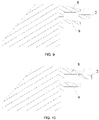
- the lifting mechanism 3 lifts the tire mold 2 to the pre-hemming station b, the pre-hemming pressing knife 8 bends the edge of the automobile door cover (as shown in FIG. 10 ) to complete the pre-hemming process.
- the jacking mechanism 3 drives the tire mold 2 to return to the pre-hemming waiting station c, and then the pressing knife mechanism 1 all returns to the waiting station.
- the jacking mechanism 3 drives the tire mold 2 to descend to the final hemming waiting station e (as shown in FIG. 11 ), and the pressing knife mechanism 1 pushes forward again to the working station.
- the final hemming pressing knife 9 is seamlessly spliced into a full circle.
- the jacking mechanism 3 drives the tire mold 2 to lift to the final hemming station d, and the edge of the door cover is flattened under the pressing of the final hemming press knife 9 (as shown in FIG. 12 ).
- the jacking mechanism 3 drives the tire mold 2 to return to the final hemming waiting station e, the pressing knife mechanism 1 returns to the waiting station again, and the jacking mechanism 3 lifts the tire mold 2 back to the loading station a.
- the pressing mechanism 6 is retracted, and the overturning mechanism 7 is driven by the motor to move to the waiting station, the robot enters the equipment again, grabs the door cover after the hemming, and leaves the station. At this point, a complete hemming cycle is completed.
Landscapes
- Engineering & Computer Science (AREA)
- Mechanical Engineering (AREA)
- Moulds For Moulding Plastics Or The Like (AREA)
- Casting Or Compression Moulding Of Plastics Or The Like (AREA)
- Automobile Manufacture Line, Endless Track Vehicle, Trailer (AREA)
- Perforating, Stamping-Out Or Severing By Means Other Than Cutting (AREA)
Applications Claiming Priority (2)
| Application Number | Priority Date | Filing Date | Title |
|---|---|---|---|
| CN202010648990.5A CN112077218B (zh) | 2020-07-08 | 2020-07-08 | 一种基于分段控制原理的高柔性桌式包边机及包边方法 |
| PCT/CN2020/141452 WO2022007363A2 (zh) | 2020-07-08 | 2020-12-30 | 一种基于分段控制原理的高柔性桌式包边机及包边方法 |
Publications (2)
| Publication Number | Publication Date |
|---|---|
| EP4112202A2 true EP4112202A2 (de) | 2023-01-04 |
| EP4112202A4 EP4112202A4 (de) | 2024-05-15 |
Family
ID=73735038
Family Applications (1)
| Application Number | Title | Priority Date | Filing Date |
|---|---|---|---|
| EP20944762.2A Pending EP4112202A4 (de) | 2020-07-08 | 2020-12-30 | Hochflexible tischfalzmaschine nach dem prinzip der segmentierten steuerung und falzverfahren |
Country Status (3)
| Country | Link |
|---|---|
| EP (1) | EP4112202A4 (de) |
| CN (1) | CN112077218B (de) |
| WO (1) | WO2022007363A2 (de) |
Families Citing this family (18)
| Publication number | Priority date | Publication date | Assignee | Title |
|---|---|---|---|---|
| CN112077218B (zh) * | 2020-07-08 | 2022-01-14 | 安徽巨一科技股份有限公司 | 一种基于分段控制原理的高柔性桌式包边机及包边方法 |
| CN111974854A (zh) * | 2020-07-08 | 2020-11-24 | 安徽巨一科技股份有限公司 | 一种基于分段控制原理的桌式包边机顶升机构 |
| CN112829329B (zh) * | 2020-12-31 | 2024-07-12 | 臻越自动化技术(上海)有限公司 | 下模模具装置及汽车扶手的表皮粘贴方法 |
| CN113306205B (zh) * | 2021-06-03 | 2025-03-14 | 温州宜能包装有限公司 | 一种偏心旋转包边机 |
| CN113441587B (zh) * | 2021-06-28 | 2023-01-24 | 四川成焊宝玛焊接装备工程有限公司 | 一种适用于车身位置偏差的浮动滚边夹具 |
| CN116262277B (zh) * | 2021-12-14 | 2026-04-17 | 一汽-大众汽车有限公司 | 汽车门盖压合模块 |
| CN114289583B (zh) * | 2021-12-31 | 2024-06-25 | 安徽巨一科技股份有限公司 | 一种桌式包边机的控制方法 |
| CN114798931B (zh) * | 2022-02-28 | 2024-04-09 | 中国第一汽车股份有限公司 | 专机压合设备及方法 |
| CN114951462B (zh) * | 2022-05-25 | 2026-04-07 | 安徽巨一科技股份有限公司 | 一种用于包覆式机盖的包边设备及包边方法 |
| CN115415422B (zh) * | 2022-08-31 | 2025-06-03 | 重庆众思创智能科技有限公司 | 一种分段式门盖包边专机 |
| CN116037737B (zh) * | 2023-01-05 | 2026-02-27 | 大连奥托股份有限公司 | 一种汽车白车身四门两盖压边装置 |
| CN116329354B (zh) * | 2023-04-11 | 2025-10-31 | 池州市九华明坤铝业有限公司 | 一种铝制型材加工用多角度折边装置 |
| CN116511309A (zh) * | 2023-05-23 | 2023-08-01 | 广州耐谊通用设备有限公司 | 一种卷边机构 |
| CN117885341A (zh) * | 2023-09-22 | 2024-04-16 | 江铃汽车股份有限公司 | 一种门窗框内包边机构 |
| CN117299914B (zh) * | 2023-09-28 | 2026-02-27 | 江苏长腾汽车焊装设备有限公司 | 一种顶盖自动包边结构 |
| CN117922939A (zh) * | 2024-01-19 | 2024-04-26 | 燕山大学 | 一种高温合金饼料硬包套包装设备 |
| CN119566166B (zh) * | 2024-11-19 | 2025-10-10 | 一汽-大众汽车有限公司 | 一种用于汽车门盖的三步压合模块和方法 |
| CN119657768A (zh) * | 2024-11-29 | 2025-03-21 | 上汽通用五菱汽车股份有限公司 | 滚边胎模及其面差调整方法 |
Family Cites Families (25)
| Publication number | Priority date | Publication date | Assignee | Title |
|---|---|---|---|---|
| US5150508A (en) * | 1991-06-28 | 1992-09-29 | E. R. St. Denis & Sons, Limited | Hemming machine and method |
| DE19954441A1 (de) * | 1999-08-13 | 2001-02-15 | Thyssenkrupp Ind Ag | Vorrichtung zur Betätigung eines Stößels in einer Hub- oder Spannvorrichtung, insbesondere zum Falzen von Blechen im Automobilbau |
| EP1702692B1 (de) * | 1999-11-25 | 2008-03-05 | Ford-Werke GmbH | Bördelvorrichtung |
| CN2449908Y (zh) * | 2000-08-30 | 2001-09-26 | 广兴塑胶机械股份有限公司 | 具有顶升机构的空压成型机 |
| US6474125B1 (en) * | 2001-05-18 | 2002-11-05 | Valiant Corporation | Hemming machine with dual ball screw drive |
| EP1258301A3 (de) * | 2001-05-18 | 2003-10-22 | Valiant Corporation | Bördelvorrichtung mit mit bewegbaren Matrizenkasetten |
| DE112005003561B4 (de) * | 2005-04-27 | 2012-01-19 | Honda Motor Co., Ltd. | Walz-Umschlagverfahren und Walz-Umschlagvorrichtung |
| US7997113B2 (en) | 2007-06-11 | 2011-08-16 | Magna International Inc. | System and method for hemming components |
| DE102007054559A1 (de) * | 2007-11-15 | 2009-05-20 | Thyssenkrupp Drauz Nothelfer Gmbh | Vorrichtung zum Verbinden von Blechen sowie schwenkbares Aufnahmeelement |
| DE102008045404A1 (de) * | 2008-09-02 | 2010-03-04 | Thyssenkrupp Drauz Nothelfer Gmbh | Verfahren und Vorrichtung zum Beölen einer Falzvorrichtung |
| CN201500714U (zh) * | 2009-05-26 | 2010-06-09 | 南京鹏力科技有限公司 | 汽车车门钣金件包边成型装置 |
| CN101758131A (zh) * | 2009-07-23 | 2010-06-30 | 缪建成 | 一种新型数控滚压包边机 |
| CN201500711U (zh) * | 2009-09-28 | 2010-06-09 | 戴崇强 | 汽车门包边机 |
| KR101329052B1 (ko) * | 2012-06-12 | 2013-11-14 | (주)미래테크노 | 차량 도어의 윈도우용 개구부를 위한 헤밍장치 |
| CN203265351U (zh) | 2013-05-13 | 2013-11-06 | 上汽通用五菱汽车股份有限公司 | 一种汽车车门的包边机 |
| CN103406413B (zh) * | 2013-08-19 | 2015-07-08 | 上海大众汽车有限公司 | 折边加工装置及方法 |
| CN203725572U (zh) * | 2014-03-21 | 2014-07-23 | 安徽江淮汽车股份有限公司 | 一种新型门盖包边机构 |
| CN105251872A (zh) * | 2014-07-17 | 2016-01-20 | 江苏振世达汽车模具有限公司 | 一种汽车车门内外板两次合边模具 |
| CN104399795B (zh) * | 2014-11-28 | 2016-09-14 | 奇瑞汽车股份有限公司 | 一种汽车覆盖件的大角度三步动作包边专机结构 |
| CN205436841U (zh) * | 2016-01-05 | 2016-08-10 | 北京汽车股份有限公司 | 包边模夹紧装置 |
| CN106040812B (zh) * | 2016-08-09 | 2018-01-16 | 中国第一汽车股份有限公司 | 预翻边设备及预翻边方法 |
| CN107597932B (zh) * | 2017-09-26 | 2019-01-04 | 南京埃斯顿智能系统工程有限公司 | 车门包边机及其用于车门包边的方法 |
| CN110216182B (zh) * | 2019-05-31 | 2020-07-14 | 中国第一汽车股份有限公司 | 伺服驱动压合装置 |
| CN305939359S (de) * | 2020-04-15 | 2020-07-24 | ||
| CN112077218B (zh) * | 2020-07-08 | 2022-01-14 | 安徽巨一科技股份有限公司 | 一种基于分段控制原理的高柔性桌式包边机及包边方法 |
-
2020
- 2020-07-08 CN CN202010648990.5A patent/CN112077218B/zh active Active
- 2020-12-30 EP EP20944762.2A patent/EP4112202A4/de active Pending
- 2020-12-30 WO PCT/CN2020/141452 patent/WO2022007363A2/zh not_active Ceased
Also Published As
| Publication number | Publication date |
|---|---|
| CN112077218A (zh) | 2020-12-15 |
| WO2022007363A3 (zh) | 2022-11-24 |
| WO2022007363A2 (zh) | 2022-01-13 |
| CN112077218B (zh) | 2022-01-14 |
| EP4112202A4 (de) | 2024-05-15 |
Similar Documents
| Publication | Publication Date | Title |
|---|---|---|
| EP4112202A2 (de) | Hochflexible tischfalzmaschine nach dem prinzip der segmentierten steuerung und falzverfahren | |
| CN100453201C (zh) | 车门框包边工艺方法及包边模 | |
| CN111974854A (zh) | 一种基于分段控制原理的桌式包边机顶升机构 | |
| CN202701475U (zh) | 一种开口度可调式液压剪切机 | |
| CN201889384U (zh) | 一锤锻成无飞边十字轴精锻模具 | |
| CN201231269Y (zh) | 液压板料折弯机的滑块行程调节机构 | |
| CN209124805U (zh) | 一种锻造成型装置 | |
| CN105081192A (zh) | 整体式汽车转向节锻造毛坯实现热挤压锻造的方法 | |
| CN108723186B (zh) | 一种液压机 | |
| CN110814115B (zh) | 一种汽车天窗导轨压弯模具的模芯定位机构 | |
| CN2785847Y (zh) | 开式精密压力机 | |
| CN2659578Y (zh) | 旋转凸轮 | |
| CN224128668U (zh) | 一种铝制品加工用冲孔装置 | |
| CN114101495A (zh) | 一种钣金成型自动生产线侧翻边压机 | |
| CN119681121B (zh) | 一种汽车零部件冲压设备及冲压方法 | |
| CN224058578U (zh) | 一种可压制异形铝型材的冷压机 | |
| CN112239865A (zh) | 利用等离子熔覆技术对轨道车辆轮对再制造处理的系统 | |
| CN224044666U (zh) | 一种高速重载压力机用模高调整装置 | |
| CN120190216B (zh) | 一种高强钢建筑模板加工用多级成型设备 | |
| CN223889365U (zh) | 一种凸轮驱动的压装机构 | |
| CN2620599Y (zh) | 阴极板加工输送冲铆机 | |
| CN221473269U (zh) | 一种冲压模具的斜锲结构 | |
| CN222695770U (zh) | 一种自调式弧形定位器及具有定位器的模具总成 | |
| CN224073092U (zh) | 滑块驱动上翻边结构 | |
| CN220862622U (zh) | 一种飞机发动机叶片快速液压平锻机 |
Legal Events
| Date | Code | Title | Description |
|---|---|---|---|
| STAA | Information on the status of an ep patent application or granted ep patent |
Free format text: STATUS: THE INTERNATIONAL PUBLICATION HAS BEEN MADE |
|
| PUAI | Public reference made under article 153(3) epc to a published international application that has entered the european phase |
Free format text: ORIGINAL CODE: 0009012 |
|
| STAA | Information on the status of an ep patent application or granted ep patent |
Free format text: STATUS: REQUEST FOR EXAMINATION WAS MADE |
|
| 17P | Request for examination filed |
Effective date: 20220329 |
|
| AK | Designated contracting states |
Kind code of ref document: A2 Designated state(s): AL AT BE BG CH CY CZ DE DK EE ES FI FR GB GR HR HU IE IS IT LI LT LU LV MC MK MT NL NO PL PT RO RS SE SI SK SM TR |
|
| DAV | Request for validation of the european patent (deleted) | ||
| DAX | Request for extension of the european patent (deleted) | ||
| A4 | Supplementary search report drawn up and despatched |
Effective date: 20240415 |
|
| RIC1 | Information provided on ipc code assigned before grant |
Ipc: B21D 19/08 20060101ALI20240409BHEP Ipc: B21D 19/00 20060101ALI20240409BHEP Ipc: B21D 53/88 20060101ALI20240409BHEP Ipc: B21D 37/18 20060101ALI20240409BHEP Ipc: B21C 51/00 20060101ALI20240409BHEP Ipc: B21D 39/02 20060101AFI20240409BHEP |