EP4112610A1 - Procédé de synthèse pour synthétiser un dérivé d'oxétane par microréacteur - Google Patents
Procédé de synthèse pour synthétiser un dérivé d'oxétane par microréacteur Download PDFInfo
- Publication number
- EP4112610A1 EP4112610A1 EP21780711.4A EP21780711A EP4112610A1 EP 4112610 A1 EP4112610 A1 EP 4112610A1 EP 21780711 A EP21780711 A EP 21780711A EP 4112610 A1 EP4112610 A1 EP 4112610A1
- Authority
- EP
- European Patent Office
- Prior art keywords
- microreactor
- synthesizing
- oxetane
- catalyst
- oxetane derivative
- Prior art date
- Legal status (The legal status is an assumption and is not a legal conclusion. Google has not performed a legal analysis and makes no representation as to the accuracy of the status listed.)
- Granted
Links
Images
Classifications
-
- C—CHEMISTRY; METALLURGY
- C07—ORGANIC CHEMISTRY
- C07D—HETEROCYCLIC COMPOUNDS
- C07D305/00—Heterocyclic compounds containing four-membered rings having one oxygen atom as the only ring hetero atoms
- C07D305/02—Heterocyclic compounds containing four-membered rings having one oxygen atom as the only ring hetero atoms not condensed with other rings
- C07D305/04—Heterocyclic compounds containing four-membered rings having one oxygen atom as the only ring hetero atoms not condensed with other rings having no double bonds between ring members or between ring members and non-ring members
- C07D305/06—Heterocyclic compounds containing four-membered rings having one oxygen atom as the only ring hetero atoms not condensed with other rings having no double bonds between ring members or between ring members and non-ring members with only hydrogen atoms, hydrocarbon or substituted hydrocarbon radicals, directly attached to the ring atoms
-
- C—CHEMISTRY; METALLURGY
- C07—ORGANIC CHEMISTRY
- C07D—HETEROCYCLIC COMPOUNDS
- C07D407/00—Heterocyclic compounds containing two or more hetero rings, at least one ring having oxygen atoms as the only ring hetero atoms, not provided for by group C07D405/00
- C07D407/02—Heterocyclic compounds containing two or more hetero rings, at least one ring having oxygen atoms as the only ring hetero atoms, not provided for by group C07D405/00 containing two hetero rings
- C07D407/12—Heterocyclic compounds containing two or more hetero rings, at least one ring having oxygen atoms as the only ring hetero atoms, not provided for by group C07D405/00 containing two hetero rings linked by a chain containing hetero atoms as chain links
-
- B—PERFORMING OPERATIONS; TRANSPORTING
- B01—PHYSICAL OR CHEMICAL PROCESSES OR APPARATUS IN GENERAL
- B01J—CHEMICAL OR PHYSICAL PROCESSES, e.g. CATALYSIS OR COLLOID CHEMISTRY; THEIR RELEVANT APPARATUS
- B01J19/00—Chemical, physical or physico-chemical processes in general; Their relevant apparatus
- B01J19/0093—Microreactors, e.g. miniaturised or microfabricated reactors
Definitions
- the invention relates to the field of organic synthesis, in particular to a synthesis method for synthesizing an oxetane derivative by a microreactor.
- the etherification reaction with a halogenated organic compound under the action of a base can obtain a series of oxetane derivatives, which can be used as monomers in a photocurable cation system, and applied in the fields of photocurable inks, coatings, adhesives, and the like.
- the representative products are 3-ethyl-3-[(oxiranyl-2-methoxy)methyl]oxetane, bis[1-ethyl(3-oxetanyl)methyl]ether, and 3-benzyloxymethyl-3-ethyloxetane.
- a main object of the invention is to provide a method for synthesizing an oxetane derivative in a microreactor, so as to solve the problems present in the existing synthesis methods for oxetane derivatives such as long reaction time, cumbersome operations, and poor safety.
- the selectivity of etherification reaction is ensured while realizing the continuous production, and the product yield is improved.
- the invention provides a method for synthesizing an oxetane derivative in a microreactor, the oxetane derivative having the structure shown in Formula (I): wherein R is a C 2 to C 12 linear or branched alkyl, an alkyl containing ethylene oxide structure, an alkyl containing oxetane structure, phenyl, tolyl, benzyl, or biphenyl, and n is 1-4; the method for synthesizing an oxetane derivative by a microreactor as above comprising: feeding 3-ethyl-3-hydroxymethyloxetane, a raw material Ha, a catalyst, and a base into a microreactor for etherification reaction to obtain an etherification product, wherein the raw material Ha has a general formula of R-(X) n , and X is halogen; and submitting the etherification product to separation to obtain the oxetane derivative.
- R is a C
- the microreactor has a reaction channel having an inner diameter of 200 to 10,000 ⁇ m.
- the base is an alkali metal compound or an aqueous solution of alkali metal compound
- the alkali metal compound is selected from one or more of the group consisting of lithium hydroxide, sodium hydroxide, potassium hydroxide, and calcium hydroxide; preferably, the alkali metal compound is sodium hydroxide; the concentration of the aqueous solution of alkali metal compound is 10 % to 20 %; and the catalyst is selected from one or more of the group consisting of polyethers, cyclic polyethers, and quaternary ammonium salts.
- the catalyst is selected from one or more of the group consisting of polyethylene glycol, polyethylene glycol alkyl ether, 18-crown-6, 15-crown-5, tetraethylammonium bromide, tetrabutylammonium bromide, tetrabutylammonium chloride, trioctylmethylammonium chloride, dodecyltrimethylammonium chloride, and tetradecyltrimethylammonium chloride.
- the catalyst is selected from one or more of the group consisting of polyethylene glycol dimethyl ether, 18-crown-6, and tetrabutylammonium bromide.
- the catalyst is added in an amount of 0.1 % to 5 % by weight.
- the catalyst is added in an amount of 0.5 % to 2 % by weight.
- reaction temperature of the etherification reaction is 10 to 60°C
- residence time of materials is 2 to 5 min.
- the device used in the separation step comprises a secondary thin-film evaporation device or a rectification tower.
- the microreactor has a reaction channel having an inner diameter of 500 to 8,000 ⁇ m.
- the microreactor the advantages, such as high heat and mass transfer coefficient, good mixing performance, easy temperature control, and safe and controllable process as compared to conventional reactors.
- the advantages of the use of a microreactor in the preparation of oxetane derivative can greatly improve the mass and heat transfer performances of the reaction system, reduce the reaction time, improve the production efficiency, improve the product yield, realize the process continuity and automation, and improve the process safety.
- Limiting the aperture of the reaction channel of the microreactor within the above-mentioned range is beneficial to improving the selectivity of the etherification reaction, thereby contributing to improving the conversion rate of the oxetane derivative.
- the above synthesis process requires small size for reaction device, small floor space for production site, and less manpower, and has high safety.
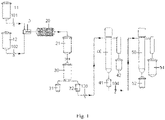
- FIG. 1 shows a schematic diagram for the structure of a device for preparing an oxetane derivative provided according to a typical embodiment of invention.
- the invention provides a method for synthesizing an oxetane derivative in a microreactor, the oxetane derivative having the structure shown in Formula (I): wherein R is a C 2 to C 12 linear or branched alkyl, an alkyl containing ethylene oxide structure, an alkyl containing oxetane structure, phenyl, tolyl, benzyl, or biphenyl, and n is 1-4; this method for synthesizing an oxetane derivative comprising: feeding 3-ethyl-3-hydroxymethyloxetane, a raw material Ha, a catalyst, and a base into a microreactor for etherification reaction to obtain an etherification product, wherein the raw material Ha has a general formula of R-(X) n
- the microreactor has advantages, such as high heat and mass transfer coefficient, good mixing performance, easy temperature control, and safe and controllable process as compared to conventional reactors.
- the advantages of the use of a microreactor in the preparation of oxetane derivative can greatly improve the mass and heat transfer performances of the reaction system, reduce the reaction time, improve the production efficiency, improve the product yield, realize the process continuity and automation, and improve the process safety.
- the above synthesis process requires small size for reaction device, small floor space for production site, and less manpower, and has high safety.
- the microreactor has a reaction channel having an inner diameter of 200 to 10,000 ⁇ m. Limiting the aperture of the reaction channel of the microreactor within the above-mentioned range is beneficial to improving the selectivity of the etherification reaction, and further improves the conversion rate of the oxetane derivative.
- the microreactor has a reaction channel having an inner diameter of 200 ⁇ m, 500 ⁇ m, 4,000 ⁇ m, 6,000 ⁇ m, 8,000 ⁇ m, or 10,000 ⁇ m, and more preferably, the microreactor has a reaction channel having an inner diameter of 500 to 8,000 ⁇ m.
- the base is an alkali metal compound or an aqueous solution of alkali metal compound.
- the alkali metal compound can be selected from those commonly used in the art.
- the alkali metal compound includes but is not limited to one or more of the group consisting of lithium hydroxide, sodium hydroxide, potassium hydroxide, and calcium hydroxide; more preferably, the alkali metal compound is sodium hydroxide; and the concentration of the aqueous solution of alkali metal compound is 10 % to 20 %.
- the catalyst can be selected from those commonly used in the art.
- the catalyst includes but is not limited to one or more of the group consisting of polyethers, cyclic polyethers, and quaternary ammonium salts.
- the catalyst includes but is not limited to one or more of the group consisting of polyethylene glycol, polyethylene glycol alkyl ether, 18-crown-6, 15-crown-5, tetraethylammonium bromide, tetrabutylammonium bromide, tetrabutylammonium chloride, trioctylmethylammonium chloride, dodecyltrimethylammonium chloride, and tetradecyltrimethylammonium chloride.
- the use of the above catalysts is beneficial to further improving the reaction rate of etherification reaction and shortening the reaction period.
- the catalyst includes but is not limited to one or more of the group consisting of polyethylene glycol dimethyl ether, 18-crown-6, and tetrabutylammonium bromide.
- the catalyst is added in an amount of 0.1 % to 5 % by weight.
- the amount of the catalyst includes but is not limited to the above-mentioned range, while limiting it within the above-mentioned range is beneficial to further improving the reaction rate of the etherification reaction.
- the catalyst is added in an amount of 0.1 %, 0.5 %, 1 %, 1.5 %, 2 %, 3 %, or 4 % by weight. More preferably, based on the weight of 3-ethyl-3-hydroxymethyloxetane, the catalyst is added in an amount of 0.5 % to 2 % by weight.
- the molar ratio of 3-ethyl-3-hydroxymethyloxetane to the halogen in the raw material Ha is 1: (1.0 to 1.2).
- the molar ratio of 3-ethyl-3-hydroxymethyloxetane to the halogen in the raw material Ha includes but is not limited to the above-mentioned range, while limiting it within the above-mentioned range is beneficial to improving the conversion rate of 3-ethyl-3-hydroxymethyloxetane.
- the reaction temperature of the etherification reaction is 10 to 60°C
- the residence time of materials is 2 to 5 min.
- the reaction temperature of the etherification reaction and the residence time of materials include but are not limited to the above-mentioned ranges, while limiting them within the above-mentioned ranges is beneficial to further improving the yield of the etherification product.
- the reaction temperature of the etherification reaction can be 10°C, 20°C, 30°C, 40°C, 50°C, or 60°C.
- the above separation step can be conducted using a device commonly used in the art.
- the device used in the separation step includes: a secondary thin-film evaporation device or a rectification tower.
- the device shown in FIG. 1 was used to prepare the oxetane derivative, and the synthesis method included the following steps:
- Example 2 It differed from Example 1 in that: the microreactor has a reaction channel having an inner diameter of 200 ⁇ m.
- Example 2 It differed from Example 1 in that: the microreactor has a reaction channel having a size of 10,000 ⁇ m.
- Example 2 It differed from Example 1 in that: the catalyst was added in an amount of 1.0 %, the catalyst was polyethylene glycol dimethyl ether, and the residence time of materials was 5 min.
- Example 2 It differed from Example 1 in that: the catalyst was added in an amount of 1.0 %, the catalyst was 18-crown-6, and the residence time of materials was 4 min.
- Example 2 It differed from Example 1 in that: the catalyst was added in an amount of 1.0 %, the catalyst was polyethylene glycol, and the residence time of materials was 4 min.
- Example 2 It differed from Example 1 in that: the catalyst was added in an amount of 1.0 %, the catalyst was tetradecyltrimethylammonium chloride, and the residence time of materials was 5 min.
- Example 2 It differed from Example 1 in that: the reaction temperature of the etherification reaction was 30°C.
- Example 2 It differed from Example 1 in that: the microreactor has a reaction channel having a size of 12,000 ⁇ m.
- Example 2 It differed from Example 1 in that: the stoichiometric amounts of 3-ethyl-3-hydroxymethyloxetane (MOX101), caustic soda flakes, and catalyst were mixed well and charged into the organic raw material storage tank 11, and epichlorohydrin was charged into the raw material storage tank 12, wherein the microreactor has a reaction channel having an inner diameter of 500 ⁇ m.
- MOX101 3-ethyl-3-hydroxymethyloxetane
- Cathlorohydrin was charged into the raw material storage tank 12, wherein the microreactor has a reaction channel having an inner diameter of 500 ⁇ m.
- Example 2 It differed from Example 1 in that: the stoichiometric amounts of 3-ethyl-3-hydroxymethyloxetane (MOX101), epichlorohydrin, and catalyst were mixed well and charged into the organic raw material storage tank 11, and the base solution was charged into the raw material storage tank 12, wherein the microreactor has a reaction channel having an inner diameter of 8,000 ⁇ m.
- MOX101 3-ethyl-3-hydroxymethyloxetane
- epichlorohydrin epichlorohydrin
- Example 2 It differed from Example 1 in that: the reaction temperature of the etherification reaction was 100°C.
- Example 2 It differed from Example 1 in that: the reaction temperature of the etherification reaction was 5°C.
- Example 2 It differed from Example 1 in that: the catalyst was added in an amount of 0.1 %, the catalyst was tetrabutylammonium bromide, and the residence time of materials was 5 min.
- Example 2 It differed from Example 1 in that: the stoichiometric amounts of 3-ethyl-3-hydroxymethyloxetane (MOX101) and caustic soda flakes were mixed well and charged into the organic raw material storage tank 11, and epichlorohydrin and catalyst were charged into the raw material storage tank 12, wherein the catalyst was added in an amount of 5 %, the catalyst was 18-crown-6, and the residence time of materials was 2 min.
- MOX101 3-ethyl-3-hydroxymethyloxetane
- caustic soda flakes were mixed well and charged into the organic raw material storage tank 11
- epichlorohydrin and catalyst were charged into the raw material storage tank 12 wherein the catalyst was added in an amount of 5 %, the catalyst was 18-crown-6, and the residence time of materials was 2 min.
- Example 2 It differed from Example 1 in that: the stoichiometric amounts of 3-ethyl-3-hydroxymethyloxetane (MOX101) and caustic soda flakes were mixed well and charged into the organic raw material storage tank 11, and epichlorohydrin and catalyst were charged into the raw material storage tank 12, wherein the catalyst was added in an amount of 4 %, the catalyst was tetrabutylammonium bromide, and the residence time of materials was 3 min.
- MOX101 3-ethyl-3-hydroxymethyloxetane
- caustic soda flakes were mixed well and charged into the organic raw material storage tank 11
- epichlorohydrin and catalyst were charged into the raw material storage tank 12 wherein the catalyst was added in an amount of 4 %, the catalyst was tetrabutylammonium bromide, and the residence time of materials was 3 min.
- Comparative Examples 1 to 5 a conventional reactor was used to prepare the oxetane derivative, and the specific process parameters were shown in Table 3.
- the synthesis method included the following steps: Into a four-necked flask 3-ethyl-3-hydroxymethyloxetane (MOX101) and raw material R-(X)n were added and stirred to mix well; the base solution and catalyst were mixed well and dropwise added into the above four-necked flask; after the dropwise addition was completed, the reaction was conducted under heat preservation; the organic phase was taken for detecting the conversion rate by GC, and the reaction was stopped after the conversion rate no longer changed; and the reaction product system was allowed to stand for phase separation, then subjected to rectification to obtain the finished product.
- MOX101 3-ethyl-3-hydroxymethyloxetane
- R-(X)n raw material
Landscapes
- Chemical & Material Sciences (AREA)
- Organic Chemistry (AREA)
- Epoxy Compounds (AREA)
- Low-Molecular Organic Synthesis Reactions Using Catalysts (AREA)
- Chemical Kinetics & Catalysis (AREA)
Applications Claiming Priority (3)
| Application Number | Priority Date | Filing Date | Title |
|---|---|---|---|
| CN202010261424 | 2020-04-03 | ||
| CN202110184195.XA CN113493427B (zh) | 2020-04-03 | 2021-02-10 | 通过微反应器合成氧杂环丁烷衍生物的合成方法 |
| PCT/CN2021/081185 WO2021197057A1 (fr) | 2020-04-03 | 2021-03-16 | Procédé de synthèse pour synthétiser un dérivé d'oxétane par microréacteur |
Publications (3)
| Publication Number | Publication Date |
|---|---|
| EP4112610A1 true EP4112610A1 (fr) | 2023-01-04 |
| EP4112610A4 EP4112610A4 (fr) | 2024-04-10 |
| EP4112610B1 EP4112610B1 (fr) | 2025-07-30 |
Family
ID=77927690
Family Applications (1)
| Application Number | Title | Priority Date | Filing Date |
|---|---|---|---|
| EP21780711.4A Active EP4112610B1 (fr) | 2020-04-03 | 2021-03-16 | Procédé de synthèse pour synthétiser un dérivé d'oxétane par microréacteur |
Country Status (6)
| Country | Link |
|---|---|
| US (1) | US12583830B2 (fr) |
| EP (1) | EP4112610B1 (fr) |
| JP (1) | JP7599505B2 (fr) |
| KR (1) | KR102755419B1 (fr) |
| TW (1) | TWI807290B (fr) |
| WO (1) | WO2021197057A1 (fr) |
Families Citing this family (2)
| Publication number | Priority date | Publication date | Assignee | Title |
|---|---|---|---|---|
| CN114262310A (zh) * | 2021-12-27 | 2022-04-01 | 山东广浦生物科技有限公司 | 双(1-2(3-氧杂环丁基)甲基)醚的制备方法 |
| CN114957168A (zh) * | 2022-05-17 | 2022-08-30 | 大连天源基化学有限公司 | 一种3,3′-(氧基双亚甲基)双(3-乙基)氧杂环丁烷及其制备方法 |
Family Cites Families (16)
| Publication number | Priority date | Publication date | Assignee | Title |
|---|---|---|---|---|
| DE1021858B (de) * | 1956-12-14 | 1958-01-02 | Bayer Ag | Verfahren zur Herstellung aromatischer Oxacyclobutanderivate |
| US5463084A (en) * | 1992-02-18 | 1995-10-31 | Rensselaer Polytechnic Institute | Photocurable silicone oxetanes |
| US5750590A (en) * | 1995-02-22 | 1998-05-12 | Heraeus Kulzer Gmbh | Polymerizable material |
| JP3508502B2 (ja) * | 1997-09-30 | 2004-03-22 | 宇部興産株式会社 | オキセタン環を有するビフェニル誘導体 |
| JP3931448B2 (ja) | 1998-09-11 | 2007-06-13 | 東亞合成株式会社 | ビス(3−アルキルオキセタン−3−イルメチル)エーテルの製造方法 |
| JP3882495B2 (ja) | 2000-11-01 | 2007-02-14 | 東亞合成株式会社 | 3−アルキル−3−ヒドロキシメチルオキセタンを原料とするエーテル類の製造方法 |
| JPWO2004106314A1 (ja) | 2003-05-28 | 2006-07-20 | 宇部興産株式会社 | オキセタン環含有ビフェニル化合物の製造方法 |
| EP1719769B1 (fr) * | 2004-02-23 | 2011-10-05 | Nippon Steel Chemical Co., Ltd. | Procede de production de composes d'oxetane alicycliques |
| JP2007217471A (ja) | 2006-02-14 | 2007-08-30 | Fujifilm Corp | カチオン重合性組成物、並びにこれを用いた画像形成方法および記録物 |
| JPWO2010032712A1 (ja) | 2008-09-20 | 2012-02-09 | 国立大学法人長岡技術科学大学 | マイクロリアクター |
| JP5683796B2 (ja) * | 2009-07-13 | 2015-03-11 | 株式会社Kri | 微小構造体の製造方法およびマイクロリアクター |
| JP5473699B2 (ja) | 2010-03-18 | 2014-04-16 | 大阪瓦斯株式会社 | 変圧器制御装置 |
| CN104892549A (zh) | 2015-04-20 | 2015-09-09 | 南昌大学 | 一种可用于紫外光固化的烯丙基氧杂环丁烷类化合物的合成方法 |
| CN104876807A (zh) | 2015-05-19 | 2015-09-02 | 安徽生源化工有限公司 | 羟基苯醚(iii)的合成工艺 |
| JP2017133039A (ja) | 2017-05-10 | 2017-08-03 | Dic株式会社 | 重合体の製造方法 |
| CN110845643A (zh) | 2018-08-21 | 2020-02-28 | 常州强力电子新材料股份有限公司 | 可能量固化的环氧接枝改性的氯磺化聚乙烯树脂、含有其的可能量固化组合物及应用 |
-
2021
- 2021-03-16 WO PCT/CN2021/081185 patent/WO2021197057A1/fr not_active Ceased
- 2021-03-16 JP JP2022560041A patent/JP7599505B2/ja active Active
- 2021-03-16 US US17/913,671 patent/US12583830B2/en active Active
- 2021-03-16 EP EP21780711.4A patent/EP4112610B1/fr active Active
- 2021-03-16 KR KR1020227037912A patent/KR102755419B1/ko active Active
- 2021-04-01 TW TW110112178A patent/TWI807290B/zh active
Also Published As
| Publication number | Publication date |
|---|---|
| EP4112610B1 (fr) | 2025-07-30 |
| KR102755419B1 (ko) | 2025-01-21 |
| US12583830B2 (en) | 2026-03-24 |
| EP4112610A4 (fr) | 2024-04-10 |
| TW202138358A (zh) | 2021-10-16 |
| TWI807290B (zh) | 2023-07-01 |
| WO2021197057A1 (fr) | 2021-10-07 |
| KR20220161446A (ko) | 2022-12-06 |
| US20230116611A1 (en) | 2023-04-13 |
| JP2023520477A (ja) | 2023-05-17 |
| JP7599505B2 (ja) | 2024-12-13 |
Similar Documents
| Publication | Publication Date | Title |
|---|---|---|
| EP3954678B1 (fr) | Monothiocarbonates cycliques à cinq chaînons | |
| CN110655645B (zh) | 强碱性阴离子交换树脂在制备端羟基聚醚季铵盐中的应用 | |
| EP4112610A1 (fr) | Procédé de synthèse pour synthétiser un dérivé d'oxétane par microréacteur | |
| CN112250646A (zh) | 烷基缩水甘油醚的制备方法 | |
| CN105330836A (zh) | 一种端环氧基烯丙醇聚氧乙烯醚的合成方法 | |
| CN106243344A (zh) | 一种环氧基封端聚醚连续开环生产工艺 | |
| EP2412712A1 (fr) | Procédé de production d'un composé époxy | |
| CN113493427B (zh) | 通过微反应器合成氧杂环丁烷衍生物的合成方法 | |
| CN101168493B (zh) | 一种氟代氯苯的制备方法 | |
| WO2014077465A1 (fr) | Procédé de préparation de glycidol | |
| EP4129991B1 (fr) | Procédé de synthèse d'un composé oxétane par microréacteur | |
| CN102050943A (zh) | 缩水甘油醚基聚醚的合成方法 | |
| CN113336655A (zh) | 一种(r)-3-氨基丁醇的制备方法 | |
| JP5761775B2 (ja) | ビスフェノールAプロピレンオキシド付加物のジβ−メチルグリシジルエーテル及びそれを用いた硬化性樹脂組成物 | |
| CN117720484A (zh) | 一种烯丙基缩水甘油醚的制备方法 | |
| US20100168450A1 (en) | Novel branched alkoxylates | |
| EP1341607B1 (fr) | Nouvelles compositions catalytiques a base d'antimoine | |
| US6455459B1 (en) | Antimony catalyst compositions | |
| KR102730063B1 (ko) | 디에폭사이드 화합물의 제조방법 | |
| WO2026035536A1 (fr) | Synthèse d'éthers d'alkyl-aryles | |
| KR101006003B1 (ko) | 이상계 반응을 이용한 폴리옥시 알킬렌 알케닐 에테르의제조 방법 | |
| KR20230124192A (ko) | 글리콜의 직접 제조 방법 | |
| JP2022102229A (ja) | エポキシ化合物の製造方法 | |
| HU193377B (hu) | Eljárás pentaeritrit-tetraglicidil-éter előállítására | |
| PL209275B1 (pl) | Sposób epoksydacji 1,4-bis(alliloksy)butanu |
Legal Events
| Date | Code | Title | Description |
|---|---|---|---|
| STAA | Information on the status of an ep patent application or granted ep patent |
Free format text: STATUS: THE INTERNATIONAL PUBLICATION HAS BEEN MADE |
|
| PUAI | Public reference made under article 153(3) epc to a published international application that has entered the european phase |
Free format text: ORIGINAL CODE: 0009012 |
|
| STAA | Information on the status of an ep patent application or granted ep patent |
Free format text: STATUS: REQUEST FOR EXAMINATION WAS MADE |
|
| 17P | Request for examination filed |
Effective date: 20220923 |
|
| AK | Designated contracting states |
Kind code of ref document: A1 Designated state(s): AL AT BE BG CH CY CZ DE DK EE ES FI FR GB GR HR HU IE IS IT LI LT LU LV MC MK MT NL NO PL PT RO RS SE SI SK SM TR |
|
| DAV | Request for validation of the european patent (deleted) | ||
| DAX | Request for extension of the european patent (deleted) | ||
| A4 | Supplementary search report drawn up and despatched |
Effective date: 20240313 |
|
| RIC1 | Information provided on ipc code assigned before grant |
Ipc: C07D 407/12 20060101ALI20240306BHEP Ipc: C07D 305/06 20060101AFI20240306BHEP |
|
| GRAP | Despatch of communication of intention to grant a patent |
Free format text: ORIGINAL CODE: EPIDOSNIGR1 |
|
| STAA | Information on the status of an ep patent application or granted ep patent |
Free format text: STATUS: GRANT OF PATENT IS INTENDED |
|
| INTG | Intention to grant announced |
Effective date: 20250514 |
|
| GRAS | Grant fee paid |
Free format text: ORIGINAL CODE: EPIDOSNIGR3 |
|
| GRAA | (expected) grant |
Free format text: ORIGINAL CODE: 0009210 |
|
| STAA | Information on the status of an ep patent application or granted ep patent |
Free format text: STATUS: THE PATENT HAS BEEN GRANTED |
|
| AK | Designated contracting states |
Kind code of ref document: B1 Designated state(s): AL AT BE BG CH CY CZ DE DK EE ES FI FR GB GR HR HU IE IS IT LI LT LU LV MC MK MT NL NO PL PT RO RS SE SI SK SM TR |
|
| P01 | Opt-out of the competence of the unified patent court (upc) registered |
Free format text: CASE NUMBER: APP_30067/2025 Effective date: 20250624 |
|
| REG | Reference to a national code |
Ref country code: GB Ref legal event code: FG4D |
|
| REG | Reference to a national code |
Ref country code: CH Ref legal event code: EP |
|
| REG | Reference to a national code |
Ref country code: DE Ref legal event code: R096 Ref document number: 602021035193 Country of ref document: DE |
|
| REG | Reference to a national code |
Ref country code: IE Ref legal event code: FG4D |
|
| REG | Reference to a national code |
Ref country code: NL Ref legal event code: MP Effective date: 20250730 |
|
| REG | Reference to a national code |
Ref country code: AT Ref legal event code: MK05 Ref document number: 1818823 Country of ref document: AT Kind code of ref document: T Effective date: 20250730 |
|
| PG25 | Lapsed in a contracting state [announced via postgrant information from national office to epo] |
Ref country code: PT Free format text: LAPSE BECAUSE OF FAILURE TO SUBMIT A TRANSLATION OF THE DESCRIPTION OR TO PAY THE FEE WITHIN THE PRESCRIBED TIME-LIMIT Effective date: 20251202 |
|
| PG25 | Lapsed in a contracting state [announced via postgrant information from national office to epo] |
Ref country code: IS Free format text: LAPSE BECAUSE OF FAILURE TO SUBMIT A TRANSLATION OF THE DESCRIPTION OR TO PAY THE FEE WITHIN THE PRESCRIBED TIME-LIMIT Effective date: 20251130 |
|
| PG25 | Lapsed in a contracting state [announced via postgrant information from national office to epo] |
Ref country code: NO Free format text: LAPSE BECAUSE OF FAILURE TO SUBMIT A TRANSLATION OF THE DESCRIPTION OR TO PAY THE FEE WITHIN THE PRESCRIBED TIME-LIMIT Effective date: 20251030 |
|
| REG | Reference to a national code |
Ref country code: LT Ref legal event code: MG9D |
|
| PG25 | Lapsed in a contracting state [announced via postgrant information from national office to epo] |
Ref country code: AT Free format text: LAPSE BECAUSE OF FAILURE TO SUBMIT A TRANSLATION OF THE DESCRIPTION OR TO PAY THE FEE WITHIN THE PRESCRIBED TIME-LIMIT Effective date: 20250730 |
|
| PG25 | Lapsed in a contracting state [announced via postgrant information from national office to epo] |
Ref country code: FI Free format text: LAPSE BECAUSE OF FAILURE TO SUBMIT A TRANSLATION OF THE DESCRIPTION OR TO PAY THE FEE WITHIN THE PRESCRIBED TIME-LIMIT Effective date: 20250730 |
|
| PG25 | Lapsed in a contracting state [announced via postgrant information from national office to epo] |
Ref country code: NL Free format text: LAPSE BECAUSE OF FAILURE TO SUBMIT A TRANSLATION OF THE DESCRIPTION OR TO PAY THE FEE WITHIN THE PRESCRIBED TIME-LIMIT Effective date: 20250730 Ref country code: HR Free format text: LAPSE BECAUSE OF FAILURE TO SUBMIT A TRANSLATION OF THE DESCRIPTION OR TO PAY THE FEE WITHIN THE PRESCRIBED TIME-LIMIT Effective date: 20250730 |
|
| PG25 | Lapsed in a contracting state [announced via postgrant information from national office to epo] |
Ref country code: GR Free format text: LAPSE BECAUSE OF FAILURE TO SUBMIT A TRANSLATION OF THE DESCRIPTION OR TO PAY THE FEE WITHIN THE PRESCRIBED TIME-LIMIT Effective date: 20251031 |
|
| PG25 | Lapsed in a contracting state [announced via postgrant information from national office to epo] |
Ref country code: SE Free format text: LAPSE BECAUSE OF FAILURE TO SUBMIT A TRANSLATION OF THE DESCRIPTION OR TO PAY THE FEE WITHIN THE PRESCRIBED TIME-LIMIT Effective date: 20250730 |
|
| PG25 | Lapsed in a contracting state [announced via postgrant information from national office to epo] |
Ref country code: LV Free format text: LAPSE BECAUSE OF FAILURE TO SUBMIT A TRANSLATION OF THE DESCRIPTION OR TO PAY THE FEE WITHIN THE PRESCRIBED TIME-LIMIT Effective date: 20250730 |
|
| PG25 | Lapsed in a contracting state [announced via postgrant information from national office to epo] |
Ref country code: BG Free format text: LAPSE BECAUSE OF FAILURE TO SUBMIT A TRANSLATION OF THE DESCRIPTION OR TO PAY THE FEE WITHIN THE PRESCRIBED TIME-LIMIT Effective date: 20250730 Ref country code: PL Free format text: LAPSE BECAUSE OF FAILURE TO SUBMIT A TRANSLATION OF THE DESCRIPTION OR TO PAY THE FEE WITHIN THE PRESCRIBED TIME-LIMIT Effective date: 20250730 |
|
| PG25 | Lapsed in a contracting state [announced via postgrant information from national office to epo] |
Ref country code: RS Free format text: LAPSE BECAUSE OF FAILURE TO SUBMIT A TRANSLATION OF THE DESCRIPTION OR TO PAY THE FEE WITHIN THE PRESCRIBED TIME-LIMIT Effective date: 20251030 |
|
| PG25 | Lapsed in a contracting state [announced via postgrant information from national office to epo] |
Ref country code: ES Free format text: LAPSE BECAUSE OF FAILURE TO SUBMIT A TRANSLATION OF THE DESCRIPTION OR TO PAY THE FEE WITHIN THE PRESCRIBED TIME-LIMIT Effective date: 20250730 |
|
| PG25 | Lapsed in a contracting state [announced via postgrant information from national office to epo] |
Ref country code: SM Free format text: LAPSE BECAUSE OF FAILURE TO SUBMIT A TRANSLATION OF THE DESCRIPTION OR TO PAY THE FEE WITHIN THE PRESCRIBED TIME-LIMIT Effective date: 20250730 |
|
| PG25 | Lapsed in a contracting state [announced via postgrant information from national office to epo] |
Ref country code: DK Free format text: LAPSE BECAUSE OF FAILURE TO SUBMIT A TRANSLATION OF THE DESCRIPTION OR TO PAY THE FEE WITHIN THE PRESCRIBED TIME-LIMIT Effective date: 20250730 |
|
| PGFP | Annual fee paid to national office [announced via postgrant information from national office to epo] |
Ref country code: DE Payment date: 20260313 Year of fee payment: 6 |
|
| PG25 | Lapsed in a contracting state [announced via postgrant information from national office to epo] |
Ref country code: IT Free format text: LAPSE BECAUSE OF FAILURE TO SUBMIT A TRANSLATION OF THE DESCRIPTION OR TO PAY THE FEE WITHIN THE PRESCRIBED TIME-LIMIT Effective date: 20250730 |
|
| PGFP | Annual fee paid to national office [announced via postgrant information from national office to epo] |
Ref country code: FR Payment date: 20260330 Year of fee payment: 6 |