EP4112793B1 - Procédé de tricotage d'un élément tricoté doté d'une languette en tricot d'une seule pièce - Google Patents
Procédé de tricotage d'un élément tricoté doté d'une languette en tricot d'une seule pièce Download PDFInfo
- Publication number
- EP4112793B1 EP4112793B1 EP22184470.7A EP22184470A EP4112793B1 EP 4112793 B1 EP4112793 B1 EP 4112793B1 EP 22184470 A EP22184470 A EP 22184470A EP 4112793 B1 EP4112793 B1 EP 4112793B1
- Authority
- EP
- European Patent Office
- Prior art keywords
- knit
- knitted component
- integral
- knitting
- tongue
- Prior art date
- Legal status (The legal status is an assumption and is not a legal conclusion. Google has not performed a legal analysis and makes no representation as to the accuracy of the status listed.)
- Active
Links
Images













Classifications
-
- D—TEXTILES; PAPER
- D04—BRAIDING; LACE-MAKING; KNITTING; TRIMMINGS; NON-WOVEN FABRICS
- D04B—KNITTING
- D04B7/00—Flat-bed knitting machines with independently-movable needles
- D04B7/04—Flat-bed knitting machines with independently-movable needles with two sets of needles
-
- D—TEXTILES; PAPER
- D04—BRAIDING; LACE-MAKING; KNITTING; TRIMMINGS; NON-WOVEN FABRICS
- D04B—KNITTING
- D04B1/00—Weft knitting processes for the production of fabrics or articles not dependent on the use of particular machines; Fabrics or articles defined by such processes
- D04B1/22—Weft knitting processes for the production of fabrics or articles not dependent on the use of particular machines; Fabrics or articles defined by such processes specially adapted for knitting goods of particular configuration
- D04B1/24—Weft knitting processes for the production of fabrics or articles not dependent on the use of particular machines; Fabrics or articles defined by such processes specially adapted for knitting goods of particular configuration wearing apparel
-
- A—HUMAN NECESSITIES
- A43—FOOTWEAR
- A43B—CHARACTERISTIC FEATURES OF FOOTWEAR; PARTS OF FOOTWEAR
- A43B1/00—Footwear characterised by the material
- A43B1/02—Footwear characterised by the material made of fibres or fabrics made therefrom
- A43B1/04—Footwear characterised by the material made of fibres or fabrics made therefrom braided, knotted, knitted or crocheted
-
- A—HUMAN NECESSITIES
- A43—FOOTWEAR
- A43B—CHARACTERISTIC FEATURES OF FOOTWEAR; PARTS OF FOOTWEAR
- A43B23/00—Uppers; Boot legs; Stiffeners; Other single parts of footwear
- A43B23/02—Uppers; Boot legs
- A43B23/0205—Uppers; Boot legs characterised by the material
-
- A—HUMAN NECESSITIES
- A43—FOOTWEAR
- A43B—CHARACTERISTIC FEATURES OF FOOTWEAR; PARTS OF FOOTWEAR
- A43B23/00—Uppers; Boot legs; Stiffeners; Other single parts of footwear
- A43B23/02—Uppers; Boot legs
- A43B23/0245—Uppers; Boot legs characterised by the constructive form
-
- A—HUMAN NECESSITIES
- A43—FOOTWEAR
- A43B—CHARACTERISTIC FEATURES OF FOOTWEAR; PARTS OF FOOTWEAR
- A43B23/00—Uppers; Boot legs; Stiffeners; Other single parts of footwear
- A43B23/02—Uppers; Boot legs
- A43B23/0245—Uppers; Boot legs characterised by the constructive form
- A43B23/0265—Uppers; Boot legs characterised by the constructive form having different properties in different directions
-
- A—HUMAN NECESSITIES
- A43—FOOTWEAR
- A43B—CHARACTERISTIC FEATURES OF FOOTWEAR; PARTS OF FOOTWEAR
- A43B23/00—Uppers; Boot legs; Stiffeners; Other single parts of footwear
- A43B23/26—Tongues for shoes
-
- A—HUMAN NECESSITIES
- A43—FOOTWEAR
- A43C—FASTENINGS OR ATTACHMENTS OF FOOTWEAR; LACES IN GENERAL
- A43C5/00—Eyelets
-
- D—TEXTILES; PAPER
- D04—BRAIDING; LACE-MAKING; KNITTING; TRIMMINGS; NON-WOVEN FABRICS
- D04B—KNITTING
- D04B1/00—Weft knitting processes for the production of fabrics or articles not dependent on the use of particular machines; Fabrics or articles defined by such processes
- D04B1/10—Patterned fabrics or articles
- D04B1/102—Patterned fabrics or articles with stitch pattern
-
- D—TEXTILES; PAPER
- D04—BRAIDING; LACE-MAKING; KNITTING; TRIMMINGS; NON-WOVEN FABRICS
- D04B—KNITTING
- D04B1/00—Weft knitting processes for the production of fabrics or articles not dependent on the use of particular machines; Fabrics or articles defined by such processes
- D04B1/10—Patterned fabrics or articles
- D04B1/102—Patterned fabrics or articles with stitch pattern
- D04B1/104—Openwork fabric, e.g. pelerine fabrics
-
- D—TEXTILES; PAPER
- D04—BRAIDING; LACE-MAKING; KNITTING; TRIMMINGS; NON-WOVEN FABRICS
- D04B—KNITTING
- D04B1/00—Weft knitting processes for the production of fabrics or articles not dependent on the use of particular machines; Fabrics or articles defined by such processes
- D04B1/10—Patterned fabrics or articles
- D04B1/12—Patterned fabrics or articles characterised by thread material
-
- D—TEXTILES; PAPER
- D04—BRAIDING; LACE-MAKING; KNITTING; TRIMMINGS; NON-WOVEN FABRICS
- D04B—KNITTING
- D04B1/00—Weft knitting processes for the production of fabrics or articles not dependent on the use of particular machines; Fabrics or articles defined by such processes
- D04B1/10—Patterned fabrics or articles
- D04B1/12—Patterned fabrics or articles characterised by thread material
- D04B1/123—Patterned fabrics or articles characterised by thread material with laid-in unlooped yarn, e.g. fleece fabrics
-
- D—TEXTILES; PAPER
- D04—BRAIDING; LACE-MAKING; KNITTING; TRIMMINGS; NON-WOVEN FABRICS
- D04B—KNITTING
- D04B1/00—Weft knitting processes for the production of fabrics or articles not dependent on the use of particular machines; Fabrics or articles defined by such processes
- D04B1/10—Patterned fabrics or articles
- D04B1/12—Patterned fabrics or articles characterised by thread material
- D04B1/126—Patterned fabrics or articles characterised by thread material with colour pattern, e.g. intarsia fabrics
-
- D—TEXTILES; PAPER
- D04—BRAIDING; LACE-MAKING; KNITTING; TRIMMINGS; NON-WOVEN FABRICS
- D04B—KNITTING
- D04B1/00—Weft knitting processes for the production of fabrics or articles not dependent on the use of particular machines; Fabrics or articles defined by such processes
- D04B1/22—Weft knitting processes for the production of fabrics or articles not dependent on the use of particular machines; Fabrics or articles defined by such processes specially adapted for knitting goods of particular configuration
-
- D—TEXTILES; PAPER
- D04—BRAIDING; LACE-MAKING; KNITTING; TRIMMINGS; NON-WOVEN FABRICS
- D04B—KNITTING
- D04B15/00—Details of, or auxiliary devices incorporated in, weft knitting machines, restricted to machines of this kind
- D04B15/38—Devices for supplying, feeding, or guiding threads to needles
- D04B15/54—Thread guides
- D04B15/56—Thread guides for flat-bed knitting machines
-
- D—TEXTILES; PAPER
- D04—BRAIDING; LACE-MAKING; KNITTING; TRIMMINGS; NON-WOVEN FABRICS
- D04B—KNITTING
- D04B37/00—Auxiliary apparatus or devices for use with knitting machines
- D04B37/02—Auxiliary apparatus or devices for use with knitting machines with weft knitting machines
-
- D—TEXTILES; PAPER
- D04—BRAIDING; LACE-MAKING; KNITTING; TRIMMINGS; NON-WOVEN FABRICS
- D04B—KNITTING
- D04B7/00—Flat-bed knitting machines with independently-movable needles
- D04B7/24—Flat-bed knitting machines with independently-movable needles for producing patterned fabrics
-
- D—TEXTILES; PAPER
- D04—BRAIDING; LACE-MAKING; KNITTING; TRIMMINGS; NON-WOVEN FABRICS
- D04B—KNITTING
- D04B7/00—Flat-bed knitting machines with independently-movable needles
- D04B7/24—Flat-bed knitting machines with independently-movable needles for producing patterned fabrics
- D04B7/28—Flat-bed knitting machines with independently-movable needles for producing patterned fabrics with stitch patterns
-
- D—TEXTILES; PAPER
- D04—BRAIDING; LACE-MAKING; KNITTING; TRIMMINGS; NON-WOVEN FABRICS
- D04B—KNITTING
- D04B19/00—Unravelling knitted fabrics
-
- D—TEXTILES; PAPER
- D10—INDEXING SCHEME ASSOCIATED WITH SUBLASSES OF SECTION D, RELATING TO TEXTILES
- D10B—INDEXING SCHEME ASSOCIATED WITH SUBLASSES OF SECTION D, RELATING TO TEXTILES
- D10B2401/00—Physical properties
- D10B2401/04—Heat-responsive characteristics
- D10B2401/041—Heat-responsive characteristics thermoplastic; thermosetting
-
- D—TEXTILES; PAPER
- D10—INDEXING SCHEME ASSOCIATED WITH SUBLASSES OF SECTION D, RELATING TO TEXTILES
- D10B—INDEXING SCHEME ASSOCIATED WITH SUBLASSES OF SECTION D, RELATING TO TEXTILES
- D10B2403/00—Details of fabric structure established in the fabric forming process
- D10B2403/01—Surface features
- D10B2403/011—Dissimilar front and back faces
- D10B2403/0113—One surface including hollow piping or integrated straps, e.g. for inserts or mountings
-
- D—TEXTILES; PAPER
- D10—INDEXING SCHEME ASSOCIATED WITH SUBLASSES OF SECTION D, RELATING TO TEXTILES
- D10B—INDEXING SCHEME ASSOCIATED WITH SUBLASSES OF SECTION D, RELATING TO TEXTILES
- D10B2403/00—Details of fabric structure established in the fabric forming process
- D10B2403/01—Surface features
- D10B2403/011—Dissimilar front and back faces
- D10B2403/0114—Dissimilar front and back faces with one or more yarns appearing predominantly on one face, e.g. plated or paralleled yarns
-
- D—TEXTILES; PAPER
- D10—INDEXING SCHEME ASSOCIATED WITH SUBLASSES OF SECTION D, RELATING TO TEXTILES
- D10B—INDEXING SCHEME ASSOCIATED WITH SUBLASSES OF SECTION D, RELATING TO TEXTILES
- D10B2403/00—Details of fabric structure established in the fabric forming process
- D10B2403/02—Cross-sectional features
-
- D—TEXTILES; PAPER
- D10—INDEXING SCHEME ASSOCIATED WITH SUBLASSES OF SECTION D, RELATING TO TEXTILES
- D10B—INDEXING SCHEME ASSOCIATED WITH SUBLASSES OF SECTION D, RELATING TO TEXTILES
- D10B2403/00—Details of fabric structure established in the fabric forming process
- D10B2403/02—Cross-sectional features
- D10B2403/023—Fabric with at least two, predominantly unlinked, knitted or woven plies interlaced with each other at spaced locations or linked to a common internal co-extensive yarn system
-
- D—TEXTILES; PAPER
- D10—INDEXING SCHEME ASSOCIATED WITH SUBLASSES OF SECTION D, RELATING TO TEXTILES
- D10B—INDEXING SCHEME ASSOCIATED WITH SUBLASSES OF SECTION D, RELATING TO TEXTILES
- D10B2403/00—Details of fabric structure established in the fabric forming process
- D10B2403/02—Cross-sectional features
- D10B2403/024—Fabric incorporating additional compounds
- D10B2403/0241—Fabric incorporating additional compounds enhancing mechanical properties
-
- D—TEXTILES; PAPER
- D10—INDEXING SCHEME ASSOCIATED WITH SUBLASSES OF SECTION D, RELATING TO TEXTILES
- D10B—INDEXING SCHEME ASSOCIATED WITH SUBLASSES OF SECTION D, RELATING TO TEXTILES
- D10B2403/00—Details of fabric structure established in the fabric forming process
- D10B2403/03—Shape features
- D10B2403/032—Flat fabric of variable width, e.g. including one or more fashioned panels
-
- D—TEXTILES; PAPER
- D10—INDEXING SCHEME ASSOCIATED WITH SUBLASSES OF SECTION D, RELATING TO TEXTILES
- D10B—INDEXING SCHEME ASSOCIATED WITH SUBLASSES OF SECTION D, RELATING TO TEXTILES
- D10B2501/00—Wearing apparel
- D10B2501/04—Outerwear; Protective garments
- D10B2501/043—Footwear
Definitions
- the present invention relates generally to methods of manufacturing articles of footwear, and, in particular, to a knitting process for a knitted component with an integral knit tongue for an article of footwear.
- the sole structure may include a midsole and an outsole.
- the midsole often includes a polymer foam material that attenuates ground reaction forces to lessen stresses upon the foot and leg during walking, running, and other ambulatory activities.
- the midsole may include fluid-filled chambers, plates, moderators, or other elements that further attenuate forces, enhance stability, or influence the motions of the foot.
- the outsole is secured to a lower surface of the midsole and provides a ground-engaging portion of the sole structure formed from a durable and wear-resistant material, such as rubber.
- the sole structure may also include a sockliner positioned within the void and proximal a lower surface of the foot to enhance footwear comfort.
- the upper generally extends over the instep and toe areas of the foot, along the medial and lateral sides of the foot, under the foot, and around the heel area of the foot.
- the upper may extend upward and around the ankle to provide support or protection for the ankle.
- Access to the void on the interior of the upper is generally provided by an ankle opening in a heel region of the footwear.
- a lacing system is often incorporated into the upper to adjust the fit of the upper, thereby permitting entry and removal of the foot from the void within the upper.
- the lacing system also permits the wearer to modify certain dimensions of the upper, particularly girth, to accommodate feet with varying dimensions.
- the upper may include a tongue that extends under the lacing system to enhance adjustability of the footwear, and the upper may incorporate a heel counter to limit movement of the heel.
- the upper may have multiple layers that each include a variety of joined material elements.
- the material elements may be selected to impart stretch-resistance, wear-resistance, flexibility, air-permeability, compressibility, comfort, and moisture-wicking to different areas of the upper.
- material elements are often cut to desired shapes and then joined together, usually with stitching or adhesive bonding.
- the material elements are often joined in a layered configuration to impart multiple properties to the same areas.
- US 2005/193592 A1 describes An article of footwear and a method of manufacturing the article of footwear.
- the footwear may include an upper and a sole structure.
- the upper incorporates a textile element with edges that are joined together to define at least a portion of a void for receiving a foot.
- the textile element may also have a first area and a second area with a unitary construction.
- the first area is formed of a first stitch configuration
- the second area is formed of a second stitch configuration that is different from the first stitch configuration to impart varying textures to a surface of the textile element.
- Various warp knitting or weft knitting processes may be utilized to form the textile element.
- US 2005/115284 A1 describes an article of footwear with a knit upper and a method of manufacturing the footwear are disclosed.
- the upper is formed through a knitting process to include a plurality of sections formed of different yarns and knits to provide the sections with different physical properties.
- a tuck stitch is utilized to join the sections.
- the method utilizes a circular knitting machine having multiple feeds that work together to knit the upper into a unitary, seamless structure. The multiple feeds, each of which provide multiple types of yarns, produce the sections to have varying physical properties.
- the invention provides a method of manufacturing a knitted component for an article of footwear, as defined in claim 1.
- the knitted components may be used in a variety of products, an article of footwear that incorporates one of the knitted components is disclosed below as an example.
- the knitted components may be used in other types of apparel (e.g., shirts, pants, socks, jackets, undergarments), athletic equipment (e.g., golf bags, baseball and football gloves, soccer ball restriction structures), containers (e.g., backpacks, bags), and upholstery for furniture (e.g., chairs, couches, car seats).
- the knitted components may also be used in bed coverings (e.g., sheets, blankets), table coverings, towels, flags, tents, sails, and parachutes.
- the knitted components may be used as technical textiles for industrial purposes, including structures for automotive and aerospace applications, filter materials, medical textiles (e.g. bandages, swabs, implants), geotextiles for reinforcing embankments, agrotextiles for crop protection, and industrial apparel that protects or insulates against heat and radiation. Accordingly, the knitted components and other concepts disclosed herein may be incorporated into a variety of products for both personal and industrial purposes.
- FIGS. 1 through 15 illustrate various footwear configurations according to the principles described and illustrated herein.
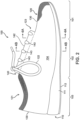
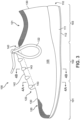
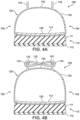
- FIGS. 1-4B illustrate an example of an article of footwear incorporating a knitted component including an upper and an integral knit tongue.
- FIGS. 1 through 4B illustrate an article of footwear 100 useful for understanding the invention, also referred to simply as footwear 100.
- article of footwear 100 may include a sole structure 110 and an upper 120.
- footwear 100 is illustrated as having a general configuration suitable for running, concepts associated with footwear 100 may also be applied to a variety of other athletic footwear types, including baseball shoes, basketball shoes, cycling shoes, football shoes, tennis shoes, soccer shoes, training shoes, walking shoes, and hiking boots, for example.
- the concepts may also be applied to footwear types that are generally considered to be non-athletic, including dress shoes, loafers, sandals, and work boots. Accordingly, the concepts disclosed with respect to footwear 100 may be applied to a wide variety of footwear types.
- footwear 100 may be divided into three general regions: a forefoot region 101, a midfoot region 102, and a heel region 103, as shown in FIGS. 1 , 2 , and 3 .
- Forefoot region 101 generally includes portions of footwear 100 corresponding with the toes and the joints connecting the metatarsals with the phalanges.
- Midfoot region 102 generally includes portions of footwear 100 corresponding with an arch area of the foot.
- Heel region 103 generally corresponds with rear portions of the foot, including the calcaneus bone.
- Footwear 100 also includes a lateral side 104 and a medial side 105, which extend through each of forefoot region 101, midfoot region 102, and heel region 103 and correspond with opposite sides of footwear 100.
- lateral side 104 corresponds with an outside area of the foot (i.e., the surface that faces away from the other foot), and medial side 105 corresponds with an inside area of the foot (i.e., the surface that faces toward the other foot).
- medial side 105 are not intended to demarcate precise areas of footwear 100. Rather, forefoot region 101, midfoot region 102, and heel region 103 and lateral side 104, medial side 105 are intended to represent general areas of footwear 100 to aid in the following discussion.
- medial side 105 may also be applied to sole structure 110, upper 120, and individual elements thereof.
- sole structure 110 is secured to upper 120 and extends between the foot and the ground when footwear 100 is worn.
- the primary elements of sole structure 110 are a midsole 111, an outsole 112, and a sockliner 113 (shown in FIGS. 4A and 4B ).
- Midsole 111 is secured to a lower surface of upper 120 and may be formed from a compressible polymer foam element (e.g., a polyurethane or ethylvinylacetate foam) that attenuates ground reaction forces (i.e., provides cushioning) when compressed between the foot and the ground during walking, running, or other ambulatory activities.
- a compressible polymer foam element e.g., a polyurethane or ethylvinylacetate foam
- midsole 111 may incorporate plates, moderators, fluid-filled chambers, lasting elements, or motion control members that further attenuate forces, enhance stability, or influence the motions of the foot, or midsole 111 may be primarily formed from a fluid-filled chamber.
- Outsole 112 is secured to a lower surface of midsole 111 and may be formed from a wear-resistant rubber material that is textured to impart traction.
- Sockliner 113 is located within upper 120 and is positioned to extend under a lower surface of the foot to enhance the comfort of footwear 100.
- this configuration for sole structure 110 provides an example of a sole structure that may be used in connection with upper 120, a variety of other conventional or nonconventional configurations for sole structure 110 may also be used. Accordingly, in other embodiments, the features of sole structure 110 or any sole structure used with upper 120 may vary.
- upper 120 defines a void within footwear 100 for receiving and securing a foot relative to sole structure 110.
- the void is shaped to accommodate the foot and extends along a lateral side of the foot, along a medial side of the foot, over the foot, around the heel, and under the foot.
- Access to the void is provided by an ankle opening 121 located in at least heel region 103.
- a throat area 123 extends from ankle opening 121 in heel region 103 over an area corresponding to an instep of the foot to an area adjacent to forefoot region 101.
- an integral knit tongue 140 is formed of unitary knit construction with upper 120 and extends through throat area 123 of upper 120 between lateral side 104 and medial side 105.
- a lace 122 extends through various lace apertures 143 in raised elements 142 of integral knit tongue 140 and permits the wearer to modify dimensions of upper 120 to accommodate proportions of the foot. More particularly, lace 122 permits the wearer to tighten upper 120 around the foot, and lace 122 permits the wearer to loosen upper 120 to facilitate entry and removal of the foot from the void (i.e., through ankle opening 121). In addition, integral knit tongue 140 of upper 120 extends under lace 122 to enhance the comfort of footwear 100.
- upper 120 may include additional elements, such as (a) a heel counter in heel region 103 that enhances stability, (b) a toe guard in forefoot region 101 that is formed of a wear-resistant material, and (c) logos, trademarks, and placards with care instructions and material information.
- additional elements such as (a) a heel counter in heel region 103 that enhances stability, (b) a toe guard in forefoot region 101 that is formed of a wear-resistant material, and (c) logos, trademarks, and placards with care instructions and material information.
- Additional advantages of constructing integral knit tongue 140 during the knitting process and of unitary knit construction with upper 120 include providing more efficient manufacture and common properties. More particularly, manufacturing efficiency may be increased by forming more of knitted component 130 during the knitting process and eliminating various steps (e.g., making a separate tongue, securing the tongue) that are often performed manually.
- Integral knit tongue 140 and upper 120 may also have common properties when formed from the same yarn (or type of yarn) or with similar knit structures. For example, using the same yarn in both of integral knit tongue 140 and upper 120 imparts similar durability, strength, stretch, wear-resistance, biodegradability, thermal, and hydrophobic properties.
- FIGS. 5 through 15 illustrate various knitted components that may be incorporated into articles of footwear in a similar manner as the example of FIGS. 1 through 4B .
- the knitted components illustrated in FIGS. 5 through 15 are depicted separate from a remainder of footwear 100.
- each of the embodiments of knitted components described herein may be combined with the elements of footwear 100, described above, to form an article of footwear incorporating the knitted component.
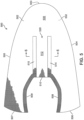
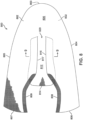
- first knitted component 500 useful for understanding the invention is shown in a top plan view.
- First knitted component 500 may be substantially similar to knitted component 130, described above.
- first knitted component 500 includes a first portion defining an upper 502 and a second portion defining an integral knit tongue 512.
- first knitted component 500 incorporates upper 502 and integral knit tongue element 512 formed of unitary knit construction.
- a knitted component e.g., first knitted component 500, or other knitted components described herein
- a unitary knit construction may be used to form a knitted component having structures or elements (including upper 502 and integral knit tongue 512) that include one or more courses of yarn or other knit material that are joined such that the structures or elements include at least one course in common (i.e., sharing a common yarn) and/or include courses that are substantially continuous between each of the structures or elements.
- structures or elements including upper 502 and integral knit tongue 512
- courses including at least one course in common (i.e., sharing a common yarn) and/or include courses that are substantially continuous between each of the structures or elements.
- first knitted component 500 may be joined to each other (e.g., edges of first knitted component 500 being joined together) following the knitting process, first knitted component 500 remains formed of unitary knit construction because it is formed as a one-piece knit element. Moreover, first knitted component 500 remains formed of unitary knit construction when other elements (e.g., a lace, logos, trademarks, placards with care instructions and material information, structural elements) are added following the knitting process.
- elements e.g., a lace, logos, trademarks, placards with care instructions and material information, structural elements
- first knitted component 500 is a knit element forming upper 502 and integral knit tongue 512.
- a knit element may be formed from at least one yarn that is manipulated (e.g., with a knitting machine) to form a plurality of intermeshed loops that define a variety of courses and wales. That is, the knit element forming first knitted component 500 has the structure of a knit textile.
- Other knitted components including the examples or embodiments described below, may include a knit element and at least one tensile element.
- First knitted component 500 has a generally U-shaped configuration that is outlined by an outer perimeter and an inner perimeter.
- the outer perimeter includes a front perimeter edge 503, a lateral perimeter edge 504, a medial perimeter edge 505, and a pair of heel edges, including a lateral heel edge 506 and a medial heel edge 507.
- the inner perimeter of first knitted component 500 includes a lateral inner edge 508, a medial inner edge 509, and a front inner edge 510.
- lateral heel edge 506 and medial heel edge 507 When incorporated into an article of footwear, including footwear 100, front perimeter edge 503, lateral perimeter edge 504, medial perimeter edge 505, and at least a portion of lateral heel edge 506 and medial heel edge 507 lays against an upper surface of a midsole and is joined to a strobe) sock (e.g., midsole 111 and strobe) sock 125, described above).
- lateral heel edge 506 and medial heel edge 507 are joined to each other and extend vertically in a heel region.
- a material element may cover a seam between lateral heel edge 506 and medial heel edge 507 to reinforce the seam and enhance the aesthetic appeal of the footwear.
- lateral inner edge 508, medial inner edge 509, and front inner edge 510 form an ankle opening, including ankle opening 121 described above, and extends forward to a throat area 520 where integral knit tongue 512 is located. Additionally, in some examples, throat area 520 may further include a lace and lace apertures for receiving the lace.
- first knitted component 500 may have a first surface 530 and an opposite second surface 532.
- First surface 530 forms a portion of the exterior surface of upper 502
- second surface 532 forms a portion of the interior surface of upper 502, thereby defining at least a portion of the void within upper 502.
- a knitted component may incorporate various types of yarn that impart different properties to separate areas of the upper.
- one area of first knitted component 500 may be formed from a first type of yarn that imparts a first set of properties
- another area of first knitted component 500 may be formed from a second type of yarn that imparts a second set of properties.
- properties may vary throughout upper 502 by selecting specific yarns for different areas of first knitted component 500.
- Cotton provides a soft hand, natural aesthetics, and biodegradability.
- Elastane and stretch polyester each provide substantial stretch and recovery, with stretch polyester also providing recyclability.
- Rayon provides high luster and moisture absorption.
- Wool also provides high moisture absorption, in addition to insulating properties and biodegradability.
- Nylon is a durable and abrasion-resistant material with relatively high strength.
- Polyester is a hydrophobic material that also provides relatively high durability.
- a yarn forming first knitted component 500 may be a monofilament yarn or a multifilament yarn.
- the yarn may also include separate filaments that are each formed of different materials.
- the yarn may include filaments that are each formed of two or more different materials, such as a bi-component yarn with filaments having a sheath-core configuration or two halves formed of different materials. Different degrees of twist and crimping, as well as different deniers, may also affect the properties of upper 502. Accordingly, both the materials forming the yarn and other aspects of the yarn may be selected to impart a variety of properties to separate areas of upper 502.
- integral knit tongue 512 may be centrally-located in throat area 520 of first knitted component 500 and may extend from an ankle opening in a heel region over an area corresponding to an instep of the foot to an area adjacent to a forefoot region, as well as extending between a lateral side and a medial side of first knitted component.
- integral knit tongue 512 is formed of unitary knit construction with upper 502 at a forward portion of throat area 520 of first knitted component 500.
- integral knit tongue 512 is joined through knitting to upper 502 at the forward portion of throat area 520 such that integral knit tongue 512 and upper 502 include at least one course in common and/or include courses that are substantially continuous between integral knit tongue 512 and upper 502 at the forward portion of throat area 520.
- integral knit tongue 512 may be further formed of unitary knit construction with upper 502 along the sides of integral knit tongue 512 extending along a length of throat area 520 of first knitted component 500. Accordingly, integral knit tongue 512 is joined through knitting to upper 502 along each of a lateral side and a medial side of throat area 520 such that integral knit tongue 512 and upper 502 include at least one course in common and/or include courses that are substantially continuous between integral knit tongue 512 and upper 502 along the sides extending through throat area 520.
- integral knit tongue 512 may include raised elements disposed on opposite sides of throat area 520 and extending along the length of integral knit tongue 512. Raised elements may be a portion of integral knit tongue 512 that are formed through the knitting process to be a flap or overhanging portion of integral knit tongue 512 that extends outward away from first surface 530 of upper 502. As shown in FIG. 5 , integral knit tongue 512 includes a lateral raised element 514 and a medial raised element 515. In an example, lateral raised element 514 and medial raised element 515 are formed of unitary knit construction with integral knit tongue 512 and upper 502 according to the method below. With this arrangement, lateral raised element 514 and medial raised element 515 include one or more common courses and/or courses that are substantially continuous with integral knit tongue 512 and upper 502.
- raised elements associated with an integral knit tongue may include one or more lace apertures disposed at various locations along the raised element for receiving a lace.
- the lace apertures may be a void or opening within the knitted structure forming the raised element that is sufficient to allow a lace to pass through.
- the lace apertures may be a hole or opening that is cut or removed from the material forming the raised elements.
- the lace apertures may include additional elements, including, but not limited to loops, grommets, eyelets, eye hooks, or other suitable lace receiving members.
- raised elements are formed of unitary knit construction with integral knit tongue 512 and upper 502 such that first knitted component 500 is a one-piece element.
- lateral raised element 514 is joined with upper 502 at a first proximal end 600 and medial raised element 515 is joined with upper 502 at a second proximal end 601.
- Each raised element extends outward from first surface 530 of upper 502 in a flap-like arrangement to form an overhanging portion of integral knit tongue 512.
- lateral raised element 514 extends outward from first proximal end 600 to a first distal end 602 and includes a first outward facing side 604 and a first inward facing side 606.
- medial raised element 515 extends outward from second proximal end 601 to a second distal end 603 and includes a second outward facing side 605 and a second inward facing side 607.
- first outward facing side 604 and/or second outward facing side 605 may be oriented towards each side of first knitted component 500, while first inward facing side 606 and/or second inward facing side 607 may be oriented towards the center of first knitted component 500 where integral knit tongue 512 is located.
- lateral raised element 514 and medial raised element 515 are shown in a flat configuration such that first inward facing side 606 and/or second inward facing side 607 is oriented towards first surface 530.
- raised elements including lateral raised element 514 and medial raised element 515, may be positioned in an upright configuration.
- FIG. 7 lateral raised element 514 and medial raised element 515 are shown in an upright configuration such that first inward facing side 606 and/or second inward facing side 607 is oriented generally perpendicular to or at a raised angle with regard to first surface 530.
- the process of pulling upper 502 tight on opposite sides of integral knit tongue 512 may cause each of lateral raised element 514 and medial raised element 515 to move from the flat configuration to the upright configuration.
- lateral raised element 514 and medial raised element 515 of integral knit tongue 512 may extend a first height H1 above first surface 530 of first knitted component 500.
- upright configuration of lateral raised element 514 and medial raised element 515 may be used to incorporate lace apertures into integral knit tongue 512.
- a plurality of lace apertures 700 are shown disposed along the respective sides of lateral raised element 514 and medial raised element 515 and extending through from first outward facing side 604 to first inward facing side 606 and from second outward facing side 605 to second inward facing side 607.
- plurality of lace apertures 700 may be a void or opening within the knitted structure of integral knit tongue 512 forming the raised elements.
- plurality of lace apertures 700 may have a different structure, including any of the suitable structures for lace apertures described above.
- Second knitted component 800 may be substantially similar to knitted component 130 and/or first knitted component 500, described above.
- second knitted component 800 includes a first portion defining an upper 802 and a second portion defining an integral knit tongue 812.
- second knitted component 800 incorporates upper 802 and integral knit tongue 812 formed of unitary knit construction.
- second knitted component 800 has a generally U-shaped configuration that is outlined by an outer perimeter and an inner perimeter.
- the outer perimeter includes a front perimeter edge 803, a lateral perimeter edge 804, a medial perimeter edge 805, and a pair of heel edges, including a lateral heel edge 806 and a medial heel edge 807.
- the inner perimeter of second knitted component 800 includes a lateral inner edge 808 and a medial inner edge 809 which may form an ankle opening.
- second knitted component 800 may have a first surface 830 forming a portion of the exterior surface of upper 802 and an opposite second surface 832 forming a portion of the interior surface of upper 802.
- second knitted component 800 may include integral knit tongue 812 that includes a top end 814 that extends into the portion of second knitted component 800 that is associated with an ankle opening. Top end 814 may be generally free from other portions of second knitted component 800. Integral knit tongue 812 may be formed of unitary knit construction with upper 802 at a forward portion of a throat area 820 of second knitted component 800 and along the sides of integral knit tongue 812 extending along a length of throat area 820. In an example, integral tongue 812 of second knitted component 800 does not include raised elements.
- second knitted component 800 includes a portion of upper 802 that extends over integral knit tongue 812 to form a lateral inner edge 816 and a medial inner edge 817. More particularly, edges of integral knit tongue 812 are knit to an area of second knitted component 800 that is spaced outward from lateral inner edge 816 and medial inner edge 817.
- edges of integral knit tongue 812 are formed of unitary knit construction with upper 802 such that second knitted component 800 is a one-piece element.
- first edge 900 and second edge 902 of integral knit tongue 812 are joined with second surface 832 of upper 802 such that integral knit tongue 812 extends below lateral inner edge 816 and medial inner edge 817 of upper 802.
- a top surface of integral knit tongue 812 may be oriented facing towards second surface 832 of second knitted component 800 disposed on the portion of upper 802 extending out to lateral inner edge 816 and medial inner edge 817.
- the configuration of integral knit tongue 812 included in second knitted component 800 may be provided to lay in a substantially flat condition.
- provisions may be made within a knitted component to assist a wearer with inserting and/or removing a foot from an ankle opening of an article of footwear.
- an integral knit tongue of a knitted component may be modified to allow for a larger ankle opening.
- FIGS. 10 through 15 illustrate embodiments of knitted components that have been provided with mechanisms to allow a larger ankle opening when incorporated into an article of footwear.
- FIGS. 10 through 12 illustrate an embodiment of a knitted component that includes a mechanism to allow a larger ankle opening when incorporated into an article of footwear and that falls within the knitted component as manufactured by the claimed method.
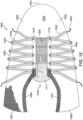
- FIG. 10 a top plan view of an alternate embodiment of a knitted component with an integral knit tongue having a partially integral portion is illustrated.
- a third knitted component 1000 includes a first portion defining an upper 1002 and a second portion defining an integral knit tongue 1010.
- Third knitted component 1000 may be substantially similar to knitted component 130, first knitted component 500, and/or second knitted component 800, described above.
- third knitted component 1000 may have a generally U-shaped configuration that is outlined by an outer perimeter and an inner perimeter.
- the outer perimeter includes a front perimeter edge 1003, a lateral perimeter edge 1004, a medial perimeter edge 1005, and a pair of heel edges, including a lateral heel edge 1006 and a medial heel edge 1007.
- the inner perimeter of third knitted component 1000 includes a lateral inner edge 1008 and a medial inner edge 1009 which may form an ankle opening.
- third knitted component 1000 may have a first surface 1030 forming a portion of the exterior surface of upper 1002 and an opposite second surface 1032 forming a portion of the interior surface of upper 1002.
- third knitted component 1000 may further include additional structures.
- third knitted component 1000 may include at least one tensile element 1040 that is inlaid within the knit structure of third knitted component 1000.
- Suitable materials for tensile element 1040 may include, but is not limited to, yarn or an inlaid strand in the configuration of a filament (e.g., a monofilament), thread, rope, webbing, cable, or chain.
- Tensile element 1040 extends through third knitted component 1000 and passes between the various loops within a knit structure 1042 formed within third knitted component 1000. Although tensile element 1040 generally extends along courses within knit structure 1042, tensile element 1040 may also extend along wales within knit structure 1042.
- tensile element 1040 include providing support, stability, and structure.
- tensile element 1040 assists with securing upper 1002 around the foot, limits deformation in areas of upper 1002 (e.g., imparts stretch-resistance) and operates in connection with a lace to enhance the fit of the article of footwear incorporating third knitted component.
- a tensile element in the form of an inlaid strand or other suitable element, as well as the method of manufacturing a knitted component incorporating an inlaid strand and knit structures, for use in the embodiments described herein is disclosed in one or more of commonly-owned U.S. Patent Application Serial Number 12/338,726 to Dua et al., entitled “Article of Footwear Having An Upper Incorporating A Knitted Component", filed on December 18, 2008 and published as U.S. Patent Application Publication Number 2010/0154256 on June 24, 2010 , and U.S.
- Patent Application Serial Number 13/048,514 to Huffa et al. entitled “Article Of Footwear Incorporating A Knitted Component", filed on March 15, 2011 and published as U.S. Patent Application Publication Number 2012/0233882 on September 20, 2012 (collectively referred to herein as the "Inlaid Strand cases”).
- partially integral portion 1012 may be centrally-located in a throat area 1020 of third knitted component 1000 and may extend from a distance D1 adjacent to an ankle opening in a heel region over an area corresponding to an instep of the foot to an area adjacent to a forefoot region, as well as extending between a lateral side and a medial side of third knitted component 1000.
- partially integral portion 1012 is formed of unitary knit construction with upper 1002 at a forward portion of throat area 1020 as well as along the sides extending along a length of throat area 1020 of third knitted component 1000.
- partially integral portion 1012 is joined through knitting to upper 1002 along the forward portion and each of a lateral side and a medial side of throat area 1020 such that partially integral portion 1012 and upper 1002 include at least one course in common and/or include courses that are substantially continuous.
- integral knit tongue 1010 may include raised elements disposed on opposite sides of throat area 1020 and extending along the length of integral knit tongue 1010. Raised elements may be a portion of integral knit tongue 1010 that are formed through the knitting process to be a flap or overhanging portion of integral knit tongue 1010 that extends outward away from first surface 1030 of upper 1002. As shown in FIGS. 10 and 11 , integral knit tongue 1010 includes a lateral raised element 1016 and a medial raised element 1015 that are formed of unitary knit construction with upper 1002 and partially integral portion 1012 of integral knit tongue 1010. Lateral raised element 1016 and/or medial raised element 1015 may be substantially similar to, and similarly formed as lateral raised element 514 and medial raised element 515, described above.
- free portion 1014 may be disposed at a top end of throat area 1020 of third knitted component 1000 adjacent to the ankle opening.
- free portion 1014 is formed of a unitary knit construction with partially integral portion 1012 at a rearward portion 1100 of throat area 1020, but is otherwise not joined or attached to other portions of upper 1002 and/or third knitted component 1000.
- an ankle opening may be provided with a larger opening corresponding to the location of rearward portion 1100 of partially integral portion 1012 of integral knit tongue 1010 that extends distance D1 from the ankle opening along throat area 1020 of third knitted component 1000.
- Free portion 1014 of integral knit tongue 1010 may serve to cover a foot of a wearer disposed within the ankle opening to enhance the comfort of the article of footwear incorporating third knitted component 1000.
- partially integral portion 1012 of integral knit tongue 1010 may include multiple knit structures, including knit structures of different types.
- partially integral portion 1012 may include a first knit structure 1102 and a second knit structure 1104.
- First knit structure 1102 may be associated with a first knit type and may be centrally located and extending along integral knit tongue 1010 from rearward portion 1100 to the forward portion of throat area 1020.
- Second knit structure 1104 may be associated with a second knit type and may be located along peripheral sides of integral knit tongue 1010 between first knit structure 1102 and each of lateral raised element 1016 and medial raised element 1015 extending similarly from rearward portion 1100 to the forward portion of throat area 1020.
- first knit structure 1102 and second knit structure 1104 may be different knit structures or different types of knit structures.
- first knit structure 1102 may be a mesh or similar knit type and second knit structure 1104 may be a jersey or similar knit type.
- first knit structure 1102 may be a double-knit jersey structure and second knit structure 1104 may be a single-knit jersey structure.
- first knit structure 1102 may have a greater thickness than second knit structure 1104 disposed on either peripheral side of first knit structure 1102 extending along the length of partially integral portion 1012 of integral knit tongue 1010.
- lace apertures for receiving a lace is provided by tensile element 1040.
- a plurality of lace loops 1110 may be disposed at portions of tensile element 1040 that extend out from knit structure 1042 adjacent to lateral raised element 1016 and medial raised element 1015 on opposite sides of throat area 1020 of third knitted component 1000.
- a lace (not shown) may be disposed through plurality of lace loops 1110 to assist with securing an article of footwear incorporating third knitted component 1000 onto a foot of a wearer.
- FIGS. 13 through 15 illustrate another embodiment of a knitted component with a mechanism to allow a larger ankle opening when incorporated into an article of footwear.
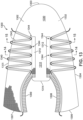
- a top plan view of an alternate embodiment of a knitted component with an integral knit tongue having partially decoupled knit elements is illustrated.
- a fourth knitted component 1300 includes a first portion defining an upper 1302 and a second portion defining an integral knit tongue 1310.
- Fourth knitted component 1300 may share one or more substantially similar features with knitted component 130, first knitted component 500, second knitted component 800, and/or third knitted component 1000, described above.
- fourth knitted component 1300 may similarly have a generally U-shaped configuration that is outlined by an outer perimeter and an inner perimeter.
- the outer perimeter includes a front perimeter edge 1303, a lateral perimeter edge 1304, a medial perimeter edge 1305, and a pair of heel edges, including a lateral heel edge 1306 and a medial heel edge 1307.
- the inner perimeter of fourth knitted component 1300 includes a lateral inner edge 1308 and a medial inner edge 1309 which may form an ankle opening.
- fourth knitted component 1300 may have a first surface 1330 forming a portion of the exterior surface of upper 1302 and an opposite second surface 1332 forming a portion of the interior surface of upper 1302.
- fourth knitted component 1300 may further include additional structures, including at least one tensile element 1340 that is inlaid within a knit structure 1342 of fourth knitted component 1300.
- Tensile element 1340 may be substantially similar to tensile element 1040, described above, including suitable materials and methods of manufacturing a knitted component incorporating tensile elements and knit structures disclosed in the Inlaid Strand cases.
- tensile element 1340 may further include a plurality of lace loops 1344 that may be configured to receive a lace. Plurality of lace loops 1344 may be disposed at portions of tensile element 1340 that extend out from knit structure 1342 and may have a substantially similar structure as lace loops 1110, described above.
- lace loops 1344 may serve as lace apertures for receiving a lace. In other cases, lace loops 1344 may coordinate with one or more lace apertures disposed within raised elements of integral knit tongue 1310 to receive a lace. In still other cases, lace loops 1344 may be disposed through lace apertures disposed within raised elements and may receive a lace that extends through a throat area 1320 of upper 1302.
- fourth knitted component 1300 incorporates upper 1302 and integral knit tongue 1310 formed of unitary knit construction such that at least a portion of upper 1302 and a portion of integral knit tongue 1310 are a one-piece element.
- portions of upper 1302 may be formed from multiple knit element layers.
- integral knit tongue 1310 may be formed of unitary knit construction with at least one of the knit element layers.
- integral knit tongue 1310 may be centrally-located in throat area 1320 of fourth knitted component 1300 and may extend from a top end 1314 adjacent to an ankle opening in a heel region over an area corresponding to an instep of the foot to an area adjacent to a forefoot region, as well as extending between a lateral side and a medial side of upper 1302.
- integral knit tongue 1310 is formed of unitary knit construction with at least one knit element layer associated with upper 1302 at a forward portion of throat area 1320 and along the sides extending along a length of throat area 1320 of fourth knitted component 1300.
- fourth knitted component 1300 may further include raised elements disposed on opposite sides of throat area 1320 and extending along the length of integral knit tongue 1310. As shown in FIGS. 13 through 15 , fourth knitted component 1300 includes a lateral raised element 1312 and a medial raised element 1313 that are formed of unitary knit construction with at least one knit element layer of upper 1302. Lateral raised element 1312 and/or medial raised element 1313 may be substantially similar to, and similarly formed as lateral raised elements 514, 1016 and/or medial raised elements 515, 1015, described above.
- the portion of fourth knitted component 1300 forming integral knit tongue 1310 may made from a different material than the remaining portion of fourth knitted component 1300.
- integral knit tongue 1310 may be made from an elastic yarn that has a large degree of elasticity, while the remaining portions of fourth knitted component 1300 may be made from a regular yarn that is substantially inelastic or that has a smaller degree of elasticity compared with the elastic yarn.
- integral knit tongue portion 1310 of fourth knitted component 1300 may be configured with throat area 1320 that is allowed to stretch to accommodate a foot of a wearer inserted through an ankle opening of an article of footwear incorporating fourth knitted component 1300.
- the throat area 1320 may further be permitted to stretch to allow a larger ankle opening for an article of footwear incorporating fourth knitted component 1300.
- the partial decoupling of the first knit element layer and the second knit element layer may be shown in FIGS. 14 and 15 .
- upper 1302 may include a first knit element layer 1400 associated with first surface 1330 of fourth knitted component 1300 and a second knit element layer 1402 associated with second surface 1332 of fourth knitted component 1300.
- first knit element layer 1400 and second knit element layer 1402 may be partially decoupled at the portion of fourth knitted component 1300 associated with integral knit tongue 1310. That is, while other portions of fourth knitted component 1300 may include a single knit element having first surface 1330 on one side and second surface 1332 on the opposite side, the partially decoupled portion of fourth knitted component 1300 includes separate first knit element layer 1400 and second knit element layer 1402 disposed adjacent to one another, but not joined along the entirety of their surfaces.
- first surface 1330 is disposed on one side of first knit element layer 1400 and second surface 1332 is disposed on one side of second knit element layer 1402.
- first knit element layer 1400 and second knit element layer 1402 may be rejoined with one another through the knitting process so as to form a single knit element extending through the remaining portion of fourth knitted component 1300.
- integral knit tongue 1310 may be formed of unitary knit construction with at least one knit element layer.
- integral knit tongue 1310 is formed of unitary knit construction with second knit element layer 1402.
- integral knit tongue 1310 is joined through knitting to second knit element layer 1402 of upper 1302 along each of a lateral side and a medial side of throat area 1320 such that integral knit tongue 1310 and second knit element layer 1402 include at least one course in common and/or include courses that are substantially continuous between integral knit tongue 1310 and second knit element layer 1402 along the sides of upper 1302 extending through throat area 1320.
- raised elements including lateral raised element 1312 and medial raised element 1313, may be formed of unitary knit construction with first knit element layer 1400.
- integral knit tongue 1310 includes multiple knit structures, including knit structures of different types, as described above.
- integral knit tongue 1310 may include a first knit structure 1410 and a second knit structure 1412.
- First knit structure 1410 may be associated with a first knit type and may be centrally located and extending along integral knit tongue 1310 from a rearward portion to the forward portion of throat area 1320.
- Second knit structure 1412 may be associated with a second knit type and may be located along peripheral sides of integral knit tongue 1310 between first knit structure 1410 and each of lateral raised element 1312 and medial raised element 1313 extending similarly from the rearward portion to the forward portion of throat area 1320.
- first knit structure 1410 and second knit structure 1412 may be similar made of an elastic yarn, however, first knit structure 1410 may be a double-knit jersey structure and second knit structure 1412 may be a single-knit jersey structure. As shown in FIGS. 14 and 15 , first knit structure 1410 may have a greater thickness than second knit structure 1412.
- portions of first knit element layer 1400 and second knit element layer 1402 may be joined to secure first knit element layer 1400 and second knit element layer 1402 at desired locations along integral knit tongue 1310.
- a first yarn 1404 may be used to join first knit element layer 1400 to second knit element layer 1402 at a first end 1406 where lateral raised element 1312 begins to extend outward over integral knit tongue 1310.
- a second yarn 1403 may be used to join first knit element layer 1400 to second knit element layer 1402 at a second end 1405 where medial raised element 1313 begins to extend outward over integral knit tongue 1310.
- first yarn 1404 and/or second yarn 1403 may include a single yarn or a plurality of yarns from fourth knitted component 1300 that join first knit element layer 1400 to second knit element layer 1402 during the knitting process.
- first yarn 1404 and/or second yarn 1403 may include a stitch or a plurality of stitches that are used to join first knit element layer 1400 to second knit element layer 1402 after the knitting process.
- first yarn 1404 and/or second yarn 1403 may be chosen to coincide with one or more of lace loops 1344 of tensile element 1340.
- first knit element layer 1400 and second knit element layer 1402 may be secured to each other at the location that corresponds to where a lace may be used to secure throat area 1320 of upper 1302 to fit onto a foot of a wearer of an article of footwear incorporating fourth knitted component 1300.
- the partially decoupled portion of fourth knitted component 1300 shown in FIG. 15 does not include first yarn 1404 and/or second yarn 1403 joining first knit element layer 1400 to second knit element layer 1402.
- first knit element layer 1400 and second knit element layer 1402 may be allowed to move independently of one another.
- This arrangement together with the use of an elastic yarn to form one or more portions of second knit element layer forming integral knit tongue 1310, allows throat area 1320 to stretch to allow a larger ankle opening for an article of footwear incorporating fourth knitted component 1300.
- FIGS. 16 through 29 illustrate various knitting processes that may be used to manufacture a knitted component in accordance with the principles described herein.
- the different knit structures of a particular knitted component may be made using various types of knit structures, including knit types and yarn types.
- the integral knit tongue of a knitted component that includes raised elements along a medial side and a lateral side may be formed using a specific knitting process.
- FIG. 16 depicts a loop diagram of the manner in which raised elements associated with an integral knit tongue, including, for example, any of raised elements 142, raised elements 514, 515, raised elements 1015, 1016, and/or raised elements 1312, 1313 is formed with a knitting process 1600.
- knitting process 1600 for an integral knit tongue having raised elements may include loop diagrams indicating the direction and type of knitting operation being performed to make the integral knit tongue. It should be understood that the remaining portion of a knitted component may be made according to any suitable knitting process, knitting process 1600 details an exemplary knitting process for an integral knit tongue portion of the overall knitted component. Accordingly, in a first step 1601, yarn is transferred to a back bed of a knitting machine. Next, in a second step 1602, the yarn is knit along a first direction as shown, then back along a second, opposite direction in a third step 1603. Next, in a fourth step 1604, the yarn is transferred to a front bed of the knitting machine and the yarn is knit along the first direction in a fifth step 1605.
- a raised element along one side of the integral knit tongue is formed. While an exemplary knit type is illustrated for fifth step 1605 which may form the central portion of an integral knit tongue, any suitable knit type may be used to make a central portion of the integral knit tongue having any desired knit structure.
- a raised element disposed on the opposite side of the integral knit tongue may also be formed.
- the yarn may be transferred to the back bed of the knitting machine at a sixth step 1606 and the yarn is knit along the second direction as shown in a seventh step 1607, then back along in the opposite, first direction in an eighth step 1608.
- the yarn may then be transferred back to the front bed of the knitting machine at a ninth step 1609 and the yarn is knit along the second direction in a tenth step 1610 along the entirety of the width of the integral knit tongue.
- the exemplary knitting process 1600 may be repeated multiple times to make an integral knit tongue with raised elements having the desired length along the knitted component.
- portions of the integral knit tongue may be made wider or narrower by changing a number of needles that are associated with knitting process 1600.
- portions of knitting process 1600, including fifth step 1605 and/or tenth step 1610, may be varied to include a larger or smaller number of needles to correspondingly increase or decrease the width of the integral knit tongue.
- other knitting processes not shown here may be used to make the remaining portions of the knitted component.
- each raised element is made from a double-jersey half-gauge knit
- the central portion of the integral knit tongue is made from a single-jersey half-gauge knit.
- one or more knit types may vary.
- the central portion of the integral knit tongue may include one or more portions of full-gauge (or "all-needle") single or double-jersey knit.
- the width of various knit types along the central portion of the integral tongue may be varied repeatedly, for example, by using different numbers of needles, as noted above.
- Still other cases may include a combination of knit types and/or knit structures employing various combinations of knit, tuck, or float stitches.
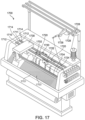
- FIG. 17 illustrates an exemplary embodiment of a knitting machine 1700 that is suitable for producing any of the knitted components described in the previous embodiments, including knitted component 130, first knitted component 500, second knitted component 800, third knitted component 1000, and/or fourth knitted component 1300, as well as other configurations of knitted components not explicitly illustrated or described but made according to the principles described herein.
- knitting machine 1700 has a configuration of a V-bed flat knitting machine for purposes of example, but any of the knitted components or portions of knitted components may be produced on other types of knitting machines.
- knitting machine 1700 may include two needle beds, including a front needle bed 1701 and a back needle bed 1702, that are angled with respect to each other, thereby forming a V-bed.
- Each of front needle bed 1701 and back needle bed 1702 include a plurality of individual needles that lay on a common plane, including needles 1703 associated with front bed 1701 and needles 1704 associated with back bed 1702. That is, needles 1703 from front needle bed 1701 lay on a first plane, and needles 1704 from back needle bed 1702 lay on a second plane.
- the first plane and the second plane are angled relative to each other and meet to form an intersection that extends along a majority of a width of knitting machine 1700.
- needles 1703, 1704 each have a first position where they are retracted and a second position where they are extended. In the first position, needles 1703, 1704 are spaced from the intersection where the first plane and the second plane meet. In the second position, however, needles 1703, 1704 pass through the intersection where the first plane and the second plane meet.
- a pair of rails including a forward rail 1710 and a rear rail 1711, extends above and parallel to the intersection of needle beds 1701, 1702 and provide attachment points for multiple standard feeders 1720 and combination feeders 1722.
- Each rail 1710, 1711 has two sides, each of which accommodates either one standard feeder 1720 or one combination feeder 1722.
- rails 1710, 1711 include a front side 1712 and a back side 1714.
- knitting machine 1700 may include a total of four feeders 1720 and 1722.
- the forward-most rail, forward rail 1710 includes one combination feeder 1722 and one standard feeder 1720 on opposite sides
- the rearward-most rail, rear rail 1711 includes two standard feeders 1720 on opposite sides.
- further configurations of knitting machine 1700 may incorporate additional rails to provide attachment points for more standard feeders 1720 and/or combination feeders 1722.
- a yarn 1724 is provided to combination feeder 1722 by a spool 1726. More particularly, yarn 1724 extends from spool 1726 to various yarn guides 1728, a yarn take-back spring, and a yarn tensioner before entering combination feeder 1722. Although not depicted, additional spools may be used to provide yarns to feeders 1720 in a substantially similar manner as spool 1726.
- Standard feeders 1720 are conventionally-used for a V-bed flat knitting machine, such as knitting machine 1700. That is, existing knitting machines incorporate standard feeders 1720. Each standard feeder 1720 has the ability to supply a yarn that needles 1703, 1704 manipulate to knit, tuck, and float. As a comparison, combination feeder 1722 has the ability to supply a yarn (e.g., yarn 1724) that needles 1703, 1704 knit, tuck, and float, and combination feeder 1722 further has the ability to inlay the yarn. Moreover, combination feeder 1722 has the ability to inlay a variety of different tensile elements, including yarn or other types of strands (e.g., filament, thread, rope, webbing, cable, or chain). Accordingly, combination feeder 1722 exhibits greater versatility than each standard feeder 1720.
- tensile elements including yarn or other types of strands (e.g., filament, thread, rope, webbing, cable, or chain). Accordingly, combination feeder 1722 exhibits greater versatility than each standard
- Standard feeders 1720 and combination feeder 1722 may have substantially similar configurations as the structure of standard feeders and the combination feeder described in U.S. Patent Application Serial Number 13/400,511, entitled “Article Of Footwear Incorporating A Knitted Component With A Tongue”, filed on February 20, 2012 .
- knitting machine 1700 operates to manufacture a knitted component
- the knitting process discussed herein relates to the formation of various knitted components, which may be any knitted component, including knitted components that are similar to knitted components in the embodiments described above.
- various knitted components which may be any knitted component, including knitted components that are similar to knitted components in the embodiments described above.
- only a relatively small section of a knitted component may be shown in the figures in order to permit the knit structure to be illustrated.
- the scale or proportions of the various elements of knitting machine 1700 and a knitted component may be enhanced to better illustrate the knitting process.
- a knitted component is formed between needle beds 1701, 1702, for purposes of illustration in FIGS. 18 through 29 , a knitted component is shown adjacent to needle beds 1701, 1702 to (a) be more visible during discussion of the knitting process and (b) show the position of portions of the knitted component relative to each other and needle beds 1701, 1702.
- one rail, and limited numbers of standard feeders and combination feeders are depicted, additional rails, standard feeders, and combination feeders may be used. Accordingly, the general structure of knitting machine 1700 is simplified for purposes of explaining the knitting process.
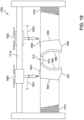
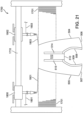
- FIGS. 18 through 21 illustrate an exemplary process of knitting a knitted component in the form of first knitted component 500 useful for understanding the invention, described above.
- knitting machine 1700 may include a first standard feeder 1800 and a second standard feeder 1802 that are substantially similar to standard feeder 1720, described above.
- First standard feeder 1800 may be secured to a front side of front rail 1710 and second standard feeder 1802 may be secured to a rear side of front rail 1710.
- additional feeders may be used and may be located on the front or rear side of front rail 1710 and/or rear rail 1711.
- a first yarn 1801 from a spool passes through first standard feeder 1800 and an end of yarn 1801 extends outward from a dispensing tip at the end of first standard feeder 1800.
- first standard feeder 1800 any other strand (e.g., filament, thread, rope, webbing, cable, chain, or yarn) may pass through first standard feeder 1800.
- a second yarn 1803 similarly passes through second standard feeder 1802 and extends outward from a dispensing tip.
- first yarn 1801 and second yarn 1803 may be used to form portions of second knitted component 500.
- loops of first yarn 1801 are shown forming an uppermost course of medial heel edge 507 of second knitted component 500 and are held by hooks located on ends of needles 1703 and needles 1704.
- loops of second yarn 1803 may be used to form lateral heel edge 506 of second knitted component 500.
- knitting machine 1700 may use a similar process to add additional courses to the material forming second knitted component 500 to form further portions, including lateral perimeter edge 504, medial perimeter edge 505, lateral inner edge 508, medial inner edge 509, and front inner edge 510 of integral knit tongue 512.
- first standard feeder 1800 and second standard feeder 1802 may form integral knit tongue 512 according to the loop diagram illustrated in FIG. 16 , above.
- FIG. 20 illustrates knitting machine 1700 completing the courses associated with knitting integral knit tongue 512, lateral raised element 514, medial raised element 515, and a portion of the rest of second knitted component 500 forming upper 502.
- FIG. 21 illustrates knitting machine 1700 nearly completing the knitting process of forming second knitted component 500. By adding additional courses using a similar process, second knitted component 500 may be completed.
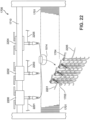
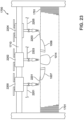
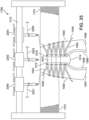
- FIGS. 22 through 25 illustrate an exemplary process of knitting a knitted component in the form of third knitted component 1000, described above.
- knitting machine 1700 may include a first standard feeder 2200 and a second standard feeder 2204 that are substantially similar to standard feeder 1720, described above and a combination feeder 2202 that is substantially similar to combination feeder 1722, described above.
- First standard feeder 1800 and combination feeder 2202 may be secured to a front side of front rail 1710 and second standard feeder 2204 may be secured to a rear side of front rail 1710.
- additional feeders may be used and may be located on the front or rear side of front rail 1710 and/or rear rail 1711.
- a first yarn 2201 from a spool passes through first standard feeder 2200 and an end of yarn 2201 extends outward from a dispensing tip at the end of first standard feeder 2200.
- first standard feeder 2200 any other strand (e.g., filament, thread, rope, webbing, cable, chain, or yarn) may pass through first standard feeder 2200.
- a second yarn 2205 similarly passes through second standard feeder 2204 and extends outward from a dispensing tip.
- a third yarn 2203 passes through combination feeder 2202 to a dispensing tip.
- third yarn 2203 may be a different type of yarn than first yarn 2201 and/or second yarn 2205.
- third yarn 2203 may be a tensile element or other inlaid strand.
- first yarn 2201 and second yarn 2205 may be used to form portions of a knit element of third knitted component 1000, whereas third yarn 2203 may be inlaid within the knit element as a tensile element of third knitted component 1000.
- third yarn 2203 may be used to form portions of a knit element of third knitted component 1000.
- FIG. 23 illustrates knitting machine 1700 completing the courses forming free portion 1014.
- at least the final course of free portion 1014 may include cross-tuck stitches with a relatively tight or dense knit to ensure that free portion 1014 of integral knit tongue 1010 remains properly positioned on needles 1701, 1702 during later stages of the knitting process to be joined with the remaining portion of integral knit tongue 1010.
- Knitting machine 1700 now begins the process of forming the remaining portion of the knit element forming third knitted component 1000, in accordance with a similar knitting process discussed above.
- loops of first yarn 2201 may then begin to form an uppermost course of medial heel edge 1007 of third knitted component 1000 and loops of second yarn 2205 may be used to form lateral heel edge 1006 of third knitted component 1000.
- first standard feeder 2200 and second standard feeder 2204 may continue adding courses to third knitting component 1000, including lateral perimeter edge 1004, medial perimeter edge 1005, lateral inner edge 1008, medial inner edge 1009, and partially integral portion 1012 of integral knit tongue 1010.
- first standard feeder 2200 and second standard feeder 2204 may form partially integral portion 1012 of integral knit tongue 1010 according to the loop diagram illustrated in FIG. 16 , above.
- combination feeder 2202 inlays third yarn 2203 to form tensile element 1040, as depicted in FIG. 24 , also in accordance with the knitting process discussed in the Inlaid Strand cases.
- free portion 1014 of integral knit tongue 1010 may remain stationary relative to needle beds 1701, 1702, as the portions of third knitted component 1000 move downward and may overlap free portion 1014 as successive courses are formed in third knitted component 1000. This continues until a course is formed that is intended to join free portion 1014 to the partially integral portion 1012 of integral knit tongue 1010 formed with the rest of third knitted component 1000.
- FIG. 25 illustrates knitting machine 1700 nearly completing the knitting process of forming third knitted component 1000. By adding additional courses using a similar process, third knitted component 1000 may be completed.
- first standard feeder 2200 may be permitted to form both a front and back portion (associated with first surface 1030 and second surface 1032, respectively) of third knitted component 1000 along a medial side and across partially integral portion 1012 of integral knit tongue 1010, but be restricted from forming a portion of third knitted component 1000 along a lateral side.
- second standard feeder 2204 may be permitted to form both the front and back portion of third knitted component 1000 along the lateral side and across partially integral portion 1012 of integral knit tongue 1010, but be restricted from forming a portion of third knitted component 1000 along the medial side.
- the knitting process depicted in FIGS. 22-25 may require that specific feeders are used to form specific portions of third knitted component 1000.
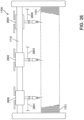
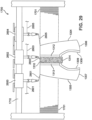
- FIGS. 26 through 29 illustrate an exemplary process of knitting a knitted component similar to fourth knitted component 1300, described above.
- knitting machine 1700 may include a first standard feeder 2600, a second standard feeder 2602, and a third standard feeder 2604 that are substantially similar to standard feeder 1720, described above.
- fourth knitted component 1300 includes tensile elements
- a combination feeder (not shown) that is substantially similar to combination feeder 1722, described above, may be included to form tensile element 1340 according to the process described above with regard to the knitting process of third knitted component 1000 and as described in the Inlaid Strand cases.
- fourth knitted component 1300 will be illustrated in FIGS. 26 through 29 without tensile element 1340.
- first standard feeder 2600 and second standard feeder 2602 may be secured to a front side of front rail 1710 and third standard feeder 2604 may be secured to a rear side of front rail 1710.
- additional feeders may be used and may be located on the front or rear side of front rail 1710 and/or rear rail 1711.
- a first yarn 2601 from a spool passes through first standard feeder 2600 and an end of yarn 2601 extends outward from a dispensing tip at the end of first standard feeder 2600.
- any other strand e.g., filament, thread, rope, webbing, cable, chain, or yarn
- a second yarn 2603 similarly passes through second standard feeder 2602 and extends outward from a dispensing tip.
- a third yarn 2605 also passes through third standard feeder 2604 to a dispensing tip in a similar manner.
- second yarn 2603 may be a different type of yarn than first yarn 2601 and/or third yarn 2605.
- second yarn 2603 may be an elastic yarn that has a larger amount or degree of elasticity than first yarn 2601 and/or third yarn 2605, which may be a substantially inelastic yarn or a yarn with a small amount or degree of elasticity.
- first yarn 2601 and third yarn 2605 may be used to form lateral and medial portions of a knit element forming fourth knitted component 1300
- second yarn 2603 may be used to form the elastic portion of integral knit tongue 1310 that is centrally-located within throat area 1320 of fourth knitted component 1300.
- second yarn 2603 may be further used to form other portions of the knit element of fourth knitted component 1300.
- loops of first yarn 2601 are shown forming an uppermost course of medial heel edge 1307 of fourth knitted component 1300 and loops of third yarn 2605 may be used to form lateral heel edge 1306 of fourth knitted component 1300.
- Second yarn 2603 may not yet be used to form any portion of fourth knitted component 1300.
- knitting machine 1700 may use a similar process to add additional courses to the material forming fourth knitted component 1300 to form further portions, including lateral perimeter edge 1304, medial perimeter edge 1305, lateral inner edge 1308, and medial inner edge 1309.
- second standard feeder 2602 may have begun to use second yarn 2603 to form portions of fourth knitted component 1300, including integral knit tongue 1312, which extends from needles 1701, 1702 to the completed top end 1314.
- second standard feeder 2602 may form integral knit tongue 1310 using an elastic yarn so as to permit throat area 1320 of fourth knitted component 1300 to stretch.
- fourth knitted component 1300 may be formed with one or more decoupled knit layers, as described above.
- FIG. 29 illustrates knitting machine 1700 completing the courses associated with knitting integral knit tongue 1310 and the rest of fourth knitted component 1300 forming upper 1302. By adding additional courses using a similar process, fourth knitted component 1300 may be completed.
- first standard feeder 2600 may be permitted to form both a front and back portion (associated with first surface 1330 and second surface 1332, respectively) of fourth knitted component 1300 along only a medial side of fourth knitted component 1300.
- third standard feeder 2604 may be permitted to form both the front and back portion of fourth knitted component 1300 along only a lateral side of fourth knitted component 1300.
- second standard feeder 2602 may be used to form integral knit tongue 1310 spanning between the lateral side and the medial side of fourth knitted component 1300.
- the knitting process depicted in FIGS. 26-29 may require that specific feeders are used to form specific portions of fourth knitted component 1300.
Landscapes
- Engineering & Computer Science (AREA)
- Textile Engineering (AREA)
- Chemical & Material Sciences (AREA)
- Materials Engineering (AREA)
- Footwear And Its Accessory, Manufacturing Method And Apparatuses (AREA)
- Knitting Of Fabric (AREA)
- Knitting Machines (AREA)
Claims (12)
- Un procédé de fabrication d'un composant tricoté (1000 ; 1300) pour un article chaussant, le procédé comprenant le fait de :tricoter, avec une machine à tricoter (1700), une portion du composant tricoté (1000 ; 1300) définissant une tige (1002 ; 1302), la tige (1002 ; 1302) incluant une portion d'au moins une parmi une surface extérieure du composant tricoté (1000 ; 1300) et une surface intérieure opposée du composant tricoté (1000 ; 1300) ; et detricoter, avec la machine à tricoter (1700), une languette tricotée intégrale (1010 ; 1310) qui est une construction de tricot unitaire avec la tige (1002 ; 1302), la languette tricotée intégrale (1010 ; 1310) s'étendant à travers une zone de gorge (1020 ; 1320) du composant tricoté (1000 ; 1300) ;sachant que la languette tricotée intégrale (1010 ; 1310) est reliée par tricotage avec la machine à tricoter (1700) à une portion antérieure de la zone de gorge (1020 ; 1320) et au moins le long d'une portion d'un côté latéral et d'un côté médial de la zone de gorge (1020 ; 1320) du composant tricoté (1000 ; 1300) s'étendant de la portion antérieure à une ouverture de cheville de la tige (1002 ; 1302),sachant que la languette tricotée intégrale (1010 ; 1310) inclut de multiples structures de tricot de différents types, etcaractérisé en ce queune ouverture de lacet pour la réception d'un lacet (122) est fournie par un élément de traction (1040, 1340).
- Le procédé d'après la revendication 1, sachant quela languette tricotée intégrale (1010 ; 1310) inclut une première structure de tricot (1102) et une deuxième structure de tricot (1104),la première structure de tricot (1102) est un premier type de tricot et qu'elle est située de manière centrale, et s'étend le long de la languette tricotée intégrale (1010 ; 1310),la deuxième structure de tricot (1104) est un deuxième type de tricot et qu'elle est située le long des côtés périphériques de la languette tricotée intégrale (1010 ; 1310).
- Le procédé d'après la revendication 2, sachant que
la première structure de tricot (1102) et la deuxième structure de tricot (1104) sont des structures de tricot différentes ou des types de structures de tricot différents. - Le procédé d'après la revendication 2 ou 3, sachant que
la première structure de tricot (1102) est une maille ou un type de tricot similaire et que la deuxième structure de tricot (1104) est un jersey ou un type de tricot similaire. - Le procédé d'après la revendication 2 ou 3, sachant que
la première structure de tricot (1102) est une structure de jersey à double maille, et que la deuxième structure de tricot (1104) est une structure de jersey à maille simple. - Le procédé d'après l'une quelconque des revendications de 2 à 5, sachant que
la première structure de tricot (1102) présente une épaisseur supérieure à celle de la deuxième structure de tricot (1104). - Le procédé d'après l'une quelconque des revendications précédentes, sachant que
la languette tricotée intégrale (1010 ; 1310) est fabriquée à partir d'un fil élastique qui présente un degré d'élasticité plus important qu'un degré d'élasticité d'un fil à partir duquel sont fabriquées les portions restantes du composant tricoté (1000 ; 1300). - Le procédé d'après l'une quelconque des revendications précédentes,sachant que l'étape de tricotage de la languette tricotée intégrale (1010 ; 1310) inclut la formation d'une rangée de mailles (course) de la languette tricotée intégrale (1010 ; 1310) pour inclure au moins un fil commun avec la tige (1002 ; 1302), ousachant que l'étape d'assemblage de la languette tricotée intégrale (1010 ; 1310) par tricotage inclut la formation d'une rangée de mailles avec la machine à tricoter (1700) qui joint la languette tricotée intégrale (1010 ; 1310) à la tige (1002 ; 1302).
- Le procédé d'après l'une quelconque des revendications précédentes, sachant que la languette tricotée intégrale comprend une portion partiellement intégrale (1012) et une portion libre (1014), le procédé comprenant en outre le fait de :tricoter, avec la machine à tricoter (1700), la portion partiellement intégrale (1012) avec une construction de tricot unitaire avec la tige (1002 ; 1302) au niveau de la portion antérieure de la zone de gorge et au moins le long de la portion du côté latéral et du côté médial de la zone de gorge du composant tricoté ; et detricoter, avec la machine à tricoter (1700), la portion libre (1014) avec une construction de tricot unitaire avec la portion partiellement intégrée (1012) au niveau d'une portion postérieure de la languette tricotée intégrale, et qui reste non attachée aux autres portions du composant tricoté.
- Le procédé d'après la revendication 9, sachant que l'étape de tricotage de la portion libre (1014) comprend en outre le fait de :tricoter la portion libre (1014) de la languette tricotée intégrale avec la machine à tricoter (1700) ; maintenir la portion libre (1014) sur les aiguilles de la machine à tricoter (1700) ;tricoter une première portion de la tige (1002 ; 1302) avec la machine à tricoter (1700) pendant que la portion libre (1014) est maintenue sur les aiguilles, la première portion de la tige (1002 ; 1302) incluant au moins la portion postérieure de la languette tricotée intégrale ;joindre la portion libre (1014) à la languette tricotée intégrale au niveau de la portion postérieure ; et detricoter une deuxième portion de la tige (1002 ; 1302) à l'aide de la machine à tricoter (1700).
- Le procédé récité dans la revendication 10, sachant quel'étape de tricotage de la première portion comprend en outre le fait de maintenir la portion libre de manière stationnaire par rapport à une assise d'aiguille de la machine à tricoter (1700) pendant le tricotage de la première portion de la tige (1002 ; 1302), et la première portion de la tige (1002 ; 1302) se déplaçant par rapport à la portion libre pendant le tricotage de la première portion de la tige (1002 ; 1302) ;l'étape d'assemblage de la portion libre inclut le fait de former une rangée de mailles avec la machine à tricoter (1700) qui assemble la portion libre à la languette tricotée intégrale ; et quel'étape de tricotage de la deuxième portion comprend en outre le fait de déplacer conjointement (moving ... together) la portion libre et la tige (1002 ; 1302) pendant le tricotage de la deuxième portion de la tige (1002 ; 1302).
- Un procédé de formation d'un article chaussant (100) comprenant :le procédé de fabrication du composant tricoté (1000 ; 1300) d'après l'une quelconque des revendications précédentes ; etl'assemblage du composant tricoté (1000 ; 1300) avec une structure de semelle (110).
Priority Applications (1)
| Application Number | Priority Date | Filing Date | Title |
|---|---|---|---|
| EP25162837.6A EP4545694A1 (fr) | 2012-02-20 | 2014-02-27 | Procédé de tricotage d'un élément tricoté doté d'une languette en tricot d'une seule pièce |
Applications Claiming Priority (4)
| Application Number | Priority Date | Filing Date | Title |
|---|---|---|---|
| US13/400,511 US8448474B1 (en) | 2012-02-20 | 2012-02-20 | Article of footwear incorporating a knitted component with a tongue |
| US13/781,551 US9060562B2 (en) | 2012-02-20 | 2013-02-28 | Method of knitting a knitted component with an integral knit tongue |
| EP14717892.5A EP2961873B1 (fr) | 2012-02-20 | 2014-02-27 | Procédé de tricotage d'un élément tricoté doté d'une languette en tricot d'une seule pièce |
| PCT/US2014/018852 WO2014134247A1 (fr) | 2012-02-20 | 2014-02-27 | Procédé de tricotage d'un élément tricoté doté d'une languette en tricot d'une seule pièce |
Related Parent Applications (1)
| Application Number | Title | Priority Date | Filing Date |
|---|---|---|---|
| EP14717892.5A Division EP2961873B1 (fr) | 2012-02-20 | 2014-02-27 | Procédé de tricotage d'un élément tricoté doté d'une languette en tricot d'une seule pièce |
Related Child Applications (1)
| Application Number | Title | Priority Date | Filing Date |
|---|---|---|---|
| EP25162837.6A Division EP4545694A1 (fr) | 2012-02-20 | 2014-02-27 | Procédé de tricotage d'un élément tricoté doté d'une languette en tricot d'une seule pièce |
Publications (2)
| Publication Number | Publication Date |
|---|---|
| EP4112793A1 EP4112793A1 (fr) | 2023-01-04 |
| EP4112793B1 true EP4112793B1 (fr) | 2025-03-12 |
Family
ID=48445228
Family Applications (7)
| Application Number | Title | Priority Date | Filing Date |
|---|---|---|---|
| EP24213857.6A Pending EP4487726A3 (fr) | 2012-02-20 | 2013-02-19 | Article chaussant incorporant un composant tricoté avec une languette |
| EP15202457.6A Active EP3031966B1 (fr) | 2012-02-20 | 2013-02-19 | Article de chaussure incorporant un composant tricoté avec une languette |
| EP20151135.9A Active EP3666102B1 (fr) | 2012-02-20 | 2013-02-19 | Article chaussant incorporant un élément tricoté pourvu d'une languette |
| EP13724426.5A Active EP2817442B1 (fr) | 2012-02-20 | 2013-02-19 | Article chaussant incorporant un élément tricoté pourvu d'une languette |
| EP22184470.7A Active EP4112793B1 (fr) | 2012-02-20 | 2014-02-27 | Procédé de tricotage d'un élément tricoté doté d'une languette en tricot d'une seule pièce |
| EP14717892.5A Active EP2961873B1 (fr) | 2012-02-20 | 2014-02-27 | Procédé de tricotage d'un élément tricoté doté d'une languette en tricot d'une seule pièce |
| EP25162837.6A Pending EP4545694A1 (fr) | 2012-02-20 | 2014-02-27 | Procédé de tricotage d'un élément tricoté doté d'une languette en tricot d'une seule pièce |
Family Applications Before (4)
| Application Number | Title | Priority Date | Filing Date |
|---|---|---|---|
| EP24213857.6A Pending EP4487726A3 (fr) | 2012-02-20 | 2013-02-19 | Article chaussant incorporant un composant tricoté avec une languette |
| EP15202457.6A Active EP3031966B1 (fr) | 2012-02-20 | 2013-02-19 | Article de chaussure incorporant un composant tricoté avec une languette |
| EP20151135.9A Active EP3666102B1 (fr) | 2012-02-20 | 2013-02-19 | Article chaussant incorporant un élément tricoté pourvu d'une languette |
| EP13724426.5A Active EP2817442B1 (fr) | 2012-02-20 | 2013-02-19 | Article chaussant incorporant un élément tricoté pourvu d'une languette |
Family Applications After (2)
| Application Number | Title | Priority Date | Filing Date |
|---|---|---|---|
| EP14717892.5A Active EP2961873B1 (fr) | 2012-02-20 | 2014-02-27 | Procédé de tricotage d'un élément tricoté doté d'une languette en tricot d'une seule pièce |
| EP25162837.6A Pending EP4545694A1 (fr) | 2012-02-20 | 2014-02-27 | Procédé de tricotage d'un élément tricoté doté d'une languette en tricot d'une seule pièce |
Country Status (10)
| Country | Link |
|---|---|
| US (12) | US8448474B1 (fr) |
| EP (7) | EP4487726A3 (fr) |
| JP (6) | JP6122878B2 (fr) |
| KR (3) | KR101691779B1 (fr) |
| CN (3) | CN105768363B (fr) |
| AR (1) | AR094973A1 (fr) |
| BR (2) | BR112014020456B1 (fr) |
| DE (7) | DE202013012939U1 (fr) |
| TW (5) | TWI541402B (fr) |
| WO (2) | WO2013126313A2 (fr) |
Families Citing this family (151)
| Publication number | Priority date | Publication date | Assignee | Title |
|---|---|---|---|---|
| US7107235B2 (en) | 2000-03-10 | 2006-09-12 | Lyden Robert M | Method of conducting business including making and selling a custom article of footwear |
| US7347011B2 (en) | 2004-03-03 | 2008-03-25 | Nike, Inc. | Article of footwear having a textile upper |
| US7774956B2 (en) | 2006-11-10 | 2010-08-17 | Nike, Inc. | Article of footwear having a flat knit upper construction or other upper construction |
| US9301569B2 (en) * | 2010-06-22 | 2016-04-05 | Nike, Inc. | Article of footwear with color change portion and method of changing color |
| US9060570B2 (en) | 2011-03-15 | 2015-06-23 | Nike, Inc. | Method of manufacturing a knitted component |
| US10172422B2 (en) * | 2011-03-15 | 2019-01-08 | Nike, Inc. | Knitted footwear component with an inlaid ankle strand |
| US8839532B2 (en) | 2011-03-15 | 2014-09-23 | Nike, Inc. | Article of footwear incorporating a knitted component |
| US10398196B2 (en) | 2011-03-15 | 2019-09-03 | Nike, Inc. | Knitted component with adjustable inlaid strand for an article of footwear |
| US9420845B2 (en) * | 2011-12-27 | 2016-08-23 | Cheng-Tung Hsiao | Shoe upper structure |
| US9510636B2 (en) | 2012-02-20 | 2016-12-06 | Nike, Inc. | Article of footwear incorporating a knitted component with an integral knit tongue |
| US11319651B2 (en) | 2012-02-20 | 2022-05-03 | Nike, Inc. | Article of footwear incorporating a knitted component with an integral knit tongue |
| US8448474B1 (en) | 2012-02-20 | 2013-05-28 | Nike, Inc. | Article of footwear incorporating a knitted component with a tongue |
| US20130255103A1 (en) | 2012-04-03 | 2013-10-03 | Nike, Inc. | Apparel And Other Products Incorporating A Thermoplastic Polymer Material |
| DE102012206062B4 (de) | 2012-04-13 | 2019-09-12 | Adidas Ag | Schuhoberteil |
| US9398784B2 (en) | 2012-11-15 | 2016-07-26 | Nike, Inc. | Article of footwear incorporating a knitted component |
| US10182617B2 (en) | 2012-11-20 | 2019-01-22 | Nike, Inc. | Footwear upper incorporating a knitted component with collar and throat portions |
| US9498023B2 (en) | 2012-11-20 | 2016-11-22 | Nike, Inc. | Footwear upper incorporating a knitted component with sock and tongue portions |
| FR3002551B1 (fr) * | 2013-02-26 | 2015-08-14 | Anton Percy Spielmann | Procede de tricotage d'un element chaussant et element chaussant obtenu par un tel procede. |
| US11666113B2 (en) | 2013-04-19 | 2023-06-06 | Adidas Ag | Shoe with knitted outer sole |
| DE102013207156B4 (de) | 2013-04-19 | 2025-12-24 | Adidas Ag | Schuh, insbesondere ein Sportschuh |
| DE102013207163B4 (de) | 2013-04-19 | 2022-09-22 | Adidas Ag | Schuhoberteil |
| DE102013207155B4 (de) | 2013-04-19 | 2020-04-23 | Adidas Ag | Schuhoberteil |
| US12250994B2 (en) | 2013-04-19 | 2025-03-18 | Adidas Ag | Shoe |
| US9538803B2 (en) * | 2013-05-31 | 2017-01-10 | Nike, Inc. | Method of knitting a knitted component for an article of footwear |
| CN105324050B (zh) * | 2013-06-17 | 2017-05-17 | 株式会社岛精机制作所 | 鞋帮及鞋帮的制造方法 |
| CN108378463B (zh) | 2013-06-25 | 2021-06-25 | 耐克创新有限合伙公司 | 具有编织鞋面的鞋类物品 |
| US10863794B2 (en) | 2013-06-25 | 2020-12-15 | Nike, Inc. | Article of footwear having multiple braided structures |
| US9682519B2 (en) * | 2013-07-26 | 2017-06-20 | Aurora Flight Sciences Corporation | Integral composite bushing system and method |
| US9491983B2 (en) * | 2013-08-19 | 2016-11-15 | Nike, Inc. | Article of footwear with adjustable sole |
| US10645990B2 (en) | 2013-08-19 | 2020-05-12 | Nike, Inc. | Article of footwear with adjustable sole |
| JP6009087B2 (ja) * | 2013-08-23 | 2016-10-19 | 株式会社島精機製作所 | シューズアッパー、およびシューズアッパーの製造方法 |
| US8701232B1 (en) * | 2013-09-05 | 2014-04-22 | Nike, Inc. | Method of forming an article of footwear incorporating a trimmed knitted upper |
| US10092058B2 (en) * | 2013-09-05 | 2018-10-09 | Nike, Inc. | Method of forming an article of footwear incorporating a knitted upper with tensile strand |
| TWI633851B (zh) | 2013-09-13 | 2018-09-01 | 島精機製作所股份有限公司 | 足面覆蓋物及足面覆蓋物之編織方法 |
| US20150075031A1 (en) * | 2013-09-13 | 2015-03-19 | Nike, Inc. | Article Of Footwear Incorporating A Knitted Component With Monofilament Areas |
| US8997529B1 (en) * | 2014-02-03 | 2015-04-07 | Nike, Inc. | Article of footwear including a monofilament knit element with peripheral knit portions |
| US8973410B1 (en) * | 2014-02-03 | 2015-03-10 | Nike, Inc. | Method of knitting a gusseted tongue for a knitted component |
| US9072335B1 (en) * | 2014-02-03 | 2015-07-07 | Nike, Inc. | Knitted component for an article of footwear including a full monofilament upper |
| US9145629B2 (en) * | 2014-02-03 | 2015-09-29 | Nike, Inc. | Article of footwear including a monofilament knit element with a fusible strand |
| DE102014202432B4 (de) | 2014-02-11 | 2017-07-27 | Adidas Ag | Verbesserter Fußballschuh |
| WO2015134648A1 (fr) * | 2014-03-04 | 2015-09-11 | Knitmaster, Llc | Composants de chaussures tricotés et leurs procédés de fabrication |
| US10383388B2 (en) * | 2014-03-07 | 2019-08-20 | Nike, Inc. | Article of footware with upper incorporating knitted component providing variable compression |
| JP6141520B2 (ja) * | 2014-03-28 | 2017-06-07 | 株式会社島精機製作所 | シューズアッパー、およびシューズアッパーの編成方法 |
| US9861162B2 (en) | 2014-04-08 | 2018-01-09 | Nike, Inc. | Components for articles of footwear including lightweight, selectively supported textile components |
| US9872537B2 (en) * | 2014-04-08 | 2018-01-23 | Nike, Inc. | Components for articles of footwear including lightweight, selectively supported textile components |
| KR101437472B1 (ko) * | 2014-04-15 | 2014-11-04 | 송수복 | 신발 갑피, 그 제조방법 및 이를 이용한 신발 |
| US10368606B2 (en) | 2014-04-15 | 2019-08-06 | Nike, Inc. | Resilient knitted component with wave features |
| CN103989290A (zh) * | 2014-04-30 | 2014-08-20 | 福建省莆田市双驰科技有限公司 | 一种鞋 |
| WO2015166824A1 (fr) * | 2014-05-02 | 2015-11-05 | 株式会社島精機製作所 | Tige de chaussure et procédé pour tricoter une tige de chaussure |
| US9907349B2 (en) * | 2014-05-30 | 2018-03-06 | Nike, Inc. | Article of footwear including knitting a knitted component of warp knit construction forming a seamless bootie |
| US9877536B2 (en) * | 2014-05-30 | 2018-01-30 | Nike, Inc. | Method of making an article of footwear including knitting a knitted component of warp knit construction forming a seamless bootie with wrap-around portion |
| US9510637B2 (en) | 2014-06-16 | 2016-12-06 | Nike, Inc. | Article incorporating a knitted component with zonal stretch limiter |
| US9661892B2 (en) * | 2014-07-29 | 2017-05-30 | Nike, Inc. | Article of footwear incorporating an upper with a shifted knit structure |
| US20160058099A1 (en) * | 2014-08-29 | 2016-03-03 | Nike, Inc. | Article of Footwear Incorporating a Knitted Component with Monofilament Areas in Body and Heel Portions |
| US9078488B1 (en) | 2014-09-30 | 2015-07-14 | Nike, Inc. | Article of footwear incorporating a lenticular knit structure |
| US9375046B2 (en) | 2014-09-30 | 2016-06-28 | Nike, Inc. | Article of footwear incorporating a knitted component with inlaid tensile elements and method of assembly |
| CN114668214B (zh) * | 2014-09-30 | 2026-03-20 | 耐克创新有限合伙公司 | 结合有透镜编织结构的鞋类物品 |
| US10822728B2 (en) | 2014-09-30 | 2020-11-03 | Nike, Inc. | Knitted components exhibiting color shifting effects |
| US9192204B1 (en) | 2014-09-30 | 2015-11-24 | Nike, Inc. | Article of footwear upper incorporating a textile component with tensile elements |
| DE102014220087B4 (de) | 2014-10-02 | 2016-05-12 | Adidas Ag | Flachgestricktes Schuhoberteil für Sportschuhe |
| US9668544B2 (en) | 2014-12-10 | 2017-06-06 | Nike, Inc. | Last system for articles with braided components |
| US10674791B2 (en) * | 2014-12-10 | 2020-06-09 | Nike, Inc. | Braided article with internal midsole structure |
| EP3527099B1 (fr) * | 2015-01-16 | 2022-12-14 | NIKE Innovate C.V. | Article chaussant incorporant une enveloppe d'orteil a l'avant du pied |
| CN107208333B (zh) | 2015-01-30 | 2020-08-18 | 耐克创新有限合伙公司 | 形成针织部件的方法以及组装包含针织部件的鞋类物品的方法 |
| US10182656B2 (en) | 2015-04-13 | 2019-01-22 | Steelcase Inc. | Seating components with laminated bonding material |
| US10130142B2 (en) | 2015-04-14 | 2018-11-20 | Nike, Inc. | Article of footwear with knitted component having biased inter-toe member |
| EP3283676B1 (fr) * | 2015-04-16 | 2021-12-01 | NIKE Innovate C.V. | Article chaussure comprenant un tricot avec des brides de fils et un procédé pour son obtention |
| WO2016182870A1 (fr) | 2015-05-08 | 2016-11-17 | Under Armour, Inc. | Chaussure comprenant une tige en textile |
| TWI667968B (zh) * | 2015-05-15 | 2019-08-11 | 荷蘭商耐克創新有限合夥公司 | 編織組件 |
| US20160345675A1 (en) | 2015-05-26 | 2016-12-01 | Nike, Inc. | Hybrid Braided Article |
| US10555581B2 (en) | 2015-05-26 | 2020-02-11 | Nike, Inc. | Braided upper with multiple materials |
| US9888743B2 (en) | 2015-06-17 | 2018-02-13 | Nike, Inc. | Reinforcement component for an article of footwear |
| US20180199668A1 (en) * | 2015-07-30 | 2018-07-19 | Shima Seiki Mfg., Ltd. | Knitted fabric and knitted fabric joining method |
| US11103028B2 (en) | 2015-08-07 | 2021-08-31 | Nike, Inc. | Multi-layered braided article and method of making |
| US9888742B2 (en) | 2015-09-11 | 2018-02-13 | Nike, Inc. | Article of footwear with knitted component having plurality of graduated projections |
| MX2018008620A (es) * | 2016-01-15 | 2018-11-19 | Nike Innovate Cv | Metodo de fabricacion de una estructura superior de calzado con componente tricotado. |
| TWI615105B (zh) * | 2016-03-07 | 2018-02-21 | 重慶股份有限公司 | 製造鞋幫之方法及系統 |
| CN115568661A (zh) | 2016-04-01 | 2023-01-06 | 耐克创新有限合伙公司 | 具有针织部件的物品以及制造该物品的方法 |
| US10724161B2 (en) * | 2016-04-25 | 2020-07-28 | Shima Seiki Mfg., Ltd. | Method of manufacturing footwear and footwear |
| US20170311681A1 (en) * | 2016-04-29 | 2017-11-02 | Aknit International Ltd. | Shoe body-forming piece and manufacturing method thereof |
| WO2018005277A1 (fr) | 2016-06-27 | 2018-01-04 | Nike Innovate C.V. | Textile comprenant un fil gonflant |
| US11445779B2 (en) * | 2016-07-21 | 2022-09-20 | Nike, Inc. | Article of footwear with multiple layers, retention system for an article of footwear, and methods of manufacture |
| CN109714998B (zh) * | 2016-08-12 | 2021-11-02 | 耐克创新有限合伙公司 | 具有带有第一纱和第二纱的第一区段的物品 |
| US10973268B2 (en) | 2016-08-25 | 2021-04-13 | Nike, Inc. | Garment with zoned insulation and variable air permeability |
| CN117286624B (zh) * | 2016-08-26 | 2026-01-27 | 耐克创新有限合伙公司 | 包括缓冲结构的针织部件、鞋面和制造鞋类物品的方法 |
| US10349702B2 (en) * | 2016-09-09 | 2019-07-16 | Nike, Inc. | Knitting of multiple uppers on a machine |
| US10844526B2 (en) | 2016-10-23 | 2020-11-24 | Nike, Inc. | Upper including a knitted component having structures with apertures extending from a surface |
| GB2571231B (en) | 2016-11-09 | 2020-03-25 | Nike Innovate Cv | Textiles and articles, and processes for making the same |
| US10753019B2 (en) | 2016-11-14 | 2020-08-25 | Nike, Inc. | Upper including a knitted component and a tab element |
| CN108342819B (zh) * | 2017-01-25 | 2020-06-05 | 上海织遇织品有限公司 | 针织靴及其制作方法 |
| US11224261B2 (en) | 2017-02-10 | 2022-01-18 | Nike, Inc. | Knitted article with at least one scallop element and methods of manufacture |
| TWI667965B (zh) | 2017-03-10 | 2019-08-11 | 薩摩亞商紘織國際有限公司 | Method for manufacturing integrally formed shoe blank |
| TWI632265B (zh) | 2017-03-10 | 2018-08-11 | 薩摩亞商紘織國際有限公司 | Method for integrally weaving an extended shoe with a flat knitting machine |
| US11617416B2 (en) * | 2017-03-20 | 2023-04-04 | Asics Corporation | Shoe upper |
| CN113729353B (zh) * | 2017-04-21 | 2024-03-05 | 耐克创新有限合伙公司 | 具有本体感受元件的鞋底结构及鞋底结构的制造方法 |
| CN110730835B (zh) * | 2017-05-05 | 2022-03-04 | 耐克创新有限合伙公司 | 具有第一针织部分和第二针织部分的用于鞋类物品的鞋面以及制造鞋面的方法 |
| US11051573B2 (en) | 2017-05-31 | 2021-07-06 | Nike, Inc. | Braided articles and methods for their manufacture |
| US11202483B2 (en) | 2017-05-31 | 2021-12-21 | Nike, Inc. | Braided articles and methods for their manufacture |
| EP3629803B1 (fr) | 2017-05-31 | 2025-07-30 | NIKE Innovate C.V. | Composant tricoté pour un article chaussant |
| US10806210B2 (en) | 2017-05-31 | 2020-10-20 | Nike, Inc. | Braided articles and methods for their manufacture |
| CN108978010B (zh) * | 2017-06-05 | 2020-07-07 | 纮织国际有限公司 | 具舌片的一体成形立体鞋胚及其制造方法 |
| TWI681728B (zh) * | 2017-06-05 | 2020-01-11 | 薩摩亞商紘織國際有限公司 | 具舌片之一體成形立體鞋胚及其製造方法 |
| CN107326517B (zh) * | 2017-06-22 | 2019-01-01 | 宁波慈星股份有限公司 | 一种鞋面的编织方法 |
| US10711380B2 (en) | 2017-07-13 | 2020-07-14 | Under Armour, Inc. | Article with embroidered tape segments |
| EP3662102B1 (fr) * | 2017-08-04 | 2022-02-09 | NIKE Innovate C.V. | Article constitué par une structure tricotée comprenant au moins une gaîne formée par couches et structure tricotée |
| US10791791B2 (en) | 2018-01-20 | 2020-10-06 | Nike, Inc. | Articles of footwear reinforced with high tenacity yarn |
| US10731279B2 (en) | 2018-01-20 | 2020-08-04 | Nike, Inc. | Knitted components reinforced with high tenacity yarn |
| US11168416B2 (en) | 2018-05-02 | 2021-11-09 | Fabdesigns, Inc. | System and method for knitting shoe uppers |
| US11828009B2 (en) | 2018-05-16 | 2023-11-28 | Fabdesigns, Inc. | System and method of unspooling a material into a textile machine |
| US11186930B2 (en) | 2018-05-17 | 2021-11-30 | Fabdesigns, Inc. | System and method for knitting shoe uppers |
| US11401638B2 (en) | 2018-05-22 | 2022-08-02 | Fabdesigns, Inc. | Method of knitting a warp structure on a flat knitting machine |
| USD888479S1 (en) | 2018-06-04 | 2020-06-30 | Steelcase Inc. | Chair arm |
| USD891842S1 (en) | 2018-06-04 | 2020-08-04 | Steelcase Inc. | Chair arm |
| US10736381B2 (en) | 2018-07-03 | 2020-08-11 | Under Armour, Inc. | Article with directional tensioning |
| US10619280B2 (en) | 2018-07-03 | 2020-04-14 | Under Armour, Inc. | Method of making article with ribbon structure and embroidered edges |
| US10786043B2 (en) | 2018-07-03 | 2020-09-29 | Under Armour, Inc. | Article with thermally bonded ribbon structure and method of making |
| US10758007B2 (en) | 2018-07-03 | 2020-09-01 | Under Armour, Inc. | Article with thermally bonded ribbon structure and method of making |
| US10716362B2 (en) | 2018-07-03 | 2020-07-21 | Under Armour, Inc. | Article with ribbon structure having nodes and links |
| US10736380B2 (en) | 2018-07-03 | 2020-08-11 | Under Armour, Inc. | Article with ribbon structure and embroidered edges |
| DE102018212632B4 (de) * | 2018-07-27 | 2024-03-14 | Adidas Ag | Gestricktes oder gewirktes Oberteil für einen Schuh und Verfahren zu dessen Herstellung |
| US10993497B2 (en) | 2018-11-15 | 2021-05-04 | Under Armour, Inc. | Article with ribbon loops for string lasting |
| CN113195812B (zh) * | 2018-12-10 | 2023-07-21 | 耐克创新有限合伙公司 | 使用针床横移的针织方法和用作鞋面的相关针织部件以及具有极端横移能力的针织机 |
| CN111501184B (zh) * | 2019-01-30 | 2021-10-26 | 佰龙机械厂股份有限公司 | 具有变化喂纱位置的横编机喂纱器 |
| US11421354B2 (en) * | 2019-02-27 | 2022-08-23 | Pai Lung Machinery Mill Co., Ltd. | Flat knitting machine yarn feeder with variable yarn feeding positions |
| KR102138621B1 (ko) * | 2019-05-31 | 2020-07-28 | 아진시스텍(주) | 샌들 중창과 갑피의 섬유로프 체결 협동로봇 자동화 시스템 |
| US11739448B2 (en) | 2019-05-31 | 2023-08-29 | Nike, Inc. | Knitted component with an inner layer having a thermoplastic material and related method |
| IT201900007821A1 (it) | 2019-06-03 | 2020-12-03 | Lonati Spa | Struttura di tomaia e procedimento per la produzione di una struttura di tomaia. |
| US12075886B2 (en) | 2019-07-24 | 2024-09-03 | Biothread Llc | Footwear having therapeutic light source |
| US10806211B1 (en) | 2019-07-24 | 2020-10-20 | Biothread Llc | Footwear having therapeutic light source |
| WO2021026033A1 (fr) | 2019-08-02 | 2021-02-11 | Nike, Inc. | Tige pour article chaussant |
| US11655570B2 (en) | 2019-10-08 | 2023-05-23 | Biothread Llc | Illuminated garment |
| IT201900019984A1 (it) * | 2019-10-29 | 2021-04-29 | Ffi Global S R L | Calzatura antinfortunistica e relativo metodo di produzione |
| WO2021101979A1 (fr) | 2019-11-18 | 2021-05-27 | Nike Innovate C.V. | Composant tricoté comportant une caractéristique de surface en mousse |
| JP2021084322A (ja) * | 2019-11-28 | 2021-06-03 | 株式会社リコー | インクジェット用活性エネルギー線硬化型組成物、造形方法、及び造形装置 |
| AU2020404842B2 (en) * | 2019-12-16 | 2023-09-21 | Pure Medical, Inc. | Knitted quilt fabric and compression garments made therefrom |
| US20210274887A1 (en) | 2020-03-09 | 2021-09-09 | Nike, Inc. | Upper for an article of footwear having angled tubular knit structures |
| US11399591B2 (en) | 2020-03-16 | 2022-08-02 | Robert Lyden | Article of footwear, method of making the same, and method of conducting retail and internet business |
| US12178288B2 (en) | 2020-03-16 | 2024-12-31 | Robert Lyden | Article of footwear, method of making the same, and method of conducting retail and internet business |
| CN115361886A (zh) * | 2020-03-31 | 2022-11-18 | 株式会社爱世克私 | 鞋类 |
| WO2021221674A1 (fr) | 2020-04-30 | 2021-11-04 | Safran Seats Usa Llc | Panneau d'aménagement tissé pour siège d'avion |
| US11576462B2 (en) * | 2020-06-29 | 2023-02-14 | Saucony, Inc. | Footwear with mesh sole construction |
| US12440356B2 (en) | 2020-10-05 | 2025-10-14 | Stumpworx Llc | Pressure-relieving flexural load-bearing strap and related systems and methods |
| US12310457B2 (en) * | 2020-10-09 | 2025-05-27 | Nike, Inc. | Upper for article of footwear |
| CN116670347A (zh) * | 2020-12-31 | 2023-08-29 | 耐克创新有限合伙公司 | 具有可变特征的针织制品 |
| US11849773B2 (en) | 2020-12-31 | 2023-12-26 | Nike, Inc. | Knit article with variable features |
| CN119243401A (zh) | 2020-12-31 | 2025-01-03 | 耐克创新有限合伙公司 | 运动袜 |
| WO2022146574A1 (fr) * | 2020-12-31 | 2022-07-07 | Nike Innovate C.V. | Article tricoté à caractéristiques variables |
| WO2024054583A1 (fr) | 2022-09-09 | 2024-03-14 | MillerKnoll, Inc. | Structure de siège dotée d'un matériau de suspension tricoté |
| US12150513B2 (en) | 2022-09-14 | 2024-11-26 | Lululemon Athletica Canada Inc. | Upper for article of footwear incorporating a knitted butterfly workpiece |
| USD1069380S1 (en) * | 2023-03-13 | 2025-04-08 | Amazon Technologies, Inc. | Footwear |
| JP2025064356A (ja) * | 2023-10-06 | 2025-04-17 | 株式会社アシックス | シューズ |
Family Cites Families (185)
| Publication number | Priority date | Publication date | Assignee | Title |
|---|---|---|---|---|
| US601192A (en) | 1898-03-22 | Tongue for boots or shoes | ||
| US1215198A (en) | 1916-09-21 | 1917-02-06 | Joseph Rothstein | Cushion instep-raiser. |
| US1597934A (en) | 1922-10-10 | 1926-08-31 | Edwin B Stimpson | Stocking |
| US1902780A (en) | 1930-04-11 | 1933-03-21 | Holden Knitting Co | Knitted lining for rubber footwear and method of making same |
| US1910251A (en) | 1931-12-09 | 1933-05-23 | Reliable Knitting Works | Knitted foot covering and method of making the same |
| US1888172A (en) | 1932-06-06 | 1932-11-15 | Reliable Knitting Works | Knitted footwear and method of making the same |
| US2001293A (en) | 1934-02-10 | 1935-05-14 | Wilson Wallace | Knitted stocking foot protector |
| US2047724A (en) | 1934-07-12 | 1936-07-14 | Louis G Zuckerman | Knitted article and method of making same |
| US2147197A (en) | 1936-11-25 | 1939-02-14 | Hood Rubber Co Inc | Article of footwear |
| US2330199A (en) | 1939-05-22 | 1943-09-28 | Basch Olive Holmes | Knitted article |
| GB538865A (en) | 1939-11-18 | 1941-08-20 | Harold Edmund Brew | Improvements relating to knitted fabrics and manufactured knitted articles |
| US2314098A (en) | 1941-04-26 | 1943-03-16 | Mary C Mcdonald | Method of making shoes |
| US2343390A (en) | 1941-11-26 | 1944-03-07 | United Shoe Machinery Corp | Method of stiffening shoes |
| US2400692A (en) | 1943-03-24 | 1946-05-21 | Theotiste N Herbert | Foot covering |
| US2440393A (en) | 1944-08-18 | 1948-04-27 | Frank W Clark | Process of making last-fitting fabric uppers |
| US2569764A (en) | 1946-07-25 | 1951-10-02 | Boyd Welsh Inc | Initially soft stiffenable material |
| US2608078A (en) | 1950-01-04 | 1952-08-26 | Munsingwear Inc | Foundation garment and element therefor |
| US2586045A (en) | 1950-06-23 | 1952-02-19 | Hoza John | Sock-type footwear |
| US2641004A (en) | 1950-12-26 | 1953-06-09 | David V Whiting | Method for producing knitted shoe uppers of shrinkable yarn |
| US2675631A (en) | 1951-02-13 | 1954-04-20 | Doughty John Carr | Footwear article of the slipper-sock type |
| DE870963C (de) | 1951-03-13 | 1953-03-19 | Georg Hofer | Lasche fuer Stiefel, insbesondere fuer Skistiefel |
| DE1084173B (de) | 1954-09-18 | 1960-06-23 | Walter Geissler | Schuhoberteil |
| US2994322A (en) | 1959-01-12 | 1961-08-01 | Charles C Cullen | Protective supporter |
| DE1886440U (de) | 1963-08-14 | 1964-01-23 | Adolf Dassler | Sportschuh. |
| GB1223285A (en) | 1967-08-29 | 1971-02-24 | Onitsuka Co | Improvements in shoes |
| DE6944404U (de) | 1969-11-14 | 1970-02-19 | Justus Rieker Co Dr | Innenschuh fuer stiefel, insbesondere skistiefel aus kunststoff |
| US3704474A (en) | 1971-10-21 | 1972-12-05 | Compo Ind Inc | Method of string-lasting |
| US3766566A (en) | 1971-11-01 | 1973-10-23 | S Tadokoro | Hem forming construction of garments, particularly trousers and skirts |
| US3778856A (en) | 1971-11-05 | 1973-12-18 | Salient Eng Ltd | String lasting |
| FR2171172A1 (en) | 1972-02-07 | 1973-09-21 | Ici Ltd | Non-woven fabric prodn - using composite fibres in layers with higher ratio of bonding fibres at surface |
| NL7304678A (en) | 1973-04-04 | 1974-10-08 | Non woven stitched fabric - including thermoplastic fibres fused to increase mech resistance | |
| US4211806A (en) | 1973-09-19 | 1980-07-08 | Milliken Research Corporation | Treated fabric structure |
| US4031586A (en) | 1974-05-09 | 1977-06-28 | Von Den Benken Elisabeth | Insole for footwear |
| US3952427A (en) | 1974-05-09 | 1976-04-27 | Von Den Benken Elisabeth | Insole for footwear |
| IT1015280B (it) | 1974-06-21 | 1977-05-10 | Toja E | Macchina per il montaggio di to tomaie direttamente sulle forme da montaggio |
| US4027402A (en) | 1976-04-02 | 1977-06-07 | Liu Hsing Ching | Novel educational toy |
| US4232458A (en) | 1978-03-13 | 1980-11-11 | Wheelabrator Corp. Of Canada | Shoe |
| GB1603487A (en) | 1978-03-30 | 1981-11-25 | Inmont Corp | Leather like materials |
| CH620953A5 (fr) | 1978-04-12 | 1980-12-31 | Dubied & Cie Sa E | |
| US4258480A (en) | 1978-08-04 | 1981-03-31 | Famolare, Inc. | Running shoe |
| US4255949A (en) | 1979-08-16 | 1981-03-17 | Thorneburg James L | Athletic socks with integrally knit arch cushion |
| US4317292A (en) | 1979-12-04 | 1982-03-02 | Florence Melton | Slipper sock and method of manufacture |
| US4373361A (en) | 1981-04-13 | 1983-02-15 | Thorneburg James L | Ski sock with integrally knit thickened fabric areas |
| IT8121560U1 (it) | 1981-04-23 | 1982-10-23 | Nuova Zarine S P A Costruzione Macch E Stampi Per Calzature | Calzatura con tomaia zonalmente ricoperta da materiale sintetico iniettato stabilmente unito alla tela |
| US4465448A (en) | 1982-03-19 | 1984-08-14 | Norwich Shoe Co., Inc. | Apparatus for making shoes |
| US4499741A (en) * | 1982-05-19 | 1985-02-19 | Kemfast Textiles, Inc. | Stretchable knitted article with printed design |
| US5095720A (en) | 1982-07-14 | 1992-03-17 | Annedeen Hosiery Mill, Inc. | Circular weft knitting machine |
| JPS5964905U (ja) * | 1982-10-20 | 1984-04-28 | 鷲尾 邦夫 | 懐炉入れ靴下カバ−及び靴下 |
| JPS59162041A (ja) | 1983-03-04 | 1984-09-12 | アキレス株式会社 | シ−ト状物の製造方法 |
| JPS6325004U (fr) | 1986-07-31 | 1988-02-18 | ||
| US4756098A (en) | 1987-01-21 | 1988-07-12 | Gencorp Inc. | Athletic shoe |
| US4737396A (en) | 1987-02-04 | 1988-04-12 | Crown Textile Company | Composite fusible interlining fabric |
| US4813158A (en) | 1987-02-06 | 1989-03-21 | Reebok International Ltd. | Athletic shoe with mesh reinforcement |
| US4750339A (en) | 1987-02-17 | 1988-06-14 | Golden Needles Knitting & Glove Co., Inc. | Edge binding for fabric articles |
| DE3705908A1 (de) | 1987-02-24 | 1988-09-01 | Arova Mammut Ag | Gepolsterter gurt |
| US4843653A (en) | 1988-02-22 | 1989-07-04 | Coble Terry G | Moisture absorbent wristband |
| US5152025A (en) | 1988-07-29 | 1992-10-06 | Sergio Hirmas | Method for manufacturing open-heeled shoes |
| EP0436659A1 (fr) | 1988-10-03 | 1991-07-17 | Jen Jen Holdings, Inc. | Chaussures estampees a chaud |
| JPH0390665A (ja) | 1989-01-06 | 1991-04-16 | Ikenaga:Kk | 横編機の柄出制御装置 |
| WO1990014779A1 (fr) | 1989-06-03 | 1990-12-13 | Puma Aktiengesellschaft Rudolf Dassler Sport | Chaussure a dispositif de fermeture et a tige en materiau deformable |
| EP0448714B1 (fr) | 1989-10-18 | 1996-07-03 | Toray Industries, Inc. | Procede de production d'un tissu presentant des bandes lisses recouvrantes |
| DE4027790A1 (de) * | 1990-09-01 | 1992-04-16 | Franz Falke Rohen Strumpffabri | Verfahren zur herstellung eines gestrickten strumpfes mit beim tragen unsichtbarer kennzeichnung |
| US5192601A (en) | 1991-03-25 | 1993-03-09 | Dicey Fabrics, Incorporated | Dimensionally stabilized, fusibly bonded multilayered fabric and process for producing same |
| WO1992022223A1 (fr) | 1991-06-17 | 1992-12-23 | Puma Aktiengesellschaft Rudolf Dassler Sport | Procede de façonnage d'une partie de chaussure a partir d'une bande d'etoffe et partie de chaussure realisee selon ce procede |
| JP2656405B2 (ja) * | 1991-09-17 | 1997-09-24 | 旭化成工業株式会社 | ニットデザインシステムおよびその編成データの作成方法 |
| EP0548474B1 (fr) | 1991-12-11 | 1997-03-26 | Nitto Boseki Co., Ltd. | Fil adhésif fusible et procédé pour sa fabrication |
| JPH06113905A (ja) | 1992-02-21 | 1994-04-26 | Daiyu Shoji:Kk | シューズ用胛被材 |
| JP2610208B2 (ja) * | 1992-04-27 | 1997-05-14 | 株式会社島精機製作所 | 編地終端部におけるパイピング処理方法及び編地終端部をパイピング処理した編地 |
| US5365677A (en) | 1992-06-30 | 1994-11-22 | Dalhgren Raymond E | Footwear for facilitating the removal and dissipation of perspiration from the foot of a wearer |
| US5623840A (en) | 1992-07-08 | 1997-04-29 | Tecnit-Technische Textilien Und Systeme Gmbh | Process for production of weave-knit material |
| US5319807A (en) | 1993-05-25 | 1994-06-14 | Brier Daniel L | Moisture-management sock and shoe for creating a moisture managing environment for the feet |
| CH689665A5 (fr) | 1993-09-07 | 1999-08-13 | Lange Int Sa | Partie de chaussure autre que la semelle, en particulier languette de chausson intérieur de chaussure de ski. |
| US5371957A (en) | 1993-12-14 | 1994-12-13 | Adidas America, Inc. | Athletic shoe |
| US5461884A (en) | 1994-01-19 | 1995-10-31 | Guilford Mills, Inc. | Warp-knitted textile fabric shoe liner and method of producing same |
| KR100272751B1 (ko) | 1994-02-28 | 2002-11-22 | 아담 에이치 오렉 | 헤이스 튜브를 가진 신발 |
| JPH08109553A (ja) | 1994-10-04 | 1996-04-30 | Toho Seni Kk | 三層シート用基布及びその製造方法並びに、この三層基布を用いた自動車座席、靴、鞄、袋物など用の三層シート |
| JP3406097B2 (ja) * | 1994-12-02 | 2003-05-12 | 株式会社島精機製作所 | 切りポケットを有する編地およびその編成方法 |
| CN2220179Y (zh) | 1995-01-04 | 1996-02-21 | 赵力 | 方便套鞋 |
| DE19506037A1 (de) | 1995-02-22 | 1996-08-29 | Hoechst Trevira Gmbh & Co Kg | Verformbare, hitzestabilisierbare textile Polware |
| US20050147787A1 (en) | 2000-08-08 | 2005-07-07 | Bailey Larry M. | Carpet construction and carpet backings for same |
| BR9602748A (pt) | 1995-06-13 | 1998-04-22 | Faytex Corp | Estrutura para calçado |
| ATE207554T1 (de) | 1995-08-11 | 2001-11-15 | Alfred Buck | Halbzeug für verbundwerkstoff |
| US5678325A (en) | 1996-01-11 | 1997-10-21 | Columbia Footwear Corporation | Clog type shoe with a drawstring |
| US5735145A (en) | 1996-05-20 | 1998-04-07 | Monarch Knitting Machinery Corporation | Weft knit wicking fabric and method of making same |
| DE29616943U1 (de) | 1996-09-28 | 1996-11-21 | Recytex-Textilaufbereitung GmbH & Co. KG, 41751 Viersen | Textiles Flächengebilde |
| US5729918A (en) | 1996-10-08 | 1998-03-24 | Nike, Inc. | Method of lasting an article of footwear and footwear made thereby |
| US5823012A (en) * | 1996-11-20 | 1998-10-20 | Pine Hosiery Mills, Inc. | Jacquard knit patterned wristband and headband and methods of making same |
| DE29700546U1 (de) * | 1997-01-14 | 1997-05-15 | Jakut, Murat, 88416 Ochsenhausen | Strickschuh |
| US5765296A (en) | 1997-01-31 | 1998-06-16 | Nine West Group, Inc. | Exercise shoe having fit adaptive upper |
| DE19728848A1 (de) | 1997-07-05 | 1999-01-07 | Kunert Werke Gmbh | Bekleidungsstück mit eingeprägtem Zeichen |
| US6166500A (en) | 1997-07-18 | 2000-12-26 | Siemens Canada Limited | Actively controlled regenerative snubber for unipolar brushless DC motors |
| JP3044370B2 (ja) | 1997-08-21 | 2000-05-22 | 株式会社島精機製作所 | 横編機における糸供給装置 |
| US6032387A (en) | 1998-03-26 | 2000-03-07 | Johnson; Gregory G. | Automated tightening and loosening shoe |
| US5996189A (en) | 1998-03-30 | 1999-12-07 | Velcro Industries B.V. | Woven fastener product |
| JPH11302943A (ja) | 1998-04-20 | 1999-11-02 | Masahiko Ueda | アパレル用生地及びブレード、それを用いた形態安定化繊維製品の製造方法 |
| IT1305843B1 (it) * | 1998-09-10 | 2001-05-16 | Franco Sciacca | Metodo o apparecchiatura per la produzione di articoli tridimensionalie o conformati di miglieria e calzetteria tubolare,preferibilmente |
| AT2872U3 (de) * | 1998-11-19 | 1999-09-27 | Kunert Ges M B H | Feinstrumpffüssling |
| US6392099B1 (en) | 1998-11-19 | 2002-05-21 | Eagleview Technologies, Inc. | Method and apparatus for the preparation of ketones |
| DE19855542A1 (de) | 1998-12-01 | 2000-06-08 | Keiper Recaro Gmbh Co | Stabilisierung eines Gestricks durch Thermomaterial |
| US6170175B1 (en) | 1998-12-08 | 2001-01-09 | Douglas Funk | Footwear with internal reinforcement structure |
| AU5104899A (en) | 1998-12-22 | 2000-07-12 | Reebok International Ltd. | An article of footwear and method for making the same |
| US6029376A (en) | 1998-12-23 | 2000-02-29 | Nike, Inc. | Article of footwear |
| US6088936A (en) | 1999-01-28 | 2000-07-18 | Bahl; Loveleen | Shoe with closure system |
| JP2000238142A (ja) | 1999-02-22 | 2000-09-05 | Ykk Corp | 強化繊維入り成形用材料およびそれを用いた成形体の製造方法並びに安全靴先芯 |
| US6558784B1 (en) | 1999-03-02 | 2003-05-06 | Adc Composites, Llc | Composite footwear upper and method of manufacturing a composite footwear upper |
| US6151802A (en) | 1999-06-15 | 2000-11-28 | Reynolds; Robert R. | Chain saw protective boot and bootie |
| US6308438B1 (en) | 1999-11-15 | 2001-10-30 | James L. Throneburg | Slipper sock moccasin and method of making same |
| US7752775B2 (en) * | 2000-03-10 | 2010-07-13 | Lyden Robert M | Footwear with removable lasting board and cleats |
| JP2001340102A (ja) | 2000-06-01 | 2001-12-11 | Toray Ind Inc | ポリエステル製靴材およびシューズ |
| US6401364B1 (en) * | 2000-06-15 | 2002-06-11 | Salomon S.A. | Ventilated shoe |
| US6754983B2 (en) | 2000-07-26 | 2004-06-29 | Nike, Inc. | Article of footwear including a tented upper |
| WO2002031247A1 (fr) | 2000-10-10 | 2002-04-18 | Prodesco, Inc. | Tissu renforce |
| US7056402B2 (en) | 2000-11-21 | 2006-06-06 | Eads Deutschland Gmbh | Technical production method, tension module and sewing material holder for creating textile preforms for the production of fibre-reinforced plastic components |
| FR2818506B1 (fr) | 2000-12-22 | 2004-06-18 | Salomon Sa | Chaussure |
| US6321574B1 (en) * | 2001-01-29 | 2001-11-27 | Domestic Fabrics Corporation | Double knit terry fabric with sculptural design |
| US6837771B2 (en) | 2001-02-06 | 2005-01-04 | Playtex Apparel, Inc. | Undergarments made from multi-layered fabric laminate material |
| GB0104143D0 (en) | 2001-02-20 | 2001-04-11 | Courtaulds Textiles Holdings | Knitted fabric |
| US20030126762A1 (en) | 2002-01-10 | 2003-07-10 | Tony Tseng | Three-dimensional spatial shoe vamp |
| US20030191427A1 (en) | 2002-04-05 | 2003-10-09 | Jay Lisa A. | Breast band for hands-free breast pumping |
| US20030200679A1 (en) * | 2002-04-24 | 2003-10-30 | Wilson Frederic T. | Shoe construction utilizing a bootie with an impervious sole and method of production |
| US6931762B1 (en) | 2002-12-18 | 2005-08-23 | Nike, Inc. | Footwear with knit upper and method of manufacturing the footwear |
| US6910288B2 (en) | 2002-12-18 | 2005-06-28 | Nike, Inc. | Footwear incorporating a textile with fusible filaments and fibers |
| JP4505212B2 (ja) | 2003-01-10 | 2010-07-21 | 美津濃株式会社 | シューズ及びこれに用いるダブルラッセル経編地 |
| WO2004076732A1 (fr) | 2003-02-26 | 2004-09-10 | Shima Seiki Manufacturing Limited | Guide-fil pour metier a mailles cueillies |
| US20040181972A1 (en) | 2003-03-19 | 2004-09-23 | Julius Csorba | Mechanism of tying of shoes circumferentially embracing the foot within the shoe |
| JP2005000234A (ja) * | 2003-06-09 | 2005-01-06 | Aprica Kassai Inc | 靴 |
| US6922917B2 (en) | 2003-07-30 | 2005-08-02 | Dashamerica, Inc. | Shoe tightening system |
| JP2005058301A (ja) * | 2003-08-08 | 2005-03-10 | Moon Star Co | ゴム紐を有する靴 |
| US7331127B2 (en) | 2003-09-10 | 2008-02-19 | Dashamerica, Inc. | Reduced skin abrasion shoe |
| JP2005160697A (ja) * | 2003-12-02 | 2005-06-23 | Asics Corp | 長距離用シューズ |
| US8440055B2 (en) | 2004-01-30 | 2013-05-14 | Voith Patent Gmbh | Press section and permeable belt in a paper machine |
| ES2267336B1 (es) | 2004-02-13 | 2008-02-16 | Calzados Robusta, S.L. | Proteccion metatarsiana para calzado de seguridad. |
| US7347011B2 (en) * | 2004-03-03 | 2008-03-25 | Nike, Inc. | Article of footwear having a textile upper |
| US20070294920A1 (en) | 2005-10-28 | 2007-12-27 | Soft shell boots and waterproof /breathable moisture transfer composites and liner for in-line skates, ice-skates, hockey skates, snowboard boots, alpine boots, hiking boots and the like | |
| US20050273988A1 (en) | 2004-06-11 | 2005-12-15 | Christy Philip T | Lace tightening article |
| US7568298B2 (en) | 2004-06-24 | 2009-08-04 | Dashamerica, Inc. | Engineered fabric with tightening channels |
| USD517297S1 (en) | 2004-08-20 | 2006-03-21 | Adidas International Marketing B.V. | Shoe upper |
| US7441348B1 (en) | 2004-09-08 | 2008-10-28 | Andrew Curran Dawson | Leisure shoe |
| US7293371B2 (en) | 2004-09-22 | 2007-11-13 | Nike, Inc. | Woven shoe with integral lace loops |
| JP4365775B2 (ja) * | 2004-12-02 | 2009-11-18 | 日本マイヤー株式会社 | ダブルジャカード筬を用いたメッシュスペーサファブリックの製法及び該製法により製造されたスペーサファブリック |
| CN1317061C (zh) | 2005-03-30 | 2007-05-23 | 长春师范学院 | 螯合性表面活性剂 |
| US8065818B2 (en) | 2005-06-20 | 2011-11-29 | Nike, Inc. | Article of footwear having an upper with a matrix layer |
| US7637032B2 (en) | 2005-07-29 | 2009-12-29 | Nike, Inc. | Footwear structure with textile upper member |
| JP4919470B2 (ja) * | 2005-08-29 | 2012-04-18 | ピジョン株式会社 | 幼児用靴 |
| EP1972706B1 (fr) | 2005-11-17 | 2013-09-04 | Shima Seiki Manufacturing., Ltd. | Machine a tricoter a mailles cueillies permettant d inserer une chaine et procede de tricotage par cette machine |
| US7849609B2 (en) | 2006-03-31 | 2010-12-14 | Nike, Inc. | Interior and upper members for articles of footwear and other foot-receiving devices |
| US7552547B2 (en) * | 2006-05-03 | 2009-06-30 | Converse, Inc. | Slip on athleisure shoe |
| US8312645B2 (en) | 2006-05-25 | 2012-11-20 | Nike, Inc. | Material elements incorporating tensile strands |
| US8312646B2 (en) | 2006-05-25 | 2012-11-20 | Nike, Inc. | Article of footwear incorporating a tensile element |
| US8418380B2 (en) | 2006-05-25 | 2013-04-16 | Nike, Inc. | Article of footwear having an upper incorporating a tensile strand with a cover layer |
| US7543397B2 (en) | 2006-09-28 | 2009-06-09 | Nike, Inc. | Article of footwear for fencing |
| US7774956B2 (en) | 2006-11-10 | 2010-08-17 | Nike, Inc. | Article of footwear having a flat knit upper construction or other upper construction |
| US8225530B2 (en) * | 2006-11-10 | 2012-07-24 | Nike, Inc. | Article of footwear having a flat knit upper construction or other upper construction |
| GB0701927D0 (en) | 2007-02-01 | 2007-03-14 | Stretchline Holdings Ltd | Fabric |
| FR2912427B1 (fr) * | 2007-02-14 | 2009-12-11 | Soprema | Procede de fabrication d'une armature de renfort et d'une membrane d'etancheite comprenant une telle armature et produits obtenus. |
| US20080189830A1 (en) | 2007-02-14 | 2008-08-14 | Colin Egglesfield | Clothing with detachable symbols |
| JP2008291402A (ja) * | 2007-05-25 | 2008-12-04 | Violetta Corp | 編地とその製造方法 |
| US20080313939A1 (en) | 2007-06-25 | 2008-12-25 | Ardill William D | Identification of personnel attending surgery or medical related procedure |
| MX2010002835A (es) | 2007-09-12 | 2010-04-30 | Maidenform Inc | Tela que tiene un hebra fundible termoplastica procedimiento para elaborar una tela que contiene hebra fundible termoplastica, y articulo de tela que se forma con una tela que contiene una hebra fundible termoplastica. |
| DE102008027856A1 (de) * | 2008-06-11 | 2009-12-24 | W. L. Gore & Associates Gmbh | Schuh mit Belüftung im unteren Schaftbereich und dafür verwendbares luftdurchlässiges Abstandsgebilde |
| US8122616B2 (en) | 2008-07-25 | 2012-02-28 | Nike, Inc. | Composite element with a polymer connecting layer |
| US8347438B2 (en) * | 2008-09-29 | 2013-01-08 | Nike, Inc. | Footwear uppers and other textile components including reinforced and abutting edge joint seams |
| WO2010038267A1 (fr) * | 2008-09-30 | 2010-04-08 | 株式会社アシックス | Chaussure de sport avec contrefort pour maintenir la forme de la section talon |
| US8490299B2 (en) * | 2008-12-18 | 2013-07-23 | Nike, Inc. | Article of footwear having an upper incorporating a knitted component |
| JP5596014B2 (ja) * | 2009-02-25 | 2014-09-24 | 株式会社島精機製作所 | 筒状編地およびその編成方法 |
| US8215033B2 (en) * | 2009-04-16 | 2012-07-10 | Nike, Inc. | Article of footwear for snowboarding |
| US8474157B2 (en) | 2009-08-07 | 2013-07-02 | Pierre-Andre Senizergues | Footwear lacing system |
| US8266827B2 (en) | 2009-08-24 | 2012-09-18 | Nike, Inc. | Article of footwear incorporating tensile strands and securing strands |
| US9149086B2 (en) * | 2009-10-07 | 2015-10-06 | Nike, Inc. | Article of footwear having an upper with knitted elements |
| US9295298B2 (en) * | 2009-10-07 | 2016-03-29 | Nike, Inc. | Footwear uppers with knitted tongue elements |
| US8578632B2 (en) * | 2010-07-19 | 2013-11-12 | Nike, Inc. | Decoupled foot stabilizer system |
| US8595878B2 (en) | 2010-08-02 | 2013-12-03 | Nike, Inc. | Method of lasting an article of footwear |
| US8677654B2 (en) | 2010-11-18 | 2014-03-25 | Nike, Inc. | Article of footwear with tongue of varying thickness |
| DE102011000398B3 (de) | 2011-01-28 | 2012-04-26 | Terrot Gmbh | Strickware mit Lochstruktur, Verfahren zu deren Herstellung und Funktionstextilie |
| US8839532B2 (en) * | 2011-03-15 | 2014-09-23 | Nike, Inc. | Article of footwear incorporating a knitted component |
| US9060570B2 (en) | 2011-03-15 | 2015-06-23 | Nike, Inc. | Method of manufacturing a knitted component |
| US8800172B2 (en) * | 2011-04-04 | 2014-08-12 | Nike, Inc. | Article of footwear having a knit upper with a polymer layer |
| JP2014512911A (ja) | 2011-04-08 | 2014-05-29 | ダッシュアメリカ インコーポレイテッド | 履物用シームレスアッパーおよびこれを作製するための方法 |
| US9510636B2 (en) | 2012-02-20 | 2016-12-06 | Nike, Inc. | Article of footwear incorporating a knitted component with an integral knit tongue |
| US11319651B2 (en) | 2012-02-20 | 2022-05-03 | Nike, Inc. | Article of footwear incorporating a knitted component with an integral knit tongue |
| US8448474B1 (en) | 2012-02-20 | 2013-05-28 | Nike, Inc. | Article of footwear incorporating a knitted component with a tongue |
| KR101690525B1 (ko) | 2012-07-17 | 2016-12-28 | 가부시키가이샤 시마세이키 세이사쿠쇼 | 슈즈 어퍼 및 슈즈 어퍼의 제조방법 |
| CN202697860U (zh) * | 2012-07-25 | 2013-01-30 | 蔡华娟 | 针织鞋 |
| US9498023B2 (en) * | 2012-11-20 | 2016-11-22 | Nike, Inc. | Footwear upper incorporating a knitted component with sock and tongue portions |
| US8973410B1 (en) * | 2014-02-03 | 2015-03-10 | Nike, Inc. | Method of knitting a gusseted tongue for a knitted component |
-
2012
- 2012-02-20 US US13/400,511 patent/US8448474B1/en active Active
- 2012-05-17 US US13/474,531 patent/US8621891B2/en active Active
-
2013
- 2013-02-19 EP EP24213857.6A patent/EP4487726A3/fr active Pending
- 2013-02-19 KR KR1020167013947A patent/KR101691779B1/ko active Active
- 2013-02-19 BR BR112014020456-0A patent/BR112014020456B1/pt active IP Right Grant
- 2013-02-19 EP EP15202457.6A patent/EP3031966B1/fr active Active
- 2013-02-19 DE DE202013012939.5U patent/DE202013012939U1/de not_active Expired - Lifetime
- 2013-02-19 DE DE202013012927.1U patent/DE202013012927U1/de not_active Expired - Lifetime
- 2013-02-19 DE DE202013012929.8U patent/DE202013012929U1/de not_active Expired - Lifetime
- 2013-02-19 EP EP20151135.9A patent/EP3666102B1/fr active Active
- 2013-02-19 TW TW103143383A patent/TWI541402B/zh active
- 2013-02-19 KR KR1020147026058A patent/KR101626512B1/ko active Active
- 2013-02-19 TW TW107108999A patent/TWI650087B/zh active
- 2013-02-19 TW TW102105769A patent/TWI478674B/zh active
- 2013-02-19 JP JP2014557864A patent/JP6122878B2/ja active Active
- 2013-02-19 DE DE202013012924.7U patent/DE202013012924U1/de not_active Expired - Lifetime
- 2013-02-19 DE DE202013012921.2U patent/DE202013012921U1/de not_active Expired - Lifetime
- 2013-02-19 WO PCT/US2013/026618 patent/WO2013126313A2/fr not_active Ceased
- 2013-02-19 CN CN201610221594.8A patent/CN105768363B/zh active Active
- 2013-02-19 DE DE202013012930.1U patent/DE202013012930U1/de not_active Expired - Lifetime
- 2013-02-19 TW TW104104297A patent/TWI644632B/zh active
- 2013-02-19 EP EP13724426.5A patent/EP2817442B1/fr active Active
- 2013-02-19 CN CN201380020780.XA patent/CN104246040B/zh active Active
- 2013-02-19 DE DE202013012922.0U patent/DE202013012922U1/de not_active Expired - Lifetime
- 2013-02-28 US US13/781,551 patent/US9060562B2/en active Active
- 2013-04-24 US US13/869,398 patent/US9474320B2/en active Active
- 2013-11-27 US US14/091,367 patent/US9445640B2/en active Active
-
2014
- 2014-02-27 EP EP22184470.7A patent/EP4112793B1/fr active Active
- 2014-02-27 CN CN201480011235.9A patent/CN105264133B/zh active Active
- 2014-02-27 KR KR1020157026367A patent/KR101861419B1/ko active Active
- 2014-02-27 WO PCT/US2014/018852 patent/WO2014134247A1/fr not_active Ceased
- 2014-02-27 EP EP14717892.5A patent/EP2961873B1/fr active Active
- 2014-02-27 TW TW103106631A patent/TWI542749B/zh active
- 2014-02-27 JP JP2015560294A patent/JP6443993B2/ja active Active
- 2014-02-27 BR BR112015020813-4A patent/BR112015020813B1/pt active IP Right Grant
- 2014-02-27 EP EP25162837.6A patent/EP4545694A1/fr active Pending
- 2014-02-28 AR ARP140100688A patent/AR094973A1/es active IP Right Grant
- 2014-05-09 US US14/273,683 patent/US9032763B2/en active Active
-
2015
- 2015-04-13 US US14/684,521 patent/US9420844B2/en active Active
-
2016
- 2016-09-16 US US15/268,086 patent/US10351979B2/en active Active
-
2017
- 2017-04-03 JP JP2017073958A patent/JP6527545B2/ja active Active
-
2019
- 2019-03-07 JP JP2019041703A patent/JP7005544B2/ja active Active
- 2019-05-16 US US16/413,997 patent/US11155945B2/en active Active
-
2021
- 2021-10-25 US US17/510,331 patent/US11566354B2/en active Active
-
2022
- 2022-01-05 JP JP2022000425A patent/JP7301177B2/ja active Active
- 2022-12-16 US US18/083,262 patent/US12486600B2/en active Active
-
2023
- 2023-06-20 JP JP2023100988A patent/JP7571204B2/ja active Active
-
2025
- 2025-11-19 US US19/394,221 patent/US20260071359A1/en active Pending
Also Published As
Similar Documents
| Publication | Publication Date | Title |
|---|---|---|
| JP7524238B2 (ja) | 履物製品のアッパー | |
| EP4112793B1 (fr) | Procédé de tricotage d'un élément tricoté doté d'une languette en tricot d'une seule pièce | |
| US10660394B2 (en) | Method of knitting a knitted component with a vertically inlaid tensile element | |
| EP4272593B1 (fr) | Article chaussant incorporant un composant tricoté ayant des parties flottantes | |
| US12264422B2 (en) | Article of footwear incorporating a knitted component with an integral knit tongue | |
| HK1215458B (en) | Method of knitting a knitted component with an integral knit tongue | |
| HK1222099B (zh) | 并入有具有整体编织鞋舌的编织部件的鞋类物品 |
Legal Events
| Date | Code | Title | Description |
|---|---|---|---|
| PUAI | Public reference made under article 153(3) epc to a published international application that has entered the european phase |
Free format text: ORIGINAL CODE: 0009012 |
|
| STAA | Information on the status of an ep patent application or granted ep patent |
Free format text: STATUS: THE APPLICATION HAS BEEN PUBLISHED |
|
| AC | Divisional application: reference to earlier application |
Ref document number: 2961873 Country of ref document: EP Kind code of ref document: P |
|
| AK | Designated contracting states |
Kind code of ref document: A1 Designated state(s): AL AT BE BG CH CY CZ DE DK EE ES FI FR GB GR HR HU IE IS IT LI LT LU LV MC MK MT NL NO PL PT RO RS SE SI SK SM TR |
|
| P01 | Opt-out of the competence of the unified patent court (upc) registered |
Effective date: 20230515 |
|
| STAA | Information on the status of an ep patent application or granted ep patent |
Free format text: STATUS: REQUEST FOR EXAMINATION WAS MADE |
|
| 17P | Request for examination filed |
Effective date: 20230629 |
|
| RBV | Designated contracting states (corrected) |
Designated state(s): AL AT BE BG CH CY CZ DE DK EE ES FI FR GB GR HR HU IE IS IT LI LT LU LV MC MK MT NL NO PL PT RO RS SE SI SK SM TR |
|
| GRAP | Despatch of communication of intention to grant a patent |
Free format text: ORIGINAL CODE: EPIDOSNIGR1 |
|
| STAA | Information on the status of an ep patent application or granted ep patent |
Free format text: STATUS: GRANT OF PATENT IS INTENDED |
|
| INTG | Intention to grant announced |
Effective date: 20241002 |
|
| GRAS | Grant fee paid |
Free format text: ORIGINAL CODE: EPIDOSNIGR3 |
|
| GRAA | (expected) grant |
Free format text: ORIGINAL CODE: 0009210 |
|
| STAA | Information on the status of an ep patent application or granted ep patent |
Free format text: STATUS: THE PATENT HAS BEEN GRANTED |
|
| AC | Divisional application: reference to earlier application |
Ref document number: 2961873 Country of ref document: EP Kind code of ref document: P |
|
| AK | Designated contracting states |
Kind code of ref document: B1 Designated state(s): AL AT BE BG CH CY CZ DE DK EE ES FI FR GB GR HR HU IE IS IT LI LT LU LV MC MK MT NL NO PL PT RO RS SE SI SK SM TR |
|
| REG | Reference to a national code |
Ref country code: GB Ref legal event code: FG4D |
|
| REG | Reference to a national code |
Ref country code: CH Ref legal event code: EP |
|
| REG | Reference to a national code |
Ref country code: DE Ref legal event code: R096 Ref document number: 602014091687 Country of ref document: DE |
|
| REG | Reference to a national code |
Ref country code: IE Ref legal event code: FG4D |
|
| PG25 | Lapsed in a contracting state [announced via postgrant information from national office to epo] |
Ref country code: RS Free format text: LAPSE BECAUSE OF FAILURE TO SUBMIT A TRANSLATION OF THE DESCRIPTION OR TO PAY THE FEE WITHIN THE PRESCRIBED TIME-LIMIT Effective date: 20250612 |
|
| PG25 | Lapsed in a contracting state [announced via postgrant information from national office to epo] |
Ref country code: FI Free format text: LAPSE BECAUSE OF FAILURE TO SUBMIT A TRANSLATION OF THE DESCRIPTION OR TO PAY THE FEE WITHIN THE PRESCRIBED TIME-LIMIT Effective date: 20250312 |
|
| PG25 | Lapsed in a contracting state [announced via postgrant information from national office to epo] |
Ref country code: ES Free format text: LAPSE BECAUSE OF FAILURE TO SUBMIT A TRANSLATION OF THE DESCRIPTION OR TO PAY THE FEE WITHIN THE PRESCRIBED TIME-LIMIT Effective date: 20250312 |
|
| REG | Reference to a national code |
Ref country code: LT Ref legal event code: MG9D |
|
| PG25 | Lapsed in a contracting state [announced via postgrant information from national office to epo] |
Ref country code: NO Free format text: LAPSE BECAUSE OF FAILURE TO SUBMIT A TRANSLATION OF THE DESCRIPTION OR TO PAY THE FEE WITHIN THE PRESCRIBED TIME-LIMIT Effective date: 20250612 |
|
| PG25 | Lapsed in a contracting state [announced via postgrant information from national office to epo] |
Ref country code: HR Free format text: LAPSE BECAUSE OF FAILURE TO SUBMIT A TRANSLATION OF THE DESCRIPTION OR TO PAY THE FEE WITHIN THE PRESCRIBED TIME-LIMIT Effective date: 20250312 |
|
| REG | Reference to a national code |
Ref country code: NL Ref legal event code: MP Effective date: 20250312 |
|
| PG25 | Lapsed in a contracting state [announced via postgrant information from national office to epo] |
Ref country code: LV Free format text: LAPSE BECAUSE OF FAILURE TO SUBMIT A TRANSLATION OF THE DESCRIPTION OR TO PAY THE FEE WITHIN THE PRESCRIBED TIME-LIMIT Effective date: 20250312 |
|
| PG25 | Lapsed in a contracting state [announced via postgrant information from national office to epo] |
Ref country code: BG Free format text: LAPSE BECAUSE OF FAILURE TO SUBMIT A TRANSLATION OF THE DESCRIPTION OR TO PAY THE FEE WITHIN THE PRESCRIBED TIME-LIMIT Effective date: 20250312 Ref country code: GR Free format text: LAPSE BECAUSE OF FAILURE TO SUBMIT A TRANSLATION OF THE DESCRIPTION OR TO PAY THE FEE WITHIN THE PRESCRIBED TIME-LIMIT Effective date: 20250613 |
|
| REG | Reference to a national code |
Ref country code: AT Ref legal event code: MK05 Ref document number: 1775078 Country of ref document: AT Kind code of ref document: T Effective date: 20250312 |
|
| PG25 | Lapsed in a contracting state [announced via postgrant information from national office to epo] |
Ref country code: NL Free format text: LAPSE BECAUSE OF FAILURE TO SUBMIT A TRANSLATION OF THE DESCRIPTION OR TO PAY THE FEE WITHIN THE PRESCRIBED TIME-LIMIT Effective date: 20250312 |
|
| PG25 | Lapsed in a contracting state [announced via postgrant information from national office to epo] |
Ref country code: SE Free format text: LAPSE BECAUSE OF FAILURE TO SUBMIT A TRANSLATION OF THE DESCRIPTION OR TO PAY THE FEE WITHIN THE PRESCRIBED TIME-LIMIT Effective date: 20250312 |
|
| PG25 | Lapsed in a contracting state [announced via postgrant information from national office to epo] |
Ref country code: SM Free format text: LAPSE BECAUSE OF FAILURE TO SUBMIT A TRANSLATION OF THE DESCRIPTION OR TO PAY THE FEE WITHIN THE PRESCRIBED TIME-LIMIT Effective date: 20250312 |
|
| PG25 | Lapsed in a contracting state [announced via postgrant information from national office to epo] |
Ref country code: PT Free format text: LAPSE BECAUSE OF FAILURE TO SUBMIT A TRANSLATION OF THE DESCRIPTION OR TO PAY THE FEE WITHIN THE PRESCRIBED TIME-LIMIT Effective date: 20250714 |
|
| PG25 | Lapsed in a contracting state [announced via postgrant information from national office to epo] |
Ref country code: IT Free format text: LAPSE BECAUSE OF FAILURE TO SUBMIT A TRANSLATION OF THE DESCRIPTION OR TO PAY THE FEE WITHIN THE PRESCRIBED TIME-LIMIT Effective date: 20250312 Ref country code: PL Free format text: LAPSE BECAUSE OF FAILURE TO SUBMIT A TRANSLATION OF THE DESCRIPTION OR TO PAY THE FEE WITHIN THE PRESCRIBED TIME-LIMIT Effective date: 20250312 |
|
| PG25 | Lapsed in a contracting state [announced via postgrant information from national office to epo] |
Ref country code: AT Free format text: LAPSE BECAUSE OF FAILURE TO SUBMIT A TRANSLATION OF THE DESCRIPTION OR TO PAY THE FEE WITHIN THE PRESCRIBED TIME-LIMIT Effective date: 20250312 |
|
| PG25 | Lapsed in a contracting state [announced via postgrant information from national office to epo] |
Ref country code: CZ Free format text: LAPSE BECAUSE OF FAILURE TO SUBMIT A TRANSLATION OF THE DESCRIPTION OR TO PAY THE FEE WITHIN THE PRESCRIBED TIME-LIMIT Effective date: 20250312 Ref country code: EE Free format text: LAPSE BECAUSE OF FAILURE TO SUBMIT A TRANSLATION OF THE DESCRIPTION OR TO PAY THE FEE WITHIN THE PRESCRIBED TIME-LIMIT Effective date: 20250312 |
|
| PG25 | Lapsed in a contracting state [announced via postgrant information from national office to epo] |
Ref country code: RO Free format text: LAPSE BECAUSE OF FAILURE TO SUBMIT A TRANSLATION OF THE DESCRIPTION OR TO PAY THE FEE WITHIN THE PRESCRIBED TIME-LIMIT Effective date: 20250312 |
|
| PG25 | Lapsed in a contracting state [announced via postgrant information from national office to epo] |
Ref country code: SK Free format text: LAPSE BECAUSE OF FAILURE TO SUBMIT A TRANSLATION OF THE DESCRIPTION OR TO PAY THE FEE WITHIN THE PRESCRIBED TIME-LIMIT Effective date: 20250312 |
|
| PG25 | Lapsed in a contracting state [announced via postgrant information from national office to epo] |
Ref country code: IS Free format text: LAPSE BECAUSE OF FAILURE TO SUBMIT A TRANSLATION OF THE DESCRIPTION OR TO PAY THE FEE WITHIN THE PRESCRIBED TIME-LIMIT Effective date: 20250712 |
|
| REG | Reference to a national code |
Ref country code: DE Ref legal event code: R097 Ref document number: 602014091687 Country of ref document: DE |
|
| PG25 | Lapsed in a contracting state [announced via postgrant information from national office to epo] |
Ref country code: DK Free format text: LAPSE BECAUSE OF FAILURE TO SUBMIT A TRANSLATION OF THE DESCRIPTION OR TO PAY THE FEE WITHIN THE PRESCRIBED TIME-LIMIT Effective date: 20250312 |
|
| PGFP | Annual fee paid to national office [announced via postgrant information from national office to epo] |
Ref country code: FR Payment date: 20251231 Year of fee payment: 13 |
|
| PLBE | No opposition filed within time limit |
Free format text: ORIGINAL CODE: 0009261 |
|
| STAA | Information on the status of an ep patent application or granted ep patent |
Free format text: STATUS: NO OPPOSITION FILED WITHIN TIME LIMIT |
|
| REG | Reference to a national code |
Ref country code: CH Ref legal event code: L10 Free format text: ST27 STATUS EVENT CODE: U-0-0-L10-L00 (AS PROVIDED BY THE NATIONAL OFFICE) Effective date: 20260121 |
|
| 26N | No opposition filed |
Effective date: 20251215 |
|
| PGFP | Annual fee paid to national office [announced via postgrant information from national office to epo] |
Ref country code: GB Payment date: 20260106 Year of fee payment: 13 |
|
| PGFP | Annual fee paid to national office [announced via postgrant information from national office to epo] |
Ref country code: DE Payment date: 20260102 Year of fee payment: 13 |