EP4117332A1 - Dispositif de détection d'anomalie, procédé de détection d'anomalie, et support lisible par ordinateur non transitoire - Google Patents
Dispositif de détection d'anomalie, procédé de détection d'anomalie, et support lisible par ordinateur non transitoire Download PDFInfo
- Publication number
- EP4117332A1 EP4117332A1 EP20923068.9A EP20923068A EP4117332A1 EP 4117332 A1 EP4117332 A1 EP 4117332A1 EP 20923068 A EP20923068 A EP 20923068A EP 4117332 A1 EP4117332 A1 EP 4117332A1
- Authority
- EP
- European Patent Office
- Prior art keywords
- feature amounts
- abnormality
- radio waves
- mask
- abnormality determination
- Prior art date
- Legal status (The legal status is an assumption and is not a legal conclusion. Google has not performed a legal analysis and makes no representation as to the accuracy of the status listed.)
- Pending
Links
Images



Classifications
-
- H—ELECTRICITY
- H04—ELECTRIC COMMUNICATION TECHNIQUE
- H04B—TRANSMISSION
- H04B17/00—Monitoring; Testing
- H04B17/10—Monitoring; Testing of transmitters
- H04B17/15—Performance testing
- H04B17/17—Detection of non-compliance or faulty performance, e.g. response deviations
-
- H—ELECTRICITY
- H04—ELECTRIC COMMUNICATION TECHNIQUE
- H04B—TRANSMISSION
- H04B17/00—Monitoring; Testing
- H04B17/30—Monitoring; Testing of propagation channels
- H04B17/309—Measuring or estimating channel quality parameters
- H04B17/318—Received signal strength
-
- H—ELECTRICITY
- H04—ELECTRIC COMMUNICATION TECHNIQUE
- H04W—WIRELESS COMMUNICATION NETWORKS
- H04W24/00—Supervisory, monitoring or testing arrangements
- H04W24/08—Testing, supervising or monitoring using real traffic
-
- H—ELECTRICITY
- H04—ELECTRIC COMMUNICATION TECHNIQUE
- H04B—TRANSMISSION
- H04B17/00—Monitoring; Testing
- H04B17/20—Monitoring; Testing of receivers
- H04B17/26—Monitoring; Testing of receivers using historical data, averaging values or statistics
Definitions
- the present disclosure relates to an abnormality detection apparatus, an abnormality detection method, and an abnormality detection program.
- Radio communications using radio waves are used in a variety of fields.
- important communications such as police radio communications and railway radio communications are called important radio communications. Since interference with important radio communications can lead to life-threatening situations, it is extremely important to detect (monitor) abnormalities in an emission state of radio waves used for these communications.
- Patent Literature 1 discloses a technique for estimating a cause of a radio wave reception failure which is repeated periodically in association with activities of humans and machines.
- a periodic abnormality cause estimation model is constructed by using radio wave information, positional information, radio wave information, spatial information, and peripheral information accumulated in the past during a periodic abnormality time and during a normal time as input data and using a cause of occurrence of the periodic abnormality as teacher data.
- a cause of an occurrence of a periodic abnormality in a current state is estimated based on the periodic abnormality cause estimation model using the positional information, radio wave information, spatial information, and peripheral information when the periodic abnormality is detected as the input data.
- Patent Literature 1 Japanese Patent No. 6617995
- Patent Literature 1 In order to estimate the cause of periodically repeated radio wave reception failures, in Patent Literature 1, a model that can estimate a cause of a failure and the positional information, the radio information, the spatial information, and the peripheral information when the failure occurs, based on accumulated information of past radio wave information, and then abnormality detection is performed. On the other hand, in the case of monitoring a radio wave emission state, it is difficult to determine whether or not an abnormality has occurred by supervised learning as in the case of Patent Literature 1, because a failure which is due to an abnormality is difficult to predict and classify often occurs.
- a threshold value is set for a certain reception level of radio waves, and a radio wave whose reception level exceeds the threshold value is determined to be abnormal.
- the threshold value of the reception level defined for each frequency of the radio waves is called a spectrum mask.
- an object of the present disclosure is to provide an abnormality detection apparatus, an abnormality detection method, and an abnormality detection program which can uniformly and multilaterally determine that there is an abnormality in a radio wave emission state.
- an abnormality detection apparatus includes: a reception unit for receiving radio waves; a feature amount extraction unit for extracting a plurality of feature amounts in a predetermined frequency band from the received radio waves; a recording unit for recording the plurality of extracted feature amounts and the frequency band in association with each other; and a processing unit for acquiring a plurality of feature amounts in a predetermined range from the plurality of accumulated feature amounts, determining whether or not the acquired feature amounts fall within a preset normal range, and generating, based on a result of the determination, an abnormality determination mask, threshold values for the plurality of feature amounts, in order to detect an abnormality of the radio waves being set in the abnormality determination mask.
- an abnormality detection method includes: receiving radio waves; extracting a plurality of feature amounts in a predetermined frequency band from the received radio waves; recording the plurality of extracted feature amounts and the frequency band in association with each other; and acquiring a plurality of feature amounts in a predetermined range from the plurality of accumulated feature amounts, determining whether or not the acquired feature amounts fall within a preset normal range, and generating, based on a result of the determination, an abnormality determination mask, threshold values for the plurality of feature amounts, in order to detect an abnormality of the radio waves being set in the abnormality determination mask.
- an abnormality detection program causes a computer to execute processing of: receiving radio waves; extracting a plurality of feature amounts in a predetermined frequency band from the received radio waves; recording the plurality of extracted feature amounts and the frequency band in association with each other; and acquiring a plurality of feature amounts in a predetermined range from the plurality of accumulated feature amounts, determining whether or not the acquired feature amounts fall within a preset normal range, and generating, based on a result of the determination, an abnormality determination mask, threshold values for the plurality of feature amounts, in order to detect an abnormality of the radio waves being set in the abnormality determination mask.
- an abnormality detection apparatus an abnormality detection method, and an abnormality detection program which can uniformly and multilaterally determine that there is an abnormality in a radio wave emission state.
- Non-transitory computer readable media include any type of tangible storage media.
- Examples of non-transitory computer readable media include magnetic storage media (such as floppy disks, magnetic tapes, hard disk drives, etc.), optical magnetic storage media (e.g. magneto-optical disks), CD-ROM (Read Only Memory), CD-R, CD-R/W (Read Only Memory), and semiconductor memories (such as mask ROM, PROM (Programmable ROM), EPROM (Erasable PROM), flash ROM, RAM (Random Access Memory), etc.).
- the program may be provided to a computer using any type of transitory computer readable media. Examples of transitory computer readable media include electric signals, optical signals, and electromagnetic waves. Transitory computer readable media can provide the program to a computer via a wired communication line (e.g. electric wires, and optical fibers) or a wireless communication line.
- An abnormality detection apparatus includes: a reception unit for receiving radio waves; a feature amount extraction unit for extracting a plurality of feature amounts in a predetermined frequency band from the received radio waves; a recording unit for recording the plurality of extracted feature amounts and the frequency band in association with each other; and a processing unit for acquiring a plurality of feature amounts in a predetermined range from the plurality of accumulated feature amounts, determining whether or not the acquired feature amounts fall within a preset normal range, and generating, based on a result of the determination, an abnormality determination mask, threshold values for the plurality of feature amounts, in order to detect an abnormality of the radio waves being set in the abnormality determination mask.
- the abnormality determination mask can be generated by unsupervised machine learning.
- the abnormality determination mask threshold values related to a plurality of feature amounts used as determination criteria for detecting an abnormality of radio waves are set.
- the generated abnormality determination mask can be used to eliminate personal factors and perform multilateral abnormality detection using the plurality of feature amounts of the radio waves as determination criteria.
- FIG. 1 shows a configuration of the abnormality detection apparatus according to the example embodiment as a functional block.
- an abnormality detection apparatus 10 includes an antenna 1, a reception unit 2, a feature amount extraction unit 3, a recording unit 4, and a processing unit 5.
- processing for generating an abnormality determination mask from a plurality of feature amounts related to an intensity of radio waves is executed.
- the antenna 1 receives the radio waves, converts them into electric signals, and transmits them to the reception unit 2.
- the reception unit 2 amplifies the electric signals from the antenna 1 to an appropriate size.
- the feature amount extraction unit 3 extracts a plurality of feature amounts in any frequency band from the electric signals amplified by the reception unit 2, and transmits them to the recording unit 4.
- APD Amplitude Probability Distribution
- the APD is a percentage of amplitudes of a specific magnitude of the received signal that occurred within a predetermined period of time.
- frequency band components of the signal are analyzed, and a probability that the magnitude of each frequency band component exceeds a predetermined threshold value within the predetermined period of time (the probability is also referred to as amplitude probability or simply time rate) is measured, and a relationship between the reception level and an occurrence rate is shown in one graph.
- a period of time longer than a length of a measured transmission time where signals are continuous for each band may be set as the period of time in which the APD is to be calculated. For example, about twice the length of one transmission time of the signal transmitted in the target band may be set as the period of time in which the APD is to be calculated. When a plurality of signals having different transmission times are measured in the target band, the longest period of time may be used as the period of time in which the APD is to be calculated.
- the recording unit 4 records and stores a plurality of feature amounts (frequency spectrum, APD, etc.) related to a radio wave intensity extracted by the feature amount extraction unit 3.
- the processing unit 5 generates an abnormality determination mask based on various feature amounts accumulated in the recording unit 4.
- the abnormality determination mask includes two examples of a "multidimensional feature amount mask” and a "multidimensional abnormality determination mask”.
- the multidimensional feature mask is a mask that sets a boundary surface (a threshold value) between a normal range and an abnormal range in a multidimensional vector space in which a plurality of feature amounts related to the intensity of radio waves are used as one vector as a determination criterion for detecting an abnormality of the radio waves.
- the multidimensional abnormality determination mask is a mask in which threshold values of the plurality of feature amounts related to the intensity of radio waves are individually set.
- the threshold values of the feature amounts are used as the determination criteria for detecting an abnormality of the radio waves.
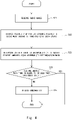
- Step S11 radio waves are received by the antenna 1 (Step S11).
- the received radio waves are converted into electric signals and transmitted to the reception unit 2.
- the plurality of feature amounts (reception level, APD) related to the radio wave intensity in a predetermined frequency band are extracted from the received radio waves (Step S12).
- a range of a predetermined frequency width can be selected centering on a frequency band of radio waves used for radio communication. For example, when the frequency of a signal used for railway radio is 400 MHz, a range of 400 MHz ⁇ f (f is any frequency width) is selected as a predetermined frequency unit.
- the plurality of feature amounts extracted in Step S12 are stored and accumulated in the recording unit 4 in association with the frequency band (Step S13).
- the plurality of feature amounts in the predetermined range are acquired from the plurality of accumulated feature amounts (Step S14).
- the plurality of acquired feature amounts are used to generate the abnormality determination mask with a threshold value set by unsupervised machine learning.
- an algorithm of unsupervised machine learning for example, One-Class SVM (Support Vector Machine) which is a method of outlier detection is used.
- One-Class SVM a set of normal data pieces for a class is learned, and an identification boundary (a threshold value) is determined, so that outliers are detected based on that boundary. Specifically, it is determined whether or not the acquired feature amount falls within the normal range by using the normal data for determining whether or not the feature amount is normal (Step S15). If it is determined that the acquired feature amount falls within the normal range (YES in Step S15), the level of the threshold value is changed according to a result of the determination, and the abnormality determination mask is generated (Step S16).
- the multidimensional abnormality determination mask it is determined whether or not each of the plurality of feature amounts falls within a preset normal range, and a mask in which threshold values are individually set is generated by unsupervised machine learning.
- the multidimensional feature mask it is determined whether or not each of the acquired feature amounts exceeds the threshold values of the normal range and the abnormal range in the multidimensional vector space including the plurality of feature amounts as one vector, and a threshold value in the multidimensional vector space is set.
- Step S15 If it is determined in Step S15 that the feature amount does not fall within the normal range, the level of the threshold value is not changed and the processing is ended.
- FIG. 3 shows a configuration of the abnormality detection apparatus 10 according to the example embodiment as a functional block. Overlapping components of the abnormality detection apparatuses 10 shown in Figs. 1 and 3 may be used in common, and can be configured as one apparatus.
- the abnormality detection apparatus 10 includes an antenna 1, a reception unit 2, a feature amount extraction unit 3, a determination unit 6, a display unit 7, and a recording unit 8.
- an abnormality of the radio waves is detected using the abnormality determination mask generated by the above-described method.
- the antenna 1 receives radio waves, converts them into electric signals, and transmits them to the reception unit 2.
- the reception unit 2 amplifies the electric signals from the antenna 1 to an appropriate size.
- the feature amount extraction unit 3 extracts a plurality of feature amounts (reception level, APD) related to the radio wave intensity in any frequency band from the electric signal amplified by the reception unit 2, and transmits them to the determination unit 6.
- the determination unit 6 determines whether or not the received radio waves have an abnormality by using the abnormality determination mask generated by the processing unit 5, and transmits a result of detection indicating the presence or absence of the abnormality to the display unit 7 and the recording unit 8.
- the display unit 7 displays the result of the detection.
- the recording unit 8 records and accumulates the result of the detection.
- Steps S21 and S22 are the same as the processing of Steps S1 and S12 in Fig. 2 , respectively, and therefore the description of the processing of Steps S21 and S22 is omitted.
- Step S23 abnormality determination using the abnormality determination mask is performed on the extracted plurality of feature amounts. Specifically, it is determined whether or not the feature amount extracted this time is equal to or less than the threshold value set in the abnormality determination mask (Step S24).
- the determination unit 6 proceeds to Step S24 "NO".
- Step S25 If it is determined that the received radio waves are abnormal, a result of the detection indicating a radio wave abnormality is displayed on the display unit 7, and the detected abnormality is recorded in the recording unit 8 (Step S25).
- Step S24 if the feature amount this time is less than or equal to the threshold value set in the abnormality determination mask (YES in Step S24), it is determined that the received radio waves are normal, and a result of the detection indicating that the radio waves are normal is displayed on the display unit 7, and the processing is ended.
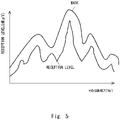
- the abnormality determination mask generated according to the example embodiment will be described with reference to Fig. 5 .
- the abnormality determination mask includes the multidimensional abnormality determination mask and the multidimensional feature amount mask.
- a mask used for abnormality determination of the reception level of radio waves is shown for explanation.
- Fig. 5 shows a mask used for abnormality determination of the reception level of radio waves in the abnormality determination mask obtained according to the example embodiment.
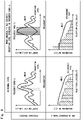
- Fig. 7 shows, as a comparative example, a spectrum mask in which the threshold values of the reception levels are artificially defined for respective frequencies of radio waves.
- the horizontal axis represents the frequency (Hz) and the vertical axis represents reception level (dB ⁇ V).
- Fig. 7 different spectrum masks are shown in the upper, middle, and lower rows.
- the shape of the mask varies depending on a creator, and thus there is a problem that it is not possible to make a uniform determination in detecting abnormal radio waves.
- Fig. 5 in the example embodiment, a mask with a threshold value set by unsupervised machine learning is generated. In this manner, it is possible to generate a mask for performing abnormality detection of radio waves excluding personal factors.
- the threshold values of the plurality of feature amounts of the radio waves are set in the multidimensional abnormality determination mask.
- the threshold values of the reception level and the APD are set in the multidimensional abnormality determination mask.
- a threshold value in the multidimensional vector space is set by using the plurality of feature amounts of the radio waves.
- the boundary surface (the threshold value) between the normal range and the abnormal range in the multidimensional vector space in which the reception level and the APD are used as one vector is set in the multidimensional feature amount mask.
- Fig. 6 is a diagram for explaining an example of abnormality detection using the abnormality determination mask according to the example embodiment.
- an abnormality detection example using a mask used for the abnormality determination of the reception level of the radio waves and an abnormality detection example using a mask used for the abnormality determination of the APD are separately shown.
- the left column of Fig. 6 shows a detection result in the normal state, and the right column shows a detection result when an abnormality has occurred.
- the upper row of Fig. 6 is a detection result obtained by using the frequency spectrum, and the lower part is a result of detecting the APD in a frequency band A.
- the radio waves having the reception level larger than the threshold value are determined to be abnormal. Therefore, when the reception level of the radio waves is larger than the threshold value, the radio waves are determined to be abnormal, whereas when the reception level of the radio waves is smaller than the threshold value, the radio waves are not determined to be abnormal. Thus, for example, when the reception level decreases in the frequency band A, the radio waves are not determined to be abnormal.
- the abnormality of the radio waves is determined not only by the reception level but also by the APD.
- the rate at which small reception levels occurs generally increases in the APD.
- the APD in the frequency band A exceeds the threshold value of the mask, and thus the radio waves are determined to be abnormal.
- the feature amount extracted from the received radio waves exceeds the threshold value set in the abnormality determination mask, it can be determined that the received radio waves are abnormal, so that an abnormality of the radio waves can be detected multilaterally.
- the reception level is lower than that in the normal state or when an abnormality occurs in the feature amount other than the reception level, which cannot be detected by abnormality determination using only the reception level, the abnormality can be detected.
- the present disclosure is not limited to the above-described example embodiment, and may be suitably modified without departing from the spirit.
- the method of generating the abnormality determination mask is not limited to the above-described method, and various techniques related to machine learning can be used as appropriate.
- the above-described abnormality detection technique can be applied, for example, to radio wave monitoring, proximity detection of a mobile body emitting radio waves such as a drone, and failure detection of a radio apparatus.
- the feature amount of the radio wave may be a feature amount other than a feature amount related to radio wave intensity, such as an azimuth angle of arrival.
Landscapes
- Engineering & Computer Science (AREA)
- Computer Networks & Wireless Communication (AREA)
- Signal Processing (AREA)
- Physics & Mathematics (AREA)
- Electromagnetism (AREA)
- Quality & Reliability (AREA)
- Monitoring And Testing Of Transmission In General (AREA)
- Mobile Radio Communication Systems (AREA)
Applications Claiming Priority (2)
| Application Number | Priority Date | Filing Date | Title |
|---|---|---|---|
| JP2020034621 | 2020-03-02 | ||
| PCT/JP2020/047712 WO2021176805A1 (fr) | 2020-03-02 | 2020-12-21 | Dispositif de détection d'anomalie, procédé de détection d'anomalie, et support lisible par ordinateur non transitoire |
Publications (2)
| Publication Number | Publication Date |
|---|---|
| EP4117332A1 true EP4117332A1 (fr) | 2023-01-11 |
| EP4117332A4 EP4117332A4 (fr) | 2023-08-09 |
Family
ID=77613265
Family Applications (1)
| Application Number | Title | Priority Date | Filing Date |
|---|---|---|---|
| EP20923068.9A Pending EP4117332A4 (fr) | 2020-03-02 | 2020-12-21 | Dispositif de détection d'anomalie, procédé de détection d'anomalie, et support lisible par ordinateur non transitoire |
Country Status (4)
| Country | Link |
|---|---|
| US (1) | US12356223B2 (fr) |
| EP (1) | EP4117332A4 (fr) |
| JP (1) | JP7435732B2 (fr) |
| WO (1) | WO2021176805A1 (fr) |
Families Citing this family (3)
| Publication number | Priority date | Publication date | Assignee | Title |
|---|---|---|---|---|
| US20240176002A1 (en) * | 2022-02-28 | 2024-05-30 | Panasonic Intellectual Property Management Co., Ltd. | Person detection system, utterance system, and person detection method |
| JP7831057B2 (ja) * | 2022-03-24 | 2026-03-17 | 日本電気株式会社 | 電波異常検知システム、電波異常検知方法、及び、電波異常検知プログラム |
| WO2024157447A1 (fr) * | 2023-01-27 | 2024-08-02 | 楽天モバイル株式会社 | Gestion de réseau pour surveillance d'utilisation de caméra |
Family Cites Families (12)
| Publication number | Priority date | Publication date | Assignee | Title |
|---|---|---|---|---|
| JPS58138881A (ja) | 1982-09-30 | 1983-08-17 | 昭和鋼機株式会社 | 突き出し横引き窓 |
| CN101019033A (zh) * | 2005-01-11 | 2007-08-15 | 太阳诱电株式会社 | 电磁场分布测定方法及其装置和计算机程序及信息记录媒体 |
| WO2008010306A1 (fr) * | 2006-07-18 | 2008-01-24 | Panasonic Corporation | dispositif de mesure ultrasonore et procédé de mesure ultrasonore |
| JP5337111B2 (ja) * | 2010-01-07 | 2013-11-06 | 株式会社エヌ・ティ・ティ・ドコモ | 無線通信システムの無線局で使用される信号検出装置及び信号検出方法 |
| JP5793961B2 (ja) | 2010-07-26 | 2015-10-14 | 日本電気株式会社 | 電磁波識別装置、電磁波識別方法及びプログラム |
| US20160299182A1 (en) * | 2013-11-14 | 2016-10-13 | Nec Corporation | Electromagnetic interference wave measurement device, electromagnetic interference wave measurement method and non-transitory computer-readable medium |
| CN104796204B (zh) * | 2015-03-16 | 2017-09-12 | 深圳大学 | 一种基于无线网络的金属携带检测方法 |
| US20190246982A1 (en) * | 2015-08-05 | 2019-08-15 | Emotiv Inc. | Method and system for collecting and processing bioelectrical signals |
| JP6758541B2 (ja) * | 2018-05-28 | 2020-09-23 | 三菱電機株式会社 | 無線機同定装置 |
| WO2020035920A1 (fr) * | 2018-08-15 | 2020-02-20 | 三菱電機株式会社 | Dispositif et procédé de détection de signaux |
| JP2020034621A (ja) | 2018-08-27 | 2020-03-05 | キヤノン株式会社 | 像加熱装置及び画像形成装置 |
| JP6617995B1 (ja) | 2019-02-28 | 2019-12-11 | 株式会社エステック | 無線電波調査システム |
-
2020
- 2020-12-21 WO PCT/JP2020/047712 patent/WO2021176805A1/fr not_active Ceased
- 2020-12-21 US US17/801,313 patent/US12356223B2/en active Active
- 2020-12-21 JP JP2022504980A patent/JP7435732B2/ja active Active
- 2020-12-21 EP EP20923068.9A patent/EP4117332A4/fr active Pending
Also Published As
| Publication number | Publication date |
|---|---|
| WO2021176805A1 (fr) | 2021-09-10 |
| JP7435732B2 (ja) | 2024-02-21 |
| EP4117332A4 (fr) | 2023-08-09 |
| US20230092448A1 (en) | 2023-03-23 |
| JPWO2021176805A1 (fr) | 2021-09-10 |
| US12356223B2 (en) | 2025-07-08 |
Similar Documents
| Publication | Publication Date | Title |
|---|---|---|
| US12356223B2 (en) | Abnormality detection apparatus, abnormality detection method and non-transitory computer readable medium | |
| US9658916B2 (en) | System analysis device, system analysis method and system analysis program | |
| EP3314762B1 (fr) | Détection d'anomalie de réseau reposant sur un filtrage adaptatif | |
| US12562829B2 (en) | Radio wave abnormality detection system, radio wave abnormality detection method, and radio wave abnormality detection program | |
| CN110267298B (zh) | 一种链路损耗的监控方法、监控装置和网关设备 | |
| US20230133242A1 (en) | Work assignment status monitoring system, work assignment status monitoring method, and work assignment status monitoring program | |
| JP6163811B2 (ja) | 時系列データ処理装置、時系列データ処理方法、及び時系列データ処理プログラム | |
| JP2018139085A (ja) | 異常予測方法、異常予測装置、異常予測システムおよび異常予測プログラム | |
| CN107677899A (zh) | 基于物联网的机房电磁干扰监控系统 | |
| US11750491B2 (en) | Information processing device and information processing method | |
| JP2008165802A (ja) | 無線周波数識別ネットワークを監視する方法および装置 | |
| JP5920810B2 (ja) | 地震予知システム及び地震予知方法 | |
| CA3114157C (fr) | Dispositif, procede et support de donnees de programme de gestion de processus | |
| JP5625962B2 (ja) | 作業者異常発生検知装置、作業者異常発生検知方法、及びプログラム | |
| JP7111173B2 (ja) | 情報処理装置 | |
| JP7571512B2 (ja) | 干渉検知装置、干渉検知方法及び干渉検知プログラム | |
| JP7338367B2 (ja) | サーバ及び制御方法 | |
| JP2013011987A (ja) | 異常状態検知装置及び異常状態検知方法 | |
| US11885720B2 (en) | Time series data processing method | |
| US20190003927A1 (en) | Monitoring device, monitoring method, and program | |
| CN111796554A (zh) | 监视装置、监视系统和监视方法 | |
| EP3457609B1 (fr) | Système et procédé de calcul d'anomalies sur la base d'une transformation entraînée par la fréquence et calcul de nouvelles caractéristiques sur la base de la densité d'anomalie de point | |
| Luca et al. | Anomaly detection using the Poisson process limit for extremes | |
| US20250234236A1 (en) | Wireless communication system, wireless communication method, and control station | |
| JP5742951B2 (ja) | 震度推測装置、震度推測方法、及びプログラム |
Legal Events
| Date | Code | Title | Description |
|---|---|---|---|
| STAA | Information on the status of an ep patent application or granted ep patent |
Free format text: STATUS: THE INTERNATIONAL PUBLICATION HAS BEEN MADE |
|
| PUAI | Public reference made under article 153(3) epc to a published international application that has entered the european phase |
Free format text: ORIGINAL CODE: 0009012 |
|
| STAA | Information on the status of an ep patent application or granted ep patent |
Free format text: STATUS: REQUEST FOR EXAMINATION WAS MADE |
|
| 17P | Request for examination filed |
Effective date: 20220901 |
|
| AK | Designated contracting states |
Kind code of ref document: A1 Designated state(s): AL AT BE BG CH CY CZ DE DK EE ES FI FR GB GR HR HU IE IS IT LI LT LU LV MC MK MT NL NO PL PT RO RS SE SI SK SM TR |
|
| DAV | Request for validation of the european patent (deleted) | ||
| DAX | Request for extension of the european patent (deleted) | ||
| A4 | Supplementary search report drawn up and despatched |
Effective date: 20230712 |
|
| RIC1 | Information provided on ipc code assigned before grant |
Ipc: H04B 17/17 20150101ALI20230706BHEP Ipc: H04B 17/26 20150101ALI20230706BHEP Ipc: H04W 24/08 20090101AFI20230706BHEP |
|
| STAA | Information on the status of an ep patent application or granted ep patent |
Free format text: STATUS: EXAMINATION IS IN PROGRESS |
|
| 17Q | First examination report despatched |
Effective date: 20250707 |