EP4119089A1 - Système de support orthodontique - Google Patents
Système de support orthodontique Download PDFInfo
- Publication number
- EP4119089A1 EP4119089A1 EP21185607.5A EP21185607A EP4119089A1 EP 4119089 A1 EP4119089 A1 EP 4119089A1 EP 21185607 A EP21185607 A EP 21185607A EP 4119089 A1 EP4119089 A1 EP 4119089A1
- Authority
- EP
- European Patent Office
- Prior art keywords
- wings
- section
- self
- cover
- orthodontic bracket
- Prior art date
- Legal status (The legal status is an assumption and is not a legal conclusion. Google has not performed a legal analysis and makes no representation as to the accuracy of the status listed.)
- Withdrawn
Links
- 230000000295 complement effect Effects 0.000 claims description 6
- 230000009977 dual effect Effects 0.000 abstract 2
- 238000010276 construction Methods 0.000 description 10
- 238000000034 method Methods 0.000 description 7
- 210000003298 dental enamel Anatomy 0.000 description 5
- 239000000463 material Substances 0.000 description 4
- 229910052751 metal Inorganic materials 0.000 description 3
- 239000002184 metal Substances 0.000 description 3
- 239000007769 metal material Substances 0.000 description 3
- 238000012986 modification Methods 0.000 description 3
- 230000004048 modification Effects 0.000 description 3
- 239000002245 particle Substances 0.000 description 3
- MCMNRKCIXSYSNV-UHFFFAOYSA-N Zirconium dioxide Chemical compound O=[Zr]=O MCMNRKCIXSYSNV-UHFFFAOYSA-N 0.000 description 2
- 239000003086 colorant Substances 0.000 description 2
- 239000003479 dental cement Substances 0.000 description 2
- 208000037265 diseases, disorders, signs and symptoms Diseases 0.000 description 2
- 208000035475 disorder Diseases 0.000 description 2
- 238000004519 manufacturing process Methods 0.000 description 2
- 238000010146 3D printing Methods 0.000 description 1
- BQCADISMDOOEFD-UHFFFAOYSA-N Silver Chemical compound [Ag] BQCADISMDOOEFD-UHFFFAOYSA-N 0.000 description 1
- 229910000831 Steel Inorganic materials 0.000 description 1
- HZEWFHLRYVTOIW-UHFFFAOYSA-N [Ti].[Ni] Chemical compound [Ti].[Ni] HZEWFHLRYVTOIW-UHFFFAOYSA-N 0.000 description 1
- 230000004308 accommodation Effects 0.000 description 1
- 239000000853 adhesive Substances 0.000 description 1
- 230000001070 adhesive effect Effects 0.000 description 1
- 229910052782 aluminium Inorganic materials 0.000 description 1
- XAGFODPZIPBFFR-UHFFFAOYSA-N aluminium Chemical compound [Al] XAGFODPZIPBFFR-UHFFFAOYSA-N 0.000 description 1
- 238000005452 bending Methods 0.000 description 1
- 238000005266 casting Methods 0.000 description 1
- 239000000919 ceramic Substances 0.000 description 1
- 229910010293 ceramic material Inorganic materials 0.000 description 1
- 239000011350 dental composite resin Substances 0.000 description 1
- 238000006073 displacement reaction Methods 0.000 description 1
- 230000006870 function Effects 0.000 description 1
- 210000004195 gingiva Anatomy 0.000 description 1
- 238000001746 injection moulding Methods 0.000 description 1
- 230000010354 integration Effects 0.000 description 1
- 238000005259 measurement Methods 0.000 description 1
- 229910001092 metal group alloy Inorganic materials 0.000 description 1
- 238000005459 micromachining Methods 0.000 description 1
- 229910001000 nickel titanium Inorganic materials 0.000 description 1
- 238000000059 patterning Methods 0.000 description 1
- 230000008092 positive effect Effects 0.000 description 1
- 229910001285 shape-memory alloy Inorganic materials 0.000 description 1
- 229910052709 silver Inorganic materials 0.000 description 1
- 239000004332 silver Substances 0.000 description 1
- 239000010959 steel Substances 0.000 description 1
Images




Classifications
-
- A—HUMAN NECESSITIES
- A61—MEDICAL OR VETERINARY SCIENCE; HYGIENE
- A61C—DENTISTRY; APPARATUS OR METHODS FOR ORAL OR DENTAL HYGIENE
- A61C7/00—Orthodontics, i.e. obtaining or maintaining the desired position of teeth, e.g. by straightening, evening, regulating, separating, or by correcting malocclusions
- A61C7/12—Brackets; Arch wires; Combinations thereof; Accessories therefor
- A61C7/14—Brackets; Fixing brackets to teeth
- A61C7/146—Positioning or placement of brackets; Tools therefor
-
- A—HUMAN NECESSITIES
- A61—MEDICAL OR VETERINARY SCIENCE; HYGIENE
- A61C—DENTISTRY; APPARATUS OR METHODS FOR ORAL OR DENTAL HYGIENE
- A61C7/00—Orthodontics, i.e. obtaining or maintaining the desired position of teeth, e.g. by straightening, evening, regulating, separating, or by correcting malocclusions
- A61C7/12—Brackets; Arch wires; Combinations thereof; Accessories therefor
- A61C7/28—Securing arch wire to bracket
-
- A—HUMAN NECESSITIES
- A61—MEDICAL OR VETERINARY SCIENCE; HYGIENE
- A61C—DENTISTRY; APPARATUS OR METHODS FOR ORAL OR DENTAL HYGIENE
- A61C7/00—Orthodontics, i.e. obtaining or maintaining the desired position of teeth, e.g. by straightening, evening, regulating, separating, or by correcting malocclusions
- A61C7/08—Mouthpiece-type retainers or positioners, e.g. for both the lower and upper arch
-
- A—HUMAN NECESSITIES
- A61—MEDICAL OR VETERINARY SCIENCE; HYGIENE
- A61C—DENTISTRY; APPARATUS OR METHODS FOR ORAL OR DENTAL HYGIENE
- A61C7/00—Orthodontics, i.e. obtaining or maintaining the desired position of teeth, e.g. by straightening, evening, regulating, separating, or by correcting malocclusions
- A61C7/12—Brackets; Arch wires; Combinations thereof; Accessories therefor
- A61C7/125—Mouth tissue protecting means, e.g. bracket caps
-
- A—HUMAN NECESSITIES
- A61—MEDICAL OR VETERINARY SCIENCE; HYGIENE
- A61C—DENTISTRY; APPARATUS OR METHODS FOR ORAL OR DENTAL HYGIENE
- A61C7/00—Orthodontics, i.e. obtaining or maintaining the desired position of teeth, e.g. by straightening, evening, regulating, separating, or by correcting malocclusions
- A61C7/12—Brackets; Arch wires; Combinations thereof; Accessories therefor
- A61C7/28—Securing arch wire to bracket
- A61C7/30—Securing arch wire to bracket by resilient means; Dispensers therefor
Definitions
- the present disclosure relates generally to an orthodontic bracket system, and more particularly, to an orthodontic bracket system having a self-ligating configuration.
- Misaligned teeth or crooked teeth is one of the most commonly occurring disorder in children and young adults. While misaligned teeth is generally not a life threatening disorder and may even add a certain charm to ones' smile, not everybody with misaligned teeth may want to keep their teeth as they are. Some individuals may wish to have their teeth aligned as it may have a positive effect on their confidence. To this end, orthodontic bracket systems are developed in the art.
- a typical orthodontic system includes a bracket that may be attached in the enamel of the teeth using an adhesive.
- the bracket may include a slot defined on the body of the bracket.
- One such bracket may then be attached to all the tooth requiring alignment.
- a wire is then fitted into the slots defined on the brackets and ligated thereto via conventional ligature means, including but not limited to resilient O-rings or fine metallic wires.
- the wire is fitted in and held by the brackets such that a corrective force is constantly applied on the teeth by the virtue of the wire being held within the bracket, thereby gradually displacing each teeth to its desired location. This displacement of all the tooth results in alignment of the tooth.
- a disadvantageous aspect of such an orthodontic bracket system may be that they have a bulky configuration due to the usage of the separate and discreet ligature means, which may cause a lot of discomfort to the user.
- Another disadvantageous aspect may be that a user of such an orthodontic bracket system may need to have numerous visits to the dentist for maintaining and correcting the position of the ligature means on the bracket body.
- Yet another disadvantageous aspect of such an orthodontic bracket system is the difficulty in applying a separate ligature means to each bracket.
- Self-ligating orthodontic brackets are therefore developed in the art for overcoming the aforementioned disadvantageous aspects of some conventional orthodontic bracket systems. These self-ligating orthodontic brackets typically employ the usage of a movable slide or a latch for holding the wire within the slot on the bracket. A disadvantageous aspect of these self-ligating orthodontic brackets is that they have a complicated construction, which directly impacts their price and affordability.
- the present disclosure provides an orthodontic bracket system.
- the orthodontic bracket system in accordance with an exemplary embodiment of the present invention, includes a bracket body.
- the bracket body includes a base configured for fitment on a teeth.
- a first plurality of wings is configured on the base and extends in an occlusal direction when the bracket body is assembled on the teeth.
- a second plurality of wings is configured on the base and extends in a gingival direction when the bracket body is assembled on the teeth.
- a slot is defined operatively between the first plurality of wings and the second plurality of wings.
- the orthodontic bracket system further includes a self-ligating cover.
- the self-ligating cover includes a first section, a second section, and a third section. The first section is configured to clip on the first plurality of wings.
- the second section is configured to fit over the second plurality of wings.
- the third section has a substantially flat configuration and extends operatively between the first and the second sections, wherein the first section, the second section, and the third section integrally define a body of the self-ligating cover.
- an orthodontic bracket system comprising:
- each wing of the first plurality of wings has a dome shaped configuration.
- the first section of the self-ligating cover includes a plurality of dome shaped protrusions having a hollow configuration, and wherein the configuration of the plurality of dome shaped protrusions is complementary to the configuration of the first plurality of wings for facilitating snug and secure fitment between the first plurality of wings and the first section of the self-ligating cover.
- the first plurality of wings includes a pair of wings
- the first section of the self-ligating cover includes a pair of dome shaped protrusions.
- each wing of the second plurality of wings includes an operative top surface having a substantially flat configuration, and an operative bottom surface having a substantially S-shaped configuration.
- the second plurality of wings includes a pair of wings.
- the second section of self-ligating cover has a substantially S-shaped configuration complementary to the configuration of the second plurality of wings for facilitating snug and secure fitment between the second plurality of wings and the second section of the self-ligating cover.
- the arrangement further comprises a groove configured on the third section of the self-ligating cover.
- the first section is a step protruding from an inner surface of the self-ligating cover, the step having at least one pocket configured thereon in a spaced apart manner for fitment on each wing of the first plurality of wings.
- the second section is a step protruding from an inner surface of the self-ligating cover and configured to be positioned snugly between the wings of the second plurality of wings subsequent to the fitment of the self-ligating cover on the bracket body.
- meial refers to a direction toward the middle of the patients arch and “distal” refers to a direction away from the middle of the patient's arch.
- distal refers to a direction away from the middle of the patient's arch.
- Occlusal refers to a direction toward the outer tips of the patient's teeth, while “gingival” refers to a direction toward the gums or gingiva.
- Labial refers to a direction toward the patient's lips or cheeks, while “lingual refers to a direction toward the patient's tongue.
- Fig. 1A and Fig. 1B illustrate different views of an orthodontic bracket system 100 (hereinafter referred to as system 100), in accordance with an embodiment of the present invention.
- the system 100 includes a bracket body 102 and a self-ligating cover 104 configured for fitment on the bracket body 102.
- An advantageous aspect of the self-ligating cover 104 in accordance with an embodiment of the present invention, is that the self-ligating cover 104 has been designed to have a removable configuration. More specifically, the removable configuration of the self-ligating cover 104 is more advantageous for both patients and orthodontists aesthetically
- the self-ligating cover 104 is its versatility.
- Conventional self-ligating covers include mechanical slide or mechanical latch like arrangements for facilitating ligation of the wire within the bracket body.
- the self-ligating cover 104 may be designed for any conventional orthodontic bracket system and easily replace the usage of the conventional resilient O-rings or metal wires as ligature means.
- Such a configuration of the self-ligating cover 104 eliminates the need of having complicated constructions of bracket bodies involving the use of mechanical slide or mechanical latch like arrangement. As a result, the system 100 is relatively more cost effective than the conventional self-ligating orthodontic bracket systems.
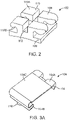
- Fig. 2 illustrates an isometric view of a bracket body used in the system 100.
- the system 100 includes the bracket body 102.
- the bracket body 102 includes a base 106 configured for fitment on a teeth.
- orthodontic adhesives are used for facilitating the fitment of the bracket body 102 on the enamel of the teeth.
- the bottom surface of the base 106 may be patterned for increasing the surface area thereof to maximize the surface area contact and interlocking with the orthodontic adhesive applied to the enamel of the teeth.
- Some examples of such patterning may include a knurled surface, ridges, pegs, grooves, particles such as regularly shaped particles including spheres, rods, and cones, and irregularly-shaped particles such as shards of ceramic material.
- the bracket body 102 includes a first plurality of wings 108.
- the first plurality of wings 108 is configured on the base 106 and extends in an occlusal direction when the bracket body 102 is assembled on the teeth.
- the first plurality of wings 108 includes a pair of wings.
- the number of wings in the first plurality of wings 108 is not limited to two, and the first plurality of wings 108 may include either more than two wings or less than two wings.
- the first plurality of wings 108 have a dome-like configuration.
- the bracket body 102 further comprises a second plurality of wings 110.
- the second plurality of wings 110 is configured on the base and extends in a gingival direction when the bracket body 102 is assembled on the teeth. As seen in Fig. 2 , the second plurality of wings 110 includes a pair of wings. However, it is to be noted that the number of wings in the second plurality of wings 110 is not limited to two, and the second plurality of wings 110 may include either more than two wings or less than two wings.
- the second plurality of wings 110 include an operative top surface 110A having a substantially flat configuration, and an operative bottom surface 110B having a substantially S-shaped configuration.
- a slot 112 is defined operatively between the first plurality of wings 108 and the second plurality of wings 110.
- the slot 112 facilitates the accommodation of an archwire therewithin.
- the archwire may be held within the slot 112 via the self-ligating cover 104.
- the construction and configuration of the self-ligating cover 104 is hereinafter described.
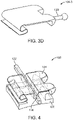
- FIG. 3A illustrates an isometric view of the self-ligating cover 104 used in the system 100.
- the self-ligating cover 104 (hereinafter also referred to as cover 104) includes a first section 104A, a second section 104B, and a third section 104C.
- the first section 104A is configured to clip on the first plurality of wings 108.
- the first section 104A of the cover 104 includes a plurality of dome shaped protrusions 114 having a hollow configuration.
- the configuration of the plurality of dome shaped protrusions 114 is complementary to the configuration of the first plurality of wings 108 for facilitating snug and secure fitment between the first plurality of wings 108 and the first section 104A of the self-ligating cover 104.
- the fitment of the cover 104 on the bracket body 102 is illustrated.
- the protrusions 114 generally encapsulate the wings 108 up to substantially half the length of the entire wing 108 up to location "L", as illustrated in Fig. 1B .
- Such snug fitment of the protrusion 114 on the wing 108 prevents the section 104A of the cover 104 from moving out of position in an assembled configuration thereof.
- the second section 104B of the cover 104 is configured to fit over the second plurality of wings 110.
- the second section 104B has an S-shaped configuration.
- the second section 104B is an S-shaped component extending along the entire width of the cover 104.
- the S-shaped configuration of the second section 104B is complementary to the S-shaped configuration of the operative bottom surface 110B of the second plurality of wings 110 for facilitating snug and secure fitment between the second plurality of wings 110 and the second section 104B of the self-ligating cover 104.
- the third section 104C has a substantially flat configuration and extends operatively between the first and the second sections 104A, 104B, wherein the first section 104A, the second section 104B, and the third section 104C integrally define a body of the self-ligating cover 104.
- the cover 104 further comprises a tongue 116.
- the tongue 116 is configured at an operative end of the second section 104B.
- the tongue 116 allows an orthodontist to grip the cover 104 while assembling the cover 104 on the bracket body 102.
- a cover 104-1 in accordance with another embodiment of the present invention, is illustrated in Fig. 3B .
- the construction and configuration of the cover 104-1 is similar to that of cover 104, which has been described above with reference to Fig. 3A .
- the only difference in the cover 104 and the cover 104-1 is the configuration of the tongue 116A.
- the tongue 116A includes a hole configured thereon. The provision of the hole on the tongue 116A allows the orthodontist to grip the cover 104 with an instrument.
- covers 104, 104-1 are examples of passive self-ligating covers. More specifically, the covers 104, 104-1 only facilitate holding the arch wire inside the slot 112 on the bracket body 102. The covers 104, 104-1 do not apply any kind of pressure on the cable and only prevent the wire from coming out of the slot 112.
- An active self-ligating orthodontic bracket system is one in which a constant pressure is applied on the archwire by the bracket.
- An exemplary embodiment of the cover 104-2 of active self-ligating type is illustrated in Fig. 3C .
- the construction and configuration of the cover 104-2 is similar to that of cover 104-1, which has been described above with reference to Fig. 3B .
- the only difference in the cover 104-2 and the cover 104-1 is the provision of the groove 118 on the third section 104C.
- the assembly of the cover 104-2 on the bracket 102 is illustrated in Fig. 4 . As seen in Fig. 4 , the bottom surface of groove 118 constantly applies a pressure on a wire 122 in an assembled configuration.
- Fig. 3D illustrates an isometric view of the cover 104-3, in accordance with an alternate embodiment of the present invention.
- the construction and configuration of the cover 104-3 is similar to that of cover 104, which has been described above with reference to Fig. 3A .
- the only difference in the cover 104-3 and the cover 104 is the provision of the handle 120.
- the handle 120 may be provided on the cover 104-3 for facilitating the usage of intra oral elastic bands, which may be required at some point during the course of a patient's treatment.
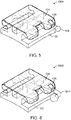
- FIG. 5 Another embodiment of an orthodontic bracket system 100A is illustrated in Fig. 5 .
- the construction and configuration of the system 100A is similar to that of the system 100, which has been described above with reference to Fig. 1A thru Fig. Fig. 3B .
- the only difference in the system 100A and the system 100 is the provision of a hook 124 on the bracket body 102.
- the hook 124 is provided on the bracket body 102 instead of the body of the cover 104 (see Fig. 3D ).
- the hook 124 facilitates the use of intra oral resilient band that an orthodontist may be required to use during the course of a treatment.
- the cover 104 includes an aperture 126 for allowing the hook 124 to protrude thru the cover 104 in an assembled configuration of the cover 104 and the bracket body 102.
- FIG. 6 Another similar embodiment of the system, numbered as 100B, is illustrated in Fig. 6 .
- the only difference in relation to system 100A is that hook 124A has a substantially L-shaped configuration.
- FIG. 7 An exemplary application of the covers 104 in a form of an array 104-4, is illustrated in Fig. 7 .
- a plurality of covers 104 may be conjoined to form the array 104-4.
- the array 104-4 may be assembled on a plurality of brackets 102 that are stuck on a patient's tooth. Using the array 104-4, even the wire 122 may be camouflaged.
- An advantageous aspect of such an application of the array 104-4 is that it allows the bracket body 102 to be made of any metallic material, which provides better biomechanical properties relative to the plastic material used in conventional camouflage orthodontic bracket systems.
- the metallic bracket body 102 may be covered with the array 104-4, wherein the array 104-4 may be of a color that is similar to the color of the tooth enamel of the patient. As such, array 104-4 provides a relatively cost effective option to the conventional specialized camouflage orthodontic bracket systems.
- FIG. 8 illustrates a sectional view of the cover 104-5 being assembled on the bracket body 102.
- FIG. 9 illustrates a side view
- FIG. 10 illustrates a top view of the cover 104-5, in accordance with an embodiment of the present subject matter.
- the construction and configuration of the cover 104-5 is similar to that of cover 104, which has been described above with reference to Fig. 3A .
- the only difference in the cover 104-5 and the cover 104 is the provision of a pair of steps 128, 130 configured on an inner periphery of the cover 104-5. As such, the description of the like elements between the cover 104 and the cover 104-5 is not repeated herein for the sake of brevity of the present document.
- the cover 104-5 has steps 128, 130 configured on the inner periphery thereof. More specifically, in the instant embodiment, the step 128 forms the first section of the cover 104-5 that is configured to fit on the first plurality of wings 108, while the step 130 is the second section of the cover 104-5 that is configured to fit between the second plurality of wings 110.
- the step 128, in accordance with the instant embodiment, includes a pair of pockets 132.
- the pair of pockets 132 are configured in a spaced apart manner on the step 128, wherein each of the pockets 132 has a shape that is designed to snugly fit over the first plurality of wings 108.
- the step 130 in accordance with the instant embodiment, is a protrusion protruding from the inner surface of the cover 104-5.
- the step 130 is designed such that the step 130 is positioned snugly between the second plurality of wings 110.
- the number of steps 130 may be a number that is one less from the total number of wings in the second plurality of wings 110, and wherein such steps 130 may be arranged in a spaced apart manner to snugly fit between two consecutive wings of the second plurality of wings.
- step 130 and pockets 132 An advantageous aspect of providing step 130 and pockets 132 is that it eases the process of assembling the cover 104-5 on the bracket body 102. More specifically, the pockets 132 and the step 130 may act as alignment means to ensure that the cover 104-5 is properly assembled over the bracket body 102.
- the method of applying the cover 104 to the bracket body 102 is hereinafter described.
- the bracket body 102 is assembled on the enamel of the teeth such that the first plurality of wings 108 face the occlusal end, while the second plurality of wings 110 face the gingival end.
- To assemble the cover on the bracket body one may firstly assemble the second section 104B of the cover on the second plurality of wings 110 at the gingival end.
- the orthodontist may use the tongue provided at the second section of the cover 104 for optimal fitment of the second section 104B on the second plurality of wings 110.
- the first section 104A of the cover 104 is pulled towards the occlusal end and fitted onto the first plurality of wings 108.
- the orthodontist is required to hold the tongue via an instrument and pull it out towards the occlusal end while going upward farther away from labial teeth surface and pushing it to the gingival end. Doing so opens up the cover 104 in relation to the bracket body 102.
- the self-ligating cover is of the type that can be entirely removed from the bracket body 102.
- the bracket body 102 and the cover 104 may be of entirely different materials.
- the bracket body may be made of a metallic material, while cover may be made of a non-metallic material.
- the cover 104 is such that it covers the entirety of the bracket body 102. Therefore, it is possible to camouflage the silver color (in case of a metal bracket body) of the bracket body by providing a cover 104 that is white in color.
- the cover 104 may be made to depict different colors. For example, the cover 104 may be made with colors of the rainbow flag or the United States national flag. This gives an aesthetic appeal to the system 100.
- the orthodontic bracket can be manufactured using casting, metal injection molding, 3D printing, micromachining, any combination of generic mass production and customization techniques, and/or any direct digital manufacturing technique.
- the archwire can be bent by the operator, through a wire-bending robot, and/or through any other process that can set the shape of the wire to a pre-determined shape.
- the various portions of the various brackets that have been described may be all part of a single integration piece of material, such as steel, aluminum, nickel-titanium, any other shape memory alloy, or any other metal alloy, ceramic, zirconia, dental composite, or any other plastic material.
- a single integration piece of material such as steel, aluminum, nickel-titanium, any other shape memory alloy, or any other metal alloy, ceramic, zirconia, dental composite, or any other plastic material.
- One or more of these components may instead be formed separately from the others.
- the invention may also broadly consist in the parts, elements, steps, examples and/or features referred to or indicated in the specification individually or collectively in any and all combinations of two or more said parts, elements, steps, examples and/or features.
- one or more features in any of the embodiments described herein may be combined with one or more features from any other embodiment(s) described herein.
Landscapes
- Health & Medical Sciences (AREA)
- Oral & Maxillofacial Surgery (AREA)
- Dentistry (AREA)
- Epidemiology (AREA)
- Life Sciences & Earth Sciences (AREA)
- Animal Behavior & Ethology (AREA)
- General Health & Medical Sciences (AREA)
- Public Health (AREA)
- Veterinary Medicine (AREA)
- Dental Tools And Instruments Or Auxiliary Dental Instruments (AREA)
Priority Applications (2)
| Application Number | Priority Date | Filing Date | Title |
|---|---|---|---|
| EP21185607.5A EP4119089A1 (fr) | 2021-07-14 | 2021-07-14 | Système de support orthodontique |
| CN202110961304.4A CN115607306A (zh) | 2021-07-14 | 2021-08-20 | 正畸托槽系统 |
Applications Claiming Priority (1)
| Application Number | Priority Date | Filing Date | Title |
|---|---|---|---|
| EP21185607.5A EP4119089A1 (fr) | 2021-07-14 | 2021-07-14 | Système de support orthodontique |
Publications (1)
| Publication Number | Publication Date |
|---|---|
| EP4119089A1 true EP4119089A1 (fr) | 2023-01-18 |
Family
ID=76942779
Family Applications (1)
| Application Number | Title | Priority Date | Filing Date |
|---|---|---|---|
| EP21185607.5A Withdrawn EP4119089A1 (fr) | 2021-07-14 | 2021-07-14 | Système de support orthodontique |
Country Status (2)
| Country | Link |
|---|---|
| EP (1) | EP4119089A1 (fr) |
| CN (1) | CN115607306A (fr) |
Cited By (1)
| Publication number | Priority date | Publication date | Assignee | Title |
|---|---|---|---|---|
| WO2025220941A1 (fr) * | 2024-04-18 | 2025-10-23 | 김영준 | Verrou orthodontique et son procédé d'utilisation |
Citations (6)
| Publication number | Priority date | Publication date | Assignee | Title |
|---|---|---|---|---|
| US4355975A (en) * | 1980-02-08 | 1982-10-26 | Kinya Fujita | Orthodontic appliance |
| US20030165790A1 (en) * | 2001-12-28 | 2003-09-04 | 3M Innovative Properties Company | Orthodontic appliances including polycrystalline alumina-based ceramic material, kits, and methods |
| DE202005013890U1 (de) * | 2005-03-07 | 2005-11-10 | Schmitz, Herbert, Dr. | Bracket und Clip dafür |
| US20050260532A1 (en) * | 2004-05-21 | 2005-11-24 | Jedediah Feller | Orthodontic appliance attachment |
| WO2009103104A1 (fr) * | 2008-02-22 | 2009-08-27 | Pbd, Patent & Business Development Ag | Dispositif de fixation orthodontique et procédé pour son maniement |
| US20210267724A1 (en) * | 2020-02-27 | 2021-09-02 | Said Anjary | Orthodontic bracket system |
-
2021
- 2021-07-14 EP EP21185607.5A patent/EP4119089A1/fr not_active Withdrawn
- 2021-08-20 CN CN202110961304.4A patent/CN115607306A/zh active Pending
Patent Citations (6)
| Publication number | Priority date | Publication date | Assignee | Title |
|---|---|---|---|---|
| US4355975A (en) * | 1980-02-08 | 1982-10-26 | Kinya Fujita | Orthodontic appliance |
| US20030165790A1 (en) * | 2001-12-28 | 2003-09-04 | 3M Innovative Properties Company | Orthodontic appliances including polycrystalline alumina-based ceramic material, kits, and methods |
| US20050260532A1 (en) * | 2004-05-21 | 2005-11-24 | Jedediah Feller | Orthodontic appliance attachment |
| DE202005013890U1 (de) * | 2005-03-07 | 2005-11-10 | Schmitz, Herbert, Dr. | Bracket und Clip dafür |
| WO2009103104A1 (fr) * | 2008-02-22 | 2009-08-27 | Pbd, Patent & Business Development Ag | Dispositif de fixation orthodontique et procédé pour son maniement |
| US20210267724A1 (en) * | 2020-02-27 | 2021-09-02 | Said Anjary | Orthodontic bracket system |
Cited By (1)
| Publication number | Priority date | Publication date | Assignee | Title |
|---|---|---|---|---|
| WO2025220941A1 (fr) * | 2024-04-18 | 2025-10-23 | 김영준 | Verrou orthodontique et son procédé d'utilisation |
Also Published As
| Publication number | Publication date |
|---|---|
| CN115607306A (zh) | 2023-01-17 |
Similar Documents
| Publication | Publication Date | Title |
|---|---|---|
| US6910884B2 (en) | Low profile orthodontic appliance | |
| US9492246B2 (en) | Self-ligating orthodontic appliance and related methods | |
| USD859663S1 (en) | Orthodontic elastic attachment for use with dental aligners | |
| EP3267927B1 (fr) | Appareil orthodontique comprenant un élément formant arc | |
| US7140875B2 (en) | Orthodontic bracket with reinforced tiewings | |
| US7192274B2 (en) | Ceramic orthodontic appliance with archwire slot liner | |
| KR20230051157A (ko) | 논슬라이딩 아치 구조를 구비한 교정 장치 | |
| US11298212B2 (en) | Set of brackets for orthodontics | |
| US20150125803A1 (en) | Tube for Orthodontics | |
| US20210267724A1 (en) | Orthodontic bracket system | |
| EP3164096B1 (fr) | Dispositif pour molaire pour un appareil orthodontique | |
| WO2008073769A1 (fr) | Appareil orthodontique à profil réduit | |
| USD910191S1 (en) | Orthodontic elastic attachment for use with dental aligners for canine or premolar teeth | |
| EP4119089A1 (fr) | Système de support orthodontique | |
| JP7326300B2 (ja) | 高い唇側引張強度を有するセラミック自己結紮式ブラケット | |
| US6139317A (en) | Orthodontic appliance | |
| US20210353390A1 (en) | Orthodontic bracket system | |
| EP3981358B1 (fr) | Attache auto-ligaturante et clips | |
| US20220192792A1 (en) | Set of brackets for orthodontics | |
| US20230165663A1 (en) | Self-ligating orthodontic bracket | |
| KR102058526B1 (ko) | 지르코니아 소재를 이용한 인공치표면에 치아 교정 유지장치의 접착력을 증가하게 하는 구조체 제작방법과 이를 이용한 치아 교정장치 | |
| KR101366038B1 (ko) | 자가 결찰 브래킷 | |
| JP6152292B2 (ja) | 固定式リテーナー及び固定式リテーナーの製造方法 | |
| US20070259305A1 (en) | Orthodontic ligature | |
| US10201402B2 (en) | Orthodontic appliance and orthodontic treatment using the same |
Legal Events
| Date | Code | Title | Description |
|---|---|---|---|
| PUAI | Public reference made under article 153(3) epc to a published international application that has entered the european phase |
Free format text: ORIGINAL CODE: 0009012 |
|
| STAA | Information on the status of an ep patent application or granted ep patent |
Free format text: STATUS: THE APPLICATION HAS BEEN PUBLISHED |
|
| AK | Designated contracting states |
Kind code of ref document: A1 Designated state(s): AL AT BE BG CH CY CZ DE DK EE ES FI FR GB GR HR HU IE IS IT LI LT LU LV MC MK MT NL NO PL PT RO RS SE SI SK SM TR |
|
| STAA | Information on the status of an ep patent application or granted ep patent |
Free format text: STATUS: REQUEST FOR EXAMINATION WAS MADE |
|
| STAA | Information on the status of an ep patent application or granted ep patent |
Free format text: STATUS: THE APPLICATION HAS BEEN WITHDRAWN |
|
| 17P | Request for examination filed |
Effective date: 20230710 |
|
| RBV | Designated contracting states (corrected) |
Designated state(s): AL AT BE BG CH CY CZ DE DK EE ES FI FR GB GR HR HU IE IS IT LI LT LU LV MC MK MT NL NO PL PT RO RS SE SI SK SM TR |
|
| 18W | Application withdrawn |
Effective date: 20230718 |