EP4119181A1 - Cathéter de guidage à grande lumière - Google Patents
Cathéter de guidage à grande lumière Download PDFInfo
- Publication number
- EP4119181A1 EP4119181A1 EP22187778.0A EP22187778A EP4119181A1 EP 4119181 A1 EP4119181 A1 EP 4119181A1 EP 22187778 A EP22187778 A EP 22187778A EP 4119181 A1 EP4119181 A1 EP 4119181A1
- Authority
- EP
- European Patent Office
- Prior art keywords
- tubular body
- elongate
- wire members
- elongate tubular
- guide catheter
- Prior art date
- Legal status (The legal status is an assumption and is not a legal conclusion. Google has not performed a legal analysis and makes no representation as to the accuracy of the status listed.)
- Withdrawn
Links
Images



Classifications
-
- A—HUMAN NECESSITIES
- A61—MEDICAL OR VETERINARY SCIENCE; HYGIENE
- A61M—DEVICES FOR INTRODUCING MEDIA INTO, OR ONTO, THE BODY; DEVICES FOR TRANSDUCING BODY MEDIA OR FOR TAKING MEDIA FROM THE BODY; DEVICES FOR PRODUCING OR ENDING SLEEP OR STUPOR
- A61M25/00—Catheters; Hollow probes
- A61M25/0043—Catheters; Hollow probes characterised by structural features
- A61M25/005—Catheters; Hollow probes characterised by structural features with embedded materials for reinforcement, e.g. wires, coils, braids
-
- A—HUMAN NECESSITIES
- A61—MEDICAL OR VETERINARY SCIENCE; HYGIENE
- A61M—DEVICES FOR INTRODUCING MEDIA INTO, OR ONTO, THE BODY; DEVICES FOR TRANSDUCING BODY MEDIA OR FOR TAKING MEDIA FROM THE BODY; DEVICES FOR PRODUCING OR ENDING SLEEP OR STUPOR
- A61M25/00—Catheters; Hollow probes
- A61M25/0009—Making of catheters or other medical or surgical tubes
- A61M25/0012—Making of catheters or other medical or surgical tubes with embedded structures, e.g. coils, braids, meshes, strands or radiopaque coils
-
- A—HUMAN NECESSITIES
- A61—MEDICAL OR VETERINARY SCIENCE; HYGIENE
- A61M—DEVICES FOR INTRODUCING MEDIA INTO, OR ONTO, THE BODY; DEVICES FOR TRANSDUCING BODY MEDIA OR FOR TAKING MEDIA FROM THE BODY; DEVICES FOR PRODUCING OR ENDING SLEEP OR STUPOR
- A61M25/00—Catheters; Hollow probes
- A61M25/01—Introducing, guiding, advancing, emplacing or holding catheters
-
- A—HUMAN NECESSITIES
- A61—MEDICAL OR VETERINARY SCIENCE; HYGIENE
- A61M—DEVICES FOR INTRODUCING MEDIA INTO, OR ONTO, THE BODY; DEVICES FOR TRANSDUCING BODY MEDIA OR FOR TAKING MEDIA FROM THE BODY; DEVICES FOR PRODUCING OR ENDING SLEEP OR STUPOR
- A61M25/00—Catheters; Hollow probes
- A61M25/01—Introducing, guiding, advancing, emplacing or holding catheters
- A61M25/06—Body-piercing guide needles or the like
- A61M25/0662—Guide tubes
Definitions
- the invention relates to guide catheters.
- a guide catheter serves to provide a lumen for the advancement therethrough of therapeutic devices, at least from an entry point to the vasculature to an ostium of a coronary artery. It is desirable that the proximal portion (closcst to the physician along the longitudinal axis of the guide catheter) have stiffer properties than the distal portion (furthest from the physician, along the longitudinal axis of the guide catheter) to provide sufficient "pushability" and flexibility to advance the guide catheter, typically tracking along a guide wire, through the vasculature, to the desired site.
- Additional desirable properties of guide catheters are sufficient "back up support", which describes the ability of the guide catheter to provide an equal and opposing force to the therapeutic device therein and therefore resist movement of the guide catheter away from the ostium when the therapeutic device contacts the guide catheter under the force of trying to, for instance, advance across an occlusion or stenosed section of the coronary artery.
- Another is the ability to transmit torque from proximal end where the physician grips the hub and applies torque to the distal end, which the physician is trying to twist. The higher the torque transmission the better.
- Braid reinforced guide catheters have been commercialized for many years for cardiovascular and endovascular procedures and stent delivery to provide thin walled tubular devices that permit either smaller outer diameters for the same sized inner diameter, or a larger inner diameter for the same sized outer diameter.
- the largest diameter of an inner lumen on a 6 French guide catheter is marketed as 0.071 inches, in a product sold by Terumo, as well as Medtronic's LAUNCHER TM guide catheter. Most others on the market today have a 0.070 inch inner diameter for a 6 French guide catheter.
- a medical device comprising an elongate tubular body with an outer diameter of no more than 0.0835 inches (2.1209 mm), an inner diameter of no less than 0.0715 inches (1.8161 mm), a proximal end, a distal end, and a total length therebetween; and a sole reinforcement tubular structure embedded in polymer between the outer diameter and the inner diameter of the elongate tubular body from the proximal end of the elongate tubular body to proximal to the distal end of the elongate tubular body, the sole reinforcement tubular structure made solely of a first plurality of elongate wire ribbons and a second plurality of elongate wire members braided together in a braid configuration; wherein each of the first plurality of elongate wire members arranged in a counter-clockwise helix about a central longitudinal axis of the elongate tubular body and having a first constant transverse cross-sectional shape, which first cross-sectional shape has a maximum thickness
- a medical device comprising an elongate tubular body with an outer diameter of no more than 0.0835 inches (2.1209 mm), an inner diameter of no less than 0.0720 inches (1.8288 mm), a proximal end, a distal end, and a total length therebetween; and a sole reinforcement tubular structure embedded in polymer between the outer diameter and the inner diameter of the elongate tubular body from the proximal end of the elongate tubular body to proximal to the distal end of the elongate tubular body, the sole reinforcement tubular structure made solely of a first plurality of elongate wire ribbons and a second plurality of elongate wire members braided together in a braid configuration; wherein each of the first plurality of elongate wire members arranged in a counter-clockwise helix about a central longitudinal axis of the elongate tubular body and having a first constant transverse cross-sectional shape, which first cross-sectional shape has a maximum thickness
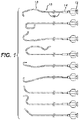
- the guide catheters shown in FIG. 1 have useful application as a guiding catheter for guiding a therapeutic device, for example, a dilation catheter for PTCA (balloon catheter), a stent delivery system, or a drug coated balloon catheter, or the like to a target location such as a stenosed portion of a coronary artery.
- a therapeutic device for example, a dilation catheter for PTCA (balloon catheter), a stent delivery system, or a drug coated balloon catheter, or the like to a target location such as a stenosed portion of a coronary artery.
- Each guiding catheter 10 has a proximal hub 12, a strain relief 14 co-axial with the main catheter body 16, which is visible in FIG. 1 extending to the left of strain relief 14, although the total length of main catheter body 16 is not displayed, the relevant distal portions 18 of each guiding catheter assume a pre-formed shape when not under external forces.
- distal portions “straighten” as they are introduced to and advanced through the vascular system over a guidewire, and regain their pre-formed shape when the placement guide wire is withdrawn proximally from at least the distal portion. Once the distal portion returns to the pre-formed shape, advancing the guidewire distally therethrough does not straighten the guide catheter, but instead, the guide wire conforms to the curves of the lumen of the guide catheter.
- a guide catheter 10 in accordance with the invention may include a braidless tip 20 that exhibits relatively high flexibility and is mounted on the distal side or distal end of the catheter main body 16.
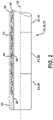
- the catheter main body 16 is an elongate tubular body 22, a distal portion of which is shown in partial longitudinal cross-section in FIG. 2 .
- Elongate tubular body 22 has an outer surface 24, comprised of a first region 26, a second region 28 proximally abutting the first region 26, a third region 30 proximally abutting the second region 28, a fourth region (not shown) proximally abutting the third region 30, and a fifth region (not shown) proximally abutting the fourth region.
- the third region 30 is made of a material having a lower durometer, and is more flexible than the fourth region
- the second region 28 is made of a material having a lower durometer, and is more flexible than the third region
- the first region 26 is made of a material having a lower durometer, and is more flexible the second region 28.
- the elongate tubular body 10 may gradually increase in flexibility along the distal direction along the longitudinal axis 32.
- the material of region 26 is the same material as region 28, even though assembled as a separate member initially.
- elongate tubular body 22 has three layers, and outer layer 34, a braided layer 36, and an inner layer 38.
- Outer layer 34 comprises the series of materials selected for the various regions, discussed above, and in any one region, the material constituting the outer layer may be a polyamide based material, such as Nylon or PEBAX, a blend thereof, or a polyurethane, such as Pellathane.
- the material constituting the inner layer 38 is a lubricious polymer, such as polytetrafluoroethylene (“PTFE”), or high density polyethylene (HDPE).
- PTFE polytetrafluoroethylene
- HDPE high density polyethylene
- Braidless tip 20 may be constructed completely from one material, or it may be a composite structure as shown in FIG. 2 .
- braidless distal tip is formed from the distal extension of the polymer forming the outer layer of elongate tubular body region 26, except for its proximal and inner surface, which is formed from the distal extension of the lubricious polymer forming the inner layer 38.
- the braided layer comprises a first plurality of elongate wire members winding in a clockwise direction about longitudinal axis 32 and a second plurality of elongate wire members winding in a counterclockwise direction about longitudinal axis 32.
- Elongate wire member 40 is one of the first plurality of elongate wire members and elongate wire member 442 is one of the second plurality of elongate wire members.
- the first plurality and the second plurality of wires that form the braided layer are embedded in polymer between outer surface 24 and inner surface 44. Preferably, they are embedded in the polymer forming outer layer 34 and outer surface 24.
- braid layer 36 overlaps in space with at least outer layer 34.
- Braided layer 36 forms the sole reinforcement structure in elongate tubular body 22. There are no other reinforcing structures, such as fibers running generally parallel ("straight") to longitudinal axis 32.
- FIG. 3 is a copy of a photograph of a magnified transverse cross-section of an elongate tubular body with a first plurality of elongate wire members and a second plurality of elongate wire members.
- FIG. 3 Also labeled on FIG. 3 are the inner diameter, d.sub.3, outer diameter, D.sub.3, lumen 50, outer layer 34, outer surface 24, overall wall thickness, t.sub.3T, wall thickness of inner layer 38, and t.sub.3i.
- FIG. 3 is a copy of a photograph of a magnified transverse cross-section of an elongate tubular body with a first plurality of elongate wire members and a second plurality of elongate wire members.
- FIG. 3 Also labeled
- FIG. 3 depicts a cross section where the elongate wire members of the first plurality of elongate wire members cross the elongate wire members of the second plurality of elongate wire members.
- the braid pattern in this embodiment is such that in every other location around the annular cross-section of elongate tubular body 22, as elongate wire member of the first plurality of elongate wire members is located "over" an elongate wire member of the second plurality of elongate wire members, and in the remaining locations, an elongate wire member of the first plurality of elongate wire members is "under” an elongate wire member of the second plurality of elongate wire members.
- cross-sectional areas of the elongate wire members are greater than their respective transverse cross-sectional area, due to the braid angle, which can be calculated knowing the number of elongate wire members used in the braid, the pics per inch, and the arrangement of elongate wires about the annulus, and the diameter of the braided layer.
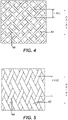
- FIG. 4 illustrates a first plurality of elongate wire members braided with a second plurality of elongate wire members in a 1-over, 1-under braid configuration.
- the distance between center-crossing points in two axially aligned sets of crossed wires is defined as a "pic”, and informs the expression, PPI, pics per inch.
- FIG. 5 illustrates a first plurality of elongate wire members braided with a second plurality of elongate wire members in a 2-over, 2-under braid configuration.
- FIG. 6 is a copy of a photograph of a magnified transverse cross-section of an elongate tubular body with a first plurality of elongate wire members and a second plurality of elongate wire members.
- the thirty-two of the first plurality are grouped in sub sets of four, generally round cross-sectionally shaped small elongate wire members in the place of one "flat" (rectangular cross-section) wire ribbon having a width equal to the sum of the four diameters, and a thickness equal to the diameter of the elongate wire members.
- the sixteen second plurality of elongate wire members in are grouped in subsets of two, generally round cross-sectionally shaped elongate wire members in the place of one "flat" (rectangular cross-section) wire ribbon, where these two elongate wire members, each appear to be twice as large in diameter as one of the thirty-two elongate wire members of the first plurality.
- FIG. 6 Also labeled on FIG. 6 are the inner diameter, d.sub.3, outer diameter, D.sub.3, lumen 50, outer layer 34, outer surface 24, overall wall thickness, t.sub.3T, wall thickness of inner layer 38, and t.sub.3i.
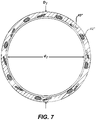
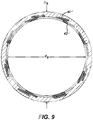
- FIGS. 7 , 8 , and 9 are copies of photographs of a magnified transverse cross-section of an elongate tubular body with a first plurality of elongate wire members and a second plurality of elongate wire members, where the magnification for each is the same as in FIG. 3 .
- the braid ppi is constant over the total length of the elongate tubular body. In certain embodiments, the braid ppi varies over the total length of the elongate tubular body. It should be understood that differences in ppi due to a manufacturing process window are considered insignificant and the resulting ppi is considered constant.
- the braid ppi is constant and is a value between 60-70 ppi. In certain embodiments, the braid ppi is constant and is a value between 65-75 ppi. In certain embodiments, the braid ppi is constant and is a value between 60-90 ppi.
- the braid ppi varies along the catheter, in an increasing fashion along longitudinal axis 32, the specific values falling between 60 and 90 ppi.
- the braided tubular reinforcement structure has 16 stainless steel ribbons evenly spaced about the circumference, 8 winding helically about the inner layer in a clockwise direction, and 8 winding helically about the inner layer in a counterclockwise direction, and the 16 ribbons are braided in a 2-over, 2-under- pattern with 70 +/- 3 pics per inch, which is constant along the entire length of the braided layer.
- the counterclockwise ribbons each have a rectangular transverse cross-section with a 0.002" thickness and 0.005" width, oriented with respect to the inner tubular layer such that the width is normal to the radial direction and the thickness is in the radial direction.
- the clockwise ribbons each have a rectangular transverse cross-section having a 0.001" thickness and a 0.004" width, oriented with respect to the inner tubular layer such that the width is normal to the radial direction and the thickness is in the radial direction.
- the outer tubular polymer layer comprises four separate tubular sections that abut each other and are individually made of blends of nylon 12 and a polyetherblockamide.
- the four sections have sequentially decreasing durometer, but all are higher (Shore D scale) than the Shore A 80 durometer of the distal tip.
- the outer tubular polymer layer has a fifth outer tubular polymer layer that is distal to the four other sections and proximal to (and abutting) the distal tip. This fifth section is made of the same material as the distal tip.
- the distal tip is made of a urethane, sold as Pellethane 80AE, with radiopaque filler (bismuth trioxide).
- Pellethane 80AE has a hardness measured on the Shore A scale of 80.
- the inner tubular polymeric layer is the longest of the three layers.
- the distal end of the braided layer is proximal to the distal end of the inner tubular polymeric layer.
- the distal end of the fourth (or fifth, if any) outer tubular polymeric layer section is proximal to the distal end of the braided layer.
- the distal tip extends proximally to abut the distal most outer polymeric layer section and the braided layer is embedded in the distal tip material.
- Distal to the distal end of the braided layer there are only two layers, the distal tip material being the outer layer and the PTFE liner being the inner layer.
- the remaining distance of the distal end of the guide catheter is comprised completely and only of the distal tip material, and has the same OD (0.0835") and ID (0.072") of the remainder of the main catheter body, or elongate tubular body.
- the outer surface of the inner layer is chemically etched to assist in a mechanical bond between it and various outer tubular layers.
- the distal tip and all components are assembled over a metal mandrel and encased in a heat-shrink tube and heated to bond all adjoining polymeric surfaces and to embed the braided layer in the respective outer layer material. After bonding, the heat shrink tube is slit longitudinally and peeled from the guide catheter, and the outer diameter of the distal tip is ground down to size.
- the outer layer may be extruded onto the braided layer over the inner layer, and then ground down for the areas where different durometer tubular sections may be assembled and bonded.
- An embodiment in accordance with the invention has an outer diameter of 0.0835 inches and an inner diameter of 0.0720 inches, a braid pattern of 2-over, 2 under, at a ppi of 70. There are sixteen flat wires all with a rectangular cross-section. The dimensions of the first transverse cross-sectional shape
- Catheter of FIG. 8 has an outer diameter of 0.0835 inches and an inner diameter of 0.0710 inches (although it really looks more polygonal than circular), has a braid pattern of 2-over, 2-under, at a ppi of approximately 63.
- the catheter is in a U shaped arch made to model the aortic arch, and the hub is turned at a constant low speed (revolution per minute) for a set period of time (here enough time to complete five revolutions of the proximal hub).
- the distal end of the guide catheter is unconstrained (other than being in a larger tubular "U", and thus facing 180 degrees opposite to the proximal hub.
- the rotation of the distal end is tracked and the two rotations are plotted against one another (proximal input versus distal output).
- proximal input versus distal output When "whip” occurs, the distal tip rotates a large amount for a small given input rotation.
- the reported numbers indicate the percent of the time tested during which the distal end was “whipping”. Lower percentage “whip” is better.
- Example 1 has a smaller bending radius, and therefore, surprising resists kinking better than Comparative Example 1.
Landscapes
- Health & Medical Sciences (AREA)
- Life Sciences & Earth Sciences (AREA)
- Biophysics (AREA)
- Pulmonology (AREA)
- Engineering & Computer Science (AREA)
- Anesthesiology (AREA)
- Biomedical Technology (AREA)
- Heart & Thoracic Surgery (AREA)
- Hematology (AREA)
- Animal Behavior & Ethology (AREA)
- General Health & Medical Sciences (AREA)
- Public Health (AREA)
- Veterinary Medicine (AREA)
- Media Introduction/Drainage Providing Device (AREA)
- Materials For Medical Uses (AREA)
Applications Claiming Priority (4)
| Application Number | Priority Date | Filing Date | Title |
|---|---|---|---|
| US201361825089P | 2013-05-19 | 2013-05-19 | |
| US201361825481P | 2013-05-20 | 2013-05-20 | |
| EP14734595.3A EP2999509B1 (fr) | 2013-05-19 | 2014-05-19 | Cathèter de guidage à grande lumière |
| PCT/US2014/038570 WO2014189828A1 (fr) | 2013-05-19 | 2014-05-19 | Cathèter de guidage à grande lumière |
Related Parent Applications (2)
| Application Number | Title | Priority Date | Filing Date |
|---|---|---|---|
| EP14734595.3A Division EP2999509B1 (fr) | 2013-05-19 | 2014-05-19 | Cathèter de guidage à grande lumière |
| EP14734595.3A Division-Into EP2999509B1 (fr) | 2013-05-19 | 2014-05-19 | Cathèter de guidage à grande lumière |
Publications (1)
| Publication Number | Publication Date |
|---|---|
| EP4119181A1 true EP4119181A1 (fr) | 2023-01-18 |
Family
ID=51059545
Family Applications (2)
| Application Number | Title | Priority Date | Filing Date |
|---|---|---|---|
| EP22187778.0A Withdrawn EP4119181A1 (fr) | 2013-05-19 | 2014-05-19 | Cathéter de guidage à grande lumière |
| EP14734595.3A Active EP2999509B1 (fr) | 2013-05-19 | 2014-05-19 | Cathèter de guidage à grande lumière |
Family Applications After (1)
| Application Number | Title | Priority Date | Filing Date |
|---|---|---|---|
| EP14734595.3A Active EP2999509B1 (fr) | 2013-05-19 | 2014-05-19 | Cathèter de guidage à grande lumière |
Country Status (8)
| Country | Link |
|---|---|
| US (2) | US10596347B2 (fr) |
| EP (2) | EP4119181A1 (fr) |
| KR (2) | KR102473033B1 (fr) |
| CN (2) | CN105377352B (fr) |
| AU (3) | AU2014268859B2 (fr) |
| CA (1) | CA2915932C (fr) |
| RU (1) | RU2693209C2 (fr) |
| WO (1) | WO2014189828A1 (fr) |
Families Citing this family (17)
| Publication number | Priority date | Publication date | Assignee | Title |
|---|---|---|---|---|
| US10702674B2 (en) * | 2013-06-28 | 2020-07-07 | Normedix, Inc. | Braided catheter assemblies |
| CN105579091B (zh) * | 2013-06-28 | 2020-04-14 | 诺梅迪克斯公司 | 用于桡动脉入路的导引鞘 |
| JP6426068B2 (ja) * | 2015-08-10 | 2018-11-21 | 朝日インテック株式会社 | カテーテル及びバルーンカテーテル |
| US20170072165A1 (en) | 2015-09-11 | 2017-03-16 | Cathera, Inc. | Catheter shaft and associated devices, systems, and methods |
| EP3347079B1 (fr) * | 2015-09-11 | 2024-12-25 | Covidien LP | Cathéter |
| WO2017201280A1 (fr) * | 2016-05-18 | 2017-11-23 | Ganske Karl V | Ensembles cathéters tressés |
| DK3592411T3 (da) * | 2017-03-10 | 2022-01-10 | Abiomed Inc | Udvideligt indførselshylster til medicinsk indretning |
| EP3646916A4 (fr) * | 2017-06-27 | 2021-06-30 | Nipro Corporation | Cathéter, séparateur et système d'aspiration |
| JP7006020B2 (ja) * | 2017-08-25 | 2022-01-24 | 住友ベークライト株式会社 | カテーテル、及び、カテーテルキット |
| WO2019149680A1 (fr) | 2018-01-31 | 2019-08-08 | Teijin Aramid B.V. | Tige tubulaire de cathéter |
| SG11202007428TA (en) | 2018-02-15 | 2020-09-29 | Abiomed Inc | Expandable introducer sheath for medical device |
| WO2020037063A1 (fr) | 2018-08-14 | 2020-02-20 | Abiomed, Inc. | Gaine d'introduction extensible pour dispositif médical |
| CN113660973B (zh) * | 2019-05-13 | 2024-09-24 | 美敦力瓦斯科尔勒公司 | 用于左桡动脉入路的经延伸导引器 |
| WO2021159139A2 (fr) | 2020-02-03 | 2021-08-12 | Abiomed, Inc. | Gaine extensible avec dilatateur à verrouillage |
| CN111803782A (zh) * | 2020-08-18 | 2020-10-23 | 上海上医康鸽医用器材有限责任公司 | 可塑型子宫输卵管造影导管装置 |
| CN116867536A (zh) * | 2021-02-22 | 2023-10-10 | 泰尔茂株式会社 | 导管 |
| CN116650794A (zh) * | 2022-02-21 | 2023-08-29 | 微创神通医疗科技(上海)有限公司 | 导管 |
Citations (8)
| Publication number | Priority date | Publication date | Assignee | Title |
|---|---|---|---|---|
| US4899787A (en) * | 1981-11-17 | 1990-02-13 | Kabushiki Kaisha Medos Kenkyusho | Flexible tube for endoscope |
| US5676659A (en) * | 1993-11-12 | 1997-10-14 | Medtronic, Inc. | Small diameter, high torque catheter |
| EP0839548A1 (fr) * | 1996-10-29 | 1998-05-06 | Medtronic, Inc. | Cathéter de guidage à paroi mince |
| US5891112A (en) * | 1995-04-28 | 1999-04-06 | Target Therapeutics, Inc. | High performance superelastic alloy braid reinforced catheter |
| EP0732117B1 (fr) * | 1995-03-17 | 1999-08-11 | Asahi Intecc Co., Ltd. | Structure de cathéther pour traitements médicaux |
| US20040143239A1 (en) * | 2003-01-17 | 2004-07-22 | Scimed Life Systems, Inc. | Unbalanced reinforcement members for medical device |
| EP1712247A1 (fr) * | 2005-04-11 | 2006-10-18 | Terumo Kabushiki Kaisha | Cathéter |
| US20120172798A1 (en) * | 2006-07-21 | 2012-07-05 | John Miller | Devices and methods for accessing a cerebral vessel |
Family Cites Families (18)
| Publication number | Priority date | Publication date | Assignee | Title |
|---|---|---|---|---|
| DE8714255U1 (de) | 1987-10-27 | 1989-02-23 | Harmjanz, Dietrich, Prof. Dr.Med., 3101 Gross Hehlen | Schlauch- oder rohrförmiger Führungskatheter |
| US5176660A (en) | 1989-10-23 | 1993-01-05 | Cordis Corporation | Catheter having reinforcing strands |
| US5071407A (en) | 1990-04-12 | 1991-12-10 | Schneider (U.S.A.) Inc. | Radially expandable fixation member |
| US5234416A (en) * | 1991-06-06 | 1993-08-10 | Advanced Cardiovascular Systems, Inc. | Intravascular catheter with a nontraumatic distal tip |
| ATE189964T1 (de) * | 1995-04-28 | 2000-03-15 | Target Therapeutics Inc | Hochleistungskatheter mit geflochtenem element |
| AUPN775296A0 (en) | 1996-01-25 | 1996-02-22 | Endogad Research Pty Limited | Directional catheter |
| US6042578A (en) | 1996-05-13 | 2000-03-28 | Schneider (Usa) Inc. | Catheter reinforcing braids |
| US5891114A (en) | 1997-09-30 | 1999-04-06 | Target Therapeutics, Inc. | Soft-tip high performance braided catheter |
| JP3181547B2 (ja) | 1997-12-01 | 2001-07-03 | 朝日インテック株式会社 | カテーテル |
| US6689120B1 (en) | 1999-08-06 | 2004-02-10 | Boston Scientific Scimed, Inc. | Reduced profile delivery system |
| AU2040601A (en) * | 1999-11-26 | 2001-06-04 | Micro Therapeutics, Inc. | Elliptical wire-reinforced catheter |
| US7438712B2 (en) | 2003-03-05 | 2008-10-21 | Scimed Life Systems, Inc. | Multi-braid exterior tube |
| CN100553707C (zh) * | 2005-09-30 | 2009-10-28 | 微创医疗器械(上海)有限公司 | 一种编织物加强管及其制备方法 |
| US20080091169A1 (en) * | 2006-05-16 | 2008-04-17 | Wayne Heideman | Steerable catheter using flat pull wires and having torque transfer layer made of braided flat wires |
| WO2009054509A1 (fr) * | 2007-10-26 | 2009-04-30 | Terumo Kabushiki Kaisha | Cathéter |
| CN101933821B (zh) * | 2009-06-30 | 2014-03-12 | 上海微创医疗器械(集团)有限公司 | 一种微导管 |
| US9101733B2 (en) * | 2009-09-29 | 2015-08-11 | Biosense Webster, Inc. | Catheter with biased planar deflection |
| WO2011057131A1 (fr) | 2009-11-09 | 2011-05-12 | Spotlight Technology Partners Llc | Hydrogels à base de polysaccharide |
-
2014
- 2014-05-19 CA CA2915932A patent/CA2915932C/fr active Active
- 2014-05-19 US US15/316,910 patent/US10596347B2/en active Active
- 2014-05-19 WO PCT/US2014/038570 patent/WO2014189828A1/fr not_active Ceased
- 2014-05-19 CN CN201480041022.0A patent/CN105377352B/zh active Active
- 2014-05-19 CN CN202010305873.9A patent/CN111437490A/zh active Pending
- 2014-05-19 KR KR1020217033413A patent/KR102473033B1/ko active Active
- 2014-05-19 AU AU2014268859A patent/AU2014268859B2/en active Active
- 2014-05-19 EP EP22187778.0A patent/EP4119181A1/fr not_active Withdrawn
- 2014-05-19 EP EP14734595.3A patent/EP2999509B1/fr active Active
- 2014-05-19 RU RU2015154745A patent/RU2693209C2/ru active
- 2014-05-19 KR KR1020157036073A patent/KR102315805B1/ko active Active
-
2019
- 2019-06-14 AU AU2019204215A patent/AU2019204215A1/en not_active Abandoned
-
2020
- 2020-02-11 US US16/787,125 patent/US11759604B2/en active Active
-
2021
- 2021-06-23 AU AU2021204275A patent/AU2021204275C1/en active Active
Patent Citations (8)
| Publication number | Priority date | Publication date | Assignee | Title |
|---|---|---|---|---|
| US4899787A (en) * | 1981-11-17 | 1990-02-13 | Kabushiki Kaisha Medos Kenkyusho | Flexible tube for endoscope |
| US5676659A (en) * | 1993-11-12 | 1997-10-14 | Medtronic, Inc. | Small diameter, high torque catheter |
| EP0732117B1 (fr) * | 1995-03-17 | 1999-08-11 | Asahi Intecc Co., Ltd. | Structure de cathéther pour traitements médicaux |
| US5891112A (en) * | 1995-04-28 | 1999-04-06 | Target Therapeutics, Inc. | High performance superelastic alloy braid reinforced catheter |
| EP0839548A1 (fr) * | 1996-10-29 | 1998-05-06 | Medtronic, Inc. | Cathéter de guidage à paroi mince |
| US20040143239A1 (en) * | 2003-01-17 | 2004-07-22 | Scimed Life Systems, Inc. | Unbalanced reinforcement members for medical device |
| EP1712247A1 (fr) * | 2005-04-11 | 2006-10-18 | Terumo Kabushiki Kaisha | Cathéter |
| US20120172798A1 (en) * | 2006-07-21 | 2012-07-05 | John Miller | Devices and methods for accessing a cerebral vessel |
Also Published As
| Publication number | Publication date |
|---|---|
| US20200246582A1 (en) | 2020-08-06 |
| AU2019204215A1 (en) | 2019-07-04 |
| AU2014268859B2 (en) | 2019-03-14 |
| AU2021204275A1 (en) | 2021-07-22 |
| AU2021204275C1 (en) | 2023-08-10 |
| CA2915932A1 (fr) | 2014-11-27 |
| CA2915932C (fr) | 2023-10-17 |
| US11759604B2 (en) | 2023-09-19 |
| AU2021204275B2 (en) | 2023-02-02 |
| RU2019112858A (ru) | 2019-09-09 |
| KR102473033B1 (ko) | 2022-12-01 |
| KR102315805B1 (ko) | 2021-10-25 |
| KR20160034254A (ko) | 2016-03-29 |
| KR20210128509A (ko) | 2021-10-26 |
| RU2015154745A3 (fr) | 2018-03-29 |
| AU2014268859A1 (en) | 2016-01-21 |
| CN105377352B (zh) | 2020-05-19 |
| US10596347B2 (en) | 2020-03-24 |
| WO2014189828A1 (fr) | 2014-11-27 |
| EP2999509A1 (fr) | 2016-03-30 |
| CN111437490A (zh) | 2020-07-24 |
| EP2999509B1 (fr) | 2023-04-05 |
| CN105377352A (zh) | 2016-03-02 |
| US20170095640A1 (en) | 2017-04-06 |
| RU2015154745A (ru) | 2017-06-26 |
| RU2019112858A3 (fr) | 2022-04-27 |
| RU2693209C2 (ru) | 2019-07-01 |
Similar Documents
| Publication | Publication Date | Title |
|---|---|---|
| AU2021204275B2 (en) | Large lumen guide catheter | |
| EP3589348B1 (fr) | Cathéter à pointe flexible | |
| US20030191451A1 (en) | Reinforced catheter system | |
| US20030135198A1 (en) | Catheter device having multi-lumen reinforced shaft and method of manufacture for same | |
| WO2013003835A4 (fr) | Cathéter de guidage pour aspiration à accès distal | |
| EP3458138B1 (fr) | Ensembles cathéters tressés | |
| US20050004556A1 (en) | Catheter having polymer stiffener rings and method of making the same | |
| US11027094B2 (en) | Tubular body and catheter having tubular body | |
| EP3328476B1 (fr) | Cathéter-guide coronaire | |
| EP4013480B1 (fr) | Cathéter de support | |
| RU2775437C2 (ru) | Направляющий катетер с большим просветом | |
| HK40034574A (en) | Large lumen guide catheter | |
| EP4279113B1 (fr) | Structure de corps de cathéter multifilaire | |
| HK40100454A (en) | Multi-filar catheter body construction | |
| HK40100454B (en) | Multi-filar catheter body construction |
Legal Events
| Date | Code | Title | Description |
|---|---|---|---|
| PUAI | Public reference made under article 153(3) epc to a published international application that has entered the european phase |
Free format text: ORIGINAL CODE: 0009012 |
|
| STAA | Information on the status of an ep patent application or granted ep patent |
Free format text: STATUS: THE APPLICATION HAS BEEN PUBLISHED |
|
| AC | Divisional application: reference to earlier application |
Ref document number: 2999509 Country of ref document: EP Kind code of ref document: P |
|
| AK | Designated contracting states |
Kind code of ref document: A1 Designated state(s): AL AT BE BG CH CY CZ DE DK EE ES FI FR GB GR HR HU IE IS IT LI LT LU LV MC MK MT NL NO PL PT RO RS SE SI SK SM TR |
|
| RAP1 | Party data changed (applicant data changed or rights of an application transferred) |
Owner name: CORDIS US CORP. |
|
| STAA | Information on the status of an ep patent application or granted ep patent |
Free format text: STATUS: REQUEST FOR EXAMINATION WAS MADE |
|
| 17P | Request for examination filed |
Effective date: 20230718 |
|
| RBV | Designated contracting states (corrected) |
Designated state(s): AL AT BE BG CH CY CZ DE DK EE ES FI FR GB GR HR HU IE IS IT LI LT LU LV MC MK MT NL NO PL PT RO RS SE SI SK SM TR |
|
| STAA | Information on the status of an ep patent application or granted ep patent |
Free format text: STATUS: EXAMINATION IS IN PROGRESS |
|
| 17Q | First examination report despatched |
Effective date: 20250310 |
|
| STAA | Information on the status of an ep patent application or granted ep patent |
Free format text: STATUS: THE APPLICATION IS DEEMED TO BE WITHDRAWN |
|
| 18D | Application deemed to be withdrawn |
Effective date: 20250911 |