EP4119309A1 - System und verfahren zur abgabe einer flüssigkeit in einen geschlossenen behälter - Google Patents
System und verfahren zur abgabe einer flüssigkeit in einen geschlossenen behälter Download PDFInfo
- Publication number
- EP4119309A1 EP4119309A1 EP21710608.7A EP21710608A EP4119309A1 EP 4119309 A1 EP4119309 A1 EP 4119309A1 EP 21710608 A EP21710608 A EP 21710608A EP 4119309 A1 EP4119309 A1 EP 4119309A1
- Authority
- EP
- European Patent Office
- Prior art keywords
- dispensing
- container
- rapid transfer
- transfer port
- liquid
- Prior art date
- Legal status (The legal status is an assumption and is not a legal conclusion. Google has not performed a legal analysis and makes no representation as to the accuracy of the status listed.)
- Pending
Links
Images


Classifications
-
- B—PERFORMING OPERATIONS; TRANSPORTING
- B25—HAND TOOLS; PORTABLE POWER-DRIVEN TOOLS; MANIPULATORS
- B25J—MANIPULATORS; CHAMBERS PROVIDED WITH MANIPULATION DEVICES
- B25J21/00—Chambers provided with manipulation devices
-
- B—PERFORMING OPERATIONS; TRANSPORTING
- B01—PHYSICAL OR CHEMICAL PROCESSES OR APPARATUS IN GENERAL
- B01L—CHEMICAL OR PHYSICAL LABORATORY APPARATUS FOR GENERAL USE
- B01L1/00—Enclosures; Chambers
- B01L1/04—Dust-free rooms or enclosures
-
- B—PERFORMING OPERATIONS; TRANSPORTING
- B01—PHYSICAL OR CHEMICAL PROCESSES OR APPARATUS IN GENERAL
- B01L—CHEMICAL OR PHYSICAL LABORATORY APPARATUS FOR GENERAL USE
- B01L1/00—Enclosures; Chambers
- B01L1/50—Enclosures; Chambers for storing hazardous materials in the laboratory, e.g. cupboards, waste containers
-
- B—PERFORMING OPERATIONS; TRANSPORTING
- B01—PHYSICAL OR CHEMICAL PROCESSES OR APPARATUS IN GENERAL
- B01L—CHEMICAL OR PHYSICAL LABORATORY APPARATUS FOR GENERAL USE
- B01L3/00—Containers or dishes for laboratory use, e.g. laboratory glassware; Droppers
- B01L3/02—Burettes; Pipettes
- B01L3/0289—Apparatus for withdrawing or distributing predetermined quantities of fluid
- B01L3/0293—Apparatus for withdrawing or distributing predetermined quantities of fluid for liquids
-
- B—PERFORMING OPERATIONS; TRANSPORTING
- B01—PHYSICAL OR CHEMICAL PROCESSES OR APPARATUS IN GENERAL
- B01L—CHEMICAL OR PHYSICAL LABORATORY APPARATUS FOR GENERAL USE
- B01L3/00—Containers or dishes for laboratory use, e.g. laboratory glassware; Droppers
- B01L3/52—Containers specially adapted for storing or dispensing a reagent
- B01L3/527—Containers specially adapted for storing or dispensing a reagent for a plurality of reagents
-
- B—PERFORMING OPERATIONS; TRANSPORTING
- B25—HAND TOOLS; PORTABLE POWER-DRIVEN TOOLS; MANIPULATORS
- B25J—MANIPULATORS; CHAMBERS PROVIDED WITH MANIPULATION DEVICES
- B25J21/00—Chambers provided with manipulation devices
- B25J21/005—Clean rooms
-
- B—PERFORMING OPERATIONS; TRANSPORTING
- B65—CONVEYING; PACKING; STORING; HANDLING THIN OR FILAMENTARY MATERIAL
- B65B—MACHINES, APPARATUS OR DEVICES FOR, OR METHODS OF, PACKAGING ARTICLES OR MATERIALS; UNPACKING
- B65B3/00—Packaging plastic material, semiliquids, liquids or mixed solids and liquids, in individual containers or receptacles, e.g. bags, sacks, boxes, cartons, cans, or jars
- B65B3/003—Filling medical containers such as ampoules, vials, syringes or the like
-
- B—PERFORMING OPERATIONS; TRANSPORTING
- B01—PHYSICAL OR CHEMICAL PROCESSES OR APPARATUS IN GENERAL
- B01L—CHEMICAL OR PHYSICAL LABORATORY APPARATUS FOR GENERAL USE
- B01L2200/00—Solutions for specific problems relating to chemical or physical laboratory apparatus
- B01L2200/02—Adapting objects or devices to another
- B01L2200/026—Fluid interfacing between devices or objects, e.g. connectors, inlet details
-
- B—PERFORMING OPERATIONS; TRANSPORTING
- B01—PHYSICAL OR CHEMICAL PROCESSES OR APPARATUS IN GENERAL
- B01L—CHEMICAL OR PHYSICAL LABORATORY APPARATUS FOR GENERAL USE
- B01L2200/00—Solutions for specific problems relating to chemical or physical laboratory apparatus
- B01L2200/06—Fluid handling related problems
Definitions
- the present invention relates to the dispensing of liquids in a closed chamber. More specifically, the present invention relates to a system and a method for dispensing a liquid in a closed chamber.
- isolators are becoming more widespread, said isolators being understood as devices closed by physical barriers (walls, etc.) and also generally by aerodynamic barriers (excess or reduced pressure of the interior relative to the exterior), such that the interior of the isolator is completely isolated from its exterior, thus preventing possible contaminants from entering or leaving the interior, depending on whether the 'clean' or 'dirty' environment is found inside or outside the isolator.
- isolators are often used to maintain in their interior the necessary requirements of sterility and cleanliness for the process that is to be carried out, without requiring the chamber in which the isolator is located to have the same closed chamber cleanliness grade as the interior of said isolator.
- isolators are usually equipped with one or more gloves connected to the external structure thereof which allow an operator to manipulate the interior of the isolator, but without 'breaking' the isolation barrier.
- Modern isolators usually incorporate one or more rapid transfer ports (RTP), that allow, in a relatively rapid and simple way, the aseptic transfer of components such as, for example, sterile vials, syringes, bottles or other types of containers, as well as the actual product from and to the interior of an isolator.
- RTP rapid transfer ports
- various types of rapid transfer ports exist, the most common being the DPTE ® transfer system (Double Porte pour Transfert Etanche ) from Getinge La Calhene and the SART system ® ( Sartorius Aseptic Rapid Transfer System ) from Sartorium Stedim Biotech ® .
- the object of the present invention is to disclose a system for dispensing a liquid in a closed chamber that minimises, or even eliminates, human intervention. Accordingly, the present invention discloses a system for dispensing a liquid in a closed chamber which comprises:
- the present invention discloses a system for dispensing a liquid which comprises:
- the robotic arm may also be configured to open the rapid transfer port before removing the plurality of dispensing nozzles from the first container.
- the robotic arm may also be configured to open the rapid transfer port before removing the plurality of dispensing nozzles from the first container.
- the robotic arm may also be configured to remove the plurality of dispensing nozzles from the liquid dispensing position and introduce them into the container and close the rapid transfer port, thus achieving the complete elimination of human intervention in the process of preparing the system to carry out the dispensing, carrying out the dispensing and removing the dispensing system when the dispensing is complete and/or when the useful life of said dispensing system has ended.
- the dispensing system may comprise a pipe connected to the plurality of dispensing nozzles and to a second container which contains the liquid to be dispensed, said second container being positioned outside of the first container and of the closed chamber.
- a large quantity of product can be dispensed, as the dispensing nozzles are supplied from a container that acts as a reservoir and which may have a large capacity as it is not subject to the restrictions imposed by the closed chamber.
- the dispensing nozzles may be supplied from a container, for example, a bag, present inside of said first container and which contains the product to be dispensed. This configuration is especially advantageous for dispensing small batches. Other configurations for supplying the dispensing nozzles are also possible.
- said dispensing system is disposable. More specifically, the pipe or pipes supplying the plurality of dispensing nozzles may be disposable, whilst the dispensing nozzles and/or other elements may be reused after being sterilised by means of an autoclave or other suitable sterilisation method. However, it is also possible for all the elements of the dispensing system to be disposable. Alternatively, said dispensing system is reusable.
- the system according to the present invention may comprise a pump for each dispensing nozzle.
- the system according to the present invention may comprise a single pump common to each dispensing nozzle or may comprise various pumps, each pump being associated with a portion of the plurality of dispensing nozzles, for example, in an embodiment with two pumps and six dispensing nozzles, each pump supplies three dispensing nozzles.
- the at least one rapid transfer port of the system according to the present invention is a DPTE ® port (Double Porte pour Transfert Etanche) or SART System ® ( Sartorius Aseptic Rapid Transfer System ).
- DPTE ® port Double Porte pour Transfert Etanche
- SART System ® Sartorius Aseptic Rapid Transfer System
- the ports may all be of the same type or they may be different, for example, a DPTE ® port and a SART ® port.
- the DPTE ® port (Double Porte pour Transfert Etanche) is a rapid transfer port located in a wall of a closed chamber and defining a circular opening, with means for opening and closing the same, for receiving a container or bag with a connection port with a shape matching the one of said circular opening, both ports being configured to produce a leaktight seal between them.
- Said DPTE ® port is particularly suitable for the transfer of sterile and/or toxic products, among others, between the inside and the outside, and vice versa, of the closed chamber whose wall comprises the aforementioned rapid transfer port.
- the port located on the closed chamber, and more specifically, in a wall of the closed chamber is commonly referred to as an alpha port, while the port of the bag or container for being coupled to said alpha port is commonly referred to as a beta port.
- the SART ® port ( Sartorius Aseptic Rapid Transfer System ) is a rapid transfer port located in a wall of a closed chamber and which comprises an internal port and an external port with respect to said closed chamber, wherein the external port comprises an orifice defining V-shaped profiles or sections for receiving a connector matching the shape of said orifice.
- Said port and connector are particularly suitable for transferring liquids between the outside and the inside, and vice versa, of said closed chamber.
- said closed chamber is isolated.
- said closed chamber of the system according to the present invention is an isolator.
- said closed chamber of the system according to the present invention is a cleanroom. Both the cleanroom and the isolator are understood as closed chambers that meet, as a minimum, ISO 14644-1:2015 and ISO 14644-2:2015 or equivalent standards. Both the embodiments in which the closed chamber is a cleanroom and the embodiments in which the closed chamber is an isolator may be configured to dispense blood products and/or haemoderivative products, or to dispense medicines, preferably sterile medicines.
- each dispensing nozzle comprises a dispensing needle protected by a tubular or similar element which acts as a shield and which is removed before beginning to dispense the liquid.
- Said shield may be placed back on the dosing needle after completing the dosing of the liquid and before removing the dispensing system from inside the closed chamber.
- said protector also prevents the needle from perforating the container configured for coupling to the rapid transfer port.
- a method of dispensing a liquid in a closed chamber which comprises at least one rapid transfer port in at least one wall of said chamber which comprises the following steps:
- One of the advantages of the method according to the present invention is that it reduces human handling of the product before it is dispensed, as it is possible for a duly qualified operator to carry out one or more of the additional steps that do not involve direct interaction with the product, such as, for example, opening the rapid transfer port.
- the method according to the present invention may also comprise the following steps:
- the opening of the rapid transfer port is carried out by a robotic arm.
- the closing of the rapid transfer port is carried out by a robotic arm.
- the removal of the dispensing nozzles and the re-introduction into the first container is carried out by a robotic arm.
- a robotic arm is responsible for handling the rapid transfer port and the dispensing system, although, alternatively, having one robotic arm for handling the rapid transfer port and another for handling the dispensing system is also possible.
- a pipe connected to the plurality of dispensing nozzles is connected to a second container which contains the liquid to be dispensed, said second container being positioned outside of the first container and of the closed chamber. It is thus possible to dispense a large quantity of liquid whilst ensuring the sterility thereof and of the closed chamber (cleanroom, isolator, etc.) as the plurality of dispensing nozzles is supplied directly from a second container which acts as a reservoir for the liquid to be dispensed.
- the second container connected to the plurality of dispensing nozzles and responsible for the supply thereof may be situated inside the first container. This option has the drawback that the size of the second container must be smaller, as it must be contained within the first container, and therefore it is only recommended for dispensing small quantities of liquid.
- the liquid to be dispensed is a blood product and/or a haemoderivative product.
- the liquid to be dispensed is a medicine.
- the grades of cleanliness of a cleanroom and/or an isolator are understood as defined by ISO 14644-1:2015 or equivalent standards.
- the terms 'cleanroom' and 'white room' are used in an equivalent and interchangeable manner.
- the terms 'dispense' and 'dispensing' are used, said terms may be replaced by the terms 'dosing' and 'dosage' respectively.
- the terms 'method' and 'process' are considered equivalent and interchangeable in the present document.
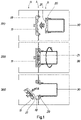
- Fig. 1 shows diagrammatically a rapid transfer port and, more specifically, shows diagrammatically the operation thereof.
- the rapid transfer port shown in this figure is of the DPTE ® ( Double Porte pour Transfert Etanche ) type.
- DPTE ® Double Porte pour Transfert Etanche
- the principle of the operation of a DPTE ® port is applicable to other rapid transfer ports.
- a DPTE ® port basically comprises two portions, an alpha ⁇ port and a beta ⁇ port.
- the alpha ⁇ port is usually installed in a surface such as, for example, the wall of an isolator.
- the alpha ⁇ port usually comprises a flange 10, a seal and a gate 11.
- the beta ⁇ port also comprises a flange 20, a seal and a gate 21 and is connected to a container 30, another isolator or another device suitable for transfers, such as, for example, a bag.
- the gates 11, 21 After connecting the alpha ⁇ and beta ⁇ ports, by rotating the beta ⁇ portion through about 60 degrees, the gates 11, 21 are connected and act as a single part, at which moment the alpha ⁇ side of the unit can be opened, giving access to the isolator or cleanroom.
- the outer surfaces of the gates 11, 21 of the alpha ⁇ and beta ⁇ portions remain firmly connected until the alpha ⁇ gate 11 is closed and an opposite rotation of the beta ⁇ unit takes place, separating the two gates 11, 21.
- the beta ⁇ container 30 or the attached device must be internally sterile, like the isolator.
- Fig. 1 shows in a simplified manner the process of coupling a container 30 provided with a beta ⁇ port to an alpha ⁇ port installed in the wall of an isolator.
- the first step 100 consists in coupling the beta ⁇ port of the container 30 to the alpha ⁇ port of the isolator, at which moment the gates 11, 21 of the respective ports ⁇ , ⁇ close the aperture defined by the respective flanges 10, 20.
- the second step 200 consists in rotating the beta port ⁇ , which is usually rigidly connected to the container 30, until the gates 11, 21 are connected to one another, so that the dirty faces of both are in contact and isolated with respect to the interior of the isolator or cleanroom and the interior of the container 30. Said rotation of the beta port ⁇ is usually about 60 degrees.
- the third step 300 consists in opening the gates 11, 21 so that the interior of the container 30 is in communication with the interior of the isolator.
- the interior of the container 30 has been sterilised using an autoclave, radiation or any other applicable technique.
- the alpha ⁇ and beta ⁇ ports comprise respective seals to provide a sealed closure between both ports.
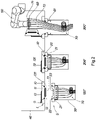
- Fig. 2 shows diagrammatically an embodiment of a system according to the present invention.
- the rapid transfer port 1 is of the DPTE ® type, i.e., similar to that in Fig. 1 . Consequently, said rapid transfer port 1 also comprises and alpha ⁇ portion and a beta ⁇ portion.
- the beta ⁇ portion is part of a container 30 which contains in its interior a dispensing system 70.
- Said rapid transfer port is mounted in an isolator 40, although in other embodiments it may be mounted in a cleanroom.
- the presence of more than one rapid transfer port 1 is also possible, and all said ports may be of the same type or of a different type (DPTE ® , SART ® , etc.).
- the alpha ⁇ portion comprises a flange 10, a seal 12 and a gate 11 connected to the flange 10 by a hinge 13.
- the gate 10 may not be hinged or the hinge 13 may have a different arrangement from that shown here.
- the beta ⁇ portion also comprises a flange 20, a gate 21 and a seal 22.
- the gate 11 comprises a projection 13 configured to accommodate a recess 23 of a matching shape present in the gate 21.
- the projection 13 in the embodiment shown comprises a seal 131 to guarantee that the connection of the gates 11, 21 is sealed.
- the dispensing system 70 comprises a plurality of dispensing nozzles 71 associated with respective supply pipes 72.
- Said plurality of dispensing nozzles 71 may be held in a support 60.
- Said support 60 facilitates the combined handling of the plurality of dispensing nozzles 71 by a robotic arm 50.
- Said support 60 for the dispensing nozzles is in turn attached to the container 30 or to the flange 20 by a support 61 which, as well as holding the support 60, may act to protect said support and the dispensing nozzles 71 against blows, etc.
- Said protection is particularly important in embodiments in which the container 30 is not rigid or is semi-rigid, such as, for example, if it is a bag.
- the robotic arm 50 allows human intervention in the dispensing process to be eliminated, or significantly reduced, thus reducing the risk of accident or contamination due to human error and increasing security at work for employees, particularly given that the liquid to be dispensed may on occasion be toxic, irritant, etc., in other words, harmful to health.
- the fluid dispensing system 70 may be disposable, i.e. may be destroyed or discarded after the fluid dispensing is complete or alternatively reusable. If it is reusable, after the dispensing process has ended it must be properly sterilised using any suitable sterilisation method. It is also possible for the dispensing system 70 to be partly reusable and partly disposable, i.e., for example, the dispensing nozzles 71 are reusable, whereas the respective supply pipes 72 and/or other elements are disposable. If any element of the dispensing system 70 is reusable, said element must be properly sterilised by any suitable sterilisation system (heat, steam, radiation, chemical agents, etc.) before being used again.
- any suitable sterilisation system heat, steam, radiation, chemical agents, etc.
- Fig. 2 shows three distinct phases of the process of dispensing a liquid by means of an embodiment of a system according to the present invention.
- the alpha ⁇ port of the isolator 40 and the beta ⁇ port of the container 30 are closed and said container 30 houses in its interior a fluid dispensing system 70.
- the second phase 200' consists in connecting the alpha ⁇ port to the beta ⁇ port in order subsequently to lock together the gates 11, 21 of the alpha ⁇ and beta ⁇ portions using, in this embodiment, a rotation of the beta ⁇ port and of the container 30 rigidly connected thereto.
- the connection and locking process may differ from that described above.
- the gates 11, 21 have already been opened so that the interior of the isolator 40 and of the container 30 are in communication.
- the robotic arm 50 is in the process of placing the plurality of dispensing nozzles 71 in a dispensing position after grasping the support 60 and then removing it, together with the plurality of dispensing nozzles 71, from the respective support 61 in the container.
- the ends of the supply pipes 72 have been removed from the container 30.
- the container 30 comprises means for removing said supply pipes whilst maintaining their sterility and without breaking the isolation of the interior of the container 30 from the exterior.
- a plurality of supply pipes 72 has been shown passing through the container 30, usually a single connection with the exterior is made after joining the plurality of supply pipes 72 into a single pipe (see Fig. 3 ).
- the interior of the isolator 40 may be grade A according to ISO 14644-1:2015, whilst the exterior thereof may be grade B, C or D, as circumstances require, thus reducing the technical complexity and the associated economic cost involved in maintaining a grade A closed chamber, such as, for example, a white room.
- a grade A closed chamber such as, for example, a white room.
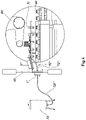
- Fig. 3 is a perspective view of a dispensing system 72' which may be used in a system according to the present invention.
- the rapid transfer port 1' is of the SART ® type and the container 30' associated therewith is a flexible bag configured to maintain hermetic conditions even though the pipe 721' passes into and through said bag.
- the dispensing system 72' shown in this figure comprises a plurality of dispensing nozzles 71' held in the same support 60' configured to be handled by a robotic arm.
- that shown in Fig. 2 that shown in Fig.
- a bag 720' which acts as a buffer reservoir responsible for supplying the various pipes 72' which supply each dispensing nozzle 71' directly and individually.
- Said pipe 721' is responsible for supplying the bag 720', which in turn supplies the various pipes 72'.
- Said pipe 721' may be connected to an external reservoir for supplying the product to be dispensed continuously (see Fig. 4 ).
- Fig. 4 shows diagrammatically an embodiment of a system according to the present invention.
- the dispensing system 70 as well as other elements, has been shown in a simplified manner.
- This figure shows how the reservoir 73 supplies the plurality of dispensing nozzles 71 through the pipes 721", 72", which are inserted into the isolator 40 through the rapid transfer port 1".
- This arrangement is particularly advantageous for dispensing large batches of product, as the reservoir 73 may be of a large size since said reservoir is not subject to the space restrictions imposed by the size of the isolator 40.
- the dispensing system according to the present invention dispenses a fixed amount of liquid into vials 80.
- Said liquid is preferably a haemoderivative product or a drug, although it may be any type of liquid (a food product, a chemical product, etc.).
- the system according to the present invention is configured to dispense relatively large amounts of fluid
- said system may be configured to dispense smaller amounts of product.
- the system according to the present invention may have, for example, a small container which acts as a reservoir inside the container 30, 30' and is connected to the dispensing system 70, 70' in such a way that said small internal reservoir may supply the plurality of dispensing nozzles 71, 71'.
- this configuration may have lower productivity than that shown in Fig.
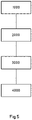
- Fig. 5 is a flow diagram of a first embodiment of a method of dispensing a liquid according to the present invention.
- the first step 1000 consists in coupling to a rapid transfer port 1, 1', 1" a container 30, 30' which houses in its interior a dispensing system 70, 70', 70" which comprises a plurality of dispensing nozzles 71 held in a support 60.
- the second step 2000 consists in opening the rapid transfer port 1 so that the interior of the first container 30, 30' is in connection with the closed chamber 40.
- the third step 3000 consists in removing from the container 30, 30' the support 60 and the plurality of dispensing nozzles 71 held therein and placing them in a liquid dispensing position inside the closed chamber 40 using a robotic arm 50.
- the fourth step 4000 consists in dispensing a fixed amount of liquid into a destination container, for example, a vial.
- a destination container for example, a vial.
- each dispensing nozzle 71 dispenses fluid into a different container, it is also possible that more than one nozzle 71 dispenses into a common container.
- Fig. 6 is a flow diagram of a second embodiment of a method of dispensing a liquid according to the present invention.
- the steps 1000, 2000, 3000 and 4000 are similar to those described in Fig. 5 , and therefore will not be described again.
- the dispensing method comprises an additional step 3500 between the third 3000 and the fourth 4000 step, which consists in connecting a pipe 721, 721' which supplies the plurality of dispensing nozzles 71 to a container 73 positioned outside of the container 30, 30' and of the closed chamber 40 and which contains the liquid to be dispensed.
- the second embodiment in Fig. 6 after step 4000 which consists of dosing the liquid comprises the fifth step 5000 which consists of removing the support 60 and the plurality of dispensing nozzles 71 from the dispensing position and re-inserting them into the container 30, 30'.
- the sixth step 6000 consists in closing the rapid transfer port 1, 1', 1" so that the respective gates 11, 21 of the alpha ⁇ portion and beta ⁇ portion close the isolator 40 and the container 30, 30', respectively.
- the seventh step 7000 consists in uncoupling the container 30, 30' from the rapid transfer port 1, 1', 1" and then discarding or recycling the container 30, 30' and/or the used dispensing system 70, 70', 70" contained therein.
- steps 2000, 3000, 4000, 5000 and 6000 are carried out by a robotic arm 50, in other words, with no human interaction with the fluid to be dispensed or with the dispensing system 70, 70', thus reducing the risk of accidents and/or contamination due to human error.
- the part of step 3500 that takes place inside the closed chamber is also preferably carried out by a robotic arm 50.
- the closed chamber may comprise a robotic arm 50 capable of carrying out the steps described above or may comprise more than one robotic arm, each of said robotic arms specialising in carrying out specific steps from among those described above.
- a robotic arm is used in the present invention to carry out the steps performed inside the closed chamber 40 and the container 30, 30'
- the robotic arm only carries out the steps 3000 and 4000 described above, the rest of the steps being carried out in a conventional way by an operator handling the components inside the closed chamber 40 through specially designed gloves.
- Embodiments in which the process is carried out completely automatically by the use of one or more robotic arms may also have handling gloves as a safeguard in case a problem occurs inside the closed chamber 40.
Landscapes
- Engineering & Computer Science (AREA)
- Chemical & Material Sciences (AREA)
- Health & Medical Sciences (AREA)
- Mechanical Engineering (AREA)
- Clinical Laboratory Science (AREA)
- Chemical Kinetics & Catalysis (AREA)
- Robotics (AREA)
- Analytical Chemistry (AREA)
- Medicinal Chemistry (AREA)
- Medical Preparation Storing Or Oral Administration Devices (AREA)
Applications Claiming Priority (2)
| Application Number | Priority Date | Filing Date | Title |
|---|---|---|---|
| EP20382186.3A EP3878612A1 (de) | 2020-03-12 | 2020-03-12 | System und verfahren zur abgabe einer flüssigkeit in einer geschlossenen kammer |
| PCT/IB2021/051950 WO2021181270A1 (es) | 2020-03-12 | 2021-03-09 | Sistema y metodo para la dispensacion de un liquido en un recinto cerrado |
Publications (1)
| Publication Number | Publication Date |
|---|---|
| EP4119309A1 true EP4119309A1 (de) | 2023-01-18 |
Family
ID=70295078
Family Applications (2)
| Application Number | Title | Priority Date | Filing Date |
|---|---|---|---|
| EP20382186.3A Withdrawn EP3878612A1 (de) | 2020-03-12 | 2020-03-12 | System und verfahren zur abgabe einer flüssigkeit in einer geschlossenen kammer |
| EP21710608.7A Pending EP4119309A1 (de) | 2020-03-12 | 2021-03-09 | System und verfahren zur abgabe einer flüssigkeit in einen geschlossenen behälter |
Family Applications Before (1)
| Application Number | Title | Priority Date | Filing Date |
|---|---|---|---|
| EP20382186.3A Withdrawn EP3878612A1 (de) | 2020-03-12 | 2020-03-12 | System und verfahren zur abgabe einer flüssigkeit in einer geschlossenen kammer |
Country Status (3)
| Country | Link |
|---|---|
| US (2) | US12344415B2 (de) |
| EP (2) | EP3878612A1 (de) |
| WO (1) | WO2021181270A1 (de) |
Cited By (5)
| Publication number | Priority date | Publication date | Assignee | Title |
|---|---|---|---|---|
| DE102023109926A1 (de) * | 2023-04-19 | 2024-10-24 | Bausch + Ströbel SE + Co. KG | Dosiervorrichtung für pharmazeutische Zwecke und Verfahren zum Betreiben einer Dosiervorrichtung |
| WO2025016641A1 (de) * | 2023-07-14 | 2025-01-23 | Syntegon Technology Gmbh | Befüllungssystem zur fluidbefüllung von behältnissen |
| IT202300024525A1 (it) | 2023-11-20 | 2025-05-20 | Ima Spa | Componente beta per un sistema di trasferimento, sistema di trasferimento, area di isolamento sterile, apparato di riempimento asettico e metodo per effettuare tale riempimento. |
| DE102024102062A1 (de) * | 2024-01-24 | 2025-07-24 | Peter Schubert | Transferportanordnung zum Transfer von Komponenten in und/oder aus einem pharmazeutischen Isolator |
| DE102024102064A1 (de) * | 2024-01-24 | 2025-07-24 | Peter Schubert | Verfahren zum, insbesondere aseptischen, Abfüllen eines Mediums, insbesondere eines Medikaments |
Families Citing this family (5)
| Publication number | Priority date | Publication date | Assignee | Title |
|---|---|---|---|---|
| US11814200B2 (en) | 2021-12-30 | 2023-11-14 | Cytiva Us Llc | Fluid distribution system with single use manifold assembly for scaled filling |
| DE102022101820A1 (de) * | 2022-01-26 | 2023-07-27 | Atec Pharmatechnik Gmbh | Transfer-Port zum Übertragen eines Fluides sowie Übertragungs-System |
| BE1030467B1 (fr) * | 2022-04-20 | 2023-11-20 | Quantoom Biosciences S A | Bras robotique pour la manipulation de milieux liquides, système comprenant ledit bras robotique et méthode pour la manipulation de milieux liquides |
| EP4516468A1 (de) * | 2023-08-30 | 2025-03-05 | Hecht Technologie GmbH | Vorrichtung zur handhabung von behältern |
| CN117585322B (zh) * | 2023-11-08 | 2025-09-23 | 展一智能科技(苏州)有限公司 | 罐箱充料控制方法 |
Citations (2)
| Publication number | Priority date | Publication date | Assignee | Title |
|---|---|---|---|---|
| WO2021040983A1 (en) * | 2019-08-26 | 2021-03-04 | Emd Millipore Corporation | Fluid transfer system for isolators |
| WO2021156261A1 (de) * | 2020-02-04 | 2021-08-12 | Groninger & Co. Gmbh | Verfahren zum transferieren zumindest einer füllnadel einer anzahl von füllnadeln in einen aseptischen isolator |
Family Cites Families (9)
| Publication number | Priority date | Publication date | Assignee | Title |
|---|---|---|---|---|
| US20040185521A1 (en) * | 2003-03-20 | 2004-09-23 | Shigeru Yoshida | Microorganism sampling method and microorganism sampling device |
| WO2010100234A1 (en) * | 2009-03-06 | 2010-09-10 | Disposable-Lab | Disposable isolator comprising means for filling containers |
| FR2956092B1 (fr) | 2010-02-10 | 2012-02-24 | Sartorius Stedim Biotech Sa | Procede et unite d'emplissage sterile d'un conteneur elementaire final avec un contenu destine au domaine biopharmaceutique. |
| US10684303B2 (en) * | 2011-07-22 | 2020-06-16 | Vanrx Pharmasystems Inc. | Method for protecting and unprotecting the fluid path in a controlled environment enclosure |
| ES2718093T3 (es) * | 2013-08-16 | 2019-06-27 | Vanrx Pharmasystems Inc | Método para llenar envases farmacéuticos |
| WO2015023934A1 (en) | 2013-08-16 | 2015-02-19 | Kimmerling Holdings Group, Llc | Synthesis of antimicrobial silsesquioxane-silica hybrids |
| US20150114515A1 (en) * | 2013-10-31 | 2015-04-30 | Oden Machinery Inc. | Liquid filler using single motive force |
| US11156627B2 (en) * | 2016-06-20 | 2021-10-26 | Genesis Technologies Limited | Automated cell processing systems and methods |
| IT201600081444A1 (it) | 2016-08-03 | 2018-02-03 | I M A Industria Macch Automatiche S P A In Sigla Ima S P A | Macchina per il riempimento e confezionamento di flaconi, cartucce, siringhe e simili con cambio di formato automatico. |
-
2020
- 2020-03-12 EP EP20382186.3A patent/EP3878612A1/de not_active Withdrawn
-
2021
- 2021-03-09 EP EP21710608.7A patent/EP4119309A1/de active Pending
- 2021-03-09 WO PCT/IB2021/051950 patent/WO2021181270A1/es not_active Ceased
- 2021-03-09 US US17/906,053 patent/US12344415B2/en active Active
-
2025
- 2025-05-30 US US19/223,837 patent/US20250289600A1/en active Pending
Patent Citations (2)
| Publication number | Priority date | Publication date | Assignee | Title |
|---|---|---|---|---|
| WO2021040983A1 (en) * | 2019-08-26 | 2021-03-04 | Emd Millipore Corporation | Fluid transfer system for isolators |
| WO2021156261A1 (de) * | 2020-02-04 | 2021-08-12 | Groninger & Co. Gmbh | Verfahren zum transferieren zumindest einer füllnadel einer anzahl von füllnadeln in einen aseptischen isolator |
Non-Patent Citations (1)
| Title |
|---|
| See also references of WO2021181270A1 * |
Cited By (6)
| Publication number | Priority date | Publication date | Assignee | Title |
|---|---|---|---|---|
| DE102023109926A1 (de) * | 2023-04-19 | 2024-10-24 | Bausch + Ströbel SE + Co. KG | Dosiervorrichtung für pharmazeutische Zwecke und Verfahren zum Betreiben einer Dosiervorrichtung |
| WO2025016641A1 (de) * | 2023-07-14 | 2025-01-23 | Syntegon Technology Gmbh | Befüllungssystem zur fluidbefüllung von behältnissen |
| IT202300024525A1 (it) | 2023-11-20 | 2025-05-20 | Ima Spa | Componente beta per un sistema di trasferimento, sistema di trasferimento, area di isolamento sterile, apparato di riempimento asettico e metodo per effettuare tale riempimento. |
| WO2025109637A1 (en) * | 2023-11-20 | 2025-05-30 | I.M.A. Industria Macchine Automatiche S.P.A. | Beta component for a transfer system, transfer system, sterile isolation area, aseptic filling apparatus and method for performing such filling |
| DE102024102062A1 (de) * | 2024-01-24 | 2025-07-24 | Peter Schubert | Transferportanordnung zum Transfer von Komponenten in und/oder aus einem pharmazeutischen Isolator |
| DE102024102064A1 (de) * | 2024-01-24 | 2025-07-24 | Peter Schubert | Verfahren zum, insbesondere aseptischen, Abfüllen eines Mediums, insbesondere eines Medikaments |
Also Published As
| Publication number | Publication date |
|---|---|
| US20250289600A1 (en) | 2025-09-18 |
| CA3171194A1 (en) | 2021-09-16 |
| EP3878612A1 (de) | 2021-09-15 |
| US12344415B2 (en) | 2025-07-01 |
| US20230234734A1 (en) | 2023-07-27 |
| WO2021181270A1 (es) | 2021-09-16 |
Similar Documents
| Publication | Publication Date | Title |
|---|---|---|
| US20250289600A1 (en) | System and method for dispensing a liquid in a closed chamber | |
| ES2875726T3 (es) | Aparato y procedimiento para llenar asépticamente recipientes farmacéuticos con un fluido farmacéutico | |
| US10555872B1 (en) | Convenience kits for aseptic sterilizing and dispensing | |
| EP2734300B1 (de) | Verfahren zum schutz und zur aufhebung des schutzes eines fluidkanals in einem gehäuse für eine gesteuerte umgebung | |
| CN104755115B (zh) | 用于药物容器的组件包装结构 | |
| US9121512B2 (en) | Coupling assembly with sterilizing chamber | |
| US20200130873A1 (en) | Methods for preparing autologous blood eye drops | |
| EP1468959A2 (de) | Maschine zum aseptischen Abfüllen | |
| US10646601B2 (en) | Device and method for transferring a sterile product between two containers | |
| MX2014007289A (es) | Distribuidor de bolsa de guantes para el ensamblado aseptico de unidades de llenado de radiofarmacos. | |
| JP2001055207A (ja) | 2つのエンクロージャ間で無菌製品を移動させる方法およびその方法を実施するための搬送コンテナ | |
| US11389976B2 (en) | Disposable isolator and product conditioning installation comprising such a disposable isolator | |
| CA3171194C (en) | System and method for dispensing a liquid in a closed chamber | |
| US20250229265A1 (en) | Functional element, beta container, transfer system and barrier system | |
| US8071009B2 (en) | Sterile de-molding apparatus and method | |
| US5715659A (en) | Transfer system for transferring objects into a barrier isolator | |
| KR102476248B1 (ko) | 커넥팅 부재 | |
| GB2577835A (en) | Single-use isolator with laminar flow and double filtration | |
| US20250289606A1 (en) | Functional element, beta container system, transfer system and barrier system | |
| US20260054868A1 (en) | System for processing pharmaceutical containers and method for operating such a system | |
| CN215944943U (zh) | 一种胶塞分装隔离器 | |
| WO2025163549A1 (en) | A regulating valve for sealing process chambers | |
| Lehmann et al. | Advanced Aseptic Pharmaceutical Production in a Scalable Isolator: A Case Study. | |
| Agalloco et al. | 13 Sterile Bulk Active Pharmaceutical Ingredient Production | |
| WO2025104628A1 (en) | Steam sterilizable container and related sterilization method |
Legal Events
| Date | Code | Title | Description |
|---|---|---|---|
| STAA | Information on the status of an ep patent application or granted ep patent |
Free format text: STATUS: UNKNOWN |
|
| STAA | Information on the status of an ep patent application or granted ep patent |
Free format text: STATUS: THE INTERNATIONAL PUBLICATION HAS BEEN MADE |
|
| PUAI | Public reference made under article 153(3) epc to a published international application that has entered the european phase |
Free format text: ORIGINAL CODE: 0009012 |
|
| STAA | Information on the status of an ep patent application or granted ep patent |
Free format text: STATUS: REQUEST FOR EXAMINATION WAS MADE |
|
| 17P | Request for examination filed |
Effective date: 20221007 |
|
| AK | Designated contracting states |
Kind code of ref document: A1 Designated state(s): AL AT BE BG CH CY CZ DE DK EE ES FI FR GB GR HR HU IE IS IT LI LT LU LV MC MK MT NL NO PL PT RO RS SE SI SK SM TR |
|
| P01 | Opt-out of the competence of the unified patent court (upc) registered |
Effective date: 20230330 |
|
| DAV | Request for validation of the european patent (deleted) | ||
| DAX | Request for extension of the european patent (deleted) | ||
| TPAC | Observations filed by third parties |
Free format text: ORIGINAL CODE: EPIDOSNTIPA |
|
| STAA | Information on the status of an ep patent application or granted ep patent |
Free format text: STATUS: EXAMINATION IS IN PROGRESS |
|
| 17Q | First examination report despatched |
Effective date: 20251014 |
|
| TPAC | Observations filed by third parties |
Free format text: ORIGINAL CODE: EPIDOSNTIPA |