EP4119496A2 - Verfahren zur erhöhung der effizienz und verminderung der emissionen in einer dampfreformierungsanlage - Google Patents
Verfahren zur erhöhung der effizienz und verminderung der emissionen in einer dampfreformierungsanlage Download PDFInfo
- Publication number
- EP4119496A2 EP4119496A2 EP22184646.2A EP22184646A EP4119496A2 EP 4119496 A2 EP4119496 A2 EP 4119496A2 EP 22184646 A EP22184646 A EP 22184646A EP 4119496 A2 EP4119496 A2 EP 4119496A2
- Authority
- EP
- European Patent Office
- Prior art keywords
- hydrogen
- modified
- stream
- base
- sco2e
- Prior art date
- Legal status (The legal status is an assumption and is not a legal conclusion. Google has not performed a legal analysis and makes no representation as to the accuracy of the status listed.)
- Pending
Links
Images
Classifications
-
- C—CHEMISTRY; METALLURGY
- C01—INORGANIC CHEMISTRY
- C01B—NON-METALLIC ELEMENTS; COMPOUNDS THEREOF; METALLOIDS OR COMPOUNDS THEREOF NOT COVERED BY SUBCLASS C01C
- C01B3/00—Hydrogen; Gaseous mixtures containing hydrogen; Separation of hydrogen from mixtures containing it; Purification of hydrogen; Reversible storage of hydrogen
- C01B3/02—Production of hydrogen; Production of gaseous mixtures containing hydrogen
- C01B3/32—Production of hydrogen; Production of gaseous mixtures containing hydrogen by reaction of gaseous or liquid organic compounds with gasifying agents, e.g. water, carbon dioxide or air
- C01B3/34—Production of hydrogen; Production of gaseous mixtures containing hydrogen by reaction of gaseous or liquid organic compounds with gasifying agents, e.g. water, carbon dioxide or air by reaction of hydrocarbons with gasifying agents
- C01B3/48—Production of hydrogen; Production of gaseous mixtures containing hydrogen by reaction of gaseous or liquid organic compounds with gasifying agents, e.g. water, carbon dioxide or air by reaction of hydrocarbons with gasifying agents followed by reaction of water vapour with carbon monoxide
-
- C—CHEMISTRY; METALLURGY
- C01—INORGANIC CHEMISTRY
- C01B—NON-METALLIC ELEMENTS; COMPOUNDS THEREOF; METALLOIDS OR COMPOUNDS THEREOF NOT COVERED BY SUBCLASS C01C
- C01B3/00—Hydrogen; Gaseous mixtures containing hydrogen; Separation of hydrogen from mixtures containing it; Purification of hydrogen; Reversible storage of hydrogen
- C01B3/02—Production of hydrogen; Production of gaseous mixtures containing hydrogen
- C01B3/32—Production of hydrogen; Production of gaseous mixtures containing hydrogen by reaction of gaseous or liquid organic compounds with gasifying agents, e.g. water, carbon dioxide or air
- C01B3/34—Production of hydrogen; Production of gaseous mixtures containing hydrogen by reaction of gaseous or liquid organic compounds with gasifying agents, e.g. water, carbon dioxide or air by reaction of hydrocarbons with gasifying agents
- C01B3/38—Production of hydrogen; Production of gaseous mixtures containing hydrogen by reaction of gaseous or liquid organic compounds with gasifying agents, e.g. water, carbon dioxide or air by reaction of hydrocarbons with gasifying agents using catalysts
-
- B—PERFORMING OPERATIONS; TRANSPORTING
- B01—PHYSICAL OR CHEMICAL PROCESSES OR APPARATUS IN GENERAL
- B01D—SEPARATION
- B01D53/00—Separation of gases or vapours; Recovering vapours of volatile solvents from gases; Chemical or biological purification of waste gases, e.g. engine exhaust gases, smoke, fumes, flue gases, aerosols
- B01D53/02—Separation of gases or vapours; Recovering vapours of volatile solvents from gases; Chemical or biological purification of waste gases, e.g. engine exhaust gases, smoke, fumes, flue gases, aerosols by adsorption, e.g. preparative gas chromatography
- B01D53/04—Separation of gases or vapours; Recovering vapours of volatile solvents from gases; Chemical or biological purification of waste gases, e.g. engine exhaust gases, smoke, fumes, flue gases, aerosols by adsorption, e.g. preparative gas chromatography with stationary adsorbents
- B01D53/047—Pressure swing adsorption
-
- B—PERFORMING OPERATIONS; TRANSPORTING
- B01—PHYSICAL OR CHEMICAL PROCESSES OR APPARATUS IN GENERAL
- B01D—SEPARATION
- B01D53/00—Separation of gases or vapours; Recovering vapours of volatile solvents from gases; Chemical or biological purification of waste gases, e.g. engine exhaust gases, smoke, fumes, flue gases, aerosols
- B01D53/14—Separation of gases or vapours; Recovering vapours of volatile solvents from gases; Chemical or biological purification of waste gases, e.g. engine exhaust gases, smoke, fumes, flue gases, aerosols by absorption
- B01D53/1456—Removing acid components
- B01D53/1475—Removing carbon dioxide
-
- B—PERFORMING OPERATIONS; TRANSPORTING
- B01—PHYSICAL OR CHEMICAL PROCESSES OR APPARATUS IN GENERAL
- B01D—SEPARATION
- B01D53/00—Separation of gases or vapours; Recovering vapours of volatile solvents from gases; Chemical or biological purification of waste gases, e.g. engine exhaust gases, smoke, fumes, flue gases, aerosols
- B01D53/22—Separation of gases or vapours; Recovering vapours of volatile solvents from gases; Chemical or biological purification of waste gases, e.g. engine exhaust gases, smoke, fumes, flue gases, aerosols by diffusion
- B01D53/229—Integrated processes (Diffusion and at least one other process, e.g. adsorption, absorption)
-
- C—CHEMISTRY; METALLURGY
- C01—INORGANIC CHEMISTRY
- C01B—NON-METALLIC ELEMENTS; COMPOUNDS THEREOF; METALLOIDS OR COMPOUNDS THEREOF NOT COVERED BY SUBCLASS C01C
- C01B3/00—Hydrogen; Gaseous mixtures containing hydrogen; Separation of hydrogen from mixtures containing it; Purification of hydrogen; Reversible storage of hydrogen
- C01B3/50—Separation of hydrogen or hydrogen-containing gases from gaseous mixtures, e.g. purification
- C01B3/501—Separation of hydrogen or hydrogen-containing gases from gaseous mixtures, e.g. purification by diffusion
-
- C—CHEMISTRY; METALLURGY
- C01—INORGANIC CHEMISTRY
- C01B—NON-METALLIC ELEMENTS; COMPOUNDS THEREOF; METALLOIDS OR COMPOUNDS THEREOF NOT COVERED BY SUBCLASS C01C
- C01B3/00—Hydrogen; Gaseous mixtures containing hydrogen; Separation of hydrogen from mixtures containing it; Purification of hydrogen; Reversible storage of hydrogen
- C01B3/50—Separation of hydrogen or hydrogen-containing gases from gaseous mixtures, e.g. purification
- C01B3/52—Separation of hydrogen or hydrogen-containing gases from gaseous mixtures, e.g. purification by contacting with liquids; Regeneration of used liquids
-
- C—CHEMISTRY; METALLURGY
- C01—INORGANIC CHEMISTRY
- C01B—NON-METALLIC ELEMENTS; COMPOUNDS THEREOF; METALLOIDS OR COMPOUNDS THEREOF NOT COVERED BY SUBCLASS C01C
- C01B3/00—Hydrogen; Gaseous mixtures containing hydrogen; Separation of hydrogen from mixtures containing it; Purification of hydrogen; Reversible storage of hydrogen
- C01B3/50—Separation of hydrogen or hydrogen-containing gases from gaseous mixtures, e.g. purification
- C01B3/56—Separation of hydrogen or hydrogen-containing gases from gaseous mixtures, e.g. purification by contacting with solids; Regeneration of used solids
-
- B—PERFORMING OPERATIONS; TRANSPORTING
- B01—PHYSICAL OR CHEMICAL PROCESSES OR APPARATUS IN GENERAL
- B01D—SEPARATION
- B01D2257/00—Components to be removed
- B01D2257/50—Carbon oxides
- B01D2257/504—Carbon dioxide
-
- C—CHEMISTRY; METALLURGY
- C01—INORGANIC CHEMISTRY
- C01B—NON-METALLIC ELEMENTS; COMPOUNDS THEREOF; METALLOIDS OR COMPOUNDS THEREOF NOT COVERED BY SUBCLASS C01C
- C01B2203/00—Integrated processes for the production of hydrogen or synthesis gas
- C01B2203/02—Processes for making hydrogen or synthesis gas
- C01B2203/0205—Processes for making hydrogen or synthesis gas containing a reforming step
-
- C—CHEMISTRY; METALLURGY
- C01—INORGANIC CHEMISTRY
- C01B—NON-METALLIC ELEMENTS; COMPOUNDS THEREOF; METALLOIDS OR COMPOUNDS THEREOF NOT COVERED BY SUBCLASS C01C
- C01B2203/00—Integrated processes for the production of hydrogen or synthesis gas
- C01B2203/02—Processes for making hydrogen or synthesis gas
- C01B2203/0205—Processes for making hydrogen or synthesis gas containing a reforming step
- C01B2203/0227—Processes for making hydrogen or synthesis gas containing a reforming step containing a catalytic reforming step
- C01B2203/0233—Processes for making hydrogen or synthesis gas containing a reforming step containing a catalytic reforming step the reforming step being a steam reforming step
-
- C—CHEMISTRY; METALLURGY
- C01—INORGANIC CHEMISTRY
- C01B—NON-METALLIC ELEMENTS; COMPOUNDS THEREOF; METALLOIDS OR COMPOUNDS THEREOF NOT COVERED BY SUBCLASS C01C
- C01B2203/00—Integrated processes for the production of hydrogen or synthesis gas
- C01B2203/02—Processes for making hydrogen or synthesis gas
- C01B2203/0283—Processes for making hydrogen or synthesis gas containing a CO-shift step, i.e. a water gas shift step
-
- C—CHEMISTRY; METALLURGY
- C01—INORGANIC CHEMISTRY
- C01B—NON-METALLIC ELEMENTS; COMPOUNDS THEREOF; METALLOIDS OR COMPOUNDS THEREOF NOT COVERED BY SUBCLASS C01C
- C01B2203/00—Integrated processes for the production of hydrogen or synthesis gas
- C01B2203/02—Processes for making hydrogen or synthesis gas
- C01B2203/0283—Processes for making hydrogen or synthesis gas containing a CO-shift step, i.e. a water gas shift step
- C01B2203/0288—Processes for making hydrogen or synthesis gas containing a CO-shift step, i.e. a water gas shift step containing two CO-shift steps
-
- C—CHEMISTRY; METALLURGY
- C01—INORGANIC CHEMISTRY
- C01B—NON-METALLIC ELEMENTS; COMPOUNDS THEREOF; METALLOIDS OR COMPOUNDS THEREOF NOT COVERED BY SUBCLASS C01C
- C01B2203/00—Integrated processes for the production of hydrogen or synthesis gas
- C01B2203/04—Integrated processes for the production of hydrogen or synthesis gas containing a purification step for the hydrogen or the synthesis gas
- C01B2203/0405—Purification by membrane separation
-
- C—CHEMISTRY; METALLURGY
- C01—INORGANIC CHEMISTRY
- C01B—NON-METALLIC ELEMENTS; COMPOUNDS THEREOF; METALLOIDS OR COMPOUNDS THEREOF NOT COVERED BY SUBCLASS C01C
- C01B2203/00—Integrated processes for the production of hydrogen or synthesis gas
- C01B2203/04—Integrated processes for the production of hydrogen or synthesis gas containing a purification step for the hydrogen or the synthesis gas
- C01B2203/0415—Purification by absorption in liquids
-
- C—CHEMISTRY; METALLURGY
- C01—INORGANIC CHEMISTRY
- C01B—NON-METALLIC ELEMENTS; COMPOUNDS THEREOF; METALLOIDS OR COMPOUNDS THEREOF NOT COVERED BY SUBCLASS C01C
- C01B2203/00—Integrated processes for the production of hydrogen or synthesis gas
- C01B2203/04—Integrated processes for the production of hydrogen or synthesis gas containing a purification step for the hydrogen or the synthesis gas
- C01B2203/042—Purification by adsorption on solids
-
- C—CHEMISTRY; METALLURGY
- C01—INORGANIC CHEMISTRY
- C01B—NON-METALLIC ELEMENTS; COMPOUNDS THEREOF; METALLOIDS OR COMPOUNDS THEREOF NOT COVERED BY SUBCLASS C01C
- C01B2203/00—Integrated processes for the production of hydrogen or synthesis gas
- C01B2203/04—Integrated processes for the production of hydrogen or synthesis gas containing a purification step for the hydrogen or the synthesis gas
- C01B2203/042—Purification by adsorption on solids
- C01B2203/043—Regenerative adsorption process in two or more beds, one for adsorption, the other for regeneration
-
- C—CHEMISTRY; METALLURGY
- C01—INORGANIC CHEMISTRY
- C01B—NON-METALLIC ELEMENTS; COMPOUNDS THEREOF; METALLOIDS OR COMPOUNDS THEREOF NOT COVERED BY SUBCLASS C01C
- C01B2203/00—Integrated processes for the production of hydrogen or synthesis gas
- C01B2203/04—Integrated processes for the production of hydrogen or synthesis gas containing a purification step for the hydrogen or the synthesis gas
- C01B2203/0465—Composition of the impurity
- C01B2203/0475—Composition of the impurity the impurity being carbon dioxide
-
- C—CHEMISTRY; METALLURGY
- C01—INORGANIC CHEMISTRY
- C01B—NON-METALLIC ELEMENTS; COMPOUNDS THEREOF; METALLOIDS OR COMPOUNDS THEREOF NOT COVERED BY SUBCLASS C01C
- C01B2203/00—Integrated processes for the production of hydrogen or synthesis gas
- C01B2203/08—Methods of heating or cooling
- C01B2203/0805—Methods of heating the process for making hydrogen or synthesis gas
- C01B2203/0811—Methods of heating the process for making hydrogen or synthesis gas by combustion of fuel
- C01B2203/0816—Heating by flames
-
- C—CHEMISTRY; METALLURGY
- C01—INORGANIC CHEMISTRY
- C01B—NON-METALLIC ELEMENTS; COMPOUNDS THEREOF; METALLOIDS OR COMPOUNDS THEREOF NOT COVERED BY SUBCLASS C01C
- C01B2203/00—Integrated processes for the production of hydrogen or synthesis gas
- C01B2203/08—Methods of heating or cooling
- C01B2203/0805—Methods of heating the process for making hydrogen or synthesis gas
- C01B2203/0811—Methods of heating the process for making hydrogen or synthesis gas by combustion of fuel
- C01B2203/0827—Methods of heating the process for making hydrogen or synthesis gas by combustion of fuel at least part of the fuel being a recycle stream
-
- C—CHEMISTRY; METALLURGY
- C01—INORGANIC CHEMISTRY
- C01B—NON-METALLIC ELEMENTS; COMPOUNDS THEREOF; METALLOIDS OR COMPOUNDS THEREOF NOT COVERED BY SUBCLASS C01C
- C01B2203/00—Integrated processes for the production of hydrogen or synthesis gas
- C01B2203/12—Feeding the process for making hydrogen or synthesis gas
- C01B2203/1205—Composition of the feed
- C01B2203/1211—Organic compounds or organic mixtures used in the process for making hydrogen or synthesis gas
- C01B2203/1235—Hydrocarbons
-
- C—CHEMISTRY; METALLURGY
- C01—INORGANIC CHEMISTRY
- C01B—NON-METALLIC ELEMENTS; COMPOUNDS THEREOF; METALLOIDS OR COMPOUNDS THEREOF NOT COVERED BY SUBCLASS C01C
- C01B2203/00—Integrated processes for the production of hydrogen or synthesis gas
- C01B2203/12—Feeding the process for making hydrogen or synthesis gas
- C01B2203/1205—Composition of the feed
- C01B2203/1211—Organic compounds or organic mixtures used in the process for making hydrogen or synthesis gas
- C01B2203/1235—Hydrocarbons
- C01B2203/1241—Natural gas or methane
-
- C—CHEMISTRY; METALLURGY
- C01—INORGANIC CHEMISTRY
- C01B—NON-METALLIC ELEMENTS; COMPOUNDS THEREOF; METALLOIDS OR COMPOUNDS THEREOF NOT COVERED BY SUBCLASS C01C
- C01B2203/00—Integrated processes for the production of hydrogen or synthesis gas
- C01B2203/12—Feeding the process for making hydrogen or synthesis gas
- C01B2203/1205—Composition of the feed
- C01B2203/1211—Organic compounds or organic mixtures used in the process for making hydrogen or synthesis gas
- C01B2203/1235—Hydrocarbons
- C01B2203/1247—Higher hydrocarbons
-
- C—CHEMISTRY; METALLURGY
- C01—INORGANIC CHEMISTRY
- C01B—NON-METALLIC ELEMENTS; COMPOUNDS THEREOF; METALLOIDS OR COMPOUNDS THEREOF NOT COVERED BY SUBCLASS C01C
- C01B2203/00—Integrated processes for the production of hydrogen or synthesis gas
- C01B2203/14—Details of the flowsheet
- C01B2203/146—At least two purification steps in series
- C01B2203/147—Three or more purification steps in series
-
- C—CHEMISTRY; METALLURGY
- C01—INORGANIC CHEMISTRY
- C01B—NON-METALLIC ELEMENTS; COMPOUNDS THEREOF; METALLOIDS OR COMPOUNDS THEREOF NOT COVERED BY SUBCLASS C01C
- C01B2203/00—Integrated processes for the production of hydrogen or synthesis gas
- C01B2203/80—Aspect of integrated processes for the production of hydrogen or synthesis gas not covered by groups C01B2203/02 - C01B2203/1695
- C01B2203/86—Carbon dioxide sequestration
Definitions
- SFFC specific feed and fuel consumption
- a secondary objective may be to reduce carbon dioxide emissions of the hydrogen plant on a specific basis, SCO2e, defined herein as tons of CO2 emitted per standard cubic foot of hydrogen produced.
- SCO2e defined herein as tons of CO2 emitted per standard cubic foot of hydrogen produced.
- 55-65% of the CO2 emitted is generated in the syngas generation step and water gas shift step(s), where the balance is generated by combustion of hydrocarbon fuels to provide heat for the syngas generation step.
- CO2 capture is less expensive on a syngas stream than on a flue gas stream, which is not considered in this filing.
- solvent based non cryogenic CO2 removal units such as amine-based technologies or Rectisol TM are the industrial standard for treating such streams.
- the water gas shift step maximizes hydrogen yield by converting carbon monoxide, produced in the syngas generation step, and water, to additional hydrogen and carbon dioxide.
- the Pressure Swing Adsorption (PSA) step follows water gas shift and is responsible for separating as much produced hydrogen out of the syngas stream as possible.
- the typical recovery in a syngas plant is 80-90% of the hydrogen, which means at least 10-20% of hydrogen produced is not recovered.
- the non-recovered hydrogen, as well as any non-hydrogen components, comprise the PSA offgas, which is most commonly used as fuel in the Plant.
- the main component of the PSA offgas is carbon dioxide (usually 40-50 mol%), followed by any lost hydrogen, and other components like residual carbon monoxide, methane, nitrogen, and water.
- a method for decreasing the SFFC and SCO2e and increasing the SCO2c of a steam reforming plant including establishing a base operating mode. Then modifying the base operating mode by introducing the shift gas stream into a solvent based, non-cryogenic separator prior to introduction into the pressure swing adsorption unit, thereby producing a saturated carbon dioxide stream, and a carbon dioxide lean shift gas stream, combining the carbon dioxide lean shift gas stream with a hydrogen enriched permeate stream and introducing the combined gas stream into the pressure swing adsorption unit, thereby producing a modified hydrogen product stream, which contains not more than 90% of the total hydrogen produced by the syngas generation and water gas shift steps, and a hydrogen depleted off-gas stream, which contains not less than 10% of the total hydrogen contained within the shift gas stream, wherein the hydrogen depleted off-gas stream is compressed to a pressure greater than 25 psi greater than the hydrocarbon stream pressure, and introducing the compressed hydrogen depleted off-gas stream in a membrane separation unit, thereby producing a
- said pressure swing adsorption unit has a modified overall hydrogen recovery.
- said modified operating mode has a modified hydrogen production, a modified hydrogen production unit firing duty, a modified SCO2e, and a modified SFFC.
- the modified SCO2e is at least 7% less than the base SCO2e.
- the modified SCO2c is at least 12% greater than the base SCO2c.
- SFFC specific feed and fuel consumption
- SCO2e specific CO2 emissions
- SCO2c specific CO2 capture
- These methods include compression of the pressure swing adsorption off-gas which contains hydrogen not recovered by any other process unit, processing of the compressed off-gas by a membrane unit, recycling without additional compression of the hydrogen rich stream from the membrane unit to the inlet of the pressure swing adsorption unit for further hydrogen purification, and recycling without additional compression of the hydrogen depleted stream from the membrane as a feed of the syngas generation unit.
- a so-called “base operating mode” may be defined as introducing a process a process feed stream into a hydrogen production unit and thus produce a raw syngas stream.
- This raw syngas stream is the introduced into a high temperature water gas shift converter, thus producing a shifted syngas steam.
- This shifted syngas stream may then be introduced into a pressure swing adsorption unit which produces a product hydrogen stream.
- This "base operating mode” will have a base overall hydrogen recovery, a base hydrogen production, a base hydrogen production unit firing duty, a base SCO1e, a base SCO2c, and a base SFFC against which the following improvements will be gauged.
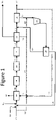
- process feed stream 101 is combined with highpressure steam stream 102 and introduced into hydrogen production unit 103.
- process feed stream may be combined with hydrocarbon stream 104, which may consist of hydrocarbons of C2 and higher.
- Hydrocarbon stream 104 may include, but not be limited to, ethane, propane, butanes, or naphtha. Introduction of these higher hydrocarbons would tend to maximize SCO2c from the syngas and optimize CO2 capture costs and revenues.
- Hydrogen production unit 103 is preferably a steam methane reformer, which may be combined with a waste heat boiler (not shown). Fuel gas stream 105 is also introduced into hydrogen production unit 103, which thus produces raw syngas stream 106 and flue gas stream 107. Raw syngas stream 106 is then introduced into high temperature water gas shift reactor 108, and optionally then into low temperature water gas shift reactor 109, thus producing shifted syngas steam 110. Within high temperature water gas shift reactor 108 and/or low temperature water gas shift reactor 109, carbon monoxide and steam are catalytically converted into carbon dioxide and hydrogen. Shifted syngas stream 110 is then introduced into syngas cooler 111, which produces cooled, shifted syngas stream 112.
- solvent based non-cryogenic separator 113 is an amine unit. This is the most economical location from which to recover CO2. An alternate, but more expensive option being removal of CO2 from the furnace flue gas, which is not considered herein.
- Solvent based non-cryogenic separator 113 produces saturated CO2 stream 122 and shift gas stream 114 that is largely depleted of CO2. Saturated CO2 stream 122 may be captured and utilized for some downstream purpose. As saturated CO2 stream 127 is purposed as to not be emitted to the atmosphere, the SCO2e is reduced by not less than 50% compared to the "base operating mode", but preferably by not less than 60%.
- Solvent based non cryogenic separator 113 may also have a flash step, thereby producing flash gas stream 123.
- Flash gas stream 123 may have a pressure of not more than 200 psig, and preferably not more than 30 psig. Flash gas stream 123 may contain CO2, hydrogen, carbon monoxide, and methane.
- At least a first fraction 124 of flash gas stream 123 may be combined with off-gas stream 117, prior to admission into off-gas stream compressor 118. Combining first fraction 124 with off-gas stream 117 thereby decreases SCO2e by not less than 15% when compared to the prior art. Combining first fraction 124 with off-gas stream 117 thereby increases SCO2c by not less than 20% compared to the prior art.
- a second fraction 125 of flash gas stream 123 may be combined with a segment 128 of hydrogen product stream 116, and/or a portion 129 of process feed stream 101, prior to admission into hydrogen product ion unit 103 as a combined fuel stream.
- Shift gas stream 114 may be combined with hydrogen rich permeate stream 120 (below), and the combined stream is introduced into pressure swing adsorption unit 115.
- Pressure swing adsorption unit 115 produces hydrogen product stream 116 and off-gas stream 117.
- the recycling of hydrogen rich (i.e. CO2 depleted) permeate stream 120 this way provides a steady state operation of the iterative system that yields an overall hydrogen recovery for pressure swing adsorption unit 115 of not less than 98 mol%, and preferably not less than 99 mol%, an increase of not less than 10 base points compared to the "base operating mode" or a new plant designed without the instant invention.
- any CO2 that may have been present in the feed stream to pressure swing adsorption unit 115 in the absence of solvent based non-cryogenic separator 113 is now largely absent from the PSA unit off-gas.
- Off-gas stream 117 is now mostly hydrogen (typically up to 65%). The lack of CO2 in off-gas stream 117 stream allows it to be economically compressed for additional hydrogen recovery.
- Hydrogen product stream 116 may contain less than 90% of the total hydrogen produce by hydrogen production unit 103, high temperature water gas shift reactor 108, and (if present) low temperature water gas shift reactor 109.
- off-gas stream 117 contains at least 10% of the total hydrogen produce by hydrogen production unit 103, high temperature water gas shift reactor 108, and (if present) low temperature water gas shift reactor 109.
- Off-gas stream 117 is then introduced into off-gas stream compressor 118, wherein it is compressed and sent to membrane separation unit 119.
- Off-gas stream compressor 118 may compress off-gas stream 117 to not less than 25 psi less than the pressure of hydrocarbon stream 104.
- Membrane separation unit 119 separates at least 50%, but preferably at least 70%, of the hydrogen in off-gas stream 117 from the other components (CO, CO2 (trace), CH4, N2, H2O).
- the resulting hydrogen rich permeate stream 120 comprises up to 98 mol% H2.
- Membrane separation unit 119 is designed in such a way that hydrogen rich permeate stream 120 is of suitable pressure to be recycled back to the inlet pressure swing adsorption unit 115 in order to further purify up to 99.9 mol% H2, without further compression.
- Membrane separation unit 119 may recover not less than 50 mol% of the hydrogen contained in the off-gas stream 117, and preferably not less than 70 mol%.
- Membrane permeate stream 120 may have not less than 50 mol% hydrogen purity, and preferably not less than 70 mol%.
- Residual hydrogen depleted retentate stream 121 is mostly CO, CH4, and CO2 with some amount of N2 and water. Some unseparated H2 remains in the hydrogen depleted retentate stream 121.
- Hydrogen depleted retentate stream 121 may be combined with process feed stream 101.
- this system may be added to existing plants.
- Existing plants which recover the additional hydrogen can also produce the same amount of hydrogen product as previously, but at a reduced reformer load, decreasing both SFFC and SCO2e depending on the configuration.
- the concept is suitable for existing plants which want to make additional hydrogen (i.e. "H2 boost"), or for new plants where the syngas generation step could be reduced in size and cost due to the increased hydrogen recovery downstream.
- the additional hydrogen recovered may be used as a fuel to decarbonize the fuel system.
- the plant may run at full firing duty, and burn the hydrogen produced above original design. Utilization of this additional hydrogen recovery allows for the same hydrogen production in an existing plant for a decreased firing duty, thereby decreasing SFFC by not less than 2% compared to "base operating mode", preferably by not less than 3%.
- the additional hydrogen recovery may allow for a higher hydrogen production, for the same firing duty, not less than 10% more, preferably by not less than 15% more compared to prior art.
- the additional hydrogen recovery may allow for a smaller and cheaper syngas generation step with a lower firing duty in a new plant, for the same desired hydrogen production, compared to prior art.
- the additional hydrogen recovery may allow for the same hydrogen production in an existing plant at the same firing duty, allowing for some percentage of hydrogen product to be used as a carbon free fuel, thereby decreasing SCO2e by not less than 30% compared to the prior art, and increasing SCO2c by not less than 40% compared to the prior art.
Landscapes
- Chemical & Material Sciences (AREA)
- Organic Chemistry (AREA)
- Engineering & Computer Science (AREA)
- Chemical Kinetics & Catalysis (AREA)
- Combustion & Propulsion (AREA)
- Inorganic Chemistry (AREA)
- Analytical Chemistry (AREA)
- General Chemical & Material Sciences (AREA)
- Oil, Petroleum & Natural Gas (AREA)
- Health & Medical Sciences (AREA)
- General Health & Medical Sciences (AREA)
- Hydrogen, Water And Hydrids (AREA)
Applications Claiming Priority (1)
| Application Number | Priority Date | Filing Date | Title |
|---|---|---|---|
| US17/377,625 US11629051B2 (en) | 2021-07-16 | 2021-07-16 | Method for increasing efficiency and reducing emissions in a steam reforming plant |
Publications (2)
| Publication Number | Publication Date |
|---|---|
| EP4119496A2 true EP4119496A2 (de) | 2023-01-18 |
| EP4119496A3 EP4119496A3 (de) | 2023-01-25 |
Family
ID=82594643
Family Applications (1)
| Application Number | Title | Priority Date | Filing Date |
|---|---|---|---|
| EP22184646.2A Pending EP4119496A3 (de) | 2021-07-16 | 2022-07-13 | Verfahren zur erhöhung der effizienz und verminderung der emissionen in einer dampfreformierungsanlage |
Country Status (2)
| Country | Link |
|---|---|
| US (1) | US11629051B2 (de) |
| EP (1) | EP4119496A3 (de) |
Cited By (2)
| Publication number | Priority date | Publication date | Assignee | Title |
|---|---|---|---|---|
| GB2614780A (en) * | 2021-11-17 | 2023-07-19 | Johnson Matthey Plc | Method for retrofitting a hydrogen production unit |
| GB2631813A (en) * | 2023-07-07 | 2025-01-15 | Technip Energies France | Plant and process for producing hydrogen from hydrocarbons with reduced CO2 emissions |
Family Cites Families (5)
| Publication number | Priority date | Publication date | Assignee | Title |
|---|---|---|---|---|
| US20100037521A1 (en) * | 2008-08-13 | 2010-02-18 | L'Air Liquide Societe Anonyme Pour L'Etude et l'Exploitatation Des Procedes Georges Claude | Novel Steam Reformer Based Hydrogen Plant Scheme for Enhanced Carbon Dioxide Recovery |
| US8057773B2 (en) * | 2009-12-28 | 2011-11-15 | Institute Francais du Pétrole | Reduction of greenhouse gas emission from petroleum refineries |
| WO2013131916A1 (en) * | 2012-03-08 | 2013-09-12 | Shell Internationale Research Maatschappij B.V. | Process for the production of hydrogen |
| EP2682364A1 (de) * | 2012-07-04 | 2014-01-08 | L'air Liquide, Societe Anonyme Pour L'etude Et L'exploitation Des Procedes Georges Claude | Verfahren zur Wiederherstellung von Wasserstoff und Erfassung von Kohlendioxid |
| EP3962856A1 (de) * | 2019-05-02 | 2022-03-09 | Haldor Topsøe A/S | Atr-basiertes wasserstoffverfahren und -anlage |
-
2021
- 2021-07-16 US US17/377,625 patent/US11629051B2/en active Active
-
2022
- 2022-07-13 EP EP22184646.2A patent/EP4119496A3/de active Pending
Cited By (3)
| Publication number | Priority date | Publication date | Assignee | Title |
|---|---|---|---|---|
| GB2614780A (en) * | 2021-11-17 | 2023-07-19 | Johnson Matthey Plc | Method for retrofitting a hydrogen production unit |
| GB2614780B (en) * | 2021-11-17 | 2024-05-22 | Johnson Matthey Plc | Method for retrofitting a hydrogen production unit |
| GB2631813A (en) * | 2023-07-07 | 2025-01-15 | Technip Energies France | Plant and process for producing hydrogen from hydrocarbons with reduced CO2 emissions |
Also Published As
| Publication number | Publication date |
|---|---|
| US11629051B2 (en) | 2023-04-18 |
| US20230020425A1 (en) | 2023-01-19 |
| EP4119496A3 (de) | 2023-01-25 |
Similar Documents
| Publication | Publication Date | Title |
|---|---|---|
| US9481573B2 (en) | Steam reformer based hydrogen plant scheme for enhanced carbon dioxide recovery | |
| US7731923B2 (en) | Method for simultaneously producing hydrogen and carbon monoxide | |
| US5669960A (en) | Hydrogen generation process | |
| EP2196448B1 (de) | Verfahren zur gleichzeitigen Herstellung von Methanol und Ammoniak | |
| AU2018308586B2 (en) | Method for the preparation of ammonia synthesis gas | |
| US8124049B2 (en) | Zero steam export with CO2 recovery in a high thermal efficiency hydrogen plant | |
| WO2022040677A1 (en) | Steam reforming with carbon capture | |
| CN102770372B (zh) | 利用基于氮气对净化气流洗涤改造氨合成设备的方法 | |
| EP4119496A2 (de) | Verfahren zur erhöhung der effizienz und verminderung der emissionen in einer dampfreformierungsanlage | |
| EP4122876A1 (de) | Verfahren zur erhöhung der effizienz und verminderung der emissionen in einer dampfreformierungsanlage | |
| CN101528648A (zh) | 用于gtl装置的轻烃回收方法 | |
| US12109527B2 (en) | Process and apparatus for the separation of two gaseous streams each containing carbon monoxide, hydrogen and at least one acid gas | |
| JP2024530171A (ja) | Co2回収と連携した水素製造方法 | |
| WO2012037245A1 (en) | High pressure cryogenic process and system for producing ammonia products | |
| CN112262106A (zh) | 甲醇生产方法 | |
| JP2005522396A (ja) | 水素および一酸化炭素の混合物を分離するための方法および装置。 | |
| GB2522015A (en) | Hydrogen production processing | |
| GB2237287A (en) | Production of synthesis gas | |
| US20240092638A1 (en) | Oxyfuel combustion in method of recovering a hydrogen-enriched product and co2 in a hydrogen production unit | |
| US20220119254A1 (en) | Method for synthesising a hydrogen-containing compound | |
| US20250162964A1 (en) | Integrated steam cracking and hydrogen production process | |
| US20260062369A1 (en) | Process for producing methanol | |
| KR102748427B1 (ko) | 제철 부생가스를 이용한 고순도 수소가스 제조 방법 | |
| CN120584085A (zh) | 蓝氨的生产方法 | |
| KR20250169582A (ko) | 개선된 co₂분별 공정을 이용하는 수소 생성 공정 |
Legal Events
| Date | Code | Title | Description |
|---|---|---|---|
| PUAI | Public reference made under article 153(3) epc to a published international application that has entered the european phase |
Free format text: ORIGINAL CODE: 0009012 |
|
| STAA | Information on the status of an ep patent application or granted ep patent |
Free format text: STATUS: THE APPLICATION HAS BEEN PUBLISHED |
|
| PUAL | Search report despatched |
Free format text: ORIGINAL CODE: 0009013 |
|
| AK | Designated contracting states |
Kind code of ref document: A2 Designated state(s): AL AT BE BG CH CY CZ DE DK EE ES FI FR GB GR HR HU IE IS IT LI LT LU LV MC MK MT NL NO PL PT RO RS SE SI SK SM TR |
|
| AK | Designated contracting states |
Kind code of ref document: A3 Designated state(s): AL AT BE BG CH CY CZ DE DK EE ES FI FR GB GR HR HU IE IS IT LI LT LU LV MC MK MT NL NO PL PT RO RS SE SI SK SM TR |
|
| RIC1 | Information provided on ipc code assigned before grant |
Ipc: C01B 3/56 20060101ALI20221219BHEP Ipc: C01B 3/52 20060101ALI20221219BHEP Ipc: C01B 3/50 20060101ALI20221219BHEP Ipc: C01B 3/48 20060101ALI20221219BHEP Ipc: C01B 3/38 20060101AFI20221219BHEP |
|
| STAA | Information on the status of an ep patent application or granted ep patent |
Free format text: STATUS: REQUEST FOR EXAMINATION WAS MADE |
|
| 17P | Request for examination filed |
Effective date: 20230725 |
|
| RBV | Designated contracting states (corrected) |
Designated state(s): AL AT BE BG CH CY CZ DE DK EE ES FI FR GB GR HR HU IE IS IT LI LT LU LV MC MK MT NL NO PL PT RO RS SE SI SK SM TR |